Awake!, September 22, 1979
Download: PDF — Awake!, September 22, 1979
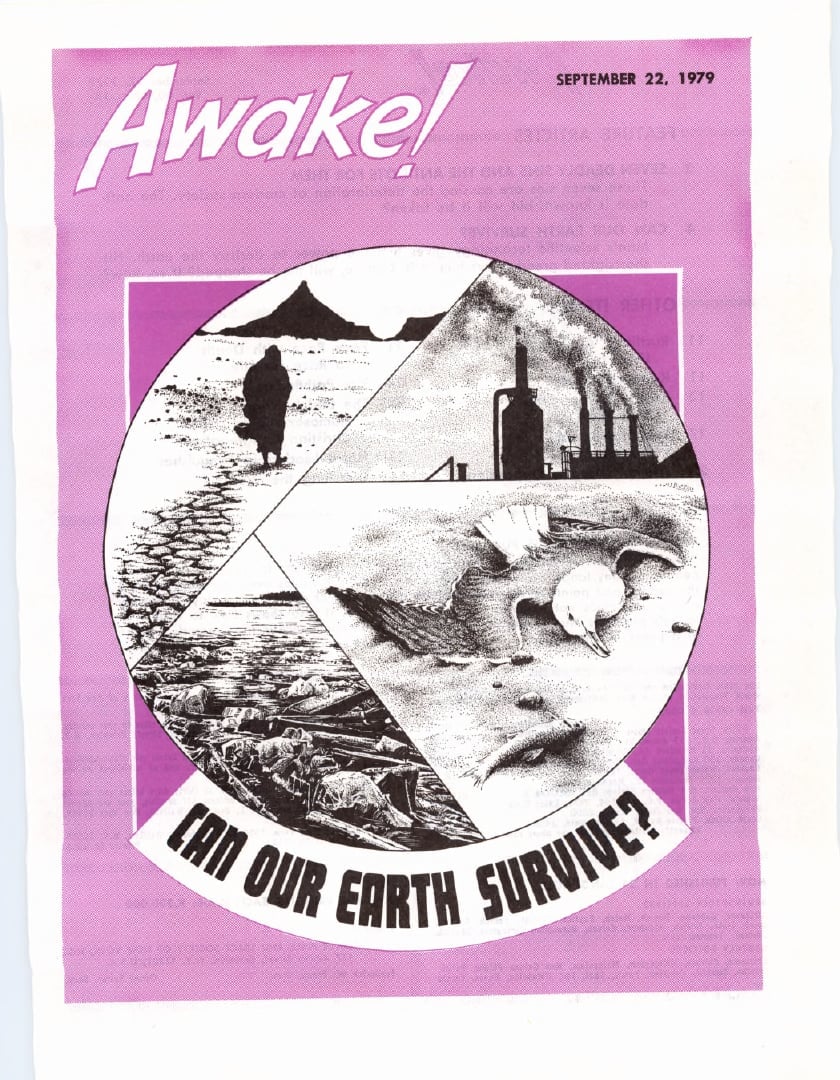
Awake! — September 22, 1979
Source: jw.org
Contents
Page Two
Seven Deadly Sins and the Antidote for Them
Can Our Earth Survive?
Rustling “Ain’t What It Used to Be”
Kangaroo Rats
Escaping from Chad’s Civil War
The Marvels of Microsurgery
Triumph Despite Opposition
From Race with Death to Race for Life
The Pathfinders
Homosexuals and the Christian Congregation
Moral Leadership Languishes
Watching the World
Is There Really a God?
Could All the Animals Have Fitted Into Noah’s Ark?
Page Two
Page Two
3 SEVEN DEADLY SINS AND THE ANTIDOTE FOR THEM
These seven sins are causing the deterioration of modern society. The antidote is known, but will it be taken?
4 CAN OUR EARTH SURVIVE?
Man’s scientific technology gives him the power to destroy the earth. His shortsighted greed drives him to it. Can he, will he, be stopped? If so, how?
Seven Deadly Sins and the Antidote for Them
Seven Deadly Sins and the Antidote for Them
THE chairman of International Harvester, Brooks McCormick, delivered an address in which he listed his version of the seven deadly sins.
Business without morality. “What I find disturbing today is the perception that almost anything justifies profit.” When social responsibility is discussed, it’s lip service or the result of government mandate.
Politics without principle. There was a time when government was the butt of jokes, but it is no laughing matter now. This bureaucratic octopus reaches out to entwine every facet of our existence. To gain its ends it stoops to any means, and the credibility gap between public and politician is wide indeed.
Science without humanity. It has toppled from its pedestal as a public idol. Suddenly its blessings have turned into curses, as its technologies ruin the environment on which our lives depend.
Pleasure without conscience. McCormick comments: “Our society seems inebriated with the ‘new’ freedom from established rules of conduct. In the process, we have obscured the fact that most of the old rules met the test of pragmatism . . . they worked. They help prevent one person from hurting another in the pursuit of pleasure, and from hurting himself.”
Wealth without work. As examples he points out welfare fraud, welfare as a way of life for two or three successive generations in some families. “However, this greed to Get Something for Nothing spreads beyond the welfare levels . . . It permeates the craftsmen and industrial workers whose pride in the job they could do is being replaced with ‘punch in, put in your time, and punch out.’”
Worship without sacrifice. “Worship must involve sacrifice—in the form of financial contribution, church attendance or simply giving more of yourself than you might comfortably choose to allocate to the disciplines of your creed.”
Knowledge without character. McCormick’s discussion of this point blends into the conclusion of his speech, published in Vital Speeches of the Day, May 1979:
“What we do need and will never have enough of is good judgment based on moral standards and only backed up with true character. Which, in my opinion, are the antidotes for my Seven Deadly Sins. This, then, would suggest that defeating the Seven Deadly Sins of modern society and bridging the gap between our social resources and desired social results pivots more than anything else on the individual’s loyalty to his own sense of worth, his own sense of quality in everything he or she does or thinks. That sense of excellence must be strong enough to withstand the swings of fad or fashion, and even the disapproval of one’s peers.”
Christ Jesus is loyal to his own sense of worth, unswayed by the failings of others. “If we are unfaithful, he remains faithful, for he cannot deny himself.”—2 Tim. 2:13.
Can Our Earth Survive?
Can Our Earth Survive?
Is this an idle question? Is it pessimistic? Or is the earth on the brink of destruction? What are the facts?
“WE SAILED through water filled with lumps of oil for 43 out of 57 days. Great whales and many fish which swim with their mouths open, filtering their food, are swallowing this pollution. Some of those fish we shall eat.
“There are people who tell you that . . . the sea can absorb and recycle all this pollution. I call them the Sandmen—they want to put you to sleep with calming words. Don’t listen! Unless you and I—all of us—act now to stop the seas being overloaded with poisonous refuse, they will suffocate and die.”
This is explorer Thor Heyerdahl’s description of his second trip across the Atlantic on a reed boat. To many, it is frightening, and Heyerdahl is not alone in sounding the alarm.
A scientific study published in the Brazilian newspaper O Estado de S. Paulo is not less pointed: “It may be too late to restore what has been destroyed. Of life’s basic components—air, water, land and light—only the latter is not polluted.”
People everywhere complain about the weather. Why are there climatic changes and freak weather world wide?
Climate researcher Dr. Reid A. Bryson calls the overall effect of man’s activities—his smoke, tractor dust, jet exhaust, smog from cities—the “human volcano.” “We are indeed a factor in the climate equation,” he says. “We may be the decisive factor.”
And an article in National Geographic concluded: “A steady buildup of carbon dioxide in the earth’s atmosphere from the burning of fossil fuel—coal and oil—has occurred since the industrial revolution began. Higher levels of this colorless, odorless gas tend to warm up the planet by the so-called greenhouse effect, holding in the infrared radiation—heat—that would otherwise escape into space.”
Other disturbing factors have been in the news lately. For example, the World Meteorological Organization (WMO) reported that pollution of the atmosphere was depleting the earth’s ozone layer, which screens out part of the harmful ultraviolet rays from the sun. Meanwhile, increased ultraviolet radiation has already been linked with increased cancer of the skin, according to Rumen Bojkov, director of WMO’s atmospheric science division.
Moreover, pathologist Leon S. Dochinger of the U.S. Department of Agriculture cites “acid rain” as another potential killer. It is a result of burning fossil fuels with high sulfur content, especially coal. Polluting particles and gases are spread by the wind and return to the earth with the rain in the form of sulfuric and nitric acids. These directly endanger the life of fish, animals and vegetation. Besides, in the soil “acid rain” can liberate poisonous metals. These metals may find their way into rivers and lakes and thus become a health hazard.
A medical survey in São Paulo said that, next to smoking, air pollution there is mainly responsible for diseases of the respiratory organs and their being the second cause of death. Additionally, according to a U.N. report, many cancers “relate to the air people breathe or the water they drink, to the environment in which they work or live, to their personal diet or way of life.”
Without water, there is no human life. But how safe is our drinking water? How safe are the rivers and oceans?
On a recent visit to Brazil, Jacques Cousteau found famous Guanabara Bay in Rio de Janeiro more polluted than the Mediterranean around Venice, Cannes and Genoa. He expressed deep concern over the destructive pollution caused by oil spills, chemical and nuclear wastes.
And what about the rivers? Under the headline “Agony of the Waters,” the Brazilian newsmagazine Veja blamed effluents from sugarcane mills and rum manufacturers, soda from cellulose factories, sewage from growing cities and industries and other refuse for killing the Brazilian rivers. A similar condition obtains in other countries.
What is more, an ever-rising demand for water is putting its availability in doubt. Syrian delegate Saub Kaule told experts at the United Nations conference on water at Mar del Plata, Argentina: “A drop of water will cost more than a drop of oil.”
Why? Comments Time: “Between 30% and 40% of the world’s food production is now dependent on irrigation. . . . Industry is also using ever increasing amounts of water—to generate electricity, to cool nuclear reactors and manufacture chemicals and metals. As a result, many lakes and streams have been so badly polluted by agriculture and industry—as well as by the wastes from increasing numbers of humans—that they have become unusable without expensive treatment. Despite purification measures, the need to take drinking water from contaminated sources has caused widespread disease. The World Health Organization estimates that as much as 80% of the world’s cases of disease are traceable to unclean water.”
That is a chilling revelation. But is it all? Not really.
A group of agronomists met in Brasília and condemned the “indiscriminate and growing use of pesticides, herbicides and fungicides, leading to an ecological plight that will soon put agricultural production itself in jeopardy.” And why the excessive use? Only “to obtain monetary and immediate advantages from the land,” say the specialists.
Another stealthy enemy was revealed at a conference in Nairobi, Africa. It was noted that deserts are spreading in many parts of the earth. Said Time: “Thanks largely to man’s own folly, desertification now threatens the fragile existence of about 630 million people who dwell in these regions.”
No wonder U.N. Secretary-General Kurt Waldheim was prompted to make the ominous observation that “countries could disappear from the face of the map.”
And what may be the causes? Environmentalists assembled in Mexico concluded: “Primitive deforestation, fire, erosion, inadequate agricultural forms and pesticides join the natural causes to accelerate the desertification process.” O Estado de S. Paulo noted that Brazil has “everything to form one of the largest deserts in the world within the next 25 to 30 years if it continues to occupy the Amazon area in a disorganized way.”
As a matter of fact, Brazilian ecologist Jose Lutzenberger told a group of specialists: “The models of development of the present consumer society . . . rest on orgiastic wasting of limited and irreplaceable resources. They mean the destruction of all systems for the maintenance of life on Earth.”
This ecologist added: “We have unbalanced all the large and small water systems, giving rise to destructive droughts and catastrophic floods; through unchecked pollution, we will soon lose the usability of the last water source and precipitate the elimination of all forms of life in the water, including the oceans.”
This is a gloomy picture. But have no efforts been made to stem the tide? Fortunately, they have. Consider some of these.
Scientists and others raise ever louder clamors for drastic measures to be taken in order to preserve the earth. Are their plans yielding positive results? Some are.
Veja magazine interviewed Hideo Oguri, who is in charge of the fight against pollution in Tokyo’s rivers. He said: “Tougher legislation and even the closing down of industries has produced some results. But what is bringing better results is the constant action of hundreds of ecological groups who defend the protection of the environment.”
Luiz Roberto Tommasi of São Paulo University’s Oceanographic Institute, in Brazil, believes that the rivers can be saved if the present polluting factors are eliminated or at least reduced to a level that allows for self-purification. But he also said: “There is no time to lose. . . . In England the authorities began to show concern over the Thames fifty years ago and only now salmon has returned to the river.”
Speaking in Curitiba, Brazil, Jacques Cousteau said that he was going to suggest to the United Nations “a world ocean use policy established by international agreements so as to slow down the destruction of marine life.” But he added that “even the most developed countries lacked any policy aimed at the preservation of marine ecology.”
Similarly, Thor Heyerdahl wrote: “For a start, we should create protected areas, natural reserves where the local ecosystem could reconstruct and maintain itself. As important as this, however, is the formation and enforcement of laws in areas outside the natural reserves where the ecological balance is already affected.”
Obviously, the answer to air pollution does not lie simply in higher chimneys. Take, for example, the presence of dangerous acid in the lakes of Adirondack National Park, in New York State. The fish were dying. Eventually, the source was traced to the metallurgical district in Sudbury, Canada, hundreds of miles away. The winds carried the pollution to New York.
In Scandinavia, where ecological problems are given much attention, the mountain soil was found polluted. “Acid rain” was directly connected with Great Britain’s antipollution drive. Tall factory chimneys thrust polluting agents high into the atmosphere and the winds carried them all the way to Scandinavia.
The Agriculture Department of the United States has been coordinating data from a national network of stations in the U.S. and research stations in Canada, Scandinavia and other European countries. The urgent thought behind it is a world campaign to alert everyone to the problem, as an initial step toward its eventual solution. The problem being world wide, it has to be handled on a global scale.
Praiseworthy efforts are under way. Already, the U.S. and other countries have either prohibited the use of poisonous substances such as DDT, fluorocarbons, and others, or are discouraging their use.
Pakistan introduced a reforestation program to fight soil erosion in that country. Saudi Arabia has planted 10 million acacia, eucalyptus and tamarisk trees to keep the sand dunes near al-Hasa oasis in check. Brazil is planting eucalyptus and pine trees in various areas. Similar efforts to hold off or recover wastelands have been made in Mongolia’s Gobi desert.
But are homogenous tree plantations, that is, forests of only one kind of trees, the answer? Professor Celio Vale of Federal University of Minas Gerais, Brazil, is against substituting natural forests by homogenous plantations. He says that the consequences are, “first, the destruction of the soil through erosion. Then the [destruction of] typical wildlife of the forests, as the animals are unable to survive in a homogenous forest. Finally, drastic changes in the microclimate of the deforested region will occur, as the solar radiation will increase considerably due to lack of environmental protection.”
What conclusions can we draw from our consideration of recommended international legislation and efforts made so far? Efficient or weak, most attempts are still only local. According to Time, the U.N. “warns that these unilateral moves are not enough to remove the threats to man’s well-being and calls for international collaboration ‘on a scale not seen so far in the history of mankind’ to save the environment from irreparable damage.”
However, there are almost insurmountable obstacles to success. Admits Time: “Still, there are many obstacles to overcome. To begin with, traditional life-styles will have to change. . . . Perhaps the greatest obstacle of all is the political question that continues to divide the world’s rich and poor nations.”
Admittedly, then, national and racial pride and prejudices, open hostilities, social injustices, clearly stand in the way to unification. Man’s greed and often ignorance, his shortsightedness and often outright malice, oppose his making headway. Said Jacques Cousteau: “It is true that reducing all values to a common denominator—money—does not work. It is exactly that which has led our civilization to the present-day problems.”
Man himself has created the situation. He has been unable to undo it. Disaster is looming ahead. Where should we turn for a way out? We invite you to consider an interesting answer.
The Bible counsels: “Don’t put your trust in human leaders; no human being can save you. Happy is the man who . . . depends on the LORD his God, the Creator of heaven, earth, and sea, and all that is in them. He always keeps his promises; he judges in favor of the oppressed and gives food to the hungry.”—Ps. 146:3, 5-7, Today’s English Version.
This is really an exciting way of looking at today’s problems and their solution. In fact, is it not reasonable to look to the One who made our earth and mankind for the way out?
Jehovah God is the Creator-Owner of the earth. The multiple provisions for sustaining life on it are amazing. Only a loving Father-Provider would shower such blessings on his children. Plant and animal life, the rivers, lakes and seas add so much to life’s enjoyment. No wonder the first model of what God purposed for earth came to be known as a paradise of Eden, or a “park of delights.”
By showing loving obedience to the Creator’s universal rules of conduct, man would always enjoy the earth’s yield. “If you live according to my laws and obey my commands,” said the Creator to his ancient people, “I will send you rain at the right time, so that the land will produce crops and the trees will bear fruit. Your crops will be so plentiful that you will still be harvesting grain when it is time to pick grapes, and you will still be picking grapes when it is time to plant grain. You will have all that you want to eat, and you can live in safety in your land.”—Lev. 26:3-5, TEV.
“Too good to be true,” you say? But why should it be? Stop and think.
Why should there not be plenty of food and resources? God certainly knows what to do and can accomplish it. Does not every inventor know best how his invention should work? So God’s blessing means right distribution of rains, proper climate. And we must remember that he created a perfect ecosystem in the first place.
Do not scientists admit that man’s thoughtlessness and selfish tampering with this delicate system have brought on catastrophic floods and droughts, pollution, untold misery and death? But how do things work out if man cooperates with earth’s natural systems that God has implanted in it?
In ancient Israel earth’s Designer specified rest periods for the land itself. Israel held the land, God’s property, in trust. (Ps. 24:1; 89:11; 115:16) Knowing the need for the land to be revitalized, Israel’s invisible Ruler made provision. Every seventh year the land had complete rest. There was no cultivating, sowing or pruning, under threat of the death penalty for violators.—Ex. 23:11; Lev. 25:4.
“How did the people live?” you ask. Jehovah’s blessing on the sixth year produced bumper crops that lasted right through the “sabbath year” and to the next crop. (Lev. 25:20-22) Besides, what grew of itself could also be consumed, though not stored. So on the Sabbath year the land lay fallow. Rain, natural growth and humus would act as natural fertilizers. The land had an opportunity to become revitalized.
So serious was the requirement of letting the land get its rest that one reason for Israel’s 70-year captivity in Babylon was the violation of God’s Sabbath laws. King Nebuchadnezzar “took all the survivors to Babylonia. . . . And so what the LORD had foretold through the prophet Jeremiah was fulfilled: ‘The land will lie desolate for seventy years, to make up for the Sabbath rest that has not been observed.’” (2 Chron. 36:20, 21, TEV; also Lev. 26:34, 35, 43) For selfish reasons they had been exhausting the land.
But what happened when the Israelites returned to their homeland after 70 years? Jehovah blessed them and the land became fruitful once again, exactly as the prophet Ezekiel had foretold shortly after the Israelites were removed from their land: “There I will bless them with showers of rain when they need it. The trees will bear fruit, the fields will produce crops, and everyone will live in safety on his own land.”—Ezek. 34:26, 27, TEV.
Years before, Isaiah excitedly declared: “The desert will rejoice, and flowers will bloom in the wastelands. . . . Streams of water will flow through the desert; the burning sand will become a lake, and dry land will be filled with springs.”—Isa. 35:1, 6, 7, TEV.
Did this come about? Indeed it did. The returning Israelites experienced this very thing and were still a thriving nation when the Romans occupied the land hundreds of years later.
But do we have modern evidence of the existence of a self-recuperation system in the earth?
An astonishing example of land recuperation has been achieved in modern Israel. Said one report: “The Israelis have restored some of the water-collection systems left by the ancient Nabataeans in the Negev desert, and are using the runoff to nourish flourishing orchards of almond and pistachio trees. Other tactics that make the Negev bloom: drip irrigation systems, which feed small amounts of water directly to the roots of plants with the help of computer monitors; greenhouses for vegetables and flowers in which even the circulation of water is solar-powered; raising protein-rich algae in brackish ponds for animal feed.”
That’s a remarkable revival of once-desolate land. Similar revivals have taken place in other areas, such as in China’s deserts. But what about land destroyed by war action? Can the earth cope with such a heavy load?
During World War II, the harbor of Truk Island became a vast underwater cemetery of Japanese warships. “Studying this sunken fleet more than a quarter of a century later,” says National Geographic, “biologist Sylvia A. Earle and photographer Al Giddings find a unique display of nature’s power to heal.”
Said a local scuba diver who remembers the battle: “For more than two years afterward, oil from ships and planes covered the beaches and reefs. But the sea is healed now.”
Who did the healing? No human hand was necessary. The “healing system” built into the earth and seas by their Creator did it, in just over 30 years. The superabundance of corals, plants and animals covering the sunken wrecks is a wonderful testimony to the Creator’s wisdom and power.
Is this the only example of earth’s own healing capacity? Consider what has happened on the Eniwetok Atoll in the Pacific Ocean. The United States chose that site as a testing ground for nuclear devices. In 1977 the islanders began to return to their former homes. What did they find after 20 years without bombs?
Writes one marine biologist: “Today fish and corals thrive in the [atomic] craters, which attests to the capacity of nature to recover from nearly any kind of disturbance.” The scientists are astonished at the amazing resilience of the land.
This is exciting news! It is evident that the earth contains a remarkable built-in system for recovery. Would the Creator let man ruin his handiwork? Obviously not. Wrote the prophet Isaiah: “Thus says the LORD, the creator of the heavens, who is God, the designer and maker of the earth who established it, not creating it to be a waste, but designing it to be lived in.”—Isa. 45:18, New American Bible.
Of course, it will need a global change of affairs. That will mean the end of the present system with its injustices, ignorance and imperfection. But how will this be brought about?
The simple answer is contained in the Bible book of Revelation: “The kingdom of the world did become the kingdom of our Lord and of his Christ, and he will rule as king forever and ever. . . . your own wrath came, and the appointed time . . . to bring to ruin those ruining the earth.”—Rev. 11:15, 18.
Yes, by means of God’s heavenly Kingdom government under Christ Jesus, a grand transformation will take place soon. God has proved to be a Liberator and Restorer of the land in the past. Examples in our own lifetime prove that he built into the earth a remarkable recuperation system. So we can be confident that the earth will survive. God will accomplish his purpose to make the earth a paradise, a delightful home for man.
[Blurb on page 4]
“Depleting the earth’s ozone layer . . . increased ultraviolet radiation”
[Blurb on page 5]
“‘Acid rain’ . . . another potential killer”
[Blurb on page 5]
“A drop of water will cost more than a drop of oil”
[Blurb on page 6]
“80% of the world’s cases of disease are traceable to unclean water”
[Blurb on page 6]
“Deserts are spreading . . . ‘thanks largely to man’s own folly’”
[Blurb on page 7]
“The problem being world wide, it has to be handled on a global scale”
[Blurb on page 7]
“The land will produce crops and the trees will bear fruit”
[Blurb on page 9]
“Every seventh year the land had complete rest”
[Blurb on page 9]
“The desert will rejoice, and flowers will bloom”
[Blurb on page 10]
Time . . . to bring to ruin those ruining the earth
Rustling “Ain’t What It Used to Be”
Rustling “Ain’t What It Used to Be”
THEY used to come on horseback, carrying rifles and six-guns, and stealing cattle. Now they come in pickup trucks, armed with shovels, and they rustle cactuses. Rustlers in the old wild West were hanged when caught, but the modern breed of rustler draws a lighter sentence, though the damage he does is more serious. The motive is the same—money.
The thieves ride across the deserts of the American Southwest and dig up cactus plants until their pickups or vans are full, then peddle these to nurseries and homeowners for landscaping. The only winners, if they aren’t caught, are the cactus rustlers. Even if they are caught, the price for one plant can pay the fine. The buyer loses. The plant he buys may die in a few months. The desert loses the plants that hold its precious soil in place. The wildlife living there suffers and dies out as the habitats are destroyed. The public loses the beauty of the deserts as vacationlands. Future generations are denied the pleasure of the hundreds of varieties of plants, animals and birds that are slowly disappearing.
The saguaros, one type of cactus that rustlers love to steal, can bring as much as $1,000 (U.S.). But without the saguaros it is estimated that half of all species of birds in Arizona’s Sonora Desert could not survive. Buyers as far away as New York, Europe and Japan pay as much as $40 (U.S.) a foot and more for certain types of cactus. The transplanted cactus may look healthy for months, but removed from its natural habitat it does not survive many years.
Cactus grows slowly. Some take 100 years to reach full size, but in a few minutes it is dug up. Plants are being removed from the desert faster than they can be replenished. Add to this the recreation vehicles and motorcycles that roar across these lands tearing up the plants and thin soil, and the deserts themselves are put in jeopardy.
Arizona has had laws since 1929 protecting over 200 types of desert plants. However, with only a five-person task force to combat the cactus rustlers in the entire state, the depredations continue. In 1977 California passed plant protection laws for the deserts, but it is of little value since the state has only one ranger to patrol 5,000,000 acres of the Mojave Desert. The penalties are considered stiff—fines ranging from $100 to $1,000 (U.S.) and jail sentences of up to one year. But very few rustlers are caught, and cactus rustling continues to be big business.
For strong reasons, environmentalists and concerned citizens worry about the future of the desert and its plants and wildlife.
Kangaroo Rats
Kangaroo Rats
CALIFORNIA’S Morro Bay kangaroo rats are on the list of endangered species. They thrive in desert areas, sleeping through the hot days in their deep, cool burrows, and foraging at night. They cram their cheek pouches full of seeds and store them in underground chambers. These sun-dried seeds supply all the water they need—their digestive systems break down the fats and carbohydrates and oxidize them to form H2O (water). They can live without drinking, and usually do. Their kidneys reclaim water that most other animals lose. These little squirrel-like rodents (they’re not rats at all) have long hind legs that shoot them along the ground at 17 feet (5 m) a second, and send them soaring into the air nine times their length. But these fascinating little creations of God are dying out in Morro Bay. Man’s “progress” is destroying their habitat.
Escaping from Chad’s Civil War
Escaping from Chad’s Civil War
By “Awake!” correspondent in Ivory Coast
WE ARRIVED in N’Djamena during the first days of August 1978. We had left our native land, France, to help in Chad with the vital work of preaching the good news of God’s kingdom. We realized that there were difficult conditions in the country. This did not discourage us, however, and we were anxious to get started in our missionary work. In the missionary home were three married couples and one single brother.
Our first contact with the population as we shared in Christian service was unforgettable. At just about every door we could fully develop a Scriptural subject of conversation and felt that the people were famished for Bible truth. We were very thankful to Jehovah for the privilege of being there to help.
The month of September 1978 brought to light the political duel between the professed Christian chief of state, President Malloum, and his Moslem prime minister, Hissein Habré. Starting in August 1978, the chief of state did little more than protest verbally, then rumors started flying. But we were not involved in politics, so Anna and I continued to talk to people about God’s solution to mankind’s problems.
It seemed that the armed forces of FROLINAT (National Liberation Front supported by Libya to the north) had gone on the offensive during September 1978. In town we saw many wounded soldiers, no doubt returned from the front. But even then, most people were not taking this news seriously. After all, since 1966 the fire of war had been burning in Chad; most of the population was indifferent to the news and rumors.
At night we regularly heard bursts of machine-gun and rifle fire, which seemed to indicate violence in the city. In the morning, around the table we would talk about what we had heard to be sure that we weren’t mistaken.
December 1978 saw a national assembly of Jehovah’s Witnesses take place successfully here, although we had been apprehensive, due to the political climate.
In the month of January, the tension was such that we had to diminish our door-to-door activity somewhat in the Moslem quarters, where we had several times met up with problems. We pursued our activities more prudently, trying to get back to the missionary home as quickly as possible at nightfall.
At the vegetable market on January 27, the crisis came to a dangerous level with serious incidents. Submachine-gun fire and grenades were heard; there were several dead and injured. Schools were closed for a time. On 40th Street, where the missionary home is situated, we saw dozens of young Moslems shouting and brandishing arms. On the advice of several with whom we studied the Bible, we stayed at home waiting for calm to return.
It was at this time that we received a telegram from the Watch Tower Society’s branch office in Nigeria inviting us to go to Lagos if it became necessary. Since the situation was getting worse, we took the initiative by filling out applications for visas to Nigeria. However, when things stabilized somewhat, we suspended these steps while waiting to see how things would work out. In spite of all these difficulties, we desired to pursue our activities in this land. In the preaching work we quickly forgot the local problems.
Sunday, February 11, was also a memorable day; that day, in Farcha, about 5 km (3 mi.) from downtown, almost all the local brothers, as well as all the missionaries, met in the morning at Brother Sarki’s house to listen to a Bible talk, after which we all went on a campaign of house-to-house preaching. Farcha sheltered the French troops to the number of over 2,500, as well as some units of the regular Chad army. Many publications were placed that Sunday. By the end of the morning, happiness was visible on the faces of the Kingdom proclaimers, in spite of the atmosphere of civil war.
N’Djamena, February 12: Anna and I rose as usual at about 5:45 a.m. We had breakfast with the family. Max and Pauline were on missionary cook duty that day. As for us, we left at about 7:30 a.m. to conduct a Bible study. On our motorbike we passed in front of the presidency. By the time we got in front of Chad National Radio we perceived that something was about to happen. There were armed men in firing position. The whole quarter was filled with armed and helmeted soldiers belonging to the FAN (Armed Forces of the North) commanded by Hissein Habré.
Then we went toward the large mosque along General de Gaulle Avenue. Along both sides of this street there were now men in combat uniform, in firing position. They belonged to the FAT (Tchad Armed Forces) under the direction of President Malloum.
We realized how serious the situation was. Cars were all over, headed for the most part toward the Farcha quarter. As for us, we wanted to get back home. We had to go through the gendarmerie quarter. People were running in all directions. We were about 100 m (325 ft.) from the home of our friend Seraphin, with whom we studied the Bible, when a grenade exploded, and this was followed by automatic-weapons fire. Our hearts beating at a hundred miles an hour, we prayed aloud to Jehovah for his guidance and help in making right decisions.
We decided to take refuge at the home of the employer of Seraphin—a French teacher married to an American. People were fleeing in our direction from the northeast quarter. We were received kindly and invited into the house. The man said that he had just returned from the university and that it was in flames. It was terrible!
A few minutes later another teacher arrived straight from Felix Eboue high school. He was especially frantic because of what he had seen. Chad National Radio was partially destroyed; violent confrontations between the FAN and the FAT were taking place at the high school. Already many students had been killed. He had just had enough time to escape the site and seek refuge in this zone where many foreign teachers and advisers lived.
Then there was a sudden calm and quiet. It was time to try to get back home. We had at least 3 km (2 mi.) to go. I put on full throttle in order to go more quickly. People were still fleeing in all directions. Finally we arrived at the missionary home. Max and Pauline were there; we could do nothing but wait, trusting in Jehovah, who had already helped us.
By now aircraft were flying over the city. At about 12:15 p.m. they started firing heavily on the Kabalai quarter. The whole city echoed the bursts of automatic-weapons fire, explosions, as well as heavy mortar fire. It was war, the feared confrontation.
We started packing our bags in case evacuation became necessary. We listened carefully to all news bulletins on the radio (France International, Voice of America, Radio Canada International). We were living tense hours, not knowing how things would work out. During the afternoon helicopters flew over our part of town firing on it, but happily our home was untouched.
At bedtime we arranged a shelter under the bed as protection against stray shells. There under our beds we could hear the whistling of bullets, some ricocheting off our metal shutters!
On Tuesday, February 13, the fighting continued just as fiercely. We were really wondering about our situation but were confident in Jehovah. Anna and I realized that even if the worst happened we still had the wonderful resurrection hope. We felt within us a helping force in those critical moments.
By Wednesday morning, February 14, the fighting seemed to have stopped, except for isolated firing. We were watching the street from our windows. Plenty of armed men were on the street corners. The radio said that casualties were heavy. We decided to make a better shelter by using literature cartons. Since Olaf and Barbara were in the “bush” visiting the congregations, we moved into their room, which was less exposed than ours at the front of the house.
We got ourselves ready for a third night of fighting. This was to be the most terrifying; the violence of combat was noticeably more severe than during the preceding nights. There, under our makeshift shelters, flat on our stomachs, squeezed against each other, we could hear the rat-tat-tat of automatic weapons and the explosion of heavy mortar bombs. At any moment a shell could demolish the house. About 50 m (160 ft.) from the house the northern camp had set up a rocket launcher on the roof terrace of an apartment building. Each time a rocket was fired there was a deafening noise. Once we thought that we had had it—one of the rockets misfired and fell near the house with a shattering explosion. The falling debris of the rocket and dirt echoed on our tin roof. Real fireworks! At about 7 a.m. the fighting stopped again.
In the street there were still the comings and goings of those fleeing the combat zones. Many had a few belongings rolled up in a straw mat on their heads.
That day Anna and I read the Bible and made supplication to Jehovah to guide us in our decisions concerning the future. We went to bed, and the night was relatively calm in comparison to the preceding nights. The opposing forces had signed a cease-fire.
Before long everyone made his decision. Max and Pauline, as well as Patrice, would go by car to the south by way of Bongor, 250 km (155 mi.) away, to Cameroon and then Nigeria. As for Anna and myself, we would try to reach the airport. Actually, being as we were in the middle of a civil war, no way out seemed likely or possible.
That Friday night was spent largely in prayer as we needed Jehovah’s direction. Sleep wouldn’t come. We were wondering what the next day would bring. Anna and I got up very early, made two white flags, got the motorbike ready, and then listened to the complete African news bulletin. The cease-fire seemed to be holding. It was the best time to try to reach the French military base. With sad hearts we left our three companions at about 7:45 a.m. Later, they would head in the direction of Chagoua bridge.
When we went out, few people were on the streets. We drove in first gear in order to avoid giving the impression that we were fleeing. Arriving on the main street, we had to decide which way we would go. Soldiers were on the corners ready to fire. We asked some Moslems which would be the safest way to reach the airport. They indicated the shortest route. Seeing that the way was deserted, we took the risk. Oh, how we prayed to Jehovah during that unforgettable trip!
The results of the war were there before our eyes—houses deserted, munition cases here and there. We greeted the people we met en route in order to relax the atmosphere. Approaching street corners, I slowed down as much as possible as there were hidden snipers. But our white flags could be seen from afar. This quarter had really suffered. There was no noise; all seemed dead. As we passed the gendarmerie, dozens of soldiers (under the command of Colonel Wadal Abdelkader Kamougue) aimed their guns at us. We made a friendly gesture. They didn’t reply, but they let us continue.
Now we were in front of the prison, with soldiers on both sides, but no one slowed our flight. It was as if they didn’t see us. Next, we took the avenue that led straight to the airport. All the woods around the airport were burned. Charred bodies were scattered about, and houses blown open by bombs had a sinister appearance.
On arriving at the airport we were directed to the welcoming service. We explained that we had come from the Moslem quarter in the northeast part of the city. The military authorities said that it was a miracle that we had been able to get by the gendarmerie. They told us that others had tried to reach the base but in vain. Some Europeans who had attempted this means of escape had been slain.
That afternoon, about 800 corpses were buried in a common grave. Hundreds of bodies were still visible in various quarters of town: Kabalai Moursal, Saaba Ngali, Bobolo, St. Martin’s Basin, by the National Radio Station, downtown. These corpses had swollen to double their normal size, and hungry dogs were starting to eat them. The smell of death hovered over the city.
The number of dead in the capital was now estimated in the thousands. A member of the Health Service told us that the hospital, which also had been shelled, was overflowing. We saw wheelbarrows carrying bodies of those terribly mutilated by knife wounds. Several embassies had been destroyed and the U.N. building burned.
The authorities commended us for the initiative taken, as they had been aware of our situation, but had been unable to intervene to evacuate us. Since all our papers were in order, the French authorities gave us a meal and put us on the next flight out on an airforce plane. After a wait of several hours on the runway, our plane took off for Libreville, Gabon, at 6:30 p.m. We were sad to have to leave N’Djamena under such circumstances. We were sure that it would be a long time before we could come back to this country locked in civil war.
The plane landed in Libreville at about 10:00 p.m. All the French national evacuees were looked after by the French embassy. We were lodged in the Okoume Palace Hotel.
Since the Society had suggested that we go to Nigeria, Monday morning we went to their embassy to get a visa. The consular officer absolutely refused us a visa since we were French and evacuees from Chad. He wanted nothing to do with us. Even a 24-hour visa was refused. What should we do? We had very little money on us.
From there we could, of course, very easily accept evacuation to Paris, but we desired to remain in missionary service in Africa if at all possible. With Jehovah’s help we decided to try to go to Abidjan in Ivory Coast. With the help of the Air Afrique passenger agent, who was supervising the repatriation of Air Afrique personnel and their families evacuated from N’Djamena, we were able to get two tickets, Libreville-Abidjan-Dakar. They even kindly gave us a reduction as missionaries—this in a country where the work of Jehovah’s Witnesses is under ban. There were only two places left on flight RK 103. We were overjoyed to be able to stay in Africa.
Thus, on Tuesday, February 20, we arrived in Abidjan at about 3:45 p.m. and went through customs at the airport without any problem. How happy we were to be here, appreciative of Jehovah’s protection! After some searching we finally found our Christian brothers. We’ll never forget the welcome and the love extended to us by our fellow missionaries. All the brothers we have met in Abidjan have shown themselves to be full of goodness toward us.
Here in Ivory Coast we are continuing to sanctify Jehovah’s name and are enjoying the preaching work in a residential quarter of the city very much. What a privilege it is to tell others about Jehovah’s purpose to bring true peace and security to all who love righteousness! (Mic. 4:2-4; Ps. 46:8, 9)—Contributed.
[Blurb on page 13]
“At night we regularly heard bursts of machine-gun and rifle fire”
[Blurb on page 14]
“Under our beds we could hear the whistling of bullets, some ricocheting off our metal shutters”
[Blurb on page 15]
“Dozens of soldiers . . . aimed their guns at us”
[Blurb on page 16]
“Corpses had swollen to double their normal size, and hungry dogs were starting to eat them”
[Map on page 12]
(For fully formatted text, see publication)
CHAD
N’Djamena
The Marvels of Microsurgery
The Marvels of Microsurgery
By “Awake!” correspondent in Australia
A YOUNG mother, working in her home, suddenly heard an anguished scream. Rushing outside, she was horrified to find that her three-year-old son had just used an ax to chop off two of his younger sister’s fingers. A plumber, using a circular saw, accidentally amputated his middle finger and partially severed two others. A two-year-old boy fell off the back of his father’s farm grass cutter, and his foot got caught in the blades and was cut off at the ankle. A boilermaker amputated his right forearm about halfway between wrist and elbow when he crashed through a plate-glass window.
If these accidents had occurred about 10 years ago, all that could have been done would have been to provide medical attention to the wound. The amputated portion would have been discarded. Today, however, if you or any of your family are faced with situations such as these, the prospects for replacement and complete healing of the severed part would be excellent—if you can gain access to the marvels of microsurgery.
As the name suggests, microsurgery is performed under a microscope, enabling specially trained surgeons to join together arteries, veins and nerves, some smaller than one millimeter (1/25 of an inch) in diameter. Not only are body parts rejoined, but blood flow and feeling can be restored to amputated fingers and limbs.
Interestingly, the technique is not new. Early beginnings took place in Sweden in 1921 with ear, nose and throat surgery, and then with eye surgery in the 1940’s. Then in 1965, in Japan, an amputated thumb was replaced successfully, while in the next year in China, the first index-finger replacement was accomplished. In 1968 in Sydney, Australia, the world’s first successful finger replacement was performed on a child. Now, in many parts of the world, successful reattachment of amputated portions of the body (called replantation) is becoming a rather commonplace procedure.
Microsurgery’s Many Uses
While replantation is the most dramatic and usually the most publicized use of microsurgery, its uses are by no means limited to that one field. Many other major surgical procedures now make use of the marvels of microsurgery to accomplish results that would have been considered impossible a little over a decade ago.
For example, recent operations have involved the transference of flaps of skin, along with accompanying arteries, veins, nerves and even bone, from areas such as the groin, chest or top of the foot, to another part of the body that has been injured. Valuable contributions have also been made to the field of major surgery that necessitates the removal of large portions of tissue, such as with throat cancer where the formation of a new esophagus is needed. The vessels and nerves in the transferred portion are connected by microsurgery to those in the new location, while the donor area is similarly closed, or skin may be grafted to close the wound. Because just the one individual is involved, rejection problems are minimized.
Another major use of microsurgery that is rapidly expanding in scope is the reversal of sterilization operations for persons whose circumstances in life have changed. Although vessels as small as one third of a millimeter (0.0130 inch) are joined in reversing male vasectomies, one study showed a 90-percent restoration, with early pregnancy of the spouse in half of the case histories. Women’s Fallopian tubes have been rejoined with such good results that a recent newspaper headline claimed: “For sterilized mothers there’s an 80 p.c. chance of children . . . the 2nd time around.”
Research is being done to open more fields as well. Fetal surgery—operating on a baby while it is still in the womb—and the use of microlaser beam in surgery are just two of these.
Equipment and Technique
With microsurgery, the operating theater looks just the same as for general surgery—the gowned and masked surgical team, the operating table, the anesthetic trolley—along with one very obvious addition. Above the operating theater there is a large instrument that resembles a double-sided combination of binoculars and a movie camera. By using this, instead of directly viewing the patient, the microsurgeon (and usually his assistant as well) gains an enlarged stereoscopic view of the tiny vessels and other body parts that must be joined together.
The needles used resemble a baby’s eyelash and are difficult to see with the naked eye. The nylon thread, 0.018 millimeter (1/1400 of an inch) in diameter, a quarter the thickness of a human hair, is bonded to the needle so there is no need to thread it. The surgeons also use ultra-fine jewelers’ forceps, small vascular clamps, fine scissors and a special needle holder.
Individual knots must be used, as continuous stitching would prevent the necessary movement of a vessel with pulse. As many as 14 knots could be placed in a vessel about one millimeter (1/25 of an inch) in diameter. If you are familiar with hand sewing of cloth materials or leather, you can imagine how painstaking and time consuming it would be to tie such intricate microscopic knots. The technique was recently described as “probably one of the most difficult tasks in the world. The slightest tremor of the hand spells disaster.”
The Microsurgeon at Work
Watching the surgeons working at their task, one is impressed by the patience, concentration and coordination necessary to accomplish the desired result. Slow, gentle hand movements are required, so most microsurgeons avoid drinking coffee or alcohol before operating as these can produce tremors in the hands, imperceptible to the naked eye, but which appear like shaking when seen under the microscope.
Because of the techniques and special skills that are unique to this field, expert tutoring and years of training, practice and experiment are necessary. Australia is considered the world leader in microsurgery at the present time, which is fortunate, as statistics suggest that Australians tend to suffer more accidental amputations per person than any other industrialized Western nation.
Let us now ‘focus in’ on an operation to restore the completely severed palm of a hand to see what actually takes place during microsurgery. Skin, muscles, tendons, nerves, veins and arteries must all be reunited in a complex of microscopic knots.
Four arteries and four veins are rejoined to provide adequate circulation. Being thin walled, veins collapse and shrink and consequently can be very difficult to locate. Once located, it is essential for them to be cleaned out, trimmed and joined. If a length of vessel has been damaged, a bridging section from elsewhere in the body may be needed. By joining veins first and then arteries, blood loss can be lessened.
About 10 nerves to fingers are repaired, each nerve having five or six fiber bundles. Nine tendons and eight small muscles are also joined together. Finally, stitching is required for all skin structures. All together, about 180 microscopic stitches and 100 conventional ones have been inserted.
This particular operation lasted for about six hours. Depending on the objective, operations may vary in length from two to 20 hours. The replacement of just one finger takes four to six hours.
Emergency!—What to Do
Suddenly it happens! You, your loved one or your workmate accidentally amputates a finger, hand or leg. Do not panic! Place the severed part in a clean plastic bag (or rubber glove) and seal well so water cannot leak in. The part should then be kept cool—at about four to six degrees Celsius (39 to 43 degrees Fahrenheit). So place the bag in cold water containing lumps of ice and get it to the nearest hospital or microsurgical unit as quickly as possible. If a delay is involved, the part could be stored in a refrigerator, but not in a freezer. Do not pack the part in ice or immerse it in antiseptic solutions or disinfectants, as these destroy tissue and may make rejoining impossible. Do not even wash it, as it is important to keep the amputated part dry.
It is obviously a good idea to know the location of the nearest microsurgical unit. The Lancet, October 2, 1976, notes: “Regrettably, amputated digits are still being discarded by casualty officers when they should be cooled and dispatched with the patient to the nearest microsurgeon.”
The time periods for successful replantation vary for different members of the body. Amputated fingers have survived after 10 hours without effective cooling and over 30 hours when properly cooled. Experimenters replanted a dog’s leg after separation and refrigeration for 48 hours.
Limitations and Benefits
Success in reattachment is dependent on many factors. With a sharp guillotine-like amputation of a finger, there is close to a 100-percent chance of successful replantation. The prospects are reduced if tearing, crushing or other serious damage to tissue or bone has occurred. The microsurgeon may decide not to attempt the operation if the amputated part is too damaged. The patient’s condition is another possible limiting factor, as the person must be well enough to endure a long operation.
A recent survey in Australia showed a 70-percent success rate in replanted fingers and 80 percent in replanted arms. Another report showed that movement of replanted fingers was generally 80 percent of normal except for limitations of stretching of some joints. Exercise and physiotherapy generally are needed after the operation to restore function to the formerly amputated part. However, reattachment of amputated parts above the mid-forearm has so far produced disappointing results.
When a thumb has been amputated, great effort is made to restore it, as the thumb provides 40 percent of the efficiency of the hand. If the severed portion cannot be reattached, microsurgeons have been able to transfer the patient’s large toe. After the toe’s tendons, nerves, vessels and bones have been joined, the patient has feeling that is almost as good as it was in his original thumb.
“It’s funny how much like a thumb a big toe can look when it’s actually transferred,” one doctor commented. “It’s a fatter thumb than before, but that can be surgically improved.” To many people the thought of losing a big toe may not be too appealing, but, then again, a big toe is not needed for eating or writing or performing the myriad of tasks a thumb has to do each day.
After a short period of adjustment and training, a person can once again walk, run and share in sporting activities. A professional football player is one of a growing number of Australians who have big toes for “thumbs.”
Happy Endings
People from all walks of life have derived benefit from the marvels of microsurgery. Take, for examples, the persons mentioned earlier. These are typical of hundreds of cases.
The little girl, now about a year older, has both fingers restored and her injured hand can scarcely be distinguished from the other. For the plumber, all fingers survived, but he does have some problems during cold weather. The two-year-old boy, now eight, runs, jumps and plays football normally. With regard to the boilermaker, his forearm was joined so well that he has taken up karate and can break roof tiles with his formerly cut-off arm.
Yes, microsurgery is a marvelous technique, able to accomplish a great deal of good for those in need. Even more wonderful, however, is the amazing healing capacity of the body. Surgeons may sew various body parts together, but inbuilt regeneration testifies to the greater wisdom of the One who designed our bodies. Appreciating this makes us echo the sentiments of the psalmist who said respectfully to our Grand Creator: “I shall laud you because in a fear-inspiring way I am wonderfully made.”—Ps. 139:14.
Triumph Despite Opposition
Triumph Despite Opposition
● Early in the sixteenth century, Bible scholar William Tyndale translated much of the Bible from Hebrew and Greek into the English language of his time. However, there was great clerical opposition to his translation. Hence, copies of Tyndale’s rendition of the Christian Greek Scriptures (the first ever printed in English) had to be brought into England from continental Europe in barrels, cases, bales of cloth, sacks of flour and the like. The clergy burned thousands of copies at St. Paul’s Cross in London as “a burnt-offering most pleasing to Almighty God.”
● As it is, the printing press was too much for the opposers. The Bible triumphed in its fight to live.
From Race with Death to Race for Life
From Race with Death to Race for Life
WHAT a sight! Beautifully painted, multicolored cars with chrome plating glistening under the lights. Motors revving to the limit, 20,000 screaming fans and the smell of racing fuel in the air. Small speed cars driven at breakneck speeds, often just inches apart.
These are my first recollections of speedway racing. I was just a small child that night when my father took me to the floodlit Sydney Showgrounds, but the impression made there stayed with me for decades and deeply affected my life. I too was to enter the same race with death that I was observing that night.
Cars Mean More than Marriage
I was born into a middle-class family in 1940. My father was a builder and a well-respected man in the community. As with the majority of fathers in that era, discipline and respect were foremost in daily life. And as with the majority of sons, by the time I was a teen-ager, I felt that I knew more than my parents did. I began dating, against their advice, before I was 16 years of age. This led to a situation that resulted in marriage at 18 years of age. We thought we knew everything.
It did not take long to realize how unprepared for marriage I really was, and soon I became completely bored with the situation. The responsibility that comes with marriage became a real burden to me, and, after viewing other married people around me, I decided to do just what they did with their responsibilities—ignore them.
I bought a car and began spending all my time and money on it. At that time I did not drink or smoke, and adultery was a dirty word. I would just spend my evenings down at the gas station, where I could talk to the mechanic about cars and motors. My wife began to complain and, when she got no satisfaction, she began to nag. I settled down for a while, built a home and gave my children a little attention, but soon became bored again.
Love at First Sight
So back to the gas station I went. But this time, when I walked in, sitting there in the middle of the floor was a midget speed car. It was love at first sight. When could I see it run? Sunday, I was told, at the Westmead Speedway, outside of Sydney. And, yes, there was a vacancy in the pit crew.
Suddenly the responsibility of marriage, the worries, the boredom, all seemed to disappear and the memories of those nights at the Sydney Showgrounds, sitting on my father’s shoulders, began flooding back. The race meet that Sunday was magic to me and I became a permanent member of the crew. But, before long, that was not enough. I knew I had to drive.
My chance came a few weeks later in what we call a mechanics race. I came in third, frightened the life out of the owner of the car, and hit the fence only once. It was an exhilarating experience. The acceleration was fantastic. The noise and the danger kept my adrenaline pumping for hours. I relived that race for weeks. The comment that I looked like ‘a drunk cat on ice skates’ did not deter me at all.
But an occasional drive was not enough, either. So, some time later, I became the proud owner of my own speed car. We rebuilt the car and won many races. By this time, I had taken on the tobacco habit, and adultery was the accepted thing. Married life had been left far behind, although I still lived with my wife.
A Race with Death
Violent death was a constant worry to me, as winning involved taking a lot of chances. Cars were equipped with safety belts and roll bars. Crash helmets were inspected before each race meet, as were the cars. Drivers were not allowed to drink alcohol for 24 hours before a race meeting, yet the death toll was still very high.
I would constantly wonder what happened to my friends who were killed. Did they go to heaven, as was said at their funerals?
In 1964, two things happened that changed my life. I met a girl who was quite different from the girls I had formed associations with previously, and we became inseparable. About the same time, I received an offer to drive a brand-new car. This meant joining a new club in Australia. I would be driving against the best cars and the best drivers in the world.
My life centered around my driving. We would race both Saturday night and Sunday afternoon, sometimes wrecking and rebuilding the car in between the two meets. This kind of life soon took its toll on my nervous system. I was smoking and drinking heavily, and immorality was now a way of life.
…