Awake!, September 8, 1979
Download: PDF — Awake!, September 8, 1979
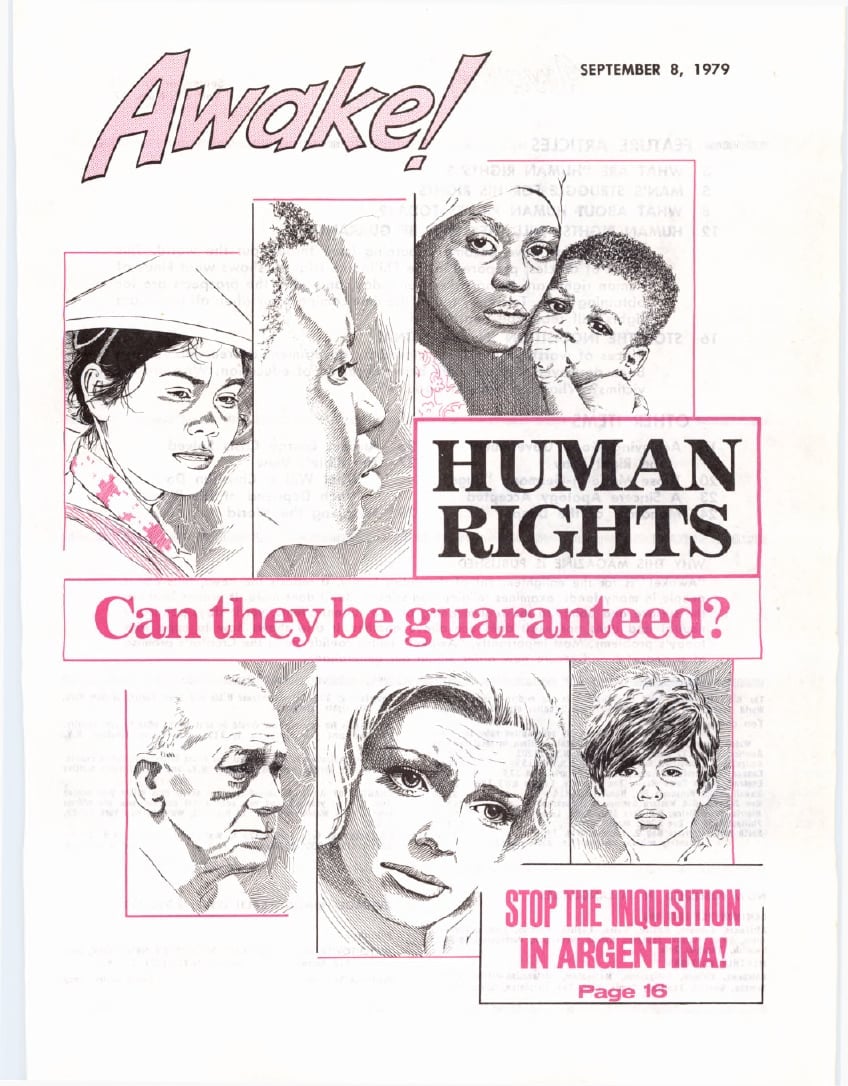
Awake! — September 8, 1979
Source: jw.org
Contents
Page Two
What Are “Human Rights”?
Man’s Struggle for His Rights
What About Human Rights Today?
Human Rights: Will They Ever Be Guaranteed?
Achieving Good Government the Right Way
Stop the Inquisition in Argentina!
Those Made-in-Germany “Bugs”
A Sincere Apology Accepted
Monarchs of the Deep
Ancient Energy Crisis Solved
What Will a Christian Do When Deprived of His Rights?
Watching the World
‘Hearing Aids’ for Parents
God Does Not Torment Souls
Page Two
Page Two
3 WHAT ARE “HUMAN RIGHTS”?
5 MAN’S STRUGGLE FOR HIS RIGHTS
8 WHAT ABOUT HUMAN RIGHTS TODAY?
12 HUMAN RIGHTS: WILL THEY EVER BE GUARANTEED?
Human rights have become a burning issue throughout the world. This series of articles, prepared in the Philippine Islands, shows what kinds of human rights are being asked for today, and what the prospects are for obtaining them. Too, they tell of the time coming soon when all legitimate rights will really be guaranteed.
16 STOP THE INQUISITION IN ARGENTINA!
Places of worship have been closed by government decree. Bibles have been destroyed. Children are being deprived of education. Who are the victims? What can you do about it?
What Are “Human Rights”?
What Are “Human Rights”?
“THROUGHOUT the world today, in free nations and in totalitarian countries as well, there is a preoccupation with the subject of human freedom, human rights.” So claimed Patricia Dering, an official in the Bureau of Human Rights and Humanitarian Affairs in the United States government.
Certainly, human rights receive a lot of publicity today. A recent conference of lawyers from 140 nations proclaimed: “Respect for human rights is a vital security, and central to the realization of man’s ultimate mission: the creation of a world of peace with justice and equality for all.” Hence, these lawyers appealed to world leaders to “respect the dignity of man . . . putting an end to any deprivations and violations of the fundamental human rights of the nation that has been entrusted to their care.”
While the theme of human rights is being discussed on such a high international level, individuals and groups within nations are also campaigning for what they feel are their human rights. So we read of old people claiming the “right to work,” others fighting for “equal rights for women,” anti-abortionists campaigning for the “right to life” of unborn fetuses. We even hear of terminally sick persons claiming the “human right to die,” and homosexuals demanding “gay rights.”
Perhaps in the flood of publicity about so-called rights, you have found yourself wondering: “Just what are these ‘human rights’? Why are they called ‘human’ rights? Who decides what is a ‘human right’ and what is not? Will human rights ever really be guaranteed?”
What Are Human Rights?
Human rights are defined in the Encyclopædia Britannica as “rights thought to belong to the individual under natural law as a consequence of his being human.” In other words, every one of us has a right to expect certain standards and freedoms for no other reason than that we were born human.
Why people should possess these rights has often been argued. Some feel it is just because of tradition. Others maintain it is a part of “nature,” part of the “humanness” of man. At least one philosopher held that human, or natural, rights are a consequence of God’s commands. For example, God commands man not to murder his neighbor. Hence, all men have a human right to expect not to be murdered.
One of the most comprehensive descriptions of what are viewed as human rights is found in the Universal Declaration of Human Rights, adopted by the United Nations in 1948. After mentioning that all men have the right to life, liberty and security of person, it goes on to specify such things as freedom from slavery, torture and degrading punishment; equality before the law; protection from interference with a person’s privacy; freedom of thought, conscience and religion; and the right to a standard of living adequate for the health and well-being of a man and his family. These are only some of the rights proclaimed in that document.
Human Rights and Government
As we read through the list, certain problems come to mind that show that human rights are not a simple subject. For example, most people would be unable to enjoy these rights unless they were guaranteed by a higher authority, such as a central government with adequate power.
In history, whenever there has been no strong, benevolent central government, the weak have usually been oppressed by the strong, and the situation has been as the Dutch philosopher Spinoza once said: “Everyone has as much right as he has might.” A strong, benevolent government can produce the peaceful, law-abiding environment where all can have a reasonable opportunity to enjoy some of the rights described in the Universal Declaration.
Reportedly, more than 70 countries today have documents outlining the human rights of their citizens. But does this mean that in most places today that kind of government exists? One government official remarked recently: “Bills of rights, declarations of human rights, constitutions and statutes are more often than not aspirational statements rather than descriptions of observable reality.” In other words, very often these documents merely state the hoped-for ideal of politicians, while what actually happens in their country is quite different.
Human Rights and the Community
Another point to remember is that a person cannot be so interested in his own rights that he overlooks the rights of others. For example, the Universal Declaration proclaims freedom of opinion and expression. But what happens when a man uses this right to slander another man? He then is encroaching on the rights of his neighbor.
Again, there used to be a religious practice in India known as suttee. In this, a widow would be burned alive on the funeral pyre of her dead husband. Due to existing marriage customs, sometimes the widow might have been a 10-year-old girl! Now, banning this practice was an interference with religious freedom; but potential widows were doubtless very happy when it was no longer allowed. This demonstrates the balance that has to be maintained in observing the rights of different groups. Here again, an authority, or government, is needed to decide what that balance should be.
Finally, human rights can be affected by social conditions. Jose Leviste, a Filipino politician, made this comment: “The Universal Declaration accords about as much emphasis [to the right to have adequate food as it does to] the right that nobody shall tamper with your mail. The fact is that most of the people who have problems over mail do not have problems over food, while the millions . . . who go to bed hungry every night probably have nobody tampering with their mail if they get any. This merely emphasizes that not all human rights are immediately relevant to all people all the time.”
Hence, the question of human rights is complicated. Yet people do feel that they have certain rights, and, as standards of living increase, they are demanding more and more rights. Many feel as does Dr. Keith D. Suter, chairman of a United Nations Human Rights Committee in Australia, who said: “The need to protect human rights is an idea whose time has come. It will not go away.”
Is this the case? Will human rights ever really be guaranteed under this system of things? It would be instructive to look back briefly in history and examine the human-rights record of mankind over the centuries.
Man’s Struggle for His Rights
Man’s Struggle for His Rights
IN THE year 73 B.C.E., a Thracian slave named Spartacus escaped from the school where he was being trained as a gladiator. He hid on Mount Vesuvius and was joined by other escaped slaves until he had an army. Defeating two Roman forces in succession, he overran most of southern Italy and fought his way right up to the Alps. By then his army numbered about 90,000. When the other slaves refused to leave Italy, he had to return south, intending to cross back into Sicily. Finally, he was killed in battle by a new Roman commander, M. Licinius Crassus.
This, in short, is the history of one man’s struggle for what today would be called a human right, the right to liberty or freedom from slavery. Similar scenes have been witnessed many times during the history of mankind.
Failures to Guarantee Human Rights
The term “human rights” is seemingly quite modern. They used to be called “natural rights.” But, whatever the name, it seems that man has always felt the need to protect certain of his rights and freedoms. Hammurabi’s law code, Solon’s legal reforms in Greece and the “unchangeable laws” of the Medes and the Persians were all designed to protect rights and give a measure of security to members of different nations.
Nevertheless, the laws did not always accomplish their purpose. Sometimes there would arise a tyrant like Nero who would disregard the laws. In the days of Mordecai, the wicked man Haman used the very laws themselves to try to cause the destruction of the Jewish minority in the Persian Empire. Some very rich and powerful people were above the control of the laws.
Besides that, history is full of examples of groups that were not really protected by the laws. Spartacus’ revolt highlighted the plight of slaves in the Roman Empire, many of whom were forced to fight to the death in the arenas, or were literally worked to death in the mines and the galleys. In ancient Athens, the position of women was unenviable. Viewed generally as little more than child-bearing slaves, they are described as “secluded in their homes, had no education and few rights, and were considered by their husbands no better than chattel.”
The cruelty of the Assyrians and the mass deportations by the Babylonians remind us of another class whose rights never received much attention: those on the losing side of history’s numerous wars. The poor, too, have always suffered, and in more modern times, cultural, linguistic and, particularly, racial and religious minorities have seen severe deprivation of their rights.
Selfishness and Human Rights
Hence, throughout history, human law systems have failed to guarantee equal human rights for all. This has led to struggles, revolutions and uprisings as people have fought for greater freedom.
Through all these struggles, one human trait has stood out: selfishness, or self-centeredness. This has worked strongly against all mankind’s enjoying human rights, and demonstrates what the German philosopher Hegel once maintained: that freedom is possible only in a community where people have certain moral standards.
An example of what happens when self-centeredness prevails was seen during the so-called “Peasants’ Revolt” in England. In 1381, a large crowd of peasants under the leadership of Wat Tyler marched on London and demanded to see the king. They had been through the trauma of the Black Death, and now were objecting to the heavy taxation and forced labor to which the barons—the landowners of those days—were subjecting them. They numbered perhaps 100,000. The king was willing to meet them and accede to their demands, but the barons were unwilling to give up some of their rights. Wat Tyler was killed, and not one of the peasants’ demands was met.
This self-centeredness was seen in another way. It often happened that whenever a certain group fought for and finally obtained certain rights, they afterward had little regard for the rights of others.
In 1789, for example, the citizens of France violently threw off the rule of an oppressive aristocracy, and produced the famous Declaration of the Rights of Man and of the Citizen. In this they listed the rights that should be enjoyed by Frenchmen, highlighting “liberty, property, security and resistance to oppression.” Yet, not many years later, the French nation under Napoleon was engaged in wars of conquest, adversely affecting the ‘liberty, property and security’ of most of the nations of Europe.
Reportedly, the first major formulation of rights in a political document was the English Bill of Rights, in 1689. Yet later, when the British Empire was being built in different parts of the world, little regard was paid to the rights of many of the conquered peoples, such as the aboriginal inhabitants of Australia and Tasmania.
Similarly, the Declaration of Independence in the United States highlighted the rights of Americans to “life, liberty and the pursuit of happiness.” Yet how much thought was given to the “life, liberty and the pursuit of happiness” of the millions of Negroes who were uprooted from their homes in Africa and sold as slaves on the American plantations? And when the expansion of the American nation collided with the rights of the various Indian tribes encountered, whose rights were often disregarded?
Christendom and Human Rights
Finally, the historical record of Christendom’s churches in the field of human rights has not been a good one. Christendom’s attitude toward the spread of human rights is shown in two interesting historical occurrences.
In 1215, the restive English barons forced the bankrupt King John to sign the Magna Carta. This has been called a predecessor of modern human rights documents. While the freedoms it granted were quite limited, it is viewed as a landmark in that it brought the king under the rule of law.
The reaction of Pope Innocent III to this document is on record. He said: “We utterly reject and condemn this settlement, and under threat of excommunication order that the king not dare to observe it nor the barons require it to be observed. The charter, we hereby declare to be a nullity, void of all validity forever.”
Of course, the Magna Carta did not just fade away. It was reissued several times, was even used by the Catholic Church when its rights were threatened, and became a force in the political growth of England and America.
In 1524, in Germany, there occurred what is called the “Peasants’ War.” Similar to the Peasants’ Revolt in England, the lowly peasants were protesting against the ever-increasing taxes and services demanded by the princes of Germany. Martin Luther advised the peasants to lay down their arms. When they refused, he is reported as counseling the princes to strike them down and stab them “like mad dogs.” The princes followed his counsel.
Many, many times the stand of Christendom against what are today called “human rights” became violent. Protestant Cromwell’s massacre of the Irish Catholics, and the slaughter of the French Protestant Huguenots by the Catholics of that nation are just two examples of the vicious intolerance manifested within the nations of Christendom toward the rights of others. Further examples are her bloodthirsty crusades and inquisitions; the careers of the Spanish conquistadores who, with the blessing of their spiritual leaders, engaged in acts of murder and pillage in many parts of the world; and not to be forgotten are the women, estimated to have numbered 100,000, who were burned at the stake during the Middle Ages on the charge of witchcraft.
Yes, throughout history, the human rights record of mankind has been poor. The forces that should have worked toward man’s betterment, like the laws of the land or even the laws of Christendom, have been either inadequate or positively harmful to mankind. There have been many classes that were deprived of their rights, and the selfish tendencies of men have hindered these classes from finding relief from oppression. Too often it has happened as the book of Ecclesiastes in the Bible stated long ago: “Man has dominated man to his injury.”—Eccl. 8:9.
What does this mean for us today? Have things changed? Is there more hope now than in the past that human rights will be guaranteed? What do the facts show?
[Blurb on page 7]
It often happened that whenever a certain group obtained certain rights, they afterward had little regard for the rights of others.
What About Human Rights Today?
What About Human Rights Today?
“There is a worldwide growing abuse of human rights, with violations of international standards so widespread that we are facing a human rights crisis.”
So said Donald M. Frazer, a member of the United States House of Representatives.
Some, on reading those words, may be surprised. They may feel that much progress has been made in publicizing and observing human rights in the modern world. Which view is correct?
Progress in Modern Times
This generation has witnessed a lot of international activity on behalf of the rights of different groups—certainly more so than previous generations. The United Nations has tried to establish an international standard by producing, in 1948, the Universal Declaration of Human Rights. This was followed by two covenants: the International Covenant on Economic, Social and Cultural Rights, and the International Covenant on Civil and Political Rights.
The Universal Declaration was merely a statement of goals, and, hence, was signed by most of the then members of the United Nations. The two covenants, however, were designed to make these goals into international law, binding on the signers. The nations were much more hesitant about signing these.
Besides this, the United Nations has discussed such questions as genocide, refugees, political rights of women, the rights of children and world health.
In addition to the United Nations, other international organizations—such as Amnesty International—work to encourage the observance of human rights around the world. The European Commission on Human Rights has been established to handle allegations of violations. The International Labor Organization has worked to abolish such things as forced labor and to prevent unemployment.
Many national governments have passed laws protecting the rights and living standards of working people. Even the leaders of Christendom are speaking out in favor of human rights. And, most recently, the United States has made human rights a major part of her foreign policy, hoping to use her economic and political strength to encourage other lands to preserve the rights of their citizens.
Problems Still Remaining
Does all this activity mean that human rights will be guaranteed in our time, or in this existing world system of things? Unfortunately, we still hear of violations in many lands, even as Representative Frazer indicated. In 1976, the then United States Secretary of State was quoted as saying: “No country, no people, for that matter no political system, can claim a perfect record in the field of human rights.”
On the occasion of the 30th anniversary of the Universal Declaration of Human Rights, Pope John Paul II was quoted as saying: “The world in which we live today offers too many examples of injustice and oppression.” A comment from Amnesty International was quoted in the Canberra Times: “Human Rights are violated in most countries under all kinds of political regimes and ideologies.” Why should this be?
One problem is that some violations are out of the control of the national governments. No government wants to see its citizens’ rights violated by criminals, yet, in most lands today, the “security of person” of many has been violated due to the rising tide of crime.
Another problem very difficult to solve is world hunger. Millions of people live at a starvation level, and, hence, enjoy very few rights. As one person expressed it: “How could the people enjoy their right to live fully and well if there is poverty and hunger?”
Prominent in the news in recent months have been the so-called “boat people” or refugees from Vietnam. Most will agree that, according to Article 14 of the Universal Declaration, these have a right to “seek and enjoy in other countries asylum from persecution.” However, their appearance at the shores of some lands has caused much consternation. Seemingly they threaten the economy of these countries, and there are reports of their being driven off, sometimes with tragic results.
Conflicts of interests, or rights, are another problem. Here is how Philippine educator Ruben Santos Cuyugen explained it: “Protecting the cultural rights of a minority may run counter to the development needs of the larger community or of the region. Similarly, protecting the property rights of the advantaged group could be suppressive of the rights of the disadvantaged or deprived groups.”
What does he mean? Well, imagine a country where most of the wealth is in the hands of the privileged few, while the large majority exist in poverty. To try to raise the living standards of the majority, and, hence, protect their rights, the government may try to redistribute the country’s wealth. Yet in doing this they may find themselves violating the equally valid rights of the wealthy minority.
Finally, there is the question of interpretation. Certain Western countries often point to the rights that are enjoyed by their citizens, yet they have been accused of human-rights violations by some Eastern nations. As Fidel Castro maintained recently, according to the New York Times, the so-called freedom of the West was no more than the bourgeois right to exploit man and to preserve the class system.
On the other hand, some noncommunist countries draw attention to many alleged rights violations in Communist lands, such as the reports of slave-labor camps, and the widely publicized plight of dissidents. Yet, according to the French newspaper La Croix, “the Soviet Union . . . has chosen to make a big celebration of this anniversary (of the Universal Declaration of Human Rights) by extolling . . . the exceptional rights enjoyed by its citizens.”
It may seem as if they are talking about different things, and perhaps they are. As Dr. Edward Norman, dean of Peterhouse in England’s Cambridge University, said recently: “Western democracies urge these sorts of moral objections (about human rights) in their critiques of authoritarian regimes . . . Socialist states respond with exactly the same rhetoric of human rights in their rejection of Western liberalism. There is a shared vocabulary of human rights, but the content varies according to ideology or class.”
Torture and Genocide
Perhaps worse than the above social problems and ideological differences are the many cases where the governments have a policy of oppressing their own peoples. Two years ago, Amnesty International was quoted in Time magazine as saying that in the previous decade, torture had been officially practiced in 60 lands. In 1975 alone, there were 40 countries accused of torturing their own citizens. In addition, several countries are accused of holding political prisoners.
After the last world war, the world was horrified to hear of the slaughter of six million Jews, as well as millions of others, in Europe. Many said, “It must never happen again!” Yet even now, we read reports of large-scale massacres in different parts of the world. The government of one small African country is accused of causing the deaths of one sixth of its population. In one tropical island, it is claimed that 100,000 died in a recent invasion. In an Asian country, some reports tell of more than a million being murdered for political reasons.
Perhaps, when you read these reports, you have asked: ‘Why doesn’t somebody do something? Why can’t someone go in, check whether these things are true, and stop them?’ The answer lies in what British jurist Lord Wilberforce called the “insoluble dilemma in matters of human rights—one principle being that human rights since the Universal Declaration are of international concern—the other being that how a State treats its own subjects is a matter of exclusively domestic concern.”
Professor W. J. Stankiewics, of the University of British Columbia, explained it at greater length: “Apparently, even if a country feels that human rights are being violated in another state, international law does not allow it to proceed against the violator either alone or jointly with other states. Indeed, an act designed to stop a violation of human rights would be an act of aggression according to international law. Human rights exist and are recognized, but their defense is hardly possible.”
What Is Needed to Guarantee Human Rights?
In view of this, it is hard to see how, under the present system of things, human rights could ever be fully guaranteed. Is there any way, then, that these rights can be assured? In examining the past and present history of man’s struggle for his rights, it seems that at least two things are needed.
First, there needs to be a truly moral community, one where each will not only enjoy his own rights, but unselfishly respect the rights of his neighbors. Second, there has to be an authority with sufficient wisdom to be able to decide justly how to balance the rights of different groups, and to solve the conflicting ideologies of human rights. This authority needs also to have sufficient power to solve social problems like crime and poverty, which lead to people’s being deprived of their rights. It would also need to be supranational, that is, have authority over nations, so that no earthly power would be able to massacre, torture, imprison unjustly or otherwise oppress its citizens.
Needless to say, no such community and no such authority exists under the world’s present system of things. Does this mean, then, that hoping for human rights to be guaranteed is just impractical idealism? No. There is a sure hope that human rights will be realized world wide—and that in the near future. Consider the facts presented in the next article.
[Blurb on page 9]
“No country, no people, for that matter no political system, can claim a perfect record in the field of human rights.”
[Blurb on page 10]
“How could the people enjoy their right to live fully and well if there is poverty and hunger?”
[Blurb on page 11]
First, there needs to be a truly moral community . . .
[Blurb on page 11]
Second, there has to be an authority with sufficient wisdom to be able to decide justly how to balance the rights of different groups.
Human Rights: Will They Ever Be Guaranteed?
Human Rights: Will They Ever Be Guaranteed?
CONSIDER for a moment the following commands:
“You must not murder.”
“You must not steal.”
“You must not testify falsely as a witness against your fellowman.”
“One judicial decision should hold good for you. The alien resident should prove to be the same as the native.”
This was part of a law code written nearly 3,500 years ago and that governed the life of a nation for over 1,500 years. The author of that code certainly understood about human rights. These commands remind us of some of the principles of the Universal Declaration of Human Rights, such as Article 3, which states that everyone has a right to “life, liberty and security of person,” or Article 7, which states that all are “equal before the law.” When that ancient law code was observed, it went a long way toward guaranteeing the “life, liberty and security” of the people who lived in those days.—Ex. 20:13, 15, 16; Lev. 24:22.
The above quotations were taken from the law given to the nation of Israel in the time of Moses. Of course, there were other nations then that had law codes too. But one thing made this code very different from any other then existing. Apart from its superior moral tone and provisions, this law did not come from a human source. Moses showed that it had a superhuman source when he said to the Israelites: “You will listen to the voice of Jehovah your God so as to keep his commandments and his statutes written in this book of the law.”—Deut. 30:10.
This shows us that there is a power higher than man who is interested in what today are called “human rights.” That power is none other than man’s Creator, Jehovah God. He has promised that soon all of man’s rights will be observed, to the best interests of everybody.
The Creator’s Record in Human Rights
The record of God’s dealings with mankind is contained in the Bible. There, the modern term “human rights” does not actually appear. Nevertheless, what are thought of today as “human rights” are quite often mentioned in the Scriptures.
At the very start of the human race, Jehovah God blessed man with an abundance of “life, liberty and security.” He created the first pair, Adam and Eve, perfect. This meant that they did not need to die at all—surely a measure of life that no modern government can give.
They had liberty in the sense that they had free will, and also, the whole earth was their domain. One of the privileges God offered them was to “be fruitful and become many and fill the earth and subdue it.”
They had security also, including economic security. There was no threat at all to their welfare. Even the animals were at peace with them, since the human pair were given dominion over “the fish of the sea and the flying creatures of the heavens and every living creature that is moving upon the earth.”—Gen. 1:28.
God himself was the authority who would guarantee these blessings. But Adam and Eve had to accept that authority. If they went to some other authority, then these blessings would no longer be guaranteed. Jehovah mentioned just one limitation to the first pair’s freedom. He said: “From every tree of the garden you may eat to satisfaction. But as for the tree of the knowledge of good and bad you must not eat from it, for in the day you eat from it you will positively die.”—Gen. 2:16, 17.
Some may object that God was here limiting Adam’s liberty. But human rights, or freedom, can never be absolute. Just as Adam’s continued life depended on his eating, drinking and sleeping, so it also depended on his obedience to the only authority who could guarantee his happiness.
Mankind Deprived of God’s Blessing
Adam and Eve did not remain in this blessed situation. An unseen spirit creature, who came to be known as Satan, placed a temptation before Eve. It was then that selfish thinking, which has been such a prominent feature of human history, was first seen.
Eve, in response to false reasoning by Satan, “saw that the tree [of knowledge of good and bad] was good for food and that it was something to be longed for to the eyes, yes, the tree was desirable to look upon. So she began taking of its fruit and eating it.” (Gen. 3:6) Hence, Eve, and later Adam, rejected the only authority who was able to guarantee their happiness. They followed the alluring suggestions of one who did not have their best interests at heart.
The result, as Jesus Christ later showed, was catastrophic. Talking about Satan, he said: “That one was a manslayer when he began.” (John 8:44) Yes, Adam and Eve died because of their sin. But Satan had caused their death just as surely as if he had murdered them. He caused them to lose the life with which they had been blessed. Jesus also said: “Every doer of sin is a slave of sin.” (John 8:34) Hence, they lost their liberty too. They were now slaves to sin, and under an authority, Satan, who would oppress them. Finally, their security was also lost. Their eldest son, Cain, killed his brother, Abel, and the future history of their children was one of increasing insecurity.
Really, what we see happening today is merely the long-term result of what Adam and Eve did. Man still has not returned to the rulership of the only One who can guarantee his happiness and bless him with what are known as “human rights.” Until he does, he will never enjoy those rights.
Human Rights Will Be Guaranteed
Is there any prospect of better things in the near future? Yes, there is, because the Creator has a deep and continuing interest in the human race. Jehovah God has put a limit on the length of time that men will be allowed to rule the earth. He has appointed a king who will rule mankind. That king will restore all the rights, or blessings, that man once had.
This change in rulership was referred to in the Bible at Isaiah 32:1: “Look! A king will reign for righteousness itself; and as respects princes, they will rule as princes for justice itself.” The king is Jesus Christ, and the princes whom he appoints will, in God’s appointed time, ensure that justice and righteousness will exist in all the earth.
This authority, according to the Bible, will very shortly replace the multitudinous forms of government that exist today, and bring in a new era in which things will be done in God’s way. Christians have prayed for this for centuries when they said: “Our Father in the heavens, let your name be sanctified. Let your kingdom come. Let your will take place.” When that prayer is answered, human rights will be observed on this earth as never before.—Matt. 6:9, 10.
The “right to life” will be enjoyed in a way hardly imaginable now. Jesus said: “God loved the world so much that he gave his only-begotten Son, in order that everyone exercising faith in him might not be destroyed but have everlasting life.” (John 3:16) Even the most ardent human-rights activist could not guarantee everlasting life. But God will, and the quality of this life is further shown at Revelation 21:4: “He will wipe out every tear from their eyes, and death will be no more, neither will mourning nor outcry nor pain be anymore. The former things have passed away.”
No more will nations be allowed to torture, massacre or oppress their subjects. This divine authority will be powerful enough to prevent all abuses, and bring tranquillity to mankind. “He will certainly render judgment among many peoples, and set matters straight respecting mighty nations far away. And they will have to beat their swords into plowshares and their spears into pruning shears. They will not lift up sword, nation against nation, neither will they learn war anymore. And they will actually sit, each one under his vine and under his fig tree, and there will be no one making them tremble; for the very mouth of Jehovah of armies has spoken it.”—Mic. 4:3, 4.
What About Religion?
You may ask: ‘But what about freedom of religion? And how will there be a moral community where each will respect his neighbor’s rights?’ Actually, these two points are related.
There will be freedom of religion, in the sense that all will have the freedom to worship the one true God without interference. But Christ Jesus will not permit all forms of religion. Consider this for a moment: At one time in India, certain devotees of the goddess Kali, called thugs, used to strangle people as a sacrifice to their mistress. They sincerely believed this was what she demanded. Was it wrong to interfere with their freedom of worship and ban that practice? Of course not.
But that was not the only objectionable religious practice in history! Should religionists be allowed to infringe on the rights of others by torturing them in inquisitions, or killing them in wars or crusades? Or even by teaching them lies? No. The fact is, true religion is as necessary as eating and breathing; but false religion is as harmful to man as eating poison and breathing lethal gases. Hence, man must have both the knowledge of what God himself shows to be true religion and the freedom to practice it.
This is exactly what will happen. God’s Son, Jesus Christ, will ensure that all will be aided to learn and to practice true worship. This will have the effect of producing a truly moral community where human rights can really exist. As the Bible promises: “They will not do any harm or cause any ruin in all my holy mountain; because the earth will certainly be filled with the knowledge of Jehovah as the waters are covering the very sea.”—Isa. 11:9.
Does this prospect seem realistic to you? Or do you feel it is more realistic to rely on the rulers of this system of things to guarantee your “human rights”? Why not contact the publishers of this magazine and find out more about the way Christ Jesus will finally guarantee our “human rights” and how you can show, even now, that you desire to be part of the community that will enjoy those blessings?
[Blurb on page 14]
Jehovah God has put a limit on the length of time that men will be allowed to rule the earth.
[Picture on page 13]
At the start of the human race, mankind had total security. Even the animals were at peace with them.
Achieving Good Government the Right Way
Achieving Good Government the Right Way
“OUR weapons were rubber cudgels, lead-lined clubs to destroy cars, chains and also guns,” relates a former political party worker in Italy. This young man worked for his political ideals in the late 1960’s by violence and “city warfare.” He says that “one of the main objectives of city warfare was to work mischief and then make the blame fall on the opposing political faction.”
But something happened to change this man’s thinking on politics. A young man visited his home and began a study of the Bible with him, which he says “taught me above all, that God ‘has made out of one man every nation of men.’” (Acts 17:26) This formerly violent political agent says that such Bible principles “freed me of the hate I had within me for other men, just because they had a political idea different from mine.” He continues:
“On this point I keep asking myself: How can man ever resolve his problems with politics, when politics itself has created the first problem—the division of humankind? For mankind to get together, the reasons for division must first disappear. With Jehovah’s Witnesses I have understood that this is possible. I have seen blacks and whites getting baptized in the same water; former Protestants and former Catholics, in Ireland, stop hating each other; Arabs and Jews unite together in the same meeting, during the Six Days’ War. And I myself have learned to love those that I had been taught to hate. Nobody can say that the kingdom that Jehovah’s Witnesses long for—God’s kingdom—is utopian, since there already exists an international community united under this kingdom.”
Stop the Inquisition in Argentina!
Stop the Inquisition in Argentina!
WHAT does the term “Inquisition” call to your mind? For many people, it reminds them of a time centuries ago when people were unjustly denied their right to practice freedom of worship. It also calls to mind the persecution, even torture and murder that went with the Inquisition.
Today, in the eighth decade of this “enlightened” 20th century, we would view such inquisitions as belonging to a “dark ages” mentality. We would like to believe that mankind has advanced well beyond these practices.
But that is not the case. Right now, in the country of Argentina, a type of Inquisition is being carried on. It is directed against a people whose peaceful, law-abiding and God-fearing way of life is well known throughout the world.
This modern Inquisition began with the issuing of Presidential Decree Number 1867, on August 31, 1976. The decree banned all the activities of Jehovah’s Witnesses throughout the country. And despite all the appeals, all the court cases, and even a favorable Argentine Supreme Court decision, the Inquisition continues.
One Result of the Ban
One direct result of this ban was the expelling of children from school. As the Buenos Aires Herald reported recently: “Approximately 1,000 children of parents who are Jehovah’s Witnesses have been expelled from school throughout the country for refusing to show reverence to the national symbols.”
A typical example of this took place on December 15, 1978. At school number 35 in Bahía Blanca, a province of Buenos Aires, school inspector Mrs. Teresa E. Inchauste de Stechi decreed that Susana and Gladys Simón were to be expelled from all schools, public and private. She stated: “They are subject to the sanction of expulsion from the establishment, and as pupils of any other educational service, as well as being banned from being given exams as independent students.”
Why? As this school official said, because of “the attitude of the children who refuse to revere the patriotic symbols, the national heroes and to commemorate corresponding dates, to sing the national anthem and patriotic marches.”
Of course, those familiar with Jehovah’s Witnesses know that the highest courts in democratic lands have firmly established the right of schoolchildren not to engage in activities that violate their Bible-based conscience. Thus, in these lands they are not required to offer gestures to symbols when they view those gestures as part of a religious ceremony contrary to their beliefs.
Ignoring the Court
Ironically, the expulsion of schoolchildren for their religious beliefs is also contrary to the constitution of Argentina. So when, in violation of the law of the land, children were expelled, Jehovah’s Witnesses took the matter to the Supreme Court of Argentina.
The high court heard the case and ruled against the expulsion of schoolchildren because of religious beliefs. The Court agreed that this was unconstitutional.
The Supreme Court’s decision should have solved the problem immediately. Further expulsions should have been avoided. Students expelled in the past should have been reinstated. Even the public press felt that this would be the case. For instance, a front-page headline in the Buenos Aires Herald of March 9, 1979, declared: “SCHOOLS ORDERED TO TAKE BACK WITNESSES’ CHILDREN.” Another publication, Somos, carried this title to an article on the matter: “THE RIGHT TO LEARN.”
But did the Supreme Court’s decision have the desired effect? No, it did not. Incredibly, in May 1979, less than two months after the Supreme Court’s ruling, two Witness girls were expelled from the Cura Brochero School in Barrio Residencial América, Córdoba. These two, Alejandra D. Brentan and Veronica L. Barrionuevo, were thrown out of school for not “revering” the national symbols.
Yet those same symbols were called “images” in the Supreme Court’s ruling. And since Jehovah’s Witnesses also regard these emblems as images, they do not want to perform what they regard as an act of reverence, or worship, toward them. They believe what the Bible says, for example, at Exodus 20:4, 5: “You must not make for yourself a carved image or a form like anything that is in the heavens above or that is on the earth underneath or that is in the waters under the earth. You must not bow down to them nor be induced to serve them, because I Jehovah your God am a God exacting exclusive devotion.” Jesus himself refused to participate in doing “an act of worship” that was against his religious convictions.—Matt. 4:8-10; see also Daniel chapter 3.
It is hypocritical for school officials, whose duty should be to instill respect for the law and for the government, themselves deliberately to disregard the high court’s decision! Indeed, their actions in expelling the children were contemptuous of the Supreme Court.
Too, regarding the insistence by some school officials that children should “revere” such things as national heroes and other symbols, the comments of Dr. German J. Bidart Campos, a prominent jurist, are of interest. These comments were carried in the magazine El Derecho, published by the Argentine Catholic University. The jurist declared: “‘Obligatory reverence’ to the ‘heroes.’ Is there an official list of who these are? It is not the State’s concern to manufacture lay saints. What does obligatory reverence mean? Does it mean that they cannot be argued with or criticized, or that one cannot disagree with what they thought or did? Is it that they were infallible? Where did this quasi-religious dogmatism come from? Because for me Rosas was a tyrant, and for others he was a hero.”
Continued Persecution
The persecution of Jehovah’s Witnesses goes far beyond expelling schoolchildren. All the Bible literature of Jehovah’s Witnesses has also been banned. In addition, all their meeting places have been closed down, as was their branch headquarters.
This Inquisition-type treatment was reported in Awake! of September 22, 1978. Millions of copies of that issue were distributed to the public throughout the world. As a result, many indignant voices were raised in well-justified concern over the outcome of such flagrant denial of elementary human rights.
Letters from all parts of the world have poured into government officials’ offices. Many favorable newspaper and magazine articles have been written. But so far, all of this has been to no avail! The Argentine government has not changed its attitude. It continues to deny freedom of worship to Jehovah’s Witnesses.
For example, when their religious activity was banned and the more than 600 Kingdom Halls were closed down, seals were placed on the doors so that they could not be opened. The same thing was done to the branch headquarters of Jehovah’s Witnesses. This happened on September 7, 1976. Those seals are still there. They were put there for the purpose of preventing the use of these halls as houses of worship, and for preventing Bibles and Bible literature from being distributed.
Confiscation of Bibles and Bible Literature
Another example of the inquisitorial mentality displayed by the government took place on September 21, 1978. On that date, four plainclothesmen of the Customs Police searched the former offices of the Watch Tower Society’s branch. They left a summons for the person in charge to be present the next day.
Sure enough, the following day, they returned and searched one of the buildings. It became apparent what they were looking for: personal copies of all Bibles and Bible literature that were imported.
They took this literature from individuals’ bedrooms and put it all in a vacant room. Then they sealed the room. The literature even included personal copies of Catholic Bibles.
More was to come. On November 13, 1978, Federal police again appeared at the branch headquarters. This time they had orders to confiscate all Bible literature on the premises. During the next three days Federal police trucks hauled away 3,000 cartons of Bible literature! This included 225,000 Bibles, and books explaining the Bible, such as Is the Bible Really the Word of God?, Good News—to Make You Happy, and Is This Life All There Is? All of these, in addition to other Bible literature such as booklets and magazines—all the property of Jehovah’s Witnesses—were to be destroyed, reduced to pulp!
Yet the Argentine constitution, in its Article 17, states that “confiscation of property is forever erased from the Penal Code of Argentina”! Since the action was a violation of this law, a petition was presented the next day to the Ministry of the Interior for the return of the literature. But no action was taken to correct this inquisitorial procedure that violated Argentina’s constitution.
What Has Been Done
In deep concern for the spiritual welfare of the more than 30,000 Witnesses in Argentina, and the many thousands who have been studying the Bible with them, appeals have been made through the court system. The constitutionality of the presidential decree closing down the organization of Jehovah’s Witnesses was challenged in court.
The Federal Court, and next the Court of Appeals, ruled in favor of Jehovah’s Witnesses. But the government appealed that decision to the Supreme Court. On September 13, 1978, the Supreme Court rejected the case. It stated that ‘not all administrative means had been exhausted,’ and so claimed that it was not proper for them to consider the case legally.
This meant that Jehovah’s Witnesses had to make a new petition for inclusion in the Registry of Cults. This was attempted, but the Witnesses were denied the status of a non-Catholic religion. This denial was appealed to the Ministry of Foreign Affairs and Cults. Action is still pending.
If the Minister of Foreign Affairs denies the appeal of Jehovah’s Witnesses to be considered a valid religion, then legal steps have to be started all over again, from the beginning. That procedure can take years. In the meantime Jehovah’s Witnesses would be deprived of the basic human right to worship Almighty God freely, of assembling to study God’s Word, or even of talking about the Bible with others.
What is moving the Argentine government to exert such pressure against God-fearing Christians? Does it believe that modern-day Christians differ from those of the first century who withstood the pressures of the Roman Empire? Does it expect that Jehovah’s Witnesses will recant, deny their religion, when those early Christians did not? Or does the government approve of the Inquisition, where many suffered injury and death for the “crime” of owning a Bible?
There Is More You Can Do
Expressions of indignation by concerned people around the world have had their effect on some of the authorities. Jehovah’s Witnesses greatly appreciate this support. And they also appreciate the favorable decisions in the courts and by individual government officials.
However, there is more that you can do to express yourself at this continued denial of elementary human rights. You can write and express your point of view regarding this modern-day Inquisition. Let officials know how you view the practice of mass destruction of Bibles and Bible literature as practiced in Argentina today. Let them know how you feel about the actions of fanatical school officials who ignore the ruling of the Supreme Court of Argentina, as well as the constitution of the land, and still expel children from school.
You may write to the Argentina embassy in your country, and to the members of the Argentina government whose names and addresses are listed below.
President of Argentina
Jorge Rafael Videla
Balcarce 50
1064 Capital Federal
Argentina
Commander and Chief of the Army
Teniente General Roberto Eduardo Viola
Balcarce 50
1064 Capital Federal
Argentina
Commander and Chief of the Navy
Almirante Armando Lambruschini
Balcarce 50
1064 Capital Federal
Argentina
Commander and Chief of the Air Force
Brigadier General Omar Domingo Graffigna
Balcarce 50
1064 Capital Federal
Argentina
Minister of Foreign Affairs and Cults
Carlos Washington Pastor
Arenales 761
1061 Capital Federal
Argentina
Those Made-in-Germany “Bugs”
Those Made-in-Germany “Bugs”
As a rule, bugs are quite unloved. People tend to avoid them. However, let me tell you about myself, for I, too, am a “bug,” but I think quite an exception.
Although German by birth, I have become an international figure, equally at home in all parts of the world. I have been the butt of friendly jokes in any number of languages and the subject about which even movies have been made.
But now I’m getting up in years and things are beginning to change. I’m afraid they will never really be quite the same again. May I tell you my story?
My Birth
Actually, I’m not a bug at all, but as you can see from my picture, a car. But my nicknames, “beetle” or “bug,” as is so often the case, are used almost as much as my real name. I was originally christened “der Kraft durch Freude Wagen” (the strength through joy car). This was derived from a popular slogan (“strength through joy”) of the government that was ruling in Germany at the time of my conception. Quite a mouthful for the name of a car! Later, I became better known as the Volkswagen, a registered name, meaning “people’s car.”
Although the idea of building such a car had originated much earlier, it was not until 1934 that the German government ordered Ferdinand Porsche, auto designer and inventor, to produce one. To bring it within the reach of every pocketbook, the government decreed that it was to cost no more than 990 reichsmark, the equivalent of $396 U.S. at that time. It was to be for the people, a “people’s car.” You might say it was a Teutonic version of the American “chicken in every pot” dream of the 1930’s.
Preparations for my birth were both extensive and elaborate. Not only was a new factory to be built, but plans were even drawn up to construct an entirely new city with a population of 90,000 persons! The city’s cornerstone was laid on July 1, 1938, about five weeks after work had begun on the factory buildings where I was to be born. This new city, located strategically in the approximate center of the German Reich, had the rather unimaginative and awkward name “City of the Strength Through Joy Car.” Today named Wolfsburg, it is a modern city of 130,000 persons that you would scarcely suspect is only slightly over 40 years old.
So you see, although I may be nothing more than a “bug,” I dare say few human babies ever had such extensive plans and preparations made for their birth! My future prospects were promising indeed.
Disaster Strikes
Then World War II erupted, bringing an untimely end to many a bright future, including, at least for the time being, mine. Scarcely born, I was abandoned in lieu of more urgent matters. The entire production apparatus prepared for me was now geared to military purposes.
In fact, this turn of events even called into question the legitimacy of my existence. A shadow fell across my path, for I was accused of being part of a giant swindle. William L. Shirer, author of the book The Rise and Fall of the Third Reich, explains:
“Since private industry could not turn out an automobile for $396 [990 reichsmark], Hitler ordered the State to build it and placed the Labor Front in charge of the project. . . . The Labor Front advanced fifty million marks in capital. But that was not the main financing. Dr. Ley’s ingenious plan was that the workers themselves should furnish the capital by means of what became known as a ‘pay-before-you-get-it’ installment plan—five marks a week, or, if a worker thought he could afford it, ten or fifteen marks a week. When 750 marks had been paid in, the buyer received an order number entitling him to a car as soon as it could be turned out. Alas for the worker, not a single car was ever turned out for any customer during the Third Reich! Tens of millions of marks were paid in by the German wage earners, not a pfennig of which was ever to be refunded.”
Whether, as some persons claim, the government knowingly did this to raise money for the war effort or not, yet the sad fact of the matter is that an estimated 170,000 persons did lose their money. Although not my fault, this is a chapter in my history of which I am not proud. I was determined to live down my shame, and—permit me to brag just a bit—I think I have succeeded quite nicely in doing so.
A Rebirth
At the end of the war, the Wolfsburg facilities were in shambles, over 50 percent destroyed. None of the occupying powers wanted them as reparation payments. As I later learned, all the Allied Powers auto makers thought me too simple and—I dislike the word—too ugly to be taken seriously.
Nevertheless, the British occupying troops ordered the plant reopened under German management, and production of the long-delayed “people’s car” began. It was at this time that the Americans and the British dubbed me “beetle” or “bug,” a nickname that was destined to stick. And, in all honesty, I must admit that there is a resemblance. But beetles are not really all that ugly, do you think?
My early years were difficult, but they were marked by steady progress. From less than 2,000 cars in 1945, production figures rose by the early 1970’s to well over 2,000,000 cars annually. By 1974 almost 18 million look-alike “bugs” had been produced, all of them sporting the emblem of a wolf and a castle on their steering wheel. Did you ever wonder why? Simply because Wolfsburg, my birth place, means, in German, “wolf’s castle.”
Yes, we “bugs” do look alike. The original concept and my general appearance have not changed over the years, but this has not ruled out technical improvements. In fact, every one of the more than 5,000 individual parts that go into each auto has in one way or another undergone improvements or changes over the intervening years.
It did not take long for me to become a familiar sight throughout Germany. But many foreigners also began taking a liking to me, and by 1947 you could even find me in our neighboring land of Holland. In 1949 I crossed the Atlantic to the United States for the first time. Many an American military man took a “bug” home with him when his tour of duty in Germany was over.
As the trend toward smaller, more compact and more economical cars gathered momentum in such places as the United States, my popularity grew. More and more “beetles” were exported; in fact, at times during the 1960’s and 1970’s as much as two thirds of the entire production was reserved for export. Factories were built in foreign countries to facilitate the work done in Wolfsburg and in the five additional plants that meanwhile had been built in Germany.
Oh, what treasured memories! Like in 1955 when the one millionth “bug” was driven from the production line, or when the 15 millionth was whisked off to a place of honor in the Washington, D.C., Smithsonian Institution. But the climax came on February 17, 1972. I had broken the all-time production record of slightly over 15 million cars set by the famous Ford “Tin Lizzy” back in 1927. I was now the new champ, the most successful car of all time! For a “bug” I had come a long way!
The End of an Era
While in many countries the trend toward smaller cars continued, here in my homeland the trend began to move in the opposite direction. As Germans became more affluent—ironically, I myself had done much to bring this about—they wanted bigger, more powerful and more comfortable cars. I must admit that I am not the most comfortable car in the world, and my small size and light weight can put me at a disadvantage in an accident or when I am being driven under hazardous conditions. But, then, who is perfect?
January 19, 1978: the saddest day of my life, the day that “bug” production in Germany ceased. From now on only more sophisticated models would be turned out in Volkswagen’s six domestic plants. The last “made-in-Germany bug” would never thrill to the excitement of the open road, but was destined to spend the rest of its life tucked away in the safety of a museum. Still, I take pride in the fact that the original “beetle” is still being manufactured in Volkswagen plants in Mexico, Brazil, Nigeria and South Africa.
This turn of events puts the German who is a “beetle” lover in a paradoxical situation: should he want a new “bug”—now almost as much a symbol of Germany as are leather shorts, beer mugs and cuckoo clocks—he will have to import it. Imagine! Why, that’s almost like telling Americans that from now on they will have to obtain their hamburgers, hot dogs and ice cream from abroad!
Excuse me for crying on your shoulder. I guess prominent persons always tend to live in the glories of their past. Maybe I’m just getting old and sentimental. Who wants to be cast off and forgotten? Of course, there are still millions of my kind roaring around the German autobahns and roads and byways of over 140 countries throughout the world. So even though my heyday may have passed, I am still around, alive and kicking, maybe just not as strongly as before. But at least you can be sure of one thing: It’s going to be a long time before anyone forgets us made-in-Germany “bugs”!
[Picture on page 21]
Few human babies ever had such extensive plans and preparations made for their birth!
A Sincere Apology Accepted
A Sincere Apology Accepted
The following letter was received at the headquarters of Jehovah’s Witnesses from a doctor of philosophy and counselor in psychology:
Dear Jehovah’s Witnesses: I am writing to apologize to Jehovah’s Witnesses for something I took part in in the spring of 1942 in Brookhaven, Mississippi. I was 16 and too young to enter the military, but filled with a fervor about the war. On the strength of a rumor that a group of Jehovah’s Witnesses were encamped in trailers outside of town and that they were encouraging people not to participate in the draft, about ten of my fellow high school students and I strapped on pistols and went to the encampment. We made what we thought to be patriotic speeches to them and told them they had better be out of town by the next night. They were. I don’t recall any discussion with my friends about what we would have done if they hadn’t been.
The temper of the times was reflected in the fact that the Jackson “Daily News” carried an editorial praising our ignoble act.
…