Awake!, June 8, 1979
Download: PDF — Awake!, June 8, 1979
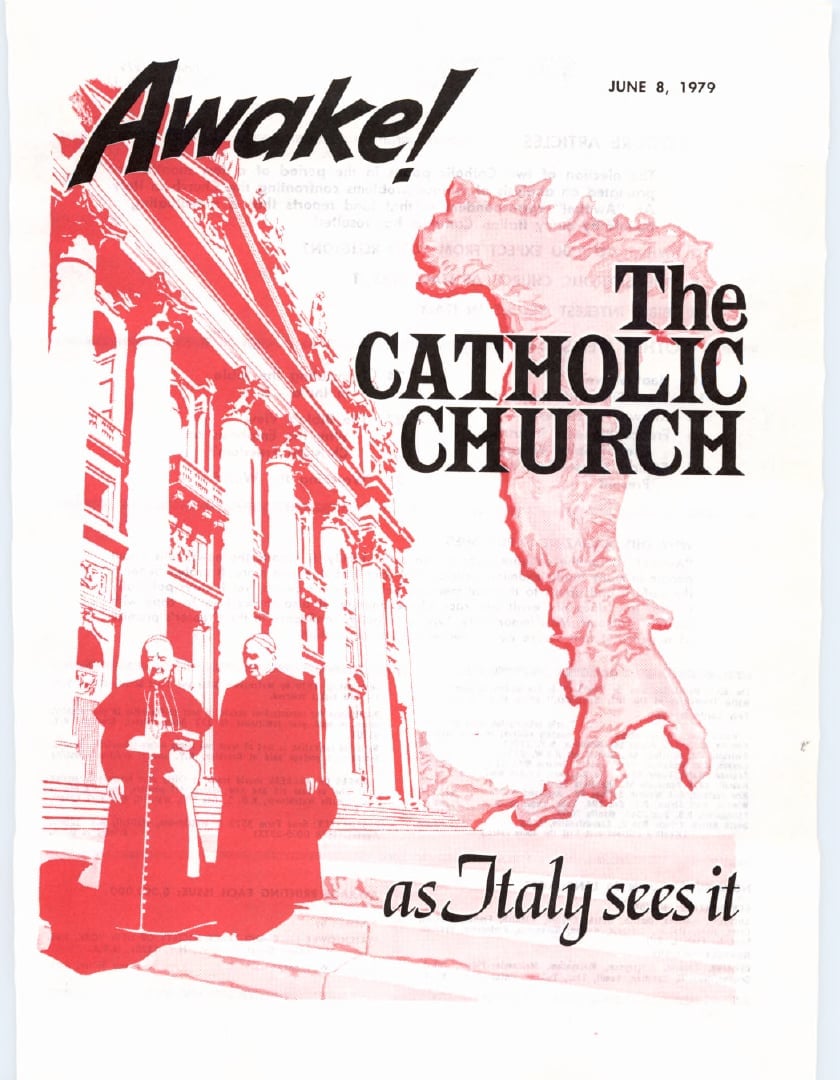
Awake! — June 8, 1979
Source: jw.org
Contents
Page Two
What Do You Expect From Your Religion?
The Catholic Church as Italy Sees It
Bible Interest Grows in Italy
Heat Wave
Treat Fire with Respect!
Known for Honesty
France Pioneers Industrial Use of Solar Energy
Sailing Ships—Past and Present
Translating the Bible in India
Why the Emphasis on Christian Freedom?
Watching the World
Making Your Family Life Happy
You Are Invited to Attend: The “Living Hope” District Convention of Jehovah’s Witnesses
Page Two
Page Two
The election of two Catholic popes in the period of a few months has prompted an analysis of various problems confronting the Church in Italy. An “Awake!” correspondent in that land reports that a reevaluating of beliefs by many Italian Catholics has resulted
3 WHAT DO YOU EXPECT FROM YOUR RELIGION?
4 THE CATHOLIC CHURCH AS ITALY SEES IT
8 BIBLE INTEREST GROWS IN ITALY
What Do You Expect From Your Religion?
What Do You Expect From Your Religion?
EVERY person who is religious has some reason for being so. He gets, or hopes to get, from his religion what he feels will benefit him.
Early Christianity offered a thorough understanding of God’s Word and a satisfying relationship with God and with his Son, Jesus Christ. By studying the Scriptures they then had, along with the inspired letters of the apostles, Christians found the solutions to their everyday problems. The knowledge of the Bible promoted a fine spirit among them. In association with others of like faith, they had happiness and contentment, because these associates were clean, law-abiding and loving people. Their faith also impelled them to impart to others a knowledge of the truth they had learned.
A Change in View
Today we find a great change in viewpoint as to what religion should be and do. This current trend was noted in a Copley News Service release, which cited Rawley Myers, a Roman Catholic priest, as saying that the first thing a preacher needs to do in giving a sermon is to get people’s attention, and that quoting from the Bible is the wrong way to do it. He remarked: “If a priest starts with a Scripture quotation, often he has already put a lot of people to sleep.” It appears that Bible teaching is not really desired, for the report continued: “The notion that people go to church looking for help in coping with their mothers-in-law, teen-agers, alcoholic husbands, sickness in the family and other problems is very popular today.”
The Really Desirable Thing
However, does the matter revolve around what the individual or the congregation desires? Or is it what God knows people need? If we go to the Bible to see what God says, and by so doing get the spirit of the Bible, it will enable us to cope with the problems of relationships with marriage mates, mothers-in-law and children, and with other family and personal problems. And we can count on God’s help through prayer, as the Bible promises: “Do not be anxious over anything, but in everything by prayer and supplication along with thanksgiving let your petitions be made known to God; and the peace of God that excels all thought will guard your hearts and your mental powers by means of Christ Jesus.”—Phil. 4:6, 7.
Three very vital questions therefore present themselves: Do I want a religion based on the Bible, or a social, philosophic religion? And, if I choose a Bible religion, which one of these really follows the Bible? Which religion satisfies, both in helping people with the many problems we face in this modern world and in giving us spiritual benefit?
Making an Examination
If you are a member of a religious group and you wish to be sure of the right religion, you will naturally look at your own religion first. You will want to know, primarily, these three things: (1) Does my religion help me to get an understanding of the Bible? Does it provide regular Bible study, with teachers qualified by study, knowledge and personal faith in the Word of God? (2) Have the doctrines made significant changes in the personalities and ways of its members, so that they are living genuine Christian lives, and do true love and unity prevail among them? (3) Does my church ‘keep itself unspotted from the world,’ not contaminated by its low level of morality, its politics, its selfish strife, as the Christian writer James describes the qualities of true religion at James 1:27?
Many persons in this time of unrest are taking a second look at their religion. Whether you are young or old, it is the appropriate time to do so. If you feel uneasy about your religion, first sit down and do some Bible reading, if possible with your wife or husband and other members of your family. Using a Bible concordance or dictionary, check to see if the teachings of your church are in line with the Bible. Then consider whether your religion is bearing good fruitage. Do the members express “love, joy, peace, long-suffering, kindness, goodness, faith, mildness, self-control”? (Gal. 5:22, 23) Is there the motivation to teach Bible truths to others? Does your religion keep itself ‘unspotted from the world’?
If you find your religion wanting in some of these respects, look for those Christians who are exerting themselves to help others understand the Bible—who are willing to conduct a Bible study or discussion with you. See whether they do this in genuine love, not out of any commercial or selfish motive, but in the peaceable spirit of God’s Word. See whether they follow the pattern of Christ’s early disciples. Associate with those Christians who, in line with the Bible’s counsel, are ‘considering one another to incite to love and fine works.’—Heb. 10:24, 25.
If you do this, you may be sure that God will help you to get what you need from religion and, moreover, what truly satisfies your heart.—Matt. 6:33, 34.
The Catholic Church as Italy Sees It
The Catholic Church as Italy Sees It
RECENT developments at the Vatican have caused a stir throughout the Catholic world. Priests and others closely connected with the hierarchy of the Church have been greatly shaken. What about the Italian people?
Italian Catholics were grieved by the death of Pope John Paul I (Luciani). Radio and television coverage of matters relative to his death on September 28, 1978, was exceptional. However, comments by the people seem to reveal that, in general, they are more interested in the nonreligious side of the news.
Many Italians complained about the cancellation of films and other favorite programs in order to make way for the almost constant news bulletins on the funeral, the election conclave, and so forth. With regard to the death of John Paul I, the periodical L’Espresso, of October 8, quoted the director of a national news program as saying: “We certainly would not show a great respect for the public if we continued to bombard them quantitatively and qualitatively as we did at the death of Paul VI.”
There was also a feeling that political rather than religious qualifications exercise a major force in papal elections. The press gave wide coverage to the “political maneuverings” behind the election of a successor to John Paul I. The newspaper Il Messaggero, in its October 3rd issue, carried a front-page headline asking: “A shepherd of souls like Luciani or a ‘politically minded’ Pope?” And on October 7th an article about “Benelli’s Game” considered the maneuvers of that influential cardinal in the election of a successor to the pope. Even before the election of Luciani, the newspaper La Nazione, in its issue of August 27, had stated: “During the last few days too much importance has been given to analyzing the various cardinals, their political position and geographical extraction, forgetting the crisis in which the Church finds herself today.”
Suspicions Regarding John Paul’s Death
The suspicion of political intrigue was heightened by the sudden death of John Paul I. “They have murdered him” and “They have killed him for political reasons” were remarks repeatedly heard. A sociologist quoted in Corriere della Sera, under date of October 2, commented: “It is very strange how the rumor spread that the Pope had been poisoned.” Panorama magazine of October 10 (in a brief article entitled “Why Do People Say He Has Been Murdered?”) remarked: “At Rome this doubt immediately began to insinuate itself into people’s minds, just as if the clock had been put back 500 years to the days of the Borgia intrigues fomented by Pope Alexander VI and his children Lucretia and Caesar. Taxi drivers and shopkeepers only had one subject of conversation in the last few days: that there was surely some kind of plot behind the Pope’s death.”
But not only did the public have suspicions. Several newspapers carried headlines calling the pope’s death a mystery and suggesting that an investigation be conducted. The secretary of “Civiltà Cristiana,” a Catholic traditionalist movement, stated: “The rumors, perplexities and doubts about certain circumstances and the causes of the Pope’s death are many and varied. For this reason we think it would be proper for the judicial authorities to give us an unequivocal answer.” The newspaper Corriere della Sera, which reported the secretary’s comment, said also that “Civiltà Cristiana” had presented to the Vatican authorities a written request for an inquest.
One reason for the public’s interest in the matter is that Pope John Paul I had gained much sympathy from the masses by his use of simple language, as some said, ‘similar to that of a country parish priest.’ Many were pleased that he decided to abolish the three-tiered crown at the installation ceremony that marks the opening of a new pope’s rule, and that he at first desired to eliminate the use of the portable throne on which the pope is carried so that he might be seen by the crowd, though he reconsidered and did accept this feature of his inauguration ceremony.
Was Rejection of the Tiara Significant?
F. Margiotta Broglio, writing in La Nazione (Sept. 3, 1978), indicated that greater significance was attached to Luciani’s rejection of the tiara than was warranted. “Here,” Broglio said, “we do not want to criticize this first decision taken by the Pope, but we wish to mention that once the decision to do without ‘symbols of sovereignty’ had been taken, then it should have been carried through to its logical conclusion, renouncing the presence of ex-colleagues of royalty, ceremonial sabres, the Toson d’Oro—a relic of Bourbonic rule—and other ‘secular’ trinkets associated with pontifical rule . . . Only by courageously going back to spiritual realities will the Church succeed in banishing all traces of Pope Montini’s [Paul VI’s] neo-temporalism.”
The writer of a letter to La Repubblica, a daily paper, spoke more strongly. Decrying the pomp, ceremony and riches surrounding the pope, he concluded: “I am not a worshiper of a bejeweled pope nor am I fascinated by a Vatican like something out of the Arabian Nights. The message I want to send to John Paul is contained in the Gospel. Open this book and read it thoroughly, my dear Pope. Then be consistent and put it into practice, stripping yourself of all those riches and giving them to others, live on the bare essentials, get down off your pedestal and talk to people!”
As to the new pope, John Paul II (Wojtyla), it remains to be seen whether he will bring about any significant changes in doctrine or Church structure. Before becoming pope, he declared himself to be in complete agreement with the contents of Paul VI’s encyclical letter Humanae Vitae, which included a stand against contraceptives and birth control. Corriere della Sera of October 18 refers to the pope’s veneration of the “Madonna,” commenting that her initial letter “M” is included in the papal coat of arms adopted by the present pope. These two facts are taken to indicate that future innovations will be of a superficial nature and will not bring any substantial change in the Church.
The Church Faces Problems
A barometer of how the Italian people feel about the Church may be found in the condition of the parishes. Il Messaggero of September 29 quoted the speech of Cardinal Poletti, of Rome, delivered to an assembly of diocesan clergy, in which he described the critical situation existing in the diocese of Rome itself. He declared:
“There are 68 parishes in Rome lacking a parish church or structure and which are carrying on an existence in temporary quarters in spiritually distressing conditions for population and priesthood alike.”
Poletti explained that there are numerous parishes of “monstrous dimensions” varying from 30,000 to 80,000 inhabitants, and that it was an achievement merely to administer the sacraments, to the neglect of any “authentic evangelization.” There are also many new residential areas, he said, that will house more than 150,000 people when they enter into full operation, but where “it is impossible to arrange for even a temporary place of worship,” and that these parts of the city “will be abandoned to themselves, to backslide into popular paganism—what evangelization!”
Other areas are likewise affected. Palermo, for example, is said to need at least 20 new parish churches. “But we are lacking the priests and the material means to establish them,” said one spokesman, as reported in Giornale di Sicilia. “What can be said about the parish churches?” this journal asks. “They have become like ‘petrol stations’ where people go only when they need something. None of the ecclesiastical structures run smoothly and some are not working at all. The priests pray less and less . . . Young priests sometimes have wrong ideas about what should be understood as progress, while the other priests remain entrenched behind out-of-date opinions. The result is that contrasts often explode between the two categories, and end up by paralyzing certain Church activities.”
Confusion and Disbelief
All these things have had a deteriorating effect on the priesthood, and this has naturally passed on to the people in the form of skepticism, indifference and even lack of belief and confidence in the Church. As far back as 1976, a priest wrote to the religious periodical Seminari decrying the fact that “some young priests talk about the Church, the Pope and the Bishops in a way that I am sure even the Church’s most deadly enemies do not, yet they are priests!”
So there is confusion among the Catholic laity of Italy. The changes, such as the abolition of Latin from the Mass and of the command not to eat meat on Fridays, have caused upset among some, while others consider the changes as being of minor importance. These latter ones desire to see more sweeping changes made—changes of a nature that have to do with the everyday lives of people.
That respect for the clergy is diminishing is revealed in a survey published in the book entitled “Enquiry into Vocations for the Ministry,” by Giuseppe Bove, which analyzes the critical remarks often made about priests. Of the people interviewed, 69 percent said that the priests are not consistent; they are lovers of money (52 percent); they are too aloof from ordinary people (33 percent); they do not understand this modern world (30 percent); they are not faithful to their vows of celibacy (25 percent); they are mixed up with politics (23 percent); they are useless (21 percent); they are not up-to-date (15 percent of those interviewed).
What, then, does the future hold for the Catholic Church in Italy? Only time will tell. But it is certain that Christ the Judge will bring into judgment all institutions, as well as all individuals, claiming to exercise faith in him and to follow him as God’s appointed King and High Priest. If their doctrines and Church structure do not measure up to the requirements of Christianity as set forth in God’s Word, any blessing from him will be impossible to obtain. Such institutions or individuals, therefore, cannot stand.—1 Pet. 4:17, 18; Heb. 4:12; compare Nahum 1:6.
Bible Interest Grows in Italy
Bible Interest Grows in Italy
MANY sincere people in Italy are searching God’s Word for the answers to the problems of life. They are happy at finding these answers and are becoming servants of God and proclaimers of the good news of his Messianic kingdom. Some typical true-life experiences show the strong desire that they have for learning more about God, and the obstacles that they overcome in doing so.
Often either to see or read the Bible is a new thing for many, even though they are nominal Christians. This was the situation in the case of one sincere person. He says:
“I was a Catholic, though I was not very diligent in attending church. However, when I did go to church I did it with a certain conviction and seriousness. But more and more I developed a feeling of emptiness in my heart and earnestly desired to be a more worthy worshiper of God. I had no knowledge of the Bible; so I began to think about reading it. Since I have a brother who is a Catholic priest, I asked him to get me a Bible. He made a gift of a copy to me, saying, ‘Read it and then we can have a talk.’ As I began to read I soon noticed the contrast between the Bible’s teachings and those of the Church. In the meantime, a friend spoke about some witnesses of Jehovah he had met at Turin. So I located them and arranged to have a Bible study with them. My brother did all he could to discourage me, and although he had success for a time, I soon resumed my study, making progress, and in 1974 I was baptized. I now have joy in living and do not have that feeling of emptiness that I had when I was in ignorance of God’s Word.”
Knowledge of God’s Name Enlightens
One of the features of the “good news” is the making known of God’s name, Jehovah. A man from southern Italy relates the effects that this knowledge had on him, saying:
“I had my first contact with Jehovah’s Witnesses many years ago. At the time I was a fervent Catholic and the very thought of missing Mass on Sunday was an unthinkable sin. For this reason I did not want to listen to the Witnesses when they came to my door. However, I finally agreed to a Bible discussion. One of the first things I learned was the name of our God—Jehovah. What struck me most was the number of times the Holy Scriptures mention this name of God, and that Jesus himself (in the model prayer he left for his disciples) placed the sanctification of this name in the forefront. Soon I saw that many of the teachings I had believed were unscriptural, being only traditions invented by men. So I made the necessary changes in my life. I resigned from the Church, left the various parish sporting clubs and made other changes. Later, my wife and I were baptized in water as servants of Jehovah and his Son Jesus Christ.”
Bible’s Message of Life Attracts Many
The desire for everlasting life as held forth in the Bible is a motivation for many people to look into God’s Word of truth. From Tuscany a man writes:
“My life used to be the same as that of so many Catholics. I believed in the existence of God and followed the traditional teachings of the Church. One day two of Jehovah’s Witnesses came to my door and I was particularly struck by one of their questions, ‘Would you like to see your children get married and your grandchildren and great-grandchildren grow up to be adults?’ You can imagine that I was interested in this proposal, when you consider that I am the father of 13 children. Furthermore, as caretaker of the local cemetery, I had spent most of my life surrounded by the dead. Therefore, the eternal life spoken of in the Bible seemed impossible to me, in spite of my religion. I accepted a Bible study right then and there. Soon members of my family began opposing me. The local priests also did their share to create trouble and there were other difficulties, like being threatened with the loss of my job. However, I persevered and this has brought good fruits. My wife is now interested in the ‘good news’ and my family is closely united. My children have a regular family Bible study to build up their faith and I thank Jehovah for having helped me to find peace of mind, a correct relationship with him and a solid hope for the future.”
Elderly Concerned About Serving God
The “good news” as proclaimed in Italy by Jehovah’s Witnesses is drawing persons of all ages, even “senior citizens” who, logically, are thinking very seriously about life and desire a hope for the future. A lady 60 years of age tells her experience, saying:
“From the age of 10 onward, that is to say, for 50 years, I had attended Mass and taken Communion every morning. My eldest daughter, who was also a devoted Catholic, had spoken with Jehovah’s Witnesses. Due to questions that arose, we felt the need of clarifying certain doctrinal points with a qualified priest. I was extremely surprised when the theologian we consulted explicitly declared that neither limbo nor purgatory exists. I felt as though everything I had believed in had collapsed around me. I realized that the things I had been doing for a lifetime may have been all in vain—for example, all the prayers and Masses said for the dead. In a further conversation we asked for an explanation of the Trinity, and my daughter asked: ‘If Jesus Christ were God, why did Satan try to tempt him if he knew he was God himself? Didn’t he realize that it would be useless?’ The priest’s reply was quite unacceptable. He said: ‘Satan did not know that Jesus was God.’ From then on we decided to engage in conversations with Jehovah’s Witnesses, using only the Bible as a basis. Soon six other members of the family and I accepted the truth and now I am baptized, a true worshiper of Jehovah God, happy to serve him in accordance with the truth of his Word.”
Is It Proper to Change One’s Religion?
Can a person who has gone so far as to enter into a religious order change his religion with God’s approval? A former Catholic monk tells his story, stating:
“The day of my 35th birthday was a very memorable one for me because it coincided with the day I decided to leave the monastery where I had been living for many years. Why did I make this decision? As a result of the disillusionments I had experienced. The cold atmosphere that permeated the environment, the use of formal language when addressing our superiors, the regular seclusion for meditation and penance, the vows of poverty and obedience carried to extreme lengths to mortify us—all these things made that life a very unhappy one. Another reason for my dissatisfaction was my conviction that the Bible was the Word of God. Yet I could not understand it. I asked my superiors questions, but I used to get the answer, ‘You cannot understand these things.’ After all those years I finally decided to leave. The abbot gave me the dispensation from my vows, saying with rage, ‘Take your passport to Hell!’
“After this I found a job in the city and a room in a private house. One evening, arriving home late, I passed by to say good-night to my landlady and was invited in to take part in a conversation that she was having with two men. I saw that they were studying the Bible. ‘Oh, good gracious!’ I mistakenly thought, ‘I have taken a room with Protestants!’ However, I accepted the invitation. Afterward, I decided to accept a Bible study in my own quarters. I started to reexamine my religion very carefully, but this merely confirmed what I already knew. Moreover, the Church was empty and cold. I then attended a meeting at a Kingdom Hall of Jehovah’s Witnesses. What a difference! Everyone spoke to everyone else, they all knew each other well, and valuable instruction was imparted. I soon had the courage to miss Mass on Sunday for the first time. Later I attended a district assembly of Jehovah’s Witnesses. I looked around very carefully, to see whether other congregations had the same faith and spirit, and I was won over when I saw the identical spirit, faith and brotherly love among all attending. Finally I was baptized exactly one year after my leaving the monastery.”
As the apostle Paul wrote: “The word of God is alive and exerts power and is sharper than any two-edged sword and pierces even to the dividing of soul and spirit, and of joints and their marrow, and is able to discern thoughts and intentions of the heart.” (Heb. 4:12) It can transform lives. Its truth is enlightening to the mind and heart, giving a purpose in life and a hope for the future. Those who sincerely study it develop a love for their fellowman. This love is often the first thing that attracts those sincerely searching for God. Jesus pointed out that this would be true when he said: “By this all will know that you are my disciples, if you have love among yourselves.”—John 13:35.
Thus the “good news” proclaimed by Jehovah’s Witnesses is finding a ready place in the hearts of many Italian people. The 42 congregations of Jehovah’s Witnesses now in Rome, as well as the more than 1,200 other congregations in all of Italy, are flourishing and increasing. At the Witnesses’ recent conventions in Rome and Milan there was an attendance of more than 111,000! And 2,288 were baptized, to join in spreading the “good news” to many more God-fearing persons here in Italy.
Heat Wave
Heat Wave
In January, Antarctica’s McMurdo Sound base experienced the highest temperature ever recorded there. It reached 9.4 degrees Celsius (49 degrees Fahrenheit), as the south polar region enjoyed one of its warmest summers ever. By contrast, many nations in the northern hemisphere were experiencing one of their bitterest winters.
Treat Fire with Respect!
Treat Fire with Respect!
By “Awake!” correspondent in Japan
● Where the greatest danger is
● How to prevent fire disasters
● What to do if a fire breaks out
AS A friend, fire cooks our meals, warms our bodies, provides light in the dark and is a source of energy to carry us long distances. Yes, it does a host of jobs to provide necessities or to make our lives more pleasant. But, on the other hand, it can destroy billions of dollars’ worth of property and denude whole forests of their greenery. Every year, in the United States alone, it snuffs out the lives of about 12,000 men, women and children. Fire can be a deadly foe.
Certainly anything with such potential to provide benefits or cause great harm is worthy of consideration so that we may continue to call it our “friend.” Whether fire is our friend or foe depends a lot on the way we treat it and our having a basic knowledge of its causes.
Fire is caused naturally by means of lightning. Lava from volcanoes is another source of fire. Whether our early ancestors imitated natural sources or were given divine knowledge of how to produce fire, it has been an integral part of man’s life for thousands of years.
Bible records show that the first man and woman were familiar with fire, for, upon their expulsion from the garden of Eden, God posted at the east of the garden “the cherubs and the flaming blade of a sword that was turning itself continually.” (Gen. 3:24) Early in man’s history Tubal-cain was a forger of tools of copper and iron, a job calling for intense heat, since it requires more than 2,800 degrees Fahrenheit (c. 1,500 degrees Celsius) to melt iron.—Gen. 4:22.
What Is Fire?
Although men had been using fire for thousands of years, its true nature was not known until experiments by Antoine Lavoisier and others in the 1700’s showed that fire marks a chemical reaction involving oxygen. They proved that oxygen is actually added during the burning process, although others before that had thought that fire resulted from the release of an imaginary substance called “phlogiston.” Fire is defined as the heat and light that come from burning substances.
In describing the basic essentials for fire, many now prefer to use a word referring to something that has four faces. So they speak of the “fire tetrahedron.” In other words, besides the original “fire triangle” of fuel, heat and oxygen, they add the fourth essential of chemical reaction.
It is necessary for us to understand the part each of these plays in producing fire so that we can put it to use in either preventing or extinguishing unwanted fires. For example, to put out a grease fire on the stove, turn off the stove (removing the heat) and cover with a lid (removing the oxygen that feeds the fire). To get a better idea of what causes fire, let’s take a look at these four basic elements.
FUEL: Given the right circumstances, most substances will burn or combine with oxygen in combustion, a chemical process that liberates heat. (Remember that fire is the heat and light resulting from combustion.) However, the temperature at which things will burn, called the ignition point or kindling point, varies according to the substance. For example, the kindling point of film, nitrocellulose, is only 279 degrees Fahrenheit (137 degrees Celsius). For wool it is 401 degrees Fahrenheit (205 degrees Celsius) and for newsprint 446 degrees Fahrenheit (230 degrees Celsius).
HEAT: Generally, heat is provided from an outside source, such as a match or spark, and then the fire produces enough of its own heat to be self-supporting. If we reduce the temperature of a burning substance below its kindling point, the fire will go out. Even though our breath contains fire-sustaining oxygen, blowing on a burning match carries away the heat faster than it is being produced, and the fire goes out. Sometimes enough heat is generated within substances, such as in a pile of oily rags, to cause them to burst into flames. This is called spontaneous combustion. Certain bacteria in moist hay can cause the temperature to rise rapidly, causing the hay to burn, leading to a loss of valuable feed, and possibly storage facilities and livestock. These sources of heat cannot be ignored when considering fire prevention and safety.
OXYGEN: Although there are other chemicals that can combine with fuels to produce heat, oxygen is the most common. The need for oxygen to sustain a fire is shown by the fact that fuels heated in a vacuum will not burn.
CHEMICAL REACTION: There are certain conditions under which fuels will not produce a flame, even though fuel, heat and oxygen are present. For example, if the percentage of natural gas in air is not between about 4 percent and 15 percent, no flame will be produced.
The burning process can be illustrated by an examination of the flame of a candle. The wax does not burn directly, but, rather, gas given off by the heated wax travels up the wick and burns. Prove this by blowing out a candle that has been burning for some time. Then pass a lighted match through the trail of smoke rising from the wick. A flame will travel down the smoke to the wick and relight the candle. There are three areas in the flame: (1) the dark inner area of no combustion and (2) an intermediate layer of incomplete combustion, composed of hydrogen and carbon monoxide that gradually work their way to (3) the outside cone of complete combustion.
Keeping in mind the essentials for fire, would it not be a good idea to take a look around your home or place of work to see if you may not be giving destructive fire a place to start?
Three Steps to Avoid Catastrophe
While checking, bear in mind that no two fires are exactly alike. So it is not possible to cover all circumstances. We need to consider some places where fire is most likely to start so as to help all in our families to be conscious of fire safety.
Generally speaking, three steps are necessary to help us avoid the catastrophe of a fire in our home. They are: (1) Practice good housekeeping; (2) develop safe habits; and (3) plan ahead.
Checking the Kitchen Area
The kitchen is the most dangerous place in the house. Here is where most home fires start. The stove and other appliances are especially threatening. So, special care must be taken to keep them in good repair and to use them safely. Good housekeeping is vital. Are there combustible materials above the stove that could catch fire from rising heat or flames? Curtains blown over a stove can suddenly turn the whole kitchen into the scene of a holocaust.
Good housekeeping includes keeping the stove and surrounding areas grease free. With heat and oxygen already present, grease can provide the fuel for an unwanted fire.
Develop safe habits. Are appliances such as refrigerators, toasters and ovens in good repair? Do you use only fuses of the recommended size?
If a pan of grease catches fire, never try to carry it out of the house or to put it out with water; these actions will only make matters worse. First, turn off the heat. Then try to smother the flame with a lid, being careful not to burn yourself and watching that your clothing does not get too close to the fire. If that does not work and you do not have a fire extinguisher, then sprinkle baking soda over the grease fire.
A word of caution: About 20 percent of all fire fatalities involve children under five years of age; so develop safe habits to protect them from fire. Turn all pot handles so they do not stick out beyond the stove where little children could reach them. Do not risk tragedy by storing a cookie jar above the stove. Keep matches and lighters out of the reach of children. Fire is not a plaything and it is never too early to teach children respect for fire.
Since most home fires start in the kitchen, many fire prevention authorities recommend that each household keep within the kitchen area a dry-chemical extinguisher. One of a 2 1/2-pound (1-kilogram) capacity will do. It should be a multi-purpose “ABC” type, the kind that is effective on all classes of fires, such as (A) paper, wood, drapes, and so forth; (B) flammable liquids, such as grease, paint, solvents, and so forth; (C) live electrical equipment, such as faulty wires, frayed electrical cords, and so forth.
Each member of the family should be familiar with how to use the extinguisher. The prudent time to read the instructions and to learn how to operate a fire extinguisher is NOT at the moment of a fire emergency.
If a kitchen fire cannot readily be extinguished, everyone in your household should leave the building first. Then, from a safe location, summon the fire department.
The accompanying chart lists some of the most common causes of fires in the kitchen, along with the action you can take to prevent or put out a fire.
Keeping Other Areas Safe
In the other areas of the house or apartment, the heater is probably the biggest culprit in starting home fires. Whether you have central or room heat, care must be given to keeping the heater in good repair, and caution must be exercised in its use. Do you have the furnace—also flue pipes, chimneys, and areas around the furnace—checked and cleaned regularly by a qualified repairman?
Room heaters are especially dangerous because they often have an open flame and must have adequate clearance from walls and combustible materials. Position of the heater is important because it may be easily bumped or turned over. It is also wise to turn off portable heaters before going to bed.
Here in Japan, where fire causes an average of 30 deaths and injuries every day, portable heaters are used quite extensively. To warn of their danger, arrangements are made in most communities for volunteers to walk through the streets at a set time each night, ringing a bell or beating wooden sticks. In some areas, firemen drive the fire truck up and down the streets, blowing the siren and making announcements to turn off heaters. No doubt a constant community awareness of the dangers of fire helps to reduce the tragic loss due to home fires each year.
In addition to heaters, there are other items in the home that need to be considered. For example, the smoking habit and the careless use of matches cause about 25 percent of all fires of known origin, resulting in 200,000 fires and 1,200 deaths in the United States each year.
Also, a television set generates much heat, and if sufficient ventilation is not provided to disperse the heat, it can accumulate and ignite any nearby combustibles. If wires are frayed, give them immediate attention.
If fire does strike and someone’s clothing catches fire, do not let the victim run; this only fans the flame and makes it burn faster. Throw the victim to the ground, and roll him in a coat, rug or blanket to smother the fire.
Safe Habits in Storage Areas
Do you have any storage areas, such as a basement, a garage or a closet in your home? Vapors from paint thinners, gasoline and other flammable liquids in closed areas can be a cause of a dangerous explosion and fire. Are these liquids all stored in closed, metal containers? When using these items, is the area well ventilated?
Rubbish or rags piled up in a storage area can burst into flames by spontaneous combustion. Good housekeeping will remove this danger.
Plan Ahead
Firemen recommend that each family plan ahead for a family fire escape route. It is too late once fire strikes. Plan a first route of escape and an alternate route in case the first one is blocked. Then practice it so that all are familiar with what they should do. Have a prearranged meeting place outside so that all will know when everyone is out of the house. People have died because they ran back into burning homes to save children who were already safely outside. Once everyone is out, do not return to try to save valuables. This could cost you your life.
For thousands of years, the human family has benefited from the gift of fire. However, it can turn on us as a merciless foe. “Look! How little a fire it takes,” declares Bible writer James, “to set so great a woodland on fire!” (Jas. 3:5) It is for our own good and that of our families if we have respect for the potential power in fire and cultivate safe habits in its use. Will fire continue to be your friendly servant, or will it turn on you as a deadly foe? This depends much on how you treat it.
[Chart on page 14]
KITCHEN FIRES
Fire Causes in Kitchen Remedies and Prevention
1. Burning frying pan 1. Smother with pan cover
2. Grease fire in oven 2. Sprinkle baking “soda” (not
baking powder) into oven.
Keep oven free from grease
3. Leaving the house unattended 3. Shut off oven and gas jets
while food is cooking whenever leaving house
and/or oven is on
4. Matches and mechanical 4. Handle carefully and keep
lighters out of reach of children
5. Children playing with and 5. Keep children away from stove
near stove
6. Window curtains blowing 6. Tie back curtains to avoid
near gas flame flame; better yet, use
fiber-glass curtains
7. Flammable liquids for 7. Avoid use near flame or
cleaning gas pilot light
8. Improper clothing, such as 8. Do not cook while wearing
long-flowing sleeves on such apparel; or, wear fire-
housecoats and dresses, while resistant material
using stove
9. Careless handling of cooking 9. While cooking, handle
utensils and handles, causing utensils in a careful manner
flammable foods to fall on
gas flame
10. Reaching up into cabinets 10. Procure needed items in
above stove, causing items such cabinets before
to fall, spilling food onto beginning to cook
gas flame
11. Odor of gas 11. Check pilot light and for
open gas jet. If these are
not the cause, notify fire
department and gas company
Known for Honesty
Known for Honesty
Honesty is a Christian requirement. Appropriately, then, the apostle Paul wrote: “Carry on prayer for us, for we trust we have an honest conscience, as we wish to conduct ourselves honestly in all things.” (Heb. 13:18) Such honesty is noted by others and is beneficial, as illustrated by the following experience from France.
A Christian businessman encountered some difficulties because of the current economic crisis. In this regard, he stated:
“As a manufacturer, I sometimes have trouble paying bills at the end of the month due to business difficulties. Thus, at the end of August 1977, I was obliged to ask a dealer to postpone my paying a considerable sum. It was a large foreign firm and was strict about settling bills on time. The financial director turned down my request and asked the local agent to claim the amount immediately. I had already witnessed to this agent, who told the director that he knew me very well and that I was trustworthy. However, no argument was of any use.
“He then added that I was one of Jehovah’s Witnesses. The reply was: ‘In that case, it’s different! Grant him the postponement he requests.’ Since then, the agent has been to see me and has explained the whole thing. He showed me a photocopy of a letter that the director had sent to the firm’s headquarters. On the letter was this comment: ‘One of Jehovah’s Witnesses—Favorable opinion.’”
This Witness settled his debt after the postponement and still has excellent business relations with this firm. Of course, Christians do not follow the course of honesty just to secure some material advantages. But their good reputation for honest words and deeds does not go unnoticed.
France Pioneers Industrial Use of Solar Energy
France Pioneers Industrial Use of Solar Energy
By “Awake!” correspondent in France
UP TO the middle of the last century man burned wood to satisfy most of his needs for fuel and power. But with the advent of the industrial era, more and more energy was required to drive the increasing number of machines. So coal began to be utilized on a wide scale. In fact, by 1910 three quarters of mankind’s power needs were met by coal.
Around 1859 another type of fossil fuel, mineral oil (petroleum), began to be used. It was to have far more industrial uses than coal ever had. The invention of the internal-combustion engine gave rise to the increased development of motor vehicles of all kinds, such as cars, trucks and aircraft.
Increasing industrial use of coal and oil has played a decisive part in the pollution of the earth. The reason is that these fuels do not burn up completely. They release into the atmosphere great concentrations of gases—carbon monoxide and nitrogen oxides and sulphur oxides—as well as solid particles.
As in other industrial countries, pollution is on the increase in France. During restoration work on the Louvre in Paris, the stonework was found to have suffered considerably from the corrosive effects of atmospheric pollution. Some blocks of stone had lost seven centimeters (2 3/4 inches) of their original thickness. Today corrosion is eating away the masonry at the rate of three millimeters (over 1/10 inch) a year, 100 times as fast as at the beginning of the century!
In recent years nuclear energy has been introduced as a potential replacement for oil. However, its industrial use results in many difficulties. For one thing, there is a risk of radioactive contamination that could follow an accident. Additionally, there is potential danger to the ecology. It is feared that, as nuclear power stations become more numerous, the rivers and lakes will be ruined by thermal pollution. This is because, in order to cool its apparatus, a nuclear power station draws huge quantities of cold water out of a nearby river or lake. The heated water is then returned to its source. When the temperature of a lake or river is raised, the amount of oxygen in the water is lowered. This not only kills fish but fosters the growth of algae, which also consume oxygen when decaying.
These disturbing facts emphasize the need to find pollution-free sources of energy. The sun itself meets this requirement exactly. Solar energy, although intermittent and diluted, is so generously distributed over the surface of the earth that every square mile of land and sea receives several million kilowatt-hours daily. This type of energy is naturally abundant, which explains why a number of countries, including France, have undertaken to pioneer the industrial use of solar energy.
Exploiting Solar Energy
During a visit to Paris in October 1774, the English chemist Joseph Priestley told French chemist Antoine Lavoisier of an experiment during which he had heated mercuric oxide by means of solar radiation concentrated by a powerful lens. Lavoisier did the experiment again and concluded that atmospheric air is a blend mainly of two distinct gases, which he called “vital air” (oxygen) and “non-vital air” (nitrogen). Thus, as far back as the 18th century it was possible to produce high temperatures by utilizing solar radiation.
For decades researchers at the C.N.R.S. or Centre national de la recherche scientifique (French National Center for Scientific Research) have been following in Lavoisier’s footsteps. In 1946 at Meudon, in the suburbs of Paris, a first solar furnace was set in operation and different experiments were made at high temperatures (3,000 degrees Celsius, or over 5,400 degrees Fahrenheit).
However, as a result of research on simple furnace prototypes from 1949 on at Mont Louis, in the French Pyrenees, the Odeillo solar furnace was eventually developed. After a long period of perfecting and adjusting, it eventually became operational in 1970. Today France has a large solar furnace at Font-Romeu-Odeillo-Via, near Mont Louis, at an altitude of 1,600 meters (5,250 feet). This beautiful mountainous region enjoys exceptional sunshine, which enables the 1,000-kilowatt furnace to reach a temperature of 3,800 degrees Celsius (over 6,800 degrees Fahrenheit).
Various methods can be used to capture solar radiation, such as using panes of glass, which, working on the principle of a greenhouse, can easily generate temperatures approaching 100 degrees Celsius (212 degrees Fahrenheit)—the boiling point of water. This method is used mostly for domestic purposes, such as heating houses and heating and distilling water. If higher temperatures are required, the rays coming directly from the sun have to be concentrated by an appropriate optical device.
The higher the temperature desired on the spot where all the rays converge (the focal point), the stronger the concentration must be. Concentrating tens of thousands of reflections of the same light source onto a small area is no easy task because of the movement of the earth around the sun. The difficulty, however, has been overcome at the Odeillo solar furnace, which superimposes over 20,000 images on the focal point. This remarkable result is the fruit of long research.
The Solar Furnace
Basically the Odeillo solar furnace consists of three different elements: (1) flat mirrors, (2) a large parabolic reflector and (3) a tower housing the focal point. As indicated on the accompanying diagram, the sun’s rays hit dozens of flat mirrors and are thrown back toward the parabolic reflector, which, in turn, focuses the rays onto the focal point facing it in the tower.
The 63 mobile flat mirrors, each of which is made up of 180 flat panes of glass, are arranged in tiers along eight levels. Measuring 45 square meters (484 square feet) each, they are in alternate rows so as to avoid any shadow in the beam of rays directed toward the parabolic reflector. Owing to the rotation of the earth, the position of the sun in our sky is constantly changing. However, each flat mirror can follow the sun in its never-ending journey by means of optical and electronic tracking devices. The movements involved on the part of the mirrors are brought about by hydraulic jacks.
Supported by a 40-meter- (130-foot-) high and 54-meter- (177-foot-) wide concrete structure, the large, immobile parabolic reflector consists of 9,500 mirrors, each measuring 45 centimeters (about 18 inches). Each facet in this giant mirror had to be mechanically curved, oriented and adjusted, so that maximum concentration was obtained on the focal point. As already stated, the parabolic reflector receives solar radiation by means of 63 mobile flat mirrors.
All the rays from the parabolic reflector converge on the focal point. It is housed in a tower 18 meters (59 feet) away from the reflector. The resulting focal spot is approximately 40 centimeters (almost 16 inches) in diameter. The energy concentrated on this elliptical spot amounts to 1,000 kilowatts. The high concentration makes it possible to reach a temperature of 3,800 degrees Celsius (6,872 degrees Fahrenheit). This spot of high heat intensity is where various experimental devices are set up.
Advantages of the Solar Furnace
The solar furnace offers significant advantages over other types of furnaces. The following extract from a C.N.R.S. publication emphasizes one of its essential characteristics: “In basic research solar furnaces constitute an exceptional means for carrying out experiments requiring between 1,000 and 3,800 degrees Celsius [approximately 1,800 to 6,800 degrees Fahrenheit] in conditions of extreme purity.” This is because the solar furnace allows processing at high temperatures by concentrating the heat rays on the materials to be processed, rather than by melting them down in a crucible, which is often the case with high-frequency electric furnaces.
The Odeillo solar furnace makes it very easy to melt refractory oxides, that is, oxides that melt only at very high temperatures (over 2,000 degrees Celsius or 3,600 degrees Fahrenheit), as well as special metallic alloys, which, too, are refractory.
Solar furnaces are also very convenient to use. They can be put into operation quickly and simply. Furthermore, they do not have such drawbacks as the bombardment of electrons that occurs in certain heating systems requiring that the materials be vacuum processed. Finally—and this is far from being negligible—the thermal energy available at Odeillo is obtained with practically no operating costs.
The Solar Power Station
A milestone in the field of solar energy was reached on November 19, 1976, when, for the first time ever, a solar-thermodynamic power station supplied electricity to the French national electric power system.
Simply put, this experimental solar power plant works in the following way: The temperature of a thermal fluid called “gilotherm” is raised to 335 degrees Celsius (635 degrees Fahrenheit) in a boiler placed on the focal point of the Odeillo complex. By means of a storage unit and three exchangers, this fluid supplies steam at 270 degrees Celsius (518 degrees Fahrenheit). The steam then propels a turbo-alternator, which produces electricity.
Near Marseilles, in the south of France, tests are being made on different types of mirrors. After pioneering in this field, France is considering the setting up of a one-megawatt prototype and aims at a range of 10 megawatts for the year 1980.
Future Applications of Solar Energy
The French newspaper Le Monde emphasized the immense field of application of solar energy for industrial use in these terms: “Diffuse and cheap, solar energy seems to be quite adapted to the needs of the lesser-developed countries. . . . It appears to be particularly appropriate for pumping water in isolated areas. In Latin America and Africa, the water needs for several villages are now covered by pumping stations using simple and reliable [solar] appliances which can for the most part be made locally, and which progressively become competitive, compared with those that rely, as most do, on Diesel engines.”
France has signed solar cooperation agreements with Brazil, Iran, Egypt and Algeria. As noted in the magazine L’Express, “For once, the southern countries are at an advantage, for it is there that solar energy can first be applied and improve its competitiveness before conquering the foggy industrialized north.”
Arab nations, such as Saudi Arabia, would like to cooperate in research on solar energy. French technology is in a position to respond to Saudi Arabian proposals, for, according to M. Jean-Claude Colli, French delegate to the Department of New Sources of Energy, “[France is] now practically the only nation offering solar electrical power plants for immediate operation.”
The 1978 French budget for new sources of energy rose sharply. Solar energy expenditures doubled. These efforts show that energy problems can be progressively solved by wise use of clean energy sources, such as the sun, wind, flowing water and ocean tides. Man really does not have to ‘ruin the earth’ to satisfy his growing energy needs.—Rev. 11:18.
[Diagram on page 17]
(For fully formatted text, see publication)
Sun’s rays
Parabolic reflector
Flat mirrors
Focal point
Sailing Ships—Past and Present
Sailing Ships—Past and Present
By “Awake!” correspondent in Japan
HAVE you ever had the pleasure of taking a ride on a sailboat, skimming gently over the waves, the salt spray flying? Many persons find nothing more enjoyable.
But sailing has not confined itself to pleasure. For centuries, sailboats have served for fishing, cargo-carrying and other commercial purposes, and as warships. The style of boats and sails has been greatly varied according to the materials available, the body of water to be traversed, the purpose of the vessel and the skill of the boat makers.
Sailing Ships of the Past
The first vessel of which history gives any description is Noah’s ark. Present-day artists picture the ark as having a round bottom and sharp bow. The purpose of such design is to reduce friction and increase speed. However, the Bible describes the ark as being of a boxlike design. It did not have sails, masts or rudder. This was because it was not designed to move through the water, but, rather, to float on the water and carry a maximum load, as it did for five lunar months.—Gen. 7:17, 24.
God gave Noah the ark’s specifications, commanding him:
“Make for yourself an ark out of wood of a resinous tree. You will make compartments in the ark, and you must cover it inside and outside with tar. And this is how you will make it: three hundred cubits [about 450 feet, or, 137 meters] the length of the ark, fifty cubits [about 75 feet, or, 23 meters] its width, and thirty cubits [about 45 feet, or, 14 meters] its height. You will make a tsoʹhar [roof; or, window] for the ark, and you will complete it to the extent of a cubit [about 18 inches, or, 46 centimeters] upward, and the entrance of the ark you will put in its side; you will make it with a lower story, a second story and a third story.”—Gen. 6:14-16.
The Egyptians used papyrus reeds that were woven and lashed together to form a boat. Some sails were also made of papyrus. Papyrus is a tapering three-sided reed that grows to a height of eight to 16 feet (2.5 to 5 meters) in shallow water. In the year 1970, Thor Heyerdahl traveled thousands of miles across the Atlantic in a papyrus vessel, to prove the seaworthiness of such a boat. The Babylonians and Ethiopians also used reed boats. Some of these boats were round.
The Chinese junk is one of the most ancient sailboats. Yet in spite of its unwieldy appearance to Western eyes, it is quite practical. It has been said that it represents the ultimate in aerodynamic efficiency. These sailing vessels at one time controlled the Indian Ocean and during the Middle Ages sailed regularly to India, Ceylon (Sri Lanka), the east coast of Africa and to Aden (Yemen). In 1848 a junk even made a voyage from China to Boston, New York and London. It is not known when the Chinese junk was first used.
The Phoenicians were master seafarers, carrying on extensive trading in the Mediterranean Sea, and possibly sailing through the Strait of Gibraltar to Britain and around the African coasts. Their principal seaports were Tyre and Sidon. The Bible gives us an idea of the materials used in the construction of the Phoenician ships. It depicts the city of Tyre as a pretty sailing ship, with planks of durable juniper, a single mast from a cedar of Lebanon, and oars of massive trees of Bashan, probably oak. The prow was made of cypress wood inlaid with ivory. The sail was of colored Egyptian linen, the deck covering of dyed wool. The boat’s seams were caulked.—Ezek. 27:3-9.
During the first century of the Common Era, numerous ships sailed the waters of the Mediterranean Sea. Some were quite large. The Jewish historian Josephus reports that he once sailed on a ship carrying 600 people. The apostle Paul, along with a crew and passengers—totaling about 276 persons—was shipwrecked off the island of Malta.—Acts 27:37; 28:1.
From the first century onward, wood was the main construction material. However, as early as 1829 iron made its appearance in ship construction in Great Britain. An event that possibly aided in the turnover from wood to iron was the development of the explosive shell in 1819.
But by the middle of the 19th century most countries were constructing warships of steel. Also, steel passenger ships and freighters or merchant schooners with four, five, six and, at times, seven masts began to appear. The shipping of tea, coffee, dried fruits and other perishable goods increased. Fast “clipper” ships could get them to their destination in a short time. The clippers could average 300 nautical miles (556 kilometers) per day, the best 24-hour run recorded being 436 nautical miles (807 kilometers). They were the forerunners of the sleek cargo steamers that now make the trip from Japan to the west coast of the United States in seven to ten days.
Handling the big sailing ships is not an easy job. For instance, the Nippon Maru is about 320 feet (98 meters) long. It has four masts with up to six yardarms on each mast to support huge square sails having a total area of 25,800 square feet (2,397 square meters). The crew of 150 men (including 120 cadets) must climb ladders 90 feet (27 meters) or more up to a yardarm, then walk out on a rope suspended below the yardarm. Ten crew members on one yardarm raise or lower the sail. Teamwork and coordination are a must, as a slip of the foot or a misjudgment could be fatal.
Sailing Ships of the Present
The near disappearance of the clipper ships does not mean that sailing has become obsolete. Rather, it has largely changed from a business to a sport, and many people from all walks of life are able to enjoy the thrill of being moved noiselessly over the waves of the sea.
During the first half of this century, construction materials have changed greatly. Not only steel, but also aluminum, concrete and other materials have been used to construct sailing boats. However, since World War II a new material has been in use that has advantages over the others in many respects. This material is fiber glass or glass-reinforced plastic. Steel and aluminum have rust and corrosion problems, but fiber glass does not rust, corrode or rot, though some maintenance is required, and it is more easily damaged by floating objects. At present the majority of modern sailing boats and motorboats are constructed of fiber glass.
Glass fiber looks much like closely woven cloth material. In boat construction, a mold for the fiber glass is first constructed. The mold is polished and waxed. The gel coat, which is a hard surface coating of the hull color required, is next sprayed over the waxed mold. Then layers of fiber-glass cloth are placed on the mold, and polyester resin is rolled or sprayed over the previous layers. This process is continued until the required thickness is obtained. When the resin has set, the hull is removed from the waxed mold, the deck is built, interior appointments are completed and the ballast is installed. Finally, the mast is “stepped” (placed in a socket, frame or platform for supporting its lower end) and the sails are raised. You are ready to go sailing! To a great extent, aluminum masts have replaced those made of wood; dacron sails have replaced cotton and linen ones; and stainless fittings have replaced those of iron or steel. All of this has resulted in a lighter, stronger and more durable yacht, with improved speed and beauty.
Fiber-glass construction has revolutionized the pleasure-boat industry. Construction time has been markedly reduced. The time to cut out a stem, a keel, frames and a transom, set them up and plank and caulk the seams of an average-sized wooden cruiser can run more than a month. With a fiber-glass boat, the entire hull can be constructed in less than a week. Moreover, skilled carpenters are needed to construct a wooden boat, but unskilled laborers can be used to a certain extent in fiber-glass lay-up, thereby decreasing labor cost.
…