Awake!, May 22, 1979
Download: PDF — Awake!, May 22, 1979
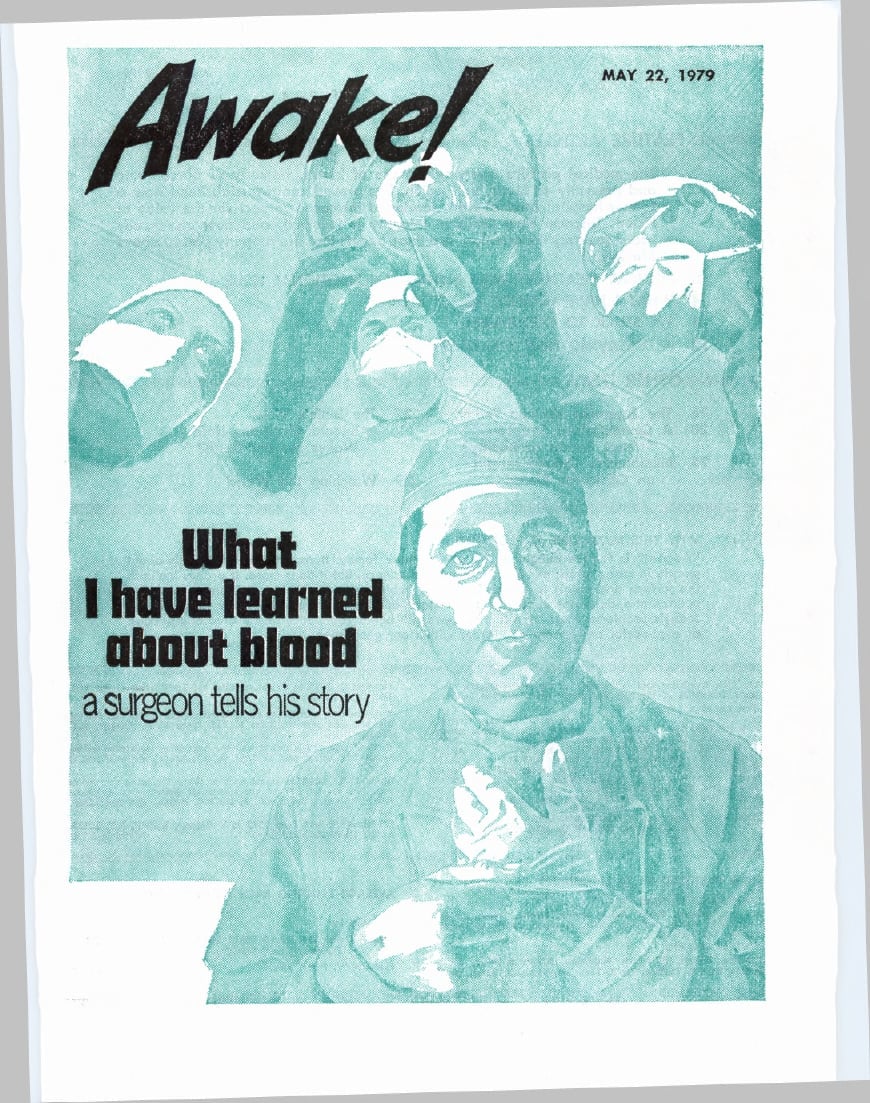
Awake! — May 22, 1979
Source: jw.org
Contents
Page Two
Medical Treatment With Blood—An Emotional Issue
What I Have Learned About Blood
We Stuck to Our Beliefs
A Lifesaving New Treatment
The Japanese Woman Today
A Computerized Society—Science Fiction or Reality?
Missionaries Gained Insight on Obstacles Ahead
Should Christians Hold Wakes for the Dead?
Watching the World
1914—A Turning Point
Bible Stories to Fascinate Children
Page Two
Page Two
The medical practice involving the use of blood, formerly of bloodletting and presently of blood transfusion, has proved controversial. Read how a former hospital chief of staff developed increased respect for the value of blood. Discover how Christian integrity is involved, and how one family faced squarely the question: Are there beliefs that are properly placed above life itself?
3 MEDICAL TREATMENT WITH BLOOD—AN EMOTIONAL ISSUE
4 WHAT I HAVE LEARNED ABOUT BLOOD
8 WE STUCK TO OUR BELIEFS
12 A LIFESAVING NEW TREATMENT
Medical Treatment With Blood—An Emotional Issue
Medical Treatment With Blood—An Emotional Issue
PEOPLE are inclined to look at currently popular medical treatment as scientific, as the only way to treat an ailment. There may be strong criticism of a person who chooses a treatment that is not in vogue, or if he refuses the popular one. That person may even be vilified and persecuted.
To illustrate: For centuries bloodletting was a popular medical practice. Bleeding, it was believed, drew off bad blood and helped the sick person to recover. This was accepted medical treatment up to and including much of the last century. “Bloodletting was to an incredible degree in favor,” wrote Dr. Alonzo Jay Shadman in his book Who Is Your Doctor and Why?
As a result of this medical treatment, many suffered and died, including the first president of the United States, George Washington. He developed an infection of the upper part of the windpipe (evidently it was a strep throat) and died in December 1799. “The physicians of George Washington bled him to death,” Dr. Shadman claims.
At the time, Washington’s physicians were not criticized. Nor were they criticized during much of the following century. But what about those who, during the last century, began to question the value of bloodletting?
They were maligned and persecuted. Christoph Wilhelm Hufeland, called by The Encyclopædia Britannica “the most eminent practical physician of his time in Germany,” favored the then-popular medical treatment of bloodletting. In 1830 he said: “Anyone who neglected to draw blood when a man was in danger of suffocating in his own blood (this was the idea regarding inflammatory fevers) was a murderer by omission.”
Yet today, physicians of that time are characterized as the ‘murderers,’ having ‘bled Washington to death.’ In current medical practice giving blood, not taking it, has become a popular treatment. In fact, persons who have refused blood transfusions for family members have been characterized as ‘murderers.’ Thus medical treatment involving blood is again an emotional issue.
Is It the Answer?
The pendulum has now swung so that blood is routinely transfused into patients, as though it were a cure-all. But it is not! Instead, it may worsen one’s condition, or even kill. “Within the last decade, an estimated 30,000 people have died of serum hepatitis [transmitted by blood transfusion],” notes Family Health of March 1977, “and thousands more have had their livers irreparably damaged by contaminated blood transfusions.”
Blood transfusions are also responsible for transmitting many other diseases that sicken and kill thousands every year. In addition, many patients have adverse transfusion reactions, which are sometimes fatal. “In the Miami [Florida] area,” notes Dr. Charles Gilpin, “about one out of every 10 transfusions produces some kind of reaction.”
So how great are the dangers? The Southern Medical Journal of April 1976 suggested that the estimate of “between 3,000 and 30,000 deaths attributable to transfusions” each year is probably a conservative estimate. Yet these figures are only for one country—the United States! Therefore, can you blame informed persons for being hesitant about taking blood transfusions?
Obviously, however, if too much blood is lost, a person will die. Blood transfusions, most doctors say, can save such persons who would otherwise die. Although this may be true, Jehovah’s Witnesses refuse to take blood transfusions. The reason is that they view this Bible command to Christians seriously: “Keep abstaining . . . from blood.” (Acts 15:28, 29) Obedience to this command has at times put them at odds with popular medical treatment, creating an emotional issue.
However, there are alternative forms of treatment, and these do not pose the dangers that blood transfusions do. Jehovah’s Witnesses accept such medical procedures, which have often proved lifesaving. Many medical doctors may feel that they are fully informed on the matter of blood, but they may not have all the facts. Consider the experience of a former chief of staff of a Texas hospital.
What I Have Learned About Blood
What I Have Learned About Blood
a surgeon tells his story
AS A doctor, I was engaged in a busy general practice in Dallas, Texas. Often, 7 a.m. would find me in the operating room, standing across the surgical table from my associate surgeons, capped and gowned in pale green surgical garb. I remember, in particular, a cesarean section that we performed in 1965 as if it happened yesterday.
The operation was going well. Roy had made the incision quickly, encountering no serious bleeding. Now before us was the bulging uterus, protruding upward as the inner layer of the abdominal wall was opened. I glanced up to meet Roy’s eyes, just above his surgical mask, as he let out a soft breath, and exclaimed, “Would you look at that!”
My eyes, darting down, saw around the base of the straining, pregnant uterus unusually large blood vessels—almost the size of my fingers—coming up from the bottom and through the supporting ligaments. We were going to have to slice through many of those vessels, and there was going to be massive hemorrhaging.
“OK, let’s go,” Roy said. Holding out his right hand, he received a smart slap with the scalpel handed him by the surgical nurse. Each cut brought a fresh gush of blood from the large varicose vessels that had to be severed in order to open the uterus enough to get the head of the baby out.
“Jessie,” I yelled. “Call the lab and tell them to type and cross-match two units of whole packed cells.”
“Yes, doctor,” the efficient operating-room supervisor said over her shoulder as she went through the swinging operating-room doors. I glanced up to meet the eyes of the anesthesiologist. He was giving me his smiling nod of approval as he opened the valves of the IV fluid bottles to let this fluid replace the escaping precious blood. The anesthesiologist is usually responsible for the care of fluid and blood replacement when the patient is under an anesthetic. The surgeon, although the captain of the ship, is generally too busy at that time to attend to it.
The anesthesiologist, who had just given me the smile of approval, had taught us respect for blood. His belief was in the use of what he called “white blood,” Ringer’s lactate solution. It is a fluid that contains the salts, water and other ingredients necessary to replace body fluids, but it does not present the dangers of whole blood. He had repeatedly told us that if a patient did not need massive amounts of blood, then you were a fool to use anything but Ringer’s lactate to replace volume loss. I had listened to him and had learned a lot. Now I was chief of staff of the hospital, and I thought I knew just about all there was to know about blood. The operation was a success—the mother and baby lived.
“The Good Life”?
Back in those earlier years of my practice I thought I had “arrived.” On the outside everything was going well; my practice was booming and my income was growing. I had all the external evidence of success—a home with a swimming pool, a new car, a fast racing sailboat, two children—just about everything the world can give you. But in reality everything was going wrong. The strange thing is that I knew it was. Yet I kept denying it, trying to convince myself and my family that this was “the good life.”
We were on a merry-go-round. The more money I made, the more we spent. We were traveling with a fast-moving crowd. I began to drink excessively, and immorality became a way of life. At the close of that sixth year of being a big-city doctor, my whole life as I knew it came crashing down on my head. My three-and-a-half-year-old boy drowned in our swimming pool. One month later, my wife left me and our other son for one of my closest friends.
I fell into a horrible depression, one day trying very deliberately and almost successfully to kill myself by injecting morphine into my body. I was so surprised when I awakened in our hospital, asking only, “What went wrong?” In just under six short years I had climbed to the pinnacle of success, only to fall all the way back down to the bottom.
I tried everything—psychoanalysis, pills (“uppers” and “downers”), and always alcohol—to get relief from the misery of my life. Nothing worked. In one year I remarried and, hoping that my life was returning to normal, began making the same mistakes all over again. My poor wife did not know what she was getting into. She was 15 years younger than I was, and had never been married before. Now she suddenly had a ready-made family, and the new responsibilities of a doctor’s wife.
I began to build myself back up in the eyes of my associates; again my practice began to boom. My income grew toward six figures. But I still had all the same bad habits. My drinking and pill taking continued, and the immorality had never ceased. I was making my new wife an emotional and physical wreck. We soon had two children, in addition to my son from the previous marriage. We moved into a bigger house with a larger swimming pool, and bought larger cars. We spent every weekend racing sailboats, drinking heavily, and participating in late night life. We “farmed out” our children to the grandparents, who saw them more than we did. Just as long as they didn’t bother me, I was satisfied. We spent thousands of dollars on “fun”—new sailboats, snow-skiing trips and equipment—but still my life wasn’t any fun.
My moods grew more terrible. I began having a serious affair with one of my office nurses, and she demanded more and more of my time. Depression followed depression, and all the while I had this real fear that I was going to die and never really know life or what it was all about. I watched world conditions like a hawk. I knew things couldn’t go on indefinitely the way they were headed, and this only made me more depressed.
What Is the Answer?
Then one night, in a semidrunken state, my wife and I were talking in the backyard. We were both deeply depressed because of the situation the world was in. We had looked into everything—the occult, Far Eastern religions, reincarnation. I asked her to pray with me, something that we had never done before. We threw ourselves on our faces in the grass, with tears flowing profusely, begging God to hear us.
A few days later, when I came home one night from the office, my wife told me that she was studying the Bible with Jehovah’s Witnesses. “Oh, no!” I yelled. “You’ll never get rid of them. Don’t you know they’re just after our money? Anything but that.” But for some reason my wife resisted me on this and she continued her studies. I was furious and made it very difficult for her, although I didn’t physically prevent her from studying.
I was determined that I could teach my wife that I knew more about the Bible than the Witnesses did. This was strange, since I had never read the Bible through in my whole life. So, I would get up early each morning to read the Bible just so I could teach her. However, to my anger and shock, she would show me things in the Bible that I had read right over and completely missed.
The Matter of Blood
Then one night she was reading from a red book, and she quietly said: “Oh, look! Did you know that God told Noah that he was supposed to pour out the blood of animals on the ground before they could eat them?”
I was instantly defensive, and said: “Yes, that’s what I don’t like about those people; they won’t accept blood transfusions.” Now here at last was something that they couldn’t teach me. It was something I could sink my teeth into, for, after all, I thought that I knew everything about blood. I was bitter and full of pride. She knew it and didn’t say another word about the matter.
Shortly afterward, she gave me a list of blood replacement fluids that her Bible teacher had given her over the phone, and she asked me if I knew about these. It really exasperated me—to think that they thought I didn’t even know about plasma volume expanders. On the list was Ringer’s lactate, “white blood.” To the next study, her teacher brought her a little booklet called “Blood, Medicine and the Law of God,” which she asked me to read. The very next morning, when I sat down to read the Bible, I picked up that little booklet and read it from cover to cover. When I had finished, I knew it was the truth.
I had never seen the scripture ‘Keep abstaining from blood,’ and never knew about God’s commandment to Noah not to consume blood. (Acts 15:28, 29; Gen. 9:3, 4) I had thought that the prohibition on blood was only part of the old Jewish Law covenant that I knew was canceled with the coming of Jesus Christ. However, when I read the entire 15th chapter of the Bible book of Acts, all I could say was, “Well, I’ll be!” Of course, for years I had known the dangers of blood transfusions—the hemolytic reactions, the dangers of mismatched blood, and so forth. I also knew about the unnecessary blood transfusions that I had given in our hospital, and I had witnessed the hepatitis cases resulting from contaminated blood.
A Changed Way of Life
After finishing that little booklet, I wanted to talk to the woman who was studying the Bible with my wife to find out if I could ever be forgiven by God for all the bad things I had done. In time, my wife and I both began to attend her Bible study together, and we would ask all our friends to come. Sometimes we would have a whole room full of people when our study conductor would arrive. Six months after I began to study, my wife and I symbolized our dedication to Jehovah God by undergoing water baptism. Our three children looked on, sharing with us in our newfound happiness.
It has been 19 years since I began my career as a doctor, and Jehovah has brought real inner joy and peace to our lives. True, my associates in the hospital were difficult when they first found out about my becoming a Witness. But their attitude has generally turned to respect, even though I will not give blood transfusions. One of my greatest joys was discovering that the surgeon I had first associated with when starting out in practice, but whom I had not seen for years, had also become one of Jehovah’s Witnesses and was doing major surgery without blood.
Today we are a united family, serving the true God, Jehovah, and preaching about his incoming world government. I am an elder in our Christian congregation, and we are happy now with the more important things of spiritual life. Our hearts flood with gratitude to Jehovah God for all his blessings. We have found that the only blood that is lifesaving in the fullest sense is the blood of the ransom sacrifice of Christ Jesus, for it alone can give us everlasting life. (Eph. 1:7)—Contributed.
“For the soul of the flesh is in the blood, and I myself have put it upon the altar for you to make atonement for your souls, because it is the blood that makes atonement by the soul in it.”—Lev. 17:11.
We Stuck to Our Beliefs
We Stuck to Our Beliefs
Are there any beliefs that you would put above the preservation of your life or the lives of your loved ones? Early Christians held such beliefs, refusing to worship the Roman emperors even though this meant their being thrown to wild beasts in the arenas. Christians today also hold to God’s laws even in the face of death, as the following account shows.
WHEN the doctor confirmed that I was pregnant, any joy of expectant motherhood was taken away by the insistent and unrelenting fear that the new life I was carrying would die within months after being born. But why such a dreadful anxiety?
Four years earlier I had given birth to a beautiful little girl we called Lisa. But suddenly, without prior warning, she became tragically ill and died within two short months of her birth. The cause of her death was an uncommon blood disease called Amegakaryocytic Thrombocytopenia Purpura—the inability to produce blood platelets.
The uncertainty of how or why Lisa got the disease haunted me. With my next baby, Adam, I worried and had some anxious moments, but was relieved when he showed no evidence of the disorder. But this time the news of my pregnancy caused a horrifying sense of fear, for I began to imagine that this rare disease had a peculiar cycle of striking every other child. Our first child, Dana, born two years before Lisa, is perfectly healthy.
My husband, Gary, tried to tame my negative thoughts. “Jan, it might not be hereditary,” he would argue. “It could have been the medicine that caused the problem; you’ve read reports of how some drugs have been suspected of causing blood disorders in babies. This time you haven’t taken anything, not even aspirin.”
Finally, early Thursday morning, June 23, 1977, birth pains served notice that delivery was near. It was at 1:35 p.m. that our baby—a boy—made his anticipated entrance into our family circle. Using the LeBoyer method of natural childbirth, the doctor gently placed him on my stomach. After a short while Gary cut the umbilical cord, and then the doctor placed the baby in a bath of water warmed to near body temperature. Embracing, we gazed at our son, Bryan, partially floating in the water as he was being gently rinsed. It is all so amazing, we thought, as we took inventory of our little one.
The Worst News
It was 3:30 the next morning, while my mother was tending to Bryan and diapering him, that I noticed the familiar and dreaded purple patches around the groin area. I peered more closely, concentrating on what I was seeing. Then a sinking feeling came over me. My whole body weakened and my legs trembled. “Oh, no, not again!” I blurted. I quickly woke Gary to tell him.
Later that morning the doctor, familiar with our daughter’s case, took Bryan’s platelet count. In a few minutes he told us what we feared most: “Bryan has what Lisa had.” He advised us to take him to the hospital as soon as possible. Grief-stricken and scared, we left his office.
Returning home, we frantically called doctors everywhere, starting with the doctor who had treated Lisa, but who, we now learned, had since then moved to Wisconsin. With our phone inquiries not bringing results, we took Bryan to a highly recognized university medical hospital on the west side of Los Angeles. While we were explaining all about our daughter’s sickness and now our son’s, one of the attending physicians spoke up. He said that Bryan, upon admittance, would immediately be given a blood transfusion. Staring at Gary, I said impatiently, “We better leave.” Driving home, we felt dejected and mentally fatigued.
It was almost midnight when we reached home. My parents, who looked after the boys while we were gone, said that a doctor from an Orange County hospital had telephoned and he wanted to speak to us and see Bryan. Just the knowledge of the call gave a spark of encouragement.
As the hospital building came into view the next morning, it looked new and modern, giving me confidence that perhaps something could be done. A doctor greeted us and, after some conversation, Bryan was taken to a small room in the Pediatrics Ward. He was put into an incubator. They gave him medication and observed him for about five days. But being unable to do more, they decided to release him.
Although a court order had been obtained to take Bryan away from us to give him blood, it became clear that blood would be of no help. We were told that few had ever survived this disease. The prognosis: Bryan would probably die within six months. His platelet count was only 4,000 per cubic millimeter; normal is 200,000 to 400,000 per cubic millimeter. A sneeze or even crying could lead to his bleeding to death.
Just before Bryan was to have been released, he began bleeding from his gastrointestinal tract. Alarmed, the doctors kept him for further observation and treatment. Since there were no accommodations for me to stay at the hospital, I would always make sure that he was asleep before I would leave for home. The nurses were excellent. They took fine care of him; they would even permit me to take him into another room so that I could nurse him to sleep each night before I left.
Another Tragedy
Tuesday, July 19, began like any normal workday. Bryan was now home. Gary left for work early. Then, at 4 p.m., I received a phone call. “Gary has been in an accident,” the voice began. “But don’t get excited! He has a broken leg. You better hurry and get down to the emergency room!”
Entering through the large swinging doors of the emergency room, I identified myself to the woman clerk, asking about Gary’s condition. A loud cry rang out, followed by another, then another. My heart turned over. “Was that my husband?” I asked. “Yes,” the woman answered.
“How serious is he?” I demanded.
“Pretty serious,” she replied soberly. I learned he suffered a severe head abrasion, internal hemorrhaging and multiple fractures.
“He’ll need a blood transfusion. Otherwise he will die,” the attending physician said. For a moment I was stunned by the news, unable to answer. Then the familiar sinking feeling came over me. Fighting the urge to give in to panic, I told the doctor, “No blood.” He protested. Again I said, “I can’t help it; no blood.” He shrugged his shoulders, turned and started to walk away.
“Can I see Gary?” I pleaded.
“No, you can’t,” he answered.
“Look,” I argued, “I’ve lost a daughter. I’m about to lose my son. I think I can take being with my husband!” He conceded.
Gary was lying on a table under the bright lights of the operating room. For a few incredible seconds, I just stared at him, aghast. He was lying on his back with only his undershorts on. His left leg was split open in two places, below the knee and above it. His face was badly swollen and dirty. A deep wound appeared on the bridge of his nose, apparently caused by his sunglasses gouging out the flesh when his face hit the pavement. And there was a deep, gaping hole in the top of his head, exposing a pink layer of tissue next to the skull.
Looking over to the doctor, I could see he was obviously alarmed. He said they were going to transfer Gary by helicopter to the County-U.S.C. Medical Center on the east side of Los Angeles. The arrangements were made. Stifling my fear of heights, I boarded the large, military-type aircraft along with Gary. The flight took only five minutes. Gary was then wheeled into a ward where other accident victims awaited treatment.
The chief concern was whether Gary had severed an internal artery. If so, he would bleed to death. A diagnostic test to determine whether he had or not was performed. Finally, one of the doctors announced that they had found no ruptured arteries, and that things looked good. His vital signs—heart rate and rhythm, blood pressure and temperature—had stabilized, although his hematocrit (measure of cells in the circulating blood) was down to 25; normal is in the range of 40 to 65.
About 11:30 the next morning Gary was taken into neurosurgery. The surgeon explained what was done: They sewed up Gary’s head wound, cleaned out the dirt and pavement particles that had lodged in the open wounds of his leg, inserted three stainless-steel pins to provide support for traction, and then sutured up the skin. Following this, his leg was encased in a cast and put in traction.
An Emotion-draining Crisis
Friday, July 22, I left Gary after being at his side all day. His condition was about the same—stable but very serious. Putting Dana, Adam and Bryan to bed, I went to sleep around 11:30 p.m. In what seemed only minutes later, the chilling ring of the telephone woke me. My pulse racing, I jumped out of bed. Lifting the receiver, I heard the neutral voice of a doctor telling me that Gary had taken a turn for the worse, and that he would not make it through the night. “Oh, no!” I blurted, dumbfounded. The same sickening feeling spread through me.
The drive to the hospital with friends took 30 minutes. I felt enormous pressures building within me. If they gave Gary blood he might survive; if they did not, he would die—it seemed as simple as that. Why die and leave me bereaved with three boys? Why? I realize it may be difficult for some persons to understand. But to me God’s law on blood is very clear. “Blood—you must not eat,” God told Noah and his offspring. (Gen. 9:4) And showing that such law still applied to Christians, the early Christian church council in Jerusalem ruled: “For the holy spirit and we ourselves have favored adding no further burden to you, except these necessary things, to keep abstaining from things sacrificed to idols and from blood and from things strangled and from fornication.”—Acts 15:28, 29.
When we arrived at the hospital I hurried up to Gary’s room. Approaching his bed, I saw an oxygen mask covering his nose and mouth. He was pale white and weak because of his reduced blood supply. His breathing was shallow and his voice very weak and thin. Above him hung two IV bottles containing salts and water and other ingredients to replace body fluids. The clear tubes made their way down to the bed and over to both forearms where they were securely taped. He managed to say a few words with effort, then closed his eyes.
A Matter of Integrity
I asked: “Gary, are you sure this is what you want?” I wanted to know if he was mentally alert enough to know what he was choosing. He answered, “It’s all we have, Jan . . . it’s all we’ve got.” Although I was grief-stricken, his clear, coherent answer gave me renewed strength. He did not seem to mind that he was dying; but he was positive that he would not violate Jehovah’s law on blood.
One of the attending doctors walked over to Gary. He spoke with a concerned tone of voice, saying: “Gary, you’re dying. What makes you think you’re right, when every other religion in the world does not believe the way you do? They all can’t be wrong. They must be right. I know in my heart if you take blood, God will forgive you.”
Mustering up the last reserves of strength, Gary spoke. “The majority are not always right,” he said emphatically. “Remember Elijah of the Bible?” he continued. “The whole nation of Israel turned away from God. They weren’t right. Just one man, Elijah, who thought he was alone, although there were others who were faithful, knew he was right.”
Exhausted, Gary finished. Weakly he reached over to the doctor and, with a clenched fist, landed a punch on his arm and said: “I’ll see you in the morning.”
Gary was hemorrhaging internally. To stem the bleeding, vitamin K was added to his IV’s. At last, in the early morning hours, his vital signs stabilized. He narrowly clung to life with only a fourth of his blood supply left. I sat there beside Gary’s bed for a long time, bewildered and afraid. I spoke to Jehovah in prayer as one would talk to a kindly father. How long I lingered in prayer and in private thoughts, I cannot say. But it seemed that it was for the whole morning until I was interrupted by the nurse who entered to make her routine examination.
A Lifesaving New Treatment
A Lifesaving New Treatment
LEAVING Gary’s room for a few minutes, I caught sight of two of our Christian brothers from the congregation sitting in the waiting room. They approached, one of them holding in his hand a photostatic copy of a page from a Watchtower magazine. After a brief exchange of greetings, he gave it to me. It was “Insight on the News” in the September 1, 1974, issue.
As I read it, a sharp pulse of hope entered my heart. The quoted news report told of a new technique to aid patients with large volume blood loss. The treatment is called “hyperbaric oxygen.”
A Showdown
It was around 11:30 a.m. when the hospital chief of surgery came down the hall. He summoned us into his office with the remark: “We are going to settle this once and for all.”
It was a small office made smaller with three doctors, myself and two of my friends crowded into it. I could see that the doctors were tired, I presumed because they put in so many long hours and are faced with many difficult problems. The no-blood restriction in Gary’s case seemed to add to their burdens. I could understand that.
“I’ve talked to my doctors and we are upset,” the chief of surgery declared. “More than upset, we’re angry! We have a young man we can save, but the principles you people live by and encourage him to live by make it next to impossible to help.”
Slapping several X rays of Gary’s broken leg under the holding clips of the viewing screen situated on one of the walls, he pointed to the multiple breaks in Gary’s leg. They looked like the jagged sawtooth break of a pencil. One vividly showed the bone sticking out through the flesh.
“This is what we’re fighting,” he said, pointing in rapid succession to each of the breaks shown on the X rays. “Gary needs rods here, here and here, and in each case the operation calls for blood.” Over and over he kept repeating, “I’m very mad!” I was terribly frightened, knowing that I was the principal target of his indignation. I bowed my head and gave way to tears.
“I’m a Christian,” the chief of surgery announced. “I see nothing wrong in taking blood transfusions. Even if it was wrong, God would forgive you.” Changing his tactic, he said: “If you don’t try to get Gary to take blood, it will be the same as murdering him. Anyone that really cares [I knew his eyes were probably fixed on me] will try to influence Gary to take blood.” Reversing himself again, he skillfully appealed to my desire, saying: “If he does take blood, he could be out of here and home with you and the kids and eventually back to work. Blood is the only answer.
“This man is dying, and we can save him, but you are tying our hands. Have you ever had someone just die in your hands and not be able to save him?” he continued. Interrupting, I said softly, “Yes. I had a daughter.” My statement must have caught him off guard because he stopped talking. The awkward pause was broken when he declared: “All right, I want everybody to leave. Go out there and think about what that man has to go through.”
Change in Attitude
As I got up to leave, I turned to him and asked: “Can I speak to you?” Everyone stopped and turned to me. “Alone,” I finished. “OK, everybody out,” he bellowed.
When everybody left, I immediately sensed a change in his bearing. He seemed to soften. Engaging in small talk, he asked how I became one of Jehovah’s Witnesses and inquired about my daughter. Then he asked my age. “Twenty-six,” I said. To my surprise, he replied: “My, you’re such a young thing to be going through all this.”
I was astonished at the transformation. I asked him if he had an open mind. He said he did. I wanted him to commit himself before I gave him the Watchtower report about the hyperbaric treatment. As he gave it back to me, I asked, “Do you think it might work?”
“Well, I don’t know,” he answered. “At this point anything is worth a try.”
“Can you send him somewhere?” I pleaded.
“Oh, no,” he said. “I’m not going to do it; you have to do this all by yourself. You can call the naval base.”
“What do I say? Whom do I call?” I asked.
“You just have to call and ask for whoever is in charge of Hyperbaric and just tell them about it.” At that he quickly leaned forward, reaching for the telephone on his desk. He began talking to someone—someone he knew on a first-name basis. Relating my entire experience, he acted as though he really wanted to help me. Replacing the receiver, he said: “It’s all set.” Gary was to be transferred to Long Beach Memorial Hospital.
Probably due to the decisiveness of the chief of surgery, preparation for sending Gary off went surprisingly fast. While getting him ready for the trip, however, one of the doctors said of the hyperbaric treatment: “It won’t do any good.” Although speaking softly, his voice was furious as he stressed: “He needs blood to heal his wounds.” This discouraged me. But in no time Gary was wheeled down to a waiting ambulance. A doctor accompanied us on the trip.
My Hopes Revived
Finally, I saw coming into view a huge ultramodern hospital. Attendants were waiting. They wheeled Gary up to the seventh floor, to a small private room in the Intensive-Care Unit. Approaching me, the nurse explained that I was to wait outside until the doctors had completed their examination. I left to go to a rest room downstairs to freshen up. There I paused to pray for courage and strength. Some 18 hours had passed since I had been awakened by the frightening phone call the night before.
I managed to drag myself back up to Gary’s room. When I entered, the two doctors were still there. For a moment I forgot that I was carrying the article about the hyperbaric treatment. Walking over to the doctor closest to me, I handed it to him. He was a tall, slightly rotund man with broad shoulders and black wavy hair combed back. He took it and began reading. When he finished, he muttered in typical doctor fashion, “Ah, ha.” Impatient for his opinion, I asked: “Have you ever heard of this treatment?”
“Oh, yeah,” he replied rather nonchalantly. “I wrote the article.” (This was the article appearing in the May 20, 1974, Journal of the American Medical Association, referred to in The Watchtower.) I felt my face reddening as a combination of embarrassment and extreme joy swept over me. As he continued to speak, describing the manner of treatment, my low spirits soared.
I wanted to be optimistic, but still had doubts. I repeated the comments made by the doctor just before we left the university hospital. “It was his opinion,” I explained, “that the treatment would not help, and, even if it did, Gary still would not heal right because he needed whole blood.” Looking directly into my eyes, he nodded his head understandingly and declared philosophically: “Some men speak only in their ignorance.” Satisfied and reassured, I now believed that the odds were in Gary’s favor.
The Hyperbaric Oxygen Treatment
What the hyperbaric oxygen therapy does is subject the whole body to 100 percent oxygen under pressure greater than that of our atmosphere, which is 14.7 pounds per square inch at sea level. The raised pressure dissolves oxygen in body tissues and fluids in concentrations much higher than normal. The apparatus used is a cylindrical tank of heavy metal construction with a thick glass dome that enables the patient to see out and those outside to see in. The unusually thick, circular chamber door resembles the door of a bank vault. Communication is possible by means of an intercom system.
Compression is begun slowly, and is gradually increased until reaching the prescribed level. The sensation on the eardrums is similar to what one feels when driving up or down a mountain. For the first few days Gary received treatment every six hours around the clock. Upon completion of each treatment, he would feel an invigorating stimulation.
Upon his returning from Hyperbarics at 8 p.m. on the fourth day, the nurse, as usual, took Gary’s blood count. The reading generated some excitement—the hematocrit level had risen a full percentage point, from 10 to 11. Although it still was perilously low, the news had a buoyant effect upon us both. By the eighth day of treatments his count reached 19, sufficiently high to transfer him from Intensive Care to Isolation.
An unmistakable evidence of Gary’s improving health occurred one morning when he woke up. “You feel like eating breakfast this morning?” I asked cheerfully. Since the accident he had been unable to keep any food down. I was brought right out of my chair, which I used as a bed, when he said, “Yes, I think so.”
“Good, good,” I bubbled excitedly. His awakening taste for food was added proof that he was going to live. Contrary to popular medical opinion, he had survived without blood, and, at the same time, had avoided the complications, sometimes fatal, that often occur when blood transfusions are given. But, of course, the reason for refusing blood was God’s law to Christians: “Keep abstaining . . . from blood.”—Acts 15:28, 29.
Another Crisis
Before Gary was moved out of Intensive Care, Bryan began running a high temperature. His fontanel, the soft spot on top of his head, was swollen, indicating that pressure was being exerted on the brain—a first clue to spinal meningitis. A wave of sickly horror descended upon me when the attending woman doctor announced he needed a blood platelet transfusion. She explained that since his platelet count was so low, performing the spinal tap posed a risk of causing hemorrhaging, possibly leading to paralysis.
A court order to take custody of Bryan away from us had been obtained the first time we admitted him into this hospital. But no blood was given, because no amount would help. Bryan was unable to manufacture his own platelets properly. So we reached an agreement with the doctor treating Bryan that no blood would be given to him.
Finally, the doctor we had made the agreement with arrived. I briefed him on what had occurred. He said he would proceed with the spinal tap without blood. It was as simple as that—no blood was to be given. Yet the possibility of hemorrhaging to death and of paralysis existed. The spinal fluid was sent to the laboratory, and it was learned that Bryan had viral meningitis. I sighed.
A Dramatic Reversal
Since his first platelet test had been taken the day we discovered his malady, Bryan’s count had remained a static 4,000 per cubic millimeter. But a few days after his attack of meningitis, a test of his blood revealed a dramatic reversal. His face beaming, the doctor reported: “Bryan’s count went up a little bit.”
“It did?” I broke in.
“Yes,” he continued. “It went up to 25,000.”
Terribly excited, I wanted to believe Bryan would live. But we had given up hope because we were told that few had ever survived this disease, at least to the doctor’s knowledge. I could hardly contain myself as I told Gary the good news about Bryan’s increased platelet count. “That’s still not good, Jan,” he said flatly, unmoved by my enthusiasm. He was trying to protect me. One of the doctors declared that chances of Bryan’s surviving were one in a billion.
A week passed. We took Bryan in for another blood test. This time his platelet count was 50,000! And each successive weekly test continued to show an increase. The next test measured an overwhelming 193,000; the following week it read 309,000. Eventually it reached 318,000, which is considered normal. The doctors were amazed, so much so that they made remarks like: ‘Here comes the Unique Baby,’ and, ‘He is making Jehovah’s Witnesses out of all of us.’ They even went so far as to attribute the change in Bryan’s condition to ‘a miracle.’
Both Gary and Bryan have completely recovered, and I am so grateful for the fine outcome. No one wants to see loved ones suffer or die. Yet, at the same time, these experiences emphasized to me that there is something more important than our present life. It is of even greater importance that we keep God’s laws, because, if we do, we have the sure promise that God will raise us from the dead into his righteous new system where we can enjoy everlasting life in perfect health and happiness. (Rev. 21:3, 4) Doesn’t the faithfulness of Jesus Christ even to death, and his resurrection by God, prove that such a course of obedience to God’s requirements is the wisest course?
I am thankful to our merciful and kind God, Jehovah, for providing me with the strength to endure faithfully, while obeying his laws through those trialsome days. These inspired words of the apostle Paul, I feel, were truly applicable in my case: “We have this treasure in earthen vessels, that the power beyond what is normal may be God’s and not that out of ourselves.” (2 Cor. 4:7)—Contributed.
The Japanese Woman Today
The Japanese Woman Today
By “Awake!” correspondent in Japan
FOR CENTURIES the Japanese woman has been, to Western observers, a model of graceful beauty and passive subjection. A picture of a kimono-clad, modest, silent, servant-wife has gone out to foreign lands. Is this model a complete picture? How is she faring in the modern world?
In Japan the traditional definition of woman is ryosai kembo (good wife, wise mother), and this is still the ideal today. By far the majority of Japanese women show they can find happiness and fulfillment within that role. However, especially since World War II, woman’s status in Japanese society is changing.
Today, the kimono-clad, graceful woman still exists, but alongside her is the woman in blue jeans, or perhaps shorts, and high boots. The spirited young woman dressed in a pantsuit, hailing a taxi, may also be the sedate young woman in kimono that attends her ocha (tea ceremony) class once a week. This modern woman, for the most part, still displays admirable qualities of her ancestors, such as modesty and endurance. However, she is more apt to speak her mind and has a greater control over her future than her grandmother did. Although the match may be arranged for her, she will make the final decision as to whom she marries. The modern woman pursues education, enjoys reading, views self-improvement as important and develops her artistic inclinations. Her upbringing, which is more strict than that of her brothers, helps her to develop the personality and sense of duty that are expected of her as a future wife and mother.
She is also a factor in the economy. According to a recent government report, more than 20 million women are part of the labor force, making up nearly 40 percent of the whole. They work at a variety of jobs, are particularly active in the field of education and comprise more than 50 percent of the agrarian work force.
That her lot is changing is well illustrated by the observation of a longtime resident of Japan, Edwin Reischauer. In his book The Japanese, he writes: “I can remember very well that in the 1920’s a wife was likely to follow, deferentially, a pace behind her husband on the street, encumbered with whatever babies or bundles needed to be carried, while he strode ahead in lordly grandeur. Over the years I have seen the wife catch up with her husband, until they now walk side by side and the babies and bundles are often in his arms.”
However, women have not entered into big business and, with few exceptions, do not socialize with their husbands outside the home. Although this is changing in some modern families, the husband and wife often live almost separate lives, with little or no companionship.
Her Past—An Aid to Understanding Her
It is claimed that Japan was originally a matriarchy, but through the centuries various social changes drastically lowered the position of women. Interestingly, it was religion and philosophy imported from foreign lands that played a big role in lowering her position. The Buddhist sects that became popular in Japan taught that women were inherently evil, could not attain the five states of spiritual awareness and could gain salvation only by being born again as a man. Then, as Confucianism permeated society, it was taught that women were social parasites, intellectually and morally inferior to men. In the Onna Daigaku (Greater Learning for Women) that was written to instruct women, Confucianist scholar Kaibara Ekken writes, “Such is the stupidity of her character that it is incumbent on her, in every particular, to distrust herself and to obey her husband.” Being conditioned by these tenets, the woman thought of herself as inferior. Therefore the self-effacing, shy bearing of the Japanese woman evolved. As feudalism took hold, her position grew steadily worse. She lost all legal rights and by the 17th century she was completely subjugated as the servant of men.
Marriage, not being based on conjugal love or a religious concept but rather on social and economic relationships, did not require that the wife be an object of love. She was merely a means to continuance of the family. Many times she was under the direct charge of a harsh mother-in-law and had no legal or personal rights. Her place was in the home, even to the forgoing of religious participation. She was a self-sacrificing mother who heaped all her overt affection on her children. She gained solace from the love she received from them in return.
With this background, women worked hard at home to be pleasing to the menfolk and did whatever was required of them without complaint. One woman produced by this training is thus described by her daughter: “She is intelligent, modest, unselfish, and always thoughtful of the other members of the family. She is particular about her manner and impresses everybody she meets with her graceful dignity. . . . She rises earlier and retires later than anybody else in the family. She has never allowed herself to enjoy a lazy Sunday morning in bed, and the sickbed is the only place for her to rest. . . . Endurance and repression are her greatest ideals. She says to me, ‘Endurance a woman should cultivate more than anything else. If you endure well in any circumstance, you will achieve happiness.’”
In all of this, women did not hold a totally negative view of themselves but, rather, were proud of their ability to endure hardship. They learned to run a household efficiently, gained the ability to stand against heavy odds and developed a strength of character rarely equaled in the world today.
By the end of the 19th century the Industrial Revolution had acted to take the woman out of the home and put her to work in the world. Then later, as war came, women took over more and more duties of the absent male family head, until by 1941 many were regular wage earners in their own right. With the end of World War II, legal equality of women was established. The woman was suddenly declared to be man’s equal in every way, and was given the right to vote, equal educational opportunities and all legal redress.
It is interesting to note that, with all the freedom available to her, the Japanese woman still preferred to stay in the background and be the “ideal” good wife and wise mother. Today, while she exercises her rights to obtain an education and to vote, often more than men do, for the most part she still prefers the backseat socially and does not compete with men. She is not apologetic about being a housewife but appreciates her different role. There has been no challenging of that role here as there has in the West. The good housewife in Japan is a respected person. A young woman looks forward to marriage and prepares for it by taking classes in cooking and flower arranging with a view to making herself a better, more attractive wife. Though she may work until she is married and again after her children are in school, her career is in the home.
Problems She Faces
The emotional burdens as well as the worries for the family’s welfare are quite heavy on Japanese wives today. This is one of the chief complaints they are voicing. Also, the father who exercises authority in the family is a rare person in Japan today, and this contributes to development of delinquent children. Since, many times, all the discipline is left to a permissive or working mother, child training is an area where she often seeks aid.
Another thing that gives rise to problems is that although the axiom of the good wife and wise mother is still valid, the application of that principle has changed drastically. Whereas in the past the wise mother gave good counsel and loving companionship to her children, today’s “good mother” is often the one who works to provide her family with more material things or pushes her children to attend the best schools so they can get ahead in the world. In her heart she wants to fulfill her role of “wise mother,” but the realities of a materialistic society frustrate her efforts.
When She Becomes a Christian
The meek qualities of the Japanese woman many times make it easy for her to accept the Bible as her guide. When she does, she receives many benefits.
If a married couple become Christians together, their marriage becomes one based on love. The Bible counsel to husbands to love their wives as their own bodies and to cherish them goes a long way toward creating a pleasant atmosphere at home. Also, the wife will no longer serve her husband merely because that is what is expected of her, but will do so out of love for him. She will be rewarded by his words of gratitude for her labors. (Prov. 31:28, 31) Since he learns that being the head of the house carries responsibilities of oversight, she is relieved of much of the pressure of weighty decision making. In addition, the marriage mates become companions, as the Bible encourages good communication between husband and wife.
Even in cases where only the woman studies the Bible, she is benefited greatly. Single or married, she learns that she is not an inferior creature, but one that has value in the eyes of God. In the family she recognizes her husband as the head of the house. Even if the husband is not a Christian she makes an effort to include him in family matters, and in many cases this effort has been rewarded with the husband’s drawing closer to the family and, in time, even studying the Bible. In seeking her husband’s counsel she shows Christian subjection and respect and thus becomes more attractive in his eyes.
As to family and personal relationships, the experience of a newlywed wife who lived with her husband’s mother testifies to the benefits. This young woman accepted a Bible study and, with a view to becoming close to her mother-in-law, invited her to sit in on the study. The mother-in-law accepted, not wanting the younger woman to be misled by any new religion. In time they both saw that the Bible teaches the truth and together worked to bring their family into harmony with Bible principles. For the first few years the husband did not show interest but did brag to his friends about how well his wife and his mother got along. Recently, influenced by the fine conduct of his Bible-trained children, he too began to study.
Also, by association with the Christian congregation, even shy, retiring ladies gain the ability to conduct themselves with ease in society and find an outlet for self-expression in a loving family-like atmosphere.
As can be seen, the Japanese woman today is not the traditional passive stereotype. She fulfills a complex role in a changing society. True, urban and rural life patterns differ greatly and it must be admitted that old attitudes are deeply ingrained and many persons still view women as inferior. In spite of this, the Japanese women are proud of their role as wife and mother and have maintained the feminine charm and modesty that have brought them to the attention of the world.
A Computerized Society—Science Fiction or Reality?
A Computerized Society—Science Fiction or Reality?
By “Awake!” correspondent in the British Isles
THE writers of science fiction stories often describe a world where giant computers control government, industry and commerce. More than that, they envision the time when every home has access to a computer that serves as a household manager and provides knowledge and information or advice on any subject—all at the touch of a button. Does that kind of world appeal to you? Could it ever become a reality?
During the last 25 years, the use of computers has grown from something of a novelty into a multibillion dollar industry. Twenty years ago, there were only about 100 computers in the world, whereas today there are about 300,000. The next two decades could see them numbering into the tens of millions. In view of such growth, it is appropriate to ask: What are computers doing? What developments are taking place? Perhaps more importantly, where are developments leading?
Developments in Computer “Hardware”
The past two decades have seen enormous leaps in the technologies associated with computer “hardware,” that is, the actual bits and pieces that make up the machines. Often, successive steps in technology are revolutionary and bring improvements that are hundreds of times better. A good example of this can be seen in the miniaturization of circuit components.
Twenty years ago it took a printed-circuit card the size of a standard playing card, with components mounted on it, to store just one binary piece of information. This means that such a card could retain the values 0 or 1, no more. It took at least six such circuits to store a character from the alphabet. Today, four or five technological steps later, there are circuits that can store 16,000 of such binary bits on a “chip” smaller than a thumbnail. This means that all the information on this magazine page could easily be stored on such a chip.
The internal processing speeds of computers have increased just as impressively. Older machines could process 30,000 or 40,000 instructions each second, while their modern equivalents can handle three to four million in the same time. Considering that just one instruction can perform an arithmetic operation (can add, subtract, multiply, and so forth) with two numbers of almost any sum, a person gets some idea of the capability of modern computers. No wonder they have been referred to as “number crunchers”!
Apart from “working storage”—the information, or data, stored on chips—computers have what is known as secondary storage. This is used for the bulk storage of data that is not in direct use, in much the same way as library shelves serve to store books until they are needed. This kind of storage usually is achieved by magnetic recording on tapes, strips, disks or drums using exactly the same principle as a tape recorder. In this area, too, progress has been dramatic. Recording densities have been improved from 500 characters to the inch (2.5 centimeters) to over 6,000. Mass storage units, using these densities on strips of magnetic tape, can retain over 200 thousand million characters. This is the equivalent of what is contained in 50,000 copies of the Bible.
Finally, there is the means by which we humans get information in and out of computers. In the past, this was limited to the use of cards or paper tape with punched holes, and to the familiar computer printout. The user had to be at the computer site to submit his cards and to get his printout. Today there are various alternatives. Probably the most widely used are devices known as video terminals. These are like television sets, with typewriter keyboards attached. The user types in information, which appears on the screen and which can be read by the computer. Then the computer replies by displaying information on the same screen for the user to read. By means of this kind of terminal, communication with the computer becomes interactive, that is, it becomes like a two-way conversation. What is more, these terminals do not have to be on site at the computer installation. They can be in an office, laboratory, classroom or a home hundreds, even thousands, of miles away at the other end of a telephone line or satellite link.
Developments in Computer “Software”
There also have been significant developments in computer “software” or the programs that control what computers do. In the past, if you wanted a computer to do some work for you, it was necessary to code your request into computer language. Such “programming” is complicated business and takes a great deal of time and effort. The programmer needs a detailed knowledge of a computer’s makeup. For this reason, computers traditionally have been the exclusive domain of those in the computing profession. But that is not the case today. The last decade has seen the development of control programs or “operation systems” that “manage” the computer and make it more usable. They allow users to communicate their needs directly to the computer in human language. Doctors, scientists, schoolboys, teachers, housewives—in fact, even persons with no knowledge of how a computer works—can get one to perform by using simple, English-like commands. Furthermore, the control programs “time-share,” that is, they enable many users to share computer time, allowing the enormous capacity to be used in serving many persons all at the same time.
Then, there is the problem of usefully storing vast amounts of information. If you have ever considered the task of the librarians who look after large libraries, you will appreciate that the storing of large amounts of information needs very careful organization. Computers have control programs that perform as librarians and organize data into what are called “data bases.” These data bases are so arranged that individual data records can be retrieved in fractions of a second. This means that users can be given almost instant access to volumes of information.
Another very important development in software involves computer communication via telephone lines. In recent years, the telephone networks have been used to carry coded data between terminals and computers. Due to the growth of this kind of activity, the public telephone authorities are cooperating internationally to develop networks exclusively for conveying computer information. Unlike the public telephone networks, these “data networks” will allow for multi-way conversations between machines.
Could you imagine the task of a telephone operator in such a network? This vital function, however, is not handled by a telephone operator. Control programs have been developed that enable computers to exchange information simultaneously with terminals and other computers. Using these networks, computers can parcel out the work to be done. This is called “distributed processing.” For example, one computer with a large medical data base could handle all the medical queries coming into the network.
Whereas the advances in hardware have made the computer more powerful, advances in software have made it more usable. Since computers are now more usable than in earlier years, manufacturers have been able to offer personal computing for the first time.
Uses and Misuses
In the light of all these developments, understandably the use of computers is growing daily. Large organizations use them for all kinds of applications—management and accounting, information storage and retrieval, education—the list is almost endless. Often, in large-scale applications like these, distributed processing networks stretch right across the organization, bringing the computer facilities to the desks of managers, engineers and students.
A good example is to be found in banking. A local branch may have terminal access to a computer that holds the details of a person’s account. This computer may itself be a part of a distributed processing network that covers the whole country and allows the giant banking concerns to manage their affairs in an orderly way.
Also, some large department stores and supermarkets use cash registers that are connected to minicomputers, each of which can handle two or three local stores. These computers are themselves part of nationwide networks that link whole chains of stores together.
Just think! If the banking and retail networks were connected together, a person could make purchases and his bank account could be checked and debited without his needing to use cash or credit cards. Further, if a person’s home was connected to the same network, it would not even be necessary to visit the store. The individual could choose his purchases from a catalogue, place his order and pay for the items, all through the computer network. These are very real possibilities.
…