Awake!, September 8, 1978
Download: PDF — Awake!, September 8, 1978
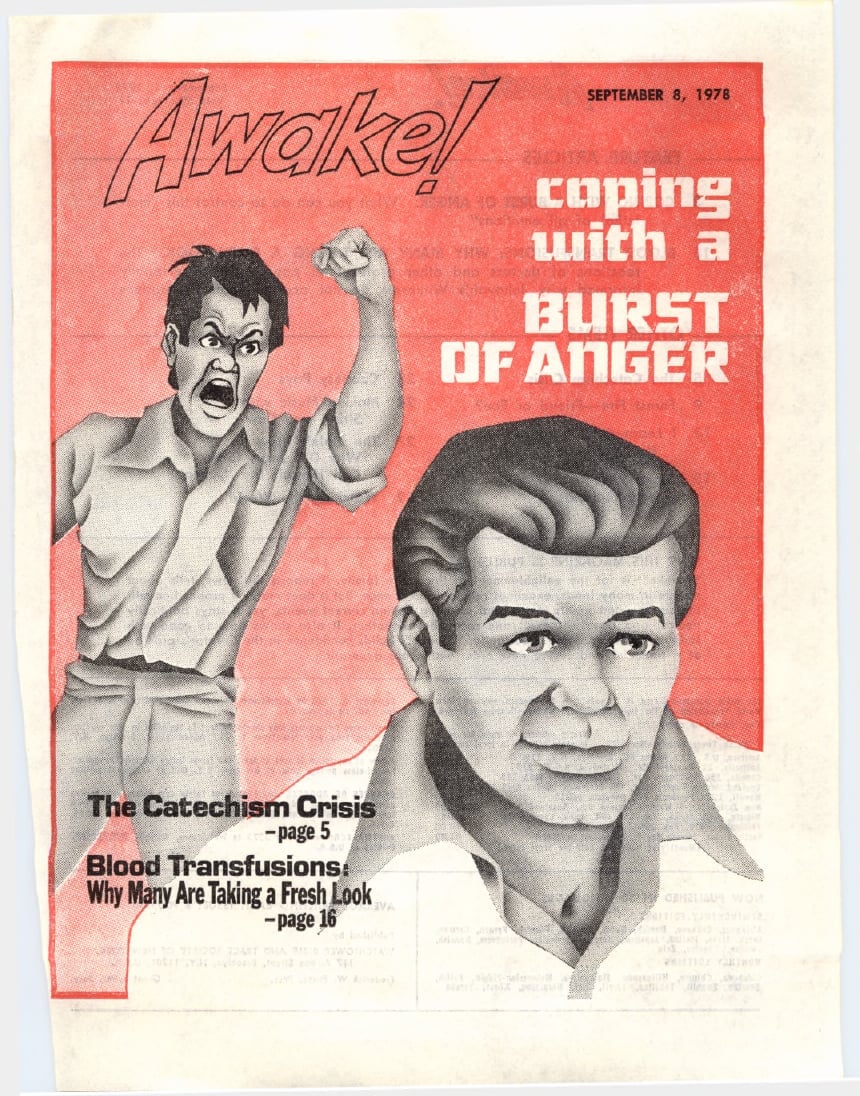
Awake! — September 8, 1978
Source: jw.org
Contents
Page Two
Coping With a Burst of Anger
The Catechism Crisis
Forest Fire—Friend or Foe?
I Learned to Treasure My Eyesight
Make Wise Use of Vacationlands
Blood Transfusions: Why Many Are Taking a Fresh Look
Courtesy Pays
Making Music with String and Bow
Why Did Jesus Christ Call Himself the “Amen”?
Watching the World
How Valuable Is Your Blood?
God Does Not Torment Souls
Page Two
Page Two
3 COPING WITH A BURST OF ANGER.
What you can do to control this “most lethal of all emotions”
16 BLOOD TRANSFUSIONS: WHY MANY ARE TAKING A FRESH LOOK.
The reactions of doctors and other professional people when personally informed why Jehovah’s Witnesses do not accept blood transfusions
Coping With a Burst of Anger
Coping With a Burst of Anger
THE subway train screeched as it slowed to enter the station. Two male riders exchanged words in a brief argument. Another man, of foreign extraction, interrupted, saying, “Shut up.” One of the arguers retorted: “Go back to your own country.” “You want me to make you [shut up]?” was the intimidating response from the 21-year-old foreign visitor. Now enraged, the man retorted: “You go right ahead—you’re a chump.” These were his last words, as the visitor whipped out a gun and, before the horrified eyes of dozens of subway riders, fired four shots into the man, killing him instantly. “Now you’ll shut up,” the young man said as he stepped out of the car and was arrested.
This incident illustrates one way of responding when one is angered. But what tragic results for both men!
Have there not been times when you were faced with biting remarks, perhaps even a verbal barrage delivered in a burst of anger? How did you respond? What is the best way to deal with such a situation? Is it, “Fight fire with fire”? There are those who feel as one editorial declared, “Why It’s Good to Get Good and Mad.”
A true-life story of an ancient monarch tells us of another way to deal with such outbursts. But at the very outset we might wonder whether it is a practical one in this age of violence.
King David of Israel and his entourage were fleeing for their very lives from his son who had just usurped the throne. They were suddenly confronted by Shimei, a descendant of King Saul. Shimei screamed:
“Get out, get out, you bloodguilty man and good-for-nothing man! Jehovah has brought back upon you all the bloodguilt for the house of Saul in place of whom you have ruled as king; and Jehovah gives the kingship into the hand of Absalom your son. And here you are in your calamity, because you are a bloodguilty man!”—2 Sam. 16:7, 8.
What a hateful outburst! And in the face of the king himself! So how would David cope with these fighting words? His military commander pleaded: ‘Let me go over and cut off his head.’
How would you have responded? Remember, here the man David was pressed to the limit. His people’s hearts had just been stolen from him. His son had turned traitor. His counselors had deserted him. He had lost his kingdom and now was being mocked and cursed! To be called a “good-for-nothing man” (“man of Belial” [Authorized Version]—a term that eventually was applied to the Devil) was the highest insult, for it meant a person of the lowest sort. David’s response, however, was simply:
“Thus let him call down evil, because Jehovah himself has said to him, ‘Call down evil upon David!’ So who should say, ‘Why did you do that way?’ . . . Let him alone . . . Perhaps Jehovah will see with his eye, and Jehovah will actually restore to me goodness instead of his malediction this day.”—2 Sam. 16:10-12.
David refused to respond with a verbal outburst, but uttered a mild reply. The results? First of all, no blood was shed. Then when David was restored to his kingship, who was among the first to greet him, to apologize and beg forgiveness? That’s right. Shimei.—2 Sam. 19:16-23.
‘But that was over 3,000 years ago,’ some will contend. ‘Times are different now. Be aggressive or people will walk on you. To answer mildly sounds nice, but it won’t help you today.’
However, this is not what knowledgeable people say. Note the following advice:
“If selfish people try to take advantage of you, cross them off your list, but don’t try to get even. When you try to get even, you hurt yourself more than you hurt the other fellow.”—Bulletin in a Milwaukee, Wisconsin, police station. [Italics ours.]
“The expression ‘I was so mad I could have died’ has a serious literal meaning, in the view of [a] psychiatrist [who] thinks ‘anger’ might well be listed as the cause of death in many cases, particularly among younger people.”—Family Health. [Italics ours.]
“Cardiologists have known for years that anger is one of the most lethal of all emotions. Heart attacks and strokes have often been preceded by an episode of severe emotional stress.”—New York Sunday News. [Italics ours.]
So the course pursued by David is recognized as practical. But how can you follow it? It is easy to talk about a ‘mild answer’ when nothing is irritating you and all is calm. What can be done when there is a confrontation?—Prov. 15:1.
By saying “Jehovah himself has said to him, ‘Call down evil,’” David acknowledged that he had sinned and was worthy of such chastening. However, he was not guilty of Shimei’s false charge (bloodguilt in connection with the house of Saul), for David had gone out of his way to avoid killing Saul. (1 Sam. 24:1-7; 26:7-11) Nonetheless, David had committed a sin with consequences such as this and was cognizant of his own guilt before God. (2 Sam. 12:10, 11) As one Bible commentator put it: “A humble, tender spirit will turn reproaches into reproofs, and so get good by them, instead of being provoked by them.”
Humility and our being aware that perhaps there could be a grain of truth in what our opponent may be saying, coupled with genuine consciousness of our own shortcomings, can keep us calm. If the accusation is totally baseless, as was Shimei’s, then recall that God’s view of us is far superior to the narrow opinions of others.
Because of our imperfection, there are times when we may become angered by another’s remarks. But do not despair. Even first-century Christian overseers once exchanged “a sharp burst of anger.” Yet, rather than cherish resentment, they solved the problem by appropriate action. (Acts 15:36-39) So can you. Sometimes physical activity can be an immediate help. No, do not do as one writer recommended: “Break pencils, go in the [rest] room and kick all the doors.” Rather, take a walk, throw a ball around or work in the garden.—Jas. 3:2.
David’s advice in Psalm 37:8 is: “Let anger alone and leave rage; do not show yourself heated up only to do evil.” Are there people today who endeavor to follow such good counsel? The experience of a man in the Fiji Islands—a person who violently opposed his wife’s studying the Bible with Jehovah’s Witnesses—gives an affirmative answer. He did everything from beating his wife and throwing her out on the street to disrupting a large gathering of Witnesses. Out of curiosity, he finally decided to attend one of their local meetings. He said:
“I was in great trepidation as to what reception the Witnesses would give me due to my treating them so shamefully before. This struck me: These people were kind to me without resentment. . . . the brother whom I had treated the worst of all offered me [a personal Bible study] and I accepted. Now I understand Jehovah’s great forgiveness for my maltreatment of his people and my wife.”
Now, as one of Jehovah’s Witnesses, this man is cultivating the fruitage of God’s spirit, including peace, long-suffering, kindness, mildness and self-control. (Gal. 5:22, 23) Indeed, developing such qualities is the best way to cope with outbursts of anger.
The Catechism Crisis
The Catechism Crisis
Did the original Christians use catechisms?
How divided opinions of the bishops have caused a crisis.
By “Awake!” correspondent in France
“THE revealed word should not be diluted and virtually destroyed by catechisms that are based on speculative, psychological and sociological ravings.” So spoke Cardinal Lorscheider of Brazil, head rapporteur of the Fifth Synod of Catholic bishops held in Rome from September 30 to October 29, 1977.
In Catholic usage, the word “synod” refers to “gatherings under hierarchical authority, for the discussion and decision of matters relating to faith, morals, or discipline.” (The Catholic Encyclopedia) The Fifth Roman Synod, at which 204 Catholic cardinals, archbishops, bishops and other ecclesiastical experts gathered, had as its theme “Catechesis, especially for children and youths.”
What is “catechesis”? According to the authoritative Dictionnaire de Theologie Catholique, “the word catechesis comes from the Greek verb katecheô, meaning literally to resound or to cause to resound and, figuratively, to teach by word of mouth or instruct orally, the teacher’s words resounding in reply to the student’s questions, and the student’s answers resounding in reply to the teacher’s questions. . . . Acts XVIII, 25 . . . Luke I, 4 . . . Gal. VI, 6.”
By way of explanation to our non-Catholic readers, a catechism is a manual, often written in question-and-answer form, used to teach Catholic doctrine, especially to the young.
The danger that God’s revealed Word might be “diluted” by Roman Catholic catechisms was well illustrated by an exhibition near the hall where the synod convened. It displayed over two thousand different catechisms, in 63 languages! And the differences were not only in language, but also in doctrinal content.
The Bible describes Christianity as “one faith.” (Eph. 4:4-6) But how can Catholics throughout the world have that faith if what they are taught from childhood differs from one country to another, or even from one diocese to another in the same country? It is no wonder that just before the synod a group of French priests and Catholic lay workers sent Pope Paul VI a letter bemoaning the fact that no single Vatican-approved catechism yet exists in France, and deploring “the poor quality of the teaching set forth in modern catechisms published under the auspices of the National [Catholic] Center for Religious Instruction.”
“The Blame Lies with Us Churchmen”
As far as religion is concerned, Catholic youths are confused. Surveys carried out even in Catholic countries invariably reveal that “unbelief is growing among the young and they are becoming increasingly skeptical toward any confession of faith.” (Le Monde, October 29, 1977) But how can youngsters in Catholic families be expected to have faith in God if, as Cardinal Hoeffner, archbishop of Cologne, Federal Republic of Germany, put it, they are fed “a horizontal mixture of psychology and sociology.” As a last resort before plunging into the bottomless pit of atheism, many young Catholics are turning to Eastern religions.
Whose fault is this? At the Fifth Synod, Cardinal Picachy, archbishop of Calcutta, India, blamed the Catholic Church itself, stating that it has “failed of its mission.” (Le Figaro, October 21, 1977) Cardinal Suenens, archbishop of Malines-Brussels, Belgium, joined in this ecclesiastical mea culpa (self-blame), first quoting Napoleon’s words: “There are no bad soldiers; there are only bad officers.” Then the cardinal added: “If so many youths reject the [Catholic] Church, is it not partly our fault? . . . The blame lies with us churchmen because in the eyes of the young, through ossification, formalism or inhibition, we reflect little or nothing of Christ’s true face.”
Archbishop Nguyen Van Binh of Vietnam “emphasized that it was important to talk to the young in the language of Marxism, for this was the only language they knew.” (London Observer, October 9, 1977) He stated: “As to the language used, it must be adapted to a new situation, even going as far as to use the Marxist vocabulary, imitating the [Catholic] Church of years gone by, when Saint Thomas [Aquinas, 13th century C.E. Catholic theologian] used Aristotle’s vocabulary.” However, this kind of talk was not to the liking of all prelates present in Rome for the Fifth Synod.
Reflects Two Trends of Thinking
The world catechism crisis actually reflects the general crisis within the Roman Catholic Church, caused by the profound disagreement between conservative, traditionalist Catholics and the modern, progressive Catholics. As might be expected, these two trends quickly manifested themselves at the Fifth Synod.
The traditionalists recommended publishing a common universal catechism for use throughout the entire Catholic Church. The progressives came out in favor of different catechisms and teaching methods in each country and even in each diocese.
The second trend won out. Reporting on this, the French provincial newspaper La Voix du Nord reported: “The majority [of the bishops] are of the opinion that cultural differences must be taken into account and that in each diocese the Christian message must be transmitted in a different way.”
That is tantamount to saying that God should have provided a different Bible for each country, indeed for each “diocese,” or jurisdictional district of a Roman Catholic bishop.
Some of the prelates present at the Fifth Synod in Rome advocated a catechism based more on the Gospel than catechisms had been in the past. That is quite a statement. But how can Catholics be sure that their youngsters will be taught from a catechism that is based on the Bible when each country or diocese is free to choose the one (or ones) it prefers? In spite of the Fifth Roman Synod, it appears that Catholics will continue to learn different things in different ways, depending on where they live.
Summing up the results of these special meetings of Catholic bishops at Rome, Le Monde commented: “To be truthful we must say that the catholicity [universality] of the Church is becoming increasingly difficult to observe. There is little unity of thought between Asian, African and Latin American [Catholicism]. . . . Such is the upshot of the 1977 Synod, that has left the priests and rank-and-file Catholics completely indifferent.” The same newspaper also stated: “In the nineteenth century the Church lost the working class people. In this twentieth century she is losing the young people, and this is even more serious.”
“All Christians Should Be Catechists”
Interestingly, the solution to the world catechism crisis was hinted at in a press conference given just before the close of the Fifth Synod. Cardinal Baggio, an influential member of the Roman Curia, spoke of the urgency of transmitting the Word of God in an understandable way, and added: “All Christians should be catechists and entice people to believe.” The Italian-language periodical Oggi remarked: “The recent Synod of bishops dedicated to religious teaching has revealed the Catholic Church’s consciousness of the following: the present unchristianizing, atheism and indifference are due to ignorance of evangelical teaching and tradition-based doctrine.”
Archbishop Benelli of Florence, Italy, made similar comments, emphasizing the need of “catechesis that provides continuous instruction from childhood and on through adulthood.” And the 18-point message published by the ‘synodal fathers’ at the end of the synod contained this as point number 12: “[Oral instruction] is a vital duty of the entire Church. This duty involves all the faithful, each according to his life’s circumstances and in accordance with his particular gifts. In fact all Christians, as a result of having received the sacraments of baptism and confirmation, are called upon to announce the Gospel and to be concerned about the faith of their brothers in Christ, above all the faith of children and youth.”
“No Longer the Same Necessity”?
Regarding religious instruction made available for converts to Christianity at the beginning of the Common Era, A Catholic Dictionary states: “From the beginning of her history, the Church fulfilled the duty of instructing those who came to her for baptism (Mt. XXVIII, 19, 20). . . . We can still form an accurate idea of the kind of instruction given in the early Church, for Cyril of Jerusalem [4th century C.E.] has left sixteen books of catechetical discourses, explaining the Creed [summary of doctrine] to the candidates for Baptism.”
What happened to this arrangement for Christian instruction? Why did it change from instructing people before baptism to formal schooling for children already baptized as infants?
The same Catholic Dictionary informs us: “When the world became Christian there was no longer the same necessity for instructing converts, but the children, and, indeed, the people generally, still needed catechetical instruction. Hence we find a council held at Paris in 829 deploring the neglect of catechetical instruction.”
So there you have it. On the assumption that the world had become Christian, the Catholic Church abandoned the early Christian practice of orally instructing converts who were preparing for baptism. And, judging by comments made at the recent Fifth Synod, the same situation exists today that existed in 829 C.E. Many Catholics are “deploring the neglect of catechetical instruction,” not only for the youngsters, but also for “the people generally.”
The need for true Christian instruction is more pressing today than ever before. By admission of its own clergymen, the Catholic Church is not filling that need. But there is a way that you can benefit from Christian teaching “of the Gospel and according to the Gospel,” such as recommended by Cardinal Lorscheider of Brazil; and indeed without cost to you personally.
In this regard it is interesting to note that in Bogotá, Colombia, the publication El Catolicismo reported that religious leaders in Spain held a conference where they discussed the weakness of the churches in contrast with the “successes” of Jehovah’s Witnesses. The conference noted:
“Perhaps [the churches] are excessively neglectful about that which precisely constitutes the greatest preoccupation of the Witnesses—the home visit, that comes within the apostolic methodology of the primitive church. While the churches, on not a few occasions, limit themselves to constructing their temples, ringing their bells to attract the people and to preaching inside their places of meeting, [the Witnesses] follow the apostolic method of going from house to house and of taking advantage of every occasion to witness.”
Would you enjoy having Jehovah’s Witnesses call at your home to conduct a free Bible study? If so, contact the Witnesses locally or write to the publishers of this magazine.
Forest Fire—Friend or Foe?
Forest Fire—Friend or Foe?
In the United States 2.25 million acres are burned annually by wildfires. But 2.5 million acres are deliberately burned annually by the Forestry Service. They have six reasons for doing it.
WHEN I first saw the fire it was five miles (8 kilometers) up the canyon. It was small and a long way off. Fires occurred frequently during the dry season in the mountains of southern California. So I watched it for a moment, then left to put out the nightly supper for the five or six raccoons that expected it, and the grain for the 60 to 90 quail that would be up early in the morning for breakfast. I didn’t give the fire a second thought.
I checked on it the next morning. It had spread. A wind was blowing. I heard sirens as a couple of truckloads of men sped up the canyon road to fight the fire. If necessary, a couple of planes would be dispatched to drop fire-suppressant chemicals on it. I spent a couple of hours watering the flower beds and slopes of ice plant that were just starting their fall blooming. In a few days I would have to deep water the hundred pine trees that I had planted during the 10 years that my wife and I had lived on the top of this hill overlooking the Big Tujunga canyon. Some of them down on the lane were now 40 feet (12 meters) high. But right now I had to go to prepare a site where I was to pour concrete tomorrow.
That evening my wife and I stood on one of the decks that projected out over the hillside. We watched the fire. It was much bigger now, whipped along by the wind, and was both beautiful and frightening. It was three miles (5 kilometers) away, and now I did give it a second thought. Still, it was high up on the ridge on the other side of the road from us, in the national forest, and no homes were threatened. And an army of men were fighting it. Anyway, I had cleared the brush back 100 feet (30 meters) from our house. We went to bed and quickly fell asleep.
During the night I was awakened by the slamming back and forth of the sliding screen door. Slammer, the raccoon, did this when the food bowl was empty. I went outside, got the bowl and went to the storeroom to refill it with dry dog food, and returned it to its place—Slammer trotting alongside me all the time. Two other raccoons had arrived. As they ate, I looked up at the flaming ridge. It was no longer an ordinary wind that was blowing, but a hot Santa Ana out of the northeast that was of gale force. It fed the fire with an excess of oxygen, whipped the flames forward at increased speed and preheated the fuel in the fire’s pathway.
Early the next morning I refilled one of the hummingbird feeders and held a finger over one of the perches. Soon a hummer sat on my finger and sipped sugar water. The fire was only two miles (3 kilometers) away, driven on by the Santa Ana that tore through the pines around our house. I went to work—very apprehensive. Many animals would flee out of the fire’s path, but in that rough terrain that was now an inferno hundreds of others were being burned alive—all because some campers five miles (8 kilometers) up the canyon had been careless with their campfire. Ninety percent of all wildfires are caused by man—burning matches; cigarettes; leaving campfires not completely extinguished; and fires deliberately set by incendiaries.
For three days this fire on the eastern ridge of the canyon had been burning out of control. When I got home in the afternoon, it had jumped the canyon floor, and the western ridge was aflame. Our home, on top of a small ridge in the canyon, now had fire on both sides. All the next day I watched as hundreds of men fought the flames. Helicopters landed men on firebreaks. Planes circled overhead, some mapping the fire’s spread and directing operations of ground crews. Others were from television stations that were filming for their evening newscasts. Several helicopters and air tankers were dropping water and chemical suppressants on the flames—dangerous work made doubly so by the gale-force winds.
Forced to Evacuate
The next day the fire fighters subdued the fire on the western ridge; but on the eastern ridge the flames raged unchecked. On the fifth night of the fire, we watched from one of our decks as the wind blew burning embers down the mountainside and new fires would break out a half mile below the main body of fire up on the ridge. These new outbreaks were perilously close to a tract with 200 homes. Some 20 fire engines set up battle lines around these houses. We went to bed, but I soon got up to keep watch. The fire was less than a mile away, and the burning embers were being blown in our direction. By 2 a.m. the fire had burned all around the tract of houses, had jumped the road, and was racing toward our hill.
I got my wife up, collected a few clothes, and we left—she in our car with our dog and I in my truck. The flames were up to the only road out and the heat was like that of a blast furnace as the firemen directed us out. Leaving my wife and our dog with a friend’s family, the friend and I returned. The road in was impassable. We hiked in a back way. When we reached the top of the ridge, I could see the other end of it, where our house was. Great torches of fire flamed upward—the pine trees were burning. By the time we forced our way through the chaparral and got up the driveway, most of the fire was out. Two cords of firewood were burning. A helicopter flew over and dropped 150 gallons (about 570 liters) of water on it. A fire truck was preparing to leave. I thanked the firemen for saving the house. “Don’t thank us,” one replied. “The rock roof saved your house.”
The flower beds, the ground cover, the rock garden with its waterfall—everywhere I looked there was blackened ruin. Black sticks rose skyward 20, 30 and 40 feet (6, 9 and 12 meters)—many being pine trees that I had nursed from three-foot (.9-meter) shoots. Even in the midst of the desolation, however, I felt grateful that the house was undamaged. With a chain saw I cut down over 50 charred trees, and then planted 100 more. New flower beds were made. Shrubs were planted. Two decks that were half burned up were repaired. The waterfall was restored; the house was painted. We survived. Life went on.
What about the wildlife? A week after the fire we were awakened by the screen door banging back and forth. Slammer was back! It was 3 a.m., but I was delighted! The raccoons, the quail, the hummers, the mice and pack rats, even the coyotes—all returned for their handouts—but not as many as before the fire. Not all had escaped the flames.
Friendly Forest Fires
A week after the fire a newspaper carried an article stating that the fire did a lot of good. The writer’s home was not involved, of course. I was not emotionally ready to be objective, but a few months later I did send to the Forest Service for a book published by the government. It is entitled “Forest Interpreter’s Primer on Fire Management.” Among other things, it presented the following facts:
More acreage in the United States is deliberately burned by government agencies than the acreage lost to wildfires. In 1970 wildfires burned 2.25 million acres, but 2.5 million acres (1 million hectares) were burned by what is called prescribed fire. There are several reasons for using prescribed fire, but six were highlighted in this publication of the Forest Service.
One is the use of fire to fight fire—more accurately, perhaps, using fire to prevent it. When forested areas are protected from fire, the underbrush builds up, or, in logging areas, slashings accumulate. Then if a wildfire starts, from lightning or other causes, the fuel buildup on the ground feeds the flames and leads to crown fires in the treetops, and a major disaster may occur. However, if prescribed fire is used at intervals, this dangerous fuel buildup never occurs and any fire that accidentally starts never becomes so serious.
Secondly, many commercially important softwoods need full sunlight for their seedlings to thrive. Also, the seeds need to be on mineral soil to germinate. Controlled burning of accumulated litter on the forest floor—grasses, needles, small shrubs—prepares the soil for seeding and also reduces serious fire hazard. The prescribed fire also helps reproduction of some types of pine and spruce that have serotinous cones requiring heat to open them up and free their seeds.
A third reason for prescribed burns is the control of insects and disease. In pine forests light surface fires will kill needles on seedlings infected by fungus, but will not injure the terminal buds. Oak trees can be saved from heartrot fungus diseases. The pine engraver bark beetles that hibernate in forest litter are killed by properly used fire. Where pines are grown as commercial crops, prescribed fire will clear out small hardwood saplings and thereby eliminate their competing with the pines for light and nutrients. The thin bark of hardwoods makes them susceptible to damage from fire, whereas the bark of pines is thick and heat resistant.
Another reason for controlled burning is the revitalizing of berry-producing shrubs, especially blueberries. In Maine this is regularly practiced. It rids the bush of old wood and causes vigorous new sprouts to shoot forth. Shading is reduced, providing needed light for the berry plants. These burns are recommended for every fourth spring for blueberry wildlands. Not only does man benefit by the increased berry production, but wildlife food supplies also are thereby increased.
In fact, the improvement of the habitat for wildlife is the fifth reason given for prescribed burning. It increases the yield and quality of grasses, herbs, legumes and browse, providing food for grazing and browsing wildlife, and also for cattle, sheep and goats that ranchers may run on government land. In various ways and in some situations these burnings also are beneficial for different species of birds. Annually, for wildlife purposes, the Forest Service prescribes burns for about 55,000 acres (22,250 hectares) of forest land.
The sixth reason given for prescribed burns is to increase the beauty and recreational value of parklands. The burns encourage the growth of herbs and wild flowers, and open up the forest floor for easy travel by visitors by removing thick underbrush. One of the most impressive trees is the giant sequoia, and about it and fire we read:
“The Giant Sequoias of California, until the recent employment of fire management, were being threatened with destruction from wildfires because of the huge buildup of forest fuels resulting from fire protection. Through thousands of years, light surface fires had always maintained these magnificent forests but fire exclusion was permitting other highly flammable species to invade the area. Presently, with the use of prescribed fire, progress is being made in reducing the fire hazard and the Sequoias are commencing to reproduce more abundantly on the exposed mineral soil.”—Forest Interpreter’s Primer on Fire Management, pp. 46, 47.
Forest fire—friend or foe? It can be either one. Under control, it can be very friendly. Out of control, like the one that ravished our pines and flowers and decks, and cut down the number of wildlife visitors that delighted us during our years on the hilltop, forest fire is a foe. This particular one removed the watersheds on the mountains. When the rains came, the mineral-rich topsoil eroded away and mud slides came down the hills, in many cases heavily damaging homes. Some forest fires are friendly, but not this one—not to me.—Contributed.
I Learned to Treasure My Eyesight
I Learned to Treasure My Eyesight
IT WAS a thrilling experience for me, a few months ago, to sit and watch the friends who had come to my “thanksgiving” party. I enjoyed it so much that I did not want the party to end. The “thanksgiving” was for the fact that I could see again, and as I contentedly watched them all happily talking and laughing, I thanked Jehovah that I could clearly see each one of them.
Even while I was watching them, however, my mind went back more than a year before, to the time that the doctor told me that my sister was dying of uremia. Soon afterward, my father died of a heart attack. Perhaps he was brokenhearted because of my sister’s serious illness. A month later, my sister died. Because of their deaths, when I had a health problem, it seemed sensible to go to a hospital in Manila for an extensive checkup.
I checked into the hospital at four o’clock one afternoon. After two days, I was about ready to go home, when I had a sudden, agonizing pain in my stomach and head. I called the doctor, and he gave me a tranquilizer. But the pain did not stop.
The back of my neck felt hot, and I closed my eyes. When I opened them again, everything was dark. I asked for the lights to be switched on, but they said the lights were already on. I started trembling, as I realized that I could not see! Once again, I closed my eyes and opened them again. There was a slight change. Now I could see a gray mist. I could not distinguish anything, but I could see a kind of stirring in the mist if something moved.
For a while, I thought this would pass. But it did not! When I realized that it was not going away, I became hysterical. I begged for help and cried bitterly until they had to give me oxygen. Then I prayed to Jehovah for aid and felt much calmer.
Encouraged by Friends
My eyes were examined repeatedly in the hospital, but all came to one conclusion: there was no organic disease! I became confused and felt that I was losing my grip on reality. My husband contacted some of our Christian friends, who quickly came to visit me. Their association encouraged me immensely. I started to feel better inside, and although my eyes did not improve, I forced myself to act normally so as not to add to the burdens of my husband, Manny.
There was no change in my condition in the hospital; so it seemed that I might as well go home. There some friends and my two children, King and Ruth, were waiting. For some time, there was no letup in the visits of friends from the different congregations. Some cooked, some cleaned, and some just chatted with me. All of this was very strengthening, but I knew that the brothers were busy too. So, eventually, I thanked them and said that since I had two big children (King was 15 and Ruth 13) they could help me now.
Living Without Seeing
There were times, when I was alone, that I could not help but weep a little, reflecting on the thought that there seemed to be no possibility of my eyesight’s returning. But then I would quickly pray to Jehovah and feel happy again. After all, my situation was not nearly as bad as that of the Bible character Job! Besides, I had two fine children and a wonderful husband. This in itself was cause for gratitude to Jehovah.
Around the house, I quickly got used to doing my usual chores. After about a month, I could do just about everything I did before, although not so quickly. I did the marketing with a companion Witness, and did the washing and cleaning alone. I also prepared and cooked food, although frying posed some problems. Sometimes I would be scalded with hot fat! I could tell when the food was cooked by tasting it.
Manny and the children agreed among themselves to treat me as they did before, and not as an invalid. So, just as before, they would say: “Mammy, give me some water, please,” or, “Honey, would you give me my socks?” And I was expected to do it! This did wonders for my self-confidence.
Nevertheless, I did need help, and my husband and children were very good. The children, particularly Ruth, benefited a lot. They had to take a larger share of the household responsibilities, and this taught them how to work. Often I would make mistakes, especially at first. When the children were at school, I sometimes tripped, cut myself or was bitten by the dog because I could not see to avoid him. But I tried to be careful, and had no serious accident.
I did learn to appreciate the other senses that Jehovah has provided. Lacking sight, my senses of hearing, touch and taste became keener. And my memory improved immeasurably. I was able to distinguish coins by feel, while I folded paper money in different ways according to its denomination so that I could recognize it by touch. Even now that I can see again, my memory is still very sharp, and my hearing quite sensitive.
Christian Activity
Manny and the friends in the congregation were a great help in my keeping on in regular Christian activity. I stayed up-to-date with the new publications because Manny would read them to me at night before we went to sleep. At the meetings I was able to comment, thanks to our advance study together. I joined in the singing too. My husband would quickly read to me the words to be sung. I would sing them out loud, while he quietly read the next line to me.
I was able to share in house-to-house preaching and continued to conduct a Bible study. Others, of course, would have to read the scriptures and the questions from the publication. But I would ask additional questions to highlight important points. In this situation, I was very grateful that I had used opportunities beforehand to study the Bible and build up a fund of knowledge! The lady with whom I conducted a Bible study had seemed a little indifferent previously. But after I became blind, she made very fine progress.
So my prayer was answered. I was able to keep on serving Jehovah and find joy and success in that service.
Eyesight Returns
For about eight months, I could see only that gray mist. I persevered in visiting various doctors and taking the medicines they prescribed, although there seemingly was no improvement. But about two months after I stopped taking the prescribed medicines, I felt a little better. Gradually, I could see vague shapes, and the gray mist disappeared. Though everything was still white, this improvement helped me in my washing and cooking.
A year passed. Although I could see some colors, I often felt dizzy, as if I were under water. Everything would move around and then disappear. Although my sight was still very weak, I could recognize people when they came close. Finally, during the 13th month of my illness, I looked at a can of cookies and was able to read the letters on the label. My sight had returned!
So there I was, sitting at my “thanksgiving” party, feeling intense gratitude to Jehovah for so many things. I was grateful, of course, for my returned sight. I was also grateful for all the things that I had learned because of having been blind for a period of time. I felt so much closer to my Christian brothers, because of the intense love they had shown me when I needed it most. I treasured very much the warm love that existed in our family. We were so much closer because of what had happened. Having had to rely heavily on Jehovah, I felt so much closer to him too. I could sense that my relationship with him had deepened. And I had learned that the most precious privilege we have is our service to him.—Contributed.
Make Wise Use of Vacationlands
Make Wise Use of Vacationlands
MAJESTIC mountains and verdant forests both have their own special beauty. Towering trees, high peaks and bold cliffs have defied wind, rain and snow for centuries. But at times they are marred by man. Hence, strict regulations have been put in force to preserve a number of these areas.
An example is the White Mountain National Forest, a vast wilderness of more than 730,000 acres (about 300,000 hectares) situated mainly in New Hampshire and partly in the adjoining state of Maine. Although not yet facing the great influx of visitors drawn to similar parks, the White Mountain National Forest is being overused, especially during summer months.
Problem of Preservation
Years ago, discerning individuals came to realize that wilderness vacationlands need protection from misuse by man. Hence, back in the early 1900’s, the United States Forest Service began setting aside certain scenic landmarks.
To keep them pleasant, however, your cooperation is also needed. As you hike through a national forest you may come upon ‘Restricted Use Areas.’ Possibly, fragile plants are sprouting. They may be capable of withstanding extreme weather conditions, but they cannot survive being trampled on. If plant communities are destroyed, surrounding soil succumbs to erosion.
Hikers are required to obtain ‘wilderness permits.’ This arrangement restricts the number of people permitted in particular areas. To illustrate: Part of the White Mountain National Forest is known as the Great Gulf Wilderness Area. There the limit per night is 60 persons. The maximum size group for hiking is restricted to 10, and people can remain in the area only four nights at a time. Permits for climbing are reserved no more than 30 days in advance. In some locations only overnight camps are allowed.
Are these restrictions unduly harsh? Well, did you realize that 62,000,000 people live within 500 miles (800 kilometers) of this forest? Failure to limit the number of hikers could result in trampling the plants out of existence.
Some Safety Tips
During the past 80 years, 43 persons have died in the Mount Washington area. So, visitors here and in similar areas are urged to do their utmost to ensure a safe trip. This calls for careful planning.
Study the latest guidebook and trail maps before beginning your trip and take note of alternative trail routes. Check weather conditions. Frequently, cold fronts and storms arise suddenly on Mount Washington, and these can spell disaster. It is important to carry extra clothing for the high altitudes. Include windbreakers, hats and gloves. Take along some high-energy foods, as well as some first-aid items. And don’t forget the shorter period of daylight during fall and winter.
Tell others where you are going. Leave with a family member or close friend a copy of the route that you plan to follow. Rather than trying to hike alone, keep together in groups of three or four.
Also, don’t forget to leave camping areas in good condition for the next group. A motto promoted by the National Forest Service is: ‘Take nothing but pictures; leave nothing but tracks.’ If you build a fire, rather than cutting wood from living trees, use wood that is dead or lying on the ground. Plan to carry your own garbage out of the area. And bury human waste away from water sources.
A trip to forested vacationlands can bring benefits in many ways. Properly controlled hiking in these areas is healthful. It causes more rapid circulation of blood that has been purified due to cleaner air. Seldom-used muscles get a workout and achieve better tone. Perhaps best of all, one can obtain a better outlook on life. Tranquil surroundings help chase away the anxieties and tensions of life in noisy, crowded, fast-paced cities.
Increasing numbers of people today enjoy hiking, camping, fishing, skiing or just taking a weekend drive through scenic national forests. Do you have similar plans for the future? We hope that this discussion will aid you to use such vacationlands wisely.
Blood Transfusions: Why Many Are Taking a Fresh Look
Blood Transfusions: Why Many Are Taking a Fresh Look
“SPREADING THE WORD ABOUT TRANSFUSIONS.” With this title, an article in Medical World News of November 28, 1977, informed thousands of United States doctors:
“This month, 370,000 U.S. physicians and hospital officials are being handed a 64-page pocket-size pamphlet: Jehovah’s Witnesses and the Question of Blood. A million registered nurses are getting the same booklet; so are 320,000 lawyers and judges, all from volunteer Witnesses by hand delivery.”
But the professional people in the United States were just a fraction of the total reached. The material was also provided in Canada, England, Finland, France, Germany, Italy, Japan, Sweden and many other lands.
All of us are interested in our health, conscience and fundamental rights. But we may ask: Why was this vast campaign undertaken? Was it important? How did those in the medical and legal professions react? What were the results?
As Medical World News noted, the special campaign had to do with a new booklet (and a four-page folder, to be added to a patient’s medical record) explaining why millions of Christians earth wide do not accept blood transfusions. The material also took up the vital moral and ethical implications for patients and doctors. And it presented thought-provoking evidence that the use of alternative therapies instead of blood transfusions has sound medical basis.
What Was the Response?
After reading the information a specialist in internal medicine in Berlin, Germany, said: “I find these explanations of great importance for every doctor. For the first time I understand your attitude, which I now can esteem and respect.”
The head of a medical clinic in northern Indiana told Mrs. Don Hahn: “The information in it is marvelous.” In fact, he said that he asked his associate physicians to read it. Some weeks later, Fletcher Earles needed surgery and approached one of the other doctors. The reaction? “There will be no problem.” The doctor said that the head of the clinic had had all of them study the booklet together. How did the surgery go without blood? Just fine.
In Curaçao, Netherlands Antilles, one of the leading surgeons told T. R. Yeatts: ‘I already have a copy of the booklet and have gone through it. You are right; blood is dangerous.’ He said that he, too, was operated on by Dr. Denton Cooley (of Texas) and so he read with interest the recent reports of hundreds of open-heart surgery cases that Dr. Cooley has handled without using blood. The doctor felt moved to offer a generous contribution to the work of the Witnesses.
Naturally, the reactions varied. Many doctors, lawyers and judges simply were polite, accepting and promising to read the material. A small number reacted very unfavorably, such as by saying that they were staunch members of such-and-such a church and would not read anything from another religion. Or there was the doctor in Seattle, Washington, who fumed: “I make my living giving blood transfusions; so I’m not about to read that!”
Those were exceptions, though. Many immediately sensed the value of the material. Upon seeing the title, a teacher of pediatrics at the University of New Mexico clapped his hands and said:
“I really do appreciate this. We have tried to teach our doctors to take a more liberal position toward Jehovah’s Witnesses; but, frankly, we were not sure just what our own position was. We have needed something just like this.”
Some doctors were so pleased with Jehovah’s Witnesses and the Question of Blood that they spoke enthusiastically about it to their colleagues. One doctor in Los Angeles, California, was given a booklet and two weeks later one of his associates was contacted. When the second doctor saw the booklet, he commented: “I was worried that you had forgotten me. I’ve been waiting for my booklet since I’ve heard so much about it! I’m going to read it right away and then keep it in my library for future use.”
Publicized and Welcomed
Many medical publications took note of the educational campaign. For example, Patient Care (Dec. 15, 1977) had an article on the uses of blood but added a special box entitled “When religious principle prohibits blood transfusion.” After mentioning that Jehovah’s Witnesses refuse blood for religious reasons and will sign a medically approved form releasing the medical staff and hospital of responsibility, the magazine urged readers to obtain a copy of the new booklet from the publishers. The Journal of the Medical Society of New Jersey, in its January 1978 issue, reprinted verbatim the four-page folder that each Witness will sign and have his doctor add to his medical record.
When a doctor in San Antonio, Texas, heard Patsy Cross mention blood, he said: “I’m the head of the blood bank here. What is it you have?” As she began to explain that she was one of Jehovah’s Witnesses, he happily interrupted: “I wondered when you would come! The notice came out in Texas Medicine that you would be coming by with some material. I’ve been anxious to get this. I’ve already seen and read part of this book and I sure would like to have one for myself. I’m very interested in the historical aspect. I hope that everyone gets one of these.”
Literally scores of doctors, lawyers, medical librarians and others wrote to the Watchtower Society for copies. For instance, an assistant professor of philosophy wrote from Pittsburgh, Pennsylvania:
“I teach a course in Medical Ethics, and am very interested in presenting the class with the problems which Jehovah’s Witnesses have in refusing blood transfusions. I would appreciate receiving a copy of your pamphlet.”
Others responded by letter after reading the booklet. Dr. L. H. Cohn, of Harvard Medical School Department of Surgery, wrote:
“Dear Sirs,
I recently received medical material regarding the relationship of Jehovah’s Witnesses to the question of blood transfusions. I certainly appreciate receiving this information and it will be of help for problems requiring open-heart surgery. We have done a number of open-heart surgical operations without the use of blood for many patients, not just Jehovah’s Witnesses, but we have operated on a number of your followers. Thank you once again.”
Dr. Richard Roelofs, Fellow in Bioethics, Montefiore Hospital and Medical Center, wrote us:
“I have read with much interest your recent publication . . . The issues and arguments discussed in this publication are of concern not only to physicians, but also to hospital administrators and to lawyers and philosophers engaged in the study of medical ethics. I could make good use of 25 additional copies.”
Many other hospitals and doctors contacted the local congregations of Jehovah’s Witnesses, expressing their appreciation and giving assurance of their willingness to cooperate. This even occurred with doctors whom the Witnesses were not able to contact personally and so they had to leave the material with the receptionist or nurse.
Some told of fine successes they had had in treating Jehovah’s Witnesses. An obstetrician-gynecologist in Delaware related:
“A pregnant Witness was brought to the emergency room of the hospital where I was working. She was hemorrhaging with what seemed to be the complication known as placenta previa. Though the staff had already cross-matched her for a transfusion, I respected her convictions and I treated her for shock. When examination showed that an emergency cesarean section was needed, I performed it. Her ‘blood count’ got to the critical low of 3 grams and the staff called a judge and over the phone got a court order to administer blood. But I refused because of her religious convictions and was advised that I might be arrested for contempt of court. With Dextran and iron injections she improved; her hemoglobin level came up. The mother and healthy child left the hospital in good condition.”
A staff doctor at the medical school of the University of California appreciated the booklet and related:
“Last year one of the world’s most distinguished surgery professors [here] did the exceedingly difficult Whipple operation for cancer of the ampulla of vater without blood transfusion, upon the patient’s insistence. I am happy to report that the patient made an excellent recovery.”
It is “exceedingly difficult” because it involves extensive abdominal surgery and reconstruction of the internal organs. Yet this doctor wrote that its being done successfully confirmed the view “that Witnesses can be operated on successfully without transfusions ‘by means of calmness, extreme carefulness and a measure of skill, in addition to good communications with the anesthetist.’”
Professionals Wanted to Help
Many professional people were so appreciative that they helped Jehovah’s Witnesses to carry out the campaign thoroughly.
A hospital in Newfoundland contacted our office there and requested “300 booklets to distribute to the nurses at the hospital.” A doctor at the Memorial University there wanted 65 additional copies for all the medical students. From Auburn, New York, comes a report of a student nurse who had nearly completed her schooling. She was so enthused over the information and so desirous of sharing it with others that “she took the booklet to college and had it mimeographed in its entirety. For the benefit of other student nurses she had copies posted on the bulletin board.”
When a representative of the University Hospital in San Diego, California, was asked how many booklets were wanted, the answer was 300 ‘so that all department heads and others who need the information will get them.’ The Witness calling had only 50 at the time, and had to return later with 250 more. A hospital administrator in Ann Arbor, Michigan, asked for 66 copies of the booklet and brochures. Then he sent a memo to all the other administrators regarding the visit they would receive. The Witness who followed up reports: “I received a warm and cordial welcome. They took about 30 to 40 copies each. They told me, too, that they would make this matter known in their regular meetings.”
One large hospital in Los Angeles, California, wanted 800 booklets to distribute with their payroll checks. An administrator at the Harbor General Hospital called to mind his experience with a Witness who had a terminal disease. With each of four operations ‘she had calmly maintained her position about blood, explaining her Bible reasons for it.’ He so admired her courage and positive attitude that when she finally died he went to her funeral, the Witness being the only patient whose funeral he had ever attended. He wanted 50 copies of the booklet for the department heads and assistants.
Nurses, too, benefited from such help. Rather than the few minutes requested, an administrator in Missouri spent an hour and a half inquiring of the visiting Witness. Expressing appreciation for “such needed understanding,” the administrator saw to it that every nurse would get a booklet. Then he arranged for three Witnesses “to speak for half an hour to all the nurses on the three shifts. The hospital even paid for the nurses’ time.”
Help of a different kind came from an official of a nurses’ association in Arizona. “Very impressed” with the material, she supplied 555 address labels so that all the nurses could be sent a copy.
Were Professional Views Affected?
The objective of distributing the material on blood was primarily informational. Yet many professionals formed new opinions.
Mrs. Beverly Perrin left a booklet with her pediatrician. A month later she brought her five-year-old girl Joy for a checkup. The doctor said: “You know, I couldn’t help but feel that whoever wrote that information ought to be the ambassador of the United States. They had a way of putting it so gently. Such a touchy subject; yet after reading it you could easily be convinced.”
Mrs. Robert Cartwright needed a major operation. She went to a surgeon in Philadelphia, Pennsylvania, but he said emphatically that he would not touch one of Jehovah’s Witnesses. He agreed, though, to try to find another surgeon, and he accepted the Blood booklet. A few weeks later the Cartwrights saw him again. He had not gotten another surgeon but said that he would operate himself. Why? He explained that he “read the booklet and got the point it was making. He would depend and trust in his surgical skills to operate without blood.” The surgery went well and Janice Cartwright recovered quickly.
The blood issue came up in Arizona regarding a premature, four-pound (1.8-kilogram) baby girl with liver trouble. Her parents, José and Carmen Sandoval, explained their beliefs to the doctor. Saying he could not accept their views, the doctor threatened to go to court to remove the baby from their custody. But he agreed to wait a little longer and to read the booklet. He was much impressed and showed a changed attitude. With skilled care the infant improved and is now in “bubbling good health.” The doctor? He told the Sandovals that if the blood issue came up again he would be more than willing to care for the girl.
A patient needing a hysterectomy explained to a gynecologist in Pittstown, New Jersey, that she could not accept blood. He responded unhappily, “Well, that’s one more risk.” Yet he agreed to operate and to read the booklet. The Witness relates:
“When the doctor walked into the operating room and saw some units of blood ready, he said loudly: ‘What’s that doing in here? Mrs. —— is a Jehovah’s Witness and she has the right to refuse blood. It’s against that right even to have it in here. I didn’t order it and I want it out of here.’”
She recovered and went home. Two weeks later she had to call a specialist about removing her daughter’s tonsils. Upon hearing about blood, he got quite upset and said, “I’m not going into an operation with my hands tied!” She mentioned the gynecologist and her operation without a transfusion. That brought a changed tone. Later, the specialist did remove the girl’s tonsils. Afterward, when the mother went back to the gynecologist for a checkup, he asked, “How did your daughter’s operation go?” How did he know of it? He answered:
“When you told her doctor on the phone that I did a hysterectomy without blood, you blew his mind. He came over here to me all upset. But I straightened him out. I gave him your booklet and told him that he had no right to force his moral opinions on you.”
Yes, the first doctor was convinced, and he helped to convince his colleague.
Some months before the campaign, Mrs. Hilda Meeks had explained her position to her doctor in Geneva, Ohio. Believing that his conscience would compel him to override her view, he urged her to find another physician. When the booklet became available, she took him a copy. Mrs. Meeks explains:
“The next morning the doctor’s nurse called and said: ‘The doctor has asked that you come by and pick up that little booklet. He is thoroughly convinced that he can go along with you on this issue.’”
A week after 100 booklets had been given to medical students and instructors in Gothenburg, Sweden, two Witnesses were invited to a discussion. Some students were quite critical, especially about a parent’s right to decide for minors. Then a surgeon instructor rose and said that the matter was much exaggerated, that a group of surgeons and chief physicians had agreed that blood transfusions were seldom necessary, even in cases where blood had been forced on someone. “Time upholds Jehovah’s Witnesses,” he added.
More Interest in Spiritual Things
A number of doctors and lawyers showed increased interest in spiritual matters after reading the Bible-based material.
Since the Blood booklet was distributed in Italy, one of Jehovah’s Witnesses has been discussing the Bible regularly with a neurosurgeon, who commented: “After a full day of hard work always handling physical bodies I feel the need to be interested in spiritual things.” From Avellino, Italy, a Witness writes: “I have started a regular Bible study with a doctor [who read the booklet]. He is a person extremely devoted to God, and has said: ‘I would like to be a man like you, completely dedicated to God and to His work.’”
Lorraine Sanchez presented the booklet to an attorney in Las Vegas, Nevada. Already having read a copy, he said:
“After you study to be a lawyer and pass your exams, you don’t really know all there is to know about law. Similarly, I feel that doctors don’t know all there is to know about blood. Each one’s blood is unique. Now I am beginning to learn how God feels about blood.”
His continued comments on the world situation led to a discussion of what the Bible says about our living in the “last days.” The Witness left him the book The Truth That Leads to Eternal Life. When, at his invitation, the Witness returned, the lawyer said:
“I have no objection to anything I read in that little book. I found some things very different from the religious beliefs I was brought up with. I told my wife that I want to be a Jehovah’s Witness. I have spent almost a lifetime studying all these books [pointing to his law library], and I have decided it’s not too late. I am going to study the Bible.”
The visitor explained the Bible study service that Jehovah’s Witnesses offer. He responded that his wife also was interested and he invited the Witness to come to his home to study with both of them.
Lawyers and Judges
Many others in the legal profession responded favorably to the campaign and the information in the Blood booklet.
Gregory King is an administrator connected with the New York State Supreme Court. Being a Witness, he gave a booklet to one of the Court justices, who then inquired at length about blood. Finally, the judge expressed amazement, saying that he never knew that Witnesses welcomed nonblood alternatives, and that he had mistakenly thought that they were fighting for some “right to die.” The justice commented that the presentation in court usually is one-sided. Feeling that other judges would like to hear the Witnesses’ side, he gave permission for the internal mailing system to be used to reach all the judges.
It was similar in Pasadena, California. After hearing what was in the booklet, a judge said: “I’ve always wondered why Jehovah’s Witnesses don’t take transfusions. Now I guess I’ll find out.” Though the Witness had asked for only a couple of minutes, the judge discussed the matter for over an hour and made it possible to get the booklet to all the other judges under his oversight.
…