Awake!, August 22, 1977
Download: PDF — Awake!, August 22, 1977
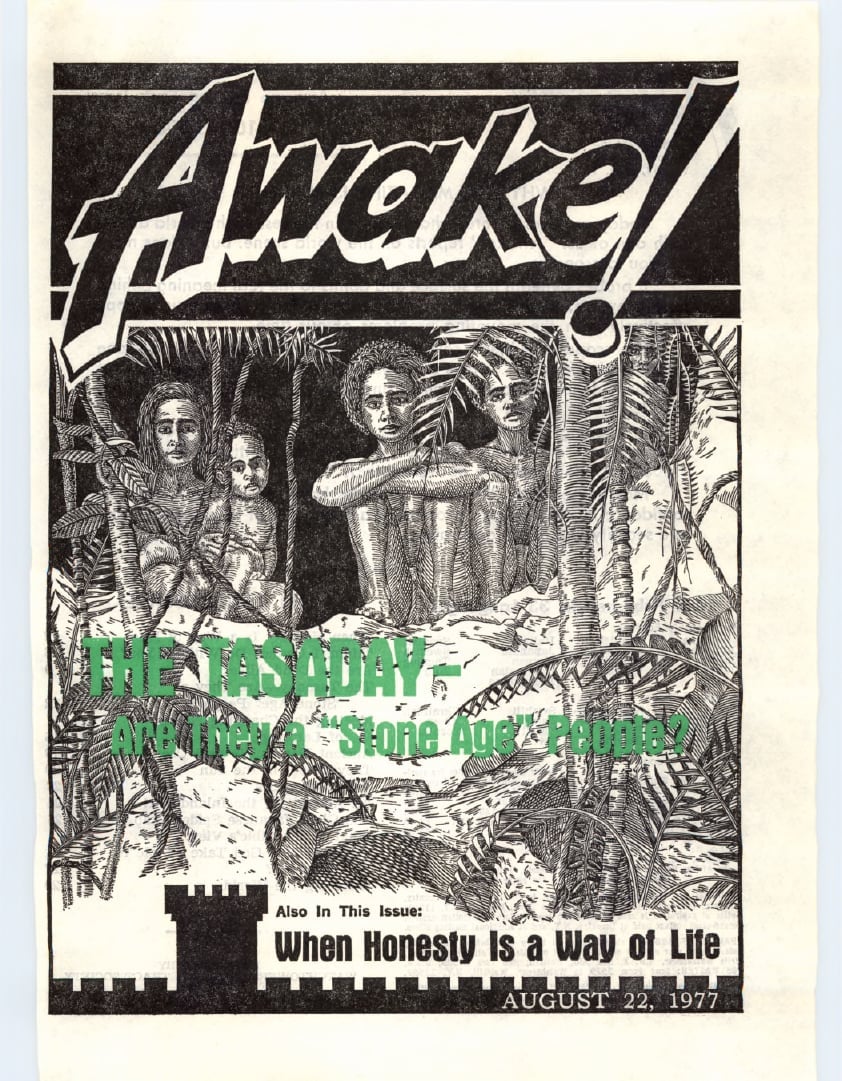
Awake! — August 22, 1977
Source: jw.org
Contents
When Honesty Is a Way of Life
Mom, I Cannot Do Without You”
Are the Dead Alive?
The Tasaday—Are They a “Stone Age” People?
Meeting the Changing Needs of Language
Ancient Names We Still Use
They Bloom in the Sun
A City on Stilts
All Aboard for the Inland Sea!
The Giant Japanese Spider Crab
The Benefits of “Foot Power”
Why Does God Take People to Heaven?
Watching the World
What Remedy for a World Torn With Violence?
A Bible You Can Understand
When Honesty Is a Way of Life
When Honesty Is a Way of Life
WHAT would you do if you found a bag lying on the street containing $25,000 in small denominations? A truck driver in Brooklyn, New York, recently faced this very situation. The bag had fallen unnoticed from an armored security car during a minor accident.
For turning this sum over to the police, the truck driver took a lot of ribbing from his fellow workers who reminded him of what they could and would have done with the money had they found it. Detectives investigating the incident stated that the truck driver’s honesty was “amazing for this town.” One further stated: “I’ve been on the force for eighteen years and I’ve never seen anything like it. And if I’m on the force another eighteen years I don’t think I’ll ever see it again.” Yes, for is it not true that hardly a day passes without reports of widespread dishonesty, cheating or corruption by all kinds of people?
Last year massive international bribery scandals shocked Italy, Japan, Belgium and the United States, among other lands. Former prime ministers, cabinet members and even a European prince were charged with extensive corruption. Hundreds of cadets at a prestigious U.S. military academy were exposed as cheaters and were expelled.
Wealth and status seem to have little to do with such dishonesty. Several prominent entertainment figures were prosecuted for using electronic devices called “blue boxes” to make lengthy long-distance telephone calls without paying. The head of a giant electronics firm resigned after admitting his failure to file income tax returns for five years, and a wealthy socialite pleaded guilty to charges of drastically reducing an invoice price to reduce customs duty on dresses from Paris.
It appears to many that opportunities for dishonesty seem to strike a responsive chord in just about everyone. When Clerks at a Paris supermarket recently staged a wildcat strike, for example, over a thousand customers walked off with more than $30,000 worth of merchandise before they could be stopped. The American Library Association estimates that about $250 million worth of books are stolen annually by all kinds of people, but the worst offenders, they say, are “student doctors and student lawyers”—the very ones expected to be examples of integrity.
Among many workers, reports the New York Times, “collecting unemployment compensation checks while avoiding employment appears to have become a way of life.” As one widely read news columnist puts it: “Everyone, it appears, is getting while the getting is good.”
“Sickness of Character”
But what about religion? Do the churches tend to restrain dishonesty among their members? Hardly, notes George Plagenz, religion editor for the Cleveland Press. “Cheating and other questionable conduct . . . takes in even esteemed members of the average church-going community.” Plagenz also makes the revealing observation: “It isn’t that they don’t consider cheating to be a sin. It is that they don’t consider what they are doing to be cheating.”
Hence, many who practice some form of dishonesty do not feel that what they are doing is actually wrong. Said one aircraft executive convicted of accepting bribes: “It’s in the framework of the job . . . it came naturally.” Those who make inflated accident-insurance claims often reason: “Insurance companies expect this sort of thing. They have it figured into their premiums. A person is a fool not to make a high claim.” But who pays in the end?
Some students feel that being honest puts them at an unfair disadvantage when everyone else is cheating. Other people believe that cheating your employer or the government is just correcting an injustice. Big business and big government cheat the average person, they reason; so why not get even with those who are always robbing you? “Anyway,” many believe, “they are so big that they will never miss the loss.” But, again, who pays in the end? Does not everyone pay through the higher prices such dishonesty causes?
Revealing the way some view their dishonest practices is an angry statement from a doctor convicted of making huge fraudulent medicaid profits. He told a U.S. Senate subcommittee that he had taken “advantage of a lousy system, and one that turned its back and didn’t look.” His attorney added that “they’re here to complain about a system that is so bad that it virtually invites those acts.”
But why should the system have to watch everyone? And is not complaining that the system “invites” dishonesty somewhat like a youthful thug who complains that the elderly people he attacks “invite” him to commit crimes because they make themselves such easy targets? No, the problem is not one of poor watchfulness by the system. “Somewhere is a deeper, more troublesome explanation,” observes a well-known news columnist. “This is a sickness of character, and God alone knows how we treat that.”—Atlanta Constitution, Sept. 2, 1976.
Curing Dishonesty
The fact is that God does know how to treat this rampant “sickness of character,” and is doing so among millions of people. Take, for example, the Brooklyn deliveryman who found that $25,000 bag of money and took it to the police. What was it that caused him to do so? The report in the Long Island Press quotes him as saying: “As a Jehovah’s Witness, I try to uphold the teachings of the Bible in my daily life. We point to Hebrews 13:18.” There the Bible says of Christians: “We trust we have an honest conscience, as we wish to conduct ourselves honestly in all things.”
Hence, the motivating power of the Bible’s principles can overcome the dishonest “sickness of character” that prevails among so many. People from all nations and backgrounds who truly make these principles their way of life are known for their honesty. For example, under the headline “Watchtowers Are Honest,”. Zambia’s leading newspaper, the Times, reported that the “Zambia Trade Fair management engages members of [Jehovah’s Witnesses] to man the gates because of their honesty.”
An official explained that, in the past, shortages as high as K500 ($769) occurred, while under the Witnesses the shortage was an “astounding 40n [62c].” “You can understand why the management prefers the Watchtower people,” noted the official. “They are so honest that for the past three years the management has had no problem with the takings.”—July 4, 1974.
It is not that these are just born as naturally honest persons. Many formerly were just the opposite. But these people are making their lives over to conform to standards of honesty that will soon prevail earth wide when God brings about his promised righteous system of things. The difference in personality of people living then will be so great that the Bible calls that system a “new heavens and a new earth” wherein “righteousness is to dwell.” Why not find out how this body of people have learned to make honesty their way of life?—2 Pet. 3:13.
Mom, I Cannot Do Without You”
Mom, I Cannot Do Without You”
By “Awake!” correspondent in Sweden
BIRTH is a revolution in the life of a child. The infant comes out of fluid and darkness into air and light. Breathing starts. Temperature control begins to function. The brain starts receiving entirely new impressions that must be sorted and filed away. The eyes have to get used to light, and the ears to completely new sounds. Nourishment must now be taken in through the mouth.
Before birth, the development of a baby is regulated by laws that link it to its mother. Is it reasonable to assume that these laws suddenly cease to apply right after the infant’s birth? Many researchers agree that during the child’s early life, mother and newborn baby interact harmoniously, as if according to some law. This is very important for the infant’s continued development.
The Law of Interaction
Just after birth, the law of interaction begins to apply. It is reflected in the mother’s instinctive desire to hold the child close to her, and the child’s searching for the mother’s breast. When the baby’s chin touches the breast, the infant starts a head movement toward it until the mouth finds the nipple. The child’s mouth opens, sucks with the tongue as a pump, and then closes. The swallowing mechanism begins to work. The baby’s sucking triggers a reflex action in the mother, causing the uterus and cervix to contract. This contributes toward helping these organs to return to their original form.
Newborn babies are not, as many believe, passive or lazy. Just as the infant eagerly sucks milk, it actively takes in information from the world surrounding it. The cells of the nervous system are molded by the information that is received and processed by the brain. It is vital that the infant get just the right amount and the right kind of information. This is so because the most important period of the brain’s development comes during the last three months of pregnancy and the first fifteen months of life.
Especially while nursing, the infant receives much important information about the outside world. All the child’s senses are stimulated at that time. The infant perceives the warmth and smell of the mother’s skin. It feels her with its sense of touch. The baby looks almost continuously at her face as she feeds it. It listens to her voice and heartbeat. The sense of balance is stimulated in the nursing position—the fluid in the inner ear is set in motion—one of the many stimulations necessary for the brain to develop properly.
Also, the child must work hard to get food from the breast. This lays a basis for the child’s power of concentration and endurance, abilities that must be developed. A nursing child that gives up too easily risks its life. Here the mother is truly needed.
The Infant’s Sight
The visual power of a young child is much greater than once thought. Recent experiments show that the world of the newborn baby is not a diffuse, gray mist without contours. Examination of newborn infants has shown that the gaze fastens preferably on complex patterned surfaces rather than on plain ones. A frontal view of the human face turns out to be the most stimulating and attractive visual object for the infant.
Psychologist R. L. Fantz made a thorough test of forty-nine babies from four days to six months of age to find out their visual interest. He had them look at several test objects, including a human face. What were the results? The infants of all age levels showed the greatest interest in the face pattern. Fantz concluded: “Innate knowledge of the environment is demonstrated . . . by the interest of young infants in kinds of form that will later aid in object recognition, social responsiveness and spatial orientation.” So, it seems that from birth we search for the important, stimulating and meaningful human face.
Since the activity of a person’s pupils turns out to be a measure of the brain’s intellectual and emotional activity, much research work has been done regarding pupil reflexes in small children. One researcher found that the sight of the mother’s face caused the greatest dilation of the pupils even in infants less than one month old. Often it is the mother’s face that prompts the first smile, a reaction unique to humans and a sign of good emotional activity in the brain. So, it may be that a very important function of the mother is to provide stimuli that play a role in the maturing of the child’s nervous system.
Its Hearing
Not only do the visual impressions originating with the mother cause the infant to smile or react in other important ways, but sound also is important, and it is the female voice that provides the best stimuli. How vital, then, is the mother’s warm, quiet talking to her baby, or her soft cradle song!
When the baby cries, the mother instinctively picks it up and usually holds it to her left breast. This enables the baby to hear the heartbeat—something of no little importance in the infant’s development. Experiments with children indicate that those who were allowed to listen to normal heartbeats increased in weight, cried less and slept better than children who were not permitted to hear such sounds.
Skin Contact and Stimulation
The feel of the mother’s skin evidently also plays a role in the child’s development. Child psychologist Anne-Marit Duve observes: “Since the activity of the pupils clearly shows the degree of brain activity, we have reason to believe that a high degree of skin stimulation, a high degree of contact—not the least the contact connected with nursing—can stimulate the mental activity, which in turn can lead to greater intellectual capacity in adulthood.” So, when the child is picked up, patted, bathed and dried, the mother’s touch stimulates its skin in a way that may be of great importance later in life.
Father and Mother Equally Important in Different Ways
Many researchers agree that the child must be bound to one person by close ties and must establish a “one-to-one” relationship with someone in order to be able to develop further in all aspects of life. It is most natural and biologically most correct that this relationship be established with the mother. However, it is agreed that the father’s role is at least as important, though it is different. The father’s role, among other things, is to use his usually superior physical strength and his constructive mental faculties to build up the conditions necessary to make the close relationship between mother and child as effective as possible.
We recognize this pattern from ancient times. In the past, the mother almost always had her child with her wherever she went. She often carried it, perhaps on her back, while working. She lifted it up, rocked it, cuddled it, sang to it and pressed it to her breast. The father, on the other hand, provided for the family materially and brought from the outside world information that his children needed.
This is the pattern of life that the Bible describes as existing among the Hebrews. There was a special closeness between the mother and the children. Hebrew mothers breast-fed their children until they were about three years old, or even five years of age. After the child was weaned, the father began to look after its upbringing and education.
Today, however, children often are with baby-sitters, or in day nurseries and nursery schools. They spend much of the active part of the day with people other than their parents. But when circumstances do not require this, is it wise? Many people wonder whether this pattern of life has not increased mental problems, including depression, among children. Child psychologist Anne-Marit Duve states: “Clinical experience leads me to suggest that much sorrow is lying and fermenting in many young minds because the bearers of them have, early in life, lost their most important foundation in life—their mother.”
Recent research appears to indicate that the woman who wishes to have children must accept her role as a mother for the sake of both herself and her children. It is not just a matter of physical pregnancy and then giving birth. Apparently another “pregnancy,” which researchers call “mental pregnancy,” takes over immediately after birth and continues until the child is fully developed. This “pregnancy” also is connected with the mother.
How truly important a mother’s role is! The statement, “Mom, I cannot do without you,” is no exaggeration. It is clear that our Creator, Jehovah God, had in mind distinct roles for men and women. When their respective roles are rightly esteemed, parents are able to give their offspring the best possible basis for a good start in life.
Are the Dead Alive?
Are the Dead Alive?
THE desire of humans to remain alive is strong; so strong, in fact, that throughout history mankind in general has been reluctant to accept death. Funeral customs ancient and modern suggest not only that the dead are alive, but also that they can influence humans, either for good or for bad.
Regarding beliefs of the ancient Babylonians, Professor Morris Jastrow, Jr., writes in The Religion of Babylonia and Assyria:
“It must not be supposed that the denial of immortality to man involved the total extinction of conscious vitality. Neither the people nor the leaders of religious thought ever faced the possibility of the total annihilation of what once was called into existence. Death was a passage to another kind of life, and the denial of immortality merely emphasized the impossibility of escaping the change in existence brought about by death. . . . The Babylonian religion does not transcend the stage of belief, characteristic of primitive culture everywhere, which cannot conceive of the possibility of life coming to an absolute end. Life of some kind and in some form was always presupposed.”
Funeral Customs at Babylon
According to the view of the ancient Babylonians, at death humans enter Arallu, “the desolate land,” where they continue alive in a dreary existence. “The body, in which the departed soul had still a lively interest,” notes Hastings’ Encyclopædia of Religion and Ethics, “was either buried or burned, and the kinsmen supplied it with food, drink, clothing, and the implements which characterized the occupation of the person on earth. Cremation and body-burial existed side by side from the earliest times.”
According to the same reference work, even in cases of cremation food and other items accompanied the remains. “The ashes were gathered carefully in an urn, in which jars of drink (beer in the early period, water in the later), bread, etc., were placed, to provide for the immediate needs of the soul.”
Not only did the ancient Babylonians believe that the dead were still alive, but they also believed that humans could communicate with and be influenced by them. The custom developed of offering monthly communion sacrifices to the “shades” of dead ancestors.
Professor Jastrow points out that an important factor in the honors paid by the living to the memory of the deceased was fear. Yes, fear prompted the living to engage in various rites associated with the dead. Professor Jastrow said in this regard: “To provide the dead with food and drink, to recall their virtues in dirges, to bring sacrifices in their honor,—such rites were practised, as much from a desire to secure the favor of the dead and to ward off their evil designs as from motives of piety, which, of course, were not absent. The dead who was not properly cared for by his surviving relatives would take his revenge upon the living by plaguing them as only a demon could.”
Disposal of the Dead in Egypt
Similar attitudes toward the dead prevailed in ancient Egypt. H. R. Hall, a specialist on Egyptian antiquities, writes: “That he who had been alive was now absolutely and irrevocably dead was as inconceivable to the childlike mind of the oldest Egyptian as it was to that of any other primitive man. And among this most conservative of all races, the primitive idea merely became more elaborate and overgrown with ritual as civilization progressed.”
When it came to funeral procedures, the Egyptians went beyond the Babylonians. In ancient times Egyptian slaves were strangled and buried along with their masters in order to serve them after death. Burial of persons connected with royalty came to include a vast array of objects. H. R. Hall gives some examples:
“There were stacks of great vases of wine, corn, and other food, covered up with masses of fat to preserve the contents, and corked with a pottery stopper, which was protected by a conical clay sealing, stamped with the impress of the royal cylinder-seal. There were bins of corn, joints of oxen, pottery dishes, copper pans, and other things which might be useful for the ghostly cuisine of the tomb. There were numberless small objects, used, no doubt, by the dead monarch during life, which he would be pleased to see again in the next world—carved ivory boxes, little slabs for grinding eye-paint, golden buttons, model tools, model vases with gold tops, ivory and pottery figurines, and other objets d’art, the golden royal seal of judgment of king Den in its ivory casket, and so forth.”
Have you ever seen a picture of the huge Egyptian pyramids? These are luxuriously furnished tombs for dead Egyptian royalty. The Great Pyramid near Cairo is 146.59 meters (481 feet) high. Each side measures 230.35 meters (756 feet) long. Made up of more than two million stones weighing up to two and a half tons each, in area this massive structure covers 54,000 square meters (about 13 acres), enough to hold ten football fields. Attached to the pyramids were temples to promote worship of the dead Pharaohs.
Outstanding among Egyptian burial customs was preservation of the body through mummification. Greek historian Herodotus, who was an eyewitness of this process, mentions three methods, the most costly of which he describes in this way:
“[The embalmers] take first a crooked piece of iron, and with it draw out the brain through the nostrils, thus getting rid of a portion, while the skull is cleared of the rest by rinsing with drugs; next they make a cut along the flank with a sharp Ethiopian stone, and take out the whole contents of the abdomen, which they then cleanse, washing it thoroughly with palm wine, and again frequently with an infusion of pounded aromatics. After this they fill the cavity with the purest bruised myrrh, with cassia, and every other sort of spicery except frankincense, and sew up the opening. Then the body is placed in natrum [subcarbonate of soda] for seventy days, and covered entirely over. After the expiration of that space of time, which must not be exceeded, the body is washed, and wrapped round, from head to foot, with bandages of fine linen cloth, smeared over with gum, which is used generally by the Egyptians in the place of glue, and in this state it is given back to the relations, who enclose it in a wooden case which they have had made for the purpose, shaped into the figure of a man. Then fastening the case, they place it in a sepulchral chamber, upright against the wall.”
What was the purpose of this elaborate embalming procedure? The ancient Egyptians believed that humans were made up of several parts. There was the ikhu (spark of intelligence), the ba (birdlike soul), the ka (the individual’s double that accompanied him while on earth) and the khaibit (his shadow). These were believed to separate from the body at death. In early times Egyptians believed that the soul of a dead person wandered through the underworld or through the desert during the day. But at night or in times of danger it would return to the body. Likely this was an important reason why such pains were taken to preserve the body.
Belief that the dead are alive has survived even down to our day. “Among many peoples,” declares the Encyclopædia Britannica, “the belief that the dead actually dwelt in their tombs has caused the tombs of certain holy persons to become shrines, which thousands visit to seek for miracles of healing or to earn religious merit; notable examples of such centres of pilgrimage are the tombs of St. Peter in Rome, of Muhammad at Medinah, and, in ancient times, the tomb of Imhotep at Saqqarah, in Egypt.”
The Bible’s Unique View
Contrasting with these complex burial procedures is disposal of the dead by the ancient Israelites. Says the Encyclopædia Judaica: “Archaeology reveals no distinctively Israelite burial practices during almost the whole of the biblical period. . . . The [Mosaic] law says relatively little about burial, and where it treats the subject, the concern is to avoid defilement by the dead (Num. 19:16; Deut. 21:22-23). The dead do not praise God, they are forgotten and cut off from His hand (Ps. 88:6, 10-12), and in consequence mourning and the burial of the dead are at most peripheral matters in Israelite religion.” So inconspicuous were Jewish burial places that Jesus could speak of “memorial tombs which are not in evidence, so that men walk upon them and do not know it.”—Luke 11:44.
This highlights the fact that concerning death the Bible presents a unique view. In both the Hebrew and the Christian Greek Scriptures death is likened to a sleep in which the deceased “are conscious of nothing at all.” (Eccl. 9:5; Ps. 13:3; John 11:11-14) Persons dying go into the “dust of death,” becoming “impotent in death.”—Ps. 22:15; Prov. 2:18; Isa. 26:14.
What about the soul? According to the Bible, the soul is not a part of a person, but is the entire person. (Gen. 2:7) When an individual dies, therefore, the soul dies. Hence, we find the prophet Ezekiel condemning those who connived “to put to death the souls that ought not to die” and “to preserve alive the souls that ought not to live.” (Ezek. 13:19; 18:4, 20) In agreement with many current Bible scholars, Professor Edmond Jacob of the University of Strasbourg flatly states: “No biblical text authorizes the statement that the ‘soul’ is separated from the body at the moment of death.” Did you know that?
Since the dead are not alive they cannot harm persons on earth. Nor can they be helped by religious ceremonies performed by the living. The Scriptural hope for the dead is not by the survival of a nonexistent immortal soul, but by a resurrection. That means a returning to life of the whole person, as happened with those whom Jesus raised from the dead. (Luke 7:11-17; 8:41, 42, 49-56; John 11:1-44) Would you not like to learn more about this Bible-based hope? If so, ask the publishers of this magazine to help you.
The Tasaday—Are They a “Stone Age” People?
The Tasaday—Are They a “Stone Age” People?
By “Awake!” correspondent in the Philippines
“A MODERN relic of the Stone Age”; “The most primitive human beings so far discovered”; “The first known living ‘cavemen.’” Through such newspaper reports, worldwide attention was focused on a twenty-five-member tribe living in the dense jungle of Mindanao in the southern Philippines. Their discovery led to the forming of several expeditions composed of Filipino and American anthropologists, news correspondents, television crews of the National Geographic Society, a cabinet minister of the Philippine government, and an American conservationist, the late Charles A. Lindbergh.
Why should such a small group of people as the Tasaday attract such unprecedented interest and attention? What makes them so special? Can modern, civilized society learn anything from this tiny primitive band?
Discovering the Forest People
Discovery of the Tasaday was quite accidental. Sometime in 1966, a hunter from a town at the forest’s edge stumbled upon them while laying his wild-pig traps deep in the mountains of South Cotabato. Following a trail of strange footprints, he came upon three small brown men wearing only loin coverings made of leaves. With sharp sticks they were digging up a large root. Startled, they fled. But the hunter gave chase, calling out: “I am good! I am good.” Finally, the men stopped in a stream bed, trembling.
Although the tongue spoken by the hunter was related to that of the Tasaday, he resorted to sign language because of difficulty in communicating. The hunter’s tribe practically lives back to back with the Tasaday, but the difference in their languages can be compared to that between early German and today’s English. Scientists have deduced that this suggests an isolation of about a thousand years. Why, the very name Tasaday (pronounced Taw-sawdai), combines the Malay word sadai (“abandoned”) and the Malayo-Polynesian word tawo (“man”)! Tasaday is also the name of the forested peak rising above their hidden valley. So complete has been their isolation that, when first contacted, they knew nothing about a nation called the Philippines.
The existence of this tribe became known to outsiders through the efforts of Panamin, a government agency working for the interests of cultural minorities in the Philippines. During early meetings between the hunter and the tribesmen at the forest’s edge, it was not known that they lived in caves, and there were no immediate attempts to go deep into the rain forest. The latter decision to visit the caves was made to protect the Tasaday from loggers, farmers, ranchers and miners who were nibbling away at their shrinking realm. Not long thereafter, the president of the Philippines signed a proclamation reserving some 200,000 hectares (nearly 500,000 acres) of land for them.
Entering the World of the Tasaday
March 23, 1972, marked the intrusion of the first outsiders—and of the twentieth century—into the world of the Tasaday. The helicopter was the only means of transportation that could effectively bring the expedition to within walking distance of the caves. Since the thick jungle made a ground landing impossible, a wooden platform was lashed to a treetop. The members of the expedition had to jump from the hovering helicopter onto the rickety landing pad that was rocking like a canoe in choppy water due to airblasts from the rotor blades. Lindbergh said his jump was “like passing through the looking glass” from modern to ancient times.
From the treetop, the group descended seventy-five feet (23 meters) to the ground below. There they were met by a young Tasaday man wearing only his leaf G-string. An hour’s hike down a ridge and along a sparkling stream brought the party to the home of the Tasaday: three limestone caves located 15 feet (5 meters) from the ground at an altitude of 4,500 feet (1,370 meters). Here they were, deep inside a tropical rain forest—damp and teeming with plant life. All around were giant ferns and orchids, rattan, climbing bamboo, wild banana and palm, as well as huge, towering dipterocarp trees shooting skyward to spread their canopies a hundred feet (30 meters) or more above the sides of the sloping valley.
Heads poked curiously from the ledges of the caves, as eyes scrutinized the first strangers ever to set foot in this hidden valley. A boy stepped from one of the caves, wrapped his arms and legs around a slender, white-barked tree and slid fifteen feet (5 meters) to the ground. He joined others who were shouting and bounding down a dusty path to cluster around the visitors. The outsiders were speechless as the scene unfolded! Here were men, women and children wearing only earrings and orchid-leaf G-strings and skirts, a handsome people with tanned skin and soft dark hair. They were a far cry from the hairy, lumbering apelike creatures depicted by evolutionary artists. No, the men do not hit their women with clubs or drag them by the hair. These are probably the gentlest people on the face of the earth.
The Tasaday Way of Life
When discovered, the tribe was composed of five families with thirteen children. The Tasaday practice monogamy, with no expectation of divorce and no provision for it. Couples mate for life—“until all our hair turns white,” said Kulataw and Sikal, one of the Tasaday couples. Marriages are solemnized mainly by a meeting of the tribe at the mouth of their main cave, where a group forms around the new couple and simply says, “Mafeon, mafeon” (“Good, good”). Brides also have been taken from Tasafang and Sanduka mountain groups, with whom the Tasaday have dealt on a limited basis.
A close look at the caves, the biggest of which was thirty feet deep and thirty-five feet wide (9 x 11 meters), was revealing. The walls have no drawings or markings, and the floor is swept clean by branches, leaving no debris. There is no furniture, except for a few bark mats. Also on hand are pieces of dried firewood and some bamboo, wooden and stone tools. The cave walls gleam like varnished coal due to years of exposure to soot from the fires used for cooking and heating the caves during the chilly evenings.
The gathering of food constitutes the day’s major activity, and it requires team effort. Normally three hours are spent in foraging, and the menu depends upon what they can gather: crabs, fish and tadpoles, which the Tasaday catch simply by feeling under and around stream rocks with their bare hands. The people have no knowledge of agriculture, gathering only what they need when it is available. Their diet indudes fruits, berries, flowers, bamboo shoots, yams and the pith of the wild palm prepared into a starch cake called natak. Food is cooked inside bamboo tubes or in leaf packets placed right on top of the glowing coals. Incidentally, fire is made by rotating a wooden drill between the palms until friction causes its base to smolder. Then tinder of dry moss is applied, and when this ignites, it is blown into a flame. The whole process takes about five minutes.
Because of the abundance of food, the Tasaday do not stray from their habitat like nomadic tribes who ‘pull up stakes’ when food runs out. The whole forest is a Tasaday “supermarket.” It is said that they have not ventured more than five miles (8 kilometers) from their home. “Our fathers and grandfathers told us we could go out into the forest at daytime, but must always return to the caves at night,” said one of them. It is thought that perhaps misunderstanding, war or fear of the smallpox plague (fugu) caused the Tasaday to cut off contact with the other Manobo tribes from which they originated.
With the midday meal over, the afternoon is spent resting, sleeping or ridding one another’s hair of dry leaves, twigs or lice. At play, one boy was seen flying a pet butterfly on a string, much as one would fly a kite. Their needs are simple, and they have no words for rice, salt, sugar, needle or tobacco. Although the Tasaday diet is low in calories (1,000 to 1,500 a day), among them there is no malnutrition, no tooth decay, no malaria and no tuberculosis. When the visitors asked them what they wanted, they answered, “What do you mean ‘want’?”
The Message of the Tasaday
The Tasaday also do not have any word in their language for fighting. They have no concept of war and do not have any idea of violence. Manuel Elizalde, Panamin head and the cabinet minister who led the expedition, stated: “They don’t know all the problems that send people into insane asylums and start wars and feuds and everything. All these things are foreign to them.”
Evolutionists thought that the discovery of the Tasaday would be “a shot in the arm” for their crumbling theory. But, despite being virtually cut off from civilization for centuries, the discipline and uprightness of the Tasaday combine to prove that man is not simply a higher form of animal. Unlike animals, he possesses the faculty of conscience, and also has the urge to worship. Interestingly, this need to worship became evident in the way the Tasaday regarded cabinet minister Elizalde. They believed that he was the “white god” who was to descend on their homesite one day and pay them a visit.
It is noteworthy that a people cut off from modern technology and all its conveniences could still emerge from their isolation in good mental and physical health, and with fine moral values, whereas “civilized” man today is beset with problems of mental and physical illness, earth-wide pollution, a moral breakdown and a constant fear of war.
Some pity the Tasaday because they lack worldly comforts and sophistication. Yet, thinking people may envy them for their uncomplicated way of life, being reminded of what God’s Word, the Bible, says: “We have brought nothing into the world, and neither can we carry anything out. So, having sustenance and covering, we shall be content with these things.”—1 Tim. 6:7, 8.
Meeting the Changing Needs of Language
Meeting the Changing Needs of Language
MONSIEUR BOULANGER, an ordinary man, created the need for a new word. He opened a shop where prepared meals could be bought and eaten on the premises. To attract famished survivors of the Seven Years’ War (1756-1763) who then swelled the streets of Paris, Boulanger hung a sign over the door that said in Latin, “Venite ad me omnes qui stomacho laboratis et ego vos restaurabo.” That meant, “Come to me all ye that suffer from the stomach and I will restore you.” So this establishment, designed to restore its clientele, was, quite naturally, termed a restaurant, which is French for ‘that which restores.’
Monsieur Boulanger’s unwitting contribution to French, and eventually to English and other tongues, illustrates how language grows in response to changing needs. But exactly what is language? Simply stated, it is “the words, their pronunciation, and the methods of combining them used and understood by a considerable community.” A language will grow, change, diminish, or even disappear according to the circumstances of the community using it, as well as the pressures and demands that are made on it. Language changes constantly. New words are added daily, while others fade and eventually vanish from common usage.
The English language is one of the richest in the world. It has borrowed from almost every language known to mankind. While many authorities estimate that there are up to 600,000 words in English, this does not take into account the many thousands of specialized and technological words not found in general, though unabridged, dictionaries. If these were added, the final count could well be upward of three million words. For every idea, usually there are several different terms that express it in English, with varying shades of meaning.
Where did all these words originate? An examination of how words are borrowed or coined to meet a language’s changing needs is by no means reserved for the etymologist (one who studies words and their origins). Rather, an investigation may be interesting, beneficial and even amusing to the casual reader. Indeed, you may be surprised to learn of the role that you play in the development of the language that you speak.
Many Words Are Borrowed
The process of borrowing words from other languages and modifying them according to the new needs and the liking of a different “community” is almost endless. Consider the French description of the leaves of a common plant. The three French words dent de lion (lion’s teeth), being quite appropriate, were combined, slightly anglicized, and presto!—we have “dandelion.”
There seemed to be no reason not to keep the American Indian word for a vegetable that the natives had introduced to the early Pilgrims. Of course, it was a trifle long. So the Narragansett askutasquash was abbreviated simply (and happily) to “squash.” (Imagine asking someone at the dinner table to pass the askutasquash!) The Latin phrase mobile vulgus, meaning ‘an excited crowd,’ also proved too cumbersome for common usage. Despite the strenuous efforts of language “purists,” the term was shortened to “mobile” and finally to “mob.”
Changes in Definition—Why?
In the foregoing examples of words borrowed from other languages, the definition of the word remained intact after adoption. The word “chauffeur” did not fare as well. Borrowed directly from the French, originally it meant “one who heats.” It was a fitting description indeed of the hired man who, with the advent of the steam automobile, was required to build up a good head of steam in the boiler of the vehicle in preparation for the owner’s departure. The word has outlived the invention that inspired it and retains its usefulness as “a person employed to drive a motor vehicle.”
In time, popular but incorrect use of a word will also change its definition. The word “burgeon,” meaning “to bud,” frequently has been misused to mean “rapidly growing or expanding.” So, a number of dictionaries now show the latter definition as acceptable and even the preferred one.
Origin of Words
Where do words get started, however? Someone, sometime, has to coin a word or an expression to meet a new need or circumstance. If it gains popularity and withstands the test of time, eventually the term may become a part of standard, acceptable usage. Many words were drawn from the names of people, the mention of whose name consistently suggested a certain idea in the minds of a “considerable community.” Thus the name of a French finance minister from about the time of Europe’s Seven Years’ War gave rise to a new word. His stringent measures were ridiculed by those most affected—the nobility. Anything or anyone reduced to a bare outline of his former substance was termed a silhouette, in sardonic reference to Etienne de Silhouette, who evidently had that effect on the noblemen’s pocketbooks and life-style.
Please consider some other examples involving a person’s name or title. An Englishman, John Montague, unwilling to leave the gaming table long enough to eat, arranged for his meals to be served to him between slices of bread. We are not surprised to learn, then, that he was the titular Fourth Earl of “Sandwich,” and this name came to apply to his food item. “Derrick,” a device for hoisting objects, was named after another Englishman whose vocation brought vividly to mind the word’s definition—he was a hangman at London’s Tyburn Prison. General Burnside, once infamous for his poor Civil War record in the United States, found a more comfortable niche in history by means of his ample side whiskers, popularly termed “burnsides.” Eventually, by some semantic quirk, they became “sideburns.”
Other words were derived from names of places. One of these particularly emphasizes that it is popular usage more than anything else that determines whether a word becomes a standard part of a language. That word is “bedlam,” the once-popular abbreviation for the Hospital of St. Mary of Bethlehem, an English institution that pioneered in the field of humane treatment of the insane. But the word has come to mean “a place or scene of uproar and confusion.”
Some words are acronyms, that is, they are made up of the initial letters of a compound term’s successive parts. For example, “radar” is an acronym drawn from ‘radio detecting and ranging.’ Other words are formed by blending two words together to create a third one with a slightly different meaning from either of its parent words. “Clash,” for example, is a blend of “clap” and “crash.”
Slang, or nonstandard vocabulary, usually of an extremely informal nature, also has contributed to language development. Occasionally, slang words have achieved such widespread acceptance on educational levels that they have found their way into standard dictionaries. The word “kidnap,” meaning, literally, to “nab a kid” or young child, has become standard English, whereas both of its component parts, “nab” and “kid,” generally are considered to be somewhat nonstandard language.
What About Idioms?
Idioms are expressions that have a meaning other than that logically indicated by their component words. Yet, they add color and life to a language. Idiomatic expressions may also have an interesting background.
To illustrate: It is said that when an Indian maharajah was displeased with someone, he would bestow on him the gift of a white elephant. It being strictly forbidden to kill, give away, or work the rare animal, the new owner was driven to destitution by the expense of feeding it. Hence, we have the idiomatic “white elephant.”
How It All Began
When you think about idiomatic expressions and the origins of words, however, you may well wonder how mankind got its many languages. Just how did the numerous dialects and tongues get their start?
Well, according to an ancient book that has been translated into more languages than any other, there was a time when “all the earth continued to be of one language and of one set of words.” This same book, the Bible, also explains how so many new languages suddenly came into existence. You can read that true account in Genesis, chapter 11, verses 1 through 9. There it is shown that a part of the human family engaged in a project that was in opposition to God’s purpose. Rather than spreading out and ‘filling the earth,’ in keeping with God’s will, they sought to centralize human society by concentrating their residence at a site in what came to be called the plain of Shinar in Mesopotamia. (Gen. 9:1; 11:2) There they endeavored to build a tower for false religious use. But Jehovah God foiled their plans and caused them to be scattered earth wide. How? By confusing their language and making impossible any further cooperative efforts on that project. Moreover, Jehovah God’s action at that time was beneficial in that it limited mankind’s ability to combine their powers in schemes that would be dangerous to them and out of harmony with the divine will.
Ever since that time, languages have been forced to meet the challenge of new circumstances and changing needs. True, you may never have contributed directly to this process by actually coining a new word. Nevertheless, by your choice of words, you participate daily in the shaping of the language that you speak.
[Picture on page 17]
Why is this plant called the “dandelion”?
[Picture on page 17]
Why did the nobility dislike M. Silhouette?
[Picture on page 18]
Have you ever owned a “white elephant”?
Ancient Names We Still Use
Ancient Names We Still Use
Showing the Bible’s wide influence is the fact that in many lands Bible names are still common. Here are but a few of these ancient names. But, do you know their meanings? See if you can match the name with its meaning:
1. DAVID a. “Princess”
2. DEBORAH b. “God Is My Oath”
3. DANIEL c. “Bee”
4. ELIZABETH d. “God Is My Judge”
5. JOHN e. “Jehovah Has Been Gracious”
6. RACHEL f. “Beloved”
7. SARAH g. “Ewe”
Answers: 1-f, 2-c, 3-d, 4-b, 5-e, 6-g, 7-a.
They Bloom in the Sun
They Bloom in the Sun
By “Awake!” correspondent in Barbados
DWELLING in the tropics or subtropics is much like living in a colorful flower garden for a large part of the year. Were you to walk about here in Barbados, mile after mile of flowering trees or blossoming plants would meet your gaze. You can see flowers at all stages of their life cycle, adding a touch of beauty and color to many small unpainted houses and extending much-needed shade to city streets.
In Barbados the sun and the climate are kind toward flowers, causing them to bloom in many varieties. Here one can see the bright-yellow Allamanda or Cup of Gold, the rosy flamingo flower (similar in color to the flamingo bird), the ginger lily and Ixora. The beauty of local flowers prompts individuals to talk about them. Let me relate to you some things I’ve observed on a tour of local gardens.
The Flamboyant, or Flame Tree
Imagine a tree completely covered with flowers that are rich scarlet in color! Perhaps because of this color and the tree’s size, which varies from twenty to forty feet (6 to 12 meters) in height, some call it the royal poinciana. The climate here is just right for bringing this tree to full bloom, when it seems aflame with flowers; hence, its name flamboyant, or flame tree. This is one of the most beautiful flowering trees in the world.
During most of the year the flamboyant is without foliage, due to the dry climate. But then something marvelous happens. A few weeks before the rainy season, as if sensing the coming downpours, these bare, dead-looking branches come alive and burst into a sheet of scarlet. Rather than each flower standing alone, the blooms form clusters.
Individual flowers of the flamboyant tree may measure up to five inches (13 centimeters) across. Each sports five petals, four of which are identical in size and color. The fifth one, however, looks like the proverbial ‘runt of the litter.’ Being narrow and slightly yellow, this petal appears somewhat malformed.
Though outstanding in beauty, the flamboyant has a relatively short period of bloom, lasting from a few weeks to two months. Thereafter it gradually sheds its flowers, replacing them with bright-green fernlike leaves. Also about this time pointed green pods, some eighteen inches to two feet (46 to 61 centimeters) in length develop. People use dried pods of this tree for fuel. Eventually, the leaves dry out and drop off and the pods turn brown. But we know that this will change with the approach of the next rainy season.
Frangipani—Ready-made for Tables
Another tree that blossoms out in our sunny climate is frangipani. This tree usually reaches a height of fifteen to twenty feet (4.5 to 6 meters), though at times it attains twenty-five feet (7.6 meters). It, too, bursts into bloom with the change from dry to rainy weather.
Early in the dry season its dark-green leaves drop off, making the tree appear lifeless. But as the dry season comes to its close, the branches of frangipani burst forth with clusters of flowers, containing perhaps fifteen or more blossoms in each bunch. Scattered blooms may appear anytime in the year. But frangipani puts forth its greatest number of blooms shortly before the rainy season.
In size and shape the flowers are small and uniform. They have a starlike appearance, with five overlapping petals that curl slightly at the edges. These petals have come out of longish tubes attached to smooth-skinned branches. The colors are either creamy white or pinkish red, and they always have a smooth, waxy look. This flower is well known for its lovely fragrance, which is especially noticeable in the cool of the evening. As a table decoration, clusters of frangipani flowers are just the right size for use as a ready-made centerpiece.
The Lovely Hibiscus
Nearly everywhere in the tropics one sees the delicate hibiscus. This flower is costumed in many colors, ranging from pale pink to dazzling vermilion. Some are vibrant yellow, others clear orange. Rather than appearing in clusters, individual blossoms droop gracefully at the ends of long stems.
The hibiscus flower usually measures about four to five inches (10 to 13 centimeters) across, and has five petals that curl back from the center. As with color, the form of these petals varies considerably from plant to plant. Certain petals feature a slight frill, whereas others are deeply fluted. Some hibiscus flowers have double, rather than single, petals.
Here in Barbados, hibiscus flowers serve many purposes. Some people work this plant into a hedge, so that blooms will poke out here and there at random. It is popular to pick hibiscus blossoms and float them in a bowl of water as a tablepiece. This is really no abuse of these beautiful flowers, for they last only twenty-four hours, whether picked or left on the bush. Compensating for such a short life-span is the fact that the hibiscus plant blooms constantly and heavily the year around.
The benefits of hibiscus are not limited to its flowers. From the seed pod of one variety comes the popular green vegetable “okra,” used in soups and stews. Also, the same plant family produces a bud that serves as the basis for a refreshing cool drink called “sorrel.”
I have only had an opportunity to describe briefly three flowering plants to give you a small idea of the natural beauty to be seen here in Barbados. So why not visit us and see for yourself the tremendous variety of flowers that bloom in the sun.
A City on Stilts
A City on Stilts
By “Awake”’ correspondent in the Netherlands
“GRANDPA! The ground is shaking! Is it an earthquake?” Grandfather smiles and tells his teen-age grandson who is vacationing in Amsterdam: “No, Frank, this is not an earthquake. The truck that just rumbled by caused the ground to shake. The soil in this city is so unstable that sudden pressure of weight causes surroundings to tremble.”
Frank breathes a sigh of relief: “I never experienced anything like this before. I was really scared.”
“The city officials, too, have reason for concern, Frank. The heavy traffic that winds its way through the old city causes tremors. This does much damage to centuries-old structures that just weren’t built for this kind of thing.”
After the two walk on for a while, Frank asks: “What I can’t understand is, How do the old houses manage to stand right side up when the soil is so miry and soft?”
“Stilts, Frank.”
“Stilts?”
“Well, I admit, a building expert would not use that word. Would you like to know something about this method of building?”
“Of course, Grandpa.”
“Let’s sit down on this bench. Now, try to eliminate all the houses, apartment buildings, towers, roads, bridges—everything. What do you see?”
Frank shuts his eyes and tries to imagine that nothing is there. “I, well, . . . I see nothing.”
“Right! That’s the way it all started—a boggy area at the mouth of a river. In time a small group of persons settled there, some farmers and a merchant or two. For protection against rising tides, a dam was built across the mouth of the river Amestelle. The houses that were constructed in the area, Frank, were nothing like those of today. People were satisfied with very little. The wooden walls were set up on a simple foundation of reeds and small branches. On top of these a roof of reeds was fashioned and made fireproof by a layer of clay mud. These early houses weighed very little. When a house caught on fire, the people living next door quickly dismantled their home and moved it to a safer spot.
“The ever-present danger of fire in time required building more substantial structures. In the fifteenth century, two major fires ravaged old ‘Amestelledamme.’ The one in 1452 destroyed more than half of the then-existing hundreds of houses. Thereafter the officials ruled out wooden walls and required that brick structures be erected. This created a new problem for the citizens. Frank, I presume that you readily see the problem this brought.”
“I suppose the old foundations of reeds and branches could not support brick walls.”
“Right! Better foundations were needed. The first step was to drive wooden poles, or piles, into the wet ground. At first these were just short piles, only about four or five feet [1.2 or 1.5 meters] long. When larger houses began to be built, piles up to twenty-five feet [7.6 meters] long were used.
“Still, old Amsterdam’s houses were quite primitive. Several houses used just one toilet. Sales contracts contained clauses stipulating who was responsible for emptying the toilet containers and through whose house the waste was to be transported. Not until 1528 did the city’s administrators decree that no house could be built without its own toilet facilities. Eventually the city grew to be a busy merchant port, and the demand for more stable buildings increased. At the beginning of the seventeenth century, a thick layer of hard-packed sand was found about thirty-six feet [11 meters] beneath the mire of the city. From then on the city officials required that piles be driven down all the way to the hardpan.”
“That’s very interesting, Grandpa,” Frank remarks, “but how did they get those long piles into the ground?”
“For a long time the piles were driven in by hand. First, just a simple maul was used. Later, the pile driving was accomplished with a heavier hammer block that was equipped with handles on each side and was heaved up and down by two men. Still later, the hammer blocks were made to move up and down between two upright guide poles. This hammer would be drawn up high by means of a rope running over a wheel. Many strong men were needed to pull the hammer up and down.”
“How could so many men tug at the rope without falling over one another?”
“That’s a good question! Those early Amsterdammers had a solution. They tied many thinner ropes to the main line so that each man could pull his own rope. Of course, it was monotonous work. To break the monotony, special pile-driving songs were sung to the rhythm of the hammer. The foreman would sing the songs, and the workers would supply the rhythm. In an effort to speed up the rhythm and the singing, strong drink would be served. But this commonly led to misconduct and rowdiness—and violation of the building code.
“For hundreds of years only wooden piles were used. As each of these can carry only eight to twelve tons, many were needed under a building of considerable size. Do you recall seeing the Royal Palace the other day? Well, it was built on 13,659 wooden piles.”
“But, Grandpa, don’t those wooden piles ever decay? Don’t they have to be replaced with new piles?”
“It would seem so, Frank, but when the tops of the piles are driven under the water level, they last for hundreds of years.”
“Are wooden piles still used?”
“Once in a while for smaller buildings. But usually reinforced concrete piles are used. They do not have to be driven below the water level and can bear much heavier loads than wooden ones. Now back to your question about replacing defective piles. The piles used for replacement purposes come in sections of about four feet [1.2 meters] or so. These sections have a hollow core and are so constructed that one section fits on top of the other one to form a complete pile. These piles are pressed into the ground by hydraulic power. As a section is pressed in, the soil from its foot is removed through the hollow core. When one section is in the ground, the other sections, one at a time, are pressed into the soil until hardpan is reached. Thereafter the hollow core is filled with concrete, adding strength to the sectioned pile and forming a broad foot to give it good bearing capacity. This method is also used in the neighborhood of buildings that would otherwise be damaged by conventional hammering or in the neighborhood of hospitals and office buildings where people would suffer from the noise of a pile driver.”
“Thank you for telling me all of this, Grandpa. When I get home I’m going to have a lot to tell all my friends about my vacation in the Netherlands.”
All Aboard for the Inland Sea!
All Aboard for the Inland Sea!
By “Awake!” correspondent in Japan
IT IS a fascinating wonderland of over 3,000 islands—often described as a necklace of emeralds. Strewn over some 300 miles (480 kilometers) of sea, these islands form an oceanic National Park—Japan’s “Inland Sea.”
In Japanese this stretch of island-studded waters is known as Seto-nai-kai, which means “sea within the channels.” The Inland Sea is situated between Honshu, Kyushu and Shikoku, three of Japan’s four main islands.
In this unique waterway, the size of the islands varies. Some are about sixty-three miles (101 kilometers) in circumference and are well populated. Others are small enough to be mere nameless rocks. Among the most picturesque of these “rocks” are ones on which a single pine tree grows. Supposedly, these islands came into existence as a result of a sudden land fall prompted by volcanic action many years ago.
The scenery of Japan’s Inland Sea is breathtaking. Variety in seasons contributes to this. If you were to sail past these islands during winter, the ripening of tangerines on shore would add a splash of orange to your view. Spring, with softer colors, delights the observer, as peach and cherry blossoms become prominent. In summertime, chrysanthemums change the panorama to a creamy white. And during autumn the waters reflect red, as maple leaves take on a change of costume.
Would you enjoy a look at some of these scenic islands? Then please come aboard and join us for a brief cruise by small craft.
We begin our excursion at the northeastern tip of the Inland Sea. First of all, we pass Shodo and Awaji Islands, among the largest in the entire Inland Sea complex. The Naruto Channel, between the islands of Shikoku and Awaji, is over three quarters of a mile (about 1 kilometer) wide. At this location, water from the Pacific sweeps into the Inland Sea with a deafening roar. Whirlpool-like eddies, measuring up to seventy-five feet (23 meters) across, are found here.
Easing our way southwestward, not far from Takamatsu on Shikoku we pass the island of Megishima. Some know it by the name of Onigashima, meaning “den of demons.” In times past, Megishima was a notorious haunt of pirates whose hideout was a cave at the top of a hill.
…