Awake!, June 22, 1977
Download: PDF — Awake!, June 22, 1977
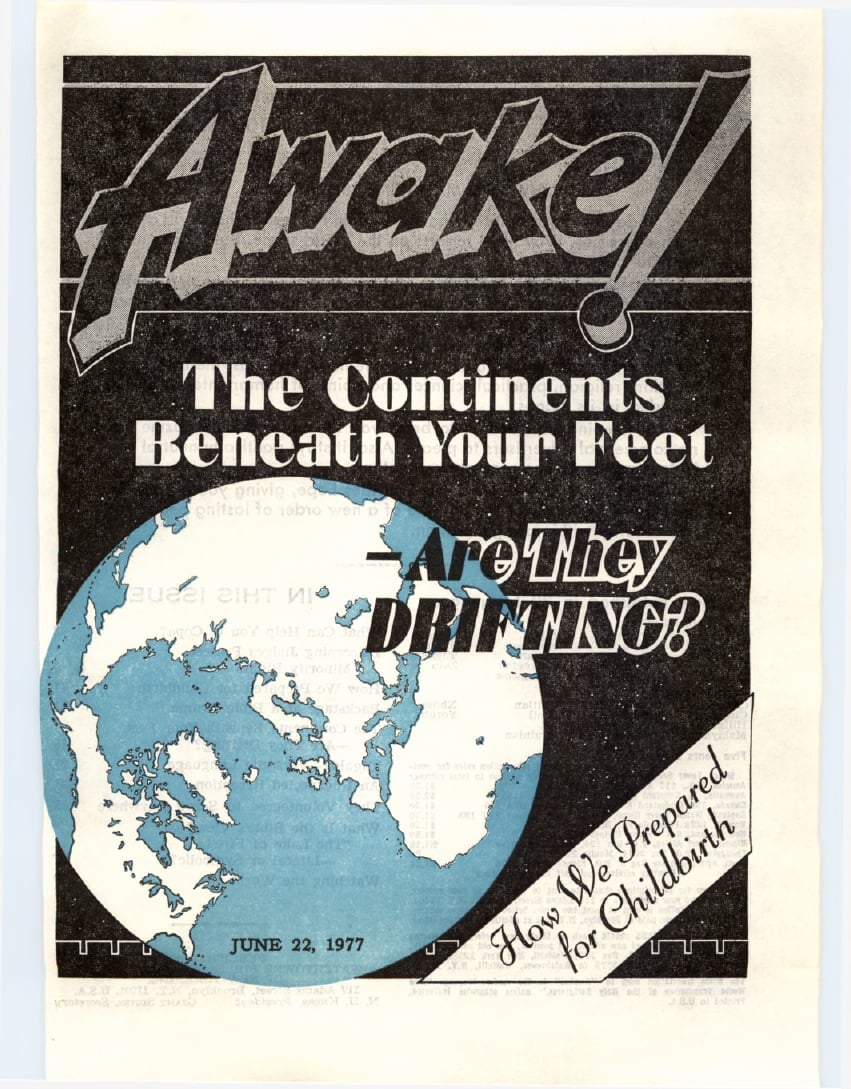
Awake! — June 22, 1977
Source: jw.org
Contents
What Can Help You to Cope?
Discerning Judges Protect Minority Rights
How We Prepared for Childbirth
Backstage at a Bible Drama
The Continents Beneath Your Feet—Are They Drifting?
Tagalog—Versatile Language
An Unexpected Reception
They Volunteered to Serve Anywhere
“The Lake of Fire”—Literal or Symbolic?
Watching the World
Can You Talk With the Dead?
Do Not Miss the Four-Day “Joyful Workers” District Assembly of Jehovah’s Witnesses
What Can Help You to Cope?
What Can Help You to Cope?
THE television news program began as usual. There was a report of a shoot-out at a local bar. Then, suddenly and without any forewarning, it happened.
The Florida newscaster, a twenty-nine-year-old woman, returned to the screen and announced: “In living color you are going to see another first—attempted suicide.” In full view of the television audience, she took a pistol in hand, pointed it at the back of her head and pulled the trigger. Hours later she was dead.
Recent years have seen an alarming increase in the number of persons who feel unable to cope with life. Many attempt suicide. Others ‘go through the motions’ of life severely depressed and miserable.
In many cases people can point to specific reasons for their despair, such as chronic, painful illnesses, becoming maimed in accidents and the losing of loved ones suddenly. But where people feel like giving up on life, something else is usually present. How so?
Regarding the newscaster who committed suicide, a friend is quoted as saying that “she became a sniveling, self-pitying creature.” A big factor that led to her suicide was self-pity.
Of course, persons who have experienced tragedies in their lives have reason for a measure of sorrow over their personal circumstances. But isn’t it true that self-pity often gets out of hand? Learning to cope with day-to-day life calls for getting this inclination under control. How can one do that?
One factor is to realize that excessive self-pity only makes matters worse. Though not always leading to suicide, it brings on loneliness and, in some cases, even physical disorders. Author Dale Carnegie furnishes an example in his book How to Stop Worrying and Start Living:
“I know a woman in New York who is always complaining because she is lonely. Not one of her relatives wants to go near her—and no wonder. If you visit her, she will tell you for hours what she did for her nieces when they were children . . .
“Do the nieces come to see her? Oh, yes, now and then, out of a spirit of duty. But they dread these visits. They know they will have to sit and listen for hours to half-veiled reproaches. They will be treated to an endless litany of bitter complaints and self-pitying sighs. And when this woman can no longer bludgeon, browbeat, or bully her nieces into coming to see her, she has one of her ‘spells.’ She develops a heart attack.
“Is the heart attack real? Oh, yes. The doctors say she has ‘a nervous heart,’ suffers from palpitations. But the doctors also say they can do nothing for her—her trouble is emotional.”
How can one avoid going to extremes in feeling sorry for oneself? Since the reasons for it differ from person to person, there is no simple cure-all. But consider the experiences of three individuals who unexpectedly conquered self-pity. The first two come from Dale Carnegie’s book, mentioned above. See if you can pick out a common element in them all.
A woman relates feeling sorry for herself because “after several years of happy married life, I had lost my husband.” One day this woman, in the depths of despair, boarded a bus and rode it to the end of the line. After wandering about for a while in a strange area, she entered a church and fell asleep. Upon awakening she saw two timid, poorly dressed children staring at her from a distance. Learning that they were orphans, she took them to a drugstore for some refreshments, chatted with them and bought them some presents. Did this help the woman to cope with the grief of losing her husband? She continues:
“Those two little orphans did far more for me than I did for them. That experience showed me again the necessity of making other people happy in order to be happy ourselves. I found that happiness is contagious. By giving, we receive. By helping someone and giving out of love, I had conquered worry and sorrow and self-pity, and felt like a new person. And I was a new person—not only then, but in the years that followed.”
Persons who think that they can no longer cope may feel in need of help, rather than feeling that they are in position to give it. Nevertheless, doing a kindness for someone else will always lift one’s spirits, making it easier to cope with life. Jesus Christ said: “There is more happiness in giving than there is in receiving.” (Acts 20:35) But what if you have no money or other material things to give away? Consider another experience that unexpectedly lifted someone out of despondency.
“The tragedy of my girlhood and young womanhood was our poverty. We could never entertain the way the other girls in my social set entertained. My clothes were never of the best quality. I outgrew them and they didn’t fit and they were often out of style. I was so humiliated, so ashamed, that I often cried myself to sleep.
“Finally, in sheer desperation, I hit upon the idea of always asking my partner at dinner parties to tell me about his experience, his ideas, and his plans for the future. I didn’t ask these questions because I was especially interested in the answers. I did it solely to keep my partner from looking at my poor clothes.
“But a strange thing happened: as I listened to these young men talk and learned more about them, I really became interested in listening to what they had to say. I became so interested that I myself sometimes forgot about my clothes. But the astounding thing for me was this: since I was a good listener and encouraged the boys to talk about themselves, I gave them happiness and I gradually became the most popular girl in our social group and three of these men proposed marriage to me.”
A third experience deals with the value of giving spiritually. It too was unexpected and helped a person better to cope with the unpleasantness of a chronic illness. One of Jehovah’s Witnesses from Illinois relates:
“I had just recently spent another 10 or 12 days in the hospital with a very aggravating chronic disease. Now that I was back home, I planned once again to go out from house to house to share Bible truths with my neighbors. When the day for this arrived, however, I felt exceptionally, depressed. Though I decided to go anyway, I said to the person who was to accompany me: ‘Just let me listen this morning. I can hardly talk to a friend, much less a stranger.’
“My partner agreed to this. She knocked at a door and began talking with a woman, who eventually invited us in. Immediately I joined in on the discussion, sharing Scriptural thoughts with the householder. Noting her appreciation for what she was hearing, my depression gave way to sheer joy. By the time we left that call, I couldn’t have even described what depression meant. The joy in sharing Bible truth is indescribable.”
Do you become despondent at times? If so, fight hard against excessive self-pity by seeking out ways to help others. Though this may not remove the cause of your sorrow, it will surely help you to cope with the problem.—Luke 6:38; Phil. 4:8, 9.
Discerning Judges Protect Minority Rights
Discerning Judges Protect Minority Rights
A FAMOUS judge of deep discernment once said: “The law knows no finer hour than when it cuts through formal concepts and transitory emotions to protect unpopular citizens against discrimination.”a
A fine example of this impartial justice occurred recently at the city of Tacoma in the state of Washington, U.S.A.
It was there that a minority religious group decided to erect a building for the worship of God. This was to be in Pierce County, eight miles (13 kilometers) from Tacoma. The structure would seat 1,800 people for combined religious meetings of several congregations of Jehovah’s Witnesses. Nine acres (3.6 hectares) of land had been obtained in this sparsely settled area where zoning ordinances permitted a “church,” or place of worship, to be built.
Carefully prepared plans and documents, even surpassing technical requirements, were filed. Every cooperation was given the officials. The Health Department gave approval. With slight modifications, the Engineering Department gave approval. And, with the decision that the assembly hall would have “no significant adverse effect on the environment,’’ the Environmental Review Committee gave approval. Everything seemed favorable.
Unlawful Restriction Imposed
In January 1976 Chief Building Inspector Bill P. Horn was asked for a building permit. At this point the favorable atmosphere was shattered. The permit was refused! Mr. Horn agreed that a “church” had a right to build on the site, but Jehovah’s Witnesses could not erect an assembly hall there! Why not? His letter cited these two factors: “Your proposed assembly hall intends to attract persons from outside this county in addition to its very large capacity.” The County Planning Department also said that the assembly hall “is in no way a normal church,” which must be “a place of religious gathering for local residents to worship.”
But that was not what the County Zoning Code said. It simply stated: “‘Church’ means an establishment the principal purpose of which is religious worship.” Surely, freedom of worship cannot be confined to local people! Were the officials adding unlawful restrictions to block construction of this particular building? If so, how could a minority protect its lawful rights?
Attorneys advised that legal action was the only recourse. Proceedings were instituted on February 4, 1976, for a mandamus or court order commanding the permit to be issued. Extensive legal briefs and a study of the larger capacity of other churches in the area were presented.
On April 13, 1976, the case came up for argument before Judge Hardyn B. Soule of the Superior Court of Pierce County. Judge Soule, rapidly discerning minority rights, gave his decision:
“The Pierce County Zoning Code under Section 9.06.150 defines a church as follows:
“‘Church. “Church” means an establishment the principal purpose of which is religious worship . . .’
“The parties have stipulated that the services to be held at the proposed assembly hall are wholly for the worship of Almighty God; that the basic textbook for these meetings is the Holy Bible and that preaching, bible reading and instruction form the entire content of the program. . . .
“The building permit was refused on the ground that the proposed building is not a church in the normal sense because it has no resident congregation and because it intends to draw people from considerable distances. . . .
“Unfortunately for the defendants [i.e., Pierce County and its Building Inspector], we need look no further than the definition of the Code itself as above set forth. That definition does not require a local resident congregation. It has no restrictions as to size. . . . It places no restriction on the area from which the attenders may be drawn. The only requirement is that the principal purpose be for religious worship . . .
“It appears to me that under the stipulated facts the proposed building is clearly within the ordinance and there is no ambiguity. . . . Therefore, the Writ of Mandamus will issue.”
Thus Judge Soule faithfully upheld the law, and unlawful restriction was routed.
Persistent Refusal
Still the permit was refused—in persistent defiance of the court order! The applicants’ respect for Judge Soule’s decision required them to pursue the only legal remedy.
The newspaper The Daily Olympian, May 14, 1976, reported the next move, saying:
“Contempt Charges Filed
“Jehovah’s Witnesses, who are proposing to build an Assembly Hall in Puyallup, have filed contempt of court charges against Pierce County and the Pierce County Building Department.”
On May 27, 1976, the contempt charge came before Judge Soule. Since the defendants obviously were in contempt, they tried to change position by filing an appeal to the state Court of Appeals. Then they asked Judge Soule for a “stay,” that is, permission to delay the building permit till after a ruling on their appeal. This would take at least a year.
Judge Soule, discerning the tactics of evasion, refused the stay. Instead, he protected the rights of this minority by giving the county and its inspector a limit of five business days to issue the permit, warning, “or they shall be punished for contempt of this court.”
This order was made at 10 a.m. Shortly after noon the county attorney, in cooperation with an attorney for some antagonistic neighbors, came before Judge James V. Ramsdell, another judge of the same court. Without notifying counsel for Jehovah’s Witnesses, and without disclosing Judge Soule’s morning order, the two attorneys obtained from Judge Ramsdell an order directing the county not to issue the permit for the assembly hall. In consequence, two directly contrary orders issued out of the same court, on the same subject, on the same day!
How did Judge Ramsdell learn of this astonishing situation? The Tacoma News Tribune carried these headings the next day, both in the very same issue. One read “County Must Give Witnesses Permit,” whereas the other read “Judge Bars Permit for Witnesses’ Hall.”
On June 1, his next day in court, Judge Ramsdell personally called the two attorneys before him and this time invited counsel for Jehovah’s Witnesses to be present. Then he took forthright corrective action and vacated the order he had been led to make.
Some days later, on June 11, 1976, the county, persisting in its obstruction, asked the Court of Appeals for the stay order denied it by Judge Soule. Opposing the request, Jehovah’s Witnesses contended that the county’s appeal was frivolous, without merit and solely for the purpose of unlawful delay. The discerning judges again protected minority rights by refusing to grant the stay.
Would the permit now be issued? It still took hours of argument and reminder of further immediate contempt proceedings to obtain the permit from the reluctant officials on June 14, 1976.
Building Under Clouds
With their long-delayed permit in hand, Jehovah’s Witnesses joyfully went onto the construction site and immediately began to lay the foundation of the hall. In full faith, they proceeded to build, notwithstanding the legal clouds still on the horizon, which could have prevented the building from ever being completed.
The county’s appeal from the mandamus still was pending. Additionally, the neighbors appealed from the favorable decision of the Environmental Review Committee to the Board of County Commissioners, hoping to stop the building of the hall pursuant to the Environmental Protection Act. The commissioners were asked to order Jehovah’s Witnesses to provide an Environmental Impact Statement. This could take a year and could cost $10,000. The proposal was another useless delaying tactic. Why useless? Because, obviously, a church, used only on weekends, would have no significant impact on the environment.
The appeal to the three-man Board of County Commissioners was heard on July 20 and 27, 1976. Opposers claimed that the building would cause problems of traffic, parking and drainage. Their arguments were personal opinions, without facts to support them. On behalf of the assembly hall, an engineer, Mr. Louis Cantor, showed it was a “low-profile project” that did not require an impact statement. Mr. Cantor added: “Using an analogy, we have observed an elephant walk across a plank and have measured the deflection of the beam: From this we have concluded that a pussycat may safely walk the same plank.” Environmentally speaking, the hall was the “pussycat.”
In spite of the very clear evidence against the necessity of an impact statement, a majority—two of the three commissioners—ordered it because this was what “the residents of that area wanted.” The dissenting commissioner, Mr. Clay Huntingdon, alone referred to the evidence and said: “I see no evidence that would require this Environmental Impact Statement.”
The adverse order of the commissioners was good for only one day. On July 29, at 9:15 a.m., attorneys for Jehovah’s Witnesses appeared before Judge Ramsdell, requesting a writ of review to challenge the commissioners’ decision. As he signed the documents, the judge said: “I read about their decision in the paper. I thought I’d be seeing you.” The writ directed the commissioners to bring before the court for review the entire record of the hearing that took place before them. In the meantime, they were prohibited from interfering with construction.
This legal delay meant another three months of construction time. With determination and enthusiasm, volunteer workers moved ahead with the building, in full faith that justice would be done and that they would be able to complete it.
On September 9, 1976, the county appeal to the Court of Appeals came before Judge Vernon R. Pearson of the Court of Appeals on a settlement conference. This discerning judge made it clear to the county that its appeal was frivolous, without merit, and that there was no hope of success. The county wisely withdrew its appeal, without its ever having been briefed or argued.
Only one legal proceeding remained: The writ of review of the commissioners’ decision.
Back to Court
When the date for argument of the writ arrived, October 29, the hall was 70 percent built. Its walls were up, the roof was on, the floor had been laid, and much of the landscaping had been done. That morning, reporters, television cameramen and interested spectators swarmed into the court section of the County-City Building at Tacoma. It was the last act in this protracted legal drama. On the bulletin board there appeared an announcement listing the case as “Jehovah vs. Pierce Co.”
Those words may have been more accurate than many individuals realized.
Rapidly, the courtroom filled with spectators, mostly Jehovah’s Witnesses deeply concerned about their hall. Then, the hour arrived. Judge Waldo F. Stone took his seat. Silence prevailed. The clerk called the case. Proceedings commenced. Tension grew. The issue was vital. Many individuals present knew that the building already was up. Questions raced through their minds: Was construction going to be stopped? Would the building be torn down? Might all their work and effort end in this courtroom? Eagerly, they hung on every word.
Argument to Judge Stone was opened by Glen How, Queen’s Counsel, of Toronto, Ontario, Canada. He urged the court to reverse the majority decision of the County Commissioners as being arbitrary, unfair and not supported by the evidence.
Attorneys for the county and the neighbors made short and ineffective opposing arguments. Finally, associate counsel for the assembly hall, Thomas Fishburne of Tacoma, spoke in rebuttal. Then came a hushed moment as Judge Stone prepared to deliver judgment. Anxious ears strained to catch every word.
Judge Stone first complimented counsel for “excellent briefing, excellent homework, excellent presentation of the case to the judge” making the decision “a little less difficult.” The judge then continued: “I would also like to compliment the many people in the back of the courtroom [mostly Jehovah’s Witnesses] for recognizing that this is a court of law and treating it as a court of law.”
At the key point of his decision, Judge Stone said:
“It is the conclusion of the Court in looking at the entire picture here that the County Commissioners misconceived their function under the particular law with which we are dealing here. I think that their decision was based on what they felt was desirable . . . The Court will find that the decision of the commissioners was not for an environmental purpose and that it was not a proper function or application of the particular environmental laws here to require the Environmental Impact statement.
“. . . this is a low-profile project, and the ordering of the Environmental Impact statement was a misconception of the proper function of this law . . . Obviously, the Court will decline to allow an injunction to stop the building.”
Judge Stone’s written conclusion described the decision of the Board of County Commissioners as “arbitrary and capricious action and therefore void.” Here again a discerning judge was protecting minority rights.
By this time the public had become very interested in this struggle for freedom of worship. Television news coverage enabled the people to see and hear Judge Stone delivering his important favorable decision making it unnecessary for the Witnesses to provide an Environmental Impact Statement (EIS). The headline in the Tacoma News Tribune said it all—“Jehovah’s Witnesses Win Court Decision on EIS.”
Happy Completion!
With the conflict over, dedicated witnesses of Jehovah moved to complete their building with a grand feeling of happiness and unity. Reporters from the Tacoma News Tribune came to the hall to take pictures. They marveled at both the activity and the results, and were most impressed to find that every bit of labor was volunteered. One remarked that it was hard to believe that in this day and age there still were people who would devote their time to a project of this kind.
A neighbor who had been quite antagonistic came several times to visit and have coffee with the workers on the building. He apologized for having opposed the building of the hall. Especially did he appreciate being received in such a kindly manner, and he was pleased to note that no one bore any animosity. This former opposer was glad to obtain a Bible from a ninety-year-old worker on the site.
A naval man at Bremerton was anxious to see this building being erected by volunteers. With two friends, he came to visit one Saturday. After a tour of the site, the three visitors joined in and worked hard all afternoon. One remarked that he had never seen people work together with such cooperation. After his next tour at sea, he returned to the hall, to work two more days and enjoy the friendly atmosphere.
In all, more than 2,500 persons contributed time and labor in building the assembly hall. One holiday there were 500 workers on the job.
Reflections
This drawn-out legal battle with a result favorable to civil liberty and equal rights is an unusual example of the “finer hour” of the law as it acts “to protect unpopular citizens against discrimination.”
Seven different judges demonstrated their concern for justice by their nine different rulings protecting minority rights. In all, this was a sterling example of discernment and consistency in law enforcement.
Jehovah’s Witnesses very much appreciate men of integrity on the bench who devote their lives to the pursuit of justice. Especially, however, do the Witnesses appreciate this guarantee of their God Jehovah: “Any weapon whatever that will be formed against you will have no success.”—Isa. 54:17.
Jehovah’s Witnesses in western Washington State are happy to invite all interested persons to their beautiful assembly hall in its quiet, wooded setting. At the dedication held on April 23, 1977, they were delighted to welcome 1,977 people from the Puget Sound area to share their joy. This center of true worship remains open to visitors as a place of loving cooperation and Christian fellowship.
[Footnotes]
Falbo v. United States, 320 U.S. 549. Supreme Court Justice Frank Murphy.
[Blurb on page 7]
“Two directly contrary orders issued out of the same court, on the same subject, on the same day!”
[Blurb on page 8]
“Volunteer workers moved ahead with the building, in full faith that justice would be done and that they would be able to complete it.”
[Blurb on page 10]
“Seven different judges demonstrated their concern for justice by their nine different rulings protecting minority rights.”
How We Prepared for Childbirth
How We Prepared for Childbirth
Are you expecting a baby? How much do you and your husband know about the coming experience of childbirth? For many couples the picture of childbirth is hazy and dotted with fallacies that cause unnecessary fear, even panic.
WHEN I became pregnant, my husband and I decided to do all that we could to prepare for the day that our child would come into the world. We attended eight classes that provided instruction about the development of the fetus and the processes leading to birth. The course included films and practical discussions. It was our desire to have a family-centered birth, with my husband participating.
Let me share with you some of the things we learned.
Early in the course we reviewed the outstanding importance of good and balanced nutrition during pregnancy. Iron is especially important, because in its uterine home the baby is storing up enough iron to last for about six months after being born. Members of the class, therefore, submitted recipes for that seldom-liked yet iron-rich food—liver. Something else that I needed, we learned, was increased intake of milk and cheese, since baby was using up a lot of calcium for bone building. And my diet would require setting limits on carbohydrates to avoid excessive weight increase.
Cooperating with Labor Pains
Slides and films helped us to learn about a new human creature’s development in the uterus and the process of birth. Labor can be divided into three stages. First, there is a series of increasing contractions of the muscles of the uterus, or womb. These cause the cervix, or mouth of the womb, gradually to open up over the baby’s head. Second is passage of the baby through the birth canal into the outside world. The third stage is expulsion of the placenta, which had been baby’s link with mother for nourishment and disposal of wastes.
Considered most difficult is the end of the first stage. This is when the cervix attains its greatest diameter or dilatation—about 10 to 12 centimeters (4 to 5 inches). Understanding that the labor pains are working for arrival of the long-awaited baby should motivate mother to cooperate with the contractions by relaxing between the pains. Tensed voluntary muscles will only clash with the contracting involuntary muscles of the uterus, increasing discomfort. Hence, we learned the value of total relaxation and of certain breathing techniques. In this way mother’s total energy is available for use by the uterine muscles.
The husband can have an especially important role as coach, particularly during transition from the first to the second stage of labor. He can keep reminding his wife to relax and maintain the prescribed breathing pattern, while he gives soothing massages. We learned of the need to push during the second stage, panting in between pains so as to avoid tissue tearing from too rapid delivery of the baby.
What about anesthesia? Our course of instruction emphasized that each woman must make her own decision on this matter. Many are able to have their babies without anesthesia. On the other hand, no woman who requests it during childbirth is viewed as a failure. This we found very comforting.
“It’s a Girl!”
As my baby neared the completion of its passage through the birth canal, I gave a last gentle push. The baby’s head appeared, leading to excited speculation. “It looks like a boy’s head,” exclaimed my husband. “No, it looks like a girl’s head,” retorted the nurse-midwife. Then came the thrilling moment—“It’s a girl!” How marvelous and delightful that moment was!
Shortly thereafter our precious infant nuzzled at my breast to receive her first meal, a unique fluid called “colostrum.” This, I remember learning, is especially fine for the newborn. There are three reasons: (1) Because of a very low fat and carbohydrate content, colostrum is easier for a newborn to digest. (2) It is richer in immunity factors than true milk. (3) Colostrum has a slightly laxative effect, clearing out the “meconium” (an accumulation of cells, mucus and bile) that collects in the infant’s bowels before birth.
I knew that within a few days our baby would be getting my true milk. This is far superior to any substitute. Breast milk is easier for the baby to digest and provides immunity to certain viral diseases. Breast-feeding would help me too. The sucking action of my baby would assist the uterus to contract, controlling blood loss. Certain studies have indicated that in some cases, though not all, complete breast-feeding may postpone the resumption of ovulation, a natural means of spacing children.
Our classes also helped us to set aside certain unfounded beliefs. For example, one mother-to-be had been told not to stretch her hands above her head, as this would wrap the umbilical cord around the baby’s neck and strangle it. Our instructor pointed out, however, that a mother’s movements cannot determine the position either of the fetus or of the cord. In the case of my own baby, the cord was wrapped twice around her neck, yet she was born healthy and lively.
Some claim that they can predict the sex of a child from the shape of the mother’s belly. “If you carry low and round,” they say, “it’ll be a girl.” These beliefs, however, are unfounded. The only way to determine in advance a baby’s sex is by taking a sample of amniotic fluid from the uterus and examining the cells therein.
My three postpartum days spent in a special “maternity center” permitted close family relationship for the new baby. Our daughter was not handed to me only at certain preordained hours and then whisked away, with Daddy getting only occasional glimpses of her. Instead, she and I were at each other’s beck and call. Helpful for this was a crib on wheels for easy transport to and from my room. How nice, too, that Daddy could be there with us whenever he so desired. For my husband and me, preparing in advance for childbirth proved to be altogether worth while.—Contributed.
Backstage at a Bible Drama
Backstage at a Bible Drama
THE music faded, and an appreciative audience responded with applause. Backstage, faces cloaked in unfamiliar makeup and beards turned to one another and smiled. The drama “The Tested Quality of Our Faith—A Cause for Praise and Honor” had just concluded in Laurel, Maryland.
Thousands went home that evening with a finer appreciation of the life of the apostle Paul. But about 150 Jehovah’s Witnesses from local congregations returned home with much more than that—they had had the unique experience of participating in a drama that portrayed events recorded in the Bible.
An Effective Means of Instruction
Since 1966 Bible dramas have been a program highlight of the annual district assemblies of Jehovah’s Witnesses. For example, at the four-day “Joyful Workers” assembly being held this summer in over a hundred cities, two such dramas are featured.a One is based on the experiences of Judean King Hezekiah during the days when Jerusalem was besieged by the Assyrians, and the other on events during the time of Israelite Governor Nehemiah and the prophet Malachi.—Isa. chaps. 36 to 39; Mal. 1:12-14; 3:10.
In past years the dramas have been based on Bible accounts of Jephthah and his daughter, Esther and Mordecai, Ruth and Naomi, Joseph and his brothers, David and Bath-sheba, the fall of Jericho, the flood in Noah’s day, Naaman and the unnamed Israelite girl, youthful Samuel, and Shadrach, Meshach and Abednego, to mention just a few.
At times these dramas are televised. In Liberia, West Africa, an hour-long performance revolving around events dealing with Joshua and the Israelites was masterfully presented. The British program director was highly pleased and commended the Witnesses for their poise and discipline. Many impressed viewers asked when more such dramas would be presented.
The dramas, although often entertaining, are not put on for mere amusement. Their chief purpose is to instruct. First, they teach viewers in a colorful, dramatic way Bible events that can make a lasting impression on the mind. Also, the scripts are designed to drive home an important point of instruction. For example, the drama about the apostle Paul, as noted in the opening paragraph, emphasized the importance of faith. This summer’s Hezekiah drama stresses the value of prayer.
Early Preparations
For the performers in the Paul drama, work started in mid-April, two months before presentation at the assembly. Tapes and scripts for the drama were received by the one in charge of production. Recorded on the tapes are the music, sound effects and all the spoken words. Tryouts for parts were held at a local Kingdom Hall, where later rehearsals took place.
The two-hour Paul drama encompassed three acts, a total of eighteen scenes. The cast included some seventy-five speaking parts and forty extras. To compensate for a lack of available actors, many took two parts. Extras were worked in to fill out sparse crowd scenes. By the end of April most parts were assigned.
Early rehearsals emphasized scene arrangement and the learning of lines. Yes, it is necessary for performers actually to say their lines as the tape plays. This assures proper synchronization of words with gestures, and it also helps the performer to remain “in character.”
Up to the end of May rehearsals remained separated into four parts. In this way it was easier for the director to work with individual scenes for timing, entrances and exits, gestures and movements on stage.
Costumes
By this time, all cast members had been measured for costumes, and the women on the sewing committee were working very hard to clothe a cast of over a hundred. While most appreciate the beauty of drama costumes, few realize how much research goes into making them authentic-looking. Yards of bright materials, plaids, stripes, leather-look vinyl, and trim were either purchased or donated. Jewelry, hair pieces and pins for togas were loaned by the cast and other Witnesses.
It was interesting to learn how to drape a toga for the Greek and Roman costumes. The togas measured approximately four feet (1.2 meters) wide and sixteen feet (5 meters) long. But with three safety pins anchoring it to the shoulder and one decorative pin on top, the job was done. Priests’ hats were made by covering plastic flowerpots with white or gray silk. Some authentic stage helmets were obtained, and these served as models for making helmets for the Roman soldiers. A hard hat, gold construction paper, bristles from a broom, and a little ingenuity combined to create acceptable duplicates.
Final Rehearsals and the Performances
Starting June 1, nearly all of Saturday and Sunday were spent rehearsing. The group began playing the drama in its entirety, stopping to concentrate on trouble spots, and then proceeding. During the break for lunch, many cast members would gather in groups under the trees and play music and sing.
There were ‘two assemblies at Laurel, Maryland, that year, and the same cast put on the drama for both of them. A dress rehearsal was scheduled for one week before the first performance. Cast members invited their families and friends, and there were about 250 for the dress rehearsal.
Cast members were called in for makeup and beards about four hours before the start of the drama. The first step was to get base makeup applied. Then came the highlight makeup. Some just received “straight” makeup—not changing the features—only making them stand out at a distance. Others received special makeup. Many had to be aged to fit their part, some as much as forty years. Members of the Sanhedrin were given dark eye makeup to add a sinister look. Greek women wore generous eye shadow and rouge.
Most of the men then had beards applied. These were made from theatrical crepe hair, and were realistic-looking. They were applied with spirit gum. Then they were sprayed to match the actor’s hair in color. Later, brief rehearsals were held on the assembly stage so the performers could get familiar with the setting there.
The day for the first performance, June 21, was extremely hot; the following week there was a downpour. But both performances came off well. As each scene unfolded one could actually feel the involvement of the audience. Time and again they responded with their applause. They became righteously angry when Stephen was condemned to death by the Sanhedrin. They felt the strength that Paul displayed when he was stoned. They sensed the power of God’s holy spirit as Paul cast the demon from the girl and made the lame man walk. They were caught up with the realism of the earthquake that released Paul and Silas from their bonds. They felt the sadness as Paul said farewell words to his good friends Luke, Timothy and Mark.
The cast, too, felt the same emotions. They had spent many hours and extended themselves to the limit, but they had the satisfaction of a job well done. They had learned cooperation, patience, humility and other Christian qualities by working as one large family, and it was indeed encouraging to know that the drama was faith-strengthening and helpful to so many.
Why not take advantage of the opportunity to view one of these Bible dramas? As already mentioned, they will be a feature of each district assembly of Jehovah’s Witnesses this summer. Attend an assembly near you at any location listed on the back page of this magazine.
[Footnotes]
See page 32 for dates and places of assemblies in sixty-six cities of the United States.
[Picture on page 14]
Repeated rehearsals contribute to dramatic, realistic presentations, as shown in this scene when Jehovah’s prophet Nathan reproves King David for his sin with Bath-sheba
[Picture on page 15]
Preparing cast members with makeup and beards adds realism to a Bible drama
The Continents Beneath Your Feet—Are They Drifting?
The Continents Beneath Your Feet—Are They Drifting?
HAVE you ever noticed, when looking at a map of the Atlantic Ocean, how the east coast of South America seems to match the west coast of Africa? If you fit the hump of Brazil into Africa’s Gulf of Guinea, the shoreline all the way from Guyana to Argentina matches amazingly well with the line from Ghana to Capetown. The two continents seem like pieces of a gigantic jigsaw puzzle.
Perhaps when you noticed this, the thought crossed your mind that at one time South America and Africa may have actually been joined, and that somehow they split and drifted apart. If so, you probably dismissed the idea as preposterous, just a curious coincidence.
But do you know that this idea is now considered seriously by most geologists? A theory that proposes that the continents actually move here and there over the fluid mantle inside the earth’s crust has, since 1960, won general acceptance.
Theory of Continental Drift
The theory was first proposed, not by a geologist, but by a meteorologist in Germany, named Alfred Wegener. He suggested that, not only had South America and Africa once been joined, but all the continents had formed part of a single huge landmass. He called this hypothetical ancient continent Pangaea (meaning “all land”). He found that the fit of the continents was better when the outlines of the continental shelves were used, rather than the now-existing shorelines.
Today geologists use computers to slide and turn the continental outlines over a globe to obtain the best fit. In a typical reconstruction of the supposed ancient supercontinent, the southeastern coast of North America lies against the northwest coast of Africa. Eurasia is pivoted about Spain so that the west coast of Europe nuzzles in against Newfoundland and Greenland. Antarctica lies against southeast Africa, with Australia attached to its opposite side.
When Wegener first proposed this revolutionary concept in 1912, it aroused mixed feelings among geologists. Any theory that goes counter to prevailing notions in science is usually received cautiously. Continental drift met with a reception even cooler than usual, perhaps because its author was not a member of the geologists’ circles. Although there were solid bits of evidence to support the theory, it was “proved” mathematically that the earth’s crust is too strong to allow any lateral movement of the continents. And, it was asked, Where would any force originate to push the continents one way or another? No one could suggest anything that stood up under analysis. The idea gradually came to be ignored by reputable scientists.
Evidence for the Theory: Conformity
Why, then, have geologists changed their minds about continental drift? In the first place, there have gradually accumulated several kinds of evidence that they find hard to explain any other way. Among these are the similarity of geological formations and of fossil deposits on continents now widely separated, as well as the wandering of the magnetic poles of the earth.
As an example of geological conformity, we are told of a succession of sedimentary deposits, laid down during what is called the Paleozoic geologic era, and later exposed when they were lifted up into mountain ranges. Deposits of red sandstone, gray shales, and coal beds are found in the Appalachian mountain system in eastern North America, extending to eastern Greenland. They are also found in the highlands of the British Isles. Similar sediments are found in the Kjölen range in Scandinavia, and along the Atlas range in northwest Africa. In the theoretical parent continent of Pangaea, all these rock formations are believed to have been part of a continuous mountain system whose remnants are now widely separated on three continents.
The similarity in fossils found in these strata on both sides of the Atlantic is used as a further argument for the theory. Fish fossils are abundant, also land plants, even forests of tall tree ferns and great scale trees. Another oft-cited example of conformity of the fossil record is that of the mesosaurus, a small dinosaur that lived during the so-called Paleozoic era. Its fossils are found in southwest Africa and in Brazil, but they have not been found in other parts of the earth. If South America and Africa were joined at that time, then the range of the mesosaurus would have been one continuous area.
Wandering Magnetic Poles
More convincing proof has come from study of the mysterious phenomenon of polar wandering. The belief that the magnetic poles of the earth have moved about is based on measurements of the magnetization of igneous rocks. When a hot rock is cooled in a magnetic field, it is left weakly magnetized, because particles of magnetic minerals in the rock line up in the direction of the magnetic field. This shows the direction of the earth’s magnetic field at the time the rock was formed, like a “frozen compass.”
Now you might expect that all such fossil compasses would point north, but, surprisingly, rocks of different geologic ages show magnetization in many different directions. It is as if the magnetic pole were wandering widely and aimlessly all over the earth—hence the expression “polar wandering.”
However, when the directions are arranged in order according to the apparent successive ages of the rocks, it is found that the pole does follow a definite path from age to age. Furthermore, when the magnetism of rocks in other places on the same continent is measured, it is found that they consistently trace out the same path.
This discovery put the geophysicist in a quandary. Although no one knows what causes the earth’s magnetic field, it seems that it must be in some way related to the earth’s rotation, and it is hard to believe that the magnetic pole can stray very far from the geographic pole, surely not clear across the equator as the rock compasses indicated. Now, of course, the wandering magnetic paths would be explained equally well if the pole stayed fixed while the continents slid around over the globe, but that seemed even harder to believe.
What tipped the balance between two incredible explanations was the discovery that magnetic measurements on different continents usually indicate entirely different paths for the pole. This could not be explained by movements of the pole, because the earth has only one north pole, and it can’t go in several different directions at the same time. This appeared to geologists as a strong indication that the continents had actually moved independently of each other, over many thousands of miles.
Evidence from the Ocean Floors
New evidence that finally converted geologists to belief in continental drift came from the bottom of the sea. Exploration of the ocean floors really got under way in the International Geophysical Year of 1955. Oceanographers used elaborate sounding devices to chart the ocean floors. By timing echoes, they probed, not only the floor of sediment on the bottom, but also the depth of the basement of basalt rock underneath. They came to an astonishing conclusion about the ocean floors: They concluded that these are not fixed, but appear to be forming continuously at definite boundaries and spreading on a global scale.
Let us examine the discoveries that led to this startling hypothesis. The first clue to come to light was a long mountain ridge in the middle of the Atlantic Ocean. Starting there, geologists have mapped a system of mid-ocean ridges that literally encircles the earth. A typical ridge rises from the ocean floor, some three miles (5 kilometers) deep, to a peak about two miles (3 kilometers) above the floor. It is flanked on both sides by a strip of hilly terrain hundreds of miles wide. A striking feature is a valley that runs like a crack right along the crest of the ridge, thus dividing it into a pair of parallel ridges.
The acoustic soundings from the surface have been supplemented by using vessels equipped to drill holes in the bottom of the sea. These have brought up cores of rock for close inspection and analysis, some as long as 1,500 feet (460 meters), from many parts of the ocean. These surveys disclose that the ridges themselves are bare igneous rock, and that there is little or no sediment up to 60 miles (97 kilometers) on either side. Farther away, they show increasingly thicker layers of sediment, up to a mile thick.
Magnetic surveys over the oceans in the vicinity of the ridges resulted in another striking discovery. There are strips of rock lying parallel to the ridges in which the magnetism is reversed. It is as if the north and south poles had been reversed when the rocks formed. This reverse magnetization had been noted earlier in certain volcanic lava flows, but near the oceanic ridges there appears to be a continuous record of normal and reverse magnetic polarities frozen into the ocean bed. There is no explanation for this mysterious change; after all, no one knows why the earth has a magnetic field, much less why it reverses itself. It is just an observed fact of creation.
Sea-Floor Spreading
Geologists explain all three of these observations by a single hypothesis, called sea-floor spreading. They suppose that the mid-ocean ridge is being formed continuously by the upwelling of magma from the earth’s plastic mantle through a crack in the earth’s crust, and that the ocean floor is moving away from both sides of the crack as it is formed. The newly formed rock is clean, and sediment accumulates slowly and becomes noticeable only after the new rock has been exposed for some time and has moved away from the ridge. The parallel bands of normal and reverse magnetic polarity result when the magma oozes out and solidifies for a time while the earth’s poles are normal, and then for a time while they are reversed.
The findings indicate that at the present time the floor of the Atlantic Ocean is spreading a little more than an inch (2.5 centimeters) a year, and the Pacific Ocean about six inches (15 centimeters) a year. But if the earth is forming new crust on the ocean floor on this prodigious scale, it must be getting rid of its old crust somewhere else. After all, the total surface of the earth is not increasing. Geophysicists speculate that this takes place along certain boundaries where one part of the crust slides under another part and descends into the hot interior, where it melts and is consumed into the fluid mantle again. They believe that this is not a smooth process, but is accompanied by earthquakes and volcanic eruptions. It forms deep ocean trenches and high mountain ranges along the consumption boundary lines.
The Theory of Tectonic Plates
From a world map of the mid-ocean ridges and the consumption boundaries, geologists have divided up the whole earth’s surface into six large (and several smaller) plates of rigid rock. These plates, they postulate, are being formed at the ridges and move like a conveyor belt toward boundaries with other plates, where one of them is thrust underneath into the mantle and is dissolved. The continents are carried on these plates, like an Eskimo’s igloo on an ice floe.
This is called the tectonic-plate theory, from the Greek word for “builder.” Both the continental drift and the sea-floor spreading are included as parts of the broader theory.
Let us look at a few examples of how this theory is used to explain observed features of the earth’s crust. The American plate, which carries both North and South America, as well as the western half of the Atlantic Ocean, theoretically is being formed at the mid-Atlantic ridge and moving west. Along the western coast of South America, a smaller plate arising in the eastern Pacific collides with and plunges under the American plate. This supposedly causes a deep trench in the ocean off the coast of South America, and lifts the Andes mountains to the highest peaks in the Americas. The crumpling of the oceanic plate causes frequent earthquakes all along the Pacific coast. When, according to the theory, the lighter rock carried down into the mantle melts, it rises through cracks in the continental crust above it to form the volcanoes in the Andean Cordillera.
A detailed map of the mid-oceanic ridge shows that it is not really continuous, but it is offset by numerous faults at right angles. Along these transform faults, as they are called, the two theoretical plates slide horizontally. Geologists suggest that the friction from this movement is another cause of earthquakes. One of the longest of these transform faults lies between the American plate and the Pacific plate along the west coast of North America. Along this line, well known to Californians as the San Andreas fault, the Pacific plate is moving northwest against the American plate at about two inches (5 centimeters) per year. The resulting strains cause frequent earthquakes.
The city of San Francisco lies athwart this fault, and the coast of California to the south lies west of it, on the Pacific plate. So if the present movement is not interrupted, it is predicted that at some far-distant time the site of Los Angeles will lie close to where San Francisco is today.
Evidences that some places once had a climate very different from the present one also are viewed by geologists as fitting the theory of continental drift. In the postulated Pangaea, the present-day continents were all much farther south than now, excepting Antarctica. North America and the Spanish peninsula were on the equator. South America, Africa, India, and Australia were all clustered around Antarctica in the south polar regions.
Will the Theory Stand?
Scientists take satisfaction in finding a theory that apparently brings many disparate kinds of information together into a unified picture. That is what they believe the tectonic-plate theory has done for the science of geology. But does that mean that it is therefore the final and correct answer? Not necessarily.
In spite of seeming wide-ranging successes of the theory, there are still many bits of information that do not fit into it. Geologists argue over the interpretation of details. As research continues, some of these questions may be answered in a way that harmonizes with the theory. On the other hand, there may remain stubborn facts that cannot be reconciled with it.
One major shortcoming is acknowledged in the present state of the theory. The forces that cause the upwelling magma along the ridges are not explained. Some geologists have been content with the general statement that convection currents inside the earth’s mantle are responsible. But what generates the convection, and why does its pattern change? When this idea is examined in detail, it breaks down. A convection current in air or water rises around a central axis, not in a long slender sheet that would form a ridge. It is even more difficult to imagine how the displacements along the transform faults can result from convection currents.
Professors Flint and Skinner of Yale University offer this word of caution in their book Physical Geology:
“The theory of plate tectonics seems to provide answers for so many questions that we are tempted to believe it is the long-sought unifying theory that explains the lithosphere [the land areas of the earth, from its surface to the center of the earth]. But we must be careful. Other theories, too, have seemed overwhelming in their promise, yet in the long run have proved incorrect. The theory of plate tectonics is still only a theory.”
Whether the tectonic-plate theory survives the test of time and proves correct or not, we have abundant evidence of the great power and wisdom of earth’s Creator. Of him the psalmist wrote: “Long ago you laid the foundations of the earth itself, and the heavens are the work of your hands.” (Ps. 102:25) The questions Jehovah put to Job thousands of years ago still remain unanswerable by modern geologists: “Where did you happen to be when I founded the earth? Tell me, if you do know understanding. Who set its measurements, in case you know, or who stretched out upon it the measuring line? Into what have its socket pedestals been sunk down, or who laid its cornerstone?”—Job 38:4-6.
Tagalog—Versatile Language
Tagalog—Versatile Language
By “Awake!” correspondent in the Philippines
IN THE Bible it states that those making up the “great crowd” praising God come out of “all nations and tribes and peoples and tongues.” (Rev. 7:9) One of the “tongues” that is providing fulfillment to that prophecy is the Filipino language called Tagalog (pronounced Ta·gaʹlog). Maybe you have never heard of this tongue, but since it is now becoming very important in the Philippine Republic, it would be good to introduce you to it.
If any country could be said to have a language problem, the Philippine Republic is it! Among a population of about forty million, there are more than eighty different languages in constant use, and some of these are themselves broken up into a number of dialects.
Tagalog is spoken by several million people who live mostly in the provinces of Central Luzon, the largest island in the northern Philippines. However, it is being developed into a national language called Pilipino, and by means of education in the schools, production of films and television shows, the government is encouraging everyone to learn and use this at least as a second language. Why? So as to solve the fragmentation in the country, with all the misunderstandings and administrative problems that this involves.
Tagalog, along with all other major dialects in the Philippines, belongs to what is called the “Malayo-Polynesian” group of languages. In addition, it is agglutinative, which means that it is composed of a number of “root” words, which are given added meaning by joining syllables to them. For example, the root word awit, meaning “song,” can appear as mang-aawit (singer), umawit (to sing), awitan (to be sung to), mag-awitan (to sing together), and so forth. According to a recently produced dictionary,a with the help of these roots and additions, you can make a vocabulary of literally millions of words.
Interesting to the foreigner are the differences between Tagalog and Western languages. For example, in everyday things Tagalog is often much more specific than English. Thus, English has one word for rice, which takes it all the way from the field to the table. But in Tagalog, rice in the field is palay, while in the kitchen, before cooking, it is bigas. If you boil it, it becomes kanin, while if you then go ahead and fry it, it is called sinangag. Tagalog is also quite specific as to how things are carried. If you carry a case or a book bag, the word you use would designate whether you carry it in your hand, on your shoulder, on your head, in the arms, or under the arm.
On the other hand, distinctions that seem so important in European dialects do not appear in Tagalog. Asawa means “husband” or “wife”; anak is “son” or “daughter”; kapatid is “brother” or “sister”; and siya is “he” or “she”! If it becomes necessary to specify the sex of the one referred to so as to avoid ambiguity, the word for “male” or “female” ‘is added. What this means in practice is that while in English you are constantly being reminded whether it is a man or a woman that is being discussed because of using “he” or “she” all the time, in Tagalog you may only get one clue at the beginning of the discussion. If you miss that, you may spend a whole conversation thinking you are talking about a man, only to find that it was a woman after all!
In 1521 the Spanish arrived and eventually colonized the country, and there followed more than three centuries of subjugation to them. This is reflected in the Tagalog language by the presence of several thousand roots that have been adopted from the Spanish language—although usually they are spelled a little differently, to accommodate the Filipino pronunciation. This accident of history is quite a help, incidentally, to the Westerner learning the dialect. Sometimes the Spanish and native Tagalog words will coexist. For example, puede (Spanish) and maaari (native Tagalog) are interchangeably used for “can,” “to be able to”; pero (Spanish) and nguni’t both mean “but,” and so forth. Now and then, the Spanish word will be used to add distinctness where the Tagalog may seem a little vague. Sometimes the Spanish word has completely replaced the original Tagalog.
At the turn of the century, American influence came in, and this is reflected in the number of English words regularly used in Tagalog. Now, in fact, any new ideas are usually expressed in a Tagalog adaptation of English. For example, “to play basketball” appears as magbasketbol! “To ride a bus” is magbus. Sometimes an English-speaking person may be startled at the strange shapes some words assume. In Manila he may hear kinokompute for “it is computed,” or nagfofloor wax instead of “putting on floor wax.” In fact, in the Manila area, English words are used very freely along with the native Tagalog and Spanish words.
This symbiosis or interrelationship between English, Spanish and native Tagalog is especially seen in numbers. In counting, you will hear all three languages used almost interchangeably. In citing Scripture verses, Spanish numbers are generally used, while in counting money, Spanish or English is heard. Tagalog numbers are longer, so they are often used for small numbers, Spanish or English for big numbers.
Two more points might be noted regarding Tagalog. One is the length of the language. English tends to make a virtue of brevity. In Tagalog, however, while many words are short, some words and phrases get very long indeed, and public speakers find they often have to cut out sections of an English talk when it is given in Tagalog. With all that, however, the language has a nice ring and sonority to it because of the long words, and it can be very dignified. To say “by faith in the Almighty,” for example, is nice, concise and clear; but imagine the force you can put into the Tagalog equivalent for this: “sa pamamagitan ng pananampalataya sa Pinakamakapangyarihan-sa-lahat”!
The other point that most newcomers notice in Tagalog is the extreme respectfulness that it embodies. There are special words to use to show respect for older people. Children are taught to use these when speaking to their parents. There are also special forms of the verb, to show degrees of politeness and consideration, as distinguished from familiarity. When properly used, these forms are very pleasing to the ear.
…