Awake!, April 8, 1976
Download: PDF — Awake!, April 8, 1976
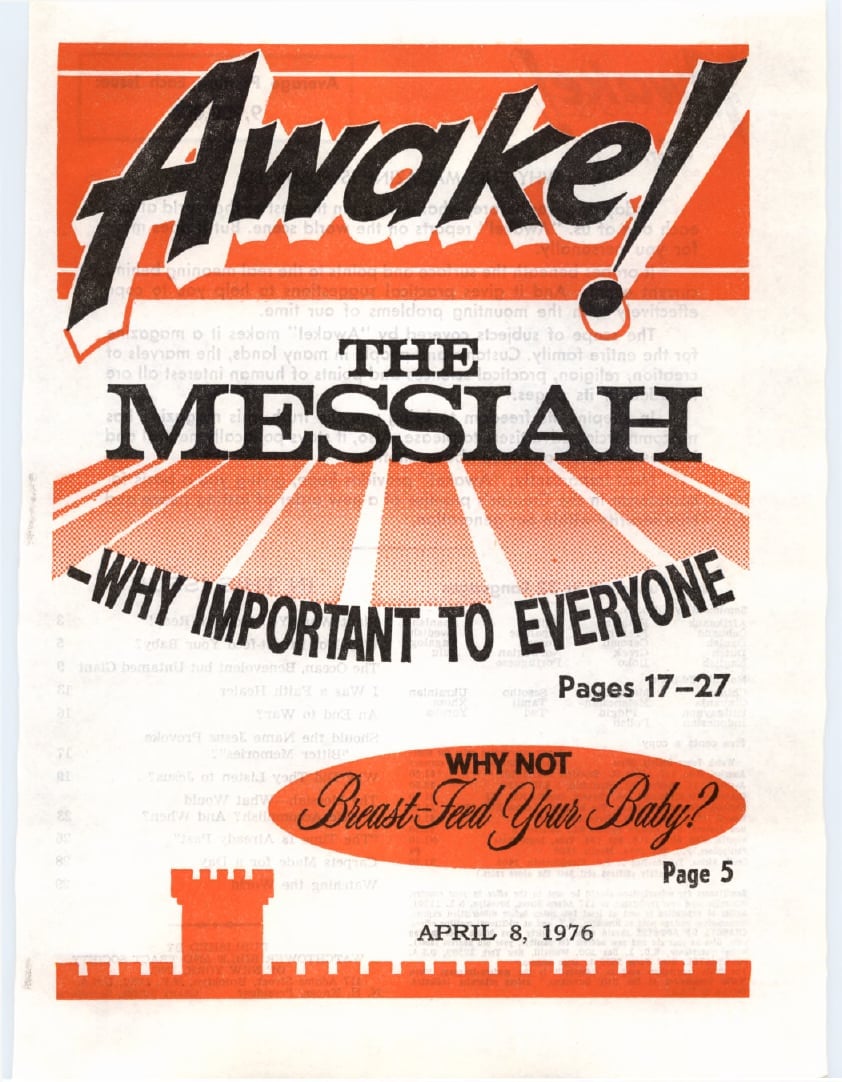
Awake! — April 8, 1976
Source: jw.org
Contents
Plant What You Hope to Reap!
Why Not Breast-Feed Your Baby?
The Ocean, Benevolent But Untamed Giant
I Was a Faith Healer
An End to War?
Should the Name Jesus Provoke “Bitter Memories”?
Why Did They Listen to Jesus?
The Messiah—What Would He Accomplish? And When?
“The Time Is Already Past”
Carpets Made for a Day
Watching the World
Is This God’s Purpose?
A Night of Remembrance
Plant What You Hope to Reap!
Plant What You Hope to Reap!
SPRINGTIME is delightful! In many places, it marks the end of a cold, snowy winter. Flowers bloom in the spring and it is the season to plant. Plant what? Well, if a farmer expects to harvest corn, what must he plant? Rice? Of course not! He must plant what he hopes to reap.
Similarly, what an individual sows in word and in deed determines what he is going to reap in a figurative way. The Christian apostle Paul appropriately stated: “Whatever a man is sowing, this he will also reap.” (Gal. 6:7) So, if an individual desires to “reap” what is good, that is what must be planted.
Well, then, are we planting wisely? Will our words and deeds produce the good things we desire? Do we really plant what we hope to reap?
Happiness is what young married couples would like to reap. To do so, however, they must do some careful planting. What if they purchased a large home that was heavily mortgaged? Suppose they bought many articles of furniture on credit. The couple could start married life with many material possessions. But perhaps both the husband and the wife would then have to work full time, even overtime, to meet the extremely high monthly payments. Because of this and related responsibilities, likely they would be weary from overwork and would have little time for each other.
Due to unwise planting, the married couple may actually reap unhappiness.
Others have planted in hope of having financial security in later life. But note what happened to some people after World War I. One report says: “In Germany scores who had retired and were able to live comfortably on the income from 50,000 marks found at the peak of the inflation in that country that their entire hoard of 50,000 marks was not sufficient to buy a half pound of butter, so worthless was the money of that day.”
If a person desires to reap happiness and security, he needs to heed the words of Jesus Christ. He said: “Keep your eyes open and guard against every sort of covetousness because even when a person has an abundance his life does not result from the things he possesses.” To prove that point, Jesus spoke an illustration, telling about a rich man whose land produced so well that he intended to tear down his storehouses and build bigger ones in which to store his grain and good things. Then he was going to take his ease—eating, drinking and enjoying himself. However, Jesus added: “But God said to him, ‘Unreasonable one, this night they are demanding your soul from you. Who, then, is to have the things you stored up?’ So it goes with the man that lays up treasure for himself but is not rich toward God.”—Luke 12:15-21.
To be “rich toward God,” a person needs to place primary emphasis on spiritual things. Through the prophet Hosea, Jehovah God put matters this way: “Sow seed for yourselves in righteousness; reap in accord with loving-kindness. Till for yourselves arable land, when there is time for searching for Jehovah until he comes and gives instruction in righteousness to you.” (Hos. 10:12) God was speaking to his wayward people of the ten-tribe kingdom of Israel, counseling them to do what was right. Following God’s way, they would be sowing or planting in righteousness. If they did that, what could they hope to reap? The loving-kindness of Jehovah God!
The same thing is true in everyday human relationships. What can a person expect to reap if he customarily is cruel to others? As the Bible states, “the cruel person is bringing ostracism upon his own organism.” Conversely, the same proverb says that “a man of loving-kindness is dealing rewardingly with his own soul.” (Prov. 11:17) Whereas the cruel individual stirs up enmity against himself, the one who shows others loving-kindness treats himself well, for he enjoys their goodwill.
Supposed pleasure and satisfaction are sought by some people who plant in accord with selfish desires, without concern about doing what is righteous. Author Samuel Butler once wrote: “Everyone has a mass of bad work in him which he will have to work off and get rid of before he can do better . . . We must all sow our spiritual wild oats.” But will a person reap true pleasure and satisfaction if he ‘sows wild oats’?
Perhaps a man has chosen a life of sexual irresponsibility. What might he reap? True pleasure and satisfaction in life? Notice what the Bible indicates: “She [a prostitute] has misled him by the abundance of her persuasiveness. By the smoothness of her lips she seduces him. All of a sudden he is going after her, like a bull that comes even to the slaughter . . . until an arrow cleaves open his liver . . . and he has not known that it involves his very soul.” (Prov. 7:21-23) The liver, as well as other organs, may be attacked by syphilis, and death can result from this venereal disease. But even if a person living immorally does not reap some fatal malady, his course is disapproved by God. The apostle Paul declared: “Do not deceive yourselves: no fornicators, idolaters, or adulterers, no sodomites . . . will inherit God’s kingdom.”—1 Cor. 6:9, 10, The New American Bible.
With good reason, then, Paul—who said one would reap what one sowed—went on to say: “Because he who is sowing with a view to his flesh will reap corruption from his flesh, but he who is sowing with a view to the spirit will reap everlasting life from the spirit.” Earlier, the apostle had enumerated the fruits of God’s spirit as love, joy, peace, long-suffering, kindness, goodness, faith, mildness and self-control. (Gal. 6:8; 5:22, 23) Obviously, anyone cultivating and displaying such qualities will reap the goodwill of his associates. He will also enjoy God’s approval.
Any wise person would want to plant in a way that would enable him to reap what is good. Do you desire everlasting life in happiness and security? Then acquire accurate knowledge of God and his Word, the Bible. Said the divinely inspired psalmist: “Who, now, is the man fearful of Jehovah? He will instruct him in the way that he will choose. His own soul will lodge in goodness itself, and his own offspring will take possession of the earth.”—Ps. 25:8, 12, 13.
Why Not Breast-Feed Your Baby?
Why Not Breast-Feed Your Baby?
AS A mother of four children, I have found that nursing a child does more than provide the little one with nourishment. It helps to forge a warm, loving relationship between mother and child. A baby needs his mother to hold him close, to feel the texture of her skin, to hear the rhythmic beating of her heart and to have her speak softly to him. What better way has been provided than for a mother to hold her baby to her breast and nurse him!
Today, however, in many places, the sight of a mother nursing her child has become rare. Why do so few modern women choose this way to nourish their children? And why do many mothers who start to nurse their babies fail? I have given considerable thought to such questions. What I have learned through experience and research may be of help to you, especially if you are a mother who doubts her ability to nurse her baby.
Do I Have Enough Milk?
This was a question I used to ask myself. I worried, because I didn’t realize that babies cry for more reasons than being hungry. Babies sometimes cry because they’re wet, or maybe they have some gas. Or, a little cuddling is often all that they need. Such affection can be as important to them as food.
Actually, there is no need to fear that you will not have sufficient milk. Why? Because the production of milk works by the law of supply and demand. So the more your baby nurses, the more milk your breasts will be stimulated to supply. Even if you have twins, your breasts will be triggered by the sucking stimulation to provide enough milk for both babies. This is really a marvelous supply-meets-demand system designed by an all-wise Creator.
One way in which you can tell that your baby is getting enough to eat is by his frequently wet diapers. Something has to be going into him to wet those diapers! Also, if your baby is happy most of the time and is gaining weight at a reasonable rate, he is getting enough to eat. An average gain of a pound a month, or four to seven ounces a week, is sufficient.
Feeding Schedules
You may have heard that a baby should be breast-fed on a regular schedule, say every three hours. Believing this, I tried feeding my first child by the clock, rather than by his hungry tummy. If he woke up and wanted to eat before his scheduled feeding time, I became upset and nervous. I couldn’t understand why he couldn’t tell that it wasn’t yet time to eat.
However, by the time our fourth baby arrived I had decided that, as far as feeding time was concerned, there was no such thing as a clock. To my surprise, I found that I had a contented baby and a relaxed me. Try it and see if it doesn’t work for you.
On the other hand, if you have a sleepy baby, it might be necessary to wake him up to feed him. It is not unusual for a baby to sleep for five hours at a time or longer, hopefully at night. But if he sleeps that long more than once during the day, it would be advisable to wake him, perhaps feeding him at three-hour intervals. You will probably find that before long he will fall into a schedule of his own.
Determination Required
Since so few mothers breast-feed nowadays, many doctors haven’t had much experience with this feeding method. Physicians know, of course, that human milk is a better food for babies than cow’s milk. Medical literature makes this very clear. But since bottle-feeding has become so popular, a doctor may discourage you from breast-feeding simply because of his unfamiliarity with this method. What then?
There are other doctors. Talk to women who have breast-fed their babies and ask them what doctor they went to, and if he really supported them in their desire to breast-feed. If he did, go and have a talk with him, telling him of your desire to breast-feed. Do this before your baby is born. Look around for a doctor you like.
If your baby is to be born in a hospital, it is important that you make it very clear that you are determined to nurse your baby. Why so? Because, as Dr. Jean Mayer, professor of nutrition at Harvard University, says: “In male-dominated hospitals breast feeding is officially discouraged. Unless the new mother has clearly signified her will to breast feed, she is given a shot of estrogens before she is even out of anesthesia so as to ‘dry her up.’” But even if “dry-up” shots are given, nursing can restore a good milk supply.
At your request, some hospitals will allow your baby to stay with you during your hospital stay. If the hospital does not provide such a ‘rooming-in’ program, ask that you be given your baby at least every three hours or whenever he is hungry. This means, of course, that you will also be given your baby to feed at night. Ask that he not be given supplementary bottle feedings in the hospital nursery, since this will curb his appetite and, hence, interfere with your milk production.
Some doctors have been allowing their patients to nurse their newborn babies right on the delivery table. This is a recommended practice, since the sucking of the newborn stimulates milk production. But it serves another purpose—it stimulates the mother’s uterus to contract and may help to reduce bleeding.
If a medical problem develops with regard to your nursing, make sure the doctor realizes your keen desire to continue to nurse. Do some research of your own on the problem. This will show the doctor that you are interested enough in nursing to learn how to cope with obstacles that can arise. If for some medical reason the doctor insists that you quit nursing, suggest that you stop only temporarily. Then, to keep up your milk production, pump milk from your breast while the baby is not nursing. Later, when the situation has improved, you can continue nursing.
Your determination to succeed in breast-feeding has rewards. For example, mothers who breast-feed show fewer cases of cancer of the breast. Also, if you are a nervous person, sitting down periodically during the day to nurse may help you to relax. Nursing causes your body to produce hormones that have a calming effect. And, too, in view of these perilous times when calamities threaten, we might ask ourselves: “Could my child survive difficult times on emergency rations without breast milk?”
A word to husbands. Since your opinion as to how your baby is to be fed will probably mean more to your wife than what anyone else thinks, give her all the support you can in her effort to breast-feed.
Nipple Care
Some women have trouble with sore nipples, particularly women who are redheads and those with fair complexions, and this has caused them to give up nursing. However, a conditioning program started before the baby is born will usually prevent this problem.
First, it is suggested that soap be used sparingly, if at all, on nipples, since it tends to dry the skin, which is then more susceptible to cracking. To keep the nipples supple, a daily program of pulling on them quite firmly several times, but not until they hurt, is recommended. Do this exercise once or twice a day. Afterward, it is good to use an oily lubricant, such as lanolin, on your nipples.
To open the milk ducts and thus reduce breast engorgement, which sometimes occurs following birth, it is recommended that, about six weeks before your baby is born, you start attempting to hand-express some colostrum from your breasts. Colostrum is the yellowish fluid that is present before your actual milk comes in.
To express the colostrum, cup your breast in your hand. Place your thumb above and the forefinger below the breast at the edge of the dark area. Then gently squeeze thumb and finger together, being careful not to slide your finger and thumb toward the nipple. Rotate your finger and thumb around the nipple area a few times in order to reach all the milk ducts and thus help to open them. At first only a tiny drop, if even that much, may be expressed, but don’t worry. It has no effect on the amount of milk you will have.
If you have sore nipples after the baby is born, don’t despair. I found that exposing the nipples to the air as much as possible is helpful. So after you finish nursing, make sure that you give your breasts time to dry before covering them. I found that vitamin E applied to the sore area did wonders, while others recommend lanolin or A & D ointment.
If your nipples are sore, you may think that nursing less often will help. But the opposite is usually true. Nurse more often, say, every two or two and a half hours. This will keep the breasts comfortably empty. Also, the baby will not suck ravenously due to hunger, which can irritate the nipples. It will be good, too, to limit feedings to ten minutes at each breast while nipples are sore.
Maintaining Milk Production
To keep up your milk supply it is important to nurse your baby on both breasts at each feeding. If you nursed him last on your left breast, then at the next feeding start on your left breast. After he has emptied that breast switch over to the right one. At the next feeding, start on the right breast. I used a small safety pin to remember which breast I should start with the next feeding. Just pin it to your undergarment.
You may find that when your baby is about six weeks of age, and then again when he is about three months old, he may become fretful and want to nurse more often. This only means that he is growing and this is his way of increasing your milk supply. Nurse him when he wants to nurse, and you will find that in a day or so he will be back to his regular schedule.
When to Start Feeding Solids
It is advisable not to be in a hurry to start your new baby on solid food. Your milk is all he needs for the first few months of his life. He doesn’t even need water, since the milk he receives will take care of his need for fluids.
Generally your baby will let you know when it is time to start feeding him solids. He will do this by suddenly increasing his demand for food. If you have tried increasing your number of nursings over a period of about five days and this doesn’t satisfy his ravenous appetite, then the baby is telling you that he’s ready for solid food. Start solids one at a time, and slowly. In this way if he develops a rash, or any allergic reactions, you will be able to tell which food is the culprit.
I started feeding our youngest one solids at the age of five months. He received only my milk up until that time, and thrived too. When solids were started I found that he was able to sit up and handle the new experience much better than younger babies. I also found, as a surprising side effect, that we had saved quite a bit of money, since we hadn’t bought any baby food for those months. Nor did we buy any formula or bottles! At five months I simply began taking food from our table, and ground it up enough for the baby to assimilate it.
How Long to Breast-feed?
Does this mean that when you start feeding your baby solids you should cease breast-feeding? By no means! You simply supplement your baby’s diet of milk with solid food. So when should you stop breast-feeding?
Israelite mothers nursed their children for two and a half to three years or longer. The Bible reveals that Abraham’s aged wife Sarah did not wean her son Isaac until he was five years old. Other women are reported to have nursed longer. Saturday Review of the Sciences of May 1973 observes:
“Early Indians believed that the longer a child received breast milk, the longer it would live. It was not uncommon, therefore, for children to be suckled until the ages of eight or nine years. As recently as 40 years ago, Chinese and Japanese mothers nursed their children as long as 5 and 6 years.”
Now perhaps you are thinking, “Who wants to nurse for that long? People would think there was something wrong with me.” True, we live in different times. But perhaps we could ask ourselves if we and our babies would not benefit from nursing longer than society today dictates that we should. It’s not odd these days to see a toddler with a baby bottle, so why is it so odd to continue nursing, say for at least a year or more? In the book Touching, Ashley Montagu states:
“The advantages of breastfeeding during the first year of life on subsequent development and into adulthood have been demonstrated by a number of investigators. The evidence indicates that the infant should be breast fed for at least twelve months, and terminated only when the infant is ready for it, by gradual steps in which solid foods, which can begin at six months, commence to serve as substitutes for the breast. The mother will generally sense when the baby is ready for weaning.”
I have nursed our youngest baby well into the toddler age, and have found that little by little he is putting away the traits of a babe and is becoming a little boy.
No question about it, I will always look back at this time in my life and thank my Creator, Jehovah God, for this gift he gives to nursing mothers—this beautiful relationship I have had with my children.—Contributed.
The Ocean, Benevolent But Untamed Giant
The Ocean, Benevolent But Untamed Giant
Have you ever stood on the ocean shore enjoying the salt spray, watching the breakers dash against the rocks or spend themselves as they run up onto the sandy beach and then withdraw? Have you marveled at the vastness of the ocean, its might and mystery?
There are few people who cannot enjoy spending hours at the ocean. There is a fascination about the sea, and its ceaseless sound never becomes irritating, but, rather, is conducive to peaceful sleep.
It is impossible to grasp the immensity of the ocean’s power. Most of its secrets have not yet been unlocked. Men have done little to harness its energy, and when it goes on a rampage nothing that man erects can stay its fury.
One Ocean, but as Varied as Land Areas
The oceans cover about 71 percent of the earth’s surface. We say “oceans,” but there is really one World Ocean. It is usually divided by geographers into three: the Pacific, the Atlantic, and the Indian Ocean. However, they all come together, particularly in the Antarctic. Yet, different areas of the ocean have their own distinctive traits, just as do various sections of land. In fact, some lands are what they are because of the characteristics of the part of the ocean that washes their shores.
For example, sections of the ocean have certain kinds of surface currents, warm or cold, that affect the climate in their areas. There are also tremendous “rivers” running through the ocean in definite channels at various depths—rivers that would make the Mississippi or the Congo look like mere brooks. Unimaginably varied forms of plant and animal life exist there too. Some sections of the ocean are saltier than others; in some places the water is heavier because of salt or temperature. But all the water circulates.
The ocean contains 329 million cubic miles of water. To get some idea of the ocean’s volume, consider its salt content (mostly common salt), only 3.5 percent by weight. Yet, if all this salt were separated and dried out it would cover the continents with a layer about 500 feet thick! If all the ocean beds could be emptied, and all the land above sea level “shoveled” into that space, there would still be room left to hold ten times that much land. And the highest land mountain, if placed on the lowest ocean floor, would be more than a mile beneath the surface of the water.
Pressure in the ocean increases about 14.7 pounds per square inch for every thirty-three feet of depth. If you could dive to the deepest spot in the ocean, Challenger Deep in the Mariana Trench of the Pacific, southwest of Guam, the pressure at that depth (35,597 feet) would be about eight tons on every square inch of your body. A human, used to fifteen pounds per square inch in our atmosphere, would be crushed long before reaching the ocean floor. Nonetheless, certain fishes and other forms of sea life have been designed to live comfortably in such an environment. Apparently they survive because their bodily construction equalizes the pressure inside and outside their bodies.
Essential to Life on Earth
Yes, when we look at the ocean we are staggered by its depth and extent. One can sail on it for days, even weeks, without sighting land. And yet the volume of all the water on earth is only a little more than one tenth of one percent of the planet’s total volume. This view makes the oceans mere shallow basins of water. (Isa. 40:12) It is good for us, however, that this comparatively small amount of water is on the earth’s surface, for if not, we could not live. Meditating on this will help us to appreciate the dynamic energy of the Creator, and his wisdom and foresight in putting the oceans where they are. Consider:
Both temperature and rainfall are regulated by the ocean. It greatly influences earth’s temperature because of water’s property of holding heat and releasing it much more slowly than land surfaces do. Also, ocean currents distribute heat and cold. As waters heat up under the tropical sun they tend to move away. Cooler waters move in to replace them. Adding to this orderly movement of the seas are the tides. Important also is the “Coriolis effect.’’ This is a tendency, caused by earth’s rotation, for everything in motion to sidle to the right and to go in a clockwise direction in the northern hemisphere, to the left and counterclockwise in the southern. Therefore currents in the North Atlantic, such as the warm Gulf Stream, travel up the North American coastline and turn toward European shores. Winds also do their share in producing the ocean’s movements. The trade winds, for example, which blow from east to west, create the North and the South Equatorial currents. Part of this water returns in the Equatorial Countercurrent, which runs from west to east through the belt of equatorial calms. Deep-sea waters are affected by other factors and do not follow the same pattern as waters nearer the surface.
So, far from being a static basin of water, the ocean is a moving, functioning part of this planet, specifically designed by the Creator for the maintenance of all forms of life on earth. And, though at times seeming rough, it is actually most orderly and stable. Aside from maintaining life, it also has had much to do with the formation of coastlines, beaches and even land areas such as volcanic and coral islands.
The constant motion of the ocean makes possible a “self-perpetuating” food supply. Dead organic matter that settles toward the bottom is eaten by various forms of sea life. That which these scavengers miss is decomposed by bacteria and changed into mineral form down in the depths. Then there are “upwellings” from the ocean bottom that carry these nutrients up to the surface as food for the phytoplankton—minute plant life that forms the ocean’s “pastures.” These phytoplankton are fed on by small sea creatures that are, in turn, eaten by larger ones. So, just as on land, plant life is the starting point for the food cycle.
Moreover, the ocean is a gigantic reservoir of carbon dioxide—130 trillion tons of it. The great quantities of this chemical enable the seas to maintain a balanced atmosphere for both plant and animal life on the land. It has been estimated that the ocean gives off into the atmosphere 100 billion tons of carbon dioxide per year and receives back the same amount, in a cycle. There is also an almost exact exchange of smaller quantities on the land (60 billion tons) between photosynthesis of land vegetation (which consumes carbon dioxide) and respiration of humans and land animals (which produces carbon dioxide). Thereby a perfect balance is maintained, and life, both on land and in the sea, goes on. Only man disturbs this balance, mainly by combustion of fossil fuels. However, providentially, the ocean can hoard carbon dioxide or release it, depending on equilibrium conditions. This very fine provision of the Creator has a great deal to do with our health and with weather conditions.
Where the “Giant” Shows His Muscles
It is in the restless waves of the ocean that we see its might. The pattern of waves, which may appear intricate and confusing in a storm area, is really governed by definite, unchanging laws. In a wave the force moves forward but the water does not. This can be illustrated by placing a cork on a wave. It merely moves back and forth and up and down. A particle of water at the surface of a wave in the open ocean travels in a circle having a diameter equal to the height of the wave.
When waves get close to the shore and the depth becomes less, the waves finally break (and here the water and your cork do move ahead). An interesting fact is that waves tend to converge around a point of land, thereby exerting great energy on it. Along a straight beach the energy is distributed and the water is more peaceful. There are exceptions, however, because the ocean bottom in the area greatly affects the surf’s characteristics. By studying a carefully timed series of aerial photographs of the surf, oceanographers are able to determine the depth and contour of the ocean floor along a shoreline. This method was used during World War II in planning amphibious troop landings on enemy-held beaches.
Storm waves are caused by wind—the strength and duration of the wind determining the size of the waves, some of which grow to a height of a hundred feet. The power that storm waves exert is almost unbelievable. They have been known to throw rocks weighing 7,000 pounds over a wall twenty feet high! At Tillamook Rock Light off the Oregon coast, the lighthouse beacon is 139 feet above low water, but it had to be protected by a heavy steel grating because rocks were constantly breaking it.
At Wick, Scotland, storm waves moved a breakwater having a cap weighing 2,600 tons, lifting it as a unit and setting it into the water.
But the most destructive waves of all, generally known as “tidal waves,” are more correctly called tsunami (Japanese, meaning “powerful waves”). The term “tidal waves” is a misnomer, for such waves are not caused by the tides. To understand their origin we need first to know something about the ocean floor.
On the ocean bed there are hundreds of seamounts of volcanic origin. Some extend above water to form islands, such as the Hawaiian Islands. There are also tremendous plates of rock that lie along “faults” in the ocean floor. Under stress they crack and crunch, causing undersea earthquakes. Such earthquakes, along with hurricanes or typhoons and the occasional eruption of a volcano, are the causes of tsunami. One of the greatest tsunami caused by volcanic action resulted from the explosion, in 1883, of a volcano on the island of Krakatoa in the Indian Ocean. The blast destroyed eight square miles of island. Either from the explosion or from the cubic mile of rock and earth that fell back into the water, a tsunami was formed that killed 36,000 people on the shores of Java and Sumatra. An earlier tsunami, in 1876, swept the shore of the Bay of Bengal, killing 200,000 persons. In 1970 a tsunami striking East Pakistan also killed about 200,000 persons.
Tsunami travel at speeds of up to 450 miles an hour. On the open sea they are hardly noticed, but when they come to the shallow waters of a coastline they create waves that wreak havoc. A sea captain in a ship standing off the coast of Hilo, Hawaii, looked around to see a wave destroying the harbor and half the city. Yet he had not even noticed when the wave passed under his ship.
To Serve Forever for Mankind’s Benefit
Volumes have been written about the ocean, and its fascination has been so great that many men have spent their lives on it, enjoying it and marveling at its many mysteries. Some have gone far beneath the surface; some have even spent periods of time living under it in specially built laboratories. Yet it is less understood in many respects than is outer space. And its varying moods are far from being controlled by man.
However, its Creator, Jehovah God, fully understands and will control the ocean’s might so that, in his approaching New Order, the ocean will bring no harm to those who love him. Being the Maker of the earth, his account of creation written thousands of years ago anticipates what modern geologists have found by research. Describing events of the third creative “day” (of thousands of years’ duration), the account reads: “And God went on to say: ‘Let the waters under the heavens be brought together into one place [there is actually only one ocean] and let the dry land appear.’ And it came to be so. And God began calling the dry land Earth, but the bringing together of the waters he called Seas.”—Gen. 1:9, 10.
Furthermore, the psalmist wrote poetically under inspiration:
“He has founded the earth upon its established places;
It will not be made to totter to time indefinite, or forever.
With a watery deep just like a garment you covered it.
The waters were standing above the very mountains.
At your rebuke they began to flee;
At the sound of your thunder they were sent running in panic—
Mountains proceeded to ascend,
Valley plains proceeded to descend—
To the place that you have founded for them.
A boundary you set, beyond which they should not pass,
That they should not again cover the earth.”—Ps. 104:5-9; compare Psalm 107:23-30.
When Jesus Christ was on earth he had mastery over the sea and the winds. (Matt. 8:23-27; John 6:16-21) As heavenly King during his thousand-year reign over earth, he will exercise full control over the ocean’s might and resources so that it will benevolently serve mankind forever.
I Was a Faith Healer
I Was a Faith Healer
By “Awake!” correspondent in Guadeloupe
MY PATIENT is sitting in front of me. Between us, on a table, there is an ordinary plate on which are three burning candles. Under the plate there is a large sheet of white paper with three initial letters lined up in a direction parallel with the candies. The first candle represents the patient herself; it corresponds with the initial letter of her name. The second candle represents her house or family. The third, her outside interests. While I am listening to her account, I observe intently the color of the flame of each candle, the smoke, the wick, whether it tilts left or right and the flow of the running wax.
This woman has been ill for one year. Her leg is badly swollen and, though she has been given medical care, she is still in pain. So she has come to ask me to cure her disease.
After having observed intently the signs in the candles, and after calling upon the spirit, I touch her bad leg, saying: “In the name of the three persons of the Holy Trinity, be cured.” Then I prescribe for my patient some potions made of herbs and I enjoin her to pray to the Holy Trinity when burning candles at home on certain days that I designate.
In times past, such sessions were common in my house. People would come to me from all over the island of Guadeloupe here in the Caribbean, bringing with them their own particular problems. Some were physically sick, while others wanted me to “look into their business.” A man might be searching for work, or he might be wanting to marry and so be looking for a good wife. Or a woman might be having marital difficulties. Still others, convinced that their enemies had cast a spell on them, were asking for protection.
So it was that for almost twenty years I was a faith healer, being convinced that God had given me this power. Now, however, nobody comes to call upon my power. Do you wonder why I am no longer a faith healer? Let me tell you.
Early Religious Training
I was born here in Guadeloupe in a small fishing village on the Atlantic side of the island. My parents were humble peasants of Hindu extraction and, although they were sincere practicing Catholics, nevertheless they also kept the worship and religious rites that their forefathers had brought from India.
Alongside our house was a ten-meter-high bamboo pole with a red rag on its top in honor of the divinity “Maliemin.” Early in the morning, and for several hours, the drum would be sounded to attract Maliemin’s attention and to notify him when preparations were being made to offer up sacrifices. My father lit candles, offered first the prayers and then the sacrifices, consisting of such foods as rice pudding, coconuts and bananas. Sometimes a kid of a goat was offered, and until I was twenty years old I was the one that held the rope while its throat was cut. A fire of dried boughs gave off smoke toward the divinity. Then the foods were served to the women and the children, because they were regarded as sacred. The woman, for her fecundity, and the children, for their innocence.
Though my whole family practiced this worship of Maliemin, they all attended the Catholic Mass, for the priest never found fault with Maliemin worship. As for me, at my birth I was baptized a Catholic. I was taught the catechism, I attended Communion, and I was confirmed and married according to the rites of the Catholic Church. And, for his part, the divinity Maliemin never prevented me from practicing my Catholic worship.
I always liked to read, and when I was fourteen years old my uncle gave me a little Catholic missal. Later I went to see the priest and asked him for a copy of the Gospels. One day when I was reading in the Gospel of Mark I found this passage: “Furthermore, these signs will accompany those believing: By the use of my name they will expel demons, they will speak with tongues, and with their hands they will pick up serpents, and if they drink anything deadly it will not hurt them at all. They will lay their hands upon sick persons, and these will become well.” (Mark 16:17, 18) I did not know at the time that these verses at the end of the Gospel according to Mark (16 verses 9 through 20) were spurious, since they are not found in the oldest manuscripts of the Christian Greek Scriptures. I also read many books dealing with astrology and horoscopes. I associated with friends who were “spirit-rappers.”
Soon I was convinced that I too could cure sick persons as well as solve their other problems. I began making fetishes to bring people good luck. When I invoked the three persons of the Trinity by means of the three candles my body would shake all over. Now I felt I was in contact with my god and that I could help people with their problems.
However, I read in the Gospel how Jesus cured sick persons, cripples and paralytics instantaneously. As for me, I could never cure in this way. I needed several days and sometimes several séances. So I wondered whether I would manage someday to imitate Jesus.
It was about that time that a terrible calamity befell me. My young son fell ill. I tried everything to cure him, but without result. “The Holy Trinity” did nothing for me. Several doctors looked after him for three years, but at last he died at the age of twelve. This certainly was a terrible shock. I asked myself: “Why is God so unjust to me? Maybe I did something bad to him. If I could cure others, why could I not cure my son?”
Learning the Truth That Sets One Free
I went on practicing my faith healing, but from then on with less enthusiasm, until 1969 when a great change began to take place in my life. I had bought a Bible from an Adventist peddler and I attended a few meetings in the temple of the Seventh-day Adventists. But I proceeded no further. I held to my Catholic worship and to my gifts of faith healing.
Then one day one of Jehovah’s Witnesses let me have a book, “Things in Which It Is Impossible for God to Lie.” I set about reading it at once, and though I did not understand everything I realized that the Adventists were wrong. Not long afterward I began to study the Bible seriously with one of Jehovah’s Witnesses. This study was made easy with the aid of the book The Truth That Leads to Eternal Life. This man knew who I was and what I practiced. So he was tactful in explaining how the miraculous gifts possessed by first-century Christians had to end when the Christian assembly came to maturity, as shown in 1 Corinthians chapter 13, where Paul says: “Whether there are gifts of prophesying, they will be done away with; whether there are tongues, they will cease; . . . when that which is complete arrives, that which is partial will be done away with.” (1 Cor. 13:8-10) This caller taught me too that just doing something that may be viewed as miraculous does not prove that it is by the power of the true God. He asked me to read Jesus’ statement at Matthew 7:21-23: “Not everyone saying to me, ‘Lord, Lord,’ will enter into the kingdom of the heavens, but the one doing the will of my Father who is in the heavens will. Many will say to me in that day, ‘Lord, Lord, did we not prophesy in your name, and expel demons in your name, and perform many powerful works in your name?’ And yet then I will confess to them: I never knew you! Get away from me, you workers of lawlessness.”
As the study progressed I became aware of the difference between my works of healing and those performed by Jesus Christ. I was really ashamed of myself when I thought of how I used to take money on the pretense of curing people, and yet Jesus said to his faithful followers: “You received free, give free.”—Matt. 10:8.
You can just imagine how amazed I was when Deuteronomy 18:10-14 was called to my attention. There it is written: “There should not be found in you anyone who makes his son or his daughter pass through the fire, anyone who employs divination, a practicer of magic or anyone who looks for omens or a sorcerer, or one who binds others with a spell or anyone who consults a spirit medium or a professional foreteller of events or anyone who inquires of the dead. For everybody doing these things is something detestable to Jehovah, and on account of these detestable things Jehovah your God is driving them away from before you. You should prove yourself faultless with Jehovah your God. For these nations whom you are dispossessing used to listen to those practicing magic and to those who divine; but as for you, Jehovah your God has not given you anything like this.”
I was really moved and decided at once to renounce these practices. I now understood that I had been serving the Devil and his demons through astrology and the practice of magic and by relying on some so-called “Holy Trinity” for assistance, which trinitarian idea was actually a hand-me-down from ancient Babylonish religion.
For several nights thereafter I could not sleep. I had dreadful nightmares in which sick persons were imploring me to cure them. Sometimes I heard dreadful noises, like stones falling on the roof, or I felt someone touching me. In my fright I would pray to Jehovah, begging him to rescue me, for I realized that I was suffering from demon attacks. For a whole month I suffered like this. In fact, I began to recover only after taking the advice of one of Jehovah’s Witnesses who urged me to burn all my old books on faith healing, astrology and magic, just as those people in Ephesus did in the days of the apostles.—Acts 19:17-20.
Two months after I began studying the Bible with Jehovah’s Witnesses I was attending the meetings at the Kingdom Hall. After nine months of study I dedicated my life to Jehovah and was baptized in symbol thereof in 1970. From being a so-called “faith healer” of others, I myself had been cured. The truth had set me free—free from being a slave to the demons and their lies. (John 8:32) From my own experiences I know that all sorts of lying works, signs and prodigies can be done by demonic powers, even as the apostle Paul says at 2 Corinthians 11:14: “Satan himself keeps transforming himself into an angel of light.” Thanks be to Jehovah, who has called me out of darkness and the trap of the Devil into his wonderful light!—1 Pet. 2:9.
When my former patients would come to me, I would tell them: “I have stopped working for the Devil and his demons. I have burned all my books. Now, if you would like I can help you to know the true God and his way to perfect health as set forth in the Bible.”
Now you know why people no longer come to me seeking a cure for their ills. On the contrary, I go to them. Before, I wished vainly to imitate the instantaneous, miraculous cures effected by Jesus. Now I have become an imitator of Jesus in another way—preaching from place to place the good news of God’s kingdom. Sometimes people ask me: “What! You are not this man who cured people . . . ?” And then I show them that eternal release from bodily pain will take place according to God’s promise in the new and perfect system of things, according to Revelation 21:4, which says: “And he will wipe out every tear from their eyes, and death will be no more, neither will mourning nor outcry nor pain be anymore. The former things have passed away.”
Formerly I kept my magic-practicing secrets to myself. I did not want people to know how I was able to “cure” them. Today I am convinced that I have found the truth and I want everyone to know from what source I have learned it. I am thankful to Jehovah because he has made me know and appreciate his precious Word and promises and I enjoy the privilege of working for the spiritual cure of mankind, this being more advantageous to them, leading on to eternal life in the earthly Paradise with perfect health and happiness!
An End to War?
An End to War?
The public has in recent years been warned from many of the problem of the pollution and destruction of earth’s ecology. Dr. Oscar W. Johnson, professor of biology at Moorhead State College, discussed some of the steps necessary in his essay “The Impact of Industry Upon Our Environment.”
Professor Johnson observed: “It is no longer heretical to suggest that our traditional view of ‘progress’ has to change. Our planet is finite.” As to steps he feels are necessary, he mentioned stabilizing population growth, a new technology to recycle instead of exploit, and massive programs of pollution abatement. Finally, he pointed out: “War will have to become obsolete if the human species intends to meet the economic demands associated with becoming a member of a self-sustaining ecological system. Perhaps this last requirement will be the most difficult of all.”
Whereas a review of man’s history seems to point to the improbability of war coming to an end, the Bible describes Jehovah God as the One who “is making wars to cease to the extremity of the earth.” (Ps. 46:9) That is a blessing that will exist earth wide when his heavenly kingdom acts to replace human rulership with divine rulership.—Dan. 2:44.
Should the Name Jesus Provoke “Bitter Memories”?
Should the Name Jesus Provoke “Bitter Memories”?
NEARLY everyone has heard of Jesus of Nazareth. Hundreds of millions of persons consider him the most important man who ever walked on earth. Some, however, take a decidedly different view.
The body of Jewish religious writings known as the Babylonian Talmud,a for example, contains the following statement: “On the eve of the Passover Yeshu [Jesus] was hanged. For forty days before the execution took place, a herald went forth and cried, ‘He is going forth to be stoned because he has practised sorcery and enticed Israel to apostasy. Any one who can say anything in his favour, let him come forward and plead on his behalf.’ But since nothing was brought forward in his favour he was hanged on the eve of the Passover!”—Tractate Sanhedrin, folio page 43a.
In his book The Jewish People and Jesus Christ, Jakob Jocz remarks: “The name of Jesus and the symbol of his suffering evoke bitter memories in the Jewish mind.” On occasion this bitterness has reached extremes. When reminded of Jesus, some sincere Jewish persons have uttered the phrase: “May his name and his memory be blotted out.”
While not all Jews feel bitterness toward Jesus, even in this twentieth century such feeling does exist. Let us consider several reasons.
Reasons for Bitterness
● For centuries Jews have suffered horrible persecution at the hands of Christendom. Some of the most heartrending pages of history tell of blood-spilling crusades, torturous “Inquisitions,” public humiliation, forced baptisms and systematic extermination of millions of persons whose only “crime” was their being Jewish.
● Hundreds of millions of Christendom’s church members worship Jesus as the second person of a mysterious “Trinity,” the full equal of Almighty God. However, the inspired Hebrew Scriptures declare: “Hear, O Israel: the Lord our God, the Lord is One.” (Deut. 6:4, “Jewish Publication Society”) Jewish people have found unconvincing the arguments of Christendom’s theologians that God is both “one” and “three” at the same time.
● Many of Christendom’s churches contain images of Jesus before which worshipers bow in reverence. This is distasteful to persons who order their lives by what is stated in the second of the Ten Commandments: “Thou shalt not make unto thee a graven image, nor any manner of likeness, of any thing that is in heaven above, or that is in the earth beneath, or that is in the water under the earth; thou shalt not bow down unto them, nor serve them.”—Ex. 20:4, 5, “JP.”
● Jesus of Nazareth claimed to be the long-promised Messiah. Yet, according to Rabbi H. G. Enelow: “The ideas associated in the Jewish mind with the Messiah not only were left unrealized by Jesus, but have remained unfulfilled to this day.”
In view of the above, have you ever wondered why for seven years after Jesus began his public preaching and teaching activities all of his thousands of followers were natural Jews, or persons who had converted to Judaism? Why did they listen to Jesus?
“No Sensible Jew Can Be Indifferent”
Some may feel that the matter of Jesus of Nazareth and the Jews is a dead issue, unworthy of discussion. However, Rabbi Enelow raises an important point: “No sensible Jew can be indifferent to the fact that a Jew [here referring to Jesus] should have had such a tremendous part in the religious education and direction of the human race.” Another Jewish scholar, E. R. Trattner, remarks in As a Jew Sees Jesus:
“It is estimated that more than sixty thousand volumes have been written about him (Jesus). Eight hundred languages and dialects tell his story. To me—because I am a Jew—this is an amazing thing, for nothing quite like it has ever happened on so large a scale in the annals of man.”
“Two Distinct Themes”
Here it will be good to clear up some misunderstandings. Dr. Jocz points out: “The Christ of the Church . . . has nothing in common with the great Nazarene. The discussion concerning Christian doctrine and the discussion concerning Jesus of Nazareth are two distinct themes.” How is that so?
An examination of the Gospel accounts by the Jewish writers Matthew, Mark, Luke and John may prove surprising. You will find that nowhere does Jesus solicit worship from his disciples. Instead of claiming equality with God, Jesus said: “I do nothing of my own initiative; but just as the Father taught me I speak these things.” (John 8:28) Jesus also declared: “The Father [God] is greater than I am.” (John 14:28) And during a time of testing, he prayed to God: “Let, not my will, but yours take place.”—Luke 22:42.
Unlike the churches of Christendom, neither Jesus nor any of the writers of the “New Testament” encouraged the use of images in worship. On the contrary, you will read: “Flee from idolatry.” “Guard yourselves from idols.” (1 Cor. 10:14; 1 John 5:21) And instead of urging mistreatment of fellow humans, Jesus taught in his Sermon on the Mount: “Continue to love your enemies and to pray for those persecuting you; that you may prove yourselves sons of your Father who is in the heavens, since he makes his sun rise upon wicked people and good and makes it rain upon righteous people and unrighteous.”—Matt. 5:44, 45.
As to the content of Jesus’ teaching, The Jewish Encyclopedia comments: “In many ways his attitude was specifically Jewish, even in directions which are usually regarded as signs of Judaic narrowness. Jesus appears to have preached regularly in the synagogue, which would not have been possible if his doctrines had been recognized as being essentially different from the current Pharisaic beliefs.”
Thus, many of the obstacles that have embittered Jewish persons toward Jesus of Nazareth did not exist in the first century C.E. In fact, Jews back there showed willingness to listen to him. Why?
[Footnotes]
There are two Talmuds, the Palestinian and the Babylonian. Both of these comprise materials that expound the Mishnah, a body of Jewish traditional legislation, some of which dates back to before the Common Era.
Why Did They Listen to Jesus?
Why Did They Listen to Jesus?
DESPITE the advances of science and technology today, there has never been greater need for practical guidance in human relations. Not only is mankind divided racially, nationally and religiously, but frequently persons feel unaccepted by others of their same race, nation and religious organization.
A tendency toward class distinctions is part of imperfect human nature and has existed throughout the millenniums of human history. Some things, however, can aggravate it. Have you noticed the inclination of some who have had considerable education to look down upon persons not so well educated? This problem existed in Jesus’ day too. Professor George Foot Moore writes in Judaism in the First Centuries of the Christian Era: “The educated had the common pride of learning in double measure because it was religious learning. . . . Hillel [who was alive at the beginning of the Common Era] had put it in a word, ‘No ignorant man [‘am ha-arez, “people of the land,” Hebrew] is religious.”’—Compare John 7:49.
Indicating the extent to which certain persons carried this attitude, the Talmud preserves the following statements of rabbis who lived in early centuries of the Common Era:
“Our Rabbis taught: Let a man . . . not marry the daughter of an ‘am ha-arez, because they are detestable and their wives are vermin, and of their daughters it is said [at Deuteronomy 27:21], Cursed be he that lieth with any manner of beast. . . . R[abbi] Eleazar said: An ‘am ha-arez, it is permitted to stab him [even] on the Day of Atonement which falls on the Sabbath . . .. One must not join company with an ‘am ha-arez on the road. . . R[abbi] Samuel [son of] Nahmani said in R[abbi] Johanan’s name: One may tear an ‘am ha-arez like a fish! Said R[abbi] Samuel [son of] Isaac: And [this means] along his back.”—Babylonian Talmud, tractate Pesachim (“Feast of Passover”), folio page 49b.
Jesus, however, went right out among the common people. When certain “scribes of the Pharisees” objected to his eating with despised tax collectors and “sinners,” Jesus stated: “Those who are strong do not need a physician, but those who are ill do. I came to call, not righteous people, but sinners.” (Mark 2:16, 17) Concerning this attitude, E. R. Trattner points out in As a Jew Sees Jesus:
“No Jewish prophet before Jesus ever searched out the miserable, the sick, the weak, and the downtrodden in order to pour forth love and compassionate service. He went out of his way to redeem the lowly by a touch of human sympathy that is altogether unique in Jewish history.”
This spirit of compassion for the common people surely moved many to listen carefully to what Jesus had to say. But that was not all. Unique too was the content of Jesus’ teaching.
Humility and Forgiveness
Instead of urging his hearers to strive for greatness in learning or otherwise, Jesus taught: “The greatest one among you must be your minister. Whoever exalts himself will be humbled, and whoever humbles himself will be exalted.” (Matt. 23:11, 12) Claude Montefiore, a Jewish scholar who produced several works about Jesus of Nazareth, writes in Rabbinic Literature and Gospel Teachings:
“The doctrine of service and of the humility of service was a notable feature in the teaching of Jesus. It was also a comparatively new feature. There are no complete parallels to the doctrine in the Rabbinic literature, so far as I am aware and have been able to probe the matter. For Jesus . . . means more than such a small point as serving or pouring out wine at a banquet, though such action might be the occasion or the illustration of his teaching. He meant the service of a life-time; the lowly or devoted service of others. He meant spending oneself for the sake of the lowliest . . . Such a conception was a new thing, a new teaching. And of its gigantic importance and effects in history it is needless here to speak.”
How should a person who wished to serve his fellowman react when offended? Have you ever heard someone say: “I’ve ‘had’ it with him. He’ll never get away with that again.” While it is popular to extol the virtues of forgiveness, many set a distinct limit to the number of times they will put up with an annoyance. Possibly Jesus’ disciple Simon Peter thought it an exaggeration when he asked: “How many times is my brother to sin against me and am I to forgive him? Up to seven times?” Jesus, however, replied: “I say to you, not, Up to seven times, but, Up to seventy-seven times.” (Matt. 18:21, 22) In other words, there should be no limit to forgiveness of personal insults and injuries. These principles of humility and forbearance were another reason why people found it pleasurable to listen to Jesus.
Good Deeds and “Salvation”
What is your opinion of very religious persons? Have you noticed the tendency in some to overstress the value of carrying out religious precepts or performing charitable deeds? Do not certain persons appear to believe that generous contributions to charity, or other philanthropic or religious deeds, excuse harmful attitudes or even an immoral way of life? Beneath a veneer of piety such individuals may be very selfish and cause much unhappiness for others.
As is the case with nearly all humans, many Jews of Jesus’ day tended to feel that keeping religious precepts or performing deeds of benevolence would counterbalance, in God’s eyes, transgressions of his Law. The Pharisees (meaning “Separated Ones”) were particularly prone to this attitude. Among the “7 types of Pharisees,” the Palestinian Talmud lists “he who counterbalances,” explaining: “[He] says to himself, I am going to fulfill one religious prescription, and then violate another, and sets off one against the other.” Another type of Pharisee, “who is conscious of his duties, endeavours to efface his sins by his good conduct.” (Tractate Berakhoth [“Benedictions”], chapter 9) Showing how far some carried this balancing off of sinful acts by good deeds is the following statement:
“Our Rabbis taught: A man should always regard himself as though he were half guilty and half meritorious: if he performs one precept, happy is he for weighting himself down in the scale of merit; if he commits one transgression, woe to him for weighting himself down in the scale of guilt.”—Babylonian Talmud, tractate Kiddushin (“Betrothals”), folio pages 40a, 40b.
With regard to this attitude, Montefiore remarks: “The Rabbis seem to judge too much from acts. . . . And this emphasis leads to a strange externalism. If a man’s good deeds, at any given moment, exceed his bad deeds by one, he may be classed among the righteous; if his bad deeds exceed his good deeds by one, he may be classed among the sinners. Thus his ‘salvation’ may depend on whether, at the moment of death, his good deeds are in excess of his evil deeds by one.”
Of course, Talmudic literature includes many statements about the need for right motives in keeping precepts and doing charitable deeds. There is emphasis on ‘keeping the commandments for the sake of the commandments’ rather than for reward. Expressions of this type, however, do not offset the numerous passages that portray the making of a record of good deeds as a sure way to “salvation.” As Montefiore puts it: “There is much to be quoted (as usual) on the other side; but there was a tendency to regard the whole affair of life as if it were a case of a schoolboy’s marks.”
Jesus, while he did not belittle the importance of right conduct, emphasized that individuals could be disapproved by God despite scrupulous performance of religious and charitable good deeds. The Pharisees, for example, took a special vow to observe laws of religious purity, which included ritual hand washing at meals. However, when questioned as to why his disciples neglected such hand washing at a meal, Jesus replied: “Listen and get the sense of it: Not what enters into his mouth defiles a man; but it is what proceeds out of his mouth that defiles a man. . . . the things proceeding out of the mouth come out of the heart.”—Matt. 15:10, 11, 18.
Another vow taken by Pharisees involved tithing, or giving tenths of the produce of the land, and of its fruit trees, herds and flocks for the support of the Levitical priesthood and other necessary things connected with God’s worship. While there was nothing wrong with tithing in itself, Jesus sternly rebuked Pharisees who felt that performing such religious precepts would excuse a lack of other godly qualities. Jesus said:
“Woe to you, scribes and Pharisees, hypocrites! because you give the tenth of the mint and the dill and the cummin, but you have disregarded the weightier matters of the Law, namely, justice and mercy and faithfulness. These things it was binding to do, yet not to disregard the other things. Blind guides, who strain out the gnat but gulp down the camel!”—Matt. 23:23, 24.
…