Awake!, January 22, 1976
Download: PDF — Awake!, January 22, 1976
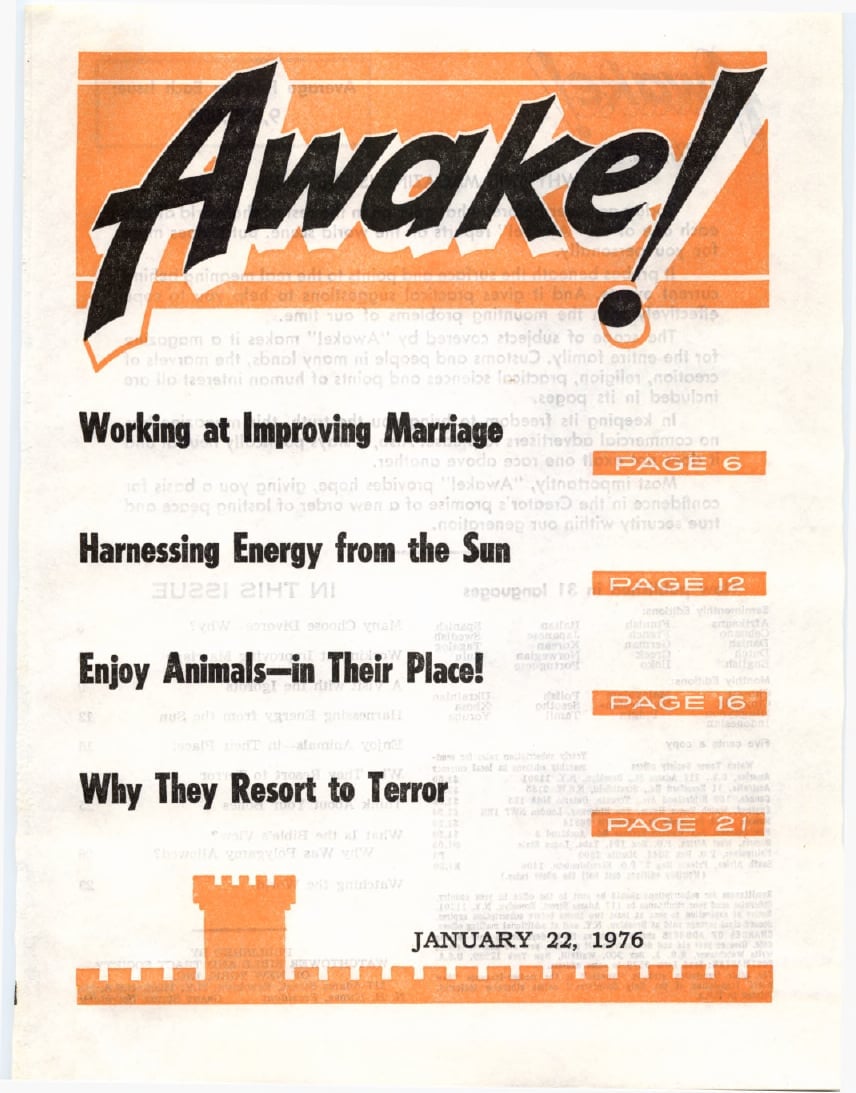
Awake! — January 22, 1976
Source: jw.org
Contents
Many Choose Divorce—Why?
Working at Improving Marriage
A Visit with the Igorots
Harnessing Energy from the Sun
Enjoy Animals—in Their Place!
Why They Resort to Terror
Think About Your Bones
Why Was Polygamy Allowed?
Watching the World
Do You Long for Something Better?
A Thousand Years of Peace
Many Choose Divorce—Why?
Many Choose Divorce—Why?
IN RECENT years a peculiar malady has spread throughout many countries with amazing speed. News sources call it “Divorce Epidemic,” “Divorce Fever,” “Split Fever.”
According to figures for the United States released by the National Center for Health Statistics, between 1965 and 1973 marriages increased by 26 percent. Divorces, however, went up from 470,000 in 1965 to 913,000 in 1973, an increase of 90 percent. Last year the figure climbed to 970,000 divorces. Divorces in the United States were predicted to exceed one million a year by the end of 1975. That is nearly one divorce for every two new marriages.
This “divorce epidemic” is by no means confined to the United States. The Oregon Journal noted at the end of 1973 that, according to government figures, divorces in Egypt outstripped marriages by two to one during 1970. Official figures from Russia, according to an Associated Press report, indicate that “one out of every four couples get divorced although it is believed the rate is actually one out of three.” People in many other countries, such as Italy, Portugal and Sweden, have obtained legislation that makes getting a divorce easier.
Divorce Now Possible in Portugal
On May 27, 1975, Portugal published a new divorce law. For the first time in nearly thirty-five years, persons married by the Roman Catholic Church can obtain a divorce in Portugal.
Back in 1940 the Portuguese government and the Vatican signed a concordat in which the government agreed to insert in its laws a clause that would prohibit divorce for anyone married by the Catholic Church. The result was Article 1790 of the Civil Code, which declared it impossible to “dissolve by divorce Catholic marriages celebrated since August 1, 1940.”
This law prevented individuals married by the Catholic Church from getting a divorce even when their mates committed adultery or took up living sexually with other partners. But rather than keeping couples together, Article 1790 drove thousands of Portuguese married persons to enter consensual arrangements with individuals other than their marriage mates. Obviously, the results of such unions were undesirable. For one thing, children born from consensual relationships were viewed as illegitimate.
The new divorce law, No. 261/75, abolishes Article 1790 of the Civil Code mentioned above. Accordingly, “Catholic marriage henceforth can be dissolved in the civil courts, in the same terms and on the same basis as a civil marriage can be dissolved.”
Some Reasons Why
An important reason why so many marriage partners rush to the divorce courts is the ease with which a marriage can be dissolved. Some parts of the United States now have a “no-fault” arrangement. If a couple insist that their differences are “irreconcilable,” their marriage can quickly be dissolved. Since California introduced such a law, the divorce rate there has increased by 25 percent. In Britain liberalizing of divorce laws resulted in more than double the number of marital breakups in just two and a half years.
Portugal’s new law is a very liberal decree, granting divorce, not only on the grounds of adultery, but even on the basis of mutual consent by both mates. Article 1778 of Portugal’s Civil Code now states that any de facto separation that has lasted more than five consecutive years constitutes grounds for divorce. Interesting, too, is Article 1793, which permits conversion of a legal separation into divorce by a simple written request submitted to the court.
Have you noticed, too, how easy it is, in many places, to get married? As a result, thousands of adolescents have rushed into marriage, only to be disillusioned when faced with responsibilities that they were not prepared to undertake. Many seek escape through the divorce courts.
In recent years a changed attitude toward morals is, in many cases, another factor leading to divorce. In times past most people viewed extramarital sexual activity as a violation of the law of God. Today, however, an increasing number of persons have no qualms whatever about committing adultery.
Other frequently cited reasons for divorce are sexual dissatisfaction, unfulfilled emotional needs, constant argument, problems with in-laws and physical abuse. At times divorce can even be related to why persons marry in the first place. Writer Sydney J. Harris observes:
“More young people marry for negative reasons than for positive ones—and negative reasons are incapable of holding any relationship together. . . . More couples, for instance, marry out of than into. They marry out of loneliness, fear, desperation, a bleak home life, a sense of insecurity. They are running away from something rather than to something. Many are trying to escape their own feeling of isolation or alienation.”
Are you thinking of getting married soon? Have you analyzed your reasons for taking this step, and are you sure that you are equipped to take on the responsibilities of marriage and parenthood?
Before deciding to marry, it is wise to talk matters over seriously with your prospective mate and to seek the guidance of persons who have had long experience with happy marriage. The Scriptures urge thinking things out in advance, saying: “The plans of the diligent one surely make for advantage, but everyone that is hasty surely heads for want.”—Prov. 21:5.
Often, though, divorce springs from a cause that may not be readily apparent. How so?
Breakdown of Communication
The wife of a schoolteacher explains why a void developed in her life:
“[My husband’s] world begins and ends at the high school, and while I’m interested in his work and want to share everything with him, I discovered shortly after our second daughter was born that I needed other adult conversation. . . . Oh, sure, when we’re making love, I feel very close to [my husband], but the rest of the time I feel that his mind is in a textbook or a classroom and that I’m just an animated decoration around the house.”
The problem here was a basic one—lack of communication. This was found at the top of two lists of things that cause marital problems. When communication breaks down, other problems crop up too, such as whether to have children and how to bring them up. And, according to a study by McCall’s magazine, the key to the confusion over money matters was a disturbing lack of communication between marriage partners when the subject of money was brought up. The principle at Proverbs 15:22 is certainly true with regard to marriage: “There is a frustrating of plans where there is no confidential talk.”
Communication with one’s spouse calls for more than mere discussion of household affairs. Think of your own courtship. Did not you and your fiancé or fiancée repeatedly assure each other of your love, appreciation and need of each other? How meaningful that “sweet talk” was then!
But what happens after marriage? In many cases communication of affection between married couples ceases altogether. This can have dire consequences, as noted by an article in the New York Sunday News: “It is a common platitude that the unfaithful husband is just oversexed. But this is not true. The cooling off of love and affection at home sends many more men into infidelity than does simple lust.” The same may be said for women whose husbands deprive them of affection.
It may be, though, that problems in a marriage stem from an even more basic cause. What is that?
“Everyone Wants More”
Have you noticed the increasing emphasis on self that permeates modern thinking? “Marriages are succumbing,” notes Erica Abeel in New York magazine, “because only a perfect relationship will do. No one wants to settle or accommodate—everyone wants more. The push for ‘more’ comes largely from psychotherapy. . . . Unfortunately for a marriage, though, ‘more’ often means more for me rather than more for us. And a wife may have a very different conception of ‘more’ than her husband.” In agreement with this are comments of Joseph Epstein, author of the book Divorced in America (1974):
“Therapy is the new religion and therapy is the self . . . how do I come out? The new age of psychology tells you to take care of Number One. All that attention to self is very abrasive in a marriage.”
Current emphasis on self deceives many unwary marriage partners into thinking that they are missing out on the ultimate in personal satisfaction. They become “bored” with their responsibilities at work and in the home. Then arises the demand for more satisfaction during sexual relations, for “more fulfillment” in everything. And what happens if these demands are not met?
It is considered courageous to head for the divorce court. “For a lot of people,” explains a writer in Atlantic, “divorce is a sort of Ph.D., a point of growth and self-analysis and change, a thumbing-of-nose at marriage.”
Would divorce be a “point of growth” for you? Or is there, perhaps, a better way to deal with your marital problems?
Working at Improving Marriage
Working at Improving Marriage
MARRIAGE is the closest of adult human relations. When a husband and a wife mistreat each other, the wound is often deep and lasting. It may seem that divorce is the only answer.
Surely you will agree, though, that breaking up a marriage is serious. Will divorce really bring greater happiness? Or might it be better to work at improving your marriage?
The Need for a Balanced View
Divorce may seem to be an easy way to escape the unpleasantness of marital problems. But a balanced view is needed, for in many cases divorce has only made matters worse for those involved. Psychology Today, of May 1975, contained the following comments: “In spite of all the cheerful books on creative divorce, no-fault divorce, and better living through divorce, people whose marriages fail are miserable.” Especially difficult for divorced persons is loneliness.
‘But why should a divorced person be lonely?’ you may ask. ‘Are not casual relationships of couples who live together without serious commitment to each other popular today?’ Many, however, cannot conscientiously enter such promiscuous relationships. And even if you chose to live that way, could someone who takes pride in ‘not getting involved’ fulfill your need to belong to someone? “Marriage serves a deep need for emotional nourishment and commitment,” notes a New York marriage counselor. “You don’t find that in a casual relationship.” Could it be that divorce would intensify, rather than solve, your problems?
But what if a married person engaged in sexual relations with someone other than his mate, perhaps even with a homosexual? This brings up an interesting discussion of divorce found in the Bible.
“On Every Sort of Ground?”
In the first century C.E. there was a controversy among Jewish scholars as to what were acceptable grounds for divorce. The code of Jewish law known as the Mishnah preserves the following tradition from that time: “The School of Shammai say: A man may not divorce his wife unless he has found unchastity in her . . . And the School of Hillel say: [He may divorce her] even if she spoiled a dish for him . . . R[abbi] Akiba says: Even if he found another fairer than she.”a
In view of these differing opinions, which are similar to ones held in modern times, certain Pharisees asked Jesus Christ: “Is it lawful for a man to divorce his wife on every sort of ground?” (Matt. 19:3) Jesus answered:
“Did you not read that he who created them from the beginning made them male and female and said, ‘For this reason a man will leave his father and his mother and will stick to his wife, and the two will be one flesh’? . . . Therefore, what God has yoked together let no man put apart. I say to you that whoever divorces his wife, except on the ground of fornication, and marries another commits adultery.”—Matt. 19:4-6, 9.
The Greek word porneía, which is here translated “fornication,” includes adultery, homosexuality and unnatural sex acts. Where such things are involved, therefore, the Scriptures allow for a person to get free from the unfaithful marriage mate and to marry again. But there is no Scriptural obligation to seek a divorce.
But what of a situation where one subjects one’s mate to physical abuse, though not committing “fornication”? Here the counsel found at 1 Corinthians 7:10, 11 is appropriate: “A wife should not depart from her husband; but if she should actually depart, let her remain unmarried or else make up again with her husband; and a husband should not leave his wife.”
Thus, while the Word of God permits divorce on the ground of “fornication” and allows for separation, it does not encourage couples to split up. Rather, the admonition is to work at improving marriage, to “make up again.” And the Bible contains simple principles that have helped thousands of couples to improve their marriages. Let us consider some of these principles.
Becoming “One Flesh”
You will recall that Jesus said of husbands and wives: “They are no longer two, but one flesh.” (Matt. 19:6) A couple who function as “one” know each other’s mind and agree on matters. In other words, they communicate. How can you do this?
Did you know that frequently the Scriptures portray God as “listening” and “paying attention” to people, even to their complaints? (Gen. 21:17; Ex. 2:23-25; Deut. 9:19; Ps. 69:33; Mal. 3:16) Are you a good listener? Do you restate what your mate says, prodding to make sure that you understand? Real listening is much different from just cocking one ear to what is being said and perhaps punctuating the “conversation” with an occasional “uh-huh,” while concentrating on something else.
Then there is a need for communicating appreciation and love for each other. The Bible speaks favorably of “expressions of endearment” that passed between a shepherd boy and his beloved Shulammite maiden. (Song of Sol. 1:2, 4; 4:10; 7:12) An occasional warm smile, an affectionate wink, a genuine expression of appreciation such as “You look fine today, dear,” can do much to keep a marriage on solid footing, and to rebuild a tottering one too.
The Principle of Loving Headship
Another matter that steers many marriages toward the divorce court is misunderstanding of the respective roles of husband and wife. Think, though, of how much bickering and strife could be avoided by observing the following Bible principle: “Let wives be in subjection to their husbands as to the Lord, because a husband is head of his wife.”—Eph. 5:22, 23.
Does that sound like a harsh arrangement? Before answering, consider what the Scriptures further state: “Husbands, continue loving your wives . . . Husbands ought to be loving their wives as their own bodies. He who loves his wife loves himself, for no man ever hated his own flesh; but he feeds and cherishes it. . . . Let each one of you individually so love his wife as he does himself.”—Eph. 5:25, 28, 29, 33.
A loving family head pays attention to his wife’s opinion on matters, realizing that she may have greater ability than he in certain areas. He also ‘assigns her honor as the weaker vessel’ physically, not expecting from his wife more than she reasonably can give. (1 Pet. 3:7) Wife, if your husband shouldered his responsibility as family head along with your support, would not your marriage improve?
Improving a marriage, however, requires that a husband and wife avoid an attitude that has become popular today. How so?
Who Is More Important?
You have probably noticed the stress on personal satisfaction today. The publication Physician’s World remarks: “There’s a much higher level of expectation on the part of both spouses these days. They learn from the media that they should expect to retain their youth, enjoy higher status, and keep up their sexual appetites. It’s a crisis that often ends in divorce.”
The Bible, at 1 Corinthians 10:24, urges the very opposite frame of mind: “Let each one keep seeking, not his own advantage, but that of the other person.” For example, with regard to sexual relations the Scriptures counsel:
“Let the husband render to his wife her due; but let the wife also do likewise to her husband. The wife does not exercise authority over her own body, but her husband does; likewise, also, the husband does not exercise authority over his own body, but his wife does. Do not be depriving each other of it, except by mutual consent.”—1 Cor. 7:3-5.
If you viewed your partner’s satisfaction as more important than your own and vice versa, would not your marriage improve?
When Nothing Seems to Work
It must be acknowledged that many persons have struggled for years to make a success out of their marriage, but have not received cooperation from their mates. Is that your situation?
If so, do not lose heart. Take seriously the admonition at Galatians 6:9: “Let us not give up in doing what is fine, for in due season we shall reap if we do not tire out.” Often an obstinate husband or wife has had a change of heart because of a mates good conduct.—1 Pet. 3:1, 2.
But even if that does not happen in your case, there is no need to feel that your good efforts are in vain. The apostle Peter wrote: “If someone, because of conscience toward God, bears up under grievous things and suffers unjustly, this is an agreeable thing.” (1 Pet. 2:19) Sticking to Bible principles under pressure brings God’s favor, which is the most important thing that Christians can “reap.”
Would you like to work at improving your marriage? Jehovah’s witnesses will be happy to conduct a free Bible study with you. They will gladly point out to you the God-inspired principles that can make your marriage a success.
[Footnotes]
The Mishnah, translated by Herbert Danby, tractate Gittin 9:10.
[Picture on page 7]
Really paying attention when your mate speaks can help to improve the marriage relationship
A Visit with the Igorots
A Visit with the Igorots
By “Awake!” correspondent in the Philippines
IT IS early afternoon when my wife and I board a comfortable air-conditioned bus and sink into the soft cushioned seats, anticipating our unique vacation. We are on our way to visit the Igorots, who have, to a great extent, resisted the intrusion of foreign influence into their culture. They live in the mountainous provinces of Northern Luzon.
The Igorots are of Malay origin, medium height, strong, with dark skin and straight black hair. The remarkable thing about these people is that over the centuries, with only hand tools and sheer hard work, they have converted an entire valley into the world’s most extensively terraced rice gardens.
On the way to visit the Igorots, we ride for five hours through the picturesque central plains of Luzon with its many small towns and rice fields before arriving in Baguio, the summer capital of the Philippines. The cool weather here is a welcome change from the heat and humidity of Manila.
The next morning we are up early so as not to miss the 5:30 bus departure for Banaue. Although we arrive at the station a half hour early, to our disappointment the bus is full. But Filipinos are hospitable, and soon a passenger motions to the others, who begin putting their sleeping little ones on their laps and pushing vegetables aside to make room for us. A man with a smiling face extends his hand to help us up.
The bus is shorter than other buses, looking more like a truck and giving the impression that it is built for strength rather than comfort. It is completely open on one side, with wooden benches across its width but quite comfortable despite its Spartan appearance. For shelter from the wind and rain there are canvas shades that can be pulled down.
Although it is only about seventy miles from Baguio to Banaue, our trip takes nine hours because of winding mountain roads that take us through the clouds to elevations of over 7,000 feet. As we start up the mountains, a yellow-orange sunrise colors the sky and we see the morning mist hanging just below the tops of tall pine trees.
Igorot Customs and Way of Life
Nearing the town of Bontoc, we begin observing the Igorot people. The men wear a brightly colored loin covering called a wanes, commonly known as a G-string. They also wear a small, flat-topped, round cap, which serves the same purpose as trouser pockets.
Women wear a skirt of heavy, brightly colored hand-woven cloth called a tapis. It is predominantly red, with yellow, white, green and black horizontal stripes. The tapis is held in place by an eight-inch-wide belt, woven with heavy cord, called a wakes. Most of the women we see wear a white blouse, but in the villages some women go without upper covering.
Along the road we see women carrying their children in a blanket tied to their back or side. Even little girls carry their baby brother or sister in this fashion, along with packages on their head! When our bus stops, I ask a young girl if I may lift her package, and to my surprise it is heavier than my loaded suitcase. Yet she picks it up gracefully and carries it off on her head!
Bontoc is the capital of Mountain Province. Here Igorots live in a modern town in cement houses with electricity and running water. Yet, across the river in the village of Samoki, others live as their forefathers have for hundreds of years.
As we walk along here with our traveling companion and interpreter, we notice that she speaks to everyone she sees. We learn that Igorot people almost always greet persons they meet on the way by mentioning where they are going and, as a gesture of courtesy, invite the greeted one to come along. However, it is not really expected that they will join the one doing the greeting.
We notice that many Igorot women wear tattoos over their entire arms. “It is a sign of beauty,” explains our guide, “and is applied at the age of fifteen.”
I ask: “How do they know when they are fifteen if no birth records are kept?”
“They estimate the age by the first time she is in love with a young man,” is the reply.
Courtship, Marriage and Work
Igorot courtship customs, we learn, are most original and interesting. In the village is an ulog, or ag-gam, a thatched hut where girls of marriageable age sleep overnight. A young man interested in marriage will approach the girl of his choice in the ulog and ask her to marry him. This may be the first time the couple has ever spoken to each other.
When the proposal is accepted the next step is to visit the girl’s parents, with a pig as a gift. This pig is slaughtered and the bile examined. If it is acceptable, the couple is engaged. This is followed by a second pig. If its bile is acceptable, the marriage is official. A bile that is not in good condition is believed to be an omen that the marriage will not be blessed. A marriage feast follows with much food and dancing.
The marriage, though, is still subject to the condition of the bile of a third pig, to be sacrificed after the rice harvest. An unacceptable bile annuls the marriage.
The work load in an Igorot family is divided in half, between the husband and the wife. One day the man plows the field while the wife cares for the home. Then the man cares for the home while the wife spends the day in the field planting and cultivating the crops.
The Igorot Home
We resume our bus trip, eventually arriving at our destination, Banaue, where arrangements have been made for us to spend time with a family in their Igorot hut.
It is already dark when we arrive and start our thirty-minute walk to our accommodations. With a flashlight, we make our way up roughly chiseled-out steps on the vertical side of a mammoth boulder alongside the road. Once on top, we follow the flashlight beam along the narrow ledge of a twenty-foot-high rice terrace, walking carefully, trying to balance ourselves on a ten-inch-wide path. Soon we come to a narrow but deep gorge. We are cautioned not to look down as we make the four-foot jump. It is incredible to think that this is the easiest way of approach to these people’s home!
Finally we come to a little clearing on the mountainside. In the moonlight we see a small hut, perhaps eight feet high and seven feet wide. No sooner do we catch our breath than a smiling, elderly man comes out to invite us in.
Once inside, we realize that there are no windows, only a small hole in the roof above the fire that burns in one corner. The only other source of light is a small oil lamp made from a jam jar and a piece of cord. There are no tables or chairs, only a small mat made of narrow bamboolike sticks called bilaw, which is laid on the floor. It serves for sitting, as a dining table, and, as we later discover, our bed.
Since it is still early evening, our host, Pedro Kindajan, tells us how he built this hut during the time of the Japanese occupation, which explains why it is so hard to get to. He points out that the walls are made of bilaw, and the thatched roof is a grass called goloon. Upon racks above the fire is stacked a supply of firewood that dries as it absorbs the smoke.
Our conversation lasts until about 8:30 p.m., when it is time to go to bed, since the day begins early for the Igorot people. A small thin mattress is rolled out and the mat we are sitting on instantly becomes a bed. Contrary to what one may think, it is very comfortable. Our host and his family sleep in other huts he has on his property.
A Rewarding Visit
The new day begins before sunrise. While breakfast is being cooked, we wash up outside. Breakfast includes hard-boiled chicken eggs, boiled camote (sweet potato), and coffee. I spend part of the morning working with Pedro Kindajan as he cares for his daily chores, which include feeding the ducks, chickens and pigs.
Pedro points to a recently plowed hill across the valley and tells me he is going to plant some camote up there, and rice on one of the terraces below. Here for the first time I see the vastness of the Banaue Rice Terraces!
Eastward, northward and westward, as far as the eye can see, are green rice terraces upon green rice terraces. They extend from the base of the mountains clear to the summit. On one mountainside there are over fifty terraces, one on top of another. These terraces cover an area of some 250 square miles and, if put end to end, they would stretch a distance of some 14,000 miles. Of all man’s marvelous accomplishments, these terraces are the most impressive I have ever seen. It staggers the imagination to think that they were constructed with simple hand tools and without the aid of modern technology.
Living for several days with the Igorots proved to be a rewarding lesson for my wife and me. Although not having modern inventions to keep us continually busy, we were constantly learning interesting things about the good earth. Never once did we feel bored. While modern technology has helped man to better his lot in certain cases, somehow it has also had the tendency to alienate him from his home, the earth, rather than to make him feel a part of it, as this visit among the Igorots did for us.
Harnessing Energy from the Sun
Harnessing Energy from the Sun
HAVE you ever gotten into an automobile that has been closed up and sitting for a long time in the hot sun? The heat can be almost unbearable! No question about it, the sun is certainly a tremendous potential source of energy.
Just think of it, the sun’s energy could be used to heat our homes, operate our home appliances, light our cities, drive our vehicles or fill any other power needs we may have. In fact, so much solar energy falls on the earth that if man could harness its flow for just fifteen minutes he would have enough power to supply world’s present needs for a full year!
There are skeptics, however. They believe that sunshine is too diffused to be a practical energy source. Yet, according to J. T. Kane, editor of Professional Engineer: “Something on the order of six to ten times the amount of energy required to heat the average building in the U.S. radiates down on the building from the sun each year.”
But is harnessing energy from the sun really practical? Can homes today economically utilize this fabulous flow of energy?
A Practical Energy Source?
You may be surprised at the strides that have already been made in harnessing solar energy. The distinguished geologist Dr. M. King Hubbert noted: “Solar energy is not just a theory. We’re talking about things that already exist, things we already can do.”
What are some of these things? For instance, can the sun be harnessed to supply a home with electricity? In a letter to the editor of the New York Times, United States Senator James Abourezk explained: “The technology for converting solar energy into substantial quantities of electricity is available.” The senator therefore urged: “The major effort should center on converting solar energy into usable electrical energy.”
As yet, though, there is no economical way of doing this. True, there is little question that the sun could be harnessed to provide all the electrical needs of one’s home. Orbiting spacecraft use the sun’s energy to power electrical equipment on board. But producing electricity from sunshine is still too expensive to be practical.
Most authorities believe that the first step in utilizing the sun’s energy is not in producing electricity, but in heating water and in heating and cooling buildings. Some solar experts say that it is practical for many homeowners to do this even now. The idea is to capture the sun’s heat, store it, and circulate the heat to warm the house, or to use the heat to run an air-conditioner.
D. Elliot Wilbur, marketing and business director of Arthur D. Little, a firm involved in solar research, notes: “All the materials to install solar heating in buildings are available on the market right now. All that’s needed is a company that’s willing to put the entire package together and offer it to the general public.”
Will companies begin doing this soon? Peter E. Glaser, a vice-president of the Little firm, is optimistic. “Within three to five years,” he claims, “you should be able to buy a solar heating system from a Sears catalogue.”
Is there sound basis for such optimism? Is a massive solar-heating industry about to develop?
Heightened Interest—Why?
There is no question about the increased interest in solar energy. Last May thousands of persons attended a solar-energy seminar organized by the Solar Energy Industries Association in Washington, D.C. And when the Environmental Information Center of Winter Park, Florida, announced a free booklet, “How to Build a Solar Water Heater,” the first 5,000 printing was exhausted in ten days.
Newspapers and magazines carry a flood of stories about solar energy being used to heat swimming pools, homes, schools and other buildings. To mention just a few reports:
◆ A Colorado developer is installing a solar-heating system in a new condominium complex.
◆ The city of Santa Clara, California, plans to heat and cool a new community center with energy from the sun.
◆ Solar heating is being installed in an Atlanta, Georgia, school; already schools near Washington, D.C., Baltimore and Boston are heated by solar energy.
◆ In Vermont, sunshine heating is planned for a new colony of vacation and ski homes.
◆ Western ranchers are seeking to replace propane driers with solar-heat collectors to dry their grain.
What has prompted this interest in the use of solar energy? Principally, the realization that a change in the present system of generating power is inevitable. It must come. Why? Because the main sources of our energy—oil, natural gas and coal—are limited, with some experts claiming that reserves will run out soon. Already fuel prices have skyrocketed. Furthermore, the use of fossil fuels is beginning to pollute the environment to an objectionable extent.
Future for Solar Energy Brightens
There is much to be said for solar energy. It is abundant and available to all, it does not pollute the environment, and it is free, the only cost being to harness it. It is claimed that, if solar-heating systems were mass produced, they would be more economical than conventional heating systems.
Knowing the merits of solar energy, many scientists are urging its use on a large scale. Dr. Harold I. Zeliger, a New York chemist, went so far as to tell an international environmental conference recently: “It seems obvious that the only long-term solution to the world’s energy-pollution problem is the use of solar energy.’’
This source of energy is also gaining political credibility. For many years the United States government spent only about $100,000 annually on solar projects. But in 1973 this jumped to $4 million, then to an estimated $25 million in 1975, and for 1976 a congressional source foresees more than $100 million going into solar research and development.
In some countries the sun already is harnessed to provide much of the hot-water needs. In Japan, for example, about 160,000 solar hot-water units were sold in 1974. Israel was said to have some 150,000 of such solar installations, providing sun-heated hot water for about one of every five families. And an estimated 10,000 Australian homes use solar water heaters.
Sunshine could also soon be a significant energy source in the United States. It may surprise you, but well over 80 percent of the average homeowner’s energy bill is for hot water and for heating and cooling. And more than a quarter of all the energy consumed in the country goes for these three uses! So if sunshine is harnessed for just these purposes, millions of barrels of oil will be saved daily.
One study last year showed that in the U.S. nearly two hundred solar-heated homes were either completed, under construction or planned. To equip these homes, a solar-hardware industry has emerged; in fact, there are reportedly dozens of solar-equipment makers. But what, you may wonder, is involved in a modern solar-heating system?
How the Sun’s Energy Is Harnessed
Since the industry is in its infancy, there is little standardization. But the basic system consists of a solar-energy collector, a storage tank to hold the heat, and a distribution system.
The collector is usually placed on the roof, and is angled to catch the maximum amount of sunlight. The basic principle of the collector is that of a greenhouse. Black absorber panels are covered by glass or plastic. These panels may consist of aluminum sheets painted with a special heat-absorbent black coating. A fluid, commonly water, is piped through the black paneling. In one system, the paneling is corrugated and the corrugations are ribbed with radiator-like pipes.
Sunlight penetrates the glass or plastic, and the black paneling absorbs the trapped heat. Water flowing through the pipes in the paneling may be heated to 200 degrees Fahrenheit and more. This hot water flows to the storage tank, usually in the basement. In a simple hot-water system, however, the tank is often placed on the roof along with the collectors. About a 140-gallon tank will provide a family of four with hot water.
But to fill also heating and cooling needs, a several-thousand-gallon storage tank is required for an average-size U.S. house. One system heats the house in this way: The hot water is siphoned from the tank to heating coils in a duct. Air is then blown through the coils, heating the air, and the hot air is circulated to warm the house.
In order to cool the house, the hot water is routed through an air-conditioner that has been modified to use hot water as a heat source, instead of a gas burner. There is much to be said for solar air-conditioning, because when the sun shines hotter and more air-conditioning is required, the energy is available to operate the system.
But can an efficient solar-heating system now be mass produced? Many scientists think so. Two professors at upstate New York’s Syracuse University wrote: “Technology is far enough along to begin applying it on a large scale. Some researchers, engineers and architects, including members of the Syracuse University’s Energy Research Council, feel at this time that it is possible to build homes, even in our latitude, that depend entirely on solar energy for heating.”
As noted earlier, some solar experts feel that in three to five years such a solar-heating system will be on the market. But Chicago University professor Roland Winston, who also has spent years in solar research, warns: “It’s a long way from a handful of solar homes to buying a solar heating plant at Sears.”
It will be interesting to observe developments. But, at the same time, what about the prospects for solar-produced electricity?
Solar Energy for Electricity
There are two often-discussed ways to produce electricity from the sun. First, sunlight may be used to heat a liquid that produces steam, which, in turn, drives a turbine engine. It is estimated that a solar-collecting area of five to seven square miles would fuel a steam plant capable of matching the energy output of the largest nuclear power plants. The construction of such a solar electrical plant has been urged by some.
“It appears possible,” notes Dr. R. C. Jordan, head of the University of Minnesota’s School of Mechanical and Aeronautical Engineering, “that, using today’s materials and processes, we can convert 20% of solar energy falling on the Earth at a given point to thermal power and then to usable electric power. This would mean enough power to serve the requirements of this nation for many years to come, and do it at a cost we can afford, making use of unused portions of our land such as deserts without causing pollution.”
This type of electrical power plant, however, is considered the wrong approach by some. Dr. Erich A. Farbet, head of one of the world’s largest solar-energy research efforts, says: “You don’t build a large power plant in Arizona and send the energy to Florida. Solar energy falls on your roof, your yard, on the walls of your house. It can be economically developed right where you are. You don’t need large solar-energy power stations.”
It is true, sunlight can be converted to electricity right at home. This can be done by solar cells. These are thin, waferlike chips of silicon that produce an electric current when sunlight strikes their surface. These photovoltaic cells now produce electricity on orbiting spacecraft. And a thousand square feet of these long-life cells attached to the roof could furnish the electricity needs of a modern home. However, solar cells are much too expensive for such use. Yet they need not always be, claims United States Senator James Abourezk.
“There are,” he says, “numerous laboratories around the country currently producing photovoltaic cells, which, if produced on a mass basis, could (in the opinion of solar cell engineers) become competitive with other forms of electrical generation. . . . And converting solar energy to electricity will have a far greater impact on many more people than attempting to install solar heating and cooling devices in every home in the United States.”
What Future for Solar Energy?
Truly in the sun we have a bountiful, pollution-free source of energy that can be harnessed to serve human needs. How will this be done? When? These are good questions.
Admittedly, there are obstacles. Machine Design observes: “That solar energy has been largely ignored can probably be blamed on economics, vested interests, and government bureaucracies that are founded on fossil-fuel systems.”
Will such obstacles be overcome? Will there be a real commitment to develop this non-polluting energy source, thus conserving earth’s fast-disappearing reserves of oil, natural gas and coal? It will be interesting to watch.
Enjoy Animals—in Their Place!
Enjoy Animals—in Their Place!
THE young married couple were making their first visit to Berlin, Germany. There were many things to see—the opera house, lakes, museums and historic spots. Yet one of their cherished memories was of something that they saw at the zoo.
In the spacious area for the snow (polar) bears, one bear was bounding into and out of the water as he played with a long-handled shovel. They watched him toss his odd toy up into the air and then dive underwater to retrieve it. There is no doubt that he was having fun. And what a joy it was to watch him!
Have you also not delighted in watching or being with animals? Maybe it was a time when, after much patience on your part, a chipmunk or a squirrel came close enough to pick a nut out of your fingers. Or perhaps you even now smile at the memory of when you stroked a tame deer or watched your new pet kitten chasing after a leaf.
Frankly, almost all of us can find much enjoyment in animals. Oh, yes, maybe you have some doubts about snakes, spiders, bats or something of that sort. And yet, by and large, most of us find animals to be enjoyable and interesting.
There is a need, however, to keep animals in their relative and proper place if we are to enjoy them fully. An example, admittedly an extreme one, forcefully illustrates this point.
One man was intensely fond of his pet—a five-foot boa constrictor. Though his wife feared it, he insisted on taking the snake to bed with them, sleeping with it coiled around his body. He began bringing the boa to the dinner table, draping it over his shoulders. When, finally, he started to feed it live mice at the table, his wife could stand it no more. She got a divorce. The husband? He proceeded to get another boa constrictor, hoping the two would mate. Obviously he enjoyed animals, at least this kind. But did he enjoy them to a reasonable degree, or in their proper place?
Pets Galore
Unless you live on a farm your enjoyment of animals may be limited mainly to dogs, cats, small birds or fish. Yet, some individuals have pet turtles, hamsters or certain insects, such as fleas or cockroaches. Really, the list of pets is vast. Japanese children often tame mice. Some Australians make pets of kangaroos. Then what about mongooses, frogs, monkeys and otters? And, incredible as it sounds, some 10,000 Americans own large cats such as lions and leopards as pets!
One book reported recently that there were eight million dogs and cats in West Germany and some 16.5 million in France. The London Times (September 9, 1967) said that in a single year the British spent £95,555,304 on food for over 5 million dogs, 4.5 million cats and 3.5 million birds, fish and small animals. As to the United States, Time magazine stated:
“The U.S. today is undergoing what can only be described as an animalthusian explosion. . . . The some 100 million dogs and cats in the U.S. reproduce at the rate of 3,000 an hour, [versus] the 415 human babies born each 60 minutes. An estimated 60% of the 70 million American households own pets.”
If you, too, enjoy animals—whether you have a pet or not—you may have thought about the various benefits of animals.
Value of Animals
It is quite natural that most humans should find animals enjoyable and important, for Jehovah placed them on earth as a valuable part of our earth’s ecology. He knew that man could benefit by having both the “wild” and “domestic” ones sharing together this globe of ours. (Gen. 1:24) For instance, who of us has not benefited from comfortable and durable clothing made from wool? And could this not have been true even of Adam’s family, since his son Abel was “a herder of sheep”?—Gen. 4:2.
But animals, particularly pets, are often valuable in other ways. They may protect a person’s property or life. Imagine how many persons have been protected from being mugged or assaulted because they were walking with a loyal dog that would bark and defend its master. A woman in a nice section of Brooklyn said with an understanding smile that, though many nearby homes had been burglarized, hers had not. Her family has a 100-pound Great Dane whose “woof” would give any would-be robber second thoughts—third and fourth thoughts too! Still, that black-and-white Dane is so mild and affectionate to the family and their friends that they really enjoy him.
If you are a parent, you may have an animal in the home because you feel that a pet can be an important part of a child’s life. In this regard the Encyclopædia Britannica says:
“Keeping pets offers the opportunity to teach children the close dependence of privilege on responsibility and also something about sex; the process of mating is soon noticed, followed by such matters as gestation periods and the varied problems involved in the birth and care of young.”
If you choose to have a pet for your children’s sake, for them to benefit most fully the children must be trained as to the responsibility involved. Would it show any deep care for your children or for a pet to allow it to be neglected once the initial enthusiasm for it waned or once it was no longer “cuddly”? If you teach your children to share in the cleaning, feeding, exercise and discipline of the pet, not just doing it yourself, you will be helping them. And everyone will enjoy the pet more.
Caring for a pet, as well as having its companionship, has aided many retarded children and youths with emotional problems. One reason is that they may respond when they feel that a part of God’s living creation is dependent on them. Also, a pet may help them to relate to the “outside world.” A London psychology worker told of a disturbed boy who had communication problems and an obsessive fear of dirt. As the lad became interested in Daisy, a pet dog, he started to communicate better, talking to his parents about the pet. When Daisy had five pups and he could help to care for them, he overcame his obsession about cleanliness.
But, of course, a person does not have to have emotional problems to enjoy a pet’s companionship. Have you ever sat quietly in a chair softly caressing a purring cat? Have you ever listened to the melodious singing of a pet canary, or been welcomed home by the happy barks of your dog? Then you know that animals can bring much enjoyment.
Reasonableness Needed
Even persons who enjoy animals very much usually realize that reasonableness is needed in connection with them. If you have a pet, or may get one, you should not overlook some important factors relative to enjoying animals, particularly pets.
Cost certainly is one factor. Simply stated, a pet costs money. Of course, so does attending a soccer match, going to a theater or pursuing a hobby such as oil painting. A reasonable view, then, is to weigh the enjoyment obtained in the light of its cost. Time magazine said:
“Americans spend $2.5 billion a year on commercially prepared pet food alone to feed their pets—more than six times as much as they spend on baby food, and more than enough to nourish the one-third of the world’s population that goes hungry. . . . For each dollar spent on pet food, Americans lavish at least as much for pet products and services.”
Many persons obtaining a pet do not anticipate a large expense. But costs have a way of mounting. Perhaps special food seems advisable. The pet gets ill and requires treatment. Licenses, cages, leashes and so on may be needed.
When her husband died, Mrs. E. bought a Sealyham terrier. She grew very fond of it. At the end of a year, however, she calculated how much her pet cost. She had gradually come to feed it special meat and snacks—$547.50 in one year. Shots and medicines—$50; grooming and accessories (sprays, collars, toys and so forth)—$291; kennel care when she traveled—$126. After giving this example, a book about pets concluded:
“When Mrs. E. found that she had spent, in one year, [$1,014.50] on her dog, a sum equivalent to the annual income of a migrant worker in California, she decided there was something basically wrong about treating animals, however much one loved them, better than people.”
That was her conclusion. Someone else might conclude that for him the benefits of having a pet warrants the cost. In any event, a person ought to weigh the expense and use reasonableness in deciding what is best for him. Priorities differ, as do circumstances. One African said:
“In the general economic climate of undeveloped Africa it is very difficult for people to understand how the higher paid members of the community can spend as much, if not more, money on feeding dogs and cats and horses than the average person spends feeding his whole family.”
Thus, in many parts of Africa, dogs are left to scavenge for their food. So, even many dogs that are owned to protect the home are “so painfully thin that you can count their ribs.”
Perhaps you feel that you would not want your pet to be in that condition. Then are you prepared to bear the cost of keeping it fed and healthy? More and more persons who have pets find that they are not able to care for them properly. So humane societies are receiving for destruction many emaciated pets. Other people throw animals into the streets or abandon them in a field, even though they may not be able to survive there. That surely is no way to “enjoy” an animal.
A person having a reasonable outlook on enjoying animals also recognizes potential hazards, just as you give thought to any hazards that might be part of a sport or other recreation you are considering. Certainly being bitten is one possible danger with a pet. The Toronto Star said: “Dr. Bruce Feldman [a specialist in pets] points out that in the U.S. about one person in 170 is bitten by dogs annually, ‘and at least as many bites are unreported.’ Applying these figures to Canada, it is possible that as many as 100,000 Canadians suffered animal bites” in 1974.
But it is not just dogs that present this danger. Dr. Harvey Rhein, a former president of a veterinary association, said:
“As far as I’m concerned, no wild animal makes an acceptable pet. Monkeys are too close to man; they can both pick up and spread human diseases. I’m also opposed to raccoons, skunks and squirrels. Despite claims of some people, who’ve domesticated these animals, that they make lovable pets, there remains a question of rabies being a latent virus. All these animals are biters; they can do so—fiercely.”
Aside from bites, some doctors warn about pet-borne diseases. A newspaper article entitled “New Pet-Induced Ills Challenging Doctors” listed diseases contracted from turtles, hamsters, cats and dogs. A number of these diseases, which range in potential seriousness from flulike symptoms to fatal infections, are spread in the urine and feces of the animals. Time magazine commented:
“Each day across the nation, dogs deposit an estimated 4 million tons of feces and 42 million quarts of urine on city streets and parks. . . . More than 100 human infections, from diphtheria to tuberculosis, can be picked up by animals and passed on to their owners. Dog defecation is also rich in toxocara (roundworm), which can cause blindness in children.”
Is this to say that you should fear to be around all animals? No, just as the danger of attack from some human or contracting a disease from such a source does not lead us to shrink from all human association. But these factors about pets ought to be considered by a person in determining in what ways and to what degree he or she will enjoy animals.
Reasonable in Affection
As we have discussed, animals can be valuable in many ways. And there is abundant proof that a pet can be a pleasant, entertaining and devoted companion. Understandably, humans might respond with affection, wanting to be kind and to care for a pet.
Still, the fact that some imperfect humans go to extremes with regard to various pleasures and interests should alert us to the danger of “going overboard” concerning animals.
Did you know that persons have provided their pets with things such as gold bracelets, black lace panties, evening gowns and birthday parties? They have obtained clip-on diapers for their parrakeets, false eyelashes for their poodles and sunglasses for vacationing pets. One New York woman has her two dogs picked up each day in a chauffeured limousine; they are slowly driven around a park “so they may have some fresh air and see some green.”
Individuals become so emotionally wrapped up with pets that the animals govern human lives. One couple was going to emigrate to Australia. They already had shipped their furniture. But when their Alsatian dog failed a medical exam and was refused entry, they canceled their passage and paid £500 for their furniture to be sent back. They said: “A new life would have been meaningless if we had sacrificed our dog for it. She is part of our marriage.”
As with the man and his boa constrictor, for some persons a pet becomes even more important than marital attachments. One woman kept six Siamese cats, though her husband was allergic to cats and had nearly choked to death a number of times. Even though pregnant with her first child, she was willing to have a divorce rather than live without her cats. It is reported that she “only hoped her child would not inherit the father’s allergy.”
When affection for animals is not controlled by reasonableness, pets can seem even more important than human life. Hysterical pet owners gathered outside during a fire in one animal hospital. The report is that “women screamed, tore their hair, several fainted, and two tried to break through the cordon, crying that they wanted to die with their darlings.”
Yes, reasonableness is needed. Otherwise a person might gradually allow animals to occupy an increasingly important place in his life and affections. As we have seen, this can and does happen. Whereas at first a person might think that it would be pleasant to have a pet around the home, without reasonableness being manifested he could get to the point of spending inordinate amounts of money, time and attention on the pet. Or, even though he is a clean person, he might come to permit himself to be “kissed” by a pet that had recently been licking its sexual and anal areas or eating something unsanitary. Surely extremes need to be guarded against.
Also, a person ought to evaluate his intention in regard to a pet. Is it a matter of settling on the affection or companionship of an animal as a substitute for obtaining such from humans? In his book Tiere Sind Ganz Anders (Animals Are Quite Different), Hans Bauer observed: “It is altogether unreasonable to ‘fly to the animal world’ because one is ‘disappointed’ by men.” He went on to mention how sad it is for someone to ‘bestow his affections on a dog or a cat in the hope of discovering in an animal what he has failed to find among his own species’ when an animal’s “whole nature prevents it from ever giving” this to him.
Enjoying Animals in Their Place
Actually, the Bible shows that the exact opposite should be the case. After the Creator made all the forms of animal life, he concluded that what he had made was “very good.” (Gen. 1:20-31) Undoubtedly, the first man Adam wholeheartedly agreed with that conclusion. But what place did animals hold in Adam’s life?
Since we today can find such pleasure in watching and being near animals, just imagine Adam’s joy in the animals and especially at the time when God brought them all to him for naming. (Gen. 2:19, 20) Job later said that animals, besides bringing enjoyment, can be a means of much instruction about the Creator. (Job 12:7-9) Adam must have realized that too. Still, the Bible record says that, having surveyed and enjoyed all the animals, Adam found no full companion or complement among them. Adam was an intelligent human made in God’s image, and a similarly endowed creature is what he needed as a complement. As enjoyable, devoted, instructive, amusing or interesting as animals might be, God never purposed that they be a substitute for humans. Do we appreciate this? If so, it will enhance our enjoyment of animals, for we will see them in the proper light and hold them in the place that God purposed for them.
Questions remain, though, about the life and death of animals, such as whether men have the right to kill animals, how we should view the death of an animal, killing such for food, and so forth. We will leave these questions for consideration in a later issue.
Why They Resort to Terror
Why They Resort to Terror
By “Awake!” correspondent in West Germany
A FAMILIAR face peered down from hundreds of election billboards scattered throughout the city. Peter Lorenz was a candidate for mayor of Berlin, and an issue was security. “More Energetic Action to Ensure Security,” urged the billboards. “Berliners are living in danger . . . crime is on the rise,” explained handbills distributed by Lorenz’ party.
But then, shortly before election day, that same familiar face could be seen staring blankly from thousands of newspapers throughout the city—this time tired, drugged-looking, robbed of glasses. “Peter Lorenz—Prisoner of the June 2 Movement,” boasted the sign placed in front of him—now a victim of the very terror that he was campaigning against! Release came only after the German government gave in to all his captors’ demands.
Political terrorism and violence have recently burst forth across the face of the earth, like a deadly plague. In fact, during the very week that Lorenz was held hostage, German newspapers were also reporting other widespread acts of political violence:
Argentina: “Extremists have shot kidnapped American consul John Patrick Egan.”
Southern France: “Extensive property damage was caused Sunday night in a series of six bomb attacks.”
Kenya: “The once peaceful capital of Nairobi dwells in the shadow of terror. A bomb attack upon an overland bus resulted in 27 dead and 36 injured.”
Rome: “In a [blood-spilling] street battle . . . between young extremists of the right and left, a demonstrator was critically wounded.”
Northern Ireland: “Despite the truce two persons were killed last night in Belfast and two others wounded.”
Israel: “A terrorist attack on a hotel in Tel Aviv ended early Thursday in a blood bath . . . fourteen deaths.”
All of this in just a week’s time! No wonder people were asking, “Where will it all end?” and, “Can nothing be done?” However, German Chancellor Helmut Schmidt warned the Bonn Parliament: “The constitutional state can offer no guarantee of protection against terrorism and anarchistic violence . . . Even military and police dictatorships are unable to offer absolute protection.” In search of solutions, Berlin’s daily Tagesspiegel asked:
“What has happened to world organizations like the UN or to the international solidarity of the countries involved in not demanding that political murderers, kidnapers and skyjackers be extradited or at least prosecuted? This evil cannot be eradicated as long as it is not possible to get to the root of the trouble.”
True, but what is the root of the trouble? Will merely prosecuting terrorists reach and correct it? A took at what is behind their acts of violence reveals that the roots run far deeper.
The Road to Violence
Idealistic young people do not have to be told that something is wrong with the society around them. The need for change seems evident. But often their voices alone have had little effect upon deeply entrenched systems. The wave of protests that began in the Western industrial nations in the 1950’s, for example, was peaceful at first. Many people can still remember the “Ban the Bomb” slogan used by marchers from Aldermaston in England. But the bomb was not banned. Indeed, nuclear stockpiles are now growing faster than ever before.
Similar frustrations in connection with the Vietnam war, civil rights and other issues became a breeding ground for more active forms of protest. Increasingly, the seeming success of revolutionary violence in countries such as China and Cuba strengthened many protesters in their belief that change could come only through violent overthrow of those in power.
“Destroy what is destroying you” became the revolutionary slogan of protesting Berlin students during the 1960’s. Since the established state had failed to solve mankind’s problems, they reasoned, it would have to be done away with and replaced—by violent means if necessary. The group that kidnapped mayoral candidate Lorenz put it this way: “Words and demands accomplish nothing in changing what is wrong with this country . . . Only violence and weapons can do away with fascism.”
…