Awake!, January 8, 1976
Download: PDF — Awake!, January 8, 1976
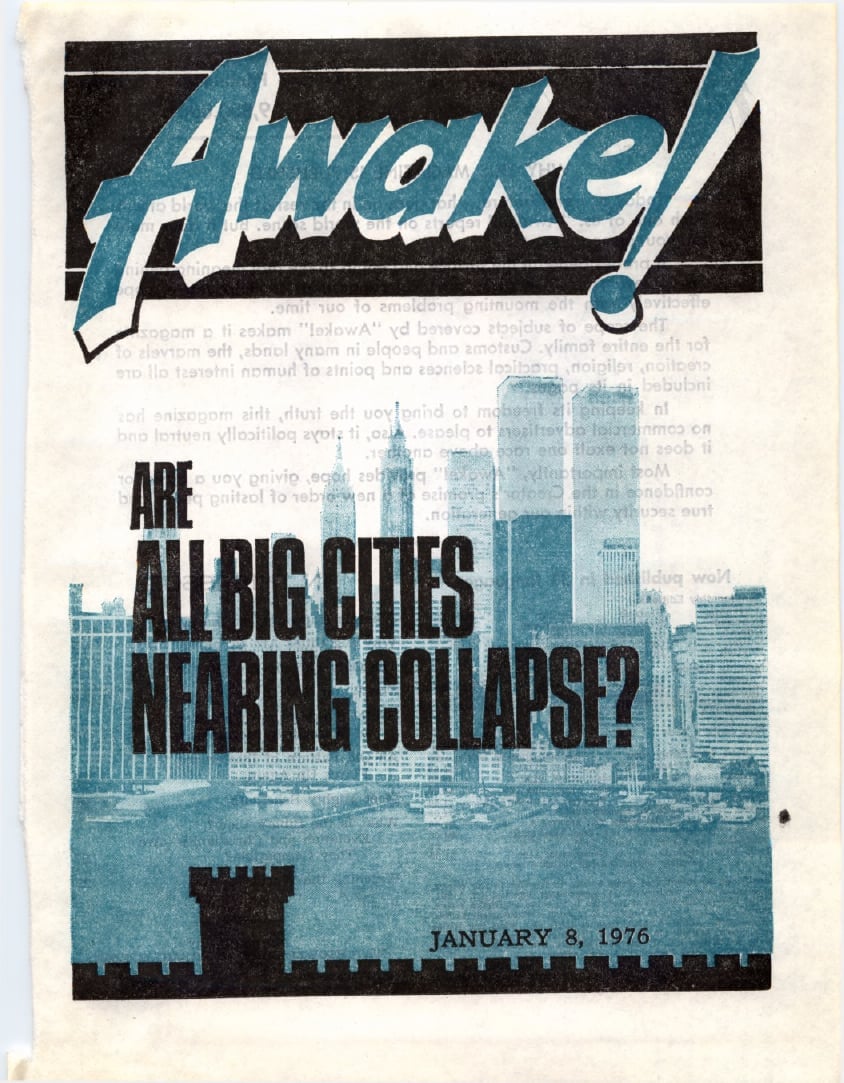
Awake! — January 8, 1976
Source: jw.org
Contents
What Is Happening to the Cities?
Why Big Cities Are Breaking Down
The Only Remedy for City Troubles
The Water You Drink
Brutal Suppression of Freedom of Worship in Mozambique
An Old Pattern of Intolerance Flares Up Again
Meet Mighty Behemoth
Evolution and Christianity—Are They Compatible?
Watching the World
Can You Find Bible Verses?
How Good News Reached Southern Africa
What Is Happening to the Cities?
What Is Happening to the Cities?
“STRIKE! Strike! Strike!” The masculine voices that filled San Francisco’s legislative chambers with that chant belonged to policemen, who had never before in the city’s history done so.
Before that cloudy August Monday in 1975 gave way to dawn, two officers were hit by an irate motorist’s car and another was beaten with a baseball bat. Sniper fire rained down on others, precipitating the spectacle of police officers shooting out street lights to avoid being lighted targets. And from parking violations to murder, people took advantage of the absence of police.
Behind this turmoil, and an equally threatening firemen’s strike, was a massive top-level disagreement among mayor, city supervisors, police and fire officers: What share of spiraling city salaries and other costs should the officers get, and should public-safety officers have a right to strike over the issue?
“An entire city was kidnapped and held for ransom,” commented New York Times columnist William Saire. “The ransom was paid, and now the extortionists patrol the city’s streets, making sure nobody else breaks the law.”
On the other hand, public-employee unions in a growing number of cities say that, regrettably, there is no other way to achieve that to which they feel they are entitled. Thus, crippling strikes of municipal employees, though illegal in many places, hit city after city as contracts come due.
Money Squeeze
Underlying these visible symptoms, there are much deeper problems. Many big cities in the U.S. and in other countries are being squeezed in what has been termed a “financial vise”: On the one hand, soaring pay demands of highly organized public employees plus skyrocketing costs of everything a city has to buy, and, on the other hand, swelling numbers of poor city dwellers who require more and more services even though city income is waning.
This “financial vise” tightened early last year into a death grip on the so-called “financial capital of the world,” New York city. City spending had more than tripled in ten years. Even after slashing thousands of city jobs and frantic fund-raising activities by the hastily formed Municipal Assistance Corporation, the city remained under threat of financial collapse from week to week. And when New York State stepped in to help, its own financial integrity immediately began to crumble.
Economic shock waves spread rapidly. The financial journal Business Week declared:
“New York City’s problems are poisoning the well for everybody. . . . Already, states and cities—even those not in financial distress—are encountering difficulties borrowing, and paying higher prices when they do. . . . many states and cities may find themselves sliding inexorably into New York City’s dilemma: either cut spending and services . . . or see their increasingly shaky financial scaffolding collapse around their ears.”
Agonized cries for federal help raised this question in another journal of finance: “Uncle Sam can bail out New York, but who will ball out Uncle Sam?” (Forbes magazine, July 1, 1975, p. 42) The U.S. federal government already owes its creditors almost twice as much as it takes in annually from taxes, while New York city owes little more than a year’s income!
Furthermore, much of the world’s economic system is similarly founded upon layer after layer of credit. And many analysts believe that New York reflects the world’s credit structure in miniature. “Credit is faith,” noted a New York official. “Faith lies in the ability of a borrower to repay. If a major borrower like New York doesn’t, that affects credit transactions everywhere.”
Behind this far-reaching financial dilemma are numerous deep-rooted city problems that refuse to go away. Creeping urban “ghettos” hasten the flight of the “middle class” to the suburbs, public employees grow more militant, welfare rolls spiral, housing decays, pollution pervades and crime and violence thrive. Such problems tend to concentrate in big cities far more than higher population alone accounts for, and they are inexorably worsening in many of them.
A Worldwide Disease
“New York just got hit first,” said Mayor Henry W. Maier of Milwaukee. “All large cities are in the trend New York is in. It’s a matter of time.” And U.S. cities are not alone. Japan’s Daily Yomiuri, for example, reports that hundreds of cities in that nation are “on the verge of ‘bankruptcy’ with snowballing expenditures.”—October 5, 1975, p. 2.
The scope of the world’s big-city problems is indicated by the fact that 116 cities world wide have entered the “million” population category in the twenty-five years since 1950, while it took all the centuries until then to produce just seventy-five cities that large. These metropolises are sprouting up fastest in “third world” countries that can least afford them. Many reflect, not only problems that face Western cities, but also others unique to their own culture.
“Already up to a third of the people living in Manila, Caracas, Kinshasa, and Cairo are not citizens but illegal squatters, living in tents, tin shacks or waterless, drainless hovels,” reports the Milwaukee Journal. “The experts see no alternative to the slums and shantytowns becoming the dominant form of city life in many countries before 1980.”
A look back, though, reveals that city life was often quite different in the past. Kunle Akinsemoyin writes in the Lagos, Nigeria, Sunday Times: “I can well remember when Lagos Island was the pride of Nigeria. That was in my boyhood days some 40 or more years ago. . . . people were friendly, helpful, well-mannered and hospitable.” Now he says sadly that his home city is “fast gaining the reputation of being one of the filthiest capitals in the world.”
Many of you older city dwellers may find that you are identifying yourselves with Mr. Akinsemoyin’s reflections. Why is it that many formerly vibrant centers of civilization are facing serious setbacks? Is there something fundamentally wrong with big cities?
[Picture on page 4]
CAUGHT IN THE MONEY SQUEEZE
CITY HALL
EMPLOYEE WAGES
COST OF SOCIAL SERVICES
Why Big Cities Are Breaking Down
Why Big Cities Are Breaking Down
BACK in 1913, the English sociologist Patrick Geddes theorized that big cities go through five stages:
1. Polis—early city
2. Metropolis—large but healthy city
3. Megalopolis—unhealthy, oversized city with grand illusions
4. Parasitopolis—parasitic city that drains its nation
5. Pathopolis—diseased, shrinking, dying city
Many see cities like New York as having symptoms of the fourth stage, as having already begun to leech strength from the nation. Others fear that aspects of the final stage are also evident. A cancerlike municipal disease—creeping urban decay—is even now shrinking the hearts out of many American cities, as middle- and upper-income families flee to the suburbs.
The populations within the taxable bounds of some American big cities are actually shrinking to “their lowest size in this century,” according to recent census information. “The populations of Boston, Pittsburgh and Jersey City haven’t been so low since 1900. . . . New York’s population is down almost to the level of 1940.”—U.S. News & World Report, September 1, 1975, p. 64.
Driven by a growing distaste for big-city existence, taxpaying citizens, business and industry are fleeing out of the big “central city” areas to noncontributing suburbs and beyond. A sore point in San Francisco’s police strike, for example, was that more than half of those demanding higher pay lived outside the bounds of its taxpaying community. And even though New York’s taxable population has fallen to well under eight million, some estimate that as many as another ten million people living outside the city in some way derive economic benefit from it.
A Vicious Cycle
Hence, a self-perpetuating “vicious cycle” of lost taxpayers, higher taxes, more lost taxpayers, and so on, has developed. When the more prosperous families and industries move out, taking taxes and jobs with them, the poor, unemployed, aged and minorities least able to pay taxes remain. Said Milwaukee’s Mayor Maier: “We, along with other cities, are part of a deepening trend . . . toward an ever-growing concentration of the poor and the relatively poor in the central cities of America.”
Meanwhile, regular city services, as well as programs for the mounting numbers of poor and unemployed, continue to skyrocket in cost. As New York city’s spending for all purposes tripled during the past ten years, welfare costs grew at almost twice that pace!
To compensate, cities raise taxes on remaining property owners, business and industry—an encouragement for them, too, to leave. San Francisco has been forced to more than quadruple average property taxes since 1950—a pace double that of the rise in the cost of living.
But such high taxation makes owning housing a losing proposition for some, and this, in turn, hastens urban decay. New York apartment owners will reportedly abandon an estimated 50,000 dwelling units in 1976, after having abandoned about 35,000 units annually in recent years! Not only are taxes on these properties lost to the city, but gone also are the former residents of block after block of rubble-covered land and condemned buildings—thus feeding the “vicious cycle.”
When highly taxed business and industry choose to leave as well, tax revenue is not the only thing taken. Since 1969, for example, it is reported that New York city steadily lost half a million manufacturing jobs—and taxpaying workers—due to business moves. But the alternative to higher taxes, say city officials, is cutbacks in city services. Such cutbacks make the big cities even less desirable—driving more “middle class” and industrial taxpayers away.
Thus urban problems tend to concentrate in big cities and get driven out of proportion to what higher populations alone account for. But there are other pressures that also enter this “vicious cycle’’ of big-city economic problems. Among them are . . .
. . . Minorities
Big cities tend to stack up minorities and economically deprived persons all together in older, decaying housing and “low-rent projects,” or, in some countries, shantytowns of their own making. The effects of concentrating minorities in this fashion are well known. A report from Sweden, for example, notes that the area surrounding her big-city “urban renewal” projects are “traditionally a decaying slum-zone, where the socially and economically handicapped and newly arrived immigrants are allotted to live. These areas become haunts of alcoholic and narcotics addicts”—as well as a drain on city resources.
The growth of black and other ethnic communities in American cities has created intractable housing problems. Deep-rooted prejudices and fears sped the exodus of whites to the suburbs, creating another big-city problem: de facto segregation. Well-intentioned efforts to give blacks equal educational opportunities by “busing” pupils between the two communities have met with only limited success, while driving many whites even farther into the suburbs and beyond.
. . . Crime
Bad housing and cramped populations tend to breed far more crime, on the average, in big cities than normally affects outlying areas. West Germany, for example, reports an average of nearly twice as many persons affected by crime in densely populated areas as in the country as a whole. Yet almost three times as many police, on the average, are assigned to protect those same city people! Can you see why many prefer to “escape” from the big cities?
Overburdened big-city courts have actually spurred the “vicious cycle” of metropolitan crime problems. The concentration of crime produces so many cases that the process of “plea bargaining” has come to be viewed as an absolute necessity in many U.S. cities. Criminals are allowed to plead guilty to lesser offenses than first charged so that massive numbers of time-consuming trials can be avoided. As a result, criminals—even murderers—are often back on city streets in short order.
. . . Militant Public Employees
As crime mounts and cities decay, more police and firemen are needed, as are more employees to take care of swelling welfare and other programs. Before recent cuts, for example, the number of New York city employees had grown from about 200,000 to over 300,000 in fifteen years—yet the city’s population had hardly changed!
Public-safety employees such as police and firemen, and even garbage men, in order to compensate for the increased dangers they face, as well as to offset the rise in the cost of living, have used the absolute necessity of their services as a powerful bargaining tool to gain higher wages and benefits. The mere threat of chaos without their services has usually driven their wages up far faster than those of most other workers. For example, while living costs rose to about two and a quarter times their 1950 level in twenty-five years, wages and benefits of San Francisco police and firemen multiplied to about seven times their 1950 level! Many other cities have been just as liberal—but someone has to pay the bill.
. . . Pollution
Those who flee to the suburbs to escape pollution and other city problems have actually added to the problem. Traffic moving into the big cities for work is becoming “heavier and heavier, moving slower and slower,” notes a recent report from Sweden that is typical of many cities. Mass-transportation schemes have accomplished little to check pollution. “The persistent traffic tie-ups shatter a dream of urban planners—that rapid transit would ‘get people out of their cars and off the freeway.’”—New York Times Magazine, October 19, 1975, p. 84.
A National Academy of Sciences report notes that even though U.S. federal standards have brought some improvement, country air still remains ‘far superior to most city air.’ The concentration of industry adds much to big-city pollution. But cities need industries for jobs and revenue. To survive, many recession-plagued businesses are seeking a slowdown of costly-to-meet air-quality standards, thus keeping pollution in the “vicious cycle’’ of city decay.
. . . Dehumanizing People
Squeezing humanity together in great masses seems to accentuate the worst in many people. Rather than close quarters bringing them together in warm personal relationships, just the opposite is too often the case. A report from London tells of “sick and elderly people dying alone in their apartments and not being found for weeks afterward, because no one ever visited them.” The report adds: “This would have been absolutely impossible twenty years ago.” Other big-city dwellers know that London is not unique in this matter.
Cooped up in cramped apartments and narrow city streets, children, too, suffer. They lose much of the joy of openness, discovery and interacting with nature found in more rural environments. Destroying, crushing and breaking things are often the way they satisfy the need for excitement and experience. The consequent vandalism and graffiti bring further deterioration to the cities, and more seeds of crime are planted.
Thus many of the world’s big cities are caught up in a vicious cycle of degenerating forces that seem to feed upon themselves, ever worsening. But are not the big-city governments working to improve matters?
City Government
“No American big city is well-governed today,” asserts Milton Rakove, professor of political science at the University of Illinois, “and it is unlikely that any big city could be, given the kinds of problems confronting our cities, the demands being made on their political and governmental systems, and the inability of those systems to cope with those demands.”—New York Times, October 23, 1975, p. 39.
Lack of permanent, stable leadership hampers many big-city governments. Says Business Week of one floundering city: “It is directed by elected officials who, because of the nature of politics, often have a ‘here today, gone tomorrow’ philosophy of management.”
Such transient leadership may even have a corrosive effect on the habits of municipal employees, whose productivity is said to be below that of other workers. Extra workers have to be paid to get the same job done, further draining city finances. Why? An official of one of the largest municipal-employee unions in the U.S. put it this way: “When the municipal worker discovers the city isn’t interested in how he does his job, he loses interest too. . . . We want to feel we’re disciplined. Discipline means somebody cares. What we need is leadership.”
Rather than truly caring, the tendency of many politically motivated officials is to “throw money” at city problems in the hope that they will go away. Failing to get to the heart of the problems, their superficial, money-oriented programs often swell to huge proportions and suck the lifeblood from cities. The disastrous consequences of such policies are now being felt in a number of the world’s big cities.
Even so, most national governments stand ready to “bail out” cities in trouble, thus transferring the strain to the entire nation. So it would be an exaggeration to say that all big cities are facing imminent economic collapse. Some may even appear to be coping with matters. But time is not on their side.
The plight of many big cities today might well be described by this report on the condition of those in Britain:
“Their fabric is tattered and torn. Their services generally are diminishing in scope and effectiveness at a time when more is being demanded of them. It is unlikely that the national government will refuse to ‘bail out’ cities which become as bankrupt as New York. So it seems likely that the cities will struggle on, with ever less effective services at an ever greater cost. Standards of living will continue to fall as will life values in the cities. Life in the cities, like the traffic, will likely grind on slower and slower.”
Does that mean that the pathopolis of Patrick Geddes’ theory—the diseased, shrinking, dying city—is the only course that lies down the road for today’s metropolises? Is there no solution for the big cities?
[Picture on page 6]
Owners abandon thousands of dwelling units yearly due to high taxes
The Only Remedy for City Troubles
The Only Remedy for City Troubles
NO, THE remedy for big-city troubles is not more money and give-away programs. That kind of “help” has only hastened the cities to their ruin. It does not reach the underlying problems. Municipal leaders have too often come to “look upon the ghetto as a walled enclave into which some money can be tossed to keep it quiet,” writes Sol Linowitz, president of America’s Federal City Council. “That view can only invite disaster.”
Then what is the remedy? Well, the experts say that some fundamental changes are needed. “[Municipal] bonds may help us avoid a financial crunch,” says Mr. Linowitz. “But we won’t have dealt with the central problems of our cities until we have learned how to devise another kind of bond one that will bind people together . . . in mutual trust and respect.”—New York Times, October 25, 1975.
Additionally, a recent conference of several hundred prominent scientists, scholars and others at Houston, Texas, suggested another basic change. A number of the experts, it was reported, urged that, to avoid a “gloomy, catastrophic future . . . people should be given the incentive to return to rural areas from huge urban centers and be employed in smaller, more labor-intensive tasks.”—U.S. News & World Report, November 3, 1975, p. 88.
But how soon do you think most city dwellers will ‘learn to devise bonds of mutual trust and respect’? Or, can you imagine the majority of business, industry and city folk willingly reverting to a less production-minded, convenience-oriented way of life? Even if political leaders should attempt such innovations, they would be stymied by forces beyond their control. Is the kind of farsighted leadership and power that it would take to make such far-reaching changes anywhere to be found?
Superior Direction Needed
Well, consider the Source of earth’s marvelously balanced and complex natural cycles. These cycles function flawlessly when men do not tamper with them. Is not the power and intelligence behind these obviously successful systems just the kind of direction that humans and their cities sorely need? That One can bring success to the human condition as well, because He is “the Former of the earth and the Maker of it, . . . who did not create it simply for nothing, who formed it even to be inhabited.”—Isa. 45:18.
There can be no question that earth’s Maker designed it to be a happy, comfortable home for its inhabitants. However, they have rejected the Creator’s standards and veered from patterns of life that harmonize with his creation’s natural cycles into ever more artificial life-styles. But how can these seemingly “locked in” big-city patterns of living ever be changed?
Well, since the big-city way of life is part of a worldwide system of things that does not work, the only remedy is to replace it with a global system that does work for the benefit of all. Man’s Creator has purposed such a new system of management with the kind of farsighted leadership and power needed to make it a success. The Bible calls it the “kingdom of God,” and it is carried on by means of his Son Jesus Christ.—Mark 1:15.
But such directing of earth’s affairs from heaven will obviously not be welcomed by either present power-hungry heads of state or proud city governments. That is why the Bible says that the Kingdom, for which we pray, “will not be passed on to any other people.” Rather, “it will crush and put an end to all these kingdoms” before it successfully takes charge of earth’s affairs. Dan. 2:44.
A New Way of Life
Thus God’s kingdom will make a clean sweep of all vestiges of this failing system’s way of doing things. So differently will earth be managed that Bible prophecy pictures the changed human society then as being like an entirely “new earth.” It says that “death will be no more, neither will mourning nor outcry nor pain be anymore. The former things have passed away.”—2 Pet. 3:7, 13; Rev. 21:1-5.
We can be sure that among former causes of outcry and pain that will pass away are the giant metropolises that jam people into row after row of multistoried concrete apartments, robbing them of sunlight, fresh air and privacy, and surrounding them with noise and irritation. Though we do not know the extent to which community living will prevail for that “new earth,” we do know that it will never again be allowed to become a source of oppression. There are some indications of this from God’s past dealings with humans.
After the earth was cleansed by the flood of Noah’s day, God repeated his original statement of purpose for humans on earth: “Be fruitful and become many and fill the earth.” Later on, that purpose was tested when men chose instead to concentrate in a big city. “Let us build ourselves a city,” they said, and “make a celebrated name for ourselves, for fear we may be scattered over all the surface of the earth.” God registered his disagreement with that way of doing things by taking actions that did scatter the would-be big-city builders “over all the surface of the earth.”—Gen. 9:1; 11:4, 8.
Additionally, the inspired law that later governed the nation of Israel had provisions that were not encouraging to big-city living. Any person living in the small, unwalled settlements of Israel who sold his house, perhaps due to economic need, always had the unchallengeable right to repurchase it. And if the seller was unable to repurchase his home, it reverted to the family anyway when the Jubilee year came around every fifty years. On the other hand, those living in the larger walled cities retained the right of repurchase for only one year, after which the new owner held all claim to the property. Thus the more rural location was advantageous.—Lev. 25:29-34.
In view of such expressions of God’s viewpoint, a more agricultural way of life will no doubt predominate for the soon-to-be-realized “new earth.” Bible prophecy portrays the kind of existence that God can provide in these words:
“They will certainly build houses and have occupancy; and they will certainly plant vineyards and eat their fruitage. . . . The work of their own hands my chosen ones will use to the full.”—Isa. 65:17, 21, 22.
Then, too, even the attitudes of people will reflect their new environment and its righteous governing procedures when God ‘makes all things new.’ Mutual trust and respect will prevail, “for the earth will be filled with the knowing of the glory of Jehovah as the waters themselves cover over the sea.” This is the only true remedy for today’s troubled big cities.—Rev. 21:5; Hab. 2:14.
[Pictures on page 11]
God’s kingdom will make a clean sweep of this failing system, transforming the earth into a global paradise
The Water You Drink
The Water You Drink
‘DRINKING WATER,’ once wrote Leonardo da Vinci, ‘can be health-giving, unwholesome, laxative, sulphurous, mournful, angry, red, yellow, green, black, blue, greasy, fat and thin.’
The water you drink today probably has few of these qualities. But even in our day about half a billion people are said to be constantly sick because of the water they drink. Ten million of them may die each year.
Surprisingly, even developed nations that take pride in their “safe” water are now having problems. Modern farming and industry are introducing a growing list of hard-to-remove and potentially hazardous chemicals into drinking-water sources. “It seems that everything that makes life easier makes water dirtier,” noted one U.S. expert at Senate hearings on the problem.
Life Depends on It
Despite these problems, water remains one of the most marvelous and absolutely essential substances known. The very existence of life itself on earth is based on it. In fact, water is the main ingredient of most living things. The human body has been described as a “virtual walking sack of precariously contained fluids.” About two thirds of your total weight is water, while as much as three fourths of your brain and muscles are.
From this it is obvious that life functions best within the narrow temperature range in which water exists as a liquid. Such an environment where life could exist is said to be practically nonexistent elsewhere in the universe. Though scientists speculate about possible millions of planets in the universe, the book Water: The Web of Life marvels:
“As we learn more about how unusual the conditions on earth really are . . . we wonder whether among even millions of planets we could find a duplicate of earth. . . . Apparently there is a very particular series of events that results in a planet with liquid water on its surface.”
What water does to sustain the life in your body illustrates what a remarkable substance it truly is.
Water at Work Within You
Blood is often equated with the very life of creatures, as in the term lifeblood. Appropriately, blood is over four fifths water. The unique qualities of water make it ideally suited as the basis of this life-giving fluid. For example, more substances dissolve in water than in any other liquid. It also has the unique ability to move freely back and forth through your body’s cell walls, carrying with it the chemicals of life. At the same time it serves as the medium in which complex chemical reactions take place within the cells.
These reactions “burn” as fuel the food you eat, generating heat, as an auto engine does when it burns fuel. But, then, how does your body keep its steady 98.6° temperature? Water! If the water in your body were another liquid—mercury, for example—heat from your cells would tend to raise your temperature over thirty times as fast as it does! This is because water requires far more heat to change its temperature than do most other substances.
But water serves in other ways, also, to control your body temperature. Rapid circulation by way of the bloodstream keeps heat relatively even all over, and quickly moves excess heat to your skin for radiating into the air. On the other hand, heat stored in your body’s water delivers welcome warmth to the extremities when you are cold.
Even with this remarkable system, your body usually does not quickly enough get rid of the heat that it generates. So another amazing property of water comes into play—evaporation. How does this help?
Well, when a pint of water evaporates, it soaks up about 1,100 times as much heat as when its temperature rises just one degree! You feel this cooling effect when a breeze dries moisture from your skin. Since about two pints of body water normally evaporate unnoticed each day through your skin and lungs by means of your breath, much excess heat is regularly released in this way.
But on a hot day, or as your activity picks up from normal levels, your sweat glands exude more water, possibly gallons in a day. Any perspiration that evaporates from the surface, rather than dripping off, carries with it immense amounts of heat—surely a marvelous cooling system!
Your Need for Water
Since water is so much a part of our very existence, we need to keep our bodies well supplied. Though a person may survive as much as eighty days without food, few can last longer than about ten days without water. With a very small drop from normal water content, you quickly feel thirsty. Even a 1- or 2-percent deficiency of water can be distressing or painful. Just 5 percent causes skin shrinkage, dried-out mouth and tongue, and hallucinations begin. A 15-percent loss is usually death-dealing.
Your body is constantly losing water. In addition to the two pints normally lost through the skin and breath, another three pints or more may be eliminated through your kidneys and bowels. Water lost by sweating, and even by tears, has to be added to the normal total of five or six pints that must be replaced each day to maintain your body’s fluid balance.
Does this mean that you have to drink three quarts of liquid every day? Not unless you are sweating heavily. Actually, about a third of the water you need comes from eating “solid” food, which is often mostly water. Even bread is about a third water. Interestingly, your own body cells manufacture nearly a pint of water (H2O) chemically as they use oxygen (O) to burn the hydrogen (H) in your food as fuel.
Thus you may need to drink only five or six glasses of liquids such as milk, coffee, juice or water directly each day. But even though water is among the most abundant substances on earth, supplying enough drinkable water is a major undertaking. Since it can dissolve so many different substances, water is not always safe to drink without purification.
Making Water Drinkable
Drinking water can seldom be called “pure” or “clean” in a chemical sense, because it almost always has some gases and minerals dissolved in it. Making water “potable” or safe to drink and pleasing to the taste does not require removal of all impurities. In fact, some of the elements necessary to good health and taste are often found naturally in good drinking water.
Fresh underground water obtained from springs and wells is often—but not always—safe to drink because of the filtering and purifying that takes place as it sinks through layers of soil and porous rock. Even fresh surface waters have self-purifying abilities. As it moves along, running water tends to break up wastes that enter, dissolving and diluting them to harmlessness, allowing the heavier particles to settle out. Wind and turbulence help aerate running water, causing it to release unwanted waste gases and absorb oxygen.
Dissolved oxygen is vital to an amazing step-by-step “digestion” process that occurs in both moving and still waters. The oxygen may directly oxidize or “burn” wastes, neutralizing them, or, more often, it supports bacteria that break down wastes to a harmless residue.
As the process continues, tiny life forms consume the bacteria, clearing the water further. Sunlight penetrates more easily, encouraging the growth of green algae, which, in turn, consume certain contaminating compounds and give off much oxygen in the process. Small water creatures feed on the algae, completing the “digestion” cycle. In this way fresh waters tend to purify themselves in time.
But even this marvelous system can suffer indigestion, as you do when you eat too much of the wrong things. Rainwater runoff from farmlands often contains chemical fertilizer and pesticide residues. New arrays of industrial wastes join them in our water sources, choking these with a variety and volume of chemicals often well beyond the capacity of nature’s purification system. As a result, self-purification, says Preventive Medicine and Public Health, has become “at best a half-truth and has in the past too often been used to justify acceptance of unsafe waters.” Now almost all communities in developed countries treat water in some way before using it.
In so doing, their methods often follow the lead of nature. Thus aeration is usually the first step of a typical purification system. Water is sprayed, cascaded or has air bubbled through it so as to absorb as much purifying oxygen as possible. Then certain chemicals are added that encourage impurities and bacteria to clump together in “flocs.” This coagulation process speeds up natural settling action, which is completed during sedimentation. Then comes filtration, usually through sand filters, to remove the remaining flocs and most other impurities. Finally, disinfection kills most remaining live organisms, usually by means of chlorine.
Water-Treatment Problems
You would think that the foregoing process would be thorough enough to remove anything dangerous from the water you drink. But recent tests by the U.S. Environmental Protection Agency (EPA) indicate that small amounts of numerous chemical compounds are getting through to the faucet in some cities. A few of these compounds are known to cause cancer. The irony of this is that several are said to be compounds of the very chlorine that is added to make the waters safe!
Some doctors even present evidence that chlorine may help to trigger the cholesterol buildup in human blood vessels that is said to cause heart attacks and strokes. Joseph M. Price, M.D., asserts in his book Coronaries/Cholesterol/Chlorine that it is “one of the greatest paradoxes of recorded history” that a public health measure responsible for saving so many lives “should also unsuspectedly be responsible for many of the chronic disorders of later life.”
Though such conclusions are disputed, hundreds of cities in Europe, Russia, Canada and Japan prefer alternative methods to disinfect their water. Nice, France, for example, has used ozone instead of chlorine for over sixty years; Paris, since 1968. Ozone is an unstable form of oxygen that reacts in a chemical frenzy with water, oxidizing impurities quickly and leaving no ozone residue.
Others advocate activated carbon granules in place of, or in addition to, conventional sand in filters. Activated carbon has a unique chemical “stickiness” that “absorbs” impurities. A single pound is said to expose more than four million square feet of activated carbon surface for removing impurities. Now many U.S. environmentalists are exerting increasing pressure to force adoption of such alternatives.
Water as Medicine
Should citizens be subjected to mass medical treatment through their drinking water? That issue still rankles opponents of fluoridation, even though almost half of the U.S. population now drinks fluoridated water. Children who drink treated water reportedly have only half to a third as many dental cavities.
But opponents cite the fact that the majority of people do not benefit, since it admittedly helps only youngsters. Further, they argue, since some drink more water than others, they are bound to suffer greater exposure to any potential dangers, which allegedly include mongolism, cancer and shortened life. Though most medical authorities discount such charges, those who oppose fluoridation say that they should be free to choose.
Some people have fled to bottled water for safety. However, recent studies indicate that even some bottled waters cannot be assumed safe. One doctor, writing in the Medical World News annual Cardiovascular Review, suggests boiling your drinking water to drive off any free chlorine. But even boiling will not necessarily remove other harmful compounds.
A Balanced View
Thus it is wise to have a balanced view of the water we drink. What we can do to assure its purity is limited. The air we breathe is polluted enough to shorten life in some areas, but gas masks are impractical.
So rather than allowing such situations to distort our perspective on life, we should see in them proof that human systems fail when they do not work in harmony with earth’s marvelous natural systems. But, at the same time, we can be confident that the Designer of these natural systems will soon see to it that they operate in accord with his purpose, when he brings “to ruin those ruining the earth” and its waters.—Rev. 11:18.
Then earth’s waters will sustain life without ever causing pain, sickness or death. Appropriately, God’s provision of eternal life on earth at that time is pictured as a “river of water of life, clear as crystal.” “Let anyone thirsting come; let anyone that wishes take life’s water free.”—Rev. 21:1-5; 22:1, 17.
Brutal Suppression of Freedom of Worship in Mozambique
Brutal Suppression of Freedom of Worship in Mozambique
A CURTAIN of darkness is falling in a sizable area of Africa. Yet for decades the cry there has been for the light of “Freedom!”
The peoples of many African countries for long years, even centuries, were under the yoke of conquering nations of other continents. They have sought and recently gained liberation from the political and economic subjection accompanying that yoke. But now, within some of those liberated lands, there is an attempt to wipe out a basic freedom of the people: Freedom of worship.
Once the colonial powers were accused of using raw power and military might to force native inhabitants into rigid conformity, with no allowance for difference of viewpoint or of conscience. Now the same raw power and military force are wielded in a brutal attack on the right to worship according to one’s conscience.
However, this time the attack is by Africans against fellow Africans, people of their own land! Awake! has recently reported on such assault on freedom of worship in Malawi.a Now a similar attack is taking place in neighboring Mozambique.
If a man wins out in a long struggle against a formidable opponent, onlookers—whether sympathetic to his struggle or not may be impressed with his courage and endurance. But would their esteem rise or fall if afterward they should see him turn upon a small child, beat and tie up the child, claiming it was a “dangerous threat” to him? In effect, this is what has happened in the East African country of Mozambique. Consider:
For three centuries Mozambique lay under Portuguese rule. But in the last ten years a determined struggle was waged by revolutionary forces to make the country independent. Finally, in the summer of 1975, Portugal turned over full control of the country to the principal revolutionary party, the “Front for the Liberation of Mozambique” (generally shortened to Frelimo). The long struggle had ended. A new era had begun for Mozambique.
Yet, within four months after the changeover of authority, a campaign was mounted to crush a small minority in the country—Jehovah’s witnesses. They number only about 7,000 among the 8,000,000 inhabitants of Mozambique. Compared to the nation as a whole, this minority is like a small child, defenseless from the physical standpoint and now robbed of all legal protection of their basic freedoms.
Reports received from Mozambique, beginning in the latter part of October 1975, show that massive arrests have been made. Almost all of the 7,000 witnesses of Jehovah in Mozambique have been imprisoned. A house-to-house hunt was made to find and arrest men, women and children. Men were arrested at their places of work without being able to contact their families. In many cases the arrests were accompanied by brutal beatings. The ultimate goal seems to be the complete elimination of Jehovah’s witnesses and their worship in all of Mozambique. The accomplishment of this can mean but one thing: The denial of freedom of worship, a principle firmly embodied in the constitution of the now independent country of Mozambique.
But why? Why seek to obliterate a people known around the earth as being peaceful and politically harmless? What had Jehovah’s witnesses done? What does their record in Mozambique show? When brought out from under the obscurity caused by clouds of propaganda, the facts reveal a remarkable scene, particularly in this so-called “Age of Enlightenment.”
[Footnotes]
See Awake! December 8, 1975, and December 22, 1975, for detailed reports.
[Map on page 16]
(For fully formatted text, see publication)
AFRICA
MOZAMBIQUE
MALAWI
An Old Pattern of Intolerance Flares Up Again
An Old Pattern of Intolerance Flares Up Again
OVER a period of three years, from 1972 to 1975, Mozambique was a haven of refuge for more than thirty thousand of Jehovah’s witnesses from neighboring Malawi. Forced by violent persecution to flee their homeland, these Malawian men, women and children found a measure of peace in ten refugee camps in Mozambique. Recent reports reveal that, at this writing, a considerable number still find refuge here. For all of this Jehovah’s witnesses earth wide are grateful to the people of Mozambique.
The intensity of the attack now being made by some elements upon native Mozambican Jehovah’s witnesses, however, threatens to convert a haven of refuge into a crucible of brutal oppression.
In Mozambique, radios and newspapers have poured out a flood of propaganda against Jehovah’s witnesses. They are depicted as “agents left behind by Portuguese Colonialism,” “former ‘Pides’ [Portuguese secret police],” whose aim is to “upset the Social Order.” (Noticias, October 9, 1975) They were said to “cling fiercely to a religious fanaticism . . . as a means not to pay taxes, not to show respect for the Social Order and to annihilate the mobilization and organization of the People,” to achieve “anarchy,” according to A Tribuna of October 22, 1975.
Compare this with another account from a different source of information. It deals with a time when a mob had whipped up a city into an uproar and a crowd of people gathered before the city officials shouting, ‘The men who have made trouble all over the world have now come here and they all flout the law.’
This latter report is of an occasion that took place nineteen hundred years ago. And the accusations then were leveled against the Christian apostle Paul and his companion Silas. (Acts 17:6, 7, New English Bible) Those words then spoken were lies, totally false.
Such words are totally false when spoken today about Jehovah’s witnesses, who are well known as law-abiding Christians in some 200 lands of the earth. The charges they face today in Mozambique are basically the same charges made against early Christians in the first century. And it is the same intolerance that brings suffering upon true Christians now.
That pattern of intolerance in Mozambique did not begin with the changeover of government in 1975. And this exposes the falsity of the claims made that Jehovah’s witnesses there in some way serve the interests of Portuguese colonialism. The facts show that nothing could be farther from the truth.
Over the past forty years Jehovah’s witnesses in Mozambique have felt the lash of dictatorial intolerance. They suffered much brutal treatment at the hands of the PIDE (Portuguese secret police). See now what the facts of history reveal:
The Record of History Testifies
It was back in 1925 that some Mozambican men working in South African gold mines received some publications of Jehovah’s witnesses that explained Bible teachings. Some of the men, on returning that year to their homes in Vila Luisa (north of Lourenço Marques, the capital of Mozambique), began to talk to their neighbors about the things they had learned.
Thus, native Mozambicans, not foreign missionaries or Portuguese agents, introduced into the country the message about God’s kingdom that Jehovah’s witnesses bring earth wide.
During the regime of Portuguese dictator Antonio Salazar, in 1935, two Witnesses from South Africa, Fred Ludick and David Norman, entered the country to cooperate with the Mozambican Witnesses in their activity. What happened? They were soon arrested by the Portuguese police and deported. Similar efforts in 1938 and 1939 brought the same results: immediate deportation.
Now, however, the Portuguese authorities went farther. They began arresting Mozambicans who received the Watchtower magazine. Some spent as much as two years in jail before receiving a trial. Some were deported to the penal colony of São Tomé for twelve years! Others were given a ten-year sentence in work camps in the northern part of Mozambique.
This severe opposition under the dictatorial Salazar regime tested the courage and endurance of Jehovah’s witnesses in Mozambique. When they met to study the Bible together, it was always in danger of arrest. Over the years, many were arrested, beaten, held in prison or sent to the penal islands.
Efforts to get relief were rejected. In 1955 one of Jehovah’s witnesses from England, John Cooke, was sent to Mozambique to apply for official recognition of the work of Jehovah’s witnesses. In time he was brought before an inspector of the secret police (PIDE) and subjected to lengthy interrogation. He was accused of being a Communist and holding secret meetings. Though the interview convinced the official that Jehovah’s witnesses are not Communists, he told Cooke: “Nevertheless, you people are against the Catholic Church and the Catholic Church is our church. She helped us to build up the Portuguese Empire!” Cooke was given forty-eight hours to leave the country.
Mozambique daily paper Noticias of October 9, 1975, quotes Frelimo leader and Mozambique President Samora Machel as asking the question (at Massingir, Mozambique): “When we were tied and beaten by Portuguese colonialists, where were these Witnesses of Jehovah?” Where were they? The answer of many of Jehovah’s witnesses is that they were then imprisoned by those same Portuguese authorities!
Francisco Zunguza, for example. He was put in prison in Lourenço Marques in 1956 for six months; in 1964 for three months; in 1965 for one year; and in 1969 he was put in Machava prison for over two years. His wife and ten other Witnesses were also arrested at that time. All of this simply because they were Jehovah’s witnesses, but not for any overt or seditious act against the Portuguese government.
From 1969 onward the Portuguese secret police (PIDE) intensified their activity against Jehovah’s witnesses. Time and time again these were brought in and questioned. And what was the main criticism that the Portuguese authorities and the secret police leveled against the Witnesses? That they refused to take part in fighting against Frelimo, the revolutionary party that by then had become active and which now forms the government of Mozambique!
Jehovah’s witnesses made clear their neutrality as regards all politics and warfare of the nations. Their position was in full harmony with the words of Christ Jesus, spoken to the Roman governor, Pontius Pilate: “My kingdom is no part of this world. If my kingdom were part of this world, my attendants would have fought that I should not be delivered up.” John 18:36.
During that same year, 1969, the elders of the congregations of Jehovah’s witnesses in southern Mozambique were called into the offices of the police. These elders were told that the activities and meetings of Jehovah’s witnesses were banned. Though severely hampered, they managed to keep going ahead, acting in harmony with the position that Christ Jesus’ apostles took when authorities in Jerusalem tried to force them to comply with a ban on their activity. The apostles were faced with a choice of obeying the Jewish authorities or obeying God’s command. Though law-abiding persons, they said with boldness that, in such case of conflicting commands, “We must obey God as ruler rather than men.”—Acts 5:29.
In 1969 the complaint was that Jehovah’s witnesses did not fight against Frelimo. But in 1973 the secret police (PIDE) arrested a number of Witnesses, and this time the accusation was that they were supporters of Frelimo! Under such charge, on March 5, 1974, a Witness, the father of three children, was put in a small cell in Machava prison. He was kept in solitary confinement for two months, with nothing but the floor to sleep on. His is but one of many similar cases of unjust treatment during the final years of the Portuguese regime in Mozambique.
With Colonialism Out—Greater Light of Freedom or Continued Darkness of Intolerance?
Came April 25, 1974. Almost overnight the political situation in Portugal and its overseas possessions changed dramatically. A coup in Lisbon ended forty-eight years of dictatorial rule and shook the Portuguese empire.
Prospects of greater freedom in Portugal and its overseas territories seemed great. People in Mozambique rejoiced. Jehovah’s witnesses themselves wondered if they might be coming out of a long, dark tunnel of some forty years of persecution.
An interim government was established in Mozambique preparatory to a complete turnover of power to the Frelimo forces by June 1975. During this period of relative freedom Jehovah’s witnesses were able to hold their Bible studies openly. They even held large assemblies to which all the public were invited.
In April 1975, for the first time, they were able to have a mixed assembly of Africans and whites in Lourenço Marques. That would have been impossible under the Portuguese dictatorship. The Witnesses were happy to be able to share Christian fellowship free from any racial separation.
But now political forces began placing great emphasis upon outward displays of political support. Activist groups went around calling on all to attend political meetings where attenders were to shout “Viva Frelimo” (“Long Live Frelimo”) and raise their right fist (as in the Communist salute).
What position did Jehovah’s witnesses take? They remained nonpolitical. They took the same position that Jehovah’s witnesses had taken in Italy during the Mussolini regime when people were expected to cry out “Viva il Duce” and give the Fascist salute. They did as had Jehovah’s witnesses in Germany when all were expected to shout “Heil Hitler” and give the Nazi salute. They did the same as had their brothers in Japanese-occupied lands during the second world war when people were ordered to bow down in worship of the Japanese emperor.
Yes, and their position was the same as that taken in Britain, the United States, Portugal, Spain and in every other country on the face of the earth. They maintained Christian neutrality in political affairs no matter what hardship their refusal to shout political slogans or give political salutes might bring upon them. Thousands spent years in German concentration camps or in harsh Siberian work camps.
But, as in all other countries around the world, Jehovah’s witnesses in Mozambique continued to show full respect for the State authorities, in harmony with the Bible’s command at Romans 13:1. And they showed this by continuing to pay their taxes faithfully without attempt at evasion, by continuing to be industrious and reliable workers, and by continuing to be law-abiding citizens. They took no exception to any laws unless these were in evident opposition to God’s own laws set forth in his Word, the Bible. What resulted?
In the Constitution of the People’s Republic of Mozambique, which went into effect on June 25, 1975, article 33 reads:
“The individual liberties are guaranteed by the State to all the citizens of the People’s Republic of Mozambique. These liberties include the inviolability of the home and privacy of correspondence and cannot be limited, unless in special cases provided by the law.
“In the People’s Republic of Mozambique the State guarantees to its citizens the freedom of practicing or of not practicing their religion.”
Article 25 of the Constitution states:
“In the People’s Republic of Mozambique no one can be arrested and submitted to judgment except in the terms of the law. The State guarantees the accused the right of defense.”
Do these words have real meaning? What happened to Jehovah’s witnesses in Mozambique makes that a serious question.
About a month previous to the proclamation of full independence, in a place called Chonguene, a few miles from the town of João Belo, the local congregation of Jehovah’s witnesses met on Sunday for their regular Bible study. A group of people, Roman Catholics and Protestants, on their way to a political meeting, came into the Bible study meeting, interrupting it and questioning those present as to why they were not attending the political meeting. Threatening the Witnesses, they left.
A few days later, on May 23, police vans carrying Frelimo soldiers arrived and rounded up six of those who had attended the Witnesses’ Bible meeting. The commander ordered his men to beat and kick these six men and then take them off to prison.
In prison these men were beaten daily in an effort to force them to say “Viva Frelimo.” Three of them were only newly interested persons and not baptized Witnesses. These three broke under the beatings. The three who were baptized Witnesses steadfastly refused to violate their Christian consciences. They were then taken out and ordered to dig a hole deep enough to stand in. Forced to stand in the hole with just their heads showing, they were told that if they still refused to say the political slogan they would be shot and buried right there. But they remained firm in their determination not to violate their consciences. Finally they were taken back into the prison.
Happily, when this treatment was reported to the Minister of Defense in Lourenço Marques, he expressed surprise and phoned the Frelimo commander in that area. Before long the Witnesses were set free. This, however, was but one bright spot in an otherwise dark picture.
Then, on Independence Day, June 25, 1975, the new Constitution took on full force. Would brutal attacks on freedom of religion like the one just described now become a thing of the past? Would a progressive, enlightened attitude prevail over narrow intolerance?
A Violent Campaign Launched
The answer came quickly, almost within days. A campaign to vilify Jehovah’s witnesses was launched throughout the country. Many of the attacks were in the form of radio talks by district governors and other politicians.
At the instigation of activist groups, Jehovah’s witnesses in various places were arrested and taken to Frelimo headquarters for questioning. They were often beaten. As one example, consider what happened with the congregation of Jehovah’s witnesses in Choupal in the district of Lourenço Marques on September 13, 1975:
A visiting elder of Jehovah’s witnesses, Elias Mahenye, was giving a Bible talk to some 300 persons in the congregation’s Kingdom Hall. Toward the close of his talk, members of the local activist group came into the hall and tried to interrupt the meeting. Firmly but politely they were informed that the meeting had not yet ended, and they were asked to wait.
Hardly had the congregation said “Amen” to the final prayer when these activists mounted the platform and demanded that the whole congregation shout “Viva Frelimo.” Three times the demand was made but without response. Then they ordered the congregation to stay in the hall while they sent for Frelimo soldiers.
When the commander of the soldiers arrived, he asked who the padre (priest) in charge was. It was explained that the Witnesses have no padre; however, Mahenye identified himself as the one giving the talk. He and four others were then put on the platform, stripped from the waist up and ordered to shout “Viva Frelimo.” When they did not, they were severely beaten and then tied with electric wire. Mahenye’s arms still bear scars where the wires cut deeply into his arms.
The five were taken to the nearby army barracks, and Mahenye was accused of telling the people to say “Down with Frelimo”—a deliberate and malicious lie. The soldiers then beat him with fists and rifle butts. Then all five were beaten with the soldiers’ belts. They were locked into a filthy lavatory for the night. At 4 a.m. they were taken out and beaten again. Mahenye was lyingly accused of having trained soldiers to fight Frelimo and given yet another beating. Later it was admitted that this accusation was groundless.
When day came, a Frelimo sergeant arrived and interrogated the group. He told them: “If you do not say ‘Viva Frelimo’ Frelimo will not keep you in the country. Because they fought for ten years, not for Jehovah, and they did not get help from Jehovah. Everybody should say ‘Viva Frelimo,’ because Frelimo is the god of Mozambique and the second god of Mozambique is the gun. We do not want to hear anything about Jehovah.”
And what of the rest of the congregation, including women, aged persons and children, who had been at the Kingdom Hall? They had been forced to remain there all night and into the next day. Many were beaten and tied up with wire. Along with this the soldiers shouted: “Who is this Jehovah of yours? Why doesn’t he come and help you?”
During the twenty-four-hour period no one, not even the women or children, were allowed to sleep, drink water, have food or use the toilet facilities. Bibles and Bible literature used at the meetings were burned. It was as if Mozambique had become medieval Europe, as if the Dark Ages and the Catholic Inquisition had returned. Finally the Witnesses were allowed to leave, under the threat that unless they learned to say “Viva Frelimo” they would be in for worse trouble.
Among other barbarities, in Magude, north of Lourenço Marques, thirteen Witnesses were arrested, beaten and forced to dig up trees with their fingers. Then their legs and arms were tied and they were rolled around like drums. As in ancient Rome, the local residents were invited to come and see the spectacle of Christians being tortured.
Near Manjacaze, a number of members of two small congregations of Jehovah’s witnesses were imprisoned. Then the governor of Gaza district came to the area and the remaining Witnesses were requested to be present for a public meeting. They complied with the request. After discoursing about local farming activities, the governor suddenly asked all Witnesses present to come forward. They did so. The governor then ordered that they be arrested, both men and women. They were severely beaten, some so badly that blood flowed from an ear or an eye. They were then taken to prison.
In that same district of Gaza, a group of Witnesses were beaten day after day, every day, over a two-month period in an effort to break their integrity!
But all these incidents were just the prelude to the major blow to come. Within a few weeks came an official order: All of Jehovah’s witnesses in the entire country should be arrested.
This order was carried out systematically and heartlessly. Frelimo followers went from house to house demanding that residents say “Viva Frelimo.” Those who would not were assumed to be Jehovah’s witnesses and were taken to prison. Whole families, children included, were mercilessly dragged off.
…