Awake!, December 22, 1975
Download: PDF — Awake!, December 22, 1975
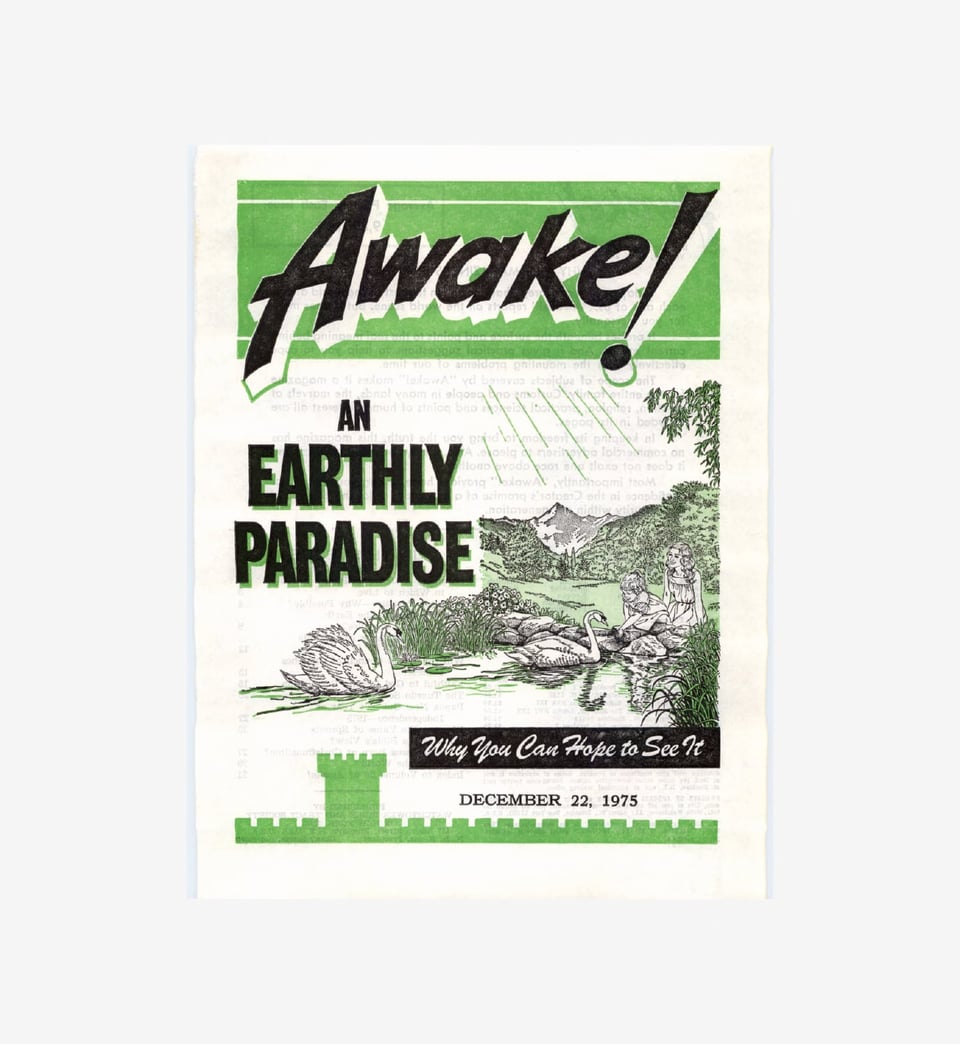
Awake! — December 22, 1975
Source: jw.org
Contents
Paradise—A Desirable Place in Which to Live
A Global Paradise—Why Possible?
Will You See All the Earth Become a Paradise?
Can the Holy Year’s New Saints Help You?
Will the World Council of Churches Protest?
Faithful to God Despite Persecution
The Tuxedo Society
Papua New Guinea’s Year of Independence—1975
Discover the Value of Sprouts
Was Jesus Born at Christmastime?
Watching the World
Index to Volume 56 of Awake!
Where Did Cain Get His Wife?
Paradise—A Desirable Place in Which to Live
Paradise—A Desirable Place in Which to Live
WHAT picture comes to your mind at the mention of an earthly paradise? What do you think it would be like?
Perhaps you envision a lovely park, a place of natural beauty and peacefulness. You may imagine trees and flowers in great variety, as well as many birds and animals that you can enjoy. Such a mental picture is understandable, for in many languages the word “paradise“ comes from ancient words meaning a wooded park or a parklike garden.
However, rather than a park with fixed boundaries, what if the whole earth were a paradise? What would it be like for you?
For one thing, a paradise earth would have endless variety in plant and animal life, not like today where, in large areas, men have killed off many forms of life.
There would also be delightful variety in terrain. You might enjoy visiting a rocky or sandy coastline unmarred by garbage or industrial pollutants. There you could listen to the waves and watch graceful gulls and other sea life. Inland you would find a variety of forests, each with its distinctive animals and plants, and all free of the effects of ruinous exploitation by greedy men.
Of course, there would be mountains, some lofty and blanketed with snow, others with gentle slopes, where you could hike without stumbling over discarded beer cans and other litter. Beyond these mountains there would be drier plains. Instead of these being man-made dust bowls, they would display their own natural vegetation, and would abound with animals, large and small, wild and domestic. Elsewhere you would find heaths with low trees and softly colored shrubs.
Maintaining and cultivating such a global paradise would require some work, would it not? But you would not mind that if you were not frustrated or oppressed by a harsh boss. You could apply your efforts and abilities in ways that would bring benefits to you, your family, and to the rest of mankind by cooperating together. You would delight in making your contribution to paradise.
Having a personal share in paradise, you would get lasting pleasure from your work and from your opportunities to rest, to travel and to learn more about the wonders of this earth.
But do you feel that this is all just fanciful dreaming? Do you think that it is not possible for the entire earth to become a place of beauty? From what you have seen and read, do you believe that it is headed in the opposite direction—toward more pollution, plunder and ruin?
Frankly, as cheerless as the earth’s future may seem, there are sound reasons for you to expect that our planet will become a global paradise.
A Global Paradise—Why Possible?
A Global Paradise—Why Possible?
TODAY many informed persons would take the view: ‘A global paradise sounds marvelous, but it is impossible. The earth can never be turned into a total paradise.’ Are you inclined to agree?
Likely you are to some extent aware of what men have done in despoiling our earth, seemingly wrecking any hope of paradise.
For instance, men have polluted our air with soot and dangerous fumes. You have breathed that in, have you not? Besides harming our health, this is damaging our entire planet. How so? One authority reported ‘that man is making the weather situation worse by pumping dust, smoke and other pollutants into the atmosphere.’ This is said to alter the climate and to bring on weather changes that have expanded deserts and contributed to famines, as recently happened in Africa.
We cannot ignore, either, the other damaging forms of pollution that are making our earth anything but a paradise. Sea life is killed by oil spills. Streams are often so filled with chemicals that the water is unsafe, and fish die by the millions. Human and animal food is contaminated with mercury, copper, lead and DDT.
A global paradise also might seem impossible because of the devastation already brought about by man-caused erosion. Men have plundered the forests, stripped off protective vegetation or overgrazed the land, resulting in millions of useless acres. What is the effect? Bioscience concluded: “For the first time in man’s history he has reached a stage where he actually has the potential to destroy the earth’s biosystem either intentionally or accidentally.”
Is Recovery Possible?
Has the earth been so damaged that it can never recover, that it can never become a paradise? Rene J. Dubos, professor emeritus at The Rockefeller University, said in this connection: “We have enormous problems, most of which are getting worse. . . . But I’ve become convinced that these bad situations are reversible.”
Have you ever given thought to the earth’s ability to recover? It is truly amazing to see how the earth can gradually overcome damage and abuse done to it. The recent book Man and His Environment: Law made this observation.
“The living, self-replenishing world is actually far richer than any comparison to a storehouse of treasure. Nature, unless broken into exploited fragments cut off from sustenance, constantly replaces itself . . . The dynamic, moving, renewing qualities in nature retain their activity and mock any comparison to the richest human treasury.”
There is abundant proof of the earth’s ability to restore itself. For instance, have you heard of the island of Krakatoa, near Java? It was blown up by a volcanic explosion equal to a 10,000-megaton H-bomb. What remained was just sterilized land covered by ashes and pumice. But would Krakatoa remain a heap of lifeless ash? Biologists watched to see. Within three years, twenty-six species of plants reestablished themselves. Ten years more brought coconut trees, wild sugarcane and orchids. And twelve years more found 263 species of animals there. Even without man’s help it became once again a tropical paradise of forests and lovely birds.
You need not travel to some distant island to see this recuperative process in action, or to see its results. Likely there are areas in your country that have been drastically changed by pollution, flood, warfare, destructive farming practices or erosion. Yet they may already have recovered from those changes or be in the process of doing just that.
For example, many sections of New England in the United States were turned into farmland a century or more ago. Virgin forests were cut down, vegetation was removed and rocks were piled on the sides of the fields. However, as the tide of agriculture moved west, these fields were abandoned. Soon wild plants began to grow in the uncultivated fields—weeds, grasses, goldenrod and some berry seedlings. Within a few years gray birches could be found and windborne white pine seeds developed into small trees. Then around some of the pines black cherry seedlings sprang up from seeds that birds had dropped. For a time the pines dominated. Yet that was a passing phase, because in the shade under their tight canopy few pine seedlings could take root. But oaks and maples could, so gradually they replaced the pines. Later, beneath the towering hardwoods, some hemlock, beech and basswood trees began to grow. And as these changes were occurring the type of wildlife shifted and adjusted to the changing forest.
Take a pleasant walk through these hills now, breathing in the sweet forest scents and keeping eye and ear alert for the varied forms of wildlife. Once in a while you will find a slowly crumbling stone fence that silently testifies to what this land was not so long ago. Now the forest has returned.
What, though, when humans have intervened, not merely by turning a forest into farmland for a time, but to the extent of badly polluting or damaging the earth? Can it still recover? Is there still the possibility of the earth’s becoming a paradise?
To Desolation and Back
“Pollution in Paradise” was the title of a television documentary about the horribly polluted Willamette River in Oregon. The river had been exploited and damaged by man. But was it ruined forever? After legislation had halted the most blatant polluting, the river restored itself. It became a place in which to swim, and once again it thrived with salmon. Similarly, a 1975 report, telling how England’s Thames River is recovering, says: “A year ago the first salmon in 141 years was taken from the Thames. This summer a second salmon was found in the river.”
Not just lakes and rivers, but the land too can recover after man has devastated it. Should you visit sections of France, Belgium and Germany that were pulverized and denuded in the world wars, you will now find lush fields and thriving forests.
Sometimes man himself can effectively cooperate with the earth’s restorative processes. In New Zealand early settlers cut or burned large forests to make pastureland. But, in many cases, they put more grazing animals on the land than the pastures could feed. Added to that, rabbits, which man introduced to New Zealand, became a plague by eating vegetation that was needed to hold the soil. The result? Massive erosion—ruined land. Later, though, soil conservationists worked to halt the damage in the Tara Hills, even to reverse it. They restored fertility by spreading manure and seeding pasture legumes, and they worked to control the rabbit population. In time the hills became pasturelands again, useful and pleasant.
What about land that has been ruined by man for centuries? Can it recover and become part of an earth-wide paradise?
A case in point is the Near and Middle East and North Africa. You may think of this area in terms of what has been there in recent times, ‘sand dunes, malarial swamps and naked limestone hills.’ But, writing in Scientific American, agronomist Walter C. Lowdermilk explained that the evidence proves “this land was once a pastoral paradise,” but that it “has been overgrazed for more than 1,000 years.” Think of that—a “pastoral paradise”! Yet, since it has been devastated for so long, is it past ‘the point of no return’?
Representing the U.N.’s Food and Agriculture Organization, Mr. Lowdermilk investigated what was being done in Israel. He concluded that “Israel is restoring to cultivation a land damaged by a millennium of abuse.” Yes, with man’s help and cooperation the earth can recover from even centuries of abuse; it can return.
Would you have thought that “the Near and Middle East and North Africa” once was a “pastoral paradise” and could be returned to such a condition? That is not surprising if you look at it from a Biblical standpoint.
The Bible explains that at the beginning of human history the Creator provided a paradise or garden for the first human couple. Evidently it was in the area of what we now call the Middle East. The historical account of this reads:
“And the Lord God had planted a paradise of pleasure [the Garden of Eden] from the beginning: wherein he placed man whom he had formed. And the Lord God brought forth of the ground all manner of trees, fair to behold, and pleasant to eat of . . . And a river went out of the place of pleasure to water paradise.”—Gen. 2:8-10, Douay.
Our forefathers, Adam and Eve, were responsible to care for that garden or park and to expand it until the entire earth became a paradise.—Gen. 1:28; 2:15.
But the first humans rebelled and were expelled from the original paradise. God told the man: “Cursed is the ground on your account. In pain you will eat its produce all the days of your life. And thorns and thistles it will grow for you . . . In the sweat of your face you will eat bread.”—Gen. 3:17-19.
Did that curse come about? It certainly did. Centuries later Lamech even spoke of the need for relief “from the pain of our hands resulting from the ground which Jehovah has cursed.” (Gen. 5:29) Lamech prophesied that relief from that curse would come in the days of Noah, and it did. By means of a flood, God wiped out the wicked. After that, Jehovah God indicated that he had also lifted the curse from the ground.—Gen. 8:21.
Because of that, parts of the earth later be described as being “watered throughout, . . . as the paradise of the Lord.” (Gen. 13:10, Douay) And the Promised Land was abundantly fruitful, veritably “flowing with milk and honey.” (Num. 13:23-27; Deut. 8:7-9; 11:10-17) Is the accuracy of this Biblical description not confirmed by agronomist Lowdermilk’s conclusion that much of that area “was once a pastoral paradise”? Also, do you not know personally of areas of the earth that right now are paradise-like because of their beauty and fruitfulness?a
What Is Lacking?
An honest appraisal of the world scene, though, leads to the conclusion that even if beautiful parks and farms are now like paradise, they are exceptions. Man is ruining more and more of the earth. Yes, the responsibility is on man’s shoulders. Oh, it is true that sometimes “natural disasters” such as floods or droughts do damage. But the basic problem is what has been done and is being done by man. Walter Lowdermilk pointed out:
“Harsh as these conditions [now common in the Middle East] are, there has been no significant deterioration in climate since Roman times. . . . The ‘desert’ that took over the once-flourishing land was the work of man, not of nature.”
Similarly, the book Ecology says:
“Man has had the power—and the responsibility—of a destiny ascribed to him in Genesis: to ‘have dominion over all the earth.’ But during his dominion he has broken nearly every ecological principle.”—Page 165.
However, man’s technical accomplishments that have been used in polluting and devastating our earth could be turned to undoing the damage. The Encyclopædia Britannica (1974) acknowledged: “The scientific and technological knowledge now available is more than adequate to solve most of the world’s major environmental problems.” Just think of what could be accomplished if that knowledge were unitedly and consistently applied to our earth, keeping in mind that the earth is a choice location for life and that it has such an ample capacity to recover from damage done to it! The earth could once again be a clean, wholesome and healthful home for mankind. This is what man needs!
In fact, Dr. Rene Dubos pointed out that a major problem today is that
“somehow the ways of life do not satisfy something very profound that the human being needs. When people have hardly any chance to experience the fundamental sensations of life—contact with undisturbed nature, hearing its pleasant sounds and smelling its pleasant odors—they are starved for these and seek a substitute. Drugs provide a momentary opportunity to create a world of one’s own, a kind of satisfaction addicts believe the real world no longer gives.”
True, more is needed than just getting away into the woods, for some persons who have fled into wilderness areas continue to seek thrills and escape in drugs. Yet that does not alter the fact that if the earth were a global paradise we could all draw peace and satisfaction from “contact with undisturbed nature.”
Since the potential for a global paradise certainly exists, why has it not been achieved? What is lacking? And why can it confidently be said that it is entirely possible for you to live to see and enjoy life in a global paradise?
[Footnotes]
The September 1, 1975, issue of Newsweek reported that ‘human traffic has now endangered the plant and animal life that parks were designed to protect.’ So UNESCO is attempting to set aside still untouched areas. We read: “To blunt man’s impact on nature, the agency is establishing a global network of Eden-like ecosystems called ‘biosphere reserves.’”—Page 64.
[Picture on page 4]
Krakatoa was sterilized by a volcanic explosion, but even without man’s help it again became a tropical paradise
[Picture on page 5]
Land that was once stripped by man and later deserted has again become a forest
Will You See All the Earth Become a Paradise?
Will You See All the Earth Become a Paradise?
NO QUESTION about it, the earth has within itself tremendous, well-nigh inexhaustible reserves to restore itself if but given the opportunity. And, likewise, there is little question about man’s scientific and technological means making it possible for him to cooperate with earth’s forces to restore and keep an ecological balance. But are scientists, such as biologists and ecologists, therefore optimistic regarding the future? By no means!
Thus Dr. Szent-Gyorgyi, one of America’s leading biologists, says that man can choose as to which course he will take: “Toward a bright future or toward exterminating himself? At present we are on the road to extermination.” Yes, according to him, the outlook is “very bleak.” And he speaks as an eminent scientist with more than fifty years of experience. Biophysicist Dr. John Platt expresses himself similarly. He urges that scholars, such as natural and social scientists, doctors, engineers, teachers and those with inventive ability all be enlisted to save the environment. But even with the help of all of these, he warns, “there is no guarantee that these problems can be solved, or solved in time, no matter what we do.”
Why are these men so pessimistic? Because man is losing the battle against pollution. More and more harmful products are being dumped into the oceans, and their contamination by oil spills is increasing. In some cases efforts to decrease one cause of air pollution have resulted in a pollution of another and even more serious kind. An example is California’s fight against air pollution. Though its laws are the strictest in the country, news reports say that it is “loosing the battle against pollution on all fronts,” and “the sad fact is that air pollution” there “is worse than ever.”
Why?
Why is the overall outlook so bleak? What accounts for it? Without a doubt one of the reasons is that the matter of keeping man’s environment livable is not just something of national concern; it is of international interest. Authors Ward and Dubos, in their book Only One Earth, explain: “Concerns with global air pollution lie beyond the effective protection of individual governments.” According to them, “man’s global interdependence begins to require . . . a new capacity for global decision-making and global care,” that is, “it requires a new commitment to global responsibilities.” But what prospect is there for such assuming of global responsibilities and for global cooperation? Little indeed, judging by the past record.
The Encyclopædia Britannica (1974) shows why this is the case. After telling that man has the technological know-how to prevent ruination of the earth, it goes on to show that the problems of the 1970’s “are not problems of science and technology but of the arrangements and functioning of human institutions and of the attitudes of individuals.”
J. F. Cassel, writing in Environmental Ethics, puts it more bluntly: “The basic problem of contemporary human ecology is selfishness—and selfishness is in. The wages of sin is death. The biotic world is dying!” And what shortsighted selfishness it is! Scientist Szent-Gyorgyi concludes that the trouble is that the people “are under the terrible strain of idiots who govern the world and [are] moving inexorably and insanely toward ultimate calamity.”
From what you have observed, you likely can agree with one prominent and concerned American official who stated: “If, by a selfish act, a man can benefit himself while harming the community, he is likely to perform that act.” Illustrating that fact is a report that showed why public utilities were so slow in complying with government orders to install pollution-control equipment. Every year that one such utility delayed in installing a million dollars’ worth of such equipment they saved a quarter million dollars. This helps to explain why American public utilities spend eight times as much in advertising as in research to help to solve the pollution problems to which they themselves contribute! Well did Lord Ritchie-Calder say: “Pollution is a crime compounded of ignorance and avarice.”a
‘Man’s Extremity Is God’s Opportunity’
Is there, then, no hope for the future? If man with all his science and technology is waging a losing battle due to ingrained selfishness, from where can help come? Help can and will come from the Grand Creator, Jehovah God. God? Yes, because his Word the Bible assures us both of God’s interest in the earth and of his purpose for the earth. After all, He created the earth. It belongs to Him, even as the ancient psalmist King David sang: “To Jehovah belong the earth and that which fills it, the productive land and those dwelling in it.”—Ps. 24:1.
When on earth, God’s Son, Jesus Christ, repeatedly assured us of his Father’s concern for earth’s creatures. He stated that God clothes the lilies of the field with beauty, that he provides for the birds of heaven, that not a sparrow falls without his knowledge. More than that, Jesus said that God causes the sun to shine and the rain to fall on good and bad people alike. (Matt. 5:45; 6:26-30) At Psalm 104 one of God’s servants extols Jehovah God for providing so bountifully for the trees of the field and for all manner of living creatures on earth, including man.
Moreover, God’s Word assures us that Jehovah is “the Former of the earth and the Maker of it, . . . the One who firmly established it, who did not create it simply for nothing,” but “formed it even to be inhabited.” Yes, to be inhabited, not to be ruined. And his Word further assures us: “My word that goes forth from my mouth . . . will not return to me without results, but it will certainly do that in which I have delighted, and it will have certain success in that for which I have sent it.” So we can have confidence that the Creator will never let this earth and all mankind go to ruin.—Isa. 45:18; 55:11.
Of imperfect humans, it is often true that ‘the means are as often without the will as the will is without the means.’ In other words, it is generally the one with little means who has compassion for those in need of help. But that is not true of the Creator. Not only has he the will to help mankind—so much so that he gave his only-begotten Son to be our savior—but also he has infinite means, resources.—John 3:16.
Unquestionably, there is no limiting of God’s ‘means,’ his wisdom and his power. Did he not create the starry heavens and the earth in the first place? (Gen. 1:1) Then in six creative epochs he prepared the earth that it might be man’s permanent home. During these epochs he caused light to be, formed the atmosphere, caused caused dry land to appear and plant life to spring forth, created sea, air and land creatures and, lastly, man, his crowning achievement.—Gen. 1:3-28.
The Encyclopædia Britannica (1974) observed: “The Earth is an ideal medium for life. It is at precisely the proper distance from the Sun to receive neither too much nor too little sunlight. It spins on its axis at a rate fast enough to allow the daytime side to warm in sunshine and the nighttime side to cool. Its mass—and therefore its gravity—is such that it holds a wide variety of molecules, including the lighter ones that otherwise would drift off into space. Its magnetic field deflects back to space the Sun’s highly energetic radiation, which otherwise would destroy life.”
What infinite wisdom all these facts regarding the earth and the creatures upon it display! Surely the wisdom that produced all these things is equal to any problem that man may cause because of his selfishness and ignorance!
Even as God’s wisdom is infinite, so is his power. As He himself reminded the patriarch Abraham, he is “God Almighty.” Furthermore, Abraham was asked: “Is anything too extraordinary for Jehovah?” Many centuries later God’s Son, Jesus Christ, assured us of the same, saying: “With God all things are possible.” Yes, he is the Almighty, of which fact the Bible reminds us some sixty times.—Gen. 17:1; 18:14; Matt. 19:26.
How Will God Do It?
How will God go about rescuing this earth from its polluters and destroyers and bring about a global paradise? This he will do by a threefold action. First of all, since ignorance and selfishness are at the root of the problem, God is at the present time having a campaign of education carried on for the purpose of turning men from a course of ignorance and selfishness to a course of wisdom and righteousness. By means of preaching the good news of God’s kingdom and teaching men how to become disciples of Jesus Christ, great changes are being made in people’s personalities. These people are being prepared for life in God’s new order, where there will no longer be the crime of pollution.—Matt. 24:14; 28:19, 20; Mark 12:29-31.
But for one reason or another the vast majority of people on earth do not respond to the preaching of God’s kingdom. All such will perish when God takes the second step against the crime of pollution by means of a “great tribulation” in which he will “bring to ruin those ruining the earth.”—Matt. 24:21; Rev. 11:18.
Once before, by a mighty act, Jehovah God rid the earth of those who were polluting and ruining it. When was that? At the time of the Noachian flood. Both Jesus and the apostle Peter drew parallels between the flood of Noah’s day and the end of this present wicked system of things. Jesus described the end as a “great tribulation such as has not occurred since the world’s beginning until now, no, nor will occur again.” That tribulation will culminate in the “war of the great day of God the Almighty,” Armageddon.—Matt. 24: 21, 37-39; 2 Pet. 3:3-13; Rev. 16:14, 16.
With the destruction of all those found in opposition to God and his righteous rule, the way will be open for God’s third great action in regard to the problem of pollution. That is the transforming of the earth into a paradise to be enjoyed by clean-living humans, including those who have survived the “great tribulation” due to their faith and love for God and righteousness. Then the prayer so long and often repeated by Christ’s disciples will find fulfillment: “Our Father in the heavens, let your name be sanctified. Let your kingdom come. Let your will take place, as in heaven, also upon earth.”—Matt. 6:9, 10.
What will it be like when God’s will is done on earth as in heaven? The Bible answers that when this divine will is done on earth, then God “will wipe out every tear from their eyes, and death will be no more, neither will mourning nor outcry nor pain be anymore. The former things have passed away.”—Rev. 21:4.
But When?
However, the big question remains, When will God take such action?
His Word states the principle: “For everything there is an appointed time.” Hence, “when the full limit of the time arrived, God sent forth his Son, who came to be out of a woman.”—Eccl. 3:1; Gal. 4:4.
So likewise today, the ‘full limit of the time has arrived’ for God to take action against all his foes, including those who ruin the earth. How do we know? Because of the fulfillment of many, many prophecies in our generation. We have seen the wars, famines, pestilences, earthquakes and increasing of lawlessness that Jesus said would mark the time of his presence and the end of this wicked system of things.—Matt. 24:1-22; Rev. 6:1-8.
No, the Creator is not going to wait until men have made this planet uninhabitable and have wiped humanity off its surface by nuclear warfare. The very fact that such things are a distinct possibility in the near future causes many people great concern. But in view of God’s interest in the earth and his concern for it, we can rest assured that he will act before that eventuality takes place.
Will You Do Something About It?
Is not the prospect of life in a paradise earth appealing to you? It is certainly within your reach. You can hope to see it—if you do something about it! You must heed God’s counsel long ago given: “Seek Jehovah . . . Seek righteousness, seek meekness. Probably you may be concealed in the day of Jehovah’s anger.” To seek Jehovah means to become acquainted with him, his qualities, his purposes and his will for you, all of which he has revealed in his Word, the Holy Bible. To seek righteousness means to learn God’s righteous principles of justice, honesty and impartiality and to bring your life into conformity with them. And to seek meekness means to cultivate a mild-tempered, modest and teachable mental disposition.—Zeph. 2:3.
Since the time is short before God takes action against those ruining the earth, the time is also short in which to make these changes in your life. You have no time to lose. Today is the ‘day of salvation,’ as far as you are concerned. The Christian witnesses of Jehovah in your locality stand ready to help you.—2 Cor. 6:2.
[Footnotes]
Let it be noted that since this is the case, it successfully refutes the claim of those who would hold God and the Bible responsible for man’s ruining of the earth. See Awake! of July 8, 1975, for details.
Can the Holy Year’s New Saints Help You?
Can the Holy Year’s New Saints Help You?
THOUSANDS of advocates dedicated ninety-three years of work and prayers to the cause. Together they donated millions of dollars. Finally, the goal—Pope Paul VI, during the 1975 Holy Year, canonized the first native-born American, Elizabeth Ann Bayley Seton. “Officially declared by the Church to have attained heaven,” she is viewed as another saint who can help church members to approach God.
In the opinion of The Wall Street Journal, Elizabeth Seton’s zealous backers had shared in a process “more arduous than any political campaign and certainly just as expensive as most.” Scores of lawyers and doctors had to be paid to argue the merits of her case and verify “miracles”; multitudes of documents had to be translated into Italian for use by Vatican authorities.
The outlay of money so overtaxed even the Mother Seton Guild’s $32,000 annual budget that an emergency appeal for more money was necessary. Lavish pageantry at the canonization ceremony in Rome is said to have been more costly than even the $100,000 earmarked for the American celebration. A reported $10,000 rental fee for St. Peter’s Basilica alone during one recent beatification ceremony (the last step before canonization) gives some idea of the expenses.
Besides vast sums of money, the making of a saint calls for investigations that sometimes may take hundreds of years. The Vatican’s Congregation of Rites sifts through mountains of written and testimonial evidence for proof of “heroic virtues” and “miracles.” On the other hand, a “general promoter of the faith,” or “devil’s advocate,” presents many legalistic challenges, called animadversions, against the proposed saint at various stages along the way. In one phase of a certain investigation, for example, 55 pages of objections in Latin were countered by a 129-page response—the work of an entire year!
Even the corpse is not left to rest. Wherever possible, Rome wants definite identification of the remains. Once exhumed, the bones of Elizabeth Seton became “first-class relics.” One bone went to Pope Paul; specially boxed fragments rewarded the principal workers for her cause.
Is the outcome worth all the effort? Church spokesmen assert that it is. The mere prospect of canonizing Elizabeth Seton and five others during the Holy Year moved Pope Paul to say that they would be “new stars . . . that shine in the firmament of the Church in order to show to the gaze of modern man . . . that life is worth living for God and the brethren.”
Why So Much Effort?
But you may wonder why so much time, effort and expense are exhausted on investigating candidates for sainthood. Well, according to the New Catholic Encyclopedia (1967 edition), for centuries saints were acknowledged without such thorough investigations, but problems arose: “Between the 6th and 10th centuries, the number of deceased who received the cult of saints notably increased. . . . Lives, often legendary, were written. As a result, abuses arose that had to be suppressed. The urgent need of regulating this important matter gradually brought about a certain uniformity of practice.”—Vol. 3, p. 55.
Besides fictitious accounts about the “lives” of the saints, other “abuses” included “commercial traffic in relics and actual fraud,” reports The Catholic Encyclopedia for School and Home (1965 edition, Vol. 9, p. 219). Elaborate canonization procedures adopted in the late sixteenth century succeeded in reducing the average number of saints named annually by about 90 percent, but this method was not without problems of its own—for example, the huge expenses involved.
The First Saints
Do you know that such problems did not exist at all for the first Christians? Methods of identifying saints then were quite different from what they are today. Concedes the New Catholic Encyclopedia: “In the Scriptures, however, the faithful in general are termed ‘the saints,’” or ‘ones who are holy.’ (Vol. 12, p. 852) “St. Paul applied [saint] to all his fellow Christians.”—The Catholic Encyclopedia for School and Home, Vol. 9, p. 538.
If you read along for yourself in the Catholic Jerusalem Bible (JB), for example, you will see that the word “saint” is almost interchangeable with “believer,” and that it applied to living Christians, not only to those who were long dead. The epistles of Paul were often addressed to “all the saints” in a particular location. He told the Ephesian Christians that they were “citizens like all the saints, and part of God’s household.”—Eph. 2:19, JB.
Interestingly, those saints even needed spiritual help themselves at times. The Christian slave Philemon was commended because “they tell me, brother, how you have put new heart into the saints.” And rather than praying to special saints in heaven to intercede for Christians here on earth, all the Ephesian Christians were urged, “Never get tired of staying awake to pray for all the saints.”—Philem. 7; Eph. 6:18, JB.
Evidently, then, the word “saint” meant something entirely different back in Biblical times from what it does to those who venerate saints and their relics now. “Today however,” agrees The Catholic Encyclopedia for School and Home, “[saint] generally applies to one who has been officially declared by the Church to have attained heaven.”—Vol. 9, p. 538.
But what happened to that early Christian view of saints? Why is the present understanding so different from that found in the Bible? The New Catholic Encyclopedia offers this explanation:
“In regard to the intercession of the dead for the living—about which no mention is made in the most ancient books of the O[ld] T[estament], in which is found, as is well known, a very imperfect knowledge of the lot of the dead . . . If in the N[ew] T[estament] writings—set down, one must remember, not as formal treatises but rather as casual pieces—nothing on the subject is explicitly mentioned . . .” (Italics added)
Does it seem reasonable that the Bible is not “explicit” on such a major teaching because it assertedly contains only “imperfect knowledge” and speaks too ‘casually’ about such matters? Or, does this same Encyclopedia’s much stronger admission regarding the veneration of relics more accurately convey the ‘perfect knowledge’?
“It is thus vain to seek a justification for the cult of relics in the Old Testament; nor is much attention paid relics in the New Testament. . . . [The Church ‘father’] Origen seems to have regarded the practice as a pagan sign of respect for a material object.”—Vol. 12, pp. 973, 235, italics added.
This admitted lack of Biblical support for such practices caused early reformers to begin “to raise voices against the cult of relics,” relates this Encyclopedia. So “the Council of Trent took up these errors and in a decree issued in its 25th session made no reference to Scripture but appealed to the Apostolic tradition and the constant practice of the Church” to support veneration of relics.—Vol. 12, p. 238, italics added.
But what if we do ‘make reference to Scripture’ rather than later traditions and ‘practices of the Church’? Can it truly be said that the Bible is ‘not explicit’ on whether saints can help you to pray to God, as the New Catholic Encyclopedia suggests?
Approaching God in His Way
Most Christians know the “Our Father” prayer. Jesus worded it when asked for guidelines on how to pray, and he suggested using the expression “Our Father” to open. Think of the warmth and closeness to God implied by those words! Could you enjoy this warm, fatherly relationship by choosing instead to pray to a saint? The first Christian saints did often pray on behalf of fellow Christians. But this at no time replaced the personal intimacy enjoyed by the Christian in talking to his heavenly Father.—Matt. 6:9; Luke 11:1, 2.
But what about the role of Jesus Christ? Is it not similar to that of a “saint”? You can read in the Catholic New American Bible (NAB) why it is not: “In Christ and through faith in him we can speak freely to God, drawing near him with confidence.” Thus sincere Christians always speak “to God” in prayer, and to no other. At the same time, they acknowledge Christ’s role as sacrificial mediator, which gives them confidence to address God as “Our Father.” Hence, the Bible maintains that “it is through him that we address our Amen to God when we worship together.”—Eph. 3:12; 2 Cor. 1:20, NAB; compare Hebrews 7:24, 25.
Jesus himself plainly ruled out any intermediary role for others in heaven when he told his disciples that “no one can come to the Father except through me,” and some years later, after he and other Christians had already died martyr’s deaths, the Bible still held that “there is only one mediator between God and mankind, himself a man, Christ Jesus.”—John 14:6, 13; 1 Tim. 2:5, JB.
Another reason that the Bible is silent about intercession with God by saints in heaven is that it was an absolute impossibility. Why? Note the apostle Paul’s words to the persecuted Thessalonians about the second coming of Christ:
“We would have you be clear about those who sleep in death, brothers; . . . the Lord himself will come down from heaven at the word of command, at the sound of the archangel’s voice and God’s trumpet; and those who have died in Christ will rise first.”—1 Thess. 4:13-16; compare 1 Corinthians 15:22, 23, 51, 52, NAB.
If those saints who had “died in Christ” were ‘sleeping in death,’ not to rise until Christ’s second coming, how could they have been in a position to intercede in heaven for anyone? Hence, the Bible is silent on this point, not because of imperfections or casualness in the record, but because it is consistent with its own teaching on the resurrection.
Then what about all the time, expense and effort exhausted in the process of canonization? Editor Joel Wells of the Catholic quarterly The Critic observes candidly that “there’s a lot more the church could do with the money spent on it.” Would not such thorough-going effort be far better directed toward teaching sincere people to have confidence in God as the One to turn to when we need help, rather than to saints?
“For it is not as if we had a high priest who was incapable of feeling our weaknesses with us,” says the Bible of Christ Jesus. Hence, it urges: “Let us be confident, then, in approaching [God’s] throne of grace, that we shall have mercy from him and find grace when we are in need of help.” (Heb. 4:14-16, JB) Truly, help from God will come, not by praying to some man-made saint, but by direct prayer to “Our Father in heaven” through the one channel that he has appointed, his Son, Christ Jesus.
Will the World Council of Churches Protest?
Will the World Council of Churches Protest?
✔ People around the world are hearing about the terrible persecution heaped upon Jehovah’s witnesses in the African country of Malawi, and here and there an outcry of protest is published in the news media.
For example, the Washington, D.C., Star, of November 8, 1975, carried an article under the headline “Will the WCC Rise to This Challenge?” William F. Willoughby, staff writer for the Star, declared that “concern is growing over the fate of 34,000 Jehovah’s Witnesses who fled from Malawi persecution in 1972 into neighboring Zambia and Mozambique, but who now are being forcefully repatriated.” The article went on to detail some of the heinous atrocities perpetrated against these harmless Witnesses by “the Young Pioneers, a political youth group of the ruling party of President H. Kamuzu Banda, [which] carried out the edicts with savage gusto.”
Where, then, can this persecuted minority look for relief? “With the United Nations remaining silent on the guarantees of religious freedom that member nations are supposed to guarantee their people, there appears to be little help for these targets of oppression from that quarter,” laments Mr. Willoughby.
“But the World Council of Churches,” he points out, “soon is to meet in an important plenary session in Nairobi [Kenya]. It has a strong record of speaking out against oppression by white colonialist powers in Africa in their exploitation of the black population. It has risked its reputation as a religious organization in supplying funds and supplies for freedom groups. It would appear that such a body, concerned—and rightly so—with the freedom of the oppressed, would be in the most powerful position to speak to President Banda, a staunch elder in Malawi’s Presbyterian Church of Central Africa, about granting a little bit of the same freedom to his fellow blacks in Malawi.”
Mr. Willoughby then asks: “Will the WCC rise to this poignant but opportune occasion? If not,” he concludes, “any other pronouncement it makes against oppression—religious, racial or otherwise—will sound less than convincing.”
Faithful to God Despite Persecution
Faithful to God Despite Persecution
FOR the fourth time in recent years, innocent Christians are the target of brutal persecution in the African country of Malawi. As reported in the December 8 issue of Awake!, thousands of Jehovah’s witnesses who, in 1972, were allowed to enter neighboring Mozambique after vicious persecution broke out in Malawi been forcibly repatriated to Malawi. There they have once more met horrible, degraded treatment.
Yet, all of this comes not because of any lawlessness on the part of these Christians. Throughout the world Jehovah’s witnesses are known to be very law-abiding citizens. As Guy Wright noted in the San Francisco Examiner: “You might regard them as model citizens. They pay taxes diligently, tend the sick, battle illiteracy.” And it is recognized that among them there are not the crime, corruption and immorality so rampant in the earth today.
But in Malawi, Jehovah’s witnesses, as elsewhere, consistently maintain their Bible-based stand of neutrality in political matters. Jesus said of his followers, “They are no part of the world, just as I am no part of the world.” (John 17:14) Hence, in Malawi they have refused to buy political party membership cards issued by the ruling Malawi Congress Party, which cards have on them the picture of the Life President of Malawi, Dr. H. Kamuzu Banda, an elder of the Presbyterian Church. This refusal has resulted in terrible persecution, instigated at the highest levels of government.
Standing Firm
The spirit of these Malawian Witnesses has proved to be a source of great encouragement both among themselves and also to their spiritual brothers and sisters in other lands. They have demonstrated to the world that in these 1970’s there are indeed Christians who keep their faith in God regardless of what brutal persecution comes their way.
This was shown by the expression of many Malawian Witnesses who, when interviewed, stated: “We will never compromise our faith in God even if faced with the threat of death at the hands of these brutal attackers.”
Indeed, one elderly Witness from Malawi who was interviewed said: “We know that Jehovah must have a purpose in permitting these things to come upon us. We are determined to go along with him until his purpose is accomplished.”
The observer remarked: “All the Witnesses, along with their young ones, appeared to be very strong spiritually.” Also, the interviewer reported that their Christian overseers “showed no fear of anything, but were determined to carry on with their shepherding work, come what may.”
What a testimony their faith is to all the world! Throughout the ages to come in God’s new order, when the acts of true Christians in this time of the end are recounted, how well spoken of their present faithful course will be!
Flight to Zambia
Recently, when the tens of thousands of Malawian witnesses of Jehovah who had been living in Mozambique were forcibly sent back to Malawi, thousands of them fled to neighboring Zambia. There the refugees camped at Sinda Misale in the Chipata district, where opportunity was given to nearby congregations of Jehovah’s witnesses to send relief supplies, including food and medicine. About 4,800 Witness refugees were camped in the extreme eastern province of Zambia near the Malawi border until late October.
Visitors to the camp were amazed at the beehive of activity. One said: “There was activity everywhere. Some brothers were marking plots of ground where the new arrivals would build their shelters, while others that had already been assigned plots were busy building. The completed part of the camp was neat and clean.”
This observer also noted many Witnesses—men, women and older children—scattered in the bush cutting poles and grass for these shelters. The women were collecting black soil for the floors of their shelters.
As Jehovah’s witnesses were unloading relief supplies, the refugee officer who was in charge of the camp was asked what his impressions were. He said: “I am very much amazed with these people. They are so hardworking and need very little supervision. I am sure that if these people were given a piece of land and told to cultivate it, they could do a tremendous work.”
The hard work and discipline were also evident in the clinic that had been established at the camp. There, Witness medical personnel tended to the sick in cooperation with three Zambian government medical orderlies. It was observed that the Witnesses in the camp were quite strong and active, although the majority of them were thin because of having been without food in the bush for many days before they reached Sinda Misale.
No Compromise in Spite of Suffering
Many reports were submitted at the Sinda Misale camp telling of the suffering of both adult Witnesses and their children at the hands of Malawi Congress Party officials, youths and policemen.
For instance, on September 28, 1975, six Witnesses, male and female, were taken to Chimutu branch of the Malawi Congress Party in Lilongwe area. They were ordered to buy party cards, but they all refused. Then these Witnesses were tied with ropes and were beaten ruthlessly.
In Mkochi village, an elderly Witness woman was very badly beaten by the youths because she would not buy a political party card. One of her teeth was knocked out in the course of the beating, and she was left lying unconscious.
Another elderly Witness, from Mambala village, reported that when she arrived home on August 26 from Mozambique with her pregnant daughter, party officials demanded that they buy the political cards. Upon finding out that the two women would not buy them, they were chased from the village. The elderly Witness, along with her pregnant daughter, continued to sleep outside the village under a tree.
A few days later, it was time for the daughter to deliver her baby. The mother asked the village dwellers if she could be permitted to take her daughter into one of the houses to deliver the child there. All the villagers refused. The village headman ridiculed her, saying: “Call on your God Jehovah to send you a ladder so that you can take your daughter to heaven to deliver her baby there.”
The young woman delivered her baby under the tree while the villagers stood around watching. Immediately after the delivery was completed, the village headman along with his people chased the elderly mother away, leaving her daughter and the new baby under the tree.
Many such accounts were told by the refugees at the Sinda Misale camp. Yet, all the reports showed that those under persecution remained steadfast. As one observer related: “They had so far not received a single report of compromise in spite of so many accounts of vicious persecution.”
Endurance Under Prolonged Test
One report came from four Witness men who had recently been released from jail in Malawi. They, and another Witness, were held in prison for one year and five months before being brought to trial in June 1974. During all that period, they were subjected to various forms of torture in an effort to get them to renounce their faith in God. They were subjected to severe and repeated beatings and long sessions of interrogation conducted by officials. They were asked to give the names of fellow Christians, such as responsible overseers. However, they remained silent, not betraying their brothers.
Then prison officials were instructed not to give the five Witnesses any food for nine days. They were also locked in a dark room and not allowed to see the sun or light for nineteen days. Then they were transferred to another cell, a very dirty one. One of the men died from this abuse, but he did not compromise. The four others said that they prayed earnestly to Jehovah and were strengthened to endure this trial.
On one occasion officials came to the prison cells and brought some food for the Witnesses to eat. But they demanded that these pray out loud before eating. Since Jehovah’s witnesses give thanks to God at mealtimes, this was done. However, immediately after the prayer they were all charged with ‘managing an unlawful society.’ This was because the one who prayed used the same expressions that are used elsewhere by Jehovah’s witnesses including God’s name, Jehovah.
In June they were taken to court and sentenced to very hard labor. But when the prison officials saw that these Witnesses performed their hard work very faithfully, they were put in charge of other prisoners. Prison officials came to respect these Witnesses highly.
Also, these four Witnesses were given the freedom to discuss the Bible with other prisoners. And the prison department made available to the group nineteen Bibles in the Cinyanja language. The official in charge said to the Witnesses: “We want you to use these Bibles in teaching these criminals here in prison so that they too may become good people like yourselves.” Soon, eight Bible studies were started, one with a prison warder!
Finally, in early October 1975, the four Witnesses were released from prison. They went to Zambia, to the Sinda Misale camp, where they related their experiences. Throughout all their trials, they felt that Jehovah’s strengthening power was with them.
Standing Firm in Spite of More Persecution
Late in October, the Malawi government arranged to have these thousands of Witnesses in the Zambian camp repatriated to Malawi. Thus, the Witnesses were once more faced with the sadistic cruelty practiced by the Malawi Congress Party.
Yet in the face of all of this, Jehovah’s witnesses in Malawi are standing firm—men, women and even young children. They have resolved never to compromise what they know is right, what they konw is God’s will. They will not commit treason against God by compromising their faith in him.
So today another thrilling chapter in faith is being written in the dictatorial land of Malawi. This takes its place alongside the record of many faithful people of ancient times mentioned in the Bible at Hebrews chapter 11. There it states that men such as Gideon, Barak, Samson, Jephthah, David, Samuel and others “through faith defeated kingdoms in conflict, effected righteousness.” It also notes that “ohter men were tortured because they would not accept release by some ransom,” that is, by a compromise or a renunciation of their faith in Jehovah God.
This same chapter of Hebrews also relates: “Others received their trial by mockings and scourgings, indeed, more than that, by bonds and prisons. They were stoned, they were tried, they were sawn asunder, they died by slaughter with the sword, they went about in sheepskins, in goatskins, while they were in want, in tribulation, under ill-treatment; and the world was not worthy of them.”—Heb. 11:32-38.
Hebrews chapter 12, verse 1, calls these faithful people “so great a cloud of witnesses.” The ‘great cloud of witnesses’ now certainly includes those Christians in the country of Malawi who demonstrate the same kind of faith in God. Though some may die, and many others are savagely mistreated, the faithful Christians in Malawi have determined not to let Satan the Devil and his agents here on earth break their faith. And they are comforted by the guarantee that, even if they die for their integrity to God, they may “attain a better resurrection,” one with the prospect of eternal life.—Heb. 11:35.
Also, these Christians appreciate that, just as Jehovah permitted persecution to come upon his people before, such as in the case of Job, so He permits it today, until His time to bring Satan’s world to an end. And though, as it was in Job’s case, the period of trial appears to be prolonged, Jehovah’s witnesses in Malawi are confident that, as with Job, the end result will be totally satisfactory, more than compensating for any hurt they receive now through brutal persecution.—Job 1:9-12; 2:3-7; 42:12-17.
Soon now, God’s judgments against this Satanic system of things will be executed. He will rid the earth of its wickedness and of wicked people to make way for the righteous ‘new heavens and new earth’ that he has promised. (2 Pet. 3:13) God’s enemies and the persistent opposers of his people “will depart into everlasting cutting-off, but the righteous ones into everlasting life.”—Matt. 25:44-46.
Hence, while Jehovah’s witnesses in Malawi are undergoing terrible persecution solely because of their faith in God, they have the firm guarantee by God that they will be rewarded with the opportunity for eternal life in his new order. For this reason they may rejoice, knowing that the “tested quality” of their faith, “of much greater value than gold that perishes despite its being proved by fire, may be found a cause for praise and glory and honor at the revelation of Jesus Christ.”—1 Pet. 1:6, 7; Ps. 37:10, 11, 28, 29.
The Tuxedo Society
The Tuxedo Society
PENGUINS may rightly be described as members of the “tuxedo society.” Standing upright, these flightless birds, with black or bluish feathers on the back, and white ones on the belly, resemble men in full-dress suits.
Waddling on land, penguins appear quite clumsy. But in the water they present an entirely different picture. Large members of their kind may arch gracefully over the surface of the water with leaps up to six feet high. Penguins are excellent swimmers. Some have been timed moving at a speed of twenty-five miles an hour. Their long, comparatively narrow wings serve as efficient and powerful flippers. Although playing little part in actual swimming, the webbed feet act as rudders.
Impressive, too, is the underwater detection power of penguins. Tests made at the San Francisco Zoo back in 1963 revealed that penguins can distinguish between the sound from their own bodies in water and that from fish. Two fish were thrown into a tank having walls that absorbed sound and prevented echoes. As four penguins plunged in, the lights were turned off and more fish were scattered throughout the tank. Within thirty seconds, the penguins had eaten all the fish! How did they locate their prey? This still is a mystery.
Another outstanding ability of penguins involves migration. Several years ago, forty Adélie penguins were captured and banded on the bleak coast of Antarctica. They were then flown 1,500 miles to the middle of Ross Ice Shelf and left there. Two years later, three of them arrived back at the home rookery, just in time for the breeding season. They had managed to swim, walk and toboggan on their bellies over many miles of coast and ice pack. Not bad for a flightless bird with no compass!
Courtship, Mating and Breeding
Of particular interest are the courtship and mating habits of penguins. These differ from one penguin variety to another and, therefore, serve to keep the kinds separate.
The Adélie penguin is outstanding in its amorous displays at breeding time. The male makes a crescendo of drumlike noises, slowly stretches his head and bill upward, and beats his flippers in jerks. The female may respond with a bow, her head turned to one side. This constitutes acceptance. Then the male bows in return. Also, one penguin may be observed presenting a stone to another: “Can you tell a male penguin from a female by who presents stones to whom?” asks naturalist R. L. Penney. His answer: “A charming notion—but inaccurate. Both do it.”
Once mated, the adult couples usually remain paired for life. In her book Freezing Point, Lucy Kavaler reports that a couple, marked with aluminum bands attached to their legs, remained together for five consecutive seasons. Usually the young males return to the very spot where they met their mates the previous year. Often, however, the young females do not return, seeking new mates instead. But they become more stable as they mature.
Emperor penguins breed when the environment is most hostile. Their young hatch in a world of darkness and winds that can blow at hurricane force.
After the female lays her egg, she turns it over to the male. He rolls it up into a pouch consisting of a fold of skin that lies just above his feet and below the rolls of fat on his stomach. The egg is thus protected from the cold. Temperatures may drop to 85 degrees below zero (Fahrenheit), but he continues keeping the egg snugly warm under him. Since the penguin sleeps standing up, the egg is never in danger of falling. In times of storm, he joins the other incubating males, and they huddle close together. They rotate, allowing each one some time in the inner circle and some time out in the cold. While carrying the egg, the male birds have nothing to eat. An emperor penguin may lose twenty-five of his seventy-five pounds at this time.
What about the female? While the male is protecting the egg, she is at sea, storing up food in her body. By the end of two months she returns fat and full. Even if the male has moved from where she left him, she can identify him by his cry. Her return practically coincides with the hatching of the egg. Once, the female is back, the male can place the baby in her care while he goes to sea to build up his strength and weight with food.
The baby penguin rides on its mother’s feet, kept warm under her fold of skin. When it is hungry, the chick sticks its little head out from under her fold and whistles. The mother then regurgitates some of the fish she has eaten, and the baby has a meal. Once the male returns, both parents take turns caring for the chick.
Hazards to Survival
Infant mortality from storms, exposure and the like is high among penguins. In his book The Territorial Imperative, Robert Ardrey observes: “No natural hazard which this planet offers can rival those circumstances assaulting the life expectancy of the emperor penguin’s young.”
To Adélie penguins, predatory birds like the giant petrels and the Antarctic skuas are a constant danger. Hence, discipline plays a vital role in protecting the chicks of this penguin variety. If a chick wanders just a foot from the nest, the parents in an adjoining nest attack it almost mercilessly, biting it on the back, the head and the flippers, while it struggles to escape. This action may seem severe, but it serves to protect the chick, since it would surely be attacked by skuas if it were to stray from the colony.
…