Awake!, July 22, 1975
Download: PDF — Awake!, July 22, 1975
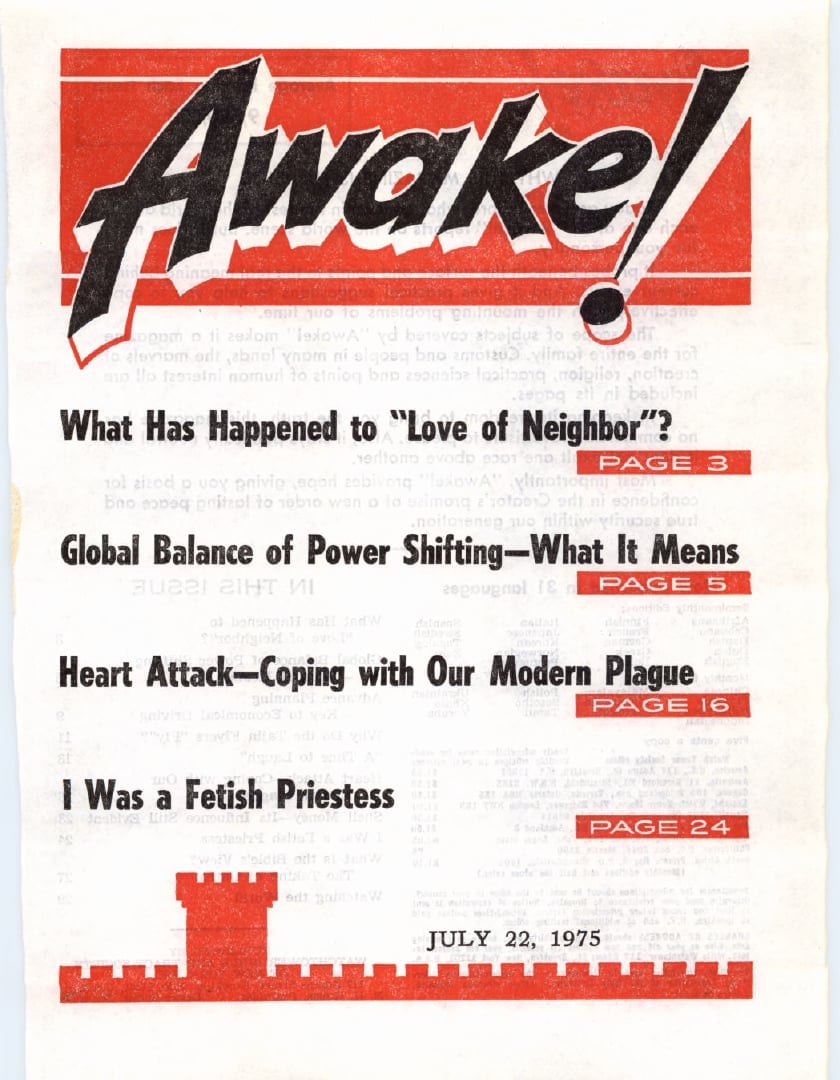
Awake! — July 22, 1975
Source: jw.org
Contents
What Has Happened to “Love of Neighbor”?
Global Balance of Power Shifting—What It Means
Advance Planning—Key to Economical Driving
Why Do the Tajin Flyers “Fly”?
“A Time to Laugh”
Heart Attack—Coping with Our Modern Plague
Shell Money—Its Influence Still Evident
I Was a Fetish Priestess
The Taking of Oaths
Watching the World
Do You Want Your Son to Avoid Fights?
A Great Mystery That Involves You
What Has Happened to “Love of Neighbor”?
What Has Happened to “Love of Neighbor”?
HOW pleasant life can be when we have neighbors around us who are friendly, warm, kind and helpful! It adds so much to the joy of living and helps to make life’s problems seem smaller. When that is the case, the Bible proverb certainly applies that “better is a neighbor that is near than a brother that is far away.”—Prov. 27:10.
But how many neighbors like that do you have? Unfortunately, today that kind of neighborliness appears to be fading. People in many places note a change, a growing lack of concern for others. Doubtless you have read newspaper headlines like these recently appearing:
“Bystanders Ignore Attacked Woman”; “Man Is Stabbed to Death as Crowd of 30 Looks On”; “Man Tells How Daughter Died as Drivers Kept Going”; “Cry Ignored So Woman Dies in Mud.” The accounts following the headlines often tell of persons’ explaining their failure to help with the statement, “I didn’t want to get involved.”
And yet it is not so much in such dramatic or sensational events that lack of neighbor love is being felt. It is in the ordinary, day-to-day lives of people. Smiles, friendly greetings, acts of courtesy, consideration and kindness seem to be high on the list of today’s scarcities. In their place, many say that they experience increasing coldness, indifference and rudeness. What is the reason?
Some persons place much of the blame on the modern industrial society. It stresses speed, mass production and often causes people to be looked on as ‘cogs in the wheels’ of giant factories rather than as individuals with individual needs, desires and personalities. Big cities are another feature of modern society. Those living in them often feel lonely even though surrounded by millions of fellow humans. Few persons seem to have or take time to show interest in others. Then, too, cities in the past often had fairly well-defined neighborhoods. Today there is so much shifting about that often the old neighborhoods have disappeared. A professor of human development at Temple University, Theron Alexander, says that ‘some of the root system of our social structure seems to be damaged. Increasingly the city resident finds that in reality he’s without a distinct community. Perhaps for the first time in the world’s history, millions of people lack a real place in the society of man.’
But whether in the city or in suburbs or in rural areas, one thing strongly affecting people’s attitude toward others is the materialism that modern society fosters. Dr. Jerry H. Siegel, director of a psychological center in New Jersey, says of conditions in the United States: “People are definitely living much more for the moment. The state of our society in general has changed tremendously. There is a real lack of values. People are becoming increasingly more self-interested, and the instability of money adds to this growing selfishness.”
Yes, interest is focused heavily on things—houses, cars, clothes, entertainment devices—rather than on people. But this does not really satisfy the human heart. It works against having a spirit of generosity or of being “outgoing.” It tends to make one callous, willing to try to satisfy one’s own desires at the expense of others.
Now, spreading economic problems and inflation are revealing how futile it is to look to material things for happiness or security. But, instead of awakening to reality, many only become more preoccupied with their economic problems and thus become more withdrawn, less inclined to take an interest in others, less concerned about contributing to the happiness of others.
The Remedy?
Where does the remedy lie? To appreciate what it is, we first need to realize that the principal blame does not lie with big cities or big factories or similar circumstances. For even in identical circumstances, people do not react the same. They may live in the same city, the same neighborhood, even on the same street, or work in the same factory, and yet some may show neighborly concern while others do not. What makes the difference?
The answer is of more than just casual interest and importance. For it has to do with life itself—in fact, the hope of life everlasting. Back in the first century, when a certain man versed in the Mosaic law asked Jesus of Nazareth, “Teacher, by doing what shall I inherit everlasting life?” Jesus responded by getting the man to quote from that Law these words: “‘You must love Jehovah your God with your whole heart and with your whole soul and with your whole strength and with your whole mind,’ and, ‘your neighbor as yourself.’” Jesus added: “Keep on doing this and you will get life.” He followed that up by giving the parable about a Samaritan man who showed genuine love of neighbor.—Luke 10:25-37.
Really, love of God and love of neighbor go together, inseparably so. As Jesus’ apostle John wrote: “if anyone makes the statement: ‘I love God,’ and yet is hating his brother, he is a liar. For he who does not love his brother, whom he has seen, cannot be loving God, whom he has not seen.” (1 John 4:20) This also helps us to understand why love of neighbor is becoming so scarce today. How so?
It is because love of God is becoming just as scarce. Christ Jesus foretold that in our time, prophetically described as the “last days” of the present unrighteous system, people would be affected by wars, food shortages and other serious problems, all hitting mankind at the same time. He also said that “because of the increasing of lawlessness the love of the greater number will cool off.” (Matt. 24:3-12; 2 Tim. 3:1-4) Love for God, interest in knowing about him, in reading his Word, the Bible, and learning what his standards and purposes are, have certainly ‘cooled off’ among the majority today. Love of neighbor has inescapably suffered.
Learning about God, learning about his purpose to restore this earth and human society on it to a clean, healthful, righteous state, can make a tremendous difference in our outlook and in our attitude toward others. It can change our set of values, give us a hope far grander and more satisfying than what the materialistic system that is now operating offers. Yes, it can cause us to ‘broaden out’ in our affections so that, like God, we are unselfishly interested in the whole world of mankind. Jehovah’s witnesses will be happy to show neighborly interest by aiding you to learn more about God’s purposes through a free home Bible study, if you so desire.
Global Balance of Power Shifting—What It Means
Global Balance of Power Shifting—What It Means
HIGHLY significant events have been taking place in world affairs in recent years. Among the many things that have happened, observers have noted a trend of unusual importance. During 1975 this trend has picked up speed.
What many have noted is a shifting in the world balance of power—politically, militarily and economically. Why is this so significant? Because of its relationship to Bible prophecy for our day. Thus, thoughtful persons are keenly interested in what is taking place, and what the real meaning of it is.
Of course, shifts in balances of power among nations are nothing new. These have been going on for thousands of years. How, then, is the current trend different?
For one thing, the shifting does not affect just a few areas of the globe, as most others in the past did, but affects the entire world. Second, it is being largely accomplished with little influence from an element that the nations previously made great use of—the religions of this world. A third factor is that this shift comes at a time that Bible prophecy shows to be very significant. All these things together confirm that we are very close to an immense turning point in history.
Struggle for Global Power
At the end of World War II in 1945 the Western world, that is, the United States and its Western European allies principally, stood at the apex of world power. Never in history had such an array of political, military and economic might been seen.
However, at the end of World War II another power was growing—Soviet Communism. While Communism had taken control of Russia back in 1917, it had been contained there for decades. Only Mongolia had come under a similar form of government, in the 1920’s. But by the end of World War II victorious Soviet armies had paved the way for Communist governments in all of Eastern Europe: Poland, East Germany, Czechoslovakia, Hungary, Romania, Bulgaria, Albania and Yugoslavia.
Then, in 1949, China was taken by Communist forces after a civil war, and, a few years later, Tibet. About a decade hence, Cuba entered the Communist ranks. And, in 1975, Communist forces have now engulfed much of Indochina.
Thus, in less than sixty years Communism as a political, military and economic force has come to dominate fully one third of mankind. Under Communist control these lands have made considerable strides in developing power and influence.
Growing Might
Almost two decades ago, Soviet Premier Nikita Khrushchev made his boastful challenge to the United States: “Whether you like it or not, history is on our side. We will bury you.”
Khrushchev, it is reported, meant that in such things as industrial might and scientific achievement the Soviet Union would overtake the United States to become the most powerful and influential nation on earth. At the time many people laughed at the challenge. But today, few consider it a laughing matter.
The power of the Soviet Union has indeed grown to enormous proportions. In 1974, for instance, the Soviet Union produced more oil, steel, coal and cement than any other country in the world. She was also the leading producer of many other products, and is rich in raw materials.
This growth has enabled the Soviet Union to acquire the base for constantly expanding military power, the largest in the world. Former American Chief of Naval Operations Admiral Elmo Zumwalt, Jr., noted: “The combination of increasing Soviet military power and declining U.S. force levels has put us at the crossover point where Soviet superiority in military capabilities may become reality.” He added: “Wherever one looks the rate of change on the international scene has achieved dizzying proportions, often with ominous overtones for United States interests.”
In addition to growing Soviet power, Communist China, with her 800,000,000 highly disciplined people, is also growing rapidly in industrial and military might. While having large differences of viewpoint with the Soviet Union, China’s ideology is also a challenge to the West. And these two huge Communist lands have vastly increased their influence with many other countries throughout the world. Scores of these nations are developing nations, or what is called the “Third World.” How do they view global matters?
“Third World” Attitudes
When World War II ended, American and Western European influence among the nations of Asia, Africa and Latin America was huge. This could be seen even in the voting pattern among the then fifty-one nations of the United Nations organization. Consistently the vast majority of smaller countries voted with the Western lands on global issues.
But that has changed greatly in recent years. Now a growing majority of the present 138 members of the United Nations very often side against Western Europe and the United States on matters. Indeed, some Western nations now complain about “the tyranny of the . . . majority.”
Since 1945 scores of these “Third World” nations have achieved independence from colonial rule and have adopted their own forms of government. And more and more of them are taking a course of action that is often at odds with the interests of Western nations. The example of the oil-producing countries in raising prices and controlling oil resources has not gone unnoticed by other “Third World” lands with other natural resources. Since the industrial nations of Western Europe have very few vital raw materials, and the United States has shortages of some, the West is at a growing disadvantage economically.
Also of interest is the fact that the economic and political activities of many “Third World” nations are invariably backed by the Soviet Union and China.
Recently a number of additional countries have stated their intentions to loosen their previous strong ties with the West. Newsweek reports that various “Third World” nations are now saying that their governments will ‘have no difficulties in dealing with a Communist regime.’ A foreign ministry official of one Asiatic land stated bluntly: “We frankly feel that a détente with China is a far better security for the country than relying on American troops.” In another land an ambassador said: “It is safer to be an ally of the Communists, and it looks like it is fatal to be an ally of the United States.”
Of course, others point out that such views may be an exaggeration. But the fact that they are expressed at all shows that there is indeed a change taking place in the thinking of many who were formerly dominated by Western influence.
Setbacks Serious
In recent times the setbacks suffered by the West have been very grave. For example, columnists Evans and Novak, in the New York Post, called the reverse suffered by the United States in Indochina “the worst foreign policy defeat in this nation’s history.”
As a result, an editorial in The Wall Street Journal by Vermont Royster from Paris asks: “Is the United States—militarily, economically and politically—now a declining world power? In varying forms this is the question Europeans are now putting to each other in conversation, in the councils of political leaders and in the press.” He added that the reverse in southeast Asia “is hardly the whole cause of the decline of U.S. prestige in Western Europe, only the dramatic event that called it to everyone’s attention. For another harsh fact is that American economic and political power has been crumbling for a long time.”
Observers also point to other recent setbacks for Western policy in various parts of the world. Editorial writer Carl Rowan stated:
“The Southeast Asia Treaty Organization (SEATO) is moribund, and U.S. influence in the Far East seems at its lowest point since World War II. The North Atlantic Treaty Organization (NATO) is in disrepair . . .
“Soviet influence is up and U.S. prestige is down in India and the Arab world . . . And quiet though it has been kept, U.S. relations with Canada and Latin America have deteriorated sharply in recent years.”
One Western official, reviewing the avalanche of troubles that has descended recently, said: “We don’t have enough fingers to stick in all the holes in the dike.”
Political commentator William Safire concluded that “the current of world events is running against” the West. United States Secretary of State Henry Kissinger spoke of “a massive shift in the foreign policies of many countries.” C. L. Sulzberger of the New York Times wrote: “The free world situation has become rapidly more critical.” He quoted a leading West European statesman who went so far as to say that “we are witnessing the collapse of Western civilization.” The Wall Street Journal also stated: “It may well be that in the great long-term sweep of history the Western democracies have finally passed their high water mark.”
Shifting attitudes are also illustrated by the fact that a growing number of people in many lands wonder if it is worth while or consistent to fight smaller Communist nations while at the same time improving relations with the giant—ones the Soviet Union and China. Evidently this includes some persons in the United States too, for the magazine U.S. News & World Report states: “Many in Congress—especially new members—think it’s time to revise the whole ‘contain Communism’ policy the nation has pursued since the end of World War II. They see huge risks and expense, few gains in return.” Of course, many other people disagree.
What It Means
While it may be premature to state that world power has completely shifted this way or that, one thing is certain. The relative power and influence once held by the Western nations that make up the leading part of what is called Christendom have diminished.
New rulers who hold the reins of power in many nations are not bound to past links with the Western world and its religions. Many of them are not religiously minded men. When confronted with problems, they answer them in a secular way, not being swayed by religious interests.
Today nationalism and power politics are far stronger than religion. In times of crisis people now respond mostly, not to the appeals of religion, but to the appeals of their political leaders, as well as to labor, social and military leaders. As a Wall Street Journal editorial commented:
“All of us have tended more and more to invest more of ourselves in political leaders. In a sense, they have tended to fill the void left by the decline of religion and other sources of moral authority.”
Also, in nearly every country on earth many people have abandoned the traditional religions. An evidence of religion’s lessening role can be noted in the poll taken among Americans in various fields. When they were asked to rate twenty-four main institutions in regard to influence, religion was rated next to last!
Just what does the shifting world balance of power, the loss of influence of the nations of Christendom and the growing trend toward irreligious thinking and ideologies mean? It means that the time is soon coming when God will call this world’s religions to account for their centuries of political meddling and support of horrible wars, their hypocrisy and misrepresentation of the Creator.
The Bible depicts the world empire of false religion as a prostitute, a harlot. Why? Because it has sold itself to this world instead of seeking true relationship with Jehovah God. In this regard an editorial in Newsweek noted:
“God must have cringed when men invented slavery and called it divinely inspired, or lighted the fires of the Inquisition in the name of Jesus. This God must still cringe when we make a desert [by means of warfare] and call it holy will. . . .
“This has made of religion a faithless thing, subject to the dictates of human pride rather than the truth about God.”
Bible prophecy for our day shows that shortly the member nations of the United Nations will turn on this world’s harlotlike religions in disgust and rage. Describing this event in symbolic language, God’s Word says that these member nations “will hate the harlot and will make her devastated and naked, and will eat up her fleshy parts and will completely burn her with fire.” (Rev. 17:16) That is why those who are yet a part of this world’s religions are warned: “Get out of her, my people, if you do not want to share with her in her sins, and if you do not want to receive part of her plagues.”—Rev. 18:4.
Further, the beginning of God’s judgment against worldly religion will mark the start of what Jesus Christ called the “great tribulation such as has not occurred since the world’s beginning until now, no, nor will occur again.” (Matt. 24:21) Who will survive? God’s Word answers: “The world is passing away . . . but he that does the will of God remains forever.”—1 John 2:17.
Thus the current shifting in the world balance of power away from Christendom and the trend away from religious influence is of tremendous importance. It signals the fact that we are nearing the time of God’s judgments against this entire system of things, beginning with false religion. Surely these momentous events of our day and their deeper meaning merit your most serious attention. What you do about them will actually mean your life.
Advance Planning—Key to Economical Driving
Advance Planning—Key to Economical Driving
IN A typical American family budget, automobiles and their expenses rank third, next to the cost for housing and food. The cost of gasoline and other automobile products has risen sharply in recent months. New-car costs have skyrocketed. There is little that the individual driver can do to prevent these rises.
However, there are areas where the average car owner can cut back on driving expenses. The secret to saving money on auto expenses is advance planning. This starts from the time you purchase your car.
When Buying an Automobile
Smaller cars are made to use less gasoline than larger ones. Of course, many comforts and conveniences, and even a degree of safety, may be forfeited for the sake of economy. If saving money is a main factor for you when buying a new car, often there are mileage charts published by the government and independent testing laboratories to supply information for you. Check several of such tests, if they are available, comparing one with the other, to gain the most accurate picture of an automobile’s performance. Consider in advance, too, if there is gasoline-saving optional equipment available for your new car.
But advance planning requires that you look at the other side of the picture too. That you now have a large car is no reason to sell it and buy a new one, a smaller model, thinking that you will save money thereby. You may actually lose money. How so?
Well, you know what upkeep expenses are on your present automobile. To buy another car may cost you several thousand dollars, along with the trade-in of your current car. Take time to figure carefully how long you would be able to support your present car with those thousands of dollars. The answer may surprise you; yes, it may be far wiser to keep the car you have.
Proper Auto Care Means Savings
Another major factor in economical driving is overall automotive care. There are a few basic points that can assist you to get maximum efficiency from your car.
For one thing, keep the car’s battery fully charged and the ignition system in top operating order. The car then uses less gasoline to start. Dirty, improperly “gapped” spark plugs can waste 10 percent of your gasoline. Do not let brake linings drag; this not only wears out the shoes but unnecessarily wastes gasoline.
Is your carburetor clean and properly adjusted? If it is checked frequently to make sure that it is not out of kilter, you could earn a 30-percent saving in gasoline. It is best set for a “lean” mixture. The air filter should also be cleaned frequently. Engine timing, too, is very important and, when incorrectly set, is the cause of much gasoline loss.
Often overlooked is the value of keeping one’s car properly oiled and greased. This means less mechanical resistance as the car functions, and that, in turn, can contribute at least to some extent to improved gas mileage.
It has been estimated that you can save about a mile per gallon of gasoline by simply increasing the air pressure in your tires by about four pounds above the around-town levels recommended in your automobile’s manual. Of course, tires should not be inflated above any suggested levels embossed on the side of the tire. Observe, too, the pattern of wear on your tires. If it is uneven, the wheels’may be out of alignment, and this not only damages the tires but also causes the loss of about a third of a mile per gallon of gas.
To Save Money, Watch How You Drive
In order to stretch your gasoline dollar, it is wise to plan your driving in advance. Instead of taking several short trips to different stores, why not line up several stops that must be made and handle all this business in one trip?
The wisdom of combining as many short trips as possible into one trip can be illustrated with one series of tests. A car started cold was driven four miles and went eight miles per gallon of gas. When driven fifteen miles, it averaged eleven miles to the gallon, and, once fully warmed up, it traveled almost thirteen miles to the gallon. In other words, the difference between driving a cold car and a warm one was almost five miles to a gallon of gas!
Car pools are a fine way to make your gasoline dollar go farther. An average of 1.6 persons ride in each automobile in the U.S. If this average were increased to just two persons, traffic congestion would be cut by 20 percent. And there would be a saving of 600 million gallons of gasoline annually. So a few minutes spent on planning with a friend or neighbor could save travel money for both of you.
Forethought is important, too, when you get behind the wheel. When first warming up a car, do not let it idle too long but, rather, just enough so that it will not stall when once put in gear. Then at first you can drive at a light or moderate speed and thereby further slowly warm up the engine.
Then, too, look ahead as you drive. In this way you avoid jerky stops and starts, perhaps the biggest single thief of gasoline. Speeding away from traffic lights can increase gas consumption almost 20 percent. On the other hand, you can save over 7 percent on gasoline by keeping your speed fairly constant. Anticipate problems that might come up, such as curves to be rounded or lanes to be changed; these can be negotiated gradually rather than by sudden stops and starts.
Perhaps you can do much of your driving during off hours when traffic is light and there are fewer stop-and-go situations. It has been estimated that two stops per half mile uses over 20 percent more gasoline than one stop per half mile.
It is wise to beware of the claims of some advertisers about gadgets that will save gasoline. Some of these may work, but caution is in order. The best way to find out if such an attachment can help your mileage is to ask somebody that has had success with it. Most users report that a vacuum gauge is a fine investment and will result in gasoline savings. This instrument is calibrated to show the best operating range for the car’s motor.
Alertness when buying gasoline can save you money too. If you plan a longer trip, gasoline will often cost more on the highway than it does in cities. So fill the tank before you begin the trip. Prices vary from state to state due to taxes, and so you may be able to plan your trip in such a way that you purchase gasoline in a state where it is cheaper.
Taking advantage of a few such hints will undoubtedly save you money. There are many other equally effective suggestions. But when all is said and done, the key to economical driving is planning ahead.
Why Do the Tajin Flyers “Fly”?
Why Do the Tajin Flyers “Fly”?
By “Awake!” correspondent in Mexico
MAYBE you were among the thousands at the World’s Fair in New York city in 1964-1965 who saw these Tajin flyers in action. Or perhaps as a tourist you have been entertained by them in the famous resort city of Acapulco, or while staying at an elegant hotel in some other city in Mexico. Or have you witnessed this daring and breathtaking performance by descendants of the Totonacos in the native setting where it began, in the vicinity of Papantla, about two hundred miles to the northeast of Mexico City in the state of Veracruz?
If so, you may wonder how this strange spectacle ever got started and why it is perpetuated down till now. It seems to be a combination of acrobatics and religious ritual.
Long before the Spaniards invaded Mexico and brought with them their European religion and culture, the Totonacan empire flourished, some say as long ago as 739 C.E. And, like so many other ancient people, they, too, greeted the arrival of the spring equinox, corresponding to March 21, with a celebration. A special feature of this annual event among the Totonacos was the festival of the Tajin flyers. It was held at a time when the sun was closest to the earth and so this fact was thought to be responsible for awakening renewed energy in men, animals and plants. It was a time of year when more marriages were held among the Totonacos. Actually, this celebration of the Tajin flyers was one of the main features of a fertility festival.
A Hand-Me-Down of Sun and Sex Worship
The ceremony began when these people went out and looked for a tree of strong wood and very tall, approximately 115 feet (35 meters). Upon finding an appropriate tree, they would dance around it while their chief spoke to Oluhuicalo, the “god of the mountain,” asking his forgiveness for cutting the tree down—the prayers and dancing being accompanied by rhythmic flute and drum music.
Four days later they would cut down the tree, trim off the branches and bring the pole to the site of the festival, where it was planted in a hole about six feet ( two meters ) deep. But before the actual planting, they would place in the hole a turkey (later they used a black hen), four eggs, some alcoholic beverage, flowers and incense.
Dancing around their newly planted tree, they would invoke special favors of Cahuimin, the “wind god.” Then five chosen men would climb to the top, these men previously having been purified by special rites. Today this preparation on their part includes going to the Catholic church and taking Communion. They begin their climb at high noon, first the four flyers, and then the chief, who serves as the priest.
The rope in olden times was made of rattan called rabo de coyolite, but now heavy Manila rope is placed around the tree to form a ladder to the top. Scholars say that the meaning is similar to Hindu beliefs, namely, that the rope wound around the tree represents the succession of the vertebrae of the spinal column through which the sexual energy ascends to the cranium—in this case, to the top of the tree where there is placed a platform called manzana, meaning “apple.” This platform is constructed in such a way that it will turn around on the top of the tree. At the four corners of this platform are four ropes that are tied to the four flyers, who are launched into space at the right moment.
In pre-Spanish times the flyers were dressed like birds. Today their costume has been modified somewhat, and is embellished with embroidery and with spangles and glass beads. They have a headpiece that is designed and colored to represent the sun.
The fact that they are four in number means that they represent the four cardinal points of the compass and also represent the four primary elements—earth, water, air and fire—considered by them to be the four basic parts of everything.
The chief, acting as priest, stands in the center of the platform. He is the soloist, and, as such, invokes the sun with his flute and dancing for about fifteen minutes. When the flyers take off, this priest, seemingly oblivious to the danger, continues his song and dance at the top of the pole in a most precarious position more than a hundred feet in the air, bowing in all four directions, starting with the east, where the sun is born. He greets the sun with elevated face, since the sun at the moment is at its zenith, and in this way he feels closer to this superior force that he deifies, all the while playing his flute and beating his small drum made of deer leather.
As the platform is rotated, the four flyers are launched into space head first, flying downward toward the earth. But not before the long ropes reaching nearly to the ground have been securely fastened around their ankles. As they fall earthward they must make thirteen turns around the tree. Thirteen multiplied by four is fifty-two, the length of their traditional cycle of years and which marks the start of a new sun and the rekindling of the sacred fire in their temple. As part of their sex worship, every fifty-two years fire borers presumably cause male and female wood to have “intercourse,” resulting in the birth of new fire. All such traditions go back to the practices of ancient Babylon on the banks of the Euphrates, the common cradle of many forms of Babylonish religion that are found in so many false religions today.
Changes in Keeping with the Times
At the present time, racially speaking, there are very few pure-blooded Totonacos still living, since the great majority are mixed with other races. And with the mixture the new generation has forgotten many of their old traditions and have acquired new ones, or they have mixed the old with the new.
The flight, for instance, is performed not only from cut-down trees more than a hundred feet high, but often from steel poles of lesser height. Spotlights with colored filters add glamour and showmanship to the spectacle. Also, they do not fly just once a year as it used to be with their ancestors, but they perform as many times as they are requested during the year. This is in connection with other religious dances in a “ritual to the sun,” or to give color to some other pagan celebration, such as the Catholic Corpus Christi celebration in the month of May. Or, just as entertainment, they perform for the money.
In short, the flight of the Tajin flyers today is not limited to fertility rites connected with sun worship, but is also staged to enhance other pagan celebrations and for commercial gain.
“A Time to Laugh”
“A Time to Laugh”
ANIMALS cannot laugh. The enjoyment of laughter is reserved exclusively for humans. For centuries research has gone on to find out why people laugh, but it is still largely a mystery.
Do you enjoy a good laugh? Is it beneficial to laugh?
There are different views about humor. Some stress the negative side, viewing humor as “aggressive,” tending to belittle other people. On the other hand, laughter has been called “a prerequisite to a well-rounded personality,” “wonder drug for depression.”
But there is a need for balance with regard to humor, for it has often been misused. The Bible wisely states that there is “a time to laugh” and, consequently, a time to refrain from laughter.—Eccl. 3:4.
Humor’s Many Benefits
Humor is helpful in coping with difficult situations. The Encyclopædia Britannica says concerning laughter: “One might call it a luxury reflex. Its only function seems to be to provide relief from tension. . . . The explosive exhalations of laughter seem designed to ‘puff away’ surplus tension in a kind of respiratory gymnastics.”
Laughter can play an important part in promoting peaceful family life. Illustrating this is the experience of a father who became provoked at his young son for leaving a new bicycle out in the rain overnight.
“Put it out in the driveway and let me run over it,” the father said bitterly. “We might as well finish it off.” As his anger flared, the father grabbed the bicycle and wheeled it onto the driveway.
Then the boy’s younger sister and mother made some remarks to provoke laughter in the angered father. What happened? The man explains: “After a moment I smiled. Then I laughed. The moment I laughed, I could sense the tension ebbing away. A feeling of relief took over. Sanity had returned. Everyone joined in the laughter.” Reflecting on the benefits of humor in trying situations, this man stated:
“More and more I am convinced that humor is a sixth sense, as important to our enjoyment of life—even to our survival—as any of the five physical senses. And if there is any place it comes in handy it is in the home. Ours, anyhow.”
Humor can brighten up even an apparently hopeless situation. Readers Digest of May 1973 relates an experience of psychiatrist Viktor E. Frankl, who was imprisoned in a German concentration camp during World War II:
“Piled on top of malnutrition, exhaustion and disease, suicidal despair was the big killer in these citadels of degradation.
“As a psychiatrist, Frankl knew that humor was one of the soul’s best survival weapons, since it can create, if only for moments, aloofness from horror. Therefore, Frankl made a rule that once each day he and his friend must invent and tell an amusing anecdote, specifically about something which could happen after their liberation.”
Doing this helped to make the torturous experience of life in a concentration camp more endurable. The article concluded: “If humor can be used successfully against such odds, what can’t you and I do with it in daily life?”
Does your occupation require you to persuade others of the value of some product, of the need to take a particular course of action, or of the reasonableness of certain arguments? How can you convince your hearers to act upon what you say? William J. McGuire, of Yale University’s Department of Psychology, writes concerning persuasion: “The use of humour in the message can enhance yielding; apparently it puts the recipient in a more pleasant, agreeable state.”
But laughter may be a warning sign too. The Bible, at Proverbs 14:13, states: “Even in laughter the heart may be in pain.”, Concerning children a psychologist noted: “A sensitive parent can learn a great deal from observing when and why his child laughs just as we learn from observing in our clinical work. . . . Relaxed laughter is healthy, but distorted, artificial laughter can be a cover-up for troubled feelings.”
Aid to a Healthy Mind and Body
An article entitled “The Sense in Humor” points out that some psychologists and psychiatrists “have begun to explore the possibilities of using humor therapeutically. They are attempting to encourage their patients’ sense of the ridiculous as an antidote to emotional distress.”
On the other hand, persons with no sense of humor often show symptoms of emotional disorders. Dr. Margaret Prouty, a retired pediatrician, made an interesting observation concerning children who developed ulcers due to stress:
“Years of observation have convinced me that one of their chief personality defects is an almost total lack of a sense of humor. Life is indeed real and earnest, and they have no ability to laugh at themselves or at others.”
You probably know some persons who take themselves very seriously, walking about with a ‘chip on their shoulder,’ so to speak. Are such people happy? Do they contribute to the happiness of others? The solution may be no more involved than learning to laugh at themselves. Psychiatrist Smiley Blanton stated: “I’ve seldom been called on to help a person who had a sense of the ridiculous, and I’ve never had to treat anyone who could really laugh at himself.” Can you see the humorous side of your life?
The Bible makes an interesting observation on mental health, at Romans 12:3: “I tell everyone there among you not to think more of himself than it is necessary to think; but to think so as to have a sound mind.” Yes, “a sound mind” goes hand in hand with a modest view of oneself. You will more easily develop that view if you learn to laugh at yourself.
What about the effect of humor on physical health? Dr. James J. Walsh, in his book Laughter and Health, explained that the up-and-down movement of the diaphragm in laughter affects internal organs in a manner similar to exercise.
Laughter gives a gentle massage to the heart, improving circulation. A like effect upon the liver and intestines aids digestion and elimination of wastes. Dr. Walsh points out that persons with blood-pressure problems would do well to “keep laughing.” Results of experiments revealed that people with blood pressure of 180 or above experienced—through laughter—a drop of 10 or more points; those with low blood pressure (below 120) showed a rise of 10 points or more.
But there are times when laughter is out of place.
Times NOT to Laugh
The Bible makes an interesting observation about laughter at Ecclesiastes 7:2, 3: “Better is it to go to the house of mourning than to go to the banquet house . . . Better is vexation than laughter, for by the crossness of the face the heart becomes better.” Does this mean that God disapproves of laughter and of having a good time? No, for the Scriptures encourage rejoicing on proper occasions. (Phil. 4:4) But there is also a time to be serious, to reflect on how quickly life can end and how important it is to use our lives wisely to build up a good “name,” or reputation, with the Creator. (Eccl. 7:1) “Exclusive reliance on humor,” notes the recent book Family Communication, “is a defensive reaction to unbearable anxiety.”
An example of when not to laugh is if a friend or an acquaintance becomes grief-stricken due to some unfortunate turn of events. In such a case the Scriptures admonish: “Weep with people who weep.”—Rom. 12:15.
What should a person do when confronted with one of the seemingly endless stream of “dirty jokes” that feature sexual immorality as their theme? Here, too, is a time to refrain from laughter, for the Word of God commands: “Let fornication and uncleanness of every sort or greediness not even be mentioned among you, . . . neither shameful conduct nor foolish talking nor obscene jesting, things which are not becoming.”—Eph. 5:3, 4.
The Scriptures, at Proverbs 26:18, 19, warn about another type of unbecoming humor: “Just like someone mad that is shooting fiery missiles, arrows and death, so is the man that has tricked his fellowman and has said: ‘Was I not having fun?’” This would rule out for Bible believers “practical jokes” that could cause harm to others. An example of the folly of such misdirected humor is the case of a teen-age boy who faked a phone call to his home saying that he had been kidnapped. The boy’s father collapsed and later died of a heart attack. The mother and aunt required medical attention.
The magazine Science Digest observes: “Like a coin, humor appears to have two sides. . . . Sometimes wit is used either consciously or unconsciously as a weapon. There is a saying, ‘Laughter kills.’” This is particularly true with regard to young children. Never should a child be the victim of derisive “humor.” Nor should children be allowed to use such a “weapon” on other youngsters. This is a sign of insecurity and parents should be quick to correct whatever is wrong. To avoid hurting another be sure you laugh with him, not at him.
A fine principle to keep in mind with regard to humor is found in the Bible at Matthew 7:12: “All things, therefore, that you want men to do to you, you also must likewise do to them.” Following this “golden rule” of Christian conduct precludes use of caustic humor or sarcasm.
Indeed, there is a time to laugh. Hearty, relaxed laughter can benefit you mentally, physically and emotionally. But be careful not to engage in laughter at the wrong time, or to use your sense of humor to hurt others.
Heart Attack—Coping with Our Modern Plague
Heart Attack—Coping with Our Modern Plague
A young woman describes how this great killer struck her mother, and how knowledge helped her to cope with the situation.
MY MOTHER, like well over a million other Americans each year, experienced a heart attack. This is the way she described it:
“On the way to work in midtown New York, I suddenly felt something in the center of my chest. Grabbing my chest, I thought, ‘What is happening? Did I eat something that disagreed with me?’
“I felt very weak, and had to stand still a long while. I was trying to breathe, but I couldn’t breathe deep, because of the intense pressure. It seemed to be coming from my stomach, but it was different from any sensation I had ever experienced before.”
Mother is certainly fortunate to be alive—over quarter of a million victims die suddenly from such attacks. Heart disease kills some 750,000 Americans annually. All, together, well over half of all deaths in the United States are caused by heart and blood-vessel disease!
But the problem is not limited to the United States—heart attack plagues industrialized nations throughout the world. I read where Dr. Jean Mayer, Harvard University professor, said: “We are in a new age of pandemics, since nearly half of the men of the Western countries (and an increasing proportion of the women) are dying of a single ailment.”
‘What,’ you may ask, ‘is causing this? What can I do to prevent a heart attack? Or, if I suffer one, what can I do to increase my possibility of surviving?’
At the time I did not know, and I have since discovered that few people understand what is involved. My mother’s experience led to my finding out.
Another Attack
Mother did not realize that she was having a heart attack that Friday morning back in May 1972. She thought it was indigestion, and that she was simply overly tired. So, when she rested a few minutes, she caught the subway and went to work.
The following week mother consulted a doctor, but he did not identify her trouble, and so she continued to work. She told me what happened that Wednesday:
“The heavy pressure in my lower chest occurred again. I doubled over in pain. A coworker got scared, and brought a glass of water, asking, ‘What happened?’
“I answered: ‘I don’t know—maybe some gas from something I ate. I feel like I’m choking.’
“She said: ‘You’d better go to the doctor.’
“I agreed. The union clinic is only a couple of blocks away. When I got down the elevator, the pressure on my chest increased. I could hardly breathe, and my arm was so weak it was difficult to hold my pocketbook. I staggered like a drunk person, but nobody offered to help. I prayed to God, ‘Help me to get to the clinic.’ I opened the door and collapsed, for a moment losing consciousness.
“The doctor examined me, and wanted to put me in a hospital. But I told him: ‘I feel much better now. Let me go home. My daughter will take me to the hospital.’ When I insisted, he let me leave. I was so weak I was barely able to make it home.”
Remarkable Survival
Mother was standing there doing some washing when I came home. I said, “Mama, something is wrong!” She looked so pale and so yellow. We live together, as we have ever since we came from Europe when I was a little girl. My father and other relatives died during the second world war.
Mother went to bed, saying very little to me. At about two in the morning I was awakened by her call. She had severe chest pains and could hardly breathe. Frantically I called our family doctor. He said: “Give her a little bit of whiskey. Keep her warm and quiet and when she feels better take her to the hospital.”
The next morning I called a taxi and took her to New York Infirmary. Still mother did not believe that it was her heart, and she wanted to leave. But then she had another attack, falling to the floor gasping for breath. Doctors and nurses came running.
Tests confirmed that it was mother’s heart. Myocardial infarction is what the doctors called it, and it was very serious. They could hardly believe that she had survived. She was kept in the hospital for twenty-four days.
When mother came home she was still extremely weak; she hardly moved from her bed for two weeks. What should I do for her? Myocardial infarction, coronary occlusion, coronary thrombosis—all these terms were confusing to me. What was wrong with mother’s heart? What caused these attacks? I went to the library and got some books to try to find out. Learning how the heart works is what began to help me to understand her trouble.
An Amazing Organ
I discovered that the heart is basically uncomplicated in physical structure. It is a large hollow muscle, which is divided into two parts. Each part is, in turn, divided into two chambers, one to receive the blood, the other to deliver it. The receiving chamber is called the atrium, and the delivering chamber, the ventricle. So there is a right atrium and a right ventricle, and a left atrium and a left ventricle. Thus the heart is composed of two separate pumps that pump simultaneously.
The heart, I learned, works like this: The right atrium receives blood from the body. The blood is squeezed from there into the right ventricle, which pumps it to the lungs, where carbon dioxide is removed and oxygen is absorbed. The freshly oxygenated blood then goes from the lungs to the left atrium. From there this life-sustaining blood is squeezed into the left ventricle, which pumps it out to the body.
Amazingly, the heart’s millions of cells each have the independent ability to contract and relax. This contraction is coordinated by electrical impulses coming from something called the sinus node, located in the right atrium. This ensures that the muscle cells contract in the proper sequence and at the proper rate—about seventy times per minute. With each contraction about two and a half ounces of blood are pumped—some seventy-five gallons an hour. But during exercise an athlete’s heart may pump hundreds of gallons of blood an hour!
The staggering strength of the heart surprised me. Doctors say that it produces so much energy that if its lifetime output could be concentrated into one burst of power it could lift a battleship several feet out of the water! It was encouraging to learn of the heart’s amazing capacity.
I found that one cardiologist even went so far as to say that if the entire right ventricle is destroyed by disease or injury, readjustments can be made in the circulatory system and the heart continues to do its work. He even said that if over 75 percent of the muscle tissue of the left ventricle is destroyed, the remaining muscle can compensate and continue supplying the entire body with blood!
But did this mean that mother’s heart had, in some way, been almost totally destroyed? What caused her heart nearly to fail?
Source of the Problem
Lack of nourishment, I learned, was the problem. ‘But how can that be,’ you may ask, ‘since the heart is literally bathed in blood, tons of it flowing through the heart chambers daily?’ It is because the heart is not nourished by this blood in its chambers.
A comparison might be to a gasoline truck, and its source of fuel. The truck may be carrying thousands of gallons of gasoline to customers, and yet run out of gas and stop. This is because the truck does not run on the gasoline it hauls, but must stop at service stations to get its own fuel. Likewise the heart receives nourishment, not from the blood in its own chambers, but from blood that is pumped out of the heart and then returns to the heart muscle by way of the two coronary arteries.
The blood is pumped from the heart into the body’s huge artery, the aorta, but a supply is almost immediately channeled off from it into the coronary arteries, so named because they encircle the top of the heart somewhat like a crown. These two arteries divide into a network of smaller branches and eventually into capillaries, bringing oxygen and chemical nutrients in the blood to all parts of the heart muscle. About 5 to 10 percent of all blood that the heart pumps is channeled into these coronary arteries to feed the heart. Trouble in these arteries, I discovered, is what causes heart attacks.
The source of the problem is a buildup of fatty deposits in the coronary arteries, resulting in a condition called atherosclerosis. To help visualize the problem, doctors may compare the process to the accumulation of rust in a hot-water pipe, which, in time, interferes with the flow of water.
In a blood vessel, however, atherosclerosis does not cause a uniform narrowing. A buildup of deposits occurs intermittently along the blood vessel, while the diameter of the rest of the vessel may be normal. Thus the effective flow of blood is not necessarily decreased, since the blood flow may merely speed up as it passes each obstruction. Yet I began to see how this condition of atherosclerosis can set the stage for a heart attack.
How so?
The Blockage Causing an Attack
When blood is forced through an unusually small opening, substances in the blood are triggered to form a clot or thrombus. Normally, this reaction protects us from bleeding to death from wounds, and helps wounds to heal. But should the clotting substances in the blood be activated in a severely narrowed blood vessel, the thrombus formed could block the blood flow. Sometimes a piece of the fatty buildup itself breaks loose and blocks a vessel. When the blocked vessel is in the heart, it is called a coronary thrombosis, or a coronary occlusion.
The result of the blockage, I learned, is what is referred to by myocardial infarction. “Myo” refers to muscle, “cardial” to heart, and “infarction” means the area of tissue that has died because of the interrupted blood flow. If the blocked vessel is a major one that supplies nourishing blood to a large section of the heart, the resulting death of muscle tissue usually causes the heart to stop—it is a fatal heart attack.
It was interesting to me that atherosclerosis can cause this vessel blockage in other parts of the body, although the coronary arteries for some reason are most frequently affected. However, if blockage occurs in a vessel in the brain, one has a stroke. But in the heart it causes myocardial infarction, that is, a heart attack.
Heart Attacks Without Blockage
I found out, however, that in many heart attacks—perhaps the majority—a blood clot is not involved; there is only narrowing of blood vessels due to atherosclerosis. In fact, fatal attacks may occur when there is only minimal damage to the heart muscle. Why do essentially healthy hearts stop?
It seems that in such cases the heart needs more blood to meet some physical or emotional emergency, and the blood reaching it through the narrowed vessels proves inadequate. Then, when only a small portion of the heart muscle is temporarily starved of blood, electrical patterns somehow become disturbed, upsetting the beating rhythm. The heart then goes into what is called ventricular fibrillation—an unusual and serious complication in which it twitches chaotically and stalls from the lack of a driving force. Death follows within a few minutes unless proper pumping of the ventricles is restored. Thus thousands of essentially healthy hearts stop each year.
Unrecognized Attacks and Healing
I was amazed to learn that many heart attacks occur with only minimal symptoms. In fact, heart specialists estimate that perhaps 20 percent of initial attacks occur without any awareness by the victims. This may be because a blood vessel in the heart is closed off gradually over a period of weeks or months, instead of abruptly. Later the resulting damage to heart muscle is often detected by the electrocardiogram in routine physical examination.
Then, again, the symptoms may simply not be recognized as a heart attack, as illustrated in the case of my mother. She thought it was a severe attack of indigestion, as do many others. Vomiting may occur, along with fatigue and an ashen appearance. This is a typical case I read about:
A man in his mid-seventies consulted a doctor when he finally began suffering from advanced heart disease. Electrocardiograms showed two old coronary occlusions—a clot had resulted in death of heart muscle. The man remembered about an attack of what he thought was acute indigestion about twenty-five years before, and then another attack two years later. He had not consulted a doctor, yet lived to a ripe old age! Doctors say there are thousands of such cases.
Actually there is really little that doctors can do to heal the area of involved heart muscle. If the heart survives the infarction—or does not go into fatal fibrillation—the area of dead muscle simply must be given time to be replaced by scar tissue. Restricted activity is important to permit the formation of a tight, effective scar. This will draw the living muscles as close together as possible so that they can function properly without the useless part.
The doctor showed us mother’s electrocardiogram, pointing to the evidence of the coronary clot and the resulting death of heart muscle. All that could be done now, he said, was to rest the heart by minimal activity to give it a chance to heal. Mother did not appreciate how critical this recuperative period is for a heart patient. However, this was soon impressed on her in a frightening way.
Another Crisis
Mother could hardly stand the inactivity; she was anxious to get back to work. She appeared to be doing well; in fact, we enjoyed a week-long vacation in the country. But apparently she overdid it.
A few days later I returned home one night to find her in tremendous pain— her left arm and whole left side were paralyzed. I called the doctor who had attended her in the hospital. He said that I should immediately get her to the hospital. But mother felt that it was useless. I could not force her to go, so asked if the doctor could come to our apartment. He said he could not come.
“What can I do?” I wanted to know.
“Just wait and see, and get prepared,” he said; “she may remain paralyzed, have a stroke or even die. There’s nothing you can do.”
I called another cardiologist who had examined her before. He was more sympathetic, but apologized for not being able to come. I was really frantic. I was in such an emotional state that I couldn’t think.
But then I got down on my knees and prayed, asking God to give me strength and guidance. When I got up I was not panicky anymore. I immediately consulted one of the medical books I still had.
Emergency Treatment
First, it said to eliminate all solid food for at least three or four days—just give liquids. So I fed mother two ounces of freshly squeezed grapefruit or orange juice every two or three hours. Several days later I gradually began to give her a little bit of cooked, mashed vegetables for lunch.
Also, the book said to keep the patient warm, give cleansing enemas, and twice daily to give hot mustard footbaths. And, particularly, the patient should not be permitted to move, not even to go to the bathroom. Looking back, mother and I feel that attempts that night to get to a hospital might well have killed her.
I took off from my job for a week and nursed her day and night. Then, when I returned to work, I arranged for a friend to be with her. For three weeks we did not permit her to get out of bed. Gradually she began to feel better, and to move around.
Thankfully mother’s heart did not go into fibrillation. If it had, I would not have known what to do. Since then I have learned about cardiopulmonary resuscitation (CPR), a combination of external heart massage and artificial respiration. Awake! discussed the technique in its July 22, 1973, issue. And last year a doctor with the New York Heart Association estimated that its use could help to avert up to 4,000 of the 14,000 yearly heart-attack deaths in New York city.
But I wondered, as I am sure others personally affected have, What is behind this modern plague? What causes the buildup of deposits in arteries that result in heart attacks?
Uncertain, Conflicting Views
Authorities are not sure, I learned. This is evident from their differing conclusions based on continuing research. However, cholesterol and fats (glycerides) are somehow involved in the deposits and hardening of the arteries. A variety of foods contain cholesterol. Yet, at the same time, cholesterol is also manufactured by our liver and other organs. But in many people deposits of the fatty substances build up in arteries, with disastrous consequences. Why?
A popular view, the one endorsed by the American Heart Association, is that a diet high in saturated fats and cholesterol causes elevated blood cholesterol levels, which, in turn, are responsible for atherosclerosis in addition to arteriosclerosis, commonly referred to as “hardening” of the arteries. But evidence now also seems to indicate that blood-cholesterol levels may be determined just as much by emotional stress. For example, a study of public accountants revealed that their blood-cholesterol levels were higher prior to April 15, the tax deadline, than in May and June when their sense of time urgency had almost disappeared.
But there are other views. Excess sugar in the diet is said to trigger abnormal production of certain hormones, notably insulin. This is believed to result in blood-level increases of fats called triglycerides, which are said to cause the buildup of fatty deposits in arteries. Another view is that chlorine in water supplies is a principal factor in the precipitation of fatty deposits.
…