Awake!, June 8, 1975
Download: PDF — Awake!, June 8, 1975
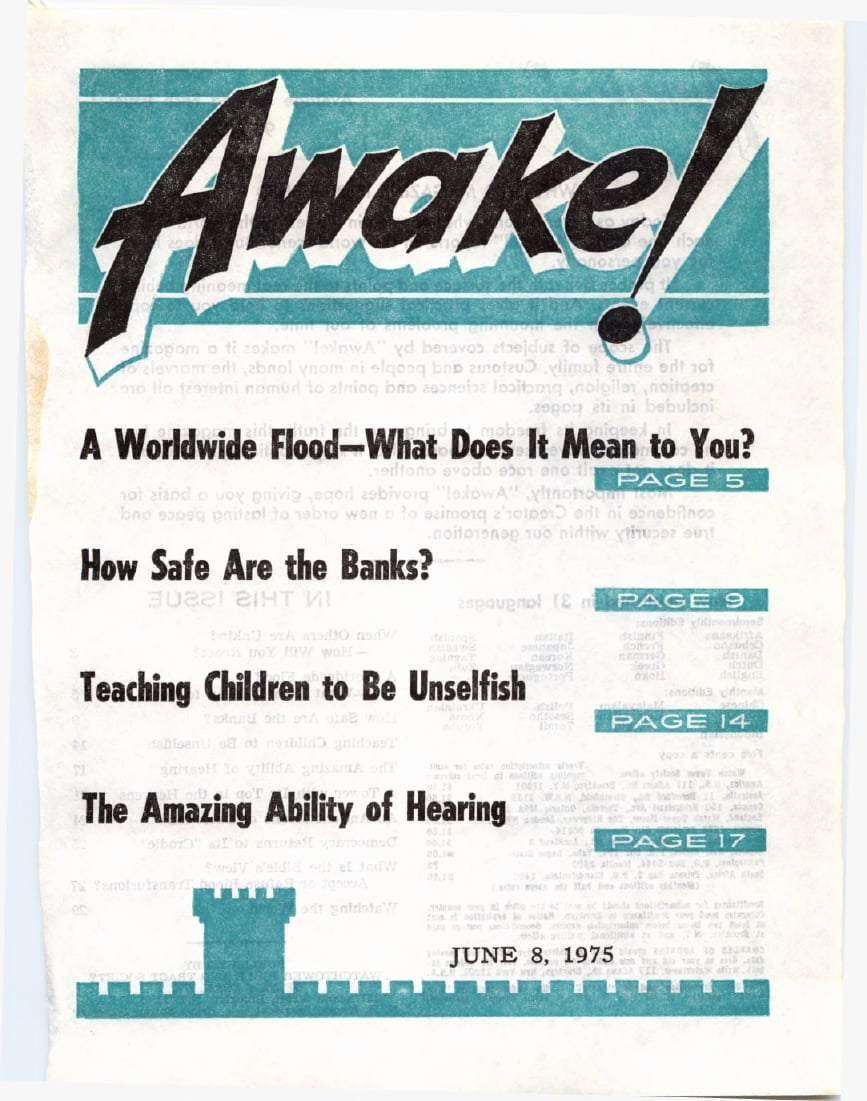
Awake! — June 8, 1975
Source: jw.org
Contents
When Others Are Unkind—How Will You React?
A Worldwide Flood—What Does It Mean to You?
How Safe Are the Banks?
Teaching Children to Be Unselfish
The Amazing Ability of Hearing
A Tower with Its Top in the Heavens
An Ancient Means of Detection
Democracy Returns to Its “Cradle”
Accept or Refuse Blood Transfusions?
Watching the World
Enjoy Reading the Bible
Do the Churches Represent God and the Bible?
When Others Are Unkind—How Will You React?
When Others Are Unkind—How Will You React?
HAS anyone said or done something unkind to you today? Perhaps at work or at school someone was rude, making some insulting or demeaning remark. Or, while you were shopping, a person may have crowded in ahead of you in line.
Similar things may occur in one’s own family. One member may speak slightingly or disrespectfully of another. Or he may be rude or unkind in some other way.
How do you react when these things occur?
Wise to Retaliate?
Is there not an immediate inclination to retaliate? But have you found that this really helps? The fact is, many marriages have deteriorated and broken up because mates retaliate. An opposite course is much wiser.
For consider: When tired or irritated, have you not said or done unkind things to persons you love? We all have. And have we not wished later that we could retract what was said or done?
But if retaliation to the unkindness follows, does not a cycle often start? Yes, unkindness quickly follows unkindness, and hostilities grow. Some persons may feel that they should repay injury with injury to keep others from taking advantage of them. But, time and again, experience has shown how unwise this is.
Feuds can result. Sometimes these have lasted so long that participants do not even recall how the strife began. Even whole nations and peoples have become involved in this cycle of rendering injury for injury.
How can it be stopped? What is the best way to react to unkind remarks or acts?
A Wise Course
An example of nearly 150 years ago illustrates. At that time there was a practice, when one was insulted, to challenge the offender to a duel. Thus, when the American statesman Henry Clay felt insulted by remarks of John Randolph about him in the United States Senate, he challenged Randolph to a pistol duel. Eyewitness Thomas H. Benton wrote:
“I withdrew a little way into the woods, and kept my eyes fixt on Mr. Randolph . . . I saw him receive the fire of Mr. Clay, saw the gravel knocked up . . . saw Mr. Randolph raise his pistol—discharge it in the air; heard him say, ‘I do not fire at you, Mr. Clay’; and immediately advancing and offering his hand.”
Though pride had moved Randolph unwisely to accept the challenge to a duel, he obviously felt no hatred toward Clay. Yet having taken offense at Randolph’s remarks, Clay was willing to kill him. It could have cost Clay his own life! Truly wise is the inspired advice of God’s Word: “Do not hurry yourself in your spirit to become offended, for the taking of offense is what rests in the bosom of the stupid ones.”—Eccl. 7:9.
But is it really wise to take abuse from others without retaliating? Well, even though Randolph had at first foolishly let pride put his life in danger, what happened when, after refusing to return fire, he kindly extended his hand to Clay? Benton continues: “He was met in the same spirit. . . . On Monday the parties exchanged cards, and social relations were formally and courteously restored.”
Yes, it is best to show kindness even when others are unkind to you. We are wise if we heed the apostle Peter’s counsel to Christians, in which he urged them not to be “paying back injury for injury or reviling for reviling, but, to the contrary, bestowing a blessing.”—1 Pet. 3:9.
Others may feel that they should return evil for evil, but the wise course is that recommended by God’s Word: “Return evil for evil to no one. . . . If possible, as far as it depends upon you, be peaceable with all men.” (Rom. 12:17-19) So, instead of trying to get even with those who may be unkind to you, wisely obey the Bible proverb: “Do not say: ‘Just as he did to me, so I am going to do to him. I shall repay each one according to his acting.’”—Prov. 24:29.
God’s way is to show kindness. “He is kind toward the unthankful and wicked.” So his Son Jesus Christ, who follows His example, urges: “Continue becoming merciful, just as your Father is merciful.” (Luke 6:35, 36) This course will be a protection.
For one thing, it can protect you from hurting yourself. How so? Well, what may happen if you angrily retaliate when someone is unkind to you? May not your blood pressure rise, with possible serious consequences to your health? However, remaining calm and under control is good for you. The Bible correctly says: “A calm heart is the life of the fleshly organism.”—Prov. 14:30.
But, furthermore, your kind reaction may have a good effect on the one who has acted or spoken unkindly to you. You may win the goodwill of that one and preserve peaceful relations. Time and again, the Bible proverb has proved true: “An answer, when mild, turns away rage, but a word causing pain makes anger to come up.”—Prov. 15:1.
Another Aspect of Matters
What will you do when others are unkind, not to you, but to someone else? At times, many people join in persecuting true Christians. In doing this, they may ‘follow the crowd.’ (Compare Exodus 23:2.) Under such circumstances, would you be kind to persecuted Christians?
A woman in the African country of Malawi faced such a question squarely when persecuted witnesses of Jehovah were fleeing from that land in October 1972. This woman, though of another religion, kindly hid fleeing Witnesses in her home and helped them to cross the river by night to safety in neighboring Mozambique. A traveling overseer of Jehovah’s witnesses told her about Rahab of Jericho, who hid Israelite messengers, with the result that Rahab and her relatives later were spared during the fall of Jericho to the Israelites.
The African woman was encouraged by this Bible account. In time, she and her husband and children crossed the border to study the Bible with the Witnesses. As a result, she symbolized her dedication to serve Jehovah God, and has been richly blessed spiritually.—Matt. 25:34-40.
So, how will you react when others are unkind? If you prize God’s approval and your own welfare, you will not retaliate. And neither will you ‘follow the crowd’ when others are unkind to those who do not deserve ill treatment.
A Worldwide Flood—What Does It Mean to You?
A Worldwide Flood—What Does It Mean to You?
UNTIL the middle of the nineteenth century most people in Christendom believed that a worldwide flood had once snuffed out almost all earthly life. The best-known account of this is found in the Holy Bible, which states that only eight humans and selected animals survived the Flood in an “ark,” or a massive floating chest.
Today it is popular for people to view the Flood as a myth. Many Bible scholars claim that it recollects a merely local inundation of ancient times, perhaps in the area of Mesopotamia.
Did the Biblical flood really occur? How extensive was it? What does that event mean to people living today?
The Flood, According to the Bible
The Bible’s first book, Genesis, sets forth the details of the Flood. In Genesis, chapter 6, we note that conditions in the world had deteriorated to the point that God said: “And as for me, here I am bringing the deluge of waters upon the earth to bring to ruin all flesh in which the force of life is active from under the heavens. Everything that is in the earth will expire.” (Gen. 6:17) God provided for the preservation of the human family and the animal kingdom by commanding Noah to build an ark, or oblong chest, 300 cubits long, 50 cubits wide and 30 cubits high.—Gen. 6:14, 15.
Do you realize how large that vessel was? If we calculate according to the conservative estimate of 17.5 inches per cubit, the ark measured 437 feet 6 inches by 72 feet 11 inches by 43 feet 9 inches. As the ark was divided into three levels, it would have a total of more than 91,000 square feet of floor space and an overall capacity of 1.2 million cubic feet. That is enough space for 445 standard railroad boxcars, or 10 trains of some 44 cars each. Would it be necessary to build such a massive structure to survive a local flood? Could not Noah simply have moved to an area unaffected by a local flood? Let us note carefully what the Bible, at Genesis 7:11, 12, 17-24, says as to the extent of the Flood:
“All the springs of the vast watery deep were broken open and the floodgates of the heavens were opened. And the downpour upon the earth went on for forty days and forty nights. . . . and the waters kept increasing and began carrying the ark and it was floating high above the earth. And the waters became overwhelming and kept increasing greatly upon the earth, but the ark kept going on the surface of the waters. And the waters overwhelmed the earth so greatly that all the tall mountains that were under the whole heavens came to be covered. Up to fifteen cubits the waters overwhelmed them and the mountains became covered.
“So all flesh that was moving upon the earth expired, among the flying creatures and among the domestic animals and among the wild beasts and among all the swarms that were swarming upon the earth, and all mankind. Everything in which the breath of the force of life was active in its nostrils, namely, all that were on the dry ground, died. Thus he wiped out every existing thing that was on the surface of the ground, from man to beast, to moving animal and to flying creature of the heavens, and they were wiped off the earth; and only Noah and those who were with him in the ark kept on surviving. And the waters continued overwhelming the earth a hundred and fifty days.”
Does a local flood fit that description? The book The Genesis Flood observes: “It would not have been possible for water to cover even one high mountain in the Near East without inundating Australia and America too!” The same publication then quotes the observation of well-known Hebrew scholar S. R. Driver:
“It is manifest that a flood which would submerge Egypt as well as Babylonia must have risen to at least 2000 ft. (the height of the elevated country between them), and have thus been in fact a universal one . . . a flood, on the other hand, which did less than this is not what the Biblical writers describe.”
The Christian Greek Scriptures, which include the testimony of Jesus Christ, confirm that the Flood was world wide. (Matt. 24:37-39; 1 Pet. 3:20; 2 Pet. 2:5; 3:6) Does the earth bear testimony to such a deluge? What would one look for?
Effects of Water in Motion
River floods in recent times give an idea of the enormous power of water in motion. A publication of the United States Department of Agriculture says of certain floods in the state of Utah: “[They] destroyed houses . . . and deposited debris to a depth of several feet, including boulders of all sizes up to 20 tons in weight. Some larger boulders were moved about 1000 feet from the canyon’s mouth down a 4° gradient. Several of these weigh from 75 to 100 tons each, and two, previously mentioned, weigh 150 and 210 tons respectively.”
The opening of “the floodgates of the heavens” does not refer to a simple rainstorm. (Gen. 7:11) It meant the pouring down of thousands of millions of gallons of water that had been suspended in the upper atmosphere as a globe-encircling water canopy, which the Bible called “the waters . . . above the expanse.” (Gen. 1:6, 7) The weight of these additional waters plunging earthward would surely contribute to considerable tectonic movements. Shifting and buckling of earth’s crust would generate immense tsunami waves that would sweep across land areas. According to an article in Scientific American, waves churned up by a storm at Cherbourg, France, “hurled 7,000 pound stones over [a] wall and moved 65-ton concrete blocks 60 feet.”
Is There Worldwide Evidence?
Do we see similar effects of flooding throughout the earth? A. M. Rehwinkel gives an example in his book The Flood:
“Large masses of granite and hard metamorphic rock, for example, which can be traced to Scandinavia, are scattered over the plains of Denmark and northern Germany. Some of these blocks are of an immense size, weighing thousands of tons. The same phenomenon is found here in America in the New England States and in New York, Pennsylvania, Ohio, Michigan, Wisconsin, Minnesota, Iowa, in eastern and western Canada, and elsewhere. . . . In many cases the distance over which they have been transported is very great, and sometimes they are found at an elevation apparently much higher than their source.”
Some have theorized that these huge masses of stone were carried to their present locations on top of glaciers during an ice age. “However, these boulders are also found in warmer climates far from any signs of glaciation. For example, in Southern California,” notes the book Target: Earth. Too, glaciers cannot account for many of these “erratic” rock masses resting on ground higher, sometimes thousands of feet higher, than their apparent original location. “And there is still another problem connected with the erratics for which the glacial theory has no satisfactory answer,” observes Rehwinkel:
“And that is the question of the mixture of rocks in one locality brought there from sources lying in opposite directions. This phenomenon has been observed in several places of the earth. One of them is in Saxony, where rocks are found lying together of which some had their source in Scandinavia in the north, while others were carried there from some source in the south. . . . Moving ice cannot accumulate boulders from opposite directions and deposit them together at one place.”
“All Flesh . . . Expired”
According to the book of Genesis, outside the ark “all flesh that was moving upon the earth expired” during the worldwide flood. (Gen. 7:21) Is there widespread evidence of such a watery destruction of living creatures?
Interestingly, in the United States, England, France, southern Spain, Germany, Russia and elsewhere huge fissures in the earth have been found filled with the remains of large numbers of animals. They include mixtures of bones of the elephant, rhinoceros, hippopotamus, reindeer, horse, hog, bear, and many others. One such cavern near Palermo, Sicily, yielded more than twenty tons of bones for commercial purposes. Often these fissures are located on isolated hills at considerable height where animals would be expected to flee from floodwaters that “kept increasing greatly upon the earth.” (Gen. 7:18) With regard to the variety of animal remains found in one bone cave, the book Earth’s Most Challenging Mysteries asks:
“What made rabbits run into the same cave as coyotes? And an antelope with a wolverine and a grizzly? Bones of the mastodon were found, also a few reptiles . . . The whole mass of bones was covered and preserved by a flood deposit of gravel and rocks.”
An extraordinary testimony to the widespread watery destruction of animal life is the remains of the mammoths found throughout northern Siberia and into Alaska. Hundreds of thousands (some estimate as many as 5,000,000) of these creatures were rapidly buried and quick-frozen in icy muck. They are sometimes found in a near-perfect state of preservation, with undigested tropical vegetation in their stomachs and between their teeth. As to the type of catastrophe that could sweep away creatures over so widespread an area, Earth’s Most Challenging Mysteries observes:
“There is one significant fact that is always connected with every dinosaur fossil and every mammoth fossil, and that is that every fossil is almost invariably dug out of water-laid sedimentary rock. Every fossil is either dug out of shale, which is just floodwater mud hardened into rock, or out of floodwater sand hardened into sandstone, or frozen into permafrost.”
Target: Earth notes with regard to the Yukon district of North America: “The presence of bones, trees, peat, and other debris all mixed together down to a depth of nearly 100 feet, points to a cataclysmic flood of tremendous proportions that must have moved across the land, grinding the bodies of the animals with stones and trees and spreading the whole out over the Yukon Valley.”
And when the destruction had been accomplished, what happened to the floodwaters? A sinking of the sea basins would cause the waters to collect there, allowing dry land to appear again. (Compare Psalm 104:8.) In the oceans today there is more than enough water to have accomplished what the Bible describes; 71 percent of the earth’s surface is water, with an average depth of two and a half miles.
Human Testimony to an Earth-wide Flood
A worldwide flood would surely make a deep impression in the memories of those who survived it. It is only reasonable that they related this event to their offspring. Since it was from “the families of the sons of Noah,” the builder of the ark, that “the nations were spread about in the earth after the deluge,” we would expect to find references to the Flood in the traditions of different peoples. (Gen. 10:32) Is there such testimony to a worldwide flood?
In his book Die Sintflut in Sage und Wissenschaft (The Deluge in Legend and Science) Dr. Johannes Riem of Germany notes: “Among all traditions there is none so general, so widespread on earth, . . . as the Flood tradition.” Some 150 separate flood legends have been found from every part of the earth, including ancient Greece, Rome, India, Australia, and the Americas. Though these legends differ in details, there is remarkable agreement on basic points. For example: (1) There was a moral cause of the Flood, namely, man’s wickedness; (2) Global destruction of the human race took place; (3) One man was forewarned and saved himself and a few others in an ark or boat. The Historical and Critical Commentary of the Old Testament: Genesis says:
“The harmony between all these accounts is an undeniable guarantee that the tradition is no idle invention; a fiction is individual, not universal; that tradition has, therefore, a historical foundation; it is the result of an event which really happened in the ages of the childhood of mankind.”
What Does the Flood Mean to You?
Abundant, indeed, is the evidence of a worldwide flood. What does this mean?
First of all, it reveals the Creator, Jehovah, as a righteous God who “did not hold back from punishing an ancient world” that had sunk to the depths of wickedness. (2 Pet. 2:5; Gen. 6:5-7, 11-13) It underscores God’s faithfulness in fulfilling what he promises to do, and his loving interest in mankind by providing both advance warning and a way to escape the Deluge. (1 Pet. 3:20) But that is not all.
“For just as the days of Noah were,” said Jesus Christ, “so the presence of the Son of man will be. For as they were in those days before the flood, eating and drinking, men marrying and women being given in marriage, until the day that Noah entered into the ark; and they took no note until the flood came and swept them all away, so the presence of the Son of man will be.”—Matt. 24:37-39.
The Bible’s time schedule and the fulfillment of numerous prophecies indicate that the invisible “presence” in Kingdom power of Jesus Christ, “the Son of man,” began in 1914 C.E. The present generation, therefore, faces a global “great tribulation” that will wipe out the present violent and morally corrupt system of things and that will outstrip even the worldwide flood of Noah’s day. (Matt. 24:3-34) Will you be among the “great crowd” who survive that tribulation?—Rev. 7:9, 14.
That depends upon whether you act on the advance warning as did Noah and his family. Will you take the time to study the Bible and find out what God’s will is for people today? Doing so can mean survival of the “great tribulation” into a paradisaic new order.—Rev. 21:4, 5.
How Safe Are the Banks?
How Safe Are the Banks?
THE phrase “as good as money in the bank” once meant that the investment or possession was considered to be very safe. This comparison was made because banks were regarded as very safe places to put money.
But times have changed. Today many people are not so sure about the safety of the money they have in banks. And there is good reason to feel that way. The financial experts are not so sure either.
The Wall Street Journal declared in a headline: “Fears About Stability of the Banking System in West Are Spreading.” It noted that many banks in the Western industrial nations are in trouble. Their financial position has deteriorated. An increasing number of economists feel that the banks are in worse shape now than at any time since the Great Depression that began in 1929.
Recent bank failures have been a shock. In October 1974 the Franklin National Bank in New York was declared insolvent. It had been the nation’s twentieth-largest bank, the largest to collapse in the history of the United States. Several others closed during the year. In Germany four banks failed, including the largest private bank, I. D. Herstatt. Some other European banks closed, while still others announced huge losses. And a growing number of banks were stretched to the limit of their resources.
These problems brought to mind the grim days of the Depression. At that time banks all over the world failed. In the United States about half the banks closed, 4,000 in 1933 alone. Most never reopened.
Could such a thing happen again? Are the banks heading for another catastrophe? Just how safe are they now?
Growing Anxiety
Banks are directly connected with overall economic conditions. So they reflect the health of the economy and the direction it is taking.
All indicators show that the world’s economies, especially those of the Western world and Japan, are in a very serious state. Never have so many countries had such economic difficulties at the same time.
French president Valéry Giscard d’Estaing summed up the feelings of many. He warned that the world was in the grip of a general economic crisis and that “all the curves are leading us to catastrophe.” Country after country has been hit with rampant inflation, money shortages, declining real income of workers, persistent unemployment and poverty.
The seeds for this condition were sown decades ago. But the situation was made much worse by the recent fourfold rise in oil prices. Now nearly every oil-importing nation has been going deeply into debt to try to pay its staggering oil bills.
Thus, after several European banks closed and others, including a Swiss bank, suffered sharp losses, The Wall Street Journal said: “The system is sick.” It added:
“Not even the highly vaunted Swiss banking system is immune. So is anything really safe today? . . .
“There never has been a time when so many imponderables hung over markets and over those elements which control actions of markets. . . .
“When even the biggest Swiss bank is clipped in a foreign exchange deal, then one might well ask: What’s the world coming to? Pessimists already are answering the question.”
Why Are Banks Troubled?
Why are so many banks troubled? Why have some of the largest failed? For much the same reason that any business or individual fails financially. That happens when expenses grow faster than income; and when it continues too long, bankruptcy ensues.
Bank expenses include such things as the interest paid out to depositors, the salaries and benefits to employees, and the cost of operating buildings. But some banks have lately added another growing cost: they have relied more on borrowing money themselves so that they could loan it out to others. But the cost (in interest payments) to the bank borrowing such money is usually high.
During 1974, in a period of recession, banks were hurt in other ways. Some made too many high-risk loans. When borrowers could not pay the loans back as scheduled, or at all, due to bad business conditions, the banks incurred losses. Also, banks that had money invested in such things as stocks and bonds suffered when these lost value. And some banks lost very heavily by speculating, and guessing wrong, on foreign money markets, where the exchange rates of currencies fluctuate in relation to one another.
During the year some banks were additionally hurt by withdrawal of money by depositors. Out of fear, or to invest in other areas that brought greater returns, money was pulled out of some banks in substantial quantities. This meant that the bank did not have that money to loan out to make a profit, and income suffered.
Hence, for a variety of reasons, bank expenses have mounted. But in too many cases income has not kept pace. Resources were stretched thin. And for some banks it stretched too far, like a balloon that has been inflated too much and bursts.
The startling bank problems during 1974 have officials worried. Among the things that concern them is how so many authorities could have been caught unawares. Business Week noted: “Now there are the recriminations and the questions about how not only the banks but also the banking regulators could have made so many wrong guesses over the past 10 years.” This business publication further commented:
“Taken as a whole, the [U.S. banking] system is in more trouble today than at any time since the 1930s, with a distressing number of banks over-loaned, over-borrowed, over-diversified, and undercapitalized. . . .
“There may very well be an unprecedented wave of bank mergers and consolidations as weaker fish seek shelter, and there almost certainly will be some failures.”
Basic Cause
Why all this economic instability? There are various factors, of course. But of all the answers, one stands out above the others. It is repeated by economists over and over again as being a main cause of the problems: too much debt!
For decades now, people, businesses and governments have been living far beyond their incomes. They have been borrowing more and more money to finance their affairs. Their desires have grown faster than their ability to pay. To make up the difference they have resorted to ever-increasing amounts of debt.
But sooner or later the time comes for debts to be paid off. If income does not rise enough, debts cannot be paid. And if more money cannot be borrowed because of becoming a bad credit risk, then failure or bankruptcy follows. That is what is taking place now to a growing number of individuals, businesses, and even banks. In the book The Coming Credit Collapse, investment adviser Alexander Paris writes:
“There does indeed exist a single fundamental cause of all the financial ills. They may all be traced to a long trend of excessive credit [debt] growth, which is rapidly approaching its final phase. . . .
“Over the entire postwar period [since 1945], the amount of credit outstanding has grown at a rate that, on the average, has consistently been two to three times faster than the growth in the nation’s ability to produce goods and services. Moreover, the rate has been accelerating in recent years. . . .
“This trend in credit has resulted in a growth in demand that has been highly artificial and, through its primary and secondary effects, has been responsible for most of the economic and financial problems facing the investor today.”
Business Week also singled out this basic cause, saying:
“The United States, like the world around it, is in sad shape today. Having borrowed too much in the expectation of perpetual plenty, Americans are desperate for answers to questions for which there are no pat answers. . . .
“The world’s great economies were running out of control long before [the huge price rise in oil] . . . and all that the oil situation has done is to hasten an inevitable day of reckoning.”
Extent of Debts
The extent of debt has become truly staggering. During 1974 the debt in the United States reached over two and a half trillion dollars! That is more than the total value of goods and services produced in an entire year. Of that debt, corporations owe about one trillion dollars, the federal government about $500 billion, state and local governments about $200 billion, consumers about $200 billion, and the mortgage debt was about $600 billion.
Now corporate debt amounts to more than fifteen times after-tax profits, about double what it was in 1955. Household debt is about 93 percent of income left over after other basic expenses are paid, a huge increase in recent years. And the mount of money available in the entire country is only a small fraction of the total debt.
The world’s debt is estimated to be over $10 trillion. It is not likely that it will ever be paid back. The debt psychology has permeated every corner of the economy. The Western world is so geared to debt that living within current income would wreck it as easily as would continued inflation. Why so?
If borrowing were cut back to pay current bills, people would not buy as much, nor would businesses or governments. Production would have to be cut back drastically. Masses of people would be thrown out of work. The industrial way of life, which has concentrated so many people off the land and into cities, could not absorb such shocks.
The “prosperity” of the Western nations has been built on borrowed money. It has not been genuine. Now the bills are coming due and cannot be paid. And that is an aspect of the problem that frightens leaders. So many people, businesses and governments are near bankruptcy that even a small number of them failing could start a chain reaction that would bring the Western world’s economy to its knees. The New York Times observed: “The impact of a staggering increase in oil prices on top of already soaring inflation and rising deficits in payments abroad has sent governments reeling everywhere.”
How Banks Would Be Affected
With debt at such an all-time high, major defaults could wreck the banking system. Business Week noted that “corporations are sick—and they are sick largely as a result of their overdependence on debt.” Consumers are also “sick,” as are most governments—due to debt.
Every bank lives with the knowledge that if a few major customers that have borrowed money cannot pay it back, the bank can be in deep trouble. If, due to economic difficulties, many businesses and individuals default on their payments, there is no way that any government can make up the difference, since most governments are also deeply in debt, much of it owed to banks!
For instance, during 1974 a U.S. federal agency, the FDIC (Federal Deposit Insurance Corporation) insured individual bank deposits up to $20,000, then later in the year raised this to $40,000. But this agency had only about $5 1⁄2 billion in its reserve, while the deposits it “insured” were nearly $470 billion! Obviously, the closing of even a small number of banks would bankrupt this insurance agency.
Yet banks themselves are much to blame for their present condition. Investment adviser Alexander Paris states: “The banking system has been a willing partner in the long postwar financial deterioration that has occurred in the United States and the world.” He observes that the financial health of the banking system “by all measures, has deteriorated steadily throughout the entire postwar period, and all former limits of propriety have been far exceeded in the pursuit of profit maximization.”
The Coming Collapse
Does this mean that the banks will soon collapse? Authorities point out that there is much that governments can do to prevent this, for a while. No doubt some measures will help, temporarily.
It is suggested that governments can pump more money into the banking system. But that creates more debt, and furthers inflation. It only postpones the day of reckoning and makes the final reckoning more severe. As one financial expert stated: “This cannot be the cure. It is analogous to giving a drunk a drink to sober him up.”
There are many people who say that authorities will simply not allow a banking collapse. But if that were so, then why have they allowed the situation to get so desperate? If they had the solutions, the world’s economies should already have been stable, secure, prosperous, instead of near collapse. Remember, “authorities” were saying that the Great Depression could not happen just weeks before it did!
In Western “free” economies, events have a force of their own. They cannot always be controlled. This is obvious by the fact that there already have been depressions and crises in such countries. In this regard, Hyman Minsky, a professor of economics at Washington University, says:
“There is a greater likelihood of a serious financial crisis now than at any time since the nineteen-thirties.
“Conventional wisdom has it that a financial collapse and deep depression cannot happen again because the Federal Reserve and the Government will not let it happen.
“However, in today’s financial environment the authorities are not that powerful: What they do to slow inflation is likely to trigger a financial crisis, and what they do to abort a crisis and offset unemployment tends to accelerate inflation. . . .
“The margins of safety have decreased markedly over the postwar period. When safety margins are thin the financial system is unstable: One failure can lead to many failures. A wave of failures, especially among financial institutions, constitutes a financial crisis. . . . The deep depressions of history followed financial crises.”
Other economists speak of this as the “domino theory,” a few big failures triggering a chain reaction. The Wall Street Journal describes it this way:
“Even some of the practical men involved in daily dealings privately confess to fearing the worst. . . .
“In its starkest form, the domino theory holds that the collapse of a single sizable bank could weaken many others around the world that had money in it, provoking panicky withdrawals of large deposits that could send them tottering, too.
“Triggering the initial collapse could be anything from speculative foreign-currency losses to the default of a big borrower, either a government beset by staggering oil-import costs or a corporation caught in an inflationary slump.”
Franz Ulrich, managing director of Düsseldorf’s Deutsche Bank, says: “Sometimes I am not able to rid myself of the feeling that such a day cannot be too far off.” And Guido Carli, governor of the Bank of Italy for fourteen years, states: “The world cannot go on this way indefinitely. We will have to accept the consequences of a recession. It will start in the weaker countries, like Italy, and spread to the stronger ones. And the monetary and trade system we built after World War II will disintegrate.” As a financial adviser told a New York reporter: “The old system is finished.”
Hence, Wall Street Journal writer Ray Vicker concludes: “So there are no real havens anywhere, no matter how men might seek them.”
Is this to say that people who have money in the bank should withdraw it? What any individual chooses to do with his finances is his own responsibility. But how secure is any other place where you might put your money today? Keep in mind that when a collapse comes, money itself often becomes worthless.
Is another financial collapse near? Yes, and it will be a total one. In that coming collapse, no money of any nation will be safe. That will be true no matter where it is—in a bank, safe deposit box, cookie jar, invested, or hidden under a mattress.
How can we be so sure? Because God’s Word, Bible prophecy, tells us that the very governments that have issued the money will be put out of business, crushed completely. (Dan. 2:44) Indeed, it shows that even precious metals will afford no protection against the execution of judgment on a self-seeking world: “Into the streets they will throw their very silver, and an abhorrent thing their own gold will become. Neither their silver nor their gold will be able to deliver them in the day of Jehovah’s fury.”—Ezek. 7:19; Zeph. 1:18.
That will pave the way for an entirely new order of God’s making. In that new order, gone will be the contrasts of abject poverty alongside extreme wealth, as exist now. Deep depressions and rampant inflations will be things of the past. All of earth’s economic affairs will be justly administered by the heavenly government of God for which Jesus Christ taught his followers to pray.—Matt. 6:9, 10.
Teaching Children to Be Unselfish
Teaching Children to Be Unselfish
“JEFFREY, would you please help me to fix your sister’s toy?” a mother asked her young son. Do you, too, invite children to do things that will benefit others in the family?
Admittedly, it is not easy to steer children from a selfish course. The fact is, we are born selfish. A new baby wants what he wants when he wants it. And he tolerates no delays, as is sometimes evidenced by unrestrained screaming for attention.
However, when provided with loving care and guidance by parents, a child begins to take notice of others. Gradually his selfish tendencies diminish. Needless to say, this involves much time and effort on the part of the parents. Yet, in time, those who persist in their efforts see results.
Role of Parental Example
Whether parents like it or not, their children are going to imitate them. Thus the importance of setting a good example in being unselfish. One father observed: “Our ten-year-old son has seen us give to others since he was small. Now when we give to those in need, he asks to be included. We’ve seen him do little things for others without being prompted, which indicates to us that he’s not just doing it to please us.”
His wife added: “If husbands are generous with their wives, the child notes this and will do things for his mother the way his father does. I know that’s true with our son.”
This mother also had some interesting observations regarding the effect upon children of their parents’ attitude toward material possessions. “Our son,” she explained, “never hears us argue about money or hears us say, ‘We can’t afford this or that.’ Not that we’re well off financially; to the contrary. But we’re not anxious about it, and because of this he feels secure. We have observed that in homes where the parents constantly argue over money, the children tend to be more selfish, and they, in turn, fight among themselves over trivial things.”
It is often observed that a selfish child is one who gets, not too much attention from his parents, but usually too little. When a child can depend on his parents for help when he needs it, he generally becomes helpful. When a child is loved by his parents, he becomes loving. Yes, how a child is treated when young will, in large part, be the basis of how he will treat others in the future.
Ways in Which Training May Be Given
The importance of early training can hardly be overemphasized. Thus if a child is properly trained in his early years to think of others, giving and helping others will usually come naturally to him.
Recently a mother was observed putting this principle into action. She was overheard to remark to her little son: “Now that you’ve found those two pennies, would you like to put one in your piggy bank and the other in your sister’s bank?”
“OK, Mom,” was the happy reply.
Thus the seed was planted and, if properly watered, it can be the basis for loving action in the future.
Other parents revealed that they include their children in discussions about family matters. The father makes the final decision, but the children are free to express their wishes, which are taken into consideration. The father of a thirteen-year-old daughter observed that making his children feel a part of family activities and decisions cultivates in them a loving, unselfish spirit. As an example, he said: “Recently I went with my daughter to buy shoes. She saw a pair that she liked, but when told the price, she said: ‘Oh, Daddy, I don’t need such an expensive pair. That cheaper pair will be all right.’ Is it any wonder I think she’s special?”
Another father similarly explained how he and his wife try to help their children to make wise decisions. “While they are still with us,” he noted, “we can detect any flaws in their thinking, and help them.” Illustrating the matter, he described a recent dinnertime discussion.
“The subject of cars came up,” the father recalled, “and our oldest boy, who is car crazy these days, said that if he had the money he’d buy a small sports car, naming the make. I remember saying: ‘Having a car is OK, Alvin, but a small sports car doesn’t leave much room for the wife and kids, does it?’
“He responded: ‘What do you mean, “wife and kids,” Dad? Why, I’m not even married yet.’
“‘I know, son, but you will be someday and you’ll have to consider them, won’t you? You know it’s all right to plan for the future, but you should consider how your plans will benefit or hinder others, don’t you think?’
“‘Well, yes, I guess you’re right. A sports car doesn’t have much room, but it would be nice to have.’
“‘Then, too, son, that’s a pretty expensive car that you want. You could be driving around in that fancy car, having a good time, while your family goes hungry. I’m sure you wouldn’t want that.’
“‘Of course not, Dad. I wouldn’t do such a thing.’
“‘I know you wouldn’t mean to. But I know you’ve seen many men in this very neighborhood do just that—get what they want at the expense of their family’s needs.’
“Well, he thought for a minute or so and then said: ‘I guess you’re right, Dad. OK, I’ll get a family car—when I get one, that is. But that’s still a long time off, isn’t it?’
“‘Yes, son, but what you think about now will shape your future plans. So it’s best to think along the right track even now.’”
Is that how you go about guiding your children to think of others? Do you do it in a natural, loving way under relaxed conditions? It will have a better chance of success than if done in a stern lecturing way. Also, if you use empathy in your approach, your children will appreciate your taking their feelings into consideration and will be more inclined to take the counsel.
Unselfishness Toward Old and Young
There is much that children can be taught to do for grandparents and others well along in years. They can read to such ones who may have poor eyesight. They can include them in family games or activities. Just because these have slowed up physically does not mean they have done so mentally.
Even outside the home, in public, children can be encouraged to notice and help older persons. They can be encouraged to give up their seats to them on buses and trains. They can show respect by not interrupting them in conversation, and by not monopolizing a conversation. Yes, instead of merely tolerating elderly ones, as is the custom in some places in the world today, children can be taught to benefit from the wisdom and experience that such ones often have.
Children should also be encouraged by parents to show loving attention to their younger brothers and sisters. Otherwise, they may resent a newcomer’s intrusion on their mother’s time. One mother, who had a six-year-old son, noted:
“From the time I was pregnant with my daughter we referred to her by name, and she became very real to my son. When she arrived, he was eager to help me with her. Years later, he told us how happy he was when she was born.”
Parents who skillfully prepare their children for the baby’s arrival find that they have little to worry about, as illustrated by the case of a seven-year-old. When asked how she liked her baby sister, she replied: “Oh, I love her. I like helping Mommy fix her up. But I don’t like it when she cries. I think she’s getting spoiled.” When asked what she intended to do about it, she said: “Well, as soon as she can understand, I’m going to have a talk with her.”
It is often typical for brothers and sisters to grow jealous of one another, or to become resentful. But by avoiding showing favoritism and explaining their actions, parents can do much to counteract this problem. One mother of three observed:
“As the children grew, the younger two showed some resentment when our oldest boy received some extra clothing or gift. But we explained that at his age he needed more than they did. We assured them that they, too, would receive the same treatment when their time came. Now that our daughter is at that age, she appreciates the truthfulness of this.”
Serving Others Brings Benefits
One of the greatest gifts you can impart to your children is the desire to serve others, to give of their time, sympathy and attention in behalf of those in need. Consider the remarks of a twelve-year-old boy who learned this lesson:
“A boy on our block lost his father recently, and I really felt sorry for him. I wanted to do something to help him so talked it over with my dad, and he said we could include him in some of our family activities. I’ve invited him over to our house, but he doesn’t seem to want to be with anybody now. But I intend to keep trying.”
Do your children get involved like that? Are they concerned for others? They will be, with encouragement from you.
Truly, children who are encouraged to be unselfish receive many benefits. They have a sense of well-being and security. They are more poised and balanced. They are better prepared for their future roles as husbands, wives and, eventually, parents. And they come to appreciate that the words of the Lord Jesus Christ are really true: “There is more happiness in giving than there is in receiving.”—Acts 20:35.
The Amazing Ability of Hearing
The Amazing Ability of Hearing
IF YOU possess good hearing, you have something truly precious. Just think! You can listen to the melodious song of a bird, the ripple of a brook, the voice of a loved one. Through your ears you can receive lifesaving messages, too—perhaps from an automobile horn, a siren or a fire alarm.
Yet, have you really given much thought to your amazing sense of hearing? And what about that possessed by other creatures? Even a brief investigation can be intriguing.
How Are You Able to Hear?
A glance at the accompanying illustration shows that your ear is much more than that trumpetlike organ on the side of your head. That part is merely the auricle. It catches sound waves and sends them inward, along the external auditory canal. In it are tiny hairs and wax-producing glands. Their purpose? To prevent dust, insects, and so forth, from going deeper and causing damage.
When sound waves reach the end of the canal, they strike your eardrum, composed of thin, taut tissue. Its resulting vibrations are amplified and transmitted in your middle ear by three minute bones, the auditory ossicles. They are commonly called the hammer, anvil and stirrup because of their shapes. The stirrup “taps” the membrane of the “oval window,” transmitting the vibrations to your fluid-filled inner ear. Sound waves also enter the inner ear through the “round window,” below the “oval window.” Some waves even travel through your skull bones into the inner ear.
Above the inner ear’s central vestibule are the semicircular canals. Movements of fluid within them enable you to maintain physical balance. However, hearing is associated with the cochlea. Sound waves passing through fluid set in motion the cochlea’s basilar membrane. In turn, its movement causes vibration of the hair cells making up the organ of Corti. This motion stimulates the nerves attached to the hair cells. Finally these nerves, through the auditory nerve, send messages as electrical impulses to your brain’s hearing center. All of this is well known, but just how a person can understand such signals continues to baffle men of science.
A Word About What You Hear
You cannot hear every sound that surrounds you, and that is a good thing. As a babe in arms, your auditory range may have run from 15 to 30,000 cycles, or vibrations, a second. But say that it was very far below 15 cycles. Why, then you would hear your own heartbeats, even your bone and muscle movements!
Though it has certain limitations, your hearing range is astounding. While individuals differ, in general the loudest sound that one can tolerate is 2,000,000,000,000 times as great as the least perceptible sound! Indeed, the human ear has the maximum sensitivity practical for its needs.
As the years pass, of course, imperfect humans experience progressive loss of hearing ability. Among other things, this is because tissues of the inner ear lose their elasticity. The upper level of the auditory range reportedly drops from 30,000 cycles when one is a baby to around 4,000 cycles by the time one is eighty. Nevertheless, even that is enough for normal conversation.
Truly a Masterwork!
Your ears have built-in protection against extremely loud noises. Of course, a sudden nearby explosion can result in excessive vibrations that could cause irreparable damage to your intricate hearing apparatus. But if a very loud sound develops gradually, quick-acting muscles can ‘turn down the volume.’ The eardrum’s membrane is tightened to reduce its vibrations, and middle-ear muscles twist the auditory ossicles. Thus the stirrup does not transmit such great vibrations through the “oval window” into the inner ear.
Protection also is afforded by the Eustachian tube, running from the nasal cavity to the middle ear. This passageway carries air and equalizes the pressure inside your eardrum with that outside. Here, then, is a safeguard against the breaking of your eardrum due to a great change in external air pressure.
Think, too, about the sounds you hear. In an amazing way, you distinguish between the rumble of thunder and the clatter of wagon wheels, the footsteps of a person and the hoofbeats of a horse, even if you cannot see their source. Moreover, usually both ears can be ‘tuned in’ on sounds. Perhaps you dropped a coin and did not see where it rolled. Yet, you heard it hit the floor, possibly bouncing a time or two. Then you listened as it rolled and struck a chair. Finally, you heard the coin flop over and reverberate before coming to rest. Both ears help you to locate the spot.
Not without good reason, it has been said of the human ear: “If an engineer were to duplicate its function, he would have to compress into approximately one cubic inch a sound system that included an impedance matcher, a wide-range mechanical analyzer, a mobile relay-and-amplification unit, a multichannel transducer to convert mechanical energy to electrical energy, a system to maintain a delicate hydraulic balance, and an internal two-way communications system. Even if he could perform this miracle of miniaturization, he probably could not hope to match the ear’s performance.”—Sound and Hearing, by S. S. Stevens, Fred Warshofsky and the editors of Life, page 38.
Yes, the human ear truly is a masterwork. How well it demonstrates the wisdom of Jehovah God, the incomparable Maker of the hearing ear!—Prov. 20:12.
Hearing in the Animal World
You have a right to be impressed with the wonder of human hearing. But what about that of other creatures? Well, people can see the external ears of dogs, cats, horses and monkeys, and they know that such animals respond to sounds. Also, though birds lack external ears, most persons are well aware that these creatures can hear. As a matter of fact, a bird’s auditory range is about the same as man’s. What about snakes? Can they hear?
Some naturalists contend that snakes cannot hear. Actually, however, recent findings show that these animals have an auditory mechanism and can hear fairly well. For instance, researchers Peter H. Hartline and Howard W. Campbell found that not only substrate vibrations but also airborne sounds evoked electrical responses in species of three snake families. Concerning a boa constrictor, they wrote: “If a brain response is accepted as indicative of hearing, these snakes can hear airborne sound.”—Science, March 14, 1969, Vol. 163, No. 3872, page 1222.
The Bible implies that the cobra can “listen to the voice of charmers.” (Ps. 58:4, 5) In this regard, the New York Times of January 10, 1954, stated: “Dr. David I. Macht, research pharmacologist of the Mount Sinai Hospital in Baltimore, is one of the world’s leading authorities on cobra snake venom. . . . Dr. Macht reported that in working with cobras and cobra venom he became acquainted with a number of Hindu physicians, well educated, and from different parts of India. All agreed that cobras respond to some musical tones, from musical pipes or fifes. Some forms of music excite the animals more than other forms, the physicians reported. Indian children, playing in the dark in the countryside, are even warned not to sing lest their sounds attract cobras, he said. Dr. Macht commented that Shakespeare, who repeatedly referred to serpents as deaf . . . merely repeated a common misunderstanding. On the other hand, Dr. Macht said, the psalmist was right who implied conversely, in Psalm 58, Verse 5, that serpents can hear: . . . Contrary to the claims of some naturalists, Dr. Macht said, snakes are ‘charmed’ by sounds, not by movements of the charmer. Revise the textbooks, the physicians recommended.”
What About Insects?
Some researchers have concluded that not all insects can hear. Yet, many of these little creatures have remarkable hearing ability. Some respond to sounds below man’s auditory range. Others can detect those over two octaves higher than any that humans can perceive.
Insect auditory equipment varies and often turns up in unusual places. Eardrums of short-horned grasshoppers are on the sides of their abdomens. The male attracts a lady grasshopper by rubbing the edges of his front wings with spines attached to his back legs. This is ‘music to the ears’ of the female that hears it and decides to become his mate.
Katydids and crickets have “ears,” too. Where? Just below what you might term the “knees” on their front legs. Of course, these are only tiny openings. But all the female katydid must do to pick up the male’s mating sound is to move her legs in the direction of the call!
The Marvel of Echolocation
Some creatures employ the sense of hearing in quite an extraordinary way. They are equipped for echolocation. These animals emit high-frequency sounds and are guided, by listening and responding to rapidly returning echoes as the sounds are reflected by objects. For instance, bottle-nosed dolphins use this method to avoid underwater obstacles.
Among echolocators is a well-known flying mammal—the bat. If you were to release a bat in a completely dark room, it could-fly about without hitting the walls or other objects. This is because the animals emit sound pulses of high frequency; as the sounds strike obstacles, they listen for the echoes. Why, they sometimes send out over 200 pulses a second! By interpreting the messages resulting from these echoes, the creature-charts a safe course.
The bat also uses its astounding guidance system to locate the insects on which it dines. But just how it tells the difference between echoes reflected by obstacles and those returning from potential meals remains a mystery to man. For that matter, certain bats catch their prey right on the obstacle, a leaf.
Another remarkable factor is that the bat does not hear the sounds it emits. Every time one is sent out, ear-muscle contractions ‘turn off the sound’ so that only the echo is heard. Furthermore, each bat may possess and follow its own pattern of sound because there is not mass confusion when hundreds of these creatures flock together.
What a system of sound emission and hearing the Creator has given the bat! It has been said: “Scientists estimate that, ounce for ounce and watt for watt, the bat’s sonar is a billion times more sensitive and efficient than any radar or sonar device contrived by man.”—James Poling, in Marvels & Mysteries of Our Animal World.
Protect Your Hearing Ability
Whether you look at the animals or consider yourself, doubtless you will admit that hearing ability truly is amazing. And surely you will want to care for and protect your hearing apparatus.
Your ears are being assailed by many unwanted sounds in this modern world. Noise pollution has become quite a problem in many places. If you must work around excessively loud machinery, for example, the use of earplugs may be advisable. They may protect you against ear injury and hearing loss.
If you now are a tobacco user, another way to protect your hearing is to stop using tobacco. The nicotine in tobacco causes constriction of inner-ear arteries. This, in turn, reduces blood flow and consequently the flow of nourishment that the inner ear needs in order to play its vital role in your life.
Never probe in your ears with objects such as hairpins or matchsticks. If you break the skin in this way, infection may result.
Do you have your ears examined from time to time? Well, having periodic ear examinations would not be amiss. It certainly pays to protect your amazing ability of hearing.
[Diagram on page 18]
(For fully formatted text, see publication)
THE HUMAN EAR
AURICLE
STIRRUP
HAMMER
SEMICIRCULAR CANALS
ANVIL
VESTIBULE
AUDITORY NERVE
COCHLEA
EUSTACHIAN TUBE
EARDRUM
AUDITORY CANAL
OVAL WINDOW
ROUND WINDOW
A Tower with Its Top in the Heavens
A Tower with Its Top in the Heavens
By “Awake!” correspondent in Canada
THERE—poised majestically in Toronto, like a giant rocket ship ready for lift-off, its needle-nosed upper end pointing skyward—is a tower that truly has its top “in the heavens”! One feels excitement as one looks with unbelieving eyes up and up to its imposing 1,815-foot elevation, five times as high as the Saturn V rocket used in the Apollo 11 moon shot. What has caught one’s gaze is the “CN Tower,” the tallest self-supporting structure in the world. (“CN” for Canadian National, the government-owned railway and communications system in Canada.)
From very early times in human history man has been occupied with building towers that ‘reach into the skies,’ first for purposes of false religion and then for military advantage. (Gen. 11:1-9) Though the earliest of these of which we have any record, a temple tower or ziggurat, did not have a noble objective, men since then have at times shown amazing abilities to achieve some worthwhile purpose with towers. Sometimes they have been erected solely for architectural beauty and symmetry, but at other times they have been designed for more practical reasons, such as in supporting huge spans in bridges.
The CN Tower strives to combine these latter goals, being both aesthetically pleasing to the eye and serving a number of practical purposes. As the federal Minister of Mines, Energy and Natural Resources, Donald McDonald, expressed it when work on the tower began: “The CN Tower will not only be impressive but will be very practical as well.”
Impressive it is! Have you seen the Eiffel Tower in Paris? Put another Eiffel Tower on top of it and the pinnacle of the CN Tower would be only about 150 feet under that doubled height. Or, have you been to the top of the Empire State Building in New York city? You were only a little more than two thirds of the way to the topmost elevation of this tower. Yes, it is almost 400 feet higher than the tallest office building in the world, the Sears Tower in Chicago, U.S.A. Though it is admitted that there are TV transmitters higher than the 1,815 feet of the CN Tower (about 553 meters), they are supported by guy wires or other external sources of stability, whereas the CN Tower is “freestanding.” More than one third of a mile high, it dominates the Metro Toronto landscape.
However, it is not just the lofty altitude of the tower that impresses. It rises from its foundation in the form of three rocketlike “fins,” this Y-shaped base tapering gracefully upward for about 1,100 feet. At this point the line of ascent is pleasingly broken by a seven-story circular observation deck/revolving restaurant complex. Above this “skypod” the ascent, blending into a hexagonal column, continues skyward for about another 400 feet to an upper observation level. Finally, a gradually tapering 335-foot antenna mast crowns the structure, bringing it to its needle-pointed tip. Once you see it, its simple, graceful form leaves an indelible picture on the mind.
…