Awake!, August 8, 1974
Download: PDF — Awake!, August 8, 1974
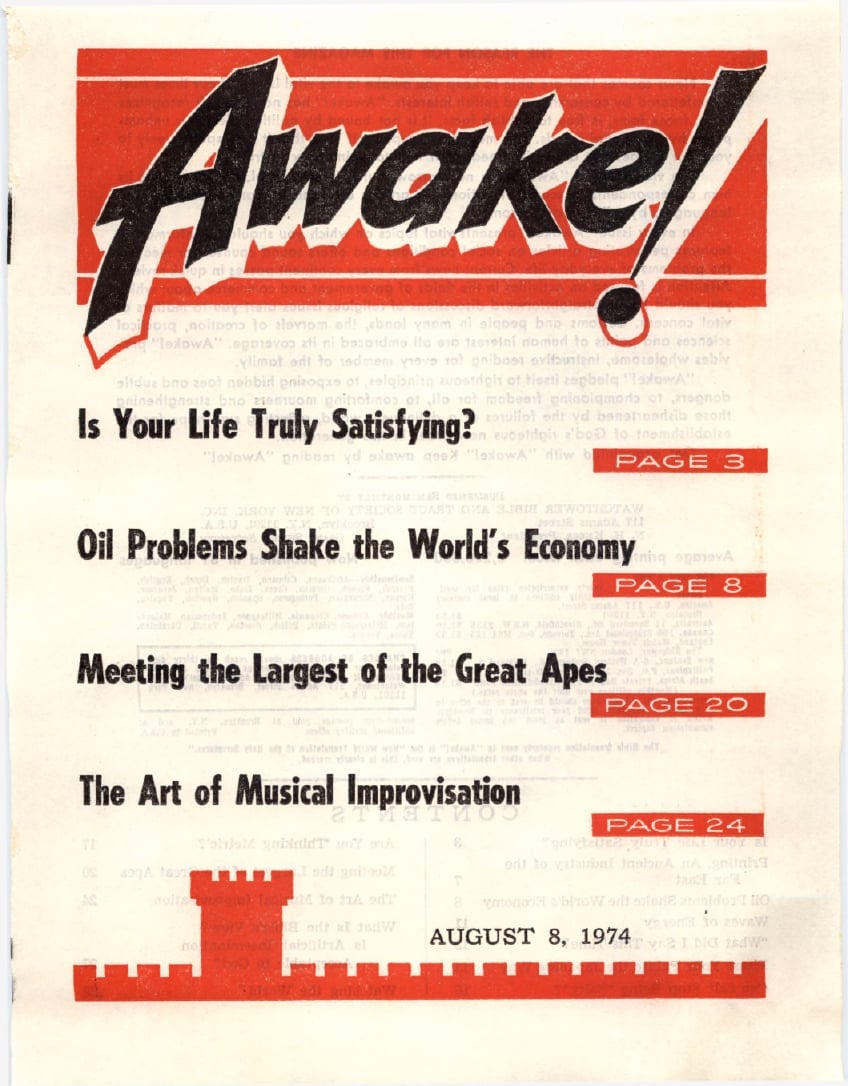
Awake! — August 8, 1974
Source: jw.org
Contents
Is Your Life Truly Satisfying?
Printing, An Ancient Industry of the Far East
Oil Problems Shake the World’s Economy
Waves of Energy
“What Did I Say This Time?”
Please Your Palate the Japanese Way
Can Salt Stop Being “Salty”?
Are You ‘Thinking Metric’?
Meeting the Largest of the Great Apes
The Art of Musical Improvisation
Is Artificial Insemination Acceptable to God?
Watching the World
Can You Live Forever in Happiness on Earth?
The Churches and War
Is Your Life Truly Satisfying?
Is Your Life Truly Satisfying?
A MOTHER of six children in a Latin-American country knows that her husband has been having sex relations with another woman for the past ten years and is trying to “conquer” yet another. She cannot go to court to divorce him; there is no provision for divorce in that country. Nor can she afford to separate from him, because she needs the financial support for his children. If you had to live under such conditions, would you find life truly satisfying?
Perhaps your case is not so severe. But are you a housewife? Does the seemingly endless routine of cleaning, cooking, shopping, mending, washing and ironing get to you at times? And how about trying to make ends meet when faced with the ever-rising cost of living? These things have caused many a homemaker to feel that her life is far from satisfying.
Men, too, become frustrated. Overcrowded subways and buses, traffic jams and parking problems try the patience of millions daily. Sometimes the cause of dissatisfaction goes deeper, as in the case of an executive of a drug company in a large Latin-American city.
This man put his whole life into his job, even working for years without taking a vacation. Overtime work was the rule for him rather than the exception. But now, after twenty-five years of faithful service on his part, the company suffers from internal frictions and is near bankruptcy. The resulting anxiety and despair have adversely affected this man’s health and disposition. After all those years of service he wonders: “Has it really been worth it?”
What about you? Do you find your life truly satisfying? Do your goals in life seem worth while? What can you do to combat the frustrations that, for many, dampen the joy of living?
Some Causes of Frustration
While some people suffer from circumstances over which they have no control, to a large extent people cause their own vexations. It is as the Bible itself truthfully states: “Whatever a man is sowing, this he will also reap.”—Gal. 6:7.
Part of the problem may be one’s attitude. Do you have a tendency to stress the negative side of matters? This can be damaging, for it gives rise to feelings of self-pity and a spirit of complaint. Would it not be better to dwell upon the benefits of your daily routine? The Bible says that people should “see good” for all their hard work. (Eccl. 5:18) Viewing the positive side of things might do much to help you to get more satisfaction out of life.
Even with a positive viewpoint, however, pursuing material security as one’s principal aim in life can rob one of satisfaction. That is what happened to the executive mentioned above. He and millions like him throughout the world have learned from hard experience that the Bible tells the truth when it says: “A mere lover of silver will not be satisfied with silver, neither any lover of wealth with income. This too is vanity.” (Eccl. 5:10) Are your major goals centered around material things? Might not a fresh outlook on life be of benefit to you?
Sexual immorality, too, has become common, but what are the results? If a person is married, immorality drives a wedge between family members. The immoral person may suffer from horrible venereal diseases or other physical maladies on account of a guilty conscience. Most seriously, this type of conduct destroys one’s relationship with God. Is that really the kind of life that you want?
On the other hand, the circumstances that rob your life of real meaning may not all be of your own making. The present system of things is a major cause of vexation for many. People squirm under the pressure of housing shortages, skyrocketing food prices and high taxes. There is injustice. Racial tension, drug abuse, crime and violence plague cities throughout the world. Knowing that they are powerless to bring about a change, some become disillusioned with life.
The Key to Satisfaction in Life
Many people, though unsatisfied with their lives, do nothing about even those situations that they could improve. Some alcoholics, for example, realize the harm that they do to themselves and to their loved ones. But how many change on the basis of these things alone? A key element that could provide sufficient motivation to change is lacking in the lives of such people. What is that?
The sincere desire to please mankind’s Creator. Hundreds of thousands of people throughout the world have found that such a desire has given them the impetus to change their entire course of life. But this desire does not become an impelling force without personal effort. Are you willing to put forth such effort? What would that require?
First of all, a person must study the Bible, which will help him to get acquainted with God’s distinctive personality and His viewpoint on matters. He will learn why there have been sickness and death, why wickedness has been permitted, also concerning the Creator’s purpose to destroy the present corrupt system of things and to provide one government for all mankind, a righteous one that will control from heaven. (Dan. 2:44; Isa. 11:1-5) He will find out about God’s provision to bring back to life on this earth billions of the dead, and that at a time when the earth has been made a paradise.—Luke 23:43; Acts 24:15.
How does such knowledge affect an honest person? Well, how do you feel when you meet a warm, compassionate, impartial, thoughtful and generous person? Are you not attracted to him with the desire to return in some small way the kindness that he has shown to you? It is the same when people learn of God’s compassionate dealings with mankind and his loving purpose for their everlasting good. Such knowledge motivates them to make changes in their lives. They do this willingly, knowing that the way to show love for God is to “observe his commandments; and yet his commandments are not burdensome.”—1 John 5:3.
People on every continent and from all walks of life have found that love for God prompted by accurate knowledge of his Word has been the key to a satisfying life for them. Not only are God’s commandments “not burdensome,” but they bring definite benefits now to those keeping them. Consider some of these.
Benefits from the “New Personality”
The apostle Paul, at Colossians 3:9, 10, 12, 13, counsels: “Strip off the old personality with its practices, and clothe yourselves with the new personality. . . . clothe yourselves with the tender affections of compassion, kindness, lowliness of mind, mildness, and long-suffering. Continue putting up with one another and forgiving one another freely if anyone has a cause for complaint against another.” Perhaps you say that you are just not that sort of person. But the Bible can help you to change, and how worth while it is! These godly qualities can aid you to face calmly the many irksome situations that befall a person every day, even if matters should be as trialsome as those of the woman mentioned at the outset of this article.—See also Ephesians 4:20-32.
Think, too, of the benefits of obeying the Scriptural command: “Deaden, therefore, your body members that are upon the earth as respects fornication, uncleanness, sexual appetite, hurtful desire, and covetousness.” (Col. 3:5) And what a notable blessing results from observing the precept: “Now really put them all away from you, wrath, anger, badness, abusive speech, and obscene talk out of your mouth”! (Col. 3:8) The clean conscience, self-respect, improved health and emotional security that can result to a person and his loved ones from such a change make it well worth all the effort.
“Never Be Anxious” for Life’s Necessities
Anxieties over obtaining necessary things such as food and clothing steal satisfaction from the lives of millions of people. But, as recorded in the Bible at Matthew 6:31-33, Jesus Christ counseled: “Never be anxious and say, ‘What are we to eat?’ or, ‘What are we to drink?’ or, ‘What are we to put on?’ . . . Keep on, then, seeking first the kingdom and his righteousness, and all these other things will be added to you.” Not that Christians expect God to provide for them miraculously without any effort on their part. The Scriptural rule is: “If anyone does not want to work, neither let him eat.” (2 Thess. 3:10) But the Bible has aided them to have strong faith in God, so they do not become frantic over these matters.
Even more of life’s frustrations disappear when one develops the Bible’s view of what is truly valuable. We read at Psalm 119:72: “The law of your [God’s] mouth is good for me, more so than thousands of pieces of gold and silver.” Those who consider spiritual things of greater worth than material ones find themselves agreeing with the apostle Paul, who said: “Having sustenance and covering, we shall be content with these things.” (1 Tim. 6:8) Whatever their circumstances, they learn to make the best of them.
They Found Satisfaction in Life
In more than 200 lands throughout the earth today the Bible has helped people to overcome frustrations and to live a life that is truly satisfying. The experience of a Royal Canadian Navy veteran is an example:
“Four years of military experience during World War II changed me from a naïve young volunteer sailor into a politically conscious veteran, eager to struggle on the civilian front for the freedoms and justice for which we had fought—supposedly.
“A higher education seemed essential to achieve my goal; so off I went to a university. But I soon realized that existing political institutions and economic systems fall painfully short of satisfying man’s need for impartial justice, equality of opportunity, and genuine brotherhood. I felt disillusioned and frustrated.
“Half way through my university education my wife and I began to study the Bible with Jehovah’s witnesses. At last we started getting answers to our questions. We learned that human rule can never satisfy man’s needs, for ‘it does not belong to man who is walking even to direct his step.’ (Jer. 10:23) Only the heavenly Kingdom government of Jehovah God can administer earth’s affairs justly. Soon God’s kingdom will replace the present corrupt system with a new one, ‘in which righteousness is to dwell.’—2 Pet. 3:13.
“The God-given hope of a new system of things filled a big gap in our lives. We were thrilled, too, to find in the Christian witnesses of Jehovah an organization that governs itself by the Bible principles that will prevail in that new order. This has satisfied our thirst for justice for the past twenty-three years.
“Further satisfaction came into our lives when we decided to move to South America. Here we enjoy to the full the privilege of searching out and teaching ‘meek ones’ how to live meaningful lives in anticipation of the coming blessings under God’s kingdom.—Ps. 25:9.
“How thankful we are to have been spared the frustrations suffered by those who strive in vain to straighten out the present system of things!”
Happier with Less
Four years ago a family of eight rearranged their affairs to spend more time in helping others to learn the divine will. This has resulted in much personal satisfaction. The five eldest children now devote their full time to teaching the Word of God to others. What led this family to do this? The mother relates:
“After World War II my husband and I left Holland and moved to Canada seeking financial security. Our goal was to raise a family on a farm there. We viewed farming as the most natural way of life, and felt that a farm would be the best inheritance that we could pass on to our children.
“Things looked promising for a while; but the cost of living continued to go up, and our family grew more rapidly than our bank account. We wondered: Will we ever reach our goal or are we chasing after the wind?
“Then a great change came into our lives. By means of a Bible study with Jehovah’s witnesses we learned that God’s promised new system of things will become a reality within the present generation. This changed our entire outlook on life.
“We came to realize that it was no longer necessary to expend ourselves to build up a sizable material inheritance for our children. In the near future God will see to it that everyone has a comfortable home and sufficient food, along with true peace and security. Now the important thing is to get out and share with our neighbors the wonderful Bible truths that we have learned.
“Though our modest income affords us few of the world’s goods, we are content having enough to eat, sufficient clothing, and a house in which to live. We have personally experienced that ‘there is more happiness in giving than there is in receiving.’—Acts 20:35.
“No more do I feel bogged down with the innumerable household duties involved in caring for a large family. Our children willingly help with cooking, washing, and other domestic chores. This affords all of us time to share in the all-important activity of helping others to learn ‘the truth that sets people free,’ that they, too, may enjoy a truly satisfying life.”—John 8:32.
Is your life truly satisfying? Why not take steps to make it so by enjoying a free home Bible study with Jehovah’s witnesses. Contact them locally or by writing to the publishers of this magazine.
Printing, An Ancient Industry of the Far East
Printing, An Ancient Industry of the Far East
LONG before the start of printing from movable type in Europe about the middle of the fifteenth century C.E., printing was being done in the Far East. Already by the end of the eighth century hundreds of thousands of impressions on paper had been made by means of wooden blocks.
It was in that century that the Japanese empress, Shotoku, ordered that a “million” Buddhist paper charms be printed. Though the printing was completed about 770, some of these charms still exist today.
No specimens of printing have survived from such an early date in China. But similar printing was done there. The year 868 is the earliest certain date of printing in that land. Testifying to this, as well as the high degree of development in the printing industry, is a complete book discovered in a walled-up chamber in a cave near Tunhuang, China.
Less than two hundred years later, printing with movable type was being done in China. The inventor of movable type was Pi Shêng. Shên Kua, a contemporary of Pi Shêng, writes:
“During the period Ch’ing-li [1041-1049 C.E.] Pi Shêng, a man in cotton cloth [i.e., a man of the common people], made also movable type. . . . If one were to print only two or three copies, this method would be neither convenient nor quick. But for printing hundreds or thousands of copies it was marvelously [literally, ‘divinely’] quick.”
Another Far Eastern land, where printing made great advances, was Korea. Toward the close of the tenth century the wood-block printing industry was developed there. During the reign of King Hyon-jong (1007-1031) the first edition of “Tripitaka Koreana,” a collection of Buddhist sutras, was printed. The third edition of this work, issued on September 25, 1251, was printed from 81,137 wooden blocks, which contain a total of more than 52,000,000 characters, and took about sixteen years to prepare. It being estimated that ten characters would be a day’s work for a modern carver, the job was indeed stupendous.
There are historical indications that about seventeen years before the issuing of the third edition of “Tripitaka Koreana” movable type began to be used in Korea. Then, in the year 1390, the king of Korea ordered the establishment of a type foundry. It was in this royal type foundry that the oldest metal type known today, the kyemi font, was cast. This was in the year 1403, several decades before Johann Gutenberg of Mainz, Germany, is thought to have invented movable type.
Though printing with movable type came into use in Eastern lands before it did in Europe, it did not become permanently established in the Far East nor is it known to have had any bearing on printing developments in Europe. The nonalphabetic writing systems of Chinese, Japanese and Korean were the primary obstacle in making printing from movable type truly economical and practical. The alphabetically written European languages, however, were ideally suited for printing from movable type. Hence, the invention of movable type in Europe had a more profound effect upon the intellectual enlightenment of peoples than did its earlier invention in the Far East.
Oil Problems Shake the World’s Economy
Oil Problems Shake the World’s Economy
EARLIER this year, the Arab oil embargo against various Western nations was lifted, and a more normal flow of oil from North Africa and the Middle East resumed. Many people breathed a sigh of relief. They hoped that this would mean the end of oil shortages.
While the oil cutbacks ended, it was not the end of oil problems. There are related problems involving oil that may even overshadow the previous shortages. In fact, almost overnight, because of such problems, the world’s economy has been thrown into turmoil.
The economic problems center on what has happened to the price of oil, especially since the Arab-Israeli war of October 1973. That price has quadrupled in recent times. The oil-producing lands of the Middle East and North Africa were the first to raise their prices sharply. Then other major oil producers followed, such as Indonesia, Nigeria and Venezuela.
What are the consequences of such higher-priced oil to a world that had based its economy on cheap oil? Are the results really catastrophic for some nations, as many authorities say? And is this all a plot by the oil companies to make more money?
A Conspiracy?
There are many people who think that the oil shortages and higher prices were part of a conspiracy by the oil companies. In a poll taken by Business Week it was found that the American public’s attitude had grown sharply skeptical. It reported that:
“62% believe oil companies held back supplies to raise prices
“68% are not satisfied with the industry’s efforts to relieve it
“55% now doubt that the crisis is really a long-run problem.”
One reason for the skepticism was that the oil companies reported huge profits in 1973 and early 1974, much higher than in 1972. This came at the very time when there were growing shortages, especially after the Arab embargo. Many persons reasoned that if the shortages were as bad as reported, then why the huge profits?
The oil companies answered that their profits only looked that high in 1973 and early 1974, percentagewise, because 1972 profits were unusually low. Also, they claimed that their profits were no higher in relation to their investment than those of many companies in other fields.
Regardless of how much truth there was in the claims and the counterclaims, in a period of shortage and public sacrifice the oil companies reaped a vast treasure. Yet, what was to be expected? In most countries, companies are not in business just to please the public. They are in business to make money, and this is permitted by most governments.
The profit motive is uppermost in the minds of those who run businesses in such societies. As an executive said to editorial writer Leonard Silk of the New York Times:
“When a business statesman makes public speeches, he has to talk in terms of social responsibility and long-term profit maximization, but the truth . . . is that he is a short-term profit maximizer.”
This businessman was saying that company executives work for their company’s interests. They want to make the greatest amount of profit in the shortest amount of time. That is what they are in business to do. The editorial also noted:
“Acceptance of this simple fact of life should spare one a great deal of moral indignation and surprise—surprise that after years of receiving huge tax breaks and oil import quotas allegedly to avoid a domestic oil shortage, there should be a horrendous domestic oil shortage.”
No, in such societies there should be no surprise that oil companies, and others, do what they consider to be best for themselves. The fact that millions of ordinary people are inconvenienced and suffer is part of the system. It testifies clearly to the injustices built into the system when a problem can cause grief to so many, yet at the same time be very profitable for others.
Why Shortages?
Yet, in the United States there had been shortages of oil products even before the Arab oil embargo. Why did this happen? After all, the oil companies received favored treatment on taxes, and the competition of imported oil was limited. Should these facts not have been incentives to greater production, avoiding shortages?
The oil companies answer that the price of oil produced within the United States was kept too low by government regulation. This, it is said, did not allow the oil companies to make the profits needed to warrant drilling enough new wells to increase production. Thus, in time, much less oil was produced in the country than was used. The rest, about a third of all requirements, came from imports. However, those imports were also regulated by the government to avoid undue competition.
Because of these factors, the oil companies claim, they were not assured of getting all the crude oil they would need within the United States. So for years they did not build any new refineries to process crude oil into gasoline, heating oil and other petroleum products.
Instead, much of the oil companies’ profits were spent outside the United States where the return on their investments would be greater and the supply of crude oil more certain, it was thought. There would be no problem of demand, since Europe and Japan had seen a huge surge in the use of oil products in recent years.
Thus, domestic production and imports did not quite meet the rising demand inside the United States. That is why there were shortages of heating oil and gasoline even before the Arab oil embargo. The embargo late in 1973 merely made a troublesome situation worse.
The lifting of the embargo in 1974 relieved the worst shortages temporarily. But it did not really solve the supply problem, because the United States and many other countries use much more oil than they produce. And the demand for oil in those lands keeps growing. For the present and immediate future most of this increasing demand must be met by imports from the Middle East and Africa, where about 80 percent of the non-Communist world’s proved oil reserves are located.
Dr. Wilson M. Laird, director of exploration for the American Petroleum Institute, says: “It doesn’t take much of a mathematician to realize that we will be forced to import huge volumes of oil until we can either develop more of our own oil and natural gas, or develop alternate energy sources.” However, alternate sources are years away and will cost a vast fortune.
But while demand keeps growing faster than many officials anticipated, it is not at all certain that the supply will grow fast enough. Oil consultant Walter J. Levy writes in Business Week: “The oil-producing countries want to use the oil resources they have to develop future industrial and economic basis independent of dwindling oil reserves. However rich the reserves are, they are limited.”
Hence, the 130,000-member American Association for the Advancement of Science warns that energy problems are ‘serious and enduring.’
The Other Worry
While getting enough oil is a major worry, especially for the highly industrialized nations, there is another. It is the price that they will have to pay for oil products.
The price of oil quadrupled on world markets, resulting in price increases for all oil-based products. While prices may fluctuate, even going lower at times, there is no hope of their returning to the very cheap cost of years gone by. What that means was described by a petroleum research engineer who said: “There is not going to be any more low-cost energy. You have to accept the truth of the situation.” And economist Paul A. Samuelson warned: “The prices we now pay for gasoline may seem high, but they are not yet adjusted to anything like the world price level for oil.” In most countries gasoline prices had already jumped sharply since last year.
Yes, the consensus is that the age of cheap energy has ended. Harpers magazine reports:
“Historians may see 1973 as a year dividing one age from another. The nature of the changes in store for us is symbolized by the Shah of Iran’s announcement last December that the price of his country’s oil would thenceforth be $11.87 per barrel . . .
“The Shah accompanied his announcement with a blunt warning to the industrialized nations that the cheap and abundant energy ‘party’ was over. From now on, the resource on which our whole civilization depends would be scarce [and costly].”
World’s Economy Changed
The higher oil prices have shocked the oil-hungry nations. Many regard it as a greater problem than shortages. The Wall Street Journal observed:
“The biggest problem, though, isn’t shortages but the skyrocketing prices for oil and oil-related products. Such increases are going to be a strain for all consuming nations—and even more so, of course, for those with weak finances.”
The additional cost of oil for the importing nations is truly staggering. Gerald A. Pollack, an official of the huge multinational Exxon oil company, says, in Foreign Affairs, that for Europe, the United States and Japan “oil imports this year may be nearly $50 billion more than in 1973.” He notes that by 1985 the cost to those nations would approach $150 billion more than in 1973.
The oil-producing nations will reap vastly higher incomes from the increased prices. They may have surplus oil incomes of 50 to 60 billion dollars in 1974 alone; some put the figure higher. Exxon official Pollack feels that these nations could accumulate about $500 billion in surplus funds by 1980. He adds: “These magnitudes would seem to be enough to scuttle any monetary system.”
That is why a financial expert called the oil price rise “the most profound economic development of the post-World War II period.” And Chancellor Helmut Schmidt of the Federal Republic of Germany said: “No matter what action the industrialized countries may take to wipe out balance-of-payments current-account deficits, the fundamental problem as such will remain unsolved. A process of shifts in patterns of income has been set in motion on a huge scale.”
The higher oil prices threaten the very existence of the poor nations. Statisticians of the United Nations estimate that even the poor countries will have to pay about $14 billion more in 1974 for the oil they use. That extra money will have to be diverted from other necessary things, such as farm equipment, food, fertilizer and consumer goods.
Do the world’s leaders have solutions for the enormous problems arising from price inflation, particularly of oil products? Chancellor Schmidt said:
“It would be wrong, of course, to believe that the oil price explosion was the only cause of instability. But the massive increase in oil prices has clearly revealed the actual fragility of this elaborate system of economic relations among the nations of the world, from the structure of their balance of payments to their trade policy. . . .
“Oil has shaken the very foundations of the present world economic system. . . . oil may shatter the laboriously built structure of the world economy.”
In Harper’s magazine, author William Ophuls, commenting on the inability of governments to cope with these new developments, says: “The political system inherited from our forefathers is moribund [dying]. We have come to the final act of the tragedy.”
It becomes more and more apparent that the present system of things now dominating the earth is not able to handle mankind’s problems. What is needed is an entirely new system, one that will not be ripped apart by greedy commercialism and divisive nationalism. Who can provide such a new order? Surely not human leaders, for they have tried and their failures are apparent to all.
Only the Creator of man and this earth can construct such a new order for mankind. And God’s inspired Word, the Holy Bible, foretells such a new arrangement, calling it a ‘new heavens and a new earth in which righteousness is to dwell.’ (2 Pet. 3:13) The “new heavens” means a new government for all the earth, operating from heaven under God’s direction and in the hands of his tried and trusted Executive Officer, Christ Jesus. The “new earth” means a new human society.
That heavenly kingdom of God will usher in a new system for controlling and distributing earth’s plentiful resources. It will not work to the advantage of some and at the expense of others, for “when there are judgments from [God] for the earth, righteousness is what the inhabitants of the productive land will certainly learn.” (Isa. 26:9) Nor will such a new order be a long time in coming, for Bible prophecy clearly shows that the present corrupt system of things now managing earth’s affairs is near its end.—2 Tim. 3:1-5.
Waves of Energy
Waves of Energy
● Ocean waves have tremendous amounts of energy. After waves on the coast of Scotland broke loose and moved a cemented stone weighing 1,350 tons, it was replaced with a pier weighing 2,600 tons. But some years later that, too, was carried away by the waves.
“What Did I Say This Time?”
“What Did I Say This Time?”
MOST of us take for granted the language we speak. If we need something, we ask for it; when we are explaining or describing, the words are not hard to find.
However, missionaries struggling to learn a new language in a foreign land find themselves in an entirely different set of circumstances, and composing even the simplest sentence can result in pitfalls.
Fortunately, the Latin people are generally very polite to the newcomer. So when he makes a mistake, they try not to laugh. Even so, they often cannot prevent a smile from ‘letting the cat out of the bag.’ At times like this the question that comes to one’s mind is, “What did I say this time?”
I have had my share of educating experiences. My wife and I had been in Peru for several weeks before our belongings arrived by ship. When we went to the terminal to identify the items, we were greeted by several customs officials. We certainly wanted to make a favorable impression, and I was eager to show how well I was progressing with the language. In the course of the conversation one official, who was especially polite and friendly, asked me, I thought, how many years I had (¿Cuántos años tiene?). Since this is the Spanish way of asking, “How old are you?” I felt that here was my chance to show him that I was onto this strange sentence structure. When I saw the by-now-familiar twinkle in his eyes I knew that somewhere along the way I had missed something. What he had really asked was how many children I had (¿Cuántos niños tiene?), and, yes, I had really told him I had twenty-eight and my wife had twenty-nine.
After an outing to the beach, I was explaining to a friend that because I had been wearing sandals I could not participate in the fútbol game, which is similar to soccer in the United States. When I said that I was wearing sandías I noticed that he had a rather puzzled expression at first, and then his eyes started to shine, and he said, “Oh, you mean sandalias.” Not being content to let well enough alone, I asked what sandías were. He seemed quite reluctant to tell me, but finally said they were a type of fruit.
“Oh,” I asked, “what type of fruit?”
“Well, they are green and more or less round, and . . .”
After a little more description I realized what fruit he meant. Can you imagine playing soccer wearing watermelons?
However, when I am licking my wounds after some spectacular blunder, I often find solace in reviewing some of the other missionaries’ unfortunate manipulations of words.
There are several common errors that almost everyone will commit sooner or later. One repeated many times by new missionaries concerns the word for “sin.” As a result, many have asked God in prayer to help them to overcome their fish (pescados) instead of their sins (pecados).
And pity the poor missionary perplexed by “casado,” which means “married,” and “cansado,” which means “tired.” So it is that a Latin Witness innocently asked a missionary girl if she were married. Thinking his question was, “Are you tired?” her equally innocent reply was, “Only in the evenings.”
People in South America are usually interested in others and eager to be of help. Yet, one girl was surprised to see just how concerned they can be. As she sat down on a rather weak chair it suddenly collapsed. Sitting on the floor, she tearfully cried out, “I’m so embarrassed!” (¡Me siento tan abochornada!)—or, so she thought. Immediately everyone became extra attentive and helpful. It was not until later that she discovered what she really had said was, “I’m pregnant!” (¡Estoy embarazada!)
In spite of these fumblings and blunders, Jehovah has blessed the efforts of the missionaries in Peru. Because of their willing spirit, others have been aided to learn God’s loving purpose for mankind. One missionary said that she had so many problems in speaking Spanish when she arrived that on her first Bible study the householder had to read the question, answer it, and then read the paragraph. Nonetheless, this woman is now a dedicated, baptized publisher of God’s kingdom.
Though there have been moments of groping for words and sometimes later wishing they had not been found after all, we have found that by having a sense of humor and not being afraid to laugh at ourselves a little, we can even enjoy our rather amusing errors. Certainly, we have gathered a vast collection of heartwarming memories.—Contributed.
Please Your Palate the Japanese Way
Please Your Palate the Japanese Way
By “Awake!” correspondent in Japan
HAVE you ever eaten at a Japanese restaurant? If so, you may have eaten sukiyaki, a dish that includes small pieces of beef along with vegetables, or tempura, which is breaded meats and vegetables that are fried. But did you know that in Japan we seldom eat these dishes, except in restaurants? It reminds one of Chinese chop suey, which is not a typical dish of that country either.
What, then, do we Japanese people in Japan usually eat on an everyday basis? And how do we prepare this food?
A Japanese Breakfast
Our main dish in the morning is hot, steaming, fluffy rice. Along with this we have miso soup, as important to the Japanese diet as rice. To round off our breakfast, we may have several types of pickled radish, known as tsukemono, and green tea. Also, many families will enjoy a side dish of baked fish. Now, would you not say that this is a nourishing meal with which to start off the day?
Of course, the preparation of the rice is what makes the meal appetizing. Japanese rice is practically always soaked before it is cooked. In fact, the last thing a Japanese housewife will do before she goes to bed is wash the rice for the next morning and leave it to soak overnight.
Most modern Japanese housewives have electric rice cookers. These indicate the amount of rice and water to add, and they automatically turn off when the rice is finished. However, many Japanese housewives still use a pot with a heavy lid that will not come off when the rice boils. For our family of five, I use three and three-quarters cups of rice.
I cook the rice in about four cups of water. If softer rice is desired, more water is added; for harder rice, add less water. After the rice and water are brought to a boil, the heat is lowered, and the rice is allowed to simmer about twenty minutes until all the water is absorbed. In the middle of cooking it is a good idea to turn the pan several times so that the rice is cooked evenly. Now the heat is turned off, and, without removing the lid, the rice is allowed to steam for ten to fifteen minutes. It is now ready to eat.
The base for miso soup is made from soybeans, wheat or rice, and salt. This mixture is put into a wooden tub to ferment, forming a thick paste.
To make the soup, we first prepare a broth, either from dried fish or from dried seaweed. Then we add some of this miso paste to the broth. While the soup is good this way, some like it better when a sliced radish or onion or perhaps fish is added. As the Japanese diet is quite starchy, this miso soup provides the vitamins needed to keep us healthy. Miso soup is so popular in Japan that there are some restaurants here that sell only this soup.
Typical Lunches
For lunch, frequently the rice left over from breakfast is packed into a small box, or bento. A few pickles, some leftover bits of meat and vegetables may be put on top of it. This makes a fine take-with-you box lunch.
For lunch at home, I may make ochazuke. All that I do is pour hot green tea on the leftover rice. The Japanese love the taste of this green tea and rice together. It is a warm dish in the winter, and when a person prefers to eat lightly in the summertime, it is quite delicious.
As you can see, the average Japanese family eats lots of rice, usually for breakfast, lunch and supper. And Japanese cooks have developed some unique ways of preparing it too.
“Sushi,” a Popular Dish
Sushi can best be described as seasoned rice that is shaped. In a large bowl, we place about six cups of cooked rice. In a small bowl, we mix together a half cup of vinegar, two and a half teaspoons of salt and three tablespoons of sugar. The vinegar mixture is added little by little to the rice while, at the same time, a wooden spoon or spatula is used to mix it into the rice with a cutting motion. At this time it is a good idea to fan the rice to cool it so it will be easy to handle.
Now, when it is cool enough, the hands are wet with the remaining vinegar mixture, and a handful of rice is taken up in one hand. Then, with the other hand’s index and middle fingers, the rice is molded into an oblong shape. If the rice is not too cold, it should stick together nicely.
Placing a dab of green horseradish and a thin slice of one’s favorite raw fish on top of the shaped rice completes this type of sushi. There are many different types of raw seafood used in making sushi, including tuna, shrimp, octopus and squid.
Sushi must be dipped in soy sauce and eaten with green tea to be really tasty. The inexperienced one eating sushi may find that it takes two or three bites to finish off just one sushi. So a person may be surprised to see even the most dainty Japanese lady stuffing a whole sushi into her mouth with chopsticks and still managing to carry on a conversation.
Another popular type of sushi is made by rolling the rice in a sheet of dried seaweed, with a strip of pickled radish or raw cucumber in the middle. These “rice rolls” are then sliced and arranged on a plate with the cut side up.
It requires an expert to prepare sushi properly. Therefore, many families here have their favorite sushi shop, where they call at almost any time and order fresh sushi delivered to their door. Among Japanese, young and old alike, sushi is a favorite.
Typically Japanese Foods
Seaweed is a very basic taste in our Japanese cooking, and is often part of the daily diet in one form or another. It is generally dried and used as a base for delicious soups, or is used in making a variety of rolled sushi.
Also, fish is usually served every day in one way or another. Since our country is surrounded on all sides by the sea, one can understand the prominence of seafood in the Japanese diet. Various types of fish are dried and used in making soups, or held over a flame until crispy brown.
Raw fish is especially delicious, at least to our taste. The average family will buy sliced fresh fish from the nearby fish market. The fish is generally dipped in soy sauce and seasoned with horseradish. Some of the more common types are carp, tuna, bonito, and flatfish.
When some persons first think of eating raw fish, it may not sound appetizing. However, when the fish is seen attractively arranged on a platter, thinly sliced and accompanied by a pretty array of vegetables, it becomes quite appealing, even to one who may not have tried it before.
While rice is basic in our diet, there are also several types of noodles that are popular among Japanese. These are cooked briefly in a soup made from soy sauce, sweet rice wine, and with perhaps a few vegetables added. The soup is served in a bowl, and is eaten with chopsticks. Some seem to feel that the noodles are much tastier when they are eaten with great speed and a slurping noise.
The outstanding flavoring in Japanese cooking is soy sauce, often with sugar added. Soy sauce improves the taste of the food and, being made from soybeans, wheat and salt, has much nutritional value. Foods cooked in soy sauce with sugar added can be preserved longer than foods cooked in just soy sauce.
Preparation for Supper
Most Japanese housewives buy their food fresh every day. So around 4 p.m. the housewife will stop whatever she may be doing, pick up her market basket and money, and without even taking off her apron, set off for the nearest vegetable and fish markets. She will often go to several different shops, where vegetables may be reasonably priced. Many housewives prefer the small shops to the modern supermarkets.
Back at home, a high-pitched sound may be heard getting louder and louder. Sure enough, here comes a man blowing a horn as he peddles his bicycle. His rickety bicycle is piled so high with trays that one would think he was in danger of tipping over. He brings to the doorstep an important item in Japanese food—tofu, or bean-curd cake. It may be described as a soybean jello, a fine addition to an evening meal.
In the kitchen, the meal is prepared simply, but with attention to making it appealing to the eye.
The Main Meal of the Day
The morning and noon meals are usually rather light; however, the evening meal is the one to which everyone looks forward. It is a time for our family to spend some time together, discussing the day’s activities. At this meal we eat slowly, really savoring the flavor. And, for many Japanese men, it is a time to enjoy some sake or rice wine.
As the family waits, the table begins to fill up with each person’s assortment of small bowls, saucers and plates. What is in all these dishes?
One small bowl holds hot, steaming rice; another has the miso soup. There is a small bowl containing boiled seaweed, with a dressing of miso paste and tiny whole fish. Another plate holds several varieties of pickled radish; still another has tofu. Also, there is a plate with dried and baked fish, complete with heads, eyes and tails. As a special treat, there is a platter of raw fish, sliced octopus and squid—all delicacies for the evening meal.
The table becomes crowded, but the family keeps adjusting and readjusting the bowls until they all fit. Here is a tiny saucer for the soy sauce, which is a must at all meals, and for each one there is a small handleless cup for green tea. It can be a real delight to eat from a number of bowls, taking a bite here and there, and flavoring everything with a mouthful of rice and a sip of tea.
A Japanese Speciality
A Japanese speciality is nabe ryori, or “cooking in a pot.” The cooking is done in a pot or pan on a burner in the center of the table. Vegetables and meat are cooked in a broth, and everyone takes from the one pot with his or her own chopsticks.
One kind of nabe ryori is called mizutaki. To make it, we use a widemouthed cooking pot about six inches deep. In the pot, we first make a stock from fried seaweed, dried tunny fish, or from either fresh or dried mushrooms. If these are not available, bouillon will serve the purpose. The stock should not have a strong flavor or it will override the flavor of the vegetables to be added later. Salt may be added.
Vegetables commonly used are Chinese cabbage, either round or long green onions, long or round mushrooms, and any type of green vegetable that will cook quickly, such as raw spinach. If it is available, tofu is added. Thinly sliced meat, such as pork, beef or chicken, even white fish, can also be used. All the vegetables and meat should be cut and arranged attractively on platters.
When the stock is boiling, some of each type of vegetable and meat is added in an eye-appealing way. Then when something is cooked to one’s liking, it is taken from the pot with one’s chopsticks, and the hostess adds some more vegetables to take its place. In this way there is a continuous pot of boiling meat and vegetables. The steaming-hot vegetables and meat are dipped into a mixture of soy sauce, lemon juice or vinegar and grated radish. What a relaxing and enjoyable way to eat! At least we here in Japan think so.
However, regardless of what country one lives in or what type of cooking one may prefer, there is one element important to good cooking everywhere. This is love, which motivates one to want to prepare something delicious and nutritious for one’s family. Perhaps sometime out of love you will want to try pleasing your family’s palates the Japanese way. If you try, you may find they will like it.
Can Salt Stop Being “Salty”?
Can Salt Stop Being “Salty”?
■ It would seem strange for salt to lose its saltiness, but it can happen. In the Sermon on the Mount, Jesus Christ said: “You are the salt of the earth; but if the salt loses its strength, how will its saltness be restored? It is no longer usable for anything but to be thrown outside to be trampled on by men.”—Matt. 5:13.
While it is true that the salt used in most countries today is a chemical compound, so that if you removed the saltness, there would be nothing remaining, note what Bible commentator Albert Barnes says on this matter: “In eastern countries, however, the salt used was impure, mingled with vegetable and earthy substances; so that it might lose the whole of its saltness, and a considerable quantity of earthy matter remain. This was good for nothing, except that it was used, as it is said, to place in paths, or walks, as we use gravel. . . . It is found in the earth in veins or layers, and when exposed to the sun and rain, loses its saltness entirely.”
Are You ‘Thinking Metric’?
Are You ‘Thinking Metric’?
A STRANGE question? Perhaps for some persons, but not for all. About 90 percent of earth’s inhabitants “think metric.” Scientists, technicians, housewives, farmers, bakers, butchers—millions in all walks of life—regularly use metric weights and measures to designate and compute lengths, weights and other values.
Today a mere handful of nations—among them Burma, Sierra Leone and the United States of America—still cling to other means of measurement. Of the major industrialized countries, the United States alone uses the Customary or English system of weights and measures. But even England is well along in its ten-year program of switching to metric—“metrication,” if you prefer. Through education, posters and the like, the British are being urged to “think metric,” instead of mentally converting Customary units to metric measures. Britain’s target date for conversion? 1975.
Will the United States ‘Go Metric’?
Since World War II such industrial lands as Japan have ‘gone metric.’ The general consensus is that it will be only a matter of time before the United States makes the switch too. Why? Mainly because the country will lose foreign markets if it does not change to the metric system. After all, a nation using metric itself is more likely to trade with countries exporting metric products. Why purchase items based on Customary measurements and then encounter expensive parts and repair difficulties? As it is, according to certain studies, the United States is losing up to $600,000,000 yearly in potential exports because it adheres to the Customary system.
Some major United States firms already are ‘thinking metric’—at least to an extent. For instance, the first domestically built metric engine is being produced at the Ford Motor Company’s automotive plant in Lima, Ohio. Certain corporations are manufacturing both metrical and nonmetrical products. In fact, United States residents in general are ‘thinking metric’ more than they may realize. Doctors write prescriptions in metric quantities. At the drugstore one may purchase pharmaceutical preparations weighed out in grams and milligrams. Metric terms are used for camera lenses. Frequency of radio waves is measured in kilocycles; electrical power, in kilowatts.
Talk about metrication is nothing new in the United States. In 1821 John Quincy Adams, then Secretary of State, made a report to Congress in which one suggestion was “To adopt, in all its essential parts, the new French [metric] system of weights and measures . . .” As early as 1866, Congress passed a bill legalizing nationwide use of the metric system. The United States was among the first nations to ratify the 1875 Treaty of the Meter, and since 1893 such Customary units as the yard and pound have been defined as fractions of metric standards.
In 1968 the United States Congress authorized a study of the metric system. Three years, twelve volumes and $2,500,000 later the results were summarized in the very title of the final report to Congress, “A Metric America—A Decision Whose Time Has Come.”
Advocates of metric conversion cite such factors as the system’s simplicity and the trade advantages. Among other things, opponents say that the switch would be too costly; because of the problem of financing such a change, the proposition recently experienced a sharp setback in the U.S. House of Representatives. Others contend that it would be a great burden for workers now using the Customary system. But retraining has not been as difficult as some have expected. Among the public there also may be some resistance to change. Granted, a young lady with a 20-inch waist may not think that 50.8 centimeters makes her seem so petite! But, like others, probably she can adjust her thinking. Since so many already use the metric system and millions more are likely to begin ‘thinking metric,’ suppose we give it more careful consideration.
Development of the Metric System
The metric system had its start in France. During the turbulent days of the French Revolution, the National Assembly directed the Paris Academy of Sciences to Develop an invariable standard for all weights and measures to replace the diverse units then employed throughout the land. For that matter, the many nations had varying weights and measures, all hampering scientific and other communication. The Academy devised a relatively simple and consistent system. In it the meter, a fraction of earth’s circumference, was the unit of length. Other elements of the system were based on it. For example, the gram was equal to the mass of a cubic centi-meter of water at its temperature of greatest density.
Necessary studies, surveys and measurements spread over several years. Not until 1799 were metric standards legally adopted in France. Actually, old weights and measures continued in use throughout the country for years. By legislation enacted on July 4, 1837, the use of nonmetric units was forbidden after January 1, 1840. In time, other nations began using the metric system, until finally the majority had adopted it. Through the years there have been refinements, and in 1960 the General Conference of Weights and Measures resolved minor differences in the use of metric measurements by various countries. From this emerged the International Metric System, sometimes referred to as SI (Système International d’Unités).
A Closer Look
The metric system is named after its principal unit of length. That is the meter, derived from the Greek word meʹtron, meaning a measure. And how long is a meter? As determined originally, it is one ten-millionths of the distance between the North Pole and the earth’s Equator, measured along the meridian from Barcelona, Spain, to Dunkirk, France. Perhaps you really want to get technical. Well, according to present internationally accepted standards, the meter is defined as 1,650,763.73 wavelengths of the orange-red light from krypton-86 (an isotope of the inert gaseous element krypton) as measured in a vacuum. But those using the Customary system will find it much easier to think of the unit of length that they call a yard, and then add three and a third inches. Whereas the yard is 36 inches long, the meter is 39.37 inches in length.
Today’s metric system has six base units. For the unit of length, there is the meter. That of mass (commonly termed “weight”) is the kilogram. In the case of temperature it is the kelvin (translated into degrees Celsius, formerly centigrade). The time unit is the second. For electric current we have the ampere. And the candela is the unit of luminous intensity. Of course, the system includes other units, such as that for speed, but all are derived from the base units just mentioned. Incidentally, the second, ampere and candela are used in the Customary system too.
One feature of the metric system is its simplicity. When you are ‘thinking metric’ ten is the basic number to remember, for you are using a decimal system. Start with a base unit. Then either divide or multiply by ten. To designate resulting quantities, just add standard prefixes. Suppose we try this, and please notice the prefixes.
10 milligrams = 1 centigram
10 centigrams = 1 decigram
10 decigrams = 1 gram
10 grams = 1 decagram
10 decagrams = 1 hectogram
10 hectograms = 1 kilogram
10 kilograms = 1 myriagram
Since metric is a decimal system, on paper you can make quick calculations merely by moving the decimal point.
Will the Whole World ‘Go Metric’?
Man was weighing and measuring things thousands of years before metric came along. Step back well over five millenniums and take Tubal-cain as an example. You never heard of him? Well, the Bible says he was “the forger of every sort of tool of copper and iron.” (Gen. 4:17-22) Perhaps he founded such an occupation. At least he was prominent in it. Surely Tubal-cain weighed out the materials he used. Doubtless he also made some linear and other measurements. Of course, he was not ‘thinking metric.’ Yet, who can say that his method of computing weights and measures was unsatisfactory for what he needed?
Parts of the human body figured prominently in ancient systems of measurement. To illustrate: Among the Hebrews there was the “handbreadth,” a linear measure about equal to the width of the adult hand at the base of the fingers. (Ex. 37:12) Both the Greeks and the Romans had a length unit called a foot—and it was about as long as a man’s foot too. The Romans divided this unit into twelve parts called unciae, or “inches.”
The Customary system is made up largely of old weights and measures that are not based on any single unit. For instance, one must remember that there are three feet to a yard and 5,280 feet in a mile. He has to learn that there are sixteen ounces in a pint, thirty-two in a quart, and four quarts to a gallon of milk. However, all this does not make the Customary system unsatisfactory. After all, it has been used successfully by masons, maids, carpenters, cooks, machinists—millions of people—even though it has given them a good deal of mental exercise. But the metric system does have advantages, particularly if the one system is used by people everywhere.
What does the future hold in store for the metric system? Will it spread until the whole world has ‘gone metric’? Only time will tell how extensively the system will be used.
[Picture on page 18]
WEIGHT
1 kilogram = 2.2 pounds
LENGTH
30.5 centimeters = 1 foot
VOLUME
1 liter = 1.06 quarts
Meeting the Largest of the Great Apes
Meeting the Largest of the Great Apes
By “Awake!” correspondent in Zaïre
“NOW remember, when he charges just stand perfectly still. He will come out of the brush suddenly with a loud scream, crashing violently through the tangled undergrowth. He will stop a few feet away from us. Then he will stand up, beat his chest and roar furiously. Don’t move! Keep silent. It’s only a bluff charge that he makes toward human intruders.”
“Don’t move!” Our guide’s words kept echoing through our thoughts as we tramped through the dense forests of the eastern part of Zaïre, formerly the Belgian Congo. How would we react upon coming face to face with one of nature’s most formidable-looking animals, the mountain gorilla, largest of the apes? His strength is said to be fifteen times that of man! How would my wife react? And what of the others in our party of six?
Our guide and his pygmy trackers had become very familiar with these rare and powerful animals. They had made many trips high into these jungle homelands of the gorilla, the pygmies having even hunted them for food when necessary. The apes had never followed through on their mock attack—yet. They always stopped a few feet away.
Although more than a hundred years have passed since the first white explorers penetrated gorilla country, only in the past two decades have intense scientific studies been made. The great apes are classified among the world’s rarest animals, found only in a few regions of Central Africa. The home of the largest of the great apes lies in rain forests of mountains that straddle the borders of the Republic of Zaïre, western Uganda and Rwanda.
A Gentle Nature
As we tramp farther into their territory we remind ourselves that gorillas are not normally aggressive. While this animal could easily tear a man from limb to limb, beneath his fierce appearance lies a shy and gentle, even introverted, nature. He has occasionally wandered down to the edge of a tea or coffee plantation and scared off the workers. However, a gorilla will not normally carry people off, or even hurt a human, unless molested or attacked. That is encouraging, but could we believe it?
We recall that gorillas travel in family groups, from a few individuals to several dozen. Each family has its leader toward whom the members will demonstrate affection and loyalty. What he does will determine the actions of the whole group. The leader generally is a male over ten years of age, and is distinguished by his silver-colored back contrasting with the iron-gray-colored hair on the rest of his body.
At maturity the great ape is enormous. His massive body weighs up to 450 pounds and he stands maybe five and a half feet tall. His gigantic arms may span eight feet! What a contrast to the three- to four-pound baby he was when born! His development is very rapid, about twice as fast as that of man.
A great ape may live to the ripe old age of thirty or even thirty-five. Does he really stand and walk around like a man? No, he is quadrupedal, usually going on all fours, moving in an intriguing half-swinging, half-jumping motion. His arms serve mainly as crutches, with the weight of his body being supported by calloused, flexed knuckles.
We knew that our presence would elicit chest-beating displays and maybe that frightening mock attack, and that this would be his way of warning his family of approaching danger as well as to intimidate us human intruders. Nevertheless, we pressed on into their domain along the trail they had made the previous day.
Always on the Move
Hiking through the jungle tracking gorillas is an unforgettable experience. Gorillas live like nomads, wandering through the forest in search for food, never spending two nights in the same place; but they restrict their movements to definite boundaries, staying within an area of about fifteen to twenty square miles. Though they may travel up to ten miles a day, depending on the availability of food, their trail is not difficult to pick up. They move in single file, crushing vegetation, breaking branches, partially eating food plants, and leaving behind other signs that remain conspicuous for many days.
…