Awake!, March 22, 1974
Download: PDF — Awake!, March 22, 1974
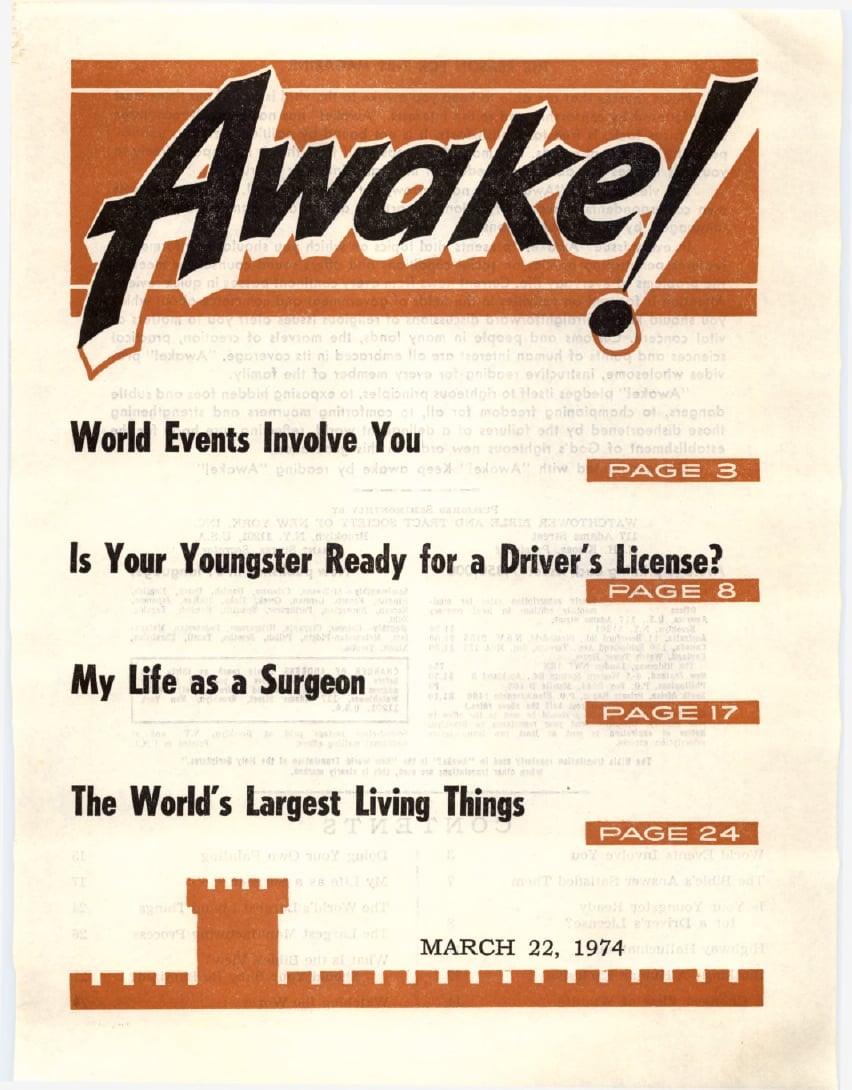
Awake! — March 22, 1974
Source: jw.org
Contents
World Events Involve You
The Bible’s Answer Satisfied Them
Is Your Youngster Ready for a Driver’s License?
Highway Hallucinations
Blushing—A Human Exclusive
A Changed View of Wildlife
Doing Your Own Painting
My Life as a Surgeon
The World’s Largest Living Things
The Largest Manufacturing Process
Should Your Baby Be Baptized?
Watching the World
How Was This Huge Mammoth Preserved?
A Highly Important Event in History
World Events Involve You
World Events Involve You
LOOK closely at the news headlines accompanying this article. The conditions that they reflect are probably not new to you, but the global extent of some of these problems and the critical proportions that they have reached may come as a surprise. In one way or another these crises are a source of personal concern for everyone living on earth.
However, because some persons are not directly and immediately affected by these world events, they may feel that some have been exaggerated and made to appear worse than they really are. But are the problems represented by these headlines really exaggerated?
How Big Are the Problems?
Before answering, we ought to take into consideration that not merely one news reporter, but knowledgeable people in many parts of the earth are saying essentially the same thing. The testimony of so many men who are prominent in their various fields gives strong indication that the problems are real, not merely imagined, does it not?
But just as convincing as someone else’s testimony is one’s own experience in life. Has your life to some extent been changed as a result of these critical situations? If such is the case, this no doubt affects how you view what is being said about the same matters on a worldwide scale.
Millions of persons know, firsthand, that when a headline says “World Starvation Is Feared” it is not just scare talk. Hunger has already become a way of life for them. Tens of thousands have recently died in Africa and Asia from famine conditions. Those whose business it is to deal with the food problem say that there is the possibility of greater disaster in the coming months. The extent to which food shortages will eventually afflict mankind or even one section of the earth, of course, remains to be seen.
Yet there is no reason for those who may live in areas currently unaffected by famine to doubt that serious shortages could occur. Ever-increasing food prices have already convinced them that something is wrong. Food supplies are limited; that is one reason why prices are driven upward.
So, too, with the energy crisis. It started with events that took place perhaps thousands of miles from where most of those affected live. Some persons doubted that a fuel shortage was real; it seemed far off, distant to them. But when they went to buy gasoline for their car or heating oil for their home, unlimited supplies were no longer available. Yes, they personally came to feel the reality of the energy crisis, just as did hundreds of millions of others.
The energy crisis, in turn, has contributed to many other shortages, some of which no doubt presently affect you. Men who are able to view the fuel situation and related problems on an international level say, as one headline here reports: “We Are Running Out of Everything.” If that is true, then the headlines warning of the danger of economic collapse do not seem farfetched, do they? These other events make the possibility quite real.
In the light of all of this, the headline that says “The World Living in Fear” is not hard to understand. Fear is a controlling factor in decisions made by individuals, institutions and nations. They fear that when favor is shown in one direction, animosity will come from another. As serious problems multiply, understandably they fear what the future holds.
There is another major situation that affects almost everyone in some way. This is the morality problem.
The Moral Crisis and You
The moral situation is evident in a variety of ways. Outstandingly, violent crime is on the upswing; an Australian newspaper says: “It’s Not Safe Anywhere.” Acts of terrorism, rape and murder have become commonplace in large cities of the world. A large percentage of these crimes are related to drugs; addicts steal to have money to support their drug habit. The safety of everyone is affected.
Sexual immorality skyrockets. Adultery and fornication are glorified on the movie screen and in the theater. Homosexuality is now out in the open. These things cause concern to parents, and may affect even the stability of their own marital relationship. Not surprisingly, the family is said to be “An Institution in Crisis.”
Do these developments affect you? ‘Those things may be problems in the big cities of America, but not where I live in a suburb,’ some may say, or, ‘not in my European village,’ or, ‘not on my South Pacific island.’ But is that entirely the case?
Murder, rape and mugging may not yet be everyday occurrences in such areas. But who can overlook more subtle lawlessness, like “white-collar” stealing and customer shoplifting? These practices abound, not just in big American cities, but elsewhere.
Yet, more importantly, are not the attitudes leading to such crimes—yes, leading even to murder—abundantly evident everywhere? Consider: Are most people, wherever they live, genuinely concerned with their neighbor’s well-being? Or is there apathy about what happens to others? Is there a desire for “easy money”? Is there even outright hatred of others? You know the answers to such questions.
Further, persons in some smaller or out-of-the-way communities may make many outward pretensions about being moral and upright individuals. But if you live there too, then you know many of these same people personally. And you know what they really are. Do they shun fornication, adultery and sexual perversion? Are not their claims to be moral and upright, therefore, often hypocritical?
Basically, regardless of where people live, most of them are essentially the same. The seeds of immorality, distrust and hatred are everywhere. Thinking people see this fact of life and realize that the morals problem is real.
Institutions Wane
The world’s religions are involved. The facts show that church members as well as others practice these things. Obviously such religion is not really teaching its members true godliness and morality. No wonder, therefore, that reports from all over the world agree with the headline reading.” “Clergy’s Stature Crumbling.” Think about your own area: Do people readily accept a religious leader’s words as undeniably truthful, as they once did? Do the majority of people even bother to go to religious services to hear him speak? More and more people notice a growing lack of respect for the clergy in their own area.
Of course, it is not just the clergy’s influence that is waning, but that of prominent men in general. Governmental and political institutions that have held the confidence of men for generations are now regularly accused of corruption and gross mismanagement. Fewer persons seem to trust governments or their representatives.
Have you not noticed this attitude among people? Is it not the topic of frequent conversations by your fellow workmen, neighbors and relatives? Yes, people all around you no doubt express this lack of confidence. It is as reported by the New York Times: “Public Trust in Institutions Found to Decline.”
The Meaning of World Events Involves You
Take all these events together, and what do they mean? Most people reach a conclusion like that found at the bottom of our page of news headlines: ‘Civilization Is on Its Last Legs.’ For most people the international picture that the facts paint is a bleak one. Is any other proper conclusion even possible?
Yes. Outstandingly, today’s world events give you basis for firmly believing the Bible. How can that be said?
Many of the major problems facing mankind today, and which most persons feel in some way, were spelled out in the Bible hundreds of years ago. For instance, Jesus Christ gave a sign, recorded in Luke chapter 21, in which he foretold a certain series of events that would mark the conclusion of the system of things. Why not get out your own Bible and read that chapter. At the same time read 2 Timothy 3:1-5. Compare for yourself what those scriptures say with what is actually happening in the world right now.
Do you see what those scriptures are saying? They point to the time in which we live as the “last days,” the time when “deliverance is getting near.” What is written there is coming true in our day.
The same Word of God also tells us that God will wipe away this present worldwide wicked system. A paradise earth ruled over by God’s kingdom, a stable, lasting government, will follow. The current world events, which so often have involved you in an unfavorable way, will be gone. No more will there be shortages of the essentials of life; earth will yield abundantly. More importantly, the people then living will be those who can be trusted, men who truly love God and one another. (Ps. 67:6; Matt. 24:21, 22; Rev. 21:1-4) Would you like to live at that time?
If you would, the first action to take is to learn what the Bible says is required of you. Jehovah’s witnesses will be happy to discuss these matters with you and your family.
[Picture on page 5]
RECENT NEWS REPORTS
World Starvation Is Feared
THE EVENING BULLETIN, November 22, 1973
INTERNATIONAL FOOD RATIONING WARNING
SYDNEY, AUSTRALIA, SUN, November 20, 1973
Food Shortage Similar to Fuel Crisis Forecast
LOS ANGELES TIMES, December 10, 1973
The Times Diary
We are running out of everything
THE TIMES (London), December 3, 1973
Selfish Leaders, Selfish Nations
The World Living in Fear
SAN FRANCISCO CHRONICLE, December 26, 1973
Financial Doomsday Near Author Sure; Blames Credit
PHILADELPHIA INQUIRER, July 1, 1973
The American family: An institution in crisis
LONG ISLAND PRESS, October 7, 1973
Homosexual Freedom Celebrated
A Sunny, Gay Parade in S.F.
SAN FRANCISCO CHRONICLE, June 25, 1973
It’s not safe anywhere
MELBOURNE AGE (Australia), September 8, 1973
White-collar crime: A growing menace
OCCUPATIONAL HAZARDS, October 1973
WHAT’S HAPPENED TO MORALITY IN AMERICA
U.S. NEWS & WORLD REPORT, March 26, 1973
Murder Increases Dramatically in Area
THE EXPRESS (Easton), December 15, 1973
Infanticide in Japan: Sign of the Time?
THE NEW YORK TIMES, December 8, 1973
Illicit Drug Trade on the Rise Again
NEW YORK POST, October 23, 1973
Child Alcoholism Problem Grows; AA Units Helping 10-Year-Olds
LOS ANGELES TIMES, December 7, 1973
Public Trust in Istitutions Found to Decline
THE NEW YORK TIMES, December 3, 1973
Clergy’s Stature Crumbling
STAR-NEWS (Pasadena), May 21, 1972
Our civilization on its last legs, says U.K.critic
THE TORONTO STAR, November 4, 1972
The Bible’s Answer Satisfied Them
The Bible’s Answer Satisfied Them
MANY persons today are deeply distressed about world conditions. They just cannot understand why things are the way they are. Some who at one time felt this way finally learned the Bible’s answers and found them to be most satisfying.
A man from Virginia relates his experience:
“I hated this system of things and wanted to withdraw from it. The grandest hope imaginable was to live on a farm with my family and just be left alone by the ‘outside world.’ Raise our own food, make our own clothes, be independent from the systems of the world—that was my wish.” Yet he realized that this would really not be the answer to his feeling of hopelessness.
“Marijuana and other drugs,” he continues, “seemed to be a relief from this hopelessness. One night, while under the influence of a drug, I stayed awake until dawn fighting to stay alive. I felt that I was dying. This made me realize how precious life is.
“A few weeks later, I decided that this frightening experience was due to my own unpreparedness, and not the fault of the drug. So I began to study different drug-oriented books. The next time I was going to get all the answers that I had asked: Who is God? What is supposed to be my relationship to him? This time I was going to ‘see’ or experience God. Also, to further prepare myself, I began reading the Bible. Of course, I didn’t understand it, but the most important thing that I did was to pray to God for his help in my search for him.
“In a few days a new electrician came to work at the company where I was employed, and I became his helper. When I learned that he was one of Jehovah’s witnesses and was considered to be a minister, I began deluging him with questions. He patiently tried to answer my questions, but, because of their nature, he told me that I needed to ‘learn to add and subtract before I could learn the multiplication tables.’”
This Witness thereafter arranged for a Witness couple to study the Bible with this man and his family. He now rejoices in having come to know that God’s kingdom by Christ will bring lasting relief to mankind. Regarding the change this brought to his life, he says: “After learning the truth, drugs were no longer used in our home. I now realize that Jehovah is all-wise and all-loving, and that he does answer the earnest prayer of searching people.”
A man from another part of the United States tells how he found satisfying answers to his questions:
“I believed in God but, because of the hypocrisy and materialism in my church and others, I didn’t think any of them represented God. I had tried to read the Bible. But the archaic language in the version that I used made it difficult to read, let alone understand.
“One night while walking to the local hangout, I was picked up by a couple of my friends who were driving by. I asked if they were doing anything. They said that later that night they were going over to Tom’s house to talk about the Bible. Tom was one of Jehovah’s witnesses. I had known him from a few years before and had been meaning to get in touch with him to find out what the Witnesses believed. When my friends invited me to come along, I readily accepted.
“We got to Tom’s house and we talked. My two main questions about God were: ‘What is his purpose for man? And why did he let things get so bad?’ Tom gave me a Bible and the book The Truth That Leads to Eternal Life and we set up a Bible study. I read the book by the following week. I was really glad finally to get answers that made sense.”
Shortly thereafter this man attended an assembly of Jehovah’s witnesses. He observes: “I was amazed at the total lack of prejudice, and at the orderliness, friendliness and love demonstrated by those in attendance. I was firmly convinced that this was God’s truth.”
If you, too, are still searching for an answer to the meaning of world conditions and God’s purpose for mankind, Jehovah’s witnesses will be happy to help you to find the Bible’s answers. We are confident that you, like others, will find these to be truly satisfying.
Is Your Youngster Ready for a Driver’s License?
Is Your Youngster Ready for a Driver’s License?
YOUNGSTERS often cannot wait to get a driver’s license. It may be one of their chief ambitions. And more and more young people today are realizing their ambition.
In 1972 there were 12,200,000 licensed teen-age drivers in the United States. Of these, 4,255,000 were under eighteen. That means that more than one driver in every ten is a teenager, and nearly four out of every one hundred drivers are seventeen years old or younger.
Perhaps your teen-age son or daughter has a driver’s license, or may want one. But is the youngster really prepared for the responsibility that comes with driving an automobile? Consider why that is such an important question.
In just four countries—the United States, France, Germany and Japan—over 100,000 persons are killed in traffic accidents each year, and more than six and a half million are injured. The dead, if laid head to toe, would stretch about 115 miles! And the injured would reach some 7,000 miles—over a quarter of the way around the earth!
Yes, more drivers are having accidents than ever before. ‘But what,’ you may ask, ‘has this to do with my youngster being ready for a driver’s license?’ A great deal.
Youth’s Driving Record
Youngsters are chiefly responsible for the growing slaughter on the roads. Last summer’s Journal of American Insurance explained: “The increase in accident rates can be traced to the upsurge in young drivers.” It added:
“Several years’ experience has shown that the under 25 driver—particularly the male in his late teens and early twenties—has more than twice as many accidents as drivers in older age groups, averaging 40 involvements per 100 drivers for each year.”
Just think: Two out of every five young drivers will have an automobile accident this year! Pointing to the particularly poor driving record of young males, Dr. Stanley H. Schuman, member of a research team of doctors and scientists, said: “Although young male drivers amount to only one-eighth of all registered drivers, they are responsible for a third of all fatal accidents.”
Proportionately, just how many more young people does this mean are dying on the roads? Traffic Safety, a National Safety Council publication, answers:
“The National Transportation Safety Board has released an accident prevention study showing that thousands more 15-to-24-year-old drivers are dying on American highways each year than their proportional share of all drivers. . . .
“Among 17,700 young fatalities in 1969, there were 7,400 more youthful driver deaths than would have occurred if their fatality rate had been the same as that of drivers 25 and older, the safety board found. This 7,400 ‘excess loss’ was greater by one-third than the combined 1969 fatality total in aviation, marine, railroad, pipeline and grade crossing accidents. The disproportionate loss involves ‘predominantly the young male,’ the board said.”
The loss of young life in traffic accidents is tragic. Just consider: In 1966, near the height of the Vietnam war, 12,200 young male drivers were killed—more than double the number of United States servicemen killed in Vietnam that year!
It would be bad enough if young drivers were only killing themselves, but they are killing others as well. Passengers riding with them, occupants of other cars and pedestrians are all dying by the thousands each year, struck down by youngsters behind the wheel of an automobile. Could your youngster also be a serious threat to the life and safety of others?
Only a Minority Responsible?
Perhaps you feel that only a small minority of young people are responsible for this horrendous slaughter. Is this true? Do a few give a bad reputation to the rest?
Well, consider these statistics: About 40 out of every 100 drivers under the age of twenty-five are involved in auto accidents each year. That is not a small minority. Thus, as soon as a teen-ager is added as a family car driver, insurance rates may jump a great deal.
But why are young drivers involved in so many accidents?
Reasons for Poor Record
Lack of driving experience is the principal reason, according to most driver-education specialists. In an effort to provide needed experience, a driving-education course is offered by over 80 percent of the high schools in the United States.
However, perhaps an even more important reason for youth’s poor driving record is the very nature of young people. They are prone to be exuberant and thoughtless, to lack judgment and to dare and be dared. Stating the matter bluntly, driving authority Paul W. Kearney wrote of young drivers: “Their judgment is juvenile—and their highway sportsmanship is on a par with that of a couple of infants fighting for a rattle in a crib!”
Behind the wheel of an automobile such youthful traits often prove disastrous. Thus on his first night out alone with a car, a seventeen-year-old high school football star ran down a mother and child in a crosswalk in a jackrabbit start. The boy’s athletic coach offered this explanation:
“If they had asked me, I could have told them that Harvey wasn’t ready emotionally to drive. He has a bad temper in the locker room and needles other players. He is a flashy performer and carries a chip on his shoulder. His mental attitude showed itself in his driving as soon as he was unsupervised. The boy just had to be first away when that light turned green.”
It seems true, as Dr. Mathew Ross, a psychiatry instructor, noted: “The auto is almost an extension of our personality and the way we drive sums us up perfectly.” Therefore the fact should not be ignored: A youth usually has the personality traits characteristic of a youth, traits that often contribute to auto accidents.
Parents need to recognize this fact, and seriously consider: Is my youngster really ready for a driver’s license? Otherwise, are they not at least partially responsible when their youngsters become involved in traffic accidents that cause deaths and injuries?
‘But what am I to do?’ you may ask. ‘Should I refuse my child a driver’s license?’
Parental Responsibility
That is a decision you will have to make. Many think it is the best answer, and recommend that laws be passed forbidding young people from driving. But others believe there are better answers, much fairer to youths. They argue that raising the driving age will not lessen the number of beginners on the road who lack driving experience. And it is this lack of experience that is considered a major cause of auto accidents, regardless of the age at which one starts learning to drive.
So perhaps it is your decision to allow your child to learn to drive while he is quite young. Do not conclude, however, that you have fulfilled your responsibility by simply having him take the driver’s education course at school. These are generally inadequate. In fact, studies in Mississippi and in California show a higher accident rate among school-trained teen-agers than among other teen-age drivers! Why do school programs fail?
Basically, it is felt, because they do not give the young driver practical experience. Only a little time is spent actually driving, and this at slow speeds on lightly traveled streets. Few, if any, emergency situations are faced. “Because of this,” a spokesman for a large auto insurer explained, “young drivers are not ready to face many emergency situations such as blowouts and skids. Too often the youthful driver’s first experience with an emergency situation is the real thing, and too often he will never get a second chance.”
For this reason Dr. Amos E. Neyhart, the man who set up the first high-school driving course in 1933, says: “At least 12 hours should be spent by each student behind the wheel. The student driver must be given simulation experience in skidding, brake failure, tire blowouts, running off the road, and so on. We’ve been teaching manipulative skills but not enough accident-prevention skills.”
So, as a parent, you should see that your youngster receives adequate driving experience. Let him practice while you are with him. Give him practical experience at turnpike speeds. Also, it is wise to teach him to handle skids, estimated to be a major contributing factor in one of every four fatal auto accidents. Perhaps you can find a large, unoccupied, iced-over parking lot and obtain permission to use it to practice skidding and countersteering. Reading about skid control will never educate as well as will experiencing the real thing.
Nor does your responsibility end with simply seeing that your youngster can expertly handle a car, even in emergency situations. Inculcating a proper mental attitude is equally important, if not even more so.
Instilling a Sober, Mature Attitude
Your youngster may be a teen-ager, but when he is behind the wheel of a car it is essential that he be a stable person who values life and property. It is your responsibility to see that he is. Endeavor to develop in him courtesy, respect for law, carefulness and consideration for the rights of others.
A vital way of doing so is by providing a good example in the way you drive. Emphasizing the importance of this, Dr. Bruno Bettelheim, a noted psychoanalyst, said: “Even if a parent breaks a traffic law only occasionally, it may be enough to destroy a child’s belief that he should obey all rules at all times. An occasional speeding violation by a parent, or impatient cheating at the stoplight, makes a youngster imagine that to be ‘grown up’ means one can break the law and get away with it.”
It is vital, too, to teach your youngster to think while he drives, always to be analyzing the traffic situation. One parent makes a kind of game out of this, explaining:
“My son . . . sits beside me in the front seat of the car, looks ahead, and picks out possible dangers. For example, there is a line of parked cars ahead with a driver seated at the wheel of one car. What should the driver of our car do if the other driver pulls out suddenly or opens his car door on the wrong side? There’s a hidden driveway where a car may come out unexpectedly. How do we prepare to meet this emergency? Up ahead is a blind curve. How do we proceed?”
Some may think that young people have such quick reflexes that they can, at the last moment, take accident-preventing action. But the fact is, being able to get one’s foot to the brake a fraction of a second faster than the next person is much less important in avoiding accidents than driving carefully enough so that such activity is unnecessary.
Yet another way to impress upon your youngster the importance of safe driving is to allow him to see and hear firsthand what happens to traffic violators. If you get in touch with the local court, the judge may be glad to have you come down to listen. He may even arrange to hear a series of cases that will be especially instructive and impressive for teen-agers.
Also effective is to have youths visit the emergency ward of a hospital and watch traffic-accident cases as they are brought in. This can certainly make a lasting impression that emphasizes the importance of safe driving! By inquiring and explaining the reason for it, you may receive permission to visit such an emergency ward.
It is not an exaggeration to say that the future of your youngster is dependent, to a surprising degree, upon your proper supervision of his use of the car. You simply cannot close your eyes to the danger when he is behind the wheel. It is real! So do all you can to make your youngster a safe driver. His life, and that of others, may depend on it.
Highway Hallucinations
Highway Hallucinations
HALLUCINATIONS brought about by driver fatigue are apparently causing many mysterious accidents at night, authorities report. Illustrating the possible effect of driver fatigue is the case of a San Francisco surgeon who was driving to his suburban home after performing an operation that lasted till 5 a.m. Suddenly the doctor saw before him a huge office building. The doctor brought his car to a screeching halt—at what he felt was a few inches from the lobby level of a skyscraper. But when he got out, there was no building at all, only a virtually deserted highway.
“I was immediately aware, of course, that I had been deceived by highway hypnosis,” said the doctor afterward. “The long drive, the late hour and my weariness had set the stage for a mirage. My need for sleep had triggered the hallucination. I could have been killed, or killed the occupants of another car, trying to avoid a building that wasn’t there.”
Because of the danger of such highway hallucinations, some authorities have proposed putting up signs on monotonous stretches of highway to warn drivers: “Danger: Hallucinations Occur Here When You Are Tired!”
But why may a fatigued driver experience hallucinations? The Harvard School of Public Health has stated this possibility: “Subconsciously, an extremely tired driver wants to stop and rest, but his conscious mind makes him continue at the wheel for one reason or another. It is his imagination trying to get him to stop that creates such roadblocks as spectral houses, buildings, windmills, walls and animals. . . . If a driver is really fatigued, he is likely to experience a hallucination. It is his mind’s way of compelling him to stop driving now.”
Blushing—A Human Exclusive
Blushing—A Human Exclusive
THE English author Rudyard Kipling once wrote a poem in which he has a seventeen-year-old girl plaintively saying the following words:
“I cannot check my girlish blush,
My colour comes and goes.
I redden to my finger tips
And sometimes to my nose.”
In those lines the poet accurately indicated several basic characteristics of blushing.
Generally, authors speak favorably of blushing. Thus some of them have written: “A blush is the color of virtue.” “A blush is a sign that nature hangs out, to show where chastity and honor dwell.” “Better a blush in the face than a blot on the heart.” However, a few others, perhaps somewhat cynical, say: “Whoever blushes is already guilty; true innocence is ashamed of nothing.” “Men blush less for their crimes, than for their weaknesses and vanity.” And a modern psychologist theorizes that persons blush because they want to communicate that what others think of them is not actually so.
Most likely you have blushed on more than one occasion or may even be among those who blush quite readily. Why do you blush? Is it a good or a bad thing?
Characteristics of Blushing
A blush is a sudden reddening of the face, ears and neck. It is often accompanied with a flaccid condition of the cheek muscles and a downcast expression of the eyes, in which the glances of others are avoided. At times there may be a turning of the body as if wanting to conceal oneself. And more likely than not, a blush will be accompanied with a glowing or tingling sensation over the whole body. There may even be a tremor of the muscles and a partial paralysis of the limbs. At times there is a change in the sound of the voice and even tears may come to the eyes of the one blushing, or one may suddenly begin to perspire. And, in some cases, a person blushing has a palpitation of the heart and a feeling of fear or panic.
All races and nationalities blush, although in the dark-skinned races the blushing is not as obvious. Albinos, those with little if any pigment at all in their skin, also blush; in fact, more readily than do their fellows of their own race.
Blushing is most prevalent in the young, the innocent and the unsophisticated. With the advancing years and with one’s becoming worldly-wise it often gradually ceases to manifest itself. However, what another does may cause you to blush if that one should happen to be a close friend or relative. And their blushing may also cause you to blush. Though some question it, it does seem that women blush more readily than do men, at least some women do. But it is quite likely that women today blush less readily than their grandmothers did.
What causes blushing? It has been described as “a mental disorder which begins with overlapping mental attitudes, producing embarrassment and inability to function.” It comes and goes almost instantaneously and is an involuntary act. A person can be made to laugh by being tickled, but there is no physical means by which one can cause another person to blush. Neither can blushing be termed a reflex action. Laughter and merriment can be feigned by actors on a stage but not a blush. Even as it cannot be brought forth at will, the will cannot prevent its appearance. In fact, to try to do so may cause one to blush all the more.
Strange as it may seem, as well as apparently contradicting some modern theories about blushing, the fact is that blind persons blush, even more readily than those enjoying sight. Deaf persons also blush. And most remarkable of all is the fact that even those blind and deaf blush, as did Laura Bridgman, who lost both her sight and hearing at the age of two. And of Helen Keller, who even earlier in life became both deaf and blind, we are told: “Her blushing can have no relation to looks or words of disapproval, connected either with her appearance or her conduct; yet she blushes just as girls do who see and hear, from the same causes, over the same parts of the body, and with the same experience of tingling.” This report accords with the findings of some that even when alone a person may blush when visualizing himself in a situation in which he would ordinarily blush or when he happens to be reading something that embarrasses him.
One artist, we are told, nearly drove himself mad trying to portray the charm of a blush on his canvas. To him it was “the most extraordinary incident in a woman’s face.” But all he could do was paint rosy-cheeked maidens.
Let it be noted that a blush is not to be confused with a flushing of the face. A hot flush may be due to some physical condition, such as the menopause of women, or it may be the flush of rage.
The Mechanism of Blushing
Blushing might be said to be an example of the psychosomatic principle at work, namely, that the mind, the psyche, and the body, the soma, are one; what affects one affects the other. A confused state of mind, as it were, acts upon the sympathetic nervous system. It, in turn, stimulates the vasodilators, causing the peripheral capillaries to expand. The result is that more blood flows to the surface of the face and neck, resulting in a reddening of the skin.
What accounts for this mechanism? Why do persons blush? What purpose does it serve?
A Human Exclusive
Blushing is a human exclusive. The brute creation, the animals, do not blush. They may at times display emotional characteristics similar to those of man, such as rage, jealousy, affection, playfulness, and so forth. But they do not blush. “Blushing is the most peculiar and most human of all emotions,” says Charles Darwin in his book The Expression of the Emotions in Man and Animals.
Why is blushing a human exclusive? Because it involves conceptual thinking and/or the moral sense, neither of which animals have. Animals cannot conceive of either the fitness or the lack of fitness of things; neither can they judge between right and wrong. They are “without understanding,” as the Bible puts it. Idiots rarely blush. And very small children, those who are still without understanding, do not blush.—Ps. 32:9.
Thus a young woman may blush when something indecent happens to her or she hears or sees something that seems immodest. It is as if her purity and innocence were violated. Then, again, a person may blush because of an awkward situation or for having committed some foolish blunder. Likewise, a modest or shy person may blush when complimented or when singled out for high praise that suddenly makes him feel unduly conspicuous.
Why do persons blush under such circumstances? Those who hold that man is the product of evolution have no answer. How has man acquired this characteristic if he evolved from the brute creation, since none of them blush?
If we recognize that man was created by God and in the image of God and given a moral sense, a conscience, then we can see at least one practical purpose being served by man’s involuntarily blushing. As one writer, living more than a century ago, put it, blushing serves as a guardian of the conscience, which tells man that he must not deceive. When he violates what he knows or thinks is right, he will blush; it will cause him to feel shame.
In addition to this basic cause for blushing, persons may blush because of having made some mistake, violating the fitness of things in another respect. It is natural to want to be well thought of, and when one makes an awkward social error or faux pas, embarrassment may cause one to blush. This would help to explain why most, though not all persons, blush less readily with the passing of the years. The nervous system becomes less responsive to the emotions and, at the same time, a person’s conscience may become less responsive to moral values.
Blushing as Mentioned in the Bible
While not all Bible translations use the term “to blush” or “blushing,” they all more or less describe the effect. Thus, The Jerusalem Bible quotes Ezra as saying: “My God, I am ashamed, I blush to lift my face to you, my God. For our crimes have increased, until they are higher than our heads.” (Ezra 9:6) And the Revised Standard Version at Jeremiah 6:15 reads: “Were they ashamed when they committed abomination? No, they were not at all ashamed; they did not know how to blush.”
No question about it, blushing is a human characteristic. It also gives evidence that man was created by a just, wise and loving Maker. Blushing is one of his gifts to man to help him to respond to his conscience, for his own happiness and well-being.
A Changed View of Wildlife
A Changed View of Wildlife
● “One of the best rough-and-ready naturalists in the Canadian north woods is a former trapper called Long Joe,” reports the volume Marvels & Mysteries of Our Animal World. Why did he suddenly end his trapping activity? “One day a she-bear was caught in Long Joe’s trap,” says the account. “When he got to the trap, the bear’s mate was there. The big, shaggy brute had his arms around her, hugging her and sobbing . . . Long Joe has never trapped another living thing.”
Doing Your Own Painting
Doing Your Own Painting
IN THESE days of rising costs, many people are looking for ways to economize. It is not genuine economy to neglect upkeep and let your property get run down. You might save money by doing some of the work yourself. For example, have you thought about doing some of your own painting? It is not hard. Furthermore, there is real satisfaction in doing things with your own hands, especially when the results are good.
Suppose you want to paint the rooms of your house. What would you need? Paint, of course; also a roller and a roller pan and a good paintbrush about two and a half inches in width (recommended for “do-it-yourself” painters). You will need drop cloths too, for covering the furniture and areas not to be painted. Old sheets will do.
Painting rooms is largely a matter of applying color to the walls. Of course, colors have an emotional effect as well as a practical value. Red and orange are lively colors, but they also tend to produce tension and so should be used rather sparingly. Yellow, which suggests sunlight, is cheerful. Light green reminds one of the outdoors; it is restful and quieting. Light blue is soothing and cool; it calls to mind clear blue skies and the waters of rivers and lakes. Light colors make a room look bigger, but darker shades make it look smaller. It is good to take these factors into account. Of course, when choosing the colors for an individual room, you may also want to consider the colors of your drapes, the upholstered furniture and the rug.
Having decided on your colors, what kind of paint should you use? While there are many different kinds, of interest to most “do-it-yourself” painters are just two: the oil-based or alkyd (a synthetic resin) and the water-based latex wall paint. Although it is called “latex,” it has no rubber in it but is simply a milky-white emulsion. Latex wall paint has much to recommend it for interior painting. It is easier to apply, easier to clean up afterward and usually is far more economical than the alkyd types of paint.
Latex flat wall paint is ideal for living rooms, dining rooms and bedrooms. In recent years manufacturers have also developed a semigloss latex paint, which is replacing the semigloss oil or alkyd paints. Semigloss paint is to be preferred for kitchens, bathrooms, windowsills and frames; it can stand more scrubbing.
How much paint will you need? About a gallon for every 400 to 500 square feet that you want to cover with one coat.
Before starting to paint, protect with drop cloths or newspapers all surfaces that you will not paint. Also, it may be practical either to move out the furniture or to move it to the center of the room so as to make all the walls accessible.
Now check the surface to be painted. If it is dry, smooth but not glossy, has no cracks or holes in it, has no loose paint, dust, dirt, oil or grease on it, then you can proceed at once. But what should you do if there are defects? Is there loose paint? Scrape it off. Then all such places, as well as holes and cracks, will need to be smoothed out with a puttylike preparation called “Spackle.” (Buy it ready mixed.) Since Spackle often shrinks when it dries, you may need to apply a second coat in some spots. When that dries, sand it smooth and then apply a primer on these areas so that they will not show through when you paint over them. Is the surface glossy? Then you will need to sand it before painting. Remember, make sure the wall is free from dust, dirt, oil, grease and soap before you start to paint.
To apply the paint you will need a seven-inch, or, preferably, a nine-inch, roller with a cage-type roller frame and a roller pan. The roller should have a core made of firm materials, such as fiber phenolic, not merely cardboard. The roller sleeve or cover should be made of good-quality material, such as lonel or dynel nylon or lamb’s wool. The length of its nap is governed by the effect you want. A three-eighths-inch nap may be good for the average wall, a one-fourth-inch nap for a very smooth surface, and a one-half-inch nap for a very rough one. (Of course, the longer the nap the more paint the roller can hold.) Either before or after applying the paint with the roller, use the brush to paint the corners and other areas of the room that need special attention.
Begin by rolling the roller in the paint pan until it is uniformly covered with paint and then get rid of the excess paint by rolling the roller on the pan’s grid. Paint the room from the top down, starting with the ceiling. But, to minimize dripping when painting the walls, make the first stroke an upward one. Start away from a finished area and then work toward it; then it will not be too apparent where you overlap. For best results, avoid applying the roller with too much paint, and avoid rolling it too long, as if to get every bit of paint out of it.
You can make things a lot easier for yourself by using a four- to six-foot handle on the roller for much of your painting. With such a handle you can work a roller with both hands, you will not need a stepladder when painting the ceiling or upper parts of the walls and you will not need to stoop if you want to paint the floor.
After completing the large areas, paint doorframes, windowsills and frames with a brush. Make sure the brush is made of synthetic material if you are using latex paint. A natural bristle brush is ideal for oil or alkyd paints, but when used with latex paint it loses its shape, as its bristles absorb water.
It may be that you will want to apply two coats. For example, if you are putting a light color on top of a dark color, you will need two coats of paint so that the dark color does not show through. Likewise, where the surface is new, whether wood, plasterboard or plaster, you may need a first coat of an appropriate primer and a finishing coat. In some cases two coats of paint will serve.
When you have finished painting for the day, what will you do? It is wise to remove all paint spots before they dry too hard. Also, clean the roller and brush. If you painted with latex, then thoroughly wash both the roller and the brush with soap and water. But if you painted with an oil or alkyd paint, you will need to clean the roller and the brush with a paint thinner such as turpentine.
As you do your work, exercise care. If you are not in too much of a hurry, you should be able to do a presentable job. And not only will you save on expenses but, more importantly, you will have the satisfaction of accomplishment, having something beautiful and enduring to show for your efforts. For, as has well been said, painting involves “the hand, the mind and the heart.”
My Life as a Surgeon
My Life as a Surgeon
THE career of surgery that I chose is one the oldest professions of man. Ancient Egyptian and Babylonian records tell of surgery as being performed as far back as four thousand years. And some archaeological finds indicate that surgery is even older than that.
In fact, I like to think that surgery is as old as man himself, for the Bible tells us at Genesis 2:21, 22: “God had a deep sleep fall upon the man and, while he was sleeping, he took one of his ribs and then closed up the flesh over its place. And Jehovah God proceeded to build the rib that he had taken from the man into a woman and to bring her to the man.” It seems noteworthy that God anesthetized Adam before operating on him, and afterward ‘sewed up’ the incision. And man-performed minor surgery goes back at least to the time of Abraham. On God’s command he had himself and all the males of his household circumcised.—Gen. 17:10-14, 22-27.
A leading American professor of surgery once stated: “The surgeon’s training is the most rigorous and demanding of all professions or occupations and his responsibilities are the heaviest.” What, then, caused me to choose this profession? My upbringing and the fact that the work promised to be as satisfying as it was challenging.
My father was a country doctor. He lived in a small town in Oklahoma and served the medical needs of farmers and others for many miles around. There were five boys in our family, and I was the eldest.
In his early days my father used a horse and buggy to make sick calls in the country. By the time he was using a Model-T Ford to visit his patients, I was accompanying him. In fact, even before I was twelve years old I was his part-time chauffeur, as well as his medical assistant, as it were.
As the years went by I was able to help him more and more in those days of kitchen-table operations. One memorable case was that of a farmer who had been kicked in the head by his mule and nearly scalped. His surgery was performed under a tree by my father, with me as his fascinated assistant. At times when a patient needed an anesthetic I was assigned to give him a few whiffs of chloroform while dad performed the operation. Today, of course, a number of better anesthetics are employed and operations are seldom done under trees.
Becoming a Surgeon
Upon completing high school I went to college. I chose what seemed to me to be the natural course to take, that of becoming a doctor. My father had never urged me to take up his profession, but he did not need to. His example, his kindness and compassionate goodness and helpfulness, as well as the great respect in which he was held, made me want to become a doctor also.
I started out with a two-year premedical basic science course at the University of Oklahoma and then continued with the regular four-year course at that university’s medical school. Studying the various medical subjects such as anatomy, physiology, biochemistry and histology was hard work, but I enjoyed it. Halfway through this school I received my bachelor of science degree, and from then on the course also included bedside experience with hospital patients and delivering babies at the homes of women too poor to afford regular hospital care.
Youthful frivolity surfaced at times despite the seriousness of medical education. After a home delivery of her baby, a new mother once heard another student and me use the word “placenta.” It was a nice-sounding word to her so she suggested it as a name for her baby girl. Without any explanation to her, we completed the official birth certificate accordingly. Our professors and the authorities soon had us “on the carpet,” however, and we had to apologize to the mother and help her think of another more acceptable name than “Placenta.”
After graduating I took a one-year internship at the Baltimore, Maryland, City Hospital. During this year I rotated from one speciality to another, such as general medicine, pediatrics, surgery, obstetrics and gynecology and psychiatry. This practical experience helped me to see just what was involved in these various fields. By the end of the year I chose surgery; to me it seemed to be the most interesting and challenging. From there I went to a hospital in a small town in Tennessee to continue my surgical training but shortly came down with tuberculosis, which I had probably contracted from tuberculous patients I had cared for in Baltimore. This sent me to a sanitarium for a few months and then back home to Oklahoma, until I recovered about a year later.
Then I was accepted as a surgical resident in the Santa Barbara, California, County Hospital. After about a year I took a position as a surgical associate with a group of some twenty-four physicians in private practice. Later I took a two-year leave of absence so that I could receive further training with Professor Owen H. Wangensteen, one of America’s foremost surgeons, at the University of Minnesota Hospitals. Finally, after some fourteen years of studying and training in premedical and medical schools, and specialized hospital training, along with practical experience, I realized my ambition to be a full-fledged general surgeon.
But then something happened that was to change both my outlook on life and my future as a surgeon. Closely related to it was the subject of blood transfusion and the issue made of it by the Christian witnesses of Jehovah.
The Blood-Transfusion Issue
My early years were influenced not only by my father as a physician; both my parents were also Jehovah’s witnesses—the only ones for many miles around. I grew up with great respect for the Bible, but with little real knowledge of it. This was no doubt partly due to the fact that my father was so occupied with his medical work. Also, the familiar family Bible study program featured by Jehovah’s witnesses was not emphasized then as it is now. So I left home for college, a country boy determined to be a doctor, strongly influenced by Scriptural principles that I did not really appreciate until several years later.
During the years I was in medical school, I saw my first blood transfusions—crude donor-to-patient procedures, somewhat heroic and usually unsuccessful. But World War II, with its terrible blood loss, gave the use of transfusions an impetus. The war also caused most doctors of my age to serve in the armed forces. I volunteered to serve as a surgeon in the Army but was turned down because of my having had tuberculosis. Later I tried to get into the Navy by not revealing my record of illness, but somehow they found out anyhow and so the Navy rejected me also. So I continued my career as a civilian surgeon.
Until my father died early in 1950, the big thing in my life was my surgical career. But his death and the funeral discourse I heard at the time gave me a jolt that made me think seriously about religion.
Somewhat to my embarrassment, my parents had always been ridiculed for their religion. I had always admired them for their stand for their beliefs, but after leaving home I had given it little thought. Now upon hearing the Bible truths about life and death and God’s kingdom as the hope for the future, old childhood memories were stirred. For his beliefs on such matters my father had been adjudged a religious fanatic by many of his old friends, and even insane by some. I knew him as an intelligent and educated man, artistic and sensitive to the needs of others. He was not one to accept ideas without study and investigation. His judgments on matters were well thought out. He was scrupulously honest. It was impossible for me to conceive of him as staking his life on something that had no merit. He was no religious hypocrite. I felt a deep need to examine critically his ideas about God and His purposes for man.
For the first time in my life I began a serious study of the Bible, primarily because my father had put so much confidence in it. I read it through in a month, along with all the Watch Tower Society publications on which I could lay hands. That convinced me that the Bible is God’s truth and that my father, as one of Jehovah’s witnesses, understood it correctly. I knew that I had to do something about it. So it was that at the 1950 Yankee Stadium assembly of Jehovah’s witnesses I symbolized by water baptism my dedication to do God’s will. Two of my brothers, moved by the same funeral talk seriously to examine the Bible, were baptized alongside of me.
Convinced as I was that the Bible was true, I readily accepted what it said about the sanctity of blood, even though I had actively participated in hundreds of blood transfusions and had seen the procedure develop with many technical refinements. To “abstain . . . from blood” now posed a real problem for me. (Acts 15:20, 29) I had a fine association with the Santa Barbara medical group, with the prospects of one day heading the surgical department. However, in those days “good” medicine and surgery dictated the use of blood as a necessary therapy; the Bible condemned its use as objectionable to God. In order to maintain my dedication to do God’s will in all matters I had no alternative, so I resigned.
But now what to do? I had a wife and two small children to support. More than that, I still had to pay off debts that I incurred during my surgical training. So I began looking for a community that was desperately in need of a doctor. In addition, the thought came to me, Could I not use my skill as a surgeon to aid Witnesses who were being denied surgery elsewhere because of their objection to transfusions?
I soon heard of the small lumber community of Loyalton in northern California. There was a new federally built hospital of about fifteen beds, well equipped except for a doctor. Their need was desperate; there was not a doctor in the entire county. By that time I was accustomed to being looked upon as something of a medico-religious oddity, but I reasoned that a community in such need would accept me. And they did.
For about four years I practiced general medicine and surgery there, at the same time getting a lot of practical experience as a house-to-house minister. My neighbors in the community could tell what business I was about by the type of bag I carried. My family and I enjoyed life there and found a number of people who were interested in regularly studying the Bible with us. Seven were baptized on one occasion.
The message that Jehovah’s witnesses preached was new to the small villages of that isolated area and we had many interesting experiences in our ministry. One well-known citizen awoke from an anesthetic, after I had operated on her, loudly proclaiming that she knew she was not dead because the dead “know not anything,” and even if she did die she would not end up in any hot fiery hell, as hell was merely the grave. In her semiconscious state she referred anyone with questions to me for further elaboration. Sometime after her recovery she too was baptized.
Medical Intolerance
What caused me to leave Loyalton, where I was so favorably situated? A traveling representative of the Watchtower Society asked me if I would be willing to go where my services—that is, my services as a presiding overseer of a congregation of Jehovah’s witnesses—were needed more than in Loyalton. I told him that I would be glad to do so, and so it was that I moved to Lodi, California.
I had not been there six months, however, when I faced a confrontation with the doctors of the city over the blood-transfusion issue. An elderly Witness from out of town came to me for help. His condition was serious due to an abdominal tumor that would require a two-stage operation. However, before I could proceed with the simple first stage, I was opposed by the anesthesia department and representatives of the hospital staff. They informed me that unless the patient received blood he could not have the surgery he so desperately needed. My argument that on religious grounds the patient had specifically requested that he have no blood fell on deaf ears. The fact that the operation could be done quickly and without appreciable risk was given no consideration. Neither was his willingness to accept full responsibility for the consequences of his stand. He was ordered to leave the hospital.
Then followed meetings and hearings in which the ire of the medical staff, the hospital directors and trustees was heaped upon me. No explanations were accepted. I was summarily dismissed from the hospital surgical staff. The county, state and national medical societies all canceled my memberships. I was now ineligible to apply for staff membership in any accredited hospital in the United States.a
This was a shocking experience for one who had thought of the practice of medicine as a sort of compassionate humanitarianism. My prior experiences and relationships had been too idealistic, perhaps. Now I was being cursed as a fool and a murderer. Ironically, many of my most vociferous castigators had had experience as so-called medical missionaries. My special respect for doctors as men was practically lost.
Their parting message was to notify me that the board of directors had ruled that neither Jehovah’s witnesses nor anyone else not agreeable to blood transfusion on the order of his doctor could use the hospital. How inflexibly they applied this rule I was to find out in a matter of weeks. My mother came to visit us and, while in our home, suffered a heart attack. The hospital refused to admit her even though no surgery nor blood transfusion was involved. So I had to take her to another town where a hospital would accept her. The following day she died.
The Witness as a Patient
Again I was faced with the question, Where to turn? I soon heard of a small private hospital staffed by osteopaths in Stockton, some twelve miles from Lodi. I consulted with them, presented my qualifications and told them of my stand on blood transfusion. Yes, they said, I could use their facilities, for being osteopaths they were not bound by the medical society boycott. Incidentally, these facilities were greatly improved and enlarged over the years. And so it was that for the next fourteen years I practiced surgery in that hospital. From then on my patients more and more came to be Witnesses who had been denied help by other doctors and hospitals because of their Christian stand on blood.
During all those years and since then, I have not administered a single transfusion of blood. To my knowledge no patient has lost his life because of this, even though many had extensive surgical operations. It has been especially gratifying to me to see at firsthand evidence of the truthfulness of the Bible’s directives on blood. The medical profession itself has gradually come to appreciate that blood is not an innocuous lifesaver. Blood transfusion is now recognized as a dangerous procedure—as hazardous as any other organ transplant. Medical journals today have more to say about the perils of the procedure than the previously proclaimed benefits. Had I been routinely giving blood transfusions during the past twenty-three years of my practice, it seems quite likely that a number would have suffered from one of the now-recognized dangers of blood administration.
The Witnesses who came to me for surgery in Stockton, by and large, elicited my greatest respect and admiration. Because of their Christian scruples they were willing to risk their own lives or the lives of their loved ones. And the hospital staff thought very highly of them. They were recognized as a respectful and cooperative people, always considerate of the nurses and other attendants. In fact, they got such a reputation that the hospital administration did not go through the formality of first ascertaining their ability to pay before accepting them.
And not only those coming there for an operation were bearing witness by their exemplary conduct. There was a local Witness housewife who called every day at the hospital and visited those who were registered as Jehovah’s witnesses. Her visits were particularly appreciated, as the patients often came from far away and had no other visitors. Her friendliness and thoughtfulness in supplying the wishes and wants of these patients greatly impressed the hospital workers, as they were aware of the fact that she did not know any of them personally.
…