Awake!, December 22, 1973
Download: PDF — Awake!, December 22, 1973
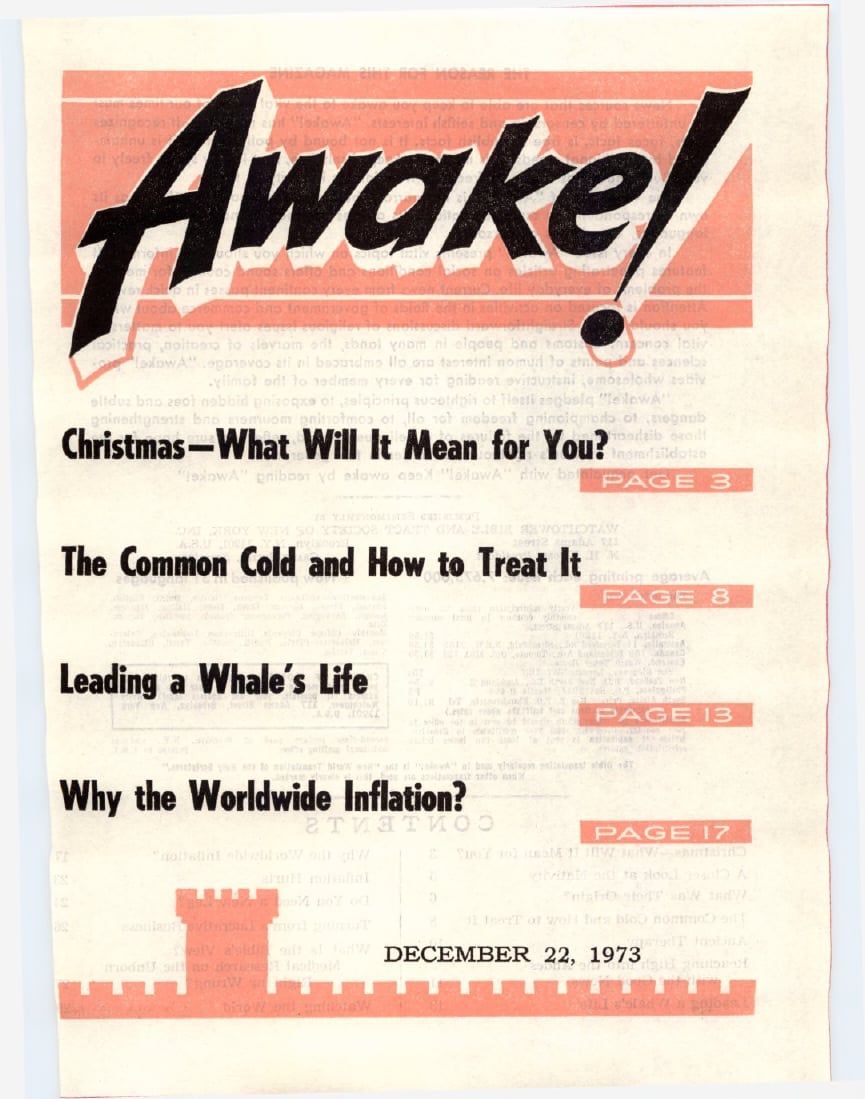
Awake! — December 22, 1973
Source: jw.org
Contents
Christmas—What Will It Mean for You?
The Common Cold and How to Treat It
Ancient Therapy
Reaching High into the Andes with the Good News
Leading a Whale’s Life
Why the Worldwide Inflation?
Inflation Hurts
Do You Need a New Leg?
Turning from a Lucrative Business
Medical Research on the Unborn—Right or Wrong?
Watching the World
Will You Listen to the Truth?
Is Worship A Daily Part of Your Life?
Christmas—What Will It Mean for You?
Christmas—What Will It Mean for You?
CHRISTMAS means different things to different people. Many view it as a time of vacation when the whole family gets together. They look forward to Christmas as a joyous occasion featuring good food, singing and dancing, preferred companionship and the exchanging of presents. A California musician summed up his feelings about his yearly trip home for Christmas in this way:
“All my grandparents will be there. . . . Everybody will be cooking, and I’ll probably gain 30 pounds. It’s the only time of the year when the whole family gets together.”
It is truly a fine thing for families to get together. A gift given in expression of heartfelt love can be most meaningful too. The Bible encourages: “Practice giving.” It also says: “There is more happiness in giving than there is in receiving.”—Luke 6:38; Acts 20:35.
What Goes Wrong at Christmas?
Have you noticed, though, that happiness is often missing during the Christmas season? A Roman Catholic priest recently called Christmas “the annual season of depression and neurosis.” A worker at a large shopping center observed: “You go out on your break, and you see people running around, getting a present for so and so, and they’re really grouchy. People don’t give presents with joy.”
Writer Mike McGrady pointed to other problems that arise at Christmas: “This is the time when reformed alcoholics seek out cozy bars and throw away their futures, the time when normally faithful husbands start to notice the way gabardine can cling to a secretary’s thigh.”
The FBI reports more murders during December than during any other month. Police in large cities note more traffic accidents at this time.
Child psychologist Dr. Nancy Hayes says that Christmastime “is a period of the highest rate of depression and suicide among children.” She notes that many youngsters become depressed when Christmas does not provide the “magical solutions to problems” that they had expected. So, while Christmas may be a pleasant time for some, it is very different for others. Why is this so? What goes wrong for so many at Christmas?
Catholic priest Peter J. Riga pointed to one cause of the problems: “As one psychologist has said, Americans feel obliged to reaffirm the ideals of kindness, generosity and love at Christmas in order to atone for their neglect of these same ideals in their day-to-day lives. To see and to feel people return to their ordinary greed and unconcern can be devastating to lonely and sensitive persons in our society.”
Christmas giving, too, is often improperly motivated. Many feel compelled to give at this time of year. They may even go deeply into debt to do so. Then, too, some give Christmas presents for selfish reasons. A professor of sociology commented:
“We reckon up where we stand and whom we wish to be tied to. The giver has not only the anxiety of trying to guess what the recipient would like, but also the added anxiety of projecting a suitable image of himself.”
This, of course, would rob one of the joy of unselfish giving.
Because of this, some have discontinued celebrating Christmas altogether. Others insist that Christmas is basically good, but has been perverted by materialism and a lack of self-restraint. They urge people to “restore the religious meaning of Christmas” as a celebration of the birth of Jesus Christ. But is Christmas related to the birth of Jesus?
The Birthday of Jesus Christ?
In his book The Story of Christmas, Michael Harrison writes:
“First of all, it must be noted that, despite the efforts of innumerable scholars, it has not yet been proved upon what day . . . Christ was born.”
The Bible is silent about the date of Jesus’ birth. Writings of early “church fathers” are divided on the matter. Clement of Alexandria (of the second and third centuries C.E.) refers to some who believed that Jesus was born on April 19 or 20. Others preferred May 20. Still others pointed to January 1, January 6, March 21, March 28 and many other dates. The Catholic Encyclopedia comments that “there is no month in the year to which respectable authorities have not assigned Christ’s birth.”
Is that not significant to you? Is it not clear that if God wanted people to celebrate the birthday of Jesus Christ he would have had the date recorded in the Bible? You will recall that the Bible does contain the date for the Passover and for the memorial of Christ’s death. (Ex. 12:6, 14; 1 Cor. 11:23-25; Luke 22:7-20) Apparently it was not God’s will for anyone to celebrate the birth of his Son, Jesus. It is not surprising, therefore, to read in The New Schaff-Herzog Encyclopedia of Religious Knowledge: “There is no historical evidence that our Lord’s birthday was celebrated during the apostolic or early postapostolic times.”
But the churches of Christendom are determined to celebrate Jesus’ birth. By the year 354 C.E. most churches set the date for this on December 25. Where did they come up with that date?
The Date and Customs of Christmas
Scholars mention two explanations for the date December 25. One is due to a calculation attributed to a certain Hippolytus of the third century C.E. According to this calculation, Jesus died on March 25 and he was conceived thirty-three years earlier on the same date.a It has been pointed out that nine months from there would give December 25 for the date of Jesus’ birth.
The second opinion is that December 25 was chosen because of its being the day for the pagan celebration of “the birth of the Unconquered Sun,” known as the Brumalia in the Roman Empire. This followed the week-long festival of the Saturnalia (December 17-24) at the time of the winter solstice. At this time of year the daylight period begins to get longer. The pagan Romans believed that the sun-god, Mithras, was conquering the darkness and gloom of winter. According to the New Catholic Encyclopedia, this second point of view “remains the most plausible explanation for the dating of Christmas.”
The book The Story of Christmas tells of the date December 25:
“It was, in particular, the greatest feast day of the Mithraic religion, which appeared, for a time, to be rivalling the Christian faith as the state religion of the Roman Empire. . . . The reverence that the Mithraists paid to 25 December certainly had its influence in deciding the Church authorities in fixing the official birthday of our Saviour on 25 December.
“To select 25 December, then, as the official date of the Nativity was to adapt, to the service of Christianity, a feast of immemorially ancient origins and world-wide observance.”
Professor A. H. Newman explains that Catholic religious leaders saw fit to make “the birthday of the Son of God coincide with that of the physical sun.” So the date for Christmas resulted from a compromise with pagan sun worship.
What about the “merry customs” of Christmas, such as the brightly lit and gayly decorated tree, holly, mistletoe, the yule log and the practice of exchanging gifts? Are these Christian customs?
Professor Edvard Lehmann writes in Hastings’ Encyclopedia of Religion and Ethics: “Most of the Christmas customs now prevailing in Europe, or recorded from former times, are not genuine Christian customs, but heathen customs which have been absorbed or tolerated by the Church. . . . The Christmas feast has inherited these customs chiefly from two sources—from Roman and from Teutonic paganism.” Some customs even come from ancient Babylon.
Does It Make Any Difference?
In spite of this, the churches of Christendom go on celebrating Christmas year after year. To them it makes no difference where Christmas came from. All that seems to matter is that it is a time of fun that is now thought to be Christian. A Roman Catholic priest replied to a letter of inquiry to the Knights of Columbus on this matter, as follows:
“The evolution of certain objects or feasts used in some form of pagan worship is of no importance. When the Church begins missionary work among a new group of people, the Church regularly takes what is good from the customs and habits of the people and re-interprets such in the light of the teachings of Christ. If formerly something was associated with error, the Church re-educates the people in the light of Christian revelation and gives the object or custom new meaning for the future.”
Do you accept that line of reasoning? Is the origin of Christmas really of “no importance”? Can a church system ‘reinterpret’ something pagan and thereby make it acceptable to God and Christ Jesus? What does the Bible have to say about this?
Consider the case of the Israelites whom God liberated from slavery in Egypt and brought into the “promised land” of Canaan (later called Palestine). While in Egypt, the Israelites had become acquainted with many religious customs of that land. The inhabitants of their new home, Canaan, too, practiced many religious traditions. What if the Jews were to adapt some of the religious practices of Egypt and Canaan to the worship of the true God, Jehovah? Would God take the view that ‘it makes no difference as long as the worship now honors me’?
Note God’s own opinion of this matter, as recorded at Deuteronomy 12:30, 31: “Beware of . . . asking ‘How did these nations worship their gods? I will do the same way.’ You are not to do the same way for your God Jehovah.” (Byington’s translation) You may recall God’s displeasure at the nation of Israel when they adopted the idolatrous Egyptian practice of calf worship. Even though they claimed that the calf represented Jehovah and that this was a “festival to Jehovah,” God said to Moses: “Your people . . . have acted ruinously.”—Ex. 32:4, 5, 7.
In the first century of the Common Era another problem arose concerning religious customs. Jews who became Christians had formerly celebrated “the seasonal festivals of Jehovah” (Passover, Pentecost and the Festival of Booths) at which they were commanded to “rejoice before Jehovah your God.” (Lev. 23:2, 40) Yet Christians were not to continue even these celebrations. (Gal. 4:9-11) If festivals that God himself instituted were now to be discontinued, certainly Christians would keep away from pagan practices!
What Will Christmas Mean for You?
It would be good for all to reflect seriously on this matter. Concerning pagan religious practices, Christians are commanded: “Quit touching the unclean thing.” (2 Cor. 6:17) The Bible also admonishes: “Now that you have put away falsehood, speak truth each one of you with his neighbor.”—Eph. 4:25.
Do you wish to obey those Scriptural commands? Could you do so and at the same time engage in a celebration admittedly rooted in paganism and one that suggests a false date for the birth of Jesus Christ? Would not doing so mean that you love pleasure more than God and his truth?—2 Tim. 3:4; Rom. 1:25.
Christmas can mean a time of testing for many. They may be aware that Christmas smacks of paganism and is displeasing to God. But their family, friends and neighbors may go in big for the celebration. The pressure to ‘go along with the crowd’ can become severe.
What will this test reveal about you this year? Will it demonstrate to all that your love of God exceeds any desire you may have to please humans? Remember, the Bible shows that Jehovah God should be the supreme object of your love and fear.—Matt. 22:37; Isa. 8:13.
But what about the children? Is it not cruel to deprive them of the delights of Christmas presents and merriment? Actually, such a view is short-sighted. We have seen that some youngsters become depressed, even suicidal, at the Christmas season because it fails to solve their problems.
If you refuse to celebrate Christmas, this does not mean that you will never give gifts to your children, or to anyone else for that matter. Anytime throughout the year can be suitable for family fun and for giving presents.
Consider, for example, Jehovah’s witnesses. They do not celebrate Christmas, but neither they nor their children suffer because of this. Actually, it is a relief for them. Gone is the compulsion to give, gone the frantic ‘Christmas shopping’ that leaves so many drained physically and emotionally. Christmas means none of these things to Jehovah’s witnesses.
And think of the benefits to the children. There are now many happy occasions throughout the year instead of one. Just imagine the squeals of delight as a child receives an unexpected gift from Mom or Dad. How thankful he is for it! How reassured of his parents’ love! And how much better that his appreciation go to the real giver rather than to a nonexistent Santa Claus!
In contrast, the annual gift giving at Christmas does not induce thankfulness. Instead, people expect to receive presents. Many become highly insulted if they do not get anything. Even those who receive gifts are often disappointed if the gift does not meet their expectations.
What will Christmas mean for you this year? Will it mean an opportunity to show that your love of God and his truth is the strongest force in your life? Or will it mean a compromise with something you know is displeasing to God? What Christmas will mean for you is really up to you.
[Footnotes]
However, according to the Bible, Jesus died on Nisan 14, 33 C.E. This would correspond with April 3 on the Julian calendar, or April 1 on the Gregorian calendar.—Matt. 26:2; John 13:1-3; Ex. 12:1-6; 13:4.
[Box on page 5]
A Closer Look at the Nativity
● Who were the “wise men”? In nativity scenes, prominently displayed at this time of year, three “wise men,” kings, are shown bringing gifts to the babe Jesus in a manger. But the Bible does not say that these men were kings; they were pagan astrologers. “A Catholic Commentary on Holy Scripture,” page 856, acknowledges: “The Magi (D[ouay] V[ersion] ‘wise men’) were originally a Median priestly tribe of clairvoyants. . . . The term later became general . . . for astrologers, sorcerers, etc. of all nationalities.” Did you know that?
● How many “wise men” were there? If you look in the Bible you will nowhere find that it says there were three. The number is not given. The book “The Glory of Christmas,” on page 72, admits: “The brief account in Matthew . . . is the only mention of these Wise Men in the Bible. It does not name them, say where they came from or even how many there were.”
● When did the “magi” visit Jesus? Nativity scenes sponsored by church groups usually show the “magi” bringing their gifts to the newborn Jesus in a manger. But read the Bible account at Matthew chapter 2 for yourself. You will see that it says that, by the time the astrologers arrived, Jesus was a “young child” living in a “house.” (Matt. 2:11) It was only the shepherds who visited the babe Jesus in the manger.—Luke 2:12.
● Did God use a star to lead the astrologers to Jesus? Do not forget that God’s Word condemns astrology. (Isa. 47:13, 14) Remember, too, that the “star” seen by the astrologers led them first to wicked King Herod, who then ordered all the young boys in and around Bethlehem slaughtered in an effort to kill Jesus. Do these facts point to God or to his adversary, Satan the Devil, as the source of that moving “star”? God did indeed announce the birth of his Son, but he did so by means of an angel.—Luke 2:8-12.
[Box on page 6]
What Was Their Origin?
● The Christmas tree has its roots in paganism. Says “The Twelve Days of Christmas,” page 33: “The use of the fir (Tannenbaum) seems to have originated at the winter solstice celebrations of the pagan German tribes in the Black Forest.” “The Two Babylons” by Alexander Hislop points to origins all the way back in pagan Rome and ancient Babylon.
● Holly and mistletoe use in Christmas celebrations also has a pagan origin. Explains Funk & Wagnalls “Standard Dictionary of Folklore, Mythology and Legend,” Volume 1, page 501: “The use of holly in religious ceremonies is of considerable antiquity; probably its use as Christmas decoration was adapted by early Roman Christians from the Roman Saturnalia.”
This dictionary also notes in Volume 2, page 732. “Decorating the house with mistletoe at Christmas is often assumed to be a survival of the old druid oak cult. Frazer links the custom of kissing under the mistletoe with the license of the Greek Saturnalia. Others associate the practice with certain primitive marriage rites.”
The Common Cold and How to Treat It
The Common Cold and How to Treat It
“THERE is just one way to treat a cold, and that is with contempt.” So declared Sir William Osler, widely famed Canadian physician of a previous generation.
Apparently his opinion is shared by certain other physicians of today, for when asked what they did when they had a cold, some variously replied: “I did nothing. Colds are usually best ignored.” “I blew my nose on a necessary basis.” However, others said they took aspirin or antihistamines.
Just what is the common cold? A medical authority on the subject states that it is “a short mild illness in which the main local symptoms are found in the upper respiratory tract and in which nasal symptoms predominate.” In other words, a cold usually does not last long, is generally no cause for serious concern, and makes itself felt in a number of ways: by a sore throat, a stuffed or running nose, by sneezing or coughing, perhaps a headache and a general feeling of discomfort, and at times is accompanied by a slight fever. It appears that women are more likely to catch a cold than are men.
The common cold is well named, for nearly everyone has at one time or another suffered from it, it being found among all peoples and on all continents. Colds, we are told, annually cost Americans some $5,000,000,000 in medication, doctors’ fees and work-days lost; they account for more than half of school- and work-days lost because of illness.
However, one of England’s leading authorities on the common cold, Sir Christopher Andrewes, jests that such statistics are to be taken with a grain of salt. Why so? Because colds often serve as a convenient excuse for staying home from school and work, especially if one wants to use up the days one is annually allowed for sick leave.
Trying to Get at the Cause
Many indeed are the days and years, the dollars, yens and pounds spent by medical researchers in trying to get at the cause of the common cold and to find a remedy for it. In recent years the blame has been put on viruses rather than on any bacteria. But the latter, when present, may bring on a second stage.
What is a virus? Without getting technical, it is something like a bacteria except that it is much, much smaller. In fact, most of them are so small that they cannot be seen except with the aid of an electron microscope, which is able to magnify things ten thousand times and more. Viruses are also different from bacteria in that they are parasites. They can exist only within a living cell as a host. When a virus enters a cell, it causes the cell to cease its normal functions and to begin producing other virus particles until the cell bursts and the viruses spill out to attack other cells. They deserve their name, which means poison. Viruses were known to cause such diseases as polio, measles and influenza before anyone ever saw one and before they were blamed for causing the common cold. It is now known that there are upward of a hundred different viruses that can cause the common cold, the rhinovirus being the most widespread of them. However, in the plant world there are such things as “friendly viruses,” which account for certain characteristics in various plants.
Are There Other Factors?
According to leading British researchers, in the vast majority of cases viruses alone do not cause one to get the common cold; usually other factors are involved. For example, doctors and nurses may be exposed to cold viruses from morning to night, day in and day out and never get a cold, indicating that merely being exposed to cold viruses will not necessarily cause one to get a cold.
There usually is something that makes the cells of the body susceptible to the virus. In fact, a number of factors have been implicated—air pollution; sudden changes in the weather from hot to cold or from dry to wet; physical fatigue and lack of sleep, also emotional upsets; dietary indiscretions; in fact, a general run-down condition. Thus one surgeon stated that only when he lets himself get down do viruses overcome his resistance to them.
So it would seem that unless you yourself are run down you need not fear if someone sneezes or coughs in your presence. But since you may be in the presence of some who are run down or otherwise susceptible, or who fear catching a cold, it would be best to exercise care when you yourself have a cold.
One of America’s foremost nutritionists in particular implicates diet as a cause of the common cold. He holds that colds are much more common in those who indulge in too much rich food, such as sweets, starches and proteins. In a similar vein, another physician blames colds on consuming too much sugars and fats, and not enough of such foods as fruits, vegetables and products made from whole grains.
Much to the same effect are the claims of a popular writer on medical subjects that colds are chiefly due to eating chocolate and other sticky sweets. These, he holds, irritate the mucous membranes of the throat and make it susceptible to infection by any number of viruses that can cause common colds. For this reason he puts the chief blame on the myxovirus rather than on the rhinovirus strains, as is usually done.
Other researchers claim to have found that in some persons drinking a lot of coffee can precipitate colds; that indulging too freely in alcoholic beverages, using a lot of table salt, and even drinking too freely of milk (by persons allergic to milk), can bring on a cold. And, of course, cigarette smoking looms up as an important factor; cigarette smokers average 65 percent more colds than do nonsmokers.
What to Do About It
Many are the suggestions offered by physicians and others as to what to do about a cold. Authorities are practically unanimous in holding that antibiotics do not affect a cold and may well harm you. For relief from its symptoms, aspirin may make you feel more comfortable and other medication may help you to breathe more freely, but they do not cure your cold and they do have side effects with which you may have to reckon.
The thing to do is to cooperate with the many built-in factors that the body has to protect itself from injurious viruses. If these are in good condition, they will most likely fight off most of the ordinary cold viruses. So common sense would indicate slowing down—get more rest, go to bed early, avoid undue stress and excitement and perhaps cut down on your eating.
But does not an oft-quoted adage say: “Feed a cold and starve a fever”? Yes, it does, but, according to one authority, it should be: “IF you feed a cold, you will have to starve a fever,” and that is quite a different opinion! So he recommends a bland diet that consists of fruit and vegetable juices and vegetable soups that do not contain meat or seasonings.
Anything that helps to build up the body’s resistance helps to overcome cold symptoms and helps the body in its fight against the cold virus. Thus, some have found the manipulative therapies, such as chiropractic, osteopathy and massage, to be helpful. Others swear by such aids as hot baths, especially hot foot baths (really hot!), and sweat or sauna baths and enemas. Others, again, including some physicians, say that they get relief from the common cold by means of a hot “toddy,” a hot lemonade to which whiskey has been added. There is a saying that “one man’s meat is another man’s poison,” and this could well be so because of differences in genetic patterns. The saying can apply to selecting a means of dealing with the common cold.
What about the highly publicized value of vitamin C in treating the common cold? There is no question about vitamin C as being essential for normal body function, preferably in its natural state, as in orange, grapefruit or tomato juice, or in the form of rose hips or acerola berries. But as to whether large quantities of synthetic vitamin C will cure your common cold, this is a controversial subject. Some adverse effects from large doses have been reported in certain persons, even as others report being greatly helped thereby.
And not to be overlooked as to curing the common cold is another factor, one also implicated in causing this ailment, and that is our emotions. One popular newspaper writer suffered with colds all her life, until she found relief by going to a psychoanalyst who revealed her hidden tensions. She was so impressed that she wrote a book on the subject. But, as Dr. Karl Menninger noted, it is not necessary to go to a psychoanalyst to learn the truth about oneself.
Going to God’s Word and being honest with oneself can help one to discover whether it is an emotional conflict that is causing one to have a cold. And heeding the Bible’s advice in such matters can help one physically as well as spiritually. As we read: “Low spirits sap a man’s strength.”—Prov. 17:22, The New English Bible.
Knowing something about what causes a cold and what you can do to relieve it should also help you to prevent a cold. As one physician put it: “Sleep well, eat well, avoid getting chilled. Take care of yourself, and you’ll rarely catch cold.” Pretty good advice.
Ancient Therapy
Ancient Therapy
Dr. Salvatore P. Lucia writes in Wine as Food and Medicine: “The therapeutic use of wine in acute respiratory infections dates back to the ancients. In modern times it has proven effective in the treatment of bronchitis . . . and other allied affections of the lungs. Warm wine is prescribed during the period of chilling in influenza and in other respiratory infections. A glass of wine taken at bedtime will often forestall a cold by acting as a sudorific [causing sweat].”
Reaching High into the Andes with the Good News
Reaching High into the Andes with the Good News
As told by “Awake!” correspondent in Peru
THOUSANDS of rugged mountain peaks, up to 22,000 feet high, crowd each other along the entire length of Peru. Scattered among the high plateaus and fertile valleys of this sierra or Andes mountain territory, the majority of the country’s fourteen million people live an isolated existence. Some of the plateaus are so high their inhabitants can witness the birth of rain, and watch it fall away to the valleys below. Seemingly bottomless gorges and steep mountain slopes discourage travel on the part of the people who live here. Thus, many are unaware of occurrences even a few hundred miles distant.
We might at first conclude that this ignorance of the world’s social, political, racial and economic breakdowns is a blessing for them. However, the meaning of these things is something that even they need to know. This evidence of an imminent change for the better is “good news” for these isolated people too. (Matt. 24:14) But how can they be reached?
Plan of Action
Casa Luz (“house of light”), a roving fiber-glass-body housecar built especially for travel in the Andes, has helped. Casa Luz was designed for four full-time preachers of Jehovah’s witnesses. It arrived at Callao port early in 1972. Thereafter began a series of birth pains to adapt it to mountain life in Peru. Since the greater portion of its life was to be spent in the interior, the housecar had to be reinforced for intermountain roads and trails.
Special heavy-duty springs were installed. Sheets of metal for protection against rocks were fitted over the gear box and other vulnerable spots. Enormous heavy-duty bumpers and guards were fabricated and welded on the front and the back. Extra racks were attached above for supplies and over the back bumper for carrying a trail bike (motorcycle). In isolated sections, it may be days before a supply barrel of gasoline can be reached, and a twenty-seven-foot mobile home traveling over steep and rocky inclines could be expected to average little more than six miles to the gallon. So an extra gas tank was installed. Finally, a Land Rover jeep, to be a traveling companion, was purchased and similarly outfitted for mountain travel.
On May 21, 1972, the four enthusiastic ministers left Lima loaded with supplies, including many cartons of Bibles and Bible study literature. They were destined for points that could only be approximated on the map. Their plan was to reach as many persons as possible with the good news of God’s kingdom, however remote their location. What kind of people would they meet?
People of the Andes
The people here, far from “civilization’s” social and moral problems, are tranquil, friendly and hospitable. Little groups of their windowless huts lie in the heatless mountain sun, wisps of smoke seeping through thatched roofs. Children play outside, windburned cheeks aglow. A boy tends his sheep, a farmer plows his acre, and, in the distance, a neighbor disappears down the trail on a two-day trek to the nearest village store.
Centuries ago their Inca ancestors roamed these same valleys and climbed the same terraced steppes up the mountainsides. Then, in 1533, Francisco Pizarro, representing the monarchy of Spain, captured Atahualpa, the last Inca king of Peru. This paved the way for Spanish control. Bringing with him the religion of his country, Pizarro initiated a period of torturous changeover, as his conquerors “persuaded” the Inca nation to adopt the Catholic religion.
The result was a mixture of beliefs and loyalties. Churches were built, crosses erected, new religious customs adopted, but their original pagan rites still persisted. Today in the many mountain villages a cross peeks from almost every housetop, yet the sun-god is honored yearly. Now Catholic priests are scarce, almost nonexistent in the small villages. Many churches have been boarded up and the priest comes around once or twice a year, on festival days. They have less and less contact with their religion and even less spiritual stimulation.
Yet these unassuming people are listening to the Bible message brought by the ministers who travel in Casa Luz. How do they carry on this ministry among these scattered, isolated people?
When they are out in the mountains, each working day in Casa Luz begins at 5:00 a.m., or earlier. Three of the four ministers make preparations for a full day’s preaching. While they load their leather cases with Bibles and study aids, their companion on “home” duty for the day prepares breakfast. Discussion of a Bible text follows breakfast, providing a stimulating spiritual beginning for the day.
Setting out in the Land Rover, the three drive along until homes are spotted on the hillsides. Then they separate on foot, intent on bringing the good news to every individual. Over rocks they go, through bushes, across streams, heading for a hacienda in a fertile valley or a thatched-roof hut perched on a plateau. Almost everyone, whether peasant, schoolteacher, police chief or mayor, listens to their message of hope. These people are anxious to read the literature left with them.
So much interest was shown in one town that the villagers persuaded the ministers to remain for three days so they could learn as much as possible. Since then a prosperous little congregation has been formed. Such appreciation for the Bible’s message is common. In one religious town a man had taken a piece of literature early in the day. Later he was overjoyed to see two of the ministers returning past his home. He was burning with questions about the use of images in worship, the subject of one of the chapters he had been reading. After an hour’s enlightening discussion, he gathered together all his images, poured kerosine over them, and burned them on the spot!
Learning to Cope
Most mountain folk live on what they produce from a few furrows of land; money is scarce. So produce is offered to cover the cost of Bible literature. As the leather bags empty of books, they begin to fill with potatoes, eggs, avocados or a few pounds of coffee beans. On one occasion 120 ears of corn were emptied onto the floor of Casa Luz at day’s end! In the event a chicken is offered, the minister must chase it down and catch it! How would you like to carry a chicken under your arm for the rest of a day, preaching in the mountains?
Scarcely a day is uneventful—from dodging dogs and bulls to avoiding cactus plants. Sometimes a river has to be forded on precariously placed spindly poles. Flat tires are a daily event. Other repairs on both vehicles must continually be made. Sometimes that is no easy task. On one occasion, the axle on the Land Rover broke. It took twelve days on trail bike, bus and train for one of the ministers to reach a large town and come back with the replacement part!
Such experiences have made the four ready for any eventuality—from spending an entire day without food, to enjoying a simple meal of boiled potatoes with an Indian family. Skin bronzed by sun and wind, muscles toned from daily walking and climbing, they can now go up a mountainside with scarcely a pause for breath in the rarefied atmosphere. And this at altitudes up to 15,000 feet!
After a nine- or ten-hour day, three tired but satisfied ministers often arrive back at the jeep as darkness begins to fall. They exchange experiences while heading for “home.” A hearty meal prepared by the day’s “cook” awaits them. This is followed by personal study or by one of the three meetings they hold each week to improve their ministry. A welcome bed then greets them until 5:00 a.m., when they begin the cycle anew. Reaching these friendly, isolated mountain people with the good news has been well worth the effort.
From icy plateaus in the shadow of giant ice caps, to steaming valleys on the jungle side, majestic Andes mountain scenery constantly reminds these ministers of their Creator. They realize the urgent need for honest people living in the midst of this grandeur to learn appreciation for the One who created it too. These isolated people of the Andes are being reached. The future of sincere individuals among them is becoming bright with hope as Casa Luz reaches high into the Andes with the good news.
Leading a Whale’s Life
Leading a Whale’s Life
By “Awake!” correspondent in Hawaii
EXPENSIVE perfume, cosmetics, livestock feed, margarine—what do they have in common? They each may have been produced, at least in part, from the whale. in fact, so much has the whale contributed to the manufacture of such things that it is an endangered species.
Hawaiians welcome whales for another reason. They look to the appearance of whale families as a sign that fish will be plentiful. Each December or January the great humpback whales return here for four months, putting on a spectacular marine show off the coast of the Hawaiian island of Maui. The forty- to fifty-foot whales play and spout, and leap just like children on a playground.
The whales come to Maui to bear their young in a safe, warmer climate, and to give the babies their first training. Why Mamma whale chooses the rockiest of Maui’s shorelines to give birth to her ten- to fifteen-foot baby is not known, but while she is laboring, Papa whale is putting on quite a gymnastic show! Some say that Papa is diverting the sharks from the ‘maternity ward.’
Characteristics of Various Whales
This very distinct whale has a slightly humped back, peculiar knobs on its head and a bumpy margin to the flukes (tail) and flippers. Its flippers, which are up to twelve feet long, are longer than in any other species of whale. The humpback stays close to shore and, by whale standards, is not an especially deep diver. But because of its great oil yield and its being easy to kill and process, authorities say that it is the first species to be killed off to near extinction.
Other whales are perhaps more distinctive, or better known. For example, there is the blue whale, which is the largest animal known to exist. It averages eighty to a hundred feet and weighs as much as 134 tons. There is also the right whale, once the most important to the industry for its baleen or whalebone. But the most famous and doggedly pursued is the sperm whale, the one of the well-known book and movie Moby Dick.
The sperm whale is quickly recognized by its huge square head, which is almost one third the length of its body, and a single nostril. The massive head contains immense quantities of high-quality liquid spermaceti wax, valued today at 28 to 32 cents per pound. Its intestines very frequently contain ambergris. This peculiar waxy compound is a prized ingredient used in the manufacture of expensive perfume. It resembles soft pitch, but is neither adhesive when cold nor greasy to the touch. Ambergris may have a musty odor and may be black, brown or even whitish. It brings $7.50 to $12.00 per ounce today.
Life of the Sperm Whale
One of the calving grounds of the sperm whale is about 200 miles west of Mexico on the Tropic of Cancer. Here a baby whale calf is born. He shares his manner of birth with only two other mammals in the world, the sea cow and the hippopotamus, in that he is born under water. He backs into the world, being born tail first. At birth he is about fourteen feet long and weighs a ton!
Do not be deceived into thinking that the baby is smiling when he opens his pink toothless mouth. Being unable to wrinkle up his forehead as humans do, his face stays firm and expressionless but for the rolling of eyes and the clapping of the jaws. Even if the calf could smile, he would not, as the water is cold. He has lain sixteen months in a warm chamber inside his mother at 96°F., and so gasps for air as his mother nudges him to the surface with her broad face. You see, the baby does not instinctively know how to swim. Mamma must teach him. But because he is fat, he floats nicely. The greatest advantage of being large at birth is in keeping warm. The greater the body volume, the slower the heat loss to the chilly sea. For the next two years he will suckle his mother’s breast (two nipples hidden in a deep slit, one on each side of the belly) on a diet of thick milk, over 33 percent pure fat. Regular dairy milk contains only 4 percent fat.
The baby sperm whale’s one-inch-thick coat of blubber will grow over the years till it will be a great firm blanket more than a foot thick. He will average a gain of seven pounds a day while following Mom like a shadow. Later, because of the reserve fat of his body, he will be able to go for weeks without food. When he graduates to his favorite solid diet of squid, however, he is going to have some digestive problems. It is said that squid are responsible for the formation of intestinal obstructions, which become large and combine with bile secretions and other organic compounds found in the lower gut to form the prized ambergris.
One of the unusual things about whales is their great care for one another. When a whale is in distress, it sends out a wild call and its companions move in. They will put their shoulder under a wounded or ailing companion and help him to the surface. Commercial whalers have exploited this loving characteristic for profit. They would cruelly wound a whale calf, knowing that the mother would come to its rescue, and then both mother and calf would be killed.
By the time the sperm whale has finished its early training, it is an expert diver. One sperm whale dove 3,240 feet, where it got tangled in a submarine cable, and drowned! Scientists marvel at how this mammal can dive to such depths quickly and surface exactly on time to get its necessary breath without getting the bends, as man would.
By the time the sperm whale is nine years old, it is sexually mature. Its full body size of forty-five to sixty feet will be reached at age thirty to forty-five, and extreme old age will be at seventy-five years.
Science of Cetology
While marine authorities state that it has been impossible to probe deeply into the natural history of any whale, the science of cetology (or, whale lore) has been built on evidence painstakingly gathered by the whale biologist. By identifying the type of algae scum scraped from the back of a harpooned animal, biologists can surmise that the animal recently lived in colder waters. Or they may slice the ovaries of a whale and count the scars of pregnancy to estimate its reproductive history.
The science of cetology also deals with the cousins of the whale: the dolphins and the porpoises. All of these are mammals, being warm blooded, giving milk and breathing air. The larger species are known as whales; the smaller species with sharp snouts are called dolphins; those with blunt heads, porpoises. And then there is an unusual species called the narwhal, which has only one tooth, a spiral tusk up to eight feet long.
Whaling Industry and Its History
The Norse settlers of Greenland were whale hunters, but the Basques along the Bay of Biscay, in the eleventh and twelfth centuries, are called the first professional whalers. Early voyagers to Newfoundland had a well-established fishing fleet by 1522. From this time on, the main object of pursuing the whale was not for its flesh but for its oil and baleen. The oil was used principally for lamp oil, and the baleen was used for making whips, umbrellas and various feminine garments. By the 1890’s baleen brought as much as $5.00 a pound.
The search for the evasive Northwest Passage led mariners into cold waters where whales abounded, giving a great stimulus to the whaling trade. Long years of hunting in the easily accessible waters had reduced the numbers of whales, and so news of the untapped marine wealth of the Arctic was welcome news.
As the number of whales diminished, the whalers had to extend their activities to the open sea. At first, the blubber was packed in barrels and taken home for the oil to be extracted. By 1680 the Dutch had 260 ships and 14,000 men engaged in the whaling trade. The practice began thereafter of boiling the oil from the blubber on board ship. This enabled the ships to extend their range considerably.
The American Indians and the early European settlers had long caught whales along the shorelines of America, but it was only in 1712 that the great sperm-whaling trade began for the United States. It resulted in American ships being sent into every ocean.
A Hard Life
Life from a whale’s viewpoint is not easy. The backs of whales are heavily scarred with pale circles made by the powerful sucking disks fringing the tentacles of the squid and the octopus. All the older whales have been repeatedly scratched and bitten around the face by beaks of giant squids. The swordfish is another enemy, which sometimes leaves its thirty-inch bill embedded in the whale’s hide.
But, by far, the worst enemy these playful monsters of the deep have known is man. However, only when provoked will the whale fight man. Then its monstrous flukes or tail would sometimes strike the old whaling boats and smash them to pieces. Many a “catch” was unsuccessful even after being harpooned because the tortured beast crashed his tail across the boat or even crushed the boat in his jaws.
However, man’s greed has almost exterminated whales. In 1850, the king of Hawaii realized this potential danger and issued an edict that stopped wholesale destruction of whales off Maui. This was the first of such restrictions ever imposed on whalers anywhere in the world.
With the advent of the harpoon gun in 1865 and the deadly efficient floating factory ships, the slaughter of whales has intensified. Now Japan and Russia also use sonar devices and the helicopter to further pursue these rapidly dwindling beasts. Marine biologists estimate that there are fewer than 300 right and bowhead whales left in the seas. The blue whale has declined to an estimated 6,000 and there are only some 10,000 gray whales left. The fin, the sei and the sperm whales are virtually the only whales left in any number.
A Future for the Whale?
What can be done to prevent the complete extermination of the whale?
At the United Nations Environmental Conference in Stockholm last June, the United States called for a ten-year moratorium on commercial whaling, and the resolution was passed. However, the International Whaling Commission has declined to enforce the ban. Some groups are pressing for direct economic sanctions against whaling nations.
Several nations, such as Great Britain, Canada and the United States, have quit the whaling business entirely. In one country a company that at one time numbered 40,000 sailors and 750 ships recently retired its last four ships and forty sailors as that nation’s commerce department refused to renew its whaling license. Further, some nations have forbidden the import of whale products. Conservationists state that alternatives exist for all present uses of the whale.
As with other forms of animal life, the future of the whale depends largely upon man. And surely it is encouraging when men take action to preserve these marvelous creations of God.
Why the Worldwide Inflation?
Why the Worldwide Inflation?
SINCE World War II, nearly every nation on earth has been plagued with rising prices, or with what is called inflation. What is unique now is that inflation is taking place all over the world at the same time. That has never happened before.
Also, inflation is picking up speed in country after country. Why this worldwide inflation? What hope is there that prices will stop rising, or even go down—and stay down?
A Basic Reason
Inflation can come for several reasons. One is shortages of goods. In their eagerness to get the commodities that are in short supply, people will be more likely to pay the higher prices that merchants ask. And, throughout the world today, there are quite a few items, such as food, that are coming into short supply.
However, one of the most basic reasons for inflation is government spending of more money than they get in taxes and other income. It is of interest to probe into this basic reason, since it has long been the one most responsible for inflation in various nations. In this regard, World Book Encyclopedia states:
“Since the development of banking and paper money during the past 200 or 300 years, inflation has been caused chiefly by deficits in the budget of a national government. A deficit is created when a government pays out more money than it collects.”
When a deficit occurs, the government has to pay its bills somehow. The way they do this depends on the form of government. In many Western nations, one way is to borrow money from its own citizens by issuing bonds. But that usually does not cover the debt.
So what often happens is that governments borrow from their own Central, or National, banks. Where do these banks get the money? When authorized by the government, they issue credits or simply print more paper money. They “loan” this to the government at a certain rate of interest. Ultimately, the taxpayer will be expected to pay the loan and the interest charges by means of taxes.
Some governments do not even bother to go through central banks to make up deficits. They simply tell their printers to print more paper money. With this new money, they pay their bills.
But when governments pump more paper money into the economy without anything of real value to back it up, it means that more money chases the available products. That causes prices to rise. It is somewhat like a public auction: when more money is available to the people at the auction, they will bid the price of items higher.
Concerning inflation, the American Institute for Economic Research stated the following:
“For a quarter century the principal money-credit systems of the world have been inflating their respective purchasing media [paper money]. Leading the procession among the more industrially developed nations has been the United States.
“In fact, the United States not only has led the procession in its creation of excessive purchasing media for internal use but also has exported much inflationary purchasing media by means of grants, loans, and investments abroad to such an extent that dollars are widely held in huge amounts by foreigners, including central bankers, who have labored under the delusion that a piece of paper is as good as gold.”
Record of United States
Since the United States has been ‘leading the inflation procession,’ it is of interest to see what has happened to her spending habits.
In the last forty-three years the United States government’s domestic budget has had a deficit for thirty-six of those years! Yes, 84 percent of the time it spent more than it made.
As a result, the government’s debt reached over 427 billion dollars ($427,000,000,000) in fiscal 1972. That is the highest debt in history, and it is going up all the time. Nobody seriously expects it to be paid back. Why, just the interest payments alone on that debt come to more than twenty-three billion dollars each year now!
That kind of deficit spending over a long period of time had to have a bad result. It did—constant inflation.
Why so Many Deficits?
As we have seen, deficits lead to inflation. And deficits come about when a government spends more than it makes. But why such constant spending by so many governments in our time?
One of the main reasons is WAR. Of all the items in the budgets of most governments, the largest is often military spending. In the United States, military spending costs about seventy-five to eighty billion dollars each year!
But war destroys; it does not build wealth. Even in peacetime, war equipment produces nothing of real value. Instead, it soon becomes obsolete and must be replaced, usually by even more expensive equipment. True, such spending does create jobs. But it also creates huge debts, so no real wealth has been contributed to the nation.
Instead, it is more like a blood-sucking parasite draining away strength that could be far better used for other purposes. For instance, think of the benefits that could result if the seventy-five to eighty billion dollars that the United States spends on its military were devoted to peaceful pursuits. The same could be said of the Soviet Union or any other country. It would create just as many jobs, but think of how many cities could be rebuilt, how many new homes constructed. Think of the improvement that could be made in health care, transportation, parks and recreation areas, in reducing poverty and pollution.
An Example
To understand better what war and huge military expenditures do to an economy, let us imagine two families living next door to each other. Each has a nice home and property, and just enough income to pay their bills.
Now assume that they begin to distrust each other, so that one family buys a gun for protection. The other does the same. This begins a cycle of buying bigger, more costly weapons. But since they cannot afford them, they begin borrowing money.
Finally, they actually “war” against each other, destroying each other’s property. Has that destruction improved their living standard? Hardly.
Then, after that “war,” they have to rebuild. But, still suspicious of each other, they keep up their purchases of ever more costly weapons. In order to do all that, and to live from day to day, they borrow more and more money, falling farther and farther behind in their debt repayments.
Now, then, has the standard of living of these families really improved? Not actually, for no real wealth has been added. In fact, their standard of living is affected adversely when they buy weapons and rebuild “war” damage, since they have to take money away from other purchases. Also, it may appear as though they are improving when they borrow heavily to buy all the things they want. But when the bill collectors eventually demand payment, their real condition will be exposed.
Same with Nations
On a much larger scale, this has happened to the nations of the world in our lifetime. They have bled themselves to support the god of war.
By their constant warfare, they have destroyed vast amounts of property and wealth. Additional vast amounts of wealth have been used to support ever more costly weapons and armies, even in peacetime.
In order to pay for all that, and to pay for other things that they want to do, most nations have spent more money than they made. Hence, inflation. As an observer wrote in the New York Times:
“The root causes of inflation, above all others, are big military spending and failure to pay for it with adequate tax revenues. . . .
“A substantial part of this vast treasure of dollars and supplies is lost to our domestic economy, thus stoking the fires of inflation while denying funds to meet critical human needs at home.”
In addition to governments spending more than they make, in recent times vast numbers of people have done the same. They have gone on a huge “binge” of borrowing money to get what they want. And certainly, for a while, such borrowing and spending will enable them to live better. But there is always a day of reckoning with the bill collector.
Also, this borrowing from lending institutions, such as banks, “creates” more paper money. Owing to the nature of banking, for every dollar in bank deposits, a bank can make loans of many times that amount. And since most money transactions are made in checks rather than in cash, huge amounts of paper money are in this way “created” in checking accounts.
However, all this excess spending adds a flood of paper money chasing the available goods. That, plus excess government spending, puts more fuel on the fires of inflation.
Just how far has this splurge of excess spending proceeded in the United States? The total government and private debt in the country is now over two trillion dollars ($2,000,000,000,000)! That is far more than the yearly income of the entire nation! And this debt is skyrocketing higher each year.
Spending Overseas
But there is more. Another factor makes the situation even more unstable—overseas spending.
On the international scene the United States has consistently spent more money in other countries than it has made. As a result, it has piled up tens of billions of dollars in debts overseas.
Business Week described it in this way: “Too many dollars have been created, and there is a huge, undigested balance hanging over world markets.” Some estimates of this “undigested balance” range as high as 100 billion dollars.
Why has the United States piled up such vast debts overseas? The Economic Education Bulletin of May 1972 answers:
“First, for many years the U.S. government has disbursed [spent] abroad more U.S. currency and credits than It has received from abroad. Through its vast and overly generous foreign aid program and through large military expenditures in other countries, it has placed these claims against it in the hands of foreign governments, central banks, and individuals. . . .
“Second, the United States has indulged in marked and prolonged inflating . . . for more than three decades. This development . . . has resulted in such a marked increase in prices [for U.S. products] that many U.S. processors no longer could compete in world markets.”
Of course, there are times when such overseas spending comes nearly into balance with income. But the overall trend for the United States over the past few decades in its foreign spending has been similar to the trend within its borders. It has consistently spent more money than it has made.
As a result of all this domestic and foreign excess spending, huge debts have piled up, both within the country, and outside it. How are these debts to be paid? One hope was that someday the trend would reverse, that income would constantly become greater than spending. That would gradually reduce the debt. But this has not happened; in fact, the reverse has. Hence, just how were these debts to be paid off?
At one time the answer was—GOLD.
Gold—the Role It Has Played
For thousands of years, when people purchased goods they had to have something of equal value to pay for them. For much of that time they paid for goods by trading other goods.
Later, one commodity was found to be more valuable, more desired than the others—gold. Gold had unique properties. It could be kept indefinitely without deteriorating. It could be made into beautiful jewelry, coins or other items.
Hence, gold eventually became the best “money,” always acceptable. When paper currency came into being, it was often backed by this real money—gold. As long as the paper could be turned in for gold, people trusted the paper money.
The United States was at one time on the ‘gold standard.’ Its people could turn in their paper money any time and get gold. But since the paper money was much easier to do business with, people preferred to use that. They felt confident using it, since it was “as good as gold.”
Then the Great Depression began in 1929. The United States government started to build up huge deficits, spending more than it was making. So, in 1933, the government ruled that its citizens could no longer get gold for their paper currency. Also, all Americans were ordered to surrender gold coins and gold bullion (bars or ingots) in return for paper money. The government thus protected its gold stock from being wiped out by people who were afraid of their paper money and wanted gold.
Yet, the law did require the government to have one dollar in actual gold for every four dollars of paper currency it had in domestic circulation. This acted as a restraint, preventing the government from printing more paper currency than could be backed by 25 percent gold.
Last Restraint Removed
But in 1968 that, too, changed. The government passed a law getting rid of the 25-percent-gold requirement as a backing for its currency. One result of this was noted by the American Institute for Economic Research. It said:
“Removal of the gold reserve requirement for Federal Reserve notes early in 1968 removed the last vestige of restraint on further inflating and severed the remaining link between U.S. currency and gold.
“Since then the exchange value of the dollar has been controlled by the fiat [decrees] of U.S. money managers no longer subject to the discipline of gold.”
With this restraint gone, it was observed that the government “continued to succumb to the continual political pressure for more and more inflating.”
In addition, all the silver was taken out of coins. Hence, the entire money system in the United States was divorced from backing by anything of real value.
What all of this meant was that the government’s currency had to be accepted on trust. But the Economic Education Bulletin noted:
“The present money-credit system of the United States is founded on a broken promise.
“We refer to the promise once found on the Federal Reserve Notes that now have been withdrawn from circulation, the promise to ‘pay to the bearer on demand x dollars,’ a ‘dollar’ being defined by law as one thirty-fifth of an ounce of pure gold.
“A broken promise is not a suitable foundation for a durable money-credit system.”
Where the paper money had once pledged on its face that the United States “will pay to the bearer on demand” the dollar value in real money (gold or silver), now it says: “This note is legal tender for all debts, public and private.” The paper certificate that had for centuries only represented the real money (gold, or even silver) was now declared to be money. But which would people trust in a crisis—a piece of paper, or gold?
Foreigners also Told “NO”
While Americans could no longer get gold for their dollars, foreigners could. Gold was still the required money for payment of debts between governments in their international dealings. That was the arrangement that the Western nations had agreed to long ago.
…