Awake!, December 8, 1973
Download: PDF — Awake!, December 8, 1973
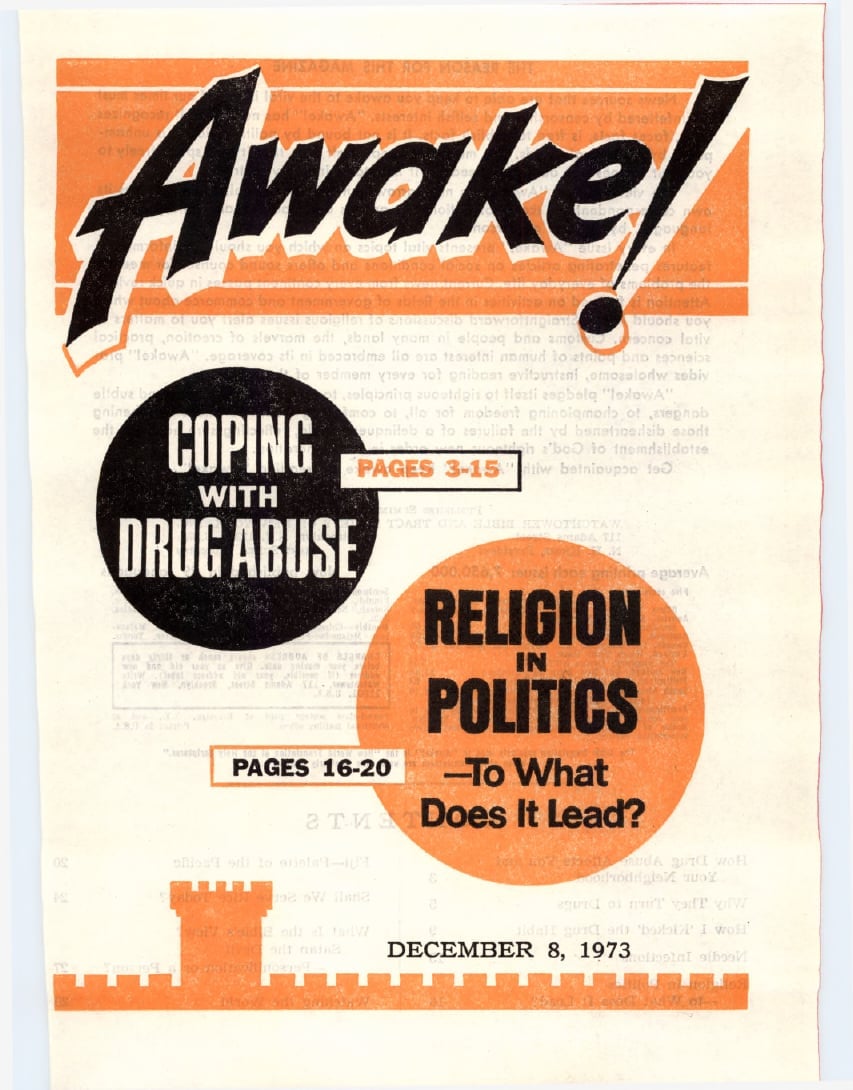
Awake! — December 8, 1973
Source: jw.org
Contents
How Drug Abuse Affects You and Your Neighborhood
Why They Turn to Drugs
How I ‘Kicked’ the Drug Habit
Needle Infections
Religion in Politics—to What Does It Lead?
Fiji—Palette of the Pacific
Shall We Serve Rice Today?
Satan the Devil—Personification or a Person?
Watching the World
An Easy-To-Read Bible
Read The New Book: True Peace and Security—From What Source?
How Drug Abuse Affects You and Your Neighborhood
How Drug Abuse Affects You and Your Neighborhood
YOU personally may not misuse drugs. But so many persons do, that you cannot help but be affected.
Drug addicts terrorize people on the streets and in their homes. They reportedly commit half the crimes in metropolitan areas of the United States! As a result, you may fear to venture from your home alone after dark.
It is reported that addicts “shoplift” over $2,000,000,000 worth of merchandise a year; so stores raise prices to compensate for their losses. Also, drug abuse by employees costs American corporations thousands of millions of dollars a year; a cost passed on to you in higher prices. And hundreds of millions of dollars are spent yearly on programs to fight drug addiction—increasing your taxes.
But you can be affected in other ways. A driver “high” on drugs may ram into you on the highway. Or perhaps a member of your own family will fall victim to drug abuse—bringing you untold sorrow.
Appalling Epidemic
Drug abuse has clearly reached crisis proportions. “The real drug scene involves millions of Americans,” science editor Alton Blakeslee wrote, including adults “who are abusing alcohol and tobacco and sleeping and pep-pills and tranquilizers to get through their day.”
But youths particularly are affected. Drug abuse has become “an extremely deadly epidemic” in American schools, the House Select Committee on Crime reported this June. The Committee said:
“Our investigation demonstrated that the drug crisis in our schools greatly exceeded our worst expectations . . . It is infecting our youth and contaminating our schools and leaving a trail of devastation.”
“It is only the uniquely gifted and self-possessed child who is capable of avoiding involvement with some form of drug abuse.”—Los Angeles Times, June 30, 1973.
Appalled by the problem, President Nixon declared: “America’s Public Enemy No. 1 is drug abuse.” The director of one of New York city’s addict treatment centers, Dr. Mitchell S. Rosenthal, said: “The misuse of drugs is pandemic [a wide-spread epidemic], with no segment of society spared.”
Is this true? What is the situation in your neighborhood?
Your Neighborhood Affected
If you live in New York city, you probably have little doubt about the magnitude of the drug problem. You may regularly see drug addicts “nodding” on the streets. And if you are a youth in school, you may see drugs being passed around.
New York Congressman Charles B. Rangel wrote: “Heroin has destroyed the functioning of our school system. . . . drugs are as available as chewing gum, young girls shoot up in the locker room and 13-year-olds buy dope from 15-year-old peddlers.” But what if you live in other cities?
The drug problem is there too. Professional all-star basketball player Nate Archibald noted: “Drugs are everywhere. It’s not just New York. I see ’em in every city we go to. You go to the bottom, it’s there.” Here are some reports:
✔ A subcommittee of the House Commerce Committee investigating organized sports said: “Drug use exists, in varying degrees, in all sports and levels of competition with few exceptions.”—Los Angeles Herald-Examiner, May 12, 1973.
✔ “The Navy revealed yesterday that its drug problem has reached such proportions that there is no Navy ship afloat or Naval station without a drug problem, and ‘many of them are major problems.’”—San Diego Union, July 21, 1971.
✔ “Addicts sporting habits that often cost $200 a day have spawned a wave of drug-related crime. Authorities ascribe as much as 70 per cent of Detroit’s armed robberies—90 per cent of its bank holdups—to the upsurge.”—Newsweek, February 28, 1972.
✔ “Drug abuse has risen dramatically in Oklahoma City . . . and no slowdown is in sight.”—The Daily Oklahoman, April 17, 1971.
✔ “A state survey of teen-age drug use reported that more than 40 percent of pupils in the ninth to 12th grades in Massachusetts have used illegal drugs in the past year.”—Boston Sunday Herald Traveler and Sunday Advertiser, August 27, 1972.
✔ A comprehensive survey of over 15,000 pupils in grades seven through twelve in Anchorage, Alaska, shows that over 41 percent of the students have used drugs, other than tobacco and alcohol.—Journal of the American Medical Association, February 5, 1973.
✔ “Southern California drug abuse authorities report that as high as 80 percent of all high schoolers experiment with illicit drugs. Young people are frequently exposed to drugs as early as fifth grade.”—Up-Look, Vol. 1, No. 1.
Wherever you go—east, west, north or south—drugs are there. They are even in small towns. In Palm Springs, California, for example, the drug problem is so bad that some parents worry about sending their youngsters to school. In Aspen and Boulder, Colorado, drugs are freely used in public. In East Jordan, Michigan; Nashua, New Hampshire; Lansing, Illinois; yes, in just about any place one looks, illegal drugs are used.
Even if some may think otherwise, the illicit use of drugs is probably rampant in their neighborhood too. Fred Hilligiest, whose thirteen-year-old son became a missing person in Houston, Texas, found this to be so. ‘I didn’t have any idea what was going on,’ he said, ‘how many kids were hanging around, taking drugs, and all that. But in the first three weeks we started looking for David, I got a college education.’
‘I thought it was maybe 10 percent of the kids in that kind of life, taking drugs,’ Hilligiest said. ‘But as I went along, it seemed like everybody’s kids were into it, maybe more like 80 percent.’ It is just as Archibald said: “You go to the bottom, it’s there.”
But is drug abuse only an American problem? What about other countries?
Drug Abuse World Wide
United Nations Secretary-General Kurt Waldheim observed: “Drug abuse . . . grows and takes on new forms. In some countries, it has reached the dimensions of a national emergency.” The Medical Tribune of November 22, 1972, carried the headline “DRUG TAKING FOUND COMMON IN CHILDREN WORLDWIDE.”
Drug abuse is a particular problem in Britain. London’s Daily Mail declared: “Illegal drug use is today virtually out of control.” Dr. H. Dale Beckett, chairman of the British Association for Prevention of Addiction, said: “There is probably not a school in the whole of the United Kingdom in which drug experimentation does not take place.”
The situation is similar in Australia. The Minister for Customs, D. L. Chipp, observed: “I can guarantee that if you have a child entering teens this year that child will be offered dangerous drugs or narcotics of some description before he or she is 18.”
The Spectator, a newspaper in Ontario, Canada, carried the headline “HEROIN EPIDEMIC THREAT—NATIONAL TALKS CONSIDERED.” To the west, in British Columbia, the illegal heroin market is said to be among the province’s top ten industries. So widespread is heroin addiction that Vancouver’s mayor said: “We would need an army to clean it up.”
And so it goes in country after country. Like a gigantic, ugly tidal wave, drugs have inundated the world.
What is the reason? Why do people abuse drugs? How great really is the danger?
Why They Turn to Drugs
Why They Turn to Drugs
THERE are no simple answers to why people turn to drugs. A few experts suggest that there are as many reasons for abusing drugs as there are people abusing them. Yet there is a fundamental reason for the problem.
It is that drugs are so available. For example, over 525 tons of barbiturates alone are produced annually in the United States. The American public consumes most of this tonnage on doctors’ prescriptions. Dr. Mitchell S. Rosenthal said that in 1971 enough mood-altering drugs were prescribed by doctors “to keep every man, woman and child in [the United States] either ‘up,’ ‘down’ or ‘out of it’ for a solid month.”
But are these “legitimate” prescription drugs dangerous? Are they a significant factor in the present drug-abuse crisis?
Drugs Used in Medicine
Barbiturates are sedatives, which doctors commonly prescribe to induce sleep. There are some twenty-six types of them. Practically all barbiturates are produced by legitimate pharmaceutical houses, but a large part of the supply is diverted into illegal channels. On the streets, the pills are called “downers” or “reds.” So great has the problem become with them that authorities have called 1972 “the year of the downer.”
Addiction sometimes results when these drugs are regularly relied upon to get to sleep. Many other persons abuse them simply for “kicks,” and become addicted. About one million persons in the United States are barbiturate addicts. An addict is one who needs drugs to avoid withdrawal pains. Sudden withdrawal can be so severe for a barbiturate addict that it can kill him. Also, over 3,000 persons in the United States each year die from overdoses of barbiturates!
There is also a deluge of stimulants, commonly known as “pep pills” or “uppers.” Amphetamines are the principal ones. Doctors often prescribe them to suppress the appetite, reduce fatigue or relieve depression. However, it is estimated that half the legally manufactured amphetamines find their way into illegal channels. These drugs, too, are dangerous and have either killed or ruined the lives of many persons.
Thus “legitimate” drugs, prescribed by doctors, are a major factor in the drug crisis. Yet the drugs grabbing most of the headlines are probably even a greater problem.
Drugs Without Accepted Medical Use
Heroin is the most dangerous of these. Ten to twelve tons of it a year are reportedly smuggled into the United States. Some 560,000 Americans are addicted to heroin, or about ten times the number in the early 1960’s. Heroin truly constitutes a deadly plague!
In New York city alone about four persons die every day from its effects! The average daily cost of a heroin habit is $40 or $50. To get this money, addicts steal more than $3,000,000 in property in New York city, on the average, every day! No wonder Newsweek reported: “New York City . . . is being killed by heroin.”
LSD (lysergic acid diethylamide) is the most potent of the dozens of hallucinogenic drugs. In recent years many underground laboratories have begun producing it. Thus, despite the heavy demand, the price of an LSD tablet has fallen to about a tenth of its cost a few years ago. Although it is not physically addicting, as is heroin or the barbiturates, LSD produces weird effects in users.
Basically, the drug causes changes in sensation. Vision is particularly altered. Illusions and hallucinations can occur, even months after taking the last dose. On a “bad trip” perceived images may be terrifying. Also, one on LSD becomes very susceptible to suggestions or influences from others and the environment. Thus news reports often tell of horrible experiences. For example, the London Daily Mail of April 26, 1973, reported how a schoolteacher under the influence of LSD tried to walk on the Thames River and disappeared beneath the surface without struggling.
With marijuana, the dimensions of the drug crisis grows. Although marijuana is illegal, an estimated twenty-four million Americans have used it, and perhaps eight million do so regularly. Marijuana’s effect on users is milder than LSD, although it, too, produces a distortion of the senses. When smoking marijuana, five minutes may seem like an hour. Sounds and colors may seem intensified. Also, habitual users have been adversely affected, suffering staggering gait, hand tremors, thought disorders and disturbances in perception.
Does inhaling the smoke harm the body? Interestingly, a recent letter by medical doctors at the College of Physicians and Surgeons, Columbia University, New York city, observed: “Marijuana smoke induces cancer in tissue cultures of human lung.” Dr. Morton A. Stenchever, who headed a University of Utah research team, concluded: Marijuana “may be a much more dangerous drug than we realized.”
Yet, despite the harm done by drugs, people continue to use them. Why? Why are millions more turning to them every year?
Drug-obsessed Society
Many authorities blame it on modern society’s obsession with drugs. One doctor explained: “Anyone who listens to commercials or reads drug ads knows he can calm down, perk up, fall asleep, lose weight and ease any number of pains and discomforts by taking one or another pill.” Drugs are often prescribed for almost any symptom.
Dr. Matthew Dumont, director of drug rehabilitation for the Massachusetts Department of Health, declared: “If there’s any single source of the drug menace in America today it’s my brotherhood—the physicians. . . . Physicians write prescriptions for 13 billion tablets of amphetamines and barbiturates each year.” The House Select Committee on Crime felt similarly, claiming: “The fault [for the drug menace] lies squarely with our pharmaceutical manufacturers, drug wholesalers and retailers and doctors.”
But these persons are not alone at fault. Adult consumers are too. They should realize that drugs are poisons, and so use them only when their possible benefits may outweigh their harm.a Yet if adults take drugs for every problem or tension, or even for pleasure, why should youths avoid them? Is it surprising that young ones should reason: ‘If grown-ups use tobacco, get drunk and take pills, why shouldn’t I enjoy myself smoking marijuana or taking “downers”?’
That parental drug use is a factor in children’s turning to drugs has been documented by various studies. For example, a major Canadian study calls drug abuse a “learned behavior.” “Adolescents modeled their drug use after parental use,” psychiatrists from Toronto’s Addiction Research Foundation explained. Surely, then, if you do not want your children to abuse drugs, you should not smoke, abuse alcohol or needlessly take pills.
But more than a proper adult example is needed. Proper association outside the home is also vital. A study by Friends of Psychiatric Research found that eighty-four out of every one hundred addicts were introduced to drugs by their “friends.” When offered drugs, many young people take them out of curiosity. They may, at first, find the effects pleasurable. But then they become “hooked,” and soon are in terrible trouble.
However, there are other reasons for turning to drugs. It is not simply because they are so available and that we live in a drug-oriented society. What are these other reasons?
Unsatisfying, Frustrated Life
Dr. James E. Anderson, an expert on drug problems, pointed to a fundamental reason, explaining: “Drug use is in effect a signal that there was a vacuum in the life of a person.” A similar observation was made by Dr. Matthew Dumont, who said: “We have to consider what’s missing in the life of young people who use them.”
Very often the problem is in the family. This was the finding of a survey of teachers, administrators and counselors in Dade County, Florida. Also, Dr. L. James Grold, assistant clinical professor at the University of Southern California, noted: “I have found, almost invariably, that the basic problem is in the home.” He said: “The teenager often begins experimenting with drugs from the family medicine chest as a means of avoiding the tension and frustration that exists in the household.” But what are the causes of troubles in the household?
Often fathers are wrapped up in trying to make their way in the world. Mothers may feel neglected, and become confused about their goals or role in life. Little open communication exists. And there is little companionship or genuine consideration for one another. Thus, even though children may be provided everything in a material way, they feel frustrated, dissatisfied or simply bored. Drugs are taken to fill the void—in a quest for pleasure and “kicks”—or just to soothe emotional hurts.
At times drug abuse is used by youths as a way of getting back at parents. One son of a famous movie actress explains his use of drugs: “I wanted to shock mother—hit her right between the eyes. I wanted her attention, even if it hurt. I hurt; I wanted her to hurt, too.”
But it is not simply problems at the family level that turn youths to drugs. Many youths feel that the whole system is, in effect, falling apart. They see the war, the assassinations, the greed, the hypocrisy, and everywhere the desperate pursuit of material things. This repels them. So they “drop out” of this way of life. Their attitude often is, in effect, ‘let’s eat, drink and be merry for tomorrow we may die.’ So they turn to fast living and drugs—anything for “kicks” and to titillate the senses.
What, then, is the answer?
Is Education the Answer?
Drug education programs have been instituted in many schools, but without real success. In fact, the programs have often cultivated curiosity, and, as a result, youths have turned to drugs to see what effects they really have. Dr. Helen Nowlis, a pioneer in drug education, illustrated the failure of the programs. As she stamped out a cigarette, she said: “See, I’m an example. I know what smoking can do to me. And I smoke.”
So more than programs that simply tell of the harm that drugs do are needed. But how can sufficient motivation be provided so that young people will refrain from using drugs, and for those already addicted to break free from them?
An editorial in the Canadian newspaper The Spectator pointed to an answer. Commenting on the widespread use of marijuana, it said: “Mankind has always craved for stimulation of the senses. Against this, the law is powerless; the only effective weapon is religion, and the generally sad state of that in our society needs no comment.”
Why has worldly religion been a dismal failure in coping with the drug problem? A principal reason is that it has endorsed the life-style, philosophy and goals of this system, the very things that the young have rejected as empty and meaningless. But there is a solution to the drug problem! The basis of it is education that motivates one to adopt an entirely different philosophy of life and to pursue goals altogether different from those popular today.
Many young drug addicts have found an answer, and are now realizing real satisfaction in living. They have become a fine asset to their communities, and are helping others to find a meaningful life. Let one of them tell how he declined into the depths of addiction, but then found a way to cope successfully with the drug problem.
[Footnotes]
Drugs, Life Science Library, published by Time-Life, says on page nine: “All drugs are poisons, and all poisons are drugs. . . . In the broadest sense, a drug—or a poison—is any chemical that can effect an alteration in the function or structure of living tissue.”
How I ‘Kicked’ the Drug Habit
How I ‘Kicked’ the Drug Habit
A HEADLINE across the front page of the Youngstown, Ohio, Vindicator of December 6, 1968, read: “LIBERTY POLICE NAB 18-YEAR-OLD YOUTH FOR SELLING LSD.”
I am that youth. The court sentenced me to ten months in the Trumbull county jail. However, I was out after thirty days, and was soon back in business “pushing” (selling) drugs. I needed the money to support my own drug habit, which included all sorts of drugs, particularly LSD.
Yet I had a long way to go to reach the depths to which heroin addiction often sinks one. In all, I was in jail more than two dozen times; three times I was put in a mental hospital. More than once I was stripped naked, locked in a padded cell, and left to undergo the agonies of withdrawal—“cold turkey,” as it is called. The last time I was taken from the cell and admitted to a hospital in critical condition; the last rites were even performed. But I pulled through and was convicted on burglary charges, finally being sent to the Mansfield unit of the Ohio State Penitentiary.
Yet that is all behind me now. I have overcome drug abuse. It has been over three and a half years since I last touched drugs, and I am confident that I never will again. This is because I have found a real answer to drug abuse.
Before telling about this, however, let me describe briefly my early life. Perhaps it will provide clues as to circumstances that often lead to drug abuse. Then, if you should notice such a pattern developing in your family, action may be taken to correct matters before it is too late.
Spoiled from Youth Up
My parents were divorced in 1951, when I was just eight months old. A battle followed, and, oddly enough, my father obtained legal custody of me. An arrangement was made for me to see my mother one day a week. When mother remarried, the battle continued, each side trying to impress me the most with material things. As a result, I became very spoiled.
Then mother gave up trying to “buy” my affection. She had begun progressing in a home Bible study with Jehovah’s witnesses. Soon pot- and pan-throwing, fighting, smoking and other bad habits began to disappear. On my visits, she and my stepfather would take me with them to meetings for Bible study. When returning home I would tell my dad the things I learned. But he did not like it. His relatives urged: “You should take him away from his mother. Jehovah’s witnesses twist the Bible—they’re crazy!”
So a concerted effort was made to turn me against my mother. I was enticed with expensive gifts, and my father allowed me to do about whatever I pleased. Thus, one day when my mother came to pick me up, I told her: “Mom, I don’t want to see you again.” She turned to my father, and said: “John, you coached him to say that, didn’t you?” I was nine then, and it was many years before I saw mother again.
Dad remarried in August 1960. Spoiled indeed I was, and I made life miserable for my dad and stepmother. Yet never did I receive a spanking or any firm discipline. I had started smoking on the sly when I was seven, and when I was ten or eleven I would get drunk. Also, I sniffed glue, and experimented with marijuana. My undisciplined upbringing and early drug abuse twisted my thinking.
When I was about thirteen, a girl snubbed me, so I threw gasoline on their driveway, lit a match and scorched the garage. Dad paid $800 in fines and expenses. I was also caught shoplifting at about this time. But troubles were just beginning.
Sexual Immorality and Jail
While a sophomore at Liberty High School I was caught with a girl friend in an embarrassing situation in the girls’ rest room. I was expelled from school for two weeks. That summer I burned my “straight” (conservative) clothes in the backyard as a protest. My stepmother and dad were furious, and cornered me in my room. I grabbed a tear-gas gun and “shot” dad, then dove out the window. The police were called, and officer Fred Faustino pulled me from the roof and placed me under arrest. That was my first confinement in jail.
Later that year my girl friend’s father caught us in bed after school. We all ended up down at the Liberty police station. But the very next day I was involved again with this girl at her house. How little regard I had for authority, or what anybody said to me! Two weeks later, when the girl’s uncle tried to interfere, a young friend and I planned to murder him, but it did not work out.
I had become a long-haired rebel, a real troublemaker. Yet I was searching for something, something to grab hold of, some type of future. I wanted to be someone, to have attention. I began to think marriage was the answer. Our parents discussed this but decided we were too young and were only infatuated.
So we made plans to run away, and in February 1967 we did, heading west with $420 of stolen money. Our journey ended abruptly when we were apprehended in Los Angeles and flown back to Ohio. Waiting police handcuffed me and took me to the Trumbull county jail, where I spent two weeks.
Now no school around would have me. Only by begging was my father able to get me admitted to the John F. Kennedy Catholic High School in nearby Warren, where I completed my junior year. While there, I became more deeply involved in drug abuse. That summer I was arrested for breaking and entering several homes.
My senior year was a disaster. Checking school records recently with principal Frank Lehnerd, we discovered that I had been absent seventy-five days! In February 1968 I hid my girl friend in my room for three days, thinking our folks could thus be pressured to let us get married. But all I got was three months in a correctional institution in Columbus, Ohio. I was released in time to take my final exams, pass them, and graduate from high school.
At my first opportunity I encouraged my girl friend to leave home again and take a bottle of aspirin to fake a suicide attempt. I thought this would surely convince our parents that we loved each other. Crawling home, vomiting blood, she was finally turned against me when her mother said: “He doesn’t love you; you’re just his puppet. He wants you six feet under.” I was never again with that girl, but this tragic affair sank me even to lower depths of depravity, spurred on by deeper involvement in drugs.
Sink into Drug Addiction
I was not yet a real addict, but was a heavy user and a pusher. I even went to New York to pick up drugs. Finally, a concerted police effort nabbed me—I sold drugs to a plainclothesman and was picked up with the marked money on me. That is when the front-page headlines reported my arrest. But my dad employed a good attorney, and I was out of jail by January 15, 1969.
Soon I was pushing drugs again, making plenty of money. But I needed it, for I had started “mainlining” heroin—putting it directly into the vein with a syringe. For a few months I was spending $40 to $50 a day for drugs. Dad tried to help me. He got me jobs, but I held them only a few weeks. I was so addicted I would “shoot” drugs right at work.
This was not difficult to do. I carried the drugs to work in a compartment in my ring. Then I went to the bathroom, and, using a syringe, I injected the drugs right into the vein. But to make sure to get every bit, I would pull back, filling up the syringe with blood, and shoot again—doing this up to ten times or so!
Then I would be off. I would get a “rush”—as if all of a sudden I had been dropped off a building. Then I would get limp—even the hair of my head felt limp. The whole idea of being an addict is to get as many “rushes” as one can.
At other times I would “speedball,” shooting a mixture of “speed” (methedrine) and heroin—an “upper” and a “downer.” Then one’s body doesn’t know what to do—relax or speed up—it is just in a turmoil.
When one takes LSD, there is an entirely different effect. While on it, I used to think I could do anything, that I could be God and control my own destiny. Joe Schovoni, my attorney, recently told me that once while on LSD I really scared him when I told him that I could take a baby right out of a pregnant woman. It is terrible what drugs cause one to think and do. In all, I took well over 200 LSD tablets.
For over a year I lived just for “kicks,” “shooting” drugs, living with girls, and trying to avoid the police. I lived in one dirty place after another, ‘going from rat hole to rat hole,’ as dad aptly described it. The police even accused me of robbing my dad’s home. My “buddies” cleaned him out of thousands of dollars’ worth of property. In August 1969 we took off for the infamous Woodstock festival, where I peddled multiple vitamins as LSD and made a lot of money. Climbing up the scaffold next to the stage to get a good view of the performers and the crowd, I remember thinking that everyone seemed drawn by a mysterious force.
Shortly after returning home I began to reap what I had been sowing. I hit absolute bottom, and barely survived.
Narrow Escape
It was September 5, 1969. I was really “strung out,” needing drugs in the worst way. So I broke into a drugstore in the little town of Vienna, outside of Youngstown. Scrambling inside, I collected various items—but then sirens! Trapped by the police with drawn guns, I broke down mentally, running toward them screaming, “Kill me! Kill me!”
They charged me with breaking and entering. Bond was set at $5,000. I was then taken to the familiar county jail. I had been there so often that they actually had my name inscribed over one of the cells! I was stripped naked and thrown into the tiny padded cell, a place so small that I could not stretch out lengthwise. There I began going through withdrawal. Recently Harold Post, the jailer, showed a friend and me the cell, and said: “I thought you would just lie there and die. I didn’t want anything to do with you.”
I cannot blame him. I was absolutely rotten! I rolled in my own urine and excrement like an animal, climbed the walls and beat at the vinyl padding. As Post recalls: “He was begging, I mean really begging, he was on his knees begging. But he wouldn’t take the medication offered him.”
Sheriff Richard Barnett was there at the time, and when I visited him earlier this year he recalled how critical my condition became: “You wouldn’t take any oral medication—you were a wild man—you’d just spit it out. So rectal suppositories were prescribed, and I had to insert these in you.” However, when I did not improve, I was taken to Woodside Receiving Hospital, a mental hospital in Youngstown.
At four in the morning my dad received a call from a nurse. She said: “Your son is sick, he needs your help . . . He’s dying.” Dad immediately got in touch with Dr. Bert Firestone, and he had me transferred to St. Elizabeth Hospital. There I was in critical condition for days. Dr. Firestone assured my father that they would try to pull me through, but that he could not guarantee I would live. St. Elizabeth’s hospital records report: “This patient was admitted . . . because of severe withdrawal symptoms due to the use of narcotics.”
Dad posted $5,000 bond, and in three weeks I was released from the hospital. But the experience did not cause me to change, even though I promised dad over and over again that I would. I still had long hair, and was soon back on all kinds of drugs. You may wonder why a person keeps going back to drugs, even after horrifying experiences like heroin withdrawal or bad LSD “trips.”
Well, when I got to feeling better I would start thinking about girls again, “kicks,” and all my associations—hippies, “free love” people, motorcycles and running around. My amplified type of music further played on my base desires. Then I reasoned in my heart, ‘Oh, there is nothing really so bad about doing it again.’ However, my last several LSD “trips” got progressively worse. Finally, in desperation, I called my mother, closing a gap of many years. My stepfather, an elder in the congregation of Jehovah’s witnesses, arranged for me to have a Bible study where I lived.
Rocky Road to Recovery
I had my first Bible study with one of Jehovah’s witnesses in March 1970. Also, I visited the Girard Kingdom Hall. I had on black leather bell-bottoms and round granny glasses, and my hair was long. I wanted to prove that Jehovah’s witnesses were just like everybody else, just as hypocritical. But I was impressed. They showed real interest in me, and they all had the same answers to my questions. Yet my heart was not really touched, for that night I went back down to my old hippie haunts and “shot up” heroin again.
However, as I continued to study off and on, I realized that what the Bible teaches is the truth. Still, I could not, or, at least, I would not break away from drugs and my immoral way of life. Then, the last weekend in April, I had a horrifying LSD “trip.” I “saw” my girl companion decompose on the car seat next to me. The ugliness and terror of the experience is indescribable. I thought it was the end—that I would surely kill myself. But I called on Jehovah God, using his name, begging that He help me.
Even though it was 3 a.m. I called the Witness with whom I had been studying, and he reassured me that Jehovah would help me if I was really serious this time about changing. I vowed that I would never take drugs again, and I never have. There is not a day that I do not wake up and thank my Maker for helping me to survive those experiences.
My trial came up the following week for the drugstore burglary back in September. Since public opinion was against me due to my record of repeated crimes, the judge sent me to the Ohio State Penitentiary for an offense that could carry a fifteen-year sentence. I began serving my time a few days later. Really this was a blessing for me. Why?
Because it gave me time to meditate and study. I analyzed my life, and realized how fruitless and destructive it had been. I begged Jehovah to forgive me, and told him that I wanted to do his will with all my heart. I totally immersed myself in a study of the Bible, with the help of the publications of Jehovah’s witnesses. Then, toward the end of June, through the efforts of my father, I was released. About two weeks later, on July 10, 1970, I symbolized by water baptism my dedication to serve Jehovah God.
Helping Others
I now began seeking out former close associates, not to take drugs with them, but to explain to them why I changed, and how I was able to do it. I felt a responsibility because I had started so many of them on drugs, and they had been my customers. I must have contacted at least three hundred former friends, and I feel that some will eventually respond to the Bible truths we discussed.
One of the first persons I studied the Bible with was one of my main drug customers. I had taught him how to “mainline” heroin, holding his arm and hitting his first veins for him. His family was so impressed by the change that I had made that they also participated in the study. However, he continued walking in my old footsteps. Thus far at least six of such former cohorts have died of drug-related causes. But another former associate did respond to my efforts. It was unusual how we met again.
I was calling from house to house in the ministry and had just turned away from a house when a long-haired fellow came running up the driveway. After introducing myself, he almost immediately asked: “What did you say your name was?” When I repeated it, he said: “No, you can’t be, you’re not the one from Murray Hill Drive!” He looked familiar, but I could not place him until he said his name. Sure! Together we had planned to murder my girl friend’s uncle. But he refused to believe who I was until I pulled out my wallet to produce identification. My appearance had changed completely.
I eventually started a study with him, and he progressed in Bible appreciation, quit drugs, and was baptized early in 1972. That summer we told our experiences at the district assembly of Jehovah’s witnesses at Three Rivers Stadium in Pittsburgh. We also have had the opportunity to speak to classes of students about the drug problem and why they should avoid drugs. Youngsters who knew about my past involvement in drugs asked teachers to arrange these talks.
For example, in November 1972 we spoke to six classes at the Mahoning County Joint Vocational School. Over 600 students in all were present! They were extremely attentive, and accepted over a hundred books and about a hundred magazines that explain further the faith and hope that enabled us to overcome drug abuse. On December 5, 1972, I received a folder with five dozen letters from these students. They were very appreciative, yet most of them said that they could not believe we had really been so deeply involved in drugs. No one could make such a great change, they felt.
Documenting the Change
That is a common opinion. For example, the Seattle School District’s chief security officer, Charles O’Toole, asserted: “There is no return (cure) from drugs.” Also, the chief of the Narcotics Division in Youngstown, William A. Friednamer, told me that in all his years of dealing with drugs he had never seen a heroin addict stay off drugs for more than three or four months. “But now there is you,” he added, almost in unbelief.
It is understandable, therefore, that many might be skeptical when reading my story about overcoming drug addiction. For this reason, earlier this year I made visits on dozens of persons who had dealings with me as a drug addict, including police officers, probation officers, jailers, judges, attorneys, psychologists, psychiatrists, doctors, and so forth. I told them why I had come to see them and asked for their comments.
Most simply could not believe that I was the same person. They all, of course, knew my name—it was notorious. But on occasion I had to produce identification to prove that I was really the same person. Nearly all wanted to know: ‘How long have you been off drugs? How is it possible? What made you change?’ I was grateful for the opportunity to explain.
The Real Solution
Denny Corodo is one of the police officers that I visited. He was in on my arrest at the drugstore break-in. He is now a captain, and is devoted solely to giving talks to high schools and other community groups about drugs and the drug problem. “You’ve really changed! I can’t believe it!” he kept saying as we talked over the past. “You’ve had something happen to you, something that affected you mentally, some realization of some kind.”
I told him that was right, that I had come to appreciate that I was accountable to my Creator. And this realization did not just reach the mind, I said; it sank into my heart. A desire to serve God has crowded out of my heart immorality, drugs and all such things, and it has provided me the motivation and strength to do what is right.
Also, on March 1, 1973, I had an appointment with Dr. Firestone, the physician at the St. Elizabeth Hospital who cared for me during withdrawal. When I came in, he exclaimed:. “I just can’t believe this is you!” He then asked if he could bring in other doctors on the staff who were acquainted with my case. They, too, were amazed at the change I had made. “How did you get out of this mess?” they wanted to know.
I explained that I came to realize that I was not the maker of my own destiny. Too many times I had ended up on dead-end roads. I had run on my own standards; I had felt like I was God and could make my own rules and do whatever I wanted to—just pursue pleasure. But then, I said, through a Bible study, I came to have a healthy fear of my Creator. Also, I could see that there is a group of people who really live according to what the Bible teaches, and that these are Jehovah’s witnesses.
“What is so special about Jehovah’s witnesses compared to other faiths?” I was asked. I explained that by studying the Bible with Jehovah’s witnesses I was able to see clearly God’s grand purpose for mankind. For example, what the condition of the dead is, the certain hope of the resurrection, and how this earth will be made a paradise under the rule of God’s kingdom. It is faith and conviction regarding these things, I said, that has enabled me to overcome drug abuse.
I told the doctors that I had examined other religions, including even Buddhism, and that I had been raised a Roman Catholic. But there is simply nothing solid in these religions—no conviction, no real hope and faith in the Creator, Jehovah God. For this reason they have been unable to provide the necessary motivation for young people to give up drugs.
For nearly three years now I have served as a full-time pioneer minister of Jehovah’s witnesses. And I have found that I am not the only one who has made such a big change in his life. I have come to know many true friends who, after studying the Bible with Jehovah’s witnesses and coming to an appreciation of their Creator, have broken free from the drug habit. If these can do it, you can too, if you are a drug abuser. Practicing the true religion is clearly an answer to the drug problem!—Contributed.
Needle Infections
Needle Infections
● The epidemic of drug taking has resulted in an increase of infectious diseases caused by the use of contaminated needles and syringes. Repeated needle punctures break the skin’s protective barrier and open the way for infectious diseases to travel throughout the body. In one city, twenty-four young adults died in one year from heart infections alone. In the case of one young girl, bacteria traveled past her skin where contaminated needles had been used, through her veins, and lodged on a heart valve. Despite treatment with tens of millions of units of antibiotics, she died.
Religion in Politics—to What Does It Lead?
Religion in Politics—to What Does It Lead?
YOU have probably noticed that in recent years the churches have been placing a lot more emphasis on social and political issues. Many clergymen around the world are joining a rush to “get involved.”
Sincere persons wonder if this is the proper role of religion. They may note that, on the surface, participation in community affairs and political activities appears to be well motivated. News headlines tell of clerics who suffer imprisonment and even lose their lives in the fight for a social cause.
But what is really behind this growing political activity? Is it motivated by devotion to Christian ideals, faith in God and a desire to see his will done on earth? To what will it finally lead? A review of recent political trends in religion will help to bring the answers into focus.
Christendom’s Changing Stance
The booklet Church and Powers published by the French Protestant Federation makes this comment about the historical relationship of religion and politics:
“The undeniable fact is that in the political field, the organized church has more often than not been directed, willingly or unwillingly, toward two extremes: either it has claimed, sometimes by force, authority over the political powers, . . . [or] it has accepted to be the principal agent, accomplice or silent witness of an unjust social order.”
However, Catholic archbishop Marcos G. McGrath of Panama says this is no longer universally true: “The old concept of a church as a parallel structure to the secular power, and sometimes identified with it, is rapidly changing.”
Now, under the banner of “helping the poor,” “relevance” and “social justice,” an increasing number of the clergy are taking a new direction. Radical social and political criticism is replacing their traditional progovernment stance. They are urging the rank and file to take an active part in politics, even encouraging them to do so with the “leftist” socialist elements.
Church Leaders Promote Politics
In May of 1971, Pope Paul VI made public a seventy-page “apostolic letter” sent to Cardinal Roy, archbishop of Quebec. Regarding the Catholic view of politics, it says:
“It rests with Christian communities to analyze objectively . . . which choices and commitments should properly be made in order to bring about the social, political and economic changes that prove to be necessary and often urgent. . . . It is the Christian’s duty to take part in this research and in the organization and life of political society.”
What is the pope telling his subjects to do? In a front-page editorial headed “Paul VI, Christians and Politics,” the Paris daily Le Monde draws the conclusion: “There can be no mistaking; this is a true pontifical document, carefully prepared, that could have as its title: ‘Christians Brought into Social and Political Life.’”
How far might a sincere Catholic go to bring about ‘urgent political changes’? Can he participate in the previously condemned “left,” the socialist or Communist movements? These are often the ones most actively promoting “social, political and economic changes.” In answer, the letter continues:
“Today, some Christians are drawn to socialist trends. . . . [acute discernment] will enable Christians to see to what extent they can commit themselves to follow that road. . . . One is obliged to recognize that a variety of legitimate [political] choices are possible.”—Le Monde, May 15, 1971.
The left-wing Italian newspapers, Stampa and Avanti, noted from this that Pope Paul now allowed Catholics to cooperate with certain forms of socialism. Gabriel Matagrin, bishop of Grenoble, France, went still farther, stating: “Nowhere does the letter state that it is impossible for a Christian to be a communist or for a communist to be a Christian.”—Annecy Catholique, October 1971.
The 136 French bishops assembled at Lourdes in October of 1972 lent their voices to the growing chorus. A long report entitled “For a Christian Practice of Politics” emerged. Quoting from this, the Catholic journal America shows the extent of political participation recommended for the faithful by these bishops:
“Certain imperatives clearly emerge for one who takes the Word of God seriously: ‘respect for the poor, defense of the weak, . . . overthrow of totalitarian powers.’ The Gospel is not neutral about such matters, and those who are witnesses of the Gospel ‘may be led to interventions in political matters that will astonish some.’”—November 18, 1972.
Clergymen in many parts of the world have taken to this view of the “Gospel” with fervor. Does this report from United Press International “astonish” you?
“In Latin America the Roman Catholic Church is something unto itself. And in much of it, radical Catholicism and Castro-style Communism go hand in hand under the slogan: ‘Viva Christ. Viva Marx.’ . . . Theirs are not the plaster saints of traditional Catholic piety, but angry flesh and blood figures of the recent past—Ernesto ‘Che’ Guevara and the Rev. Camilo Torres, a Colombia guerrilla priest.”—The Jersey Journal, April 20, 1973.
A report in the magazine Latin America also notes high-level political activity. It says that three archbishops and ten bishops in Brazil’s northeast with “a reputation for being ‘left-wing’” recently issued a “blistering attack on the government and all its works.” The report continues:
“Such a development could hardly have occurred, in the view of many observers, without the green light from the Vatican . . . Furthermore, the declaration of 6 May appears to show that, in contrast with its previous policy, the Church is no longer afraid of stepping into the political arena.”—May 25, 1973.
Do you find it difficult to relate such activity to the “Gospel”? Many do. Yet many Protestant leaders have also taken a similar stance toward politics.
Shortly after the Catholic bishops met at Lourdes, the French Protestant Federation held its triennial assembly. Le Monde headlined its long report on the meeting: “Politics the Crux of the Discussions.” The previously quoted booklet, Church and Powers, was used as a basis. Concerning a Christian’s political outlook, the booklet says:
“A number of theological trends generally known among the French Protestant public, particularly the young, point out that in the face of recognized social injustice, love of neighbor requires definite commitment in the world, . . . and personal ‘involvement in politics.’”
This “personal ‘involvement in politics’” could go to the point of “revolutionary rebellion,” say the Protestant leaders.
In the same vein, General Secretary of the World Council of Churches, Philip Potter, told Berkeley, California, seminarians and faculty:
“The role of theology is to be an agent of change—with a refusal to be caught by what is! . . . Revolution and violence is admittedly dangerous. But didn’t Easter bring the promise of revolution?”—San Francisco Examiner, June 11, 1973.
The World Council and other Protestant bodies have recently been strongly criticized for making large financial contributions to revolutionaries and “being obsessed with political and social issues.”—New York Times, August 29, 1973.
Of course, not all clergy and laity are in agreement with the foregoing activities. But the fact is that there is a growing trend of religion in radical politics, and that fact is worthy of note.
Why the Change?
As we have noted, throughout history political leaders could usually count on full support from clergymen. Now, after all these hundreds of years, why is their position changing?
Notice what the Catholic publication America suggests as a reason. One recent article refers to a “‘gathering storm’ in the Protestant Churches as the ministers who have serious doubts about basic theological doctrines try to engage their parishioners in social action programs.” (September 1, 1973; italics ours.) A similar reason is given for Catholic political activity: “Many priests and nuns have abandoned their role as preachers of a meaning-system (called ‘the gospel’), and are seeking ‘relevance’ . . . in radical political activity, which may (or may not) be a consequence of faith, but is certainly no substitute for it.”—October 28, 1972.
That is the crux of the matter, is it not? “Serious doubts” and lack of faith in the gospel’s “relevance” are driving many clergymen to look for “meaning” elsewhere. Without faith in the “gospel” or “good news” of God’s Kingdom for the blessing of mankind, they believe that reform has to come by human political means. As Richard J. Mouw, writing in The Christian Century magazine, put it:
“God has chosen to call apart a people as his instrument for bringing in his Kingdom . . . the redemption of the world is, among other things, a political redemption. . . . The political sphere is not merely an area in which a Christian can be a witness; it is one in which we are called to proclaim the liberating power of the gospel.”—December 27, 1972.
Yet the “gospel” referred to in the Bible is about God’s heavenly kingdom that will rule the earth, not an earthly, political one set up by men. (Matt. 9:35; 10:7) That is why Jesus said, “Mine is not a kingdom of this world,” and of those truly serving him, “My choice withdrew you from the world.” (John 18:36; 15:19, Catholic Jerusalem Bible) Jesus’ words agree with what the prophet Daniel had said long before. Not men, but “the God of heaven will set up a kingdom that will never be brought to ruin.” As for humans being the ones to run it, Daniel’s inspired prophecy says it “will not be passed on to any other people. It will crush and put an end to all these kingdoms.”—Dan. 2:44.
Do religious leaders believe in the separateness of God’s heavenly kingdom? No! The booklet Church and Powers counters the Bible’s plain position on this matter by saying that “these relations [between Church and State] have been based on a narrow-minded reading of the Scriptures that separate the two realms.” What do they offer sincere persons to replace this so-called “narrow-minded reading of the Scriptures”?
Is it not just another brand of politics and revolution engineered by men? Though they realize the futility of their former faithless course as the “principal agent, accomplice or silent witness of an unjust social order,” are they now turning in faith to God? More important, are they instilling in sincere churchgoers faith in the gospel about God’s kingdom, which is their greatest responsibility? The record plainly answers, No.
To What Does Meddling Lead?
How do you think the political leaders are viewing religion’s militant ventures into their domain? Can religious leaders expect immunity from harm merely because they claim to represent God? Increasingly they are finding themselves viewed as political meddlers and treated as such. The Catholic periodical Maryknoll complains:
“Committed Christians are facing increasing persecution in Latin America . . . They are lumped along with guerrillas and communists as subversive threats to the power of rightwing governments. The persecution is for political rather than spiritual reasons.”—February 1973, p. 47 (italics ours).
A number have even lost their lives and those of their followers. One, Nestor Paz, “finally took to the hills with an armed band of 70 students” in Bolivia. They “were hunted down and killed by government militia.”—San Francisco Examiner, January 11, 1973.
Do you think this kind of suffering brings God’s approval? Notice the principle stated by the apostle Peter: “If you are being reproached for the name of Christ, you are happy . . . However, let none of you suffer as a . . . busybody in other people’s matters.”— 1 Pet. 4:14, 15, NW; Rotherham, Berkeley.
With this in mind, note the following report given by the New York Times about the recent French atom bomb testing controversy:
“The military men are telling the clergy to keep out of the business of state, to render unto Caesar what is Caesar’s and to get on with dispensing charity and preaching the faith. . . . The soldiers are rebuking the churchmen for not following Jesus’s reminder that ‘My kingdom is not of this world.’ The churchmen are chastising the soldiers because they have failed to recognize the clergy’s changing role.”—July 18, 1973.
To what will the clergy’s course of political meddling finally lead?
What Future for Religion in Politics?
The Bible graphically illustrates how God views relationships between religion and politics. They are likened to illicit sex relations and called “adulterous.” (Jas. 4:4, Jerusalem Bible) So, fittingly, worldly religion’s role in history is represented in the Revelation as being like that of a “famous prostitute . . . with whom all the kings of the earth have committed fornication.”—Rev. 17:2, JB.
But the Bible shows that things are going to change for this prostitute. All the political rulers who have put their powers at the disposal of the worldwide political organization, the U.N. (pictured by a “beast”), are portrayed as “ten horns” that “are ten kings . . . all of one mind in putting their strength and their powers at the beast’s disposal.” Soon, now, the Revelation goes on to say, “the time will come when the ten horns and the beast will turn against the prostitute, and strip off her clothes and leave her naked; then they will eat her flesh and burn the remains in the fire.” Those who formerly enjoyed this prostitute will see reason to “turn against” her, laying her open for all to see what she really is, and then destroying her.—Rev. 17:12, 13, 16, JB.
Now worldly religion feels safe behind her cloak of piety. As the Bible notes, she says: “I am the queen on my throne, . . . and I am no widow and shall never be in mourning.” Yet the Bible also foretells: “For that, within a single day, the plagues will fall on her . . . The Lord God has condemned her, and he has great power.”—Rev. 18:7, 8, JB.
So religious meddling in politics leads to God’s condemnation and unexpected destruction from the political rulers themselves. And the foretold destruction will come with startling suddenness.
What can sincere Christians do to avoid the same end? The Revelation does not leave us in doubt: “Come out, my people, away from her, so that you do not share in her crimes and have the same plagues to bear.”—Rev. 18:4, JB.
If you sincerely desire to please God in your worship, then you will certainly “come out” of religion that has become impure with the world’s politics. Instead, you will associate with the “pure, unspoilt religion, in the eyes of God our Father,” where true Christians are “keeping [themselves] uncontaminated by the world.” Jehovah’s witnesses will be pleased to assist you to this end.—Jas. 1:27, JB.
Fiji—Palette of the Pacific
Fiji—Palette of the Pacific
By “Awake!” correspondent in Fiji
HERE in Fiji a multicolored canvas passes before the eyes. There are gaily turbaned Moslems, bearded Sikhs, busy Chinese. You will notice a few in conical hats and traditional black mandarin trousers. Madrasi womenfolk will be seen in saris of vivid pinks and purples buying sweetmeats from a curbside vendor. A Malay-type woman in unusual garb haggles with a tourist over the price of a basket.
But amidst this mixed population one nationality with a great head of hair stands a little taller than the rest, the native Fijian. With his splendid physique, and dressed in his unique sulu, described by one chief as the “kilt of the South Sea Highlanders,” the Fijian retains an individuality distinct from all others.
“But,” you may ask, “how is it that there are so many nationalities in Fiji, these remote islands in the vast Pacific?” To answer this we must open the pages of history.
The Fijian
Much of the past is sketchy. At some unknown time in the past, seafaring migrants in great double canoes sailed from the west through the uncharted waters of the Pacific. They had no sextant, compass or charts. They sailed mostly into the sun, against prevailing winds and currents. Their only navigational aids were their eyes and knowledge of the sea. Legends, and a now generally accepted theory, trace the path of these travelers back to Indonesia, considered to be the springboard to the Pacific. Fiji later became a melting pot of mixed Melanesian and Polynesian stock.
These Melanesian migrants became the South Pacific’s best shipbuilders. Their well-known double canoes were built of heavy planks hewn from split logs with stone axlike cutting tools and lashed together with sennit. The joints were designed with such precision that they rarely needed caulking. Some took as long as seven years to build. The largest Fijian canoe on record is the Rusa-i-Vanua, with an overall length of 118 feet and a deck 50 feet long and 24 feet wide, the mast being 68 feet high and each of the two yards measuring 90 feet. Such canoes could carry one hundred men with supplies for a long journey and reach a speed of fifteen knots. Centuries passed, and then the picture in Fiji changed with the advent of the European.
The European and Modern History
Though Fiji was visited earlier by a Dutchman, it felt European influence to a greater extent in the eighteenth century when explorers came this way. Among them were the sandalwood seekers. Sweet-smelling sandalwood contains an oil that has long been prized in Polynesia. A profitable market for this fragrant wood could be found in China and India, where it was highly valued for incense, religious articles, fine cabinet work and scent. A cargo of two hundred and fifty tons purchased with barter goods valued at one hundred dollars sold in China for forty thousand dollars. This led adventurous men through treacherous reefs to the shores of Vanua Levu and pitted them against the most dreaded cannibals of the South Seas.
During this period Fiji came to be known as the Cannibal Isles. This fearsome title was no misnomer either, for it was the Fijian’s passion for human flesh that caused poet Robert Brooke to write:
The limbs that erstwhile charmed your sight
Are now a savage’s delight;
The ear that heard your whispered vow
Is one of many entrees now.
Some chiefs subscribed to cannibalism with relish. Chief Ra Udreudre is said to have dined on 900 bodies in his lifetime. Then there is the authenticated account of the ill-fated Wesleyan clergyman, Thomas Baker, who was slain and then eaten, boots and all. Parts of his charred boots may be seen in the Suva Museum along with the flesh-eating forks. Whatever the causes, cannibalism overshadowed and tarnished the fine qualities of the Fijian.
In 1835 Wesleyan missionaries Cross and Cargill arrived. Some of the natives accepted the teachings of the black-coated strangers, but for wrong reasons. The islander’s idea of a god was of one who either blessed or punished them, and they worshiped these because of their power. When they saw that Europeans could produce metal tools, the printing press, firearms and warships, they reasoned that the new god must be more powerful than theirs and it would be best to worship him.
From 1840 onward, European settlers came in successive waves, hoping to find their “pot of gold.” They traded, purchased property at five cents an acre and established plantations. These required large work forces. Fijians were unsuitable, as they worked only on impulse and were unwilling to undertake menial labor. So some planters bought slaves on the open market. This demand for labor added another ethnic group to the scene.
…