Awake!, September 8, 1973
Download: PDF — Awake!, September 8, 1973
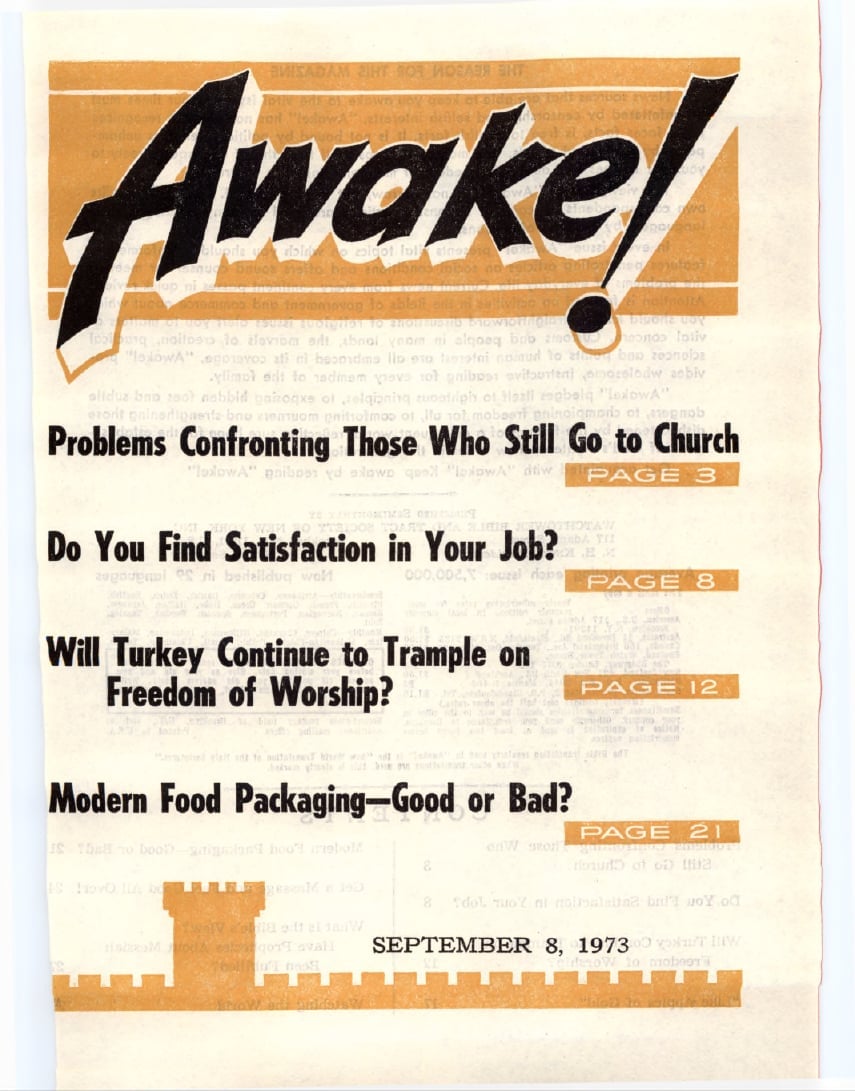
Awake! — September 8, 1973
Source: jw.org
Contents
Problems Confronting Those Who Still Go to Church
Do You Find Satisfaction in Your Job?
Will Turkey Continue to Trample on Freedom of Worship?
“Like Apples of Gold”
Modern Food Packaging—Good or Bad?
Get a Massage and Feel Good All Over!
Have Prophecies About Messiah Been Fulfilled?
Watching the World
Have You Personally Weighed the Evidence?
God’s Kingdom Has Approached
Problems Confronting Those Who Still Go to Church
Problems Confronting Those Who Still Go to Church
“CHURCH CRISIS AND CIVILIZATION CRISIS.” Under this headline French cardinal Daniélou wrote in the Paris daily Le Monde: “The real problem is that within the [Catholic] church there is a sort of internal collapse, a sacramental crisis, an inner-life crisis, a priestly vocations crisis. And behind all this there is . . . is a faith crisis. . . . These crises are real and serious.”
This avowal by a Catholic prelate was accompanied by letters sent to Le Monde by distressed Catholics. They indicate that sincere Catholics, acutely aware of the “faith crisis,” are suffering because they are gradually realizing that this crisis has been brought about in a large measure by faithless church leaders.
Priests Ashamed to Speak About God
One woman wrote: “In no church can you hear a priest who dares speak about purity, sacrifice, respect for self and for others, or virtue (a nineteenth-century word that raises a big laugh among priests dressed in light-blue pullovers and nuns in short skirts). The clergy ‘make overtures to the world,’ but rarely speak about God.—Le Monde, August 28, 1971.
A year later, a twenty-two-year-old student complained about the sermons he had listened to during his vacation. He wrote: “Like many French people, I have just spent a month traveling around France, and as in the case of many Catholics, that has meant attending Sunday Mass and listening to sermons in five different parish churches.” The first sermon, he explained, was about rural consolidation. The second dealt with “The mind on vacation.” The third priest asked the parishioners to speak in his stead. The fourth told the flock about a comic motion picture he had seen, and the fifth spoke on capitalism and brotherhood as being incompatible!
This young Catholic added: “Priests speak less and less about the things we want to hear. When I listen to a sermon, I expect it to stir up my faith, or what is left of it. I expect the priest to speak about God, and to explain Revelation. I could not care less about what Reverend Father X thinks about the change of government. . . .
“In short, there is a twofold problem. Regarding the faithful, there is absolutely no doubt that the churches are becoming empty. Any tourist will confirm that fact. Regarding the priests, they are said to be going through a vocations crisis, and there is a great increase in ‘deserters.’ . . . The real problem is that many priests, turned adrift, no longer believe very much in what they are doing. . . .
“These few lines are not meant to offend anyone. Their only purpose is to ask the priests, whose job it is, to speak again about God, love or sin. If they have nothing to say on those questions, let them remain silent!”—Le Monde, August 6-7, 1972.
Another student, age twenty-four and living in southwest France, wrote: “When in church, we would like to hear about God and the Gospel, not a commentary on a recent television program or on the cost of living. . . . The dissatisfaction, not to say the anger, I feel . . . is leading me to desert what I persist in calling the ‘house of God.’” A doctor in Mulhouse, Alsace, wrote: “At my son’s marriage service, the priest gave a sermon on the war in Biafra and on road accidents.”—Le Monde, August 23, 1972.
So, evidently one of the problems confronting those who still go to church is to find a priest who still ‘believes in what he is doing’ and who is willing to speak about “love or sin,” “God and the Gospel.”
Doctrinal Problems
But do Catholic bishops and priests mean the same thing if and when they speak about “sin,” “God” and “the Gospel”? For instance, when Dutch bishops Johannes Bluyssen and Hubert Ernst speak on such important subjects, is their conception of things in harmony with other Catholic bishops, or even with Catholic headquarters in Rome?
Apparently not, for, on October 13, 1972, the Vatican publicly ordered the withdrawal of a catechism issued under the authority of these bishops for use in their dioceses (Brabant, Netherlands). This book, supposed to teach the rudiments of Christianity, was found to be “heretical” in teaching the six following points: “The Gospels are not historical; Christ never claimed to be God; the Trinity dogma was not taught until after Christ; the resurrection is a legend; no church can claim to be exclusively Christ’s church; Christ’s body, present in the Eucharistic bread, is merely a symbol of the church community.—Le Figaro, October 14-15, 1972.
Actually, both the modernist bishops of the Netherlands and the traditionalists of the Vatican are in error. The modernists are wrong in stating that “the Gospels are not historical.” (For example, see Luke 2:1, 2; 3:1, 2.) But the Vatican is also wrong in classifying as “heretical” the statements that “Christ never claimed to be God” (see John 10:36; 5:19; 14:28) and that “the Trinity dogma was not taught until after Christ.”a The modernists are grossly mistaken when they claim that “the resurrection is a legend” (see 1 Corinthians 15:3-8) and that “no church can claim to be exclusively Christ’s church,” for Christ has only one true congregation, and it must be a “pillar and bulwark of the truth.” (1 Tim. 3:15, Revised Standard Version, Catholic Edition) And both the modernists and the traditionalists err with regard to the statement “Christ’s body, present in the Eucharistic bread, is merely a symbol of the church community.” On the one hand, Christ’s body is not present in the bread, as the traditionalists claim, and, on the other hand, while it can be said that the bread is “merely a symbol,” it does not symbolize the “church community,” but, rather, Christ’s fleshly body offered up in sacrifice for his disciples.—Luke 22:19.
It can therefore be seen that sincere Catholics are receiving no clear doctrinal lead from their spiritual overseers, be they modernists or traditionalists. Commenting on these doctrinal differences within the Catholic Church, the French monthly magazine Le spectacle du monde wrote: “The Vatican stated that the Netherlands are not an isolated case in this respect.” The doctrinal confusion is general.
The same magazine reported: “The traditionalists blame secularization for the doctrinal and institutional breakdown of the [Catholic] church: secularized Liturgy has been sidetracked by ‘man worship;’ the sudden introduction of politics into the Church has led to materialism; the doctrinal crisis has been brought about by ‘pirate theologians’ and lax bishops.”—Le spectacle du monde, December 1972.
Thus, if the aforementioned young Catholic student had been fortunate enough to find five parishes where the priests condescended to preach on subjects other than economics, motion pictures or politics, he would not have been at all sure of hearing a coherent message from week to week. How can sincere Catholics have strong faith if they are told contradictory things by their priests and bishops? How can they be expected to know what to believe when faced with the conflicting teachings of the modernists and the traditionalists, particularly when both are often in conflict with what the Bible teaches?
Political and Moral Problems
In a front-page editorial, Le Monde recently wrote the following: “Politics is no longer a forbidden word for Christians. On the contrary, this word has become quite popular in the French [Catholic] church. . . . The French bishops have just studied the close relationship between faith and politics.”—Le Monde, October 31, 1972.
In point of fact, the 1972 Plenary Assembly of French bishops, held in Lourdes, was mainly devoted to the theme “Politics, Church and Faith.” It published a long episcopal report entitled “A Christian Way of Engaging in Politics,” of which the main promoter was Bishop Matagrin of Grenoble. This French prelate is of the opinion that “to meet all the requirements of Christianity, a Catholic is duty bound to take part in politics.”—Le Dauphiné libéré, October 23, 1972.
What is the result of the church-sponsored political involvement of Catholics? Reporting on a religious meeting held in Paris to discuss this episcopal report, a Catholic daily stated: “The meeting at the Mutualité Hall confirmed the wide variety of political opinions held by Christians [Catholics], ranging from extreme Right wing to extreme Left wing.”—La Croix, January 18, 1973.
The consequences of such political divisions are obvious. As a French newsweekly put it: “From now on, each Catholic can, Gospel in hand, build his own model of future society. . . . Thus, on a certain Sunday in March 1973, Catholics will be able to kneel down side by side and receive Communion, and then go and put in the ballot box radically different votes.” (L’Express, October 16-22, 1972) Can one imagine the apostles leaving the “upper room” in Jerusalem and then casting votes for different political parties?
But the problem is even deeper than that. Catholics with widely different opinions could easily let their political feelings predominate, with serious religious repercussions. In fact, this disunity has already appeared, as shown by the following quotations: “Political choices create classes that have trouble communicating with each other. . . . This is so much so that Christians [Catholics] are asking themselves if they can really partake of the Eucharist together.” (La Croix, March 16, 1973) “Some [Catholics] refuse to celebrate Mass with others whom they disagree with on what they consider to be fundamentals.”—Le Monde, October 29-30, 1972.
It appears, therefore, that differing political opinions constitute another problem for sincere people who still go to church. What about morals?
Traditionalists inside the Catholic Church speak of the need to “challenge the modern world’s idols: sex, money and State.” But the modernist clergy have adapted themselves to the present-day permissive society. Under the title “Who Still Keeps Lent?—Misty Sin,” Robert Solé writes: “Who does penance anymore, in a church whose members seem to be progressively losing all sense of sin? . . . Today, Catholics are asking: ‘What is evil’?, whereas not long ago they saw evil everywhere. . . . Formerly, sin was well defined and subject to appropriate rules, but at present sin is misty. . . . Cheap psychology has convinced Christians that religion, with its ancient prohibitions, was what caused the feeling of guilt.”—Le Monde, March 4-5, 1973.
Here again, because the churches are giving no clear lead on morals, sincere Catholics who still go to church are faced with serious problems. Should they follow their religious leaders, many of whom have adopted this world’s standards of behavior, or should they adhere to Bible principles and listen to their God-given conscience?
The Responsibility of Each Church Member
French Catholic author and philosopher Jean Guitton, member of the French Academy, once wrote: “We should be totally willing to abandon our religion if it turns out to be anything but the truth.” More recently he stated: “In the end, an atheistic Catholicism might appear not very different from Communism.”—Paris-Match, December 16, 1972.
How do you feel about this? Do you belong to a church where it is difficult to find “a priest who dares speak about purity, sacrifice, respect for self and for others, or virtue”? The distressed Catholic woman who made that complaint added: “The clergy . . . are gradually leading us to an atheistic form of Christianity.” Is that where you want to be led?
Are you a part of a church where theologians and bishops are teaching that “the Gospels are not historical” and that “the resurrection is a legend,” or where you are told that you are “duty bound to take part in politics,” with the resulting confusion and disunity? Is yours “a church whose members seem to be progressively losing all sense of sin” because their spiritual leaders teach morals based on “cheap psychology” rather than on Bible principles?
If so, do not think you can shift all the responsibility onto the leaders of your church. Each of us is individually responsible before God. As the Bible says: “We shall all stand before the judgment seat of God.” (Rom. 14:10) Guitton was right when he said that if our religion “turns out to be anything but the truth,” then we should abandon it. The Bible summons sincere churchgoers to leave the entire world system of false religion quickly, before it is destroyed by God. (Read Apocalypse or Revelation, chapters 17 and 18.)
The Bible urges us to “worship the Father with spirit and truth.” (John 4:23) That is the kind of worship that interests Jehovah’s witnesses. It is for that reason that they put much emphasis on Bible study. They will be glad to study the Bible with you, free of charge, in your own home. You are also invited to their Kingdom Halls. There you will “hear about God and the Gospel,” yes, the good news of everlasting life in God’s new order, now near.—2 Pet. 3:13; John 17:3; Rev. 21:3, 4.
[Footnotes]
Interestingly, the New Catholic Encyclopedia (1967), on page 295 of volume 14, admits that “one should not speak of Trinitarianism in the New Testament without serious qualification.”
[Box on page 4]
Financial Support
● Routine collections and appeals for special funds continue to yield results. Yet “Giving USA” for 1971 reports: “Religious institutions have probably been hurt most by inflation. Giving to religion the last 3 years . . . represents a net loss to inflation of at least 2.5 percent.”
● Are churchgoers happy about the giving? “Chanting anti-church slogans, 500 Italian-Canadians marched three miles in [Montreal’s] north end Sunday to protest taxes levied by some Catholic churches on their parishioners,” says the “Free Press” of London, Ontario, February 26, 1973.
● Parochial schools are feeling the pinch. There are 14,952 fewer teaching nuns in the U.S.A. than in 1970. By its decision on June 25, “the Supreme Court appears to have dashed any hope at either the national or state level for major new forms of public help for financially pressed parochial . . . schools,” observes the New York “Times.”
[Box on page 4]
Membership and Attendance
● It is reported that regular church attenders in Australia have decreased by 30 percent in the past 11 years. France has only about one in four going to church. In Lisbon, Portugal, just 15 percent of Catholics go to Sunday Mass.
● The “Daily Telegraph,” of April 16, 1973, commented: “A new analysis of church membership in the United States and Canada reveals that the Roman Catholic and most major Protestant churches either lost members . . . or failed to keep pace with the population increase. . . . The Jehovah’s Witnesses, however, reported a gain of 7.2 per cent.”
[Box on page 5]
Moral Issues
● Many churches no longer advocate the high moral standard of the Bible. For example, an article in “The Christian Century,” of May 30, 1973, observes: “In attitudes toward sexual deviations, a very complex situation has arisen . . . a clergyman who is found to have some degree of homosexual tendency is not likely to be summarily dismissed.”
● Some churches are quite willing to encourage those in the gambling business. Says the British “Guardian”: “A trade Union for bookmakers’ employees has been formed with the help of the Church of England.”
● The record of religion includes bloodguilt. In eastern Africa, where over 100,000 tribesmen were slaughtered last year, “the Catholic Church . . . claims the allegiance of 60 per cent of the population. . . . Catholics killed Catholics,” according to “Newsday,” May 23, 1973.
● So many immoral things are going on these days that, as John Cogley writes in “Catholic America,” “preachers hesitate to speak openly about guilt or sin.”
Do You Find Satisfaction in Your Job?
Do You Find Satisfaction in Your Job?
“JOB SATISFACTION” is a theme that is being discussed more and more in industry. If you are satisfied with your job you have much for which to be thankful. Today increasing numbers of workers throughout the world find their jobs anything but satisfying. And this trend reaches all the way from the unskilled laborer to the executive, although it is most pronounced among those working on assembly lines.
So, if you fail to find satisfaction in your job, you are far from being alone. According to one official in the United States Labor Department, this matter of job dissatisfaction “is one of the most important issues of the day.” Why is this? Because lack of job satisfaction is pinching management where it hurts. It is affecting production, and what affects either the quantity or the quality of production affects profits. Job dissatisfaction is causing shoddy workmanship and dissension; it causes tardiness and often has racial overtones. In some plants it has resulted in not only apathy and indifference, but even rebellion to the point of sabotage, as in an instance where six finished autos were found to have their upholstery slashed.
But most symptomatic of job dissatisfaction, as well as most costly, is absenteeism. By absenteeism is meant the failure of employees to show up for work when they are supposed to, regardless of the reason—whether illness, feigned or real, bad weather, arguments with the boss, the morning-after effects of late night carousing, alcoholism, drug addiction, or a desire to go hunting or fishing. Today in many industries absenteeism averages 5 percent, which means that on any given day of the workweek five out of a hundred employees fail to show up. And on Mondays and Fridays, the beginning and ending of the workweek, the percentage in some plants is as high as 15 to 20 percent.
Absenteeism is most common among the young workers, from eighteen to twenty-five years of age. Women workers average 36-percent higher absenteeism than do men, and blue-collar workers, on an average, fail to show up for work 57-percent oftener than do white-collar workers. In recent years absenteeism has increased in various industries from 10 to 41 percent. As to the price of all this absenteeism to industry, it is reported that a rise of just 1 percent in absenteeism at a plant hiring 1,000 workers can increase costs $150,000 a year. A president of a small corporation stated that, because of absenteeism, his firm has 285 workers on the payroll whereas actually only 255 are needed.
Why the Lack of Job Satisfaction?
Why is job dissatisfaction so widespread and increasing? Is it due to insufficient wages? No, for not only do wages keep increasing year after year, but fringe benefits have gone away beyond even the fondest expectations of workers just a few years ago.
Those managing industry, by and large, apparently feel that such material rewards should be enough to satisfy their workers. As one corporation president put it: “We must receive the fair day’s work for which we pay the fair day’s wage.” And workers on assembly lines are being well paid, often receiving from $3.50 to $4.50 an hour. But are good wages and plenty of fringe benefits enough to give job satisfaction? They may have been for some workers in times past but evidently are not now, at least not for many workers.
Today the cry is heard throughout industry about the monotony, the boredom of assembly-line work and about the frustration due to the lack of opportunity for advancement. Especially young men take the attitude that they are not mere machines, but have feelings, desires and ambitions. Driving this point home was the strike that General Motors suffered at its Lordstown, Ohio, plant. It is said to be the world’s most modern and most productive auto-assembly plant, its lines being designed to turn out 101 autos an hour. Why did the men strike? Because of wages? No, they were being well paid. They struck because the jobs were too dull and the pressure seemed too great. Apparently the designers of that plant had largely overlooked the human element. So management had to learn that even the world’s most efficient assembly lines are productive only when men are willing to man them!
Management’s Share of the Blame
No question about it, the assembly-line conditions under which many employees work, together with the attitudes manifested by ‘management,’ have a great deal to do with the lack of job satisfaction. Blaming both factors for the “understanding gap” between management and the workers are a number of industrial psychologists who have made a study of the situation. Among other things, they stated:
“The biggest difficulty we have is making top management aware of the blue-collar problem—and, more important, getting them to do something about it.” “The amount of time corporate boards spend on making human decisions is infinitesimal. Recently, industry has been forced to think about these problems. But they are still regarded as secondary.” “There must be real commitment by top management to the idea that worker satisfaction is essential to increased productivity. Too often, I fear, we are more concerned about the machines than the men and women who operate them.”
That these observations are well taken is apparent from a report that appeared in the New York Times, February 5, 1973. Under the heading “Jobs Rotated to Fight Boredom,” it told of the satisfaction that sixty blue-collar workers at a pet-food plant were deriving from getting “a chance to do every major job in the plant.” But according to a recent study by the United States Department of Health, Education, and Welfare, only about 3,000 are involved in such experiments. There is more of this kind of experimenting being done in European countries. But, of course, this does not necessarily increase production. For example, at several European auto plants groups of workers together assemble an entire car, though their production does not begin to compare with that of leading United States auto producers. But is that necessarily bad? Would it not be fine if more people were genuinely concerned about the welfare of their fellowman?
The Workers’ Share of the Blame
However, not only has top management been dragging its heels in the matter of increasing job satisfaction but men in organized labor have often been hindering rather than expediting such improvements. How could that be? Instinctively they are suspicious of the motives of anything that management does. Then, too, union officials may be fearful for their jobs and power if relations between workers and management improve. It has happened repeatedly that, in plants where such innovations were made and the management has shown a genuine concern for its workers, the employees have rejected the efforts of union agents to organize them.
Not all the blame for the “blue-collar blues,” as job dissatisfaction is often called, rests with the management. There is also a steady decrease in what is termed the “work ethic.” As The Wall Street Journal put it: “In both the private and public sector, the work ethic—the belief in the dignity of honest toil, the feeling of accomplishment at having helped produce something worthwhile—clearly has fallen on hard times.” There is less and less appreciation of the Biblical principle that honest work is the obligation of everyone able to work. The Bible says: “If anyone does not want to work, neither let him eat.” In fact, time and again the Bible censures the lazy ones, the sluggards, the indolent, the slothful ones, especially in the book of Proverbs. Typical is the well-known saying. “Go to the ant, you lazy one; see its ways and become wise.”—2 Thess. 3:10; Prov. 6:6.
Illustrating this lack of will to work is the motto that appears on the wall of a bar near a Fort Dearborn auto-assembly plant. It reads: “I Spend 40 Hours a Week Here—Am I Supposed to Work Too?” Thus also one worker, when asked about the nature of his new job, replied: “Listen, man, I would not think of working at a job that caused me to be tired when I came home at night!” Older, energetic workers are often heard complaining about the work attitudes of younger ones.
Yes, people are less and less inclined to work hard, especially if the work is uninteresting. The conditions that were foretold in the Bible—the increasing of lawlessness and the critical times hard to deal with—that are upon us, doubtless have something to do with it. (Matt. 24:12; 2 Tim. 3:1-5) Helping to bring about these conditions are two trends. On the one hand, there is less and less faith in God and so less and less feeling of being accountable to Him. And, on the other hand, economic conditions have greatly improved. Whether a person wants to work or not, he seems to be able to get unemployment insurance or welfare payments.
What You Can Do About Job Satisfaction
What can you do to find satisfaction with your work? First of all, realize that when you accept a job you have responsibilities to fulfill. It is not honest to do otherwise. Then, to the extent that you are able to do so, take pride in doing well the job you are being paid to do. Each man’s job in an assembly line must be done well if the finished product is to pass inspection. Lack of interest because of lack of job satisfaction accounts for the high percentage of rejects found in some plants and only makes the matter worse for the worker himself.
Of course, if you are able to change your job, that may be the best thing to do. Perhaps you can find a job that does give you satisfaction. Not a few are doing this these days, and those doing so are not limited to assembly-line workers. Thus a salesman in Ohio quit his job and moved to Alaska, where he is finding satisfaction in outdoor work. A former stockbroker is now studying and working toward a scientific career that will keep him in touch with nature. A New York City insurance broker quit his job and now runs an inn that he bought in Maine. A former veterinarian works at loading and unloading trucks because of the satisfaction he gets from manual labor, even though it pays only $2.50 an hour. In fact, he has turned down three offers for advancement, as he is not interested in an office job. And there is a police inspector who found himself getting mean because of the frustrations associated with his work, so he quit that work and took up painting and now finds satisfaction in making his living as an artist.
If you are able to find satisfying work, obviously that is the simplest way to end job dissatisfaction. But comparatively few are in position to make such a drastic change, or they may be fearful that their plans will not work out. So, next to trying to take greater interest in one’s work, what else can a person do?
Anyone can try to cultivate an improved outlook on life. As one industrial psychologist put it: ‘The degree of boredom depends upon one’s philosophy of life.’ Even if you have a job that has a minimum of challenge or responsibility, you need not suffer from deadly monotony. View your job as a means to an end, which is really what it is. Does it provide you with a measure of security, with what you need to take care of yourself and your family? Do not lose sight of these reasons for your work.
Also, if you cannot do anything about making your job more interesting, satisfying and rewarding, you can work at making your personal and family life more interesting, richer and fuller. If you work hard at that, you most likely will be rewarded with the love, respect and cooperation for which your soul longs. As you contribute to the happiness of your loved ones and they contribute to yours, you will find the monotony of your job less of a burden.
In this regard it might be said that Jehovah’s witnesses are in a peculiarly favored position. Why? They endeavor to apply the advice of Jesus Christ not to set their hearts on material riches. Instead, they ‘seek first the kingdom of God and his righteousness.’ (Matt. 6:19-33) Of course, they, too, are grateful when their secular work is personally satisfying. But such work is not the big thing in their lives. They view it only as a means to an end. It supplies their material needs so that they can devote themselves as fully as possible to the service of God. Their real delight is in aiding others to learn about God’s new order, a new system that will not be marred by exploitation of one’s fellowmen. Love of God, love for one’s neighbor, righteousness and truth will permeate life in that new order. Under such conditions, the work that is done will be genuinely satisfying. And the realization of that hope is not dependent on the negotiations of self-seeking men. It is based on the promise of a loving God, the unfailing word of the Creator of heaven and earth. With firm faith in such a grand prospect, much contentment in life can be had even now.—2 Pet. 3:13; 1 Tim. 6:6-12.
Will Turkey Continue to Trample on Freedom of Worship?
Will Turkey Continue to Trample on Freedom of Worship?
ONE real test of a government in crisis is whether it strikes out indiscriminately against accused innocents as well as actual enemies of the state. Will the government allow itself to be swayed by the misrepresentations of alarmists who may try to use the occasion to eliminate minorities who are unpopular with them?
Turkey is at present a country struggling to prevent anarchy and terrorism. In a letter to the editor of the New York Times, Turkish Director General of Information, Altemur Kilic, says:
“Turkey is going through a difficult period, when the President, the Government and the armed forces are performing a commendable feat by combating anarchy and terrorism on the one hand and by trying to implement the reforms and safeguarding the democratic regime on the other.”
Is Turkey really succeeding in safeguarding democratic freedom? Her constitution of 1961 is claimed to be “the most progressive in the Moslem world.” She has also signed the Universal Declaration of Human Rights of the U.N., which guarantees “freedom of thought, conscience and religion.” Yet, in Turkey, the religious freedom of innocent persons, Jehovah’s witnesses, is now being trampled underfoot. Why?
Military Supreme Court Denies Appeal
On January 24, 1973, a military court in Eskisehir, Turkey, sentenced four of Jehovah’s Christian witnesses to pay heavy fines of 5,000 Turkish lira (about $357) each. The court claimed they were guilty of violating Article 143/3 of the Turkish Criminal Code. On April 17, 1973, the Military Supreme Court upheld the lower court.
The decision of the Military Supreme Court said that the crime consisted of “joining without permission an international society with the name Jehovah’s witnesses, namely, becoming Jehovah’s Witnesses.” The decision goes on to describe as evidence against them the fact that by talking to others “about Jehovah’s witnesses and especially about the Bible it is established that the accused have accepted the ideas of Jehovah.” It is now a crime in Turkey to be one of Jehovah’s witnesses, and anyone who professes to be of that faith can be punished with a TL 5,000 fine. For the average person in Turkey, that represents a major part of the year’s wages. Furthermore, as long as a person continues to hold to his beliefs, he is liable to be punished at any time!
So far about seventy persons have been arrested and tried or are awaiting trial—and the tempo of arrests has increased!
Evidence of Misrepresentation
The Military Supreme Court has tried to show that “apart from religious views,” Jehovah’s witnesses hold views from which “a very dangerous movement against our country could arise.” To support this assertion, the court presented the following statements: (We have italicized those charges among them that are false.)
“The Jehovah’s witnesses society, which is the subject of this trial, in its publications as well as through talks is expressing views such as not respecting or showing love for the flag or emblems, not performing military service and giving permission to marry more than one wife in order to instill the Jehovah principles in them, . . . has chosen a way of weakening or destroying the national unity, national tradition, national feeling and beliefs, and finally by holding that Israel, namely the Jews, will rule over all the nations, have purposely acted to develop empathy for the Jews and are thus tearing down national feelings and serving Zionism . . . emphasizing that people should live together in brotherhood and not make war, not keeping national and religious feasts and in addition by marrying more than one woman with the purpose of influencing their mates with the Jehovah belief and divorcing those mates who do not accept their beliefs, which views are against the public order and national feelings.”
Those who have any knowledge of the beliefs of Jehovah’s witnesses know that all the statements in italics are completely false. For the benefit of those unfamiliar with their beliefs, we offer these brief comments:
Are Jehovah’s witnesses ‘not respecting the flag’? The Supreme Court of Washington, U.S.A., says, “Jehovah’s witnesses . . . refusal to salute the flag is not because they do not honor the flag, but because of an honest conviction, based upon their interpretation of the Bible.”—Stone v. Stone.
Do they ‘give permission to marry more than one wife’? A publication used by Jehovah’s witnesses and entitled “Living in Hope of a Righteous New World,” says:
“Through Christ Jesus [God] restored the basic principle of marriage, that man should have but one wife. . . . In lands where the custom is for men to have more than one wife . . . it will mean a big change in his life, putting away all his secondary wives, . . . but he must make it.”—Pp. 41, 42.
Are they “weakening or destroying the national unity” when they are at the same time “emphasizing that people should live together in brotherhood and not make war,” as the Military Supreme Court itself said a few phrases later? Jehovah’s witnesses encourage people to love one another, and there is no greater uniting bond than love.—Col. 3:14.
Do they ‘hold that Israel, namely the Jews, will rule over all the nations,’ and also ‘act to develop empathy for the Jews’? The Watchtower, also used by Jehovah’s witnesses, says: “He [God] has no dealings with any other nation, and that includes fleshly Israel . . . God has therefore abandoned her nationally.” (1958, p. 156) What about ruling over all the nations? Jehovah’s witnesses believe that it is God’s heavenly kingdom that will rule the earth.
Do Jehovah’s witnesses ‘serve Zionism’? The Honorable Richard Heath, U.S. ambassador to Lebanon in 1956, said: “The officials in the Ministry [Lebanese Ministry of Information] were assured that The Watchtower is not pro-Zionist. . . . it is of nonpolitical nature.”
Are they “divorcing those mates who do not accept their beliefs”? The Encyclopædia Britannica, under the heading “Jehovah’s Witnesses” in the 1959 edition, says, “Divorce is disapproved.” Only when based on sexual immorality with a person other than one’s mate does divorce free a Witness for remarriage. What if a mate does not agree on religion? The Witness publication Living in Hope of a Righteous New World counsels: “The Christian mate who recognizes the seriousness of marriage . . . will not seek to leave his unbelieving mate.”—P. 48.
Are such beliefs, based on the Bible, really “against the public order?” Judge for yourself.
These false and misleading charges form the bulk of the Military Supreme Court’s argument to prove that Jehovah’s witnesses are “a very dangerous movement.” Now, suppose we remove the false charges from their list. How “dangerous” do these people prove to be? Here are the charges that remain:
“Not performing military service . . . emphasising that people should live together in brotherhood and not make war, not keeping national and religious feasts.”
Do you think these matters are crimes for which a person should be deprived of freedom of worship and his livelihood? It is interesting to note that the lower military court admits that these practices are not a crime. It says:
“No evidence has been found in the beliefs of Jehovah’s witnesses of their trying to change the political or social order of the state.. . . . The court has judged, that the accused have not made propaganda in the sense of influencing people not to accept or perform national duties, nor have they tried to gain persons for the purpose of weakening the national feeling. The fact that they do not accept all national duties in itself is no crime. Neither has there been found any evidence in their teachings or literature, that they encourage disrespect for the flag, or prevent people from serving in the armed forces.”
Yet the Military Supreme Court reverted to the same charges and added the false ones. Were not the judges (Colonels N. Alkan, Y. Eryilmaz, A. C. Akgün, F. Marsan and N. Turanay) provided with accurate information to consider when making their decision? Yes, they were, in the form of publications in Turkish used by Jehovah’s witnesses, as well as much legal argument.
However, at the same time, misleading information from other sources must have been introduced. Where did it come from?
Source of Misleading Information
Consider this: One of the accusations in the list of charges was that Jehovah’s witnesses are “not keeping national and religious feasts.” Also included was reference to “the answer of the Office for Religious Affairs [a Moslem government office] in response to the written enquiry Number 119647 of December 7, 1957.”
The portion quoted from this Moslem statement says, among other things: “By making propaganda in our country by various means damage can be caused toward Islam.” Is this what the court means by describing Jehovah’s witnesses as a very dangerous movement against our country”? Could it be that for religious advantage, some are using the critical times in an attempt to eliminate a minority religion?
If so, such conduct would be contrary even to the tenets of Islam. The Koran, in Sura LX. 8, says:
“As to those who have not borne arms against you on account of religion, nor turned you out of your dwellings, God forbiddeth you not to deal kindly with them, and to behave justly towards them: for God loveth those who act justly.”
Is it ‘just’ or ‘kind’ to misrepresent people who the court itself says are “emphasizing that people should live together in brotherhood and not make war”?
The “Crime” of Jehovah’s Witnesses
The law used against Jehovah’s witnesses illustrates how difficult it was for accusers to find a pretext against them. Article 143/3 of the Turkish Criminal Code says that a person who “in this country is joining without permission an existing international society or a society which has its headquarters outside the country or institutions or branches thereof,” has to be punished. Clearly this law is aimed at controlling the activities of organizations that may be subversive. It is not designed to deprive people of freedom of worship. Article 19 of the 1961 Turkish Constitution says:
“Every individual is entitled to follow freely the dictates of his conscience, to choose his own religious faith and to have his own opinions. Forms of worship, and religious ceremonies and rites are free provided they are not in opposition to public order, or morals or to the laws enacted to uphold them.”
How, then, does the court justify action against these peaceful Christians? Essentially the court’s argument is this: Apart from religious beliefs, Jehovah’s witnesses are members of a society or corporation with its headquarters outside the country. This society, the lower military court speculates, “can at any time in the future cause danger to the Turkish society.” So the court argues that permission to be one of Jehovah’s witnesses must be obtained “as a preventive measure.” Therefore, they say, Article 143/3 applies to Jehovah’s witnesses.
But if this law can be made to apply to Jehovah’s witnesses, then why does it not apply to members of all the churches located in Turkey whose headquarters are outside the country? The Catholic Church member is not less bound to the Vatican in Rome. The Armenian Church has its “supreme patriarch and catholicos” in Echmiadzin, Soviet Armenia. Other recognized Protestant organizations have their church headquarters in various lands.
A legal error was made by the court when it held that Jehovah’s witnesses are members of a corporation that operates outside the country, the Watch Tower Bible and Tract Society. This corporation is, of course, a necessary legal instrument, used to hold property and publish printed material. However, Jehovah’s witnesses in Turkey are not members of this corporation. Corporation membership is restricted to no more than 500 by its charter, and none are in Turkey.
Jehovah’s witnesses in Turkey are members of a religion, just as are the Moslems, Armenians, Catholics and others. To charge otherwise is to do violence to the intent of the law and make it clear that pressure is being exerted to eliminate a religious minority. Such action in any “free” country would be labeled ‘religious intolerance.’ Is that the reputation Turkey wishes to hold before the world?
Turkey’s Reputation in Question
Another error was made by the court when it relied on speculation as opposed to reality. Do the military judges really believe that this small group, whom they themselves characterize as “emphasizing that people should live together in brotherhood and not make war,” could at some speculative “time in the future cause danger to the Turkish society”?
The highly respected founder of the modern Turkish Republic, Kemal Atatürk, said that reason and science should be the only guide for Turks. Would it not be far more reasonable for the Turkish judicial system to expend its energies on prosecuting those who have brought real trouble to Turkey, rather than conjuring up an imaginary enemy?
Atatürk also promoted the dictum of “peace at home and peace abroad,” also embodied in the preamble to the Turkish Constitution, which was prepared “with full dedication to the principle of peace . . . Guided by the desire to establish a democratic rule of law . . . which will ensure and guarantee human rights and liberties.” This goal has not changed, according to former prime minister Nihat Erim.
Does the Military Supreme Court agree with this policy of peace? Then why prosecute those, who, by the court’s admission, live their lives in harmony with this ideal?
Will Turkey’s officials and court system justify the trust given them by the founders of her constitution in its preamble?
“The Turkish nation hereby enacts . . . this Constitution . . . and entrusts it to the vigilance of her sons and daughters who are devoted to the concept of freedom, justice and integrity, with the conviction that its basic guarantee lies in the hearts and minds of her citizens.”
How can it be in the best interests of the country to suppress the freedoms of a minority not engaged in overt acts against it? Suppression of minorities will certainly not enhance any nation’s claims of freedom in the eyes of the world.
How Turkey’s judicial system deals with the cases against Jehovah’s witnesses now pending before the courts will show her true position toward freedom. An article in The Middle East Journal by Mr. Erim says: “The democratic regime in the country and the people’s devotion to this kind of government have withstood several crucial tests.” Will they withstand this one?
The Christian View of Mistreatment
That those who serve God faithfully will be mistreated and misrepresented is something that does not surprise Christians.
Christ Jesus himself, who is recognized as a prophet by Islam, was misrepresented legally by religious opposers. He said plainly: “My kingdom is no part of this world.” (John 18:36) Yet Jewish religious opposers misrepresented him, citing the Roman law of laesa majestas (“injured majesty“), which was aimed at stopping political opposition to the emperor. They charged: “Every man making himself a king speaks against Caesar.” (John 19:12) Of course, this law had no application to Jesus, who went out of his way to avoid earthly political power, refusing to accept it on several occasions. (Matt. 4:8-10; John 6:15) Yet religious pressure was exerted to force the court to apply the law to Jesus. The trial judge, Pilate, even ‘found in this man no ground for the charges brought against him’; but, in the end, he weakly yielded to the religious pressure and sentenced Jesus on false charges. (Luke 23:14) Is Turkey’s judiciary going to continue to yield to similar pressure?
If Turkey’s judicial authorities sincerely desire justice for all her citizens, then they will correct their position, basing it upon accurate information presented by unbiased sources, as well as on the freedoms guaranteed by the constitution.
An Opportunity to Show Kindness
Is there anything you can do to assist Turkish authorities in their efforts to render justice? Yes. Even though you may not be one of Jehovah’s witnesses, you probably know something about their Christian conduct. If so, you have a fine opportunity to show where you stand on the matter of freedom of worship for all persons.
The principle found in the Bible at Matthew 10:42 illustrates what rightly disposed persons of any religion would wish to do when they see sincere Christians in need of assistance: “Whoever gives one of these little ones only a cup of cold water to drink because he is a disciple, I tell you truly, he will by no means lose his reward.” You can do much to refresh these disciples of Christ by making known the truth about Jehovah’s witnesses!
You may wish to make a written appeal for justice, tempering it with understanding of Turkey’s serious internal problems. If you wish to express yourself on this matter, it would be appropriate to write to the embassies and consulates of Turkey in your own country, as well as government officials in Turkey itself. Listed below are the names of Turkish officials to whom your appeal may be sent.
ADDRESSES OF OFFICIALS
President of the Republic
His Excellency Fahri S. Korotürk
Palace of the President
Çankaya Köşkü
Ankara, Turkey
Minister of Justice
Mr. Hayri Mumcuoǧlu
Bakanliklar
Ankara, Turkey
Minister of the Interior
Mr. Mukadder Öztekin
Bakanliklar
Ankara, Turkey
Prime Minister
Mr. Naim Talu
Başbakanlik
Bakanliklar
Ankara, Turkey
“Like Apples of Gold”
“Like Apples of Gold”
“LIKE apples of gold set in silver filigree is a word spoken in season.”a So said wise King Solomon, and few people would dispute with him the accuracy of that statement. The well-chosen word, spoken at the right time, is a work of art in the same way that a beautiful ornament of silver and gold would be. Few people realize, however, just how much goes into good expression and how necessary it is to choose words that will make the maximum impact on one’s audience.
Words are, of course, used to convey information and ideas from one person to another and so anybody who has a message to convey or an idea to get across should be interested in improving his powers of expression. Whether people will listen to him or not is largely dependent on how he expresses his thoughts.
Now we all realize that great works of literature are read and reread by their public in exactly the same way that great musical works are listened to over and over again and that the information is thereby impressed on the mind of the hearer by repetition. Most educated people have heard of Shakespeare, for example, even if English is not their mother tongue. In addition, most people tend to retain what they have read with pleasure. So if we wish to make a point or convince someone of something we should try to make our language as effective as that of those ancient authors.
The great literary critics, such as the Roman Horace, Aristotle the Greek or the Englishman Samuel Johnson, studied the works of others to find out what made them memorable reading, and their findings can be of great assistance to us.
For a start, all concur that good writing is not easy. Samuel Johnson said that what was written without effort was generally read without pleasure. Furthermore, they all agreed that we must do more than just tell a story or convey certain facts, unless our report is to be entirely functional. We must also touch the heart.
To do this our own attitude is most important. Are we really interested in that subject? One writer said that if you wished to make him feel pain, then you must first feel pain yourself, and in this way your language will have the genuine ring of truth. By involving our reader, amusing him, informing him or even shocking him, we will capture his interest and thus stir his emotions.
There are several basic things to be borne in mind in order to do this: the purpose of writing, the audience one is addressing and one’s choice of expression, called one’s style.
The Purpose of Writing
It is evident that if our intention is to amuse or entertain we will use a style radically different from that used by one who is trying to explain a complicated scientific fact to a nonscientific audience. Similarly, a person who is trying to convince his hearers of a vital religious truth does not want them rolling in the aisles with mirth.
However, it would be a mistake to imagine that what is written to instruct must necessarily be dull, or that because a person is telling a fictional story he cannot convey a great truth thereby. Many fictional works have had great social impact by placing a typical and sympathetic character in a certain situation and so calling people’s attention to the injustices inherent therein.
The works of the great French writers Flaubert, Balzac and Guy de Maupassant not only entertain but also can be considered as social commentary. People knew that slavery was wrong before Harriet Beecher Stowe wrote Uncle Tom’s Cabin, but not until they read the book, suffered with Uncle Tom and began to understand the sad plight of the Negro slaves in America were they moved to action.
On the other side of the coin, what is written to inform does not need to be boring. A Roman writer named Virgil wrote a series of works on agriculture called “The Georgics,” and if one has had the happy chance to have learned Latin, today one can still enjoy his lovely little section, all in verse, on beekeeping. He realized that an illustration drawn from an entirely different subject could enliven a discourse whose purpose was merely didactic and that humor was by no means out of place in, say, a scientific article.
Horace, a very practical critic of the first century before Christ, said that either a writer “tries to give good advice or he tries to be amusing—or he tries to do both. . . . A mixture of pleasure and profit appeals to every reader.”
In illustration of this point, one of the best-loved speakers on astronomy for the BBC in England a few years ago almost always started his talks on the night sky by talking about his garden and what the rabbits were doing to his lettuce. And throughout the course of the talk he would tell small jokes and stories, actually but distantly related to his subject, in order to retain the interest of those who had not been trained to think scientifically.
He realized that, although his primary purpose was to convey facts, his secondary one must be to do it in such a way that the people would want to know them; and since most people were not beamed in, so to speak, on the scientific wavelength, he adjusted his style accordingly.
The Audience Addressed
Yes, it makes a great deal of difference to whom we address our words. A letter to an aging aunt on the subject of her ill health is going to be quite different in tone, style and composition from a letter to a prospective employer stating one’s qualifications for a job. In the latter case facts count, in the first, warm human feeling.
Are we talking chiefly to men or do we hope that women and children will be attracted by what we have to say? Or are we addressing an international audience? Plainly, we cannot cater to everyone all at once, and some people have a natural penchant for one subject or another. Yet it is possible to give even technical subjects more universal appeal and thus reach a larger audience.
If we are addressing an international gathering, then by all means let us use illustrations from different lands. Bear in mind that on all continents points of view on basic subjects are not the same. Suppose, for example, we were trying to convince young people of the dangers of immorality. Well, we would, of course, remind the young girls of the shame attached to unwed mothers. However, have we also considered the African continent where most girls are expected to have produced a child before they marry as proof of their fertility, and where not only is this not thought a shame, but in some cases it is viewed as an honor? Frequently a man will refuse to marry a girl until she has produced a child. Many millions of people think in this way, so we need to bear such things in mind as we write.
Another example might be the technical article. Unless it is written solely for an audience with an advanced scientific training and is intended for reference, it is rarely any use filling it chock-full of facts and figures, especially in the first few paragraphs. Women almost always avoid, like the plague, articles containing a lot of numerical facts, as a glance at any magazine designed solely for women will reveal. They seem to like numbers only in knitting patterns! People from African and Asian countries, where the emphasis is more on human relationships and less on technology, find straight scientific information difficult to absorb. And honest truth to tell, there are very few of us who can enter into the enjoyment of the elderly math professor bent over a page consisting entirely of equations who looked up, chuckling, and said, “I say, he writes very well, doesn’t he?”
So suppose that we were writing a letter about the Kossou Dam in Africa. We could start off, perhaps, by eliciting our reader’s sympathy for the people living in the villages nearby who, up until now, have had no running water or electricity and for whom the dam will be a blessing. Or, conversely, perhaps we could get him worried about the bad effects these dams have on the populace due to the increase in water-transmitted diseases. And then, afterward, we could slip in those rather indigestible facts as to how long or how deep it is and how many tons of fish it is expected to produce.
Then, finally, having captured the interest of our reader, we will want to retain it, and that will depend, to a large extent, on our manner of presentation.
Manner of Presentation
First, we can vary the framework into which we put our information. We might write a straightforward documentary, counting on the facts to speak for themselves. Or we might present our ideas in the form of a dialogue, as did Plato or Aristophanes, each of the persons representing a different point of view. Or we might write a play or story and by the way in which the various characters end up show what we think of certain situations. Sometimes in a play a chorus on-stage can comment on the action as it goes along to bring out the point, as they did in Greek drama. Sometimes it is even more effective to let the action speak for itself. Some fine works were done almost entirely in verse, as was the book of Job.
Secondly, the actual words we choose will affect our audience. The critics all agree that we must be simple and brief but varied. Aristotle rated purity and clarity very highly and Horace pungently advised the budding author to throw out the paint pots and the words a foot and a half long. By that he meant that we should not be too flowery nor use long, erudite words that nobody understands.
Although we might wish to ornament what we say, there is absolutely nothing to beat the simple, straightforward style. Too many words, too elaborately said, might even confuse our audience and give them the desire to leave off reading. Look at the example of John’s biography of Christ. It is a model of simplicity, John’s style and vocabulary marking him as an ordinary and unlettered man, and yet his Gospel is considered the most moving of the four.
One of the first aids to simplicity is brevity, but being brief is a lot more difficult than one might imagine. Blaise Pascal, the French philosopher, wrote to a friend, “I have made this letter longer than usual because I lack the time to make it short.” And poor old Horace said, somewhat ruefully, that it was when he was trying to be brief that he became unintelligible!
He was, however, full of bright ideas as to how we could do it. For a start we should prune out the unnecessary words and repetitious phrases—get rid of the fuzz, so to speak. Although the information should be complete, it should also be compact. Clarity comes from stripping down to the bare bones of the idea and making it stand out in the same way that one person on a stage will hold the attention more easily than a group.
This simplicity and brevity that the great writers advocated does not mean, however, that we cannot be varied. There is no lack of interesting words, nor of interesting ways of expressing ourselves. We have many fascinating examples of different styles in the Bible, for example, and we would do well to imitate some of them.
There is the poetic diction of the Psalms; the dramatic style of Habakkuk; the vivid imagery of Nahum, who speaks of the flame of the sword and the lightning of the spear; the pithy, epigrammatic style of the Proverbs; matter-of-fact, concrete language in Jonah (he certainly had no need to embellish that story!); or the conversational, everyday speech of Christ’s parables. In exposing falsehood we might use an ironic style, as did the apostle Paul in his letter to the Corinthians, subtly showing their ingratitude in setting up their “superfine apostles.”
Our motive is, of course, important. We might ask ourselves whether our words will affect our reader, his outlook on life, his work or his relations with others. Are we hoping to arouse good or bad thoughts by what we have written? Are we going to present an immoral person as our hero and try to excuse wrongdoing, or will we support, perhaps, a theory that is in contradiction to the Bible?
No matter how well written a book might be, if it is to promote an idea that is in conflict with good morals, then it will not please the true Christian. In fact, such a book can be a danger, for if it is written well enough it may seduce people into thinking bad thoughts in much the same way that fine writing can also encourage good ones.
Finally, having said all there is to say, the rest lies, as Terentianus Maurus once said, ‘in the hands of our reader.’ As a final illustration let us take the case of that famous king who appreciated the value of the right word spoken in season. He wrote one of the most beautiful love poems of all time in which he pleaded with a young country girl to be his. He told this Shulammite girl that she was like the dawn, beautiful as the moon, bright as the sun. But where did all his fine words get him? Nowhere!
The girl was in love with her shepherd and nothing Solomon could say could change that. As far as the Shulammite girl was concerned he was wasting his fine language and his time. So it is the right word, not only at the right time, but also to the right person, that counts!
[Footnotes]
Prov. 25:11, New English Bible.
Modern Food Packaging—Good or Bad?
Modern Food Packaging—Good or Bad?
IN ONE year an average American housewife opens two thousand packages, most of which contain food and drink. When she walks into a modern supermarket she faces an exhibit of some ten thousand packaged items—all gaily wrapped in plastic, metal, paper or wood.
…