Awake!, August 8, 1973
Download: PDF — Awake!, August 8, 1973
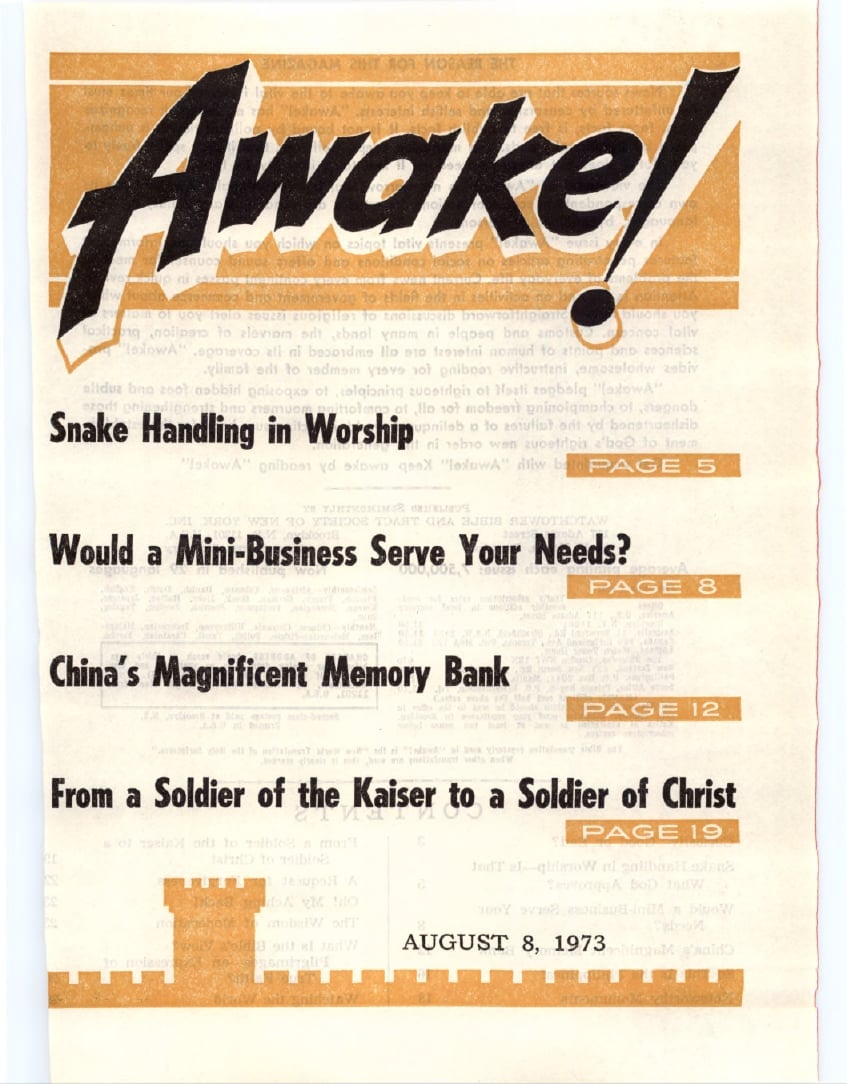
Awake! — August 8, 1973
Source: jw.org
Contents
Curiosity—Good or Bad?
Snake Handling in Worship—Is That What God Approves?
Would a Mini-Business Serve Your Needs?
China’s Magnificent Memory Bank
So This Is the Philippines!
Noteworthy Monuments
From a Soldier of the Kaiser to a Soldier of Christ
A Request for Forgiveness
Oh! My Aching Back!
The Wisdom of Moderation
Pilgrimages—an Expression of True Faith?
Watching the World
Is Television Your Baby-Sitter?
A Cleansed Earth—How?
Curiosity—Good or Bad?
Curiosity—Good or Bad?
“WHERE did I come from?” “Why is the sky blue?” “How can God see me if I’m hiding?” “Where?” “Why?” “How?” Such is the refrain loving mothers continually hear from their young children.
Yes, children have a strong instinctive curiosity. They want to know the whys and wherefores of things. But do you know that this curiosity is one of man’s gifts from his Creator? It has proved to be of great help to mankind, but, like all other instincts and qualities, its use can be wise or otherwise, foolish or even harmful.
Curiosity has been defined as “an eager desire to know.” Also, as “the desire to see or learn something that is new or unknown.” Curiosity has been an important factor in extending man’s range of knowledge, and is to the mind what the appetite is to the body.
But, as has well been noted, there are different kinds of curiosity, bad as well as good. That is why it has also been defined in a bad sense as “inquisitiveness,” which is “the condition of being too eager to know,” and as a “prying into other people’s affairs.” Yes, curiosity can be misdirected. As an American essayist once expressed it: “Curiosity is lying in wait for every secret.” It is obvious that curiosity, if not properly controlled, might become a weakness rather than an asset. That is why it was necessary for certain Christians in apostolic times to be counseled not to be “meddling with what does not concern them,” but to ‘mind their own business.’—2 Thess. 3:11; 1 Thess. 4:11.
There is yet another kind of curiosity that needs to be guarded against, and that is the curiosity directed toward what is evil, cruel, wicked. Many people are curious regarding the details of shocking murders or sordid divorce cases, or other forms of scandal. But one cannot feed the mind on such things, even out of curiosity, without being harmed by it, no more than one can take poison into one’s body, merely out of curiosity, without being harmed by it. Youths have become drug addicts simply because of curiosity as to what it is like to take a drug. The same warning also applies to curiosity as to sexual immorality, even as it does to a misdirected curiosity regarding occultism, black magic, spiritism and “things like these.” One cannot dabble in such things without risking great harm to oneself.—Deut. 18:10-12; Gal. 5:19-21.
But, wisely directed, curiosity can prove to be a real asset. Thus it has well been noted that “curiosity is an intellectual trait that distinguishes man from all subhuman forms as clearly and completely as does thinking.” This is seen in as simple a thing as travel. Apes limit their wanderings to at most fifteen square miles, while man has searched out the four corners of the earth. Truly, curiosity is one of the great gifts with which the Creator has endowed our minds. It was curiosity that caused Isaac Newton to discover the law of gravity.
Because of the possibilities that curiosity thus presents, a Yale professor of history once told a new group of college students that, while curiosity may be frowned upon by many people, his institution placed a high value on men with great curiosity. He also explained that, while a research scientist, if asked about his efforts, might reply that he is hoping to discover or produce something of practical value, actually he is out to gain knowledge per se, of itself, regardless of whether it will result in anything practical or beneficial to mankind or not. While all such curiosity per se may have possibilities, of greater value to humankind is that kind of curiosity or inventiveness that is directed at specific goals. Thus there is a Danish inventor who discovered how to raise sunken ships. Because of the practical turn of this curiosity, many are the businessmen that beat a path to his door for him to help.
However, the most rewarding, the wisest curiosity is that directed toward religious questions, that is, those involving man’s relationship to his Creator and to his fellowman. The truly wise man wants to know, Where did I come from? How do we know there is a God? Why does God permit wickedness? What is man’s duty? What is my destiny?
And where are answers to such questions to be found? In the two great Books, the Book of Creation and the Bible, the inspired Word of the Creator, Jehovah God. The vast, orderly universe and all that is in it eloquently testify to the existence of God. And from his Word, the Bible, we learn that God created the earth and the first man and woman. (Gen. 1:1-31) That book reveals that God holds out the prospect of everlasting life in a paradisaic earth for humankind. (Isa. 11:1-9; Rev. 21:4) It also shows that God has permitted wickedness for the purpose of giving his archopposer, Satan the Devil, the opportunity to try to prove his boast that he could turn all men away from God, and to let men demonstrate to themselves their utter inability to govern themselves wisely apart from their Creator and his principles.—Job 1:7 to 2:10.
As for what is the duty of man, this can be and is summed up in various ways in God’s Word. Thus Solomon said: “Fear the true God and keep his commandments. For this is the whole obligation of man.” (Eccl. 12:13) And in particular did the Son of God enlighten us on this matter, for to the question, “Which command is first of all?” he said in answer: “The first is, ‘Hear, O Israel, Jehovah our God is one Jehovah, and you must love Jehovah your God with your whole heart and with your whole soul and with your whole mind and with your whole strength.’ The second is this, ‘You must love your neighbor as yourself.’ There is no other commandment greater than these.”—Mark 12:28-31.
No question about it, curiosity can be wisely directed, and the wisest of all curiosity is that which leads you to a knowledge of your Creator and his purpose for you. Jehovah’s witnesses stand ready to help you gain this knowledge.
Snake Handling in Worship—Is That What God Approves?
Snake Handling in Worship—Is That What God Approves?
“A ZEALOUS member . . . was bitten by a rattlesnake Sunday night during a snake-handling ceremony at a rural church” and later died. So reported the New York Times, September 29, 1972. Only four days earlier the Times told of a woman dying “after being bitten twice by a rattlesnake Sept. 16 at the Jesus Pentecostal Church.”
Just a year earlier the Times featured an article entitled “Snake-handling Sect Survives in Appalachians.” It showed pictures of the snake handling done by members of the “Holiness Church of God in Jesus’ Name.” Four members of the group “passed the serpents back and forth, handling them smoothly, keeping one hand free, working the serpents’ heads away from the body, stroking them, soothing them. . . . The serpents flicked their vicious tongues, but never struck, for the five minutes that it lasted.”—New York Times, September 25, 1971.
Why do these people make snake handling a part of their worship? Because in their Authorized Version Bibles Mark 16:17, 18 reads: “And these signs shall follow them that believe; . . . They shall take up serpents; and if they drink any deadly thing, it shall not hurt them; they shall lay hands on the sick, and they shall recover.”
Is this really what the inspired Bible teaches? An experience of the apostle Paul might seem to indicate this. When he was shipwrecked on the island of Malta, a viper fastened itself on his hand as he was gathering kindling wood. When nothing happened to him, the natives “began saying he was a god.”—Acts 28:1-6.
But did Paul go out of his way to collect poisonous snakes in order to handle them? No! Nor do we read anywhere in the Christian Greek Scriptures where any of Christ’s followers did so. In fact, Paul quickly shook off the viper that had fastened itself on his hand.
What Purpose Is Served?
It may well be asked, What purpose does religious snake handling serve? All the miraculous gifts that God bestowed upon Christ’s early disciples served very practical purposes, such as curing sick people, raising dead persons, making lepers clean and expelling demons. (Matt. 10:8) Even the gift of tongues did so. On the day of Pentecost this gift enabled Jews coming from more than a dozen different lands to hear the magnificent things of God in their own language. (Acts 2:4-11) And later it was to be used for the edification of the Christian congregation. That is why the apostle Paul stressed that no one should speak in a strange tongue unless an interpreter was present so that all could benefit from it.—1 Cor. 14:28.
There are also other matters to consider. If these words at Mark 16:17, 18 about handling snakes and not being harmed authorize Christians to do so, what about the other things mentioned in those verses? Should not Christ’s followers also be able to drink poison and not die? And what about their being able to cure people merely by laying their hands on them? These are pertinent questions, are they not?
Written by the Disciple Mark?
To what conclusion do all these questions lead? That there must be a mistake somewhere. In fact, that is what nearly all modern Bible scholars have concluded, namely, that these words—and not only these words but all of what appears as Mark 16:9-20—were not written by Mark but were added by a later hand. On what grounds do scholars so conclude? On both external and internal evidence.
First of all, there is the telling fact that two of the oldest and most highly regarded Bible manuscripts, the Vatican 1209 and the Sinaitic, do not contain this section; they conclude Mark’s Gospel with Mr 16 verse eight. There are also a number of ancient manuscripts that contain a short ending of just about one verse beyond eight; and other manuscripts contain both conclusions. So, some manuscripts end with Mr 16 verse eight, others have a short ending, others have a long ending, and some even give both endings. In addition to this testimony of the Greek manuscripts, all of which combines to cast doubt on Mark’s having written anything beyond Mr 16 verse eight, there are a number of the oldest versions (or translations) that do not contain the verses in question. Among such are ancient Syriac, Armenian and Ethiopic versions. No wonder that the noted manuscript authority Dr. Westcott states that “the verses which follow [Mr 16:9-20] are no part of the original narrative but an appendage.” Among other noted scholars of the same opinion are Tregelles, Tischendorf, Griesbach and Goodspeed.a
Supporting this testimony of the Greek manuscripts and versions are the church historian Eusebius and the Bible translator Jerome. Eusebius wrote that the longer ending was not in the “accurate copies,” for “at this point [Mr 16 verse 8] the end of the Gospel according to Mark is determined in nearly all the copies of the Gospel according to Mark.” And Jerome, writing in the year 406 or 407 C.E. said that “nearly all Greek MSS. have not got this passage.”
Quite pertinent here is what the New Catholic Encyclopedia (1966), Volume 9, page 240, has to say about these verses: “The manuscript tradition indicates that the Gospel originally ended at 16.8, but that the longer ending that is incorporated in the Vulgate was later added, becoming widely accepted in the course of the 5th century. . . . Its vocabulary and style differ so radically from the rest of the Gospel that it hardly seems possible Mark himself composed it. . . . Mark 16.1-8 is a satisfactory ending to the Gospel insofar as it declares Jesus’ Resurrection-prophecy to be fulfilled.”
Mark’s Style?
Note that the New Catholic Encyclopedia argues that the vocabulary and style of Mark 16:9-20 differ so radically from the Gospel of Mark that it hardly seems possible that Mark himself wrote those verses. Yes, Mark’s style is plain, direct; his paragraphs are short and the transitions are simple. But in this ending, as the Encyclopedia observes, “we have a carefully arranged series of statements, each with its proper introductory expression.” Well has it been likened to a piece of torn satin attached to a roll of homespun.
There is also the matter of vocabulary. There are words used in Mr 16 verses 9 through 20 that do not appear elsewhere in Mark’s Gospel, some words that do not occur in any of the other Gospels, some that do not occur elsewhere in the Christian Greek Scriptures. These verses consist of 163 Greek words, and, of these, 19 words and 2 phrases do not occur elsewhere in Mark’s Gospel. Or, put otherwise, in these verses there are 109 different words, and, of these, 11 words and 2 phrases are unique to these verses.
But most conclusive of all that Mark could not have written these verses and that they are no part of the inspired Word of God is their content. As has already been noted, there is no evidence that Christ’s followers were to be able to drink deadly poison without being hurt, as stated in Mr 16 verse 18. Even in the matter of handling snakes it is very apparent that those handling them do all they can to keep the snakes from biting, and they handle them only for five minutes at a time.
Further, these questionable verses state that the eleven apostles refused to believe the testimony of two disciples whom Jesus had met on the way and to whom he revealed himself. But, according to the account in Luke, when the two disciples found the eleven and those with them, these said: “For a fact the Lord was raised up and he appeared to Simon!”—Luke 24:13-35.
So in view of all the foregoing what do we conclude? That Mark 16:9-20 is not part of God’s inspired Word, and that for the following reasons: (1) These verses are not found in two of the oldest and most highly regarded Greek manuscripts as well as others. (2) They are also not found in many of the oldest and best Bible translations or versions. (3) Such ancient scholars as Eusebius and Jerome pronounced them spurious. (4) The style of these verses is entirely different from that of Mark. (5) The vocabulary used in these verses is different from that of Mark. (6) And, most important of all, the very content of these verses contradicts the facts and the rest of the Scriptures.
Regarding these questionable verses, it might be noted that not only did the ones adding them do a very poor job but it may well be that they proceeded on a wrong premise. How so? In that Mark actually may have ended his Gospel with what is now Mr 16 verse eight. Noting that this could well be, especially in view of Mark’s abrupt style, are Eusebius, Jerome and the New Catholic Encyclopedia as well as Aid to Bible Understanding.
There certainly are grave consequences, even death to some, when additions to God’s Word are made in disregard of repeated warnings. (Deut. 4:2; 12:32; Prov. 30:6; Rev. 22:18) On the other hand, “the saying of Jehovah endures forever.”—1 Pet. 1:25.
[Footnotes]
Regarding this passage, a footnote in The Jerusalem Bible says: “That Mark was its author cannot be proved.”
Would a Mini-Business Serve Your Needs?
Would a Mini-Business Serve Your Needs?
BY “AWAKE!” CORRESPONDENT IN COLOMBIA
IN Cali, Colombia, a young mother was suddenly widowed and left without support for herself and two young sons. Her only asset was her home. After careful planning, she divided off four of her rooms into two independent apartments and thus supported her small family from a mini-business.
As prices increase on all commodities, many persons find their earnings inadequate for even basic needs. If father takes two jobs, however, the family loses his guidance and he invites illness due to overwork. If mother is employed outside the home, the children suffer the loss of her supervision and loving companionship. But where a family needs additional funds, the means to provide such income could be a self-operated mini-business.
By “mini-business” is meant any small enterprise, whether in service, manufacturing or sales, frequently using the home, garage or patio as the base of operations. The objective may be to employ profitably the spare time of older children, provide income for mother on a part-time basis, or to develop a business that would eventually support the family entirely.
Why Many Prefer Self-Employment
While a job in industry may offer greater financial security and attractive fringe benefits, it can also be routine, monotonous and lacking in opportunities to use initiative. In many countries, however, even such industrial jobs are scarce, and the inexperienced or untrained cannot readily find employment.
Among the advantages gained by the self-employed are a flexible work schedule, a more active interest in the business and so greater productivity, plus the satisfaction of worthwhile accomplishment. They can also choose their work companions, perhaps giving on-the-job training to sons and daughters, equipping them with a useful trade.
What Type of Mini-Business?
Service opportunities offer a return for one’s time and energies and usually require only a modest outlay for tools and equipment. Every community needs the services of a carpenter or plumber, a tailor or seamstress, a beautician, barber, mechanic, electrician or appliance repairman. The necessary skills can often be acquired in a trade school, or by apprenticeship to someone already in the business.
Maintenance of property or equipment on a contract basis could be a source of income for you. If you have mechanical training, why not approach the management of office or factory buildings with a contract to service air-conditioning units, electrical generators, boilers or elevators? For those without technical skills, landscaping or maintaining the grounds of private estates, clubs, or business properties, providing janitor service to industrial or office buildings, are a few of the areas for employment on a contract basis.
Agricultural work is also done by contract, such as the harvesting of grains or food crops. In the Buenaventura area of Colombia a father contracts with owners of large plantations to harvest their banana crops. This frees the owner from hiring each individual worker, and the father negotiates for a better wage for his family.
But you may feel that the manufacture of a useful or decorative item would be more appealing as a mini-business.
Sales
Since your product must be sold, a realistic appraisal of the market potential should be made before investing in machinery or raw materials. Is your product such that the public will come to you to buy? If not, would you sell to retail stores? Would it be advantageous to advertise? Is there a year-round market for your product, or would it sell only seasonally? How would your sales be affected by inclement weather, public transportation strikes or breakdowns, or illness of yourself or other family members?
Valuable information on sales could be gathered from small manufacturers experienced in your field or in a related one. Talk to them, ask for their suggestions, make notes for later reference as to how they promote sales and where they market their products.
Public-relations-oriented manufacturers have long capitalized on a natural curiosity about how their product is made, and plant tours are arranged with customer appeal in mind. Scaling this idea down to mini-size, a rug manufacturer employing six workers opens his plant to full view of all passing-by, and frequently a crowd gathers to watch his operations, observing with interest the emergence of lovely patterns as bright yarns are woven into the backing.
What Enterprising Colombians Have Done
Before making a decision on what specific business to enter, you may find the experiences of many Colombian families in operating a mini-business of interest.
A widow in Bogotá earns her livelihood as caretaker of homes whose owners are out of town. Reliable and trustworthy, she obtains work through referrals. Before engaging in this type of work, you may wish to insure yourself against the risk involved in guarding another’s property.
Few Colombian mothers work outside the home, but many add to the family income by preparing hot meals. Boarders may eat at the family table, or the hot lunch may be sent to the work site. Others prepare food for sale to small grocery stores, such as a cornmeal bun called arepas, served in most Colombian homes for breakfast or snacks. The sale of cake, candy, roasted peanuts, baked ham or fried plantains outside of stadiums or at playgrounds on holidays or Sundays brings in enough to support many families.
Persons in your community might enjoy sausages, pizza or other specialty dishes prepared with good-quality meat, free from harmful preservatives. Tamales, pasteles or empanadas, prepared with meat and vegetables, wrapped in dough of cornmeal or flour, either fried or boiled, are fast-selling delicacies in Colombia.
Supermarkets with a complete line of food items under one roof are almost unknown outside Colombia’s largest cities. Thus an opportunity exists for mini-merchants operating a booth in the central market or renting space in a small food store. A successful vendor in Barranquilla specializes in yucca, a starchy root much in demand for the preparation of soups. His stall is sought out by customers who know that he maintains the largest and best stock of yucca in the market.
Could you roast and grind coffee? A family in the city of Armenia has a small electric unit set up in the garage, and the aroma of roasting coffee brings customers from blocks around. One can buy a pound of coffee already ground and packaged, or watch while the newly roasted beans are ground to order.
A family in Medellín earns all its income from the home manufacture of gelatinas, a dessert similar to marshmallows. Sales are made retail from the home as well as wholesale to small food stores.
In communities where very few persons own automobiles, vendors render a real service by delivering fruits and vegetables to the customer. An elderly man, with a view to earning a little pocket change, started out to offer lemons from door to door. To his surprise, several persons asked him to come again the following week, and thus a route of steady buyers was established. Later, at the request of his customers, he expanded the business by adding papayas, bananas, pineapples and other types of fruit to his deliveries.
A mother needed extra cash for a trip the family wanted to take. She turned the front room of her home into a salesroom and started selling eggs to her residential neighborhood. From the profits of her modest efforts, a vacation was enjoyed by all the family.
In a tropical climate, a refrigerator is a real necessity, but in Colombia it is very expensive. How to enjoy owning one and still keep up the monthly payments? Possibly by sharing the products of your refrigerator with your neighbors—for a price! Stir up a mixture for popsicles, varying it with flavored syrups, crushed pineapple, mango, banana or shredded coconut, pour it into the ice trays or paper cups and drop in a short wooden stick. Now pop it into the freezer. Before long you will have a line of customers, especially children coming home from school, who have seen your handwritten sign in the window: helados. Since most families do not own a refrigerator, you can increase profits from your mini-business by the sale of bottled refreshments, home-prepared punch or fruit juice, or from the sale of ice cubes.
A young lad can find ways to employ his spare time profitably, contributing substantially to the family’s support. One young boy, after a nominal investment in supplies, called from door to door offering to shine shoes, then returned the following week where his services were accepted. With initiative and diligence, he built up a route of regular, appreciative customers. Shoe repair added to this service would increase one’s income.
A mother and daughter in Bucaramanga started making baby clothes in the home for sale in the immediate community. Through sales to local clothing merchants, this business was later expanded to become the family’s sole means of support.
A man sat on the sidewalk at a busy intersection of a large coastal city, with a supply of palm leaves around him. Quickly he cut the fronds into strips one inch wide, then fashioned a circle from a length of wire. Deftly, he covered the wire with many strips of palm leaf, weaving a flat brim inward about three inches, then shaped a crown, completing an attractive hat in less than ten minutes. As he started on the second hat, fascinated observers were already waving the money and shouting: “The next one is mine!”
A drugstore was opened in the living room of a home in a residential area. A supply of pharmaceutical-products, shampoos, lotions and ointments was neatly arranged on display shelves out of reach but within view of an open window. Since all sales were made through the window, mother was freed from constant attendance and could continue her housework between customers.
From a small sidewalk booth called “Noah’s Ark” all manner of used tools, plumbing equipment and other hardware are sold. A small business could be formed to sell or rent used books, magazines, furniture, clothing, appliances, sports equipment, musical instruments, or a combination of these items.
Metalwork in the form of doors, door-frames, window frames, metal shelving, or furniture provides employment for many businessmen in Colombia. Iron grillwork is becoming ever more popular for protecting windows and entrances, for enclosing porches, for fences or handrailings. Decorative and practical, the iron can be worked into floral designs, leaping antelopes, a dazzling sunrise, or even bars with musical notes.
The manufacture of flowerpots and planters provides an income for a resourceful family. While the teen-age sons and daughters mix sand and cement, mold and paint the product in the patio, father sells to small merchants in the local market, or from a handcart in residential areas. Another family expands this idea by marketing potted palms, orchids, philodendron or coleus plants, using the second-story balcony to display them.
Shoe manufacture is still largely a handcraft in Colombia, and three or four men often work together under contract to retailers or by selling from a display case in their shop. The customer can select footwear already made, or may order shoes to his exact size and style preference. A family in Bogotá makes a soft hand-stitched house slipper, similar to an Indian moccasin; and this business is their sole source of support.
Leather and imitation-leather book covers, wallets, coin purses, belts, handbags, briefcases or school-book bags are items constantly in demand. Sport jackets, made of suede or other leather, as well as imitation-leather raincoats, are clothing articles that never go out of style. Upholstering auto seats or living-room furniture in leatherlike plastics provides an income for many.
In the higher altitudes, a woolen ruana or poncho is a year-round necessity. Worn as a cape, a ruana serves for cold or rain, and is preferred by Colombians to a coat or jacket. A family in Bogotá weaves the fabric on a home loom, varying the colorful patterns for different effects. But ruanas can be made from any type of woolen fabrics, solid-color flannels or wool knits trimmed with white fringe, or lovely plaids with matching fringe.
Many other opportunities await the businessman or woman in furniture refinishing, rebinding worn books, crocheting or knitting shawls or sweaters, embroidering sheets or table linens, the manufacture of wigs or hairpieces, costume jewelry, macrame handbags, rope or wool scatter rugs, table lamps, mattresses, pillows, wicker furniture or stuffed toys.
Whatever field you choose as a means of earning a living, you will experience satisfaction in providing for your daily needs by applying your talents to productive work. So, if you need employment or additional income, why not give consideration to operating your own mini-business!
China’s Magnificent Memory Bank
China’s Magnificent Memory Bank
MANY people find history on the printed page boring; but I’m not a history book. I present history in the round. I am Taiwan’s National Palace Museum.
It took 3,000 wooden cases to bring my treasures to their present location in the suburb of Shih Lin at the edge of Taipei. Because of the periodic changes of my displays I cannot lead you on a room-by-room tour. Those changes take place every three months; yet it is said that if you visited during each display period it would take you ten years to see all my trove.
Let us go back in time to the very fringes of human memory in the Far East. Do you see those old, dried-out buff-colored bones? They are oracle bones, used for divination. They are cracked because this was the means of gaining the sought-for answer. They would drill tiny holes in the bone, apply heat and wait for the cracks to develop. Then they would write on each bone the events concerning which questions had been asked. That was during the Shang dynasty.
My Record in Bronze
The Shang dynasty lasted perhaps 650 years, down till the time of Saul the king of Israel. Its record has been made in a most durable form: bronze. The samples I show are for ritual use and not everyday household items. The Chinese are practical. A vessel can be made to stand on three legs; therefore our earliest containers are poised on three legs, not four. Yet these vessels are made beautifully, with rich decoration.
Like all the human family, the Chinese like music. Our earliest musical instruments are represented here in bronze bells. You may be surprised at how large they are. You would be more surprised if you tipped them up and could see that there are no clappers. They are true musical instruments because each gives a variety of tones when struck from the outside by a mallet. The tones vary from bottom to top on the bell.
Our record in bronze continues into one of the longest dynasties in history, the Chou. In it the Chinese dragon appears, and the bronzes of this era carry readable inscriptions, some running to more than four hundred characters. My history is in the form of real objects handed down through time, many carrying history written, not by historians, but by people writing in their own time about themselves.
The Ch’in dynasty was very short; just fifteen years in the third century B.C.E. But what it left behind was very long—the Great Wall of China; fifteen hundred miles in length. No part of that wall is here, but the Chinese talent with walls is evidenced in my own facade and the grounds surrounding me. I sit upon the topmost of two man-made plateaus, backed into deeply forested mountains. Tunnels run into deep recesses in these mountains to shelter the priceless items awaiting display.
At the time that Jesus Christ walked this earth, the Han dynasty was almost 200 years old, with yet another 200 years to go. This period is represented in bronzes too. I would like to call your attention to a bronze jar or jardiniere. It appears to be caught in a net of rope. Close inspection will show you that the “rope” is part of the bronze work itself!
“More musical instruments!” you say as you see the cases having round flat pieces of bronze with knobs in the middle. No, they are not cymbals. Try again. “Potlids?” No. Those “potlids” if turned over would offer a shining surface that long ago was used as a mirror.
Ceramic and Porcelain Treasures
A time of turmoil followed the Han dynasty as three kingdoms and six dynasties tumbled over one another in the next two hundred years. I will hurry you past these and those that followed the Northern and Southern dynasties and the Sui to bring you to the T’ang dynasty, of the eleventh century. I anxious for you to see our T’ang horse. It is ceramic. When it was made it was surfaced with colors. Now only a hint of its brilliance remains in the red of its mane. The beauty of its form, the whole sense of artistic and physical balance overcomes the loss of color. The animal is poised with one hoof held high in a proud stance. It is a large piece: two and a half feet from hoof to mane, and a touch more than two feet from nose to tail.
Six dynasties occupied the next 218 years, but now, let me lead you past these to the magnificence of the Sung dynasty. Europe lay in the grasp of the Dark Ages when Sung artistry glowed serenely across four centuries of China’s culture. Literature, the arts, architecture and furniture reached a pinnacle of expression perhaps not matched since. I have much to show you of the versatility of the epoch. Now let me explain this period in terms of porcelain. Our Sung porcelain items are muted, monochromatic—one color emphasizing the purity of the glazes used. I have a Western friend who often comes to visit me and who views my Ju ware (pronounced Roo) as my greatest treasure. You wonder why?
Let me tell you. First, that particular color cannot be had on demand. It was a gift of the Ju kiln, a transmutation, a color change taking place in the kiln. Secondly, in the Sung period the purpose of working in porcelain ware was to try to imitate the peculiar soft, translucent glow and color of jade, as well as its cool, smooth “feel.” The Chinese treasured jade in all its colors. But they wished to copy the white jade and that hue of the lighter off-green. In Ju ware it was achieved. If you could reach inside the case you would feel the third reason. Its “feel” is so smooth that it is the equal of jade. In all the world there are just some thirty known Ju-ware items, and twenty-three of them are here.
Down from Mongolia thundered the hordes of Genghis Khan in the thirteenth century. By sword and Tartar pony, they sought to smash the Sung tranquillity. The heritage Sung had left to China’s vast population could not be erased by this barbaric foreigner! The dynastic lines were erased, but China absorbed its conquerors. In time, Genghis’ grandson Kublai Khan ruled in all the silk and ivory splendor of Cathay over what was, by now, called the Yüan dynasty.
The Yüan dynasty gave way to the Ming dynasty, during which time Columbus sailed to the Americas. Let us enter the display area for Ming porcelains. Did I hear you gasp? It was a combination of surprise and pleasure, wasn’t it? The brilliant colors of the Ming wares are breathtaking! In this dynasty’s display you will notice a high-stemmed bowl. It has green dragons on a brilliant yellow base color. The technique was to engrave the design on the unglazed base, then later fill it with color. Ultimately Ming artisans learned to control color so it neither “bled” nor ran out of control in firing.
The Ch’ing dynasty followed the Ming, and with it the door closed in 1911 on the Chinese dynasties. China at last discarded its royal lines. However, the Ch’ing legacy to China was not only the prolific work of their own artisans, but also the palace accumulation of items of preceding dynasties. These form the nucleus of my collection.
Ivory, Lacquer Ware and Jade
Let us leave porcelain, which continued to be beautifully produced in this time, to talk of ivory as a representative work for this era. One skill that never fails to enchant visitors is that of carving ivory balls. The carving is so delicate that it looks like fine lace. Yet it is not just the lacework that enchants. They are spheres within spheres carved from one piece of ivory. One of these has thirteen movable layers, one inside the other. Each ball can be rotated within the others.
Still another is what is perhaps the world’s most elegant lunch box. It is a layered group of oval boxes carved of ivory so fine that each is less than the thickness of a flat toothpick. It is made as an airy screenwork to keep the food cool and yet free from insects. There are those visitors who must be convinced that it is not made of stiffly starched lace!
Miniaturization is another Chinese talent. The ivory collection includes a small excursion boat just two inches long. Every detail is sharp and clear. Passengers are visible inside the boat, and the cabin windows slide back and forth.
Here we have arrived at the present, and yet I have not even mentioned my carved lacquer ware. As many as thirty-six coats of lacquer would be carefully applied to a surface, each time drying and being sanded, and then followed by another. Then the carver would take over. His task was to carve the lacquer, not the wood beneath it. In some instances different colors of lacquer were applied, and the carver would carve to the desired color layer, and not go through it. Some of my pieces are deeply carved and have three colors in their designs.
One of my richest collections is jade. I have saved it because it belongs to no one dynasty. Chinese respect for jade is the warp yarn of the long tapestry of our cultural history. I possess both the oldest and the largest jades in the world. I can show you among later jades a stalk of white-stemmed Chinese cabbage topped with green leaves and two green grasshoppers. This was all accomplished without paint or dye, but by using the skilled eye of its carver to recognize the possibilities of the run of color in the raw material.
My Scroll Paintings
And what of painting? In Chinese scrolls my history becomes most explicit. If you ever come to visit me, I hope that at least one of two famous scrolls will be on display. “The City of Cathay” is a remarkable record of life in dynasties past. It is a horizontal or hand scroll, 37.82 feet long! The viewer starts at the mouth of a river; and the eye travels its banks passing through countryside, outlying areas and finally to the city. Thousands of figures, tiny and intricate, people the scene. From these one has a picture of life, of dress, of commerce—a pictorial view of the past that speaks beyond words.
The other great hand scroll is the one called “The One Hundred Horses.” It is a 25.46-foot-long landscape, filled with horses of every kind in every stage of use and life. One or two dead ones are there. Let me first ask you, though, do you notice that Chinese painting is a “style” you can recognize? Can you pinpoint what makes it “feel” Chinese to you? Two important things are involved. Perspective, which is always as though you are hanging by a hook out in the air, hovering over the scene as viewed. The other is the absence of shadows. Distance is created by painting things darker if they are close to you, and lighter if distant.
In “The One Hundred Horses,” however, you may note that there are shadows. Furthermore, the eyes of the horses possess highlights, a device not used by Chinese painters. Yet you still feel this painting is Chinese. You are right. All the techniques of Chinese style were used by the artist, but those two Western techniques were added. The artist is known in China as Lang Shih-ning. He was a painter at the Ch’ing dynasty court at the beginning of the 1700’s. However, he was born Guiseppe Castiglione, and came to China as a Jesuit priest. He is the only foreigner reckoned by Chinese as a Chinese painter.
Items Used in Buddhist Rites
One other foreign influence infiltrated China, yet failed to be absorbed and was lost in the massive embrace of China’s populace. That was Buddhism, which retains its Indian forms and terms and exerts its mighty influence on Chinese thought and life. Why do I, a museum, mention this? It is because it is part of my memory bank. Out of Tibet came esoteric (possessed of mysteries known only to the initiated) Buddhism to be accepted and performed in the Imperial Palace in Peiping and the Summer Palace in Jehol. My collection contains items used in these rites. It appears as a courtship with death. I can show you an iron-skull rosary, or a carved ivory “apron” to be worn by the priest, replete with death’s-heads. Cups made of human skulls such as I display were used to contain offerings to the gods. Usually only the skulls of nobles and high priests were used. Still another item made of a skull is the skull drum used in temple orchestras. It is made from the top of two skulls of children, joined crown to crown, and the open surfaces covered with lamb or monkey skin. Another musical instrument is a human leg-bone trumpet fitted with a metal mouthpiece. These are not artistically crude, rather, they are elegantly painted and adorned.
One is caught by an underlying tone of religious similarities, not only in the use of rosaries but also in the dress of priests that I have on display. Miters in my collection match their equivalents in Western religions. Many visitors comment on this. Would you like to see more? Come, pay me a visit.
We have only scratched the surface of what I have to show between my history-book covers, as well as what I have to tell you about the history of my country and my people—the most numerous upon the face of the earth. I have a very long memory.—Contributed.
So This Is the Philippines!
So This Is the Philippines!
By “Awake!” correspondent in the Philippines
THE airliner dips low over green hills and flat rice paddies. Suddenly it swoops over a wide bay, close to the roofs of a modern-looking city, and onto the runway. The door swings open, and you are in the Orient, on an island in the Philippines, only 500 miles from the coast of China.
By any standards the more than 7,000 tropical islands that make up the Philippines are beautiful. And there is such variety! To the north are pine-clad mountains and cool, clear air, and in the south there are steaming jungles. In central Luzon, on the group’s largest island, wide rivers meander through beautiful flat plains. This is one of the great rice bowls of Asia, one of the most fertile areas on earth. But what many visitors especially enjoy are the palm-studded beaches—long stretches of sunlit sands washed by the waters of a warm tropical sea.
There are other attractions too. Towering active volcanoes that smoke perpetually, springs hot enough to boil an egg, and places where the ground is so warm you can hardly walk on it. Natural steam is used in some places here as a source of power. And there are waterfalls, gorgeous tropical sunsets and exotic orchids, orchids and more orchids—nearly a thousand kinds flourish on the islands!
Near Manila, the largest city, one can get a breathtaking view of the Taal volcano from the Tagaytay Ridge. An exciting ride down the rapids from Pagsanjan Falls affords another view of the scenery. Right in Manila is the ‘Nayong Pilipino’—the ‘Philippine Village’—where the different cultures of the Philippines are represented in natural settings. For those with limited time to travel, this “village” gives a bird’s-eye view of the country.
The Filipinos
When the Spaniard Ferdinand Magellan visited the Philippines away back in 1521, he found a race of slender, handsome people. Their skin was a glowing-brown color and their hair shining black. Although most of the Spanish have left, descendants of the island’s earlier inhabitants are still here. They are the ones who will check a visitor’s passport, ask if he has anything to declare, then drive him to his hotel by taxi, bus or jeepney.
The Filipinos are made up of a number of ethnic groups. Living in the mountains to the north of the island of Luzon are the Igorots, or “natives.” Many of them still worship their own pagan gods, and some do not wear the Western style of clothing.
Many visitors to the Philippines travel hundreds of miles over difficult mountain roads to see a great work of these Igorot people. Up there in a place called Banaue, the Ifugao, one of their tribes, have, over a period of 1,500 years, fashioned whole mountainsides into a gigantic series of rice terraces that are still being used today. These terraces are said to stretch a distance equal to half the circumference of the earth. They have been carved by the Ifugao patiently, using just the simplest of tools. Truly a stupendous feat of engineering, comparable to any of the great works of other ancient nations!
There are also many other Philippine peoples with which to get acquainted. There are the warm, hospitable Bicolanos from the beautiful regions of southern Luzon, and the charming and outgoing Cebuanos from still farther south. Also, the alert and progressive Tagalogs, and the patient and persevering Ilocanos. You may have already met some of the Ilocanos from northern Luzon, as they are a group that does a lot of traveling.
As evidence of the great diversity of ethnic groups, over eighty languages and dialects are spoken around the islands. Should you visit the Philippines, why not talk to the different persons you meet? Find out where they come from and what sort of customs and habits they have.
Communication Possible
But you might say: “What? With all those languages? How do you expect me to talk to them at all?”
In spite of all the languages and dialects in use, English is commonly spoken. This is due to the period of American domination. So communication is not much of a problem, once you get used to the accent.
Actually, the existence of the scores of different languages has made for a nation of very competent linguists. Any Filipino who travels has to be prepared to learn the language of the area, and people commonly speak three or four languages fluently.
A missionary of Jehovah’s witnesses tells of attending a Bible meeting away down south in the beautiful city of Zamboanga. The literature they were studying was in English, and the chairman of the study was speaking most of the time in English. Then one person raised her hand to comment, and the remark came out in the Hiligaynon tongue. Another man volunteered a comment in Cebuano. Another spoke in Tagalog, and still another made his point in Chabacano. Everyone seemed to understand, and no one seemed to notice that different languages were being used.
What to Expect
If you are coming to the Philippines for the first time, perhaps there are some things that should be mentioned. For example, if you are a white person speaking English, you are an “Americano.” You may perhaps be English, Dutch or German, but temporarily, while here, you will be thought of as an “Americano.”
Another thing we should mention is the exceptional hospitality of the Filipino. And here hospitality is closely connected with eating. You may be served tasty local dishes like kari-kari, or lapu-lapu, a local fish. Or, for a snack, there is the ever-popular pancit, or some bibingka. A deliciously cool drink is halo-halo. Chinese food, too, is popular here, and it is said to be some of the best in the world. Or, if you prefer, food is frequently prepared American or Spanish style.
In some parts of Manila foreigners are a common sight, and pass unnoticed. But in more out-of-the-way places, such as the markets around Cubao and in the old city of Pasig, you will be as much an object of interest to the locals as they are to you. The truth is that Westerners do tend to stand out a little in the Orient, what with their unusual height and pale-colored skin. So do not be surprised if, when you are inspecting the goods in some small store, you turn around to find a Filipino standing alongside comparing his own height to yours—much to the delight of his companions.
Or perhaps a group of youngsters might gather around and just stare at you in wide-eyed amazement. Some bolder youths might call out to you, “Hi, Joe,” or “Victory Joe,” reflecting the time two and a half decades ago when all American soldiers were “Joe.” The troops were then very popular in the streets of Manila, because of having recently gained victory over the Japanese occupation forces.
The thing to remember is that everybody is just being friendly. There is very little of the antiforeign feeling that one may sense in some other countries. Children might even start stroking your arm, because they like the feel of the soft hairs on your skin. Persons cannot get much friendlier than that, can they? If you get into the spirit of it, you will enjoy the informality, the lack of tension, and the friendliness that are characteristic here.
If you should visit the Philippines, why not forsake the ‘tourist belt’? Travel by the characteristic jeepney, or the distinctive bus system. See how the Filipino lives—not with a view to criticizing—but, rather, just accepting that this is the way things are here. They are different, of course, but if you are willing to accept them as they are, you can be sure of a warm welcome in the sunny Philippines.
[Picture on page 17]
The rice terraces of the Ifugaos
Noteworthy Monuments
Noteworthy Monuments
✔ A visitor to the Philippines usually sees the José Rizal monument in the Luneta, Manila’s most famous park. However, many visitors pass by without knowing the background of the death of Rizal, the Philippines’ national hero. He was put to death by firing squad in 1895 on the spot where his monument now stands. The execution was in the presence of and at the instigation of the powerful Dominican friars. The friars were angry over Rizal’s writings that exposed the abuses of the Spanish priests in the Philippines. One was the novel “Noli Me Tangere” (English translations, “Eagle’s Flight” and “Social Cancer”), and a second novel “El Filibusterismo” (English version, “Reign of Greed”). Over the strong objections of the clergy, the Philippine Congress has made his two novels, depicting life under Spanish rule and the excesses of the clergy, required reading in all colleges and universities.
Visitors to Manila also often see in a plaza the monument of Andres Bonifacio, one of the heroes of the Philippine revolution that ended more than 300 years of Spanish rule in that country. Around the base of the monument one can see depicted in bronze the suffering of the Filipino people under the clergy-state rule of the Spanish governors-general. The friars, especially the Dominicans, did not escape when the revolution erupted, and many paid with their lives for their greed and bloodstained deeds.
From a Soldier of the Kaiser to a Soldier of Christ
From a Soldier of the Kaiser to a Soldier of Christ
AT ABOUT the turn of the century, in a certain German settlement in southwest Russia, people stood patiently in two rows outside a modest church on Sunday mornings. Only after a bearded elderly gentleman and his wife walked between the rows of people into the church would the others enter.
The elderly couple were my grandparents. They received the weekly respect of the congregation because their religious devotion was so great that it had moved them to build the church out of their own finances. My father was their eldest son, and he, in turn, did what he could to impart the same devotion to his seven children.
My Early Religious Training
Each morning before the farm work began, father called the entire family and all the farm help around our big table for Bible reading. God’s blessing was humbly asked, and appreciation was expressed for the new day and the Creator’s loving care.
Such was the atmosphere of my childhood—perhaps not what you might expect for one who was to spend most of his life as a soldier.
When the time came for the children to begin school, father immigrated to Germany so that we could be educated there. Learning was a pleasure for me, except when it came to religious instruction. I suppose one could say that I could not ‘get to first base,’ religiously speaking.
Not that I was without faith; it was the manner in which we were taught about God and his purposes that turned me away from religion. Even education for confirmation into the Lutheran Church was boring to me. The pastor appeared only to be doing his duty. Whether we children understood or not seemed to be of no interest to him. Although I was confirmed as a member of the church, I never attended the services. However, what my father taught me I kept in my heart.
World War I
During those worry-free years, there came a change that sent me into my career as a soldier. When I was eleven years old, Germany went to war. How it thrilled us boys to see the first soldiers marching with their flower-decorated guns!
Soon father became a soldier, leaving mother to care for seven small children. Her health was not strong, so much of the hard work fell on my shoulders as the eldest son.
One year after another passed, and still father did not return from the Army. I would often miss school to help the family. Constantly I was asking myself: What can I do to relieve our hardship?
I went to the military district adviser and requested to serve as a soldier in place of my father. The adviser turned me down because I was only fifteen years old. Yet I wanted so badly to relieve my father that I wrote a letter to the German kaiser, Wilhelm II, making my request known. How happy I was when permission was granted! And so, in the spring of 1918, I became the youngest soldier in the German army.
When the war ended in November of that year, I was still too young to estimate its damage or to see clearly the wounds it left in so many families. To me, those few months as a soldier had made a a child into a man. It was the beginning of my military career.
Pursuit of a Military Career
The war was lost and the Army was dissolved. I began training as a machinist, determined to become a master in the trade. However, the hard conditions of the postwar years made this a difficult goal to attain. Then came news that a 100,000-man army would be allowed for Germany. Here was an opportunity to master my trade; I could continue my training and at the same time be a soldier.
Once again I joined the infantry. While the order and discipline appealed to me, the compulsory Sunday church attendance did not. How ridiculous, it seemed, that as soldiers we were united until Sunday, when we were separated, Catholics sent here and Protestants there!
Did we not have one God? Did we not read the same Bible? Why should we separate for one special hour in the name of service to God? Even the ceremonies seemed childish to me, with nothing of value in the sermons.
Military Career Interrupted
An injury to my knee forced an interruption in my military career. Instead of returning to the church, however, I had two experiences during this period that turned me even farther away.
Through very sad circumstances, my wife and I lost our first child at the age of six months. The pastor asked if he should give a sermon for 20 marks or 25 marks. He explained that for the five extra marks he would ring the bells and give a better sermon. “So it is the money you want,” I thought. How sad, indeed!
This conclusion was confirmed by the second experience that involved my neighbor. He was in great need because of severe unemployment in the country. No matter how hard he tried, he was unable to pay the church taxes. In spite of pleas to the pastor for understanding, his furniture was seized to pay the taxes. It was too much for me. Immediately I went to court to cancel legally all ties with the church, a necessary step in Germany where Church and State are closely linked. This was in 1931.
A Soldier Again
In 1934 I was again accepted into the Army to continue my military career. A short time later I became an officer. It was not until 1936, when I was transferred to Spain on the outbreak of civil war there, that once again I came in contact with Christendom’s religion—the monasteries in Spain had become forts and warehouses of weapons!
When the second world war began in 1939, I was given the responsibility to inspect airplanes made ready for the German air force. One day, early in the war, a large decorated platform was installed at one of the military airports. Flags were flying, airplanes and weapons were on display, and the entire battalion was on parade. A limousine arrived with the guests of honor—a Catholic priest and a Protestant clergyman!
How impressive were their speeches! We were assured that we were fighting for a righteous cause. At the end of the ceremony, they blessed all the weapons.
World War II Ends
Six long years passed before the war ended. The god to whom those clergymen prayed apparently had not been listening, for we lost again. Along with my companions, I was a prisoner of war.
Following my release, I looked to my homeland, which had received the best years of my life. Although I had reached the rank of major as a soldier, when I asked for work I was pushed aside as being too old. My possessions were gone and I had lost my marriage partner in death. Without a place to live, I decided to go to France to look for work.
While in France, I worked at a city that had a library for German prisoners and anyone else who wished to use it. One day my eyes glanced from shelf to shelf until they rested in one corner where a few Bibles stood. I tucked one under my work jacket and went home, not wanting anyone to see it and laugh at me.
For several days, I read in it again and again without understanding. During working hours I found myself praying one moment and swearing the next. Never had I lost faith in God, but now I was looking for knowledge that I could not find.
Learning Bible Truth
After three lonely years, I remarried and moved back to Germany. One beautiful Sunday morning my wife and I noticed a small group of men and women who had come from a neighboring town on their bicycles. Soon there was a knock on our door, and we invited a young man to come in.
He had a Bible and he talked about things we had never heard before, not even my wife who had been a faithful churchgoer. We had many questions, and the young man answered them all from the Bible. He offered us a book that he said would help us to understand God’s Word. We declined his offer, but we were so impressed with what we had learned that we never forgot his visit.
A winter passed. One day I had some business in the same town from which the young man had come to visit us the previous summer. It was already noon when I started for home on my bicycle. As I rode along, I noticed a man standing in a public place, holding two magazines in full view. I turned around as if someone were steering me.
The magazines were The Watchtower and Awake! I had never seen them before. Their cost was 25 pennies, the exact amount of money I had with me. I obtained both magazines from the man, who was so surprised at my determination that he offered to come and visit me. Two hours later he arrived at our home.
Before he came, my wife and I had time only to eat a small meal and arrange our little room. My wife had not read any more than the title of one magazine—“‘The Watchtower’ Announcing Jehovah’s Kingdom”—when the man knocked at our door.
She almost fell over him with the questions, “Who is Jehovah? Isn’t he the God of the Jews?”
Instead of presenting a long explanation, our visitor produced a book from his bag. Why, it was the same book we had declined to take the previous summer—“Let God Be True,” published by the Watch Tower Bible and Tract Society!
We sat around the table and read together the chapter entitled “Who Is Jehovah?” We learned that He is the God who made heaven and earth.
Week after week the man returned to study the Bible with us, using the book “Let God Be True” as our guide. As our study progressed, we came to feel that we were similar to the apostle Paul when the scales of blindness fell from his eyes. (Acts 9:17-19) The scales of spiritual blindness were also falling from our eyes.
Becoming a Different Kind of Soldier
Our teacher became a dear friend. He was materially poor, perhaps even more so than we were, but he was spiritually rich with good things from God’s Word, which he shared with generosity. He had been a full-time proclaimer of the good news of God’s kingdom since the end of the first world war, supporting himself by part-time work. Yet when we had progressed to the point of dedicating our lives to Jehovah God, he kindly gave us 10 marks so that we could travel to a convention of Jehovah’s witnesses, where we symbolized our dedication by baptism.
…