Awake!, July 8, 1973
Download: PDF — Awake!, July 8, 1973
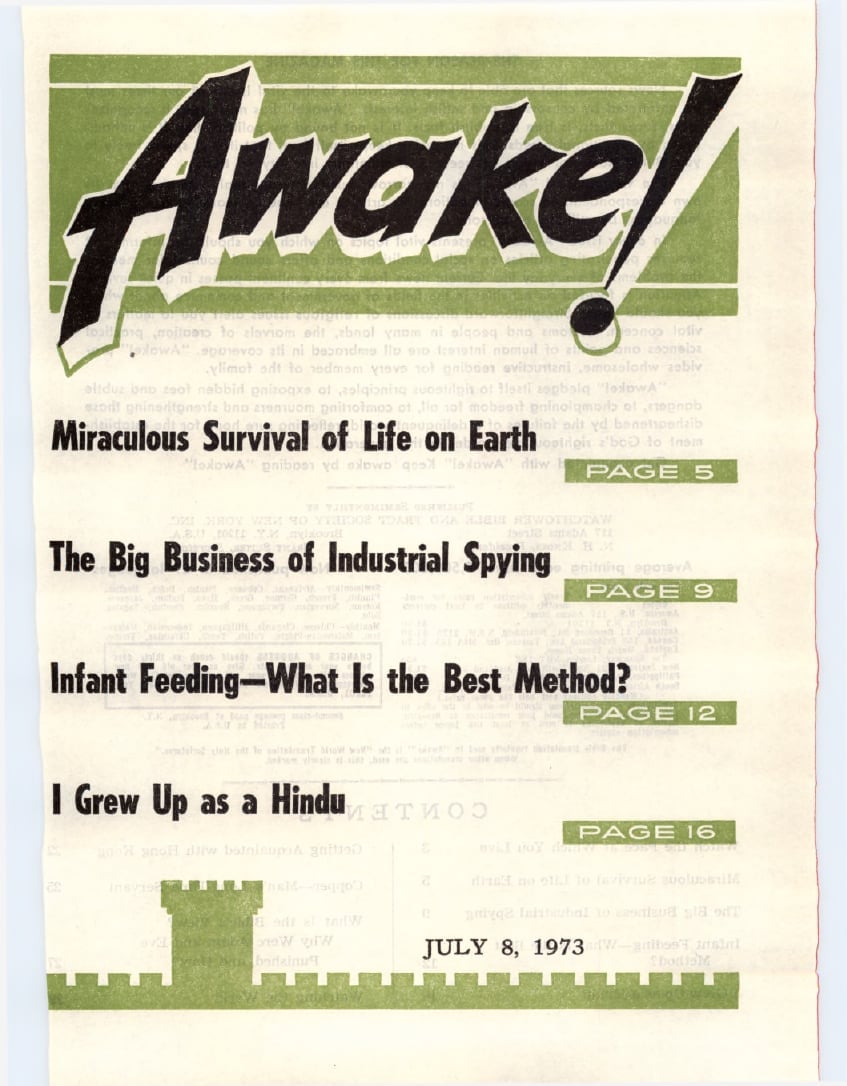
Awake! — July 8, 1973
Source: jw.org
Contents
Watch the Pace at Which You Live
Miraculous Survival of Life on Earth
The Big Business of Industrial Spying
Infant Feeding—What Is the Best Method?
I Grew Up as a Hindu
Getting Acquainted with Hong Kong
Copper—Man’s Long-Time Servant
Why Were Adam and Eve Punished, and How?
Watching the World
A Confused Concept of God
Hear the Public Address: Divine Victory—Its Meaning For Distressed Humanity
Watch the Pace at Which You Live
Watch the Pace at Which You Live
DO YOU frequently feel that others are pushing you, that they expect more from you than they should? Or do you expect too much from yourself?
One way to determine this is to note whether you always seem to be behind in getting things done. Or if you are always in a hurry. Do you fret if you have to wait—wait for a seat at a restaurant, wait for an elevator, wait for a bus, or wait for another member of the family? This constant feeling of urgency, of having to hurry, is not good.
The fact is, living at too fast a pace can harm you physically. According to a California cardiologist who has had more than forty years of experience in treating heart cases, this is the main cause of heart disease. Other primary causes, he says, are smoking, a diet too high in meat, milk and eggs, and lack of exercise.
Realizing the value of exercise, some have tried to squeeze it into their busy schedules. They rush home or to a gymnasium, hurriedly change their clothes and, in trying to get the most exercise in a limited time, overexert themselves, thus doing their hearts more harm than good. It can be more beneficial to include healthful exercise in one’s daily routine, perhaps climbing a few flights of stairs during the day. Or instead of driving to work or taking a bus all the way, some have made it a habit to walk part way, or to ride a bicycle.
That one may be living at too fast a pace may be indicated in a variety of ways. For example, does the heavy traffic that slows you down cause you to fidget, clutch at the wheel, honk the horn, or in some other way reveal the pressure you feel?
On occasion there may be something positive you can do—swing onto an alternate route, or perhaps stop and make a phone call to let those waiting for you know that you have been caught in traffic. But if there is nothing you can do, will your agitation improve the situation? How much better to relax and let your mind and body quiet down!
Do you find that you are frequently impatient when listening to what others have to say? Do you interrupt with such expressions as “Come to the point!” Neither you nor the speaker is benefited by such displays of urgency. But what can you do if you really have little time to spare?
Perhaps you can tell the person, “I am very sorry but I am busy now. May we discuss the matter at another time?” If the person is someone very close to you, your son or daughter perhaps, you might say, “I really want to discuss this with you, but right now I am unable to give it the attention it deserves. May we discuss the matter when I have the time?” The person will probably feel grateful for your desire to be helpful. And you will feel more relaxed discussing the matter when you can give it greater attention.
Even if living at too fast a pace does not give you heart trouble, it can harm you in other ways. It can result in frustration, robbing you of the joy of living and of doing things for others. A mother, for example, may feel frustrated because her pace so wears her out that she has little pleasure from the association with her family and friends and little strength left for any recreation.
If you are in business, do you find that the pressure of work causes you to take little interest in other workers, or even in your own family? Perhaps you are inclined to answer others harshly. But, really, is it wise to live at a pace that results in such actions?
Even more serious is the effect that your pace of life can have upon your relationship with God. What would you think if your children were so busy that they did not show the least interest in you or what you had done for them? Should we show less appreciation for the Grand Creator, who gave us life and breath and all good things? When was the last time that you thanked Him in prayer, or sat down and read from his Word the Bible?
If you are a victim of the fast pace of modern living, try to analyze the cause. Could it be, as one doctor put it, that you are struggling too incessantly to accomplish too many things in too short a space of time? “Yes,” you may say, “but what can I do about it?”
One thing that you can do is to establish priorities, perhaps making a list of things needing attention. Then make sure that you do the most important things first. As a result, if some things are neglected, they will not matter so much. If you are a wife, you would do well to talk this list over with your husband.
A feeling of rivalry or competition is frequently responsible for some persons driving themselves too hard. It is easy to become infected with this spirit that is so prominent in the world. The solution is to recognize the wisdom in this Scriptural advice and follow it: Do “nothing out of contentiousness or out of egotism, but with lowliness of mind considering that the others are superior to you.”—Phil. 2:3.
With many persons the driving force behind their going at too fast a pace is their quest for material things, not necessities, but extras. But the question might well be asked, ‘Of what value are these things if they are gained only at the loss of one’s health or one’s opportunity to enjoy one’s family?’ Wisdom would indicate heeding the divine counsel: “Let your manner of life be free of the love of money, while you are content with the present things.” To those who heed this counsel, God promises: “I will by no means leave you nor by any means forsake you.”—Heb. 13:5.
So take stock. If the pace at which you live is too fast, learn to slow down. Take a pace that does not rob you of your health, that does not frustrate you and cause you to neglect showing love to your fellowman. Above all, set yourself a pace that leaves you time to worship your Creator, Jehovah God.
Miraculous Survival of Life on Earth
Miraculous Survival of Life on Earth
DOES it sound strange to speak of the miraculous survival of life? We incline to take life on earth—of plants, animals and humans—pretty much for granted. But most people would be amazed if they realized all that is involved in the continuance of earthly life. And that includes your own. Consider just a few of the reasons why the survival of life on this planet can rightly be called a miracle. As a result, you will appreciate the life you have far more.
Provisions in Space
Life on earth depends on light and heat from the sun. It is believed that the sun is changing matter into energy at the rate of four million tons a second and that it can continue to do so for billions (thousands of millions) of years. But only one two-billionths of the tremendous energy produced by the sun finally reaches the earth. Yet that is enough for life to continue. Is it by chance that such an energy-producing furnace as the sun exists?
In the continuous flood of energy emanating from the sun, there is also radiation that could destroy life. But the atmosphere surrounding the earth provides a protective shield. For example, about fifteen miles above the ground, a thin layer of ozone gas in the atmosphere filters out most of the harmful rays. Were this ozone layer to drift away into space, harmful radiation would doubtless soon destroy plant, animal and human life. This moved Dr. F. E. Miller (Smithsonian Institution) to remark that we live “miraculously” on this planet because of the thin layer of ozone in our atmosphere.
Not only must life on earth be shielded from deadly radiation to survive, but it must also be protected from bombardment by meteors. And life is protected. Most meteors never reach the ground, because they are burned up in their descent through the atmosphere. In a warm layer of the atmosphere meteors explode or disintegrate into fine dust. Imagine what would happen if most meteors were not incinerated there! Millions of meteors of various sizes would be falling on all parts of the earth, resulting in extensive damage to life and property.
Not only does the atmosphere serve as a shield, but it also supplies the gases that are absolutely essential for life to continue. Arthur Beiser, geophysicist, described air as “a constant mixture; nitrogen 78 percent, oxygen 21 percent, argon 0.9 percent, carbon dioxide 0.03 percent, with traces of half a dozen other gases, plus a variable load of water vapor.” Now, some of these gases by themselves are highly lethal. Yet, because they are combined in just the right proportions, we can breathe them without harming ourselves. Then, too, if the amount of oxygen in the air were much greater, combustible materials would become highly flammable so that it would be extremely difficult to control fires.
Could mere accident have produced a combination of gases just right for life on earth? Rather, does not this as well as the way life is shielded from deadly radiation and falling meteors point to some intelligent being as the one responsible for provisions that have made it possible for life to continue?
That Marvelous Provision: Water
Without water, plant, animal and human life would not be possible. Happily there is an abundance of water available. And it is indeed an unusual liquid. Each molecule of water is made up of two atoms of hydrogen and one atom of oxygen. Hydrogen is the most flammable gas known and oxygen is needed for combustion. Yet when two atoms of hydrogen combine with one atom of oxygen, amazingly one of the best fire extinguishers is produced—water.
The effect of cold on water also illustrates that it is a unique liquid. As the water in lakes and seas cools, it becomes heavier and forces the lighter, warmer water to rise to the top. Yet, when the water as a whole reaches about 39° Fahrenheit a marvelous thing happens—the process reverses! The water becomes lighter as it nears the freezing point of 32° F. and thus remains as a layer above the warmer water beneath. This upper layer then turns to ice, and being lighter than water, it floats; thus marine life is protected. Were it not for this phenomenon, all the lakes and even the oceans would eventually become solid ice, making this earth a “deep freeze” in which no plant, animal or human life could exist.
Amazing, too, is the way that regions far from rivers, lakes and seas get the vital life-sustaining water. The sun’s heat is constantly changing thousands of millions of gallons of water into vapor. This vapor, lighter than air, floats upward and forms clouds in the sky. Wind and air currents, created by the sun’s energy, move these clouds. As the air in the clouds cools, the vapor condenses into tiny water droplets that attach themselves to dust particles. This atmospheric dust has come from various sources, including disintegrated meteors. The droplets next join together, forming larger drops, rain.
Raindrops grow only to a certain size and then begin falling. What if this were not so and raindrops became colossal in size? This would be disastrous. Observes Arthur L. Brown, in his book Footprints of God: “Without the provision for gentle showers, vegetation would be destroyed, crops beaten into the ground, trees stripped of leaves and fruits, fields ploughed into deep trenches, and soil washed away. Every passing cloud would be an object of terror. But how beneficent is the existing arrangement! Instead of ruinous cascades of water, it trickles down in gentle and fertilizing drops, as if the cloud were perforated like a sieve with tiny openings. The drops fall and seldom is a blade of grass hurt, or the most delicate flower bruised.”—Pp. 110, 111.
Do not these factors about earth’s vital water supply suggest that there is a Master Designer behind it all?
The Interdependency of Life
Truly, as we consider the earth around, we cannot help but be impressed with the fact that one form of life depends upon another form of life.
For example, green vegetation produces carbohydrates, an essential food for man and animals. How plants do this still baffles scientists. Says a plant physiologist, Laurence C. Walker: “The greatest unknown for the botanist is how to make carbohydrate synthetically when given the ingredients used by any green plant for the purpose. Chlorophyll can be prepared in the laboratory. Air gases can be mixed in any proportion, and the energy of light as the catalyst (accelerator) can be provided. Yet carbohydrate just doesn’t come out. If the secret unfolded, man could probably feed the world—using a factory the size of a common school building.”
Not only do the plants produce carbohydrates, but in the process they use carbon dioxide and give off the oxygen so vital for human and animal life. Thus their manufacturing process continually purifies the air. How different this is from man’s factories that have been responsible for polluting the air.
There is evidence of the interdependency of living things in the contributions made by bacteria, insects, birds and other animals to maintain soil productivity. The droppings or wastes of various creatures enrich the soil with valuable nutrients, such as soluble nitrogen. Certain soil bacteria convert nitrogen gas into compounds that plants need for growth. The thickness of the topsoil is increased as burrowing worms and insects continually bring up particles of subsoil to the surface.
Is there not something miraculous about all such interdependency?
Miracles at the Time of Human Birth
Think, too, about the way we humans come into the world. Consider, for example, two changes that take place in connection with the circulatory system at birth.
A normal adult heart is like a double pump handling two separate circulatory systems. The left side contains oxygenated blood, whereas the right side contains deoxygenated blood. The complete separation of the two chambers of the heart prevents deoxygenated blood from mixing with the oxygenated blood coming from the lungs.
An unborn child, however, does not need two separate systems for circulating the blood. Why not? Because, although the blood of the baby and the mother are kept separate through the placenta, by means of this organ the blood of the mother both carries away wastes and supplies oxygen and nourishment. As the lungs of the unborn infant are not functioning, the blood cannot be kept separated but must all flow together. How is this accomplished? The circulatory system of the unborn child has two “bypasses.” There is a hole in the dividing wall (septum) of the heart. This hole lets blood mix in the two chambers. There is also a connective duct or tube between the two main arteries branching from the heart. However, at birth the continuance of the hole and the connective duct would spell death.
How the arrangement changes and the critical timing involved in the change are miracles that mystify scientists. Flaps of tissue around the hole in the heart close instantaneously at birth. In time new tissue grows across the hole, sealing it for life. The connective duct has a tough sheet of smooth muscle that contracts at birth, shutting off the duct and forcing the blood to go to the lungs. Eventually the contracted muscle degenerates and disappears. In the vast majority of births occurring every minute these marvelous adjustments are made without a mishap. And we continue living because they took place at birth. Of course, in the rare instances where these adjustments do not occur, a surgical operation can often correct the defect.
Truly, the continuance of life is a marvel. And does not the fact that life has continued to this day point to the existence of a Life-Giver? The Bible identifies this One as God. (Gen. 1:1) Does not the marvelous way in which he has provided for the continuance of life show that he is actively concerned about his creation? Does this not give us assurance that he will never allow man to make this earth an uninhabitable waste? (Rev. 11:18) Is it not also reasonable to conclude that he must have a grand purpose for humankind?
How many reasons we have, then, for earnestly seeking to come into a good relationship with him and share in that purpose!
[Diagram on page 6]
(For fully formatted text, see publication)
Vapor Cools, Forming Clouds
Clouds Cool, Causing Precipitation
Invisible Water Vapor
Rain
Evaporation from Precipitation
Evaporation from Rivers and Lakes
Evaporation from Land and Transpiration from Plants
Precipitation Seeping into Ground
Evaporation from Oceans
Groundwater Flows into Lakes, Rivers, and Oceans
Water, vital for all earthly life, is transferred by solar energy from rivers and lakes and falls on the land in gentle drops
[Diagram on page 8]
Before birth the infant has a hole in its heart—vital to life. Miraculously, at the instant of birth a flap of tissue closes the hole; this is vital to life outside the mother’s womb
[Picture on page 5]
200 MILLION METEORS BOMBARD THE ATMOSPHERE EVERY DAY; THE ATMOSPHERE PROTECTS US BY CAUSING THEM TO DISINTEGRATE
THE OZONE FILTERS OUT DEADLY RAYS FROM THE SUN, BUT LETS THOSE NEEDED FOR LIGHT PASS THROUGH
AIR WITH JUST THE RIGHT COMBINATION OF GASES FOR HUMANS TO BREATHE
The Big Business of Industrial Spying
The Big Business of Industrial Spying
INDUSTRIAL spies, in some lands, have become more numerous than political spies. Yet their activities may be news to most persons. Why? Corporations that are the victims often prefer not to publicize what has happened, since this might give their competitors an advantage. Also, it might mar the image of the corporation.
According to the German weekly Der Spiegel, March 20, 1972, which featured a lengthy story on the subject, the cost of industrial espionage to West German industry is 3,000 million marks annually. To American corporations the cost runs to 4,000 million dollars each year. In fact, industrial espionage is said to represent one of the greatest threats to modern industry. Dun’s magazine of October 1970 reports: “Many are the authenticated cases of helicopters hovering watchfully over Detroit’s test tracks, of eager hit-and-run photographers ripping the tarpaulin off a rival’s not-yet introduced model, snapping pictures and careening off at seventy miles an hour.”
Giving an inkling of the extent of industrial spying is the fact that in the last two years 100,000 mini-electronic devices used by industrial spies have been sold in Germany.
Counter-industrial espionage is also a costly operation as corporations seek to protect themselves against their competitors’ spies. In the “Yellow Pages” of the telephone directories of large cities one finds listed advertisements for “Commercial and Industrial Counter Espionage” services. America’s leading detective agency, it is said, has five thousand of its men employed in trying to uncover or prevent industrial spying.
Stealing industrial secrets is not really new, however. It was more than 1,400 years ago that two monks played the role of industrial spies by smuggling out of China the secret of how to manufacture silk, a secret that China had successfully kept to herself for some 3,000 years.
Then, early in the seventeenth century, a French Jesuit was able to smuggle out of China the secrets and materials for making porcelain. In the eighteenth century a German apothecary’s apprentice, Johann Fredrich Böttger, independent of the Chinese or French, discovered how to make porcelain and proceeded to manufacture it in Dresden. Soon the workers became virtual prisoners in the porcelain factories, for industrial spies began descending on Dresden, even seducing the wives and daughters of the workers, in an effort to discover the secret.
What accounts for the phenomenal rise in industrial spying that until recent times was something only whispered about? There are basically three factors.
One of these has been the great growth in the importance of technology with its growing scientific research. This is an extremely costly business and so the temptation is great to steal the fruits of others’ labors. Secondly, with the growth in size of modern corporations, the competition has become ever more fierce. And, of course, since there is an “increasing of lawlessness” in all spheres of human endeavor, it is to be expected that such a lucrative, dishonest activity as industrial spying would also be burgeoning.—Matt. 24:12.
Disloyal Employees
The whole greedy business of industrial spying calls to mind the ancient proverb, “A faithful man, who can find?”— Prov. 20:6.
Today there is ever less employee loyalty, and so an increasing number succumb to the temptation to sell company secrets for a price. Especially is this likely to be the case if an employee feels that he has a grievance, such as having been treated unjustly, passed up for a promotion, unfairly demoted or in some other way handled prejudicially. Because of the prevalence of industrial spying some corporations eye every applicant for a job as a likely agent for a competitor.
In addition to industrial spying carried on by insiders, such as by disgruntled or greedy employees, there is that performed by outsiders.
“Professional Investigators”
Today there is an agency in West Germany, it is said, that will get any secret information anyone wants—for a price. The basic cost for a subscription to their service may be as high as $47,000 a year.
Top executives will pose as being interested in a merger for the sake of getting secret information out of a competitor. Said one counterespionage agent: “Most business executives would be shocked if they knew how often merger talks are nothing more than a blind for high-level espionage.”
A “professional investigator” may assume any number of disguises. He may pose as a fire inspector who is seeking to find out if there are any fire code violations. Or he may pose as a job applicant wanting to know more about the firm for which he intends to work. Or he may claim to be a writer wanting to get firsthand information in order to write an authentic article. Thus one of these “professional investigators” had his wife pose as a writer of magazine articles and go down in a zinc mine to get some information on a secret process used to get rid of diesel engine fumes. The information wanted was readily supplied by trusting employees.
International Espionage
A notorious instance of industrial spying involved the production of the supersonic plane, the Concorde, developed by British and French governments and corporations. In the home of the director of the Russian airline Aeroflot in Paris the police discovered a huge pile of documents giving details of the construction of the plane. In fact, the spies were able to steal so much information that the Russians were able to make experimental flights with their own supersonic plane, the TU-144, even ahead of the British and the French with their Concorde.
The stealing of drug cultures and other pharmaceutical information has also been extremely profitable. A group of Italian spies stole microbe cultures representing a loss of hundreds of millions of marks. At Merck’s, a leading American chemical corporation, a Robert S. Aries bribed a young chemical engineer to give him information about some of Merck’s most costly drugs. Aries, in turn, sold them to a French company. It took years to ferret out the culprits who were doing the same thing also to other drug manufacturers. The companies won their case in court, but Aries, who was fined more than 20 million dollars, escaped to Paris, where he was able to get patents on these formulas in forty different countries.
Spy’s Effective “Eyes” and “Ears”
It is well known that most of the knowledge we acquire we receive through our eyes, and the ‘professional investigators’ make good use of theirs too in stealing information for their clients. For example, an airplane was found hovering suspiciously over the construction site of a multi-million dollar chemical plant where a new product, not as yet patented, was to be produced. The workmen reported the matter to their employer, the Du Pont Corporation, which succeeded in tracking down the photographer and bringing him to court. Ruling in favor of Du Pont, the judge said: “This is a case of industrial espionage in which an airplane is the cloak and the camera is the dagger. . . . One may use his competitor’s secret process if he discovers it by reverse engineering applied to the finished product, or if he discovers it by his own independent research; but one may not avoid these labors by taking the process from the discoverer without his permission at a time when he is taking reasonable precautions to maintain its secrecy.”
Helicopters are a favorite tool of such spies and so are high-speed cameras with telephoto lenses. A spy may photograph an entire top-level conference from a nearby building with a high-speed camera. What good is such a film? A lipreading expert viewing such a film will be able to reconstruct the entire proceedings!
Because of the ease with which sound can be recorded, the industrial spy is even more likely to acquire the secret information he desires through the “ears” of modern mini-electronic devices. Today a spy can get a microphone no bigger than a shirt button and amplifiers the size of a fingernail. Or he will use a microphone disguised as a fountain pen, and with which he can pick up conversations a hundred yards away. There is even a recording device that is no bigger than a cube of sugar; it has its own transmitter and batteries and will pick up any conversation within twenty feet and relay it as far as 250 feet away, where it can be picked up by an FM receiver. A spy may tape such a gadget on the bottom of a conference table or hide it in an executive’s desk, its battery lasting days if not weeks. Even an ashtray or a seeming olive in a martini may be an electronic “bugging device,” as they are called.
Industrial spying truly is “big business,” and it is but another example of the way this wicked system of things operates. Corporate giants spend large sums of money spying on one another and even larger sums trying to protect themselves from one another’s spies. Being willing to corrupt the employees of their competitors, they are rewarded with grave doubts as to the loyalty of their own employees. If unable to succeed with bribery, a spy may resort to blackmail. A spy will use a charming prostitute to get an employee in a compromising situation and then assure the victim of secrecy if he will cooperate in getting the desired information for his employer’s competitor.
All such activities call to mind the words of the apostle John: “Everything the world affords, all that panders to the appetites or entices the eyes, all the glamour of its life, springs not from the Father but from the godless world.” (1 John 2:16, 17, New English Bible) The entire matter of industrial spying is but another reason why this present system of things will come to its end at the coming “great tribulation,” to make way for new heavens and a new earth wherein righteousness will dwell.—2 Pet. 3:13.
Infant Feeding—What Is the Best Method?
Infant Feeding—What Is the Best Method?
IN MANY countries, prospective mothers face the question: How am I going to feed my baby—from the breast or from the bottle?
Generations ago this question seldom, if ever, arose. Practically all mothers breast-fed their babies. There was no really safe alternative. If, for some reason, a mother could not breast-feed her baby, another woman, called a wet nurse, was found to do it. In some areas of the world wet nurses are still used.
Modern Trend in Infant Feeding
In countries such as the United States, however, there has been a rapid change in the way infants are fed. Giving babies a prepared formula in a bottle has become the preferred method.
For example, at the turn of this century close to 100 percent of any group of new mothers in the United States were breast-feeding their babies. But by 1946 the number of breast-feeding mothers had dropped to 38 percent. In 1956 the number decreased to 21 percent. And in 1966, the last year for which good statistics are available, the number of new mothers breast-feeding their babies fell to only 18 percent! In some places now, almost all mothers bottle-feed their infants.
According to the May 1973 issue of Saturday Review of the Sciences, in “the world’s poor countries,” too, there has been “a dramatic decline of maternal nursing in recent years.” In one such country, it was estimated, the milk of 32,000 cows would be required to compensate simply in quantity for the milk that mothers were no longer providing their children by nursing.
The revolution in infant feeding has occurred within the memory of many persons still living. Commenting on this, Psychology Today, for June 1968, observed: “Just 25 years ago in rural Mississippi, breast feeding in church was acceptable. And 80 years ago in Indiana, upper-class women naturally took their babies to afternoon parties to nurse them as needed.”
But today many persons grow up without ever seeing a mother suckle her child. Even if a new mother is interested in breast-feeding, she may be ignorant as to just how to go about it.
Why the Change?
A principal reason for the change in infant feeding is the attitude in hospitals today. Dr. Jean Mayer, professor of nutrition at Harvard University, observes: “In male-dominated hospitals, breast feeding is officially discouraged. Unless the new mother has clearly signified her will to breast feed, she is given a shot of estrogens before she is even out of anesthesia so as to ‘dry her up.’”
This preference in the medical profession for bottle-feeding is due largely to convenience in caring for mother and child. “Some obstetricians actively advocate bottle-feeding because breast-feeding mothers take up too much of their time with follow-up consultations,” Newsweek of January 12, 1970, reports. Then, too, the improvements of commercially processed milk formulas have been a factor in the advocating of bottle-feeding. Palatable and digestible mixtures of milk, water and various sugars have been achieved, which, it is claimed, substitute well for mother’s milk.
Since bottle-feeding is “modern” and supposedly “scientific,” some mothers seemingly view it as a status symbol, and breast-feeding as old-fashioned. San Francisco clinic director Dr. David E. Smith notes: “It’s almost impossible to persuade a black or Mexican-American mother to breast-feed, because they consider it to be a lower-class practice—it’s what their poor relatives do.”
And it is true, bottle-feeding often does fit the modern city life-style better. A nursing mother must be available almost around the clock to feed her child. An infant on the bottle, on the other hand, can be fed by someone else, as mother cares for a secular job or steps out for an evening with friends.
Bottle-feeding Better?
The current popularity of bottle-feeding would suggest that it is better than, or at least as good as, breast-feeding. But is this so? What food is best for the infant?
The White House Conference on Food, Nutrition and Health recently concluded: “Breast milk is the perfect food for the baby’s nutritional needs and development. It is the most natural way to feed babies.”
Similarly, Current Therapy 1970, a respected medical volume, observes: “For several reasons, it has been well established that breast feeding is the ideal method of infant feeding for the first few months of life. The physician should encourage this practice.” The Encyclopædia Britannica concurs, saying: “The ideal food for the young infant is human milk. It supplies all of the nutrients in amounts and variety necessary for good growth and development.”
Mother’s milk is specifically designed for infants. Thus Dr. I. Newton Kugelmass, writing in Current Therapy 1967, said: “Human milk is ideal for the baby, cow’s milk for the calf. There is no substitute for breast milk.” The noted Mayo professor emeritus Dr. Walter Alvarez explains: “Cow’s milk is not suited to a human infant’s digestive tract, and hence it has to be diluted and made into a ‘formula.’”
Yes, human milk is a superior food for infants, and few, if any, physicians would argue otherwise. But is breast-feeding really so much superior to bottle-feeding that it should be encouraged?
Differences of Opinion
Some physicians do not seem to think so. They apparently believe that improvements in bottle-feeding during the past three decades have made it as beneficial to the infant as breast-feeding. When directions are followed, Pediatrician William E. Homan asserts, “bottle-fed babies are neither healthier nor less healthy, physically or emotionally than a comparable group of breast-fed babies.” Is this true?
There are sharp differences of opinion, however. Dr. David Reuben claims: “By the age of twenty-one, it is difficult to tell the difference physically between the football player who was brought up on cow’s milk and the one who was nursed by his mother.” But what about the health of infants before reaching maturity?
This may well be a different story. For the Medical Tribune of August 16, 1972, draws attention to “the repeated observation that mortality in breast-fed infants is significantly lower than in those artificially fed.” It is noteworthy, therefore, that Dr. Paul Gyorgy, one of the world’s leading authorities on infant feeding, recently called the bottle-feeding fad “criminal.”
Expressing a similar opinion, Dr. John S. Miller, as chief of obstetrics and gynecology, French Hospital, San Francisco, recently said: “I cannot know if breast feeding will ever again become the preferred method of feeding babies in the United States. I do know that we are beginning to learn the frightful price we are paying in allowing the dairy and baby food industries to dictate custom to us in this respect.”
What does this obstetrician mean? What are the possible dangers of bottle-feeding that are avoided by breast-feeding?
Right Composition of Human Milk
As already noted, human milk is ideally designed for human babies; cow’s milk is not. For example, the type of protein the two milks contain is different. Human milk is easily assimilated and is almost completely utilized by the infant. The protein in cow’s milk, on the other hand, forms large, dense, hard-to-digest curds. For this reason cow’s milk is diluted in a formula in an effort to make it as similar to human milk as possible.
The fatty acids in human milk are not the same as those in cow’s milk. And some doctors believe that those in cow’s milk are not as good for infants, perhaps adversely affecting blood cholesterol levels. In later life, it is suggested, these cholesterol levels may be a factor in the development of hardening of the arteries, one of the major causes of stroke and heart disease.
Also, human milk contains a much lower mineral content than cow’s milk; for example, cow’s milk has four or five times as much sodium as human milk does. Harvard University’s Dr. Jean Mayer observes that this is “a fact some scientists consider very significant. High-salt diets in infancy have been linked to hypertension in laboratory animals.” Dr. Mayer adds: “If the situation applies to man, it could be that exposing infants to higher concentrations of sodium in milk (and baby foods) might be a factor in the current prevalence of hypertension, which affects 20 million Americans.”
As more research is done, it becomes clear that human milk is of just the right composition for babies, obviously being designed that way by an all-wise Creator. And there is increasing evidence that the use of substitutes can result in harm.
Human Milk a Protection
It has been observed that human milk is a real protection against illness in infants. Statistical evidence seems to support this. In her recent book, Infant Feeding, Dr. Marvis Gunther writes: “Almost every survey which compares the relation of infection to the method of feeding has shown that the bottle-fed baby is more liable to illness.”
In this connection, the White House Conference on Food, Nutrition and Health concluded recently that breast milk “provides protection against infection”, particularly intestinal disorders and respiratory disease. Colostrum, the yellowish watery fluid secreted during the first few days following birth, is especially vital to the infant in protecting it against illness.
Studies have also revealed that breast-fed babies are less prone to develop allergies. Basing conclusions on a study of 1,377 infants, Dr. E. Robbins Kimball, an Evanston, Illinois, pediatrician, said: “It would seem that introduction of non-species specific milk is sensitizing the infant to the development of allergies . . . both currently and in the future.” The well-known Dr. Walter Alvarez observed: “Every time I see some adult who says he cannot touch milk without breaking out with the hives, or suffering from some severe form of indigestion, I ask, and usually I learn, that his mother refused to breast-feed him, and immediately put him on a formula.”
An especially tragic fact is that in the United States each year some 10,000 to 20,000 infants die suddenly. The cause of these so-called “crib deaths” is unknown. But, according to Dr. Marvis Gunther, the “risk is greater among the bottle-fed.” It has been suggested that some viral infection or an intense allergic reaction to cow’s milk could be responsible. This may be something for prospective parents to consider when they are deciding how they are going to feed their infant.
Benefits to the Mother
Is breast-feeding also a protection to the mother? It can be in a number of ways.
First of all, it is evidently a protection against breast cancer. In a study of cancer among the Bantu in southern Africa, Dr. Charles Marks reports: “Breast cancer is extremely low in the primitive Bantu tribes in comparison with the European in Africa, and this may be associated with a particularly long period of lactation, with the Bantu mother breast-feeding her child for two years or more.”
Significantly, too, in its publication 101 Questions About Cancer, the American Cancer Society says: “Mothers who breast feed show less cases of cancer of the breast.”
Another benefit of breast-feeding is that it can reduce bleeding of the mother following delivery. This is because the sucking of a baby, when put to the breast soon after birth, stimulates the mother’s uterus to contract. This is a fact to which parents who have respect for God’s law concerning blood may want to give attention, especially since some doctors are prone to want to give a blood transfusion when there is considerable blood loss.
Still another benefit is that breast-feeding tends to postpone the resumption of ovulation and the menstrual cycle for about seven to fifteen months. Thus babies are spaced apart naturally, and a nursing mother is able to care for one baby before another is conceived.
And there is yet another possible benefit. During nursing the mother’s pituitary gland produces the hormone prolactin, which, experiments with animals indicate, may cause the nursing mother to feel more “motherly” toward the baby.
The Best Method
Clearly, the way that man’s Creator designed mothers to feed their young is the best method. Breast-fed babies are indeed the best-fed babies, and mothers are benefited too.
Yet, at the same time, improved milk formulas have been of great benefit. When death, illness or some other inability of the mother has made it impossible or difficult for her to nurse, bottle-feeding has been utilized to raise her infant. But this substitute method, admittedly, is not the best. To counteract the trend, Switzerland offers a financial reward to mothers if they breast-feed for ten weeks.
How parents choose to feed their young infant is a personal matter, but being informed on the subject can be of assistance to them in making a good choice.
I Grew Up as a Hindu
I Grew Up as a Hindu
IN 1968 I returned from college in the United States to visit my family in Jamnagar, India. Some friends had arranged a big dinner in my honor, and my father’s guru, Swami Trivenipuri, was there. After dinner he was talking about the supreme god and his relationship to the Hindu triune god, Tri-Murti, and what the three faces of the trinity represent. So I asked him:
“Aren’t the statues that Hindus worship simply idols? Is it good or bad that these are worshiped?”
He answered: “This is very good, because they are stepping-stones to the supreme god.”
So I asked: “Aren’t the statues really a stumbling block to understanding the supreme god? Don’t most persons think that the idols themselves are gods?”
“It is just the common people that believe that,” he said. And he went on with his discussion. But that did not seem right to me. I knew that my mother was not uneducated. She had studied in college for a law degree. And yet when she would go to the temple, she would say that she was going to durshan god. That Gujarati word durshan means “to see.” That was her understanding of the matter; she was going to the temple to see god, because the stone or idol was there. I know that mother viewed the idol itself as sacred, because that is what she taught me.
Trained in Hinduism
Among my earliest memories is visiting the Bhidbhanjan temple near our home. From infancy I was trained in Hindu worship. Even before I could walk, mother would carry me to the temple.
When I became five or six years old, I would go to the temple by myself. Every day, when I came home from school, I would either walk or ride my bicycle to the temple before supper. I would remove my shoes and enter. To worship there before the many gods was a moving experience to me. I always had a feeling of awe and adoration.
Inside the rather small, seatless hall I would bow on my knees before the image of Siva, repeating to myself his name. Silently, in prayer, I would ask Siva to help me to get good grades in school, to keep my father and mother well, and for other things. None speak out loud in the temple, not even the priests.
My visit to the temple would take about ten minutes or so. Then I would go home for supper, about five blocks away.
My Home in Jamnagar
My parents’ home is Mukund Villa on Swaminarayan Street. It is a more than twenty-room residence, occupying half a city block in Jamnagar, a city of about 150,000 population. I was born in this house in 1946, and grew up there with my grandfather, parents and four brothers and sisters.
When I was a youth my grandfather was minister of agriculture for the Indian state of Saurastra, which is now part of Gujarat State. My father had a law degree, but he went into business instead of practicing law, becoming part owner of two factories—one in Bombay and another in Jamnagar.
In our house there was a long, narrow room, or temple, filled with idol gods. Before entering it we would bathe ourselves completely. I was taught how to sit in front of the gods with my legs crossed, and to empty my mind of all thoughts. One way of doing this, my parents explained, is to repeat a god’s name over and over, saying, for example, “Hare Krishna, Hare Krishna.”
Later I was given a string of brown stone beads, similar to the Catholic rosary. The idea is to go through the beads repeating the name of the god each time a bead is moved forward on the string.
My Desire to Know God
Although I was faithful in performing these prescribed religious acts, I did not feel I knew God. I wondered to myself, Is God a real person? What is His will for man? When I was young my questions were never answered.
Hindu parents generally are unprepared to give their children religious instruction. However, my mother did try to help me, but in a way that only caused confusion. For example, she taught me to kneel by my bed every night before going to sleep and to address my prayer, “Oh, God!” But really, I wondered, who is this God, for we had scores of images of gods around our home, several of them in every room.
As I was growing up there was no way for me to study the subject of religion. There is no provision for the vast majority of India’s more than 400 million Hindus to receive religious instruction in Hinduism. Hindu temples are not places of religious instruction. The priests there are not teachers of religion. Their work is simply to care for the temple and its grounds, to open the gates and doors in the morning and close them at night, to burn incense to the gods and receive offerings from worshipers.
Hindu priests have not studied at some school to prepare them for their position. A person becomes a priest simply because he is the son of a priest. So, surprising as it may seem to Westerners, Hindu priests have no more religious learning than the average Hindu. They are ignorant insofar as knowing anything about God, and so were unable to satisfy my personal desire to know God.
Life Beyond Death
The principal concept of Hinduism is that of the ever continuance of life. As the eminent Hindu Swami Vivekananda put it: “The human soul is eternal and immortal, . . . The soul will go on evolving up or reverting back from birth to birth and death to death.”
This belief is impressed upon every Hindu by daily attitudes and customs. For example, my mother would leave food out on our rooftop for the birds. And she would explain to me: “These birds may be the departed souls of persons we knew, and they will appreciate our kindness.”
Also, many cows walk freely around the streets of Jamnagar. I remember once, when I was about six years old, the gate to our yard was left open and some cows walked in. It was my job to shoo them out, and so I picked up a board and hit a cow to get it moving. My mother really scolded me for that. “Cows are not to be hit! They are holy!” she said, believing they have departed souls in them.
The reverence with which Hindus regard all living things at times creates problems and difficult-to-explain actions. For example, a Hindu mousetrap appears very strange to Westerners. It is a small box-like object into which a mouse enters to get the bait, and is caught alive when the door falls shut. When we would catch a mouse, mother would tell me to take it out into the street and release it. “But it will only come back in the house again,” I remember saying once. So she told me to take it several blocks away and let it go.
The main problem is with flies and insects. Usually when we would eat, someone had to stand by to wave the flies away. They would not swing so as to hurt them, but just to keep them off the food, all because they believed someone’s departed soul was in each fly.
I, too, believed that the human soul transmigrated, and that the goal was to advance to a superior state with each rebirth. Sitting together on our rooftop at night, my grandfather would sometimes talk to me about reaching nirvana, which is supposed to be nothingness or an ultimate union with God. This hard-to-comprehend idea certainly did not help me to know God. It only made God even more confusing to me.
Could a Guru Help Me?
The idea of nirvana convinced me that I needed to progress intellectually in Hinduism. This required getting a guru, or personal teacher. I can remember when my father first obtained his. The way he made his selection was to have different gurus visit our home. They would have dinner or lunch, and then sit around and talk. I sometimes would listen, although at the time I was quite young. Finally my father found the one he liked best.
A guru is a student of the Hindu sacred writings. He becomes a guru by first serving as a disciple of a guru. Gurus will usually not bother talking with less educated Hindus, because they feel that such persons cannot comprehend their teachings. Thus my father and grandfather, who were each instructed by their guru in the Hindu sacred writings, had a concept of god that was different from that of persons with less education.
They would sometimes talk about a god beyond the idols, and how the idols are not really gods. I remember sitting out on the rooftop at night with grandfather and listening to him explain about Tri-Murti, the triune god consisting of Brahma, Vishnu and Siva. “They are really just one god,” he would say. “There is only one supreme god.”
But it all seemed contradictory to me, especially when grandfather and father would bow down in worship to the idols! Some day, I thought, I would understand, for I really desired to know the true God. In the meantime, my parents convinced me that I must get a secular education.
Pursuit of Secular Knowledge
My parents strongly emphasized education. From the time I was two years old they had a special tutor for me. He was the headmaster of the elementary school. By age four I could read and write well. When I was eligible to start school at age six I was put in the fourth grade.
When I was fourteen years old I graduated from the Nawanagar high school in Jamnagar. Then for two years I went to the well-known Elphinstone College in Bombay, which is about 350 miles from Jamnagar. Here I was prepared for an advanced education in the United States.
In 1962 I flew to the United States and was enrolled at Bucknell University in Pennsylvania. In time, I was given a scholarship that paid my tuition. I had the highest grades in the University in such subjects as calculus, thermodynamics, fluid mechanics and physics.
After four years at Bucknell I went to the University of New Hampshire for two years on a teaching assistantship. There I taught thermodynamics and fluid mechanics, for which I received $200 a month plus free tuition. Since I taught only a few hours a week, the rest of my time I devoted to furtherance of my scientific studies.
Later I went to the University of Colorado, in Boulder, where I had a teaching fellowship. Here, too, my tuition was free and I was paid $250 a month while teaching about analogue computers and doing special research on the new science of holography.
During these years of study I had accumulated quite an abundance of worldly knowledge. But I had learned nothing more about God, as I had desired. I still thirsted for knowledge about the God who gave us life and created our marvelous mental abilities. So it was that in September 1966 something happened that caused me to begin a careful search for a knowledge of God.
Coming to Know God
I was on my way to start school at the University of New Hampshire when I stopped unannounced at the home of my brother. He had married an American girl and was now living in Elmira, New York. That evening my sister-in-law had invited two Bible teachers called Jehovah’s witnesses to the house. I had never heard of Jehovah’s witnesses before, nor had I ever looked inside a Bible. I had never spoken to a Christian in India. And at Bucknell I had not discussed religion with anyone. So this was my first contact with Christianity.
The Witnesses talked about the fine influence the Bible can have on people’s lives. My brother and I, however, could not agree with that. I was quick to point to the horrible record of those called Christians; for example, the two world wars began in so-called Christian lands. And in Christendom, I noted, there is more crime and immorality than in Hindu India.
To my surprise the Witnesses agreed. They did not try to defend Christendom. They simply said that Christendom is not Christian—that it has rejected the teachings of Jesus Christ—and is therefore condemned by God. They claimed that Jehovah’s witnesses were entirely separate from Christendom, and therefore took no part in its wars or wrongdoing. They were so sincere that I believed there must be some truth to what they were saying.
I began to see during the discussion that the Witnesses apparently have principles that actually govern their lives. I had principles too I thought. And yet, as a Hindu, I knew I could twist them anyway I wanted so as to justify about anything I wanted to do. Even my father had said that Hindus commonly are dishonest in business practices, and yet are able to justify their dishonesty by their religious principles.
The discussion that night disturbed me. The Witnesses seemed so sure of what they believed.
I Went Searching for the Witnesses
The discussion was still on my mind when I arrived at the University of New Hampshire in Durham. So Sunday morning I got up early and started driving. I stopped at each town and checked the telephone directory for Jehovah’s witnesses. It was not until I reached Manchester, New Hampshire, that I found them listed. An elderly sounding man answered when I called, gave me the address of the nearest Kingdom Hall, and said the meetings were at 2 p.m.
That afternoon I could hardly believe the way I was treated. Almost everyone came up and said ‘hello’ and made me feel welcome. After the meetings a Greek man invited me to his home for dinner.
Soon I was in another discussion. The Witnesses talked about an improvement of the earth under the rule of God’s kingdom. In Hindu teaching nothing is ever said about improving conditions on the earth. We only learn about achieving personal advancement by coming back in a superior reincarnation. But the Witnesses showed me where the Bible says the earth will be made a paradise by a government of God. There will be no more war and crime, and even sickness and death will be eliminated—God’s promises were there in the Bible! This really impressed me.
It was past midnight before I left. I took home with me the name of the presiding overseer of the congregation of Jehovah’s witnesses nearest to the university.
The following week I called this Witness and he offered to come and study the Bible with me each week free of charge. That was hard for me to believe, for in India one pays a lot of money for instruction from a guru. So I readily accepted his offer.
Our first discussions were about the identity of God, the thing I had wondered about for so long. I was shown from the Bible, as I now already believed, that idols are not God. It was then a surprise to learn that the churches of Christendom worship a trinity of three gods in one, very similar to the Hindu triune god Tri-Murti. I was very pleased to learn, though, that the Supreme God is not a trinity.
I was particularly impressed to learn that God has a name. It is Jehovah. This helped to make God more understandable to me. He was not mysterious anymore. It became clear to me, as we continued studying, that God is a real invisible Person.
In Hinduism I was taught that God created man. But that was about all. I never learned why he created us, or why wicked conditions exist. Now I was finding the answers. I learned that long ago a rebellion occurred among God’s creatures, and that God has permitted time to settle certain issues that arose. This time period has about elapsed, I learned, and soon Jehovah will wipe out wickedness and usher in a righteous new system. This was certainly good news and it thrilled my heart.
I had always accepted the Hindu teaching that man has an immortal soul that lives on when the person dies. After a number of discussions, however, I could see that this belief is wrong and that the Bible is correct in its teaching that the soul dies. Yet, I learned, the dead are not without hope. God can and will bring them back to life again. This Bible promise of the resurrection really made sense to me. It has given me a marvelous hope of seeing on earth again loved ones who have passed away, such as my dear grandfather.
Why I Now Believe the Bible
It may seem strange for one raised as a Hindu to be speaking this way about Bible teachings. Yet even the famous Hindu Mahatma Gandhi said: “I have endeavoured to study the Bible. I consider it as part of my scriptures.” In my studies I have found that there is real reason to believe the Bible.
For example, I am impressed that the Bible does not contain unscientific myths, as are common in Hindu teachings. The Bible nearly 3,000 years ago correctly spoke of the earth as being circular in shape, not flat as people in ages past generally believed. (Isa. 40:22) Also, the Bible explains that the earth does not have any physical support, such as an Atlas holding it up, as many ancients thought. ‘The earth hangs on nothing,’ the Bible says. (Job 26:7) Since I was scientifically oriented, this accuracy of the Bible really impressed me.
Another thing that helped to convince me of the Bible’s trueness is its unerring prophecies. Hindu writings, to my knowledge, do not contain any prophecies. The Bible, on the other hand, foretold many events that actually came to pass, in fact, the very world-shaking events of this generation, including the wars, famines, pestilences, juvenile delinquency and other conditions, are in remarkable fulfillment of Bible prophecy.—Matt. 24:3-14; 2 Tim. 3:1-5.
Then there is the superlative counsel of the Bible that is so helpful to happy living. For example, the Bible urges husbands: “Continue loving your wives . . . In this way husbands ought to be loving their wives as their own bodies.” And will not a woman be a fine wife if she heeds this admonition: “Let wives be in subjection to their husbands as to the Lord”?—Eph. 5:22-28.
My wife and I can truly thank God for his counsel in the Bible for helping us in our marriage. The Bible is simply filled with practical guidance, and this, too, is a reason why I have come to believe it is really the Word of God.
Other Joys from Knowing God
In time I dedicated my life to serve Jehovah God, and symbolized this by being baptized in water. It truly is a joy to be able to pray to the God that I desired to know ever since my childhood. And it is also a joy to have so many friends earth wide whose lives are governed by what this great God says in his Word the Bible.
I have also found happiness in sharing the good things I have learned about God with others, helping them to know him too. As an elder in the Christian congregation of Jehovah’s witnesses it has been a pleasure to be of spiritual assistance to my brothers and sisters in the faith, for Jesus Christ said, “There is more happiness in giving than there is in receiving.”—Acts 20:35.
I often think of my relatives and others in India with whom I grew up. I wish that they would get a copy of the Bible and see for themselves the wonderful things that it contains. Really, it would make their hearts rejoice to know the truth.
My grandfather, I know, worked hard to bring about conditions that can be realized earth wide only in God’s righteous new system. So I’m looking forward to seeing him when he is resurrected. His heart will be thrilled to see that then there will be no more poverty, oppression or even sickness anywhere on earth. How fine it will be, perhaps, to go up on the rooftop, as we used to do, and talk about the Supreme God Jehovah and all the grand things that He has done for mankind!—Contributed.
Getting Acquainted with Hong Kong
Getting Acquainted with Hong Kong
By “Awake!” correspondent in Hong Kong
BY November 1972 Hong Kong received, with red-carpet welcome, its one millionth visitor for that year. It was the first time, in any one year, that the number of visitors to this British colony topped the million mark.
The majority of visitors arrive by one of the scores of daily international flights at the Kai Tak Airport. Many others arrive by freighters and passenger ships, which are either tied to a buoy or drawn alongside the modern Ocean Terminal at the tip of the Kowloon peninsula, the gateway to the tourist districts.
If one’s ship arrives at night, one will be treated to an aurora of colorful commercial lights emanating from both sides of the harbor. He may also see what appear to be lighted centipedes moving on the water. These, in reality, are the passenger ferries. But the lights reflecting from their windows, as they creep back and forth between the island and the mainland, cause them to resemble lighted, multilegged crawling creatures.
…