Awake!, February 8, 1973
Download: PDF — Awake!, February 8, 1973
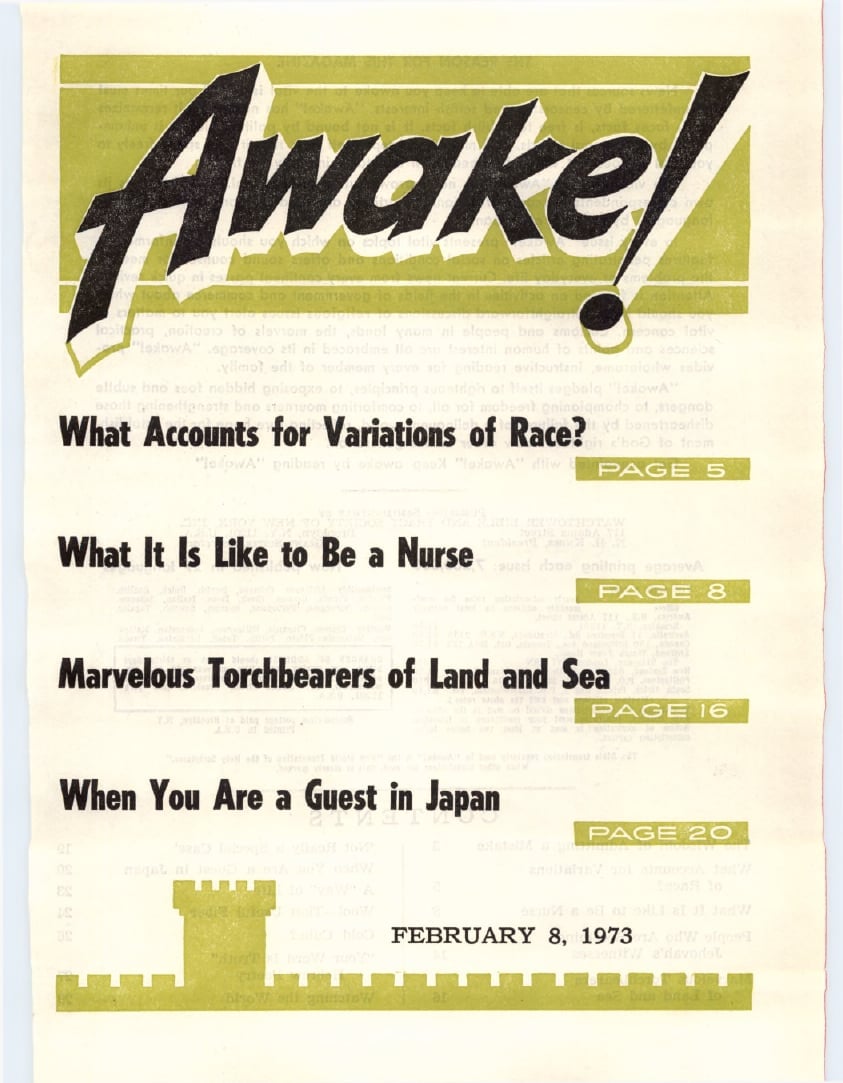
Awake! — February 8, 1973
Source: jw.org
Contents
The Wisdom of Admitting a Mistake
What Accounts for Variations of Race?
What It Is Like to Be a Nurse
People Who Are Becoming Jehovah’s Witnesses
Marvelous Torchbearers of Land and Sea
‘Not Really a Special Case’
When You Are a Guest in Japan
A “Way” of Life
Wool—That Useful Fiber
Cold Cubs?
Hebrew Poetry
Watching the World
“I Found Lots of Information”
Do You Like to Be With Morally Upright People?
The Wisdom of Admitting a Mistake
The Wisdom of Admitting a Mistake
WHO does not make mistakes? No human is infallible. Old and young, learned and unlearned, rich and poor, men and women, one and all are imperfect, and so make mistakes.
Human experience bears out the truth of the words of the inspired penman, the Christian disciple James, “We all make many mistakes.” (Jas. 3:2, Revised Standard Version) And as King Solomon said in his prayer at the dedication of Jehovah’s temple: “There is no man that does not sin.” Is it proper to say, then, that a sin is a mistake? Yes, for the word rendered “sin” in our Bibles literally means a mistake, a missing of the mark.—1 Ki. 8:46.
Since, due to inherited weakness, we all keep making mistakes and so fall short of the mark of perfection, why does it seem so difficult to admit making a mistake? For one thing, we may be trying so hard not to make a certain mistake that when we do, we dislike admitting it even to ourselves.
Doubtless in many cases the reason is pride. Admitting a mistake reflects on things we may take pride in, such as our knowledge, our skill or our carefulness. We want to have a good appearance in the eyes of others. Seeking to “save face” is not limited to Orientals.
Without doubt a very telling reason why it is difficult at times to admit making a mistake is the blame, censure or punishment that may come because of having made a mistake, as when one causes a serious accident. Thus, late in August 1972, a “human error” caused what were called “massive commuter tie-ups,” putting all four main tracks of the Penn Central railroad leading into New York city out of commission, and that for hours. “Someone pulled the wrong switch or pushed the wrong button,” and officials were determined to find out who made the mistake, who was really to blame. The guilty one was not anxious to speak up and admit the mistake.—New York Times, August 30, 1972.
Because of the shame that goes with making a mistake the tendency is to pin the blame on others, a thing our very first parents, Adam and Eve, tried to do. (Gen. 3:11-13) Similarly, Aaron, the brother of the prophet Moses, blamed the people for his mistake in making the golden calf, even as centuries later Israel’s first king, Saul, blamed the people for his mistaken act of disobedience. (Ex. 32:19-24; 1 Sam. 15:9-26) If we recognize why it was that they acted so unwisely, it can help us to avoid the same pitfall.
In contrast to such bad examples we have very good ones where faithful servants of Jehovah God freely admitted their mistakes, the record of which bears testimony to the honesty and candor of the writers of the Bible. Moses recorded his mistake of losing his temper on one occasion, resulting in his being denied entry into the Promised Land. (Num. 20:7-13) There was also Job, who, while insisting on his integrity, had made the mistake of being more concerned with his own vindication than that of God. Admitting it freely, he said: “I talked, but I was not understanding . . . I make a retraction, and I do repent in dust and ashes.”—Job 42:3-6.
The patriarch Judah, the son of Jacob, admitted his mistake in regard to his daughter-in-law Tamar, saying: “She is more righteous than I am.” (Gen. 38:15-26) Then there was also King David. When confronted with the mistake he made in sinning against Uriah, he did not seek to find excuses, but said to the prophet Nathan, “I have sinned.” (2 Sam. 12:13) And, to give another example, there was the apostle Peter. When he saw the reproving look of Jesus right after he had denied his Master three times, “he went outside and wept bitterly.”—Matt. 26:75.
Of course, admitting we made a mistake is the right, honest and decent thing to do. But it is more than that. It is also the course of wisdom. For one thing, admitting to having made a mistake is a lesson in humility. This, on the one hand, protects us from the snare of pride, which is ever ready to entrap us. And, on the other hand, the humbling experience of admitting we made a mistake may well serve to make us more careful so that we will be less likely to make that same mistake again. Wisely we are warned: “He that is covering over his transgressions will not succeed [with God], but he that is confessing and leaving them will be shown mercy”—by God and by God’s servants. Yes, the very confessing of our errors will aid us to leave them.—Prov. 28:13.
Admitting to making a mistake is the course of wisdom in that it builds in us strength and self-respect. Failure to do so is cowardly, and serves to weaken us morally, making it likely that we will continue to make the same mistake.
Further, admitting a mistake is the course of wisdom because it makes for better relations with others. When we refuse to admit we have made a mistake, we outrage the judgment of others; and they will conclude that we are either too proud, or dishonest, or too stupid to recognize that we made a mistake—all of which may well cause a barrier to come between us and those around us. Then, again, if we are willing to admit we made a mistake we will find ourselves more ready to sympathize with others when they make mistakes.
Most important of all, admitting a mistake will keep our relations with our Creator in good condition. Thus King David, by repeatedly and quickly admitting his mistakes, retained good relations with his God. King Saul, however, was reluctant to admit his sins; he preferred giving excuses, and was rejected.
Yes, in addition to the fact that to admit having made a mistake is the honest thing to do, it is also the course of wisdom. It helps to keep us humble. It also helps us to keep our self-respect and makes for better relations with others.
What Accounts for Variations of Race?
What Accounts for Variations of Race?
RACE—today the very word brings to many minds the prejudices displayed in some way in almost every part of the world. Understandably, lack of knowledge is the seeming source of so much prejudice. People ask, ‘What accounts for the variations in race?’
Answering this question requires, first of all, that we find out what the term “race” means. Numerous definitions have been suggested, usually varying from one another only in small points. Generally speaking, however, a “race” is a group of persons descended from a common ancestor and who bear certain physical similarities, such as the color of their skin or their stature.
Strictly speaking, there is only one human race! Virtually all anthropologists agree on this point. Thus, in the United Nations Educational, Scientific and Cultural Organization’s Third Statement on Race, twenty-two experts say: “Mankind is one . . . all men belong to the same species, Homo sapiens. . . . all men are probably derived from the same common stock.”
But, if that is true, why all the variations in human body size, color, shape and abilities? For one thing, men branching off from this “common stock” were so made genetically as to allow for great variation. Understanding how human genes work helps one to appreciate this.
Genes are the tiny particles that determine what traits a person will inherit. For each trait, it is believed, individuals ordinarily inherit two genes, one from the mother and one from the father. Of these two genes, the “dominant” will overpower the “recessive” one and determine the particular trait the individual will have.
Suppose, for instance, one parent has a gene for black hair and the other parent has a gene for blond. If the offspring has black hair, it is apparent that the gene for dark hair was the dominant one.
As the human family grew from its original mother and father there would be a great deal of mixing. Girls with genes for curly black hair, to cite an example, would meet and marry boys with genes for straight blond hair. This, of course, would be true of other characteristics also, such as skin color, shape of the mouth, nose and ears.
However, as groups of people isolated themselves from the larger part of mankind by geographical, linguistic and other barriers, marriage mates were necessarily selected from a smaller sphere. Variation was limited to the restricted “pool” of genes immediately available. Thereafter, in that restricted area, certain features such as straight hair or dark skin appeared regularly. In time, these traits distinguished that group or “race” of people from others. For this reason people today in Scandinavia ordinarily have fair skin, while those isolated from them, as in India, are darker.
Of course, there are limits to this variation. Races may vary in size, as from a Pygmy of less than five feet to a Watusi of some seven feet, but human genes never allow for a one-foot-high man or a twelve-foot-high one. Proving, however, that all men are really part of a common race is the fact that even individuals at “extremes” in stature or color can intermarry with other members of the human family and produce offspring. Therefore, the differences in men are not of great magnitude. Quite the opposite, as noted by anthropologist Ashley Montagu:
“All competent students who have considered the subject believe that by far the greatest number of genes are held by mankind in common, and that there are probably not more than 10 per cent of the total that are held apart. Since scientists believe that mankind drew its genes originally from the same gene pool, this great likeness is not surprising.
“As soon as we get beneath the skin, the likeness on a physical basis would suggest that the number of gene differences existing between even the most ‘extreme’ ‘races’ of man is much less than 10 per cent.”
Have Races Evolved to Fit Their Environment?
But, since all men come from a “common stock,” why is it that men of different races seem so well fitted to their environment? Did the Eskimo, for instance, acquire adaptation to a cold climate by evolutionary process? Or, at the opposite extreme, did evolution prepare only people with dark skin to live in the warm tropical climates?
Some scientists make this claim. But is it really true? In the past some speculated that characteristics acquired by a parent were passed on to the offspring. The error of this now-abandoned theory is readily evident. For example, if two light-skinned parents develop deeply tanned bodies, their offspring are not born with dark bodies, are they? No. Rather, their children must be exposed to sunlight to darken in the same way. The genes of the parents were not altered to pass on dark skin.
Nevertheless, scientists today do believe that changes in racial characteristics have resulted from gene mutations, that is, sudden alterations in genes. These alterations, it is believed, are then transmitted to offspring. But observed mutations have resulted largely in harmful changes, not in improvements. Furthermore, there is great uncertainty as to how these assumed mutations took place. Columbia University’s L. C. Dunn acknowledges:
“How [certain bodily changes] happened in history is not known; nor is it known exactly how mutations occur today, in spite of the extensive biological research on this question during the last 30 years.”
Well, if not by genetics, how do we explain why the races seem so well adapted to their environments?
More than Genes Responsible for Races
Such adjustments are largely cultural. Cultural or environmental influences are extremely persuasive. In fact, even before a child is born the emotional state of its mother, greatly determined by her own environment, begins to affect the child’s mind and body. Then, from the moment the child is born, it is immersed in a manner of life made up of local sights, sounds, smells and climate, as well as “peculiar ways” of doing things.
For instance, Eskimos have developed special bulky clothing, also housing that protects them from sub-zero temperature. Moreover, with time has come an invaluable familiarity with Arctic geography and the ways of animals that provide the Eskimo many of life’s necessities.
But, is not the Eskimo protected from cold by an inherited higher metabolism? No. While the Eskimo metabolism is sometimes one third higher than that of strangers who come into their cold surroundings, it is not inherited, but is dietetic in nature. Taken off their usual high-protein meat diet, the Eskimo metabolic rate drops within days.
Regarding this and other seemingly “inborn” adaptations, evolutionists J. F. Downs and H. K. Bleibtreu state in Human Variation (1969):
“We can see that the Eskimos have developed many cultural devices for dealing with cold . . . His narrow nose, and that of certain neighboring peoples in Siberia, has been called an adaptation that helps him avoid taking large quantities of cold air into his lungs. The fact that some people live in equally cold climates without this trait suggests that its adaptive importance is only presumptive. Similarly, the broad nose often found in Africa, Australia, and New Guinea is said to be a device which cools air; but much of Australia is very cold at night and the highlands of New Guinea are never excessively hot. In Africa, once we look past the stereotypes, we find a variety of nose widths . . . Generally speaking, biological adaptations to cold then are not well understood and seem, where they do exist, to be short-lived physiological adjustments—not genetic alterations evolved through natural selection.”—Pages 201-203.
But what about skin color? Has this not resulted from evolution so that the black man, for instance, is better adapted for the tropics? Note the answer of London medical biologist Alex Comfort:
“We may suppose that skin-colour is or was adaptive, but the fact remains that, save for those white individuals who burn without tanning, no race seems to be at a marked advantage or disadvantage today by reason of colour in their encounters with heat or sunlight. The only exception is in the slightly higher resistance to skin cancer seen in dark-skinned peoples over the parts of the body exposed to sun. Apart from this and the fact that they do not suffer from sunburn, Negroes do not have any very great advantage in standing up to heat compared with adapted white men.”
However, white-skinned people, newly arrived in the tropics, often do have problems because of the unusual ways of life and a variety of diseases there. The natives, on the other hand, thoroughly adapted to this way of life, can thrive.
God’s Purpose and the Races of Men
Surely, Jehovah, man’s Maker, knows of man’s marvelous genetic and cultural potential. He originally purposed for men to branch out and fill the earth. When men, contrary to his expressed decree, sought to concentrate around the tower of Babel, God confused their languages and they were spread over the earth anyway.—Gen. 9:1, 2; 11:1-9.
Therefore, as men scattered out and, in certain cases, were isolated from one another, differences due to genetics appeared. But man’s capacity to be educated to his surroundings, his cultural adaptability, enabled him to settle virtually anywhere on this earth.
Also, in God’s grand providence, wherever these “races” of men went, they would in time learn of God’s purpose for man. As the apostle Paul summarizes:
“[God] made out of one man every nation of men, to dwell upon the entire surface of the earth, and he decreed the appointed times and the set limits of the dwelling of men, for them to seek God.”—Acts 17:26, 27.
Today, men who “seek God” in some 208 lands and islands of the sea are being taught his purpose by Jehovah’s witnesses. Have you not heard of their genuine Christian international brotherhood? And of their lack of racial discrimination? Let them show you how to be among the “great crowd, that no one could count, out of every race and tribe and people and language . . . [crying loudly:] ‘Salvation belongs to our God who sits on the throne and to the lamb.’”—Rev. 7:9, Byington translation.
What It Is Like to Be a Nurse
What It Is Like to Be a Nurse
As told to an “Awake!” staff writer
I WAS born in Jamaica in the West Indies, and began my nursing career there in the late 1940’s when I was still a teen-ager. So for twenty-four years I have been nursing, both in Jamaica and in the United States.
I have cared for thousands of patients afflicted with practically every disease and ailment imaginable. I have worked in the operating room, tended torn and mangled accident victims, comforted the dying, and performed scores of other nurse’s tasks. I have many times known the sadness and frustration, as well as the elation and joys, common to nursing.
Often I have been asked: “Why did you choose this profession? I could never be a nurse.” Or one may hear it said: “You have to be a born nurse.” But is this so?
A Difficult Job
As with other jobs, considerable education and training are required to be a good nurse. It also takes courage, and a real desire to help fellow humans. Keeping physically fit, too, is important, due to one’s being exposed to communicable diseases. But a good nurse will especially have sympathy for patients, and give of herself to furnish their needs.
However, it is much easier to say this than to do it. For a nurse may, days on end, week in and week out, care for suffering or even dying persons. This can harden her, causing her to become indifferent toward the needs of patients. But that does not have to happen. There are nurses who are deeply moved by the plight of their patients.
I can remember, for example, a young patient that I had a few years ago at the Carson Peck Memorial Hospital in Brooklyn, New York. She was a sweet person, only about thirty-six years old. Three years or so before, she had a cancerous breast removed, and now she had another cancer operation. Looking at her, you would never know that she was sick. But her body was filled with cancer.
I really felt sympathy for her, for she had such a will to live. I do not think she ever accepted the fact that she was going to die. However, she survived only about five weeks after her second operation. It was so pathetic when her husband and mother would come to visit, for they knew her condition. It really hurts me to watch a patient slowly die, and to see the deep grief of the relatives.
What is particularly sad is when patients feel they are going to live, and are planning for something in the future, but you know that all the evidences show they are going to die. You try to hide your feelings—you have to at times. Once in a while I just have to get out of the room.
Not only are such cases sad, but some are frustrating as well. I remember a patient, about fifty years old, at St. John’s Episcopal Hospital in Brooklyn. Two weeks before, he suffered a severe heart attack. But now he was really getting along well. He was such a fine man; he never complained, and was always cooperative. Everyone on the floor liked him.
This particular morning I shaved him, gave him his bath, and he was sitting up in bed eating. He looked so good. The doctor came in, examined him, and told him that he was doing fine. But then, all of a sudden, he called for me. I immediately went over and asked him, “What’s wrong?” All he could whisper was, “Miss B————.” Then he fell back, unconscious.
This all happened without any warning. Within seconds the emergency oxygen equipment was applied to revive him. But it was useless; he was dead. I had worked so hard nursing him, and was sure he was going to recover. I really felt the loss. And then right afterward his wife came in, and I had to try to comfort her. Nursing can be like that; some of it is not easy to take.
Satisfaction and Joys
But, on the other hand, nursing can give real satisfaction; it affords an opportunity to help people, to give them a little comfort. Why does one take up this profession? It should be to help people, to make them feel a little more comfortable in their illness or dying state. That is the way I have always felt.
Nursing also affords moments of real excitement and joy, especially when a patient is saved from almost certain death. I can remember a case soon after I began nursing in Jamaica. I was working in the hospital in Montego Bay when a local tailor was seriously hurt. Apparently a door had slammed, driving deep into his chest a long sewing needle that he kept in his shirt.
When he was brought to the hospital he was gasping for breath. X rays were quickly taken. They revealed that the needle point was actually touching his heart, but it did not go through. Immediately the operation was begun. An incision was made over the heart, and I could actually see the exposed heart. The needle was taken out, and the man lived! It really thrilled me to be part of that operating team that saved his life! Since then I have had this joy a number of times.
On another occasion I was working in the operating room of that same hospital. Two boys, both about ten years old, had been on their way to school when a truck hit them, squeezing them against an earthen bank. The chest cavity of one of the boys was split apart, exposing his heart and lungs; the leg of the other child was seriously damaged.
I was waiting in the operating room when the ambulance crew delivered them. As soon as they arrived, I began cutting their clothes from the wounds. It was frightening, actually to see that one boy’s exposed heart pulsating! I did not see how he could possibly live. But quickly the doctors began an hours-long operation. They cleaned out the chest cavity, sewed up the inside ruptures, packed the cavity with antibiotics, and closed the massive wound. For months I nursed that boy. And he recovered completely!
Patients’ Gratitude
It is certainly an encouragement when patients who have been nursed back to health say: “You saved my life. Thank you so much!” Over the years a number have told me that. This helps to make nursing, despite its difficulties, seem worth while.
Many former patients still keep in touch with me. One Jewish lady, for example, never fails to write when she goes on vacation. She was really a difficult patient. In two weeks she had eighteen nurses! Nobody stayed with her but me. I find that you can be firm, but kind, with patients, and they usually respond.
I really have sympathy for my patients. That is why I like bedside nursing; I can expend myself more to make people feel that living is really worth while. Of course, not everyone expresses gratitude, but I know that people appreciate consideration and kindness, especially when they are sick.
My mother once told me that, when she was riding a bus in Jamaica, she overheard two women discussing a nurse. They were saying how kind she was to them while they were in the hospital and what she did for them. And then one of them mentioned the nurse’s name—my name. My mother was so surprised she turned around and said: “That’s my daughter!”
My Decision to Be a Nurse
How I became interested in nursing is rather unusual. While I was on vacation in Montego Bay I went with a friend to the hospital to visit a girl recovering from an appendix operation. It was a beautiful place, with a view overlooking the bay. I told the girl that if I should ever be operated on I would like to come to this hospital and have the same bed she was on.
Well, that was on a Sunday. And the following Saturday I was there as an emergency case. And I got the same bed, in the same room, and I was operated on by the same doctor for the same thing, removal of my appendix.
It was while I was lying there recovering that the thought first came to me that being a nurse would be an interesting profession. I thought to myself, “I am surely ignorant about my physical body, my anatomy.” I wanted to know more about how the body worked, so I decided to become a nurse.
Nurse’s Training
Right after I graduated from secondary school I applied for nurse’s training. We had a choice of places to go for training, so I selected that beautiful hospital in Montego Bay, and I was accepted there.
Our training consisted chiefly of on-the-job nursing. We started working in the hospital wards the first week we arrived. We were called probationers. To distinguish us from the regular nurses who wore all white, we wore a blue uniform with a white apron and black stockings.
We had to be on the job in the hospital at 6 a.m. and we worked until 6 p.m.—with some time off during the day. In the evenings we studied nursing. But except for two or three hours of class instruction, our days were devoted to actual nursing.
Experienced nurses taught us to give patients baths, enemas and injections, to change dressings, to take blood pressure, and so forth; and then under their watchful eye we did these procedures ourselves. We even learned to do things that only doctors are permitted to do in the United States. For example, if a person cut open his arm or leg, we would not call a doctor to care for this, but would sew up the wound ourselves. Only if it was a head wound, or was very serious, would a doctor be needed.
Today, however, girls in nurse’s training in some places study nursing mostly from books; they learn the theory, but often get very little practice. Some graduate nurses I have seen did not even know how to give an injection. One college-trained nurse, although able to recite the details of eight varieties of enemas, admitted that she had never actually given a single one!
Trials and Pressures
There is a big difference between reading about nursing from a book, and actually doing it. I will never forget, in about my second week of training, that a nurse told me to put back the dentures in a woman who had just died. I thought that I would die. I started to cry. But the nurse made me do it.
Watching our first postmortem, or autopsy, was also horrifying. We were all sick that night. I could not eat or sleep. The picture of those internal organs being held up by the doctor for us to identify was too vivid in my mind! But I had wanted to learn about anatomy and, I must say, I did.
For my second year of training I was transferred to the general public hospital in Kingston, the capital. There I worked in a ward for patients with tropical diseases, caring mostly for typhoid patients. The third and final year of our training passed quickly. Now, whether we were recognized as professional nurses depended on passing the final exams. In one test we had to sit before a panel of doctors and answer any questions they might ask. Also, as a practical test I had to check urine for its sugar content, with doctors watching me do it! I was so nervous, my hands were shaking, but I passed. I was now a professional or registered nurse.
Training to Be a Midwife
However, before going to work as a registered nurse, I took a six-month course in midwifery at Kingston’s Victoria Jubilee Hospital. We had to deliver at least forty babies and pass a stiff exam before qualifying as a licensed midwife.
I will never forget my first delivery. It was terrible! I thought that I was going to deliver a live set of twins, but they were macerated. They came out in my hands—dead. I was frightened to death!
In our training we were taught to deal with all kinds of abnormal births. For example, instead of coming out head first, as is normal, a baby will at times emerge feet first, hand first or at some other angle. We learned how to deliver these babies, and I have since delivered many of them successfully, without complications. Also, the umbilical cord sometimes gets wrapped around the baby’s neck, and we were taught what to do when this occurs.
However, in particular we learned how to maneuver the child in the process of delivery, so that the mother is not torn during birth. It is the standard practice among many doctors to slit the mother, deliver the baby, and sew up the incision. They do this operation, called an episiotomy, because it is easier. But a trained midwife can, in almost all cases, deliver a baby without doing this cutting to enlarge the mother’s opening. In the hundreds of babies I have delivered, I can count on the fingers of one hand the number of episiotomies I have needed to do.
For several years I nursed in Jamaica, serving as a midwife, training student nurses, and doing other hospital work. Then in 1958 I came to New York.
Lack of Caution and Care
Up until three years ago, when I began doing clinic work, I did bedside nursing in Brooklyn hospitals. True, anyone can make a mistake, but at times I have been appalled by the lack of caution and care exercised by both doctors and nurses. I know of a number of instances where patients that were operated on have had instruments or towels left inside them.
There was, for example, a patient in Brooklyn for whom I cared about five or six years ago. On returning home from the hospital after an abdominal operation she complained of severe pains. Her husband got angry with her, telling her that she was all right, but she kept complaining. So they brought her back to the hospital and took X rays. Inside her were the doctor’s forceps!
Certain doctors, it seems to me, are really careless or negligent. For example, they are supposed to run a number of tests on a patient before an operation, including an EKG to test the heart, X rays, and so forth. But I know of instances when they have failed to do this, with serious consequences.
One patient that I nursed at a Brooklyn hospital had fallen and broken her elbow. That is all. They took her to the operating room to set it. After administering anesthesia she went into a cardiac arrest—her heart began to fail—they had to do open-heart surgery right then and there. She died, after several days, without ever regaining consciousness. But if the tests had been run, they would have known her heart condition and could have taken precautions.
Things like that happen more often than one may realize. I know because I have seen them happen, and so have friends of mine who work in hospitals here in New York. It is sad to say, but many of the nurses and doctors nowadays just do not seem to be interested in the patient’s welfare. Rather, they are interested mainly in the money they can make—their salary.
Quite a number of times, when I have relieved nurses, I have had to call their attention to the way they have left a patient. The patient was not comfortable; the nurse had not changed his bed, gotten him up for a little exercise, given him a bath, and so forth. All they had done was wipe his face with a damp cloth. And that is not the way to nurse!
In recent years it has made me sick to my stomach to see the negligence of nurses, which I am convinced has led to the death of patients who otherwise might have lived. I have observed patients in discomfort ring and ring their bell. But the nurses just sit at their desk and do not answer. All they seem to be interested in is their smoking and personal comfort.
Of course, I know this is not true in all hospitals. Not all nurses or doctors are this way. In fact, I feel that most of them are not. But there is definitely a trend toward self-interest rather than patient-interest, and I have heard other doctors and nurses also express dismay over this.
Abortion and Blood Transfusions
I believe that the wholesale killing of unborn babies in New York hospitals is just another example of the deterioration going on today. What is happening is so disgusting that some city hospitals are having trouble getting nurses to work in their abortion clinics.
The recent New York abortion law permits an abortion up to twenty-four weeks after conception, by which time the fetus is easily recognizable as a human creature with distinctive parts. Some aborted fetuses have even lived! But nurses have been told to let others die. A registered nurse wrote something very interesting about this matter in a nursing magazine. She said:
“Moral considerations aside, at present an unborn child is considered by law a person: he is given rights to inheritance, court suit for prenatal damages . . . Thus, a woman has no more right to kill her unborn child than she has to batter, abuse, or kill him after birth.”—American Journal of Nursing, December 1970.
In the clinic where I work, dozens of girls a week come in for abortions. Some have had two abortions within just a few months! I think the doctors are chiefly to blame, for they could refuse these girls. But it is a booming business, and I think that doctors are interested mainly in the money. Personally I will have nothing to do with abortions; not even the paper work in connection with them. My conscience will not allow it.
I take a similar position in connection with blood transfusions. I have seen patients sicken with hepatitis from the blood they receive. Some never recover. Also, some patients are killed by circulatory overload and other adverse reactions to transfusions. So, rather than being lifesaving, I know that transfusions can be death-dealing. Some doctors I know of are beginning to use blood less and less. I really do believe that it will contribute to one’s health, both spiritually and physically, to obey God’s command to ‘abstain from blood.’—Acts 15:28, 29.
What Nursing Helped Me to Appreciate
I have learned a lot from nursing. For one thing, it has helped me to appreciate how marvelously designed the physical body is. It is indeed the handiwork of a Grand Creator. It was soon after I began my nursing career that something happened that really made me think about this.
I was working one night in the operating room in Jamaica when a little girl was rushed in by her frightened parents. She had swallowed an English halfpenny that stuck in her larynx. X rays revealed that mucus was forming around the coin, and since it could not be extracted through her mouth, an immediate operation was necessary. But just as we were about to begin, the power went out. So while I held a flashlight the doctor went ahead with that very delicate operation.
As I watched, I could not help but marvel. I can remember thinking at the time, ‘Look at those fingers. They are so skilled! Really, shouldn’t we be God-fearing?’ Because of the doctor’s God-given fingers that little girl was saved.
But often nothing that either doctors or nurses can do can keep a patient from dying. I have known many times that helpless feeling when death would claim another victim. Often I wondered, ‘Why do humans have to suffer and die? Is it really God’s purpose that people die like this?’
I am so happy that I was moved to seek an answer, and that I was helped to appreciate God’s grand purpose to establish a new system of things, wherein “death will be no more, neither will mourning nor outcry nor pain be anymore.” (Rev. 21:3, 4) As a nurse, I especially look forward to the fulfillment of that promise.
People Who Are Becoming Jehovah’s Witnesses
People Who Are Becoming Jehovah’s Witnesses
IN FIVE years, more than 680,000 persons have been baptized by Jehovah’s witnesses. Last year alone over 163,000 were baptized, 15,512 at just the “Divine Rulership” Assemblies in the United States. Who are these people that are becoming Jehovah’s witnesses?
✔ Included are elderly persons. At the Santa Rosa, California, assembly a ninety-six-year-old man was baptized. He had on many occasions taken the Watchtower and Awake! magazines from the Witnesses. Then, two years ago, when a Witness offered to study the Bible with him, he accepted. Soon he became convinced that he had finally found the true religion.
✔ Also becoming Jehovah’s witnesses are former nuns. One of them served as a nun for seventeen years. In a letter to her pastor, dated May 1972, she explained: “This is to inform you that I want to be removed from the files of the Catholic Church. This may come as a shock to you . . . I know how you rejoiced with me when I entered Visitation seventeen years ago, when I thought being a Nun was the truly Christian way to live the truths of the Bible. Lonely and frustrated as I often felt, your annual visits were always a joy and encouragement to me . . .
“You know, so many of the Sisters have been disillusioned as we tried to update our sacred, favorite customs and traditions. No wonder so many are leaving the Convents when we found out the silly reasons for so many of the age-long celebrations!”
She then described to her pastor how one of Jehovah’s witnesses challenged her to examine her beliefs through a Bible study, observing: “I almost laughed because I knew I had all the answers. But to my surprise, what he showed me in black and white made me go to Catholic friends and Priests and Nuns to help me prove him wrong. . . . I was so shook up that I wrote, terminating my study, with no intention even to see one of Jehovah’s witnesses again.
“I discussed it with Catholic friends and family, who, by the way, were either not going to Church, were high on drugs or were living immoral lives. Each told me to ‘go home and just keep the faith.’ One even said: ‘I don’t care what the Bible says, in fact—to hell with the damn Bible!’ I was so grieved that I said, ‘If that’s what your religion does to you, I don’t want any part of it!’ So humbly, I went back to my friend to admit that he had the truth taught in the Bible.
“Then I began to attend the meetings . . . I even joined their ministry school where I learned to discuss logically and prove all things true Biblically. I found great Christian friendship and practical brotherly love . . .
“I hope that you will allow yourself to be witnessed to by one of these thinking, loving believers of Jehovah’s Organization who are really living the teachings of the Bible.”
On August 5, 1972, at the Queens, New York city, “Divine Rulership” District Assembly this former nun was baptized and became one of Jehovah’s Christian witnesses.
✔ Others, who have lived extremely immoral lives, have made radical changes in their lives after learning the truth about God’s purposes. One young girl was placed in a Catholic school and home when her mother became incapacitated. Then at the age of eighteen she left and became a go-go dancer.
When sitting at the bar one day, she was told that a man would pay $20 to have sex relations with her. She had never done this before, but she consented. From that time, prostitution became her means of making a living.
Later she agreed to live with a man much older than herself. Two children resulted. Then in February of 1972 one of Jehovah’s witnesses called and arrangements were made for a Bible study. Shortly she began making remarkable changes to bring her life into harmony with God’s moral standards. In June she and the man with whom she had been living were married. In August at the Toledo, Ohio, “Divine Rulership” Assembly she was baptized.
✔ Quite a number of former drug users have also become Jehovah’s witnesses, including ones who had gained prominence as rock ’n’ roll musicians. One group, called “the Villagers,” appeared on nationwide television. After the group broke up, several of its members began studying the Bible, changed their way of life and became Jehovah’s witnesses. Some of these were baptized at the Columbia, South Carolina, “Divine Rulership” Assembly last summer.
✔ Some months back three members of a rock ’n’ roll band in Sonora, California, called the “Yowls” walked into a Kingdom Hall. They had long hair, beards, saggy clothing and were under the influence of drugs. One of them writes regarding the experience:
“Our first visit to a Kingdom Hall convinced us that this was a place where love was not just a word to use. There was real friendship shown and God’s Word was relied on. We agreed to have a Bible study, and shortly were keenly interested in sharing in the field ministry. However, we soon realized that our appearance was not correct or appropriate for ministers. So within just two weeks we cut our hair, shaved our beards and made a complete wardrobe change. My new course cost me my mother, who used to accompany me on ‘trips’ with drugs. But in her place I have many new ‘relatives’ to share my newfound joy.
“I’m happy to have been baptized with my wife at the ‘Divine Rulership’ Assembly in Pleasanton, California. One other member of our former band was baptized in Oakland, two more will be baptized at the coming assembly in Sonora, California, and twelve others are either studying or attending the Kingdom Hall.”
✔ In Southern California two young persons became engaged in a discussion of religion. They decided to phone Jehovah’s witnesses for help, and the Witnesses responded to their call. A discussion regarding God’s purpose to establish a righteous new system of things followed. The youths were thrilled by the things they heard. (2 Pet. 3:13) Soon they started attending congregation meetings of Jehovah’s witnesses. One of them said of his appearance at that time: “I had shoulder-length hair, a beard and overalls. I was, of course, involved in drugs.”
That was in the early part of 1972. Changes quickly followed, both in appearance and in conduct. Four months later the young man and his wife not only attended the “Divine Rulership” Assembly in Inglewood, California, but brought along four other young persons as well. He and his wife were baptized at that assembly!
✔ Often it is persons who are dissatisfied with this system of things who become Jehovah’s witnesses. A young Dayton, Ohio, man felt that he could no longer put up with today’s social injustices. Finally he wrote a letter to the president of the United States stating that if his demands were not met, three major cities would be destroyed. However, instead of having success in his demands, he received a visit from the FBI and was extensively questioned.
The young man began to realize that he could not change this unjust system. Then he started to study the Bible with Jehovah’s witnesses. As he studied, he was impressed with the way the Bible described today’s conditions, and yet showed the certain prospects of better conditions under the rule of God’s kingdom. Contented with this hope, he was baptized at the “Divine Rulership” Assembly in Toledo, Ohio, this past summer.
Really it is people of all kinds—young and old, rich and poor, and from all walks of life—who are becoming Jehovah’s witnesses. Many have made marvelous changes, bringing their thinking and course of life into harmony with God’s righteous standards.—1 Cor. 6:9-11; 1 Pet. 4:1-3.
Marvelous Torchbearers of Land and Sea
Marvelous Torchbearers of Land and Sea
BY “AWAKE!” CORRESPONDENT IN THE BRITISH ISLES
IS IT not a humbling thought that, long before intelligent man discovered how to make artificial light, multitudes of unthinking creatures on land and in the sea possessed their own tiny but efficient “lanterns”?
Reflect a moment on a few of such creatures that dwell in the perpetual darkness found in ocean deeps. Imagine yourself down there at a depth of, say, 5,000 feet, peering out of the porthole of a bathysphere. What is this tiny light approaching? As it nears you, no doubt to investigate the light from your porthole, you perceive that it is an odd-looking fish. Doing what? Why—fishing! Its fishing rod is twice as long as it is, and dangles out of its mouth. That light? A light organ at the tip of its rod. This creature is known as the angler fish. Another angler fish at about the same depth has its “lure”—a light organ—inside its mouth immediately behind its teeth.
Then there is the lantern fish, so called because—like a passenger ship showing its lighted portholes at night—it has rows of light along each side. Other hunters of the deep have headlights that enable them to cast a beam of light several feet in front of them.
A Mystifying Phenomenon
How, though, can we describe this mysterious phenomenon by which marine creatures (and other living things) can make their own light? Technically, it is called bioluminescence, which is the ability of living organisms to emit light without heat. This is accomplished through the interaction of a chemical known as luciferin and the enzyme luciferase.
Have you ever heard of the “burning seas”? Odd as this term may seem, it refers to several “bays of fire” in and close to Puerto Rico’s “Bahía Fosforescente” (Phosphorescent Bay). The “fire” is caused by untold numbers of tiny creatures called dinoflagellates, which create the illusion of a burning sea by emitting sparks of chemical light. According to the National Geographic Society, this is one of the few places in the world where this phenomenon is found.
One may wonder how it is that such multitudes of these tiny creatures are able to congregate so closely together, despite the scattering influence of tides and winds. The answer lies in the fact that these sheltered bays have very moderate tides, while the sea links with the Caribbean are narrow. Hence, the calm conditions in these bays, together with their vitamin-rich waters, encourage expansion in the numbers of these microorganisms. So, we have these “bays of fire”—that glow in the dark—made possible by tiny creatures that possess their own lighting systems.
Lanterns of Land Creatures
Land creatures, too, have their own tiny lanterns, in some instances a kind of luminosity. Among these are earthworms, centipedes, glowworms and various insects. The glowworms include the remarkable New Zealand glowworms, the larvae of a small fly. Normally they live on the roofs of damp caves, where they weave webs from which are suspended slender threads beaded with sticky mucus. Then, when all is ready, these glowworms turn on their lights, in ones or twos to start, then in unison, operating like a lighthouse—on-off-on-off. For what purpose? To avoid starvation. Insects fly in to investigate the flickering light, get entangled in glowworms’ fishing lines—and are eaten.
Referring to these glowworms, Life Nature Library writes: “A starry universe underground is created on the ceiling above a subterranean river in New Zealand’s Waitomo Caves by the glow of thousands of luminous larvae which trail silken threads down like fishing lines. Insects attracted by the light of the larvae stick on the threads and are then reeled in. The larvae grow into true fireflies.”
The light that these torchbearers give off is said to be without parallel for its coolness, radiating only one part in 80,000 as much heat as that given off by a candle flame of equal brightness. Truly a “cold” light.
Fireflies are possibly the most fascinating of all torchbearers. On warm summer nights, in many areas, they manifest themselves in a fashion that delights the human eye. But who can explain their uncanny ability to operate their flashing mechanisms ultimately in unison? One wonders if, perhaps, they use some kind of code or signal that, unheard and unseen by man, enables them to act thus in chorus. Science has attempted to supply answers, but without satisfying success!
Among other insects that are luminous are the springtails and beetles that may belong either to the click beetle group or the firefly group. Nor must we overlook the so-called railroad worm, related to the firefly group. It has a row of yellow-green lights on each side of its body, as well as—appropriately—a red light on its head!
Luminous Toadstools
Even certain plants have their own tiny lanterns. Notable among these is a species of luminous toadstools, some of which are found on rotting logs in Asian forests. Looking quite ordinary in daylight, at night they emit a mysterious yet beautiful glow, with colors ranging from blue green to yellow orange. So bright is this light that it is said to be as strong as a small night-light.
People who have walked in a forest at night following a heavy shower may well have been puzzled by seeing both live and dead wood giving off a luminous glow. These lights, too, come from fungi growing on timber.
Many Torchbearers in the Seas
Yet, if we could but glimpse a few of the untold multitudes of fascinating torchbearers that dwell in the seas and oceans, we would note that this mysterious built-in ability to emit some degree of light is not confined to any one order of sea creatures but is found in an amazing variety of moving, and unmoving, living things.
How vast, too, is the range in size, each able to give off some degree of light! On occasion, seagoing travelers have noted with excited wonderment tiny sea creatures swarming in glorious profusion, shining and sparkling like millions of little lanterns, lighting the sea to a considerable depth. Among such creatures are some so tiny as to be invisible to the naked eye when not emitting light.
But larger sea animals, such as jellyfish, comb jellies, crustaceans, worms, brittle stars, mollusks, the giant squid, and so on, also emit light. Then, apart from these free-swimming creatures, there are also the sea pens (a kind of polyp) and the luminous hydroids (also polyp-like) that are attached to rocks and piles.
Some deep-sea fish, as we have noted, carry torches on their bellies and sides. Among some—the squid and the shrimp, for instance—definite luminous organs of considerable complexity are visible, containing groups of photogenic cells as well as lenses, reflectors and screens, all working harmoniously together to transform each luminous organ into a beautiful lantern. Whether these light organs are located on the head, along the sides or bellies, in groups or rows (like pearl buttons) or singly, the fish are apparently able to flash them on and off at will.
Not a Different Light
You may wonder: Is this mysterious luminosity or light that so many kinds of living things emit different from other kinds of light? Apparently not, according to Professor E. Newton Harvey, who writes: “It’s colours may be reddish, yellow, green or blue, and its spectrum a continuous short band in these various regions of visible light. No infrared, ultraviolet, or penetrating radiations are produced.”
And how efficient is this light! Man, despite all his ingenuity and twentieth-century wizardry in many spheres of scientific activity, cannot even approach the efficiency of the light emitted by these torchbearers. How so? Because the light or luminosity of these living things is said to be a “cold” light, meaning that while they can create light within their own bodies at will, they can do so without losing more than an infinitesimally tiny fraction of their own body heat. They utilize the needed energy to produce light with such efficiency that almost none of it is converted into heat.
Why So Equipped?
But, for what purposes have some forty different orders of animal life (in the broadest sense), as well as two groups of plants (fungi and bacteria), been fitted with such a fascinating array of lights of varying, scintillating colors? After much research, scientists still cannot be too sure. However, they believe that a main reason is to illuminate their way.
In support of this theory scientists cite the remarkable firefly fish of the Banda Islands in Indonesia. Under each eye this fish has a pocket packed with luminous bacteria. These shine forth so brilliantly that together they look like the twin headlights of a car. When the fish wants to it switches each headlight off by pulling a black fold, like an eyelid, over each pocket. However, it does not seem reasonable to suppose that the emission of light among some marine life, especially the deep-sea fishes, is necessary to light up their way in dark depths where the sunlight never penetrates.
Possibly, also, these creatures use their light when mating, as a signal to the opposite sex, particularly as males and females of each species on land and in the sea are said to have a characteristic flash that helps them to find those of the opposite sex. Indeed, it is thought that some torchbearers use their lanterns only during mating season.
The fireworms of Bermuda may be cited to support this theory. Most of their lives they spend on the seabed. Then, during certain months and after a full moon, mysteriously triggered by some instinct, they rise in swarms to the surface of the sea and put on a brilliant display of flashing lights. Then they mate. But not at any odd time! No, indeed! The act of swarming and mating has to be carried out about fifty-five minutes after sunset!
Also, deep-sea fish apparently use the glowing lights in or close to their mouths, or those dangling in front of them, to attract smaller creatures for food. Possibly, also, these and other deep-sea torchbearers use their light to frighten or warn off predacious animals that fancy them for dinner!
But, really, there are many things about the light of these living creatures that man has yet to learn. The secrets of their “cold” light are still not fully understood, nor can man produce it as efficiently. Truly, the light of these marvelous living torchbearers of land and sea is evidence of a Wonderful Creator.
‘Not Really a Special Case’
‘Not Really a Special Case’
UNDER the title, “Vascular Surgery in Jehovah’s Witnesses,” the Journal of the American Medical Association of August 10, 1970, published an interesting article. It was prepared by a team of Houston, Texas, surgeons and which team included heart surgeon Dr. Denton A. Cooley.
The report told of the results of twenty operations for vascular congenital or acquired disease. Among other things it stated: “Patients who belong to the religious sect of Jehovah’s Witnesses refuse to undergo any surgical procedure requiring blood transfusion, because it is forbidden by their literal interpretation of Bible passages such as Acts 1[5]:20, 29, which charges those believing in God ‘to abstain from . . . blood.’ The development of a [modern] technique . . . has allowed such patients to undergo open heart surgery without challenging their religious convictions; and since 1964, open heart operations in Jehovah’s Witnesses have been extensively reported. Relatively little information exists, however, on other procedures carried out in members of this faith. . . . In this paper we detail our experience with Jehovah’s Witnesses who underwent vascular procedures without blood.”
“Results in this series of Jehovah’s Witnesses undergoing major vascular surgery compare favorably with results in other patients who received similar operations . . . Replacement of immediate blood loss with 5 percent dextrose in lactated Ringer’s solution and administration of the same fluid during the early postoperative periods was enough to keep the circulation stable. Lactated Ringer’s solution is preferable.”
The patients ranged in age from seventeen months to seventy-six years. Of the twenty operated on, eighteen recovered and returned home after an average hospital stay of one week. One patient, seventy-four years of age, died from complications that set in the third day after the operation, and one fifty-two years old died afterward in a subsequent open-heart operation. But “no complications could be attributed to the nonrestored blood loss after the vascular procedure.”
“Since it is our policy,” the authors went on to say, “to avoid the use of blood transfusions whenever possible in all operations, the patient who is a Jehovah’s Witness does not really represent a special case; and we can comply with his demands without undue concern. We have found that blood transfusion is not a necessary accompaniment to vascular surgery, but indeed has certain disadvantages such as the risk of hepatitis.”
When You Are a Guest in Japan
When You Are a Guest in Japan
BY “AWAKE!” CORRESPONDENT IN JAPAN
AS AN honorable visitor waking up to your first morning in Japan, you have the opportunity to get a glimpse of a country that probably has fascinated you for years. What will you discover?
In the lobby of your hotel there will be someone who can speak a little English, but be sure to speak slowly and make very clear what you want. It is said that when one foreigner in Tokyo said he wanted a bus to get somewhere, the hotel manager ordered a large coach.
Due to the tremendous differences between Japanese and English, many Japanese find English conversation very difficult even after years of diligent study. So after experiencing a few language problems, you may decide that a Japanese phrase book would be a good investment.
Are you ready to venture out? Your day may go something like this.
Hey, Taxi!
To get to the shopping area of Tokyo’s famed Ginza you decide to go by taxi. But you find that the taxis will not stop in spite of your frantic gestures and your finally resorting to stepping into the path of oncoming taxis, which merely swerve around you. Yet the taxis stop for the Japanese. Why? Is it because of prejudice against foreigners? No, the taxis have set places to pick up fares, so it would be advisable if you quietly went and stood in line with the local people.
Tokyo taxi drivers live up in every way to the standards set by their counterparts in Paris, London and New York. If you like to live dangerously you will find much to admire in their constant changing from lane to lane without signaling, apparently with complete disregard for other traffic. However, as everyone appears to drive the same way, you will have to acknowledge that Japanese drivers evidently know what to expect. Your estimation of Japanese taxi drivers will soar as you realize that they take you directly to your destination by the fastest route and, joy of joys, they do not expect a tip! The driver takes good care of any visitor in his country.
East or West?
Although you arrive at the shops by 9 a.m. you find that they are all closed. You may hastily assume that the Japanese do not work as hard as you thought. So as you wait for the shops to open you take in your surroundings.
Instead of seeing pine trees and ornamental gardens, you observe skyscrapers, office blocks and department stores. You expected to see attractive young girls in the very feminine kimono, but this too, much to your disappointment, has given way to midis, minis and hot pants. If it were not for the Japanese lettering on the street signs and the hearing of a foreign language, you would feel there is little difference between East and West.
Your feet have brought you to some back street and now you are amazed. The Japanese whom you thought to be sleeping are working hard, washing down the back entrances to their shops and scrubbing out rubbish bins.
To buy a phrase book, you go to the foreign bookstore. Here you will find books in many languages on every conceivable subject. The Japanese show their appreciation for these, not so much by their buying an occasional book, but by the hours they spend in the shop reading. The Japanese like to read and learn, and where could one satisfy this desire better than in a bookshop? Now, equipped with your phrase book, you feel better able to face the world and visit your Japanese acquaintances.
An Unforgettable Trip!
You set out to visit the real old Japan. In reality this is easier said than done. Getting to the main station entails a ride on a local train. You find yourself waiting on a platform with hundreds of others. Just before a train pulls in, white-gloved railway workers position themselves at certain points along the platform. In seconds you find out why.
The train doors open and you are carried bodily along with hundreds of others onto the train. Who are the white-gloved railwaymen? They are paid pushers. Their job is to push as many people as they can onto the train. As you pull in at the main station you feel gratitude toward the white-gloved man who pushed you so hard, because you now have plenty of time to make your connection for your country destination.
From the train you are thrilled to see Mount Fuji, snow-capped against a clear blue sky. Soon you are at your destination. From the minute you put foot onto the platform you get the distinct feeling that people are staring at you, and they are! You are now in a place where foreigners rarely go.
…