Awake!, September 22, 1972
Download: PDF — Awake!, September 22, 1972
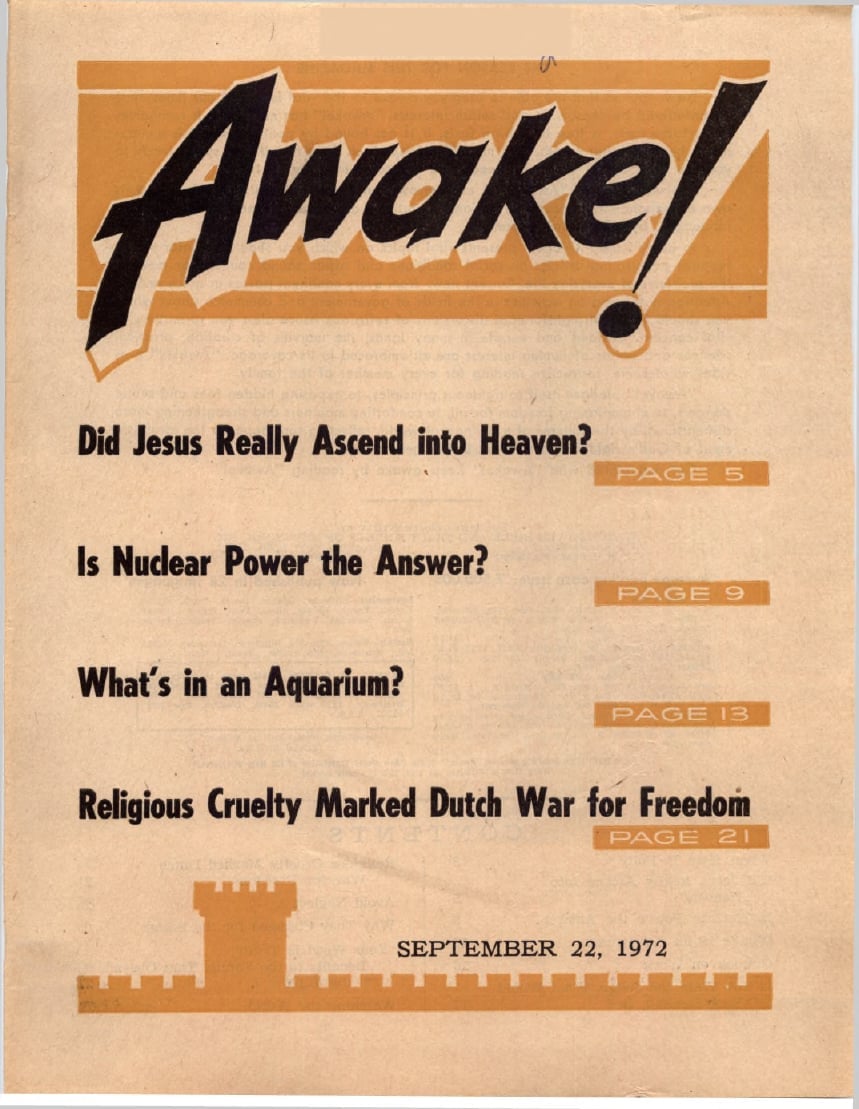
Awake! — September 22, 1972
Source: jw.org
Contents
When Hate Is Folly
Did Jesus Really Ascend into Heaven?
Is Nuclear Power the Answer?
What’s in an Aquarium?
Outlook on Work
If You Were the Judge, What Would Your Decision Be?
Religious Cruelty Marked Dutch War for Freedom
Avoid Neglect
Why They Changed for the Better
Benefits to the Family That Obeys the Bible
Watching the World
Are Your Prayers Heard by God?
Man’s Ruining the Earth Will Soon Cease
When Hate Is Folly
When Hate Is Folly
IS NOT hate always folly, always unwise, always wrong? Not necessarily. When Abraham Lincoln saw slaves for the first time he was filled with hate for slavery. That hate eventually produced the Emancipation Proclamation, declaring that all the slaves in the Confederate States were to be freed.
The hate for religious hypocrisy that Jesus Christ, the Son of God, expressed when on earth has served to put his followers on guard ever since. (Matt. 23:13-33) Similarly, the hate that the judicial committee of a Christian congregation has for gross immorality causes them to excommunicate, disfellowship the wicked man from among themselves.’ Well, therefore, do the Scriptures state that the fear of Jehovah, which makes one truly wise, “means the hating of bad.”—1 Cor. 5:13; Prov. 8:13; 9:10.
So there are times when hate is both wise and right. This is what the oft quoted statement of the Bible says: “For everything there is an appointed time . . . a time to love and a time to hate; a time for war and a time for peace.”—Eccl. 3:1, 8.
The very fact that God hates certain things and certain kinds of people shows that hate is not always folly. He does “hate all those practicing what is hurtful,” and he hates such things as “lofty eyes, a false tongue, and hands that are shedding innocent blood.”—Ps. 5:5; Prov. 6:16-19.
Fittingly, God’s Word counsels us to hate what God hates: “O you lovers of Jehovah, hate what is bad.” The Scriptures quote with approval what King David of ancient Israel said: “Do I not hate those who are intensely hating you, O Jehovah? . . . With a complete hatred I do hate them.” Does this mean that we should react violently toward those who practice bad things? No; the Bible counsels us not to get heated up at injustices and not to render evil for evil.—Ps. 97:10; 139:21, 22; Rom. 12:17-21.
But imperfect human nature, being what it is, is more prone to hate than to love and so most of the time, when men hate, it is indeed folly. Hatred is folly when it controls us instead of our controlling it. It is folly when it is based on ignorance, on lies, on prejudice, when it is irrational (when it flies into the face of reason). Hate might be likened to fire. Fire can serve ever so many good purposes when it is kept under control. But when it gets out of hand, what havoc it can wreak in destruction of lives and property!
Today the world is filled with uncontrolled bonfires of hate. Conditions may be bad, but hate makes them worse. Consider the burned-out sections of such places as Watts, California; Washington, D.C.; Newark, New Jersey; Brooklyn, New York—all the work of hate. Militants, whether white or black, preach hate and incite others to violence. Typical is the poem that Black Panthers teach children: “Kill the pig [their name for a policeman] upon the hill; if you won’t the Panthers will.”
True, this is hate due to racial discrimination and other injustices practiced against blacks over long periods of time. But does the killing of white and black policemen improve matters for anyone—either for whites or for blacks? No more than does the senseless burning down of black and white stores and dwelling places. As Professor Marie Syrkin of Brandeis University warned: “No social problem will be more rapidly solved through the calculated transformation of the chief sufferers into beings who wantonly rob and kill. Evil conditioning can only make evil conditions worse.”
Bearing this out were some statistics published in the New York Times, February 14, 1972. Among other things, these showed that for 1971 the homicide rate for Central Harlem, where such militants abound, was 328 times as high as in Kew Gardens in the Borough of Queens, which is largely Jewish but by no means a segregated community. In Central Harlem not only a few policemen but ever so many black residents were murdered.
Hate, when not based on righteous principles, is also folly in that it hurts the hater himself, both mentally and physically. As one psychiatrist put it: “It is easier to hate, but healthier to love.” According to a team of specialists, ‘whether a person falls ill physically or mentally seems to depend on the quantity of guilt, anxiety and hate in his personality.’
Can we learn not to hate when hate would be folly? Yes, and one way is by thought control. Discipline yourself not to dwell on the wrongs and frustrations you suffer. Displace negative thoughts with thoughts of things that are lovable and well spoken of.—Phil. 4:8.
Another help is reason. It will enable you to see how senseless it is to hate persons because of difference in skin color, nationality or religion. The hate that certain Moslems and Hindus have for each other, certain Jews and Arabs have for each other, certain Protestants and Catholics in Northern Ireland have for each other, as well as some whites and some blacks have for each other, is irrational. No one group is all good or all bad.
Faith in God will also help one to keep from hating when it is folly. How so? Because this leaves it up to God to settle matters. That is the way David of ancient Israel felt about it when urged by a close friend to kill his persecutor Saul on one occasion.—1 Sam. 26:8-11; Rom. 12:19.
And, above all, the very antithesis of hate—unselfish, principled love—will enable you to avoid the folly of hating when it is not the time to hate. Love, we are assured, ‘takes no account of the injury.’ More than that, ‘it bears, hopes and endures all things,’ and even ‘covers a multitude of sins.’ It works no ill to its neighbor; it does not retaliate with violence.—1 Cor. 13:4-8; 1 Pet. 4:8; Rom. 13:8-10.
Yes, there is a time to love and a time to hate. Happy is he who can discern when it is the time for each and who is able to act according to what is wise, loving and right.
Did Jesus Really Ascend into Heaven?
Did Jesus Really Ascend into Heaven?
AMONG the places of interest pointed out to sightseers visiting Jerusalem is the Chapel of the Ascension. Situated on the Mount of Olives, outside the walls to the east of the old city of Jerusalem, it houses “the stone said to bear the imprint of the feet of Christ,” the “actual spot he last stood and from which he was lifted up.” truly one must be credulous or naïve indeed to believe such a preposterous legend.
Going to the opposite extreme are many clergymen of Christendom. As we are told in The Interpreter’s Bible (Vol. 10, p. 633): “What does the modern church make of the ascension of Christ? Very little, one might well confess. Published sermons on the Ascension are hard to find. Yet in the thought of the early church the Ascension occupied a position of crucial importance.”
In fact, the trend today is to throw doubt on the ascension of Christ into heaven as being a specific event. Some stumble over the fact that the Bible speaks of Jesus ascending or going up into heaven. And says Hastings’ Dictionary of the Bible (Revised Edition): “The Ascension of our Lord is not related as an event in the synoptic Gospels. . . . The only narrative of the Ascension as a separate event is found in Acts 1:6-11. . . . What is precarious [that is, questionable] about the narrative in Acts is the suggestion that the Ascension is a distinct event separable from the Resurrection, and the placing of it in the sequence of events.”
A Distinct Event
The writer of the book of Acts, that is, Luke, not only ‘suggests’ that the ascension of Jesus was indeed an event separated from his resurrection but is very explicit about it. He specifically gives us the details of the event, when, where and how it took place.
When did it take place? Forty days after Jesus’ resurrection, for Luke goes on to tell about Jesus’ ascension right after making the statement: “To these [his disciples] also by many positive proofs he showed himself alive after he had suffered, being seen by them throughout forty days and telling the things about the kingdom of God.”—Acts 1:3.
Where did the ascension take place? At the Mount of Olives, for right after telling of it Luke goes on to report: “Then they”—his disciples that had witnessed the ascension—“returned to Jerusalem from a mountain called the Mount of Olives, which is near Jerusalem, being a sabbath day’s journey away.”—Acts 1:12.
And how did it take place? We read: “After he had said these things, while they were looking on, he was lifted up and a cloud caught him up from their vision. And as they were gazing into the sky while he was on his way, also, look! two men in white garments stood alongside them, and they said: ‘Men of Galilee, why do you stand looking into the sky? This Jesus who was received up from you into the sky will come thus in the same manner as you have beheld him going into the sky.’”—Acts 1:9-11.
How can such a record be termed “precarious” or only a “suggestion”? The ascension as a specific event is repeatedly referred to here. Jesus is reported to have been “lifted up.” His apostles looked on “while he was on his way.” And the two angels said that “this Jesus who was received up from you into the sky” will come again. Could anything be more explicit than these statements?
No doubt this gradual departing of Jesus, ascending upward before their eyes, was to underscore the fact that he really was ascending into heaven and that they could not expect to see him again. In his previous appearances after his resurrection he most likely suddenly disappeared from their sight, even as we read of his doing after he had comforted the two disciples on the way to Emmaus. After making himself known to them, “he disappeared from them.”—Luke 24:31.
Other Testimony
Those critical of the ascension account recorded at Acts chapter 1 question the authenticity of the parallel account at Luke 24:50, 51, saying that only Acts refers to the ascension as a separate event. But do they do so with sufficient reason or on adequate grounds? True, a few of the old manuscripts do not contain the words “and began to be borne up to heaven,” but many others, such as the Alexandrine, the Vatican 1209 and the Codex Ephraemi, do contain these words. The verses in their entirety read: “But he led them out as far as Bethany [on the Mount of Olives], and he lifted up his hands and blessed them. As he was blessing them he was parted from them and began to be borne up to heaven.”
The fact is, the scholars Westcott and Hort, who compiled one of the most authoritative Greek Bible texts, included the words as being in question in their text. And as has well been observed, the difference is “more easily explained as an omission from the Western than as an addition to the Oriental text.”
There has also been considerable discussion of the fact that, according to the account at Luke, chapter 24, it seems that Jesus ascended into heaven the very day he rose from the dead. Why might one draw this conclusion? Simply because the intervening events are not reported there. But at 1 Corinthians 15:4-8 further details are given. There it states that Jesus appeared time and again to his disciples after his resurrection and before his ascension into heaven.
Jesus himself over and over again stated that he would return to his Father in heaven: “I am going my way to the Father.” (John 14:12, 28; 7:33; 16:5, 10, 28) The apostle Peter on the day of Pentecost called attention to the proof that Jesus had indeed ascended to heaven, saying: “This Jesus God resurrected, of which fact we are all witnesses. Therefore because he was exalted to the right hand of God and received the promised holy spirit from the Father, he has poured out this which you see and hear.”—Acts 2:32, 33.
Bearing similar testimony are the writings of Christ’s apostles. They tell that Jesus is at the right hand of God (Rom. 8:34; Eph. 1:20; Col. 3:1); that he was highly exalted (Phil. 2:9-11; Heb. 7:26); that he is in the heavens. (Eph. 6:9; Phil. 3:20; Heb. 4:14) In view of all this testimony, there simply can be no question that the Bible teaches that Jesus not only rose from the dead but also ascended into the heavens, where he has been residing ever since.
In What Direction?
Some object to the Bible’s teaching that Jesus ascended into heaven, saying that it is not reasonable to believe that heaven is “up” from the earth regardless of where one may happen to be. But this objection is not sound. The New York Times, in reporting on one of the trips made by certain astronauts, stated that they “ascended to 739 nautical miles,” whereas actually they moved out that distance from the earth.
Doubtless Jesus’ ascent did begin with an upward (actually outward) movement—even as did that of the astronauts—from the place where the apostles stood. Afterward Jesus logically took whatever direction was required in order to reach his heavenly Father’s presence. It is of interest that at times the Bible uses the term “depart” when speaking of angels leaving the earthly scene.—Luke 2:15; Acts 12:10.
However, it must be admitted that our knowledge of the spirit world is indeed limited. It seems well therefore to think of Jesus as ascending, not only in a directional sense, but also as to the sphere of activity and level of existence in the spirit realm, to the actual presence of God. That realm, after all, is not bound by physical or material laws, factors or limitations.
In What Body?
Does the fact that his apostles witnessed Jesus going to heaven mean that he ascended to the presence of God in a human body? That is the general consensus in Christendom, but not so. Why not? For a number of reasons. We are told that “Christ died once for all time . . . being put to death in the flesh, but being made alive in the spirit.” (1 Pet. 3:18) That is why he could appear in the midst of the apostles although the doors were bolted and why at times he “disappeared from them.” (Luke 24:31; John 20:26) Furthermore, we are assured that “flesh and blood cannot inherit God’s kingdom.” So Jesus could not have entered heaven with a fleshly body.—1 Cor. 15:50.
Moreover, Jesus said that he was giving his “flesh in behalf of the life of the world.” Since Jesus thus laid down his human body as “a corresponding ransom for all,” it follows that he could not have been resurrected in a human body with human life without making void his ransom sacrifice.—John 6:51; 1 Tim. 2:5, 6.
But someone may ask, How could that be? Are not spirits invisible to man, and do they not come and go as the wind, even as Jesus told Nicodemus? (John 3:8) Yet Jesus appeared in a human form to his disciples after his resurrection. True, but that was merely by materializing in a human body for the occasion. That is why he was not recognized by Mary nor by his apostles on the shores of Galilee. (John 20:15-17; 21:4) This was nothing unheard of, for time and again angels materialized human bodies, as when one “appeared” to Moses, another to Joshua and another to the parents of Samson, to mention but a few instances. (Josh. 5:13-15; Judg. 13:3-20; Acts 7:35) Thus Jesus reassuringly communicated with his apostles by appearing in a body that they could see, yes, and feel, as in the case of Thomas.—John 20:26-29.
Why Did Jesus Ascend to Heaven?
All the foregoing evidence and reasons are greatly strengthened when we consider why Jesus simply had to ascend into heaven. It was in the very fitness of things. Jesus willingly left heavenly glory, came to earth as a man, suffered greatly and gave his human life as a sacrifice. (Phil. 2:5-8; Matt. 20:28; Heb. 5:8) Are we to conclude that for all this God would not reward him but leave him in the grave or merely upon the earth? The apostle Paul assures us that God is not unmindful of the sacrifices his servants make. (Heb. 6:10) So we cannot conclude otherwise than that God would suitably reward Jesus for his unselfish course.
In fact, Jesus expected to return to the glory that he had with his Father, even as can be seen from his prayer on the night of his betrayal: “Father, glorify me . . . with the glory that I had alongside you before the world was.” (John 17:5) God not only answered this prayer but gave Jesus even greater glory: “For this very reason also God exalted him to a superior position and kindly gave him the name that is above every other name, so that in the name of Jesus every knee should bend . . . and every tongue should openly acknowledge that Jesus Christ is Lord to the glory of God the Father.”—Phil. 2:9-11.
And there are even more compelling reasons. Jesus gave his human body and life as a sacrifice for man’s sins, but to be able to apply the merits of that sacrifice as a high priest so that mankind would be able to get the benefit of it he had to be raised from the dead and ascend into heaven. And so we read: “Christ entered, not into a holy place made with hands . . . but into heaven itself, now to appear before the person of God for us.” And further: “If anyone does commit a sin, we have a helper with the Father, Jesus Christ, a righteous one.”—Heb. 9:24; 1 John 2:1.
More than that, for the countless millions who have died and who are in the memorial tombs to get the benefit of Christ’s ransom sacrifice, it is necessary that they be raised from the dead, and this privilege God has given to his Son. It is a spirit person with ‘all power in heaven and in earth’ who is to perform that great resurrection miracle.—John 5:28,29; Matt. 28:18.
Further, Jesus continually spoke of the kingdom of God; in fact, that was the theme of all his preaching. In his model prayer he indicated that the purpose of the Kingdom was to sanctify God’s name and cause God’s will to be done upon earth as in heaven. To make possible the sway of that kingdom upon earth, Jesus Christ and his heavenly hosts must first make an end to this present wicked system of things, invisible and visible, which the Bible tells he will do soon.—Matt. 6:9, 10; Rev. 16:14, 16; 19:11-21.
Besides, we are told that “he must rule as king until God has put all enemies under his feet. As the last enemy, death is to be brought to nothing.” That will mean that God through Christ will have wiped out every tear from human eyes, that Adamic death will be no more, neither will mourning nor outcry nor pain be anymore. Such a glorious consummation of Jehovah God’s purpose regarding the earth and man can be brought about only by means of a heavenly king, the heavenly King, Jesus Christ.—1 Cor. 15:25, 26; Rev. 21:4.
Truly, there can be no doubt that God’s Word makes abundantly and explicitly clear that Jesus Christ did indeed ascend into heaven.
Is Nuclear Power the Answer?
Is Nuclear Power the Answer?
THE world, and particularly the United States, faces a power crisis because available energy sources—coal, oil and natural gas—are in short supply. What is the answer?
Many experts say: Nuclear power! The Scientific American, in September 1971, said: “If ever an energy source can be said to have arrived in the nick of time, it is nuclear energy.”
A Growing Industry
Already more than twenty nuclear electric power plants are in operation in the United States, with over a hundred more either being built or on order. About 2 percent of the nation’s electricity is produced by these facilities, and by 1980 the amount generated is predicted to increase to 10 or even 25 percent. Other countries, too, are using nuclear energy to generate electricity. In 1970 over ninety nuclear power plants were producing electrical power outside the United States.
That there is tremendous power within the atom is beyond question. This was well demonstrated at Hiroshima, Japan, in 1945. There, a single relatively small nuclear device blasted the city apart, killing over 92,000 persons. People also remember that for decades afterward many in the vicinity of the explosion continued to sicken and die from radiation-caused cancer.
So people understandably wonder: Is it safe to split atoms and harness the resulting energy to produce electricity? Can the radioactivity that is produced harm man?
Conflicting Reports
The Atomic Energy Commission and the electric power industry would have people believe that atomic energy is safe. Television commercials and other advertisements regularly give this impression. One of them shows a burning match, and says in effect: A nuclear power plant emits less pollution than this match.
However, certain news reports may cause one to wonder how true these claims are. For example, a Minnesota nuclear plant was granted an operating license by the Atomic Energy Commission that would permit a stack release of 41,400 curies a day in radioactive emissions. But the Minnesota Pollution Control Agency wanted to set the limit at 860 curies. Some scientists fear that radioactive emissions greater than this present a threat to public health. Two scientists, John W. Gofman and Arthur R. Tamplin, wrote in the Scientific American:
“We are convinced, on the basis of our research, that radiation to be expected from the rapidly-burgeoning atomic energy programs is a far more serious hazard than previously thought possible. . . .
“And we believe that the public is being deceived by a clever, well-financed propaganda campaign of delusion about ‘clean, cheap, safe nuclear power.’”
Could there be truth to such charges? How do nuclear power plants generate electricity? How is it that they discharge radioactive debris?
How Nuclear Power Is Produced
Contrary to popular impression, electric power is not generated directly from the splitting of atoms (nuclear fission) within a nuclear reactor. Rather, fission within the reactor simply produces a source of heat. It thus replaces the furnace of a conventional plant. Heat from the reactor boils water and produces steam. The steam turns a turbine, and the turbine, in turn, drives a generator to produce electricity.
The nuclear reactor’s tremendous heat is produced in long, slender, metal-clad fuel rods. These are filled with small pellets of uranium dioxide, which give each rod the potential energy of 6,000 tons of coal. In a large reactor there may be some 40,000 fuel rods that contain over a hundred tons of uranium pellets. That is more uranium than is found in over a hundred atomic bombs! The reactor’s heat is produced by the splitting of atoms of the uranium isotope U-235.
In the fission process a neutron hits a U-235 atom and usually splits it into two smaller atoms. The splitting releases not only heat but also two or three neutrons, which, in turn, hit and split other atoms. Thus a chain reaction of nuclear fission occurs. In a large reactor about 10,000,000,000,000,000 atoms are split every second!
In order to control the rate of the fission process, long control rods that absorb flying neutrons are inserted into the reactor core. Thus the rate of fission is controlled by the positioning in the core of these rods. By sliding them all the way in, all neutrons are absorbed and fission ceases.
Release of Radioactive Debris
As billions of uranium atoms in the reactor split every second they form smaller atoms of other elements that are radioactive. In a year’s time a large reactor produces as much long-persisting radioactivity as would be emitted in the explosion of a thousand Hiroshima bombs! As long as this tremendous amount of radioactivity stays within the fuel rods, there is no immediate problem. But it does not all stay there.
Gaseous atoms leak out through imperfections in the metal casings of the fuel rods. Accumulation of this radioactivity poses a threat to those who have to do maintenance work in the plant. Radioactivity is emitted into the air through the plant’s stack. Radioactivity also gets into the water used in the reactor, and is thus released into a river or lake.
It is argued, however, that the radioactive debris released in the air and water is insufficient to harm man. But even if no radiation falls directly on humans in the immediate vicinity, still there is a grave danger to those living many miles away. For radioactivity can become concentrated in food supplies. It may, for example, settle on grass, be eaten by cows and become concentrated in their milk. Children who drink the milk may then receive dangerous doses of radioactivity.
Many scientists are concerned, especially since hundreds of nuclear plants may soon be expelling radioactive debris. Dr. Ernest J. Sternglass, a professor of radiation physics at the University of Pittsburgh Medical School, believes that already nuclear power plants are responsible for infant deaths. He offers data that show, he says, an “excess” of infant deaths in areas near nuclear reactors.
What About Accidents?
Besides these controlled radioactive emissions, many are worried about the possibility of accidents. In the event of an earthquake, for example, some fear that a nuclear plant could be broken open and tremendous amounts of radioactive debris scattered to the winds! Or what about a saboteur planting a bomb? Even the thought of the possibility is chilling!
But accidents are also possible due to human error or equipment malfunction. The most probable form of disaster, according to nuclear engineers, is a reactor’s sudden loss of coolant water. This could occur, for example, if someone closed a wrong valve or if a pipe ruptured. Due to the increase of heat the fuel would melt, and the buildup of pressure might result in radioactivity being spewed far and wide.
In 1966 such a malfunction actually occurred. A baffle plate dislodged, blocking the flow of coolant in a nuclear reactor near Detroit, Michigan. This caused an overheating of the fuel elements and a melting down of some of the fuel. For a while no one involved knew whether the whole Detroit area would have to be evacuated. Writers have called it “an event as close to Armageddon as this country has ever known.”
Already large amounts of radioactive debris have been released due to accidents at nuclear facilities. One accident occurred at Windscale, England. So much radioactivity was spewed out that the government seized all growing food in a 400-mile area around the plant. Due to releases from that facility, radioactivity in the nearby Irish Sea is so high that embryo fishes display deformed backbones! More recently, something went wrong at a Northern States Power Company plant and 10,000 gallons of radioactive water were dumped into the Mississippi River, causing Minneapolis to close its water-intake gates.
But there is perhaps an even greater potential danger.
Disposal of Radioactive Wastes
The radioactive wastes that accumulate in a nuclear reactor must periodically be removed, for they will cause a reactor to lose power. So about every two years a large reactor must be shut down and the wastes removed. That means handling as much long-lived radioactive poison as would be produced by 2,000 Hiroshima-type bombs—a tremendous potential danger!
There have been a number of proposals for handling such wastes, including putting them on rockets and shooting them into the sun. However, this would be not only costly, but a tremendous risk as well. The wastes are far too dangerous to dump into the oceans. So there is now talk of concentrating them into solid form, and burying them deep in salt formations. Presently the Atomic Energy Commission is storing more than 80 million gallons of liquid wastes in metal underground tanks at various installations.
As more and more nuclear reactors begin to operate, the volume of deadly wastes will become stupendous. The prospect is frightening! Even Edward E. David, Jr., science adviser to President Nixon, acknowledged: “One has a queasy feeling about something that has to stay underground and be pretty well sealed off for 25,000 years before it’s harmless.”
Thermal Pollution
There is also a quite different aspect of the waste problem—thermal or heat pollution. To cool its apparatus a nuclear power plant sucks tremendous amounts of cool water out of a nearby river or lake, and then pours the water back warm. Conventional power plants also do this, but nuclear plants release much more heat. Atomic Energy Commissioner Wilfred E. Johnson observed: “By 1990 more than half of all the river run-off in the United States would be required for cooling.” With what result?
By thus raising a river or lake’s temperature, the oxygen content of the water is reduced. Not only can this kill fish, but often it fosters the growth of algae, which, in the course of decaying, consumes even more oxygen. Soon the water begins to smell and taste bad. It is feared that with the increase of nuclear power plants the nation’s rivers and lakes will be ruined by thermal pollution.
A Risk to Health and Safety
It is obvious that nuclear power is not as safe as industry-promoted advertisements might lead persons to believe. In fact, the late Supreme Court Justice Hugo Black and his fellow Justice William Douglas called this means of power generation “the most awesome, the most deadly, the most dangerous process that man has ever conceived.”
Also, the well-known atomic scientist Edward Teller, rather than viewing nuclear power plants as friendly neighbors, observed: “A gentle seeping nuclear reactor can put its radioactive poison under a stable inversion layer and concentrate it into a few hundred square miles in a truly deadly fashion. This is why nuclear reactors do not belong on the earth.”
And yet many scientists believe that the poisons can be largely controlled, and so they feel that nuclear power plants are worth the risks. Fossil-fuel power generation, they point out, also has its risks to health and safety. For example, nuclear physicist Ralph E. Lapp noted the “decades of the coal era,” and deplored the “societal blindness that clawed 36 billion tons of coal from the earth, killing more than 100,000 miners, befouling the countryside and polluting our cities with lung-torturing fumes.”
It is true that millions have suffered respiratory ailments, and no doubt have had their lives shortened as a result of generating electricity with pollution-producing fossil fuels. On the other hand, nuclear power plants normally emit no visible or feelable pollutants. In fact, in small doses radiation is not observed to produce any ill effects. Yet years later those exposed to sufficient doses may develop deadly cancer. The hope is that the daily emissions from nuclear plants will not result in a future cancer plague, and that accidents will not cause more immediate calamities.
Thus while nuclear power is hailed by some as the answer to the power shortage, there are others who have serious reservations as to whether its use is worth the risks. But are there other alternatives? When fossil fuels run out, is it a matter of nuclear power or no power?
There are still rivers to dam to provide thus hydroelectric facilities. But in the United States, some believe, this power source has been exploited about as far as feasible. Also, the potential of geothermal energy—underground steam—is considered quite limited. But what about energy received from the sun? The possibility of utilizing solar energy to supply man’s power needs will be considered in a coming issue of this magazine.
What’s in an Aquarium?
What’s in an Aquarium?
WHAT’S in an aquarium? A hobby? Education? Entertainment? Income? A fish tank can be what you want it to be, and you can have in it what you want it to have. Many families have enjoyed making a home aquarium a family hobby. It can provide hours of entertainment, watching and caring for these scaly friends.
Young and old often find fascination in having a fish tank. One eleven-year-old boy who calls it a “fun hobby” says: “I like to watch something alive. I like to watch the fish play games, such as tag.” And a man, a writer and editor, says: “The four goldfish that are housed in a big glass bowl, close to my big chair, are a joy. I get a bigger lift from watching their graceful movements than I do from looking at my so-called art treasures which adorn the shelves and walls of my apartment.”
Others find not only joy but also relaxation and education in having an aquarium. The book Tropical Fish expresses it this way: “Just watching the graceful movements, the uninhibited play, the sheer joy of living of healthy fish, is itself a relaxing nerve tonic. . . . Educationally, the aquarium provides a living experience in nature . . . In creating a healthy environment for fish, we learn a great deal about all nature. We see what proper oxygen (and, conversely, polluted breathing conditions) does to our health.”
Your fish can actually become pets. They will become accustomed to your presence and your hand in the aquarium as you clean or rearrange it. They seem to know the difference between your hand and the fishnet. One minnow would jump out of the water to snatch a freshly swatted fly held over the bowl.
Selecting an Aquarium and Fish
Should you desire an aquarium, which of the many types of aquariums are you going to select? A small, round, all-glass fishbowl as an ornamental piece, easy to maintain? Perhaps a rectangular tank with plate glass sides and metal frame corners? In this regard many persons prefer one that is long, high and narrow in order to serve as a kind of showpiece, somewhat like a picture. Others prefer one that is low and wide, for breeding purposes.
Although there are over 30,000 known species of fish, tropical fish are favorites. There are, of course, freshwater and saltwater tropical fish. Most people fill their aquarium with fresh water, selecting a variety of fish that thrive in it and that get along with one another.
When purchasing fish from a pet store, care must be taken to select healthy fish. Adding diseased fish to your aquarium can result in loss of those already in the tank.
Of course, fish for your aquarium may possibly be obtained from a nearby stream. For example, Central American rivers may contain a beautiful swordtail. The male has a swordlike protrusion from its tail that is either aqua green, sky blue or canary yellow outlined with black. This fish seems able to swim equally well either backward or forward. Have you ever stopped at water pools or small creeks near your home to see what different kinds of finny fellows you can find?
Caring for an Aquarium
If one chooses to have an aquarium, time must also be spent in properly caring for it. Contrary to the views of many, however, caring for an aquarium does not entail dismantling and scrubbing it each week or even each month.
By weekly siphoning out a small portion of the water from the bottom where feces collect, and by adding clean water, or by using a mechanical filter to keep the water clean, some hobbyists have let years pass by before having to dismantle their aquarium completely. In addition to keeping your tank clean, you must also provide what your fish need to remain healthy.
Oxygen and Light
For your fish to remain healthy they will need proper oxygen. They absorb dissolved oxygen from the water as it passes through their gills. The amount of oxygen in an aquarium is determined by the temperature of the water (cool water holds more oxygen than hot water), and also by the amount of water surface area. Water replenishes its oxygen supply when in contact with the atmosphere. Some persons use an electric pump to force air through a tube into the aquarium. While a small amount of oxygen is absorbed from the air bubbles, the principal purpose of the airstream is to circulate the water upward to the surface, where oxygen is absorbed.
Since the amount of water surface area determines the amount of oxygen, a round glass bowl that has a lesser circumference at the top should not be filled completely. It should be filled just a little over halfway, to allow for greater water surface area.
Because of oxygen needs, the amount of water surface area determines how many fish you can have in your aquarium. Of course, the size of your fish is also a determining factor. One authority feels that there should be at least three square inches of air surface for each fish the size of a full-grown guppy (one and a half inches long). This would mean that an aquarium with a water surface of nine inches by twenty inches (180 square inches) should not house more than sixty grown guppies.
The use of some water plants in an aquarium is beneficial. Healthy plants give off oxygen and take in carbon dioxide during the daytime. In turn, fish take in oxygen and give off carbon dioxide. Thus, healthy, growing plants not only are attractive in an aquarium but are also a source of oxygen.
When sufficient oxygen is lacking, your pet fish will soon let you know by rapid breathing, or by coming to the surface, gasping for oxygen.
Sufficient light is needed to ensure healthy plants, which, in turn, contribute toward the health of your fish. When there is not enough light, your plants will die and decay, microscopic life will multiply in your tank, and this may cause disease in the fish. On the other hand, too much light often causes excess algae, green water and high temperatures. As in the case with natural outdoor life, your aquarium should receive a total of about eight to ten hours of natural or artificial light each day.
Temperature and Food
Besides proper oxygen and enough light (if there are plants) fish need the right temperature and food. An imbalance of any of these essentials will no doubt cause problems in your underwater world. As the word “tropical” itself indicates a warm temperature, most tropical fish thrive best at temperatures between 72 and 80 degrees Fahrenheit. Temperatures colder than this can weaken their resistance to disease. Water that is too warm can rob them of needed oxygen.
Most importantly, avoid a sudden change in temperature. This often shocks the fish and lowers their resistance to disease. Because of the danger of sudden change, the matter of adding new water or new fish to the tank is critical. Make sure that the new water to be added is of the same temperature. Also, when adding new fish to an aquarium, you will be doing them a favor by gradually introducing them into their new home, rather than simply pouring them into it. This is done by floating their traveling container in the tank until both waters are of equal temperature. This usually takes about fifteen minutes.
Food, of course, will have to be provided regularly and it should be varied from time to time. It can be as simple as buying dried or frozen prepared foods for fish; or you may serve them a tasty dish of mosquito larvae, worms, ants or flies, to mention but a few. You can also add from your own table a bit of grated beef heart, finely chopped raw spinach or lettuce or bits of fish. Good diet largely determines whether you will have a healthy fish with a long life and good coloring. Different fish, of course, have varied eating habits, and that will have to be taken into consideration.
Proper feeding of your finny friends involves, not only what they are fed, but also how they are fed. In warmer water a fish will require more food, since it will breathe, digest, eliminate and grow faster than in cooler water. Healthy fish usually appear to be hungry and will often respond to your presence by swimming excitedly against the front glass of your tank, begging, as it were. However, you must be careful not to overfeed them.
A general rule to apply is to feed your fish only enough food at one time so that all of it is consumed within three to five minutes. Any food left over due to overfeeding will decay. Overfeeding results in increased bacteria life and then disease and death for the fish. Since fish feed a little throughout the day in their natural habitat, frequent small feedings are usually preferred. However, if it is convenient to feed them only once a day, it is generally best to do so in the morning.
The conditions that cause fish disease are principally the same as respects all living creatures, namely, overcrowding, chilling or fluctuating temperatures, poor diet, overeating, insufficient light and nearby dead or decaying matter. Any of these can lead to the breakdown of the fishes’ natural immunity.
Breeding Tropical Fish
Tropical fish are generally classified as either “live-bearers” or “egg layers.” Of these two, the live-bearers are usually much simpler to breed and raise. This is because the live-bearing fry is born fully developed and is usually larger than the egg-laying fry. The new fry can swim vigorously and can eat the same food finely chopped up as is eaten by their parents.
The live-bearers are easily distinguished as to sex, since the males have a modified anal fin with which to impregnate the female as he swims alongside her. You can easily recognize a pregnant live-bearing fish by her size and the dark area in the anal region behind the lower fin. Many human parents have found the reproduction of live-bearing fish to be a natural medium for educating their children concerning the “facts of life.”
Since the live-bearing female and others are inclined to eat the little fry, you will want to supply protection for the newborn fish. The best way is to separate the mother from the other cannibalistic fish before she gives birth. You can then either provide the young with hiding places such as plant thickets or use some type of breeding trap to prevent the mother from getting at her babies.
Most tropical fish reproduce by laying eggs, and they employ a variety of methods to accomplish this. Some scatter their eggs over sand or gravel. Others fasten their eggs on plants or stones. Some egg layers will build nests, afterward guarding their young from predators. Many species of egg layers need specific breeding conditions, and sometimes special food. Thus more extensive knowledge is needed for successful breeding.
Interesting among tropical fish are the egg layers known as the bubble-nest builders. The male fish actually makes bubbles from gulps of air enveloped in a filmlike saliva to prepare a nest for the eggs. To watch this is indeed fascinating. For example, a pair of Siamese fighting fish are first introduced to each other separated by a glass partition when it is apparent that the bulging female is loaded with eggs. The male madly tries to reach the female and goes into a fancy dance that is beautiful to behold, exhibiting his flowing, veillike finnage in shades of pink, purple or blue. Then the male builds a mass of foam on the water surface, his bubble nest being about one and a half inches in diameter. Now the glass partition is removed.
After the chase, which is plenty fierce, the female allows the male to wrap around her, squeeze the eggs out of her and then fertilize the eggs. As the eggs float downward, the male quickly catches them in his mouth and ejects them into the air-bubble nest. After these are carefully protected in the bubbles, the male returns to continue the squeezing process until all the eggs, which may be several hundred, are apparently released by the female. The eggs hatch in about forty hours. Being extremely small in size, the young usually have to be fed microscopic life.
Whether there is only one fish in a fishbowl or a large aquarium full of fish, many families find wholesome delight in contemplating how each fish reflects the Creator’s inexhaustible creative variety. It is only a teaspoon taste of what the future holds in God’s new order, when it will be possible to explore more thoroughly the things “passing through the paths of the seas.”—Ps. 8:8.
What’s in an aquarium? For many it is relaxation, joy and fascination.
Outlook on Work
Outlook on Work
◆ At a time when demands for more leisure are increasing and respect for good hard work is declining, it is noteworthy that the Bible commends physical and mental work to accomplish a good purpose. It says “that there is nothing better than that the man should rejoice in his works, for that is his portion.” (Eccl. 3:22) A key to this is developing the right outlook, for it has been observed that ‘work is not work if you like it.’
If You Were the Judge, What Would Your Decision Be?
If You Were the Judge, What Would Your Decision Be?
WE INVITE you to put yourself in the position of a judge in this court case from Austria:
A two-year-old girl is afflicted with leukemia. The physician handling the case orders administration of a blood transfusion. For religious reasons, the parents reject that treatment. From this point on, the physician refuses to give any further medical treatment to the child. The child is discharged from the hospital.
The parents then search for some other treatment that might help their little girl, but, a short time later, she dies. The local authorities charge the parents with manslaughter. The case comes before the court. The public prosecutor, in his accusation, demands that the parents be punished. If you were the judge, what would be your decision?
Please read this article and get familiar with the case before rendering your decision.
The Disease and the Child’s Death
In May 1970, Eduard and Veronika Walter of Steyr, Upper Austria, observed that their two-year-old daughter, Irene, was very pale. They immediately consulted a pediatrician. He believed that Irene’s ailment was simply a case of malnutrition. Since her condition did not improve, the parents consulted the doctor again in September. Irene’s blood was examined, but no blood disease was found.
A month later, toward the end of October, the child was sent to the General Public District Hospital in Steyr. Two days later, when the mother came to see the child in the hospital, she was told that Irene would have to be given a blood transfusion. Mrs. Walter explained that, as one of Jehovah’s Christian witnesses, she refused any blood transfusion for her child because of the Bible command to abstain from blood of any sort.—Acts 15:28, 29; Lev. 17:14.
Then the father was asked to come to the hospital, and he went. The parents maintained their stand respecting blood transfusions for their child. At that the doctor declared: “Then the case is closed, as far as I am concerned.”
Thus, from the very beginning the hospital showed intentions of discharging the child from its care if the parents would not agree to a certain type of treatment—a blood transfusion. That same evening, Mr. and Mrs. Walter were allowed to take their child home, without receiving any instructions whatsoever as to other methods of treatment.
Repeatedly, they asked whether there were methods of helping their child other than by blood transfusion. But the doctor said there were none. The parents took Irene to a clinical hospital in Upper Austria and thence to two nonmedical practitioners in Germany and Austria. No cure was found for the child. On November 5, 1970, she died at the home of her parents in Steyr.
Charges Brought Against the Parents
Are you under the impression that the parents actually wanted their child to die, or that they deliberately contributed to her death by their rejection of a blood transfusion? Dr. Alfred Andel seems to have felt that way, for when he made out the postmortem examination paper, he filled in Point 12 of the death certificate with the words: “Refusal of blood transfusion.” Point 12 bears the following heading: “In case of violent deaths (suicide, murder, manslaughter, accident) give details as to manner and cause of such violent death.”
The following day Dr. Andel reported the case to the Federal Police Station in Steyr. The parents were questioned immediately by the Federal Criminal Investigation Department, and they explained their religious viewpoint on blood transfusions. Moreover, they stated that the doctors had not been able to guarantee a cure, and, knowing that transfusion of blood can also have serious, even fatal results, this reason, too, had led them to refuse a transfusion.
The police passed the report on to the public prosecutor’s office, which, in turn, obtained an opinion from the Institute of Forensic Medicine of Paris Lodron University, Linz, regarding the death of Irene Walter. The final opinion of the Institute, written by Professor Norbert Woelkart and head physician Dr. Klaus Jarosch, said:
“Actually the life prognosis respecting this disease is infaust [not favorable] even with modern medication, i.e., basically a recovery was not possible, the fundamental ailment proving fatal sooner or later.”
However, this same opinion went on to say that refusal to consent to blood transfusions “shortened the child’s life-span not inconsiderably.” The summary was that the child died from anemia due to leukemia and “prevention of proper medical treatment.”
The public prosecutor’s office then filed accusation against Eduard and Veronika Walter at the Circuit Court, Steyr, on February 19, 1971. It was asserted that their refusal to consent to blood transfusion for their child was a violation of section 335 of the penal law with regard to security to life. This law says:
“Any action or default of which the acting person is able to perceive even by its natural consequences, obvious to anyone, or by virtue of specially publicized regulations or by way of his rank, office, profession, trade, occupation, or generally by way of his particular circumstances, that a danger to life, health or physical security of persons might be induced or likely to be enhanced, should, if severe injury was caused to a person, be counted as a violation of the law on the part of the guilty one and be punished with imprisonment up to six months or with a fine up to S 100,000.00 [about $4,350] and, should the death of a person result, with imprisonment up to one year.”
The accusation closes with the request that the second measure of punishment of this law be meted out.
Questions to Be Considered
What do you think about the case now? Do you agree with the public prosecutor’s charge, feeling that the guilt of the accused has been sufficiently established? Or did the parents conscientiously do all they could to save the child’s life? What likelihood was there for the child to survive or for her life to be lengthened by a blood transfusion? Was blood transfusion the only proper treatment and the best therapy in this case?
On the other hand, did the doctors do all they could do and ought to do in order to help the child? Let us turn to some opinions of experts.
What Is the Proper Therapy?
The summary in the aforementioned final opinion reads: “Death from anemia due to aleukemic lymphadenosis and prevention of proper medical treatment.” What if that which is considered “proper” treatment turned out to involve certain risks? As a fair judge you would have to take this into consideration in your opinion. Consider, then, the following:
During preliminary investigation, the parents submitted the Monatsschrift fuer Kinderheilkunde (Monthly Magazine for [the German Association of] Pediatrics), Vol. 118, No. 1, January 1970, to the court. This magazine published the discourses given at the 67th conference of the German Association for Pediatrics at Saarbruecken on September 24, 1969, on the subject “Newer Viewpoints on Leukemia of Children.”
Page two states that weeks before hospitalization, symptoms of the disease are perceptible. Pages four to twelve deal with the variety of today’s most effective chemotherapeutic methods of treatment and their success. This scientific discussion on twenty-six pages of the publication for pediatrics was submitted to the Forensic Institute of Forensic Medicine of Paris Lodron University, Linz, in order to obtain a supplementary opinion.
Thereupon, the Institute summarized the discussion in about thirty-five lines and stated that “the more recent methods of treatment of acute leukemia have led to a considerable prolongation of survival.” They added: “The time of survival has been increased by modern methods of treatment to an average of 13 months.” “One even expects five times the normal period of survival.”
The parents’ counsel for defense also obtained expert opinions: Professor H. Weicker, head of the Institute of Human Genetics at Bonn University and coeditor of a handbook for pediatrics, treated more than 200 children suffering from acute leukemia during twenty years of pediatric practice. Professor Weicker writes:
“The average life expectancy of a child with acute undifferentiated leukemia is approximately three months, if the child is not treated from the first occurrence of clear symptoms of leukemia. Irene Walter showed these symptoms in May or June (unusual paleness) and in July (enlargement of the spleen), regardless of whether they were diagnosed as such or not. The average life expectancy—without treatment—would have been September or October 1970; this could have varied, of course, individually. The life expectancy of children with leukemia has not or has only insignificantly changed since blood transfusions have been introduced. . . .
“Only by the introduction of cortisone into leukemia therapy has the life expectancy increased to six to nine months on the average. This is why the combined cortisone-cytostatica therapy is completely in the foreground in leukemia treatment. . . . Judging the course of disease in this manner and taking into account our knowledge about the chances of survival of leukemic children, the inference of a violent death due to refusal of a blood transfusion must be rejected in the case involved. . . . There is no doubt that the chances of prolonging her life were increased considerably since the combined cortisone-cytostatica therapy was introduced, however, alone by means of this therapy and not by means of blood transfusions, customary since the forties.”
Risks of Blood Transfusions
Another expert asked for his opinion was Dr. F. W. Guenther, head of the city hospital of Wuppertal-Barmen, Germany. He said that he ‘entirely agreed’ with the above-mentioned opinion of Professor Weicker and then added his own opinion:
“Being director of Wuppertal-Barmen’s clinical hospital for children, which admits four to five thousand patients annually, the disease features of leukemia during childhood are familiar to me. I have never seen a child survive that was suffering from leukemia. . . . The physicians treating Irene are to be agreed with inasmuch as a blood transfusion was recommended to the parents. In this connection, however, it should be mentioned that I have observed myself that blood transfusions can cause serious, even fatal complications in leukemic patients.”
By order of the court the records of the case were sent to the head physician of the pediatric department of the Moedling Hospital, to university lecturer Dr. Ruziczka, to obtain an additional pediatric expert opinion.
In this opinion, Dr. Ruziczka said that a blood transfusion would have been appropriate in the case of Irene Walter as treatment for the anemia associated with the leukemia affliction. But he also pointed out the disadvantages and even life endangerment that a blood transfusion may bring about.
Mr. and Mrs. Walter were well aware of the risks involved in giving blood transfusions. They had read the booklet published by the Watch Tower Bible and Tract Society entitled “Blood, Medicine and the Law of God.” This treatise, which gives documented evidence as to the various dangers involved in administering blood transfusions, was added to the court’s records.
The Trial
On October 27, 1971, the trial was held at Steyr. A physician of the Steyr hospital, Dr. Johann Fritz, was heard as a witness. He testified that the proposed blood transfusion would have been intended to improve the general condition of the child, namely, her striking paleness, not as the actual treatment of her disease. After the examinations that were made in cooperation with the Innsbruck University clinical hospital, the child would have been transferred to the next bigger treatment center in Vienna. (The child died, however, about two and a half weeks after the initial reception into the hospital!) The actual treatment would then have been administered in Vienna.
Then the public prosecutor read the bill of indictment, charging the parents as being guilty of or, rather, accessory to criminal offense against security of life. He demanded their punishment.
The counsel for the defense, Dr. Heimo Puschner and Dr. Hans Frieders, Vienna, argued that the parents had done more to save their child than they had been required to do by law.
If you were the judge, what would you decide? Please review the pertinent facts of the case by answering the following questions from what you have read:
What was said in section 335 of the penal law, which the parents were accused of breaking? What did the medical opinions from both sides state? What did the parents do to prolong the life of their child?
Do not let your reasoning be swayed by the thought that the child would have died anyway. According to the law, even a shortening of life is punishable. On the other hand, would the child’s life definitely have been prolonged by a blood transfusion?
Have you reached a decision? If so, you can compare it now with the judge’s actual decision in the Walter case:
The Decision
Mr. and Mrs. Walter were acquitted on the basis of the following:
(1) The accused had informed themselves sufficiently about the effectiveness of a blood transfusion and knew that there were other efficacious methods of treatment. Therefore, they were not able to see, in the sense of the law, that refusal of a blood transfusion should be an offense against the security of the life of their child.
(2) Actually, the hospital would have been obliged to call upon the court of guardianship to receive further instructions as to the child’s treatment. In view of the risk involved, the court of guardianship might well have renounced a forced blood transfusion and might have respected the religious convictions of the parents.
(3) The experts called upon by the court pointed to the disadvantages of a blood transfusion. Thus, the parents’ refusal was not unfounded.
NOTE: About ten well-known Austrian specialists, including university lecturers, chief surgeons of pediatric clinical hospitals and directors of pediatric hospitals of universities in Austria declared, when questioned in connection with this case, that they personally were willing to respect the religious stand of Jehovah’s witnesses in the blood issue and that they would administer all other conceivable medical treatment, so as to help these patients. Such physicians are to be commended, for they are endeavoring to help their fellowman, and, at the same time, they show respect for the Bible-based dictates of Christian conscience.
Religious Cruelty Marked Dutch War for Freedom
Religious Cruelty Marked Dutch War for Freedom
TODAY the Roman Catholic Hierarchy in the Netherlands appears to be in the forefront of the criticism of Pope Paul’s policies. In particular was the Dutch stand opposing mandatory celibacy for priests considered an “unforgivable sin” by the Vatican. But did you know that four hundred years ago the Dutch were also in the forefront in opposing the Vatican’s policies?
The Dutch had good reason for this, for regarding those days a historian states: “Nowhere was the persecution of heretics more relentless than in the Netherlands.” That this is not exaggeration is seen from the remarks of their chief persecutor, Philip II: “Wherefore introduce the Spanish Inquisition? . . . the inquisition of the Netherlands is much more pitiless than that of Spain.”
It was primarily this inquisition that caused the people of the Netherlands to revolt and eventually to throw off the Catholic yoke of Spain. For eighty years (except for a truce from 1609 to 1620) the Dutch fought, and in 1648 they gained their freedom with the signing of the treaties of Münster and Westphalia. With these, “Spain yielded everything for which the Dutch contended.” Incidentally, what was then the Netherlands includes what today is Belgium.
…