Awake!, August 22, 1972
Download: PDF — Awake!, August 22, 1972
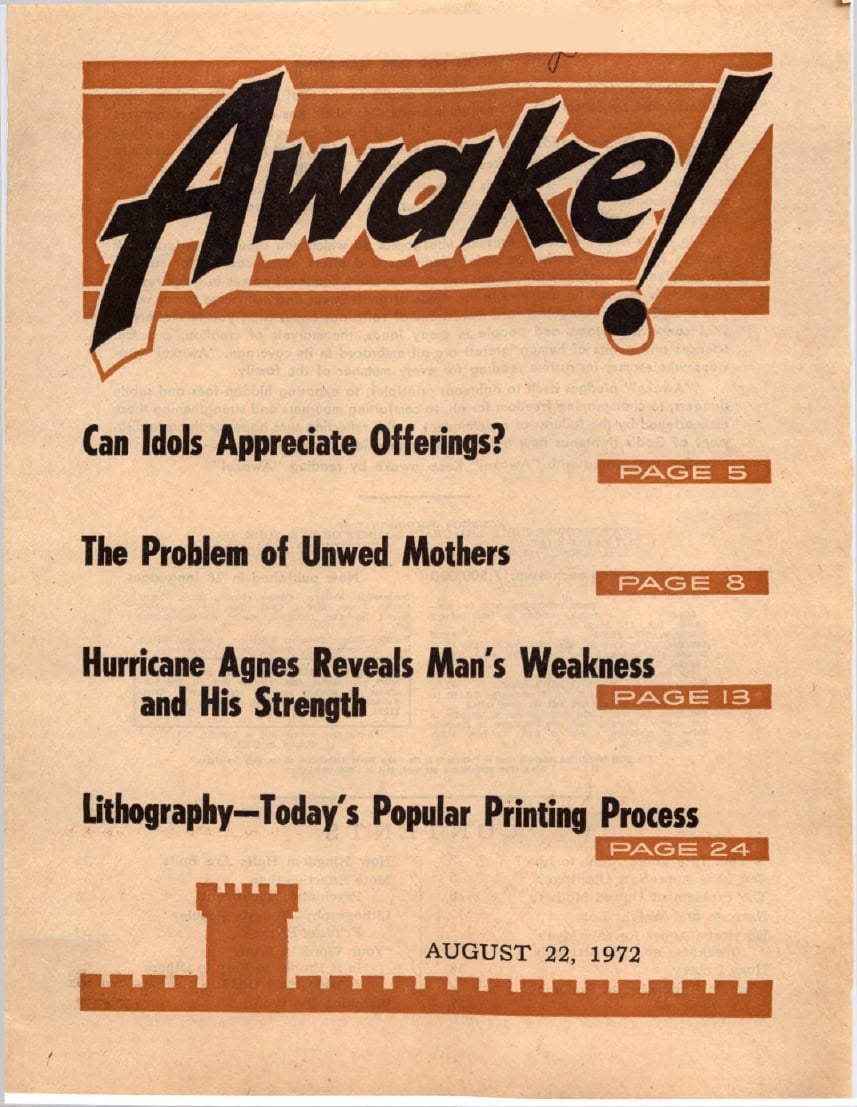
Awake! — August 22, 1972
Source: jw.org
Contents
Is Your Life Yours Alone to Live?
Can Idols Appreciate Offerings?
The Problem of Unwed Mothers
Exercise and Weight Loss
Hurricane Agnes Reveals Man’s Weakness and His Strength
Huge Iceberg
What Is Happening to Religion in Finland?
How Kingdom Halls Are Built
More Effective than Psychiatric Treatment
Lithography—Today’s Popular Printing Process
Is It Proper to Pray to Others Aside from God?
Watching the World
The Greatest Mystery of All Time
You Do Not Have to Be Lonely
Is Your Life Yours Alone to Live?
Is Your Life Yours Alone to Live?
“THREE Nightmares.” That was the title of an article that appeared this past April in a popular monthly magazine, describing the wretched results of trifling with drugs. One of the nightmares involved a young woman whose drug addiction landed her in a hospital for psychiatric treatment. Another nightmare was experienced by a young man who under influence of drugs gouged out both of his eyes. And the third nightmare was the experience of a young man who committed suicide by means of a stick of dynamite. These three young folks all had the same philosophy: I can do as I please. My life is mine alone to live.
This independent spirit is abroad today as never before. Lawlessness is rampant and moral values are being watered down to the vanishing point. Ever so many acknowledge no obligation to either God or their fellowman. Like the ancient Epicureans, they make the pursuit of pleasure their chief aim in life. But the pursuit of pleasure at times exacts a terrible price, even as ancient history, and the three nightmares above noted, demonstrate.
So, is your life yours alone to live? Can you keep ‘doing your own thing’ regardless of how it affects others or even yourself? Many laws on the statute books say No. Your freedom is relative. For example, a man and a woman may want to marry but the laws of their particular state or nation may forbid them. Why? Because these two may have VD or they may be first cousins and there may be laws against such persons marrying. Why these restrictions? Because what people do with their own lives does affect others. Offspring may result that are mentally and physically so handicapped that they become burdensome charges of the state. Is it right for people blithely to reproduce without any regard to the consequences? Can they do with their lives whatever they want to? No, not altogether.
That is also why there are laws prohibiting traffic in narcotics. If anyone wants to become a drug addict, is that anybody else’s concern or business? Well, a man who drives an auto while he is “high” on marijuana may cause serious accidents and so poses a threat to the safety and lives of others. And while it might be argued that not many experience such nightmares as described earlier, many drug addicts do turn to violent crime or to prostitution to pay for their addiction, both of which wreak harm upon others.
Or take traffic laws. Many cities, states and lands limit the speed at which a person may drive his auto on certain streets and highways. A thrill seeker may want to drive his auto as fast as it can go, but he may not do so. Why not? Because of the risks that such speeds represent both to himself and to others.
Clearly, your life is not yours alone to live. Life is a trust. What you do with it is bound to affect others. In fact, we are under a moral obligation to make the best possible use of our lives. We cannot do violence to that trust and obligation without hurting others as well as ourselves.
True, man has for ever so long dreamed of being absolutely free. A poet once expressed that wish “which ages have not yet subdued, in man—to have no master but his mood.” But he who has no master but his moods becomes a slave to his moods; in fact, he may have so many conflicting moods that he does not know what he wishes to do. And did not Napoleon, Hitler and others like them come to grief because of insisting on living their lives their own way?
We cannot get away from it. Man was not made to be absolutely free. Man has a Creator; man did not get here by himself. Therefore, man is accountable to the Creator. In the garden of Eden the first human pair was given much, but not absolute freedom. They were told to produce offspring, beautify the earth and exercise dominion over the animals. Also they were told NOT to eat of the fruit of a certain tree. By these laws man was placed under obligation to his Creator. Clearly his life was not his to lead just as he himself wished; not altogether.—Gen. 1:28; 2:16, 17.
And when the Son of man came to earth he summed up the obligations or duties of man, showing that they were basically twofold: ‘Love God with all your heart, soul, mind and strength, and love your neighbor as yourself.’ It might be said that the second commandment implied a third, that of loving oneself. Obedience to these commandments of God is at once the right and the wise thing to do.—Mark 12:29-31.
The result to our first parents bears out the folly of trying to ‘do our own thing’ regardless of how it may affect others, or regardless of our obligations to others. By Adam and Eve acting as if their lives were theirs alone to live they brought not only irreparable harm to themselves but also dishonor to their Creator and great woe to their offspring.—Rom. 5:12.
So do not follow their course. Take the wise, rewarding way, which is, not to lead your life as if it were yours alone to live, but to recognize your obligations to your Creator, to your neighbor and to your offspring. One who did so was Abraham of old, who “died in a good old age, old and satisfied.” (Gen. 25:8) Another was the apostle Paul, who was able to write of himself: “I have learned, in whatever circumstances I am, to be self-sufficient.” (Phil. 4:11) Yes, these and countless others since their time have proved the Bible proverb true, “The blessing of Jehovah—that is what makes rich, and he adds no pain with it.” You can be assured of that blessing if you recognize your accountability to your Grand Creator and to your fellowman. To enable you to do so is the purpose of such publications as the one you are now reading.—Prov. 10:22.
Can Idols Appreciate Offerings?
Can Idols Appreciate Offerings?
By “Awake!” correspondent in Hong Kong
WHEN entering a home here in Hong Kong it is not unusual to see an altar with food on it. Some persons offer to their idols a meal each day. It may be just a piece of fruit. But at times the offering is a complete banquet. The occasion may be that a relative is sick or has died, or that it is a special feast day.
The use of idols in worship is surprisingly widespread. Making of regular food offerings to them is common in Japan, Korea, India, Africa, South America and other places. The offerings vary considerably from place to place, depending on the customs and traditions that have been handed down from ancestors.
Here in Hong Kong one may easily come in contact with the practice. For example, one may visit a home, and the host, wishing to be hospitable, may remove food from the altar and offer it to a visitor. If one should hesitate, the host may assure: “It’s all right. The fruit is very fresh; I just bought it this morning.”
What would you do? Would you consider it in conflict with your religious principles to eat the food? Why is the food offered to the idol in the first place? When and where did the practice originate?
An Old Practice
The use of idols in worship is not new. In fact, there is evidence that in ancient Mesopotamia about four thousand years ago idol worship, with accompanying offerings of food, was already being practiced. The belief was that the real or supposed higher power represented by the idol would take pleasure in the food offered. It was believed that the god entered the idol so that the idol itself became the ‘body of the god.’
Such beliefs continue to this day. But perhaps the majority of persons give little thought to why they offer food to idols. If an idol worshiper here were asked why he follows this custom, a typical answer might be: “I am only doing what I can remember my parents used to do, but I am not really sure what it all means.”
There are no clearly defined regulations to govern the making of offerings. And since this is so, is it not likely that over the generations of verbal transmission certain details have been lost? Is it not even possible that the offerings have varied greatly over the hundreds and thousands of years? The facts of history show this has occurred.
Background of Offerings to Idols
It used to be that human victims were offered to gods. Regarding this practice The Encyclopædia Britannica observed: “Sacrifices, especially of human beings, are offered immediately after a death or at a longer interval. Their object may be . . . to strengthen the dead by the blood or life of a living being, in the same way that food is offered to them.”a
In ancient China it was the practice to offer as sacrifices to their idol gods captured enemies. The worshipers believed that such human offerings were necessary to appease their gods. But this practice was not limited to China. The above-quoted encyclopedia notes:
“Human sacrifices were known in ancient India and survived till late in the 19th century; both Greeks and Romans practised them, no less than the wilder races of ancient Europe. Semites and Egyptians, Peruvians and Aztecs, slew human victims; Africa, especially the West Coast, till recently saw thousands of human victims perish annually; in Polynesia, Tahiti and Fiji were great centres of the rite—in fact, it is not easy to name an area where it has not been known.”
The ruling dynasty of China outlawed human sacrifices long ago. Thus the practice here has become to offer only food or incense to an idol. But one may ask, If human offerings were required by idol gods in ancient times, why not now? Did the idols’ desires or needs change when a ruler outlawed human sacrifices? Is an idol actually capable of feelings or desires? Do you think idols can really appreciate offerings?
Able to Show Appreciation?
It is obvious that idols do not eat the food given them, since the food may later be eaten by the worshiper or others. Some say that the idol god does not eat because it already has the necessities of life, but the claim is that the idol appreciates the thought and devotion of the worshiper. Yet how is this appreciation shown?
An idol is usually bought from a shop, perhaps only a few doors from one’s home. Do you believe that a god enters the idol when it is brought into one’s house? If so, why does the god not show appreciation for the worshiper’s devotion by consuming some of the food, or by some other action?
Is it not obvious that an idol is incapable of doing anything, that it is just like any other piece of wood or metal except for having a different form? Long ago this observation was made in the Holy Scriptures about an idol worshiper who cut down a tree: “He takes part of it that he may warm himself. . . . Half of it he actually burns up in a fire. Upon half of it he roasts well the flesh that he eats, and he becomes satisfied. He also warms himself and says: ‘Aha! I have warmed myself. I have seen the firelight.’ But the remainder of it he actually makes into a god itself, into his carved image. He prostrates himself to it and bows down and prays to it and says: ‘Deliver me, for you are my god.’”—Isa. 44:15-17.
Is it not useless to look to a piece of wood or metal as God? How can it appreciate offerings made to it? As the Scriptures also explain: “Their idols are silver and gold, the work of the hands of earthling man. A mouth they have, but they cannot speak; eyes they have, but they cannot see; ears they have, but they cannot hear. A nose they have, but they cannot smell. Hands are theirs, but they cannot feel. Feet are theirs, but they cannot walk; they utter no sound with their throat.”—Ps. 115:4-7.
The fact is, idols are useless in helping a person. They are lifeless. So why put one’s trust in them? They cannot appreciate one’s offerings, nor can they bring one benefit.
Who Can Show Appreciation?
If you saw a beautiful ivory carving intricately cut and designed, to whom would you give credit? To the carving or to the carver? Who could appreciate your words of praise? It would be the carver, would it not?
Regardless of the material from which an idol is made, the material did not create itself. Neither did the one who made the image create the material. Rather, all matter here on earth must have originated from an all-wise Creator who gave the earth boundless beauty and variety. So what do you think we should worship—that which is created or the Creator?
The wise thing is to worship the Creator, whose name the Scriptures tell us is Jehovah. (Ps. 83:18) The Scriptures explain what offerings please Him, saying: “Always offer to God a sacrifice of praise, that is, the fruit of lips which make public declaration to his name. Moreover, do not forget the doing of good and the sharing of things with others, for with such sacrifices God is well pleased.” Jehovah God appreciates these fine offerings, and to those who make them he promises the reward of “salvation,” yes, eternal life. How wise it is, therefore, to worship Jehovah!—Heb. 13:15, 16; 6:9-12.
Attitude Toward Offerings to Idols
What, though, if you were visiting a person who, to show you hospitality, took food from an idol altar and offered it to you? Would it be wrong to eat it?
In the first century it was a custom for idol worshipers to eat foods offered to idols with a feeling of reverence for the idol. When eating, the worshiper became a sharer with the demon god represented by the idol. (1 Cor. 10:18-22) So the counsel to Christians was “to keep abstaining from things sacrificed to idols.” It would be wrong for a worshiper of Jehovah to eat food offered to an idol with the idea of sharing in worship of the idol.—Acts 15:28, 29.
However, some person might take some food from an altar and offer it to guests to eat with no thought of the idol or its worship. Would that be any different? Regarding such a situation, the Scriptures observe: “Now concerning the eating of foods offered to idols, we know that an idol is nothing in the world, and that there is no God but one.” So “if we do not eat, we do not fall short, and, if we eat, we have no credit to ourselves. But keep watching that this authority of yours does not somehow become a stumbling block to those who are weak.”—1 Cor. 8:4-13.
Thus, while it would not be wrong under such circumstances to eat the food, the question of how one’s eating would affect others needs to be considered. A Christian would never want anyone to think that he was sharing in worship of an idol. Therefore he may wisely refrain from eating to avoid giving a wrong impression, and perhaps stumbling someone.—1 Cor. 10:25-29.
Worship of lifeless idols can never bring one benefit. They are without thought or feelings, and so cannot appreciate offerings made to them. How fine it is, though, that there is a living God, Jehovah, who truly appreciates our offerings, and who “becomes the rewarder of those earnestly seeking him”!—Heb. 11:6.
[Footnotes]
Eleventh Edition, Vol. 23, pages 983 and 984.
The Problem of Unwed Mothers
The Problem of Unwed Mothers
FOR a married couple, the birth of a wanted baby represents a happy time in their lives. How joyful and proud they are to have the offspring they desire!
But for increasing numbers of persons, particularly women, the birth of a baby is a deep tragedy. Typical of such women is the following, whose true-to-life story is not unusual anymore:
“My boyfriend and I went to school together and my grandmother, who raised me, liked him very much. She allowed him to visit me, and we managed to be alone quite a bit. I was about 20 years of age when we became intimate.
“At first I was afraid and reluctant, but my boyfriend urged me, assuring me that he wouldn’t let anything happen. And nothing did for a time. But then one day I realized that I was pregnant, and fear and misery became my constant companions after that.
“When I was sure I was pregnant I had to tell my grandmother. Her reaction to my news has never left me. She gave me a piercing look and cried out as if her heart would break. From then on I became increasingly aware of how much I had hurt her and how my actions would now affect her life as well as my own.
“Since we lived in a small town, what I had done soon became open gossip. My grandmother continued to care for me but she was cold and hardly a kind word passed between us after that. Every time I looked into her eyes I saw that hurt look.
“As soon as my pregnancy became obvious to others, I was to know what real misery and shame were. Whenever I went outside I saw fingers pointing at me and there was snickering behind my back. After a while I only went out when it was absolutely necessary.
“By this time all my friends, with no exceptions, stopped speaking to me. To add to that, my boyfriend and I stopped seeing each other after I got pregnant, since we were in no financial position to marry and we were also both confused as to how we now felt about each other. So I became increasingly alone.
“But it was when I started my labor pains to give birth that the full import of what I had done suddenly enveloped me. I had no one to rely on for sympathy, no one to hold my hand and comfort me. I had no husband to assure me of his love at this crucial time. I had nothing but my pain for company. I could not remember a more miserable time in my life.
“How I regretted what I had done! But there was no going back. It was something I had to live with now for the rest of my life. I also realized now that although it takes two to have a baby, it is the woman who does most of the suffering. I became wiser, but it was too late.”
Those expressions mirror the anxiety and shame that many women feel who find themselves pregnant outside of marriage.
How Big a Problem?
Illegitimacy is one of the most serious and pressing social problems of our time. In New York state alone illegitimate births have quadrupled since 1946. In one recent year 20 percent of all births were illegitimate, and 34 percent of those were by teen-agers. Many other areas throughout the United States follow close behind.
Some government experts predict that by 1980 the number of unwanted babies born in the United States will reach 400,000 every year. And that, of course, does not include the babies killed by abortions!
In England, the number of births to girls under the age of sixteen has increased some 200 percent in the last decade. In Sweden about one fifth of all babies are now born outside of marriage. Various other countries report similar increases.
The Reasons Why
One of the reasons given for the rise in illegitimate births is the moral breakdown in society. This has ushered in a ‘sexual revolution,’ especially for women. While many men have long felt that they could “sow their wild oats” before marriage, women were expected to preserve their virginity until then.
But now all that is changed! More and more women, particularly younger ones, are engaging in fornication. This has resulted in a phenomenal, epidemic [some call it “pandemic,” that is, universal] rise in venereal disease. In country after country it is admittedly “out of control.” A by-product of this is the huge crop of unwanted babies.
Another reason for such a tidal wave of disease and unwanted pregnancies is the early age at which many parents allow their children to date. In previous generations, dating was permitted only when the young people were ready for the responsibilities of marriage. And in many lands that dating was closely supervised and chaperoned.
Today, however, many youngsters are allowed to date unchaperoned in their early teen years. When alone they often engage in activities that stimulate an urge for mating. Trouble is the end result. Typical here are the comments of one girl:
“I didn’t mean to go all the way, honest I didn’t. I thought I could control myself, but once we got to necking and petting, I didn’t want to stop. Then before I knew it, we had . . . Now I’m pregnant. Oh, what am I to do?”
Similarly, another teen-age girl tells this story about becoming pregnant:
“It all started innocently enough. At first we saw each other when others were present. But soon we found reasons and opportunities to be alone. At times I would cut classes to be with him and at other times I lied to my mother about where I was going.
“It was not long before we started to toy with immorality. So about four months after we began dating, we became intimate. I felt bad afterward and decided this must stop. But I cared for him and he for me and we were soon back together again.
“In a week or two I expect to give birth. If my story can help even one confused and frightened girl like myself, it will be worth the telling. I know that there are many young people who feel that although they are dating and are not ready for marriage, they will not do anything wrong. They think they can kiss and pet and not become intimate. I thought so too. But now I know it doesn’t work that way. One thing leads to another.”
Thus, being alone and unchaperoned, and not fully appreciating how their bodies work, ever so many young people get into trouble. In fact, sociologists say that many young people are totally ignorant of the inevitable result that toying with sexual immorality leads to. Some are not even aware that a girl can become pregnant the first time she engages in sexual intercourse.
What Solutions Are Offered?
What can be done to prevent the agony that comes from being an unwed mother? How can pregnancy be avoided? What is the answer?
Some young people declare that if they had been given more sex education, unwanted pregnancy would not have happened. But now sex education is part of the curriculum in the schools of many lands. Yet, this has not stemmed the tide of venereal disease or unwanted pregnancies.
Contraceptive methods to prevent pregnancy are also a part of sex education. Various devices are used to try to accomplish this purpose. There are contraceptive devices designed for use by the man; and women have diaphragms, intrauterine devices and birth-control pills. Male and female sterilization is also used, but not generally on younger people.
Yet, despite all this supposed education and birth-control information, unmarried women continue to get pregnant in ever greater numbers. Many of these are now getting abortions. Various countries have liberalized their abortion laws and growing numbers of women now regard it as the only way to dispose of an unwanted baby. It is estimated that abortions now terminate at least one million pregnancies each year in the United States alone.
Abortions represent innocent lives lost, not through accident, but through deliberate and premeditated action. And that, incidentally, is the definition of “murder.” But is this solving the problem of illegitimacy? Does it eliminate the root cause? Hardly. Just the opposite occurs. The easier access women now have to abortion allows them more freedom to engage in sexual intercourse with the idea that ‘if anything happens, there’s always abortion.’ It is even noted at abortion clinics that there are ‘repeat patients’ who have more than one abortion.
The Roman Catholic Church has long opposed abortions. The Archdiocese of New York has even set up a special program known as Birthright to provide a “positive alternative” to abortions. It supplies counseling to pregnant women to help them to keep their babies or give them up for adoption. But this is nothing new. It is doing what Catholic and other charities have done for decades.
Secondly, it treats abortion as the great evil, and not fornication and adultery which create the problem. There would be no illegitimate births nor any need for most abortions if sexual intercourse was not practiced outside of marriage. So if the problem is to be solved, the root cause must be attacked, and abortion is not the cause. It is merely one unsatisfactory method of treating the problem.
Dealing with Unwed Mothers
Despite sex education, sterilizations, contraceptives, and abortions, large numbers of babies are born to unwed mothers. In most countries, there are local or federal programs designed to assist them.
The unwed mother who has her family to rely on is fortunate. But others do not. For these there may be maternity homes and other agencies set up to help during and after pregnancy. In such locally or federally funded places the mother is assisted physically, and counseled in order to help her over this tragic episode in her life. Often she is also helped to learn a skill that can be used as a future means of support for herself and her child. But if she has no means of support, then “welfare” money is made available, which money ultimately comes out of the taxpayer’s pocket.
Despite such help, if proper care is not given to rehabilitate the mother, pregnancy may reoccur. As one mother stated: “When you’re pregnant, you really believe you won’t ever let a man touch you again. But once your baby is born, you go back to being a woman again, with the same fears, frustrations and need to be loved. And before you know it, you may be right back where you started.”
Another way that governments are now dealing with unwed mothers and their offspring is to try to remove the stigma attached to illegitimacy. Previously, the unwed mother had an almost impossible task of continuing her life as before. She became the target of abuse, her baby’s birth certificate was labeled “illegitimate” and both were condemned and ostracized. But recent legislation and social reforms in many lands have greatly improved her status and that of her child.
In Austria a new law removes any discrimination against illegitimacy. These children now have more rights than ever before. In Norway the unwed mother now receives care without cost under a health insurance program. In Denmark they are taken care of in Mother’s Aid centers. In many European countries illegitimate children have the same legal and inheritance rights as legitimate children. And in the U.S.S.R. there is no legal or social distinction made between the two. In Sweden a child born out of wedlock is assigned a child welfare guardian who protects the child’s rights, in addition to those of the mother. And an unmarried mother in Sweden has the right to call herself “Mrs.”
The Answer
However, none of the above really gets at the root of the problem. And venereal disease, illegitimacy and anguish continue to mount as more and more single women become pregnant.
But there is a solution. And it is not just a theoretical one. It is one that works. What solution is that?
It involves living according to God’s standards of morality as set out in His Word, the Holy Bible. Those standards show that the complete solution to the problem of unwed mothers is not to commit fornication. Sexual intercourse should be reserved for the only place where it is proper in God’s sight—within the bounds of marriage.
“That is impossible to live by,” many will say. But that is not so. Large numbers of people, hundreds of thousands in fact, are already abiding by this standard. In over 200 lands, Jehovah’s Christian witnesses are living proof that persons can bring their lives into harmony with God’s laws.
The truths from the Bible can and do transform the lives of even those persons who were promiscuous in the past. Note the following experience of a woman:
“My childhood was basically unhappy and devoid of any real love and affection. My parents both worked and my three brothers and I were left entirely to ourselves after school and all day during the summer months. Needless to say, we often got into trouble.
“I was eight years old when I started kissing and petting with boys and by the time I was ten, I was engaging in sexual play. I was about 18 years old when I first had sexual intercourse. It seems strange now as I look back on it, but I often cried after intimacies because I somehow knew that I was doing wrong.
“I had my first baby at 19 and my second less than two years later, by two different men. I kept my babies with me as I felt it was my fault they were alive and it was up to me to keep and rear them myself. I didn’t want my children to have the same life I had, yet I saw no way of breaking the pattern.
“I often prayed to God for help. One day it came. I saw a middle-aged man on the street with a Bible in his hand. Although I didn’t know he was one of Jehovah’s witnesses, I approached him and asked him some questions. They concerned marriage and what the Bible had to say about it, since I was now engaged. He spent over an hour answering my questions, and arrangements were made for him to bring a female Witness to my house for a Bible study.
“The knowledge from the Bible let me know that there was something better than the life I knew. And I also wanted the happiness that the Witness radiated while talking about the Bible. I called my fiancé and informed him that I was going to live by the Bible’s standards. Thereafter, each time I was tempted to be intimate with my fiancé, the Bible’s teachings came to my mind and I refused. Needless to say, he was not happy with my newfound morality and soon terminated our relationship, much to my relief! I was now free and ready to pursue my new course in life!
“I poured myself into learning more about Jehovah God’s standards and it made a great change in me. I began associating with those who were living by these high moral standards, and what a joy they were to be around! Here were people leading clean, moral lives, people whose daily existence was not centered around sex. And surprisingly to me, even single men and women were happy and content.
“They all showed genuine interest in me and my children. They contributed food and clothing when necessary as well as financial aid. When I began to tell others the things I had learned by engaging in the ministry with Jehovah’s witnesses, they baby-sat. They did all they could to help me develop real love for Jehovah.
“It was also wonderful to find that Jehovah had forgiven me for my past and was providing many aids to help me stay clean: His Word the Bible which outlined the course to follow; his clean organization; and the association of Christian brothers who were oriented to encourage one another on the road to life.
“In time I met a man who was to become my husband. He was a newly baptized witness of Jehovah. How happy I was! Now I had found a man who was not only striving to develop godly love, but who also cared for me and my children. We were married two years after I was baptized.
“Now after four years of serving Jehovah and living by his righteous standards, and over two years of marriage, I can honestly say that my life really began when I met that Witness on the street.
“Living by godly principles has also improved my relationship with the children. Although I loved them before, I used to beat them severely, taking out my guilt and shame on them. Now we do things together as a family. We eat, play, attend meetings and study the Bible together. How grateful I am to Jehovah that I found a way of life that produces love, peace and security within the marital arrangements, where love is the foundation for children to grow on and mature.
“How true the words of Jesus when he said: ‘The truth will set you free.’”
This experience highlights the force and power of God’s Word in people’s lives. And what a joy it will be in the future when the entire “earth will certainly be filled with the knowledge of Jehovah as the waters are covering the very sea.”—Isa. 11:9.
In God’s new order, after he brings this present wicked system to its end shortly, there will be no venereal disease, neither illegitimate births, nor unwanted pregnancies nor abortions to erase them. There will be no need for various services to care for unwed mothers and their babies. Why, no more girls will become unwed mothers, nor will any more unwanted babies be born. Then illegitimacy and its horrible consequences will forever be a thing of the past!
Exercise and Weight Loss
Exercise and Weight Loss
● A common view is that exercise is a hopeless way to try to lose weight. For, as is pointed out, to lose just one pound one would have to walk thirty-five miles or more. This is true. But this does not mean that all the walking must be done in one day. It is unlikely that the thousands of extra food calories represented by one pound of body fat were consumed in one day, or even in two or three days. By walking about one extra mile a day, or close to 400 extra miles a year, a person will burn up ten pounds of body fat annually if food intake is not increased.
And, contrary to what one may believe, such moderate physical exercise does not increase one’s appetite much. In fact, studies and experiments with man and animals repeatedly have shown that those who exercise moderately actually eat less than others.
Hurricane Agnes Reveals Man’s Weakness and His Strength
Hurricane Agnes Reveals Man’s Weakness and His Strength
DURING the last two weeks of June one of the most devastating storms in United States’ history swept through the eastern parts of the country. Named “Agnes,” it took over 130 lives and caused almost two billion dollars’ worth of damage.
Right from Agnes’ conception her treachery baffled weather watchers. She began off the lower eastern coast of Mexico. Many tropical disturbances are initiated there yearly during the June-through-November hurricane season. While most disappear, about a half dozen, like Agnes, develop into full hurricanes—whirling, moving masses of warm air that suck water vapor into themselves, and this, in turn, condenses as rain.
Agnes was responsible for seven deaths in Cuba and several in south Florida as tornadoes spawned by her spun into that area. She then slammed into the Florida “panhandle” with eighty-mile-per-hour winds. Once inland, Agnes, as expected, lost much of her strength.
But instead of dissipating over the mainland, Agnes swung eastward through Virginia and Maryland and out to sea, there reviving herself. A strong ridge in the upper air barricaded her seaward path and forced her back inland. The storm now hit eastern Pennsylvania, New Jersey and western New York. Then she unexpectedly whipped back to take a second punch at Pennsylvania, this time on the state’s western end. Agnes’ unpredictable course finally ended over eastern Canada.
Agnes Reveals Man’s Weakness
The storm’s greatest damage resulted from its torrential rains. It could hardly have come at a worse time. The northeastern United States was already ‘waterlogged,’ with rivers swollen and the ground saturated from two years of the heaviest rain on record. Then came Agnes, a storm, 250 miles wide, packing an amazing amount of moisture. Disaster came particularly to the low areas near rivers in Virginia, Maryland, New Jersey and West Virginia.
The waters of Pennsylvania’s Susquehanna River, however, were the most violent, making the hundred-mile stretch between Wilkes-Barre and Harrisburg seem like a war zone. Vast devastations appeared commonplace. Cresting at over forty feet at Wilkes-Barre, the Susquehanna forcibly ejected over 60,000 area residents from their homes. Harrisburg became virtually an island cut off from the rest of the state. Some 15 percent of the city itself was under water. Main streets in smaller cities became rivers. Bridges were twisted off their moorings, while others washed away or sank under tons of accumulated debris. Damage in Pennsylvania, the state hardest hit by Agnes, is estimated by some to tally over one billion dollars!
New York state’s usually placid Chemung River, which flows into the Susquehanna, acted, to quote one reporter, “like an uncaged tiger.” It and other New York streams ruined everything in their broadened paths.
Most graphic are the accounts of those who saw the loss of human life. A woman in Corning, New York, sobbed: “I cried when I saw people sliding under. There were waves of people making for Denmark Hill (a local landmark of high ground). They tried to run for the hill and never made it.”
Almost one hundred thousand persons were stranded homeless in New York state and the economic cost is estimated at one hundred million dollars.
Words, even pictures, can only partially convey what the survivors saw when they went back to their homes. Inches of smelly muck coated everything; worms and mold often accompanied it. Furniture, appliances, carpets, draperies and personal possessions were twisted rags and rubble. Walls and ceilings warped while foundations gave way or weakened. Automobiles lay overturned in driveways, and lawns were pocked with huge holes.
Health hazards threatened—typhoid from sewage seeping into the water supply; rotting garbage attracted rats and flies. The danger of electrocution from downed power lines and fire from ruptured petroleum tanks was very real. And when the sun finally came out and dried the mud-covered roads, the coating turned powdery fine, creating choking clouds of dust.
Human shortsightedness undoubtedly contributed to make Agnes a bigger disaster than she had to be. Numerous people refused to heed advance warnings. Other men later risked their lives to retrieve those who had stubbornly failed to listen.
Selfishly, others slowed evacuation procedures by insisting on taking along needless material items, like color television sets. Sightseers came into or near areas due to be evacuated, congesting roads with their automobiles.
And, like human parasites, looters appeared, many working out of boats, while thieves collected money from flood victims for nonexistent flood relief programs. Lawmen thus had to divert their attention from saving lives to combating such unscrupulous activity.
Workers Show Strength Before Agnes
On the other hand, Agnes brought numerous displays of courage. Policemen and troopers, despite their own personal losses, stayed on the job. Many did much of the initial warning by going from house to house or using loudspeakers to rouse people from sleep. Though working long hours and suffering injury along with exhaustion, some had to be all but ordered home.
Firemen were forced to wade through treacherous currents and risked climbing dilapidated buildings. Members of the military did rescue work or trucked or flew in food, water and medical supplies. Some rescuers were killed trying to save others.
Helicopters whirred into the rescue operations, lifting literally hundreds from watery crises. Twenty-five stranded vacationers were helicopted from two islands in the Susquehanna. At Lock Haven, Pennsylvania, utility lines kept state police from bringing their helicopter near a family stranded in a mobile home. So two officers dropped into a rubber raft and floated downstream to the listing trailer. Then, after the family was in the raft, the hovering helicopter created a wind to drive the bobbing craft to higher ground and safety!
Volunteer ham radio operators often coordinated rescue efforts. They were, on occasion, the only means of emergency communications, relaying calls for supplies and help.
Alongside swollen rivers, volunteers worked hard building dikes. They filled sacks, plastic bags, pillowcases, and anything else that would hold sand to keep back the water. In Wilkes-Barre, though thousands volunteered as dike builders, the surging Susquehanna suddenly destroyed their work, forcing them to flee for their lives.
Youthful strength and expertise played their part. Residents at Carlisle, Pennsylvania, credit Dickinson College students with doing much of the work on the successful dike erected there. Emergency shelters in some areas were largely staffed by those under twenty-five years of age.
Loving Concern Shown for Christian Brothers and Others
Scores of congregations of Jehovah’s witnesses were in the danger zone. The way they faced the problem is enlightening and encouraging.
Prior to the storm’s arrival, those who had oversight of the congregations made sure that all the Witnesses were cared for and heeding warnings. These advance efforts probably contributed to there being no fatalities among the thousands of Witnesses in the entire storm area.
In drenched Wilkes-Barre, for instance, two overseers in one congregation contacted each other as the storm threatened. They divided the number of Witnesses to be contacted between themselves. One recalls what that night meant for him:
“I heard news reports that all persons in Lower Plymouth were to evacuate their homes. Being a resident of Wilkes-Barre (a neighboring town), and not affected by this evacuation, I thought I had better go to Plymouth and help the brothers in the low area to evacuate.
“It was a long process with all the congested traffic and it took four hours for the trip to the other side of the river. At 3:30 a.m. Friday I returned home, only to find that lower Wilkes-Barre had to evacuate also. So for an hour and a half my wife and I were on the telephone trying to reach all the brothers affected to see if they had transportation.”
Then, after working all night, what happened? The Witness continues:
“At 5:30 in the morning the sirens sounded and the speakers were heard saying that now was the time to go. I got my family and we left with what we had on. There was no time to gather personal belongings—some Witnesses were still not contacted so we had to drive to their homes in the heavy traffic. When all the Witnesses were checked on, I took my family to safety.”
With his Christian brothers and family safe, he then volunteered his services to help sandbag the dike. In certain stricken areas men appointed to supervise Bible study groups of ten to twenty other Witnesses watched after those in their care.
What strengthened the Witnesses to carry this load in a loving and organized fashion? One thing that no doubt greatly helped was prayer. Once Agnes had swept through Apalachicola, Florida, the Witnesses there “prayed that Jehovah would protect His people on up the coast as the storm kept up its course and caused more damage than it did here.”
Faced with losing personal property, they found additional strength in knowledge of Bible truth. As one Witness in the storm area recalls:
“We conditioned our minds to the possibility that we might lose everything and we must be glad that we could escape with our lives. This reminded me of Job’s experience and some wise sayings in the Proverbs and the comfort of some Psalms. The hope we have of living under Divine Rulership in a paradise earth all of a sudden seemed much more important to us than all the possessions we had.”
Such strength had to be maintained. As waters receded, most people put cleanup activities foremost in their minds. But Jehovah’s witnesses gave something else good attention. In all the affected areas they gathered together for Bible meetings almost immediately after the storm. The presiding minister at Salamanca, New York, remembers:
“The brothers kept in touch and, while our Thursday night meeting was canceled in compliance with police pleas for residents to stay off the streets, our Sunday Watchtower meeting was held in three locations, due to the fact that it was impossible to get across the river with all bridges being closed. Our attendance was about 100%.”
Over in Elmira, New York, the Bible study with the use of The Watchtower that same day was held by candlelight. And, in spite of personal setbacks from the storm, many Witnesses expressed determination to get to one of the “Divine Rulership” District Assemblies due to meet in various parts of the country.
In the clean-up operations that followed, hundreds of Witnesses from many states traveled into afflicted areas to aid their Christian brothers. Material contributions, including money, often accompanied them.
As these volunteer Witness crews had opportunity they also helped strangers. This help often led to such remarks as, ‘I’ll never again turn Jehovah’s witnesses away from my door.’
What About the Future?
Now, throughout the flooded area, everyone asks one question, How can future disasters such as Agnes brought be prevented?
Dams and other flood-control devices have proved to be only partially successful. Virtually all experts in flood control will agree with the New York Times editorial: “The real need is to break the pattern, to abandon the dangerous flood plains and to resettle people . . . on safer, higher ground.” Harrisburg newspaper columnist Paul Beers supports that view with this observation:
“The [early] pioneers had little scientific knowledge, but they knew the value of high ground beside a river like the Susquehanna. It is interesting to note that many of the fine old homes along Front St., including the site of the old Governor’s Mansion, were high and dry, while farther up and down [everything] was submerged, including the new Governor’s Mansion.”
Most people probably will never “break the pattern” of the past. Too many like their “riverfront views.” Others return to the floodplains after each disaster, saying that to move would be an admission of defeat. Many in lower economic brackets and on fixed incomes have mortgaged homes in the river area and so feel they cannot move.
Persons of strong faith realize that it will require God’s new system to bring genuine security. As one of the survivors of Agnes’ fury said: “We are looking forward to the time after the great storm of Armageddon when the earth can be thoroughly cleaned up. In the meantime, all are certainly very thankful to Jehovah for their life, their health and the privilege of serving him.”
[Map on page 13]
(For fully formatted text, see publication)
Mexico
Cuba
Gulf of Mexico
Atlantic Ocean
Huge Iceberg
Huge Iceberg
● The largest Antarctic iceberg ever reported was 208 miles long and sixty miles wide. It thus had an area of over 12,000 square miles, or more than the land area of Belgium.
What Is Happening to Religion in Finland?
What Is Happening to Religion in Finland?
By “Awake!” correspondent in Finland
FOR many centuries religion remained firmly fixed in the national life of Finland. Not long ago it would have seemed incredible that religion could be in trouble here.
But now, religion is facing more than just trouble. It stands in great danger of collapsing altogether! At present the danger is due mainly to internal forces. But these are of such magnitude that if religion in Finland were to receive a blow from the outside, it would be in no position to withstand it.
What has happened to weaken religion when it was for so long such a part of national life? Who is responsible?
What Has Happened
To get a picture of what has actually occurred within the churches of Finland, one needs only to consider a few statistics. For instance, while 92 percent of the population is said to belong to the Evangelical-Lutheran Church, that is deceptive. Most people are more or less automatically listed as members from childhood.
More realistic statistics are indicated by the interest people show in this ‘national’ church. In 1963 only between 3 and 4 percent regularly attended church. In 1970 even that small figure dropped! Without question, the interest of the Finnish people in religion is declining.
Although nine out of ten belong to the Lutheran Church technically, their only interest in the church is getting married and buried by it, and having their children christened and confirmed. For the average Finn, the church is something that performs certain functions, but not something to get serious about. In fact, a survey showed that the majority of the men questioned who wanted a church burial did not even believe in life after death!
Lately, another trend has been noticed. The number actually resigning from the churches (not those just drifting away) is rising—doubling in one recent year. A reason why more and more persons are taking this official act is this: As long as a person is a listed member of the church, he has to pay the church tax. But when he resigns, that obligation ends.
The disinterest in religion has also reached the ranks of the clergy. This is especially true of younger clergymen and seminary students. Professor Mikko Juva, of the World Council of Churches, told a meeting of clergymen in Tampere here in Finland on April 14, 1971: “We are living through a difficult period of change in the church. This change is not just taking place in our country, but it is a change in the whole world. There are many visible signs of this. In many countries the theological students do not want to become ordained ministers, and they particularly do not want to go into congregation work.”
He mentioned that the crisis for religion in Finland began particularly in 1963, after the World Council’s fourth general assembly had met in Helsinki. But Dr. Martti Miettinen foresees more than just a battle. Speaking at a conference of the Evangelistic Work Council in Pori, he said: “The end of Protestantism could soon be a reality.”
Why Has This Happened?
Why has this amazing situation come about in Finland? Why is religion in such a state of deterioration?
One of the fundamental reasons is that the churches have thrown away their reason for existing. Dr. Miettinen observed: “This critical development began with criticism of the Bible by theologians, which led to the rejection of God’s Word as an authority. Jesus was regarded as being only a man, even a political revolutionary, not as God’s son. The ‘God is Dead’ theology was born.”
If Christ was not God’s Son, then the Bible is not telling the truth; so why study it? thinking Finns reasoned. And if God is ‘dead,’ then why go to church where they talk about him? Hence, this destructive ‘higher criticism’ of the Bible by clergymen sowed the seeds of disbelief. It devastated the faith of younger persons.
For instance, on television Lutheran minister Olavi Aula, an instructor of young persons, ridiculed the Bible’s accounts concerning Cain, Noah’s ark and Jonah. With such viewpoints among the clergy, what encouragement is there for Finns in general, especially younger ones, to want to read the Bible or learn about God? Such teachings undermine the belief in God and Christianity.
This was acknowledged by the church newspaper Sana, which admitted: “The Christian downhill slide is an accomplished fact. The reason is not so much ‘the ungodly world,’ but we Christians who . . . are coming loose from the foundations of our faith.”
The clergy, as already mentioned, are directly responsible for this. Since there is more and more unbelief among the clergy, the people observe this and so they also become unbelievers.
Yet, thinking persons should ask themselves: Who knows more—Jesus Christ and God, or such clergymen? Jesus knew that God had inspired the Bible, so he believed and taught the historical truths about such things as the creation account, the flood of Noah’s day, the account of Jonah. He did not treat them as myths. He knew they actually happened. Who, then, do you think is it that is lying—the Bible, Christ, God—or the clergy?
Paying the Price
The churches in Finland have indeed lost their foundation. Their leaders are not teaching the people the truth about God and his purposes. Hence, it was inevitable that the churches would pay a price for not sticking to the truths about God as found in his Word, the Bible.
Part of that price comes in the low esteem in which people hold the churches. For instance, Martti Mäkisalo, a theology student, said: “If you ask young people what they expect to get out of church activity, you will be told: I would like a suite of rooms where you can play records, dance, drink beer and do whatever you want. If you ask old people the same question, you get quite different ideas: The church should restore discipline. . . . The middle generation, estranged from the church, . . . suggests that the church build houses for people.”
The theology student concludes: “The conception of the church is twisted.” That is surely true in Finland. And who is responsible for its getting so twisted? The church leaders themselves.
Another part of the price the churches are paying is that the people, and quite a few even of the clergy, are abandoning them in record numbers. Also, fewer and fewer young men want to become involved in preaching from pulpits. It is no wonder that Dr. Miettinen said: “The end of Protestantism [in Finland] could soon be a reality.”
How Kingdom Halls Are Built
How Kingdom Halls Are Built
EVERY week, on the average, construction is started on three Kingdom Halls of Jehovah’s witnesses in the United States. Over 3,000 of them have so far been completed. In many other countries, too—on all continents—these places of worship are being constructed.
The growing interest in genuine Bible education has brought about the need for so many Kingdom Halls. In just four years the number of Jehovah’s witnesses in the United States has increased by nearly 100,000; world wide they number over 1,600,000. However, Kingdom Halls today are often crowded with more interested persons than Witnesses themselves! Thus to accommodate everyone, one of the most unusual building programs in history is under way.
Built for a Specific Purpose
The basic design of Kingdom Halls is governed by the special purpose they serve—as places for people to assemble for Bible study and Christian association. Here they listen to talks building up faith in the Bible and can share in programs involving audience participation.
The main feature of the Kingdom Hall is a small auditorium. Usually it seats around 100 to 300 persons. There is a raised platform or stage, generally a foot or so higher than the rest of the auditorium. The seats may be wooden folding chairs, chairs made of molded plastic, or reupholstered theater seats. Since the hall is for Bible Study, it is well lighted, reminding one of a large modern schoolroom. There is no altar or idols.
Usually the Kingdom Hall has a smaller room that serves as a library. In addition, there are washrooms and a cloakroom, or at least an area for hanging outer garments. There are also counters for dispensing Bible literature that is placed with people in the neighborhood.
Although having these basic similarities, Kingdom Halls vary greatly in construction, design and decoration. They may be built of brick, stone, wood, or other materials, often depending upon what is locally least expensive. They may have a variety of shapes, be one or two stories, with or without basements, and they have an almost endless variety of décors, both inside and out.
Working Together to Build
What is unusual about this tremendous building program is not the architectural design of Kingdom Halls, or even the remarkable number being erected. Rather, it is the manner in which they are built—by voluntary contributions and labors.
Most of the work is generally done by the Witnesses themselves. Often the majority in the congregation share in it, including women and sometimes even children. In this way construction costs are greatly reduced, making possible a place of worship that otherwise could not be afforded.
At times the public press takes notice of Kingdom Hall construction, as did the Austin, Minnesota, Daily Herald last fall. Accompanying an architect’s drawing of the hall, the paper reported:
“Completion is expected about Jan. 1, 1972, on the new Kingdom Hall for Jehovah’s Witnesses in the Austin area . . . Ground was broken July 22 on the 32 x 62 foot one-story structure . . . Total worth of land and building upon completion will be about $50,000. Volunteer work by congregation members during weekends as well as during the week will keep the actual cost to around $25,000.”
On weekends often twenty or more were at work. Meals were brought by fellow Witnesses right to the construction site. A number of the women worked alongside the men. One enjoyed running the cement mixer, while others shoveled sand and cleaned up scraps. Even older children shared in hammering nails and fetching tools for other workers. In a town of 27,000 the building project drew much attention.
The new Milo, Maine, Kingdom Hall drew similar attention. The Bangor Daily News reproduced a photograph of it, and reported: “The hall was built by the church’s membership, and the only construction cost incurred was in securing sufficient supervision to direct the pouring of the concrete foundation.”
During the course of construction a prominent Baptist lady remarked to a Witness while he was purchasing some building materials: “I hope you have better success than we do in getting help on our building projects. Usually we wind up with one or two doing all the work.” Often there were as many as twenty working on the Kingdom Hall, and construction was completed in seven months.
In Upper Sandusky, Ohio, the renovated Dairy Queen ice-cream parlor used as a Kingdom Hall was unable to hold the increasing attendances. So it was decided to build a new hall. The fine cooperation of members of the congregation is exemplified by what happened on the day set for framing the building. It poured rain, and still about twenty-five workers showed up! During the course of construction, men, women and children all shared in the work. Thus for a little over $17,000 a fine new Kingdom Hall was built, one that county assessors value at $60,000.
An interesting experience occurred as the work was just getting started. A neighbor offered his backhoe for digging the footings. However, on its arrival it was found that none of the Witnesses knew how to operate it. The owner said that he would run it himself, but that he had corn to plant. So one of the Witnesses, who is a farmer, planted the man’s corn while he operated the backhoe.
Good planning and organization are required to build Kingdom Halls, especially when most of the help is inexperienced. Generally someone is put in charge who understands what needs to be done, and who provides work assignments accordingly. Close cooperation results in quality work and speed of construction that often amaze others.
Cooperation from Other Congregations
Generally a congregation does not build their Kingdom Hall by themselves. They do not have sufficient qualified workers to do it, at least not in a reasonable length of time. So, other congregations pitch in and help. This happened in Webb City, Missouri.
Over fifty Witnesses from nearby congregations on one weekend assembled and erected the main framework of the Kingdom Hall and put on the roof. The women prepared the meals for the workers. With the major problem solved, the work progressed smoothly with mostly inexperienced help. Within six months a new Kingdom Hall was completed.
The situation was similar in Barstow, California; not a single Witness was in the building trade. However, when the decision was made to build, the response of those who heard about it was overwhelming. Many called long-distance and offered themselves and their equipment. More than fifty Witnesses from other places came to help.
These voluntary workers would arrive on Friday night and sleep in their trailers and campers, or stay in the homes of local Witnesses. Then they would work on the Kingdom Hall the entire weekend. In a little over three months a fine hall with 3,500 square feet of floor space was completed.
The Kingdom Hall in Canton, Illinois, was built similarly. A Witness from Lincoln kindly showed the local Witnesses how to lay the foundation; a Witness from Pekin directed the framing of the building; nine skilled bricklayers from nearby congregations laid almost 10,000 bricks in one day; a Witness from Kankakee hung doors; Witnesses from Springfield, Pekin and Rock Island helped with the electrical work, and a Witness from Peoria installed fixtures and another from there laid the carpet. Members of the local congregation assisted their fellow Christians who lovingly offered these services.
…