Awake!, February 22, 1972
Download: PDF — Awake!, February 22, 1972
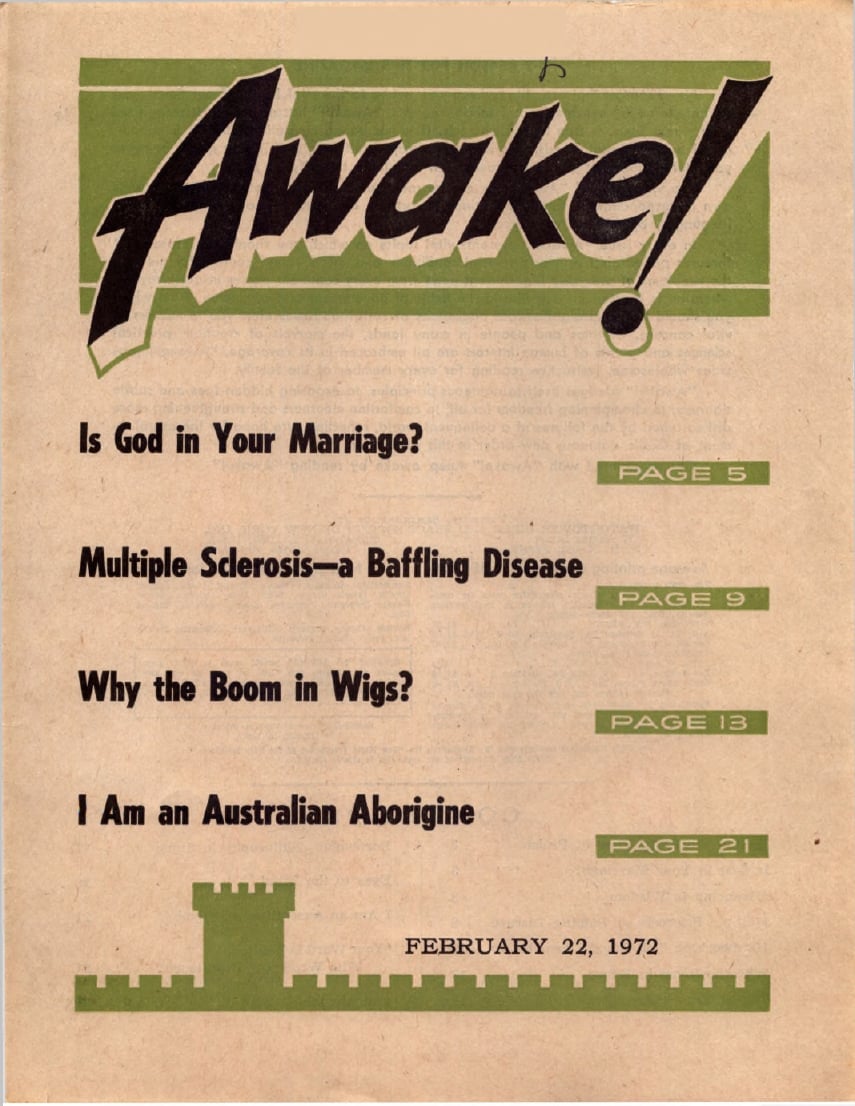
Awake! — February 22, 1972
Source: jw.org
Contents
Having the Right View of Praise
Is God in Your Marriage?
Advancing in Wisdom
Multiple Sclerosis—a Baffling Disease
Hardworking ‘Soil Bugs’ Clean the Air
Why the Boom in Wigs?
The Amazing Ostrich
Borobudur—Philosophy in Stone
Eyes to the Blind
I Am an Australian Aborigine
Who Wrote The Pentateuch?
Watching the World
Advertisement
Choosing a Modern Bible Translation
Having the Right View of Praise
Having the Right View of Praise
WHO does not appreciate praise? If we are conscientious, we want to do well, we put forth the effort to do well. Commendation encourages us in this right course. Such expressions of commendation, however, should not come from our own mouth, from our own lips, but from those of others.
The wise Bible writer at Proverbs 27:2 says: “May a stranger, and not your own mouth, praise you; may a foreigner, and not your own lips, do so.”
Self-praise on the part of some is obvious. They use the pronoun “I” to excess. But it can also be more subtle. A person, for example, might mention his making some purchase, perhaps doing so in an offhand, matter-of-fact way. But if the purchase is one involving large sums of money, far more than the person’s listeners could be expected to handle, the very matter-of-factness with which he relates the purchase may cause his listeners to be very impressed with his act. So, too, with many other things in life. Of course, no self-praise may be intended. But if a person finds himself frequently doing this, he needs to realize that his heart may be leading him astray into a course of self-elevation.
Note that the inspired writer of Proverbs 27:2 speaks of a “stranger” and a “foreigner” as being the ones to give the praise. This adds another facet to the principle being taught. It recalls the German saying, “Eigenlob stinkt, Freundes Lob hinkt, fremdes Lob klingt,” which means, “Self-praise stinks, a friend’s praise limps, a stranger’s praise rings [true].”
True, this saying may not hold good in all cases. But the Bible proverb shows that when praise comes from one who is free of ties to you, who is very unlikely to feel under any constraint to speak well of you, who gives no evidence of hoping to gain something by so speaking, then you may usually feel satisfied that his praise is ‘unvarnished,’ based on the true merits of your work, speech or course. Failing to realize the value of this proverbial truth, on the other hand, may keep one from knowing where one could, and perhaps needs to, improve.
But there is another facet to the matter. We should exercise care that gaining praise does not become our driving motive to do well. Because of being free from desire for personal benefit, the Christian apostle Paul could write to the Thessalonians, saying: “In fact, at no time have we turned up either with flattering speech, . . . Neither have we been seeking glory from men, no, either from you or from others.”—1 Thess. 2:5, 6.
So we want to be careful, first of all, not to sing forth our own praise. Then we should not go out of our way to elicit praise from others. The Bible urges Christians not to do things “with acts of eye-service, as men pleasers, but with sincerity of heart, with fear of Jehovah. Whatever you are doing, work at it whole-souled as to Jehovah, and not to men.”—Col. 3:22, 23.
Then again, having the right view of praise would include a readiness to have others included in the praise; sharing it with those who may have contributed to the success of what you said or did. As an illustration, at a symphony concert the conductor may ask the entire orchestra to take a bow in response to the great and repeated applause. And such is no more than fitting, for as a noted conductor once told his men, ‘You know that without you I can do nothing.’ Honesty and modesty will cause us to give credit where credit is due. Christians should not be like many men of this world who strive to stay ‘in the limelight.’
Of course, a person may have given help that significantly contributed to the success of a project and yet his efforts may not have received any public recognition or acknowledgment. This should never concern him, for, where it is merited, in due time each one “will have his praise come to him from God.” (1 Cor. 4:5) Thus, the hardworking wife who may receive little public acknowledgment can have the inner satisfaction of knowing how much she has contributed to her husband’s well-being and success. And she can be happy that her course is pleasing to those who are higher than her husbandly head, Christ Jesus and Jehovah God.—Prov. 31:23, 28, 31; 1 Cor. 11:3.
In particular should the Christian who receives praise for having done well in one line of endeavor or another, direct the praise to Jehovah God and his Son. God is the Giver of every good gift and every perfect present. (Jas. 1:17) Not necessarily always out loud, but in his heart and mind the Christian should remind himself of the part that God played in whatever success he has enjoyed. Jesus gave the most striking example of this.
Although greatly honored as the Messiah and the Son of God, at no time did he take credit for his message or works. Thus, to religious opposers Jesus could honestly say: “If I glorify myself, my glory is nothing. It is my Father that glorifies me.”—John 8:54.
All Christian servants of Jehovah God will therefore do well to bear in mind the principle the apostle Paul enunciated in this regard. He stressed: “We are God’s fellow workers. You people are God’s field under cultivation, God’s building.” And that it is God who deserves the praise, Paul shows in the context, for there he says: “I planted, Apollos watered, but God kept making it grow; so that neither is he that plants anything nor is he that waters, but God who makes it grow.” How true that is! Certainly everything depends upon God’s blessing on our efforts.—1 Cor. 3:9, 6, 7.
Surely, having the right view of praise, we will not only be loath to sing our own praises, or go out of our way to elicit the praise of others, but, when given praise, with due modesty give credit to others where it is due and, above all, direct the praise to Jehovah God, to whom it always is due.
Is God in Your Marriage?
Is God in Your Marriage?
MARRIAGE is more than just the union of two persons of the opposite sex. It consists of many important facets. There are emotional and religious factors, as well as social, recreational, intellectual and financial aspects that must be considered.
In the beginning Jehovah God said: “It is not good for the man to continue by himself. I am going to make a helper for him, as a complement of him.” And so God created Eve and brought her to Adam. From then on, the rule applied: “A man will leave his father and his mother and he must stick to his wife and they must become one flesh.” The words of wise King Solomon, “two are better than one,” can well be applied to marriage.—Gen. 2:18, 24; Eccl. 4:9.
Two are indeed better than one, but for these two to remain strongly and happily united in wedlock, outside help is apparently needed. This can be seen by the great number of unhappy and broken marriages. Those who have made a study of the situation in the United States say that, although all couples marry with the hope of realizing happiness, their chances of doing so are far less than 50 percent. Why, in some lands there is one divorce to every three marriages, and in certain cities the ratio is one to two!
Because of the stresses upon modern marriage, legislators are making it ever easier to obtain divorces. New York state, after allowing only adultery as a ground for divorce for ever so many decades, now grants divorces on a number of other grounds. And in California the only ground required for divorce is the desire of either one or both parties to terminate the marriage because of “irreconcilable differences.”—Time, January 12, 1970.
Why?
It has well been said that the chief reasons for unhappy and broken marriages are human weaknesses and selfishness, especially as exemplified by emotional immaturity. The personalities of two emotionally immature persons are bound to grate upon each other. Such immaturity manifests itself by wanting to have one’s own way all the time, by wanting something for nothing (as by gambling), by turning to alcohol to compensate for frustrations, or by giving oneself over to loose or promiscuous conduct. The pressures of earning a living also contribute to the breakdown, as does commercialism, which tempts people to live beyond their means.
And ironical though it may seem, it is nevertheless true that the very things that can bring so much happiness to a marriage—the differences in the sexes—can, if viewed improperly, strain it to the breaking point. For example, the man is more likely to view things intellectually and logically, while the woman is more prone to look at things emotionally and sentimentally.
With the average man sex relations are the more dominant consideration, while with the average woman other considerations are likely to play a dominant role. The incident of the patriarch Judah, son of Jacob, having relations with his daughter-in-law is a case in point. (Gen. 38:1-26) So it has been said with no small measure of truth that man gives affection to get ‘sex,’ and the woman gives ‘sex’ to get affection and love. Thus also we are told that a man will buy a home for the sake of having a wife, while a woman takes a man so that she might have a home of her own.—1 Cor. 7:1, 2.
“A Threefold Cord”
Important to the success of marriage is the desire to please each other, but that is not enough. Something else is needed. It is as we read: “A threefold cord cannot quickly be torn in two.” (Eccl. 4:12) Marriage becomes a threefold cord by bringing God into it. How is that done? By making the marriage vows in the presence of God and recognizing one’s obligation at all times to be pleasing Him, the originator of marriage.
That this should be so is recognized even by educators and university professors who are concerned with marriage problems. Thus, F. Alexander Magoun, who for decades has lectured to college students from one end of the United States to the other, devotes the last chapter of his book on love and marriage to “Religion in the Home.” Says he: “Life and religion cannot be separated . . . Real religion is indispensable to happiness and fullness of life . . . Any material problem always has a spiritual side, and a right material solution is impossible until the spiritual principles have been discovered on which to base that solution.”
In a somewhat similar vein, sociologist J. D. Unwin has noted that, for a marriage to realize its full potential, ‘partners must share an allegiance to some purpose outside themselves and which they consider ultimately more important than even themselves or their relationship.’ The service of Jehovah God furnishes just such a purpose for dedicated Christians.
Pleasing God by Loving One’s Neighbor
To bring God into one’s marriage by pleasing him means to keep his commandments as found in his Word, the Bible. It commands, “Love your neighbor as yourself.” For married folks their closest neighbor is their own mate. They must also apply to their relations with each other Jesus’ further words: “Just as you want men to do to you, do the same way to them.” How strengthening to marriage is the application of these commands!—Mark 12:31; Luke 6:31.
Married couples have vowed to love each other. How does love act? God’s Word tells us: “Love is long-suffering and kind. Love is not jealous, it does not brag, does not get puffed up, does not behave indecently, does not look for its own interests, does not become provoked. It does not keep account of the injury. It does not rejoice over unrighteousness, but rejoices with the truth. It bears all things, believes all things, hopes all things, endures all things. Love never fails.” Clearly no marriage tie could possibly be torn in two if these divine commandments are carried out.—1 Cor. 13:4-8.
Married persons, being imperfect, at times transgress against each other. Here again God’s inspired counsel helps: “Become kind to one another, tenderly compassionate, freely forgiving one another just as God also by Christ freely forgave you.” The Bible also tells Christians to cultivate the fruitage of God’s spirit: “Love, joy, peace, long-suffering, kindness, goodness, faith, mildness, self-control.” Trying to be good Christians will certainly strengthen the marriage, for it will bring God into it.—Eph. 4:32; Gal. 5:22, 23.
God’s Principles Governing Marriage
God, having originated marriage, purposed that it be a great blessing and the source of much happiness. But only by abiding by his rules for marriage can such be realized. These spell out the roles to be filled by each mate.
The role of the husband is that of exercising loving headship: “The head of a woman [wife] is the man.” (1 Cor. 11:3) A family is a miniature organization, and every organization must have a head if it is to survive and realize its purpose. A mature man is mentally, physically, emotionally and biologically fitted to take the lead in the family.
But this in no way authorizes the husband to be a selfish, independent dictator. By no means! That would be sidestepping God, for he counsels: “Husbands, continue loving your wives, just as the Christ also loved the congregation and delivered up himself for it . . . In this way husbands ought to be loving their wives as their own bodies. He who loves his wife loves himself, for no man ever hated his own flesh; but he feeds and cherishes it.” One of the greatest examples of unselfish love is this one of Christ, the one that husbands are to follow.—Eph. 5:25-29.
This matter of headship on the part of the husband cannot be dismissed as old-fashioned and out-of-date. Headship is the divinely ordained inheritance of the man.
Some people would have the family run as a democracy, with all its members voting on the way it should be run. But this is not the Creator’s way at all! One of America’s foremost educators, Elton Trueblood, states: “It is only when the recognition of male headship, as expressed in the Biblical story of creation is fully accepted by both partners to a marriage that the true dignity not only of manhood, but also of womanhood is appreciated.”—The Recovery of Family Life, p. 89.
Even more to the point are the words of David and Vera Mace,a who have studied marriage problems on all five continents:
“All cannot be treated as equals, because in fact they are not so. A man and a woman may be equal as persons in society. But as husband and wife, acting out their masculine and feminine roles in marriage, they are different and complementary; the concept of equality is meaningless here. A parent and a child simply cannot be equal, because the child needs the protective authority of his parents to give him the security without which he cannot grow healthily into an adult.
“We are coming to see in the West, therefore, that by undermining the authority of the man in the family we are not only damaging him, but hurting everyone else as well. The wife cannot function in her feminine role if her husband’s masculine role is taken from him. The family group cannot function as a family if its natural head is dethroned.
“In Western marriage many troubles are arising because the reciprocal husband-wife interaction pattern is out of kilter. If the husband can no longer play his part as leader and initiator, the wife is paralyzed in her responsive function.”—Marriage: East and West (1960), p. 297.
By supporting the Bible’s role of headship for the husband, these persons also support the role it gives to the woman, which is just as biologically sound. Her God-given role as mother, while being unquestionably very rewarding, exacts its own price. Her monthly vicissitudes, pregnancy, childbirth, nursing and care of her offspring, all emphasize her need of security, which her husband can provide. To care properly for every need of an infant (emotional, mental and physical) requires a very gentle, sensitive, feminine nature, just the opposite of an aggressive masculine one.
Truly in wisdom and love the Creator has ordained that the wife should be in subjection to the husband and father. In fact, only by her being submissive can her husband love her as he loves his own body, for his own flesh is submissive to him. That is why the Word of God commands: “Let wives be in subjection to their husbands as to the Lord.” And again, “The wife should have deep respect for her husband.” By both husband and wife playing their God-ordained roles the marriage is strengthened.—Eph. 5:22-33.
Women, by seeking to compete with men and occupy and play man’s role, are actually working against their own interests. They are denying their own femininity. True, man is naturally the leader and the aggressive one, but, in the case of a loving husband and father, is it not used in the interest of his wife and children? Thus one leading woman psychoanalyst and author in New York city, in discussing with women their marital problems, among other things said: “Women must learn to thank God daily for the enormous energy and drive of their men.”
Also strengthening the marriage tie is what God in his Word has to say regarding the intimate aspects of the marital relationship: Neither the husband nor the wife has exclusive control of that one’s own body but each has a claim on the other’s body for the satisfying of basic sex needs. (1 Cor. 7:3-7) Husband and wife are also counseled to limit their sex interest to each other; the only ground for divorce with the right to remarriage is infidelity on the part of a mate.—Matt. 19:4-6, 9.
Walking with God
There is yet another way in which God can be in your marriage so as to strengthen it, and that is by both husband and wife ‘walking with God.’ (Mic. 6:8) What does this mean? It means to have a meaningful relationship with God. This is shown by one’s looking to God at all times for wisdom and strength, and in particular by frequently talking to him in prayer. It means to be like Moses, who “continued steadfast as seeing the One who is invisible.” It means not to “be anxious over anything, but in everything by prayer and supplication along with thanksgiving let your petitions be made known to God.”—Heb. 11:27; Phil. 4:6.
True it is, “two are better than one . . . For if one of them should fall, the other one can raise his partner up.” But better still is “a threefold cord,” for it “cannot quickly be torn in two.” More than anything or anyone else that can help you to have your marriage like a threefold cord, strong—and also happy—is having God as the third strand to your marriage cord.—Eccl. 4:9-12.
[Footnotes]
D. Mace is Associate Professor of Family Study at the University of Pennsylvania and Chairman of the International Commission on Marriage Guidance.
Advancing in Wisdom
Advancing in Wisdom
● It has been said that as a person becomes older and wiser, he often talks less but says more.
Multiple Sclerosis—a Baffling Disease
Multiple Sclerosis—a Baffling Disease
ARE you stiff as a board when trying to get out of bed in the morning? Are you unable to walk so that a wheelchair is needed? Must someone push your legs and aid you into a chair so you can bathe? At one time did you have good penmanship but now can barely write your name? Do you have difficulty in controlling your bladder especially in cold or rainy weather? Do you see well and then your eyes blur or do you have double vision?
Maybe you have multiple sclerosis—baffling MS.
What Is It?
Multiple sclerosis is a disease of the central nervous system. It attacks the insulation of nerve fibers of the brain and spinal cord. Normal nerve fibers are insulated by a sheath of fatty tissue. This insulation might be compared to insulation around a telephone wire. When the insulation around a nerve fiber is broken down by MS, the conduction of impulses along the now exposed fiber is disrupted. There is a short-circuiting of nerve impulses, and the corresponding muscle cells become paralyzed.
In areas where nerve-fiber insulation is broken down, scar tissue forms; this results in hard patches in the brain and spinal cord. “Sclerosis” comes from a Greek word meaning “hard.” Because these small hard areas appear scattered throughout the gray and white substance of the brain and spinal cord, the disease is called “multiple” sclerosis.
Some of the symptoms are fatigue, numbness, tingling, incoordination, strong jerky movements, weakness or spasms of the arm, leg and eye muscles (causing blurring and double vision), tremors of the limbs on attempting some special action, staggering, a spastic gait, actual paralysis, headaches, weakness of the bladder and stiffness of the limbs.
Odd Aspects of MS
One of the many odd aspects of MS is that it attacks chiefly people in the prime of life, persons between the ages of twenty and forty. In fact, doctors report that MS is the commonest disease of the nervous system affecting people in the prime of life in northern Europe and North America. Some 250,000 Americans, and possibly many more, are afflicted. It is most common in the economically advanced areas of the earth, where the hygienic standards are the highest. “The more primitive the society,” says one doctor, “the less the MS problem.” It is relatively more common in cold climates. It is relatively rare in South America, Africa and in Asian lands.
MS is slowly progressive, perhaps developing in fifteen to thirty years. As a rule it is a disease that worsens, slackens off and then returns. Severe symptoms may appear and then, just as suddenly, disappear. The patient may suddenly find he can walk again. His eyesight may be restored. He may be an office worker, able to hold down a job, type and dress himself. Then without notice his hands become clumsy, awkward and so numb that he strikes the wrong keys. Speech is slow and broken into small syllables. Even though improvement is spontaneous, he may relapse into a similar state, or worse. Baffling MS.
Despite much medical research, MS remains, as one doctor put it, “a disease with an unknown cause, an unpredictable course, an undiscovered cure and not even a simple laboratory test to confirm its diagnosis.” Baffling MS.
Possible Causes
MS was first described in detail in 1868, and since then many opinions as to possible causes have been offered. One of the most popular in recent years is that MS is an autoimmune disease; that is, one in which the body produces antibodies that attack its own substances.
However, there are authorities who believe MS is linked with a virus. For example, writing in Scientific American of July 1970, British epidemiologist Dr. Geoffrey Dean reports that variations in its incidence around the world suggest that it results from infection by a virus of the little-understood “slow” or latent kind. Normally, he believes, MS is “a virus infection of childhood” like polio. The earlier a child is exposed to the polio virus, the less likely he is to develop the crippling variety. But in those parts of the world with a high hygienic standard, a child may miss an early infection; then if it occurs for the first time in early adult life, it is with more serious consequences. The virus theory, like others, has not been proved.
Treatment and General Aids
There is no specific therapy for MS, but many doctors use adrenocortical steroids such as cortisone. It is believed that temporary use of this drug may possibly hasten a recovery or remission. But whether such drugs actually shorten an acute episode or lessen it in intensity is still debated. Thus much of the therapy for treating MS is related to relieving symptoms, and drugs of various kinds are used. Opinions vary, and so does the treatment of MS. Baffling MS.
Many doctors recommend occupational therapy, which might be knitting, painting, typing and so forth, anything to keep the mind active and not on one’s ailment. Enough rest, a happy mental outlook and a determination to get well are helpful. It is important to keep the patient’s morale high, and a sympathetic, hopeful attitude on the part of the family will help to make life more pleasant for all concerned.
Extreme fatigue, exposure to cold or dampness should all be avoided. Infections of any sort, especially respiratory infections, often bring on relapses or cause the disease to worsen.
There is also the need to avoid bad emotions, such as anger and rage. Studies have shown that chronic bad emotions probably have an injurious effect as to the activity of the disease. Acute emotional stress may suddenly bring on a severe attack.
It is believed that inactivity will lead to increased stiffness of the legs. Thus, writing in the volume Current Therapy (1967), Dr. W. W. Tourtellotte, M.D., of the University of Michigan Medical Center, says of MS patients: “Daily walking to just beyond the level of fatigue by patients who are moderately afflicted is encouraged. . . . It is our experience that patients with multiple sclerosis should be active and busy as long as their neurological condition permits.”
Nutritional Factors
Much controversy exists as to whether the taking of certain vitamins will help an MS patient. There have been reports of improvement following the taking of some vitamins, but the medical profession in general believes that there is no real evidence or support for many of the conclusions drawn. The Merck Manual of Diagnosis and Therapy states that vitamin preparations can be taken for “their psychotherapeutic and tonic effects.” Recommended in this regard are nicotinic acid (niacin), and vitamins B1 and B12. French doctors who used vitamin B12 for treating MS reported considerable improvement in patients.
Nutritionists generally believe from their research that vitamins can help an MS patient. Nutritionist Adelle Davis, for example, reports in her book Let’s Get Well: “When patients suffering from multiple sclerosis have been given vitamins E, B6, and other B vitamins, the illness has been arrested; even advanced cases improved in walking and had better bladder control and fewer arm and leg spasms. The calcification of soft tissues has been prevented with vitamin E. It seems to me that all of these nutrients should be emphasized in the diet of any individual suffering from this disease.”
Also nutritionist Catharyn Elwood reports that Doctor J. E. Crane “has had wonderful success with vitamin-E treatment of multiple sclerosis. Of 24 severe cases, 18 ‘improved markedly.’”
Vitamin C has also been reported as having some value. In The Complete Book of Vitamins, the statement is made: “In multiple sclerosis, objective and subjective improvement was noted in the majority of cases when large doses of ascorbic acid were administered.”
A recent book, New Hope for Incurable Diseases (New York; 1971), has a chapter on MS. The authors, E. Cheraskin, M.D., and W. M. Ringsdorf, Jr., D.M.D., tell of MS patients who have benefited by a low-carbohydrate diet. A high-carbohydrate diet made their symptoms worse. Say the authors: “There is hope for the person with multiple sclerosis! Diet, as a therapeutic tool, certainly should be included on the basis of this evidence.” In the light of the dietary evidence they have uncovered, these doctors say: “Simple sugars and saturated fats should be viewed as susceptibility factors in multiple sclerosis.”
With regard to the matter of prevention, these doctors state: “It is likely that the diet offering more hope for the incurable may also prevent the development of these disorders.” Dietary factors recommended by these authorities are: Adequate protein and “1. Restriction of dietary carbohydrate, especially sugar, syrup, and very highly processed starch foods. 2. Restriction of saturat[ed] fats and replacement with the unsaturated fats. 3. Multiple vitamin-mineral supplementation. 4. Megadoses of Vitamin C and Vitamin B.”
My Own Experience with MS
Baffling MS manifests itself in various ways among different persons. My own experience with strange symptoms began in 1956 when I was in Minneapolis, Minnesota. I was waiting to attend the fall class of the Watchtower Society’s Gilead missionary school. A pain in my back came on, and one hip looked higher than the other. The doctor put me in bed for a week or so and called it sciatica. The pain in the right lumbar region left, and I straightened up.
After going to my missionary assignment in Guyana, I had no trouble again until 1959. Again it was pain in my back. After some time in bed, I returned to work but had stiffness. When I visited Minneapolis in 1961 a chiropractor told me he thought that I had multiple sclerosis. He gave me adjustments of the spine, and I began taking some vitamins, such as vitamin B.
Later my right hand went dead for over a month, and I ate with my left hand. Then my right hand came back to life, and I was normal again. It was all very baffling.
In February 1962, I did much enjoyable work. But in March I could not walk for a time. Every year I would get this attack. Then it came after nine months, and after six months.
I began to have trouble with my legs; I would often fall down. Then I had trouble with my bladder. In 1964 a doctor gave me cortisone and called my ailment peripheral neuritis. Cortisone seems to deaden the pain. Another doctor examined me and recommended shortwave treatments for my back and certain exercises. In 1965 I went to the Mayo Clinic in Rochester, Minnesota. Here I had many examinations and tests. Finally after more than a week, I was told that my ailment was multiple sclerosis. In my case it was thought wise not to take any more cortisone, as it seemed to make my muscles more stiff.
Later in 1965 I was back in Guyana to continue my missionary work. My legs steadily got worse, and in 1968 I began to use a wheelchair.
Now in 1972 my hands are getting weaker, and I am unable to stand on my legs. I find it difficult to write my name, and my typing is done with two fingers. Though there is general deterioration now, my conducting Bible studies with students helps to keep my mind alert.
A person with MS is dependent on others, and I am fortunate to be living in Guyana, where people are friendly and understanding. The doctors and nurses at the Georgetown Public Hospital really are kind, and when I need help they give me assistance. Even the climate in Guyana is favorable, since warm weather seems to help me. The whole year around it is between eighty-two and eighty-five degrees Fahrenheit.
My husband and I have been full-time ministers for eighteen years now, and we have been here for about fourteen years. I am able to teach people the Bible in my home, on the phone and when talking to neighbors and friends. It is good to keep active in spite of that baffling MS.—Contributed.
Hardworking ‘Soil Bugs’ Clean the Air
Hardworking ‘Soil Bugs’ Clean the Air
◆ Scientists at the Stanford Research Institute have concluded that soil microorganisms perform an invaluable service in removing deadly carbon monoxide from the atmosphere. Of the 200 different organisms so far isolated from the soils, at least sixteen actively remove this gas. Each year some 200 million tons of “man-made” carbon monoxide are produced in the continental United States. Yet the head of the institute’s plant biology laboratory estimated that the soil in the country can remove more than 500 million tons. And people get the greatest benefits from this service in those areas where trees have not been mostly eliminated and the ground covered with concrete. Thus it seems that these soil microorganisms largely account for the fact that the amount of this gas in the atmosphere has remained almost constant for the past decade.
Why the Boom in Wigs?
Why the Boom in Wigs?
A FEW years back, wigs were almost unknown—actresses, wealthy women of fashion and a few women with thinning hair being about the only ones who wore them. But now they are sold by the millions practically world wide. In the United States, retail sales have boomed from almost nothing eleven or twelve years ago to more than 500 million dollars annually!
In some larger cities and affluent suburbs a large proportion of women own them—if not a full wig, then a partial hairpiece of some kind or another. And the New York Times of August 22, 1970, noted that “wigs for men are a hot, new item in stores across the country.” One of the first department stores to stock wigs specially designed for men had sales of $5,000 in the first two weeks.
Such popularity, however, is not unprecedented. In the eighteenth century, wigs were commonly worn in Europe and colonial America by both women and men. During the American Revolution wigs were ‘government issued’ to soldiers, and dressing his wig was important in the soldier’s life.
But why are wigs again so widely popular, especially women’s wigs? Why such booming sales?
Improved Quality, Low Cost
When wigs started gaining popularity again around 1960, only those made of real hair looked genuine. But they were and still are generally expensive, running into the hundreds of dollars for quality ones. On the other hand, wigs of synthetic material were poor imitations, being obviously artificial.
However, in the latter 1960’s synthetic wigs made of modacrylic fibers were perfected. These fibers are inexpensive—about $3.25 a pound—not very flammable, and remarkably similar to human hair in molecular structure. They are also so light that a full wig may weigh only three ounces.
Thus began production of synthetic wigs that almost perfectly duplicate in appearance and feel human hair and they could be purchased for $25 to $30, which was quite low when compared with those made of genuine hair. Another advantage of the synthetic wig is the minimal effort and cost to maintain it.
The human-hair wig requires practically the same care one’s own hair does—regular setting, shampooing and so forth. However, when the synthetic wig is manufactured, the curls are baked into it so that the set does not come out except at high temperature. Thus it can be worn time after time, and it still looks good. When it gets dirty it can be washed simply by swooshing it about in cool or tepid soapy water, rinsing it, shaking it, and hanging it to dry.
In 1967 another improvement was made—the stretch wig was developed. The hair is attached to a cap made of elasticized fiber threads, which can be stretched to fit a variety of head sizes. It is pulled on more or less like a bathing cap, and it stays firmly and securely in place.
With such improvements, the wig boom was on. Practically all wigs sold today are synthetics. Of those sold in the United States, well over 90 percent are imported, mostly from such places as Korea and Hong Kong.
Other Reasons for the Boom
Wigs are a profitable business, tremendous profit margins being realized all along the line, from manufacturer to retail seller. So promotional efforts, prompted by a profit motive, are also a factor in the wig boom. But, of course, to maintain sales buyers are necessary.
What many women like about wigs is their convenience. It takes only a few minutes to put on a wig, and then one is ready to go, adorned with a hairstyle that few persons, if any, may be able to tell is not one’s own. A wig department supervisor observed that only one person in a hundred buys a wig because her own hair is poor.
Some women, for example, have found they can go swimming and, by donning a wig, be ready in minutes to meet an appointment or fulfill a social engagement. Some men, too, are pleased by the advantage this affords, not only for their wives, but for themselves. As one said: “The time it takes her to get ready to go out is cut in half. Now if only someone would invent instant make-up.”
A factor, too, in the boom in wig sales is that many women buy not just one, but a number of wigs, some even changing from one style (and color) to another each day.
Factors to Consider
Not all women have been satisfied with wigs. Some say they feel uncertain when wearing them, being afraid that they may come off, to their embarrassment. Others complain that they are uncomfortable, that their heads feel hot and itchy after a day’s use. Wig caps, some women say, are not porous enough to allow the scalp to breathe sufficiently. Even women who like wigs admit that in very hot, humid weather they can be unpleasant, just as a hat can be. On the other hand, in the winter this feature can be an advantage, serving to keep the head warm.
The question is often raised as to whether regular wearing of a wig harms the hair or scalp. It can. Frequent wig wearers commonly find that the elastic around the edge of the wig cap has a tendency to rub the hair off near the hairline. Aside from that, however, little harm is apparently done, at least no more than would occur from regularly wearing a hat that covers the top of the head. Of course, the wig should be taken off when going to bed, since the hair and scalp do need ventilation.
Women usually are glad to take their wigs off when they return to the privacy of their home, even as they find it comfortable to remove a hat. As a result, a woman may appear rather unsightly, for to wear a wig the hair must be pressed down tightly on the head. Some women say they do not like to appear this way before their husbands, and husbands may understandably not like it either.
Looking at Wigs from the Christian Viewpoint
Some feel that the boom in wigs may be explained entirely by lowered prices, improved synthetics and timesaving convenience. But is this all?
Perhaps one might here think of another question: Why is it that the previous boom in wigs, one that saw even ordinary soldiers wear them, faded out in most places in the nineteenth century? The answer is that what was popular became unpopular; artificiality gave way to naturalness. Could it not be simply a reversal of popularity today that has brought a restoration of an earlier fad?
Christian women will recall the Bible’s exhortation to modesty, including the avoiding of elaborate “styles of hair braiding.” (1 Tim. 2:9) Wigs can serve as a temptation to violate this sound counsel. In the eighteenth century, when wigs were so popular, French women notably competed for the most extravagant hairstyle. Today, too, some women purchase wigs that look quite unnatural on them, even outlandish. What is their motive?
Does a woman wear a wig because of a serious problem with her hair, as did one who suffered the loss of much of her hair due to a family tragedy? For most this is not the reason. Then is it truly for practicality? Or is it simply a strong desire to be “fashionable,” even to “stand out”?
In the absence of hair problems, the intensity of the wearer’s concern about wigs could be the determining factor as to the rightness or wrongness of the whole matter as viewed from the Christian standpoint—just as the intensity of desire differentiates the materialist from the non-materialistic person who nevertheless works for wages.
Admittedly we humans often suffer in appearance due to imperfection. We may try to cover over some defects or blemishes and do so with a right motive: that of wanting others to have something pleasant (or at least reasonably pleasant!) to look at. Today, however, man’s ingenuity has made it possible for humans, particularly women, to change virtually everything about their appearance, substituting artificiality for naturalness. Might not a great enthusiasm for such artificial things or immoderate use of them imply some lack of appreciation for the body we received through our parents by the Creator’s life-transmitting process? We might here recall the apostle’s statement that a woman’s hair, her own hair, can be “a glory to her.”—1 Cor. 11:15.
All this is not to say that the use of a wig is of itself improper from the Christian viewpoint—no more than the use of cosmetics, perfume, jewelry or, in menswear, padded shoulders, is of itself improper. Basically the question is the motivation behind it and whether the use is with moderation.
So, like some women, you may feel that the timesaving convenience (or winter warmth) of a wig merits its use. Or, like others, you may prefer naturalness, perhaps preferring to be appreciated principally for what you actually are. In either case, the married woman should also give due consideration to the preference of her husband.
The Amazing Ostrich
The Amazing Ostrich
By “Awake!” correspondent in South Africa
HOW would you like to start your meal by eating pebbles? Not a pleasant way to dine, but to the amazing Mr. Ostrich there is nothing better. Hard objects pass at once into the bird’s stomach and from there they go to its second stomach, the gizzard. This functions like a mill, the food being ground up by action of muscular walls.
Baby food for the amazing ostrich family is unusual. When the chicks are hatched, wet dung of the mother is an indispensable baby food. It supplies the necessary bacteria to start the baby’s digestive processes.
In South Africa there are quite a number of ostrich farms. Here these huge birds are raised not only for plumes but also for their skins, which are made into fine-quality leather. In the district of Oudtshoorn there are two hundred farms that keep some 70,000 ostriches. On these farms Mr. Ostrich has a great share in the hatching work. The hen sits during the daytime so that her grayish-brown feathers blend with the surrounding karroo bushes. The male sits at night for the same reason—for camouflage, his black-and-white plumage being invisible at night.
Just before the eggs are due to hatch, the male will sit next to the female even during the daytime or stand next to her, throwing his shadow over her to protect her from the rays of the subtropical sun.
Mrs. Ostrich lays from twelve to fifteen eggs. If a farmer removes these eggs, she will keep on laying, up to thirty eggs, providing a dummy egg is left in the nest. In this way three hatchings can be obtained annually instead of one.
As might be expected of the world’s largest living bird, the eggs are huge and may weigh three pounds. The Grand Creator has made the provision that the germ is so suspended in the egg that, no matter how the egg is turned, the germ rises to the top so that the vital spot can be brought into contact with the warm body of the parent bird. The chicks hatch after incubating for six weeks.
A chick lies folded up like a miniature umbrella inside the shell, with its feet and beak together. At the final stage of hatching, the chick kicks the shell open with its hard, bone-reinforced toenail. When grown up the ostrich may reach nearly eight feet tall and weigh as much as 345 pounds.
In spite of its hefty build, the ostrich is a very graceful bird. In fact, they have been seen dancing to the tune of a herdboy’s reed pipe.
Or perhaps you would rather watch a male bird performing his courting dance? He sits on his haunches, spreading his wings out so that the shining white plumage is fully displayed while he moves his body slowly from side to side. The neck arches backward in swanlike elegance; the head beats with a dull thud alternately on either side of his body. The mating call is three deep growls followed by a shorter call. It can be heard at a distance of two miles and sounds like the roar of a lion.
Though a flightless bird, the ostrich makes up for that by being an amazing runner. Its long legs can carry it at speeds of thirty or forty miles an hour.
If unable to run from danger, the ostrich does not hide its head in sand. Rather, it defends its nest by kicking with its powerful legs. The ostrich is unique among all birds in having but two toes on each foot, one of them equipped with a clawlike hoof that becomes a dangerous weapon when the bird is forced to defend itself.
Certain characteristics of the ostrich are said to stagger scientists. It has a bladder that collects uric acid, an organ characteristic of mammals, but not possessed by any other family of birds. It also possesses eyelashes that protect its eyes from the blowing sand. Truly the amazing ostrich gives credit to the wisdom of its Creator.
Borobudur—Philosophy in Stone
Borobudur—Philosophy in Stone
BY “AWAKE!” CORRESPONDENT IN INDONESIA
IN A picturesque setting of green terraced rice fields of Central Java, Borobudur is located. Built about 800 C.E., it has a name thought to mean “Monastery on the hill.” But rather than being a monastery, it is a huge, forty-two-meter-high square pile of stones enveloping the top of a hill. Strangely enough, the philosophy of Buddha is reflected in this mammoth pile of stones.
Buddhist teaching does not conceive God as a personal being. Thus man becomes the important thing. That is why many Chinese Buddhists are at the same time also followers of Taoism and Confucianism, to fill the religious lack of Buddhism. Since Buddhism is not so much a belief as a philosophy, Borobudur resembles, not a place of worship, but one of meditation.
Today, next to being a favorite tourist attraction, Borobudur serves as a holy place for Indonesian Buddhists. Many of them make an annual pilgrimage in order to celebrate their most important festival, the enlightenment of Buddha, during the full-moon night in May.
Magic Taken Seriously
During that night the followers of Buddha gather at the field surrounding Borobudur. The place becomes, they believe, a strong reservoir for magical power. “White magic” is said to be obtained in order to fight “black magic.” Buddha’s spirit is thought to appear in visible form on top of a southern mountain, and after the celebration is over, “magic water” is taken along from Borobudur for those who could not attend the celebration as well as for healing sick people.
Those who have witnessed Waiçak, or the celebration of the enlightenment of Buddha, have seen how important spiritism or occultism is for Buddhists. Such observers may rightly wonder why Buddhists do not believe in God yet, on the other hand, regard magical power from invisible creatures very seriously.
Buddhist Evolution Depicted
The very shape of the monument of Borobudur resembles the philosophy of Buddhism. How so? Built in ten terraces with a small room on top, it depicts the Buddhist concept of gradual transfer of the human being into the ultimate destiny of Buddha nirvana. This is represented by the central upper chamber. There are no clearly marked entrances. But on all four sides are flight steps and gateways leading to the upper chamber of the step pyramid.
Evolution is part of Buddhist philosophy. All life is thought to have its origin in the rocks. The rock is said to become sand, sand becomes plants, plants change into insects, insects into wild animals, wild animals into domestic animals, and domestic animals are thought by Buddhists to become humans.
No links are required as in Darwinism, as the Buddhist-type evolution is thought to be achieved through reincarnation. Thus Buddhists believe that Gautama Buddha himself lived before becoming a human, once as a rabbit, another time as a turtle, then as a monkey. Next, he became a man, according to Buddhist philosophy, later a spirit, and finally entered nirvana.
Now, all these different stages of life according to Buddhist concept are illustrated through artistic carvings and statues over the whole monument of Borobudur. For example, the supposed prehuman life of Buddha is depicted as a rabbit, or as a good turtle saving the lives of shipwrecked sailors by bringing them on its back safely to the beach. Thus the sculptures depict the Buddhist philosophy of evolution of man.
Efforts to Eliminate Human Suffering
Illustrated at Borobudur in the hundreds of well-preserved reliefs on the first five terraces is the Buddhist concept of life full of suffering.
Siddhartha Gautama, called the Buddha, which means the Enlightened One, is said to have lived from 563-483 B.C.E. Moved by the sudden realization of illness, old age and death, he left his home in search of wisdom that would eliminate human suffering. That was a very long time ago, and his teachings have spread far over Asia. But if we think for a moment, what did he accomplish?
With his good intentions, did Gautama finally succeed in solving human problems? Did he eliminate illness and its cause, old age and death and its cause? Or do people even today, 2,500 years after Gautama’s enlightenment, suffer from illness, old age and death? You may say: “Of course, I too feel sick sometimes; I have seen people grow older and die.” Then did Buddha really succeed in freeing humans from suffering?
After spending seven weeks under the shade of a bo tree, he came to the conclusion one night that charity and renunciation are the keys to nirvana. His argument was that if a person is in no way affected by what he sees, hears, smells, feels, tastes and thinks, he becomes free, uninvolved, unconscious of life, death, old age and sickness. He enters what is called nirvana, which is described, not as a place somewhere, but as a condition, the end of all suffering.
You may naturally wonder, How can it work to be completely uninvolved in life; not to hear a thing, or not to see? If, for example, you see something very horrible, something really disgusting done to your friend, are you not immediately moved to react? Most people would feel so. Or, if you suddenly realized that you put your hand on something very hot, would you not automatically retract it? That is what every normal person would do.
No Remembrance in “Reincarnation”
What comes next in the philosophy of Buddhism is shown on the next four terraces. This part of Borobudur is not square-shaped as the lower part is but is circular and is covered with seventy-two bell-shaped, perforated stone chambers. Each chamber contains a Buddha statue. These statues, being without ornaments, are thought by Buddhists to indicate spiritual life on a higher level than that of a human. Although the main position of Buddha is the same with each statue, the different positions of his hands are thought to indicate the progress to higher virtues.
Since it seemed impossible for a human to get completely disassociated from life, not to feel anything nor to see, hear, smell or think anything during his short lifetime, Gautama continued in the Hindu belief of reincarnation, the evolution of man into a higher form after his death.
After a person has died, according to this concept, his real spiritual personality is immediately transferred into a newborn baby somewhere else, and he now has a chance to continue his human progress to reach the unconscious life. If he has led a good life during the first lifetime, it is thought that his new life will be an improvement. That is, he may have wealthier parents, be more handsome or have better personality traits. On the other hand, if he was bad, it is thought that he may be reborn under poorer conditions, be uglier, or if he was really a bad fellow, he may even be transferred back into a newborn domestic animal.
But you may wonder, What benefit is there in reincarnation, in an experience, if you cannot remember a thing of what has happened in the life before? How can there be an improvement of the personality or a striving after a higher desire if all the lessons of the former life are not remembered anymore?
Disassociation or Enjoyment of Life?
While visiting the seventy-two statues on the four terraces, the Buddhist pilgrim is in search of freedom from human life. Each image, by means of how the hand, are held, is said to give hints of how to get disassociated, to become unconscious of life. You may wonder, however, how a person can ever be happy, enjoy and share happiness if he disassociates himself. For just the opposite is required to enjoy life—participation, the use of the senses and the use of the brain.
Did Buddha really teach love of life? Or does his philosophy not rather indicate fear of life? To try to run away from it, to disassociate himself from life, is surely not the successful way to make himself or others happy. Is Gautama’s philosophy of enlightenment not rather a way to get rid of life, to finish its existence while trying to convince himself and others of an uncertain nobility in doing so?
Torment in a fiery hell in a life after death was always a fearful expectation of Hinduism; Buddhism tries to abolish this fear by concentrating on nonparticipation. Since the use of the senses would be required for making hell a place of which to be afraid, Buddha thought that by putting the senses out of action, this would make hell ineffective; and the state of nonparticipation would abolish all things, good and evil, pleasant as well as unpleasant.
The tenth and final terrace of Borobudur is formed by a huge bell-shaped structure. It contains an empty chamber with two compartments. If the pilgrim has reached these rooms, he maintains a complete silence, meditating that he has now symbolically reached nirvana, the highest form of disassociation. He ceases to exist. The world is still there, but he himself has gone out of it. No material nor spiritual matter will ever affect him anymore, it is believed. For him the world has ended and there is nothing anymore that will come thereafter.
A Better Way of Liberation
It is true that since man’s beginning about 6,000 years ago, we have suffered from sickness, old age and death; and it is also right for humans to look for a way to free themselves from these sufferings. So why not ask man’s Creator himself how suffering will finally end?
Then you will learn that God will end suffering for all obedient mankind right here on earth. They will not need a nirvana. They will have a rich, happy life. The plants are good, and the earth is good, and the animals are good too. For people who love what is good and like to live, the Bible promises: “And [God] will wipe out every tear from their eyes, and death will be no more, neither will mourning nor outcry nor pain be anymore.”—Rev. 21:4.
Borobudur is man-made, and so is the philosophy that formed it. Siddhartha Gautama was human, and so was his thinking. And although Borobudur is an outstanding example of Indonesian art and craftsmanship, it merely expresses man’s need for liberation. God’s Word the Bible tells us in simple terms God’s way of liberating mankind. And people of all races, colors and languages can take courage that God’s time for liberating us from old age, sickness and death is now at the very threshold.
Eyes to the Blind
Eyes to the Blind
SOME years ago a man in Indiana suffered a stroke that impaired his speech. As a result, he had to learn to speak properly all over again. To help him to this end he joined a tape club, hoping to improve in his speech as he read into a tape recorder material for blind persons. He in effect wanted to be the eyes to some blind person.
The first assignment he received was to read copies of The Watchtower and Awake! for a woman in Canada, one of Jehovah’s witnesses who was blind and who had heart trouble. Although his basic desire was to improve his speech, when he began to read The Watchtower and Awake! for the Witness he realized that what he was reading was quite different from what he had been taught in church. The Scriptural articles with their many Bible quotations stimulated in him an interest to know more.
In view of his interest the Witness in Canada sent him a copy of The Truth That Leads to Eternal Life and suggested that the two of them have a regular Bible study using this small volume. He accepted the offer but wondered how she was going to manage this, since she was blind. As it turned out, she had a copy of the book in Braille and so over the next eleven months a Bible study was held by tape, slowed down somewhat by postal strikes.
The Witness in Canada encouraged the man to contact Jehovah’s witnesses in his area. But this was a problem, for he was not able to get around as he would like. Finally, a minister of Jehovah’s witnesses sharing in the regular house-to-house ministry knocked on his door. The man’s surprising greeting to the Witness was: “Come on in. I have been waiting for you for a year now . . . I know I’ve got to go to your Christian meetings. I’ve been waiting for you to come and get me.”
Now he regularly enjoys a study of the Bible with one of the local ministers and is aided to get to the Christian meetings at the Kingdom Hall. He has not, though, forgotten the means by which he learned the truth of the Bible. Though he is not physically in position to share in the house-to-house ministry with Jehovah’s witnesses, he does carry on a preaching work by means of tapes sent to blind and crippled members of the tape club. It is his hope that, just as his spiritual blindness was cured through tapes, he will be able to open the spiritual eyes of others with the enlightening truths of the Bible.
I Am an Australian Aborigine
I Am an Australian Aborigine
As told to “Awake!” correspondent in Australia
I AM an Australian aborigine. My name is Warwirra. In my country, to distinguish from first-generation migrants whom we call “New Australians,” we use the term “Dinkum Aussie” for citizens born in the land. I am a “Dinkum Aussie.”
In appearance I am much like other aborigines, for although we are many tribes yet we are of one origin. Our head shape is longer than most, with a receding forehead and protruding brow. Our hair is curly, our nostrils flattened and our mouth large, set with white teeth. Our frame is of medium build, but our limbs are long and thin. Skin color is black-brown. People say that the nearest to us in likeness are the wild Veddah tribe of Ceylon and the hill tribes of India.
I live in a humble brick house, but my forefathers did not live this way. In this as in other things, we have changed. Consequently, we get a frequent yearning to go what we call “walk-about.” When the urge comes upon us, then we will leave our houses and “go bush,” there to live off the land as did our fathers.
The reason for this urge is that in the mind of every aborigine there is what we call our “dreamtime,” meaning our tribal history and early way of life. A nostalgic longing for the days of our “dreamtime” seems born within us. Before Captain Cook landed in Botany Bay we enjoyed a way of life so different from now—a hard life, but a free one. By mutual arrangement my tribe and others held title to territories that were universally respected. There were boundaries, but unmarred by fences and gates. Inside each tribal territory were “sacred” places that were to us what Paris is to the French or London to the British.
Not all of our dreams are happy ones. Within them are memories of terrible savagery. After the Europeans established themselves in the country, they ignored our territorial rights and set about to exterminate us. Gradually we were degraded to the status of serfs in our own land. Even as recently as 1942 while, ironically, Australia was at war with Hitler on the issue of genocide, a parliamentary member in Western Australia advocated: “It will be a happy day for Western Australia and Australia at large when the natives and the kangaroos disappear. . . . In dealing with this matter all maudlin sentiment should be abolished. The time has come for drastic and positive action.”
For happier dreamings we have to go back before the Europeans arrived. We loved our land and tended it with care, but we had our own way of going about this. We did not, for example, fence in cattle or kangaroos. We had no tractor or plow. Our ways were better suited to our needs.
A Rich Nature Lore
We traveled over our territory, gathering what had grown of its own and, in the case of some tribes, scattering as they did so. Our mind was always projected to our next visit to an area. It was in our own interests that we conserve what would serve us on our next visit. We tapped water-bearing trees, but carefully plugged them afterward; we dug water holes, and then covered them with sand to prevent evaporation; we killed to eat, but never an animal with young; we fished the stingray, but in times of breeding passed it by.
…