Awake!, December 22, 1971
Download: PDF — Awake!, December 22, 1971
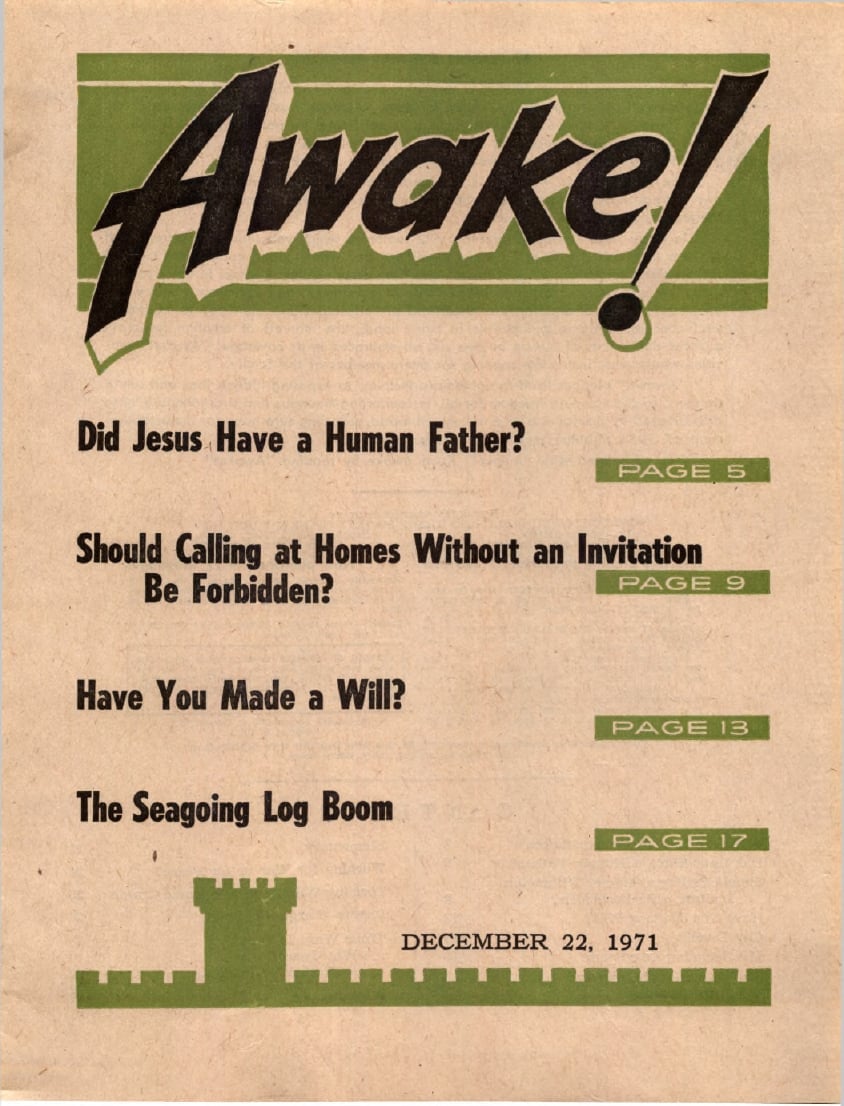
Awake! — December 22, 1971
Source: jw.org
Contents
Make the Best of Circumstances
Did Jesus Have a Human Father?
Should Calling at Homes Without an Invitation Be Forbidden?
Have You Made a Will?
City Dwellers
The Seagoing Log Boom
An International Language in the Making
Elementary
Working for War or for Peace?
Teeming Wildlife in a Volcanic Crater
Insects—Large and Small
Why Jesus Christ Wanted No Publicity
Watching the World
Wars Will Cease, Weapons Will Be Made into Farm Implements
Proclaiming Good News Worldwide
Make the Best of Circumstances
Make the Best of Circumstances
WHO today finds his lot in life to be absolutely ideal? Hardly anyone! No doubt, all of us have to put up with certain hardships or annoyances. However, under present imperfect conditions why not try to make the best of your circumstances? If you do, you will have many blessings to count.
Do you happen to be a housewife with a family, perhaps a large one? Do you at times feel discontented, bored or a little frustrated? There may be stacks of dishes to wash, a large hamper of dirty clothes to be laundered, or a number of rooms that need cleaning. Why not look at things positively? Do not these very things indicate that your family have enough to eat, have sufficient clothing and a roof over their heads? Which is better, your situation or that of the millions who are hungry, half naked and homeless?
Perhaps your circumstances are such that you have to be extremely frugal in all that you buy. Why not view this as a challenge to your ingenuity to make the best of matters? There was a housewife who in later years of prosperity said that her happiest days were during the hard times of the Depression because of the pleasure that came from making the best possible use of everything to make ends meet. Besides, did you know that a great many of the modern degenerative diseases are rather closely associated with prosperous living?
Or are you the victim of compulsory retirement, having become sixty-five years or older? Do the days now seem long and drawn out, affecting not only your mental disposition but also your health? In this situation take a positive outlook and try to be helpful to others. As one textbook for the treatment of the aged and handicapped put it: “There is a legend that an old man will starve to death if he doesn’t have someone to cook for him and an old woman will starve to death if she doesn’t have someone to cook for. This is a truism that is generally accepted.” So there are plenty of people who could benefit from your help.
Now as a senior citizen it may be the time to take up one or more hobbies to give added zest to living. It could be photography or learning to play some musical instrument or learning some foreign language. Or you might find interest in growing plants, such as a bonsai garden or African violets. Then again, your temperament might fit you to make things of wood, leather or metal, or to write poetry or articles. Such hobbies have added not only interest but also income for many an elderly man or woman.
Or perhaps you are a breadwinner for a family but are at present out of work. Surely this is a trying circumstance in which to find yourself. Yet even here you will not improve your situation by surrendering to negative thinking and becoming bitter or morose. Take the wise course: count and appreciate your blessings. If you have a measure of health and strength, you can be thankful for these things. To the extent that you have loved ones, you have reasons to be thankful, for are they not priceless treasures? Do you have unemployment insurance, Social Security, savings or some other form of assistance? If so, be appreciative of such provisions.
Learn to make the best of your circumstances. Obviously there is a limit to the time you can spend looking for work. But is it not true that while you were fully employed there were ever so many things that needed to be done around the home and for which you did not have the time? Now you do have the time; take an interest in doing them.
Because of your unemployment you may now have time to do more reading, the kind that is not only interesting but also educational. You may now be able to acquire skills that might even serve you in getting a better job.
Or are you physically handicapped? Then take a lesson from a certain Californian, a father of seven children. He got an infection that completely paralyzed all four of his limbs, making him a quadriplegic. Though he has been in this condition now for more than thirteen years, he is the most cheerful, optimistic and outgoing person you could want to meet. Unable to use anything but his mind and his voice, he has joined a correspondence club and corresponds with people all over the world by means of tape recordings, his children changing the tapes for him. He also makes recordings for blind friends and acquaintances.” His experience calls to mind the old saying, ‘I complained about having no shoes until I met the man who had no feet.’
The dedicated Christian witnesses of Jehovah in particular have learned to make the best of circumstances. In addition to practicing prudence as regards material things, they use whatever extra time they have in the furtherance of their ministry. They do personal Bible study and research and devote time to preaching the good news of God’s kingdom and in trying to make disciples of lovers of the Bible and of righteousness.—Matt. 24:14; 28:19, 20.
They are not easily discouraged. As an example, consider a dedicated Christian woman living in Puerto Rico, the wife of an unbelieving husband. Like most housewives, she takes care of her home and prepares her husband’s meals. At the same time she averages several hours each day in telling others the good news of God’s kingdom. And she does all these things with a joyful heart although being totally blind; she gets around with the help of a seeing-eye dog.
What especially helps these dedicated Christians to make the best of things is their loving God with all their heart, soul, mind and strength and their loving their neighbors as themselves. They heed God’s Word to seek first God’s kingdom and his righteousness, they appreciate that godliness with contentment is great gain, and they have found by experience that there is more happiness in giving than in receiving. If you want help to make the best of your circumstances, they will be glad to offer you that help.—Mark 12:30, 31; Matt. 6:33; 1 Tim. 6:6; Acts 20:35.
Did Jesus Have a Human Father?
Did Jesus Have a Human Father?
AT THIS season of the year the attention of many people is focused on Jesus Christ of Nazareth. Without a doubt that man affected the human race for good more than any other. His remarkable life has intrigued many authors to write about him. However, many of these writers take issue with what the Bible says about Jesus’ being born of a virgin and having the Creator, Jehovah God, as his Father, and insist that he had a human father.
In fact, today more and more religious leaders, both Protestant and Roman Catholic, are of this opinion. For example, in Theology Today, July 1971, a professor of religion purports to show that the father of Jesus was either a paramour of Mary or was her husband Joseph. A professor at Cambridge, England, writing in The Expository Times, February 1969, insists that “from the strictly historical point of view, there is very little reliable data to which appeal may be made for the virginal conception of Jesus.” He discredits the accounts in the first two chapters of Matthew and Luke and then says “there is no other reference in the New Testament which any historian . . . would think asserted that Jesus was conceived of a Virgin without human father.” And a writer in Continuum, a Roman Catholic periodical (Winter-Spring 1969), states: “The virgin birth is a mythological or pictorial way of getting at [the] theological mystery of the gratuitous nature of salvation. . . . Those who originated the story . . . used the picture images . . . to represent their sense of the Messianic event.”
Let us consider this question in greater detail. What does the Bible really show to be the case? Did Jesus have a human father or was the Creator, Jehovah God, in truth and in fact his Father?
First of all, let us note that such a thing as Jesus’ not having a human as his father would not be beyond the power of God. As has well been noted: “If God made the first man—Adam—without a human mother, then could not the same God bring into being the second Adam—Christ—without a human father?” Surely! But those who object to the virgin birth of Jesus usually also object to the Bible’s account of creation. As one of these critics put it: “I for one am not willing to grant that God made Adam without a mother.”
But those who do accept the Bible as God’s inspired Word have no difficulty in believing that He, who created Adam with sperm cells in the first place and who endowed womankind with the power to conceive and bear children, could also produce a sperm cell apart from any human and could place it in a virgin and so cause her to conceive without the aid of a male human. If we at all believe in God, we must grant him these powers, must we not? It is indeed noteworthy that the angel made this very point in reply to the virgin Mary’s question as to how she was to conceive since she was having no relations with any man. Said the angel, “because with God no declaration will be an impossibility.”—Luke 1:36, 37.
The Testimony of the Gospels
The complaint is made that the only records we have of Jesus’ birth are those of Matthew and Luke, but then those two are the only ones that tell us of Jesus’ infancy and early life. Mark doubtless left out the facts of Jesus’ birth and infancy in the interest of brevity, and the apostle John did so since he was chiefly concerned with supplementary matters not covered by the other Gospel writers.
Matthew tells us that Mary became pregnant by the spirit of God before she had intercourse with Joseph, to whom she was engaged. He also records how Joseph reacted to Mary’s being pregnant and how God’s angel assured him of how it came about. Moreover, the account makes the point that Joseph did not have intercourse with her until she had given birth to Jesus. (Matt. 1:18-25) Luke informs us of the very same facts, but all from Mary’s viewpoint or aspect. Luke and Matthew have about a dozen points in common. (Luke 1:26-35) Clearly, as far as Matthew and Luke are concerned, God, not some human, was Jesus’ Father. Even Mark might be said to testify indirectly to this fact. How so? In that, instead of recording that the people were asking, “Is this not the carpenter’s son?” he reports them as asking, “This is the carpenter the son of Mary . . . is it not?”—Matt. 13:55; Mark 6:3.
Further testifying to Jesus’ having God, not some human, as his Father were the voices heard from heaven at the time of Jesus’ baptism and at the time of his transfiguration, saying: “This is my Son, the beloved, whom I have approved.” What stronger evidence could we want that Jesus had God, not some human, as his Father?—Matt. 3:17; 17:5; Mark 1:10, 11; 9:7; Luke 3:21, 22; 9:35.
The apostle John in his Gospel testifies to the same effect. How so? In that he tells that Jesus had a prehuman existence, was used by God in the creation and was the “only-begotten son” of God. So how could any human have been his father?—John 1:1-3, 14.
The Testimony of Jesus and Paul
As for Jesus himself, it appears that, even as a child of twelve years, he knew that God was his Father. For at the time that Joseph and Mary, after looking for him for three days, found him in the temple, he said to them: “Why did you have to go looking for me? Did you not know that I must be in the house of my Father?” (Luke 2:41-50) That temple was not Joseph’s house but God’s!
More than that, throughout his ministry Jesus time and again testified that he had God as his Father, and therefore no human. He told of his having a prehuman existence (“Before Abraham came into existence, I have been”), and he told of his coming down from heaven, and of his future return to heaven. How could Jesus have had a prehuman existence and have come to earth if Joseph had been the one that had given him life?—John 3:13; 6:41, 62; 8:23, 56-58; 17:5.
The apostle Paul witnesses to these very same truths. Repeatedly he refers to Jesus’ prehuman existence, and he tells how Jesus came to earth and that upon his resurrection he returned to heaven. True, Paul does not testify to the virgin birth of Jesus in so many words, but that God, not some human, was Jesus’ Father is implicit in what Paul wrote.—Rom. 8:3; 1 Cor. 15:47; Gal. 4:4; Phil. 2:7, 8; Col. 1:15-17; Hebrews, chapters 1 and 2.
Why Not a Human Father?
Had Jesus had some imperfect human instead of God as his Father he could not have fulfilled the purposes for which he came to earth. It was imperative that God, not Joseph or some other human, be Jesus’ Father because Jesus had to be sinless in order to be the “Lamb of God that takes away the sin of the world.” (John 1:29) All mankind are sinners due to the transgression of Adam. (Rom. 5:12, 19) This being so, none could give to God a ransom for his brother, even as noted at Psalm 49:7-9. As Job observed: “Who can produce someone clean out of someone unclean?” It has been true of all, aside from Jesus, that ‘in sin their mothers conceived them and with error they were brought forth with birth pains,’ even as King David confessed when pleading for mercy.—Job 14:4; Ps. 51:5.
Due to Jesus’ having God, not some human, as his Father, he was “guileless, undefiled, separated from the sinners.” Well could he challenge his opposers to convict him of any sin. (Heb. 7:26; John 8:46) Being perfect he could “give his soul a ransom in exchange for many.” And having given his life as a ransom, he became the “mediator between God and men,” able to offer a “propitiatory sacrifice for our sins” as well as “for the whole world’s.”—Matt. 20:28; 1 Tim. 2:5, 6; 1 John 2:2.
Further, God purposed that his Son Jesus furnish the supreme example of a perfect human creature keeping integrity in spite of all that the Devil could do, and the Devil did try his worst to cause Jesus to break his integrity, both by temptations and by persecutions. (Matt. 4:1-10; John 19:1-18) That it had been the Devil’s purpose to turn all men away from God is seen from his turning aside Adam and Eve and from his boasts and efforts to turn Job away from God.—Gen. 3:1-19; Job, chapters 1 and 2.
Supposed Objections Considered
Despite all the foregoing testimony, there are many who raise objections. For example, they note that time and again Jesus is referred to as the son of Joseph. True, but since Joseph, by taking Mary as his wife when she was pregnant, in effect adopted Jesus as his son, Jesus could be spoken of as his son. Generally, adopted sons are spoken of as the sons of the fathers who adopted them, are they not? More than that, we find that usually it was those most likely not familiar with the facts that referred to Jesus as Joseph’s son. The fact that Jesus’ enemies sneered that they were not born of fornication would not necessarily mean that they had information about Jesus as not being Joseph’s son. Why not? Because in the very same connection they slurred Jesus as being a Samaritan and having a demon, which they obviously knew was not the truth.—John 8:41, 48.
Then again, many attack the virgin birth of Jesus on the basis that the first two chapters of Matthew and of Luke were added at a later time, and by some other hand. But there is absolutely no basis for this claim. For one thing, the writing style of the chapters in question is exactly the same as that of subsequent chapters. Note, for example, Matthew’s many references to the Hebrew Scriptures, a characteristic of his, and Luke’s medical language in these two chapters, a characteristic of his. Nor is there any manuscript evidence to support such claims. For example, there is evidence that Mark 16:9-20 and John 7:53–8:11 were added by a later hand; but there just is no manuscript testimony for impugning the authenticity of the first two chapters of Matthew and Luke. Neither the oldest Greek-manuscripts nor the versions or translations hint of such a thing. This is further supported by the fact that the early postapostolic writers, such as Irenaeus, Tertullian, Ignatius, Aristides, Justin Martyr, Origen and others, all accepted the Gospel accounts of Jesus’ birth from a virgin. As one authority puts it: “The witness of the Fathers to the virginal conception is unanimous and unquestioned.”a
The fact that the most noted vellum manuscripts of the Christian Greek Scriptures go back only to the early fourth century has been used as an argument by some that the chapters in question might not have appeared in the original writings. But, in view of the other even older manuscripts extant, Sir Frederic Kenyon, in his book The Bible and Archaeology, said: “The interval then between the dates of original composition and the earliest extant evidence becomes so small as to be in fact negligible. . . . Both the authenticity and the general integrity of the books of the New Testament may be regarded as finally established.”
Another objection raised is that the two accounts of Matthew and Luke do not agree. True, they are not identical, but there is no conflict between them. In fact, in quite a number of the most important points they verify each other—such as that Jesus was born at a time when Herod (the Great) ruled Palestine; that Jesus was conceived by God’s holy spirit and was born of a virgin; that Mary was betrothed to Joseph who was of the line of David; that by divine direction the son was to be called Jesus; that he was to be a savior and deliverer, and so forth.
That a virgin birth is contrary to science is another objection raised. But, as one scientist observed, today one no longer can say something is impossible. All that can be said is that something is improbable on the basis of present knowledge. And the fact remains that in creation there are ever so many examples of parthenogenesis, that is, of females giving birth without benefit of the male sperm.
Others have objected on the ground that pagan myths tell of virgin births. But they do not. They tell of demons or animals cohabiting with “virgins” so that these were no longer virgins; a far cry from what the Bible records regarding Jesus’ birth. The fact is that instead of virgins being limited to women who never had intercourse, in ancient times prostitutes as well as unmarried women who gave birth to children were also included in the term. Nor can Matthew and Luke be accused of incorporating myths or legends in their Gospels. It is almost meaningless to talk about legends when dealing with eyewitnesses.
The writers Matthew and Luke were not simpletons. One was a tax collector and the other a physician. Their writings are stamped with the same honesty, sincerity and candor that mark all the other books of the Bible. And since the testimony of the rest of the Scriptures is in keeping with their Gospels, and since we see reasons why Jesus simply had to have the Creator rather than some human as his Father, lovers of truth answer “No,” to the question, “Did Jesus have a human father?”
[Footnotes]
The New Catholic Encyclopedia, 1966, Vol. 14, p. 693.
Should Calling at Homes Without an Invitation Be Forbidden?
Should Calling at Homes Without an Invitation Be Forbidden?
By “Awake!” correspondent in Denmark
HOW do you feel about people who call at your home uninvited? Do you feel that this is a freedom you would rather see preserved although it may cause you some inconvenience at times?
Or do you feel that you would like to see laws passed forbidding anyone from calling without a prior invitation? True, the passing of such laws would get rid of unwanted callers. But enforcing all the consequences of such a ban makes it plain that it would not be desirable.
For instance, a neighbor may call, uninvited, to borrow sugar or coffee; but then, you might be the one who wants to borrow these items. A driver who has had a flat tire or an accident may want to use your phone; or you could be the one who needs the help. Perhaps someone in the neighborhood wants assistance because of an illness, or because an expectant mother’s baby is arriving sooner than anticipated; or it may be your illness, your baby coming earlier than expected and you have to make the uninvited call.
What, too, of unexpected guests, such as relatives or old friends you had not invited, but who were traveling through and dropped in for a few moments? Have you never done that? Then there are salesmen who offer goods that you may want, saving you a trip to the store. Others offer services in this way, or take up collections, perhaps of used clothing, newspapers or money for charities. You might even get an uninvited caller telling you your house is on fire!
So you can see that when one person calls on another, although uninvited, there are advantages as well as disadvantages. And while you may think primarily of the disadvantages when others call at your door, put yourself in their position and remember that you may have a similar need sometime. That does put the matter in a different light, does it not?
An Ancient Method
Calling without an invitation is an age-old custom. It has been permitted by nearly every civilized community throughout history. For thousands of years people have been calling to ask for help, to sell something, or to deliver a message—political, religious or otherwise.
Jesus Christ used this method too, more than 1,900 years ago. He called on people without a prior invitation, encouraging them to listen to the grandest message suffering humans had ever heard. It is also the method he taught his followers to use. He instructed them to make a systematic coverage of towns and villages by going from house to house, visiting all the inhabitants of an area, and that without previous invitations.—Matt. 10:11-14.
In that way, from door to door, the knowledge of Christianity was spread throughout most of the Mediterranean area in the course of about one generation. Those who hospitably received those messengers of freedom and life were richly rewarded for their hospitality.
So when Jehovah’s Christian witnesses call at your home, they are using the method that Jesus directed his followers to use.
Denmark’s ‘Door-to-Door Movement’
Contacting persons in their homes has come to the fore in another way recently. In Denmark, early 1971 saw the beginning of a campaign known as the ‘door-to-door movement.’
The newspaper Politiken devoted considerable space to this movement, using headlines such as “HOW WE WILL RING OUR NEIGHBOR’S DOORBELL,” and “50,000 UNITED IN DOOR-TO-DOOR ACTIONS.” This campaign is designed to meet a definite need that many people have, particularly in large cities, a need generally not cared for by the community. What is that?
It has to do with the many lonely persons in large cities. In congested city areas many people tend to become isolated because of old age, illness, timidity or for other reasons. They become strangers even to their close neighbors. This happens far more often in cities than in country areas or small towns. Thus, such persons do not really get much out of life. They have little opportunity to communicate and enjoy the company of other people.
Politiken told of an incident to illustrate how out of touch persons can become. It wrote about an “80-year-old man who could not get himself to ring his neighbor’s doorbell though he had locked himself out of his house and the temperature outside was about ten degrees. He wandered around for an hour and a half before a policeman came to his assistance and called a locksmith.” Is that not sad?
What the door-to-door activists are urging is for people to call on their neighbors to a greater degree and to communicate with them. As one member of the movement stated: “I know that those who live alone on each floor would be especially happy for communication.” Surely that is true of many lonely persons, especially the elderly and ill.
“Closed doors make people sick,” claimed another article in Politiken during 1971. County physician Vagn Christensen stated: “They result in chronically tired children who are so uninterested in their surroundings that their development is retarded. . . . With adults, closed doors can be the cause of great sickliness. The minute you take away function, meaning and contact from people, they become invalids.”
Thus, in the course of a few months some 50,000 persons in Denmark became members of the door-to-door movement to assist lonely persons. Some claimed that the membership was nearer to 75,000. A ban against uninvited calling at homes would work directly against the purpose of this door-to-door campaign. It would work against healthier communities.
Some Want Ban
In the Brønshønj-Husum News of October 23, 1969, instructions were given about how police regulations for Copenhagen could be used by residents to hinder callers. It noted that one could post a sign on the door saying: “Uninvited calls FORBIDDEN!”
However, some would go much farther and have the government issue a specific law forbidding home calls. They claim that such calls violate their peace and privacy. But in this regard, paragraph 263 of Denmark’s penal code states: “One is punished by fine or imprisonment if one violates another’s peace 1) by opening a letter or otherwise obtaining a closed message to another or hindering its delivery, 2) by gaining access to another’s personal effects without reasonable grounds, 3) by publicizing another’s private, domestic life, 4) by publicizing other parts of another’s private life,” and similar thoughts.
The purpose of that law is, among other things, to protect people from being spied on or having things pertaining to their private lives publicized. It really has nothing to do with uninvited home calls.
Still another aspect of that penal code, paragraph 264, states this in regard to one’s domestic peace: “One who violates domestic peace by forcing his way into another’s house, room or ship or other place not publicly accessible, will be punished by fine or imprisonment. The same punishment will apply to one who refuses to leave another’s premises on request.”
But this does not make it a violation for someone to call at another’s home and ring his doorbell without prior invitation. It is only when one refuses to leave, that one violates the law.
Committee’s Opinion
What brings this matter to the fore now is the recommendation of a committee appointed by the Danish Ministry of Justice in 1968. In their opinion published in 1970, the committee members suggested that it be forbidden by law for persons to make what they called “uninvited personal calls at private homes.”
The opinion was directed primarily at forbidding calls of a commercial nature, to protect buyers from dishonest salesmen. But if the law is formulated in such a way that it makes impossible, for example, the idea of the door-to-door movement to aid the lonely, then the law will be far broader than its stated purpose.
In addition, the proposed law expresses a tendency that should be a cause of concern to intelligent persons. It is really saying that the government should decide who should or should not be allowed to call at your home. But is it true that so many people are incapable of making this decision? Are they not able, as adults, simply to tell unwanted callers, “No”? And does not such a law cast suspicion on everyone who calls at a home uninvited?
The Norwegian consumer council favors “door-to-door sales” because houses are so scattered in most parts of that country. Would not the same thing apply in certain areas of Denmark too? And what about magazine or book sales? Many people find it much easier to subscribe for a magazine, or purchase books, such as a set of encyclopedias, at home rather than being inconvenienced by having to go to a store or to write letters to publishers.
Vital Freedoms Endangered
If the making of personal calls at people’s doors without prior invitation should be forbidden by law, it could be applied against many things that would endanger freedom. For example, it would be applied against the preaching method used by Jesus Christ and the first-century Christians.
Thus, such a law could be applied against Jehovah’s witnesses today. But not only them. It could be applied to all religious and charitable works using that method. It would strike at those clergymen of the National Lutheran Church of Denmark who make home visits. Yes, such a law would hit hard at religious freedom. It would imitate some of the worst features of Communism, Nazism and Fascism.
The contemplated law would also strike hard at the freedom of expression. For instance, the Danish constitution states: “Everyone is entitled to publicize his thoughts by the printed or written page and by word of mouth, though held responsible legally. Censorship and other preventative restrictions may not be initiated in any way.”
But merely having the right to be heard is hollow if the means of doing so is taken away And one means is by calling uninvited on the homes of people. Thus, freedom of expression involves the right of all people who cannot be heard over the radio, television or by, means of newspapers and who have to make themselves heard in another way, from door to door. Freedom of expression should not be denied to those who do not have the large amounts of money needed to use those other methods of communication.
With the right to express oneself freely comes the right to distribute printed matter. If a person wants to reach a great number of people he cannot limit the distribution to book shops alone. Besides, a book-shop owner may be prejudiced and keep certain publications out of sight. And not all people go into book shops.
Also, since the publishing of such printed matter costs money, the right to freedom of expression has to include the right of the publisher to have his expenses covered. If this is not allowed, then freedom of the press would be limited to the wealthy. That is why in Sweden the thought has been expressed that a ban against personal calls “would presumably be in conflict with the ordinance of freedom of the press, which is constitutional in character.”
Against all this some people argue that if a person wants to know about certain things he can take the initiative and approach the publishers. But this argument is not reasonable. How can people be aware of certain matters if these are not brought to their attention? How would they know where to go to be enlightened on the matter if it has not yet been brought to their attention?
In addition, such a proposed law would restrict political freedom. Anyone who has had to do with political matters, such as getting signers to a petition, knows that a personal approach is necessary. It is there that an explanation can be given, and a certain amount of persuasion used.
What Can the Individual Do?
Freedom has its price. That may include some inconvenience. It may also include the risk of being defrauded by a dishonest salesman. Laws forbidding such fraud are necessary, but they cannot forbid all business transactions just because they are concluded at the door.
Would you forbid all business transactions in stores and markets just because some store owners are dishonest? Why ban one form of selling and not the other? It is obvious that a law against one and not the other is highly discriminatory and strikes at the very foundation of freedom.
True, freedom to visit without previous invitation means that some visits can occur at inconvenient times and disturb what one was doing. But is that price not worth it to preserve basic freedoms? Is it such a tremendously difficult thing to open the door and say to the one who called: “It is not convenient,” or, “I am not interested in speaking with you”? Is that too high a price to pay for the valuable freedom of deciding for ourselves whom we will or will not receive at our doors?
Think about this the next time someone approaches your door without an invitation. Ask yourself if it is not better to put up with a little inconvenience in good humor rather than living in a dictatorial country. You should rejoice if you live in a country that gives you the right to decide whose visit you will accept, as well as giving you the right to make such a visit yourself.
Have You Made a Will?
Have You Made a Will?
WOULD you want your property arbitrarily taken from you and distributed to others in a manner contrary to your wishes? Well, in effect, that can happen—if you do not have a will!
A will is a legal statement telling how you wish to have your property dealt with after your death. It is the final expression of your mind, your will, about your belongings.
Technically, the term “will” in the expression “last will and testament” has to do with real property (such as land), while “testament” is concerned with personal property. Broadly speaking, however, today “will” is used to cover both terms. Have you made a will?
If you die without one, the government has no choice but to step in and dispose of your property according to law. And this may be entirely contrary to the way you would have wanted it distributed. Thus your will is very important.
Nevertheless, most people put off making a will. It reminds them of death. And death, to them, is a matter they would rather not think about. However, a Christian should give special consideration to those he will leave behind when he dies.
It is true that Christians anticipate soon living in God’s new order where “death will be no more.” But between now and that time life is uncertain and death faces all. One cannot ignore this. (Eccl. 3:19; Rev. 21:4) A Christian family head, in particular, knows that he has a responsibility to provide for those near him, especially his own household.
While alive, he works hard to make provision spiritually and materially for his family. (1 Tim. 5:8) Should he die, would he not want to be sure that they would still be taken care of? A will aids toward that end. Some persons therefore refer to will-making as a legal privilege.
Your Will—a Legal Privilege
Yes, making wills is a privilege. Not all nations have made allowance for them. Sir William Blackstone, the noted eighteenth-century English jurist, observed that “the right of making wills, and disposing of property after death, is merely a creature of the civil state . . . which has permitted it in some countries and denied it in others.”
In some feudal societies custom compelled a man to will the best of his personal properties to “his [feudal] lord and the church.” In England the Catholic Church controlled matters regarding wills for centuries.
Today, however, while insisting that a surviving mate be provided for, most nations allow you to will your goods as you see fit. But the same legal procedures for doing so are not followed in each place, as laws vary from nation to nation and, in the United States, from state to state. But regardless of where you live, you must take action to see that your property is distributed as you desire. Only you can make your will.
Who May Make a Will?
This is not to say that everybody can make a will; there are limitations. For example, in the United States, most, though not all, states require that you be twenty-one years of age at the time you make it. In other words, if you produce a will when you are twenty years old, that particular will does not become effective when you turn twenty-one. It is forever invalid because you were not twenty-one at the time of making it.
Similarly, a person must be mentally competent when composing his will. One may suffer from mental or emotional illness of some kind. But, at the time he is producing the will, does he know exactly what he is doing? Does he remember in a general way what is his property? And does he remember people he has known all through life? If so, he can make a valid will.
Additionally, at the time of making his will a person should not be under the influence of alcohol. Nor should he be unduly influenced by another person or group. Commenting on this latter aspect of will-making, the 1971 Encyclopædia Britannica observes:
“Coaxing and persuasion are generally not held to constitute undue influence unless there were actual threats. A testator [the one making the will] may be led, but he may not be pushed. Undue influence may be held to exist, however, where a testamentary disposition was brought about by a person upon whom the testator was dependent or whom he was likely to obey blindly.”—Vol. 23, page 526.
These are fundamental qualifications. If they are met, how should the will be worded?
What Can Be a Will?
Intent, not precise wording, is the important thing. It need not necessarily be couched in legal terminology. But clearly and with no ambiguity, a statement must show that it is in reality a will.
Certain wills are not written. Under peculiar circumstances some governments have allowed oral statements to serve as wills. However, these are generally frowned upon and best avoided, as there is too much danger of misunderstanding. Something written by or under the immediate direction of the testator is more conclusive.
Letters, when the intent of the author was clear, have served as wills on occasion. Laws in some places have required that these be witnessed, although in other cases this requirement has been waived.
In some places a holographic will, that is, one written by the hand of the testator himself, is not only acceptable, but customary. In France, for example, the only requirements for this type of will are that the testator should write it out in its entirety himself, date and sign it. Laws vary regarding the holographic will in each state of the United States. Some states do not allow them at all. Other states may allow parts of it to be typewritten or require that it be signed, while others may stipulate just the opposite.
The complications that can be caused by such legal variations are best entirely avoided. How? By consulting a lawyer.
Why See a Lawyer?
True, an attorney is not legally necessary to make a valid will. Nevertheless, usually only a lawyer will be up-to-date on all the latest laws affecting the subject. For example, an attorney will know current answers to such questions as, How many witnesses are required for a will in your area? May a witness also be a beneficiary? May you sign your will on Sunday?
In Law for Laymen, Harold D. Greeley gives another example to illustrate the wisdom of checking with an attorney:
“In the New York courts there have been many cases of worthless wills executed on printed forms sold by stationers, because some dispositive [regulative] provision followed the signature of the maker, whereas the New York law requires that the will be signed at the end.”—Page 305.
Because of not complying with simple laws like this your will regarding your property may be legally challenged. Expert advice is needed.
Understandably, the United States Department of Health, Education and Welfare says in its booklet Planning for the Later Years: “The importance of getting competent legal advice on any real legal question or problem cannot be overemphasized.”
Saving on Legal Fees
It is true that an attorney is an added expense. However, all things considered, consulting a lawyer could prove to be more economical than not doing so. He can show you, for instance, how to avoid expenses and taxes connected with distributing property to your heirs. This would benefit them.
But there are also a number of ways you personally can save money when dealing with an attorney. First of all, a lawyer should not object if you ask him in advance how much his services will be. Some cities have a lawyer referral service which grants short interviews for a small fixed fee. If, after taking advantage of this service, you should need more time, you can inquire about further consultation and costs.
In some areas there are even legal aid bureaus that provide free lawyers for poorer people. However, what you do before you visit any attorney is also a key to avoiding expense.
Before You Visit an Attorney
Before you visit an attorney organize a check list to assist him in drawing up your will. This saves him time. His time is costly, so really such advance planning saves you money. Take your time. Make your list thorough. Provide information of both a personal and a legal nature.
Personal details might be simplified by making a family tree showing full names, ages and addresses of members of your immediate family. With it you would want to include full information about a previous mate if you have ever been divorced or separated.
List all of your real property (such as land, buildings). Give addresses if these are in the city; if in the country, provide exact survey information. Then no one can later challenge your will because it says ‘south side of such and such a hill,’ when, in reality it proves to be the ‘southeast side.’
Clearly spell out what you have in the way of personal property. What about trusts? Life insurance policies? Bank accounts? Stocks? Bonds? Jewelry? Give a summary of all your assets and liabilities.
With this done, decide what you want to do with your property. Who will be your beneficiaries? What will each acquire? Who will serve as alternate beneficiaries should one of the originals die?
Do you wish to include a charity in your bequests? If so, the advice of René A. Wormser is sound:
“In selecting the agencies which are to administer your ‘charities,’ make certain beforehand that they are legally privileged to accept the gift. The institution you have in mind may not be entitled to take charitable bequests through wills, and may be restricted to those for which it was created . . .
“Inquire. Make certain that it can take bequests, that it can take your bequest. . . . It can refuse.”—Your Will and What Not to Do About It, page 104.
Other matters concerned with the distribution of your property also take forethought. Who will be the executor of the will? This is a party—often a mate or offspring—appointed to see that the provisions of the will are carried out. Check in advance with this party (and perhaps an alternate) to ascertain their willingness to accept the responsibility.
Finally, do not forget more personal matters. Do you desire to mention special funeral arrangements? Would you like to name a guardian for an infant or its property?
Being prepared with information of this kind before you see a lawyer will result in a saving of time and money. It best assures your desires being incorporated into the will and then expedited. But, once a will is made, what should be done with it?
After Completing Your Will
It should be stored in a safe place, preferably with other valuable papers. Many authorities advise against keeping it in a bank’s safe-deposit box because of the red tape involved to get the box opened after a person’s death. A delay in getting to your will may mean that immediate provisions, such as those regarding your funeral, are not available.
Therefore, you may choose to leave it with your lawyer or a trusted friend. In some areas, it can be placed on file at the office of the register of wills for a small fee.
Because of the changes in tax laws and your own circumstances it is wise periodically to review your will and make a new one when necessary. A new will should be so worded that it clearly shows that it replaces all former ones; old wills (and copies) may best be destroyed. You can check this out with your attorney, as in some states it may be advisable to keep them.
Without a doubt your will is an important document. Your family members and other heirs benefit by it. But so do you! Your mind is set at ease to know that in an uncertain world you have taken what steps you can to insure some continued provision for those you love.
City Dwellers
City Dwellers
● Some 375 million persons, or approximately 10 percent of the earth’s population, live in cities that have at least a million inhabitants. There are thought to be about 200 such cities around the globe today.
The Seagoing Log Boom
The Seagoing Log Boom
By “Awake!” correspondent in Canada
TIMBER-R-R-R!” rings out through the woods. Seconds later, another mighty giant of the forest hits the ground with a rending crash. But, turn your eyes to the mountain slope where the giant fell. How will this tree ever reach the screaming saws of the lumber mill or the grinders of a paper mill?
Some logging operations are located where it is possible for huge trucks to transport logs directly from forest to processing plant. However, many parts of the rugged coast of British Columbia and the Pacific Northwest of the United States are not suited to that type of operation. Hence, the fascinating spectacle of log booming.
It is along the rugged Coast Range of British Columbia’s mountains that the magnificent Douglas fir, Sitka spruce, cedar, hemlock, balsam and pine grow. One mountain after another stretches away into the distance, all clothed with forests so thick that, without a well-marked trail, a person could quickly lose himself in them.
The rocky shoreline in some places is exposed to the full sweep of the sea. At other places there are sheltered coves and long narrow fjords where tidewater mingles with rushing waters of small rivers and creeks. Logs are brought to these fjords and inlets. Here they meet up with a most practical method for transporting vast amounts of timber—the seagoing log boom!
Visiting a Logging Area
Recently some friends and I visited an area where logs are prepared for their sea voyage. We turned off the highway into a narrow trail just wide enough for one car as it heads down to the shore of the inlet. At a cabin in the woods, we stopped and met an elderly man. We learned he had been a logger for more than forty years. Now his legs can no longer stand up to the rigors of log booming.
“You know,” he told us, “a man is wet to the knees most of the time while booming logs, and the arms get wet as well. Today it is not as hard as it was when we used nothing but muscle power to push logs into line with a pike pole. Logs were bigger then, too. Just take a look at that stump over there! I cut that tree over fifty years ago, soon after coming from the East. For its first sixty feet it was straight as a line, with hardly a limb, and even above that we cut good logs from it; I felt like apologizing for cutting it down!”
Examination of the eight-foot-diameter stump revealed that it must have been a magnificent tree. Now, out of it another tree was growing, clutching the old stump with all the tenacity of an octopus.
We continued our journey down the old logging road and suddenly emerged from the subdued light of the forest. Before us was a sheltered inlet. Onshore, decks of logs were being arranged by a large four-wheeled vehicle that picks up logs similar to the way elephants do in the hardwood forests of the East. It slides two tusks of steel under the log, clamps a trunklike arm on top, and away it roars to the proper pile of logs faster than a man would care to run.
A nearby worker recognized us and called: “May I get a ride home with you?” We agreed. As the shift ended, our friend cleaned himself off a bit and removed his spiked boots. Fred has worked eighteen years on log booms. While looking out over the ‘booming grounds,’ as such an area is called, someone exclaimed: “Look! That farthest string of logs is moving!”
How It Is Done
“Yes, it is moving,” Fred agreed. “We finished that boom half an hour ago, so the tug is pulling it out to sea.”
“I don’t see any tug,” remarked our city friend.
“Look farther ahead,” Fred told him, “and you will.”
We verified this with our field glasses, observing two men moving around on the deck as the tug settled down for a long, heavy pull.
“Those rows of piling out there help to keep the booms in line as we form them. They also prevent the tide flow from moving the logs out of place and save us from doing our job all over again.
“Where the water is too deep or the bottom too rocky to drive in piling we build a different arrangement. Two rows of logs are chained side by side, all about the same size. The end joints on each side are placed halfway along the opposite log. The far end is anchored out over deep water, while the other end is secured to the shore. This gives us a walkway from which we can either build or disperse a log boom. It makes for safety, which is vital for working over deep water.
“The flat log boom has only one layer of logs. These are not fastened together, but they are kept in a long rectangle by special logs across the front, rear and down the sides. The rear log is always of large diameter to prevent logs from escaping underneath it.”
While discussing how logs are moved into place in the boom, Fred said: “In the old days men used long pike poles having a combined hook and spike at their business end, so logs could either be pushed or pulled as the job required. But it was easy to fall into the water doing that work, especially if a log suddenly began to roll over.”
Fred went on to tell about a sport that grew out of such experiences: “Some men became very adept at spinning a log and stopping it with their spiked boots. This logrolling became and still is quite popular in logging camps. The objective was to spin a log out from under an opponent as they balanced themselves face to face on the same log. Often it took a lot of legwork before one was proclaimed victor and the other received a dunking. I tried it when I was younger, but soon decided it was enough to fall in while on the job, without looking for trouble.
“Nowadays logs are moved into place by a little steel boat. It is well named ‘sidewinder’ or ‘log bronc.’ It works on a 360° swivel drive, enabling it to apply its power quickly in any direction. It pushes logs sideways or forward, or suddenly swings completely around to push another.”
Logs of Various Sizes and Crops
It was time to leave, so we all got into the car and as we did the driver asked: “How large were the logs we saw today, Fred?” It is plain that he took real interest in his work, as he answered:
“Several were five feet across, while others measured three or better, and a few, two. Trees are being cut smaller than years ago. In some areas, two-foot logs or even less are acceptable because it is necessary to cut second- and third-growth timber. The main idea is for logs to be straight, without too many knots. Otherwise, they usually end up at pulp and paper mills. Short cedar logs go to shingle mills, while longer ones are used to make good siding for homes. Fir, pine and hem lock are used mostly for making lumber.”
Following the road back to the highway, we noted that the story of harvesting the forest is plain to read: The first crop was the largest and finest; the second took the best of the next growth. Evidently, these were smaller trees, of lower standard and shorter lengths, but able to be used because of the versatility of the modern forest-products industry. There is a respite now before man takes from the forest a third crop.
Logging companies continue to push farther back into the mountains in search of prime first-growth trees. However, government regulations now require them to clean up the forest after a cutting operation and plant new trees for the benefit of a future generation.
Where Does the Boom Go?
On the highway we were able to get glimpses of the open sea. At one vantage point we paused to view a log boom again as it inched its way toward its destination.
Fred remarked: “I have worked at the grounds for which that boom is destined. It is a bit like a sales yard in principle. Each boom, being valuable property in transit, has to be marked by ownership identification and the approximate amount of timber it contains. A boom like that one comprises around 180,000 board feet. On arrival it is graded and the logs are sorted according to the way they will be used, whether lumber, plywood or pulp and paper. Buyers are on hand to make their purchases.
“Only certain kinds of wood are used for pulp and paper manufacturing. Hence, logs designated for such purposes are first sent to privately owned chipper mills. After reduction into chips they are loaded into great boxlike barges for transport to the pulp- and paper-fabricating plants, which are now planning to install their own chipping machinery. Other logs marked for their new owners are later boomed for towing to the locations of their industries.”
We asked one last question: “Are logs ever lost from the booms?”
“Yes,” Fred answered, “some are. However, with up-to-the-minute weather reports available these days, losses from rough seas are kept to a minimum. Yet if logs do escape, markings on them identify the owner, who oftentimes reclaims them. In other cases, individuals. using small powerboats and adhering to certain regulations, comb the coastline for stray logs and then sell them to the appropriate mill.”
In the car we heartily thanked Fred for his kindness and patience in answering our questions. After leaving him at his home we reflected on the numerous things we had learned on this outing. It made us think of how grateful man should be to the Great Creator of the mountains clothed with forests.
An International Language in the Making
An International Language in the Making
IT HAS been calculated that some 326 million people speak English, making it one of the most widely used languages in the earth today. Yet when Julius Caesar first set foot on the islands of Britain in 55 B.C.E. nobody spoke English there at all. There were no English people; the British Isles were inhabited by the Celts or Ancient Britons.
In 43 C.E. the Roman legions subdued the Celts, and they were driven out into Wales, Scotland and Ireland. A little of their vocabulary has survived into modern English, mostly incorporated into names of places such as London and the county of Kent, which owes its name to the Celtic word canti.
The Romans occupied the islands for about 400 years, but when the Empire finally declined, the Roman legions were recalled to defend the last bastions of the Empire against invaders. With the Roman legions gone, Germanic tribes called Angles, Saxons and Jutes conquered Britain, taking up residence there. These Angles and Saxons spoke almost identical languages, a form of German, one of the members of the Teutonic branch of the Indo-European family of languages.
English as First Spoken
Since the Angles had conquered the most land, the country (England) and the language (English) were named for the Angles. This Anglo-Saxon language was called Anglisc or Englisc by the writers of the time. Although it was to become the basis of modern-day English, it is totally incomprehensible to people today without special study. Here, for example, are the first lines of a famous poem called “Beowulf,” written about the year 900 C.E.:
“Hwaet, we gardena in geardagum theodcyninga thrym gefrunon.” (Lo, we have heard tell how mighty the kings of the spear-bearing Danes were in days past.)
Now that is classed as Old English by the philologists, although not one in a thousand English-speaking people can understand it. This is because nearly 85 percent of the words of the Old English vocabulary are no longer in use. Those that have survived, however, were basic elements, expressing fundamental concepts such as mann (man), wif (wife), hus (house) and mete (meat or food).
The grammar of Old English was also very different from modern English. It was an inflectional language, that is to say, one indicated the function of a word in a sentence by means of endings added to the noun or adjective, and so on. Today nearly all of these inflectional endings have been lost, and we use a fixed order of words to indicate their various functions and relations.
During the 800’s the Vikings from Denmark made raids on the shores of Britain. Because the Viking raiders seemed to delight in battle and in destroying their victim’s property, giving the appearance of madness, the Viking name for a warrior, berserker, came into the English language in the word berserk. The activities of the Danes ended in conquest of Britain. As they settled down in England, they too introduced many words to the English vocabulary, such as egg and most words that begin with sk-, such as sky, skin, skirt and skill.
More significantly, pronouns, which generally remain permanent in a language, were affected. The result was that some Scandinavian pronouns replaced English ones. For example, the pronouns they, their and them are of Scandinavian origin.
Then something happened that was to have a profound effect upon the English language. In 1066 C.E. William the Conqueror, a Frenchman from Normandy, invaded England. As illustrated on the famous Bayeux tapestry, he defeated the Saxon king Harold at the Battle of Hastings. He then distributed the English lands to the French noblemen who had come with him. At first these French lords spoke their own Norman-French, while the people whom they had enslaved spoke Anglo-Saxon or English. However, as the Normans settled down and intermarried with the local people, the two languages fused. This mixture of Old English and Norman-French produced a new form of English, now called Middle English.
A Time of Great Changes
Middle English was marked by momentous changes in the language, changes more fundamental and extensive than any others before or since. For a start the pronunciation slowly altered under the influence of the Normans, and the inflectional endings gradually disappeared. But the outstanding change was in vocabulary.
Thousands and thousands of new words were added as the Normans began to speak Old English, well sprinkled with their own French vocabulary. Among the many English words resulting from the Norman Conquest are air, chair, dinner, government, judge, paper, prison and towel.
Sometimes both the English and the French words were retained. For example, the Saxon peasant lived in an English hus, whereas the French lord lived in a French maison. Both words remained, house being the modern word for a simple dwelling and mansion, the home of the nobleman or man of wealth.
Sometimes both words were kept but took on slightly different meanings. The English raised sheep, cows, calves and pigs. The French equivalents were mouton, boeuf, veau and porc. It is easy to see that the French words were kept to designate the meat of the animal. Thus one raises calves but eats veal, one raises pigs and eats pork.
Of course, many English words were lost entirely. For example, English inwit became French conscience. However, despite this time of great change the Englishman continued to eat and sleep, walk and sing in his original English.
By the time of Geoffrey Chaucer (1340?-1400), sometimes called the father of English literature, this mongrel tongue had become quite a fluent and flexible language. Furthermore, it began to have the look of modern English, the Modern English period beginning about 1450 and lasting into modern times. Chaucer wrote much that is fairly understandable today. And when he says, for example, that a man was “a verray parfit gentil knyght” it needs no honors degree in English for one to see that he was saying that he was “a very perfect gentle knight.” Of course, the spelling looks verray odd to us!
Anybody who reads Chaucer, however, will notice that his grammar and vocabulary are still very simple. In fact, most people of the time felt that English was crude and unwieldy and incapable of expressing the finer sentiments. They felt that if a person had anything important to say he should write in Latin or Greek, which the educated people of the day understood. They called English “the vulgar tunge,” and one English writer lamented: “Poets that lasting marble seek, must carve in Latin or in Greek; we write in sand.”
…