Awake!, December 8, 1971
Download: PDF — Awake!, December 8, 1971
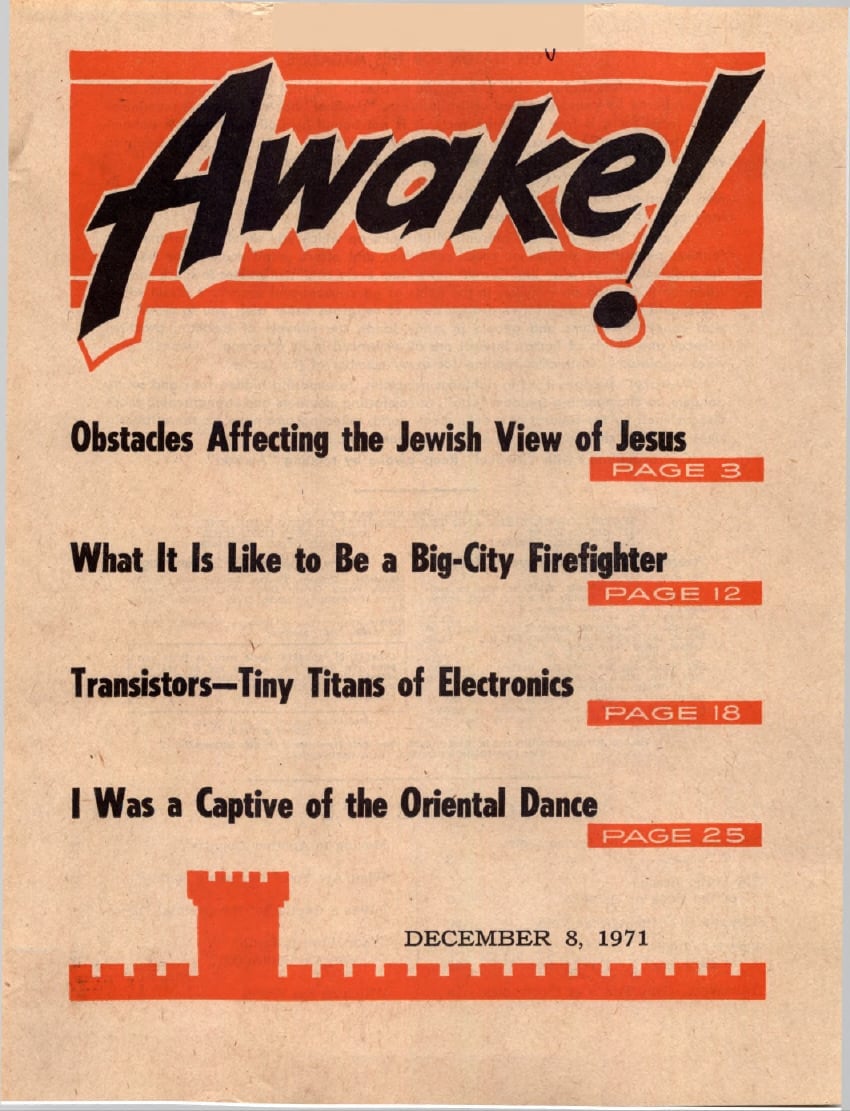
Awake! — December 8, 1971
Source: jw.org
Contents
Obstacles Affecting the Jewish View of Jesus
Who Is the Messiah of the Book of Daniel?
Skyscrapers of the African Veld
What It Is Like to Be a Big-City Firefighter
Transistors—Tiny Titans of Electronics
Moving to Another Country?
What Are Your Borrowing Habits?
I Was a Captive of the Oriental Dance
Why Do Babies Die?
Watching the World
Have You Read the Oldest Written History of Man?
Where Can You Get Help to Solve Problems That Arise in Your Life?
Obstacles Affecting the Jewish View of Jesus
Obstacles Affecting the Jewish View of Jesus
MANY Jews living today accept as fact that a man by the name of Jesus lived in the first century C.E. Even the Jewish Encyclopedia of 1904 identifies Jesus as the “Founder of Christianity” and places the time of his birth at about 2 B.C.E. Nevertheless, comparatively few Jews believe that Jesus is the promised Messiah or Christ. To some the very thought of becoming a member of a church of Christendom is repulsive. Could it be that the churches bear some or much of the blame for this?
Attitude of Christendom’s Churches
It should be remembered that the Jews have for centuries been subjected to suffering at the hands of persons professing to be followers of Jesus. Writing in We Jews and You Christians, Samuel Sandmel observes: “When in the past you persecuted us in his name, we could scarcely be expected to honor and cherish that name. . . . In parts of Europe, many of us completely abstained from letting the name Jesus come to our lips.”
In view of this, Jacob Jocz notes in The Jewish People and Jesus Christ: “The Church has, therefore, been the first and foremost stumbling-block in the Jewish appreciation of Jesus. . . . Between Jesus and the Jews stands the Christian Church,” that is, Christendom.
The twentieth century has not changed matters. In fact, this century witnessed the brutal murder of about six million Jewish men, women and children in the concentration camps established by Nazi Germany. On the attitude of Christendom’s clergymen toward such mass murder, Dagobert D. Runes observes:
“Innumerable photographs of Christian men and women led by Catholic priests and Protestant ministers are available to those seriously interested, giving irrefutable evidence of the thunderous enthusiasm rendered Hitler and his gang. These pictures show the benign and cheerful countenances of Christian churchmen not only blessing the arms of the murderous Hitler storm-troops, but welcoming them at the Nazi festivals, Nazi-sponsored church affairs, Nazi public gatherings, Nazi receptions, Nazi-sponsored musicals and Nazi-arranged victory celebrations. In fact there is no public event during the Hitler decade in Germany and in Austria in which the Christian churches did not cheerfully participate. The Cardinal of Vienna, Innitzer, during that era signed all his correspondence with ‘Heil Hitler!’ And the Bishop of Rome himself, Pope Pius XII, a former papal nuncio in Berlin, refused even to utter a plea of pity in behalf of one million Jewish children being put to death in airtight trains and gas chambers.
“. . . Austrian and Italian clergymen who failed to see the bleeding children at their doorstep lived on to praise Jesus. Indeed, if you raise this issue now, as I do and others did before me, these clergymen become rather annoyed with our unwillingness to forget.”—The Jew and the Cross, pp. 50-52.
But were the members of the various religious organizations and their clergy thereby imitating Jesus? Not at all. Jesus encouraged his followers to display genuine neighbor love, citing this as the second greatest commandment in the Law. (Matt. 22:39) He directed that even enemies be shown love, saying: “Continue to love your enemies . . . that you may prove yourselves sons of your Father who is in the heavens.”—Matt. 5:44, 45.
False Teachings, Another Obstacle
Besides being guilty of dastardly actions toward the Jews and others, Christendom’s churches have taught doctrines that make it difficult for Jews to accept Jesus as the Messiah. Believing in only one God, the Jews cannot see how Jesus could be equal to God as the second person of the Trinity. But did Jesus himself ever teach what is commonly believed about him in most churches of Christendom?
An examination of the words of Jesus clearly shows that he never claimed to be God but referred to himself as “God’s Son.” (John 10:36) Jesus spoke of his Father as his “God” (John 20:17) and attributed superior authority, knowledge and greatness to him.—Matt. 20:23; Mark 13:32; John 14:28.
There is unmistakable evidence that the actions and teachings of Christendom’s churches stand in opposition to those of Jesus. This shows that a person should not base his view of Jesus on what Christendom’s churches have done and taught.
Examine the Evidence
So if you are Jewish, would it not be an indication of wisdom on your part to examine the evidence about Jesus personally? Surely you would not want prejudice to hinder you from examining it with more than the usual care and thought, since the identifying of the Messiah is the real issue involved. From what has befallen the Jews throughout the centuries at the hands of others, you can appreciate that prejudice tends to becloud sound thinking. It can cause otherwise intelligent people to act contrary to good reasoning and logic. Knowing of this danger, you can protect yourself from drawing wrong conclusions about Jesus.
Jewish testimony concerning Jesus is readily available to you. The Gospel accounts written by the Jewish evangelists Matthew, Mark, Luke and John relate the events of Jesus’ earthly ministry, and the rest of the Christian Greek Scriptures (commonly designated as the New Testament), also written by Jews, sets forth Christian teaching. Have you read and studied this information?
Doubtless you are aware of the fact that the Christian Greek Scriptures set forth the claim that Jesus is the Messiah. “Even in the Talmud it is admitted that Jesus of Nazareth was of the family of David,” says author David Baron. He continues: “In ‘Sanhedrin,’ folio 43, Jesus is spoken of as One ‘that is akin to the kingdom.’” The Talmud even admits the truthfulness of major events of Jesus’ life, although portraying them in an unfavorable light. Notes Jewish scholar Joseph Klausner:
“These Talmud stories seem as though they are deliberately intended to contradict events recorded in the Gospels: the selfsame facts are perverted into bad and blamable acts. For example, the Gospels say that Jesus was born of the Holy Spirit and not of a human father; the Talmud stories assert that Jesus was indeed born without a father, yet not of the Holy Spirit but as the result of an irregular union. The Gospels say that he performed signs and wonders through the Holy Spirit and the power of God; the Talmud stories allow that he did indeed work signs and wonders, but by means of magic.”
Thus the question of Jesus’ identity narrows down to which is the correct testimony concerning him, the writings of his Jewish disciples as contained in the Christian Greek Scriptures or what was said by Jews who did not accept him as the Messiah. If the claim set forth in the Christian Greek Scriptures is true, the sincere investigator should be able to find convincing evidence within the pages of this record. Of course, wrong and unreasonable conclusions could easily be reached by persons who investigate with certain preconceived ideas or by individuals who are merely trying to justify their personal views in reading the Biblical evidence.
On the other hand, if Jesus is not the Messiah, the Jews who accepted him as such must have been deluded in some way. But was this the case? Why did they believe that Jesus was the Messiah?
Jesus’ Role as a Prophet
In speaking to his disciples, one of the things that Jesus himself pointed to as evidence of his messiahship was his role as a prophet. At John 13:19 we read: “I am telling you before it occurs, in order that when it does occur you may believe that I am he.”
Accordingly, if Jesus was indeed a true prophet, there should be some evidence to this effect. Also, heeding his prophetic words should have brought benefit to believing Jews. Did it?
Well, consider as just one example what Jesus said concerning the destruction of Jerusalem and the possibility of escaping that calamity:
“When you see Jerusalem surrounded by encamped armies, then know that the desolating of her has drawn near. Then let those in Judea begin fleeing to the mountains, and let those in the midst of her withdraw, and let those in the country places not enter into her; because these are days for meting out justice, that all the things written may be fulfilled. Woe to the pregnant women and the ones suckling a baby in those days! For there will be great necessity upon the land and wrath on this people; and they will fall by the edge of the sword and be led captive into all the nations; and Jerusalem will be trampled on by the nations, until the appointed times of the nations are fulfilled.”—Luke 21:20-24.
Just as Jesus had foretold, an opportunity to escape from Jerusalem came even after the Roman armies, under the command of Cestius Gallus, surrounded the city in 66 C.E. Reports the first-century Jewish historian Flavius Josephus:
“Cestius . . . suddenly called off his men, abandoned hope though he had suffered no reverse, and flying in the face of all reason retired from the City.”
Did Jewish Christians seize the opportunity to leave Jerusalem or did they get involved in the war with Rome? Writes Jewish scholar Joseph Klausner:
“While even the Essenes, in spite of all their asceticism, joined with the fighters for freedom . . . , the Christians forsook Jerusalem immediately after the outbreak of the rebellion and fled to Pella in Transjordania, a city which was for the most part foreign. . . . The Christians, and even the Jewish Nazarenes [Christians], did not accept the political aspect of Jewish Messianism at all. And the religious and spiritual aspect had for them already been realized in Jesus—so what interest had they in a war between the Jews and the Romans?”—From Jesus to Paul, pp. 598, 599.
Of course, Jewish scholars like Klausner may not admit that it was a prophecy uttered by Jesus that prompted Christian Jews to leave Jerusalem. But such scholars do acknowledge that the Jews participating in the war against Rome included no followers of Jesus. Thus it becomes evident that acceptance of Jesus as the Messiah spared Christian Jews from the terrible suffering that came upon the Jews when the Romans destroyed Jerusalem in 70 C.E. Heeding Jesus’ prophetic words resulted in the preservation of life.
Hence there is good reason to make a thorough investigation of Jesus’ messiahship so as not to bring unnecessary harm to oneself. (Deut. 18:18, 19) Also the sincere investigator would want to find persons who are truly living in harmony with the teachings of Jesus so as to ascertain whether Christianity has had a wholesome effect on their lives. This does not require an extensive examination of all the various religious organizations claiming to be Christian. The bloodguilt in which the churches of Christendom have shared is sufficient proof of their misrepresentation of Jesus and his teachings.
However, there is one group of Christians that is known earth wide for its freedom from nationalistic pride and hatred. In fact, because of this, these Christians, known as Jehovah’s witnesses, have experienced bitter persecution in the twentieth century. But they have not allowed persecution to silence their exposure of violations of God’s righteous laws or change their moral stand. They have not shared in the bloodguilt of any nation. So why not let Jehovah’s witnesses assist you in your investigation of Jesus and his teachings?
[Picture on page 4]
Clergy cooperation with murderous Hitler, attested to by many photographs, stands as an obstacle to many Jews’ accepting Jesus
[Picture on page 5]
A symbol of the Trinity, a doctrine that Jews cannot accept, since they believe in only one God
Who Is the Messiah of the Book of Daniel?
Who Is the Messiah of the Book of Daniel?
ABOUT twenty-five centuries ago the angel Gabriel revealed to Daniel a vital truth. It was that an “anointed one” or “messiah” would come at the expiration of a prescribed number of “weeks,” not ordinary weeks but “weeks of years.” The fact that an angel conveyed this message of itself suggested that the arrival of this “anointed one” would be an event of highest importance, an event that could have a profound effect upon mankind.
What did Gabriel tell Daniel? According to the translation of the Jewish Publication Society of America (copyright 1917), he said:
“Seventy weeks are decreed upon thy people and upon thy holy city, to finish the transgression, and to make an end of sin, and to forgive iniquity, and to bring in everlasting righteousness, and to seal vision and prophet, and to anoint the most holy place. Know therefore and discern, that from the going forth of the word to restore and to build Jerusalem unto one anointed, a prince, shall be seven weeks; and for threescore and two weeks, it shall be built again, with broad place and moat, but in troublous times. And after the threescore and two weeks shall an anointed one be cut off, and be no more; and the people of a prince that shall come shall destroy the city and the sanctuary.”—Dan. 9:24-26.
The rendering of this translation makes it appear that the “one anointed, a prince” would come after “seven weeks,” whereas another “anointed one” would be “cut off” after sixty-two “weeks.” Does history confirm this understanding of matters?
Jewish Views
According to Jewish commentators, the “word to restore and to build Jerusalem” went forth when the prophet Jeremiah foretold that the city would be rebuilt after having been desolated by the Chaldeans. For example, Jeremiah 30:18 states: “The city will actually be rebuilt upon her mound.” This allows them to interpret the “seven weeks” as designating the seventy-year period of desolation that ended with the return of a Jewish remnant from Babylonian exile. Proceeding further, certain Jewish commentators would link the “one anointed, a prince” with King Cyrus, who issued the decree that permitted the Jewish exiles to return to Judah and Jerusalem. Others favor identifying the “one anointed” with Governor Zerubbabel or High Priest Jeshua, both of whom returned from Babylonian exile after Cyrus’ decree was issued.
And what of the “threescore and two” or sixty-two “weeks”? Jewish commentators apply these to a period of 434 years, during which time Jerusalem was to be fully restored. Some believe that the “anointed one” that was to be “cut off” (Dan. 9:26) designates King Agrippa (II), who lived at the time of Jerusalem’s destruction in 70 C.E. But others consider the “anointed one” to be High Priest Onias, whom Antiochus Epiphanes deposed in 175 B.C.E.
So Jewish commentators are by no means certain about the significance of Gabriel’s words. In fact, there are inconsistencies in the explanation. Whereas the “seven weeks” are understood to be of ten years each, totaling seventy years (7 x 10), the ‘sixty-two weeks’ are considered to be of seven years each, totaling four hundred and thirty-four years (62 x 7). Thus these Jewish commentators have actually manipulated the time features in an effort to force an explanation of Gabriel’s words.
An Added “Stop” Changes the Meaning
Surprising as it may seem to some, Jewish copyists and a number of Jewish translators have made additions to the original text of Daniel 9:25. The scribes known as Masoretes accented the Hebrew text at Daniel 9:25 with an ’Ath·nahhʹ or “stop” after “seven weeks,” thereby dividing it off from the ‘sixty-two weeks.’ Additionally, a number of Jewish translations add “for” or “during” before the ‘sixty-two weeks’ of years to make it appear that Jerusalem would be fully restored in that period. If it were not for these adjustments in the text, Daniel 9:25 would read: “You should know and have the insight that from the going forth of the word to restore and to rebuild Jerusalem until Messiah the Leader, there will be seven weeks, also sixty-two weeks. She will return and be actually rebuilt, with a public square and moat, but in the straits of the times.” A similar rendering is found in many non-Jewish translations.
This rendering makes it quite plain that a “messiah” or “anointed one” was to arrive, not at the end of seven “weeks,” but at the end of seven plus “sixty-two weeks,” that is, at the end of sixty-nine “weeks.” Therefore, the “messiah” that was to be cut off sometime after the “sixty-two weeks” would be the same one as was foretold to arrive at the end of “seven weeks, also sixty-two weeks.” Did an “anointed one” make an appearance at that time?
Time for Messiah’s Appearance
To determine the answer to this question, we must ascertain when the command went forth to restore and rebuild Jerusalem. Reasonably we should expect such a command to go forth when action could be taken to follow through on the command rather than in the time of Jeremiah’s prophesying before the city was destroyed.
Although a Jewish remnant returned to Judah and Jerusalem from Babylonian exile in 537 B.C.E., the wall of the city and its gates were not rebuilt or repaired until years later. In describing the city, a delegation of Jewish exiles told Nehemiah, the Jewish cupbearer of Persian King Artaxerxes (Longimanus): “Those left over, who have been left over from the captivity, there in the jurisdictional district, are in a very bad plight and in reproach; and the wall of Jerusalem is broken down, and its very gates have been burned with fire.” (Neh. 1:3) Some months after receiving this report, Nehemiah was commissioned by King Artaxerxes to rebuild Jerusalem. This was in the month of Nisan in the twentieth year of Artaxerxes’ reign. (Neh. 2:1-6) The best historical evidence indicates that the Nisan of that twentieth year fell in 455 B.C.E.a So it was with Nehemiah’s arrival at Jerusalem a number of months later in 455 B.C.E. that the word to restore and rebuild Jerusalem could take effect.
Using 455 B.C.E. as a starting point for counting the sixty-nine weeks of years (483 years), we find that a “messiah” or “anointed one” was scheduled to arrive in 29 C.E. Were the Jews expecting a “messiah” at that time? Did a “messiah” make his appearance then?
Alluding to Daniel chapter 9, a well-known rabbi of the seventeenth century C.E., Manasseh ben Israel, stated: “There are some who would accept those 70 cycles of seven as saying that after their end the Messiah would come. . . . Indeed, all of the Jews who took up arms against the Romans at that time were of that opinion.” Jewish scholar Abba Hillel Silver observes: “The Messiah was expected around the second quarter of the first century C.E.” The Babylonian Talmud, in its Tractate Sanhedrin, folio 97a speaks of the “seven year cycle at the end of which the son of David [the Messiah] will come.” So the Jews were expecting, not just any “messiah,” but the Messiah, the “son of David,” to appear at the very time indicated in Daniel chapter 9.
Messiah Identified
The only person who appeared as this Messiah in 29 C.E. was Jesus, a descendant of King David. The Bible, along with secular history,b gives evidence that Jesus, in the fall of 29 C.E., came to John and was baptized. Immediately after his baptism “the heavens were opened up, and he saw descending like a dove God’s spirit coming upon him. Look! Also, there was a voice from the heavens that said: ‘This is my Son, the beloved, whom I have approved.’” (Matt. 3:16, 17) Upon his being anointed by God’s spirit, Jesus became the Messiah or Christ, which words mean “Anointed One.” From that time onward, the words of Isaiah 61:1 applied to him: “The spirit of the LORD GOD is upon me; because the LORD hath anointed me to bring good tidings unto the humble.” (Jewish Publication Society) Three and a half years after his anointing Jesus was “cut off” in death.
Thus the evidence of Daniel 9:25 unmistakably points to Jesus as the promised Messiah. Acknowledged Rabbi Simon Luzatto (of the seventeenth century C.E.):
“This most outstanding text . . . has rendered the Rabbis so perplexed and uncertain that they know not whether they are in heaven or on earth. The result of continued investigation of this prophecy on our part could easily turn out that we would all become Christians. It cannot, indeed, be denied that Messiah’s advent has been clearly set out in it and that the time should be accepted as already having gone by.”
Evidently, therefore, because of their rejection of Jesus, the Masoretes added a “stop” at Daniel 9:25, thereby endeavoring to conceal the time factor that definitely identified Jesus as the promised Messiah. Professor E. B. Pusey, in a footnote on one of his lectures delivered at the University of Oxford (published in 1885), remarked on the Masoretic accenting:
“The Jews put the main stop of the verse under [seven], meaning to separate the two numbers, 7 and 62. This they must have done dishonestly, . . . (as Rashi [a prominent Jewish Rabbi of the twelfth century C.E.] says in rejecting literal expositions which favored the Christians).”
It should not come as a surprise that most Jews continue to reject Daniel 9:25 as applying to Jesus Christ. Their views have been greatly influenced by the Jewish scholars and thinkers who flourished between the eleventh and fifteenth centuries C.E. This period was a time when Jews suffered due to extreme anti-Semitism, the bulk of the hatred being fomented by persons claiming to be followers of Jesus Christ. This caused the name of Jesus to become a stench to most Jews. It is no wonder, then, that rabbinic Bible commentaries from that period deny the Messianic application of many prophecies that had obvious fulfillment in Jesus.
Numerous sincere Jews, however, have not let the evil carried on by persons hypocritically claiming to be “Christians” prejudice them against the name of Jesus. They have examined the evidence for themselves by reading the accounts concerning Jesus’ earthly ministry that were committed to writing by the Jewish evangelists Matthew, Mark, Luke and John. They have also examined the Hebrew prophecies that identify Jesus as the promised Messiah. Their investigation has led them to believe that Jesus is indeed the Messiah.
If you are among the millions of Jews who do not believe that the promised Messiah has come, why not take the time to investigate the matter thoroughly? Certainly if Jesus is the Christ, as clearly set forth prophetically in Daniel chapter 9, you would not want to place yourself in opposition to him, with loss of blessing to yourself. So that you might be a recipient of the blessings of Messiah’s righteous rule, Jehovah’s witnesses will be happy to assist you in your examination of additional facts that point to Jesus as the Messiah.
[Footnotes]
See the book Aid to Bible Understanding, pp. 237, 328-330.
See the book Aid to Bible Understanding, pp. 920, 921.
Skyscrapers of the African Veld
Skyscrapers of the African Veld
By “Awake!” correspondent in Rhodesia
TALLEST animal in the world—this is the distinction that the giraffe enjoys. One of these skyscrapers of the African veld may stand up to nineteen feet high. Why, even a newborn giraffe is six feet tall! Yes, next to trees, these skyscrapers of the African open, dry country are the tallest living things on earth.
What most persons notice when they first see a giraffe is its very long neck and its thin, long legs. The neck seems to look all out of proportion to the rest of the animal, but it is not so much the long neck that causes this appearance as the animal’s very short backbone.
The Long Neck
The neck, which can be from six to eight feet long in a mature animal, has the same number of vertebrae as do those of other mammals such as the hippopotamus, that is, seven. Of course, these seven neck vertebrae are of enormous size compared with those of other animals. Nonetheless, the giraffe’s neck is surprisingly flexible.
Just looking at the giraffe, you would think that it needs a powerful heart to pump blood all the way up that long neck to the brain. The heart is indeed large, up to two feet long with walls three inches thick and weighing as much as twenty-five pounds! The giraffe’s heartbeat is unusual too for such a large animal, beating 150 to 170 times per minute, compared to about seventy-two times a minute for an adult human.
Something that puzzled people for a long time was why the giraffe did not burst the blood vessels in its head when it suddenly lowered its head to the ground, and why, when it suddenly lifted up its head again, it did not get giddy. The reason is that the giraffe is well equipped with valves in the arteries and veins. Moreover, the giraffe has a spongy network called the “wonder net” that protects the brain from forceful surges of blood. This wonderful “power transformer,” as it were, interrupts the blood flow through the carotid, the main artery to the brain. It disperses it into fine streams that finally reach the brain without damaging pressure. Marvelous design indeed!
Because the giraffe has such a long neck you would think it could reach the ground easily, but this is not so. The muscles and ligaments of the neck are attached to long spines on the dorsal surface of the thoracic vertebrae, which makes it difficult for the giraffe to reach the ground without spreading its front legs apart or bending its knees. This is extremely awkward and makes the giraffe vulnerable to attack. So whenever the giraffe gets into this position to drink, or to lick salt, it bobs up and down to see that there is no danger about.
Treetop Eaters in Open Country
The giraffe’s amazing height is just fine for the kind of food it prefers. You see, these skyscrapers of the African veld like to browse on the uppermost leaves of thorny acacia trees, which are from fifteen to twenty feet above ground. Mr. Giraffe is well equipped to dine on these tasty leaves, for his eighteen-inch-long tongue easily tears twigs and leaves from trees. But what about the sharp thorns of the acacia tree? Mr. Giraffe does not seem to mind them, probably because his lips are quite hairy, with a rough inside surface.
These cud-chewing skyscrapers of the African veld are one of the few wild animals that have not come into conflict with cattle and sheep farmers. Cattle and sheep cannot feed on treetop leaves!
As much as it likes its leafy diet, the deep forest is distasteful to the giraffe. And so it is found in the open, dry country called “veld” or “veldt.” Its preference for open country is understandable when you consider the giraffe’s great height and its remarkable eyesight. “The giraffe has the keenest sight of any game animal in Africa,” says zoologist George G. Goodwin, and its eyes can see in almost all directions without turning its head. So Mr. Giraffe can see danger approaching from a long way off and then speedily moves away. It has been noted that when lions, attempting to attack a giraffe, realize that they have been seen, they give up the attempt. When lions do kill a giraffe, it is usually in forested country where the animal’s vision has been obscured.
Fascinating Facts
Many are the fascinating facts about these towering creatures. For example, the giraffe can speed along at thirty-two miles an hour in open country. Even if there are quite a number of trees in the way, the giraffe still speeds along, avoiding collision by swaying its head and neck under branches and between trees. Swift Mr. Giraffe is not easily overtaken, even by a horse. It covers ground in a long loping gallop with great strides, traveling with what has been described as “marvelous grace of form and rhythm of action.”
It is notable that baby giraffes come into the world with a bang! For they have a five-and-a-half-foot drop at birth. Experience in zoos has shown that they suffer no ill effects from this and are able to stand five minutes after birth, and to feed twenty minutes later. When grown, a large bull giraffe weighs between 3,000 and 4,000 pounds.
Sleeping is not such a simple matter with giraffes. Because of their height they often prefer to sleep standing up. Some giraffes, however, do lie down to sleep.
Mr. Giraffe has an appealing expression, with large, dark-brown eyes shaded by long black lashes. On his head are two horns. They are unique to the giraffe. They are solid bone, of a hardness akin to the ivory of an elephant’s tusk, and remain skin-covered throughout the giraffe’s life. There is always at least one pair, and some species have a third horn, between the eyes, in front of the usual pair on the forehead.
Another unusual feature about these tree-high creatures is their blood pressure—the highest in the world, about three times that of man. But that is only one of many remarkable things about giraffes. These skyscraping creatures of the African veld bespeak a wonderful Designer: “For his invisible qualities are clearly seen . . . because they are perceived by the things made.”—Rom. 1:20.
What It Is Like to Be a Big-City Firefighter
What It Is Like to Be a Big-City Firefighter
As told to an “Awake!” staff writer
PERSONS have said to me, “It must be exciting to be a fireman.” They consider climbing ladders, rescuing people and battling flames to be glamorous work. So they are surprised when. I give them quite a different impression.
In my eighteen years as a New York city firefighter I have raced to thousands of fires. I have jumped from the engine and rushed into hundreds of burning buildings. However, inside, in a smoke-filled room or hallway—unseen to others—there is no glamour or excitement. Here the fireman struggles for his life and perhaps the lives of others.
Hard, Hazardous Work
The smoke is often so thick nothing can be seen—a bright light a few feet away may be barely visible. Everything must be done by the sense of touch. It is a helpless feeling—blindly groping inside an unfamiliar building.
Quickly the firefighter reaches for a wall and crawls along it. He feels for bodies and searches for a window that he can break to let out poisonous smoke. Coughing and choking, he struggles for air. At times he must hold his face within inches of the floor to breathe. With each painful breath he sucks in more irritating smoke laden with deadly carbon monoxide and other toxic gases. His eyes burn. His body temperature rises as stifling heat saps his strength.
At times firefighters are overcome by smoke and heat. Then they must be pulled or carried to safety. But some are not so fortunate—about eight New York city firemen die each year in the line of duty. The rest face the prospects of a shortened life-span due to the toxic products of combustion they inhale week in and week out. Since even regular city air pollution is hazardous to health, you can imagine the damage done to firefighters who repeatedly enter buildings so filled with smoke that even vision is obscured!
But besides personal hazards, there is the sick, helpless feeling when one is too late to help. I have had victims burned so badly they practically fell apart in my arms. There is no glamour in death, or in watching sobbing, hysterical mothers clutch at the remains of their children. Nor is the sadness in the faces of those who have lost everything they owned exciting. I have seen these things time and again, and it is despairing.
What Fire Can Do
Firemen, I believe, have an entirely different view of fire and its hazards than other citizens. We know what fire can do—how unpredictable it can be. I have seen fires that had smoldered for hours suddenly burst into flames and engulf a room. I have been to fires that within minutes from being set had involved a multistory building. I have seen how the, fumes of a smoldering mattress can kill. Even people many floors above the actual fire have died from smoke inhalation!
I would like to convey to you what fire can do—not with the intent to scare or shock you—but so that you will take measures to protect yourself and your loved ones. Think: Fires claim 12,000 victims a year in the United States alone! Think, too, of the tens of thousands of persons who survive but who are painfully burned, some maimed for life.
Statistics are cold and lifeless. But when one is personally involved, an indelible impression is made. I have many memories that give a more vivid picture of what fire can do than can any statistic.
It Can Break Your Heart
A few years back I responded to a call, arriving at an apartment in Brooklyn where everything seemed under control. The fire was out. About the only sign of it was a partially burned curtain. The little girl of about seven, however, was hurt. She had set fire to the curtain, and apparently in trying to put it out pulled the curtain down and ignited her dress. Her parents beat out the flames.
They did not seem to think their little girl was seriously hurt. But when I looked at her closely, my heart sank. The entire inside of her legs was badly burned, also part of her back. She was in shock, and so felt no adverse effects. In fact, she appeared normal. She was sitting up, and at her request her favorite TV program was turned on. I felt so helpless waiting for the ambulance to come, so awkward and useless. The next morning I called the hospital. The girl had died during the night.
It does not take much fire—a moment of carelessness and in a few seconds one can be fatally injured. It happens regularly! The average person simply does not realize how dangerous fire is, how quickly it spreads.
On another occasion we were just sitting down for lunch at the firehouse when the alarm came in. A two-story house in Brooklyn was on fire. When we arrived, the fire had involved the kitchen and the whole first floor. Since it was the middle of the day, we assumed that everyone would have gotten out. But after knocking down the fire, we discovered a boy’s body in the kitchen. And moments later, behind the kitchen in the smoke-filled bathroom, I practically stumbled over another child, dead. How quickly they were overcome!
The mother had punished her boy and sent him to his bedroom. Somehow the fire started there, but she was not aware of it until the flames were visible and her son rushed out. Her first reaction was to get upstairs and help down a cripple who lived with them. By the time she got him outside, the first floor was in flames. She assumed that her boys, about eight and five years old, had also gone out. She was looking for them. But they apparently hesitated too long or panicked.
I picked up the body in the kitchen, and carried it to the hospital across the street. It was so badly burned it hardly held together. The mother was hysterical. The doctor looked at the charred remains and quickly turned his head in dismay.
About that time schoolchildren were coming home for lunch. Some were saying excitedly, “Hey, there was a fire up there!” And as they got closer, “It’s on my block!” Then I could hear one say in an entirely different, anxious tone, “Oh, it’s my house.” This really hit me. For a youth was about to learn that his younger brothers had just died horribly. I will never forget the despair I felt.
What hurts when I see these tragedies is that they do not have to happen. They could be avoided. Sometimes it is simply a foolish act, or carelessness. An example comes to mind, one that is actually rather common.
A mother living in a city project building went to the store and locked her two preschool youngsters in the apartment. She no doubt had done it many times before. But this time a fire started; probably one of the young ones was playing with matches. When we arrived, only a little smoke was seeping out. We ran up the stairs to the apartment, but the locked fireproof door delayed us in getting in.
Inside, the smoke was thick. We could not see a thing. So it was a matter of getting down and crawling, feeling our way. Most of the time a fireman finds someone by tripping over him, or by feeling him. We found the two boys, and quickly got them out.
One was dead, killed by the smoke. The other seemed to have some life. So I immediately began mouth-to-mouth resuscitation. Then they brought the resuscitator from the engine. We worked until the ambulance came, but this child died too.
About that time the mother came back. You can imagine how she felt, especially knowing that she was partly responsible, since she had left her children alone. When a fireman sees these things, he can only wish that people would use better judgment. There is simply no reason why fire should take 12,000 American lives a year.
Giving It Forethought
I have given many talks to student and other groups on fire protection. I would try to level with them, saying pointedly: “The reason I am here is to try to save you—to help you to know what to do in case of fire. A little forethought, having a plan to follow, can mean the difference between living and dying.”
Anytime I go into a building, I automatically think, “How would I get out of here in case of fire?” Especially should one think about this in connection with his own home. Do you know every way of exit from your home? How about exits in other buildings you use? In an emergency people almost invariably try to leave the way they came in, resulting in a jam-up. In Chicago’s Iroquois Theater disaster many years ago, of ten available exits, only three were used—575 died!
Forethought is vital, for fire usually comes at night when people, upon suddenly being awakened, may be somewhat disoriented. If they are undecided, not knowing exactly what to do, they may panic. They may remain motionless, crawl under a bed, run into a closet, or do some other foolish thing. This often happens, and costs many lives. It is interesting, however, that in fire raids on cities during World War II there was almost no sign of panic, for everyone knew what to do.
To encourage planning, I would ask groups: “What would you do tonight if you had a fire? How would you get out? Where would you go? Suppose your bedroom door was closed and you went over and felt the doorknob and it was hot. Would you go out that door?”
That would be the worst thing to do. Opening the door would feed oxygen to the fire and probably cause it to rush into the room before you could escape. So never open a hot door.
It is also generally dangerous to go out to a stairway. This is because heat and flames rise, and will swiftly ascend a stairway. Realizing this fact would have saved a father and son I took from a fire a few years ago.
The fire was in a three-story multi-family house. It started on the first floor. When smoke began filling their apartment, the mother took one child and climbed to safety out the bathroom window. But the father grabbed his son and ran out the door. With flames cutting off the front entrance, he rushed upstairs toward the roof. When I came through the roof moments later, I found the man and his son near the top of the stairway, both dead. The heat and fumes overcame them before they could reach safety.
Home Fire Drills
In an emergency one needs to know what to do automatically, otherwise a wrong, possibly fatal, move is likely. So I have recommended to student groups to have fire drills at home. They have fire drills at school, so why not have them at home where far more persons are hurt and lose their lives in fires?
A window is often the best escape route, especially when awakened at night. But practice is needed, for in a smoke-filled room vision is gone, sense of direction is gone—everything is by touch. You can hardly appreciate what it is like unless you have experienced it. Usually it is best to find a wall and follow it to a window. I would encourage students: “When you get to your room tonight, close your eyes or put on a blindfold and try to find your way over to the window. Then see if you can open it.”
It is surprising how difficult this can be, especially if there are storm windows or screens. But knowing how to get them open quickly can save your life. I also would suggest getting a rope drop ladder, having children practice using it, and keeping it where it can be located quickly in case an emergency should arise.
Thousands of victims would be alive today if they had drilled in such procedures. Just recently in Jamaica Estates, a New York city suburb, a fire broke out on the first floor after the family had gone to bed on the second floor. The father, a lawyer, ran to the children’s bedroom to try to save them—as a result they all died. If each one would have gone out his own window, they would have lived. Even from the second floor one can hang by his hands from the windowsill, and drop. Possible bruises from the fall are better than almost certain death!
It is also vital that families have a meeting point outside, after escaping from the house. Often we go on fires, and parents cry, “My child is in there. Get him out! Get him out!” Frequently the child has already gotten out, but we rush in looking for him. We have lost men doing this. Just this spring Fire Captain John Dunne battled his way through flames to a third-floor Brooklyn apartment. He was told that four children were in there, when actually they had escaped earlier. Dunne was trapped by the flames and died.
Another thing I often emphasize is not to go back into a burning building to get belongings. This has cost so many lives. I recall a business building where all the workers got out. Then, when the flames did not seem so bad, they ran back to get some things, and were killed.
What most people in such circumstances do not understand is the danger of smoke; it is extremely poisonous. The fire itself seldom kills them, the smoke does. And its effects are cumulative, shortening the life expectancy of the firefighter who is repeatedly exposed to it.
Despairing Work Load, Harassment
Some things make especially despairing the increased work toad the big-city fireman must carry. It is unbelievable! When I started with the department nearly twenty years ago I was with one of the ten busiest companies in the city, Ladder 17, South Bronx. We had about 1,800 runs a year. Now some companies respond to nearly 10,000 alarms a year! From just 1966 to 1968 total city alarms went up 44 percent, with essentially no increase in personnel or fire-fighting capacity.
It is true that many alarms are false—about one in three. But we never know that one is false until we answer it. So it often means running practically all the time, with hardly a moment to grab a bite to eat. For eight years I was in Brownsville, Brooklyn, but the work there was getting to be too much—it is really only for a young man. Fortunately I was able to get a transfer to a less busy area—to Ladder 143 in Queens.
Brownsville now has the staggering rate of 10,000 alarms per square mile per year! It is fire, fire, fire, day in and day out. Often a man must fight several blazes a day. I think an experience of fireman Bob Daily shows how commonplace fires have become there.
A fire had started in a tenement apartment, and Bob went next door to see if that apartment was affected too. The door was locked, and, assuming the people had gotten out, he knocked down the door to get in. There in the smoky room was an elderly lady. He apologized profusely, asking why she had not opened the door. “Oh,” she said, “we have so many fires around here, I don’t pay much attention to them anymore.”
Sometimes practically the whole area is aflame—literally! I will never forget when Martin Luther King was killed. The night of his funeral, companies from all over the city were called into Brownsville. I recall being atop a factory building pouring water onto a fire. And I could see blazes starting up all over the area, everywhere I looked.
But such a situation is no longer unique. It has occurred a number of times since. For example, it did this spring when the city cut welfare payments. The papers said that Brownsville had more than 120 fires that day! Sometimes notices are even posted that tell the day a section will burn, and it does. As a result Brownsville, South Bronx and other sections of New York resemble the bombed-out, fire-scarred cities of Europe after World War II.
It is despairing enough fighting so many fires, but now we firemen also have to defend ourselves against the arsonists. In some areas barrages of stones and bottles regularly assail firemen trying to put out blazes. Last year there were over 800 incidents in which city firefighters were attacked, and 343 were injured.
Why does this occur? Well, underprivileged people in these areas are completely frustrated. Their buildings are old and in disrepair, and they see little improvement despite promises of urban renewal. So I believe they are thrashing out in anger, burning vacant and condemned buildings in hopes of getting speedier action. And since we are preventing them from accomplishing this, they attack us. I think, too, they fight us because they identify us with the “Establishment” they hate.
Perhaps some persons dislike firemen themselves. I know a frequent complaint is that we are malicious—that we do damage unnecessarily to homes. But the reason people think this way is because they really do not understand the hazards of fire, how it can spread, or the way buildings are constructed. Let me explain.
Putting Out a Fire
When we pull up, say, to a six- or seven-story tenement building on fire, each man knows his assignment and rushes to carry it out. He realizes that the lives of his fellows may depend on fulfilling it. One man quickly gets to the roof, opening the bulkhead door, removing skylights—doing anything to ventilate the building so that toxic fumes from the interior hallways and stairwell can escape. He then descends a fire escape, opening windows for further ventilation.
In the meantime two men may grab a fire extinguisher and rush to locate the fire itself. Inside a smoke-filled room their lives and those of any others who may yet be there are at stake. So, as you can appreciate, there is no time for gently opening windows. When found, they are smashed with whatever is available, permitting a breath of life-sustaining air. Often we are able to get children out alive as well as others who may have been trapped or overcome by the poisonous smoke.
This ventilation work also permits the men that follow to drag their heavy water hose to the fire. If the smoke had nowhere to escape, when it was driven before the spray of water, it would be compressed tighter and tighter in a room or hallway. Then it could go right back up over the heads of the hose men and start a fire behind them. They would then be in serious trouble—all because the ventilation men did not quickly enough get the roof and windows open.
Yet some persons object that their ceiling. or walls are torn up when their apartment is some distance from the fire. But there is reason for this too. Firemen know the route fire can take. They realize that it can travel long distances unseen. Years ago a few sparks from a cutting tool caused a fire in a metalworking plant. The employees completely extinguished it—they thought—using the plant’s standpipe water hose. But about thirty minutes later the flames, having traveled through the hollow walls, burst from the roof. It was a catastrophe.
Firemen understand fire, and so search in adjoining rooms and apartments for it. I take my glove off and feel the wall; if it is hot, there may be fire there. So a hole has to be torn in the wall to find out. Fire especially can travel undetected horizontally. If we pull a ceiling in one apartment and there is even the least sign of fire, we do not feel safe until we have pulled the ceiling in the next apartment to be sure it did not travel any farther. Thus damage may be done to an apartment when fire has not even reached it. But it is not done maliciously, as some may assume, but rather to protect people.
Misunderstanding, harassment, the increased work load, frequent smoke inhalation, searching for trapped victims, the hopelessness in the eyes of victims who have lost everything, seeing fellow firemen and others die all this is the despair of a big-city firefighter. Ours is hard, hazardous work. Yet we enjoy a reward rarely matched by any other occupation. It is being able to assist persons in trouble, being present to do something when they cry out for help. This, to me, outweighs all the despair.
Transistors—Tiny Titans of Electronics
Transistors—Tiny Titans of Electronics
MINIATURE radios, TV sets, hearing aids—these owe much of their existence to those tiny titans of electronics called transistors. What is behind these electronic marvels? The ideas have much to do with a branch of physics called quantum mechanics, which deals with very small objects such as atoms and electrons.
Just what do transistors do? What are their advantages? How are they made?
Basically a transistor does the same jobs that a vacuum tube does. Many of its applications center around its role as an amplifier. That is, the transistor strengthens the signals picked up, for example, by the antennas of radios and TV sets.
This amplifying device can be thought of as taking a small amount of an electrical signal into one side of the transistor, copying it and putting out large amounts of the electrical pattern on the other side. The transistor used as an amplifier takes in an electrical image in the form of current and emits perhaps twenty times the input current having the same electrical pattern.
Advantages
One might wonder, If transistors do basically the same thing as a tube, why bother with them? Because the transistor has advantages over its ancestor, the vacuum tube.
The first advantage is the transistor’s tiny size. It is about one one-hundredth the size of a vacuum tube of similar performance; in other words, a tube may be as large as a man’s thumb, but a transistor is about the size of a pea. Because of transistors, all kinds of electronic devices can be miniaturized.
Another advantage of these tiny titans of electronics is that they can operate on much less power than tubes. This is because transistors have no filament or heater. In order for a tube to work, it has to have a heater called the filament (like a burner on an electric range only much smaller) to “boil” off electrons from the cathode or the electron-emitting region in the tube. The transistor does not need such a heater. And since the transistor produces almost no heat, it does not become hot. Anytime a tube becomes hot, it is using up energy.
Other advantages are: the transistor, not needing a warm-up period as tubes do, starts to work instantly. The transistor also is more durable, since it has no fine wires suspended in it as the tube does. As a result the transistor has a higher reliability. Some persons have estimated that a transistor operating all day and all night, every day of the year, would last eight to ten years. Actually there is little reason for these tiny titans of electronics to wear out; however, bumps, temperature changes and moisture do have an adverse effect on them.
Because of their many advantages, one of the things that transistors have made possible is the communications satellite. On July 3, 1962, the Telstar communications satellite was used in transmitting live television from the United States to Europe. The Telstar received signals from a ground station in the United States, amplified these signals and then retransmitted them so they could be detected at another distant ground station. Since transistors operate on very little power, batteries energized by the sun’s light could be used for power. The Telstar satellite uses one vacuum tube, 1,064 transistors and other solid-state devices. Communications satellites that have been launched since Telstar have all used transistors. But of what are transistors made?
Made of Semiconductor Materials
Materials that conduct electricity very easily are called conductors. Silver, aluminum and copper, for example, are conductors. Now, why is it that a certain material is a good conductor? It is because of the large number of free electrons in the material. Just what is meant by “free” electrons? Well, the electrons are free in these materials in that they can wander easily from one atom, which comprises the conductor, to another.
In contrast with materials that are good conductors of electricity, some materials are called insulators. These materials have no free electrons. As a result, electricity will not flow easily through them. Understandably such materials are used on home appliances to prevent shock. Thus we have rubber-covered electrical plugs and plastic light switches.
There is still a third class of materials—a type of solids known as semiconductors. Materials of this class do not conduct electricity very well, and they are not good insulators either. Hence such materials are called semiconductors. Germanium (discovered by a German chemist and named after Germany) and silicon are the most widely known semiconductor materials.
Now, why is it that the third class of materials are not good at serving as either conductors or insulators? The reason they are only halfway good conductors is that they lack free electrons. And they are not good insulators either because it does not take much energy to produce free electrons. In fact, the number of free electrons increases about a million times when the temperature is raised from 0° F. to about 350° F.
Transistors start with pure crystalline semiconductor material, and because this material is in the solid state of matter, contrasted with the liquid and gaseous states, transistors are spoken of as “solid-state” devices.
Impurities Need to Be Added
Strangely enough, semiconductor material cannot be put to work very hard in its pure state; but when the right amount of impurities are added, it can be made to work very hard indeed.
But why do impurities need to be added? Because a slight trace of certain impurities produces a few free electrons or a lack of electrons. Thus some impurities do not produce free electrons but rather take electrons away from a few atoms of the semiconductor. The result? Lack of an electron in an atom. This is called a hole. Now, the advantage of a “hole” is that it can move from one atom to another. And a flow of these “holes,” moving from atom to atom, forms an electric current. The “hole” becomes a carrier of positive electricity, which is the opposite of the negatively charged electron.
Semiconductor material that has free electrons is called n-type (because of the negative charge). When the material has “holes” or electron deficits it is called p-type (because of the positive charge).
To illustrate: If arsenic is dissolved in very pure molten silicon or germanium, then there is an abundance of electrons that can be considered as almost free electrons. The result is n-type material because the arsenic atom has five outer electrons per atom whereas germanium has only four, so there is an abundance of electrons. These electrons are very easily excited to become free electrons.
Now, what if boron or aluminum is added to the semiconductor material? Well, these two elements have only three outer electrons. So there is a shortage of electrons compared to the germanium; thus a “hole” exists. The result is p-type material.
Made of Layers of Material
The transistor, then, consists of a layer of p-type material sandwiched between two n-types. This is called a n-p-n transistor. Or a transistor may consist of a layer of n-type material between two p-types. This is called a p-n-p transistor.
The junctions where these materials meet are where the amplifying action takes place. They can be thought of as valves that pass current freely or not, depending on which way the electrical potential or voltage is placed across these two junctions.
Microminiaturization
Even though the transistor is small in size and uses little power compared with the tube, new developments have made smaller electronic packages than is possible even with the transistors. These are called integrated circuits or simply ICs.
In this new development transistors as well as other circuit elements are put together in a series of layers. These little packages are whole circuits rather than just one component (say a transistor) of a circuit. Integrated circuits permit microminiaturization.
Says the World Book Science Annual Science Year (1968): “Today’s ICs are a tenth of an inch square and a few thousandths of an inch thick. Like transistors, they waste almost no electric power as heat, and thus need relatively little cooling. . . . A television set made entirely with ICs, except for the picture tube and the loudspeaker, would fit into a small matchbox.”
To illustrate the difference between whole circuits and individual components of a circuit, let us think of a box as large as a half-gallon milk container. Now a circuit containing perhaps one hundred conventional parts could be put into that box. But with integrated circuits, how many parts could be put into that same space? About one billion (one thousand million).
So the new developments are truly amazing. Man’s progress in the art of miniaturization owes much indeed to transistors, those tiny titans of electronics. Yet the art of microminiaturization itself is not new. Man’s Creator microminiaturized the human brain. He designed it so that about one hundred billion (one hundred thousand million) parts can be utilized in that space.
Moving to Another Country?
Moving to Another Country?
THE idea of emigrating is by no means new. Especially since the end of World War II thousands of people have emigrated to other countries. Expressions such as “I have had enough of Europe; it is bursting at its seams—I am leaving!” have not been uncommon. In their search for peace and security many have struck out for other lands, leaving behind their place of birth, friends, homes and relatives.
Ports in Australia, Canada and South America have been the destinations of many. The population of Australia has increased during the past twenty-five years from 7 million to over 12 million, of which more than 2 million inhabitants are immigrants.
Of course, Australia, with four persons per square mile, as compared to 564 per square mile in Europe (excluding European Russia), has good reason to want to increase her population. Right at her doorstep stand Asian population giants, teeming with hundreds of millions of inhabitants—a possible threat, it is thought, to Australia’s vast stretches of virgin territory.
In addition to the motive of dissatisfaction, others have emigrated because they sought adventure, excitement, advancement and riches.
Not everyone has had his dreams come true. Many have learned that you have to work wherever you go, in new locations at times even a little harder and under more difficult circumstances than at home. Some have had their hopes and ideals shaken, and they have returned disillusioned to their homelands. To others the right approach to the matter of emigration has at least brought a limited amount of satisfaction and success.
Problems Encountered in a New Country
We might use as a comparison a tree that has grown for thirty or more years in a certain spot where the soil is rich and the climate warm. Dig the tree out now and replant it in a poor soil and in a cold climate. How will the tree fare? It has been taken out of its natural habitat. After it has been replanted, it may appear to have taken root again. However, soon its leaves may wither and die. Eventually we may be forced to admit that the climate did not suit the tree. One who leaves his place of birth is comparable to that tree. He trades familiar surroundings for a location he may never have seen before in his life.
All can look very attractive on travel folders, but the true picture is not always the same. A photograph does not tell you how hot it will be in the summer or how humid during the night. If you are not used to it, such a climate can make sleep difficult, so that you get up in the morning still tired, with another hot day ahead of you. Nor do pictures tell you of the different customs and foods, or of the problems of learning a new language. And then there is that certain feeling that may start creeping into you in the course of time: “homesickness.” These words are not intended to discourage you from planning to emigrate, but they may help you to take a more realistic view of the subject.
…