Awake!, August 22, 1971
Download: PDF — Awake!, August 22, 1971
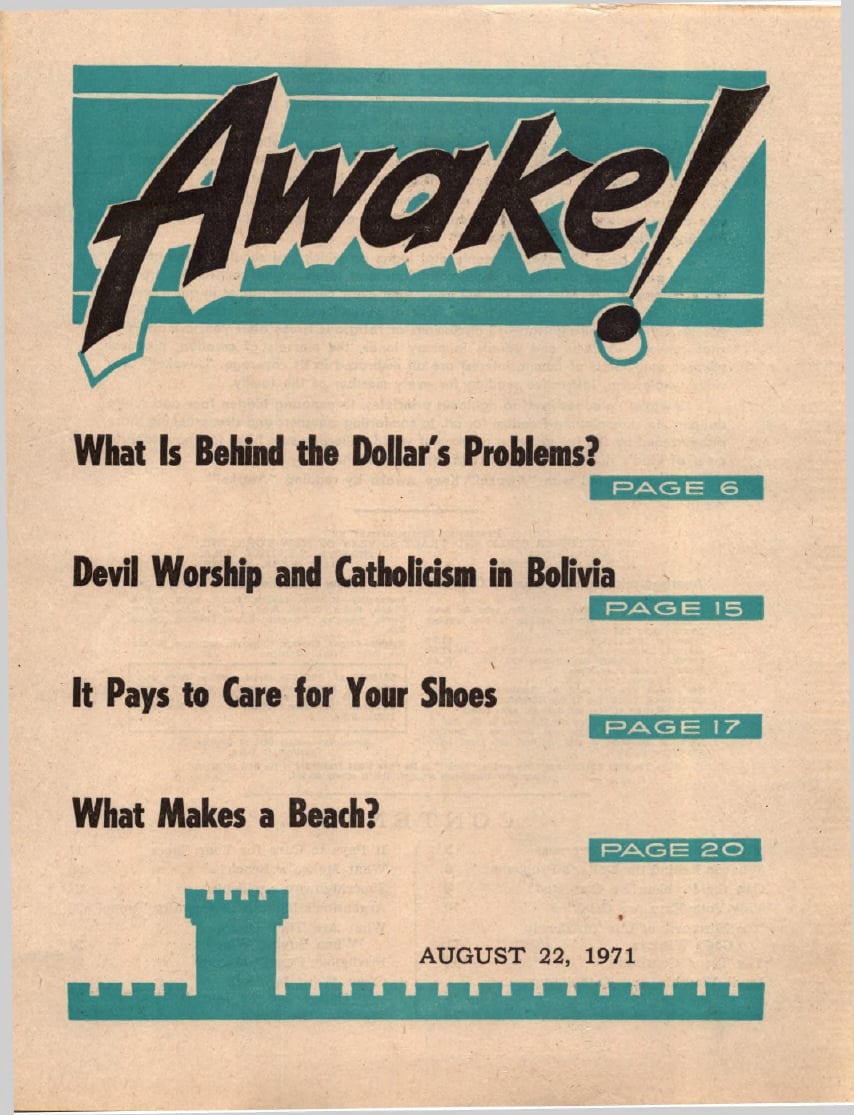
Awake! — August 22, 1971
Source: jw.org
Contents
The Dollar in Trouble Overseas
What Is Behind the Dollar’s Problems?
Can the Problem Be Corrected?
Why Your Ears Are Crinkled
The Hardiness of Life Testifies to God’s Wisdom
The Trend Continues
Devil Worship and Catholicism in Bolivia
Is It the Truth or Not?
It Pays to Care for Your Shoes
What Makes a Beach?
Superhighway Accidents
Argentina’s Modern Underwater Tunnel
What Are They Getting When Buying Wine?
Prodigious Egg Producers
“Happy Are the Pure in Heart”
Watching the World
Are You Sleeping Your Life Away?
The Dead Will Live Again!
The Dollar in Trouble Overseas
The Dollar in Trouble Overseas
“APPRECIATION has apparently grown over how close to an economic disaster the Capitalist nations have moved.”
That conclusion came from a group of the Western world’s most distinguished economists meeting in Italy. The report, published by the New York Times, added that “something is seriously wrong with the international monetary system.”
Why such a gloomy outlook for the Western world’s finances? The main cause is the United States dollar. It is in deep trouble overseas. “The U.S. dollar, contrary to popular belief, is about as sick as ever,” said U.S. News & World Report.
There was a time when the American dollar was greatly prized. Individuals and governments in other lands were happy to have large holdings of them. That is no longer the case.
Spending More than Income
Why has this situation come about? To illustrate: suppose you had a job that paid you $1,000 every week. Would you say that you were well off financially? Most people certainly would say so.
However, what if you spent $1,100 every week during the year? What if you spent $1,200 every week next year? What if you continued spending more than your income year after year? Simple mathematics would tell you that, after you used up any savings you had, you would be going deep into debt.
After a while, banks and credit firms would realize that you were living too far beyond your means and that you were a poor risk. They would see that you were headed for bankruptcy and would stop lending you money.
Thus, regardless of what income a person has, he certainly is not well off if he continues to spend more than he makes. That is not the way to prosperity. It is the way to go broke. To avoid bankruptcy, unless it is too late, he has to change his way of living. He must get his spending in line with his income.
Nor does it matter if he makes $100 a week, $1,000 a week, or $1,000,000 a week. What is crucial is how much he spends. If he keeps spending more than he makes, he will eventually get into trouble.
Although the matter of international finance is far more complex, basically that is what has happened to the United States. It has been spending more money in foreign countries than it has been earning there. Hence, in its international transactions the United States is going broke at present.
To appreciate better why this is so, it would be helpful to see what system many of the nations outside the Communist bloc have established to settle their international accounts.
The Western Financial System
Within any one country, the local currency is used when buying or selling. For example, a citizen of France goes to the store and buys goods. He pays for them in French francs. He knows what his currency can buy at any given time.
But what happens if that French citizen wants to buy an American-made automobile? How many francs must he pay for the dollars that the automobile costs? There must be some international system that lets governments, businesses and individuals know what their money is worth in relation to the currencies of other countries.
Governments could just let the value of their money rise and fall in international transactions depending upon the law of supply and demand, that is, how much their currency is valued by other countries. But that would result in a constant fluctuation in the relative values of currency. Sometimes the fluctuation would be very large.
Such a system would make it difficult to carry on world trade. Businessmen want to know what it will cost them to buy or sell goods abroad over a period of time. They must know how much of another country’s currency their own money will buy. In this way they can determine what to charge for their products.
So a stable rate of exchange is most desirable for world trade. And such a system was agreed upon by members of the International Monetary Fund. This Fund is made up of more than 100 nations outside the Communist bloc, and was established at a conference in Bretton Woods, New Hampshire, in 1944. It arranged for cooperation between nations on international money problems. The members also agreed not to let their currencies fluctuate more than 1 percent higher or lower than the established values.
Dollar ‘Good as Gold’
The Fund members agreed on the principle that the value of each nation’s currency would be based on its relationship to the United States dollar. The dollar, because of America’s financial and industrial strength, was the strongest currency at the time.
It was also agreed that the dollar would be acceptable as a form of reserves in any of these countries. And what would back up the paper dollars? Gold. Any nation holding dollars could turn them back to the United States and get gold for them at the established price of $35 an ounce.
Gold has always had intrinsic value. Unlike paper money, gold is always in demand for use in industry, jewelry, art and otherwise. So if one nation of the Fund began to accumulate too many dollars, it could turn them back to the United States and get gold instead. Yes, the dollar was ‘as good as gold.’
Because of this system, when an American businessman bought a machine from Germany, he knew in advance what the dollar was worth in German marks. And the German knew he could either hold on to the dollar, spend it to buy an American product, exchange it for some other currency, or turn it back and get gold. All of this facilitated world trade.
But why must nations have to trade and go through all this? Because different countries produce some items more economically than they do other items. They can use these things to obtain goods they do not produce at all, or cannot produce efficiently.
For instance, Japan sells many items, such as automobiles, television sets and radios, to other nations. It uses some of the money it makes from these sales to buy oil from the Middle East. Why oil? Because Japan does not produce any oil to speak of. Without oil, her industry would grind to a halt. So she sells what she produces well and uses the money to buy what she does not produce well.
Problems Grow
The system agreed upon in 1944 works as long as nations spend about the same amount as they make. It is like the person who makes $1,000 a week. He may spend somewhat more this week, but somewhat less next week. Over a period of time, he has no problem if he balances his accounts, spending about what he makes.
However, when he habitually spends more than he makes, then he is headed for trouble. When a nation does the same in world trade, it also is headed for trouble.
In 1950, due to United States spending in other countries, foreigners held about 8.6 thousand million American dollars. But that was no problem. The United States had about 22.8 thousand million dollars in gold to back that up, a huge surplus. Anytime the other countries wanted, they could turn their dollars back and get gold. Yes, in 1950 the dollar was still ‘as good as gold.’
However, ten years later, in 1960, that gold surplus had disappeared! Foreign dollar holdings totaled more than the gold possessed by the United States. And by 1970, the situation had grown much worse. According to one estimate, foreigners held over 43 thousand million dollars, but the United States had only a little over 11 thousand million in gold. It owed foreigners about four times as much as it had the ability to pay!
Nor was the situation improving. In fact, 1970 saw the largest imbalance yet. In just that one year, the United States ran up a startling 10 thousand million dollar deficit in all its overseas transactions. And in just the first three months of 1971 the deficit totaled a staggering 5.5 thousand million dollars!
What would happen now if other nations demanded gold for all their dollars? Newsweek answers: “The United States would almost surely close the window, throwing the international monetary system . . . into a period of confusion. And it is at this point that the wonderland of international finance touches daily life: the result of such chaos might be a world depression similar to the slump of the 1930s.”
[Graph on page 5]
(For fully formatted text, see publication)
50 50
40 40
30 30
20 20
10 10
(Figures represent billions of dollars.)
FOREIGN DOLLAR CLAIMS
U.S. GOLD RESERVES
1950 1955 1960 1965 1970
What Is Behind the Dollar’s Problems?
What Is Behind the Dollar’s Problems?
WHY has all this happened to America’s balance of payments? Why has such a huge deficit developed in twenty years?
As noted previously, the simple answer is that the United States has habitually spent more overseas than it has earned.
But does this mean that in the past it sold fewer products abroad than it bought? No, until very recently the United States consistently showed a surplus in its trading of goods with other countries.
Then why does it have such a huge deficit? Because the United States spends, or gives away, its dollars for other things not included in the buying and selling of goods in world trade.
In this regard, a very significant item is foreign economic aid. Thousands of millions of dollars have been given away to other countries since World War II. Then, too, when Americans go overseas for vacations, they spend dollars in other countries. They spend much more than do foreigners who come to the United States for their vacations, leaving a deficit in this account.
There are other areas that contribute to the dollar outflow. Many retired Americans live in other countries. They receive pensions and spend the money in the country where they live. Also, American businesses spend money on plants and equipment they want to operate in other lands. In addition, Americans purchase foreign securities as investments.
The Biggest Culprit
However, the biggest single item that drains away America’s dollars is none of these. What is it then? Industry Week of May 3, 1971, said: “The biggest cause of the trade deficit . . . is military spending overseas.”
Military spending includes the money to buy war equipment in other countries and salaries for military personnel who spend the dollars overseas. It also means paying for the supplying and maintenance of foreign military forces allied with the United States.
Regarding such military spending, the New York Times commented: “During the decade of the 1960’s, the net United States balance of payments deficit on military expenditures amounted to $32 billion. As former Secretary of the Treasury Henry H. Fowler has emphasized, such an outflow cannot be tolerated in the next decade.”
Another aspect of such military spending is that nothing of real value is produced. Wars and preparations for war are destructive of a nation’s (taxpayers’) wealth. When two opposing countries build planes and tanks for war, nothing has been produced that contributes any lasting economic benefit. When those weapons are used to destroy buildings, factories, cities and lands, how much wealth is produced? Are the cost, and use, of all that making the nations richer or poorer? You know the answer.
True, war making means that machines of war have to be produced. That does create jobs. But those jobs are not producing economic wealth, anything of real value for mankind. Have land, homes, trees, parks, schools or hospitals been improved? If the money used in war production were used for these things, then there would be real and lasting economic benefits.
From the long-range viewpoint, therefore, war spending by all nations does not increase their wealth, but takes away from it. And in the case of the United States, huge military spending overseas is the prime reason she is going broke on her international accounts.
Ominous Development
Lately there has been another ominous development from America’s standpoint. The large surpluses she once had in her commercial transactions with other nations are disappearing.
In recent times imports have been rising at a faster rate than exports. Other countries are now able to produce many of the goods that the United States alone produced efficiently a few decades ago. And many of these other countries produce them at a much lower cost.
Due to inflation, prices of American products have been rising rapidly. This makes them more costly in world trade. Foreigners would rather buy from other nations that produce items of equal quality, but lower in price.
American consumers are also adding to the problem. Because of high-priced American-made goods, they are buying more and more foreign-made products. This year two in five shoes sold in the United States are imports. Six in ten television sets are now imported, as are nine out of ten radios. Foreign-made automobiles, such as Germany’s Volkswagen and Japan’s Toyota and Datsun, are pouring into the country, cutting into local production.
So foreign-made goods are gobbling up markets everywhere. They are hurting United States sales to other countries as well as its sales internally. If the trend continues, America would soon run a deficit even if it eliminated all overseas military spending.
Imbalance Leads to Crisis
The deficits in the United States balance of payments kept building up over the years. However, by political pressure or otherwise, American officials were able to talk other nations out of converting their dollars into gold. They warned that any ‘run’ on its gold would produce a crisis for all the nations of the Fund, since they are closely linked together.
Yet, there comes a time when even a kind banker has little or no choice. He must say to a borrower: ‘No More!’ That happened in the spring of 1971. This drastic action was triggered by a situation that arose during 1970 and early 1971.
In 1970 the United States suffered from a recession. Among the various things done to try to get out of this recession was the lowering of interest rates. This usually stimulates business, as it makes money cheaper to borrow. Those who want to buy cars, build homes, or expand businesses are more likely to borrow and use money when interest rates are lower.
However, with lower interest rates, those with money to invest get a lower return. So, many took their money out of American investments and put it into European investments where interest rates were higher.
In the spring of 1971, dollars poured into Europe. Not only were investors seeking higher interest rates, but because of the dollar’s weakness, speculators wanted to get rid of dollars and buy the stronger European money, especially the German mark. They felt that these stronger currencies would go up in value and they would make a profit.
However, when such money pours into a country, that nation has more to spend and lend, which heats up inflation. So while the American deficits over the years were bad enough, this flood of dollars into Europe, particularly Germany, was the last straw. The central banks of various European countries suddenly said: ‘No More!’ They temporarily refused to accept any more dollars. They then allowed their money to ‘float’ upward in the financial markets.
This meant that they would not stick to the Monetary Fund’s agreement to allow their currencies to fluctuate only 1 percent. They allowed their money to seek its own level according to supply and demand. Since the demand for dollars was weak and the demand for European currencies strong, the value of those currencies rose several percentage points.
For all practical purposes that was a devaluing of the dollar. Since America would not do it herself, the other nations did it for her by revaluing their money upward. The result was the same. Now it costs more dollars to buy the same foreign products and services.
Can the Problem Be Corrected?
Can the Problem Be Corrected?
CAN the deficits in the United States balance of payments be corrected? What does the future hold for the world’s monetary systems?
To correct the deficit, America would have to make fundamental changes in her way of living. That would have to include sharp cutbacks in military spending. This would mean reducing troop concentrations throughout the world, or at least getting other countries to pay for them. But both are difficult to do.
A suggestion, in May 1971, that America’s more than 300,000 troops and 200,000 dependents in Europe be cut to save money aroused sharp outbursts by the administration. Political considerations won out. In spite of the large drain in dollars, the troops and dependents would stay for the present.
One area where cutbacks are being made is in Asia and the Pacific. Troops are being withdrawn from many areas there, including Vietnam.
A Dilemma
In addition to greater military cutbacks, the United States would have to cut down inflation so prices would not keep rising. Lower prices would make her products more competitive in world trade.
But to do that, a slowdown in business often results, with higher unemployment. That is what happened in 1970 when an attempt was made to reduce spiraling inflation. Interest rates were raised to make money harder to get. Some spending by government and business was cut back. All this helped to bring about a recession and high unemployment. No political party in power wants that.
Hence, the United States is in a dilemma. To reduce the outflow of dollars and cut the deficit, it must correct inflation within the country. But that slows down the economy and makes millions of Americans angry. That is why a recession is regarded as a greater evil, politically, than having other countries angered. Those countries do not vote in American elections.
On the other hand, stimulating American business to avoid or correct a recession usually stirs up inflation. Interest rates are lowered so more money is borrowed and used. Spending by government and business is increased. With money easier to get, people will spend more. So demand for more goods is created, requiring more production, which in turn means more jobs. But then prices tend to rise, making American products more costly, less competitive in world trade.
With greater prosperity, people usually spend more money on everything, including foreign products. And they are more likely to take foreign vacations. All of this worsens the balance of payments. This dilemma is why Federal Reserve Chairman Arthur Burns remarked that the United States financial situation is so fragile that he doubted it could survive another business boom right now.
The Prospects
What are the prospects that something will be done to stop the deficits? Some government officials tend to be optimistic.
However, many private economists are not. Dr. Roy Reierson, chief economist of Bankers Trust, states: “The United States must reduce its balance of payments deficit so that the supply of dollars comes close to matching the demand for dollars by foreign private and official holders. This, the United States has not been doing, and there is little prospect that it will do so.”
One economist noted that in the past, successive secretaries of the treasury have promised to end the deficits in a few years, but have never kept their promises. Instead, the deficits have grown swiftly. So the basic problem of achieving a working balance among Western nations and the United States remains unsolved at the present time.
Because of this, Myers’ Finance Review of Canada warns: “The world is approaching a monetary crisis that will engulf every currency in existence.” And a European banker says: “We might end up with the worst monetary disorder since the ’30s.”
Indeed, respected French economist Jacques Rueff, while sympathetic to the problems of the United States dollar, stated: “I fear that the problem has gotten out of hand, and that the balance of payments will be restored only by a forced consolidation—that is, bankruptcy—as in 1931.”
Even if temporary improvement is made, what about long-term prospects? Could a monetary disorder like the Great Depression of the 1930’s again overtake the world?
Actually, a far greater disorder is a certainty! Any system founded on selfish interests sows the seeds of its own destruction. If given enough time, the present world economic system, based on selfish national and individual interests, would collapse, as history shows so many others have.
However, the end of the present economic systems will not come simply because of their greed. Their end will come due to divine intervention! Of our time, Bible prophecy states: “In the days of those kings the God of heaven will set up a kingdom that will never be brought to ruin. And the kingdom itself will not be passed on to any other people. It will crush and put an end to all these kingdoms, and it itself will stand to times indefinite.”—Dan. 2:44.
All present governments, together with their economic systems, are thus to be crushed out of existence shortly by God’s power. Thus, man’s affairs will no longer be controlled by selfish political and financial interests. They will be controlled by a righteous administration, a heavenly government of God, that will seek the lasting benefit of mankind in all areas, including the economic. God has promised to establish such an administration for the lasting blessing of all who love righteousness.—Eph. 1:8-10.
Will you benefit from that administration? That depends to a large extent on what you do now to learn about it and to bring your life into line with the requirements of God, its Creator.
Why Your Ears Are Crinkled
Why Your Ears Are Crinkled
STUDENTS of human hearing once thought that man’s external ears were merely crinkly decorations on his head. They felt that such served no useful purpose except to act as rather inefficient ear trumpets. But Dr. Dwight Batteau, of United Research, Inc., in Cambridge, Massachusetts, has found that your external ears are crinkled to serve a very useful purpose. Those curves, hills and gullies of your ears all help you to determine from which direction a sound is coming and even the approximate distance of its source. Here is how it is believed that they do this:
The complex channels or convolutions, yes, those crinkles, of your ears add a slight, reflected sound or echo to any sound that you hear. This slight, added echo will vary with the different angles from which sounds originate. For example, if you hear a sound above you, the tiny echo added by your ears’ crinkles will differ from the one that they add to a sound coming from below you or to one from behind you.
Now, this minute echo will enter your ear a fraction of a second after the main sound does. Then that part of your brain that cares for your hearing will analyze this main sound and its accompanying delayed echo. And by this analysis you are immediately aware of the direction from which the sound came. So quickly does all this take place that you are not even conscious of it. Further, when you hear a sound coming from your right, then your right ear hears it just before your left ear does and vice versa. This too plays a part in your ability to know the direction from which a sound originates.
So even with your eyes closed you can tell if a sound came from behind you or from your right or from your left or from above you. Yes, those crinkles in your ears add a sense of direction to your hearing and this adds to the pleasure of living. With it you know where to look when you hear the lovely song of a bird perched in some tree or the knocking of a woodpecker searching for grubs. It enhances listening to music stereophonically reproduced. You can delight in hearing the silky sound of violins from one speaker and the flourish of trumpets from the other.
Yes, your ears are crinkled to enhance your enjoyment of life. Who made them? The Holy Bible, at Proverbs 20:12, tells us ‘that Jehovah God is the one who made the hearing ear.’ Let all thank and praise him for this marvelous gift!
The Hardiness of Life Testifies to God’s Wisdom
The Hardiness of Life Testifies to God’s Wisdom
ANIMAL life has been on the earth for many thousands of years, even before man’s appearance. During that time countless generations have lived and died. Some kinds or varieties have become extinct. But a great number survive to this day, probably nearly all of those kinds of animals that have lived since the great Flood.
In this long space of time, cataclysms have affected wide areas and diseases have swept through plant life and animal and human populations. Yet life persists. Moreover, fossils that have been discovered are practically identical with forms living today. Only a minor variation appears here and there, much as there are slight variations in particular animal and plant kinds now in existence contemporaneously.
How is this amazing ability to survive possible, since life seems so fragile and since the mechanism of reproduction depends on microscopic cells and is so exceedingly complex? Even though intricate almost beyond belief, the reproductive process is actually so stable that the majority of living creatures possess all their faculties and functions. For example, most babies are able to live after being born and nearly all have normal eyes, arms, legs, internal organs, mentality and good use of all these endowments.
All this testifies to the wisdom and glory of the Creator. The hardiness and persistence of life through all the centuries of time and circumstance also point to his purpose to have the earth continually teeming with life to time indefinite.
Resistance to Poisons Developed?
It is known among informed persons that insects and microorganisms in time seem to develop a resistance to poisons used to combat them. Insects against which DDT was at first very effective apparently become immune to it, some resisting such deadly chemicals as hydrocyanic acid. Similarly, even the so-called “miracle drugs” lose their effectiveness against what have become disease microbes in their effect on man. Certain infections, syphilis and other diseases, require ever more massive doses and yet resist. Some bacteria are reported to have increased 16,000-fold in ability to resist penicillin.
Evolutionists conclude that this is a proof of evolution. But is it? Does this current immunity of the insects and microorganisms mean that they have developed an immunity to the poisons? No. For the poison either killed those on which it was used, or was ineffective. Those it killed could not develop a resistance, or have offspring that were immune, for they were dead. The survival of some among the population means that there were some that were immune at the start. This immunity was a genetic factor placed in the kind at creation, one that could appear in some of the offspring and not in others. This is true also in human genetics.
A comparison can be made with respect to talent in a family line. The father and mother may not display any musical talent, but their child may be a genius in this field. In tracing back through the child’s ancestry, the parents may discover that the great-great-grandfather had unusual musical talent. It did not show up again in the family line until it was uncovered in this man’s great-great-grandson. Some may choose to call this a “mutation,” but actually the trait was already there in the hereditary factors.
The principle was proved some years ago by experiments conducted by geneticist Milislav Demerec, at Carnegie Institution in Cold Spring Harbor, New York. He used for his experiment colon bacteria, which can be cultured on a nutritive broth or nutritive agar. Under a temperature of about 98 degrees Fahrenheit these bacterial cells divide about every twenty minutes. One cell may yield thousands of millions of progeny in a day.
Streptomycin, an antibiotic drug, was used to stop the growth of these bacteria. However, it was discovered that out of several thousand million a few cells survived. Evolutionists claim that a mutation (a sudden departure from the parent type) occurred, and that this is an evolutionary step. But this idea is refuted by the actual findings in these tests. These showed that no change in heredity was brought about by the streptomycin treatment. It merely killed the nonimmune bacteria and spared those against which it was ineffective.
Demerec found that in any large culture a few resistant bacteria appeared, even when the culture had not been previously exposed to streptomycin. About one cell in every thousand million was naturally resistant in every generation. Therefore, streptomycin had not produced the so-called “mutations.”
Then the reverse side of the situation was investigated. In the streptomycin-treated solution the nonresistant strain died out, but the resistant cells lived and brought forth progeny and “took over” the population growth. Nevertheless, among this progeny about thirty-seven cells out of every thousand million produced were of the basic type, sensitive to streptomycin. Next, the surviving population was removed from the streptomycin-treated nutritive agent and placed in untreated broth. What happened? Now the nonresistant strain began to flourish and “took over” the population. The resistant strain did not fare so well, yet continued to appear as at the start, about once in a thousand million times.
Earth Always to Be Filled with Living Things
All this reveals the hardiness and persistence of life. It explains why disease epidemics can wipe out most of a population, yet leave some untouched due to their having a natural resistance to the particular disease germs involved. Furthermore, as to mankind, we see that, despite the ravages of nearly 6,000 years of sin, well-formed, handsome men and women, with brilliant minds, are still being produced.
Now, however, we behold man ruining his own environment. Health hazards of all kinds are brought about by food additives, by pollution of food, water and air, and the threat of death from crime or war increases daily. Man is literally ruining the earth, and likely, if allowed sufficient time, would make the earth uninhabitable.
But the Creator purposed earth to be a place perpetually inhabited by men and women, as well as by animals. God says he will step in at this time when earth-wide desolation threatens and will “ruin those ruining the earth.”—Rev. 11:18.
So, just as life has always existed, in that Jehovah the Source of life has always lived, he purposes that life will always exist on this planet.—Ps. 90:2; 36:9.
The Trend Continues
The Trend Continues
By “Awake!” correspondent in Costa Rica
DURING the 1960’s a definite religious trend became obvious. The New York Times Encyclopedic Almanac 1970, pages 441 and 442, noted: “Not only in the United States but all over the world, there is a steady departure from the religious life and the priesthood. . . . the exodus from rectory, monastery, and convent continues: in 1968 perhaps as many as 2,700 U.S. Catholic priests left the active ministry and 9,000 nuns their convents.”
Vatican sources reveal that in the Western world seminary students have decreased by 20,000 in just three years. Even in the strongholds of Roman Catholicism the trend is apparent. Observed the New York Times, April 21, 1968: “Everywhere in Catholic Latin America, the church is in a state of crisis. Splits have developed in nearly every country.”
What about in Costa Rica, where the overwhelming majority of the population is Catholic? According to the head of the Central Seminary, Costa Rica should have one priest for every 1,000 to 2,000 Catholics. There is, however, only one priest for every 4,000 Catholics, or just half the desired number. And what are the prospects for increasing the number?
They are not good. There is in Costa Rica a steady decrease in the number of seminary students and in the ordination of priests. For example, in 1966 there were 15 priests ordained; in 1967 just 10; in 1968 only 4; in 1969, 6; and in 1970 just 5. Also, enrollments in the Central Seminary have dwindled. In 1968 there were 21; in 1969 only 12, and in 1970 the same number.
Why the Decline
There are a number of reasons for the decline. But basically the reason is loss of confidence in the Church. People see the corruption, the confusion over doctrine and policy, even rebellion among church leaders, and so grow disgusted.
Of the few Costa Rican youths who take the Church seriously enough to enter a seminary, many drop out after seeing, as one young Catholic put it, “the way things really are.” After studying in a seminary for four years, he said he was disillusioned and discouraged by the immorality of the priests.
Many Costa Ricans have also become disgusted by the Church’s emphasis on money. A number of Catholics interviewed recently called their Church ‘a business.’ Church raffles, carnivals and bingo are common, and nuns go from door to door asking for contributions. Also, it is not unusual to see amusement rides for children and gambling equipment set up on Church property.
Many persons feel that even the religious services are designed to make money. If a Mass is said or a marriage performed, money is collected. In fact, when the priest of a prominent church in the capital, San José, is paid to say Mass at a certain hour, he often schedules another Mass for the same hour in order to collect double money. Of course, he does not tell his ‘customers’ that the Mass is to be said for two different parties.
Thus it occurred that one day he scheduled a Mass for the dead and a wedding for the same hour, two religious services that are completely incompatible! As one might imagine, the result was confusion. The parties involved were angry and disgusted. And when the priest was phoned and asked why he scheduled things as he did, he hung up.—La Nación, (San José), October 14, 1970.
But perhaps the greatest confusion and division among both clergy and laity is caused by the conflicting views within the Church regarding sex. For example, traditionally Catholics have been taught that the original sin was the first sexual experience between Adam and Eve. But now the view by progressive or liberal Catholics is quite different. Sex is no longer considered a sin, but as something wholesome. And if that is so, many are asking, why does the Church forbid its priests to marry?
A related issue is birth control. Many priests and laymen do not fully support the Pope’s decision on this, and yet do not want to say flatly that he is wrong. Thus a priest’s talk on the subject “Sex and Religion” at one of San José’s high schools resulted in an interesting discussion period.
The question was asked the priest, “What is the position of the church toward contraceptives?”
The priest answered by quoting the encyclical in which the Pope prohibited artificial contraception for Catholics. However, he said that this encyclical was not to be taken too rigidly. ‘It is a matter left to the conscience of the individual,’ he explained.
But a doctor in the audience asked how the priest’s answer could be harmonized with the Catholic Church’s teaching that the Pope is infallible when he speaks in an official way. The doctor then quoted Matthew 23:4, which tells about the Pharisees’ binding up ‘heavy loads on men’s shoulders,’ and asked, “Are not you Church leaders sinning as modern Pharisees, Father?”
At this the public present, almost 100 percent Catholic, broke out in applause.
No longer are many Catholics accepting what their Church teaches, as The New York Times Encyclopedic Almanac 1970, page 441, notes: “On celibacy and on other issues, in short, a question of Church reform has mushroomed almost overnight into a question of belief—or perhaps more precisely unbelief—in traditional Roman Catholic positions.”
The Results
As the confusion and dissension within the Church deepens, so does the moral decay. In Costa Rica marital infidelity is on the increase. People are putting iron bars over their windows and leaving someone at home at all times to prevent robbery. Even while they are in churches people are warned to hang onto their purses.
Also, young people in their anger and disgust have turned to violence against church buildings and priests. In Escazú the church last summer was vandalized. A few nights later, on August 9, 1970, a gang tried to assassinate a priest. At a lonely spot in the road they threw huge stones down on his car. And in April of 1971, some fifty youths seized control of a church for three days as “a denouncement against the oppression of the church,” as they stated it.
It is obvious that Catholic people are upset by what they see going on in their Church. But how do you think God feels? He, too, is disgusted with the religious systems that have not served Him, and so soon now the Bible shows he will bring about their destruction.—Rev. 18:4.
Devil Worship and Catholicism in Bolivia
Devil Worship and Catholicism in Bolivia
By “Awake!” correspondent in Bolivia
EL TIO, the Spanish-speaking miners call him. “Uncle” in English. But in either language the one meant is the Devil.
The most notable thing related to this one called El Tío by the people in and around the lofty mining city of Oruro, Bolivia, is the way he is rendered worship by persons professing the Catholic religion. There is even a “Devil Carnival” celebrated here each year on the weekend before the Lenten season.
How did it all get started? And how did this Devil worship get adopted into the regional Catholicism of these Bolivians?
Ancient Indian Legend
The city of Oruro draws its name from the Urus, an Indian tribe living in that area when the Spanish conquistadores entered South America. Besides the sun, moon, stars and earth, the Urus worshiped a god called Huari (also known as Supay to Quechua-speaking Bolivians), the god of the underworld and of the mineral wealth found in his subterranean domain.
One Uru legend tells of Huari’s determination to punish them for having abandoned the bad way of life this underworld god symbolized. A mighty serpent, an enormous lizard, a monstrous frog, and a horde of ants were marshaled by Huari and converged on the peaceful Indian tribe from different directions. Then, at the critical moment, the legend says, a beautiful Ñusta (young virgin) appeared to save the Urus, defeating Huari’s motley forces and driving him underground.
Amalgamation with Catholicism
Where, then, does Catholicism enter the picture? It came in with the invading Spaniards and the forced conversion of the Indians to the Catholic faith. But the old legends and worship continued. Ñusta became known as the “Virgin of Socavón,” the patroness of all miners. She supposedly protected them when they went below ground to mine tin and other metals, thereby coming within the reach of the underworld god Huari. For added protection, however, the miners make regular offerings to Huari (now called El Tío), especially on the first Friday of every month.
Showing the merging of Devil worship with Catholicism, an article in La Patria (February 8, 1970) says: “In America the peninsular clergy [those coming from Spain], faced with the impossibility of rooting out the original religion, ended up by permitting the Urus to continue worshiping Supay [or Huari] in the interior of the mines . . . and ‘cover the Indian beliefs with a Catholic varnish’ in the words of Ambrossetti.”
Dr. Augusto Beltrán H., an authority on carnival customs of Oruro, compares them with those of pagan Roman feasts to such gods as Saturn and says that “the god of the Roman Carnival has been replaced here by Lucifer, the Huari of the Urus or the Supay of the Quechua Indian.”
But, at Oruro, Lucifer (the Devil) is brought into collaboration with the Virgin in that the offerings made to Huari (El Tío) become offerings made to her. As the article in La Patria goes on to say: “. . . the ‘offerings’ . . . of gold and silver extracted from the domain of the underworld [are carried by] the Devils [men in devil costumes] to the Plaza of Socavón where the temple named for the Virgin is raised. Silverware and gold and silver jewels are put on hundreds of arches . . . under which processions, led by priests and followed by devils with Lucifer as guide, will pass.”
Miners’ Search for Security
Life is not easy for Oruro’s miners. Rising at five in the morning, many have only bread and coffee before heading for their hard labor in the mines. Some chew coca leaves (containing the drug cocaine) so as to deaden their hunger pangs and keep them from feeling the chill. Their strenuous work goes on for eight to twelve hours, with time out at noon for a simple but hot meal sent to the mines by their wives. Lest life become any more difficult, many feel bound to follow the superstitious customs their ancestors have passed on to them, including devotion to El Tío.
Besides the special Carnival offerings, the Catholic miners periodically take along to the mines offerings for El Tío—perhaps some alcohol, narcotic coca leaves or cigarettes. If a bad accident occurs in the mines, they may try to placate El Tío by sacrificing a llama or two inside the mine and sprinkling the blood around.
How strange many of these practices would seem to Catholics in New York, Paris or Munich! Yet they are typical of the practice of accommodating Catholicism to pagan practices to make it easier to draw the native population under the yoke of the Church. Very different indeed from the principle emphatically set out by the apostle Paul, who said: “What sharing does light have with darkness? Further, what harmony is there between Christ and Belial [the Devil]?”—2 Cor. 6:14, 15.
Despite their devotion to the Virgin of Socavón, along with that rendered El Tío, religion has small influence on the daily lives of most of the miners. The influence of the Church is steadily waning as more and more of the miners, finding no genuine comfort or hope, turn away to political groups and to Communism, vainly searching for something better.
Happily, many are hearing the good news of something truly better, as they receive information about the pure worship of the true God taught in the Bible. Through free Bible studies conducted in their homes by Jehovah’s witnesses many are learning ‘the truth that makes one free’ (John 8:31, 32), becoming liberated from enslaving customs and superstitious fears. Rather than trusting in political promises, they are placing wholehearted trust in God’s kingdom as the one government sure to bring better conditions.
Is It the Truth or Not?
Is It the Truth or Not?
● A man in Lancashire, England, related the following incident: “I felt that Jehovah’s witnesses had something, but my wife did not share my views. One day the local Catholic priest called on us. My wife hoped that he would set me straight. I asked him why Christmas was celebrated on December 25th, when Jesus was not born on that date. He readily agreed that Jesus was born at another time. It was then brought to his attention that the Catholic catechism asks: ‘On what day was our Saviour born?’ and replies, ‘Our Saviour was born on Christmas Day,’ with the footnote explaining, ‘Christmas Day, December 25th.’ We asked the priest if this was the truth. He made no reply.”
It Pays to Care for Your Shoes
It Pays to Care for Your Shoes
CARE of your shoes pays in many ways. For one thing it saves money. Well-cared-for shoes do not have to be replaced so often.
Also, with proper care your shoes will always look good when you wear them. They will enhance your appearance, rather than detract from it.
But perhaps the greatest benefit is that well-cared-for shoes give better, more comfortable wear. This can mean improved health and well-being for you.
Buying Shoes
The time to begin exercising care is when you buy shoes. It is wise to get ones of good quality. True, their initial cost may be higher. But in the long run it will pay economically. You will be able to use them for a long time, putting on three or four new soles before the shoes wear out. And, besides, they will always look better and feel more comfortable.
Leather is usually favored for shoes, because it once served as the skin of a living animal. It has many microscopic pores. So it lets fresh air into the shoe and perspiration out. It “breathes.” This exchange of air and moisture through the leather is healthful and comfortable to your feet.
Of course, there are persons who buy shoes of man-made materials. Although such shoes apparently do not “breathe” as well, if at all, and so may be inclined to cause more foot perspiration, some persons feel they have advantages. For example, they can be less expensive. Also they are considerably waterproof. But shoe repairmen generally say that shoes made of leather are best.
If you decide to shop for leather shoes, there are certain things to check inside the shoe. Is the heel pad of real leather? Is also the insole, that part upon which the ball of the foot rests? What about the heel lining? These parts all are of leather in quality shoes. But in many shoes cardboard or other inferior materials are used. These prevent evaporation, and they deteriorate faster than leather.
Turn the shoe over and examine the bottom. Is there stitching that secures the outersole to the welt, that narrow strip of leather around the sole’s top edge? The soles of many cheaper dress shoes are simply cemented on, and so may easily come loose.
Is the outersole leather? Leather is more puncture resistant than rubber. And it is dressier, since its edges will take a shine better. However, rubber is more water resistant, and probably gives more wear for the money than most grades of leather. So rubber soles may be preferred in some instances over leather. But, as for the heels, rubber is definitely superior to leather on men’s shoes, lasting longer and being more comfortable.
Care of New Shoes
When you get a new pair of shoes, it is wise to give them prompt attention. The care that shoes receive when new affects how well they last.
First, many persons find that it is good to treat new shoes with a silicone water repellent, a liquid that penetrates leather. It keeps shoes soft and comfortable, and prevents water, salts and perspiration from drying out the leather. After its application, let the shoes dry thoroughly.
Next, new shoes should be protected with waxes. Good shoe pastes and creams have a combination of these waxes. These nourish the leather, as well as keep out dirt. But liquid or spray polishes fail to provide adequate protection.
If the shoes are of an off shade it may be difficult to find the color of polish to match them. Grays, off-whites and pastels are particularly hard to match. For such color shoes it is advisable to use a neutral polish.
When you put on your new shoes, be especially careful that the tongue and laces are smooth and straight. If they are started out right, they are likely to stay that way.
Continual Shoe Care
Shoes require continual care, not just when they are purchased. This involves watching how you walk. If you want your shoes to look nice, do not kick at things or in other ways carelessly abuse the shoes.
Also be careful when putting them on and taking them off. Do not force shoes on or off without loosening the laces. If you do, you may damage the back of the shoe, perhaps pressing it all out of shape. Use of a shoehorn represents good shoe care. It will protect the back of the shoes.
It is often recommended that shoe trees or forms be used, especially in men’s shoes. These forms fit into a shoe to maintain its proper shape and to prevent it from curling and wrinkling. But care should be exercised that the forms are not adjusted with so much pressure that they force the shoe out of shape. In fact, one shoe repairman, who has seen many shoes damaged by improperly adjusted shoe trees, felt that they usually do more harm than good.
Regularly check the condition of your shoes. If there is a gash or scuff mark, what can be done? “Touch up” crayons can be bought at some stores or shoe repair shops. The scuffed area can be colored to match the shoe, a paste polish put over it, and the damage covered over.
What does examination of your outersoles reveal? It pays not to let them wear through on the edges, so that the welt needs to be repaired or replaced. This repair work is expensive. Also, heels should be replaced before they are too badly worn. Otherwise they can contribute to posture problems.
Good care of shoes involves permitting them to rest and dry out. Even though leather “breathes,” feet perspire to such an extent that moisture accumulates in shoes. This is harmful, deteriorating the inside leather. Thus, when possible, it is wise to have more than one pair of shoes, so one pair can be worn one day and the other the next. In the long run such a practice proves economical.
Regular Cleaning and Polishing
The best way you can care for your shoes is by keeping the leather in good condition. It pays to polish them often, once a week or so. Waxes in the polish will prevent the leather from drying out and cracking.
But make sure that shoes are dry and clean before polishing them. Never put wax on a dirty shoe. Usually cleaning simply involves wiping the dust off with a rag, though sometimes a damp or wet cloth may be needed.
When shoes are very dirty, saddle soap is a good cleanser. It is best applied as suds, using a sponge no wetter than necessary to create a thick lather. Saddle soap is good because it also acts as a lubricant to the leather. However, regular soap and warm water will also remove absorbed or encrusted dirt. Then be sure to wait until the shoes are thoroughly dry before polishing them.
Some persons prefer to apply the paste polish with their fingers. They believe that by lightly running the fingers over the paste and then over the shoe, friction is built up and the waxes are worked into the leather better. Also, they believe that paste can be more evenly distributed this way; an excess is not so apt to be applied. But, of course, use of a dauber or rag or powder puff can prevent your fingers from getting dirty. After the paste is applied, a brisk rubbing with a brush or soft cloth will produce a shine.
Special Care Tips
A situation critical to shoes is when they become soaked. Perhaps you step into some deep mud. What should you do?
After taking your shoes off, take the laces out or open the straps all the way to expose the inside. Stuff them with wads of newspaper, or insert wooden shoe forms. Clean the outside surfaces with newspapers or an old rag. Now allow them to dry in a relatively cool place. Never put them near heat or fire to dry out, for this will crack the leather. After they are nearly dry, you may need to use saddle soap to finish the cleaning job.
When the shoes are thoroughly clean and dry, they can be treated with a silicone water repellent. Let this dry. Now work into the leather a good shoe cream and give them a regular polishing with paste wax. Your shoes should be as good as new!
But what if you get spots on your shoes that do not come off with soap and water? Perhaps you have tar stains on them. Never use alcohol or bleaches. These will ruin the leather. Rather use a dry-cleaning fluid that is designed for fabrics. Dip a piece of cloth in the cleaner and rub lightly over the spots.
The way to clean suede shoes is to rub them lightly with a suede brush, but a fine grade of sandpaper works better in getting out spots.
Applying the above suggestions will do much to make your shoes look presentable and wear longer. It really does pay to care for your shoes.
What Makes a Beach?
What Makes a Beach?
By “Awake!” correspondent in Guatemala
TO MULTITUDES the thought of spending a day of pleasant recreation down at the edge of the ocean is most inviting. It can mean much fun—swimming, sunning, playing games and associating with friends and loved ones in the fresh open air, with the soothing sound of surf in the background. Particularly in the summertime the beach holds a powerful attraction.
Around the world beaches line thousands of miles of coastline bordering the oceans, seas and lakes. They constitute natural playgrounds that come to be thought of as changeless, long lasting, almost permanent. But to observant persons who visit the same beach year after year, definite changes are apparent. The quantity of sand on the beach may fluctuate. In some instances radical changes for better or worse can be noticed.
As we enjoy the attractions of the beach and take note of its gradual transformations, perhaps some questions pop into mind. Where does all the sand come from? Why do some beaches become eroded, others practically disappear? Why are some pleasant stretches almost denuded of sand in wintertime, only to regain the supply during the summer months? The answers to those questions may well surprise us, especially if, like most people, we have been inclined to take the beaches very much for granted.
Not All the Same
If one has not traveled far afield and visited other parts of the world it is easy to conclude that all beaches are about the same. Indeed, there are great variations—in color, in sand quality, in slope of the beach, and so on. For example, in volcanic areas the beach will most often consist of coarse black sand deriving from the lava. In other regions the sands may be most colorful, being composed of offshore coral that has been ground fine. Still other beaches may be a glistening white, for they are formed of broken seashells that are ground to powder.
The majority of beaches, however, have sand comprised of small rounded quartz crystals along with fine particles of many different rock types. This sand comes principally from inland areas, having been washed down to the sea by river and stream. It may range all the way from very coarse to very fine.
It is that coarseness or fineness of the sand, by the way, that will, to a large extent, determine the characteristics of the beach. If the sand on a beach is fairly coarse, then the slope of the beach will be relatively steep. Such coarse sand grains do not become tightly packed because of their very nature.
On the other hand, fine sand forms an entirely different kind of beach. The beach slope will be more gradual, the water offshore will continue shallow for a greater distance, and for this reason the waves will break farther out also. And fine sand packs down quite solidly, so that automobiles can be safely driven on it. An outstanding example is Daytona Beach, Florida, in the United States.
Governed by Laws
But where does all the sand come from, anyway? Were you not under the impression that it resulted from the pounding of surf constantly breaking down the coastal rocks? That may be involved, but it accounts for only a small percentage of the total sand on the beaches. For the vast majority of the world’s beaches the answer is quite different. Not until the last twenty years or so have men begun to gain a clearer understanding of the forces acting on beaches and the resulting effects.
As the ordinary weathering processes decompose rock formations, often far inland, the streams and rivers carry varying amounts of sediment to be deposited at the river’s mouth. The finer silts and clays are soon washed out to sea, leaving behind large quantities of sand in the river deltas. But then, how does that sand get to where the beaches are formed? To understand this transfer we must examine some of the forces that act on a beach.
Waves that are generated by the wind far out at sea eventually expend their energy on the shoreline. However, they do not always strike the beach head on, that is, the waves are not always parallel to the coastline. For this reason the energy of the oncoming waves is divided into two parts. The major part is directed perpendicularly to the beach and dissipates in the breaking surf. The second part, much less in total energy, is directed in a current parallel to the beach and confined between the dry land and the line of the breaking surf. This current could be likened to an actual river, having as one “bank” the edge of the dry beach, the other “bank” being the offshore line along which the surf first begins to break.
This river may flow upcoast or downcoast, depending on the direction of the incoming waves. This coastal “river” is quite like its cousins that flow through the land in that it is capable of carrying large amounts of sediment. The sediment carried by the coastal “river,” of course, is the sand that makes up the beach past which it is flowing.
The sand borne along by these coastal “rivers” may involve large quantities—in some areas millions of tons of sand per year. This would amount to many railroad cars of sand moving down the coast every day of the year. The quantity, however, varies from one region to another, but we can clearly see how the sand brought down to the ocean by the rivers and streams comes to be distributed along the coastlines.
While this process of sand transportation goes forward continuously, still another process is under way. This process is one that changes the appearance of the beach itself from one season to another. In most parts of the world the incoming waves are smaller and gentler during the summer months, larger and more powerful during the wintertime. The gentler waves tend to push the sand up on the beach, whereas the stormy waves of winter drag the sand from the beach and deposit it in long mounds parallel to the beach. We call these mounds sandbars. When summer’s gentler waves return, the sandbars tend to disappear as the sand is once more pushed up on the beach.
Were all the sands brought down to the ocean by the rivers to remain on the beaches, we would eventually have large, sandy beaches all around our continents. But, as it turns out, vast amounts of sand are lost offshore each year beyond the point where waves can affect them.
Man Upsets the Equilibrium
The hand of man, particularly during this twentieth century, has in many places affected the natural equilibrium. Construction of harbors and breakwaters has often wrought great changes on the nearby coastlines. Among other effects one can note the buildup of sand on one side of a harbor, expensive dredging operations within the harbor itself, and erosion of the beach on the opposite side. True, this is but one of the costs of progress as man sees it, but there is yet another problem that is coming to have more far-reaching complications.
Flood control, water conservation and hydroelectric power installations have resulted in construction of more and more dams in all parts of the world. These dams greatly reduce the sediment-carrying capacity of rivers and streams, thus seriously cutting down the supply of sand destined for beach building. When the river deltas no longer supply sufficient quantities of sand, the beaches immediately downcoast begin to erode. The fine balance between gain and loss of sand has been upset.
Bringing sand in from other areas and dumping it on a depleted beach can only be a temporary measure, for the process of erosion will continue to wash the sand out to sea. The cost of artificial replacement of sand could become prohibitive.
Another method of beach maintenance involves the construction of shoreline structures, most commonly the long narrow type built at right angles to the shore and projecting out into the surf. These “groins,” as they are called, may be formed of large rocks or woodwork. The idea is to trap sand as it is carried past the beach so as to avoid further erosion.
Beach erosion is indeed a mounting problem, especially in the world’s thickly populated areas. Beach property, valued in the millions of dollars, is becoming seriously endangered. Short-lived humans, with their very limited view of the future, have gone ahead with plans for producing immediate gain, financial or otherwise—plans that boomerang on them with unexpectedly disastrous results. Thus while large segments of population are at last gaining extra time for recreation, more and more of the natural recreation areas along the earth’s coastlines are disappearing.
…