Awake!, April 8, 1971
Download: PDF — Awake!, April 8, 1971
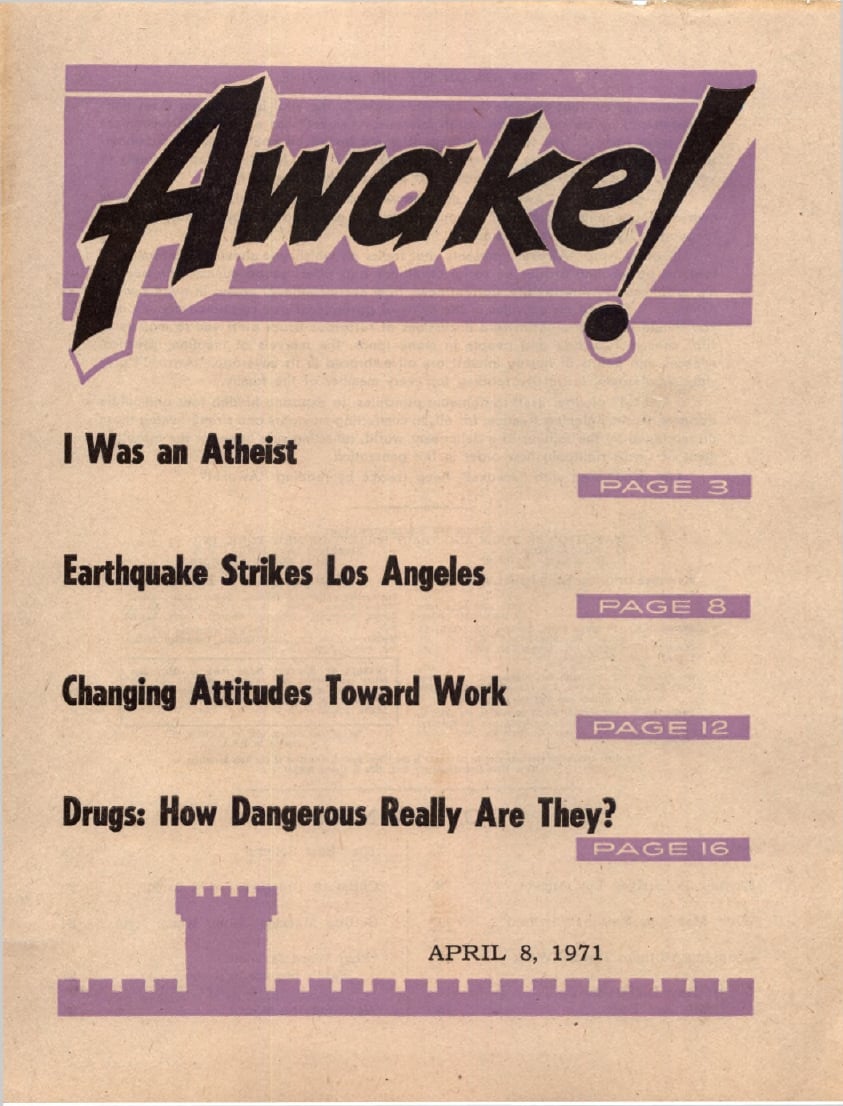
Awake! — April 8, 1971
Source: jw.org
Contents
I Was an Atheist
Earthquake Strikes Los Angeles
What Makes a Nation “Civilized”?
Changing Attitudes Toward Work
Drugs: How Dangerous Really Are They?
The “Best Sellers”
Christian Togetherness in Brazil
Getting Married—Hong Kong Style
Paul’s Voyage to Rome
Watching the World
Life Everlasting—in Freedom of the Sons of God.
Every Family Needs a Bible Study. Does Yours Have One?
I Was an Atheist
I Was an Atheist
I STILL remember that day in the early nineteen-forties when I was just five years old. All the children and their parents in my hometown in central Sweden were invited to a Sunday-school feast. The children were asked to contribute to the program with some form of religious entertainment. Since I played the accordion, when it was my turn I struck up a popular waltz. My audience was not very enthusiastic. Afterward I was told that it was a sin to play such music and that I should feel ashamed.
Many times in my early childhood I was told that it was a sin to do certain things, but nobody told me why. Thus blind fear of God rather than love for him began to fill my heart. This fear made me shun religion, even though religious teaching was a prominent part of regular schooling. During my first years at school the so-called Bible lessons were more like imaginative tales. It was interesting to hear about the miracles of Jesus and his disciples, but I was never convinced that those things really happened.
Time for confirmation came when I was fourteen. It was my first close contact with a State Church priest. The only memory I have of him is that he was irritated, nervous and a chain smoker. Preparation for confirmation was more a matter of routine than an opportunity to establish faith in God and the Bible. On the day of confirmation I was far more excited at being a possessor of a new camera and a new suit than at being a partaker of the Holy Communion.
Belief in God Completely Dissolved
The following years at a senior high school did not strengthen my belief in God. The religious lessons were given by a priest who openly confessed that he did not believe all parts of the Bible, including the creation account. He said that the Bible was written by men, and therefore it should be read with a critical attitude, as one would read any other book. I found the evolution theory taught in biology lessons an acceptable alternative to the Bible’s account of creation. I learned in the study of modern history about the efforts of professed Christian nations to destroy one another. These things influenced me toward an atheistic attitude.
More faith-ruining experiences were to come. After graduating from senior high school, I was called up for military service. The army chaplain explained that war was a necessary evil. He said that a soldier was a servant of God because Jesus said that those who took the sword would perish by the sword, and there must be somebody to wield that other sword. He stressed that war was instituted by God as a means to realize the true religion. I thought: If Christianity is no better than that, I can do without
So that boy who had a disappointing experience at Sunday school grew up to become a young man fully convinced that religion is a fraud, and that modern science eliminates the need for God. I had experienced what many others have, and reacted much the same way as they do. I raised my forefinger and asked, “How could there be an Almighty, all-bountiful God up there when we have so much corruption and wickedness down here?” To me there was only one answer to that question: There is no God!
Marriage and Outlook on Life
This atheistic outlook naturally marked my manner of living. I married a girl with about the same attitude. Since the path from mother’s womb to the grave is so short, we reasoned, “Why not try to get as much as possible out of life while we are still young and vigorous!”
We did not look upon marriage as a very serious institution. We thought that morality must be a personal matter. The two of us could have fun together, but also apart whenever we liked. We thought we were really free. Our whole outlook on life was materialistic, and even my profession was of a materialistic kind. I was a systems analyst at a computer center in Stockholm. We assisted big companies to plan for future financial advancements.
An Unexpected Visitor
Then one spring day in 1963 someone rang our doorbell. I opened the door. A neatly dressed young man modestly introduced himself as a minister, one of Jehovah’s witnesses making calls to stimulate faith in God. My first thought was: “Poor fanatic, you’ve come to the wrong place.” But there was something about him that kept me from closing the door. He did not look like a fanatic. He appeared so normal, so natural, so relaxed. “All right,” I thought, “let me at least show this poor fellow that he has got hold of the wrong end of the stick.”
So I let him in. With my wife listening from the bedroom, I began to vent my indignation concerning God and religion. “How is it possible to believe in God when scientific research and logical reasoning cannot verify him?” I asked. I told him that most of the faith I had met in religion had been a desperate faith, a hypocritical faith, or a faith against better judgment. I showed him that Christianity must have failed, for it had not been able to stop corruption, wars and violence any more than paganism had.
I went on like that for quite a while, and when I thought that he had enough to consider me a “hopeless case” and prefer to leave, he just calmly nodded. He told me that he could well understand my opinion and that it was shared by many persons nowadays. That took some of the sting out of my argument, and I could see that this was not the first time he had run into a discussion of this type. So with a mixture of curiosity and skepticism I let him speak.
Christendom Not the Same as Christianity
He told me that we first had to distinguish between true and false worship before we could judge the matter. He said that even if so-called Christianity proved to be false and unreliable, it did not mean that there is no true and reliable Christianity. “There is a great difference between Christendom and Christianity,” he said. “Christianity cannot be condemned by what Christendom says or does.”
Pointing to the distinction between Christendom and true Christianity, he observed: “It is true that Christendom has suppressed people, but not Christianity; that Christendom has waged war, but not Christianity; that Christendom has failed to stop the moral breakdown, but not Christianity. The Bible does not support Christendom. On the contrary, it prophetically condemns Christendom.
“Just consider how Christendom has misrepresented the Lord’s Prayer,” he continued. “She has prayed: ‘Our Father which art in heaven,’ but she has not practiced interracial brotherhood. She has prayed for God’s name to be sanctified, but she has not even acknowledged that God has a name. She has prayed for God’s kingdom to come, but she has patriotically supported her own kingdoms. She has prayed for God’s will to be done on earth as in heaven, but she has sought to carry on her own worldly policy. She has prayed for her daily bread, but how willing has she been to share her abundance of ‘bread’ with starving people? She has asked God to forgive her her debts and sins, but how ready has she been to forgive and forget in her own conflicts with others?”
I certainly noticed that this young man was not smoothing things over, shutting his eyes to facts or twisting things like most other religious persons with whom I had discussed this matter. To be honest, I had to agree on these points as they well reflected my own experiences. But I wasn’t going to become a believer that easily. The mere failure of Christendom did not prove anything about the existence of God. So I raised the question: “How is it possible for modern man to believe in God when scientific research and logical reasoning cannot verify him?”
“That question I would like to take up with you next week,” he said.
His Second Visit
I had nearly forgotten about the whole thing when the Witness called back. With my wife again listening from the bedroom, the discussion began. At the outset I declared my belief in evolution, and I felt backed up by the whole scientific world. However, it seemed as though he had given this considerable thought, for he said that it was important to make some distinctions as far as science is concerned.
“On the one hand,” he said, “there is the science that discovers, observes and describes facts about nature. Such science does not in any way conflict with belief in God as creation’s great Originator. On the other hand, there is the so-called science that interprets and tries to explain the origin of things by means of hypotheses and theories. Such science often denies a Divine Originator. A true Christian believes in exact science, which discovers, observes and describes facts, but he cannot unhesitantly take a hypothesis or a theory for granted, let alone build his outlook on life upon it.”
I had to admit that I had not considered evolution as only a theory, which, of course, it is. But I still felt that it must be a rather probable theory, and I told him so.
Chance or Creation
The Witness then made me agree that if we excluded an Intelligent Originator behind creation, we would have to rely upon chance as the guiding factor in creation. “How probable is chance?” he asked.
“Well, there is something called calculus of probability to solve that problem, “I replied, feeling more on my home ground.
“Yes, and let us take an example of such a calculation,” he said. He picked up a magazine from his briefcase, and read: “Another scientist computed the probability of a single protein molecule (one of the molecules essential for life) arising out of chance. As stated in the book Human Destiny, it would take 10 to the 243d power [1 followed by 243 zeros] billions of years for this to happen! Since scientists estimate the age of the earth to be a few billion years, there would not have been enough time for this to occur!”
He paused to let this sink in thoroughly, and then read on: “The same scientist says: ‘One molecule is of no use. Hundreds of millions of identical ones are necessary . . . If the probability of appearance of a living cell could be expressed mathematically the preceding figures would seem negligible.’”
“If that is so, “I said, “how do you explain that so many scientists believe in evolution?”
“You certainly use the right word when you say they believe in it, because they cannot prove it,” he replied.
“But their belief must be better founded than your belief in God,” I protested.
“Imagine,” he said, “that the most skilled scientist in the world could handle molecules like a bricklayer handles bricks, and that he only had a pile of protein molecules to work with. Do you believe that he could build a cell of hundreds of millions of such molecules? Could he make it live, grow, propagate and leave to its offspring its own, and only its own, characteristics? You know that he couldn’t.
“But, according to atheistic belief, that which not even the most skilled human intelligence can achieve, occurred by mere chance. How well founded is such a belief? The only conclusion is that those who believe in it must have an extreme desire to believe in one direction, and to refuse to believe in another direction.”
When the young Witness left that night, I did not know what position I would take in the coming discussion. Anyhow, he left the Awake! of April 22, 1963, that he had quoted from, and I decided to read it to see what deficiencies it might contain. However, as I read I became more and more impressed by the logical reasoning in the material, and it really made me do some rethinking.
Man—Wonderfully Made
Our discussions went on week after week. I can still remember when we discussed how wonderfully man is made. It was indeed sobering to consider our human body of billions of living cells constructed in such a fantastic way to cooperate harmoniously in all its parts. And to think, too, of its ability to love, rejoice, think, discover, remember, reproduce and to express its inmost thoughts and feelings by means of the spoken and written word, smiles and tears, song and music and spontaneous or carefully planned actions.
This discussion made me realize what a tremendously vast gulf there is between unconscious life and conscious life, not to mention between a protein molecule and man. It finally created in me a desire to have someone to admire and thank for all this, someone higher than merely what can be seen around us.
A Changed Way of Life
After some time I agreed to study the Bible with the Witness. This, opened up new fields of evidence for the existence of God. The historical accuracy of the Bible, its harmony, its elevated style, the fulfillment of its prophecies and God’s purpose for man and the earth—all this made a deep impression upon me as time passed.
My wife, who so often had eavesdropped in the bedroom, soon began to take part in the study. After a few months we began to attend the meetings at the Kingdom Hall of Jehovah’s Witnesses. The time also came when we attended one of their assemblies. Here we met a group of Christians forming a great family of many nationalities, of all ages, of different professions and social backgrounds, but free from dissensions and antagonism. The faith and activity they have in common unite them in a fellowship of which we could hardly have dreamed.
We began to find new meaning in life, increasing its value to us. A wonderful future opened up. Our newfound faith made us dependent upon God, instead of upon ourselves. This dependence became a corrective in our lives, and this has been a real blessing. It has helped us to become mentally and, as a result, physically clean. Our marriage has become more stable, more important to us. We have established full confidence in each other, and feel much better equipped to bring up our little son. Having made over our thinking, and dedicating our lives to Jehovah God, we feel a closeness to God as a real Person.
This is no sentimental idealization built on a desperate faith or a hypocritical faith or a faith against better judgment. It is a reality built on a balanced, genuine and well-founded belief in God. That is why I now can say: I was an atheist, but I will never be one again.—Contributed.
[Box on page 5]
CHRISTENDOM HAS—
□ Suppressed people and waged war.
□ Failed to stop her own moral breakdown.
□ Not practiced interracial brotherhood.
□ Prayed for God’s kingdom, and for His will to be done, but has advocated her own worldly policy.
☞ Does this prove that Christianity has failed? No! Christendom and Christianity are not the same.
[Picture on page 6]
How “probable” is it that a single protein molecule would arise by chance? A scientist estimated that it would take 10243 (1 followed by 243 zeros) billions of years for it to happen. The earth has not been here that long
Earthquake Strikes Los Angeles
Earthquake Strikes Los Angeles
THE bed lurched forward, jolting us awake. The noise was as if thousands of tiny hammers were beating on the backs of all the walls and the ceiling. I bounded out of bed and headed for the children’s room. My wife said: “Earthquake!”
The beds had moved out from the wall. A few things had fallen. But we had no damage. Others had not fared so well!
The first early-morning radio reports said the damage was minor. The reporters did not yet know that two hospitals had collapsed, that scores of persons had been killed and that thousands of homes were damaged. Telephones in the disaster area no longer worked, and there was no immediate way of getting the word out.
Then, reports began to come in from the communities of Sylmar and San Fernando, in the northern part of the great city of Los Angeles. They were terrifying.
Three buildings at the San Fernando Veterans Hospital (some twenty-five miles northwest of central Los Angeles) had crashed into rubble, claiming forty-six lives. A mile to the west, the new Olive View Hospital had broken apart under the wrenching force of the quake. Astoundingly, only three persons died in its collapse.
More than half the inside wall was shaken from the huge Van Norman Dam, in the foothills north of the heavily populated San Fernando Valley. Another shock could have sent 3,600,000,000 gallons of water cascading onto homes below. Police cars with loudspeakers ordered the evacuation of a twelve-square-mile area, and a thousand policemen patrolled the area to prevent looting of the 22,000 empty houses. It took three and a half days to get the water down to a safe level so that the 80,000 evacuees could return.
Emptying the water, repairing the 1,100-foot-dam and refilling the lakes could take three years.
Meanwhile, a life-and-death struggle was under way at the Veterans Hospital. Since telephone communications had been destroyed, it was about an hour and twenty minutes before authorities were aware of the catastrophe here. Deputy fire chief Kenneth Long flew over in a helicopter, saw the wreckage and the injured lying on blankets on the hospital grounds and radioed for rescue squads.
Using bare hands, jackhammers, torches and cranes, crews delicately carved the wreckage into small chunks and lifted them away, to find survivors underneath. By nightfall twenty-six persons had been saved, and sixteen dead counted.
Arc lights were set up so the search could go on. The next day, Wednesday, the grim task continued. Then, Thursday afternoon, two and a half days after the quake, a hand waved from underneath a pile of rubble. Frank Carbonara, sixty-eight, had spent fifty-eight hours under a concrete slab, listening helplessly as rescuers worked above him.
His injuries? Merely a broken hand!
Extent of the Damage
The quake’s first shock had occurred about 6 a.m., Tuesday, February 9. It was followed by another at 6:01, then by four more so close together that most people probably thought they were one long quake. The series lasted five minutes and eleven seconds. In the next thirteen days two hundred aftershocks rolled through the Los Angeles area. These could continue for months.
The quake occurred in the maze of faults, or earth cracks, at the base of the San Gabriel Mountains. Geologists say the mountains rose four feet and pushed out three or four feet over the valley floor. Several thousand landslides occurred in these mountains, which rise like a wall behind the heavily populated San Fernando Valley.
Days after the quake, many city dwellers, accustomed to having water, telephones, sewage and piped-in gas for heating and cooking, had little or none of these. They waited for new gas lines to be installed and carried bottles of water from trucks stationed throughout the area at crossroads and shopping centers. And people talked to their friends about how good it was to be invited for a hot shower at someone’s home outside the area.
Thirty-five schools reported “major structural damage,” and parts of eleven would have to be torn down for “safety and security reasons.”
Broken gas lines touched off hundreds of fires. The city’s oldest residence, the Avila Adobe, which had survived quakes for a century and a half, was severely damaged. A hundred thousand volumes were thrown from the shelves of the central library.
Twelve bridges crashed onto multilane superhighways (the famed Los Angeles “freeways”). A concrete overpass smashed down onto a pickup truck, crushing its two occupants.
One of the epicenters of a “supplemental” quake is believed to have been a mile below ground, under the highway interchange between the Golden State and the Foothill freeways. This destroyed five of the interchange’s ten bridges and severely damaged the other five.
The earthquake shattered the Sylmar end of the “intertie,” the world’s longest direct-current electrical line. This line shunts up to 800,000 volts of electrical power 846 miles between California and Oregon, sending electricity north for winter heating, and south for summer air conditioning. Estimates were that it might take up to eighteen months to restore this service, and that the destruction could mean “historic energy problems at both ends of the intertie.”
The Concern Grows
Southern California is a relatively new built-up area. People have moved here from all parts of the United States, leaving family and friends “back East,” as southern Californians call the areas from which they came.
Relatives from “back East,” and Californians trying to contact them, flooded the telephones with such a monumental communications jam that these services were swamped for days. On the day of the quake more than 5.2 million long-distance phone calls were made out of the city’s central area alone. Uncounted other persons tried to call but could not do so. For many residents, it was two or three days before they could get a phone line to tell their families that Los Angeles had not really slipped into the sea, and that they were fine.
Tall Buildings
Until just over a decade ago buildings were restricted to a height of thirteen stories in this earthquake-prone area. Now tall buildings, up to forty-three stories high, are scattered throughout this sprawling city. These new high-rise apartment and office buildings rode out the quake very well, generally suffering only minor damage. Occidental Center’s thirty-two-story tower had only two broken windows, while 169 buildings, most of them two- or three-story masonry structures, were damaged in or near the downtown area.
At Pacoima Dam, north of San Fernando, the force of the earthquake’s thrust was recorded at 50 percent of gravity, which is said to have been the strongest horizontal thrust of an earthquake ever recorded anywhere in the world. This would be the equivalent of a 5,000-ton push against a 10,000-ton building.
In the new Century City complex of tall buildings, just west of Beverly Hills, the force was 17 percent of gravity, equivalent to a 1,700-ton push against a 10,000-ton building. The Century City buildings suffered only, minor cracks to partitions inside. Dr. George Housner, chief of seismic research at the California Institute of Technology, said: “The engineering that has gone into recent buildings has really paid off.”
What It Was Like
Hardest hit were the communities of Sylmar and San Fernando, in the northern part of the San Fernando Valley.
“How far do they say you were from the center of the quake?” I asked Russell Burke, whose house in Sylmar looked as if a mighty hand had pushed it over. “As far as I’m concerned,” he said, “it was right here!”
You see newspaper pictures of earthquake damage and assume it affected a house or two. But it is a sobering thing to drive over cracks in the pavement, for block after block, realizing that these were caused by the earth’s upheaving. Roofs sagged. Walls fell. Chimneys were torn from houses and thrown out across yards, leaving gaping holes where they once had been part of the wall.
People whose homes were dangerously damaged spent the next few nights sleeping in their yards, under tents or simply on mattresses under the stars. They cooked in fireplaces and on camp stoves.
The quake struck before sunrise. “Everything in the house was down on the floor,” was a common expression. People climbed out of their darkened houses over dressers, bookcases, lamp fixtures and broken mirrors. Grant Sad, in Sylmar, thought his house had been hit by an airplane. He said: “There was no rumbling, no rushing, just one big explosion of sound.”
Patricia Helzer said the noise was so great that it drowned out the sound of everything that broke in the house. “I never heard a dish break,” she said, “but I ended up with only two cups and two bowls left.” Outside, she could see the earth still rolling. There are ridges in her lawn six to eight inches high, and they were not there before.
Ray Spendley, who lives in one of the canyons above San Fernando, says he could see the hills swaying. When the rumbling stopped, Roy Fizer said he began to hear explosions. “A man yelled that we were being bombed.” But the explosions were from broken gas mains. “In front of my house there were two holes, approximately ten feet across,” he said. “You could drop an automobile in them easily.”
Frank Nitti said: “There was a shock, and our property buckled. The lot is narrower than it was before.”
Personal Attention
Overseers of congregations of Jehovah’s witnesses made house-to-house checks of every Witness family. Ralph Allen even checked on all the families with whom members of his congregation conducted home Bible studies—a fact that surprised and elated many of them.
About half the Sepulveda congregation’s members lived in the area that had to evacuate below the Van Norman Dam. By noon its overseer had accounted for 90 percent of the congregation—all who had not already gone to relatives’ homes. The morning after the quake, a group gathered for their regular door-to-door Bible teaching activity. This congregation of 147 persons had an attendance of 190 at their midweek Service Meeting, and 241 attended the following Sunday.
“You can point out to people,” one of Jehovah’s witnesses said, “that the increase of ‘earthquakes in one place after another’ was part of the great sign that Jesus Christ gave in Matthew 24 to mark the rapidly approaching end of this present system. But earthquakes here and now seem to be an entirely different matter!”
How to Survive
A quake strikes suddenly. Before you can flee, it is usually over. Do not panic. Stay clear of anything that could fall. In a house head for an inside doorway (a doorframe is much less apt to fall than is a room’s ceiling), or get under a table. Stay away from windows and outside walls. If outside, get away from windows, masonry, walls or chimneys. In tall buildings, get under a desk.
When the quake subsides, check for injured persons and for fires. Verify the gas, and close main valves if necessary. Wear shoes—remember that broken glass is likely to be anywhere.
This was not the “great” quake that experts have been predicting for California. The notorious San Andreas Fault, where a steady buildup of strain has long been under way, was not involved in the February trembler.
As earthquakes go, this was not a particularly severe one—it just happened in a developed area. It was nothing like the 1970 earthquake that killed 50,000 persons in Peru, nor the one in Iran in 1968 that killed 11,000. But it was serious to those who were caught in it, and it was a catastrophe to those who lost lives and homes.—Contributed.
What Makes a Nation “Civilized”?
What Makes a Nation “Civilized”?
◆ In his book The Grand Alliance Sir Winston Churchill wrote about the rise of Japan after she defeated Russia in 1905. He observed: “It was with amazement that the world saw in 1905 the defeat of Czarist Russia, not only on the sea, but by great armies transported to the mainland and winning enormous battles in Manchuria. Japan now took her place among the Great Powers. The Japanese were themselves astonished at the respect with which they were viewed.” And what did the Japanese think of this?
Churchill quotes them as saying: “When we sent you the beautiful products of our ancient arts and culture you despised and laughed at us; but since we have got a first-class Navy and Army with good weapons we are regarded as a highly civilised nation.”
Changing Attitudes Toward Work
Changing Attitudes Toward Work
HAVE you noticed that the attitude of workers has been changing? Perhaps you have observed it in many salespeople, especially in large-city stores, where service often leaves much to be desired. It is likely you have received defective merchandise, or you may even have accepted shoddy goods at times simply because you knew it would take too long for the company to make a replacement.
In many fields of commerce, there are people who want to get paid but who do not want to do the work or do it well. There is more and more carelessness and the attitude of “taking it easy” on the job.
Particularly since World War II have workers made greater demands for more money and other benefits, but, in the view of many persons, the quality of their work has often appeared less and less satisfactory.
Employers today say that many workers simply do not want to put in a good day’s work. For example, the Watch Tower Society, when endeavoring to purchase certain merchandise on occasions, has been told that it is not certain when it would be available, ‘since it all depends on whether the men feel like working.’
The attitude of many workers is often one of indifference. Said one employer: “When I went into business for myself, there were times when I found it necessary to call the labor union for help. You know, I got about one good worker out of ten hired. The men really did not want to work. I was fortunate if I could get fifteen minutes’ work out of every hour from them. If you got rid of them, they didn’t mind. They would collect unemployment insurance or they would say, ‘The heck with you. We’ve got the union behind us.’”
In a similar vein a general construction contractor from Kentucky comments on work attitudes today: “Many workers today are interested mostly in two things: quitting time and payday. They are not interested in the company or what the company is trying to do.”
This employer also commented on a trend among many young persons to want a prominent position quickly but without putting forth all the effort that is required to become a craftsman. “We have to stay right with many of these young workers and show them everything or else it won’t be done right. In times past a boy would work along with his father. Four or five years of such training and he knew how to use his head and his hands. But it isn’t that way so much anymore. The young man is generally looking for an easy way out. But there are no easy ways to acquire skills or to train the body and mind to do things.”
After reflecting on what he had just said, he continued: “Today, I’d rather hire a man forty or over. The old-timers are very difficult to replace.”
Others have also observed that among many youthful workers today there is the belief that ‘work is necessary but not desirable.’ This may be because so many youths are pleasure oriented. They are not only recreation minded, and so inclined to indulge in horseplay, but also easily distracted by those around them; hence the need for someone to supervise them. Many have good intentions, but they have not developed good work habits, so as to produce steadily throughout the day.
Changing Attitudes Toward Honesty
There are changing attitudes not only toward industriousness and craftsmanship, but also regarding honesty. Many workers steal by reporting work time when they were not even on the job. For example, when a communications system breaks down, it is necessary for an emergency crew of troubleshooters to examine the lines, locate the trouble and clear it up. This work is usually done without a supervisor. So when the trouble is corrected, it is up to the repairmen to record their quitting time. It has been observed that for many workers it is standard procedure to post more hours on the time sheet than have actually been consumed on the job.
Many workers have no qualms about stealing time and other things from their employer. “Stealing is so common,” an employer said, “that it is taken for granted.” A leather goods manufacturer appeared to accept thievery as a fact of life: “Whatever workers can put in their pockets they take,” he said rather indifferently. “They figure that the company owes it to them. They don’t really think it’s stealing, or that it’s wrong to steal.”
A welder remarked that if his equipment was not chained down for the night or locked behind doors, most likely it would be stolen before the morning. One employer revealed that for twenty years he could not leave his plant and take a vacation because there was no one he could trust with the merchandise. It was only after hiring someone who lives by Bible principles, one of Jehovah’s witnesses, that he took his first vacation.
Employer Responsibility
Why the changing attitudes toward work? It is easy enough to put the blame on the workers, but the facts show that management has often contributed to these attitudes. For example, sometimes there is pressure from men higher up for workers to slow down. A girl who worked in a bookbindery at piece rates found she was disobeying orders when she worked at her normal speed. Her foreman made her doctor up her production record to match the others in the department. The surplus was entered on the next day’s record, which forced her into a slower pace the next day.
On the other hand, sometimes a company is overly concerned with production, to the detriment of work habits. “A lot of companies these days don’t care what a job looks like as long as it is passable,” one company man admitted. “What they want is production.” This may give rise to quick but sloppy work, which often has to be done over.
Sometimes there is a “don’t care” attitude among the management, and this can lead only to bad work habits. “Take my job,” said an electrician. “The starting time is 8 o’clock, but men don’t start coming to work until 8:30 or 9 o’clock, yet the company doesn’t say anything. If the company doesn’t care, then why should the men care?”
A similar indifferent attitude is often reflected toward stealing. A contractor stated that ‘there are companies that don’t mind the stealing. They figure that they hired the man for a lower salary, so if he steals, his lower salary more than makes up for the loss.’
But there is more to the changing work attitudes than a failure among some employers to encourage the right attitudes.
Pressures from a Deteriorating System
With so many workers not wanting to put in a good day’s work, there is pressure on others to conform to the prevailing attitude. For example, a young college man spent a five-week period on his first cooperative job. One day he told his school personnel department director his experience. He began by saying: “Aren’t students expected to give their best day’s work to their employer?”
“Why do you ask?” queried the director.
“Well, on my job I started out to do my best. Pretty soon one of the fellows told me not to work so fast. I didn’t pay any attention to him; then others got after me, and finally the foreman spoke to me about it.”
“Did you slow down then?” asked the director.
“Yes. I saw I was getting unpopular with the other workers, but it bothered me not to try to do my best.”
This, of course, is not an isolated incident. It has happened many times. A zealous worker went to work in the automatic screw-machine department of a large manufacturing plant. He found the work easy, so he enjoyed working quite fast. Only a few days had passed when one of the older bur grinders approached him and said: “Take it easy, buddy, there’s no hurry. Slow up a bit. Take my advice; it’s healthier.”
Workers in many fields have experienced the same pressures. Many have thus done less than what they would normally do. Men who enjoyed working and who could not resist doing more were found hiding finished products under their work benches, afraid to turn them in. Workmen were seen standing around by the hour because the day’s “limit” had been reached. Researchers have found, however, that many working people despise the whole business of what they call “goldbricking,” “taking it easy.”
Another reason for changed attitudes toward work is the trend toward super “growth” corporations, where workers feel trapped by giantism. Many youths complain that working for them is an unrewarding, frustrating experience. The much-needed sense of personal achievement often is not felt.
One employer in the electrical business who has noted these changed attitudes among workers simply said: “Maybe it’s the system.” True enough, the whole system of things gives evidence of deteriorating, and there is a widespread moral breakdown. In fact, the Holy Bible, when speaking of the “last days,” foretold that throughout the realm of professed Christians the time would come when ‘men would be lovers of money, self-assuming, haughty, unthankful, disloyal, not open to any agreement, headstrong, puffed up with pride.’ (2 Tim. 3:1-5) Such qualities do not contribute toward better work attitudes.
The whole system of things is involved, then, and the various attitudes of carelessness, dishonesty, indifference, unreliability, lack of cooperation, and so forth, are a manifestation of “the spirit of the world” and the qualities of “the ruler of this world,” whom the Bible identifies as none other than Satan the Devil.—1 Cor. 2:12; John 12:31; 14:30; 16:11; Rev. 12:9.
Benefits from Right Attitudes
Though attitudes toward work are changing, you do not need to go along with “the spirit of the world” and be influenced by it. You can cultivate good attitudes of industriousness, cheerfulness, friendliness and cooperation; with such qualities you make your work more enjoyable and you gain greater satisfaction.
Yes, with good attitudes toward your work, you find real pleasure in accomplishment. God’s Word the Holy Bible says that man should “rejoice in his works.” (Eccl. 3:13, 22) To rejoice in your work, you need to do it well. In fact, no matter what your job may be, you can strive to give it the mark of craftsmanship, of excellence. The craftsman is one who does well whatever he has to do. He finds delight in being able to do his job well.
For example, a carpenter who builds well can always point to his work with pride. In his accomplishment he feels a sense of worth. His family can also rejoice with him. A housewife, too, who applies herself, delights to show others the works of her hands; she develops wholesome attitudes toward all her work in the home. (Prov. 31:27, 28, 31) Even little children are elated over the good work they do. In fact, every good worker is. For who is there that truly takes pleasure in sloppy work?—Eccl. 2:24.
Another benefit from good work attitudes is that your skills and services are more likely to be in demand, even when there is unemployment, as prevails in a number of lands today. Here is what one employer whose business is noted for the high quality of its personnel said:
“We’re far more interested in a man’s attitude than we are in his experience. If a person has the right attitude, you can be reasonably sure that he’ll continue to learn, grow and develop. Furthermore, he’ll always be the kind of person we enjoy working with. If a person doesn’t have a good attitude, we don’t want him—regardless of his experience or ability. Sooner or later a sour attitude always means trouble.”
Good work attitudes may thus help one have employment whereas the person with poor work attitudes may find himself out of work. Since many firms today operate with very little margin of profit, poor work attitudes among employees may contribute to a company’s going bankrupt. For a number of reasons, then, the person with poor work attitudes may find himself without a job. How accurate is the Bible principle: “Whatever a man is sowing, this he will also reap.”—Gal. 6:7.
How are your work attitudes? If you wish to improve them, you can take to heart the good counsel of the Christian apostle Paul, who said: “Whatever you are doing, work at it whole-souled as to Jehovah, and not to men, for you know that it is from Jehovah you will receive the due reward.” (Col. 3:23, 24) This Scriptural counsel helps Christians to attain the highest incentive in working. With such an attitude the worker will not steal his employer’s goods, nor will he steal his employer’s time by bad work habits.—Eph. 4:28.
The changing attitudes toward work should alert us all to be on the watch to resist “the spirit of the world.” For we are faced with a system of things that is in decay, and which will soon be replaced by God’s righteous new order. (2 Pet. 3:13) Meantime, good work attitudes will bring you joy and deep personal satisfaction.
Drugs: How Dangerous Really Are They?
Drugs: How Dangerous Really Are They?
WHEN four students at Kent State University in Ohio were killed by National Guard troops in May of 1970, an entire nation was aroused. Yet, that very weekend seventeen youngsters are said to have died from drug abuse in New York city alone.
The war in Vietnam has killed over 44,000 Americans. This has outraged many and caused tremendous civil strife. Yet, in that same period of time over 140,000 Americans are said to have died from drug-related causes.
Why no similar outburst of rage over drug deaths? One reason is that many youths, and adults too, now believe that drug use is not necessarily harmful or wrong. They say that not everyone who takes them is seriously harmed or killed. That is true. But this is also true: in most localities drug abuse kills and cripples far more people than bullets do!
What Is Happening
What is happening in regard to drugs has experts shaking their heads in disbelief. Why? Because of the fantastic increase in the number of people taking drugs. The word most often used to describe the situation is epidemic.
In Sweden during the 1960’s the number of new drug addicts doubled every two and a half years. In some recent years it doubled every twelve months! In the United States drug use has advanced like a tidal wave. Some estimates are that twenty million or more persons now have used drugs, with the rate of increase 7 percent every month! John Ingersoll, director of the Bureau of Narcotics and Dangerous Drugs, declared that it has “exploded into a problem of frightening proportions . . . mounting at a startling rate.”
Young and old, rich and poor, black and white are involved. Not long ago arrests included sons of the following: the late Senator Robert Kennedy; his brother-in-law Sargent Shriver; California Assembly Speaker Unruh; and New Jersey’s Governor Cahill.
New York’s Chamber of Commerce reported that drug abuse in the business world increased to a “startling extent” and has become an “ominously growing problem.” In Vietnam it has also reached “epidemic proportions” among troops according to eyewitnesses. It is even becoming fashionable among adults to pass around marijuana at parties as casually as they would cigarettes.
In many colleges the student who has not tried at least one drug is the exception. But no longer is drug taking confined to college. It is advancing like a forest fire into high schools, and now even into elementary grades. Edward Kelley, director of the Bureau of Drug Abuse Control’s New York field office, said: “Frankly, students are in such a mood today that they will smoke, eat, inhale or inject anything that will give them a thrill.”
Is all this drug use just a passing fad? Note the following:
“If you think the problem with heroin is serious now, you wait, because at the rate we’re going now, within a couple of years every high school and every college in the Country will be inundated by heroin.”—Dr. D. A. Louria, president, New York State Council on Drug Addiction.
“The use of illegal drugs is too entrenched on campus to be a mere fad. Most psychiatrists who have examined the individual motivations of students experimenting with drugs offer telling reasons why the problem can only increase.”—The Poisoned Ivy, by William Surface.
This agrees with Bible prophecy. Calling our times the “last days,” God’s Word foretold that people would be “lovers of themselves,” “without self-control,” “lovers of pleasures.”—2 Tim. 3:1-5.
However, some contend that even if drug taking is growing, it is not all that bad. They say that using drugs, especially the ‘milder’ ones, is not harmful, and point to marijuana as an example.
Marijuana Harmless?
Marijuana is made from the leaves of the Cannabis sativa plant, rolled in thin paper, and smoked. Many claim that marijuana smoking is harmless. But that is what was once said about cigarette smoking. Now we know that cigarettes are killers.
Marijuana is classified as a ‘mild’ hallucinogen (a mind-affecting drug). It can cause a form of intoxication. And that is exactly why most people smoke it. They want to get ‘high,’ to ‘feel good.’ The very fact that a person feels ‘high’ shows his mind is being affected.
At first, smoking marijuana may not produce any pronounced effect. This often encourages persons to continue. They feel that the harmful effects have been exaggerated. But continued use can result in accumulated effects. Additional use may tip the balance toward marijuana intoxication. Stronger quality marijuana does it faster.
Marijuana intoxication includes some loss of coordination of the body. The pulse rate increases. There may be an abnormal lowering of body temperature. There is inflammation of the mucous membranes and bronchial tubes. When larger or stronger doses are used, vivid hallucinations can occur.
In tests of automobile drivers under the influence of marijuana many distortions were recorded. Some thought they were on a roller coaster. But the road was flat. One driver thought he was upside down. He also said that there seemed to be a pillow between his foot and the brake pedal. Some drivers said they had driven for a half hour. The actual time was only about three minutes. Their judgment was impaired no matter what they thought.
David Archibald, executive director of the Addiction Research Foundation of Ontario, said:
“There is no doubt about it that if 100 people use marijuana, some will suffer harmful effects. A certain proportion will get into fairly serious trouble as a result of using this drug . . . . If they are emotionally upset, marijuana will accentuate the inclination that the user has to depression and may produce depression. If an individual has a tendency to be manic [mad], marijuana may accentuate this tendency and produce a manic reaction.”
Where It Can Lead
A marijuana smoker will find it much easier to take ‘hard’ drugs than the nonsmoker. He comes into a circle of associates who use drugs and who are exposed to drug sellers. Through this association he is often influenced to experiment with stronger drugs.
In the past few years, what was once about 50,000 marijuana smokers in the United States has become about 15 to 20 million who use or have tried it. And the relatively few who took stronger drugs have become several million. The history of most users of strong drugs shows that they began by smoking marijuana. Thus Mr. Ingersoll says: “It seems reasonable to assume that if many individuals did not get involved with marijuana, they would never get around to using the more potent and dangerous drugs.”
During a school discussion, a young student said to a former ‘hard’ drug addict: “We feel we can stay with marijuana. We feel we don’t have to go on to the hard stuff. What do you say to that?” The ex-addict, a seventeen-year-old and one of twelve ex-addicts on the program, replied: “But that’s what we all thought. All of us. And you know what happened? We all got hooked, that’s what. We could stop. But we didn’t. And you won’t, so don’t you start!”
Tragedy of Strong Drug Use
Stronger drugs include LSD (lysergic acid diethylamide), narcotics such as heroin, chemical stimulants known as amphetamines, and relaxing agents known as barbiturates. New varieties appear each year.
A pinpoint of LSD will take a person on a hallucinatory ‘trip’ that may last eight to sixteen hours. There is distortion of time, depth, vision, color and sound. The ability to make sensible judgments is severely impaired. Days, or even months, after the last dose hallucinations can occur.
An overweight man on LSD took a knife and began slicing fat from his body. He bled to death. Another man stabbed his mother-in-law 105 times. Later he did not remember that he had committed this murder. Others have been committed to mental institutions. A two-and-a-half-year-old boy accidentally took one of his mother’s LSD tablets. He was rushed to the hospital in critical condition. Many have injured themselves and others in various ways.
Heroin, derived from opium, is one of the most addictive and destructive of drugs. Its use gives one a ‘high,’ a carefree self-confidence, a feeling of well-being. But as use continues, more and more is needed to reach that point. True physical addiction sets in.
The heroin addict is often undernourished because he does not feel hungry. He may pay so much for his drug that he cannot afford decent food. Indeed, he usually has to steal to support his expensive habit. In his undernourished state he is likely to contract infection. Also, using unsterilized injection techniques, he may get hepatitis, fatal blood poisoning, and abscesses of the liver, brain and lungs. One addict admitted: “Our life is such that jail is a place to get healthy.”
Heroin users live under the constant threat of death from an overdose or from regular use. In fact, New York city reports that heroin addiction now is by far the leading cause of death between the ages of fourteen and thirty-five.
A well-meaning, but naive, girl asked a former drug addict: “But didn’t your drug experience expand some of your consciousness?” He answered: “You’d think I would have learned something constructive in those years—but all I can think of is tragedy.”
It is estimated that at present about 90 percent of those treated for ‘hard’ drug addiction eventually revert to drugs. No, there is no guarantee of a medical cure. The truth is that physical and mental shipwreck, even death, are far more likely guarantees.
The “Best Sellers”
The “Best Sellers”
THE term “best seller” denotes a book that is being bought by the public in unusually large numbers. Strictly speaking, there is only one all-time best seller. That is the Holy Bible, which has been sold in thousands of millions of copies and translated, in whole or in part, into over 1,400 languages. Any other book is only a “good seller” by comparison.
Best-seller lists today are usually divided into two categories: fiction and non fiction. How do books get on these lists?
Do bookstores report the exact number of each title of a book they sell? No, that would be too time-consuming. The vice-president of one of the largest bookstore chains in the United States speaks of the reports as conveying a ‘feeling.’ He writes:
“Bookstore reports of best sellers are made up of intuition, a ‘feel,’ hope, love and, alas, the need or desire to get a book moving that hasn’t yet moved but is expected to. . . . The list is full of surprises to booksellers themselves. How odd to find on the list books your store has not sold a copy of all week, or some negligible number. The list never says how many a title has sold—18,000 countrywide last week, 23,000 countrywide this week. Publishers aren’t giving out that kind of information. . . .
“What’s really interesting about the list is what’s not there . . . Stores automatically report novels and general nonfiction. . . . But there is a whole world of self-help books or ‘tool’ books that never make the best seller lists and should.” (The Writer, January 1968) Thus books such as cookbooks might sell large numbers and still not make a weekly nonfiction best-seller list. Bibles and textbooks are also usually omitted from the lists. Yet when an important new translation of the Bible is published, it may become a best seller and appear on the lists.
The publishing of books in paperback editions at lower prices has greatly increased the sale of many books. Thus a fiction book may sell only a few hundred thousand copies in its hardbound edition but millions of copies in the paperback edition. Especially have mystery books and those featuring sex and sadism found a fertile market in paperbacks.
More books have been published during this twentieth century than ever before. If we consider, then, all books that have been written during this century, whether fiction or nonfiction, what books have the greatest distribution? There are problems in compiling an exact list, say of the world’s ten best sellers, since some religious publications have had wide distribution, but figures are not available. Further, distribution figures are not readily available for “best-selling” books in Communist lands. But if you take a look at the Guinness Book of World Records, you will find that Peyton Place is listed as the best-selling fiction book, with a sale of 9,915,785 copies by the end of 1965 (most of them in paperback edition). As for nonfiction, the above authority lists the top best seller as being The Common Sense Book of Baby and Child Care, with total sales of over 22,000,000. It is now believed that the figure has risen to 23,000,000.
However, there is a book with a much larger distribution. Since June 1968, the Bible handbook The Truth That Leads to Eternal Life has reached a distribution figure of 35,000,000, in sixty-seven languages.
The chart on the preceding page shows a list of the ten top best sellers among nonfiction books. Six of them are books based on the Bible and distributed by Jehovah’s witnesses.
Since the Holy Bible is the world’s all-time best seller, it seems most appropriate that the foremost best seller on the accompanying list is a book that explains what the Bible is all about. It is encouraging to lovers of God’s Word to see books that underscore Jehovah’s kingdom as mankind’s only hope receiving the widest distribution among all books.
[Chart on page 19]
(For fully formatted text, see publication)
THE WORLD’S BEST SELLERSa
Publication Languages Quantity
1. The Truth That Leads to 67 35,000,000
Eternal Life (1968)
2. The Common Sense Book 23,000,000
of Baby and Child
Care (1946)
3. Le Nouveau Petit Larousse 20,000,000
Illustré (1906)
4. “Let God Be True” 54 19,246,710
(1946)
5. Better Homes and Gardens 14,800,000
Cook Book (1930)
6. From Paradise Lost to 59 13,097,668
Paradise Regained (1958)
7. Did Man Get Here by 11 11,580,153
Evolution or by Creation?
(1967)
8. Is the Bible Really the 18 11,079,468
Word of God? (1969)
9. Pocket Atlas (1917) 11,000,000
10. “Things in Which It Is 34 9,984,234
Impossible for God
to Lie” (1965)
[Footnotes]
Of nonfiction books written in the twentieth century. The list is based primarily on Guinness Book of World Records and Watch Tower Bible & Tract Society distribution figures. Other lists, using different authorities, may vary.
Christian Togetherness in Brazil
Christian Togetherness in Brazil
By “Awake!” correspondent in Brazil
BRAZIL recently had powerful evidence of Christian togetherness amid a world that is increasingly fragmented. This was the recent series of eighteen “Men of Goodwill” Assemblies of Jehovah’s Witnesses in that vast land. The news media took notice of this outstanding Christian togetherness, some of the news items being headlined as follows:
“Jehovah’s Witnesses Are Unitedly Proclaiming: God Is Not Dead.” (Última Hora, December 17, 1970) “Jehovah’s Witnesses Back Up a Practical Christianity.” (Diário de Notícias, December 18, 1970) “To Learn What God Thinks About the Modern World Turn to Jehovah’s Witnesses.”—Tribuna da Imprensa, November 30, 1970.
So impressed with this example of Christian togetherness was the director of one TV station in Belém, Pará, that his interview regarding the assembly was extended from fifteen minutes to almost one hour.
If you had the opportunity to attend such assemblies for about fifty years, you would certainly appreciate their help in cultivating Christian togetherness. One such Witness, who attended the first assembly in Brazil in 1922, at Rio de Janeiro, was truly delighted to see the number of conventioners increase from dozens back then to 120,950 this year, the total number of those who heard the public talk at these eighteen assemblies. With the peak number of Witnesses in Brazil at 64,199, this meant practically one newly interested person for every Witness present.
Togetherness Despite Vast Distances
Brazil’s immense distances, diversified latitudes and longitudes only served to enhance the togetherness of these Christian witnesses. Thus while two of the assemblies were held close to the equator, at Belém, Pará and at Manaus, Amazonas, another five convened near the tropic of Capricorn, at São Paulo, São Caetano do Sul, Rio de Janeiro, Niterói and Londrina. Farther south, the convention at Pôrto Alegre, Rio Grande do Sul, met at about 30° of latitude south.
As far as longitudes were concerned, the Recife, Pernambuco, assembly was held at about 34° west of Greenwich, while the assembly at Rio Branco, Acre, deep in the Amazon jungle, met at twice this longitude, some 67° west of Greenwich. But regardless of the distances, messages and telegrams received at these conventions from far and near indicated that others were thinking of them and praying in their behalf.
Jehovah’s witnesses are interested in helping people of all kinds to come together in united worship as God’s “men of goodwill.” Thus, while the Rio Branco assembly was held at this small city of 80,000, others convened in cities with about a million persons, such as Fortaleza, Salvador, Belo Horizonte and Pôrto Alegre. The exploding population of São Paulo and Rio de Janeiro, having more than 6 and 4.5 million inhabitants respectively, with all the accompanying problems of the “urban civilization,” did serve to stress the close Christian fellowship of the Witnesses at their assemblies.
Efforts to Meet Together
For the majority of Witnesses, attending one of these assemblies required much advance planning. One Witness from the Cariacica congregation in Espírito Santo State, ingeniously bought two piglets several months before the Niterói assembly, fed them well and sold them just before traveling time. The proceeds helped to defray her expenses. Another Witness eighty-five years of age, from Carpina, Pernambuco, and almost blind, had enough spiritual vision to travel over sixty miles to the assembly in Recife. She did not hesitate for a moment to sell fruits from her orchard in the public streets. When her unbelieving relatives saw her determination to attend the assembly, they helped her financially.
Another Witness present at the Recife assembly made it through “cigarette money.” No, he did not start selling cigarettes. He just quit buying them. When he decided to get baptized, he gave up the habit. His savings—$88 in less than one year—provided more than enough to pay for his fare and meals.
In order to attend the Blumenau assembly, a couple with six children sold their means of living—a popcorn cart. They were sure that Jehovah would provide them with another means of living, since they were trying to seek his kingdom first.—Matt. 6:31-33.
Three full-time ministers in the second northernmost assignment in Brazil, at Macapá, Amapá territory, were short of cash and did not want to miss the Belém assembly. So they went to the governor of the territory himself and applied for a free ticket as evangelizers. This was granted them. It meant traveling two full days and nights in the hold of a cargo ship. It was hard, but the joys of the assembly more than surpassed all difficulties.
Problems to Overcome
Because the work of Jehovah’s witnesses has grown so much in Brazil in such a short time, there was sometimes a lack of equipment. But the happy Witnesses have learned to be thankful for anything they may get and inventively apply the famous Brazilian jeitinho (way to do things) to make things move forward. To prepare the 100,000 meals, served at about thirty cents each, at the eighteen assemblies, the Witnesses used equipment ranging from huge gas stoves, made by the Witnesses themselves, to charcoal and kerosine burners. But the meals were generally excellent. One could eat chicken stew, mashed potatoes, spaghetti, turkey, beef, tomato and other salads, meat balls, and of course, the much-appreciated beans and rice. Entire families enjoyed Christian togetherness at these meals.
Sometimes problems were solved by the cooperation of local authorities. For example, at the Salvador assembly, some eighty buses changed their route each night so as to take the conventioners back home.
…