Awake!, January 8, 1971
Download: PDF — Awake!, January 8, 1971
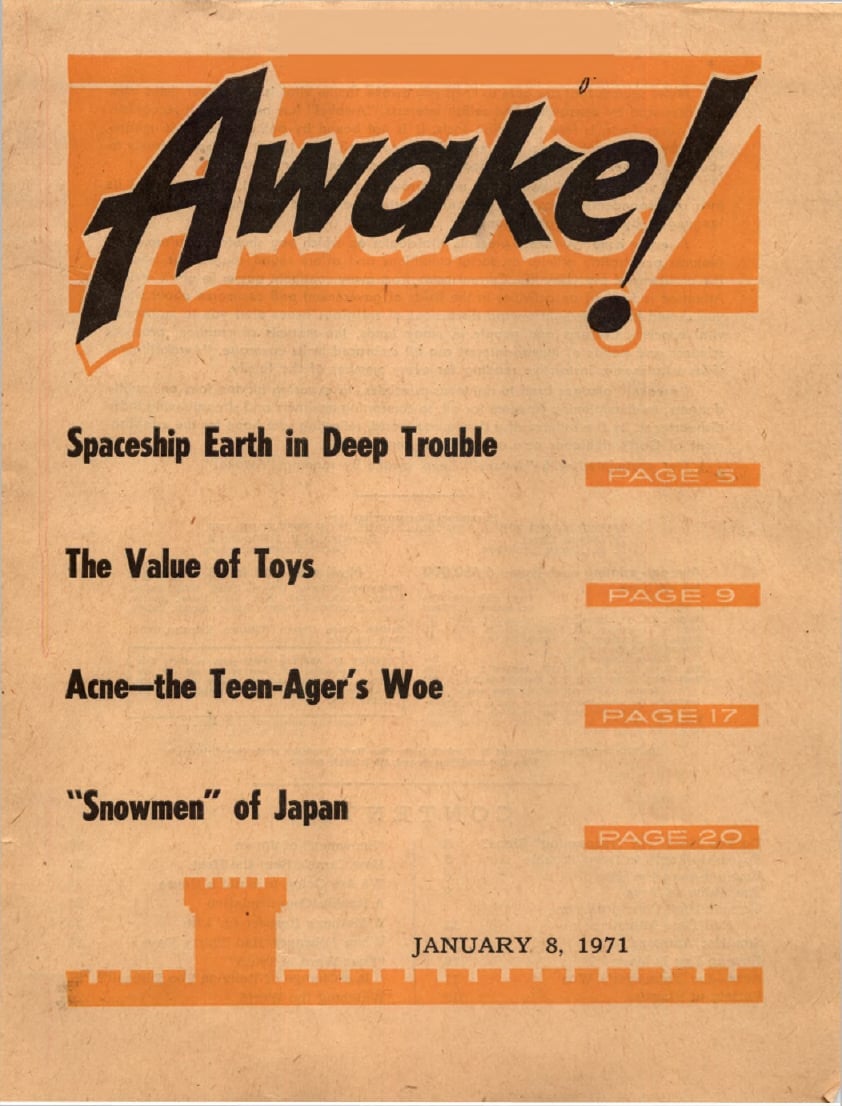
Awake! — January 8, 1971
Source: jw.org
Contents
Do You Heed “No Trespassing” Signs?
Spaceship Earth in Deep Trouble
Brighter than the Sun
The Value of Toys
German High Court Rules on Full-Time Ministers
Smallest Antelope
How an Egg Is Made
Acne—the Teen-Ager’s Woe
Variety of Flowers
“Snowmen” of Japan
How Camels Beat the Heat
We Are Going to Build a House
A Rabbi’s Commendation
A Mother’s Respect for Life
When February Had Thirty Days
Is a Change of Religion Too Difficult?
Watching the World
“Be My Follower”
“The Watchtower”
Do You Heed “No Trespassing” Signs?
Do You Heed “No Trespassing” Signs?
“NO TRESPASSING” signs are a common sight. Usually they are erected to protect the property or the privacy of the owner on whose place the “No Trespassing” signs appear. At times they are for the purpose of protecting a lawn. Government military installations often have “No Trespassing” signs for security reasons. Then again, a “No Trespassing” sign may be erected to protect a would-be trespasser from harm, as in the case of high-power electrical installations. He who fails to heed such signs might get into difficulty and might even harm himself.
The Bible tells of such a literal “No Trespassing” sign in connection with the giving of God’s law at Mount Sinai. All the people were told to gather at the foot of Mount Sinai. Jehovah further told Moses: “You must set bounds for the people round about, saying, ‘Guard yourselves against going up into the mountain, and do not touch the edge of it. Anybody touching the mountain will positively be put to death.’” By means of this “No Trespassing” sign Jehovah God impressed upon the minds of the Israelites the awesomeness of the place, because it was here that he manifested himself to Israel and gave them his law.—Ex. 19:12, 13.
For our own good the Bible contains what might be said to be many “No Trespassing” signs. For the first man Adam there was, in effect, a “No Trespassing” sign in regard to the fruit of the tree of the knowledge of good and bad, and Adam saw to it that Eve knew of the restriction. As Eve stated: “God has said, ‘You must not eat from it, no, you must not touch it that you do not die.’” Adam and Eve failed to heed that sign, with bad consequences to themselves and to their offspring. Yes, “by one man’s trespass many died.”—Gen. 2:16, 17; 3:1-19; Rom. 5:15.
The Ten Commandments that Jehovah gave to Israel might be said to have consisted of a number of “No Trespassing” signs to protect the rights of God and of everyone’s fellowman. The first four protected God’s rights: No other gods were to be worshiped; no idols were to be made and bowed down to; God’s name was not to be used in a profane manner; man was not to toil secularly on Jehovah’s day, the sabbath. Safeguarding the rights of human creatures were the remaining six commandments, such as those directed against murder, adultery and stealing. In particular might the Tenth Commandment, against coveting, be said to be a “No Trespassing” sign. It said: “You must not desire . . . anything that belongs to your fellow man.”—Ex. 20:3-17.
A warning example of one who violated one of God’s “No Trespassing” signs with disastrous results to himself was King Uzziah of Judah. He started out well, for we read that “he kept doing what was right in Jehovah’s eyes.” But success made him haughty and he trespassed onto territory strictly reserved for priests. Presumptuously he entered the sanctuary of the temple of Jehovah “to burn incense upon the altar of incense.” When eighty priests strenuously objected, Uzziah became enraged. For his presumptuousness Jehovah God struck him with leprosy. What a tragic ending to such a fine beginning!—2 Chron. 26:1-21.
Today, among God’s “No Trespassing” signs that are heeded the least are those relating to sex. In this regard the apostle Paul clearly stated at 1 Thessalonians 4:3-6: “This is what God wills, the sanctifying of you, that you abstain from fornication; . . . that no one go to the point of harming and encroach upon the rights of his brother in this matter.”—1 Thess. 4:3-6.
How can fornication be said to be the violation of one of God’s “No Trespassing” signs? In that the body of an individual Christian belongs to Jehovah God, by reason of his dedication, and by committing fornication the Christian is sinning against his own body. (1 Cor. 6:18) Since this is so, the Christian who commits fornication is, as it were, trespassing upon God’s property.
And certainly the command not to “go to the point of harming and encroach upon the rights of [a] brother in this matter” also constitutes a “No Trespassing” sign. It forbids taking liberties with the mate of another. Today it is a common custom in some places to wear wedding rings. It might be said that a wedding ring, on either a man or a woman, is also a “No Trespassing” sign. It shows that he or she belongs to another.
What will help us to heed these “No Trespassing” signs? God’s Word not only gives us these signs but also furnishes help in heeding them. One such help is the fear of Jehovah God that the Bible inculcates. We do well to fear God, “for our God is also a consuming fire.” And if we have that fear it will have a wholesome effect upon us, for we also read: “The fear of Jehovah means the hating of bad.” Trespassing on the rights of others is something bad. If we hate this form of badness we will not trespass.—Heb. 12:29; Prov. 8:13.
Another great aid is the so-called “Golden Rule” that Jesus gave: “Just as you want men to do to you, do the same way to them.” We want others to respect our rights, our belongings, do we not? So we should respect theirs by heeding the “No Trespassing” signs.—Luke 6:31.
What if others trespass against us? Then we do well to remember that we ourselves trespass at times and that ‘God has kindly forgiven us all our trespasses.’ (Col. 2:13) Since Jehovah God has kindly forgiven us our trespasses we should be willing to forgive the trespasses of others against us. In fact, it is to our own lasting welfare that we do so, for Jesus Christ, in commenting on his Model Prayer, said: “if you forgive men their trespasses, your heavenly Father will also forgive you; whereas if you do not forgive men their trespasses, neither will your Father forgive your trespasses.”—Matt. 6:12-15.
Spaceship Earth in Deep Trouble
Spaceship Earth in Deep Trouble
“ALL systems are go!” These were reassuring words to the three astronauts aboard Apollo 13 as it stood poised for its voyage to the moon and back. The success of the mission depended on the intricate life-support systems of the spacecraft; they would need to function with exactness throughout its nearly half-million-mile journey. The supplies of oxygen, water and electricity would have to be husbanded carefully. If one system went awry it could knock out other systems and endanger the men’s lives.
They did experience near disaster. But through constant communication with Ground Control and strict compliance with its instructions, the craft and crew were brought safely back to earth.
Our earth is in reality a giant spaceship and one that is in trouble, as earth’s physical environment is being thrown out of balance. It was not always this way. When the Creator put perfect human “passengers” on the earth, all its life-support systems were ready and functioning in complete harmony. Everything was in faultless balance. God made the reassuring pronouncement: ‘It is very good.’—Gen. 1:31.
For the good of these first human inhabitants of earth God gave them certain instructions. Obedience to such would keep them on a safe course wherein they would “have in subjection . . . all the earth” and would “cultivate . . . and . . . take care of” their environment.—Gen. 1:26; 2:15.
All life-support systems of the earth were designed to respond to man’s loving oversight. The whole globe was to become a paradise of beauty for a perfect human race to enjoy eternally. Only disobedience to his Creator would throw man and his environment out of balance.
The first man disobeyed his Creator and started doing things according to his own wisdom. This started the long chain of events that has brought us to the few remaining years of this system of things and an environmental defilement that now threatens all life on this planet.
Concern for Our Environment
Scientists recognize that the life-support arrangement of man’s environment is made up of many interrelated parts. The study of these parts is named “ecology.” This is the branch of biology that deals with the relationships living things have to one another and to their environment. The scientists who study these relationships are called “ecologists.”
Today ecologists deplore the general lack of discernment as to how much human life depends on keeping earth’s environment in balance. They realize that if one aspect of earth’s environment is thrown out of balance, it will in turn affect others, to the harm of man and other living creatures.
Consequently, concern for our environment is being expressed in the highest echelons of human government. For example, President Nixon of the United States in his State of the Union Message early in 1970 said: “The great question of the 70’s is: Shall we surrender our surroundings or shall we make peace with nature and begin making reparations for the damage we have done to our air, to our land, and to our water?”
Nevertheless, many well-informed men of science believe time is running out or has already run out for bringing about a reversal of the rapid trend toward total environmental wreckage of spaceship earth.
Atmosphere Endangered
Without air we cannot live. Pure air is made up of 78 percent nitrogen, 21 percent oxygen and 1 percent divided between argon, water vapor and carbon dioxide. Maintaining the balance involves the use and renewal of these gases by plant, soil, animal and human life.
A dramatic example of this marvelous interlocking of air, soil, plant, animal and human life is seen in the nitrogen cycle. Nitrogen is required as food for all plants and fleshly creatures but cannot be assimilated in its natural state. However, nitrogen-fixing bacteria in the soil take this gas from the air in a wonderfully efficient way, changing it into plant food. In turn, animals and humans feed on the plants. When these die, other bacteria move in to decompose the dead plants and flesh. Ammonia results.
The remaining moves to complete the cycle are achieved by two distinct bacterial groups. The first changes the ammonia into nitrates and the other releases free nitrogen into the atmosphere. A similar vital interplay between plant life and air is seen in the way plants take in carbon dioxide through their leaves and release oxygen. Refraining from interfering with such a finely balanced system can assure us a lasting supply of clean and healthful air.
Instead of dealing kindly with his atmospheric environment, man has used it as a dumping ground. Ever since the so-called industrial age began he has spewed hundreds of millions of tons of pollutants into it, thinking that air currents would carry them off into limitless space. No thought was given as to what tomorrow might bring forth, yet it is as a noted writer once said: “Sooner or later, everybody sits down to a banquet of consequences.”
It appears that humans are now sitting down to that “banquet.” Time magazine of February 2, 1970, stated: “What most Americans now breathe is closer to ambient filth than to air.” The Toronto Star Weekly of April 11, 1970, called it the “Exhausted Air.” Automobiles are said to be the worst offenders, causing some 60 percent of all air pollution in North American cities. However, one jet aircraft spews out pollutants equal to what is emitted by one thousand automobiles! United States industry vomits 172 million tons of smoke and gases into the air each year. When the “ambient filth” of New York’s atmosphere was recently checked it showed that a person in that city daily breathes in the same amount of poisonous fumes as if he smoked thirty-eight cigarettes a day!
In 1968, a leading meteorologist, Morris Neiburger, showed the criticalness of the situation by saying:
“It is clear that as the amount of pollution . . . increases, a stage will be reached at which the cleansing processes in the atmosphere are no longer adequate to purify the air before it reaches or returns to sources where it receives additional pollution. . . . As time goes on the amount of pollution throughout the world will then increase. Eventually the concentration of toxic substances will reach and exceed lethal concentrations and life on earth will pass away.”
With the arrival of the very large urban units and ever-larger highways to cope with more and more cars, the balanced arrangement between plants, air and soil suffers dangerous interference. It is estimated that one million acres of land are added each year to the 60 million acres in the United States that have already gone out of plant and tree production due to highways and general urbanization. Now it is noted that oxygen and nitrogen cycles are not functioning effectively. The atmosphere is becoming overloaded with poisonous gases such as carbon monoxide and dioxide plus nitrogen oxides (which cause eye irritation and infection). Pesticides have played havoc with vital soil bacteria and insects helpful to plants, besides contributing to the general air pollution.
No wonder Life magazine of January 3, 1970, stated: “Scientists have solid experimental and theoretical evidence to support . . . predictions” such as: “In a decade, urban dwellers will have to wear gas masks to survive air pollution,” and “increased carbon dioxide in the atmosphere will affect earth’s temperature, leading to mass flooding or a new ice age.”
Do you not think it would be wise for mankind to husband the rapidly dwindling atmospheric resources as the astronauts did when some of their life-support systems failed?
Is Our Water Supply Secure?
Some persons would be inclined to say, Yes, as they point to the fact that 71 percent of earth’s surface is presently covered with water. In actuality, though, a little less than 1 percent of the some 325 million cubic miles of water on the globe is available for man’s use. If that becomes polluted, what then? Man must remember that he cannot live without water either. He does not want to become like the shipwrecked mariner who said: “Water, water everywhere, but not a drop to drink!” Unhappily, this is almost the situation man finds himself in today as he views a shrinking supply of clean water.
Now, why should this be the case? Because rivers have been used as a dumping area for human and industrial wastes. Till recently the rivers and lakes have been able to purify themselves. However, once this self-purification system is taxed beyond its capability to function in proper balance, these water sources lose their precious life-supporting qualities.
Lake Erie, on the border between Canada and the United States, is an outstanding example of what happens when water becomes overburdened with pollutants. This once-beautiful body of water has been so befouled by human and industrial wastes plus chemical phosphates and nitrates that ecologists speak of it as “dying.” Detergent phosphates, after having made the family wash gleaming white, end up in the lake to promote an overgrowth of algae (as do fertilizer nitrates). When the slimy green alga dies and goes into the process of decay, it uses up so much oxygen that the bacterial action once capable of cleaning up organic wastes in the lake is rendered useless. This applies to rivers too.
One would suppose that due to the immensity of the oceans, pollution problems would be minimal. Such is not the case. On February 19, 1970, United States Senator Gaylord Nelson warned of potential disaster to our oceans. He said: “Like all other systems of the planet, the sea is a fragile environment. . . . Upset the intricate ecological systems of the ocean and you run the grave risk of throwing all natural systems so seriously out of balance that the planet will no longer sustain any life. . . . We are already on the way to causing drastic and lasting damage to the ocean and environment.”
This is confirmed by students of the subject who warn that the entire ecology of the ocean may be drastically changed in another five years. They foresee diminishing supplies of food from the oceans. Even now, every kind of fish and animal life in the seas is affected, including the penguins of Antarctica! Is there a particular reason?
Recent studies indicate that the insecticide DDT, carried to the ends of the earth by ocean currents, is a chief contributor to this potential ecological disaster. DDT slows down the process of photosynthesis, the process by which green plants make the sun’s energy available to living creatures. All plant and animal life in the seas is dependent on this process.
Especially significant is the threat to innumerable multitudes of tiny water plants called diatoms. These live close to the surface of the oceans and produce much of earth’s oxygen supply. Without this vital element all of earth’s creatures would find themselves in the same position as the astronauts would have been if their oxygen supply had completely failed!
When we add to this all the other poisons constantly flowing into the oceans from polluted rivers, as well as one million tons of crude oil being spilled or dumped into the seas each year, it simply spells out one thing—spaceship earth is indeed in deep trouble!
What to Do?
In a belated effort to save spaceship earth its passengers have been notified by news media of the crisis. Laws have been passed to control pollution. Some good has resulted. The Thames River in England, once “one of the dirtiest in the world,” has since supported some sixty varieties of fish, but recently, alas! a garbage strike increased the pollution again.
Improvement can take place when people care about their environment. What can you do? Farmers and gardeners can remember that there is nothing wrong with compost or other organic fertilizers or the use of crop rotation to build up the soil. And could it be that you do not need to use your car as much as you do, or could you walk to a nearby store? Is it possible to curb water waste in your home? As housewives, can you use good old laundry soap instead of water-polluting phosphate detergents?
Though the Bible shows that Almighty God will straighten out conditions on earth by means of his kingdom, this is no reason for God-fearing persons today to go along with those who are ‘ruining their way upon the earth.’ (Gen. 6:12) Do what you can now on a personal and a family basis to refrain from adding to the pollution of earth’s environment. And in due time, with the direction provided by the Creator by means of his kingdom, all earth’s life-support systems will be restored to perfect balance and be approved as “very good.”
Brighter than the Sun
Brighter than the Sun
One of the stars nearest to the earth is Arcturus. It is eighty times as bright as the sun and has a diameter about thirty times as great. Being the fourth-brightest star in the heavens, it can be easily seen with the unaided eye.
The Value of Toys
The Value of Toys
A LITTLE pail and shovel, some water and soil or sand—that combination works wonders for a small child! With these tools he creates a castle, a bridge, a spaceship, a cave—any number of things his mind can conceive and delight in. Indeed, a toy may be anything a child gets his hands on to play with.
Toys come in all sizes and shapes, colors and designs. The majority are manufactured to amuse children, stimulate them into action and, hopefully, educate them as well.
Although they are as varied as they are numerous, the simple ones have proved to be the most durable. Balls, ropes, dolls, jacks, building blocks, marbles, model cars and trucks have been used for decades and are still popular with each new generation.
Others have been improved upon over the years. There are now dolls that do almost as many things as a live baby. A few toys even rival complicated computers, being especially geared to create problems for the child to solve and help him to reason and make decisions.
Then, too, there is a vast supply of unconventional toys. For when a child wants to play, he can convert almost anything around him into a plaything, as parents well know. It may be a piece of string, a rock, a flowerpot, a frying pan, a key chain, an old shoe, an ordinary box or a paper bag. As long as it holds his interest, it can serve as an electric light to his imagination, a bridge to the adult world and a train to that wonderful world of make-believe.
Why Some Are Not Used
Generally, the most practical toys are purchased by parents or close relatives, since they are the logical ones to know what will suit the child best. However, despite the wide variety of interesting toys that are now available, some end up unused. Why is this?
For one thing, some parents do not give as much thought to their children’s toys as they could. For instance, a mother may be out shopping when a toy catches her attention. If the color and price are right, she may hurriedly buy it without thinking enough about its value.
Yet her choice could often be wiser if she had asked herself some questions: Is it safe? Do the children have enough of this type of toy? Will this encourage them to think?
Some adults mistakingly purchase toys that fascinate themselves rather than the child. Have you ever done this?
To illustrate, consider a father who buys an expensive train set supposedly for his two-year-old son. He spends hours assembling it. Then when it is set up, he is captivated by it. But the youngster may watch it for a short time and then surprise his father by going off and playing with a paper bag instead. Or he may even take his toy hammer and proceed to hammer away on the set. This is a natural thing for a two-year-old to do, since he does not know how intricate the mechanism of the set is or its cost. He knows only that it moves around, it attracts him and he wants to do something with it rather than sit quietly and watch it. Now, this type of toy would be ideal for an older boy who could appreciate its value and even help to assemble it. But it is entirely too complex for one so young.
Therefore, a child’s age and mental capacity are factors that are essential to consider in selecting toys that he will enjoy.
Simple Ones Usually the Best
Parents usually find through experience that the general rule in toy buying is to keep it simple. Most youngsters will pass up an expensive toy in preference to one that is simple in design and function. Have you not found this to be so with your children?
It is surely not hard to understand, is it? An uncomplicated toy provides the freedom of movement and expression that is so necessary if a young child’s imagination is to work. One has only to observe a little boy at the beach with his pail and shovel to appreciate this fact.
Observation and Individual Personality
But how can you know which kind of toys your children will like best? Well, one of the most effective means of determining that would be to observe them at their play. For instance, that dump truck your son favors so much—why does he prefer it to all his other toys? Have you asked yourself that question? Have you really looked at that truck? Oh, of course you have noticed it. You may have stumbled over it many times. But, really, did you see it through his eyes? Do you know how many different things it becomes for him in his play?
And what about your daughter’s favorite doll? It may be coming apart at the seams, but she refuses to part with it. Why? Do you ever observe her when she plays with it? The way she handles that doll could be revealing. Children not only imitate the adults around them in their play but sometimes use toys to express themselves in many little ways. Yes, observation can be very helpful.
Perhaps, too, you may have found that each child must be dealt with individually as far as toys are concerned. A toy that is popular with one child may be ignored by another because toys mean different things to different children. For some, they are a means of expression: The child may use them to make noise, playact and do many other things. For others, toys are a source of amusement and entertainment. These children may be more docile and may prefer toys that allow them to be quiet spectators rather than vigorous participants. One would have to observe each child to determine which kind of toy will best suit his personality.
Stimulating Curiosity and Imagination
Play has been referred to as a child’s work, and if that be true, then toys are certainly his tools. They teach him to investigate, observe, reason, remember, build, and coordinate his mind and body. To make sure that your children’s toys do the same, why not take an inventory of their toys? With each toy in hand, examine it and ask yourself if it does any of the following things:
One of the first things a toy should do a child is arouse his curiosity. If it does not, it will rarely hold his interest for long. That is one of the reasons why a toy for a baby is purposely oversized and vivid in color. It first attracts his attention. Once he notices it, then he wants to know more about it. He will grasp at it, shake it, squeeze it, pound it and, of course, it will usually end up in his mouth for a taste. Frequently, he may break it in the process. But even then it has served its purpose. It has given him greater enjoyment and some new information to add to his growing fund of knowledge.
Also, does a toy stimulate your child’s imagination? Once a toy triggers a child’s imagination, there is no limit to what the item can become to him. It need not be a formal toy. Your three-year-old son can take one of your shoes, and in seconds it becomes for him a sailboat on the high seas; a cave in which refugees are hid; an ark in which stuffed, as well as live, animals and insects are housed, including perhaps a dead frog or a live caterpillar. Any number of toys could qualify. It is not the materials used that are important to him but what these become through his mind’s eye. A complicated mechanical toy that does all the work itself would rob him of much of his pleasure in make-believe.
The same principle holds true with girls. How little girls delight in dressing up in their mother’s clothes and playing house with their dolls! Why, a little girl may line up all her dolls on her bed, and they become schoolchildren listening to a stern lecture from their teacher; next, they are a row of sick patients being ministered to by a sympathetic nurse; still another time, they become a silent first-row audience observing her great stage performance.
In this connection, a word of caution would be in order. There are now too many things that tend to stifle children from using their imagination. Television and many other gadgets have robbed children of much of the simple pleasure of yesteryear. As a result, reading has become almost a lost art. And this is a pity, for reading can be a means of opening up new worlds of learning to a child. In the days when listening to the radio was a popular pastime, a roomful of children could listen to a program and then relate dozens of different concepts from the same broadcast.
Although television is certainly a marvelous means of educating the young, it can stunt their imaginative powers. Many children sit immobile in front of a television screen for hours at a time with little mental stimulation. In fact, a study by the Carnegie Corporation, the Ford Foundation and the United States Office of Education found that “preschool youngsters spend 54 hours a week watching television.” They put the blame partly on the parents who use television as an electronic baby-sitter. Surely, concerned parents will try to arrest this trend by providing entertainment that will not only amuse their children but, more importantly, stimulate them to think.
Aids to Physical Growth
When a child gets past the exploratory and imaginary stages of his development, his play becomes much more physical. Toys that help him to develop physically will be most practical then. By the time he is three years old, his toys usually include those that improve his coordination and strengthen his reflexes.
Tricycles and scooters are excellent developing leg muscles. Then as he moves about in these mobile toys, he is able to learn to coordinate his leg movements with his arms in steering. Next, he may advance to jumping rope, use of skates and swings and then to the bicycle. And although much of this physical activity is hard work for him, he enjoys the feeling of movement and especially speed. It gives him pleasure and laughter and helps him to grow at the same time.
As a child’s play becomes more physical, he may tend to concentrate on the toys that exercise only his body. It is up to his parents to see to it that his play remains balanced. They can encourage his use of books, puzzles and various table games to offset activity that is solely physical.
Developing Various Skills
Some children give evidence of having unusual skills from a very early age. In fact, a child’s favorite plaything is often related to his ability. The little boy who invariably prefers his planes and toys with motors may show an aptitude along mechanical lines when he grows up. And the four-year-old who often goes to the piano with great interest may have musical talent. Of course, you may not have a budding Mozart or Einstein under your roof. But if your child does show some talent, he can be encouraged with certain toys.
There are various toy instruments that are inexpensive, and parents can use these to determine if future lessons to develop these skills are warranted. Miniature pianos, various stringed instruments, xylophones, harmonicas, accordions and the currently popular guitar are some, to name just a few. There are also clay sets, chemistry sets and water-color paint sets.
Even if your children are not especially talented in any of the arts, they can still enjoy expressing themselves in ways unknown to them previously. Toys can cause their little worlds to grow and expand.
Future Selections
Now as you proceed to analyze your children’s toys, you may find that some are not as effective as you would like them to be for one reason or another. There is no need, however, to throw them out unless, of course, they are unsafe or unwise. But you can resolve to be more selective in the future. Safety should certainly be a factor. Toys that are poorly constructed can break easily and cause harm. They all should be examined for sharp edges, rusting, peeling of paint and many other features that could be dangerous, especially for the very young.
Additionally, some toys may be quite safe but still unwise for children to have. Just because toys are sold in a store or may be currently popular with the majority, this will not unduly influence those who follow godly principles. The toys that methodically train a child to be violent and pretend to “kill” are not in keeping with the Christian command to “have intense love for one another” and to “seek peace and pursue it.” (1 Pet. 3:11; 4:8) So principles besides safety and popularity govern Christian parents’ choice of toys.
Thus, as you resolve to select toys more wisely in the future, you may want to give more consideration to what each toy will help your child to accomplish: Will it arouse his curiosity and imagination? Will it improve his coordination? Will it stimulate his creative ability? And, most important of all, will it make him think? Indeed, toys are a valuable aid in a child’s mental and physical growth, and you, as parents, can use them as tools to guide that growth.
German High Court Rules on Full-Time Ministers
German High Court Rules on Full-Time Ministers
By “Awake!” correspondent in West Germany
JEHOVAH‘S WITNESSES are well known in Germany for not having compromised for the sake of expediency during Hitler’s Reich. People of other religions, including clergymen, heiled Hitler, saluted the Nazi flag, and supported Hitler’s armies in their aggressive warfare. Nearly all Catholic priests and Protestant ministers were guilty of compromising with Hitler’s regime. These clergymen were granted exemption from military service during that time.
But Jehovah’s witnesses steadfastly refused to heil Hitler, salute the Nazi flag, or support his armies. They too claimed exemption as ministers of religion. But they were refused exemption and were persecuted. Thousands of them were sent to Nazi death camps and many were killed.
No Exemption
After World War II, military conscription was again introduced in Germany, in 1956. Catholic priests and clergymen of other religions were again given exemption. At first, Jehovah’s witnesses were also exempted. But then alternative service requirements were introduced, and Jehovah’s witnesses were not granted exemption from this service.
In 1962 the first sentence under this new law was pronounced upon a young minister of Jehovah’s witnesses. He had refused to report for service alternative to military conscription. But since ministers of state churches and other denominations were not required to perform this service, this minister of Jehovah’s witnesses claimed that he was also eligible for exemption under the West German constitution. However, his appeal was rejected. He was sentenced to four months in prison.
Many similar cases followed, with jail sentences given. Among those sentenced were ministers of Jehovah’s witnesses who devoted full time to ministerial activities. An appeal for constitutional rights was submitted in an attempt to reverse these decisions and obtain legal recognition as ministers exempt from all conscription.
In October of 1963 further evidence was submitted to the court. This outlined in great detail the fact that full-time ministers of Jehovah’s witnesses are ordained ministers entitled to the exemption provided by the constitution.
The appeal was not acted upon. The case remained pending for seven years. During all that time full-time ministers of Jehovah’s witnesses continued to be sentenced to prison for periods of from one to sixteen months.
Also, a new situation arose. Upon release from prison, these ministers were again called up for alternative service. When they refused, they were imprisoned a second time. Some were imprisoned a third time. Hence, a further appeal for constitutional rights was submitted to the Federal Constitutional Court of West Germany. The appeal contested the constitutionality of repeated convictions for the same violation.
High Court Decides
On March 7, 1968, the Federal Constitutional Court handed down its decision. It declared that repeated sentencing in these cases was indeed unconstitutional. It noted that no one can be punished twice for the same act according to basic law.
Yet, this did not entirely solve the problem. Jehovah’s witnesses continued to be jailed the first time for refusing conscription and alternative service not required of ministers of other religions.
Finally, on December 11, 1969, in Berlin, the 8th Senate of the Administrative Court of the Federal Government handed down a decision. It was of great significance regarding the status of full-time ministers of Jehovah’s witnesses serving as special pioneers and overseers of Christian congregations.
This highest administrative court of Germany declared these full-time ministers exempt from military service and alternative service as well. This reversed the decision taken by the 7th Senate of this same court several years earlier.
Arguments Against
Previously, the 7th Senate had contended that such full-time ministers of Jehovah’s witnesses did not merit exemption because they did not fill a position similar to that of ministers of other religions. It upheld a lower court’s decision that the positions did not “correspond” because of the differences in study and instruction given Catholic or Protestant ministers.
The court had also maintained: “A minister is only deserving of protection, according to the law, when his position before the congregation of believers stands out in that he alone is allowed to perform the ceremonies of the religious cult and he is conferred a special dignity, which belongs exclusively to the profession of minister; in contrast to this, the religious group of Jehovah’s witnesses do not recognize any class as laity, nor any clergy class.”
The court had also stated: “Decisive is the image that a denomination normally has of a minister; this image is in the larger denominations the position of a minister who as a pastor of his flock does a pastoral work, without which the ceremonial life practically succumbs.”
Hence, these previous decisions had maintained that Jehovah’s witnesses who were serving full time did not have the “image” of a clergyman. That was, and is, certainly true. And Jehovah’s witnesses do not want that “image.” But this did not mean that they were not ministers in the true sense of the word.
Court Upholds Rights
In its final decision of December 11, 1969, the 8th Senate disagreed with these previous interpretations. Instead, in the case at issue of a special pioneer and overseer, it upheld the rights granted by law to other ministers serving full time regardless of their religion. It stated: “The neutrality of the State toward the religious comprehensions of its citizens prohibits the State from evaluating the teaching and institutes of religious associations and other denominations.”
The court showed that the accepted “image” was not the important thing, but the duties performed were. It said: “From the principle of religious parity, however, it is inferred that here, for reasons founded on constitutional rights, the ‘pattern’ or ‘vocational image’ of a minister of both large ‘Christian denominations [Roman Catholic and Evangelical] as developed through their church order and theological interpretation may not be used as a measuring rod for the ministers of other denominations. Differences in faith and dogmas, which are understood as peculiar to the self-representation of both large Christian denominations, are not to be taken into consideration.”
Thus, the court declared that it would not be possible to force a minister of a religion other than the two large denominations to conform to a certain standard that these churches had built up for themselves. Religious equality and exemption could not be made dependent upon any particular religion’s idea of the office of minister. With Jehovah’s witnesses, it is not an “office” of “title” or “image” that is vital in establishing their ministry, but the spiritual services that they perform.
In regard to what constitutes a full-time minister, the court said: “Whether a ministerial activity . . . ‘corresponds’ to the activities that are assigned to the [Roman Catholic and Evangelical] ministers can only be decided upon according to outward characteristics, without taking into consideration a certain ‘pattern’ determined theologically or by church law.” It was pointed out that ministerial activity would be considered a “full-time” activity when the minister devoted his full labor to ministering.
Nor should just one type of schooling or preparation be the determining factor. The court decided that “what preparatory instruction and verification are required when someone is assigned to a permanent full-time activity as a minister and how this assignment is made is also of no special significance. The State leaves it up to the religious convictions and teachings of all religious associations to determine under which circumstances duties are assigned, the same as these are correspondingly attended to by the named ministers of the large churches.”
This firm decision by the German high court for freedom of religious conviction is commendable. It is similar to the noteworthy decisions of other countries where the rights of the individual are highly held.
However, long before this decision was handed down, Jehovah’s witnesses had shown that they are indeed ordained ministers of the Most High God Jehovah. They have long been known throughout all of Germany for their zealous ministerial work. That activity has helped tens of thousands of righteously disposed persons in Germany to gain a knowledge of God’s Word, the Bible, and has enabled them to serve their Creator.
Nevertheless, the court’s decision is a fine legal acknowledgment of the God-given ordination of such full-time ministers of Jehovah.
Smallest Antelope
Smallest Antelope
● The smallest antelope is the dik-dik, found mainly in eastern Africa. The largest dik-diks are only about fourteen or fifteen inches high at the shoulder. They are very delicate and have tiny hooves and short tails.
How an Egg Is Made
How an Egg Is Made
HAVE you ever given thought to how an egg is made? It is quite a complicated as well as orderly process, a fascinating one.
The development of an egg takes place in the ovary and oviduct. Chickens have only one ovary, on the left side. Certain wild birds, however, have two ovaries and oviducts. The ovary in a chicken might be likened to a bunch of grapes, with the many ova in various stages of development. The most ova ever found in one chicken was 3,065, and the greatest number of eggs any one chicken laid in her lifetime, as far as observed by man, is said to have been 1,515 in eight years.
The egg-producing process of a chicken takes about twenty-four hours. In less than an hour after a chicken has laid an egg another yolk has reached its full size, at which time it consists of six layers. In wild birds the sixth layer depends upon the presence of a male bird. If no male bird is on hand the female cannot produce her egg. Domestic fowl, though, can keep on laying eggs without ever seeing a rooster.
Can there be any purpose in this? Indeed there is. The purpose served by wild birds in laying eggs is the reproduction of their species, and so the presence of the male is required for mating. But domestic chickens also lay eggs for human consumption, and for this purpose a male bird is not needed.
Once the yolk has been fully formed or is ripe, it drops off the ovarian stem into the oviduct or egg tube, which consists of several sections. In the first section, known as the infundibulum, the egg is fertilized if the chicken has mated. Its stay in this section is but a matter of minutes; then it passes to the next section, the magnum. As the egg moves through this section the albumin is added, layer upon layer, four in all, a process that takes about four hours. By then it has also reached the next section, the isthmus, where two membranes, an inner and an outer, are added to cover the albumin layers.
These latter two membranes are completed in about an hour and ten minutes, then the egg reaches the uterus or shell gland, where it tarries for some nineteen hours. When the outer and inner membranes were first added they fit snugly over the egg, but soon they loosen up and so in the uterus the first five hours are consumed in filling out the membranes with water and minerals, a process termed “plumping” the egg. Then for the next fourteen hours several layers of eggshell are added. After that the cuticle or skin is supplied, giving the egg its characteristic color. The egg then moves on to the vagina and is expelled by the chicken.
By now you may well be asking, Who instructed the chicken in the making of an egg? How does she know how long the egg has to be in each section?
Furthermore, the producing of an eggshell presents quite a challenge to a chicken. The blood of a laying chicken at any one time contains only 25 milligrams of calcium (non-layers and roosters have only about one-third as much), yet while producing an eggshell the chicken uses 125 milligrams per hour. Where, then, does she get this extra calcium? The original source, of course, is the food she eats, the chicken extracting the calcium from her intestines. But still she is unable to absorb calcium from this source as quickly as she needs it.
So what does she do? She draws it from calcium reserves found in the ‘medullary bones’ located within the cavities of most of her regular bones. These secondary bones are not found in male chickens or in chickens too young or too old to lay eggs. This system is so efficient that a hen can mobilize as much as 10 percent of the total calcium in her bones in one day if her diet is very low in calcium. However, if her diet continues low she cannot keep this up and so first compensates by laying eggs with thinner shells. If a serious shortage of calcium persists, the chicken quits laying altogether rather than laying eggs without shells. Who taught her how to grow extra bones so as to have sufficient calcium for eggshells?
It is indeed interesting to note the facts of how a chicken egg is made. Truly there is evidence in it of wisdom and design. It adds its testimony to countless other wonders of visible creation that there is indeed an all-wise and almighty Creator, whom the Bible identifies as Jehovah God.
Acne—the Teen-Ager’s Woe
Acne—the Teen-Ager’s Woe
ARE you a teen-age youth who is troubled with acne? Do not take it too seriously. It no doubt looks far worse to you than it does to others. You may be particularly sensitive about it because you have become very conscious of your appearance, quite likely due to your budding interest in the opposite sex.
In fact, if you are a boy, your having acne might even be said to be something for which to be thankful. How so? you ask. In that, for one thing, it is evidence that you are not a eunuch. Eunuchs are not plagued with acne, for acne is triggered by the male or androgenic hormones. Proof of this is seen in that eunuchs get acne when they are given male hormones. (Female hormones have the opposite effect. That is why some doctors give these female hormones to girls bothered with acne.) And for another thing, since acne in both males and females is a result of increased activity of what are called “male hormones,” it might be said to be an indication that you are progressing physically, and it is hoped also mentally and emotionally, toward adulthood.
But just how does this hormone work to cause acne?
Your skin consists of several main layers. The upper layer, known as the epidermis, may be subdivided into a number of layers, the topmost of which might be likened to shingles on a roof. Beneath the epidermis is the dermis, in which are found the blood vessels, nerves, the sweat and oil glands and the hair roots. Sweat glands have their own openings or pores leading from the dermis to the top of the skin. The hairs rest in tiny openings alongside which are from two to five oil glands that lubricate the skin as well as keep it soft and smooth and serve to protect it.
At puberty the “male hormone,” in both boys and girls, seems to increase the oil production of these glands. Also it appears that the cells of the upper layer of skin grow more rapidly than they are shed. As a result some 80 percent of both girls and boys have a bout with acne, boys more severely than girls, but the girls earlier than the boys. A severe case of acne is invariably associated with a very oily skin, which condition often continues even after the acne disappears. Another explanation could be that the approach of puberty puts a strain on the kidneys, with the result that the skin is overburdened with the problem of removing impurities from the blood. It is a known fact that sweating has a beneficial effect on kidney patients.
Aggravating Factors
Since increased hormonal activity accompanies puberty, does that mean that nothing can be done about acne? Not necessarily, even though it is quite likely that in severe cases susceptibility to acne is inherited. This is seen from the fact that youths with severe cases of acne often have parents who were likewise plagued in their youth.
Among the things that might aggravate acne are failure to keep the skin clean, or the use of irritating soaps or the habit of squeezing blackheads or pimples.
In view of the fact that oiliness of the skin is associated with acne, exposure to oils could make it worse. Thus if one’s occupation required one to be around or in touch with oil or oil products, this could worsen one’s acne. An interesting report appeared in Archives of Dermatology, May 1970, on the subject of “pomade acne.” This was found to afflict Africans who make use of pomades to keep their hair straight. Interestingly, it showed that ordinary Vaseline or mineral oil products were far less likely to cause an acne condition than were the fancy, high-priced and highly advertised products.
It is also generally recognized that emotional problems can aggravate or cause acne. Thus Dr. Morris Fishbein, a leading medical author and editor, noted that “even antagonism between the acne sufferer and parents or close associates” can cause a persistent case of acne. And so it is not surprising that leading dermatologists, such as Dr. Gordon Sauer, hold that nervous tension, as when youths worry unduly over examinations or school sports, as well as a lack of sufficient rest and sleep can be responsible for acne.
Many years ago it was believed that sex had something to do with acne, as it accompanied puberty, when youth becomes sex conscious. However, while modern medical authorities, by a large majority, strongly stress that there is just no connection between masturbation and acne, there still could be a relationship, indirectly. In what way? In that if the practice creates an emotional problem, causing one to worry about it, this could have a bearing on one’s having acne. But youths can be afflicted with acne without engaging in this practice, and, on the other hand, they could well be indulging in it and yet not have acne.
And finally there is the matter of diet. While for ever so many years skin specialists were prone to hold that diet played a decisive role in acne, the medical profession by and large has discarded the view that diet has any bearing on it.
What Can Be Done About It?
There are two avenues of approach open to one afflicted with acne, and both can be utilized. There is the topical remedy. That is, the remedy is applied locally, to the skin. There is general agreement that, since acne is worse in the winter than in the summer, sunshine has a beneficial effect on acne. However, not so general is the agreement as to the use of sunlamps in treating acne. If they are used, care must be exercised so that one does not burn the skin. It is best to start with very short periods of exposure to the sunlamp and then gradually increase the amount.
Dermatologists generally recommend extra precautions in keeping the skin clean. Recommended by latest writers on the subject is that the skin be cleansed often and thoroughly with a soap that has a great deal of drying effect. This could be an old-fashioned laundry soap or some modern medicated soap. Since it is usually not convenient to wash the face often every day, these skin specialists recommend astringent lotions. Swimming is also said to be of help. In fact, according to such modern authorities as Dr. Milton Ross, the acne problem is basically a matter of “a few ounces of soap, medication and conscientious hard work.” This may often, though not always, be the case.
The Systemic Approach
The systemic approach considers acne as more or less a symptom and tries to get at the contributing causes. This approach recognizes that stress is likely to play a prominent role in acne. So the situation might be improved if you learn not to worry unduly about school examinations, sports events or personal problems. Especially try to cooperate with your parents, appreciate their good points and do not exaggerate in your mind their shortcomings. This may go far in relieving tension at home. Remember, the Bible says that love builds up and covers over others’ weaknesses. Love in your family circle may well make the difference between your having a light case or a severe case of acne.—1 Cor. 8:1; 1 Pet. 4:8.
Recommended also is exercise, for that which improves your general health will also work against acne. It therefore follows that you should see to it that you get sufficient rest and sleep. Learn to exercise self-control by turning off the TV set when it is time for sleep.
Vitamins are recommended by some. While in certain cases they have not proved effective, in other cases they have. And while vitamin A is the vitamin usually prescribed for acne sufferers, the B, C and D vitamins are also said to be helpful.
What about diet? Since the modern trend is to ignore diet almost entirely in dealing with the trouble, what should a teen-ager who has a serious acne problem do?
Do not be like the young woman who wrote to a leading medical authority, complaining about persistent acne in spite of doctors and medication and who said she kept eating sweets and pastry because the doctors said that diet had no bearing on acne. Rather, be wise and experiment. Find out for yourself. A well-balanced diet is essential for everyone’s health. Professor of Dermatology Dr. Sauer recommends: DO NOT EAT chocolate, peanut butter, ice cream and such things. Avoid excesses of sweets and fats, especially French fried potatoes and spicy foods. Go easy on oysters and like seafoods. Try to do without nerve and headache medicines. If such self-denial brings relief, is it not worth while? On the other hand, be sure to eat enough fruits and vegetables.
Why not follow these suggestions for two or three weeks and, if no improvement is noted, it may be that your remedy lies in a different direction. It may be that you need extra vitamins, exercise, more rest and sleep to get rid of tensions. Or you may want to go to a dermatologist for medical treatment.
But, after all is said and done, it is well to remember a few basic principles, you teen-agers with the acne problem. Concentrate on developing a good, sunny disposition and the fine qualities that make people enjoy your company. Make it a point to be always neat and clean. Do not get impatient with the problem, for most likely you will find it to be but a temporary affliction. Remember that it can even be a blessing in disguise if it makes you less vain and more sympathetic with the suffering that other persons have to endure. Since ever so many persons had the same problem in their youth, most of them will understand. Appreciate and thank God for the blessings you do have, not least of which is youth and strength.—Prov. 20:29.
Variety of Flowers
Variety of Flowers
There are about 200,000 known kinds of flowers on earth. They range in size from water blossoms so small they can be seen only with a microscope, to tropical flowers that are three feet wide. Some kinds of flowers have petals. Others look like stars, saucers or balloons. Some even have shapes that resemble insects, spiders or birds. Many flowers have smells that attract the birds or insects that help fertilize them.
“Snowmen” of Japan
“Snowmen” of Japan
BY “AWAKE!” CORRESPONDENT IN JAPAN
WHAT fun! Has it not often been a child’s delight to build a snowman? But in Sapporo, in Japan’s northern island of Hokkaido, they have super snowmen. Some of these weigh over a thousand tons, and are breathtaking in their artistic detail. There also are snow animals, birds and fishes, snow gods, snow trains and jumbo jets, snow houses, pagodas and castles—a virtual world modeled in snow!
It is a short-lived world, however—just four days in late January or early February. Then it is pulverized back into formless snow and carted away.
The site of this festival in snow, Sapporo, is called “Japan’s City of Youth.” Though little more than one hundred years old, it has blossomed into a bustling metropolis of 930,000 people. Strangely, a recent snow model depicted “Sapporo’s One-Millionth Citizen” as a bleary-eyed individual with just two bottom teeth. Most of the city’s hardy populace look healthier than that!
Japanese cities generally grew out of groups of feudal villages, with narrow, winding alleys for streets. But Sapporo is different. Designed with the aid of British and American town planners, it has wide, straight boulevards, and a 330-foot-wide park runs east and west through the center of the city. This is lined with lilac and acacia trees, which blend with green lawns and colorful beds of flowers in summer. However, it is a contrast in white in wintertime, and especially during the festival in snow.
A Festival That Snowballed
This festival dates from about 1950. To brighten the drudgery of the north’s long winter, the children were organized to build snow models, for fun and exercise. As the festival grew larger, the city fathers saw big possibilities in using it to popularize Sapporo. The festival has now snowballed into one of mammoth proportions.
A solid snow platform is constructed for each exhibit, and wooden scaffoldings are anchored into this base. These must be sturdy, as a thousand-ton avalanche of snow and ice can be dangerous to the viewer! Several years ago, a replica of Noah’s ark collapsed during construction, and had to be done over again. Had the builders simply followed the blueprint given in the Bible book of Genesis, instead of the imaginary pattern of the movie “The Bible,” they would no doubt have produced a sturdier ark. But at least the animals were beautifully accurate, true-to-life representations.
For the 1970 exhibition, ancient history was represented in a beautifully “carved” representation, forty-five feet high and one hundred feet broad, of the Abu-Simbel Rock Temple of Egypt, said to have been built by Ramses II in celebration of his conquest of the Sudan. This was complete with pharaohs, winged lions and hieroglyphics, which looked just as baffling to the Japanese as Japanese writing does to outsiders.
Modern history was featured at another exhibition site, where the visitor could make his ‘first big steps’ among craters of the moon, but with feet crunching snow instead of moon dust. Alongside, two snowman astronauts, a snow lunar module and a snow Apollo 11 rocket lent realism to the scene.
A Child’s Delight in Snow and Ice
However, the “show” is mainly a child’s delight. For here, depicted in snow, are many of the stories, from Japan and from the West, that have been told and retold to children down through the centuries. One display, stretching the width of the city park, depicts Princess Snow White arriving at “the dazzling castle of the Prince.” She comes by “bullet” train, accompanied by the dwarfs, two of whom sit astride the train. A tremendous Gulliver, weighing probably two thousand tons, lies stretched across the park. Snow models of children perform winter sports around his waist while real children in colorful berets and jerseys cluster around his feet to have their pictures taken.
In the next block of the park there is a white-haired, white-faced Urashima Taro, the Rip Van Winkle of Japan, riding out of Japanese folklore on a hundred-ton all-white turtle.
Around the larger models are arrayed many smaller exhibits, including household animals, foxes, badgers and bears. How the children love to hug these life-size animals at close quarters, and to climb up on their icy backs!
As a variation, one full block displays exhibits fashioned out of clear ice! Outstanding among these is a seven-tiered pagoda, its icicle-like structure sparkling with colored lights at night. Nearby, chiseled delicately and skillfully out of ice blocks, are to be seen a farmhouse, barn and farm animals. There is also a treasure ship and a veritable menagerie in ice: frogs, a penguin, a camel, a cobra, a swan, a “black” cat, a bear (safely tied to the fence), a crab, a turtle and arctic dogs.
Snow Gods and Men Demolished
Since Japan is a Buddhist country, a monstrous statue of the Bosatsu-Hanka Buddha, standing thirty-six feet in height, is displayed prominently at the central park. But even “Buddha,” though exquisitely carved on the exterior, is just like any other man-made image inside—only a little colder in Sapporo. He is solid enough to weather most storms, although a fubuki (blizzard) during the festival can be hard on his visitors. And if soft snow does accumulate in his eyes and ears, fire trucks and ladders are on hand to hose and brush it out again. For four crisp days and four illuminated nights, Buddha reigns along with his fellow gods and exhibits.
…