Awake!, December 8, 1970
Download: PDF — Awake!, December 8, 1970
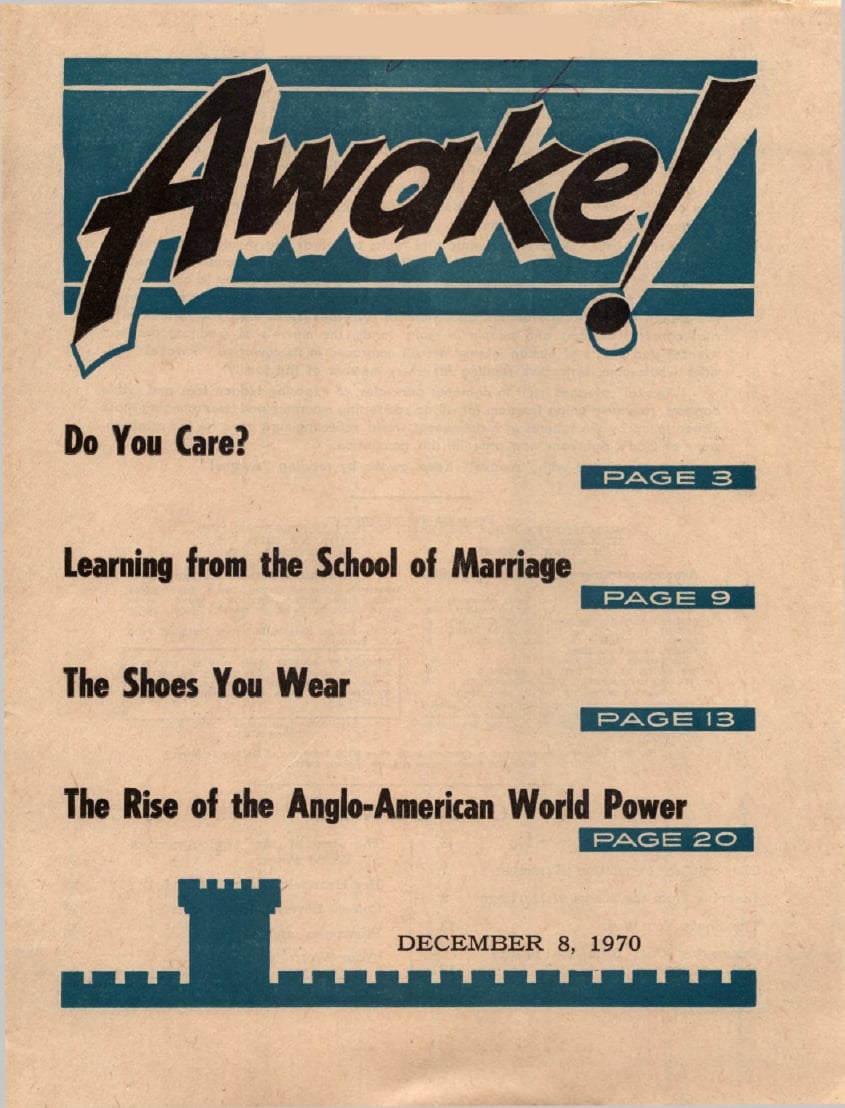
Awake! — December 8, 1970
Source: jw.org
Contents
Do You Care?
The Starfish Population Explosion
Learning from the School of Marriage
The Shoes You Wear
Uncovering Coal from the Prairie Landscape
Respect for the Flag
The Rise of the Anglo-American World Power
Her Heartfelt Desire Realized
Coffee—Beverage of Millions
Pineapples and Coconuts
“You Must Not Testify Falsely”
Watching the World
Is the Bible Really the Word of God?
Drawing Comfort From the Scriptures
Do You Care?
Do You Care?
DURING the Christmas holidays many persons show that they care for their friends and loved ones. They may send them a card or give them gifts. Hundreds of millions of dollars are spent on gifts every Christmas season.
Thus, many persons expect to receive something from friends at Christmastime. And if nothing is received, they feel hurt.
To avoid offending them, many sincere people make an effort to show that they care by sending gifts. But how much thought do these same persons give to God? Do they care about offending him?
Have they considered what God thinks about Christmas? If you want to please God, it is vital to consider what he thinks. To help in this regard, think for a moment about some of the things that you have read about Christmas.
In recent years you may have read in newspapers or in magazine articles that December 25 is not really the date on which Jesus was born. This is widely known. The New York Times of December 24, 1967, for example, observed: “There is no record of the actual time of Jesus’ birth—only a hint in the story of the shepherds in the fields keeping watch over their flocks by night, that it was in a warm season. In winter, sheep were gathered into folds.”—Luke 2:8-12.
In a similar vein, last December 20 the Toronto Star said regarding Christmas: “Let us not, however, go on pretending that it has anything specifically to do with Jesus’ birth. . . . It is high time Christians reminded themselves that the Church got along for its first 380 years without observing the birth of Jesus at all.”
The Origin of Christmas
Nevertheless, the date for Christmas, as well as other Christmas customs, had a definite origin. Newspapers, magazines and encyclopedias have commented freely on this. You yourself have no doubt read some of these articles. The facts are well known in both secular and religious circles. For instance, the New Catholic Encyclopedia observes under “Christmas”:
“The birth of Christ was assigned the date of the winter solstice (December 25 in the Julian calendar, January 6 in the Egyptian), because on this day, as the sun began its return to northern skies, the pagan devotees of Mithra celebrated the dies natalis Solis Invicti (birthday of the invincible sun).”
Yes, Christmas has its roots in ancient pagan festivals. The New York Times explains: “Pope Liberius [in the fourth century] decided to absorb pagan observances by declaring Dec. 25 the official birthday of Jesus. The change of name made little change in form.”
And what was that “form”? The ancient Saturnalia was a time when gross immorality was practiced under the guise of festivities. Says the book Curiosities of Popular Customs by W. S. Walsh:
“In spite of the condemnation of the wise and the sane, Christmas in the early days frequently reproduced all the worst orgies, the debaucheries and the indecencies, of the Bacchanalia and the Saturnalia. The clergy themselves were whirled into the vortex. . . .
“If even among the clergy heathen traditions so strenuously survived, what better could be expected from the laity? The wild revels, indeed, of the Christmas period in olden times almost stagger belief. Obscenity, drunkenness, blasphemy,—nothing came amiss. License was carried to the fullest extent of licentiousness.”—Pages 228, 229.
The change of name, as the New York Times said, indeed “made little change of form.” Is it different today? Certainly not everyone indulges in such conduct. But is it not true that many celebrators tend to throw off moral restraints at Christmas office parties? Perhaps you have been at such a party, and later wished that you had stayed home that day.
God hates such debauchery, and tells Christians, “neither fornicators, nor idolaters, nor adulterers, . . . nor greedy persons, nor drunkards . . . will inherit God’s kingdom.” (1 Cor. 6:9, 10) Is God’s view important to you?
Clergy Do Not Care
The clergy are well aware of the pagan origins of Christmas, yet they encourage the celebration. For example, according to the Vancouver Sun, Anglican Church minister R. Desmond Kimmitt “says it is well-known that Christ was not born in mid-December. The early Christians, he says, found they could not do away with the pagan [Saturnalia] festival and so adopted it.” Yet Kimmitt said: “I would hate to see Christmas as we know it go.”
Also Louis H. Valbracht, as pastor of St. John’s Lutheran Church, Des Moines, Iowa, wrote: “For those who say that Christmas is becoming just a pagan celebration, it should be remembered that Christmas was a pagan celebration.”
But the clergy do not care. Said Lutheran minister Valbracht: “As for me and for my house and for my parish, I say, let’s make Christmas bigger . . . more bustling than it has ever been.”—Successful Farming, December 1965.
So, though the clergy know that Christmas is simply a pagan festival that has been dressed up with some Christian names, it does not bother them. But it should not really surprise us that they do not care, because they have drifted far from the Bible. In recent years newspapers have commented freely on this, as many clergymen openly endorse the “new morality,” which is no morality. So if you find that you cannot share the view of the clergy, if there are things about Christmas that disturb you, you are to be commended.
Does It Really Matter?
Some may feel that if Christmas is celebrated in a decent way, it is all right. ‘Does it really matter that Christmas is tied to pagan festivals?’ they may ask.
God’s Word instructs Christians: “Do not become unevenly yoked with unbelievers. For what fellowship do righteousness and lawlessness have? Or what sharing does light have with darkness? Further, what harmony is there between Christ and Belial? . . . ‘“Therefore get out from among them, and separate yourselves,” says Jehovah, “and quit touching the unclean thing.”’”—2 Cor. 6:14-17.
Since many features of Christmas are rooted in unclean pagan festivals, can there be any harmony between it and Christ? The facts speak for themselves.
Remember, too, what Jesus said about worship of Almighty God: “Those worshiping him must worship with spirit and truth.” Thus, if our worship is to be acceptable to God, it must be based on truth.—John 4:24.
But what about Christmas? Is it a religious holiday that is based upon truth? You know that at Christmas church services it is generally said that Jesus was born on December 25. Yet December 25 is, in fact, the “birthday” of an ancient pagan sun-god, not that of Jesus. Thus celebrating a religious holiday that perpetuates such a lie simply cannot be worshiping God in truth. Do you care about the truth?
And what about the supposed magical gift-bringers at Christmas, such as Santa Claus, St. Nicholas or Father Christmas? You know that it is not true that they bring gifts. So when children are led to believe that gifts are received from them, is this not actually lying to the children? Do you care enough about truth to shun a holiday that features such lies?
If you really care about God, you will obey his command to quit participating in that which is religiously unclean. To please God you must worship him with truth, untainted by pagan religious practices. What will you personally do?
Easter’s Origins
It should not surprise us that Easter, a religious holiday closely associated with Christmas, is also rooted in pagan practices. For, as with Christmas, Easter’s pagan origins are often mentioned in newspapers. For example, this past March 29 the Newark Sunday News carried the heading “Easter Festival Tied to Pagans.” Giving some background to its paganism, the book Easter and Its Customs by Christina Hole observes:
“It was in spring, in the season of new life and revival when, from time immemorial, the pagan peoples of Europe and Asia held their Spring Festivals, re-enacting ancient regeneration myths and performing magical and religious ceremonies to make the crops grow and prosper. Vernal Mysteries, like those of Tammuz [Babylonian god condemned in the Bible] and Osiris [Egyptian god] and Adonis [Greek god], flourished in the Mediterranean world when Our Lord lived and moved in it, and farther north and east there were others, less well-known but no less vividly alive. Inevitably, some of their cherished rites and symbols were carried forward into the Easter customs.”—Page 9; compare Ezekiel 8:13, 14.
Did you know that those ceremonies often featured obscene fertility rites? As for the rabbit symbol and Easter eggs, a modern authority says: “This is not mere child’s play, but the vestige of a fertility rite, the eggs and the rabbit both symbolizing fertility.”a Even The Catholic Encyclopedia says: “The rabbit is a pagan symbol and has always been an emblem of fertility.” Certainly, rabbits and eggs have no connection with the resurrection of Christ, do they?
Do you care that Easter perpetuates memories of those immoral fertility rites of pagans? Do you want to participate in a holiday that features adaptations of ancient fertility symbols, such as the “Easter bunny” and “Easter eggs”? Do you believe that Almighty God would approve your doing so?—Deut. 7:5, 6.
Think seriously: Is God pleased when people try to mix his worship with pagan practices? The answer is obvious. The question is, Do you care?
Blessings Received by Those Who Care
‘But doesn’t that mean missing out on a lot of enjoyment?’ someone may ask.
To the contrary, if you continue in pagan practices there is much that you will miss out on—the approval of God and the opportunity of gaining eternal life in his righteous new system.
And even now, no genuine pleasure is lost by those who heed God’s Word. In fact, real blessings are received. Families can get together at any time of the year to enjoy themselves by eating and drinking in moderation and having pleasant fellowship. These happy times are not lost when Christmas is no longer celebrated. And persons can give presents to their friends and loved ones on these and other occasions if they wish. Spontaneous, uncompelled giving brings great happiness both to the giver and to the receiver.—Acts 20:35.
At the same time, think of the blessing of being free from the pagan custom of gift exchanging, an obligation that is encouraged by the business world, not to honor God, but to make money. Is it not true that this pagan custom frustrates, causes financial burdens and robs persons of joy?
‘But others will expect gifts,’ you may say. ‘They will think I have forgotten them. What shall I do?’
Why not make a list of everyone with whom you have exchanged presents in recent years? Then, instead of sending Christmas cards, write a note informing them that you are discontinuing Christmas gift giving. Do this before they buy the gifts. Explain your reasons, perhaps using some of the points in this article. You may even wish to send them a copy of this magazine.
If you really care about God and what he thinks, there is no reason to fear the reaction of others to your note. (Prov. 29:25) In fact, they may well be delighted. For they, too, may feel caught in a trap, and be happy to breathe a sigh of relief in this time of economic pressure. What you do for them in this regard may be more precious than any other gift you could give them, for it might start them on the way to life eternal, if they, too, really want to please God.
And as for Easter, is your enjoyment of spring going to be any less because you do not share in a religious celebration that has pagan roots? Do you have to tell your children that rabbits and eggs are connected with the resurrection of Jesus, when it is obvious that there is no such connection? Do you not think that your enjoyment of spring would be much greater if you truly gave honor to the Creator of all things? Spring is a beautiful time of year, so why mar it with a celebration that has its roots in immoral pagan rites?
Abandoning the pagan festivals of Christmas and Easter is courageous action that one who really cares about God is obligated to take. Such action, properly motivated, will result in rich blessings from God. For soon now he is going to destroy this wicked system of things, but he will preserve alive forever those who prove that they really care about the doing of his will.—1 John 2:17.
[Footnotes]
Funk & Wagnalls Standard Dictionary of Folklore, Mythology and Legend (1949), Vol. 1, p. 335.
[Picture on page 4]
Parents who care tell their children the truth. Do you?
[Picture on page 5]
Do rabbits and eggs have any connection with the resurrection of Christ?
The Starfish Population Explosion
The Starfish Population Explosion
“Awake!” correspondent in Hawaii
FOR decades a starfish called “crown of thorns” was rarely seen. In the 1920’s an extensive survey conducted along Australia’s Great Barrier Reef found only one specimen. But today South Pacific waters abound with them. A population explosion in starfishdom!
This has caused problems for man. Coral reefs are being destroyed by the teeming starfish. An odd thing about it is that the reef-building tiny coral polyps are natural enemies of the starfish, since they devour its free-swimming larvae. But now the tables have turned.
Swarms of 10,000 to 20,000 crown-of-thorns starfish have devastated much of Australia’s Great Barrier Reef, which covers over 250 miles. There is damage to reefs at other islands too, such as Guam and Fiji. And some 20,000 giant starfish have been found about 1,300 yards away from Hawaii’s offshore coral reef.
Why the starfish population explosion? A marine imbalance, concerning which one authority stated: “It is an incredible story, never before known in the history of marine biology.”
The Crown-of-Thorns Starfish
The starfish is built around a central point like a wheel, many of them having five arms. But the crown-of-thorns variety usually has sixteen arms! And as its name indicates, its two-foot-wide topside is covered with long, poisonous thorns.
From a central mouth on the starfish’s underside radiate sixteen grooves, one in each arm. Lining these grooves are rows of slender tubes. They are called “tube feet.” At the end of each tube foot is a suction cup, and there are hundreds of these on each arm.
Most helpful to Mr. Starfish when he is hungry, these feet enable him to grip tightly, with a force equal to about twenty-five pounds to the square inch. They can pull open even large oysters, to feed upon them. When the starfish dines on coral, it simply folds its many arms over its potential meal, and gets a good foothold. Then an amazing thing happens: The starfish turns its billowy stomach inside out through its mouth, spreads it over its victim like a collapsed parachute and pours digestive juices on the coral—and the meal is enjoyed.
As with other starfish, the crown of thorns is a remarkable creature. For one thing, it can grow new arms if old ones are broken off. In fact, an entire animal can grow from only one arm that has a portion of its central disk.
Why the Population Explosion?
But what is the cause of the imbalance that has led to the starfish population explosion? There is some uncertainty. A theory that seems valid for Australia is this: One of the few creatures that preys on the crown-of-thorns starfish, the giant triton shell, is dwindling in numbers. This beautiful, giant mollusk, commonly called the conch shell, sometimes grows to more than one foot in length. When a giant triton overtakes a starfish, it proceeds to devour it. Sometime after eating the spine-covered starfish the triton ejects the thorns.
But why are there fewer starfish-eating tritons? Australian marine experts, studying the problem, believe that the demands of tourists and collectors of the shell of the giant triton have brought about the situation. The experts reached this conclusion because they found that the worst damage from coral-eating starfish was usually on the inner side of the barrier reef, the side more accessible to humans. Dr. Robert Endean of the University of Queensland has calculated that shell collectors robbed the Great Barrier Reef of at least 100,000 tritons between 1949-1959.
Once again, as has been the case in other imbalances in the past, man seems to be behind this marine phenomenon. Five theories based on much circumstantial evidence have been advanced by top scientists investigating the matter under the auspices of the United States Department of Interior. These findings indicate that man has upset the reef’s delicate ecological balance by more means than one. They are: (1) Excessive radiation from atomic testing; (2) too much collecting of the rare triton shell; (3) too much dredging; (4) DDT pollution and (5) fish dynamiting.
When man blasts channels or he dynamites for fish, he can kill coral. And when a reef of living coral is killed by man, there are no polyps to eat starfish larvae; further the larvae now settle down in the dead reef and grow up in safety. One authority reports that great numbers of starfish in Guam and Ponape “were first discovered near blasting or dredging sites.” Thus the problem has many earmarks of being man-made.
Coping with the Problem
Some Australian plans for controlling the starfish population include large-scale collecting of this living pincushion and the importing of triton shells, releasing them to feed upon starfish. Also under consideration is how the triton can be propagated in large numbers. At present there is a ban on the taking of the triton shell from the Great Barrier Reef.
Some authorities have urged Australia to institute an emergency program of starfish extermination. But “we will not rush into any schemes or ideas for destroying the crown of thorns starfish,” said Nigel H. Bowen, federal Minister for Education and Science, “until we can assess, appreciate and understand the real nature of the problem.”
There is wisdom in gaining sufficient knowledge before acting. For example, years ago oyster fishermen, enraged by the eating habits of the starfish, used to take every starfish they caught and tear it into many pieces, throwing them back into the sea. Little did they realize they were only increasing their problem, for from a little torn-off arm a big starfish can grow!
In many news reports the starfish is depicted as the villain. But is it? May this not simply be another example showing what man has done to the earth and the consequent bad effect to himself?
It is true that the destruction of reefs has resulted in loss of a source of seafood for some islanders. But the fact of the matter is that the earth is constantly undergoing changes that affect man’s sources of supply of food. Yet there is plenty of food on this earth. It is not the starfish that is causing people to go hungry. Rather it is the political divisions set up by men, as well as their greedy commercialism.
Man needs to learn to live with his environment, to cooperate with it and to make adjustments in his activity, as changes over which he has no control require it. Then the starfish will no longer be viewed as a villain but as the remarkable creature it is.
Learning from the School of Marriage
Learning from the School of Marriage
THERE are many courses offered to young people to prepare them for marriage. These might be termed schools for marriage. But every mature married person who is able to view matters objectively will agree that from married life itself there is also much to be learned. So it might be termed the school of marriage.
Not that the experience of marriage is the best teacher. Not at all. God’s Word is the best teacher. As Elihu, God’s spokesman to Job, expressed it: “Who is an instructor like [God]?” (Job 36:22) But marriage affords numerous opportunities for one to apply the laws and principles taught in God’s Word. This helps one to see their value, their reasonableness, their justice and their wisdom.
Yes, when two persons truly love each other and want to make a success of their marriage they can learn a great deal from the experiences they share. Not without good reason has it been noted that “honeymoons are short periods of adjustment, marriages are long ones.” Learning to adjust might be said to be one of the major lessons to be learned in marriage. But as men of science have observed, the human capacity to adjust is almost infinite.
Youth in love imagines that marriage is a bed of roses. And so it may well prove to be. But even when it is, remember that roses have thorns. When marriage seems to have more thorns than roses, some may wish to end it. But, according to Jesus Christ, only adultery gives the innocent one a valid basis to sue for divorce with the right to marry again.—Matt. 19:8, 9.
Although in marriage two persons become one flesh, as it were, they not only are of opposite sexes but may also be of opposite temperaments. They may have differing ways of looking at things: the one intellectually, the other emotionally. Then again, weaknesses or limitations may cause a certain amount of irritation and frustration at times. And there is the simple matter of timing. Two persons just do not always want the same thing at the same time.
The Bible, the Textbook on Marriage
Jehovah God, the Originator of marriage, has also provided a textbook on marriage, his Word the Bible. It tells that God made husband and wife to complement each other, not to compete with each other: “It is not good for the man to continue by himself. I am going to make a helper for him, as a complement of him.”—Gen. 2:18.
So in marriage the male has the opportunity to learn to be a real man, to be strong, to be dependable, to be protective, to take the lead, to be the provider and to love and cherish his wife. The wife, on the other hand, has the opportunity to learn to play the feminine role, to be the complement. This involves submissiveness, for, as God’s Word says, “man was not created for the sake of the woman, but woman for the sake of the man.” Still he is commanded to love her as he does his own body.—1 Cor. 11:9; Eph. 5:33.
That Bible principles really work can be seen from the fact that, time and again, marriages ready to break up have been saved by applying these principles. For example, there was the housewife in Bermuda whose marriage was on the verge of collapsing when one of Jehovah’s witnesses called on her. Due to a Bible study on the Scriptural roles of husband and wife she now has a happy relationship with her husband. Similarly, in Denmark, two Witnesses, while in their house-to-house ministry, met a woman who was ready to separate from her husband even though they had three young children. Both were encouraged to apply Bible principles to their marriage, with the result that their marriage also was saved. They too are now happy together. Likewise, in France, there was a wife and mother who was ready to leave her husband because of his heavy drinking and violent fits of temper. Again Bible principles saved this marriage and brought about a happy family.
The Bible even spells out details in its counsel to the married. It urges wives to be modest, not to put too much emphasis on outward appearance and not to gossip. It counsels husbands to deal with their wives according to knowledge, “assigning them honor” as the weaker vessel. It also commands both husbands and wives to render to each other their conjugal dues.—1 Pet. 3:1-7; 1 Cor. 7:3-7; 1 Tim. 2:9, 10; 5:13.
Learning to Endure
How can marriage aid one in learning Bible principles? For example, by feeling the obligation to make a success of marriage and that one marries ‘for better or for worse,’ one may well learn the virtue of endurance, a quality needed by all Christians. Thus there was a man on the island of Guadeloupe who, because of his becoming a minister of Jehovah, met with strong opposition on the part of his unbelieving wife. To discourage and interfere with his attending Witness meetings, she would fail to prepare his meals, would neglect to wash, iron and mend his clothes. For days on end she would not talk to him at all. But by cultivating the quality of endurance and looking to Jehovah in prayer for help he was able to endure it all. For how long? For some twenty years, after which she gradually had a change of heart. Today he is rejoicing that he endured and that his wife is sharing with him the hope of God’s kingdom.
Then again, there was an American who began to get interested in Bible study. He met up with the most determined and even violent opposition on the part of his wife, whom he greatly loved. Not wanting to break up his marriage, he endured. And what he endured! She annoyed him when he wanted to study the Bible and kept him awake nights to wear him out. She feigned illness and almost broke him financially by her doctor bills. She also threatened to burn their house down and to commit suicide if he did not stop studying with the Witnesses. Then she began throwing dishes at him. But in the end she did change—so much, in fact, that both she and her husband were baptized as Witnesses at the same time. Did he learn something from his marriage? He certainly did—endurance, long-suffering and self-control!
Learning to Lean More upon Jehovah
Many a single person shrinks from the thought of the responsibilities and added burdens that go with marriage. But in one sense this might be viewed as an asset of marriage, for a man can well grow by assuming responsibilities. When responsibilities increase, the wise Christian learns to lean ever more upon Jehovah. And not being able to foretell the future, he must leave it in Jehovah’s hands.
A romantic young person may expect to find perfect understanding from one’s mate, so that one can at all times confide in that one and obtain help for bearing one’s burdens. But not necessarily so. One may fail to get sympathetic understanding at times because one’s burdens may be beyond the ability of the other to appreciate or they may be of such a nature that they cannot be divulged. One learns that, though married, one still needs to ‘throw all one’s anxiety upon Jehovah, because he cares for those serving him.’—1 Pet. 5:7.
Being able to do that, one can confess as did a very happily married father of three fine children: “Had I any idea when I was single of the responsibilities, the problems, the trials and the frustrations that come with marriage, I would not have taken the step. But I am so glad that I did not know, for then I would not have the blessings of a loving, devoted and loyal wife and three beautiful, well-behaved and happy children.”
Learning to Be Reasonable
Another quality that being married may well teach one—if one wants to be taught—is reasonableness. Often that means being willing to yield. Interestingly, the Greek word rendered “reasonable” at James 3:17, which says, “The wisdom from above is . . . reasonable,” is epiekes, which literally means “yielding.”
Husband and wife may have differing tastes or preferences in music. One may prefer classical music, the other popular; the one may prefer it soft, the other loud. Surely there are overlapping areas that will please both. Or it may be vacations. He may want to go sight-seeing; she may want to spend the time with her folks. Being reasonable would indicate alternating the vacations, or making some other arrangement, each one yielding.
Reasonableness would also seem to indicate that generally mere preferences should yield to more practical considerations. She may prefer eating in restaurants, but he may prefer to eat at home because of the expense. Perhaps they cannot afford eating out often, but perhaps they could afford it occasionally. Being reasonable means neither yielding all the time nor having one’s own will all the time. It would seem best not to insist on a pleasure if it really means suffering on the part of the other. Such would be neither reasonable nor loving.
Humility—Another Lesson
Another quality that can be learned in marriage is humility. If the wife was formerly a single woman living away from her father’s house, she was largely independent, free to make her own decisions. But as a married woman she needs to submit to the headship of her husband. If she learns to do this, not begrudgingly but with a willing heart, she truly is learning humility. She may well have been humble before, but more humility is needed to keep submitting to a husband.
The husband also can learn humility in marriage. He may pride himself on certain skills or knowledge, only to find that his wife excels in these respects. Or she may embarrass him by committing some social blunder. Humility will help him not to take such little things too seriously. Yes, for the sake of your marriage, “gird yourselves with lowliness of mind toward one another.”—1 Pet. 5:5.
Growing in Unselfishness
There is every reason why married people should grow in unselfishness. Marriage furnishes many opportunities for unselfishness and gives ever so many rewards to those manifesting it. Because of inherited imperfection the tendency is to be selfish, to think of oneself first. But a proof of love is thinking of another first. The Bible points husbands to the example of Jesus Christ, who even gave his life for his bride, the Christian congregation. That was loving her more than himself. He said that there is more happiness in giving than there is in receiving; and how true that is any happily married couple can vouch for. As has well been noted, marriage is not just an arrangement to delight and satisfy one’s own taste buds, but it also affords opportunity to delight and satisfy the taste buds of another.—Eph. 5:25; Acts 20:35.
The apostle Paul underscored this principle in his counsel to husbands, saying: “He who loves his wife loves himself, for no man ever hated his own flesh; but he feeds and cherishes it.” (Eph. 5:28, 29) There is just no escaping it. Husband and wife are so closely united, living together, eating together, relaxing together, and so forth, that the mental, emotional and physical condition of the one is bound to affect the other. So to the extent that the husband wisely and lovingly endeavors to make his wife happy and succeeds, to that extent her happiness is bound to rub off on him.
And, of course, the converse is also true. To the extent that the wife wisely and lovingly tries and succeeds in making her husband contented and happy, to that extent his happiness will tend to rub off on her.
God’s’ Word admonishes: “Do not be misled: God is not one to be mocked. For whatever a man is sowing, this he will also reap.” (Gal. 6:7) Is either mate indifferent or insensitive, blind, to the other’s needs, problems, feelings, wishes or well-being? If so, while the one sinned against will suffer, sooner or later the guilty or offending one will also have to pay. It may be in strained relations, in the indifference and insensibility being reciprocated, or there may be even serious psychosomatic effects.—2 Cor. 9:6.
Jesus told Peter that he should forgive, not seven times, but seventy-seven times. In the marital relationship one may be required to forgive even more often. Doing so will result in happiness to both the forgiver and the one being forgiven.—Matt. 18:21, 22.
Truly, marriage is a school from which much can be learned. Many are its opportunities for applying Bible principles, thus enabling one to acquire ever more wisdom with the passing years. Those doing so will be richly rewarded with peace of mind, contentment and happiness and, above all, the approval of the Originator of marriage, Jehovah God.
The Shoes You Wear
The Shoes You Wear
WHAT style shoe should I wear? Is this my correct size? How can I tell if the shoes are really well made? These questions and many more must be answered each time a pair of shoes is selected and bought.
It is important to answer these questions wisely, for the purchase of a new pair of shoes can have a profound effect on a person’s overall health and happiness. Ill-fitting footwear can cause a great deal of pain and discomfort, even leading to headaches, backaches and leg cramps. To a large degree, painful foot ailments such as corns, nail troubles, toe deformities and flat feet can be avoided by a careful selection of footwear.
A person may walk over 75,000 miles in a lifetime. ‘Why not walk those miles in comfort?
Do Not Sacrifice Comfort for Style
How, then, should one go about buying shoes? Unfortunately, many choose shoes for style rather than for comfort. More often than not, this type of buying leads to considerable pain. Further, the owner will probably cast off the shoes, being no longer able to endure this form of self-torture in the interest of fashion.
In some cases serious problems and foot deformities can result if fashion is the primary factor in selecting one’s shoes. For example, some years ago the style was pointed toes, and in this regard a letter was printed in the Cleveland Plain Dealer under the heading “What Price Style? Girl Paid Too Much—Loss of Two Toes.” The letter said:
“Like most girls I wanted to be in fashion and bought the shoes that everyone was wearing. The pointed toes and high heels were uncomfortable, but I thought that this was the price of style. You can realize how shocked I was when I went to a doctor because of painful feet and was told that I would have to have two toes amputated. This was a year ago, and since then I have heard of many other girls who have lost one or two toes.”
So, in buying shoes, do not sacrifice comfort for style. Select appropriate shoes for ‘the purpose for which they will be used: walking, working, casual, special occasions, or constant wear.
Be Sure of the Right Fit
You can buy good shoes but still end up with painful feet if you are not careful to get a good fit. Helpful in this regard is checking the time of day before you buy a pair of shoes. Why? Because if it is very early in the morning, you may not get the right fit. Since feet tend to swell somewhat as the day wears on, it is wise to buy shoes in the late afternoon. Remember, too, that hot weather will cause one’s feet to expand.
Many persons find it desirable to have their feet measured when purchasing new shoes. For one thing, sizes may vary with different makes of shoes. Some have found, too, that it is wise to stand while their feet are being measured. The foot will expand, and one is more likely to get a better all-round fit. Further, since one foot is likely to be slightly larger than the other, have both feet measured and pick a size to fit the larger foot.
Heels should be snug but not tight. Also the height and shape of the heel need to be considered, especially in women’s shoes. Women generally have four times as much foot trouble as men, largely because of high-heeled shoes. The higher the heel, the more the body is projected forward, and to maintain balance the body is bent backward at the hips. This is unnatural and results in a variety of leg and back problems if unreasonably high heels are worn over an extended period of time. Generally speaking, heels should not be higher than one and a half inches and should produce a good broad base on which to stand. Almost naillike or so-called “spike” heels are not conducive to good foot care and posture.
The widest part of your foot should spread easily across the widest part of the shoe. There should be enough room for the toes to lie straight, and the shoe should be a little longer than the longest toe. If you cannot wiggle your toes to some extent, the shoe is too small. When shoes are too tight or too short, toes may be forced back into an inverted V position called hammertoe, a common deformity. A shoe ought to be comfortable when you buy it; it is unwise to rely on a “breaking in” process to ensure comfort.
After buying a pair of shoes, you can try them on again at home, but walk only on a rug. If you have doubts about the fit, you may be able to exchange your purchase.
Children’s Shoes
Special care should be given to the selection of children’s shoes. Ill-fitting shoes are the most common cause of foot trouble among children and teen-agers. The problem often is that they outgrow their shoes. In this regard, The World Book Encyclopedia points out:
“In children from 2 to 6 years old, shoe sizes change every 4 to 8 weeks. From 6 to 10 years, sizes change every 2 or 3 months. Children from 12 to 15 should have their shoe sizes checked every 4 months. Children over 15 years old should have shoe sizes checked about every 6 months until their feet are fully developed.”
Many parents who have children that rapidly outgrow their shoes rather than wearing them out find that an inexpensive brand of shoes serves the purpose. When buying them, one can feel inside the shoes and check for rough edges that could cause discomfort.
The feet of children are growing and need careful attention to prevent deformities in later life. In the United States the American Medical Association estimates that 50 to 80 percent of children have some foot defects. So it is good to leave some “growing room” when selecting children’s shoes, possibly three quarters of an inch of space in the toe area. Watch for signs of wear developing in one place consistently, for this may indicate that the shoes are too small or poorly fitted and could produce foot abnormalities. It usually is not a good policy to pass shoes down from one child to the next, for shoes mold themselves to the characteristics of the wearer’s foot.
Look for Quality and Workmanship
Especially when shoes are for adults, quality and good workmanship are important, because you want them to last. Examine carefully the shoes you plan to buy. Be on the watch for signs of poor and careless construction. On the uppers, loose threads, seams with rough edges and excess bulk, enlarged needle holes and noticeable traces of adhesives are all things to watch for when buying shoes. Also check the sole stitch; if it is uneven and runs off the edge, it is a sign of poor workmanship.
Is the shoe lined? It should be, at least at the top opening, to prevent stretching and friction and to absorb perspiration.
Low-priced shoes are not always a bargain when it comes to durability, appearance and comfort. Really comfortable shoes usually cost more. Do not judge the durability of a shoe by mere thickness of outer soles. Durability depends more on the quality of workmanship and of the leather.
Shoe Care
Important to the shoe’s life is proper care. Yet shoes are often one of the most neglected articles in a person’s wardrobe. When you buy a new pair of shoes, it is wise to lubricate them with a good polish before wearing them; this will protect the finish.
The first few times that you wear new shoes it is good to be sure that the tongues and laces are smooth and straight. Then they are likely to stay that way for the life of the shoe, but if they are started off crooked, they may stay that way.
A shoehorn helps in putting on shoes, and it is good to loosen the laces when removing them. This prevents seams from ripping and the back from breaking down.
If you have more than one pair of shoes, you can considerably lengthen their life by wearing one pair one day, and a different pair the next day. The airing between wearings helps to prevent perspiration from rotting the leather. As for the shoes not in use, many persons find it beneficial to put a form or shoe tree in them. This prevents curling and wrinkling. However, the type of form used should not cut off the free circulation of air and thus prevent the shoe from airing properly.
From time to time shoes should receive a cleaning. Wash with a moist cloth, sponge or brush, preferably using leather soap. This removes encrusted foreign matter and permits the polish to be worked in more freely. Do not neglect the edge of the sole and heel in the cleaning process. A brisk rub with a cloth warms the leather, making it more receptive to the polish.
Apply a moderate amount of shoe polish and work it in well with an applicator. A powder puff does a fine job as applicator and can often be kept inside a can of polish. Rub the shoe briskly with a polishing cloth. This works the wax into the leather, producing a dry, hard finish and leaving no excess wax. The luster will last for some time and can be renewed by a brisk wiping. To maintain good appearance, repeat this process as often as necessary, possibly once a week if the shoes are worn consistently.
Do not neglect to have heels and soles replaced as needed. Besides looking shabby, run-over heels and shoes out of shape place a strain on the feet.
The shoes you wear definitely have a great effect on your health and your enjoyment of life. Therefore, you are wise if you choose your footwear carefully, avoiding the excesses of fashion, keeping in mind the need for comfort, durability and a pleasing appearance.
Uncovering Coal from the Prairie Landscape
Uncovering Coal from the Prairie Landscape
By Awake! correspondent in Canada
THE car turned off the main highway toward the gray “mountains” outlined ahead on the prairie landscape. In almost every direction bleak “ranges” seemed to rise from the flat plains. We were on our way to visit an unusual mine, not in those “mountains,” but beside them.
The road crossed an earth-filled dam holding back nine miles of reservoir for the huge electric generating station just ahead. A sign read: “Boundary Dam Power Station—Saskatchewan Power Corporation,” a reminder that we were only seven miles north of the Canada—United States border. The car passed between the power station and an enormous stockpile of coal, then turned to follow the edge of a “mountain range” which proved to be, not rock and stone, but mounds of dirt laid side by side. Around one of the mounds the road became a narrow track leading to the edge of a deep trench.
The two small children scrambled excitedly out of the car. They were cautioned not to stray, for, although it was a holiday, there was still danger in wandering about the mine unattended. But our host was well prepared to conduct our tour of this unusual mining operation safely. Won’t you join us now?
Machines That Uncover a Mine
Our first surprise is when we peer into the mine, not down a dark shaft, but into a gaping pit some fifty feet deep! It was about one hundred years ago that strip mining first made such excavations to uncover coal from the prairie landscape.
But it is the towering machine beside the open cut that commands our attention. It is an enormous walking dragline—nick-named “Mr. Klimax”! We have been told that it is the largest one of its kind in Canada and that such machines are a major factor in successful strip mining. Ah, here is the foreman in charge today who has kindly taken time to provide an unexpected highlight for our tour.
“It’s as high as a ten-story building and weighs 1,700 tons,” the foreman tells us about “Mr. Klimax.” That’s about one thousand times heavier than our car!
“It can dig ninety feet deep and gobbles up thirty-five cubic yards in a single bite,” he continues. “But since we’re not operating the machine today, perhaps you’d like to take a look inside it?”
Indeed we would! We mount the huge base, and the foreman unlocks the door as if we were about to enter a large building. Inside we stare in awe at the giant gears, cables and motors.
“All the motors and gears are housed inside this main enclosure,” the foreman explains. “These control the cables that work the boom and bucket on the front of the machine. When the boom is lowered, one cable drops the bucket and another pulls or drags it along the ground, filling it with dirt. The boom rises, the entire machine swings on its base and the bucket is tipped, allowing the dirt to fall on the spoil pile beside the open cut.”
Now we climb another set of metal stairs, this time to the small operator’s cab, which sits in an upper front corner of the machine. From this vantage point one man uses three levers and two pedals to control the entire digging operation.
“It’s as easy as driving a car,” the foreman smiles. “The operator can communicate with the mine office at any time by means of the two-way radio in his cab.”
The view of the prairie stretching below is stirring, even to a little girl for whom the adventure has included the danger that coal dust or grease might stain a pretty dress. And for a little boy who sits in the operator’s padded chair and grasps the mighty levers with his tiny hands, it inspires the delightful imagination of childhood.
As we make our way down toward the exit we marvel at how such a monstrous machine could move across the landscape.
“When it moves it lowers the huge pontoons at its sides, lifts up on them and leapfrogs backwards. That is why it is called a ‘walking’ dragline,” explains the foreman. “This is a delicate operation, however, since the 240-foot boom and 20-ton bucket must be precisely balanced or the whole unit will topple.”
“Mr. Klimax” took a long walk across country recently. That must have been quite a sight!
“Yes, the big dragline walked about eight miles from another mine to this present site at the rate of about six feet per minute. Since it operates on electricity, we had to run cables and small huts—or ‘doghouses’ as we call them—all the way. The doghouses contain transformers that reduce the line voltage of 72,000 volts to 4,160 volts, which is just right for ‘Mr. Klimax.’”
Along the way “Mr. Klimax” crossed a railway line, two highways, a river and a stream. But the most difficult leg of the journey was through the valley downstream from the dam.
“The vertical drop through there is ninety feet and we had to cut a special road at 10-percent grade through the valley’s walls,” the foreman tells us. Nonetheless, sixteen days after it started its stroll, “Mr. Klimax” arrived safely on the new job.
You might think that this digging machine must be the largest one in the world, but not so. In fact, it would appear dwarfed next to one that does a similar job in southern Ohio, U.S.A. Its digging bucket has a 220-cubic-yard capacity.
How can strip mining be economical when it involves the use of draglines costing many millions of dollars? The efficiency with which these machines remove overburden to reach the coal makes strip mining practical. They usually operate twenty-four hours a day. That way the mine here, for example, can produce coal at about one-sixth the cost of shaft mines elsewhere in Canada.
A Walk on a Coal Mine
Now, since you have joined us for our tour, come along for an unusual experience! Back in the car we make our way beside barren spoil piles that look like desolate badlands. Following the road down a steep grade, we come to a stop on a field of black we’re parked on a coal mine!
“The coal seam on which we’re standing could stretch for two miles,” our host remarks. “The coal is a type called lignite. Once considered inferior, better burning methods have now made it a choice fuel for electric generating stations.”
“It’s just like being in a canyon.”
“The walls are about sixty feet high where we are here.”
“And how deep is the coal seam?”
“It averages about six feet in depth. The seams rise and fall along their length like ocean waves. At some places they end in a ‘washout,’ where the coal suddenly stops and then begins again several yards beyond.”
At least two years before any stripping is done, the seams are plotted and a program is planned that will reduce movement of heavy equipment and give minimum hauling distance.
“When the coal is uncovered, bulldozers remove the top few inches and special sweepers may clean the coal if needed,” continues our host. “Then power shovels on caterpillar treads move in and load the hauling trucks, some of which can hold eighty tons.”
As we survey the scene and examine the coarse lumps of coal we are intrigued with how such vast deposits were formed. Our host is both technically versed on the subject and also a mature Christian minister who appreciates the creative activity of earth’s Maker, Jehovah God.
“Portions of trees can often be recognized in seams of lignite coal,” he explains. “Evidently the coal resulted from such decaying vegetation.”
Our discussion turns to the length of time required for transformation of such organic material into coal, since commonly accepted theories involving millions of years conflict with the Bible’s accurate chronology. Our host reminds us that before the global flood of Noah’s day the earth’s entire climate was that of a humid hothouse. This condition existed for thousands of years after the creation of plant life on the third “day” of creation. It was very suitable for growth of huge forests and heavy vegetation and also the preliminary decomposition of the trees and plants when they died off.
It is noteworthy that chemical and physical changes to form coal result from tremendous pressure and heat generated by such pressure. Time is not all-important. During the one year that the Flood waters covered the earth, tremendous pressures must have been exerted on these decomposed organic materials. It may well be that these abnormal conditions played a major part in a more rapid formation of coal.
Scientific studies confirm not only the climatic conditions that once existed but also that coal can be formed in much shorter time than is commonly believed. In 1963 the New York Times reported that in just six weeks a group of Australian scientists were able to produce coal that was chemically indistinguishable from brown coal mined in Victoria State.
A Valuable Resource
As we arrive back at the power station our host motions toward the enormous stockpile of coal.
“Haulers drive up that incline onto a weigh scale, which measures the coal they deliver. It is then dumped into an intake hopper, and crushers reduce the size of the lumps for storage. Later it is carried by the enclosed conveyer belt that crosses above us into bunkers high in the powerhouse. From there it is fed to large ball mills, which pulverize the coal until it is as fine as ladies’ face powder.”
The pulverized coal is then forced with air jets into the boiler furnaces, where the explosive mixture burns almost like gas. Steam from the boilers drives turbines, which turn generators that will produce 432,000 kilowatts of electricity when the power station is complete.
But the contribution of coal from beneath the prairie’s landscape is not ended in the inferno of the furnace. It provides yet another service in “fly ash.” This fine dust is extracted as a by-product from the burning of lignite coal. It is a useful additive in making concrete. Huge silos adjoining the power station can store 4,250 tons of fly ash for loading giant tank trucks, which transport the dust to construction industries.
Thousands of tons of fly ash indicate the burning of great quantities of coal. In fact, when the new addition to the power station is complete, annual consumption is expected to exceed two million tons of coal. This demand will raise Saskatchewan to the second-largest coal-producing province in Canada.
A high level of production is expected to continue for some time, as known reserves in this area alone, around Estevan, are estimated at 450 million tons. And this is but one portion of the total coal fields in Saskatchewan, which cover about 10,000 square miles, or roughly the area of Belgium!
Demands for coal are increasing. The chemical industry requires coal to turn out a variety of products, including perfumes, medicines, plastics and fertilizers. And coal remains prominent as a cheap source of heat and power, the main use for lignite coal mined from the Canadian prairies. Yet there appears to be little danger of depleting supplies in the near future, for some authorities believe known world reserves could last another 5,000 years at the present rate of use. Indeed, coal remains an important and valuable natural resource.
Appreciating Earth’s Riches
Leaving the power station, as the “mountains” recede in the distance, we wonder at the desolate spoil piles left as barren reminders of the prairie’s hidden riches. Under the present system of things earth’s resources are mined primarily for commercial profit, so where law does not require spoil piles to be leveled and covered with fertile soil this expense is usually avoided.
How sad that more appreciation is not shown for the treasures provided in our beautiful earth. We are thankful that soon Jehovah’s righteous new order will preserve our planet’s beauty. Then earth’s resources will be used so that, instead of adding desolation, there will be a spreading of paradise until the very desert blossoms as the rose.—Isa. 35:1.
Respect for the Flag
Respect for the Flag
● A twelve-year-old witness of Jehovah in Renton, Washington, had this experience in school one day: During a flag-salute ceremony his classmates misbehaved so much that the teacher said that she was ashamed of the way they showed disrespect for the flag by their misconduct. Then she said: “B———— B———— is one of Jehovah’s witnesses and he does not salute the flag [because of religious reasons]. But he certainly shows respect for it by his fine conduct while it is being saluted.” She then told the misbehaving pupils that it would be better if they deported themselves in a proper manner and did not salute the flag than to salute it and engage in such disrespectful conduct.
The Rise of the Anglo-American World Power
The Rise of the Anglo-American World Power
SINCE the end of World War II the Western nations and the Communist Eastern bloc have been in a competitive struggle that has at times erupted into violence. Great Britain and the United States, as a combined or dual world power, have led the Western nations in resisting the expansion of communism.
After twenty-five years of cold wars, provocative acts by both sides and hot wars, the world situation is still tense and dangerous, as shown by conditions in the Middle East, Southeast Asia and elsewhere. What will the future bring? Will it be annihilation in a global nuclear war? Is there any hope of ever realizing permanent peace? Certain facts concerning the Anglo-American world power shed light on the matter.
Close Relationship
A close relationship has long existed between Great Britain and the United States. In 1946 Winston Churchill spoke of it as a “special relationship,” a “fraternal association.”
This relationship was clearly evident during World War I and World War II. It was the pooling of the military machines and economic resources of these two nations that enabled them to defeat the military might of Germany and her allies in those two wars. The atomic bomb that played such a prominent role in deciding the outcome of World War II was the result of a joint effort by British and American scientists. But that is not all.
It has been the partnership of these two nations and their initiatives that have played key roles in establishing systems for world trade and finance. In fact, the basic currencies for use in international trade have been the British pound sterling and the American dollar. Still another indication of the world influence of the Anglo-American combine is the fact that these two nations were the initiating force behind the formation of the League of Nations and the United Nations.
There can be little doubt that the Anglo-American world power has exercised a profound influence on world affairs in this twentieth century. Although Great Britain and the United States have had some differences of opinion, they have had, on the whole, a close partnership that has made them a dual world power unequaled in history. On this point the Saturday Evening Post of July 1, 1967, observed: “Winston Churchill was fond of pointing out that the United States and Britain together made an unchallengeable combination. This is still true, empire or no empire, gold drain or no gold drain.”
Noting the close relationship of the two countries, the British ambassador to the United States stated in a speech delivered on May 22, 1963: “Today, I believe our two governments are cooperating with each other more closely than any other two free and sovereign powers have ever done before in peacetime. . . . No alliancein history has wielded as much power as that of the Anglo-American partnership since the day in 1941 when we stood as comrades in arms.” This partnership is significant, as it was foretold in Bible prophecy.
Early Beginning
The seed for the Anglo-American World power was actually planted by the Roman Empire a long time ago. According to Biblical history, the Roman Empire was the sixth world power in a series that began with ancient Egypt, or the fourth counting from Babylon. As foretold, the Anglo-American world power, described as a ‘horn speaking grandiose things,’ was to spring from the Roman Empire. (Dan. 7:7, 8, 23, 24) How did this prove to be so?
When the Roman armies arrived in Britain in the first century before our Common Era, they made Britain part of the Roman Empire. Thus the sixth world power became firmly established there with its local capital at Camulodunum, which is now Colchester. Before the Romans came, the land was divided among approximately thirty tribes of people. After these tribes were subdued, the area constituted the western division of the Roman European provinces.
Under Roman protection Britain prospered, approximately ninety-two towns rising there. Acknowledging this Roman domination of Britain as the beginning of the history of Great Britain, the book The Historians’ History of the World by Henry Smith Williams states: “The history of Great Britain may be said to begin with the landing of Caesar’s legions on the southern shore of England.” Thus we see the link between the Roman Empire and the Anglo-American or seventh world power.
Why the Date 1763 Is Significant
The first appearance of the seventh world power was in 1763, when Great Britain became the foremost commercial power of the world. It was in this year that she took over most of the French possessions in North America at the conclusion of the Seven Years’ War, which involved nearly every nation of Europe and was fought world wide—in India, North America, Germany and on the high seas. Now the seed that had been planted by the Roman Empire had grown into a mighty organization that would in time become a dual world power, foretold in the Bible at Revelation 13:11 under the symbol of a wild beast that “had two horns like a lamb” but that “began speaking as a dragon.”
That the Seven Years’ War, which began in 1756 and ended in 1763, marked the emergence of Great Britain as a world power is noted by the Encyclopædia Britannica in its Eleventh Edition. It says: “This war laid the foundations of the British empire. . . . The treaties of Paris (February 10, 1763) and Hubertsburg (February 15) marked an important stage in the history of Europe. By the first [treaty] Great Britain emerged from the war an imperial power with possessions all over the world.”
Although Great Britain lost her American colonies in the Revolutionary War that began in 1775, she continued to expand elsewhere as a world power. From 1798 to 1805 she quadrupled her area of control in India and by 1818 was the sovereign ruler there. During the reign of Queen Victoria (1837 to 1901) further areas of India, as well as Burma and large portions of Africa came under British control.
At the time of this queen’s death the British Empire possessed one out of every four square miles of land area in the world, giving rise to the saying that ‘the sun never sets on the British Empire.’ It has been said that one person out of every five in the world was a British subject. Because of her sea power it was said that ‘Britannia rules the waves.’ But how did Great Britain, as the seventh world power, grow into a dual power, a power that plays an important role in world events today?
…