Awake!, August 22, 1970
Download: PDF — Awake!, August 22, 1970
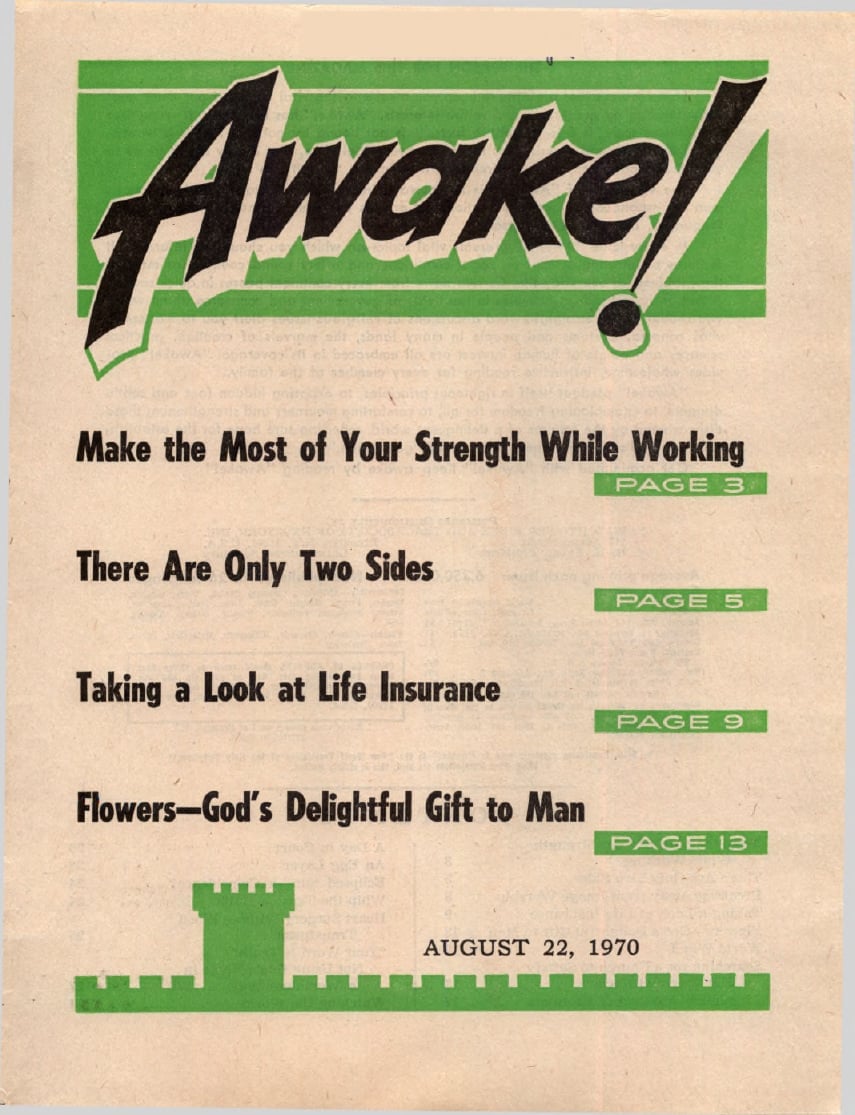
Awake! — August 22, 1970
Source: jw.org
Contents
Make the Most of Your Strength While Working
There Are Only Two Sides
Breaking Away from Image Worship
Taking a Look at Life Insurance
Flowers—God’s Delightful Gift to Man
World War I
Searching for a Church to Satisfy Her Spiritual Needs
Aluminum—Product of Frontiers
A Day in Court
An Egg Layer
Eclipsed Sun—a Coincidence?
Whip the Tension Habit
Heart Surgery Without Blood Transfusion
Not Using God’s Name in a Worthless Way
Watching the World
Your Bible Questions Answered
A World Without Faith
Make the Most of Your Strength While Working
Make the Most of Your Strength While Working
DO YOU often feel tired, worn out, before the end of your workday? If so, you can take comfort from the fact that you are by no means alone. Yet one cannot help but notice that some people tire out less quickly than do others; they seem to get more done with less expenditure of their strength. For them work is a pleasure, as it should be.
Work is a part of the Creator’s will for man. In the beginning he put the first man in the garden of Eden “to cultivate it and to take care of it.” That meant work. The principle that the Creator went by was later enunciated by the apostle Paul: “If anyone does not want to work, neither let him eat.”—Gen. 2:15; 2 Thess. 3:10.
Wisely and lovingly the Creator equipped man for working. He supplied man with strong bones and muscles so that he could do needed physical work, and an amazing brain with which man could do all manner of mental work. He also constituted us emotionally so as to get satisfaction and happiness from doing good and useful work. As wise King Solomon put it, “I have seen that there is nothing better than that the man should rejoice in his works, for that is his portion.”—Eccl. 3:22.
What will help you to make the most of your strength while working? One thing that will greatly help is taking an interest in your work. How so? Because of the power of the emotions over the body. When a young boy’s mother asks him to do some chores about the house, he may plead that he is tired. But the next minute he may be expending all manner of energy playing ball with his youthful neighbors. He finds the one activity emotionally satisfying, but not the other.
By taking a real interest in your work you can make it emotionally rewarding and so easier to do. And you can spark your interest in your work by analyzing why it is necessary, why it is work that needs to be done. Also you can increase your interest in it by reminding yourself of your own reason for doing it: because it supplies the necessities of life for yourself and your loved ones. And you can further increase your interest in your work by giving thought to improving the quality of it, or your efficiency in doing it. The resulting satisfaction will help you to dispel any feeling of boredom, which so often keeps a person from making the most of his strength while working.
If you would make the most of your strength while working, you also do well to learn to avoid unnecessary movements. A help in this regard is the arranging of your tools or materials in the most convenient way. Modern kitchens are designed so as to require a minimum of steps on the part of the housewife as she prepares her meals. She can use this principle in everything she does. So can the farmer, the mechanic, the carpenter and others. Employers often handsomely reward employees who come up with practical suggestions for improving the efficiency of an operation. For this very purpose efficiency experts are hired.
Helpful in this regard is using both hands whenever doing so makes a task easier or quicker to do. When lifting heavy objects, do not put the whole strain on your back by just bending over, but bend your knees so as to utilize the strength of your leg muscles. Failure to do this has caused many a man to rupture himself needlessly. On the other hand, do not involve more of your body than is needed to perform a certain task. Do not involve your whole arm when only your wrists or forearms are required to move.
Proper training should not be overlooked. Often haste to get going on a job causes one to neglect proper instruction or training and so one proceeds in a manner that is not efficient and wastes much time and strength. For example, one may acquire a typewriter and find much use for it. But if one does not take the time first to learn to use it correctly, by the “touch” system, one will use just a finger of each hand, the so-called “hunt and peck” system, which is no system at all. Not only is such typing slower and less likely to be accurate, but it is also far more wearying.
Being able to pace yourself is also helpful in conserving your strength while working. If you are both nervous and conscientious, you most likely are prone to go just as fast as you can go. As a result you are likely to make more mistakes as well as to be exhausted before your workday is ended. Learn to control your eagerness and to adopt a calm, steady pace. Then you will not be exhausted before quitting time and will even have some strength left for the evening hours.
Another factor to consider, if you would make the most of your strength while working, is not to burden yourself by overeating. Too rich and too heavy meals tend to slow you down and make application to tasks at hand more laborious. Such meals also tend to make you overweight, and the fat person often finds all manner of physical work much harder to do.
It is important to get sufficient rest and sleep. The amount of strength you have in the first place depends to a considerable extent on what you do each night. Do not pursue pleasures so avidly that doing your work becomes a hardship or boring. In particular is adequate sleep essential to restore your mental and nervous energy. It is even more vital than food and drink.
Especially do dedicated Christian ministers have good reason to make the most of their strength while working. Unlike others who often do not know what to do with their ‘spare’ time, their evenings and weekends, these invariably have “plenty to do in the work of the Lord.” In view of the times in which we are living, it is more important than ever that they be at their ministerial duties “urgently.”—1 Cor. 15:58; 2 Tim. 4:2.
But regardless of your vocation in life, it is the course of wisdom to give thought to making the most of your strength while working. It results not only in efficiency but also in satisfaction and enjoyment of your work.
There Are Only Two Sides
There Are Only Two Sides
“YES, I like some things about your religion,” said Khumalo. “I like your teaching of an earth restored to paradise under God’s kingdom wherein we shall live as brothers.”
“And I,” interrupted Ndebele, “find comfort in your explanation about the dead being asleep and the hope of the resurrection.”
“As for me,” added Mwene, “I thoroughly enjoy going along to your big assemblies and experiencing the warm love and friendliness you show to one another.”
“But what we all feel,” said Khumalo, acting as spokesman for the little group, “is that your religion is too extreme. To hear you witnesses of Jehovah speak, one would think that everything is either right or wrong, that there is no middle ground, whereas to get along in this world and enjoy oneself one has to be more lenient.”
“Yes, that’s just what I was going to say,” exclaimed Ndebele. “Look, while the other churches say we should have just one wife, if we quietly take another wife, so what? We can still be in the church. But you Witnesses, even before a person can be baptized he must prove he has only one wife and that his marriage is registered, although that is often difficult for us Africans to arrange, especially if we haven’t paid all our lobola (bride price) yet. And then, once a person is a Witness, if he takes another wife or even if he just has a girl friend he visits now and again for sexual satisfaction, why, you Witnesses put him out of your organization.”
“And then there’s your attitude toward our age-old customs,” complained Mwene. “Maybe you’re right that the spirits of the dead cannot harm us, but, after all, we still have witch doctors, so what’s wrong with wearing a few charms or having some strong ‘medicine’ in the house just in case someone tries to bewitch us? But, if you’re a Witness you can’t wear even one little charm, never mind visiting the witch doctor.”
“Also,” said Khumalo, taking over the conversation again, “there’s your attitude toward the political party. In order to get along and hold down our job we have to carry a party card. It doesn’t matter if we really believe the party is right or not. As long as we carry the card and attend a few meetings we get along. Members of all the other churches do this, but you Witnesses bring a lot of trouble on yourselves by not carrying a card. Why not join the political party just to make things easier for yourselves? The same too with the anthem and the flag—why make a big issue over singing and saluting? After all, they are only symbols.”
“Yes, we like you,” exclaimed Ndebele, “but you’re too strict, too rigid. Why not be like the other churches and go along with the world a bit? You would have a much bigger following. Why be so one-sided?”
The preceding is a possible conversation based on true-to-life viewpoints. Such expressions are typical of those made by persons in certain independent countries of Africa. Do you find that they echo some of your own thoughts? Have you too enjoyed some of the Bible teachings of Jehovah’s witnesses, but cannot understand why they are so uncompromising? Why are the Witnesses like that?
Are There Just Two Sides?
It is because Jehovah’s witnesses believe what the Bible says. And God’s Word the Bible indeed makes clear that there are just two sides: God’s and the Devil’s.
A study of the Bible reveals that the Devil is not just some imaginary character, but a powerful rebellious angel bent on turning all creatures away from the true worship of Jehovah God and getting them to serve him. Right at the beginning of Jesus’ earthly ministry the Devil tried to tempt Jesus from the course of single-minded devotion to Jehovah. (Matt. 4:1-11; Luke 4:1-13) Thus, all Christians are warned: “Keep your senses, be watchful. Your adversary, the Devil, walks about like a roaring lion, seeking to devour someone. But take your stand against him, solid in the faith.”—1 Pet. 5:8, 9.
From this a Christian discerns that to please God he must be solid in his faith. Any weakening of the true faith by deliberately compromising with error or by carrying on practices out of line with the high standards of Christian conduct would please the Devil. Such a course would put one on the Devil’s side. Thus, there are just two sides: God’s side and the Devil’s side.
Jesus emphasized this principle in his illustration of the two roads, at Matthew 7:13, 14: “Go in through the narrow gate; because broad and spacious is the road leading off into destruction, and many are the ones going in through it; whereas narrow is the gate and cramped the road leading off into life, and few are the ones finding it.” Jesus did not refer to a third road, a middle way. A person is either walking the cramped way of God, living his whole life according to God’s principles and high moral standards, or else he is following the crowd along the broad and spacious way as a part of this system of things, a system controlled by Satan the Devil. (2 Cor. 4:4) There are just these two roads; there are just two sides, God’s side and the Devil’s side, and they are completely opposed to each other.
As further evidence that there are just two sides, consider the words of Jesus at Matthew 12:30: “He that is not on my side is against me, and he that does not gather with me scatters.” We are either for Jesus or against him. To be for him would mean to uphold his teachings and to apply them in our own lives.
Marriage and Sexual Relationships
What did Jesus say about marriage and sexual relationships? Would he have done as many church groups, turning a blind eye to polygamy? Would he condone sex relations with an extra ‘girl friend’ now and then? Listen to his words at Matthew 19:5-9: “‘“For this reason a man will leave his father and his mother and will stick to his wife, and the two will be one flesh” . . . Therefore, what God has yoked together let no man put apart,’ . . . ‘I say to you that whoever divorces his wife, except on the ground of fornication, and marries another commits adultery.’” Jesus ruled that a man should have only one living wife to whom he should stick. Not three or four, but “the two will be one flesh.” And only if one’s mate were immoral would the innocent one be free to obtain a divorce and remarry.
The Christian apostle Paul, a follower of Jesus, saw most clearly that there are just two sides. Under divine inspiration he wrote at Hebrews 13:4: “Let marriage be honorable among all, and the marriage bed be without defilement, for God will judge fornicators and adulterers.”
Can you understand, therefore, why Jehovah’s witnesses insist that for a person to be accepted as a Christian he must, if married, have only one living wife to whom he is honorably and legally married? And can you also see why Jehovah’s witnesses do not accept or permit to remain in their organization persons that practice sexual immorality? To water down God’s moral standards to suit local customs, as other religions do, would mean to leave the cramped road of God and join those walking on the broad road of the Devil. There is no middle road. There are just the two sides: God’s and the Devil’s.
Wearing Charms
In order to bring people to his side and to keep them there, the Devil has always used false religious teachings, superstition and fear. Particularly in Africa, witchcraft and the fear of ‘spirits’ of the dead have a prominent role in the Devil’s false religious system.
However, God’s view of witchcraft is plainly stated in the Bible at Deuteronomy 18:10-12: “There should not be found in you anyone . . . who employs divination, a practicer of magic or anyone who looks for omens or a sorcerer, or one who binds others with a spell or anyone who consults a spirit medium or a professional foreteller of events or anyone who inquires of the dead. For everybody doing these things is something detestable to Jehovah.”
This helps you to understand why, as some complain, ‘Jehovah’s witnesses do not countenance even the wearing of one little charm.’ To resort to magic or witchcraft even in the slightest form would be to do something detestable to Jehovah. By doing this, you would certainly not be on God’s side but would be on the Devil’s side, subject to his corrupting influence. On the other hand, the servant of God can have faith in the promise: “For there is no unlucky spell against Jacob, nor any divination against Israel.”—Num. 23:23.
Today this Bible promise applies to spiritual Israel, the Christian congregation and their dedicated companions. These need have no fear of witchcraft or spells if they remain firmly on Jehovah’s side by rejecting anything connected with witchcraft, including charms or ‘medicine’ prepared by a witch doctor.
Friendship with the World
Another follower of Jesus Christ who discerned that there are only two sides, God’s and the Devil’s, and that you cannot be a friend of both, was the Bible writer James. In his letter, at Jas chapter four, verse four, he highlights the complete opposition between the two sides by saying: “Adulteresses, do you not know that the friendship with the world is enmity with God? Whoever, therefore, wants to be a friend of the world is constituting himself an enemy of God.”
Could any statement be more pointed than this? There is no middle ground. Either one is a friend of God and separate from the world, or one is going along with the world and is God’s enemy. These two are in opposition: friendship with God, and friendship with the world.
But why does friendship with the world mean enmity with God? Because, as the apostle John wrote, “we know we [those on God’s side] originate with God, but the whole world is lying in the power of the wicked one [the Devil].” (1 John 5:19) Although there are many who sincerely offer various schemes for improving the present world arrangement, Jehovah’s witnesses know that none of these will permanently succeed. Why not? Because there is nothing man can do to change the real ruler of this world, who is the Devil. (John 12:31) Therefore, Jehovah’s Christian witnesses avoid cultivating the friendship of this world, refusing to identify themselves with one or another of the political programs vying for support.
However, on the other hand, Jehovah’s witnesses respect the duly appointed ruling authorities and governments as the “superior authorities” permitted by God until his Kingdom government takes over sole rulership of earth. (Rom. 13:1) They demonstrate relative subjection to these authorities by honestly paying all taxes demanded and obeying all laws that do not conflict with the laws of God. (Acts 5:29) But this due respect and subjection does not require that they pay homage by gesture and word to the material emblems of the governmental authority or that they sing a prayer or anthem for the permanence of that government. (Ex. 20:4, 5; 1 Cor. 10:14) As friends of God and not of the world they flee from any appearance of idolatry, exercising care not to go contrary to the example of Jesus, who said: “I make request, not concerning the world.”—John 17:9.
Choose God’s Side
Thus, as we examine the objections to the effect that the witnesses of Jehovah are too extreme, too strict, too one-sided, we see that if the Witnesses wish to remain on God’s side they really cannot do other than adhere strictly to God’s Word. We discern that for a Christian there are only two sides when it comes to religious truth—God’s side and the Devil’s. You simply cannot water down God’s standards and still remain on his side.
It may be that there is some other issue on which you feel that Jehovah’s witnesses are too extreme, too one-sided. Why not discuss it with them and get the Bible viewpoint? Very likely you will find that the view you once thought extreme is God’s view, and that it is the right one to have if you want to be on his side.
In fact, as you study the solid food of Bible principles with Jehovah’s witnesses you will find that you will progress to Christian maturity and come to be among those “who through use have their perceptive powers trained to distinguish both right and wrong.” (Heb. 5:14) You, too, will discern that there are just two sides. Choose God’s side. Uncompromisingly stick to it. You will thereby experience peace, joy and a good conscience now, and everlasting life on an earth soon to be cleansed of all those on the Devil’s side.
Breaking Away from Image Worship
Breaking Away from Image Worship
◆ A college student in Japan was brought up in a family that worshiped the Buddhist god Jizo, guardian deity of children. This student was surrounded by images, for his father is a stonecutter, engaged principally in chiseling out Jizo “gods.” His older brother received a gift subscription for the Awake! magazine from a former friend who is one of Jehovah’s witnesses. But it was he, the younger brother, who eagerly read and reread the magazines.
When the Witness called at their home later, this young man eagerly accepted the free six-month course of Bible study offered him by the Witness. By the end of four months, the young man made a complete break from the lifeless Jizo and his fellow gods of stone, and he was telling others about the living God, Jehovah, in the door-to-door Christian ministry.
Taking a Look at Life Insurance
Taking a Look at Life Insurance
LAST year Americans added $117,000,000,000 to their life insurance coverage, raising the life insurance coverage in force in the United States to $1,300,000,000,000. In 1940 this total was a little over $100,000,000,000, about the amount of last year’s increase!
Families are buying more life insurance than ever before. Fifteen years ago families owning life insurance policies averaged a total of $8,700 in protection. Today this has skyrocketed to an average of $19,900 in coverage per family!
Obviously life insurance is a major item in many family budgets. Yet the average policyholder frequently knows less about his life insurance than he does about any other major purchase. This is so because insurance policies use terms that often are unfamiliar.
But whether they understand the terms or not, millions of persons keep buying life insurance. In fact, there are now some 400,000 persons selling life insurance in the United States alone. People buy policies from them because of the uncertainty of life; they need the protection that the insurance offers their families. The benefits of life insurance are at times quick in being realized.
At 8:30 one evening two newlyweds bought a $3,000 family policy with a $10,000 temporary rider. (A “rider” lets a person mix temporary insurance with permanent coverage.) They paid the first premium of $15.19. The next day the husband went to the stone quarry where he worked and was killed in an accident. The protection of the policy had gone into immediate effect because of payment of just one premium.
The result was that the widow was entitled to receive $6,000 in a lump sum. This was a double payment of the basic amount because of the accidental nature of her husband’s death. In addition, she will receive $10,000 over a period of time. Thus, the prepayment of just fifteen dollars and a few cents will provide $16,000 for a widow and her unborn child.
This case illustrates a basic truth. Life insurance cannot insure a person against death. But it can protect his dependents against some of the economic loss caused by his death. That is the primary purpose of life insurance.
For many persons life insurance has taken on a secondary role—that of building up a savings account to provide cash benefits in case one is disabled or if one retires.
Since there are different viewpoints with regard to life insurance and its various kinds of policies, how should a person who wants its protection buy such insurance? He should buy it according to his own needs, circumstances and outlook for the future.
Basically there are just two kinds of life insurance. There is a temporary kind called “term” insurance. And there is a permanent kind called “whole” insurance. This is also sometimes called “straight” or “ordinary” life insurance. Let us consider first the least expensive kind.
Term Life Insurance
As its name implies, term life insurance protects you for a limited term or time. It resembles insurance on cars and homes. Usually term policies are for five or ten years. If the insured person dies after the term is up, his family gets nothing. Term life insurance is not for the purpose of building cash value for use in future years. It is pure insurance for insurance’s sake only. Term insurance provides the maximum protection for the premium dollar. If a man thirty-five years of age, for example, desired a $25,000 coverage with permanent life insurance, it would cost him a yearly premium of about $415. But the yearly premium for a $25,000 coverage with five-year term insurance would be about $125.
A “renewable” term policy guarantees a person the right to renew a term policy regardless of his health. But he must pay a higher premium each time he renews. Yet when one is between the ages of twenty-five and forty-five the price of five-year renewable term insurance goes up relatively slowly. However, after one is sixty-five it is usually impossible to buy term insurance.
Over a lifetime, term insurance costs more than permanent life insurance. This is true because permanent insurance builds cash value that is received back. But for shorter periods of time term insurance gives protection at much lower cost.
Most term policies are one of two basic kinds: “level” and “decreasing.” What is the difference between these two kinds?
A ten-year “level” term policy for $10,000 insures you for $10,000 during the entire ten years. On the other hand, a ten-year “decreasing” term policy for $10,000 insures you for $10,000 only in the first year. Each succeeding year the insurance shrinks a little until it disappears at the end of the tenth year. Decreasing term costs less than level term because the company’s risk decreases.
A “convertible term” contract guarantees a person the right to exchange it for permanent whole life insurance regardless of his health. Of course, he must pay the difference in cost of permanent insurance. Generally, any term policy or term rider is convertible on this basis, but one must exercise the privilege on or before the time specified in the policy. The conversion privilege is very important to the owner of term insurance who finds himself uninsurable. One can check a term policy or rider to know the time limit.
Now let us have a look at higher-priced permanent insurance.
Whole Life Insurance
Whole life insurance usually costs about three times as much as five-year term insurance. However, the premiums of whole life insurance stay the same, whereas renewable term policies cost more at each renewal. Whole life policies charge a person an average annual premium based on insuring him for the whole of his life. This period is usually set at 100 years for statistical purposes.
Ordinary or whole life insurance is the kind generally promoted by insurance companies, and thus many salesmen may not recommend term insurance. A salesman also gets a smaller commission on a premium for term insurance than he does on the premium invested in ordinary insurance.
People buy whole life insurance so as to have permanent coverage and to accumulate money for the future. Part of the premium of a whole life policy goes toward building up cash value. Also, insurance companies pay interest on the cash value building up in a policy. If, for some reason, the insured person needs money, he can turn in his whole life policy and collect the accumulated cash value. But he does not necessarily need to surrender the policy. He can also keep the insurance. How? By borrowing its loan value, and then paying the interest on the loan as well as the premiums.
Unlike most term insurance policies, one can allow a whole life policy to lapse and still be covered. This came as quite a surprise to a New York widow recently.
This woman’s husband died in an automobile accident not long after letting his $6,000 whole life policy lapse. However, the husband was still covered under “extended term insurance.” The law provides that cash abandoned in such a policy is not forfeited, but automatically buys term insurance in the face amount of the policy for as long a time as the cash affords. The insurance agent brought the widow a check for $6,000.
It is important to note that in a lapsed family plan only the primary insured, the husband, is covered under extended term insurance. Let us consider family plans a little closer.
Variety of Policies
A family plan policy covers father, mother and children under one contract. Premiums are based on the father’s age. All newborn are automatically included at no extra cost. Death of the father means paid-up insurance for his widow and children. At age eighteen, twenty-one or twenty-five, depending on the contract, the children can convert to permanent life insurance regardless of their health. A typical family plan will cover a father for $5,000 and a mother and the children for $1,000 each.
Those who can afford to pay up their insurance completely during their peak earning years often choose “limited payment” life insurance. Ten-payment, twenty-payment or thirty-payment life means that one has a policy fully paid up in the specified number of years. The premiums are much higher than whole life because one is not paying for the whole of one’s life. Cash values build up faster than with a whole life policy.
Those who seek even greater cash buildup in a limited time turn to the expensive policy called an “endowment.” Like whole life insurance, an endowment policy is a combination of protection plus savings; however, the endowment policy definitely puts the emphasis on saving up money rather than on protection.
An endowment policy guarantees the insured person cash in the face amount of the policy when it matures. This may be, for example, in eighteen or twenty years, or when he reaches age sixty-five. At maturity the insurance protection ends and he takes the money in a lump sum or in installments. Frequently policyholders confuse their twenty-payment life policy with the higher-priced endowment.
If one bought a $2,000 twenty-year endowment at age twenty for $9.38 a month, it would be worth about $2,660 in twenty years, after which one is no longer insured. A $2,000 twenty-payment life policy bought at the same age for $5.60 a month would be worth about $1,360 in twenty years. One could take the money, or keep the $2,000 coverage, paying no further premiums after twenty years.
If one actually has an endowment, that word will appear on the policy. And one will be paying more for this type of policy.
Cutting Costs
Everyone would like to cut insurance costs without cutting out the policy. But is this possible to do? Yes, it is. And some respected insurance men say that this is really what you ought to do—in some cases.
These men advise the public to keep their whole life insurance policy six or seven years until the cash values are substantial. Then they advise lapsing the policy without taking out the money. By law, extended term insurance will keep one covered for as many years as specified in the table printed in one’s whole life policy. You will recall the case of the New York widow who collected $6,000 on the death of her husband from his lapsed policy.
Extended term insurance can run for many years if one’s policy is seven years old or older. A person with terminal illness, for example, could utilize this suggestion to help pay medical bills with saved premiums. But there are also other ways to cut insurance costs.
Is a person’s policy rated? For example, if he has been paying a penalty for being overweight and he has been normal weight for a year or more, he can ask to have the rating removed. This applies to any rated physical condition or handicap that has been corrected. It is worth a try.
Another way to cut insurance costs is to request a “reduced paid-up policy.” Under the table of cash values, one’s policy will show how large a paid-up policy one is presently entitled to. Of course, it will not equal the face amount of the contract. That is why it is called “reduced” paid up.
If you are shopping for life insurance, first estimate your family Social Security benefits should you die. They could equal many thousands of insurance dollars. Then look around for inexpensive group coverage. Try your employer or trade union. Postal workers, teachers, nurses, lawyers, electrical engineers, for example, can buy excellent group coverage at reduced rates.
For those living in New York, Connecticut or Massachusetts the answer may be savings-bank life insurance. This costs less because one is not paying for the services of a licensed insurance agent.
Once a person gets the kind of life insurance that he wants, he should form the good habit of paying premiums within the thirty-one-day grace period. If he is late and the policy lapses, the company is obliged to reinstate it up to three years after it has lapsed, but only if he proves to be in good health.
Another disadvantage in letting a policy lapse is that each reinstatement turns the clock back to the start of the two-year contestable period. After holding a policy for two years, it becomes incontestable. However, prior to the termination of the two-year period, any important omission uncovered as a result of a claim could void the contract. So, for such reasons, it is important not to let a policy lapse.
Life insurance should be treated as valuable property similar to a savings account, stocks or bonds. It takes some of the economic sting out of death. It can serve a useful role.
Flowers—God’s Delightful Gift to Man
Flowers—God’s Delightful Gift to Man
WHOSE heart is not gladdened at the sight of a flower? A bouquet of roses can immediately brighten up a day, cheer a gloomy face, lift a depressed heart, even cause friendship to sprout and love to flourish.
In the spring who can pass a body of water, its surface glistening with the beauty of the water lily, without some appreciation of life itself? Or in the fall who can walk through a field decorated with the brilliance of purple asters and gleams of the goldenrod without feeling enriched? What window has not been beautified, or kitchen enhanced, or living room transformed by the presence of lovely, delicate flowers or plants?
Men have referred to them as “the stars of the earth,” “the smiles of God’s goodness,” “an autograph from the hand of God.” “Flowers,” said the English statesman William Wilberforce, “are God’s thoughts of beauty, taking form to gladden mortal gaze;—bright gems of earth, in which, perchance, we see what Eden was—what Paradise may be!” How much less pleasant the earth would be without flowers!
Jesus Christ appreciated the presence of plants and flowers on this earth. He observed them closely and drew meaningful lessons from them. To his disciples he said: “Take a lesson from the lilies of the field, how they are growing; they do not toil, nor do they spin; but I say to you that not even Solomon in all his glory was arrayed as one of these. If, now, God thus clothes the vegetation of the field, which is here today and tomorrow is thrown into the oven, will he not much rather clothe you, you with little faith?” (Matt. 6:28-30) To Christ, flowers told of God’s constant care. What do flowers mean to you?
To many men and women flowers are more than creations of decorative beauty. They are delicate living things that excite the imagination. They inspire faith in God and cause thanksgiving and praise to flow to him. The fragile shapes of flowers and infinite colors of perfection reveal a God sensitive to human needs and emotions.
“Think of it,” said a housewife, “we may touch a flower and it may die, still that same flower is sturdy enough to survive a rainstorm unharmed! It’s simply wonderful.” In an interview she spoke of flowers as meaning many things: warm affection, understanding, appreciation and, perhaps most of all, tender love. She liked flowers.
Flowers Through the Ages
Appreciation for flowers is one thing that ancient man and modern man have had in common. The Babylonians, the Egyptians, the Medes and the Persians were ingenious in their decorative use of flowers. Their parks were magnificently designed and their feast and banquet tables were often decorated with awe-inspiring miniature gardens. According to an inscription, King Rameses III of Egypt donated no less than 500 gardens and 19 million bouquets of flowers in honor of the god Amon!
When Egypt became a province of the Roman Empire, the ancient art of floral decoration began to show its influence in Rome. In Nero’s courts it was customary to escort the guests inside at great banquets over a carpet of flower petals and offer them a wreath of roses as well, which, when laid upon the head, had a cooling effect.
Some of the most artistic forms of floral decorations have come to modern man from Japan. The ability and skill of the Japanese in this field are closely associated with the deep-seated love they have for the earth.
Indoor Gardens
When flower gardens move indoors, something wonderful happens. They become intimate companions. Windowsills are lined with potted plants and bouquets brighten rooms. Each new shoot becomes important. Every new leaf is watched from earliest infancy. Each flower becomes a personal friend, practically a guest in the home. From small nub to full-blown maturity, hardly a move is missed in this beauty of flower growth.
Some people especially enjoy fragrant flowers. When winter really takes over, how the smell of the outdoors is missed! An indoor garden enables one to enjoy some of that summertime fragrance all year. Flowers are often chosen for the house because of this. Watch them unfold and send their fragrance throughout the house. There are plants the leaves of which, when gently crushed, perfume your fingers with a variety of refreshing odors. What delightful gifts of fragrance!
Arranging Flowers
Creating a flower arrangement is a great art. It means more than thrusting flowers into a vase. The Japanese say that each stem, leaf and blossom is a vital part of a pattern, and that even the space between them can be used to good advantage. Twigs and flowers of various lengths arranged gracefully often combine to make stunning compositions.
A large bouquet is not always necessary for a good effect. A copper can with a few brightly colored zinnias or yellow sunflowers set against a light-colored background can do wonders for a room. The effect is as though the drapes were drawn aside and the sun was allowed to shine in. A few pansies in the kitchen or a little earthenware mug of snowdrops or anemones are an uplift. They make you think that someone is smiling at you all day. And what happy smiles these are!
Long stalks are set off to best advantage when placed in tall vases, but care must be exercised that the bouquet does not become a “broom.” In order to keep the entire arrangement as natural and serene as possible, the stalks must fan out from one central point and not be thrown together in a crisscross pattern.
Design requires a planned relationship between the flowers, the leaves and the container. In a miniature vase, only very small flowers are used. Very large blooms require a container large enough to fit them. A small composition may go on a small desk or table. For a large, heavy table in a spacious room, a massive arrangement in a suitable container is in order. So flower arrangement calls for balance.
By carefully observing the tastefully arranged flowers in flower-shop windows, much can be learned. In a composition of mixed colors, each color may be used in drifts or masses, instead of being spotted about like a Scotch plaid. With few exceptions, blooms are not placed one directly above the other or in ordered steps.
As for containers, in general, neutral colors are best, because these can be used for many different flowers. Gray-green, antique white, and pale gray are well-chosen colors. Forms should be simple and pleasing to the eye.
Flowers for Every Season
Every season has its beauty that can be brought indoors; no single season will let man down. During the winter months, the witch hazel and the blackthorn can be enjoyed to the full. Springtime rejoices us with the ornamental magnolia, the soft-tinted plum, peach and cherry blossoms, alder and willow catkins and the early rhododendron. Summer makes it very easy for us by providing us with a wide variety of blooming shrubs, such as the laburnum, the hawthorn, and the jasmine, while the cut stalks of asters, red barberry, the fire thorn, and the orange sea buckthorn, to name just a few, are in the autumn season especially suitable for creating a rare bit of floral decoration. A simple earthenware tray, with the help of a few berry shrub branches, can be transformed into a fascinating piece of outdoor beauty inside your living room.
In fact, a single, freakishly formed shrub branch, placed in a jar or bottle with a narrow neck, can become a peculiarly artistic creation and a conversation piece in the home. The beautiful fruits or splendidly colored leaves of certain sorts of shrubs provide very fitting decorations that bridge from one season into the next without confusion.
On and on we could go exploring more and more means of bringing God’s delightful gift to man—his beautiful plant creation—within our reach, especially if we normally are not in the position to get out into the open and enjoy the exciting beauty of the outdoors.
What intense joy will be the portion of those who live to see the day when the Creator of the universe will deem it his appointed time to bring his promise of a spiritual paradise also to a physical fulfillment: “The wilderness and the dry land shall be glad, the desert shall rejoice and blossom; like the crocus it shall blossom abundantly, and rejoice with joy and singing”!—Isa. 35:1, 2, Revised Standard Version.
World War I
World War I
The year 1914 saw the establishment of God’s kingdom in heaven, as Biblical and historical material combine to show. One evidence of this is the outbreak of World War I in that year, in fulfillment of Jesus’ prophecy. (Matt. 24:6, 7) The 1967 book The Origins of World War I—1871-1914 observed about this war:
“Few events compare, in impact and terror, with World War I. It destroyed two empires, that of the Habsburgs and that of the Ottoman Sultans. It altered two others, that of the Hohenzollerns and that of the Romanovs, beyond recognition. It created a host of new nations in Europe and overseas. It gave birth to Communist rule in Russia and provided the background for Fascism in Italy and elsewhere. In its course, roughly twice as many people were killed as in all the wars of the preceding two centuries added together, the Napoleonic Wars and the American Civil War included. It also maimed, in body or spirit, many of the survivors and laid the ground for an even more destructive World War II.”—Page v.
Searching for a Church to Satisfy Her Spiritual Needs
Searching for a Church to Satisfy Her Spiritual Needs
MANY sincere persons who are desirous of pleasing God and satisfying their spiritual needs have turned to the churches of Christendom for help. Eventually, though, they notice that the churches seem to be more concerned with money than with satisfying the spiritual needs of their parishioners. A woman who came to recognize this fact about her church began searching for something better. She related her experience at a circuit assembly of Jehovah’s witnesses held in Seymour, Indiana, in December of 1969:
“I was about thirteen years of age when I had completed communion classes in the Presbyterian Church and was baptized into it. However, I did not really derive any true spiritual satisfaction from this religion. They discredited the Bible, saying that the flood in Noah’s day did not really cover the entire earth. I could easily see that the church was more interested in money than in its members.
“My parents were not very strict about religion, so they allowed me to attend other churches with my friends. I started looking for something better than the Presbyterian religion, yes, a religion that was more interested in people than in their money.
“For a while I thought that the Roman Catholic Church had something to offer. But it did not take too long for me to realize that we are not to pray to lifeless idols, and that the mediator between God and men is not the pope at Rome. (1 Tim. 2:5) So I kept looking. I suppose that I personally investigated a dozen or more different religions: Jewish, Mohammedan, Methodist, Lutheran and Hindu to name a few. I even dabbled in spiritism, with its ESP and ‘Ouija’ boards, looking for something. I did not know just what.
“One of my girl friends tried to ‘save’ me in the Baptist religion, but I did not receive any spiritual satisfaction from going to this church either. Nevertheless, I kept going there despite the fact that they told me that I would go to a burning hellfire if I did not give one tenth of my money to them. I went along with the Baptist faith to some extent until Mardi Gras in 1969. My ‘saved’ girl friend did not act so saved during these festivities. She used the excuse ‘once saved always saved,’ as the Baptist religion teaches. The Baptists always advocated that I should read my Bible, which I did. But it struck me as very strange that there were many of their teachings that I could not find there in its pages.
“By the time I had returned to Cincinnati in May, I had more or less cultivated an agnostic view, and I was not really interested in studying the Bible. But then two young men who are Jehovah’s witnesses came to my home offering a little book that explained the Bible. I accept it along with their offer to come to my home for an hour each week to help me learn the Bible. Yet I was skeptical about what they were trying to teach me. Even when I agreed to attend one of their meetings at the local Kingdom Hall, I was not too thrilled about the prospect, that is, until I arrived there.
“One of the first things that I noticed immediately was that the Witnesses were interested in me, not my money. They taught me right from the Bible even at their meetings. They had something that I had never felt before and I wanted to be a part of it. Yes, I wanted to go out and tell other people about it and, eventually, I did.
“It has not been easy, because Satan the Devil has used many things to try to stop me from serving Jehovah God in the true manner. He brought my friends, my family and my associates against me. Nonetheless, I have found the true religion, and my spiritual needs are being satisfied. With Jehovah’s help I have come this far, for tomorrow morning it will be my happy experience to symbolize my dedication to him by being baptized in water.”
The following morning this woman was baptized, and today she rejoices to be among the happy throngs serving the true God, Jehovah. Have you found your church to be no source of spiritual satisfaction? Has it pained you to notice their interest in your money and not in your spiritual welfare? Then why not look up Jehovah’s witnesses and ask them your Bible questions? Joyful spiritual satisfaction awaits you!
Aluminum—Product of Frontiers
Aluminum—Product of Frontiers
By “Awake!” correspondent in Canada
A GIANT consuming unbelievable quantities of food day after day, hour after hour—that well describes an aluminum smelter. Its meat is the primary ore of aluminum, bauxite, or its by-product, alumina. Whichever one, there must be a constant supply flowing through, and at the same time vast quantities of electric power must be available. To establish a smelter area, then, there must be a major source of electric power and also a good port close by.
Would a location with these facilities be suitable near some large city? No, because other consumers would be making large demands on the power source. An aluminum smelter must have practically exclusive use of the power supply. This is why the aluminum industry is usually a pioneer of frontier country.
To a large extent, the determining factors for choosing a smelter site are geography and a climate with sufficient precipitation to ensure a steady volume of water. Norway’s only aluminum smelter takes advantage of power generated by water dropping 2,735 feet from the surrounding mountains.
In Ghana, the Volta River has been dammed by a hydroelectric generating station to supply an aluminum smelter and a plant for processing one of the world’s largest deposits of bauxite into alumina. The mountainous region of Minas Gerais state in Brazil at Curo Preto has three modern hydroelectric plants supplying a smelter that obtains its bauxite only one kilometer distant from the operation.
Fifty years ago at Shawinigan Falls, Quebec, the industry installed a large generating plant and smelter in the back country of the St. Maurice River valley, one hundred miles west of Quebec city. A few years later, north of that city a power plant and smelter were constructed on the Saguenay River at Isle Maligne. Shortly afterward Arvida, a few miles east on the same river, saw the beginnings of the world’s largest aluminum smelter—one that opened to industry the once-closed country of the Saguenay. Now on Canada’s west coast, part of the hinterland of British Columbia has been opened up by the Kitimat smelter installations of the Aluminum Company of Canada.
Opening New Frontiers
In Guyana, country of the fabled El Dorado, immense deposits of alumina-rich mineral have been developed. For fifty-four years the reddish-brown ore has been blasted out of beds averaging fifteen to forty-five feet in thickness. By 1958 the area around the community of Mackenzie was producing 300,000 tons of bauxite annually. Today the storage bins at its modern docks load almost three million tons yearly into vessels bound for Quebec’s Saguenay smelters.
Ten years ago few people had ever heard of Weipa on the far-northern coast of Queensland, Australia. In 1955 an Australian geologist discovered in this isolated area what has turned out to be the world’s largest deposit of bauxite. Seventy-three square miles were already blocked out by 1968 with 516 million tons of proven ore reserves. Scout drilling over another 160 square miles revealed a potential of 1,200 million tons. Suddenly, Australia was in the bauxite business to an extent that made the aluminum industry around the world sit up and take notice.
The Weipa mining operation is very simple. When the layer of ore is reached, at times 30 feet thick, no blasting is needed. Loaders simply lift it out of its bed and onto 50-ton aluminum-body dump trucks. It is taken to the beneficiation plant where the ore grade is improved by sizing and washing. Conveyor belts then take the washed, treated ore to an open stockpile, from where a conveyor loading system transfers it to ore ships.
Already over $40,000,000 had been spent on this development by last year. In addition to the modern plant and harbor works, there is a new community housing over 350 people, with air-conditioned homes, a school, stores, a theater, police and hospital services. From being a wilderness in 1957 Weipa is now one of the top bulk-material shipping ports of Australia. Maximum capacity of the installation in 1963 was half a million tons annually. This figure rose to four million tons in 1968, and is contemplated to reach seven million tons annually by early in the seventies.
Thus in Guyana and Australia new frontiers have been opened up. But in these, as with other countries, the spread of industry to frontier areas has not been an unmixed blessing. Trees and vegetation are knocked down, and open-pit mines replace the wilderness beauty. Of course, the Creator put into the earth minerals for man to use, and how rich indeed this earth is in mineral wealth! It is also God’s purpose that this earth be a Paradise. But man in his exploitation of the mineral resources of the earth often leaves unsightly scars and makes portions of the land a desolate waste. He has not solved the problem of using earth’s resources without marring the beauty of his earthly home.
The Kitimat Smelter
Interestingly, many thousands of tons of alumina from Australian bauxite will soon be feeding the potlines of Canada’s Kitimat smelter.
In a rugged retreat of Canada’s Coast Mountains stand the Kitimat smelter and power plant. The project was a triumph of engineering skill and the work of 7,500 men. It began to unfold in the spring of 1951 when work started on a scheme that was to cost $440 million by the time it was completed. Never before had so much money been spent in Canada on a single private undertaking. Current plans call for the smelter to attain an annual production of 550,000 tons of aluminum ingot, so making it the world’s largest.
Three years after construction began on this vast complex, a gleaming aluminum ingot weighing fifty pounds came off the potline. Kitimat was in operation! The smelter itself was built on what were formerly tidal flats on the Kitimat Arm of Douglas Channel. A modern townsite took shape seven miles up the valley from the smelter. An ocean port, railway line and modern highway were also constructed to serve the smelter and the new town.
The Kenney Dam
A constant downward flow of water was required to produce the power for the smelter. That meant impounding the waters of all the lakes of a plateau some 130 miles long. Up to November 1952, those waters flowed east to join the Fraser River system in its passage to the Pacific near Vancouver. At the western end of the plateau Tahtsa Lake was prevented from spilling its waters into the Pacific, only twenty miles away, by the solid rock barrier of 7,000-foot Mount Dubose. In order to form a reservoir of sufficient volume to serve the power plant that was envisioned, a 325-foot-high dam was needed to block the eastern outlet of the plateau, the Nechako River. Hence the Kenney Dam came into being.
Before work on the dam could get going, a 60-mile access road from Vanderhoof rail station had to be built through muskeg and bush as well as 45 miles of material supply roads. A 3,000-foot runway was also provided for ferrying men and material from Vancouver, three hours away by air. The dam, at completion, was 1,500 feet long, 1,500 feet wide at its base and tapering to forty feet at its crest. It became the third-highest rock-fill dam in the world.
Five years later there were five and a half cubic miles more water in the basin than before the dam was built. But now this water had to be made to fall a half mile from the west end of Tahtsa Lake to the powerhouse level on the Kemano River ten miles farther west. A waterfall was needed.
Waterfall Inside a Mountain
How was that achieved? Well, while the Kenney Dam was still being prepared, work also began on Mount Dubose. A ten-mile tunnel was dug into the face of the mountain from the west end of Tahtsa Lake. Its diameter was twenty-five feet. At the same time two 17-foot-diameter tunnels were drilled and blasted from the powerhouse level upward at an angle of 48° to meet the west end of the tunnel in the heart of Mount Dubose. Inside these tunnels sections of steel pipe, 28 feet long and having a diameter of 11 feet, were welded together to form the conduits, both 2,600 feet long. Broken rock and concrete were introduced around the outside of these conduits to hold them firmly in place.
Each penstock or conduit led to a manifold with four five-foot-diameter branches leading to the waterwheels of the generators. Tailrace tunnels from each generator were drilled and blasted out beneath the powerhouse floor, and these finally joined the 27-foot-wide main tailrace tunnel that discharges the spent water into the Kemano River and thence to the Pacific.
Thus waters that once flowed to the east now flow west to operate what is planned to be one of the largest privately owned power plants on the continent. The resultant waterfall within the mountain is, in fact, some sixteen times the height of Niagara Falls.
Powering the Smelter
Not only is the waterfall inside Mount Dubose, but the powerhouse itself is a cavern in which, for length, the oceangoing Queen Elizabeth I could easily fit. When finally completed for planned full capacity its measurements are to be 1,135 feet long, 85 feet wide and 145 feet high. It is to have sixteen generating units turning out 2,400,000 horsepower of electricity. The ventilating system of this vast plant has to operate continuously, pushing 76,000 cubic feet of air per minute onto the operating and main floors.
Connecting with the smelter, 51 miles away, special aluminum power lines with steel reinforcement traverse some really rugged country including the 5,300-foot Kildala Pass. To build the line required construction of a road of which the final six miles climb to the summit at a grade of 1,000 feet to each mile. It took 309 towers to carry the line. The line itself, because of the exposure to gales, snow- and ice storms, was built to withstand a load of 40 pounds to each foot of length. The cable itself, for most of the distance, weighs a little better than two pounds per foot, while the portion going over the Kildala Pass weighs almost five pounds per foot and has a diameter of just over two and a quarter inches.
Finally the job was completed. The switches at the switchyards at each end of the line were closed. The power came through in a mighty surge to activate the potlines of the smelter. As the gleaming silvery metal began to flow from the pots into the casting wheel where the ingots are formed, another chapter was written in the fascinating story of aluminum, product of frontiers.
A Day in Court
A Day in Court
By “Awake!” correspondent in the Netherlands Antilles
HAVE you ever attended court in your country either as spectator or as participant? It can certainly prove to be an eye-opening experience, one that can broaden your outlook and aid you to appreciate that a system of law is an indispensable feature of society as we know it.
Probably many persons feel that the television or movie presentations of court trials are sufficient to familiarize them with court procedure. However, it should be kept in mind that such mock trials are usually far more dramatic and fast-moving than the real thing. Besides, an entire day spent in court brings to view a cross section of the actions that are brought to trial, ranging from petty matters all the way to cases involving loss of life.
Having been a resident of Willemstad, Curaçao, capital of the Netherlands Antilles, for over twenty-three years, during which time I had never been in court, I thought it would be interesting to attend and see what goes on. Of additional interest is the fact that cases here are tried under the Roman law system, whereas I had been brought up in a land where common law was followed.
Two Law Systems
The laws of most countries are based on one of two great systems of law, Roman law or common law. However, we must beware of a possible confusion resulting from different applications of the same term. For instance, in countries where Roman law is followed, they do not call it “Roman law” but rather “civil law.” On the other hand, in lands where the common law is practiced the term “civil law” is used to contrast with “criminal law.” So, let us keep to the terms “Roman law” and “common law” in order to avoid any misunderstanding.
Roman law is much older than common law. The first codification of Roman law consisted of twelve tablets posted in the Roman Forum at the insistence of the unprivileged in about 450 B.C.E. It remained in force for many centuries. Then, in the sixth century C.E., Emperor Justinian sought further clarification and compilation of Roman law. During the so-called “Renaissance” Roman law gained much additional prestige. Then in 1804 further codification was undertaken in France.
As to common law, it might be said that it began with the Magna Carta in the thirteenth century C.E. King Edward I of England was to common law what Justinian was to Roman law. An outstanding point in the development of common law came with the publication of Commentaries on the Laws of England in the eighteenth century by the distinguished jurist, William Blackstone.
Investigation of the two systems brings to view evidences of rivalry. However, since neither system is perfect, it is to be expected that each has its merits and demerits. One outstanding difference is that under common law a person is considered innocent until proved guilty, whereas under Roman law the person charged with a crime is considered guilty until he can prove his innocence.
Court Opens
January 7 marked the opening of the first session of criminal court for 1970 in Willemstad, Curaçao. Proceedings got under way at 9 a.m. with Judge F. C. Fliek, a mild-mannered, middle-aged Dutchman presiding. Wednesday is the day set aside here for criminal court. Traffic violations and other minor cases are set for other days of the week. Excited about this adventure, I was in the courtroom early. I took a seat in the front row of the section set aside for spectators.
Like the Supreme Court of the United States the courthouse is large but the courtroom itself is small, accommodating only about fifty spectators on four rows of benches, each row rising slightly behind the one in front. There are chairs for three judges as well as a seat to the right of the judges for the prosecuting attorney and one at the left for the court recorder. Judges and lawyers dress in long black robes and wide white bibs, adding an air of solemnity to the scene.
…