Awake!, March 22, 1970
Download: PDF — Awake!, March 22, 1970
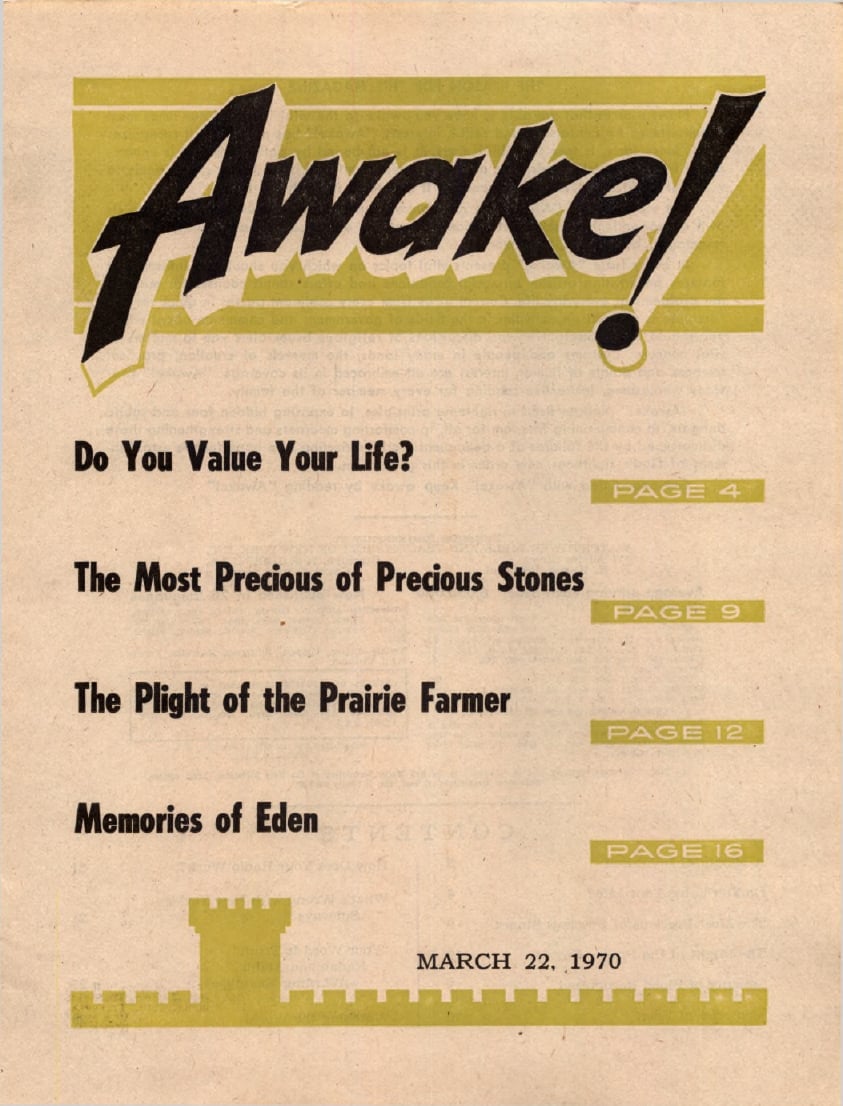
Awake! — March 22, 1970
Source: jw.org
Contents
A Memorial Invitation
Do You Value Your Life?
The Most Precious of Precious Stones
The Plight of the Prairie Farmer
Sanctity of Blood Recognized
Memories of Eden
How Does Your Radio Work?
What’s Wrong with New York’s Subways?
Nadab and Abihu—Warning Examples
Watching the World
Over 6 million Copies Each Issue!
Is the Bible Really the Word of God?
A Memorial Invitation
A Memorial Invitation
What is this Memorial?
It is the memorial of the most important and most precious death this earth has ever witnessed, the death of Jesus Christ, the Son of God. It took place 1,937 years ago in the spring of 33 C.E.
Why is Jesus’ death being memorialized?
Because Jesus Christ himself commanded his followers to do so, saying: “Keep doing this in remembrance of me.” The observance of the Memorial serves as a reminder of what Jesus Christ accomplished for the human race by his death.—Luke 22:19, 20.
Just what did the death of Jesus accomplish for mankind?
By reason of its being the death of a perfect, sinless man it provided the means to ransom the human family from sin and death, enabling us to get back into harmony with Jehovah God and gain everlasting life. The Bible explains this loving provision that Jehovah God made for us in this way: “God loved the world so much that he gave his only-begotten Son, in order that everyone exercising faith in him might not be destroyed but have everlasting life.”—John 3:16; Matt. 20:28.
How will Jesus’ death be memorialized?
In the way that he indicated. Christians will meet together, and on hand will be unleavened bread and red wine, symbols of Jesus’ body that he offered up and blood that he poured out for humankind. Of these emblems those Christians who have been anointed by God’s holy spirit will partake. Also there will be a discourse on the role that Jesus Christ plays in Jehovah’s purposes and the example he set for his followers. Included will be appropriate songs and prayers. You will receive a rich spiritual blessing from attending.—Matt. 26:26-28.
Where will this Memorial be held?
At all Kingdom Halls of Jehovah’s witnesses throughout the world. No admission will be charged and no collection will be taken. All visitors who are lovers of truth and righteousness are most welcome. If you do not know the location of the local Kingdom Hall, feel free to ask any Christian witness of Jehovah you may happen to know, or write the publishers of this magazine, who will be glad to provide you with the address.
When will this Memorial be celebrated?
On Sunday, March 22, 1970, after sundown. This is Nisan 14 according to the lunar calendar, on which date Jesus Christ instituted this celebration. If you have never attended the Memorial, why not make this your first one and experience the blessings that are in store for you on such an occasion? If you have attended before, be certain to attend again this year. Remember the date—March 22, 1970.
Do You Value Your Life?
Do You Value Your Life?
Does it make sense to endanger life by taking unnecessary risks? Why should a person care?
LIFE is a most precious possession. With it we can enjoy many things. Without it we cannot enjoy a single thing.
True, life brings difficulties. But, in spite of this, everyone in his right mind wants to live. People prefer life to death.
However, more and more persons are disillusioned with the way things are going in this world. In addition to personal problems, they see mounting troubles nearly everywhere they look—wars, skyrocketing crime rates, inflation, racial tensions, poverty, hunger. All this has a depressing effect. Many look for a way of escape.
Some find this escape in doing things that they feel will give them ‘kicks.’ They seek thrills to offset the unpleasant world in which they live. This is especially the case with many young people. Increasing numbers of them feel that there is nothing to live for but to ‘eat, drink and be merry.’
In the search for thrills, some go to the extent of participating in ‘suicide’ games. One such is to drive cars at high speed directly at each other. Whoever swerves first is ‘chicken.’ Others play ‘Russian roulette,’ where one bullet is put into a revolver, its chamber rotated, and the trigger pulled. Probably you have seen reports in the press of injury and death caused by such ‘games.’
Most people want life to be more interesting. But is serious injury or death a way to improve the situation? However small one’s enjoyment of life may have been before, it is going to be smaller after a serious injury, and nonexistent after death. In death, the Bible shows, “there is no work nor devising nor knowledge nor wisdom.” God’s Word adds: “As for the dead, they are conscious of nothing at all.”—Eccl. 9:5, 10.
Driving
Of course, few people play ‘chicken’ or ‘Russian roulette.’ But many persons come alarmingly close to it in their normal driving habits. Statistics show that the two major causes of death and injury in automobile accidents are: (1) Exceeding the speed limit; and (2) reckless driving. These account for a huge proportion of the more than 50,000 killed and several million injured each year in automobile accidents in the United States alone.
What about the driving habits of young persons? The publication Attitudes and Platitudes states: “The record of young drivers looks particularly bad. To make their record look worse, young drivers have consistently been involved in a higher percentage of fatal accidents than nonfatal accidents.” Time magazine reports: “Traffic accidents are the leading cause of death for young men between 16 and 24. Although young male drivers amount to only one-eighth of all registered drivers, they are responsible for a third of all fatal accidents.” This is why insurance premiums are so much higher for young drivers.
Young people want others to “tell it like it is.” The truth is that young drivers are being killed in epidemic proportions. In fact, each year more young drivers are killed in the United States in automobile accidents than are killed in the Vietnam war!
Researcher Dr. Stanley Schuman said: “The most dangerous young male driver is one alone in his car, because he will take amazing chances alone.” It was found that young male drivers often use the car as an instrument of ‘expression’ to gain relief from some problem at school, home or work.
But will causing more problems solve others? And causing more problems is precisely what happens to a growing percentage of those who seek thrills or work out frustrations when driving. More and more of them are becoming involved in crippling and fatal accidents. How many thrills can one enjoy if he is disabled or killed?
Drug Usage
A practice becoming ever more widespread is the taking of drugs for ‘kicks’ and to escape from reality. But does it really accomplish these things?
At first, it may seem to. But sooner or later, the ‘kicks’ are deadened, and the reality is made much worse. These consequences come inevitably; they cannot be avoided. If life had few thrills and was difficult to cope with before taking drugs, it contains even fewer thrills and becomes far more difficult after becoming addicted to drugs.
This is true in many ways. For one thing, the drug addict finds his health deteriorating. He is less able to enjoy simple pleasures such as eating and drinking, which in moderation can be a delight. Many drug addicts steal, cheat and lie to get money to pay for their expensive habit. In this process they may even injure or kill persons in holdups. They are constantly in fear of the police. And for increasing numbers, it results in an agonizing death. The New York Times reported: “In 1966, there were 33 teen-agers who died in New York after taking heroin. Last year the number rose to 72. But in three months—June, July and August—71 died this year.”
Ask any longtime drug addict if his life has been improved by his taking drugs. If he answers truthfully, he will admit that it has not. How could it be otherwise? Do conflict with the law, stealing, jail sentences, broken health and anguish add to one’s happiness in life? Does taking drugs to escape reality make sense when the reality is made much worse by doing so?
Sports
The word “sport” signifies, according to one dictionary, “diversion; recreation; pleasant pastime.” But would you regard activities that involve maiming and killing as pleasant recreation? Some “sports” involve just such a disregard for the value of life.
Boxing, or prize fighting, shows contempt for the gift of life. its purpose is to hurt, to render senseless one’s opponent. While this may seem to young persons a way to fame and fortune regardless of injuries incurred or inflicted, ask yourself: Of the many thousands who have been boxers over the years, how many can you name who won fame and fortune? Very few. But many are those who have been beaten senseless and maimed mentally as well as physically. Some have been killed as a direct result of blows in the ring.
In no way could this “sport” be considered showing respect for life. Jesus Christ said: “Just as you want men to do to you, do the same way to them.” (Luke 6:31) Do you want someone to pound you with his fists until you are unconscious? Then should you do that to him if you value the gift of life?
Wrestling is considered a “safe” sport by many. Yet, the intent is to do, or give the appearance of doing, physical damage to another. And it often results in injury. In England, a famous wrestler who recently quit upon becoming one of Jehovah’s witnesses acknowledged this when he said: “I can’t go on hurting people. It’s wrong. I know that a lot of it is showmanship but sometimes we do get hurt. Sometimes I hurt people. Instead I should show love and kindness.”
Highly Dangerous
Even more dangerous to life and limb are some other activities labeled as “sports.”
One such is automobile racing. Vehicles are pushed to the highest possible speeds. But accidents occur regularly as vehicles go out of control, their drivers being maimed or killed. In the Grand Prix of Italy one year, a famous international driver was killed when his racer vaulted off the track. But it did not end there. His car plunged into a mass of spectators and fifteen of them were killed, others being injured. And a racing car that plunged into spectators at Le Mans, France, killed 85 people!
Mountain climbing is a popular “sport” with many. By mountain climbing we do not refer to the hiking on safe trails engaged in by millions of people all over the world. We refer to the kind where ropes and pegs and other special equipment are needed, where mountain faces and icy peaks are scaled. One tragedy on Mount McKinley, North America’s highest peak, took the lives of seven out of a team of twelve climbers. After the disaster, one expert said: “It’s amazing more people haven’t been killed on McKinley when you consider 400 are killed in the Alps every summer.”
Additionally, in mountain climbing some come away with frozen fingers or toes that have to be amputated. Or due to a fall they may be confined to bed for weeks, even months, with broken limbs, perhaps being permanently disabled. Is this the way to increase one’s enjoyment of life? With the threat of serious injury or death ever present, would you say that this “sport” shows proper respect for the gift of life? Would it not be better to stay on safe trails and enjoy the majestic mountain creation of God year after year?
Tens of thousands participate in the “sport” of skydiving. They jump out of an airplane high in the air, fall free for a while at speeds in excess of 100 miles an hour, then pull the rip cord of their parachute. In one jump, eighteen sky divers were released at an altitude of 20,000 feet. Down they plummeted in a free fall at a speed of 125 miles an hour into a cloud cover at 4,000 feet. When they broke through this cloud cover, they found to their horror that they had been released over the wrong spot. They were above the angry waves of Lake Erie instead of being over a landing field. Sixteen out of the eighteen drowned. One of the two survivors stated: “I won’t jump again.”
Consider Others
What is often ignored when taking needless risks is that it is not just the participant who can be hurt. Many times it is others who are injured or killed, including persons who do value their lives highly. Too, what of the anguish that comes to relatives or loved ones of those who are injured or killed when taking unnecessary risks? What will they do? To a large extent their lives may be ruined too.
You may be a person who does not take unnecessary risks with your life. You may have a high regard for its value. But in a related matter, how do you feel about “practical jokes”? Some persons often resort to these as a means of getting ‘kicks.’ Do you feel that such considers the welfare of others?
For instance, do you feel it is considerate of others to pull the chair out from under someone just before he sits down? True, this often gets a laugh. But it has also resulted in permanent injury. If it were done to you, and others laughed at you while you were in pain and embarrassment, would you regard it as “practical”? How much better a feeling is left by those who kindly put chairs under people when they are being seated, as at a table!
There are those who may not think anything of pushing someone’s head down while one is drinking water from a fountain. But this has caused injury to the mouth and teeth. Would it not bring more joy for all to hold the fountain open for someone else instead? Then, some feel it is a joke to frighten others. But this has resulted in provoking a heart attack in some victims.
The playing of such “jokes” that result in embarrassment, injury and perhaps even loss of life, is not really considering the welfare of others. Indeed, the Bible states: “Just like someone mad that is shooting fiery missiles, arrows and death, so is the man that has tricked his fellow man and has said: ‘Was I not having fun?’” No one who values God’s viewpoint wants to be classed with “someone mad.”—Prov. 26:18, 19.
Most Unwise Now
Especially now is it most unwise to take any unnecessary risk with life, yours or another person’s. Why now, more than ever? Because God’s inspired prophetic Word clearly shows that we are nearing the end of this wicked system of things. Soon, it will be brought to an end by a direct act of God. (Zeph. 3:8) After that, he will bring in an entirely new order free from the distressing conditions of today.—2 Pet. 3:10-13.
Jehovah God also provides a government for his new order, one government, ruling from heaven. That government really cares about people on earth. It will work for the eternal benefit of all its subjects, providing benefits no human government can provide—health, happiness, interesting and productive work, an end to war and racial tensions, an end to poverty, hunger and even death itself. That government, or kingdom, is the one for which Jesus Christ taught his followers to pray.—Matt. 6:9, 10.
Therefore, the person who wants to live in God’s incoming new order will not endanger his life by engaging in activities just for ‘kicks’ or ‘thrills.’ He will appreciate that he needs to serve God to receive the reward of eternal life: “He that does the will of God remains forever.” (1 John 2:17) He realizes that he cannot serve God very well if he is maimed. And he cannot serve God at all if he is killed in some unnecessary activity.
Do you value your life? Do you want eternal life when paradise is restored to the earth? Then appreciate that the Giver of life, the One who is the Giver of eternal life, Jehovah God, should get first claim on your health and life. (Acts 17:24, 25; Rom. 6:23) Thus, value your life. Preserve it to the best of your ability. Appreciate that God holds you accountable for how you use the precious gift of life
[Picture on page 4]
Is taking chances like this showing respect for the lives of others?
[Picture on page 5]
Does taking drugs make life more thrilling—or more difficult?
[Picture on page 6]
One blow can knock you senseless—or kill you. Is this Christian?
[Picture on page 7]
Sixteen out of a group of eighteen thrill-seeking sky divers who landed in water drowned
[Picture on page 8]
Has such a fall ever happened to you? Did you think it was funny? Could it have led to injury?
The Most Precious of Precious Stones
The Most Precious of Precious Stones
By “Awake!” correspondent in Thailand
THE little Chinese girl ran merrily down the street after her friends under the watchful eye of her fond grandmother. Suddenly she stumbled and fell headlong. Grandmother rushed over anxiously to aid the crying child, but, finding no serious harm, she comforted the girl and sent her off again to play. One curious circumstance attended this familiar incident: the grandmother seemed to derive immense satisfaction from the fact that the two little green bangles worn by the youngster, one on each wrist, had been shattered beyond repair.
Why her satisfaction? Well, the little ornaments were of jade, and she herself had seen to it that the little granddaughter wore them for protection. Indeed, many Chinese believe that if a person wears jade and is involved in any sort of accident, the jade will be broken but its wearer will enjoy protection. No wonder, then, that grandmother noted this apparent confirmation of her superstition with that “I told you so” attitude!
This story helps us to understand why, for the Chinese, jade is “the quintessence of heaven and earth,” “the most precious of precious stones”—even surpassing diamonds.
The Chinese came to think of jade as being of supernatural origin, and hence as something that might be used to promote intercourse with heaven and propitiate the heavenly powers. Traditionally they associate it with their five cardinal virtues: charity, modesty, courage, justice and wisdom. Philosophers taught that jade, swallowed under the right conditions, would confer the ability to live for thousands of years, the power of rendering oneself invisible, and the ability to fly.
There are, of course, few who continue to hold to such beliefs, but they do serve to indicate the high esteem in which jade was held for centuries among the Orientals. But aside from the superstitions attaching to jade, it is, in fact, a most beautiful stone. In most parts of southeast Asia if you observe Chinese or Vietnamese ladies dressed in their best, you will seldom see them without a jade ornament somewhere about their persons.
What Is Jade?
There are two separate stones that go by this name: nephrite, a Silicate of calcium and magnesium, and jadeite or Chinese jade, a silicate of sodium and aluminum. Interestingly, that name “nephrite,” from the Greek word for kidney, reflects the idea that ground-up jade is a cure for kidney ills. The difference between jadeite and nephrite is really of importance only to collectors. On the whole, jadeite is more brilliant and takes a higher polish, while nephrite looks more oily than glossy.
Although China has long been the emporium for art objects fashioned in jade, this material in its natural state is seldom found in China. It was imported from other lands, notably Turkestan. But now nephrite comes mainly from New Zealand, and jadeite is found chiefly in Japan, Burma and California. Jade is often found in riverbeds where it has been washed down from the mountains. It is also quarried from mountains, but the Chinese have a preference for riverbed jade.
Usually we think of jade as having a bright spinach-green color. However, it comes in a variety of colors ranging from pure white, through yellow, red, and blue to black.
Identifying Genuine Jade
Since there are many stones that bear a strong resemblance to jade, how can we know when we have the real thing? If you wanted to buy a piece of jade and avoid the imitations that are passed off as genuine, the easiest way would be to have an expert determine the question. Two things in particular make jade unique: its density and its hardness. Its density or specific gravity refers to the ratio of its weight to an equal volume of water. Jadeite has a specific gravity of 3.4 or slightly less, nephrite of about 3.0. Thus a piece of nephrite weighing three ounces would be of the same volume as one ounce of water.
Hardness determinations are based on the simple principle that a harder material will scratch a softer one, and never vice versa. So, to test a piece of jade we would need, for example, a topaz. If it made no impression on the stone, then it must be genuine jade.
Something simpler is to take a steel penknife or pin and scratch or prick the stone. It is impossible to make any impression on the real jade in this way, but most imitations, such as soapstone, would be marked. Of course, it is not advisable to go around indiscriminately scratching or pricking other people’s art objects. If, however, you really have reason to apply this test, there is often an inconspicuous place, say, at the back or on the base of an object, where you can try it out, and if it is genuine jade no harm can be done. Glass, also, can be treated to look very much like jade, but a piece of glass would weigh considerably less than jade of the same bulk.
Value of Jade
The price of jade varies tremendously. More is involved than just the intrinsic value of a piece. Color, shape, quality and especially age and history play important roles. In 1960 a piece of carved Chinese jade was sold at auction for over $16,000. In 1860 a British expedition to Peking sacked the Emperor’s Summer Palace and carried off many of his magnificent jades. If one sees an object today marked “from the Summer Palace, Peking,” then one can be assured of excellent quality, if the tag is telling the truth.
Prices vary around the world, too. In Hong Kong a jade can be obtained for as little as $4. But in Europe and America higher prices usually prevail. A foremost jade manufacturer of Hong Kong is quoted as saying that if a stone is too dark, say, moss green, or too light, with much yellow tint, that is the sign of an inferior stone. The quality jade, said he, is lush green, vibrant, with a lot of shine in it. It must not be mottled; rather, almost translucent.
The Working of Jade
The working of jade is a long, slow, laborious task—one at which the Chinese are the acknowledged masters. In one Peking workshop craftsmen worked continuously day and night in shifts and still took many years to complete one piece. For two centuries at least their methods have continued unchanged. But how do they go about the job?
The first thing we must know about the matter is that jade is not carved. Rather, it is drilled and ground. Boulders of jade are cut into pieces of suitable size by means of a saw. Because of the hardness of jade its surface must be kept constantly coated with a moistened abrasive of some material harder than itself. Thus, in fact, the abrasive does the cutting and not the saw.
Boulders are sawn first from the top, and then from the bottom, but such is the skill of the workmen that the place where the two cuts merge is practically invisible. From this point the method to be employed depends on the object being made. Holes are made with a primitive, hand-operated diamond drill. A hollow steel tube is used for shaping the inside of vases; abrasive and water are again introduced and the tube is rotated until the desired depth is reached. Then the unwanted section down the center of the vase is given a smart tap to make it come away. If an unnoticed flaw in the jade causes the center trunk to break short of the desired place, the stump remaining will have to be drilled away.
Some vases are fashioned with a handle on the side, and from this handle another ring of jade may hang, looking rather like an earring on a pierced ear. That ring was originally one piece with the vase and was drilled away by the craftsman until it hung free. Entire chains of such rings are sometimes made from one stone.
Bowls are hollowed out by making a series of parallel, vertical cuts close together down into the solid piece of jade, leaving a series of raised leaves that are then chipped away. The bowl is finished by being ground with shaped disks of steel and the usual abrasive. Final polishing is accomplished with revolving disks of wood or leather and a special powder.
Uses of Jade
A piece of greenish-white jade weighing 640 pounds having been brought into Peking, Emperor Ch’ien Lung ordered it to be fashioned into a representation of a mountain landscape. The job was completed in 1874—a beautiful work of art, a mountain with streams, trees, pavilions, bamboo groves, peopled with literary scholars of the fourth century. Even larger scenes were reproduced by the Peking craftsmen. However, this particular one may be viewed by Westerners, for it now stands in the Walker Art Gallery, Minneapolis—probably the largest piece of worked jade in the United States.
Countless other objects have been fashioned out of jade—thrones, beds, pillows, screens, chopsticks, teapots, plates, books (with writing inscribed in gold on jade plaques covered with brocade and stored in sandalwood boxes), statues of Buddha and other prominent persons, flowers, combs, chessmen, fans, toys, opium pipes and various items of jewelry. At one time jade was even used for making tools, but the advent of metal made for more effective tools.
Jade crickets are often placed in the eyes and mouth of the deceased. Many have been recovered from the tombs, though contact with the body has caused partial decay of the stones in many instances. This superstition is based on the idea that the cricket symbolizes a reincarnation—it starts life as a larva in the earth and ends up with wings heading into the sky. A stone three times buried in this way is highly prized by many Chinese.
In the Bible jade is mentioned at Ezekiel 28:13 as being one of the precious stones that decorated the “covering” of the king of Tyre. And Exodus 28:15, 20, 21 shows that a beautiful jade stone with the name of one of Israel’s twelve tribes engraved upon it adorned the “breastpiece of judgment” worn by Israel’s high priest Aaron. The book of Exodus was written around 1512 B.C.E., so for at least 3,400 years jade has been known and valued by man, sometimes superstitiously, but always as one of earth’s delightful productions with which God has gifted his human creatures.
The Plight of the Prairie Farmer
The Plight of the Prairie Farmer
By “Awake!” correspondent in Canada
SMILING land! Yes, that is what the early pioneers discovered when they penetrated the Canadian prairies. It was truly a land of plenty. The lush summer vegetation fed buffalo, deer, elk and other wild creatures by the millions. Lakes and broad rivers were plentifully stocked with fish. Game birds and songbirds abounded. Vast belts of forest land interspersed by clearings and endless reaches of level land broken here and there by stands of trees, particularly along the riverbanks, gave promise of successful farming.
Each homesteader was granted 160 acres of free land, with the option of buying more. There seemed to be no question about what to do with all this land. The world needed wheat, and here was land peculiarly suited to produce it. So, they turned the sod and planted wheat until the rolling prairies became famous as the Golden West. Can you picture in your mind’s eye the ripe golden grain billowing in the wind as far as the horizon?
Then rail lines began reaching out farther and farther, and long, long trains laden with grain rumbled to the coast to transfer their precious cargo to waiting ships. Meantime, still more immigrants arrived. Energetic farmers continued to break the virgin soil with yokes of oxen or teams of horses. Temporary homes, some built of sod, would do. Everyone looked forward confidently to an era of prosperity.
With the close of World War I a period of modernization set in. Horse teams and cumbersome steam-driven threshing machines began to fade out. The versatile gasoline engine took over. This, in turn, was superseded by the diesel. Giant self-propelled combines next made their appearance. It was surely astonishing to see how they mowed down and gobbled up, as it were, vast swaths of growing grain in a matter of minutes. But with all this progress came also rising costs and maintenance charges.
A little foresight should have persuaded those prairie farmers that mechanization and improved agricultural methods would soon get to the underdeveloped nations, and they, too, would be in the market with their billions of tons of wheat. But few gave serious thought to such a possibility. Farmers bought more land to raise more wheat to pay for more machinery, and then bought more land to raise more wheat to pay for more machinery. It was a merry-go-round that was to prove to be not so merry after all.
As It Was in the Beginning
Few farmers in those earlier days specialized in wheat. They also owned horses, cattle, pigs, chickens, ducks and turkeys. They did not ‘put all their eggs in one basket.’ They soon found that bumper crops do not succeed one another endlessly. There are lean years too. So they had to grow feed for the livestock, and usually good-sized garden stocked with every kind of vegetable. Vegetables, fruits and meats were all suitably stored away for winter use.
The exchange of butter and eggs and the sale of fresh cream or the odd carcass of beef or pork always seemed to be ample to offset the grocery bill. Nobody went hungry. The children grew up as healthy as the prairie gophers that scampered all around them. Families worked together and stayed together. They made a success of farming as a unit, each member, young and old, sharing in the work.
No, it was not a case of all work and no play. Every summer brought the greatly anticipated picnics and rodeos. There were baseball and other games, and then dances in the evening. In winter there were skating, skiing and organized literary debating teams. There were frequent “bees” also, for, if a newcomer arrived or someone’s barn burned down, the neighbors gathered and built a house or raised a new barn in a hurry. People were friendly.
The Turning Point
Then suddenly, in 1929, the situation changed drastically. The Great Depression had set in. World stock markets collapsed. Well-to-do people were beggared almost overnight. The “hungry thirties” had arrived. Many a disillusioned investor committed suicide rather than face the bleakness of poverty. Farmers were hit hard, too, and many gave up the fight, allowing the mortgage companies to take over.
Others stuck to their farms. They worked from sunup till sundown and, when night fell, there were still chores to be done. There were cows to milk, cream to separate, pigs to feed, gates to mend, fences to fix, stray stock to be rounded up. Frequently, the farmer’s wife was the heroine on the home front, for many of the vital tasks fell upon her strong shoulders.
Unfortunately for the farmers, the impatient younger ones could not or would not persevere. They rebelled at being nursemaids to cattle, for, no matter how hard they worked, the family never seemed to get out from under the load of debt. They wanted better education and emancipation from farm chores. They began drifting to the city, where people had to work only eight hours a day and got pay for it. Eventually the exodus from the farms reached astounding proportions.
For those who remained it was a time of consolidation. Some, hoping for prosperity, bought up the little fellows, and huge landholdings resulted. The smaller farmer, forced to sell at a loss, drifted to industrial centers and often went on relief. Then farm labor became the big headache. It seemed in some areas there was no one left to hire. The entire farm program had to be reorganized. Everything was mechanized so that one man might handle all the work. Excess livestock was disposed of and the mixed farmer gave way to the grain farmer.
War-Induced Prosperity
World War II then boosted the economy with a cash infusion. Prices rose; farm produce of every kind was in demand. Many farmers participated in the war, but those who remained behind reaped a rich harvest. Again the farm scene changed. Now it was not only the young folks who went to the city. The older folks themselves moved to the conveniences of town life, or spent winters in California, Florida or Mexico. Livestock and gardens were no longer needed. They would buy their needs at the supermarket.
Thus the “successful farmer” became a man of leisure. He commuted to and from the farm in an expensive automobile and worked his land with tractors. In the fall the farm was shut down, and the owner was free to do as he liked during the long winter. It looked as if these farmers were about to attain to independence and a fairly easy life.
But wait! Things were happening in other countries also. Yes, even underdeveloped countries were being swiftly transformed. New methods of farming, ingenious machines, commercial fertilizers, better seed stock and fresh varieties boosted crop production. More countries managed to grow sufficient grain for their own consumption and then some.
Thus it came about that in the 50’s and 60’s Canadians found themselves in a real spot. The world’s grain market was glutted. Millions of tons of wheat were still in demand, but now Argentina, Australia and the United States of America had entered into a stiff competition. It was not long before the Golden West had massive elevators filled with surplus wheat, while the farmers, with two years of crops still in their farm storage bins, and another harvest coming on in the field, wondered how much of their acreage they should allow the flowering weeds to take over.
It is estimated that Canada now has as much as one and one-half thousand million bushels of wheat on its hands, with few takers. And it is seldom now a question of a cash transaction Canada must often determine how much of its customers’ exports it is willing to import in exchange for wheat. It is a buyers’ market. At the same time the hungry nations simply cannot pay the price. So, exporters are faced with the question: Will they or will they not sell for less? Drastic undercutting of the world price could precipitate an all-out price war that no one can afford.
Meanwhile, cattle-fattening feedlots have sprung up—feedlots where no barn is needed, no farm residence, but simply elevators for feed storage, outdoor cattle stalls and machines that distribute the feed to such stalls. And grain has become the “wampum” or medium of exchange. By it machinery, furniture, groceries, and so forth, have changed hands.
Writes Philip Mathias in the Financial Post: “The prairie farm economy is starting to revert to the barter system. Reason: Huge surpluses of grain that cannot be sold. Farmers with bulging granaries are bartering grain for machinery, cattle, furniture, education for their sons and perhaps a trip to the dentist.” This may relieve local pressure, but affords no real easing of the nation’s economy.
Of all segments of society the farmer appears to have been the most docile. Grievances of industrial workers find vent in strikes and walkouts, but the farmer just swallowed his feelings and plodded on in the hope that somehow the next season would bring improvements. But finally, the protesters’ disease got him—labor protested, students protested, even the clergy had their protests, so why not the farmer?
Protest meetings were staged throughout the country, and farm organizations sent rousing resolutions to the Government, demanding action. They would not be put off anymore by the platitudes and counsels to patience offered by those in authority. They got tough and moved en masse. When Canada’s Prime Minister, Pierre E. Trudeau, met with them recently in Winnipeg and Regina, thousands of farmers clogged city streets with their tractors and angrily shouted him down.
But what is the answer? To whom would you sell ice in the Arctic? To whom can you really sell wheat in a glutted world market? Other countries, too, are faced with the same problem, and they too are clamoring for outlets. There appears to be no immediate solution. What a paradox this produces! Grain-glutted nations have not enough of certain items because they have too much grain, while the underfed and starving see plenty everywhere except on their own tables. It will take a wiser king than Solomon to come up with the answer.
Whither Now?
Whatever remedy the Government seeks to apply, one thing appears to be certain: Previous concepts of farm-Government relations will have to be overhauled, drastically changed. Farmers will no longer be able to specialize in one type of crop. Diversified farming under totally different conditions may well return. But it will take some sort of international control to put an end to the “feast or famine” situation that now obtains in most lands.
The competitive system, particularly as regards farm production, appears to many persons to have outlived its usefulness. Many claim that an international advisory body is needed—one that is absolutely impartial, honorable and just, and that would carefully regulate who grows what and where, on an earthwide basis. The lamentable truth, however, is that such a body is presently unobtainable among the political and commercial elements of society.
Surely he will be a wise administrator who achieves a breakthrough with respect to this continuing problem! Human efforts hold out no hope of a sudden solution to the plight of the prairie farmer.
Sanctity of Blood Recognized
Sanctity of Blood Recognized
✔ Today professed Christians, by and large, think it strange that the Christian witnesses of Jehovah take seriously the apostolic prohibition of eating blood in any form as stated at Acts 15:20. But as historian Kaye notes in his work Ecclesiastical History Illustrated from Tertullian’s Writings, pages 146, 209:
“The primitive Christians scrupulously complied with the decree pronounced by the Apostles at Jerusalem in abstaining from things strangled and from blood.”
Bearing this out are the words of Tertullian himself, as found in chapter 9 of his Apology: “Christians, who have not even the blood of animals at their meals simple and natural food; who abstain from things strangled and that die a natural death, for no other reason than that they may not contract pollution, so much as from blood secreted in the viscera. To clench this matter with a single example, you tempt Christians with sausages of blood, just because you are perfectly aware that the thing by which you thus try to get them to transgress they hold unlawful.”—The Ante-Nicene Fathers, Vol. 3, pp. 25, 58.
Memories of Eden
Memories of Eden
NO DOUBT you are acquainted with the Holy Bible’s account of man’s creation and fall into sin. Adam and Eve in a paradise garden in Eden, the tree of life, the serpent and the tree of the knowledge of good and bad are familiar features. (Gen. chaps. 2, 3) This is because they are associated with events that have had devastating effects on the human family and that have left an indelible impression on its memory. Mankind cannot forget completely that something tragic happened in Eden.
The record in the Holy Bible has been the principal factor in keeping alive the memories of Eden. However, did you know that religious ideas of many non-Christian peoples reflect what the Bible says took place in Eden?
The religious ideas of these peoples, of course, are not exactly like the record in the Bible. Nevertheless, they do contain similarities to certain features of the Biblical account, and this makes them most interesting and intriguing to consider.
First of all, they show how empty-headed men can become in their reasonings when they are ignorant of God’s truth or when they turn away from it. Also, the many polytheistic ideas throw into bold relief the beauty and majesty of the simple, pure, truthful account in Genesis. This enhances our appreciation of the Bible as the inspired Word of God. Further, the very existence of so many diverse religious views, each containing some distorted features of the true account, offers confirmative evidence that there was a paradise garden that was lost to mankind.—Rom. 1:21-23.
Why They Differ from the Genesis Account
Before considering some of the religious ideas of various peoples, we should know why they are different from the Biblical account. Yes, how did these differences come about? Accurate Bible history shows that at one time all mankind spoke one language and knew of the events that occurred in Eden. Adam likely talked about them to his offspring and thus these events must have become common knowledge.
The eight survivors of the flood of Noah’s day also passed on the information about Eden to their children. However, after some time the majority of men began rebelling against God under a tyrant named Nimrod. It is reasonable to believe that by his proddings these rebellious ones began distorting the truth about man’s origin in expression of their defiance of God. Finally, Jehovah God broke up their common-language unity by causing them suddenly to speak different languages. By this act, he forced them to scatter to various parts of the earth.—Gen. 10:8-12; 11:1-9.
Though these rebellious peoples now spoke different languages, they did not forget their previous religious beliefs. So, wherever they migrated they carried these beliefs with them and expressed them in their new tongues. Of course, their new environments and the cultures they developed in various places helped to modify such beliefs. Thus in the course of time each group came to have its own particular version of the features connected with man’s beginning in paradise and his loss of it by sinful disobedience.
Also not to be discounted is the insidious influence of Jehovah God’s enemy, Satan the Devil. Since he could not remove the evidence of Eden, he would see to it that the facts about it were thoroughly distorted.—John 8:44.
We can liken this entire development to that form of music known as theme and variations. The simple, pure theme is stated and then a series of variations follow in which the theme is embellished and even distorted by changes in tempo, harmony and accompaniment. Despite all these variations, one can still faintly hear the original theme or parts of it. So with the pure, historical facts about the events in Eden. Time, ethnic culture, geography and demonic influence have evidently all played their parts in forming distorted variations on what originally happened.
Ancient Memories of Eden
Ancient peoples had memories of Eden. Archaeologists, in digging up the remains of their civilizations, have found much evidence of this. Clay tablets, cylinder seals, papyrus sheets, monuments, and so forth, have been discovered containing the religious views of the Babylonians, Assyrians, Egyptians, and other peoples.
Though they lived in various localities and had divergent religious beliefs, these ancients apparently had some recollections of Eden. Their written records indicate this. The author of Halley’s Bible Handbook writes: “These old records, carved on stone and clay, at the very dawn of history, in the original home of man . . . are evidence that the main features of the Biblical story of Adam became deeply fixed in the thought of primitive man.”
Pertinent to this are the remarks of archaeologist Sir Charles Marston in his book The Bible Comes Alive:
“As one goes over the ancient cuneiform writings, some before Abraham, and the engraved seals and stone carvings from Babylonia, Assyria, and other early civilizations, a remarkable trend of evidence is revealed to us. Even from the comparatively small proportion of these relics of a remote past that come to our notice, we derive the impression that the stories of the Creation, the Temptation and Fall of Man . . . as described in Genesis, were then matters of current knowledge. And that perhaps under a polytheistic setting, they were taught in the schools of Ur of the Chaldees.”
Reflections in Babylonia and Assyria
What exactly were these matters that were perhaps taught under a polytheistic setting? Note, for example, the belief expressed in certain Babylonian inscriptions. Halley reports that these ancient religious writings claim that “near Eridu was a garden, in which was a mysterious Sacred Tree, a Tree of Life, planted by the gods, whose roots were deep, while its branches reached to heaven, protected by guardian spirits, and no man enters.” It is seen from this that some memorable features of Eden’s events apparently still lingered in Babylonian minds.
The foregoing belief seems to indicate that the tree of life was something that the ancients could not quite forget about Eden. John Elder in his book Prophets, Idols and Diggers observes: “In old Babylonian literature there are frequent references to a Tree of Life, such as is mentioned in Genesis 2:9. Representations of the tree are frequent in alabaster reliefs and seals. Its fruits were supposed to confer eternal life on those who ate of them. One cylinder seal impression among those found seems to be a depiction of the temptation and Tree of Life.”
The cylinder seal to which Mr. Elder refers is evidently the one housed in the British Museum, in London, England. It is sometimes referred to as the “Temptation Seal.” The impression or picture it leaves when it is rolled on soft clay reflects Edenic happenings. A tree is shown in the center with a man seated on the right and a woman seated on the left. Behind the woman a serpent is seen standing erect as if it is speaking to her. Though the full meaning behind the symbolisms of this Babylonian seal is not known, the resemblances in it justify mention.
Assyrian memories of Eden were not unlike those of Babylon. This is because Assyria’s religious ideas were almost the same as those held by the Babylonians. In fact, generally speaking, the Assyrian gods and goddesses are identical with the Babylonian deities except for one named Asshur.
Prominent among the Assyrian memories of Eden is their sacred tree or “tree of life.” The motif of a sacred tree being guarded by two winged creatures appears often in the sculpture found in their palaces. In some cases the winged creatures are half animal and half human. These distorted mythical representations are perhaps recollections of the posting of cherubs “to guard the way to the tree of life.”—Gen. 3:24.
In 1932 a stone seal was found twelve miles north of Nineveh. This seal, now located in the University Museum in Philadelphia, Pennsylvania, appears to reflect another ancient memory of Eden. It shows a man and a woman naked and walking bent down as if brokenhearted and downcast. Also a serpent is shown following them. Dr. E. A. Speiser, who found the seal, said it was “strongly suggestive of the Adam and Eve story.”
Edenic Memories in Sumer and Egypt
Another people who had memories of Eden were the Sumerians. Their clay-tablet literature shows that they believed in a paradise that was located in the land of Dilmun, probably in southwest Persia. Utu, the sun-god, it is said, was ordered to water Dilmun with fresh water brought up from the earth, which water turned it into a luxuriant garden. This suggests the fact, expressed at Genesis 2:6, that the ground was watered by a mist that came up from the earth. When Enki, the water-god, ate of the precious plants in this garden, the Sumerian literature says, the curse of death came upon him. This seems to hearken back to Adam and Eve’s eating the forbidden fruit.—Gen. 3:6.
The ancient Egyptians, too, had Edenic recollections, as evident in their religious thinking. One of them was their belief that, after their Pharaoh died, there was a tree of life of which he must eat to be sustained in the realm of his heavenly father, Re. This was a most unusual idea for the Egyptians to hold. Why? Because their country is one the landscape of which is relatively treeless, trees not being a prominent feature of it. Yet in spite of this the memory of that tree of life in Eden of which man never partook seemingly persisted.—Gen. 2:9.
Another echo of Edenic history in Egyptian religious beliefs involves the serpent. To be sure, their view of it was corrupted by demon influence. The Egyptians regarded the serpent as a symbol of wisdom, and they worshiped it. Artistic representations of it were part of the headdress of the Pharaohs and adorned monuments, temples, tombs and statues of gods. How such worship ties in with Eden becomes clear to us when we recall that Satan the Devil presented his lies to Eve through a serpent. In so doing, he made himself appear as a source of higher wisdom from whom she could gain greater knowledge.—Gen. 3:1-5.
Other Peoples with Recollections of Eden
There are many other races whose beliefs and mythologies are mingled with memorable features of Eden. The book The Migration of Symbols by G. d’Alviella has a chapter of more than fifty pages devoted to the symbolisms and mythology associated with sacred trees. Its text and numerous illustrations give indications of reflections of the tree of life and the tree of the knowledge of good and bad in the beliefs of the Phoenicians, Syrians, Persians, Greeks, Sicilians, Mayans, Mexicans (Aztecs), Javanese, Japanese, Chinese and the natives of India.
For example, we note in this chapter “that the Persians possessed the tradition of a Tree of Life, the haoma, whose sap conferred immortality.” Also “that the belief in a Tree of Life existed amongst the Chinese. Traditions mention seven wonderful trees . . . One of them, which was of jade, conferred immortality by its fruit.”
Furthermore, this same chapter tells us that Scandinavian mythology contains a distorted memory of this feature of Eden. It mentions a sacred tree called Yggdrasill, under one of the roots of which was said to spring a well in which all knowledge and wisdom dwell. Another legend speaks of a goddess who kept in a box the Apples of Immortality, of which the gods would partake in order to renew their youth.
Turning to A.S. Murray’s Manual of Mythology, we read on page 173 that “the Gardens of the Hesperides with the golden apples were believed to exist in some island in the ocean . . . They were far-famed in antiquity; for it was there that springs of nectar flowed by the couch of Zeus, and there that the earth displayed the rarest blessings of the gods: it was another Eden.” The tree that produced the golden apples was entrusted to the care of the Hesperides, the daughters of Atlas. However, they could not resist the temptation to pluck and eat its fruit. So the serpent Ladon was placed to keep watch over it. And who held to this idea? The ancient Greeks.
Many of the natives of Papua in the Pacific believe in an invisible tree in and around which all those who have led good lives before they died live eternally, happy and free from care. Harold Bailey in his book The Lost Language of Symbolism reports what a visitor there observed about this belief. He noted that “it is not hard to understand that [the Papuan] still possesses dim memories of faiths learnt from lost peoples of higher development when the world was younger and perhaps nearer its Creator than it is to-day.”
As for what appear to be memories of Eden in the Americas, Harold Bailey writes:
“There is a Mexican manuscript in the British Museum wherein two figures are represented plucking the fruits of the so-called ‘Tree of Our Life.’ The Mayas and other peoples of CENTRAL AMERICA always represented their sacred trees with two branches shooting horizontally from the top of the trunk, thus presenting the appearance of a cross . . . and the first Spanish missionaries in MEXICO found to their great astonishment that the cross was already in use there ‘as symbolising a Tree of Life.’”
As for the serpent, many North American Indian tribes hold it in veneration as did the ancient Egyptians. In fact, serpent worship has infected peoples in every corner of the globe. Each group worships a particular snake indigenous to their land.
And there are many distorted views held by various peoples about a paradise garden that they hope to attain someday after they die.
Man’s Memories or God’s Purpose—Which?
Just this brief consideration of man’s memories of Eden shows us that the majority of mankind have been “tossed about as by waves and carried hither and thither by every wind of teaching by means of the trickery of men, by means of cunning in contriving error.” (Eph. 4:14) Also they have paid “attention to misleading inspired utterances and teachings of demons.’’ (1 Tim. 4:1) The variations and distortions have all but hidden the features marking the true events that took place in Eden. If we had to depend on these vagaries of men’s imaginations to learn the truth about our first parents, we would never be able to do so.
How thankful we should be to have Jehovah God’s precious Word of truth, the Holy Bible! It is there that we can find the factual history of Eden. And how we should rejoice to learn that Jehovah God has not forgotten Eden and the promise he made therein. (Gen. 3:15) This is the promise to destroy Satan the Devil and restore paradise to man, not merely in one section of the earth, but in every quarter. It is to this restored paradise that Jesus promised to resurrect the evildoer who was executed with him.—Luke 23:43; 2 Pet. 3:13; Ps. 72:16.
The opportunity to enter this paradise that God will restore is open to you now. By studying the Bible you can learn how you can do so. Jehovah’s witnesses would like to help you do this. Why not take advantage of their offer?—Rev. 22:17.
[Picture on page 17]
Ancient Assyrian sculptured slab showing cherubic figures standing before a sacred tree. Did the Assyrians know about the tree of life in Eden?
[Picture on page 18]
An ancient Babylonian cylinder seal that seems to echo what happened in Eden nearly 6,000 years ago. Can you see the resemblances?
[Picture on page 19]
Heads of serpents adorning the temple of Quetzalcoatl give evidence of Aztec serpent worship in Mexico
How Does Your Radio Work?
How Does Your Radio Work?
COMMERCIAL radio broadcasting in the United States began just fifty years ago, in 1920. By 1925 there were 3 million radios in American homes. By 1940 these had increased to over 45 million, and now there are an estimated 275 million radios in the United States. That is more than one radio per person! Yet, despite their number, most persons understand little about a radio’s operation. Have you ever wondered how it works?
Perhaps you are sitting in an easy chair as you read this and the radio is providing background music. Let us trace the steps that enable this music to travel from the radio station to your home.
Broadcasting the Music
The music is produced by an orchestra or, in most cases today, a recording in the radio studio. The musical strains are transmitted through the air from the record to the microphone. The sound is actually small pressure variations in the air. The ear senses these pressure variations and enables one to hear the music. The microphone also senses these pressure variations, and changes these sound waves into voltage forms or electrical equivalents of the sound waves.
The microphone thus carries out the first basic step in getting the sound into an electrical form. There are many types of microphones, but we will examine the operation of the moving-coil type. The accompanying illustration will help you to visualize its various parts.
The diaphragm is constructed of paper or other light material that vibrates to the sound of the music. This causes the little coil of wire to be moved back and forth, since it is rigidly attached to the diaphragm. The coil moves back and forth through the strong magnetic field produced by the permanent magnet, and this produces in the coil electrical equivalents of the sound waves. These electrical waves at this point are very weak, and so must be amplified or strengthened. This is done by vacuum tubes or transistors.
From the studio control the electrical waves are carried to the transmitter. In the case of small radio stations, the transmitter may be located right in the studio control room. However, larger stations usually have their powerful transmitters out of town, away from high buildings and other obstacles that might distort their transmissions.
The transmitter consists of electrical equipment that produces radio waves, and combines these waves with the electrical waves that have been produced in the microphone. This combination can be done to create either of two kinds of waves, amplitude-modulated (AM) or frequency-modulated (FM) waves.
Amplitude modulation is a changing of the power of the wave, whereas frequency modulation is a changing of the frequency of the wave. An AM wave has the advantage of covering a great distance, since it is a long wave and follows the curve of the earth. On the other hand, FM waves reach for shorter distances, since they do not follow the curve of the earth. An advantage of FM over AM is its relatively noise-free reception.
After the combination in the transmitter of electrical waves and radio waves to form modulated waves, the modulated waves are fed to a broadcasting antenna. The antenna reaches high into the air, sometimes 500 feet or more. From this antenna the waves are sent out into space, spreading like the ripples made by a stone dropped in still water. These modulated waves carry all the variations and tones of the music produced in the studio.
With literally thousands of radio stations broadcasting in the United States, you might wonder how all the waves emitted by these stations are kept from interfering with one another. The Federal Radio Commission was established in 1927 to prevent such interference; it was replaced by the Federal Communications Commission in 1934.
This Federal commission assigns stations a particular channel or frequency that they may use in broadcasting, and it is a Federal offense for a station to use any other than the frequency assigned to it. This assigned frequency is usually indicated by the number on your radio band at which you pick up that station. The frequency for an AM station may be anywhere between 550 and 1600 kilocycles.
Receiving the Music
Radio waves coming from broadcasting stations are all around us. We cannot see them, but they are there. How is it, then, that your radio selects the waves carrying the music you want to hear and converts these waves into sound? Let us see.
First, the waves must be received into your radio. The antenna is this receptor. It corresponds to the ears of a person. Most radios today have built-in antennas, although automobile radios frequently have exterior ones. An outside antenna provides better reception for weaker incoming signals.
The radio waves that are sent out or radiated into the surrounding community by the radio station induce a small electrical signal or pressure when they strike your radio antenna. Since the waves from innumerable stations are being fed by means of your antenna into your radio, the waves that carry the music you want to hear must be selected from the rest. How is this done?
This is accomplished by means of the device within your radio called the tuner. The dial, or tuner knob, on your radio can be moved to select the channel or frequency of the station that is broadcasting the desired music. Tuning, therefore, simply involves the selection of one frequency and rejection of all other frequencies. But this has not always been easy to do.
Years ago, when radio was not as developed as it is today, the inability to select desired frequencies precisely was a glaring shortcoming. In fact, when the United States Navy desired to receive SOS signals from a ship in distress, commercial broadcasting stations were obligated to cease broadcasts temporarily so that Navy receiving sets could pick up these radio communications without interference. However, the problem of interference from other stations is rarely encountered today. This is because most radios employ the superheterodyne principle to achieve the precision of selection that avoids the pickup of stations on adjacent channels.
…