Awake!, September 8, 1969
Download: PDF — Awake!, September 8, 1969
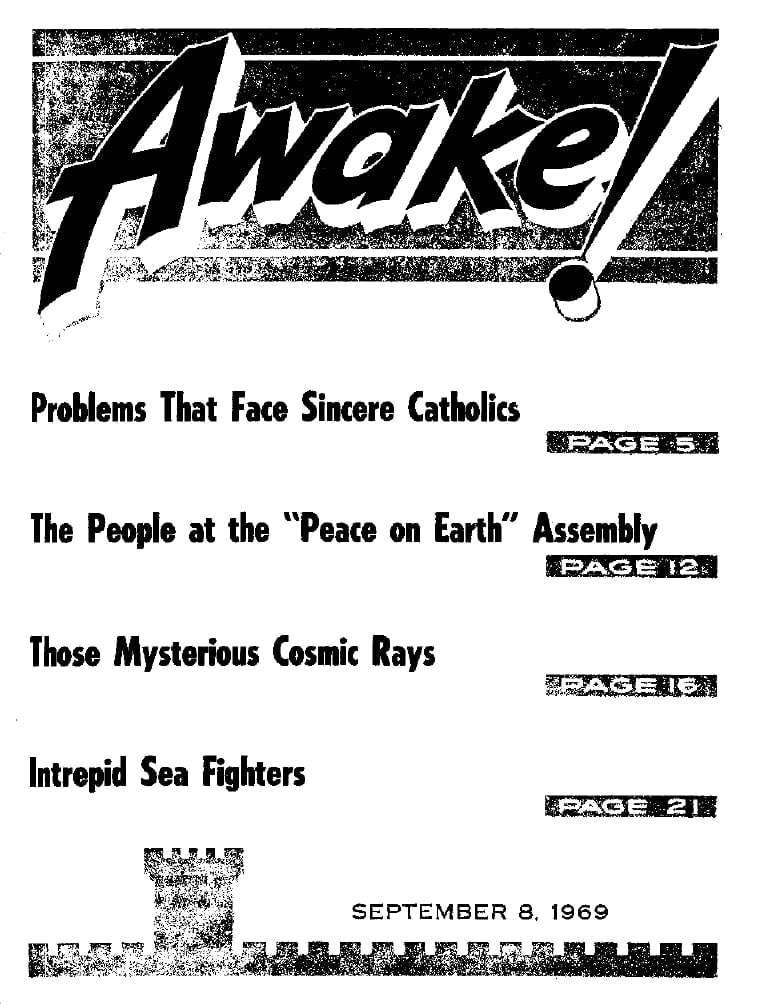
Problems That Face Sincere Catholics
PAGE 5
The People at the "Peace on Earth" Assembly
PAGE 12
Those Mysterious Cosmic Rays
Intrepid Sea Fighters
PAGE 21
SEPTEMBER 8, 1969
THE REASON FOR THIS MAGAZINE
News sources that are able to keep you awake to the vital issues or our times must be unfettered by censorship and selfish interests. "Awake!" has no fetters. It recognizes facts, faces facts, is free to publish facts. It is not bound by political ties; it is unhampered by traditional creeds. This magazine keeps itself free, that it may speak freely to you. But it does not abuse its freedom. It maintains integrity to truth.
The viewpoint of "Awakel" is not narrow, but is international. "Awakel" has its own correspondents in scores of nations. Its articles are read in many lands, in many languages, by millions of persons.
In every issue "Awake!" presents vital topics on which you should be informed. It features penetrating articles on social conditions and offers sound counsel for meeting the problems of everyday life. Current news from every continent passes in quick review. Attention is focused on activities in the fields of government and commerce about which you should know. Straightforward discussions of religious issues alert you to matters of vital concern. Customs and people in many lands, the marvels of creation, practical sciences and points of human interest are all embraced in its coverage. "Awake!" provides wholesome, instructive reading for every member of the family.
"Awakel!" pledges itself to righteous principles, to exposing hidden faes and subtle dangers, to championing freedom for all, to comforting mourners and strengthening those disheartened by the failures of a delinquent world, reflecting sure hope for the establishment of God's righteous new order in this generation.
Get acquainted with "Awake!" Keep awake by reading "Awake!"
PUBLISHED SIMULTANEOUSLY IN THE UNITED STATES BY THE
WATCHTOWER BIBLE AND TRACT SOCIETY OF NEW YORK, INC.
117 Adams Street
BROOKLYN, N.Y. 11201, U.S.A.
AND IN ENGLAND
WATCH TOWER BIBLE AND TRACT SOCIETY
Watch Tower House, The Ridgeway
LONDON N.W. 7, England
N. H. KNOR, President
GRANT SUTTER, Secretary
Average printing each issue: 5,650,000
5d in copy (Australia, 5e; South Africa, 31%)
Yearly subscription rates
For semi-annual editions
Americas, N.A., 117 Adelaide St., Northwich, N.Y. 112041 $1
Mexico, 11 Boreal Road, St. Johns, N.Y. 2135 $1
Canada, 150 Boulder Lake, Toronto, ON. $1
New Zealand, 621 New York K., Amstand 3, 996
South Africa, Private Bid 2, P.O. Blandenstaff, Trol. 706
(Monthly collections cost half the above rates.)
Remittances for subscriptions should be sent to the office in your country. Otherwise send your remittances to Brooklyn.
In your country, please send at all Dow two weeks before subscription expires.
Now published in 26 languages
Sammelmächtly—Arkansas, Cedarwood, Danish, Dutch, Englid, Finnish, French, German, Greek, Iceland, Japanese, Koran, Norwegian, Portuguese, Spanish, Saselhid, Togales Zillk
Monthly—Chinese, Ciyenla, Hillayynon, Malayalam, Pelleh,
Tamil, Ukrainian.
CHANGES OF ADDRESS should remain as thirty days before your morning date. Give as your old and new address your current address. Watch Tower, Watch Tower House, The Ridgeway, London M.W. 7, England.
Entered as second-class matter at Brooklyn, N.Y.
Printed in England
The Bible translation regularly used in "Awake" in the New World Translation of the Holy Scriptures, 1962, editi
When other translations are used, this is clearly marked.
CONTENTS
Is an Economic Crash Coming? 3
Problems That Face Sincere Catholics 5
Are You Ready to Fly in the "Jumbo Jet"? 8
Heartbeats 11
The People at the "Peace on Earth"
Assembly 12
Those Mysterious Cosmic Rays 16
How Did They Know? 20
Intrepid Sea Fighters 21
Land Area 24
Practical Wisdom in the House 25
Increasing Praise in the South Pacific 26
"Your Word Is Truth"
Were Adam and Eve Real Persons? 27
Watching the World 29
Number 17
Is an ECONOMIC CRASH coming?
In March 1968, the economic system of the Western world seemed on the verge of collapsing. Its underpinnings were badly shaken by the worst money crisis since 1931. Gold was being bought on the world gold markets in London, Paris and Zurich at a feverish rate because people were losing faith in the soundness of paper currencies such as the British pound and the American dollar. Gold was flowing out of the financial reserves of Western governments at a frightening pace. It was only by quick emergency measures taken by the Western governments that serious consequences were prevented.
Then in November 1968, and also in March 1969, the economic system was shaken again as speculative pressure was put on the French franc. It appeared that the franc might have to be devalued. People began selling it for gold and other currencies, putting it under severe pressure. Some persons feared that if the franc were devalued substantially, pressure would come on the British pound and then on the dollar. If they were devalued, especially the dollar, then the tottering economic system would very likely be in a state of chaos, they thought. There is a sound basis to their fears.
Money has value only as long as people have faith in the government that prints it. But if they have doubts about the government's ability to remain economically sound or to continue existing, will they accept its money in exchange for goods and services? Not likely. There were some American tourists last year who were shocked when they had difficulty finding someone who would cash their traveler's checks. This was due to distrust in the soundness of the dollar.
When you see the shakiness of the present economic system and how quickly people can lose faith in a paper currency, can you not see that there are good reasons for fearing that the economic system may collapse from its own weaknesses? But does this possibility necessarily mean it will happen? No; yet there is something coming that is certain, and it will cause all national currencies to become valueless. This is the termination of the governments on whose existence the value of such currency depends. To some persons such a thing may seem to be highly improbable, but nevertheless, it is what the Bible foretells.
Long ago Bible prophecy foretold that "the God of heaven will set up a kingdom that will never be brought to ruin.
. . It will crush and put an end to all these kingdoms, and it itself will stand to times indefinite." (Dan. 2:44) God's Word is true; he does not lie. When this government of God brings to ruin all man-made governments, will that not mean the total collapse of the present economic system? Will that not mean that the national currencies of those governments will become valueless? How could such currencies continue to have any purchasing power when the governments issuing them no longer exist?
Even the gold that some persons are hoarding to protect their wealth from loss because of the uncertain value of national currencies will not save them.
Under inspiration the prophet Ezekiel foretold that the riches of the people of Judah would be valueless on the day of their calamity, which came upon that kingdom in 607 B.C.E. Their gold and silver that was used as money became valueless to them as the prophet foretold. "Into the streets they will throw their very silver, and an abhorrent thing their own gold will become. Neither their silver nor their gold will be able to deliver them in the day of Jehovah's fury." (Ezek. 7:19) What was said about them can likewise be said about those today who put their trust in money, whether the money be gold and silver or paper currencies. Such money will not save them when God's kingdom brings down in ruins the political governments of our day.
these survivors will be deprived or the necessities of life. As God provides now for those who trust in him and will preserve them through the end of the political governments, so he can be counted on to provide for the needs of the survivors.
The survivors of the collapse of those governments will be the lovers of righteousness who placed their trust in God's kingdom rather than in the political systems of the world and in the money used by those governments. Because today's money will be valueless as a medium of exchange it should not be concluded that
At one time Jesus Christ reminded his followers that their Creator provides for the lilies and the birds and can be counted on to provide for their needs. He went on to say: "So never be anxious and say, 'What are we to eat?' or, 'What are we to drink?' or, 'What are we to put on?' For all these are the things the nations are eagerly pursuing. For your heavenly Father knows you need all these things. Keep on, then, seeking first the kingdom and his righteousness, and all these other things will be added to you."—Matt. 6; 31-33.
The time for God's kingdom to bring down the political governments in ruin and cause their economic system to crash is fast approaching. Now is the time to do as Jesus said: Seek first God's kingdom and his righteousness. It is not the time to be seeking financial security by boarding gold, silver, gems or even real estate. They can give you no more security than paper currencies when God's kingdom moves against the political governments of the world and those who put their trust in them.
Heed the advice given in the Bible at 1 Timothy 6:8: "So, having sustenance and covering, we shall be content with these things." It is better to seek spiritual riches by building up knowledge and faith in our Creator and his prophetic Word. Using these spiritual riches to help others to transform their lives for the better and to have hope can bring results that are far more rewarding and lasting than uncertain material riches.
PROBLEMS
That Face
</div>
PERHAPS you were brought up as a Roman Catholic and feel
that you should remain within the religion you have always considered to be the "original" Christian church. You have been taught that the pope is the God-ordained successor to the apostle Peter, and that as such he is the legitimate head of the Christian church. You felt secure inside a hierarchical system that you believed to be truly apostolic. You would never have dared to contest the spiritual authority of your priest, nor dream that the latter might someday rebel against his bishop, or that a cardinal might openly contradict the pope.
You acknowledged that the Catholic Church had its shortcomings, but you felt confident that, if reforms were necessary, they would come from the pope. You were sure he would have the active cooperation of the bishops throughout the world. Convinced that all prelates were activated by the "one Spirit" and were under oath to obey the pope, you considered yourself part of a religious organization the foundations of which go back to the apostles.—Eph. 4:4, Douay.
Your sense of logic told you that there can be only "one [Christian] faith." (Eph. 5:5, Dy) For you the Catholic religion had preserved that faith alive throughout the centuries, since long before the Protestant Reformation. The numerous Protestant religions, all different, yet for the most part differing from the Catholic Church only on matters of church government and a few doctrines, frightened you in their conflicting diversity. This made you feel even more sure that you held to the true Church.
But since the Second Vatican Council, this feeling of security has left you. You have come to realize that, while it is true that Christ is not divided, the largest church in
SINCERE CATHOLICS
</div>
Church leaders are divided. How can a Catholic determine what is right?
Christendom is far from united. -1 Cor. 1:13.
What Is the Church Teaching?
Is the Church of Rome a homogeneous system, teaching the same things everywhere? Are at least all the upper clergy in agreement among themselves as to what is required of good Catholics? If the pope is truly Peter's successor, should not all the cardinals, bishops and priests, not to speak of all the "faithful," submit to his authority?
You would like to be able to reply Yes to these questions, but things you have recently read in the press, heard over the radio or seen on television have set you thinking. You are beginning to realize that being a Catholic means different things in different places.
If you happened to be born in the Netherlands, very likely you would be using a catechism, approved by the Dutch bishops, containing new explanations of at least fourteen important doctrinal points, including original sin, the Redemption and transubstantiation. But these explanations are considered by Catholics in the Vatican to be "contrary to the faith."
So Dutch Catholics are not learning the same things as Italian Catholics. Which of them are true Catholics?
Even in Italy, if you were to stop somebody in the street and ask him what his religion is, and he replied: "I am a Catholic;" you could not be sure what he really believes.
For instance, if you were in Florence, you might meet a Catholic from the Iso-
who consciously decide to use the contraceptive pill should not be deprived of the sacraments. (Le Figaro, December 9, 1968) Whereas, "the Catholic episcopate of Yugoslavia has decreed stricter application of the encyclical Humanae Vitae on birth control." (Le Monde, January 19-20, 1969) Do not English and Yugoslav Catholics belong to the same church?
In the American magazine Look, dated December 10, 1968, author John O'Connor
lotto neighborhood. The parish priest there, Don Mazzi, was recently dismissed for unorthodox teaching set out in two small books that have come to be
ARTICLES IN THE NEXT ISSUE
When There is Crime in Your Neighborhood.
Venezuela's Prosperous Economy.
Preventing Accidents to Children.
Beauty In the Rocks.
known as "the Catechism of Isolotto." According to the French Catholic daily La Croix, this catechism was severely criticized in the Jesuit publication Civiltà Catolica by a church official. He deplored
Germany and the Netherlands emphasized the freedom of the individual conscience." But even in the United States not all the clergy followed their bishops, as the following subheading showed: "U.S.
commented on reaction to this encyclical, saying: "If U.S. bishops gave quick genuflection, the hierarchies of Austria, Belgium, Canada, England, France,
that "for Christians [Catholics] in Isolotto, Christ is a revolutionary who came to earth to help the poor and the oppressed."
Yet, on the other hand, a headline in Parus-Match dated December 21, 1968, read: "10,000 Inhabitants of Florence Go to the Help of the Poor People's Priest." So the Italian Catholics who use this "catechism" must have quite a different conception of Christ Jesus from that of more conservative Catholics. Yet they all claim to belong to the Roman Catholic
Bishops Disciplined Priests Who Dissented, but About Half of Them Still Oppose Paul's Teaching."
Confirming the widespread Catholic opposition to the pope's ruling, Life magazine wrote in an editorial: 'The priests and laymen who are objecting to the encyclical—their number includes more than 400 of the leading theologians and religious educators in the U.S., and such internationally known thinkers as Germany's Father Bernard Häring and Hans
Church. Just what does it mean to be a Catholic?
Even the clergy do not agree as to what is required of good Catholics. Take Pope Paul's recent encyclical on birth control. Catholics living in different places are being required to respect quite different rules of conduct.
For example, in England Cardinal Heenan told British Catholics that couples
Kung of Switzerland—have couched that dissent in impassioned but respectful prose."—August 16, 1968.
So, depending on where they live, Catholics may or may not be required to obey the pope's encyclical that bans the use of artificial birth-control devices. It depends on the attitude of their priest or bishop. In view of this situation, can it be said that the Church of Rome is truly Christ's catholic (universal) church, guided by the "one Spirit"?
The Catholic is supposed to look up to his priest and his bishop for spiritual guidance, but if he does so, he may find himself at odds with the pope, the head of the church.
You may reply: "This might be so, but personally I have complete confidence in the pope. He is even willing to render himself unpopular if need be in order to defend the traditional doctrines of the church."
Is the Pope Defending
Apostolic Christianity?
The tenacity of Pope Paul is not to be doubted. But is he courageously defending tenets that are based on the written "word of God," the Holy Bible? Consider, for example, priestly celibacy.
In 1967 Paul VI issued an encyclical reaffirming the church's position on mandatory cellabry for priests. His stand on this matter made him unpopular with priests all over the world. What was your reaction? You probably felt sorry for the priests, but agreed with the pope, thinking that he was steadfastly maintaining a rule laid down by the apostles. What are the facts?
Let us consult a standard reference work that is far from being anti-Catholic. In fact, its article on "Celibacy" was written by a Jesuit priest. We read: "The majority of scholars agree that the law of clerical celibacy was not of apostolic origin. St. Paul recommended celibacy, but he also wrote that a bishop should be a man of one wife (I Tim. iii, 2; Titus i, 6). ... The first and second ecumenical councils of the Lateran (1123 and 1139) removed the possibility of clerical marriage. ... The great reforming council of Trent, after long discussion, retained the earlier laws, including the Lateran decree that holy orders nullify an attempt to marry.
... The law of Trent remained the settled legislation of the church. It was incorporated into the 1918 Codex Juris Canonici in canons 132, 987 and 1072."—Encyclopedia Britannica, 1950, Vol. 5, pp. 94-96.
So this Jesuit author admits that priestly celibacy did not become mandatory until the twelfth century, and that it is neither apostolic nor Scriptural. According to the Catholic Douay Bible, the Christian apostle Paul wrote: "Drain priests in every city, as I also appointed thee: If any be without crime, the husband of one wife, having faithful children." (Titus 1:5, 6) About thirty years after Christ's death, the same apostle wrote: "It behoveth therefore a bishop to be blameless, the husband of one wife, sober, prudent, of good behaviour, chaste."—1 Tim. 3:2, Dy.
The Douay Bible itself shows that Peter, whom the Roman Catholic Church claims to be the first pope, was married. It says: "When Jesus was come into Peter's house, he saw his wife's mother lying, and sick of a fever." (Matt. 8:14) Church leaders are well aware that cellibacy is not a Bible requirement. The influential Swiss Catholic theologian Hans Kung "reminds us that Peter and the apostles were married." —Schweizerische Kirchenzeitung, 1967, No. 31.
Many leading Catholic theologians disagree with the pope on his stand on cellibacy. They believe priests should be allowed to marry, even as early Christian ministers had this privilege. Their views are shared by thousands of priests throughout the world. Thus, Catholics are completely divided on this issue. As a Paris daily reported concerning Dutch Catholics: "A veritable 'battle' is going on in the Netherlands over priestly celibacy." Le Monde, December 19, 1968.
So where do you stand? If you agree with the pope, you are at variance with many other Catholics and, more important still, with what your own Catholic Bible shows to be the truly apostolic position on this question.
Whatever position you adopt, you must admit that "the unity of the Church . . . founded upon the Apostolic See of Rome" does not exist. What is more, it is clear that the pope does not base decisions on God's Word the Bible, Said Florence priest Don Mazzi: "To obey the hierarchy is to ignore the deepest needs of the poor, but to satisfy these needs is to encounter the opposition of the hierarchy. So we have to become either Pharisees or rebels. And we don't want to become either." (Time magazine, December 27, 1968) This dilemma faces sincere Catholics throughout the world, not only on social matters, but on vital moral and even doctrinal issues.
One of the main reasons for your being and thus far remaining a Roman Catholic is the conviction that you belonged to a united and truly apostolic church. The facts, a few of which have been here outlined, show this reason is no longer valid. But do not lose heart. True, apostolic Christianity is being practiced throughout the earth by well over a million united Christians known as Jehovah's witnesses. Probably one of them brought you this magazine. The next time you see one of them, why not ask for help in solving the problems facing all sincere Catholics?
"A "JUMBO JET"? Yes, this is the nickname given to the new Boeing 747, but does this new plane really deserve such a nickname? A trip to the plant where it is built at Everett, Washington, soon convinces one that it is not only a jumbo but, as the Boeing people call it, "The Incredible." Approaching the giant 747 plant, large enough itself to hold more than eight American-size football fields, I saw the number two 747 off the line gleaming under a warm sun in the blue, white and silver colors of Pan Am. This is the first 747 to bear the colors of a customer airline.
On approaching closer, I began to appreciate just how big this giant really is. It is nearly twice as big as the Boeing 707, one of the best known and one of the largest of the present generation of jets.
The overall length of the plane is 231 feet, and the tail reaches a height of over 63 feet—approximately the height of a six-story building. The wingspan is more than 195 feet. The cabin is 20 feet wide, more than 80 percent wider than the Boeing 707. And just how much does this behemoth weigh? Well, the gross takeoff weight is 710,000 pounds. At first sight I could not help but feel that something this large should float rather than fly.
As far as speed is concerned, the 747 will be slightly faster than the present generation of jets, for it will cruise at around 625 miles per hour.
Five Main Compartments
Enough for the figures. Let's take a look inside and see what some of the special features of this great plane are. Then, we might better decide whether we want to fly in it. It has been described by its manufacturer as a plane that will end the era of the "flying tube" and begin the era of the "flying living room." The great fuselage will be divided up into five main compartments instead of the one or two compartments found on today's jets. Instead of one aisle down the center of the cabin, there will be two aisles extending the length of the cabin. These aisles will be intersected by five cross-aisles terminating at five double-width doors on each side of the cabin. Incidentally, these double-width doors will be over six feet high—a relief to many taller air travelers.
Another special feature of the 747 will be a lounge located behind the flight deck or cockpit. The flight deck itself will be located above the main cabin, and the pilot will be sitting 29 feet above the field. Incorporated into the flight deck are larger crew quarters as well as room for more sophisticated navigational equipment. Then directly behind the flight deck will be the first-class lounge on the upper level.
One wonders what kind of engine could ever get this huge plane off the ground. Special new turbofan engines have been developed for the 747, each developing 43,500 pounds of thrust. These engines not only are larger and more powerful but are also quieter and more efficient than today's jet engines. To give you an idea of the size, the air intake on the front of each of these jet turbines is eight feet in diameter.
More Passenger Comfort
"But," you might ask, "what do all of these special features mean for me if I am going to fly in that Jumbo Jet?" Well, the manufacturer and the airlines promise a new era of individual passenger comfort in the 747. Have you ever had that "sardine-can" feeling when flying in one of today's jets? The promise is that in the Jumbo Jet this will all be over, even in economy class. Here the seats will be nine abreast, separated by the two aisles. But, they will be at least 10 percent wider than seats in the economy sections of current jet airliners. And have you ever been squeezed into the center seat in a three-seat unit? Well, on the 747 there will be only one set of three-seat units on one side of the aircraft. And the middle seat does not have to be sold until the airplane is 90 percent filled. The promise of more usable space certainly sounds inviting to many travelers.
There will be more room for the passenger to walk around on the 747, too, with the two aisles going the length of the cabin and then the five cross-aisles intersecting the cabin at each set of doors. These aisles and door arrangements make it possible to divide the cabin into five roomlike sections with galleys and lavatories distributed throughout the cabin.
This should provide for more efficient passenger service on board.
You will note, too, that the 747 has almost vertical walls and high flat ceilings in the tourist or economy section. And here again the taller traveler will feel especially blessed. All of this, of course, provides a feeling of spaciousness that was not possible on earlier jetliners.
But what about first class? Well, the first-class traveler will have even greater comfort, for here one finds extra-wide seats in the forward section of the aircraft, designed for luxurious comfort. And since the flight deck is located upstairs, the first-class section goes right up to the nose of the plane, allowing some of the passengers a "pilot's eye" view. Then there is that lounge that has been placed upstairs behind the flight deck for the convenience and relaxation of the first-class passengers. It is reached by circular stairs at the center of the first-class section. The lounge itself can accommodate around fifteen passengers in both sofa- and lounge-type seats.
Since not everyone is going to be able to get a window seat and view the terrain below, passenger entertainment became an important subject in the development of the 747. One airline has already had a new entertainment system developed that will provide ten channels of audio entertainment ranging from travel tips or lessons in French and German all the way to stereo music with Strauss waltzes or something with a more modern beat. In addition there will be six separate movie screens, enabling all passengers to have video as well as audio entertainment.
"Ah," you say, "that all sounds very good, but I have one more question. When I get to my destination, will my suitcase be there?" This seems to be a problem that plagues many air travelers, but the
747 does promise faster baggage handling. Special containers contoured to the dimensions of the lower compartment of the aircraft have been designed so that baggage can be quickly loaded and unloaded. In fact, a powered system for storing the baggage has been built right into the belly of the plane. So faster baggage handling is promised.
Safety
"Is it really safe?" Well, no aircraft built and flown by imperfect men is 100 percent safe. However, the 747 certainly should offer a very high degree of safety. In fact, it should be safer than today's jet aircraft because of advanced technology. I was told that four independent hydraulic subsystems power the flight controls so that if one system fails another takes over. The huge plane is equipped with dual autopilots. And the instruments have been simplified and made larger and easier to read. Actually the 747 is considered easier to fly and to handle than the 707. After its first flight, back in February 1969, it was described by the test pilot as a "pilot's dream."
It seems that an important by-product of the size of the 747 has been stability. The plane is described as being more stable in turbulent air and also in takeoff and landing.
The 747 is safe in other respects, too. The interior of the 747 is to have new noncombustible materials lining the cabin. And in the case of emergency, the plane can be evacuated in ninety seconds by means of slides located at each of the ten large doors.
The traveler in the 747 will also have the satisfaction of knowing that the plane will have been flight-tested for over a year before going into service. It will be checked and rechecked and, of course, will have to have the necessary certification from the United States Government before it can go into service.
Out at the Boeing plant one entire 747 air frame is being subjected in ground tests to all types of loads and stresses that are greater than the plane is expected to experience in flight. These tests will continue until this airplane will eventually be a multimillion-dollar pile of junk. But by this time Boeing will know how much the aircraft can take and what it will do.
Problems
All of this may sound good to the prospective traveler in the Jumbo Jet, but certain problems are to be expected. Even though more passenger comfort is promised, the 747 will still be a crowded plane. It could carry up to 490 passengers, but most airlines will have 360 to 370 passengers.
Are the airports ready? Just this one plane, the Jumbo Jet, is going to require almost all new handling equipment, very expensive equipment that will have to be located at every airport where the 747 lands. For example, a special tow tractor had to be built for it, a tractor that weighs as much as a fully loaded DC-6 and which is powerful enough to pull three 707's. Its cost? About $125,000. But this is only one of many new pieces of expensive equipment required to handle this huge plane.
New and larger terminals are required to accommodate the great number of passengers that will disembark when a 747 pulls into its gate. Most present-day terminals are not large enough for traffic right now. Of course, one argument is that air congestion will be reduced because one 747 can carry about as many passengers as three 707's. And while this might cut down on the number of planes arriving, still there are going to be tremendous numbers of people disembarking all at one time—a situation that cannot be ignored.
This whole project is very expensive, not only purchasing the airplane but also providing the ground equipment and the new terminals. For example, Pan American alone has committed over 180 million in ground facilities throughout the world to prepare for the 747 Jumbo Jet. And each of these Jumbo Jets will cost more than20 million. So a tremendous outlay of funds will be required to acquire and handle the Jumbo Jet throughout the world.
Another problem may be to fill all the seats on this plane. So new lower fares have been suggested with the hope that the 747 will be able to help pay for itself. Of course, such lower fares would be welcomed by most air travelers.
In spite of problems and price, the Jumbo Jet is selling. Major airlines have now ordered over 200 of these huge planes from Boeing, the first twenty-five of them going to Pan Am. Eventually, Boeing will be turning out a 747 every two and a half days at its plant at Everett, Washington.
But, when can you fly in It? Well, you will not have to wait long. The first 747 is scheduled to go into regular service on Pan Am's New York-to-London run in December 1969. So it is only a few months away. The second generation of jets is about to appear on the scene. If you are an air traveler, then in all likelihood you will be flying the Jumbo Jet by 1970. —Contributed.
Heartbeats
When one reaches the age of seventy, his heart will have beaten about 2,500,000,000 times.
HUNDREDS of thousands of persons were in attendance at the "Peace on Earth" International Assembly of Jehovah's Witnesses this year. What a colorful picture they made as they overflowed the stadiums where they met! Their happy, radiant faces were a rainbow of delight in stark contrast to the dark gloom of this world.
But who were these people that came to the "Peace on Earth" assembly? What
was their religious background before becoming Christian witnesses of Jehovah? Interviews with some of them reveal what a spiritually rich group they are, filled with the love of the God of peace, Jehovah.
People Who Came from Other Lands
At Yankee Stadium was Konrad Franke, who became a Witness in 1924. He served at the Watch Tower Society's German branch at
Magdeburg and later was a pioneer (full-time) minister until the preaching work of Jehovah's witnesses was banned by Hitler. He then shared in the preaching underground. During the years 1933 to 1933 he served as a traveling overseer. He was taken into custody many times by the Nazis because of his faith. In fact, he was in a concentration camp for nine years. Now he is the overseer of Jehovah's witnesses in all of West Germany.
There were scores of others from Germany who told similar experiences of a living faith. Otto Bartzsch, now at the Society's branch office in Wiesbaden, outlived the concentration camps of Buchenwald, Wewelsburg and Ravensbrück. Ernst Seliger spent eight years in Sachsenhausen concentration camp. Once he was buried alive. In 1924 he became a pioneer minister and today, together with his wife, is still a pioneer!
From Liberia came Dorothy Seaman and her friend Jestina Neblett. In 1963 Dorothy was one of many present at Gbarnga when the military police invaded the Christian assembly grounds and persecuted the Witnesses. That persecution motivated Jestina to become a Witness.
Konrad Franke, seized five times by Nazi police during World War II, attended New York assembly
Now arm in arm they walked together at the "Peace on Earth" assembly in New York.
Other interesting persons at Yankee Stadium were a thirty-six-year-old Witness and his wife from Vänersborg, Sweden. They were baptized in 1950. He was an atheist who found faith in Jehovah's promise of a paradise earth. Nearby stood a forty-three-year-old Witness who is a French atomic scientist, but en-
Former war pilot, now a peaceful Witness, serving in convention kitchen
gaged in its peaceful pursuits. Not far away was a doctor who practiced medicine at the University of Tokyo, Japan. He quit his practice so that he could devote more time to the preaching
work. Also near him was a twenty-six-year-old Witness, a pianist and organist by trade, who has played for Tokyo's main
radio and television station, NHK. She was a Buddhist, but now is a pioneer minister of Jehovah's witnesses.
Each smiling face seemed to shield a thrilling experience. The assembly stadiums were bursting with interesting persons. What a joy it would be to know them all!
Who Are Those Who Volunteered?
Conventions of Jehovah's witnesses are operated by volunteer workers. More than
17,000 were used at the assembly at Yankee Stadium. At Atlanta, Georgia, 9,455 volunteers were busy on opening day. Who are the ones that volunteered at the assemblies?
A Witness from Wisconsin was a sailor in the United States navy for twelve years. Now he owns his own refrigeration business and served at the New York assembly as captain over a couple of ice-cream stands. In the checkroom worked a mother and her three daughters; the mother was a missionary Baptist before becoming a Witness.
Public accountant and his son help keep assembly site clean
</div>
Volunteering at the Buffalo, New York, assembly was John Badalutz. Before learning God's truth and during World War II he was a B-24 pilot on the Italian front in Europe. At the assembly he worked in the convention cafeteria. And helping out in the sound department was a Witness whose secular work is with a bridge division of a steel company, as a foreman.
At the Atlanta assembly also, Witnesses from every walk of life volunteered their services. A certified public accountant and his son worked in the cleaning department. A president of a chemical company helped out in the cleaning department. A watchmaker helped with fruit packing. A passenger sales representative of Sabena Belgian Airlines helped clean tables. A Witness in the Marine Contracting business helped in the tray-cleaning department.
Serving in the auditing department at Atlanta was E. Robinson, city servant for Jehovah's witnesses in Mobile, Alabama. Witness Robinson recalled that his great-grandmother espoused the cause of peace by subscribing for the
Watchtower magazine in 1890. When her subscription expired she wished to renew it but cash was scarce. Without hesitation
she sold a family Confederate war sword for one dollar to provide the cost of her subscription. Down through the years God's truth came to be shared with relatives. Today, Wit-
Glad to serve others in the cafeteria
</div> ness Robinson says, there are forty-three descendants who are now peace-pursuing witnesses of Jehovah.
The Old and the Young at Assemblies Seeing between 50,000 and 100,000 Christian people closely nestled together in a giant stadium can be a moving sight. At Yankee Stadium an eighty-five-year-old Witness looked up at the crowds and said: "All these people—it's beautiful!" She said that she was once a Baptist, then a Methodist, then she belonged to the Church of Christ, but with Jehovah's witnesses is "the only place where I found any rest."
Among the great numbers of young persons present were Michael Bamsey, sixteen, and his sister Janet, seventeen, from Plymouth, England. Their father sold his insurance business because he wanted his whole family to be devoted full time in the Kingdom service. The parents are special pioneers; Janet is a pioneer and Michael planned to begin pioneering in September. The trip to New York's "Peace on Earth" assembly was a gift from their parents.
At the Atlanta assembly was ninety year-old R. B. Cresswell, who entered the pioneer ministry in 1927. He is still pioneering, and all these years has never missed an assembly.
Among the older assembly delegates at Buffalo was eighty-year-old Arthur Howell. He was a Methodist minister before learning God's truth in 1924 and has spent twenty years in the pioneer ministry. Though undergoing five major operations early this year, during which he lost two-thirds of his stomach, he was here at the assembly.
Also at Buffalo's War Memorial Stadium was eighty-five-year-old Katie Kettlinger. She attended the assembly surrounded by her children, grandchildren and great-grandchildren. Her face reflected her inner satisfaction. Her great-grandson, the fourth generation, was present, a nineteen-year-old youth who has been a full-time minister for the past year. Grandma Kettlinger, as she is often called, has crisscrossed the United States attending assemblies ever since her first big one at Cedar Point in 1922.
Those Who Were Baptized
Baptism is very much a part of the assemblies of Jehovah's witnesses. In Atlanta 1,619 persons were baptized; in Buffalo 985, and at New York 2,972 symbolized their dedication to God by water immersion, for a grand total of 5,576 for these three assemblies. Who were some of the persons baptized?
At New York's Orchard Beach the first to be baptized was a twenty-year-old social worker from Englewood, New Jersey. The first woman to be baptized was a twenty-five-year-old airline hostess from Sweden. The oldest to be baptized was eighty-five-year-old Sebastina Tropie, who was once a staunch Roman Catholic in Catania, Sicily.
A number of those baptized had unbelieving marriage mates. At Atlanta, a thirty-three-year-old mother of four was baptized despite her husband's protest. "I may be locked out when I get home," she said, "but I trust in Jehovah. I know what is required of me." Another who was baptized despite opposition from her marriage mate was a forty-seven-year-old woman from Houston, Texas, who said: "The little Truth book brought me around."
Baptized at Buffalo was a twenty-six-year-old youth who was formerly a member of an ultrapatriotic organization. Dissatisfied with the United Nations, he said, "The Witnesses showed me from the Scriptures that the U.N.
was part of Satan's organization, and this is what drew me to the Bible's truth."
Also baptized at Buffalo was a forty-six-year-old man who had been both a Catholic and a Baptist minister. He had made a study of religions, trying to find the right one. After finding no satisfaction in Christian Science, he attended the Kingdom Hall of Jehovah's Witnesses. He was greatly impressed. "What I liked the most," he said, "was how everything discussed harmonized with the Bible. This, at last, was what I was seeking, oh, so many years." And now at the "Peace on Earth" assembly he heard a grand program upholding the Bible as the Word of God!
Others Who Attended the Assemblies
Yes, there were interesting people of all kinds. At the New York assembly one could talk to Walentina Kudriazsow, who visited relatives in Russia last year. She who once belonged to the Russian Orthodox Church was amazed at the number of people in Russia who asked her for a Bible and who wanted to know about God or Armageddon. Her companion at the assembly, Janina Riznyk, told that in 1951 the Russian police came at 2 a.m. and took her and her family along with eighty-five other families to Siberia. They were taken to a large forest where they lived on dried fish, bread and some tea. After working in the forest, they would come to their sleeping quarters where they would cut grass and wild onions and feed this to their children to keep them from starving. They prayed constantly. On the way to work they sang Kingdom songs. Soon the whole imprisoned group became Jehovah's witnesses. Prison officials declared: "We brought these Witnesses to Siberia to exterminate them, but instead they have contaminated the whole area with their religion."
Quite a few at the assemblies were not Witnesses but had been invited or came out of curiosity. One woman who came to Yankee Stadium said she spent all week at the stadium talking to the Witnesses. "They are truly wonderful," she stated. "I have been so touched by the atmosphere that the Witnesses have created here that I would like to have a Bible study lesson in my home."
SEPTEMBER 8, 1969
Eight nuns were present for one session at Buffalo's assembly. Two of them commented: "We came to the assembly because we've noticed the throngs of people passing by the convent. All week prior to the assembly the father' suggested that we pray for nice weather so that you would have a nice week. And we have been doing just that." "The most impressive part of your assembly is the great number of young people." A Bible study was started with some of the nuns.
Many of those at the New York assembly said they chose this assembly city because they also wanted to see the Watch Tower Society's world headquarters. And more than 15,000 of the assembly delegates toured the Society's Bethel home and upward of 20,000 toured the Brooklyn printing factories. An elderly Witness, after visiting the Bethel home with her husband, sat down and rubbed her feet. "It's a long walk, isn't it?" someone said to her.
"Yes, it is," she replied, "but it is something I can think about and talk about for years to come!"
Were you among the happy throngs at the "Peace on Earth" assembly? Then you have your own gladsome memories of the spiritual good things learned at this assembly, as well as those of the many interesting people that you met. If you were not at the assembly, you can still meet many of these fine people at the Kingdom Hall of Jehovah's Witnesses in your locality.
SCIENTISTS stand in awe of cosmic rays. They are by far the most powerful particles known to man. They contain millions of times more energy than any particles that man's largest atomic accelerators can produce.
These rays, known as "primary" cosmic rays, bombard the earth's atmosphere day and night. They collide with the atoms making up the various elements of the atmosphere. This collision produces an explosive shower of "secondary" cosmic rays. It is these "secondary" rays that then speed to the earth's surface.
The secondary cosmic rays penetrate everything, including miles of rock, even lead. In fact, right now, as you read this page, secondary cosmic rays are passing through every square inch of you at the rate of about ten a minute!
Just what are the mysterious primary cosmic rays? Where do they come from? What makes them so powerful? What effect do they have on man?
What Cosmic Rays Are
For more than half a century scientists have been probing the mysteries of cosmic rays. In 1912 the late Victor F. Hess, an Austrian physicist, flew over Europe in a balloon at altitudes up to 16,000 feet. He was seeking more information about the source of mysterious radiation detected in laboratory experiments. Based
on measurements made on the flight, he said:
"The results of my observations are best explained by the assumption that a radiation of very great penetrating power enters our atmosphere from above."
In 1925 American physicist Robert A. Millikan termed the radiation "cosmic rays" because they originated in the "cosmos," or universe. In the decades since then, the nature of cosmic rays has been fairly well determined.
It was discovered that most primary cosmic rays are the nuclei of atoms. These are atoms that have been stripped of their orbiting electrons. By far the most abundant are those of hydrogen, the lightest element known to man. Its nucleus contains only one proton. So the great majority of primary cosmic rays, about 90 percent, are hydrogen protons.
About 9 percent of primary cosmic rays are the nuclei of the next lightest element, helium. The remaining 1 percent are the nuclei of heavier atoms. The heavier the nuclei, the more rarely are they found as cosmic rays.
However, much of the space in the universe contains huge clouds of hydrogen gas, made up of the nuclei of hydrogen atoms. Are all of these particles cosmic rays?
No, for to be classified as a primary cosmic ray, a particle needs to be accelerated to a very high speed and energy. The clouds of hydrogen gas in the universe do not have such speed and energy.
We may illustrate this by thinking of an iron bar lying on the ground. It has potential power, but needs to be put into motion. If you pick up that iron bar and strike something, then it has great power, even smashing the object it strikes. The hydrogen nuclei in gas clouds may be compared to that. They have the potential to be primary cosmic rays, but are not unless they are accelerated to very high speeds, which would be nearly the speed of light, 186,000 miles a second!
Is there a minimum power that a particle must have to be classified as a cosmic ray? Writing in Scientific American of February 1969, V. G. Ginzburg, professor at the Institute of Physics and Technics in Moscow, stated:
"Although there is no universal agreement on the minimum kinetic energy a particle must have to be called a cosmic ray, I shall arbitrarily take this minimum to be 100 million electron volts."
It is estimated that the average cosmic ray has an energy of about 10 billion electron volts (10 Bev). Some hit with much higher energy, up to a billion billion electron volts (1,000,000,000 Bev). And a few have been recorded that were twenty to forty times more powerful than that! How powerful is all this? Keep in mind that the average household appliance operates on just 120 volts!
Where Do They Come From?
For years the origin of primary cosmic rays was a matter of dispute. It still is.
Some thought they came from the sun. Others believed they came from explosions of stars (supernovae) in our Milky Way galaxy. Still others said that some originated in other galaxies. It was also suggested that cosmic radiation may be left over from the explosion of an original fireball that gave birth to the universe.
Early in the 1940's it was noted that our sun produced relatively "mild" cosmic rays during solar flares. Solar flares result from sunspots, which may be likened to magnetic and electrical "storms" on the face of the sun. During these solar flares, huge quantities of particles, mostly hydrogen nuclei, are belched out into space. Some of these particles attain the speed and energy that put them in the category of primary cosmic rays.
However, this did not solve the problem. Why not? Because even when there were no solar flares there was still intense cosmic radiation reaching the earth.
Hence, the following conclusions were reached; (1) Solar flares are too infrequent to be the source of such a steady cosmic-ray bombardment; (2) many solar flares produce cosmic rays with energies much less than what is normally found; (3) the chemical composition of a solar cosmic-ray barrage is different, since helium is largely absent, while about 9 percent of the other cosmic rays are composed of helium. And finally, (4) cosmic rays of very high energy strike the earth's atmosphere from all directions, not just from the sun's direction.
For these reasons it was concluded that the sun contributes no more than a small part of the total cosmic radiation bombarding earth's atmosphere. But then where do these other, more powerful, cosmic rays come from? While it is not definitely known, some think that most of them originate within our own galaxy, the Milky Way. Many scientists think that the sources are "exploding" stars, called supernovae. These are thought to eject the nuclei of elements, mainly hydrogen, far out into space.
However, there are scientists who feel that the heavier nuclei of some cosmic rays are so powerful that they could have escaped from other galaxies and come into ours, so the source would be outside our Milky Way.
Then, as noted previously, some maintain that our galaxy may be saturated with cosmic rays as a result of the explosion of the original fireball that expanded to become the entire universe.
Whatever their origin, these particles are thought to travel a straight path through interstellar space until deflected by various magnetic fields, such as those of gas clouds. As they travel through the galaxy, they may be deflected many times, until they are travelling in an altogether different path and speed than when they started. This is given as the reason why cosmic rays from outer space strike the earth from all directions.
What Makes Them So Powerful?
One thing is certain though. The primary cosmic rays that originate outside our solar system are extremely powerful. They strike the earth's atmosphere with almost unbelievable force. How have they come by such power?
Some scientists feel that they acquire their power when they are initially ejected as bursts of particles from supernovae, exploding stars. But others feel that cosmic rays reach their speeds and power in another way.
Throughout interstellar space there exist magnetic fields and huge magnetic gas clouds. Some particles happen to fall into or near these magnetic fields and magnetic gas clouds at just the right angle. If they remain in the right direction long enough, they are pushed to higher speeds and energies. In their travels through the galaxy, these particles come into contact with still other magnetic fields and clouds and are given a further push.
We might compare this to a person kicking a ball. As it begins to roll slowly, imagine it passing by another person who also gives it a kick so that the ball rolls
even faster. Repeat this until the ball reaches maximum speed. In a somewhat similar way, as the nuclei of atoms travel through space, some are caught just right by the various magnetic fields in space and are pushed faster and faster until their speed approaches that of light. Now they contain tremendous energy. They have become cosmic rays. At least this is the process that some scientists favor as the answer.
Secondary Cosmic Rays
As noted earlier, cosmic rays that originate outside the solar system, and also those from the sun, are called primary cosmic rays. None of these actually strike the earth directly. In fact, many that head toward the earth never even reach it, as they are deflected away by the earth's magnetic field.
The primary particles that are not deflected, traveling at nearly the speed of light, come only as far as the earth's upper atmosphere. There they collide with atoms of air, such as oxygen and nitrogen.
When this collision takes place, it starts a chain reaction. The primary cosmic ray, usually a hydrogen proton, breaks apart the atom of air it strikes. This produces a shower of atomic particles. These, in turn, continue to smash into other atoms and particles. One primary cosmic ray plunging into an atom of air may thus produce a shower of millions or even billions of other high-speed particles, powerful secondary cosmic rays.
One such secondary cosmic-ray shower recorded by the Massachusetts Institute of Technology produced some ten billion secondary cosmic-ray particles! The primary ray that started the shower was said to have had an energy of between twenty and forty billion billion electron volts (20- to 40,000,000,000 Bev), a fantastic display of power! At the time, this was more than 500 million times the energy produced by the world's most powerful atom smasher.
This gigantic shower of secondary cosmic rays took place, according to scientists, in ten one-millionths of a second!
So the constant cosmic-ray shower that reaches the earth is made up of these secondary particles, the offspring of incoming primary cosmic rays. It is these secondary particles that penetrate miles of solid rock. And while the heavy condensed material known as lead can stop most other types of radiation, it cannot stop the penetration of these secondary cosmic rays.
Yet, the total energy of radiation that actually reaches the earth is only a fraction of what comes in, for even much of the secondary radiation is absorbed by the lower atmosphere.
What Effect on Man?
Nevertheless, every minute of every hour, twenty-four hours a day, a rain of secondary cosmic rays passes through you and everything else on earth. What effect does this have on man?
Scientists do not have a definite answer to this question. However, since cosmic rays are a form of radiation, it has been suggested that they could cause changes in heredity. Indeed, enough of such radiation could not only damage living cells, but kill a person. However, there is not that much lethal cosmic radiation reaching the earth now.
While it is not certain what the long-range effect of cosmic radiation has been on man, it is worth noting that shortly after the flood of Noah's day in 2370 B.C.E., man's life-span took a dramatic drop. Before the Flood some persons lived to be over 900 years old. (Gen. 5:5, 8, 11, 14, 20, 27) Yet some 800 years after the Flood the life expectancy had been reduced to about seventy years, what it is now.—Ps. 90:10.
What does this have to do with cosmic rays? Since primary cosmic rays are stopped from reaching the earth directly by earth's relatively thin atmosphere, it is possible that they were even more effectively absorbed before the Flood. Why so? Because the Bible shows that there was a watery canopy high above the earth. It was this water descending that caused the Flood. (Gen. 7:11, 12; 8:2) This pre-Flood water canopy would probably have stopped primary cosmic rays much more effectively than now. Thus it is possible that man's drastically shortened life-span after the Flood may be due, in part, to the more unhindered bombardment of cosmic rays on our atmosphere.
Too much exposure to cosmic radiation damages living tissue. Thus scientists are concerned when astronauts on moon flights leave the protective atmosphere of the earth. They face direct exposure, not just to secondary cosmic rays, but to the more powerful primary cosmic rays. A flight of a few days may not produce noticeable harmful effects. But a flight of weeks could be different. Any shielding in their spacecraft would not be completely effective. The strong primary cosmic rays striking the atoms in the shielding would set off secondary cosmic-ray showers that would easily penetrate the astronauts.
In addition, a great danger in space travel comes from showers of cosmic rays that originate in solar flares. These are beyond the ability of scientists to predict. So if astronauts are outside of earth's atmosphere and magnetic field when a sudden, giant solar flare occurs, they could be engulfed for days in a huge cosmic-ray shower.
Frightening
Earth's magnetic field deflects many primary cosmic rays so that they do not even reach the earth's atmosphere. But scientists express great concern when they think of what would happen to life on earth if the magnetic field were not there.
Is there any danger of the earth's magnetic field not acting as a buffer, a protection? Yes. It is generally acknowledged by scientists that the earth's magnetic field has reversed itself many times, being weakened temporarily in the process. It is said that the magnetic field has even been turned off completely in the past! And many scientists think that a magnetic field reversal is now taking place.
What would happen if the magnetic field of earth were weakened considerably in the course of a reversal, or if it turned off altogether, even for a short time? The primary cosmic rays that are now deflected by earth's magnetic field would strike our atmosphere directly. There would be a huge increase of cosmic radiation reaching the earth.
The larger the dose of cosmic rays, the more damaging the effects. In heavy exposure there would be very noticeable effects on the central nervous system and on the eyes. Hyperexcitability, in the last stages resembling epileptic seizures, periods of stupor and incoherence, would come first. Death would follow in a few days.
With lesser, but still lethal, radiation the effects would vary. In general there would be a loss of appetite, nausea, vomiting, followed by prostration, watery and bloody diarrhea. A high fever would ensue. Blood-forming tissues would be affected, and in a matter of days the white cell count would decrease drastically. As a result, the body would lose its natural defenses against infection. Inflammation of the intestinal lining would occur, along with inflammation of other mucous membranes of the body. The blood would lose its ability to clot, and spontaneous external and internal bleeding would result. The body would begin to shed hair. Finally would come delirium or coma, then death.
There would be no place to go to escape these vastly increased, penetrating showers of cosmic rays if such a weakening occurred in the earth's magnetic field. Not even the earth itself could provide a hiding place, as these particles would penetrate miles underground.
If, when bringing an end to this wicked system of things soon, as the Bible foretells, the Creator, Jehovah God, chooses to use cosmic rays as part of the destructive forces, then what? Then only the Creator could protect those living things he chooses to preserve. This he could easily do, for while cosmic rays may be largely a mystery to man, they are no mystery to their Creator, who can control them to suit his purposes.—Isa. 26:20; Zeph. 2:3; Zech. 14:12.
How Did They Know?
Freshwater eels that live in streams of Europe and North America are snake-like fish that grow to a length of about three feet or longer. Their breeding grounds, however, are around the Bermuda Islands in the Atlantic Ocean. The adult eels swim there from their freshwater streams and lay their eggs. After the parent eels spawn, they die. At the age of one year the young American eels swim back to the streams where their parents came from, and the European eels do so after two years. But how do the young know where their parents came from? Obviously, they could not have learned this by experience, since their parents do not make the trip back with them. This knowledge was implanted in them as instinct by the All-wise Creator, Jehovah God.
INTREPID SEA FIGHTERS
By "Awah!" correspondent in the Netherlands
LONG gone is that heyday of naval might when the Dutch fleets swept the oceans and challenged, singly or in combination, the fleets of England, France, Spain and Portugal. That was in the latter half of the seventeenth century. But from that time till the present, Netherlanders have been continuously engrossed with another kind of sea campaign—a series of battles to preserve and extend the dry land on which they live and work and play.
…