Awake!, December 22, 1967
Download: PDF — Awake!, December 22, 1967
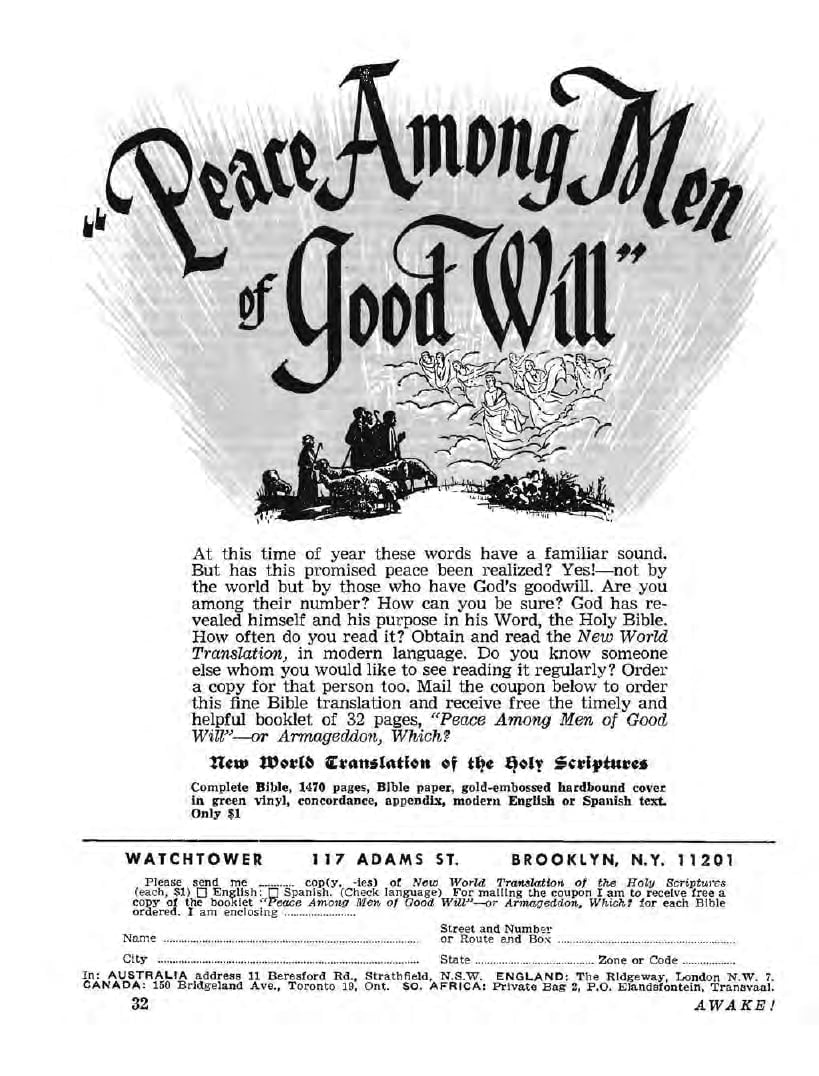
At this time of year these words have a familiar sound. But has this promised peace been realized? Yes!—not by the world but by those who have God's goodwill. Are you among their number? How can you be sure? God has revealed himself and his purpose in his Word, the Holy Bible. How often do you read it? Obtain and read the New World Translation, in modern language. Do you know someone else whom you would like to see reading it regularly? Order a copy for that person too. Mail the coupon below to order this fine Bible translation and receive free the timely and helpful booklet of 32 pages, "Peace Among Men of Good Will"—or Armageddon, Which?
New World Translation of the Holy Scriptures
Complete Bible, 1470 pages, Bible paper, gold-embossed hardbound cover in green vinyl, concordance, appendix, modern English or Spanish text. Only $1
WATCHTOWER 117 ADAMS ST. BROOKLYN, N.Y. 11201
Please send me ... cop(y, -ies) of New World Translation of the Holy Scriptures
(each, SI) □ English: □ Spanish. (Check language) For mailing the coupon I am to receive free a
copy of the booklet "Peace Among Men of Good Will"—or Armageddon, Which? for each Bible
ordered. I am enclosing ...
Name ...
City ...
State ... Zone or Code ...
IN: AUSTRALIA address 11 Beresford Rd., Stratfield, N.S.W. ENGLAND: The Ridgeway, London N.W. N.CANADA: 150 Bridgeland Ave., Toronto 19, Ontario. SO. AFRICA: PRICA! Private Bag 2, P.O. Elandstorfen, Transvaal.
What Does God Receive from You?
PAGE 5
The Splendor of Winter
PAGE 9
The Study of Spanish Can Be Fascinating
GE17
Keep It Cold! Keep It Hot! Keep It Clean!
PAGE 20
DECEMBER 22.1967
THE REASON FOR THIS MAGAZINE
News sources that are able to keep you awake to the vital issues of our times must be unfettered by censorship and selfish interests. "Awakel" has no fetters. It recognizes facts, faces facts, is free to publish facts. It is not bound by political ties; it is unhampered by traditional creeds. This magazine keeps itself free, that it may speak freely to you. But it does not abuse its freedom. It maintains integrity to truth.
The viewpoint of "Awake!" is not narrow, but is international, "Awake!" has its own correspondents in scores of nations. Its articles are read in many lands, in many languages, by millions of persons.
In every issue "Awake!" presents vital topics on which you should be informed. It features penetrating articles on social conditions and offers sound counsel for meeting the problems of everyday life. Current news from every continent passes in quick review. Attention is focused on activities in the fields of government and commerce about which you should know. Straightforward discussions of religious issues alert you to matters of vital concern. Customs and people in many lands, the marvels of creation, practical sciences and points of human interest are all embraced in its coverage. "Awake!" provides wholesome, instructive reading for every member of the family.
"Awaket" pledges itself to righteous principles, to exposing hidden foes and subtle dangers, to championing freedom for all, to comforting mourners and strengthening those disheartened by the failures of a delinquent world, reflecting sure hope for the establishment of God's righteous new order in this generation.
Get acquainted with "Awake!" Keep awake by reading "Awake!"
PUBLISHED SEMIMONTHLY
WATCHTOWER BIBLE AND TRACT SOCIETY OF NEW YORK, INC.
117 Adams Street
N. H. Knoan, President
Brooklyn, N.Y. 11221, U.S.A.
GRANT SUTTER, Secretary
Average printing each issue: 4,800,000
Five cents a copy
Fearly subscription rates for semimonthly editions
OFFICES
for elementary edition
America, U.S., 117 Adams Street, Brooklyn, N.Y. X-1201L $1
Australia, Birefeld Rd, Strafthill, N.S.W. $1
Canada, Birefeld Rd, Toronto, 18. Ont. $1
England, Wake Forest Tower,
The Ridgway, London N.W. T 7/5
New Zealand, ©21 New North Ed., Amstelland S.W. S 7/6
South Africa, Private Bag S. P, O. Elsevier, Tv. T 7/6
(Monthly) addtng, half the show rate)
Reliability for subscriptions should be sent to the office in your country. Otherwise send your resignation to Brooklyn. Notice of application is sent at least two weeks before subscriptions expire.
Saimenleng—Artikana, Cebuano, Danish, Dutch, English,
Flanish, German, Greek, Hokie, Hokie, Japanese,
Korean, Norwegian, Portuguese, Spanish, Swedish, Tagalog,
Zulu.
Monthly—Chinse, Clayania, Hillgaynon, Malayalam, Polish,
Tamil, Urkrainian.
CHANGES OF ADDRESS should reach us thirty days before your morning date. Give us your old and new address, your possible, your old address label). Write Watchtower. 10 Adams Street, Brooklyn, New York 11201, U.S.A.
Second-class postage paid at Brooklyn, N.Y.
Printed in U.S.A.
The Bible translation regularly used in "Awake!" in the New World Translation of the Holy Scriptures, 1961 edition.
When other translations are used, this is clearly marked.
CONTENTS
How Do You React to Success? 3
What Does God Receive from You? 5
The Splendor of Winter 9
False Religion 12
Was Jesus Born in December? 16
Glass in Ancient Times 16
The Study of Spanish Can Be Fascinating 17
Crime Repeaters 19
Keep It Cold! Keep It Hot!
Keep It Clean! 20
Acupuncture—An Ancient
Healing Method 24
Economic Loss 26
"Your Word Is Truth"
Matthew and Luke—Complementary
or Contradictory? 27
Watching the World 29
Volume XLVIII
Brooklyn, N.Y., December 22, 1867
Number 24
HAS success crowned your efforts? If so, how have you reacted to it? Did you feel a tinge of pride, pleased with yourself that things turned out so well? Or have you kept humble, modest, appreciative of the fact that it did not depend entirely upon what you did?
Success can be attained in many things, little and big. A housewife may feel that success crowned her
efforts upon receiving praise for a fine dinner that she prepared for special guests or for a special occasion. A student may experience a like feeling because of graduating at the top of his class in school. A Christian minister may feel that success crowned his efforts upon having given pleasure, enlightenment and encouragement to many by reason of a stimulating Bible lecture.
With success there usually goes reward. It may be the praise of others, or it may be in the form of some material gain. Then again it may consist merely of the personal satisfaction derived therefrom. But regardless of its nature, the question remains: How do we react to it?
A farmer may feel proud because of having harvested an unusually fine crop of grain, vegetables or fruit, knowing how
much depended upon hard work and his good judgment. Well and good. But were there not other factors involved, those over which he may have had little or no control? He may have worked as hard as he could and used the best of judgment, and yet success might not have crowned his efforts because of bad weather. For example, the 1967 peach crop for many United
States farmers was very small because an exceedingly warm spell in midwinter started the sap flowing prematurely, only to be later frozen.
The wise person will therefore recognize to what extent he is indebted to others, and in particular to the Creator, for the success of his efforts. (Jas. 4:13-15) American history gives us a fine example of such wisdom. On May 24, 1844, the inventor Samuel F. B. Morse, sent over a telegraph wire the now famous words: "What hath God wrought!" taken from Numbers 23:23 (AV). No question about it, all inventions are possible only because of the laws governing material things, which laws were made by the Creator. And did not He also make all material things as well as endow man with the capacity for intelligence in the first place? Yes, well does His Word remind us: "Who makes you to differ from another?
Indeed, what do you have that you did not receive?" —I Cor. 4:7.
In taking the attitude he did, inventor Morse was but following the Bible, which gives us many fine examples. Thus Jephthah, one of Israel's judges in ancient times, showed he had the right view of matters. When a delegation asked him to take the lead in routing the pagan invaders, he did not stipulate, "I will be your head if I lead you to victory." No, but he said: "If . . . Jehovah does abandon them to me, I . . . shall become your head!" And so also with King Saul who, upon winning his first victory, over the Ammonites, said: "Today Jehovah has performed salvation in Israel."—Judg. 11:9; 1 Sam. 11:13.
The apostle Paul, the foremost of all Christian missionaries, well appreciated this fact. As a most able, tireless and fearless servant of God he won many over to Christianity and started one congregation after another. But did he take the credit to himself? Did he boast of his successes? Far from it! Modestly he said: "I planted, Apollos watered, but God kept making it grow; so that neither is he that plants anything nor is he that waters, but God who makes it grow." (1 Cor. 3:6, 7) Undoubtedly, first of all Jehovah God deserves the credit!
Another reason for remaining humble, for continuing modest in the face of success is that so often our success depended upon the efforts of another or of others. The apostle Paul's foregoing remarks are to the point here, for you remember that he mentioned, not only his own part in planting and God's part in prospering Paul's efforts, but also the part that Apollos played by 'watering.' Similarly in his letter to the Christians at Rome, chapter
16, verses 1 to 4, he commends certain ones (several of whom were women), for the assistance they rendered him in his ministry, acknowledging thereby the aid they rendered toward his prominent and successful apostolic career.
In this respect wives are often the unsung worthy ones, as it were. Success crowns the efforts of their husbands who receive rewards in the form of praise, recognition or material gain; yet how often a vital factor in that success was the moral and active support given by the wife. This, of course, is as the Creator purposed it. That is one of the reasons why he gave man a mate in the first place. (Gen. 2:18) That fact is appreciated by even wise men of the world such as the late Sir Winston Churchill. Said he on one occasion regarding his wife: "It would not have been possible for any man in public life to get through what I have gone through without the devoted assistance of what we in England call one's 'better half.'"
But there are also other reasons why we do well to react with becoming modesty, with humility, in the face of success. We may have done exceedingly well and brought delight to others and elicited their commendation, but how did we do when judged by our own standards? Could it be that deep down in our hearts we must admit to ourselves that we fell short of our goal? It may have been our own fault or it may have been due to factors over which we had no control, but should not the fact that we came short of what we hoped to accomplish have a humbling effect upon us in spite of what others may say? Surely!
Truly there are ever so many compelling reasons—the foregoing by no means being all of them—for our reacting humbly, with due modesty when success crowns our efforts!
WHAT DOES GOD RECEIVE
from
</div>
PERHAPS never before in history has there been so much distress. Both the good and the bad suffer. At times, those who act wickedly prosper, while persons doing good are severely oppressed. When observing or experiencing this, some persons cannot see any benefit in doing what is right. It causes them to question God's righteousness; they believe that it is unjust on His part to allow such circumstances to exist. Therefore, some feel that God is not worthy or deserving of receiving anything from them.
What are your thoughts on the matter? Do the multitude of troubles cause you to feel that God is unjust? Do you, at times, complain against Him? It would be well for any who might be inclined to find fault with God to consider the comments of the young man Ellhu, one who gave wise counsel to afflicted Job.
Complaints Against God
Job was a righteous man as well as being very rich; he lived in the land of Uz, to the east of the Jordan River. (Job 1: 1-3) Genesis, the first book of the Bible, mentions two men named Uz. The first one was a great-grandson of Noah, a cousin of this Uz being an ancestor of faithful Abraham. (Gen. 10:22, 23) The second Uz was the son of Abraham's brother, Nahor. It was from this Uz that Job apparently descended, thus making Job a great-grandnephew of Abraham. (Gen. 22:20, 21) Nahor had another son named Buz,
and it was from him that Elihu descended. Job 32:2.
In the course of time, righteous Job came to suffer many dreadful calamities and afflictions; his ten children were killed, his material riches were lost, his wife and friends turned away from him, and he was struck with severe physical maladies. (Job 1:13-19; 2:7-9; 19:13-19) Then, when three supposed friends came to offer him comfort, they only increased his distress by falsely accusing him of some hidden badness for which, they intimated, God was punishing him.—Job 4:7, 8; 8:6, 13; 22:5, 23.
Job himself did not know or understand why he was suffering, and so in defense of his own righteousness he was prompted to speak of God as afflicting both the righteous and the bad. Calling to his attention the conclusions to which Job's arguments would lead, Almighty God asked him: "Really, will you invalidate my justice? Will you pronounce me wicked in order that you may be in the right?" (Job 40:8) Elihu, too, pointed to the effect of Job's explanation of God's position, saying of him: "For on top of his sin he adds revolt; among us he claps his hands and multiplies his sayings against the true God!"—Job 34:37; 33:8-12.
Where Job Erred
Elihu continued his remarks, explaining in what way Job had in effect spoken against God. "Is this what you have regarded as justice?" he asked Job. "You have said, 'My righteousness is more than God's.'
For you say, 'Of what use is it to you? What benefit do I have more than by my sinning?'""-Job 35:1-3.
Job did not specifically say that his righteousness was more than God's, but he did indicate that the way God had dealt with him, permitting him to suffer so, was undeserved, because of his trying to keep integrity toward God. Job did not properly understand God's manner of dealing in this case, God's motive, when he said concerning Him: "With a storm [He] bruises me and certainly makes my wounds many for no reason. . . . At the very despair of the innocent ones he would mock." Or when he asked God: "Is it good for you that you should do wrong, . . . that you should try to find my error and for my sin you should keep looking? This in spite of your own knowledge that I am not in the wrong."—Job 9:17-23; 10:3-7.
Job was, in effect, asking whether God could do wrong. Could God be looking at Job's imperfection, but overlook the things of which his three "friends" accused Job? It was a question for Job's "friends" to consider. Job became so concerned with justifying himself that he failed to justify God, not giving the leading prominence to God's righteousness in permitting Job's sufferings. His speech was based on an ignorant position.
Persons often express opinions in a similar way today. When they meet with adversity, or see much human suffering, they feel that God is unjust in permitting it. Like Job, they do not have knowledge and understanding. So these people ignorantly speak things that misrepresent God and are disrespectful of Him. Their depressed state of mind is often a factor in their transgression. 'O why does God do this to me? Why does he permit this to occur?' they are often heard to complain.
Some persons even get to the point of
questioning the benefit of serving God. "What use is it?" they may lament. According to Elihu, Job was saying: "What benefit do I have more than by my sinning?" Or, as another Bible translation expresses it: "What does it profit me? What do I gain more than if I had sinned?" (Job 35:3, AT) Judging from a material standpoint!
Job had observed; "One blameless, also a wicked one, [God] is bringing to their end." (Job 9:22) Job was, thus, questioning the present material benefit of being righteous, since the good appear to suffer as much, if not more, than the bad. Because they conclude that there is often no observable present reward for doing right, it is not uncommon for persons today also to question the value of serving a God who permits such circumstances to exist.
God's Supremacy
What caused Job to utter speech with such implications was an improper perspective. He had allowed his thoughts to become directed inward upon himself. So, in order to set matters in proper focus, Elihu drew attention to the superior importance of Jehovah God by pointing to His exalted position. He told Job: "I myself shall reply to you and to your companions with you. Look up to heaven and see, and behold the clouds, that they are indeed higher than you."—Job 35:4, 5.
Yes, just look up at what God has created! The sight of the starry heavens and majestic clouds should be sufficient to prove that God is infinitely superior to man in wisdom and excellence. As one Bible writer expressed it: "When I see your heavens, the works of your fingers, the moon and the stars that you have prepared, what is mortal man that you keep him in mind?" (Ps. 8:3, 4) How foolish to complain against or find fault with One so great! How little and insignificant man is compared with God!
Truly, one so great and powerful is deserving of our recognition and worship!
Really, Jehovah God is so exalted that when persons sin and do wickedly, it does not affect him personally. If one thinks that he can spite God, or get even with Him for what are considered injustices on His part, that person is mistaken. Elihu asks: "If you actually sin, what do you accomplish against him? And if your revolts actually increase, what do you do to him?" (Job 35:6) God is so superior that His eminent position is not affected by such conduct. If a person tries to spite God the way humans try to spite each other, he is only hurting himself, not God.
On the other hand, Jehovah is not affected personally either if one holds to a right course and keeps integrity to God. Of course, Jehovah is pleased and delighted with such a person, but he is in no way dependent upon his worship and service, as Elihu points out: "If you are really in the right, what do you give him, or what does he receive from your own hand?" —Job 35:7.
Actually, what can one give to God? God gave us life, and because of him we breathe and move and exist. He owns everything! (Acts 17:25; Ps. 50:10) As King David humbly admitted after contributing materially toward God's temple: "For everything is from you, and out of your own hand we have given to you." (1 Chron. 29:14) Yes, what we give God in the way of worship is only possible because of what God gave us, and such worship and recognition are only His just due. —Rom. 11:33-36.
So when it comes right down to it, one's wickedness or righteousness cannot affect God personally. It can only affect creatures like ourselves, our fellow humans, as Elihu pointed out: "Your wickedness may be against a man like you, and your righteousness to a son of earthling man." (Job 35:8) One can do what will either hurt or benefit his fellow creatures, but he cannot personally benefit or hurt Jehovah God. Elihu thus impressed upon Job and his companions how exalted and great Jehovah actually is.
Need for God
Whereas God does not need man and is not dependent upon what man does, humans do need God. When they are in trouble they generally give expression to the need of divine help, as Elihu noted: "Because of the multitude of oppressions they keep calling for aid; they keep crying for help because of the arm of the great ones." —Job 35:9.
In the discussion with his three companions, Job had taken note of the horrible oppression suffered by mankind. He also observed why the afflicted cry for help without avail. (Job 24:12, 13) Elihu, however, shows how one's wickedness does affect creatures on earth and explains that the crying out for help by affected ones is usually done selfishly. It is not truly a penitent cry. They do not turn to Jehovah God and seek to learn His will and do it. As Elihu says: "And yet no one has said, 'Where is God my grand Maker, the One giving melodies in the night?''" (Job 35: 10) God is certainly not unjust in refusing to listen to the cries of such persons.
Jehovah God created man different from the animals. He gave the animals marvelous inherited knowledge or instinct. But to man God gave the intellectual capacity to reason, to figure things out and to build on accumulated knowledge. Furthermore, man was created with a conscious need to worship, something that the animals do not possess.
Therefore, man can take in knowledge of his Creator; he can learn of God's wonderful works and purposes through the inspired written Word that God has provided.
And man can worship the One who made him; he can decide to serve Him. Elihu draws attention to these special endowments of God upon mankind, saying: "He is the One teaching us more than the beasts of the earth, and he makes us wiser than even the flying creatures of the heavens."—Job 35:11.
However, if humans refuse to exercise their God-given faculties properly and do not learn about him and worship him, can God be expected to listen to their cries for help? When humans groan and cry out in pain, and yet pridefully refuse to repent and submit to their grand Maker, God is not unjust in turning a deaf ear to them. This is what Elihu points out, saying: "There they keep crying out, but he does not answer, because of the pride of the bad ones."—Job 35:12.
Jehovah is a God of truth, and he rightfully expects that man worship and acknowledge him as Creator. He takes no pleasure in untruth or misrepresentation, and is displeased when persons fail to recognize His supreme position in the universe. Eilhu explains: "Only the untruth God does not hear, and the Almighty himself does not behold it. How much less, then, when you say you do not behold him!"—Job 35:13, 14.
Give God His Due
How clear it is that Jehovah God alone is deserving of our exclusive devotion! How wise we are, therefore, if we render our grand Maker the worship due him. But it is evident that in order to worship God acceptably, we need to take in accurate knowledge concerning him and his purposes. We must develop the proper perspective. We must come to appreciate God's supremacy, and humbly recognize that he is faultless in all his ways and dealings.
troubles in life, there is a tendency to complain and find fault. Perhaps, at one time or another, you have spoken disrespectfully of God and expressed dissatisfaction with his way of handling matters. You no doubt spoke the way you did due to a lack of knowledge and understanding. Will God hold this against you? Elihu observed in connection with Job: "The legal case is before him, and so you should wait anxiously for him. And now because his anger has not called for an accounting, he has also not taken note of the extreme rashness."—Job 35:14, 15.
How grateful we should be that Jehovah God is merciful and forgiving! He allows opportunity, though not endlessly, for persons to repent and change their ways. Job had, indeed, been mistaken, as Elihu pointed out: "Job himself opens his mouth wide simply for nothing; without knowledge he multiplies mere words." (Job 35: 16) Yet, Job was sincerely repentant, humbly confessing his ignorance in speaking, saying: "What shall I reply to you? My hand I have put over my mouth." "I make a retraction, and I do repent in dust and ashes." (Job 40:4; 42:6) What an example Job set! He was indeed a righteous man who truly loved Jehovah God. And when his misunderstanding was pointed out, he took the necessary steps to correct his way.—Ezek. 14:14; Jas. 5:11.
In this day of unparalleled human suffering when God is often maligned and misrepresented, you can greatly benefit from Elihu's inspired words of counsel. As he emphasized, Jehovah God truly is the Almighty Supreme One, your grand Maker. Turn to Him. Do not speak against him hastily in ignorance. Rather, go to his Word the Bible for instruction and guidance. Learn of his wonderful purposes. See why he has permitted wickedness temporarily, and rejoice in his sure promise to wipe it out forever in the near future.
WITH each passing day the sun arcs lower in the sky. The days grow shorter; the nights longer. The nip of the wind quickens one's step. Woodchucks and other tiny creatures drowsily move to their burrows; bears trudge off toward their dens. One can feel in the crisp air the approach of winter. What remarkable changes take place!
Slowly the once-concealed landscape becomes more discernible. Disappearing leaves and foliage reveal many interesting sights kept secret in the summer. High up in the trees there are nests, where feathered parents once cared for their young. Houses and farm buildings are seen standing among woods, and the eye
can follow the devious course of streams that wind across the land. Such things were largely obscured by the leafiness of summer.
Winter's Splendorous Garment
Clouds move hurriedly across the skies. The wind blows. Then, late one afternoon, the sky turns leaden, and snowflakes begin to fall. Soft as a baby's breath they descend. How delightfully fascinating! A child may not notice the coming of leaves and flowers, but he will sit at a window for an hour watching these dancing flakes of white come down. How marvelously they transform the land!
Next morning is splendid. Before one's eyes exists a new, soft scene of beauty. Dirty city streets look pure and clean in winter's garment.
The countryside, too, is transfigured under its first blanket of dazzling white. Everything is different. Snow-canopied marvels of architecture are seen everywhere. The roofs of houses, as if draped with fluffy white comforters, take on new and delightful contours. Naked trees are clothed beautifully in white-powdered dress. Stone fences are turned into ranges of hills. The skies and undulating fields of snow merge as one. The grandeur of the countryside, with a beauty reminiscent of sparkling diamonds, gives a feeling of pleasure.
Then night falls. Against the dark heavenly vault, stars sparkle like a shower of crystal, and constellations are diagramed against
the sky. As the moon rises and trees throw their shadows across the fields, a picture of frozen beauty appears. Really, many consider the earth to be at its prettiest when it is snow-covered beneath the light of a full moon, or when the snow is illuminated by the soft glow of thousands of brilliant stars.
Why Winter?
Winter and the other seasons of the year are inescapable, as the Bible explains: "For all the days the earth continues, seed sowing and harvest, and cold and heat, and summer and winter, and day and night, will never cease." (Gen. 8:22) This is true because earth was designed by its Creator to tilt on its axis as it travels around the sun. Thus, more sunlight strikes the northern half of the earth when the earth's axis is tipped toward the sun, and less when it is tipped away from the sun.
On about December 21 the vertical rays of the sun reach their southernmost point, falling directly on an imaginary line called the Tropic of Capricorn located about 1,600 miles south of the equator. This officially begins winter in the northern hemisphere and, at the same time, commences summer in the lands lying below the equator. Six months later, or about June 21, the vertical rays of the sun reach their northernmost point, officially beginning winter in the southern hemisphere and summer in the north.
Winter and snowfall are almost synonymous in many places. Yet a great number of persons have never seen snow, since it falls on only about a third of the earth's surface. Snow is practically a rarity in the southern hemisphere, Antarctica being a notable exception. South America receives very little except in the Andes, and only on Africa's few high mountains does snow accumulate. A principal reason for this is that land masses are small below the equator and are set in vast, warming oceans; whereas in the north there is a concentration of continents where the cold is not moderated.
Blanket of Ice and Snow
Winter brings protection from its own rigors by laying down a blanket of ice and snow. This provides a safe shelter for the plants and animals beneath.
The protective covering of ice is deposited by a remarkable characteristic of water. It expands as it freezes, instead of continuing to contract as do most substances. Thus, ice is lighter than water, and floats. How providential! Regarding this Science News Letter of December 14, 1963, noted:
"The mere freezing of water, man's most essential fluid, is a miracle staggering in
its significance. . . This basic phenomenon of floating ice, so commonplace that people take it for granted, saves the world from slowly being frozen to death. For if the ice would continue to become more dense, it would sink to the bottom of the ponds, the rivers, the great seas, and settle there in dark frigid silence where the warm rays of the returning spring sun could not reach it. Fortunately for us, however, ice floats."
Truly, the protective blanket of ice is a provision of earth's Masterful Designer, even as the dazzling blanket of white snow is. Animals can burrow into this fluffy natural covering and keep warm. Snow holds heat in the lower ground levels, and preserves seeds from freezing to death. It provides such fine insulation that Eskimos can keep warm within their igloos from the heat of their own bodies. It is with significance, then, that the Bible says that God "is giving snow like wool."—Ps. 147: 16; Job 37:5, 6.
But besides being a blanket that provides warmth, snow is fantastically beautiful and splendidly designed. Individually, snowflakes are masterpieces of art. Their symmetry and pattern and endless variation stagger belief. Although they are almost always six-sided in shape, and countless billions descend in an ordinary snowstorm, no two have ever been discovered exactly alike. Corydon Bell observed in his book The Wonder of Snow: "Within a single crystal there is an invisible masterpiece of construction that is achieved through the magic of nature's geometry, physics, and chemistry." Snowflakes are, indeed, a tribute to the wisdom of their Maker!
Care for Living Creatures
Birds and lower animals would starve in winter months if special provision were not made for their preservation. When earth lies beneath its white blanket of snow, there is little food to be found.
Birds, however, are protected by a marvelous migration instinct, which directs them to travel to warmer climates where food is available.
Smaller land animals cannot travel such long distances, yet they, too, are protected by miraculous instinctive behavior. They snuggle up in their nests or burrows, and enter a strange deep sleep called hibernation. Even when kept in a laboratory with plenty of light, warmth and food, these little animals roll over and go into their trancelike sleep with the coming of that particular time in autumn. This sleep, and how it is triggered, is a mystery to man.
A ground squirrel, for example, has a normal heartbeat of 360 a minute, but during hibernation it slows to only about three a minute. Respiration, too, drops drastically, from a rate of 100-200 breaths a minute to a rate of from one-half to four a minute. The body temperature of a hibernator also undergoes a startling reduction. A woodchuck's temperature, for instance, slides precipitously from about 9 7\circ F to around 3 7\circ F , or a few degrees above its surroundings. The marvelously slowed-down metabolism of these small creatures makes possible their survival during winter. The loving Creator has made wonderful provision for his creatures.
A Welcome Change
For humans, too, winter can be a welcome change in activity and scenery. What a pleasure it is to gather around a warm, crackling fire in the fireplace! How fascinating the leaping flames or dying embers are to watch! To gather with family or friends at such a time and to pop corn, sing songs, or to share in some other wholesome entertainment, can be truly a satisfying experience. Or to curl up in a
big, comfortable chair before a roaring fire with a good book to read is to some persons the pinnacle of enjoyment. Somehow such activities are always more delightful in winter.
True, there are persons who will point out that the winter season brings aggravation—that cars are difficult to start, roads are slippery, accidents happen, and people get wet and catch colds. Yet accidents and aggravation can often be avoided if automobiles are equipped for winter driving, or are not used when the weather makes driving hazardous. And if persons are properly dressed they are less likely to get wet and catch colds.
To the contrary, many persons derive deeper exhilaration and satisfaction from a tramp through freshly fallen snow than they do from an outing at any other time of the year. The pure, brisk air is invigorating and gives them a sense of well-being. And the exquisite shapes of snow, frost and ice reflect a profound peace that gives genuine refreshment to their souls.
Thousands of persons have come to wait with keen anticipation for the winter cold to freeze over ponds, lakes and streams, or for a load of snow to be dropped on their favorite hill or slope. Due to the joy afforded by such winter sports as ice skating, skiing and tobogganing, more and more persons have come to prefer this season of the year.
There can be no question about it—winter has its unique features that truly can be enjoyed. It is a splendorous time of the year. In the ice and snow and the miraculous processes that equip animals comfortably to survive the winter, the hand of a wonderful Creator unquestionably can be seen. Of Him the appreciative psalmist sang: "It was you that set up all the boundaries of the earth; summer and winter—you yourself formed them."—Ps. 74:17.
A Zulu Family SEEKS FREEDOM FROM False Religion
By "Awakel" correspondent in South Africa
LL these religions—they confuse me!" exclaimed Uncle Zondi, when he sat in on Bhengu's family Bible study for the first time. It was something that had puzzled young Bhengu's father just a few months back, but, since the visiting minister of Jehovah's witnesses had started calling, big changes had followed in the home.
At first, Bhengu's father, who was a cautious man, had discussed these matters alone with the minister. Then the family was included and a study of the Bible started. However, Uncle Zondi was not familiar with these things, not yet anyway, as he had arrived only the previous day from Zululand. Quite understandably, as he joined the family for their weekly Bible discussion, he was thinking of the scores of religious groups he had met in the past, their people clad in colorful robes, dancing, singing and chanting. No wonder it was so confusing to Uncle Zondi.
The minister agreed with him that the situation was confusing. Would Uncle Zondi like to know why there are so many religions? Would he like to know of a religion that is not confusing and that brings real benefits? Uncle Zondi agreed he would. There was a pause as Bhengu's mother put the paraffin lamp on the table and joined the discussion.
"It is not our Creator's wish that there
should be confusion as to his worship," began the minister. "The trouble started long ago in a city that is today nothing more than a desolate heap of stones—Babylon. The religion that spread from Babylon is what has brought the confusion, and this has affected many peoples. Its religious ideas were carried from nation to nation, so that a common pattern can be found in religious beliefs throughout the world."
Bhengu's elder sister looked puzzled, "Hawu! How could these ideas come to us? We are not from Babylon!"
The minister explained: "There was a time when this land was uninhabited. It was in the Middle East where the first people lived. As they multiplied, they spread out. We have no written history to consult as to when our own Zulu forefathers first moved to southern Africa. It must have been a long time ago."
Ancestor Worship Pervades Tribes
"As the Bantu tribes are closely related," the minister continued, "it is not surprising that the traditional religion of ancestor worship is basically the same from one tribe to another. Of course, those living in the big cities have been influenced by modern ways of living and their outlook has changed greatly. Many have become apathetic toward religion, and others, born in the cities, have forgotten much of the background of ancestor worship even though they are often still affected by superstitious beliefs and customs.
But in the rural areas ancestor worship is, as you know, a flourishing religion.
"These traditional ideas very much affect our concept or understanding of the God who is to be worshiped," continued the minister. "For example, the word used in the Zulu Bible for God is uNkulunkulu, meaning 'the great great one.' For a person with a Christian background this may seem no problem to understand, but what does that word mean to a person who practices ancestor worship?"
"He will think of unkulunkulu, the original ancestor spirit who lives below," said Uncle Zondi.
"That's right. But the unkulunkulu of ancestor worship is not the uNkulunkulu of the Bible. Religion that spread from Babylon knew many gods, some of whom were said to live under the earth. Ancestor worshipers believe that unkulunkulu made the animals, the sun and moon. Although unkulunkulu is considered to be the chief god, he is not prayed to, nor, in fact, worshiped directly. It is considered more practical, and, for that matter, more respectful, to call upon recent ancestors."
"But, why do people pray to ancestors?" asked Bhengu's younger sister, Nobuhle.
"Now, that's a good question," said the minister, smiling. "You see, Nobuhle, ancestor worshipers believe that when a man dies, the isithunzi, the shadow or personality, continues to live. After about a year (with some tribes, a shorter time) the ukubuyisa or 'bringing back' ceremony is held. At that time a goat or some other victim is slaughtered and feasted upon with friends. It is at this feast that the isithunzi now becomes an idlozi, or spirit, and is thus 'brought home' from the environs of the grave. The idlozi is now accepted as an ancestral spirit and is called upon in the usual way for guidance."
"That is true," commented Uncle Zondi. "In Zululand sacrifices to ancestors take place regularly."
"Not only there," interrupted Bhengu's father. "We see it often here in town too. It is not unusual to see even people who claim to be Christians celebrating the uku-buyisa with friends."
"Perhaps it is that they have never really thought why they do it," suggested Bhengu's mother.
"Nevertheless, these customs have created many problems for the Bantu peoples," continued the minister. "The worship that the Bible presents is spiritual. God is described as a spirit. Many ancestor worshipers believe that the ancestor gods and spirits have human attributes. They are believed to have human needs and habits and are thought to live much the same way as they did when with their families. If a man was insignificant, he would remain so after death; if he was important, like a chief, he would be prominent as a spirit, and so on. We want to help people develop a spiritual outlook and worship the true God in spirit and in truth."
Uncle Zondi looked thoughtful. "But isn't any religion, no matter what it is, better than none at all?"
Not Really Upbuilding but Spiritistic
"That's just the point. Is ancestor worship really upbuilding? There are tribal laws that guide the conduct of the people. These laws teach respect for the community, for property and for life. Tribal customs encourage good qualities of brotherliness and courtesy, and tribal laws make rulings on such matters as adultery, incestuous marriage, and so forth, and so provide some protection from wrong conduct. But, let us admit this: ancestor worship gives no guidance as to conduct; it does not even teach what is good or bad. It offers no reward for doing what is right, nor punishment for doing what is wrong, other than for failing to observe the customs and traditions of that worship.
So of what real value is it?"
Uncle Zondi remained silent.
"The religious beliefs of Babylon," continued the minister, "have not only held back progress but have driven people into practices that hold them in bondage and bring them into danger. Look what the
nesses. He does not go to an herbalist who uses any kind of divining, since that would involve him in spiritism, which is condemned in the Bible at Deuteronomy 18: 10-12.
"A regular diviner or isangoma can often be detected by his dress, white being the predominant color, and by outbursts of ukuhayiza (emotional hysteria) in his proceedings. Interestingly, the isangoma is
Bible says about the world empire of false religion called Babylon the Great. [He reads from Revelation 18:23.] For by your spiritistic practice all the nations were mised.' And doesn't ancestor worship do just that—mislead people into seeking protection in spiritism?
"For example, if lightning strikes a hut, the worshiper sees this as a fearful omen brought by some enemy who has obtained isiphonso or witchcraft medicine. He seeks to prevent a recurrence by consulting the inyanga, the medicine man, who can also receive divination.
very often a woman, though the inyanga is always a man.
"The methods used vary, but perhaps the best-known method of divining is with the use of bones. The diviner will 'read' the bones he has cast on the ground to determine the cause of someone's sickness and who has caused it. The proceedings may be accompanied by shouting, dancing or chanting, perhaps to the beating of an oxhide drum. The diviner (isangoma) then refers the inquirer to the inyanga, who will prescribe the use of some medicine or charm to protect the inquirer from the
practice divining. By providing charms the inyanga gives 'protection' to the house. The charm may be in the form of a tall forked stick planted next to the house or stuck in the roof. Or, a poor crop, a bad dream or an accident may be taken as an omen that some ancestral spirit is displeased and so advice may be sought from an isangoma [a regular diviner, not a medicine man]."
"What does he do?" queried young Bhengu.
one who is causing his sickness.
Use of Divination in Treating Illness
"Since most sicknesses are due to known, proved causes having to do with man's own physical imperfection or unwise living habits, or are by infection due to known physical causes that can be cured by proper medicines, the teaching of diviners leads superstitious people to put their faith in a wrong source of healing and brings them into bondage to the false practice of spiritism.
"And this all leads to further burdens. Unscrupulous diviners take advantage of
"First, in mentioning medicine," the minister explained, "it would be good to note that, while there may be a few African herbalists who just dispense herbs and nothing else, in most cases the herbalist combines divining with his trade and will recommend superstitious rites as part of his cures. That is why a real Christian is selective in obtaining treatment for sick-
the superstitious fears of others in order to extort money from them, charging exorbitant fees for their services."
"How do people get to be diviners?" asked Bhengu's sister.
The minister paused for a moment. "They say they are 'called,' but when we learn how they are selected and trained we see further evidence of spiritism. The 'call' may come by means of a dream, and the initiate claims he is possessed by a spirit, that is, of some ancestor.
His health deteriorates for a time. He becomes eccentric and 'hears voices.' To determine which 'spirit' has possessed him, there are involved ceremonies. The families of the mother and father each bring a goat to be slaughtered. There are the singing of songs and vomiting rites. The candidate is covered with white powder, and a qualified diviner may then decide which spirit has possessed him, or the candidate may announce this himself. Training is then commenced and the drinking of blood of sacrificial animals features in his instruction and initiation. Does this seem to be the type of person that could help you with your problems?"
"But," questioned Uncle Zondi, "when the Christian religion came to Africa, why did it not remove these practices?"
Christendom's Religion
Also Contaminated
"Well, false religion from Babylon spread, not only to Africa, but to all parts of the world, and the so-called 'Christian' nations also were contaminated with it. When missionaries from Christendom entered Africa, how could they free others from false Babylonish religion when they themselves were captive to it? So not much success was achieved in uprooting Babylonish ancestor worship. To the contrary, this worship provided a useful basis on which to build the new religion. For example, the belief of the ancestors' surviving death corresponded to the doctrine of the immortality of the soul taught by Christendom. Missions sprang up by the hundreds. In the reserves the chiefs gave permission to build churches with the incentive of schools' being established for the local villagers. 'Conversions' were rapid but mostly superficial. The missions
were jubilant and could report large numbers in their flocks. But it was not long before their work began to crumble. Sects and offshoots began to appear and by 1960 the official list of independent Bantu churches numbered 2,030!"
"Hawul" exclaimed Uncle Zondi in amazement.
"You'll have noticed," continued the minister, "how many people are attracted to the 'emotional' religions of the Pentecostal type. The similarities between the emotional 'prophet' of these churches and the diviner of ancestor worship are very close. Both are conspicuous in their attire and appearance, the color white being predominant in their regalia. A period of ill health may precede the 'calling' of diviner and 'prophet' alike, and both place great importance on dreams and purification. Both diviner and 'prophet' commune with the spirits. Both speak of hearing 'voices.'"
"I see what you mean," said Uncle Zondi. "It's really the same worship practiced under new names."
"To a large degree, yes. But do not let me give you a wrong impression. Not all religion is Babylonish in origin. Not all those doing missionary work have deceived the people. There are those who have brought God's Word to the Bantu people with sincerity and at much personal cost to themselves. They have shown that the Bible is from the true God, Jehovah, and that he is the God of all peoples. The Bible is not nationalistic, it does not divide people. It discourages demonism and spiritistic practices, and it really does set people free from superstitious fears."
It was late by the time the minister left. That night, as young Bhengu lay on his bed, he could see the clouds racing past the moon. How glad he was that his father had arranged for the family to study the Bible! He could see that this would lead to a worthwhile inheritance—the inheritance of freedom, freedom from fear and superstition, freedom from spiritism and false religion that had come from that ancient city of Babylon.
And to think he,
Bhengu, might one day enjoy such freedom forever in a righteous new system of things, soon to be a reality right here on this earth!
Was Jesus Born in December?
The Bible account of the birth of Jesus of Nazareth shows that at the time shepherds were living out of doors and keeping watch in the night over their flocks." (Luke 2:8) But what is the weather in Palestine in December? Early December corresponds with Chislev, the post-captivity name of the ninth Jewish month of the sacred calendar and which falls within November and December. But this is a winter month, a month of cold and rain. So we read of King Jeholakim that he was "sitting in the winter house, in the ninth month, with a brazier burning before him." (Jer. 36:22) In postexile Jerusalem, the people who gathered for the three-day assembly ordered by priest Ezra beginning on the twentieth day of this month "kept sitting in the open place of the house of the true God, shivering because of the matter and on account of the showers of rain." (Ezra 10:9, 13) Quite obviously there were no shepherds sleeping in the fields at this time of the year, nor for some time afterward.
The following Jewish month, which corresponds to the latter part of December and part of January, is Tebeth, the post-capitality name of the tenth Jewish lunar month of the sacred calendar. The name "Tebeth" is
believed to mean "sinking" or "sinking in," and this may have reference to the muddy conditions that prevail during this winter month when rainfall is at its peak. The winter rains are often torrential, like the one that ended the three-and-a-half year drought in Elijah's day or the kind that Jesus described in his illustration of the house whose sand foundation was washed away by the lashing rain. (1 Ki. 18:45; Matt. 7:24-27) According to The Geography of the Bible by Denis Baly, the latter part of December brings frequent frosts in the hill country and occasional snow flurries in Jerusalem. (2 Sam. 23:20) Though it is unusual, there have been times when roads were temporarily blocked by heavy snowfall. It may have been during this month Tebeth that a heavy snowfall hindered the Syrian army commander Tryphon when on his way to Jerusalem. (Josephus' Antiquities of the Jews, XIII, 6, 6; 1 Macc. 13:22) The month Tebeth was very evidently neither a month for traveling (Matt. 24:20) nor a month in which shepherds would spend the night in the fields. For these and other reasons December could not have been the month in which Jesus was born.
Glass in Ancient Times
When the unique substance known as glass was first made is not known. Glass beads found in Egypt were made over 4,000 years ago, about the time Abraham was born. So Job, who lived in the sixteenth century before our Common Era, knew what he was talking about when he said, "Gold and glass cannot be compared to [wisdom]." (Job 28:17) Nor was Job's contrast amiss, for glass in those times was rare and as precious as gold itself. Even fifteen centuries later, it is reported, the emperor Nero paid a sum equal to $100,000 for two glass cups with handles! Egyptian artisans and others were skilled in the blowing, cutting, grinding and engraving of glass. They knew how to inlay glass with gold.
Because of impurities in the sands commonly used, transparent glass was rare. The earliest known find of such, dated about 700 B.C.E. and discovered in an Assyrian palace at Nimrud, is a bottle bearing the name of Sargon. (Isa, 20:1) It is apparently for such reasons that the apostle John was very explicit in the description of his visions; he did not just say "glass," but, rather, "glassy sea like crystal," "like clear glass," "as transparent glass."—Rev. 4:6; 21:18, 21.
FOR one going to school and having the opportunity to learn a foreign tongue, Spanish is a language that might well be considered. It is spoken by some 170 million people in Spain, Central and South America, the Philippines and some territories in Africa—many of these being excellent fields for missionary activity. Additionally, Latin-American countries today are beckoning as vaca-
tionlands that can be reached swiftly and economically.
To the would-be language student whose native tongue is English, there should be little difficulty about learning Spanish,
for it is one of the Romance languages with a strong foundation in Latin. Remember, English also has a rich heritage of Latin bequeathed to it from the time of the Norman conquest of England early in the eleventh century C.E. So, if you have the adequate motive, and therefore can conscientiously set aside time for the project, be assured that Spanish is by no means beyond your capacity to learn.
Of course, learning a language is not all fun. There is need for concentration and for memorizing verb forms, vocabulary and grammatical rules. Listening to the spoken language on a radio program or on a recording, one's first concern is to learn what is being said. Then thought should be given to how it was said—how it was so easily expressed, just as you would say something in your own language without effort. Yes, in learning a language one should be prepared to become like a little child—striving to reproduce what one hears, being a mimic.
Smooth, easy conversation cannot be mastered right away; it is an art that requires experience and practice. Nevertheless, if you learn to speak a few sentences haltingly and then use them among Spanish-speaking people,
you will be pleasantly surprised at how appreciative, tolerant and helpful they will be.
There are three aspects of your language study that should prove to be quite fascinating,
for they involve your own personal exploration of the language: cognate words, syntax and idiomatic expressions.
Cognate Words
"Cognate" as applied to words has the meaning "related by descent from the same ancestral language," according to Webster's Seventh New Collegiate Dictionary. Thus words that have come to the English language from Latin through Norman French should have a family resemblance to Spanish words of Latin descent. That is precisely the case, and by alert observation the student should recognize these relationships. For example, there is the Latin word spectare meaning "to see." From this root more than 240 English words have sprouted, including spectacle, inspector, retrospective and spectator.
The corresponding Spanish words are espectúculo, inspector, retrospectivo and expectador.
Many Spanish words have close relatives in the English language. As examples we can immediately think of: clase, which means "class"; tomate, "tomato"; honra, "honor"; tranquilo, "tranquil." So it is helpful to relate Spanish words you encounter with the English terms that correspond closely. There is need for caution here, however. One must be sure that the words have the same meaning in both languages. If you hear someone talking in Spanish about constipación, he is very likely referring to a common cold. So, do not draw your conclusions too hastily.
As a test of your power of observation on this score, why not try to match each Spanish word in the following first column with its English cognate in the second column?
fin
—— sanguinary
novedad
—— pacify
precioso
—— final
angel
—— mundane
mundo
—— novelty
sangre
—— angel
paz
—— precious
That was quite easy, was it not? There are hosts of other examples upon which to test your skill.
Another interesting fact about Spanish is that you will meet with many words that are identical to the corresponding English words—words such as animal, natural, altar, regular, favor, superior. The difference is that Spanish pronunciation stresses the final syllable, whereas in English it is more likely to be the third from last or perhaps the first syllable that is stressed. There is also the Spanish word-ending cion which corresponds with English "tion"; edición, admiración, colección, constitución, interpretación.
Spanish words ending in io, io usually suggest an English word of similar import,
but ending with "y." Thus there are such familiar-looking words as familia, historia, diccionario, rematio. Then, too, Spanish words ending in dad or tad can be watched, for they point to comparable English words ending in "ty." Here you have only to think of the simple examples sociedad, libertad, realidad, and majestad. Is it not true that study of cognates can be fascinating and delightful?
The Role of Syntax
In studying a language one must find out how its words are formed, and how verbs, for example, vary in form to express such matters as mood, tense, person and number. Also, one must take note of how such a language strings its words together to form a sentence expressing a real thought unit. The study of all this may be termed syntax.
As an instance, in Spanish one might say, amo a Dios (I love God), but when joined with someone else having the same sentiment, the expression becomes amamos a Dios (we love God). If the reference is to a past period of time, the statement would become amábamos a Dios (we loved God). Thus the inflections or endings of the verb express number and tense.
There being few neuter nouns in Spanish, each noun is usually either masculine or feminine, and this must be memorized in connection with vocabulary exercise. The gender in each case is generally indicated by the form of the definite article preceding it: el, los, indicating masculine singular and plural, la, las, feminine singular and plural.
Again Spanish diverges sharply from English usage in that all adjectives must agree in gender and number with the noun they qualify. As examples we can note these variations: el padre rico (the rich father), la madre rica (the rich mother), los padres ricos (the rich parents). As in these cases, most adjectives follow the noun they qualify, something that would sound strange to the English student.
The order of words inside a sentence in Spanish is susceptible of much greater variety than is the case in English. In Spanish a sentence can be separated into sections according to meaning, and then the sections can follow any one of a variety of orders. Take this sentence for example:
El cielo / se presentaba / por todos lados /
The sky / appeared / on all sides /
a nuestra mirada / como un océano de liamas,
to our gaze / like an ocean of flames.
Two or three changes can be made in the order of these English phrases. In Spanish, without producing any awkwardness of expression, we could vary the order as many as nine or ten ways. This allows the speaker or writer to adopt the order that will produce the pleasantest sound combinations; also to accord to the most important word or phrase the primary position in the sentence.
Idiomatic Expressions
Of the peculiar idioms we employ in our native tongue we are often unaware until we try to translate them into another language. The literal translation may then make no sense at all. Consider the phrase "from time to time." Literally translated it would be rendered in Spanish de vez a vez and might be somewhat puzzling to the Spanish-speaking person. In his language the same idea is expressed by de vez en cuando (literally, "from time in when"). And that does not sound too intelligible to the English-speaking person.
If one purchased a large bottle of wine in a store in El Salvador, the clerk might offer to have it delivered. A new student of the language might manage to say, "No, gracias, puedo tomarla," which means, "No, thanks, I can drink it." One could fall into this little trap because of knowing that ordinarily tomar means "to take." But the student did not yet know that, when it comes to beverages, tomar has the meaning "to drink." What he should say is "No, gracias, puedo llevarla."
There are numerous English idioms that would be meaningless to the Latin-American if translated literally. Here are some examples; to throw in the sponge; to beat around the bush; to be far gone. On the other hand, interesting and common Spanish idioms suffer from literal translation into English. Note these, for example:
Echar pelos a la mar
Literally: To throw trifles in the sea.
Actually: To let bygones be bygones
Poner pies en pared
Literally: To put the feet against the wall
Actually: To insist stubbornly
Taking note of the most common idiomatic expressions heard in conversation and practicing them is a sure route to making the language your own.
Being able to speak some Spanish can add measurably to your enjoyment of a visit to any Spanish-speaking community. It also enables you to speak to its people about the things that are nearest and dearest to your heart. And even in the process of language study, you can enjoy the fascination of exploration and discovery.
…