Awake!, July 8, 1967
Download: PDF — Awake!, July 8, 1967
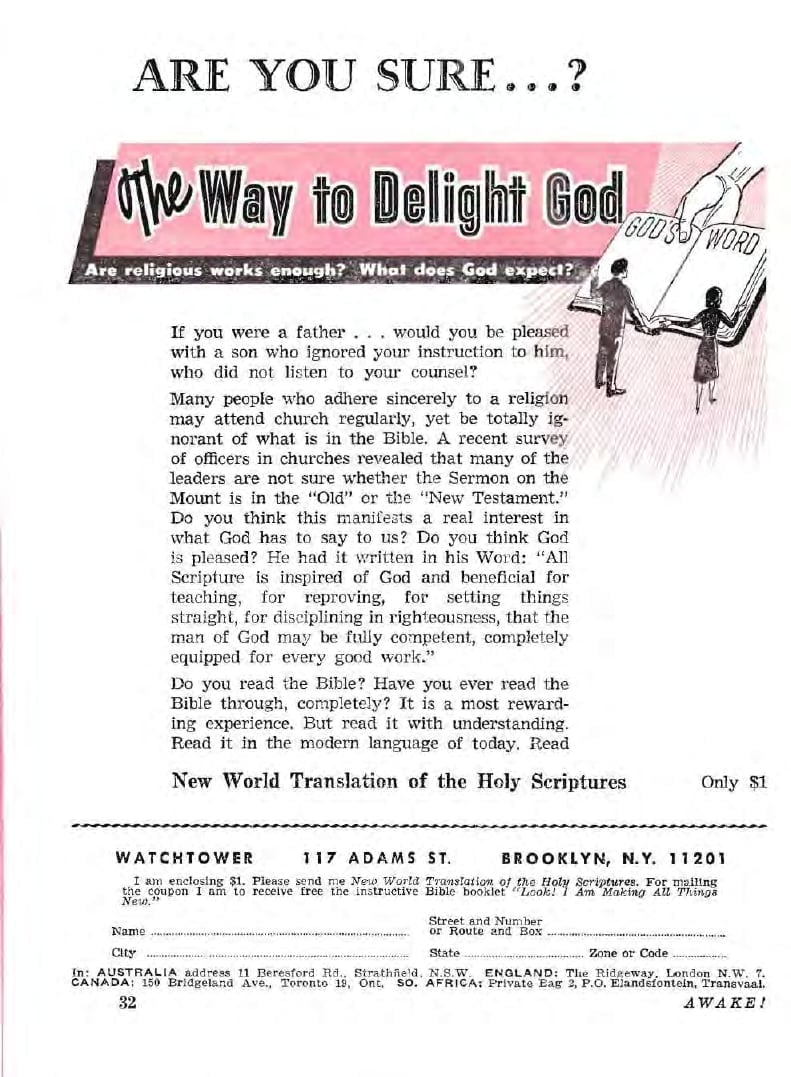
The Way to Delight God
If you were a father . . . would you be pleased with a son who ignored your instruction to him, who did not listen to your counsel?
Many people who adhere sincerely to a religion may attend church regularly, yet be totally ignorant of what is in the Bible. A recent survey of officers in churches revealed that many of the leaders are not sure whether the Sermon on the Mount is in the "Old" or the "New Testament." Do you think this manifests a real interest in what God has to say to us? Do you think God is pleased? He had it written in his Word: "All Scripture is inspired of God and beneficial for teaching, for reproving, for setting things straight, for disciplining in righteousness, that the man of God may be fully competent, completely equipped for every good work."
Do you read the Bible? Have you ever read the Bible through, completely? It is a most rewarding experience. But read it with understanding. Read it in the modern language of today. Read
New World Translation of the Holy Scriptures
Only $1
WATCHTOWER
117 ADAMS ST.
BROOKLYN, N.Y. 11201
I am enclosing $1. Please send me New World Translation of the Holy Scriptures. For mailing
the quipon I am to receive free the instructive Bible booklet "Look! I Am Making Al Things New"
News.
Name ...
Street and Number
or Route and Box ...
City ...
State ... Zone or Code ...
IN: AUSTRALIA address 11 Beresford Rd., Strathfaird, N.S.W. ENGLAND: The Ridway, London N.W. 7. CANADA: 150 Bridgeland Ave., Toronto 10, Ont. SO. AFRICA: Pivate Eag 2, P.O. Elandsforsen, Transvaal.
Before You Doubt
PAGE 5
Medicaid to the Rescue
PAGE 9
Opening the Door to an Endless Treasure
PAGE 12
The Pope—"Pilgrim of Peace" at Fátima
PAGE 20
JULY 8, 1967
THE REASON FOR THIS MAGAZINE
News sources that are able to keep you awake to the vital issues of our times must be unfettered by censorship and selfish interests. "Awakel" has no fetters. It recognizes facts, faces facts, is free to publish facts. It is not bound by political ties; it is unhampered by traditional creeds. This magazine keeps itself free, that it may speak freely to you. But it does not abuse its freedom. It maintains integrity to truth.
The viewpoint of "Awake!" is not narrow, but is international. "Awake!" has its own correspondents in scores of nations. Its articles are read in many lands, in many languages, by millions of persons.
In every issue "Awakel" presents vital topics on which you should be informed. It features penetrating articles on social conditions and offers sound counsel for meeting the problems of everyday life. Current news from every continent passes in quick review. Attention is focused on activities in the fields of government and commerce about which you should know. Straightforward discussions of religious issues alert you to matters of vital concern. Customs and people in many lands, the marvels of creation, practical sciences and points of human interest are all embraced in its coverage. "Awakel" provides wholesome, instructive reading for every member of the family.
"Awakel!" pledges itself to righteous principles, to exposing hidden foes and subtle dangers, to championing freedom for all, to comforting mourners and strengthening those disheartened by the failures of a delinquent world, reflecting sure hope for the establishment of God's righteous new order in this generation.
Get acquainted with "Awake!" Keep awake by reading "Awake!"
PUBLISHED SEMINOLOGY BY
WATCHTOWER EBLE AND TRACT SOCIETY OF NEW YORK, INC.
117 Adams Street
Brooklyn, N.Y. 11201, U.S.A.
N. H. KNORN, President
GRANT SUN, Secretary
Average printing each issue: 4,550,000 Five cents a copy
Offer Yearly subscription rates for edition editions
America, U.S., 117 Adelaide Street, Birmingham 13201
Australia, 11 Boreal Road, Borealhead, N.S.W. 81
Canada, 156 Boreal Road, Toronto, 19.1 U.S. 101
The Bibway, London N.W. 7 776
New Zealand, 621 New North E., Auckland S.W. 3 76
South Africa, 706 South Africa (Monthly edition costs half the above rates).
Requirements for subscription should be sent to the office in country you are living and send your invitation to Brooklyn.
Notices are sent at least two weeks before subscription expires.
Seminarly—Arkansas, Cebuue, Danish, Dutch, English,
Finnish, French, German, Greek, Hokie, Tallen, Japanese,
Korean, Norwegian, Portuguese, Swahili, Tagalog,
Monthly—Chile, Cynthia, Hiligayon, Malaysia, Polish,
Tamil, Urkrainian.
CHANGES OF ADDRESS should reach us thirty days before your moving date. Give us your age and new address, your old address (already), your Welcome Letter, 117 Adams Street, Bronx, New York 11201, U.S.A.
Second class portraits paid at Brooklyn, N.Y.
Printed in U.S.A.
The Bible translation regularly used in "Awoke" is the New World Translation of the Holy Scriptures, 1961 edition. When other translations are used, this is clearly marked.
CONTENTS
Jailed for Being Christian in Portugal 3
Before You Doubt 5
Medicaid to the Rescue 9
Opening the Door
to an Endless Treasure 12
Mutations Not Evolutionary 16
How to Make Your Vacation
More Satisfying 17
The Pope—"Pilgrim of Peace"
at Fátima 20
"Your Word Is Truth"
Earthly Blessings Enjoyed
Under God's Kingdom 27
Watching the World 29
Volume XLVIII
Number 13
Jailed for Being Christian in Portugal
WHAT is wrong in Portugal? On May 18, 1967, within a week of the visit of Pope Paul VI to that country, a political tribunal in Lisbon consigned a large group of Christians to jail for no greater "crime" than that of meeting together to study the Holy Scriptures. The case against these Christian witnesses had already attracted a great deal of attention.*
As the court confirmed the prison sentences that day, there were no handcuffs and no convoy of armed guards, which usually mark commitments to prison. From the court to the prison is a distance of about fifteen minutes on foot. When the formalities were complete, the Witnesses were left to walk the distance on their own. Manifestly the court considered these prisoners to be honest, serious citizens. Indeed, public officials in and around the courtroom were deeply impressed by the calm and dignity of the Witnesses, and some by their manner showed a marked sympathy.
The female Witnesses, constituting 75 percent of the group, were assigned to the Monicas Prison, the males to the Limoeiro Prison. Inmates at both places showed
keen interest in these new arrivals. Who were these fine-looking men and women? Why were they being put in prison? What crime had they committed? Were they really a threat to the State? These and many other questions were now being asked and answered.
And who are these people who are said to constitute such a grave threat to Portugal's security? At least two in the group are women nearing their seventies. And there is one young woman with a three-week-old infant in her arms. Yes, the child goes to prison too. Ordinary wives, mothers, housekeepers, they are not at all the type that could be dangerous to the State by the greatest stretch of even the ecclesiastical imagination. Yet it is well known that Roman Catholic clergy pressure on police and other officials is behind this travesty of justice.
In honor of the pope's visit an amnesty was proposed whereby a number of criminals will be released from Portugal's jails. But, now, what about this group of Christians? Is it possible they may yet be released under the papal amnesty, or shall there be in Portugal a repetition of that historic decision made by a priest-inspired mob in the year 33 C.E.?
They preferred murderer Barabbas to the holy and undefiled One, Jesus.—Matt. 27:15-26; Acts 3: 14, 15.
And what is the effect of this persecution on those who love God's truth? Are they frightened? No; in fact, the young woman with the infant was a person newly interested in Bible study at the time of her arrest back in June 1965. Despite the difficulties, she stood fast, submitted to water baptism last year, and now goes to prison convinced of the rightness of her course. Friends have undertaken to care for her other children while she is in jail.
Undaunted, another of these young women visited twenty families with whom she had been conducting Bible studies, to explain why she would be unable to come for a while, and to introduce another Witness who will conduct the studies during her absence. Many were anxious to learn what prison she would be in so they could visit her. Not one of them was pressured by fear into discontinuing the study of the Bible. As she went to jail, other Witnesses there in Portugal recalled the words of Paul the apostle: "Most of the brothers in the Lord, feeling confidence by reason of my prison bonds, are showing all the more courage to speak the word of God fearlessly."—Phil. 1:14.
It is refreshing to note, however, that not all officials have heart for this persecution of innocent Christians. In one mainland town of the south, police were summoned to cope with what was reported as some great subversive plot. Plainclothesmen were so alarmed that they sent for a detachment of twenty soldiers armed with machine guns. Thirty-seven persons were marched off to the headquarters of the Public Security Police. The police chief in this instance was genuinely embarrassed to find that all this show of force had broken up an open-air Bible meeting.
The officers were quite nonplussed by the peaceful attitude of their prisoners, and later at the station, when one of the Witnesses explained something of their beliefs and the wonderful promises of the Bible, some of these policemen were visibly moved. The whole group was released with apologies and permitted to take their Bibles home with them. The interference had the effect only of spreading the Bible's message, for the whole district seethed with talk about this happening. One Witness reported that he was kept busy all the following day answering the questions of his neighbors.
The publicity attending this campaign of persecution is, in fact, having a result opposite to that intended. Bible lovers are not being intimidated, least of all the Witnesses themselves. Rather, the number of Witnesses active in Portugal is increasing—a 31-percent increase in April over the record of the previous year. This year when the Witnesses celebrated that annual evening meal that Christ Jesus instituted among his disciples on the eve of his sacrificial death, it was most encouraging to note that the number of interested persons attending the celebration represented an increase of some 1,100 over last year's attendance. Also, scores of families have offered to care for children of incarcerated Witnesses, and generous donations have been made toward court expenses.
As for those faithful Christians in jail, are they downcast? No, rather they rejoice at being "counted worthy to be dishonored in behalf of [Christ's] name."—Acts 5:41.
HIS is an age that is rapidly becoming one of doubt and skepticism. And not without reason. For there is an increasing number of things that one reads and hears that prove untrustworthy.
Turn to the advertisements in a newspaper, for example. How much that you read there can you wholeheartedly believe? From experience you may have discovered that certain kinds of information are dependable but that statements dealing with quality of merchandise often are not.
You perhaps have found that the case is similar with other information. Some news columnists you have learned to trust, and others you have discovered are somewhat biased. Also, some salesmen you have found are honest, while others are not. It is little wonder, then, that you may have learned to doubt, and wisely so. For as the inspired Bible proverb advises: "Anyone inexperienced puts faith in every word, but the shrewd one considers his steps."—Prov. 14:15.
Living as we are in what the Bible describes as "critical times" when men are "fierce, without love of goodness, betrayers," there is indeed value in not believing everything one hears. (2 Tim. 3: 1-5) But this poses the questions: When should we doubt? How can we know
Doubt can be either a valuable protection or a destructive process. When should it be employed? When should it be avoided?
when to put faith in what we hear and when to disbelieve? Is it a wise policy to doubt everyone and everything we hear?
Importance of Open-mindedness
If a stranger should approach you on the street or call at your home with information that he claims is
for your benefit, should you turn him away or slam the door on him? Not only would that be unkind, but it would be unwise. It would be proper to listen to what the person has to say, unless, of course, by so doing your personal safety is endangered. The inspired Bible proverb points to the unwisdom of forming opinions on matters before listening to them, saying: "When anyone is replying to a matter before he hears it, that is foolishness on his part and a humiliation."—Prov. 18:13.
True, when listening to a stranger, especially when he is talking on significant matters that involve laying out money, or views that affect religious faith or morals, you are wise to give careful consideration before acting. "The shrewd one considers his steps," the Bible proverb says. He is not immediately inclined to put "faith in every word." This does not mean, however, that he distrustfully closes his mind simply because the information or ideas are new or different from what he has heard before.
In the first century of our Common Era persons from the Macedonian city of Beroea manifested an exemplary disposition. The Bible record reports concerning their attitude upon hearing the message preached by Jesus' disciples, who were at the time strangers to them: "Now the latter were more noble-minded than those in Thessalonica, for they received the word with the greatest eagerness of mind, carefully examining the Scriptures daily as to whether these things were so."—Acts 17:11.
The Beroeans listened, not with a skeptical, disposed-not-to-believe attitude, but with open-mindedness. They did not allow doubt to cause the message to fall on unreceptive ears. Rather, they took in the information, and then made a careful investigation of the inspired Scriptures to ascertain whether the things they had been taught were supported therein.
We, too, should follow this pattern of being willing to accept and examine ideas open-mindedly. "Make sure of all things," the Bible encourages; "hold fast to what is fine."—1 Thess. 5:21.
When to Doubt
So, then, when dealing with strangers, a shrewd person may wisely recognize the need to do some personal investigating. He is not necessarily inclined to disbelieve. But if it is discovered, after closer investigation, that there is no solid basis for what a person says or what is read or heard, from then on he may be disposed to doubt that source.
Otherwise, others will come to consider what you have to say as being of little merit. They will view it with doubt. The value of being honest, truthful and reliable is, therefore, inestimable.
Thus, if you desire your word to be accepted, you should always be truthful and honest. You should be careful not to repeat things unless you have a sound basis for believing that they are true.
It is upon the basis of such qualities of integrity and faithfulness that true friendships are founded. Since time is required to become acquainted with these qualities in persons, it takes time for real friendships to grow and mature. However, when one has proved to be a reliable and trustworthy friend, should we doubt him everytime he tells us something new? Not at all! And if we do, our friendship likely will suffer or may even terminate. Mutual trust and confidence are vital in order to enjoy healthy, refreshing relations with others.
In the family, for instance, doubts can severely damage relations between members. If a wife doubts her husband's faithfulness when she has no substantial basis for doing so, this can raise a barrier between the two. She only torments herself by her doubts, and her decreased capacity to love her husband that may result will only cause him unhappiness too. How important it is to have real evidence before one doubts a loved one! It is much better to give a friend the benefit of the doubt, continuing to place trust in him until there is clear proof of untrustworthiness.
Need for Balance in Exercising Doubt
Some educators have observed a modern trend toward skepticism and doubt. The deterioration of honesty and integrity is unquestionably a factor in causing this. People have heard so many untruths and half-truths that they understandably have become distrustful of what they read and hear.
Perhaps another important factor in this trend is the popularizing of doubt as a key to scientific progress, which it indeed can be.
Science writer Isaac Asimov explained in Science Digest: "If a scientist has one piece of temperamental equipment that is essential to his job, it is that of a built-in doubter. Before he does anything else, he must doubt."
There can be no question that doubt has been valuable in leading to many scientific discoveries. Unfortunately, however, the unbridled exercise of doubt has resulted in a modern tendency to be skeptical of practically everything one hears or reads. And just as putting "faith in every word" can be dangerous, so, in the opposite extreme, a disposition not to believe can also be damaging and lead to grief.
Last summer the dean of a college in the United States drew this to the attention of a class of college freshmen. Getting to the crux of his address, which was published in Vital Speeches of the Day, November 1, 1966, he said: "To state as exactly as possible what I have on my mind, we must assume that what we read and hear is reliable and then test it with skepticism. My concern is that we are omitting the assumption, and are left with skepticism. Skepticism by itself is cancerous."
That unbridled skepticism or doubt has eroded away confidence and undermined respect in modern society has been observed by many persons. It seriously disturbed this college head, as revealed in his following comments: "More and more of us are acting as if we were the only man alive. We are cynical of what we read and hear, critical of what we observe. . . .
"Could it just be that our disposition not to believe has duped us into becoming our own worst enemies? Could it be that we are becoming such egotists that unwittingly we are turning into bigots, intolerant of everything? Could it be that
in our isolation we are becoming so convinced of our individual infallibility that a constructive idea, were it to come along, would fall on deaf ears?
"With conviction which I hope is based on fairly objective observation, I think we can cite one example after another of a general assumption not to believe, not to listen, not to trust, and I say again that if we begin with that assumption we are doomed."
In Matters of Religion
When it comes to matters of religion, how can doubt be exercised in a balanced way? It would obviously be foolish to "put faith in every word" of the many different religions, since they often teach conflicting doctrines. Does this mean, then, that we should be distrustful and disposed to disbelieve any of them? Should we conclude that the Bible, upon which most of them claim to base their teachings, is all mixed up and not worthy of consideration?
No, that would be unwise. While we might hold reservations about a religion's claim to represent God, until we see convincing evidence of it, yet the wise thing would be to examine the Scriptures to see if what a particular religious organization claims is supported therein. Recall that that was the commendable course of those persons in Beroea. They listened to Jesus' disciples "with the greatest eagerness of mind." What they heard sounded good to them, but they were not necessarily putting faith in every word those strangers were telling them. For they then personally examined "the Scriptures daily as to whether these things were so."
How vital it is that we follow that example! It is important that we become familiar with the foundation of true worship, the Holy Bible.
Confidence in God and His Word
After becoming acquainted with the Bible one learns that it is faithful and true. He finds he can confidently put his trust in what it says. Its counsel and instruction invariably prove beneficial when followed. Yes, upon close study of it one comes to appreciate that the Bible is indeed the Word of the true God, Jehovah. And Jehovah God is the best friend a person could ever have! How should we view the word of such a friend? Should we doubt it?
Doubting a friend when there is no sound basis for doing so leads only to grief. It causes disturbance of mind and confusion. Thus, the inspired disciple of Jesus Christ wrote: "If any one of you is lacking in wisdom, let him keep on asking God, for he gives generously to all and without reproaching; and it will be given him. But let him keep on asking in faith, not doubting at all, for he who doubts is like a wave of the sea driven by the wind and blown about." (Jas. 1:5, 6) God has always proved reliable. One who has become his close friend has proved this. So there is no reason ever to doubt what He has to say.
The Israelite forefather Abraham is a man who came to know and trust Jehovah the true God. In fact, he is noted in the Bible as "Jehovah's friend." (Jas. 2: 23) Abraham learned that he could rely on Jehovah, so that even when God told him he was going to have a son when both he and his wife Sarah were long past the normal age of having children, he believed it. Abraham trusted God's Word; he did not doubt, as the Bible explains: "Because of the promise of God he did not waver in a lack of faith, but became powerful by his faith, giving God glory and being fully convinced that what he had promised he was also able to do." —Rom. 4:20, 21.
How wise you will be if you also seek to take in knowledge of God and of His Word the Bible! What He says there directly affects your life. Do not turn a deaf ear to his entreaty: "My son, to my words do pay attention. To my sayings incline your ear." (Prov. 4:20) Your personal safety is in no way endangered by taking time to listen to the words of God. So do not foolishly turn away from an opportunity to investigate what God says in his Word.
Consider those who refused to examine open-mindedly the message that God spoke through his prophet Noah. (2 Pet. 2:5) They were cynical of what they heard and critical of what they saw. Theirs was a skeptical, disposed-not-to-believe attitude. And what happened to them? Why, they suffered destruction when God brought the Flood just as he had prophesied.
But what concern does that have for us today? A great deal! For Jesus Christ said that this system of things will end in a similar destruction at God's hands, warning: "For just as the days of Noah were, so the presence of the Son of man will be. For as they . . . took no note until the flood came and swept them all away, so the presence of the Son of man will be." (Matt. 24:37-39) The majority refused to examine the evidence, and perished. Only those carefully heeding God's instructions survived. It will be similar again. We have the words of Jesus Christ for it.
Do you believe him? Even if you do not, wisely avoid a skeptical, disposed-not-to-believe attitude and humbly examine what the Bible says. Its grand promises of life in a new system of things are trustworthy and true, as an investigation will reveal. Learn about them! Do not allow skepticism and doubt to cause you to turn a deaf ear.—2 Pet. 3:13; Rev. 21: 3, 4.
MEDICAID
TO THE RESCUE
</div>
expenses have become so great in the United States
that many families cannot afford a serious sickness. In 1961, a person who had a semiprivate room for ten days in a New York City hospital was usually charged about 560. In 1966 the bill was842, and this year it will likely be close to $1,000. On top of this is the physician's fee, which may amount to hundreds of dollars, depending upon what he is required to do. Even for medical treatment that lasts for only a little more than a day a patient can receive a big bill.
There is the case of a man in New York who was in a hospital for thirty-seven hours, was given three series of X rays and four minor laboratory tests. His bill was 252. A two-year-old boy who spent forty-three hours in a hospital undergoing tests for a heart murmur ran up a bill for his parents that amounted to434. Hospitalization is expensive, and it is expected to get even more expensive.
It has been estimated by some officials that the cost of being in a hospital may increase nation wide by as much as 15 to 30 percent during 1967. Regarding this, Dr. Madison Brown, the American Hospital Association's director of planning and development, said, as reported in the New York Times of September 6, 1966: "The work of hospitals is complex and expensive. But in the next two years there will be raises far beyond what we've seen in the past. The national increase will range from 15 to 30 per cent from now until July 1, 1967." This is not a pleasant prospect for the average family.
What would you do if a member of your family had to be hospitalized and you were confronted with huge hospital and doctor bills? You probably would rely upon some form of medical insurance, which many persons carry for their family. Otherwise such bills could be a financial catastrophe. Carrying medical insurance, however, can be a difficult load, especially when insurance payments are raised repeatedly so as to keep pace with rising medical costs. Yet, such insurance is usually regarded as essential even when it will pay only part of a hospital bill.
But what if your income is insufficient to carry the additional load of medical insurance or it is not enough to carry the amount of insurance needed? What if you do not have the funds needed to cover that part of a bill that insurance will not pay? What will you then do if someone in the family is hospitalized for several days? This is when Medicala comes to the rescue for persons living in the states that have instituted it.
How Medicaid Will Help
Medicaid is a medical assistance program financed jointly by the Federal Government, a state and the localities in the state. In New York the program will help needy persons of any age who are residents of the state to pay their medical bills.
This includes persons in the low-income and moderate-income groups as well as others that are facing financial catastrophe because of huge hospital and doctor bills.
In a brochure published by the State Department of Social Welfare in New York, the following is said regarding the purpose of the program: "Children deprived of medical care because their parents cannot afford it, often become victims of conditions that impair their health and, later in life, limit their work capacities. Lack of needed health care, in time, builds a great burden of illness and disability in the community, much or all of which becomes a welfare burden eventually. . . . More and more individuals and families cannot pay for the medical care they require, especially people in the low-income and moderate-income groups, although they are able to support themselves otherwise. To help these citizens avoid needless suffering and disability and to prevent them from becoming welfare recipients because of medical bills, New York State, in cooperation with the Federal Government and the localities, has established a program of Medical Assistance for Needy Persons."
How Medicaid Came to Be
When the House Ways and Means Committee of the Federal Government handled the Medicare law that was passed in 1965, it appended to it a section called "Title XIX," which is the so-called Medicaid law. This was regarded at the time as a modest provision for Federal, state and local aid to be given to persons who are "medically indigent." It was estimated by the Federal Department of Health, Education and Welfare that the Medicaid program would cost the Federal Government only about $240 million a year.
Title XIX received little attention during the Congressional battle over Medicare, which is a provision for Federal payment of a large part of the medical expenses of persons that are sixty-five and over. Medicaid is for persons of all ages and is no form of medical insurance. It was not until Medicare was made law that the lawmakers began to realize that Medicaid would be far more costly than they had planned. This happened when New York State greatly expanded its medical assistance program under the provisions of Medicaid.
New York gave such a liberal interpretation to the expression "medically indigent" that 40 percent of the State's population could qualify for medical assistance. This was such a shock to the House Ways and Means Committee that it expressed determination to change the law, but opposition from the states was so great that it finally did no more than recommend a mild change.
Half of the cost of the program is carried by the Federal Government, and the other half is shared by the state and local governments. Due to the fact that the program has expanded far beyond what Congress intended, the initial estimate of 240 million for the program was far too small. Federal officials now think that New York's program alone will cost in the neighborhood of1.4 billion by 1970, when, it is said, it will be operating full scale. It was the opinion of New York's governor Rockefeller that Medicaid for New York State would cost $532 million for the fiscal year running from July 1, 1966, to June 30, 1967.
Other states are setting up Medicaid programs, but the number of persons that will benefit from them will vary according to eligibility requirements. The nation's most populous state, California, estimates that its program will benefit approximately 1.3 million persons.
Who Qualifies?
Each state is free to use its own judgment in defining the "medically indigent." Consequently, the requirements for eligibility vary. In New York State, where the program is the most liberal, the factors that determine whether a person qualifies for medical assistance or not are the amount of annual income, financial reserve for burial costs, savings and medical expenses. The total income a person has after deducting income taxes and the cost of health insurance premiums is the first determining factor.
If, for example, a single person has an annual income that does not exceed 2,900, Medicaid will help him with his medical expenses without his having to pay anything from his income. A family of four persons can have an income of6,000 without having to pay anything on a medical bill, and a family of eight persons with two wage earners can have an income of as much as $10,250.
A person is also permitted to have savings in the bank up to one-half of his annual income before he is required to use the savings to pay medical expenses. Anything in excess of that amount would have to be used, except for what is needed to establish a reserve to cover burial expenses for the family when it lacks minimum insurance protection.
Anyone that owns property and needs medical assistance is not required to give a lien or a mortgage to the welfare department, although this will probably be required of income-producing property. Such things as an automobile and personal property are not regarded as assets, and so the person getting medical assistance is not required to sell them. Personal property includes furniture, appliances and equipment needed in a business or trade.
An annual payment toward out-patient JULY 8, 1967
medical expenses is ordinarily required of a person who is not receiving welfare and who has an annual gross income over 4,500 before Medicaid will help him with medical expenses. This payment is called a "deductible." The amount of the deductible or annual payment is one percent of the gross annual income. For a family of four with a gross income of7,000 a year, the annual payment would be $70.
When a person finds that he needs help from Medicaid he can make application for it at the local department of public welfare. Application can be made in person or by mail. This department then decides on his eligibility for assistance. If he is accepted he receives an identification card.
By considering these eligibility requirements of the state of New York we get an idea of how extensive the Medicaid program can be. Of course, other states have different requirements. Washington state, for example, limits Medicaid assistance to persons that have a monthly income of 140 or less for an individual and190 or less for a couple. Medicaid does not come near the scope of socialized medicine that exists in Great Britain and some other countries. Nevertheless, it can care for a real need among families with low incomes.
In these days of steadily rising medical costs and insurance rates a family of modest means needs help to shoulder the huge medical bills that can result from the hospitalization of a member of the family. As a form of health protection provided by tax money, Medicaid exists to help such persons. It is ready to come to their rescue. Those who qualify for it need not hesitate to use it, because it was formed for their benefit. It is better to call for the help of Medicaid than to be bankrupt as a result of medical expenses.
ENDLESS TREASURE
By "Awake!" correspondent in Zambia
OU who are reading this article possess a precious gift, a divine gift that, if cultivated, can be a door to an endless treasure of knowledge. This gift is the ability to read, but it is a gift that has not been cultivated by about half of earth's adult
population. This ability can be termed a divine gift because man's Creator endowed the first man with the ability to read and write. (Gen. 5:1) However, for Adam's descendants the knowledge of how to read is not a gift acquired by heredity. Learning to read is hard work. The problem of illiteracy is not something that can be easily overcome, and the problem is immense.
According to a noted authority on literacy, Dr. Frank C. Laubach, writing in 1947, three-fifths of the world's population could not read or write. In 1957 the United Nations Educational, Scientific and Cultural Organization estimated that there were 700 million adult illiterates in the world, that is, 44 percent of the then total population fifteen years old and over. The problem is greatest in Asia and Africa, with adult illiteracy rates of 65 percent for Asia and between 80 and 85 percent for Africa. For example, in Zambia 80 percent of the adult population cannot read or write. Adult illiteracy, however, is a world problem. Even in the United States, the Census Bureau claimed a few years ago that there were 8.3 million
persons twenty-five years and over who could not read or write. For hundreds of millions of persons this door to an endless treasure is still shut tight.
Because of being unable to read or write, these millions of persons are subject to poverty, exploitation and superstition. There are many jobs and trades that cannot be learned or fully accomplished unless the worker can read and write, and thus the poorest group in a nation are the illiterate ones. If a person is a farmer or a hunter but can only put his mark on an agreement that he cannot read, he can the more easily be exploited by selfish traders. A mother who is illiterate cannot read a letter from her son nor can she write to him.
The illiterate, being unable to read the Book of revealed religion, develop their own natural religion and become prey to false ideas and victims of crippling superstitious fears. Those who respond to oral preaching of true religion and break away from false worship and superstition find it difficult to progress in knowledge and spiritual understanding because they cannot read and study. Literacy could become for them a door opening to an endless treasure of knowledge, leading to spiritual maturity.
Combating Illiteracy
Developing countries find illiteracy one of the greatest barriers to helping their peoples to progress economically and socially. The illiterate are unable to read and apply simple government instructions on improving agriculture or diet and safeguarding health. Thus, as more and more countries achieve self-rule, more governments are taking positive steps to combat illiteracy.
For example, since independence the adult literacy program in Zambia has been given new impetus. As part of community development a qualified literacy officer with countrywide powers has been appointed and assigned necessary funds. Under his direction twelve trained fulltime local literacy officers have been assigned to all the provinces and main centers, and more are being trained. It is not the purpose of these literacy officers to teach illiterate persons how to read but to train literate persons how to teach illiterates.
This program calls for self-help on the part of the community and the individual students. It is up to a community or a religious body to encourage and gather the students, find the teachers, provide the classrooms and to buy the literacy primers or to get the students to buy these. The government provides the literacy officers to train the local teachers and has devised and printed a series of six progressive literacy primers in seven of the principal languages. Generally a literacy officer will train a group of teachers in ten two-hour periods spread over two weeks. It is hoped that, under this scheme, by 1970 all adults in Zambia who wish to become literate will have had opportunity to become 'functionally' literate, that is,
'to be able to engage in all those reading activities normally expected of an adult in his community.'
One of the first groups in Zambia to cooperate in this new literacy campaign has been Jehovah's witnesses, who, for years, have been active in combating illiteracy. Thousands have been taught to read in the more than nine hundred literacy classes conducted in their 725 congregations.
A subject of much discussion and continuing research with regard to teaching literacy is that of the best method of teaching. Methods of teaching reading have been broadly classified into two groups, "synthetic" and "analytic." In the synthetic method the student first learns the sound of the smaller units, letters and syllables, and then he is taught to combine these into larger units, words, phrases and sentences. In the analytic method the student is taught first to recognize larger units, words, phrases or sentences, and then later helped to break these down into the elements making them up, that is, syllables and letters. Methods of teaching literacy usually included under the synthetic group are the alphabetic, the phonic and the syllabic.
Alphabetic and Phonic Methods
Probably the oldest method of teaching reading of alphabetic languages is the alphabetic method. The student starts off by learning the names of the letters in alphabetic order, then learns to spell and pronounce two-letter combinations, such as m-a, ma, then three-letter combinations, m-a-n, man, and so on. Syllables are combined into words and words into phrases and short sentences. By constant repetition, boring for most adults, the student eventually learns to pronounce correctly the names of all the letters. Another system widely used is the phonic method.
Phonic means 'of vocal sounds,' and so in the phonic method the student is taught, not the names of the letters, but how they sound in a word. The student is usually taught first the vowels and then the consonants. These are joined into two, three- or four-letter combinations to form short words or syllables. These syllables are combined to form words, then phrases and then sentences.
Syllabic Method
Similar to the phonic method is the syllabic method. In this method, instead of the sounds of single letters being taught, the student first learns to pronounce syllables. He then learns to read words and sentences made up from these syllables. In some languages many words consist of syllables of two letters, and thus from the beginning the student is taught to read simple words. A variation of this method is to use pictures to introduce a few common words. These words are then broken down into their syllables. The student learns to pronounce the syllables and then to combine these into different words that are made up of the same syllables. For example, in Spanish he may learn the words papa (daddy), mama (mommy), dama (lady), vaca (cow), and from these words he learns to read the syllables pa, ma, da, va, which, in turn, can be combined into other words and sentences.
The phonic and syllabic methods are most effective for languages that are entirely or almost phonetic, that is, for languages that use one letter for one sound and are pronounced the way they are spelled. Most of the African languages that were given a phonetic Roman alphabet by missionaries fall into this category, including Cibemba, Cinyanja, Citonga and Silozi, the most prominent languages in Zambia. Where a language is phonetic, a student who is taught the sounds of the
letters can quickly learn to pronounce new words. One main argument against this is that it is claimed that it develops poor comprehension in the student. He is so busy with the mechanics of pronouncing what he sees that he does not think of the meaning of what he reads.
"See and Say" Method
Those who prefer an analytic method claim that this type of teaching makes for much better comprehension in the student. The analytic method could be termed the "see and say" method. Also known as the "whole word" method, this method teaches the student to recognize whole words at the outset without being able to pronounce the individual syllables and letters that make up the word. This, it is claimed, makes it very suitable for teaching the reading of languages that are not purely phonetic, such as English. This method can be termed analytic in that pronunciation of syllables and letters is eventually introduced by the analyzing and breaking up of the words into the syllables and letters making them up.
Extensions of the word method are the sentence and the story method, where whole sentences or simple stories are first learned and then broken down into words and syllables. It is argued that, because the student learns to recognize the word or sentence as a whole, he can concentrate on what the words mean rather than working out their pronunciation. This method has few supporters among those foremost in teaching reading to adults in phonetic vernacular languages.
The main criticism of the "see and say" method is that it produces readers who guess at words, who are poor in being able to pronounce new words and who read inaccurately because of confusing similar-looking words.
Of all these methods, then, which is the best for teaching adult illiterates?
Eclectic Method
Today an eclectic method is often preferred; that is, one that chooses what is best from each method, according to the type of language, the quality of the teachers available, and other related factors. Thus the Cibemba primer recently introduced in Zambia starts with a picture of a man and under the picture appears his name, Malama. The student learns to read his name, and then he learns to
reading skill, they become discouraged, make no progress and eventually forget what they learned. For this reason much of the effort of those organizing literacy programs is now directed to the preparation of literature for new literates.
ARTICLES IN THE NEXT ISSUE
To assist in this in Zambia, the Department of Community Development has produced a list of six hundred basic words to be used by those writing for new literates.
Why So Many Parental Heartbreaks?
The Catholic Church in Crisis.
Fluoridation—Is It Good or Bad?
Heard at the Bethel Dinner Table.
read and write on the following pages the syllables ma and la. Shortly thereafter another picture introduces another word, and the student learns to pronounce and write the syllables making up this word. Soon, by combining these with the first syllables that he learned, he can read and write simple words.
While this method is basically syllable, it can be seen that it draws on elements of the phonic and whole-word methods. It is hoped that the average adult will work through the six primers in four to six months and then will progress by reading and enjoying simple books written for new literates.
Need of Literature for New Literates
For students in many areas and languages their new-found ability does not open the door to an endless treasure. This is because there is nothing further in their language that they can read. The only literature available in their language may be the Bible, and, for most, the gap between their primer and the Bible, or other literature available, is too great for them to jump. Unable to use their basic
In addition to using a simple, limited vocabulary, books, pamphlets and articles for those who have just learned to read should be written in short simple
sentences. A local literacy officer has stated that the book From Paradise Lost to Paradise Regained, written in simple language and published by the Watch Tower Bible & Tract Society, is suitable for helping new literates to progress further. Once the student has completed the six primers he should be able to work his way through this book.
While the use of an effective teaching method and the provision of simple reading matter are important, there is another aspect of teaching literacy at least equally important.
The Teaching Attitude
It has been claimed that 60 percent of the success in teaching literacy to adults depends on the attitude and manner of the teacher. The teacher must take into consideration differences between teaching adults and teaching children. The adult illiterate is more sensitive, very conscious of making mistakes, easily embarrassed and can be quickly discouraged. Thus an essential quality that a teacher must exercise is fellow-feeling. He should put himself in the place of his student and try to appreciate his difficulties.
The student cannot read a book, but he can read his instructor. If the instructor is bored, superior or impatient in his attitude, the student will sense this and be discouraged. If he loves his student and is genuinely interested in his progress, the student will respond. The teacher should work on the same level as his student, not standing or sitting above him, but sitting alongside him. His voice should not be loud, but just loud enough to be clearly heard. He should appear as a partner with him in the joint venture of opening the door to an endless treasure, not a superior schoolmaster.
The successful teacher avoids embarrassing the student. If he says ba instead of da, the teacher does not pounce on his error. He goes back to ba, agrees that that is ba, reminds the student that da begins with a different letter and lets him try da again. By commending at each opportunity, he encourages his student and builds up his confidence in his ability to read. When the student reads the word correctly, the teacher does not waste valuable time by repeating it after him. He lets the
student do the speaking. The classes should be small, at best four to six, but not more than ten. Avoiding any spirit of competition among the students, the teacher encourages each one to progress at his own pace by giving each one individual attention. From the beginning he encourages a thoughtful reading attitude. That is, he makes it his aim not merely to produce mechanical pronouncers of symbols but to produce thinkers who can understand and apply the thoughts represented by the symbols. He keeps alive in his students a strong motive for persevering at their studies, discussing with them the benefits that being able to read will bring to them.
It is with joy that the patient instructor will hear his student read his first sentence. His joy will be greater as he observes the mind of his student opening to new thoughts, new ideas, replacing ignorance and superstition with knowledge and true belief, becoming equipped to progress socially, economically and spiritually. Working together, the teacher and student will have opened a door still shut to millions of persons—the door to an endless treasure.
Mutations Not Evolutionary
The modern theory of evolution asserts that mutations have enabled one organism to evolve into another. However, the Journal of the American Scientific Affiliation for September 1965 notes: "Concerning the supposed role of micromutation and selection in producing the organisms of today, J. J. Duyvene de Wit has said, 'As a result of mutation we may get alterations with respect to certain existing characters, for example in the number and size of hair bristles in Drosophila, but it appears that after a number of X-ray treated generations, the induced mutations pertaining to a selected character reach a limited ceiling beyond which no further change occurs. . . . Moreover, and this is of crucial importance, mutations, and even series of directed mutations, never gave rise to the appearance of essentially new characters of generic magnitude. From this, it clearly appears that mutational changes remain structurally restricted to the basic genotype to which the race or species in question belongs. In other words, transformation of a given basic genotype into another one as a result of a series of one-directional mutations cannot be produced experimentally.'"
How to Make Your VACATION More
HUMANS require periods of rest or change from their regular work in order to function at full efficiency. The mind, body and spirit are restored when the normal routine is
altered and there is a change of pace and activity. Most employers have come to recognize this. So it is the general custom in many lands today to give employees a regular vacation from their jobs, often with pay.
It is observed, however, that some persons fail to realize enough satisfaction from their vacations. One noted physician pointed to a reason why: "I have had patients who did the same kind of thing on their vacations that they were doing all year long on their jobs." Thus, this doctor observed, they return to work bored and "wondering why they feel so tired."
So, remember, vacations are generally more satisfying when there is a definite change of pace—when you are able to go places or do things you normally do not have the time or opportunity to do.—Mark 6:31, 32.
There are certain things ordinarily done, however, that cannot be omitted during vacations if these are truly to be satisfying occasions. For an obvious example: eating and drinking. You may even derive added pleasure on vacations due to the different times at which you eat, or because of the type of food and drink consumed.
Vital for True Satisfaction
Similarly, worship of God is vital to true satisfaction, and that during vacations too. (Matt. 4:4) As always, dedicated Christians will pray to God. Perhaps on vacation you have occasion to be by yourself where you are surrounded by the marvelous beauties of God's creations. What a satisfying experience to be able to communicate in prayer with the Grand Maker of the luscious green meadows, the majestic mountains, the blue sky, the roaring surf! On such occasions your heart may especially be moved with appreciation for the loving provision that Jehovah God has made for righteously disposed
persons to enjoy these beautiful creations forever.
Increasing Our Knowledge
When discussing the importance of change of pace on vacation, one doctor said: "Try to learn something you didn't know before . . . acquire new skills and absorb new knowledge." Doing so, you can make a vacation of lasting benefit, one long remembered with pleasure.
As a Christian, you may have a regular program of preparing for weekly Bible studies and congregation meetings. Understandably, a change of pace, or variation in study material, may be desirable. No doubt there is some publication that you have wished strongly to read, perhaps something that did not relate directly to your regular study program. Why not do it on vacation?
Take your time. Enjoy taking in the information.
Just as eating breakfast on vacation at 10 or 11 a.m. may be a pleasurable change from routine for some, so leisurely reading of a subject of personal interest can be a rewarding experience. Do it when you are refreshed. Perhaps after breakfast, propped up in bed. Or you might settle down in a pleasant out-of-doors location, under a tree or in a hammock. The change in time and place of study, and the reward of learning valuable new things can be exhilarating.
Some years ago a youth spent two weeks of his summer vacation before graduating from high school reading a copy of the Christian Greek Scriptures. He had heard others talk about the things recorded therein, but had never really personally read them himself. It was an experience that perhaps more than anything else affected his life, causing him to take up the full-time ministry upon graduation from school. Until this day he vividly recalls that delightful vacation of over fifteen years ago.
Others have gained real satisfaction on vacation from reading the faith-strengthening Bible publications Life Everlasting—in Freedom of the Sons of God, "Make Sure of All Things; Hold Fast to What Is Fine" or "Babylon the Great Has Fallen!" God's Kingdom Rules! Have you personally read these books? You might find that your vacation becomes a memorable one for doing so, or for reading other such publications.
Sharing Spiritual Things
While such diversions as getting out in the woods, up in the mountains or down to the seashore for a week or two can be a satisfying change, some persons have found a real high point of their vacation
to be searching out fellow Christians in the area visited and attending a congregation meeting. Some time might even be enjoyably spent in making ministerial calls, and talking to people in the neighborhood about God and his purposes, just as the Lord Jesus did after traveling to a lonely place to "rest up a bit."—Mark 6: 31-34.
Last summer a young couple from New York City had this very purpose in mind when they decided to take a week's vacation in West Virginia. They selected that area because it was a section that was not assigned to any congregation of Jehovah's witnesses. While they needed a rest and change from the fast pace of city life, they planned to spend some time talking to people in the house-to-house ministry. In their territory in New York City they simply had not found enough people truly interested in discussing the Bible, and, as a result, they felt a spiritual lack.
What a refreshing lift their vacation in the country proved to be! "We got plenty of sleep," they explained, "and just relaxed and took our time. We were there to enjoy ourselves in the beautiful out-of-doors. At the same time, we desired to talk with interested persons about God and his purposes for man. We were not trying to reach any goals, beyond meeting and talking with people."
The results were beyond their expectations. "Why, people really enjoyed talking with us about the Bible," they observed enthusiastically. "In the entire week only two persons did not want to discuss spiritual matters. Although our primary purpose was not to place literature, people were so interested that we left 55 bound books, as many booklets, and over 100 Watchtower and Awake! magazines. It was a very pleasant experience. Absolutely delightful!"
vacation, you will want to write the Watch Tower Society in your country to find out whether the place where you plan to go is frequently visited by Kingdom ministers. There are still many areas that are seldom reached with the Kingdom message. You may add greatly to the joy of your vacation by spending parts of some days making ministerial calls and discussing with interested persons God's wonderful provisions for life and happiness.
Another possibility to keep in mind is the sharing of spiritual things with relatives that you might visit during vacations. One minister from Los Angeles visited his relatives in Louisiana on two consecutive vacations several years ago. While there, not only did he make a point of witnessing to them about God's kingdom, but he also made ministerial calls on others in the neighborhood. "We even arranged to give a Bible talk," he explained, "and several dozen interested persons came. It was wonderful!" From the persons that this minister contacted during these vacations there are now seven dedicated Kingdom proclaimers!
Full-Time Preaching
Thousands of Jehovah's witnesses have taken advantage of the provision made by the Watch Tower Society for qualified ministers to share during their vacations in the full-time preaching activity. These have derived great joy and satisfaction from spending their vacations in this way, even though it was for as short a time as two weeks. This provision is known as "vacation pioneering." It can be a delightful change of pace from usual work or school schedules.
Wrote one minister from Grand Rapids, Michigan, in November 1966: "It was my blessed privilege to vacation pioneer for the first time last December. The joy I gained from that experience can best be
expressed by letting you know that I would rather do that again during my vacation this year than anything else." Certainly a recommendation for this vacation activity! This January a young minister from Concord, California, wrote: "I would like to express the joy that I have experienced vacation pioneering over Christmas vacation from school. With this privilege, my appetite has been whetted for regular pioneering."
What often makes vacations pleasurable is the opportunity for families to do things together. Vacation pioneering affords a wonderful occasion for this. It draws families together in spiritual pursuits, as one family head from Illinois enthusiastically observed: "What a pleasure it has been! A daily pioneering schedule has resulted in drawing my wife and sixteen-year-old son even closer than we were before."
Some families have made vacation pioneering a regular vacation activity, and have found it thoroughly satisfying. Earlier this year a mother of three children from Fort Wayne, Indiana, wrote: "Our family has vacation pioneered for two weeks in June now for the past three years. And we are looking forward to two weeks this summer pioneering. This two-week period offers a marvelous way for a family unit to be so very close together, and be able to serve Jehovah whole-souled. The experiences one has can never be equaled. To our family the vacation pioneering time is as important as is our attending Christian assemblies."
How can you realize a more satisfying vacation? Where will you go? What will you do? Those, of course, are decisions you will have to make. But, remember, a change of pace can be of definite value. And for Christians, what can make vacations most satisfying is setting aside some time to learn more about their Creator and to serve His Kingdom interests.
"SO GREAT is our desire to honor the Holy Virgin Mary . . . that We have come as humble and faithful pilgrims to this Holy Sanctuary." With this fervent expression, Pope Paul VI began his history-making message to an estimated one million pilgrims gathered in the Sanctuary square located in the tiny village of Fátima in the heart of Portugal. The date was May 13, the fiftieth anniversary of an apparition that is said to have been seen by three young children.
However, for the myriads of persons gathered in the huge square, forming the largest crowd Fátima had ever seen,
the pope was much more than a "humble pilgrim" coming to pray to the "Queen of Peace" at the "Altar of the World"—Fafima. This was the first time in Portugal's eight-hundred-year history that a pope had visited Portugal, and many of the pilgrims believed that beholding him would be like beholding Christ.
For days pilgrims had been arriving at Fátima for the occasion. They came on foot, on donkey, by bicycle, bus, train, plane or by any other means of transportation available. Women arrived loaded with blankets, food and clothing wrapped up all together and balanced adeptly on their heads. They came on foot from the extreme reaches of Portugal: from Valença on the northern frontier and from Faro on the southern Atlantic coast. They came from Timor, Singapore, Peru, North America, Vietnam and several other countries of the earth. One girl walked from
…