Awake!, June 22, 1967
Download: PDF — Awake!, June 22, 1967
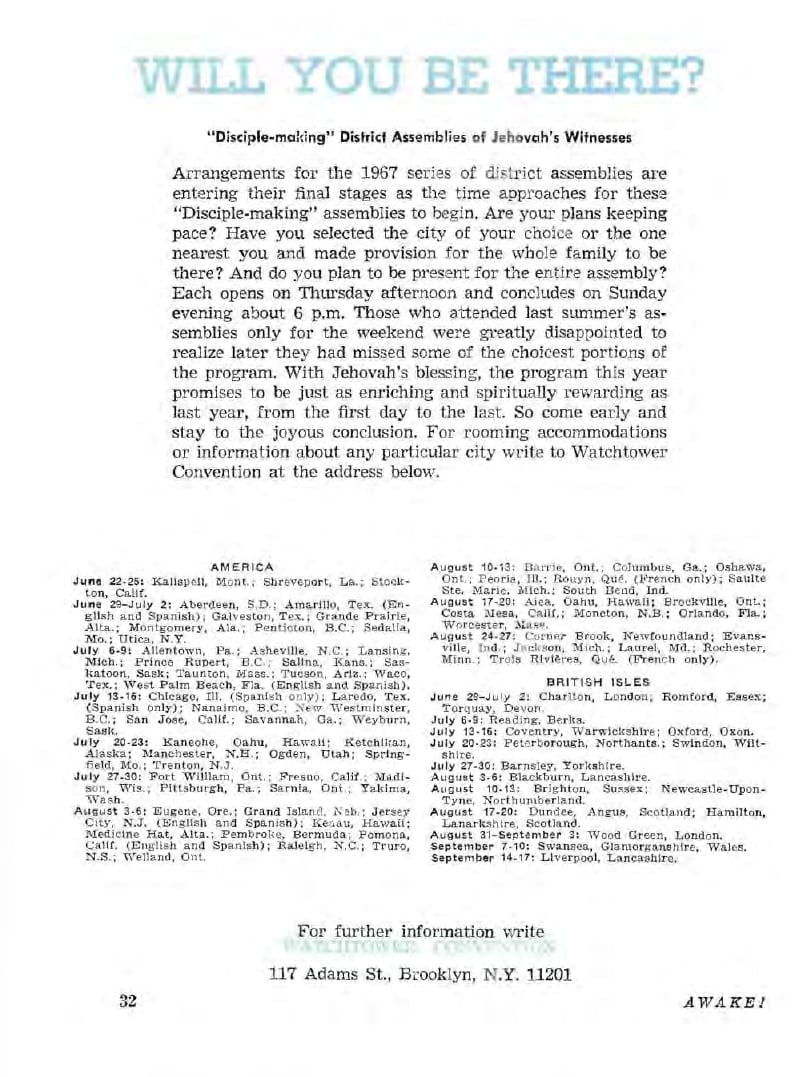
WILL YOU BE THERE?
"Disciple-making" District Assemblies of Jehovah's Witnesses
Arrangements for the 1967 series of district assemblies are entering their final stages as the time approaches for these "Disciple-making" assemblies to begin. Are your plans keeping pace? Have you selected the city of your choice or the one nearest you and made provision for the whole family to be
there? And do you plan to be present for the entire assembly? Each opens on Thursday afternoon and concludes on Sunday evening about 6 p.m. Those who attended last summer's assemblies only for the weekend were greatly disappointed to realize later they had missed some of the choicest portions of the program. With Jehovah's blessing, the program this year promises to be just as enriching and spiritually rewarding as last year, from the first day to the last. So come early and stay to the joyous conclusion. For rooming accommodations or information about any particular city write to Watchtower Convention at the address below.
AMERICA
June 22-25: Kallspelt, Mont.; Shreveport, La.; Stockton, Calif.
June 29- July 2: Aberdeen, S.D.; Amarillo, Tex. (English and Spanish); Galveston, Tex.; Grande Prairie, Alta.; Montgomery, Ala.; Pentioton, B.C.; Sedalia, Mo.; Utica, N.Y.
July 6-9: Allentown, Pa.; Asheville, N.C.; Lansing, M.; Principa Rupert, B.; Salina, Kana; Saskatoon, Sask.; Taunton, Mass.; Arkl, Arkl; Waco, Tex.; West Palm Beach, Fla. (English and Spanish).
July 13-16: Chicago, Ill. (Spanish only); Laredo, Tex. (Spanish only); Nanaimo, B.C.; New Westminster, B.C.; San Jose, Calif.; Savannah, Ga.; Weyburn, Sask.
July 20-23: Kaneohe, Oahu, Hawaii; Ketchitian,
Alaska; Manchester, N.E.; Ogden, Utah; Springfield,
Mo.; Trenton, N.J.
July 27-30: Fort William, Ont.; Fresno, Calif.; Madison, Wis.; Pittsburgh, Pa.; Sarnia, Ont.; Yakima, Wash.
August 10-13: Barrie, Ont.; Columbus, Ga.; Oshawa,
Ont.; Peoria, Ill.; Rouyn, Que. (French only); Saulte
Ste, Marie, Mich.; South Bend, Ind.
August 17-20: Alica, Oahu, Hawaii; Brockville, Ont.; Costa Mesa, Calif.; Moneton, N.B.; Orlando, Fla.; Worcester, Mass.
August 24-27: Corner Brook, Newfoundland; Evansville, Ind.; Jackson, Much.; Laurel, Md.; Rockester, Minn.; Trois Rivieres, QuÉ (French only).
BRITISH ISLES
June 29-July 2: Charlton, London; Romford, Essex; Torquay, Devon.
July 6-9: Reading, Berka.
July 13-16: Coventry, Warwickshire; Oxford, Oxon.
July 20-23: Peterborough, Northants.; Swindon, Wiltshire.
July 27-30: Barnsley, Yorkshire.
August 3-6: Blackburn, Lancashire.
August 10-13: Brighton, Sussex; Newcastle-Upon-Tyne, Northumberland.
August 3-6: Eugene, Ore.; Grand Island, Neb.; Jersey
Medicine Hat, Alta.; Palm Beach, Florida; Portola,
Calif. (English and Spanish); Kaleigh, N.C.; Truro,
N.S.; Welland, Ont.
August 17-20: Dundee, Angus, Scotland; Hamilton,
Scotland
August 31-September 3: Wood Green, London
September 7-10: Swansea, Glamorganshire, Wales
September 14-17: Liverpool, Lancashire
117 Adams St., Brooklyn, N.Y. 11201
Serve the God Who Remembers
PAGE 5
Confessed Criminals on the Streets
PAGE 9
Oil-by the Square Mile!
PAGE 14
The Strange Cult of María Lionza
PAGE 21
JUNE 22,1967
THE REASON FOR THIS MAGAZINE
News sources that are able to keep you awake to the vital issues of our times must be unfettered by censorship and selfish interests. "Awake!" has no fetters. It recognizes facts, faces facts, is free to publish facts. It is not bound by political ties; it is unhampered by traditional creeds. This magazine keeps itself free, that it may speak freely to you. But it does not abuse its freedom. It maintains integrity to truth.
The viewpoint of "Awake!" is not narrow, but is international. "Awake!" has its own correspondents in scores of nations. Its articles are read in many lands, in many languages, by millions of persons.
In every issue "Awaket" presents vital topics on which you should be informed. It features penetrating articles on social conditions and offers sound counsel for meeting the problems of everyday life. Current news from every continent passes in quick review. Attention is focused on activities in the fields of government and commerce about which you should know. Straightforward discussions of religious issues alert you to matters of vital concern. Customs and people in many lands, the marvels of creation, practical sciences and points of human interest are all embraced in its coverage. "Awaket" provides wholesome, instructive reading for every member of the family.
"Awakel!" pledges itself to righteous principles, to exposing hidden foes and subtle dangers, to championing freedom for all, to comforting mourners and strengthening those disheartened by the failures of a delinquent world, reflecting sure hope for the establishment of God's righteous new order in this generation.
Get acquainted with "Awake!" Keep awake by reading "Awake!"
[D]—[L]—E—H—[X]—[Z]—L
PUBLISHED SEQUENTIALLY BY WATCHTOWER BIBLE AND TRACT SOCIETY OF NEW YORK, INC.
117 Adams Street Brooklyn, N.Y. 17501 U.S.A.
N. H. Knock President GRANT STATE, Secretary
Average printing each issue: 4,550,000
Five cents a copy
Office Yearly subscription rate
for seminole editions
Australia U.S., 117 Adelaide Street, Brisbane N.Y. 11201
Australia, 11 Birmingham Rd, Birmingham N.Y.
Australia, 156 Bridgwater Ave, Toronto, 19 Nb
Rhode Island, London N.W. 7
New Zealand, 103 North Earl St, Appleton W. 1
South Africa, 70s
(Monthly editions add half the above rates)
Remittances for subscriptions should be sent to the office in your country. Observe your remittance to Brooklyn.
If sent at Rangoon be aware before subscription expires.
Now published in 26 languages
Seninapidhy, Artikhar, Cobanow, Danish, Dutch, English, French, German, Greek, Hokkaido, Japanese, Norwegian, Norwegian, Portuguese, Somali, Swedish, Tagalog, Zulu.
Monthly—Citizen, Ciyanta, Hillignyon, Malayalam, Polish, Tamil, Ukrainian.
CHANGES OF ADDRESS should reach as thirty days before your moving date. Give as your old and new address, your old address label),写 Waltchristen, 7 Adams Street, Bramlyn, New York 11201, U.S.A.
Second-class postage paid at Brooklyn, N.Y.
Printed in U.S.A.
The Bible translation regularly used in "Awake" is the New World Translation of the Holy Scriptures, 1961 edition. When other translations are used, this is clearly marked.
L E Q I I I E E I I E E
CONTENTS
How Much Initiative Do You Have? 3
Serve the God Who Remembers 5
Confessed Criminals on the Streets 9
Oil—by the Square Mile! 14
"Which Cut, Please?" 17
The Strange Cult of Maria Lionza 21
'Deadlier than Bullets' 23
The Hand That Rocks the Cradle
Rows the Boat 24
"Your Word Is Truth"
The Bible—Pure but Frank 27
Watching the World 29
THERE is need for the exercise of initiative every day. Teachers and employers cannot be with each one under their supervision
How much
INITIATIVE do you have?
every hour of the day, telling them when and how to do things. People, young and old, have to make at least small decisions, many of them, during each day. Those who display good initiative, who do not depend hour by hour on someone's telling them what to do, are in demand. They are
danger of overstepping one's authority, of going beyond proper limits. For example, the man who decides to change the method of operation laid down by his employer, merely because the employer is not there
the ones chosen for greater responsibilities.
How is your initiative? Some have the idea that if one is not gifted with initiative he simply does not have it. But is this necessarily so? Should not education and training equip one to exercise initiative under varying circumstances?
Have you ever, when traveling on bus or train, toyed with the idea of conversing with a fellow traveler, only to keep putting it off in the hope that he might break the ice and start up the conversation? "What should I say?" you may have kept
to consult, is not dependable. In fact, he may be viewed as disobedient. In any firm there is a framework of established policy within which each employee must remain.
On the other hand, to loaf around and do nothing at all because a supervisor is not present to direct the next operation surely shows lack of initiative. The worker can usually find some necessary job to do until such time as he is able to check with his superior. Again, if an employee believes he has hit upon a novel idea for expediting the work, he would show initiative not by taking matters into his own
asking yourself. Meantime the opportunity passed. Or, can you recall the many opportunities of talking to your next-door neighbor that perhaps slipped away because you did not speak up when you had the chance?
It is not that one has to be forward, aggressive, inclined to take things into one's own hands. No, for here there is JUNE 22, 1967
live, not by taking matters into his own hands and putting the idea into operation, but by offering the idea as a suggestion and leaving it to his superiors to decide on its merits.
Initiative is exercised to excess when we interfere, without authority, in the affairs of others, or take to ourselves authority that is not rightly ours. There
is the case of a man, as reported in the New York Times of February 25, 1967, who met his death because he sought to intervene in a quarrel between two armed men.
"He catches a passing dog by the ears," counsels the Bible, "who meddles with a quarrel not his own." (Prov. 26:17, Moffatt) The ordinary citizen is not expected to assume the duties of a peace officer, but under grave circumstances he could show initiative by informing the proper authorities promptly.
Remember, too, how King Saul, when the prophet Samuel was unexpectedly delayed, took it upon himself to get things going, and, without authorization, offered sacrifice. God's prophet denounced his action as disobedience—1 Sam. 13:8-14.
Thus it can be seen that there is a proper balance about genuine initiative. It has to be exercised within proper limitations, inside the field of action to which one is properly assigned.
Lack of initiative on the part of a married woman could lead to breakup of home and marriage. If she fails to get her housework done regularly merely because there is no one there all day to tell her what to do next, the patience of her husband may at last run out. She must learn to plan and proceed on her own in many circumstances.
Then, too, in the matter of attending the gathering of the Christian congregation to which you belong, for quite a while you may have been thinking of going. Do you wait for someone else to say, "Let's go to meeting today," or are you the one who takes the lead, shows initiative, and says, "I am going to the meeting today. Anyone coming along?" What satisfaction there is in having decided for yourself!
Again, you may think you feel deeply about certain matters, religious convictions perhaps. But do you? Is it not to be expected that, if you feel deeply enough, you would be taking the initiative in speaking to others about your beliefs? Or are you saying, "Who? Me? Oh, I could never do that! Approach others and talk to them about my beliefs? Never!" But you could start to talk to members of your own family, and in this way grow in the ability to speak effectively to others. The point is, there has to be a start made somewhere along the line. It takes initiative to get going.
Lack of initiative is revealed in the tendency to seek the easy way out, to get in a comfortable groove and stay there, to tend always to lean upon someone else to suggest a move. It is observed in those who never get farther than dreaming about what might have been. Initiative is thus the ability to move ahead without constant prompting and prodding by others, the ability to make small decisions and carry them into effect, always, of course, within the proper bounds of one's position. It is involved in initiating conversations, in the wise use of time in school or place of employment, and in connection with our worship of God. It is the quality that often determines whether we are going to continue indefinitely in some undesirable situation or not. It calls for more than just thought. It demands action.
Real benefits result from exercising initiative. Your own self-respect is increased. Your teacher, your employer, your family will have a higher regard for you. And doubtless, more than all else, you will gain God's favor by showing initiative in the things that please him. By all means, build up initiative.
HEN those whom you know forget in your time of need,
God can remember the living and the dead. Do we remember him?
it brings sadness. It is not pleasant to be ignored or forgotten by those whom you considered to be friends.
Yet, even if these do remember you, their ability to help is limited. There comes a time when even the best of friends is powerless to assist. When a person is stricken with an incurable illness and faces certain death, the best that man can do will not save his life.
Even if one is healthy during his lifetime, the aging process can bring him down to the grave, where no human can help. The grief displayed by survivors is evidence that the dead one is beyond the help of human hands. How such grieving ones should appreciate a friend who would remember them, not only while they are alive, but even after they are dead, and be able to aid them!
One Who Can Remember
There is One who can assist both the living and the dead and who has the infinite memory and power to do so. That
One is the great Creator of all life, Jehovah God.
How great is God's capacity for remembering? A servant of God, Isaiah, was inspired to write concerning the multitude of stars and planets in the heavens: "Raise your eyes high up and see. Who has created these things? It is the One who is bringing forth the army of them even by number, all of whom he calls even by name. Due to the abundance of dynamic energy, he also being vigorous in power, not one of them is missing." (Isa. 40:26) So the Almighty Creator has the power, not only to bring into being the entire marvelous visible universe, but also to remember by name each of the thousands of millions of heavenly bodies that he has created.
The capacity that God has for remembering can also be seen in some measure in the living things that he has created on earth. Scientists are now learning what it is that enables one tiny cell to grow into an adult human with a precision and ororganization that stagger the imagination.
They are discovering what it is that "remembers" all the directions for building an adult human from just one minute fertilized egg cell.
The genetic machinery that controls orderly growth scientists call DNA, short for deoxyribonucleic acid. This is found in the genes of living cells. It looks like a spiral rope ladder, with its steps made up of four different types of chemical substances. In effect, the coded message of heredity is like a tape recording that, when played back, brings forth music according to the magnetic variations imprinted on it.
The coils of DNA molecules are so small and so tight that there are millions of them in the nucleus of a single cell, enabling them to store an enormous amount of information. Science Digest of September 1964 stated: "One tenthillion of an ounce of DNA from a father, in combination with one tenthillion of an ounce of DNA through the mother, contains all the specifications to produce a new human being." That tiny particle cannot be seen with the naked eye, yet, as Medical World News of January 5, 1962, said: "DNA functions . . . like an original blueprint kept in the foreman's office. From its headquarters, the DNA transfers its genetic information to ribonucleic acid (RNA), which constitutes the 'working drawings' used in the cytoplasmic factory."
From that fantastically small beginning the DNA, acting like a master blueprint, remembers and guides the building of the thousands of billions of cells that eventually make up an adult human. Since God created these DNA molecules that can "remember" all the tremendously complicated instructions for the production and growth of a person, and since it takes only a single microscopic cell containing these
DNA molecules to do all of this, would it be so difficult for God to file away in his memory any individual?
No, the Creator who can remember each heavenly body by name and who created the amazing DNA molecule certainly has the capacity to remember the life pattern, the characteristics, of each individual he chooses to remember.
Does He Choose to Remember?
Does God choose to remember individuals? Has he ever done things on their behalf since he created them in the beginning?
Many centuries ago lived the man Noah. Of him the Bible says: "God remembered Noah and every wild beast and domestic animal that was with him." (Gen. 8:1) Why did God remember Noah? Because Noah sincerely obeyed God. So God remembered him and took steps for his benefit and that of his family and the animals he had with him. Should we be grateful that God remembered Noah? Yes, because if He had not, we would not be alive today! All persons living today are direct descendants of Noah, who survived the global deluge that wiped out all other humans aside from himself and his family!
When God promised his servant Abraham, and his wife, a son, even in their old age, did He forget? The Bible tells us: "And Jehovah turned his attention to Sarah just as he had said . . . And Sarah became pregnant and then bore a son to Abraham in his old age at the appointed time of which God had spoken to him." (Gen. 21:1, 2) God remembered his promise to Abraham and fulfilled it.
Such examples can be multiplied many times. Throughout history God has remembered men on earth and has worked in their behalf. Psalm 94:14 states; "Jehovah will not forsake his people."
From this we arrive at a fundamental conclusion. God does remember living persons for good and works on their behalf. But particularly whom? Those who remember God. Deuteronomy 7:9, 10 declares: "Jehovah your God is the true God, the faithful God, keeping covenant and loving-kindness in the case of those who love him and those who keep his commandments to a thousand generations, but repaying to his face the one who hates him by destroying him." And Proverbs 10:7 adds: "The remembrance of the righteous one is due for a blessing, but the very name of the wicked ones will rot." God remembers those who sincerely try to serve him, but he is not obligated to remember persons who deliberately practice wickedness.
Does He Remember Dead Persons?
But what of the countless millions of persons already dead? Of them the Bible book of Ecclesiastes says: "The living are conscious that they will die; but as for the dead, they are conscious of nothing at all, neither do they any more have wages, because the remembrance of them has been forgotten."—Eccl. 9:5.
Hence, the unconscious dead can do no more. They have no feeling, nor can they do anything at all and earn wages. Neither can they be helped by humans who are alive and whose remembrance of them gives way to forgetting them.
However, God does not forget the dead, particularly those who have feared and served him. When the God-fearing man of ancient times, Job, was in the midst of great suffering, he said to God: "O that in Sheol [the grave] you would conceal me, . . . that you would set a time limit for me and remember me! If an able-bodied man dies can he live again? All the days of my compulsory service I shall
wait, until my relief comes."—Job 14:13, 14.
Of what was Job speaking? He was speaking of the resurrection from the dead. He knew that even if he died God could, and would, remember him in due time and bring him back to life here on the earth. But such power was beyond any human. That is why God-fearing persons, such as Job, throughout the ages have put their confidence in God, and not in men.—Ps. 146:3-5.
When God's set time for the resurrection comes, he will call to mind that person who died and will resurrect the individual with his same personality. For the God who created the universe and the DNA molecule, this will be no problem. Why, even today man can record a person's voice on a tape and also film him, so that after his death we can know what that person looked like and sounded like. Surely, the God who created all things, including man, has a greater capacity for making people live again than that! —Acts 24:15.
Once, a man who was about to die said to Jesus Christ: "Jesus, remember me when you get into your kingdom." (Luke 23:42) This man knew that Jesus was said to be the Messiah, or Christ, and he apparently realized that this meant that he would receive kingly power from God. Perhaps he had heard of the resurrections performed by Jesus. (John 12:17) That man wanted to be remembered by Jesus. Jesus promised he would be, for he answered: "You will be with me in Paradise."—Luke 23:43.
Misplaced Trust
Throughout the ages, however, men have worshiped idols and false gods. But how many of them can help humans in the resurrection? Why, they cannot even help themselves! Indeed, who even remembers most of them today?
Where are Molech, Baal, Astarte, Zeus and all the others? They are out of existence because they were false, mythical, not real, and of no help to man. Really, they never existed at all, except in man's imagination.
Perhaps you feel that at least in our "enlightened" age most people do not worship such false gods. True, in many countries people do not worship an idol or mythical god, but acknowledge the existence of one God in heaven. But does such acknowledgment by itself bring a person any more merit in the eyes of the true God than the ancients who worshiped Molech, Baal, Astarte or the others?
When Jesus Christ was on earth he spoke about persons that acknowledge the existence of a supreme God but do not obey His commandments. Note what he said about them: "Many will say to me in that day, 'Lord, Lord, did we not prophesy in your name, and expel demons in your name, and perform many powerful works in your name?' And yet then I will confess to them: I never knew you! Get away from me, you workers of lawlessness."—Matt. 7:22, 23.
What was wrong? Those of whom Jesus spoke believe that God exists and that Christ is Lord. They even perform a type of worship. But Jesus said that they are workers of lawlessness in God's sight. Why? Because what they do in Jesus' name is not what he instructed them to do! They claim to worship God but are actually violating His commandments under cover of Jesus' name. Of such persons the Bible declares: "They publicly declare they know God, but they disown him by their works, because they are detestable and disobedient and not approved for good work of any sort." (Titus 1:16) That is why Jesus exposes their hypocrisy.
course of life in harmony with what he requires. It means that belief in God must be coupled with proper works. The Bible says of this: "Of what benefit is it, my brothers, if a certain one says he has faith but he does not have works? That faith cannot save him, can it? Indeed, as the body without breath is dead, so also faith without works is dead."—Jas. 2:14, 26.
What counts with God is not just acknowledging his existence, but leading a
Learning About the God Who Remembers
Is simply joining a religion of one's choice the way to learn about God and his requirements? That such is not the solution can be seen from this item in the Toronto, Canada, Star Weekly of March 28, 1964. In an article titled "Canadian Christianity Broad but Shallow" the following was noted: "During a recent series of Holy Week services in an Ontario city, five clergymen, old friends, sat until the early hours of the morning discussing the problems of the ministry, sipping coffee, and generally talking shop. Suddenly one of the men interjected the remark, 'I'll have to confess that if someone came and asked me point-blank how he could find God, I simply wouldn't know what to say.' Then, looking around at the others, he said, 'And am I wrong in saying that the same would be true of the rest of you?' There was an extended silence but no rebuttal."
Such is typical of today's religious leaders. Why? Because they have abandoned the plain counsel of God. They have substituted their own conflicting ideas for God's truths. As a result, they cannot even tell sincere persons where to go for God's truths.
Jesus Christ did not have that trouble. He said to his Father in prayer: "Your word is truth." (John 17:17) Yes, Jesus knew the truth was to be found in God's Word, the Holy Scriptures. One of his apostles later wrote: "All Scripture is inspired of God .
. . that the man of God may be fully competent, completely equipped for every good work." (2 Tim. 3:16, 17) Jesus pointed persons to that Word of God. He knew that it would enable us to remember God and serve him properly.
Do you want to be remembered by God? Then learn his purposes and requirements as set out in his own Word. Avoid the contradictory philosophies of men, even
of clergyman, who substitute their thinking for God's wisdom. Do what God requires of you, having the assurance that "his commandments are not burdensome." —1 John 5:3.
Remember God. Learn of him. Do what he asks. Then he will remember you and will let you live in his righteous new system of things, where you will have the opportunity to enjoy peace and happiness forever.—Ps. 37:11, 29.
"A MAN who admitted slaying his wife and five small children walked out of a Brooklyn courtroom yesterday, free, because the only available evidence against him was his own confession." (New York Times, February 21, 1967) "Two years to the day after the rape of a 71-year-old Bronx widow, a crime which he allegedly confessed, a 21-year-old youth walked out of court a free man yesterday." (New York Daily News, February 28, 1967) "Hundreds of confessed criminals in the metropolitan area will be freed without trial in coming months as a result of the Miranda decision." (New York World Journal Tribune, March 1, 1967) How can such things be? What are the police doing, and the courts?
None of these cases had been brought to trial by June 13, 1966, when the United
States Supreme Court handed down the decision in the Miranda case. This case was representative of several cases before the Court at the time. In each instance the Court claimed there had been failure to inform prisoners adequately of their rights at the time of pretrial interrogation. On this basis the decisions of the lower courts were reversed and defendants who had been convicted of rape, murder and robbery were released. The Court also ruled that all cases not brought to trial before this decision must be adjudged on the basis of the Miranda decision.
But self-confessed criminals are being loosed upon society, you may object. How are we to view such action in the light of well-founded fears about crime in the streets?
Is it not more important to protect the community than to show such concern over the rights of self-incriminated lawbreakers? How can the justices of the Supreme Court justify a ruling that evidently spawns glaring injustice?
A look at the trend of American criminal jurisprudence may help us to understand this strange situation. Perhaps it will aid us to comprehend the trend of court decisions and see that the Miranda decision was the logical extension of a process that has been in progress for many years.
Trend of Criminal Jurisprudence
The early colonists who came to America were seeking freedom from religious and political oppression. Some of them had suffered under the cruelties of "inquisitional" justice, and many carried with them vivid memories of the injustices, the handicaps and the frustrating invasions of their rights experienced in Europe. They could remember how courts and commissions had used coercive methods, even brutalities, in order to wring testimony from witnesses, confession of guilt from suspects.
The dignity of the individual citizen, they reasoned, should be protected by an enlightened constitution. By the terms of the Fifth and Sixth Amendments to the Constitution of the United States the accused was not to be "compelled in any criminal case to be a witness against himself"; he must enjoy the right "to have the assistance of counsel for his defence"; men were to be viewed and treated as innocent until proved guilty; and even in court, conviction was to be based upon guilt proved beyond reasonable doubt.
However, after those Amendments were adopted in 1791 many years were to pass before Americans would begin to gain appreciable benefit from their provisions.
Accused persons did not always have the financial means to engage counsel. The result was that only the well-to-do defendant could take advantage of this right. Such obvious inequity must have resulted in many innocent ones' being convicted. There still remained a wide gap between the provision of the law and the citizen's ability to avail himself of it.
Right of the Poor Established
In 1963 the Supreme Court handed down a historic decision when it passed upon the case of Gideon v. Wainwright. Originating in the State of Florida, this case involved the denial of the right of an indigent to be represented by counsel, on the ground that the State was required to furnish counsel only in capital cases. Said Mr. Justice Black, delivering the opinion reversing the Florida decision: "From the very beginning, our state and national constitutions and laws have laid great emphasis on procedural and substantive safeguards designed to assure fair trials before impartial tribunals in which every defendant stands equal before the law. This noble ideal cannot be realized if the poor man charged with crime has to face his accusers without a lawyer to assist him."
So now the responsibility belonged to the courts to see that legal counsel was made available to defendants requesting it even if unable to afford the cost. This was, indeed, a laudable stride forward. But how would it work out? Would the poor man be aware of his right? Would he know enough to ask for counsel, or should the court inform him of his privilege?
Other pitfalls there were for the citizen charged with crime. There was, for example, that hazardous period extending from the time of arrest until the arraignment in court. Hours, days, yes, even weeks might elapse, during which the suspect is in urgent need of the guidance of a lawyer.
It is a sort of "twilight zone" in which he is bereft of the legal safeguards that the Constitution declares he should have. And remember, he is still technically innocent. He may be subjected to lengthy questioning, cut off from the world and from counsel. Law-enforcement officers may browbeat, shout, threaten and provoke in an effort to have him confess.
Persons slow of wit or lacking in education are particularly susceptible to psychological probing of their minds and other tactics employed by the police. Bright lights, bare, windowless walls and the general prisonlike atmosphere of the police station's back room can all have a profound effect on them. Innocent persons have been known, under such conditions, to confess imaginary crimes.
Surprise Development
In the case Escobedo v. Illinois the Supreme Court in 1964 took a hard look at this feature, the right of the accused prior to appearance in court. Up till now there had been little question about the accused's rights in court. However, every effort was put forth to obtain a confession prior to arraignment. Then, armed with a signed confession, the prosecution could present its case and obtain conviction. If, on the basis of the confession, the accused could be persuaded to plead guilty, all the better. There would then be nothing that could really be called a trial, but just a summary conviction.
Escobedo, serving a twenty-year sentence for murder, allegedly confessed complicity in the murder of his brother-in-law. But he had been denied the privilege of seeing his lawyer while under questioning in a Chicago police station, and at the very time when his lawyer was being refused access to him. Here was a case that pointed up the plight of anyone who happens to become a "prime suspect" in the view of the police. What now would the high court do about the issue?
Like a bombshell to the law-enforcement world came the Court's 5-to-4 decision reversing Escobedo's conviction after he had been in prison for four and a half years. The right to refuse to answer police interrogation without prejudice and the right to be represented by counsel even at the police station were stressed. It was as though the justices of the majority considered questioning under any custodial situation without benefit of counsel as, in fact, trial by police. Any subsequent courtroom appearance would then be no more than an appeal from the decision of the police trial.
The decision produced a variety of reactions. Police officers and prosecutors protested that efforts to battle the mounting crime wave were being handicapped. Complaint was made that an intolerable burden was being placed on the police—that of finding evidence for prosecution other than by confession. Others warned that a host of vicious criminals would be loosed upon society.
On the other hand, there was distinct elation in some quarters over the Court's ruling. One spokesman declared that police would now be forced to learn new and improved techniques of crime detection. Others declared that, while it is true a few criminals might be able to slip through the law-enforcement net on account of the ruling, this would be more than offset by the benefits accruing to all citizens in the realm of individual rights.
Many questions still needed clarification, however. The Court had not spelled out the rules, so to speak, governing proper procedure by the police in dealing with suspects. Police officers were still in doubt. Was interrogation of suspects in the police station ruled out? If not, under what circumstances and according to what ground rules might it still be conducted?
Spelling Out the Rules
The answers were not long in coming, not long, that is, as time in legal circles is measured. On June 13, 1966, came the Supreme Court's 5-to-4 decision in the Miranda v. Arizona case. Several cases were grouped together in this decision, cases having features in common. The accused had not been adequately warned that their own statements could be used in court against them; they had not been informed of their right to representation by counsel before or during police-station questioning. And in one case the accused had been held incommunicado and denied the opportunity to consult counsel.
The Court took this occasion to spell out rules that must henceforth determine the admissibility of confessions. The suspect in custody must be told plainly of his rights: that he can refuse to answer questions, with or without counsel; that he has a right to counsel even if unable to meet the cost of same; that police may not continue questioning if he has in any manner declined to be questioned. At the same time the suspect may waive any or all of these rights. However, the onus is then upon the prosecution to satisfy the court that any confession produced in evidence was freely given by an accused who clearly understood his rights.
Now the rules had been spelled out, but many did not like them. Said Police Commissioner Bell of Philadelphia: "I respectfully submit the police are now limited. The thorough, complete and comprehensive investigation and interrogation of suspects is next to impossible." A professor of criminal law declared: "Police will be inhibited by the ruling. There'll be a lot of cases they won't try to prosecute, because the only way they could get information on which to make a case would be through interrogation of suspects." Said another police official: "It practically wipes out one of the most valuable tools of law enforcement—the confession."
In his dissent from the majority opinion Mr. Justice White claimed: "In some unknown number of cases the Court's rule will return a killer, a rapist or other criminal to the streets and to the environment which produced him, to repeat his crime whenever it pleases him." Another dissenting opinion, this time that of Mr. Justice Harlan, offered this comment: "The new rules are not designed to guard against police brutality or other unmistakably banned forms of coercion. Those who use 'third degree' tactics and deny them in court are equally able and destined to lie as skillfully about warnings and waivers. Rather, the thrust of the new rules is to negate all pressures, to reinforce the nervous or ignorant suspect, and ultimately to discourage any confession at all."
Defending the Rules
That the Court's majority decision is aimed at something other than discouragement of confessions may be noted by this excerpt from the majority opinion as expressed by Mr. Justice Warren: "The use of physical brutality and violence [in the interrogation of suspects and potential witnesses] is not, unfortunately, relegated to the past or to any part of the country. Only recently in Kings County, N.Y., the police brutally beat, kicked and placed lighted cigarette butts on the back of a potential witness under interrogation for the purpose of securing a statement incriminating a third party."
On this same point, lawyer Robert M. Cipes approves of the move to introduce lawyers at police-station questioning, and claims that it will have the effect of challenging "the hypocritical framework of the adversary process—a framework which permits bar associations and judges to boast of our 'accusatorial' system, while permitting the inquisition to flourish invisibly in the back rooms."—The Atlantic Magazine, September 1966, page 55.
A number of responsible law-enforcement officials remain unruffled by the Court's decisions. California's Attorney General Thomas Lynch comments: "The U.S. Supreme Court's ruling will not have any significant effect on California law enforcement. In fact, the decision is helpful because it lays down definite guidelines." Former United States Attorney General Nicholas Katzenbach, while admitting the ruling will make the work of the police more difficult, says: "But that in itself does not mean that it is a bad decision or poorly conceived."
As to the claim that the Escobedo and Miranda rulings will produce a great increase in unsolved crimes, due to depriving the police of freedom to interrogate, it is of interest to note these words of Deputy Attorney General Ramsey Clark (recently appointed United States Attorney General): "Court rules do not cause crime. People do not commit crimes because they know they cannot be questioned by the police before presentment, or even because they feel they will not be convicted. We as a people commit crimes because we are capable of committing crimes. We choose to commit crimes."
To allay the fears that many criminals, long since consigned to prisons, would now seek to appeal sentence on the basis of these rulings, the Court promptly ruled that the Escobedo and Miranda decisions could not be invoked as applying to cases tried prior to the date of those decisions. And it is of interest to note that Ernesto Miranda was tried again on the kidnaprape charge, this time without benefit of confession, and was convicted.
No Perfection from Imperfection
As Assistant Attorney William L. Siegel of Kings County, New York, rightly declared: "No human institution is perfect, and we cannot require from a prosecutorial apparatus a level of perfection not found anywhere else in human affairs." Not alone to prosecutorial apparatus but to courts also, high and low, his words apply. They can be no nearer perfection than the individuals who man them. Perfect justice and law enforcement cannot be expected in a system that is permeated by selfish, materialistic endeavors.
At best, law enforcement in all nations restrains and punishes but a few of the multitude of lawbreakers. The bigger criminals, wealthy and shrewd, operate freely for the most part. Ordinary citizens have even come to view the condition as normal and are satisfied to let things continue as they are, at least until there is threat to them personally. For this reason the police receive a minimum of cooperation from the citizenry and are often even obstructed. Surely a dismal but accurate reflection upon humankind today!
The only hope for equal law enforcement world wide lies in the fulfillment of God's grand promise of a New Order. Looking to that happy event, the inspired prophet declared with feeling: "With my spirit within me I keep looking for you; because, when there are judgments from you for the earth, righteousness is what the inhabitants of the productive land will certainly learn." (Isa. 26:9) The mountainlike authority of God's kingdom by Christ will forever halt every hurtful and destructive activity among men, for the prophet assures us: "They will not do any harm or cause any ruin in all my holy mountain; because the earth will certainly be filled with the knowledge of Jehovah as the waters are covering the very sea." —Isa. 11:9.
By "Aweke!" correspondent in Canada
STRETCHING across 30,000 square miles of northern Alberta is a vast deposit of sand. No, not the kind of sand you find on the sunny beaches. This sand is black, sticky and tarry. If one walks over it, the sand sticks to one's boots in big clumps; if one kneels on it, one's clothes are ruined by the adhesive substance; if one lives in the area, there is a constant, penetrating odor of oil throughout the summer season. Yes, these are oil sands miles and miles of them. For years they have been known as the Athabasca tar sands.
The greatest concentration of known deposits are in the vicinity of McMurray, Alberta. A long time before the white man ever explored this area, the Indians had discovered these beds and their sticky, gooey properties. They used it for caulking their canoes, even before the famous fur trader, Peter Pond, and his party paddled their canoes down the Athabasca River in 1778.
When Alexander Mackenzie was on his history-making exploratory trip to the mouth of the Mackenzie River in 1793, he arrived with a badly damaged canoe at the place where McMurray now stands. How would he repair it? The Indians sold him some of the gummy substance for a bottle
of Scotch whiskey—the first commercial transaction in connection with the tar sands on record! How his frugal heart must have suffered when, a day or so later as he paddled downstream, he saw gallons of this "tar" exuding from the banks of the Athabasca River, all for free! This so impressed him that he called this spectacle "fountains of bitumen" in the journal of his trip.
Veritable Ocean of Oil
In the early 1930's it was believed that the oil sands covered an area of only 1,000 square miles and were only 150 feet deep. Now it is realized that the area is thirty times that large and that the deposit reaches a depth of 200 feet in places. All this adds up to an ocean of oil, estimated conservatively to contain 626 billion barrels of "black gold"!
The consumption of oil by Canada and the United States amounts to about twelve million barrels daily. If this rate were maintained and they had to rely on the "irr sands" alone, this source would keep them supplied for the next 143 years. It would take the Mackenzie River in the Canadian north, flowing into the Arctic Ocean at the rate of 3,750,000 gallons per second, two and one-half years to discharge this same volume of liquid! Indeed, the Athabasca oil sands deposit is the world's largest source of hydrocarbons.
Where Did It Come From?
How the sand came to be located here is much easier to fathom than how the oil came to be in the sand. Up till now geologists are still unable to agree on any one solution to the question. Most authorities do agree that the sands were deposited by a river or by a flood.
The position of the numerous fossil tree trunks in the bed, some of which are up to forty feet in length, also is in keeping with this view. Since they are always in a horizontal position, it indicates that they floated to their present location.
Some of these tree trunks have been so well "pickled" by the oil that the most delicate cell structures are preserved. One of the trees was found to be entirely unlike any species of tree presently growing in North America. In fact, it most closely resembled a type of shade tree that grows in Japan! Freshly mined pieces of these ancient trees are quite soft and can be sliced like cheese.
After close examination of the individual grains of bitumen-coated sand, one investigator discovered that "each grain has a film of moisture around it inside the oil, or in other words, the sand was wet when the bitumen [first] coated it." However, none of this explains where all the oil came from. Some geologists are hoping that as the sands are mined the answer to the puzzle will show up in oil springs coming out of the underlying rocks. But until that time it will likely remain what one writer described as "one of the most fruitful fields for mental gymnastics known to geologists."
Efforts to Recover the Oil
Many methods have been tried to recover the oil. In 1929 an experiment was made to distill oil from the sands without removing the sand from its present position. A vertical hole was drilled, kerosene poured into it and ignited at the bottom. Air was passed in to keep the fire alive. It was hoped that once the underground fire began to burn well,
the bitumen-coated sands would be "cracked," releasing the oil, which could then be pumped to the surface. However, the oil sands proved to be a poor heat conductor and, unless kerosene continued to be fed to the fire, the fire went out. A test was made at the bottom of one hole to see how hot the surrounding material had become. One foot away from the fire it registered only 2 1 2\circ F.!
Again, someone had the idea that microorganisms could be used. These would be put down boreholes and allowed to feed on the bitumen, and so extract the oil. This, too, met with failure.
An inventor in Calgary, Alberta, tried the use of centrifugal force by extracting some oil from the sands with a spin-dry washing machine. This seemed to be fairly successful, and the idea was taken up by a large oil company. Announcement was made of a $50 million plan to start producing 20,000 barrels of synthetic crude oil daily by 1960. However, there was some hitch and the oil firm dropped the plan.
Next, the idea of an underground atomic blast was put forward. Its promoters thought the intense heat generated would cook the bitumen out of the sands, and
allow it to be recovered through ordinary oil wells. A plan was worked out to set off a nuclear explosion of nine kilotons 1,250 feet below ground level at a location some sixty miles south of the town of McMurray. Plans were checked and endorsed by the United States Atomic Energy Commission and by technical committees set up by the Alberta and Canadian governments. This idea, too, faded into history when, due to the international pact to curtail nuclear testing, final approval was withheld.
Oil Production at Last Possible
The process that has proved most successful is called the "hot water flotation method." Simply stated, this is a way of
making the oil film around each sand grain rupture so the sand can be discard-
barrels of crude oil, besides sulphur and coke.
Two giant bucket-wheel excavators from Germany will gnaw out 100,000 tons of the sands each day and feed it to large conveyor belts. These will move the sands to the processing plant. After initial processing, 65,000 tons of thick, molasseslike bitumen will result. Further refining
ARTICLE IN THE NEXT BLOCK
Before You Doubt.
ed and the oil recovered. It is done by mixing the oil sand with the hot water and
How to Make Your Vacation More Satisfying.
steam until the temperature of the sand is raised to 176\circ F. Then this "pulp" is fed into a turbulent flow of 185\circ F. water. In turn, it is all passed into what is known as a separation cell, where the oil rises in a froth to the surface and is skimmed off by rotating blades. Meanwhile, the sand sinks to the bottom and is flushed off into the disposal arrangement.
will produce 3,000 tons of coke each day. This will be used to fire a large, high-
pressure steam plant for providing necessary hot water for the plant as well as electricity—sufficient to care for a town of 10,000 population. Finally, 45,000 barrels of crude oil will flow daily into eight huge storage tanks capable of holding one million barrels. Out of these the oil will be pumped through a 16-inch, 270-mile-long pipeline to Edmonton for distribution through other existing pipelines to the
Great Canadian Oil Sands, Ltd., will use this method in its $230 million project to produce 45,000 barrels daily from this gargantuan treasure trove of "black gold." In a ten-square-mile area some twenty miles north of McMurray there are already proven reserves of over two billion tons of bituminous sands. One of the largest open-pit mine operations in the world is scheduled to begin by September 1967 in the vicinity of the Mildred-Ruth Lakes on the west side of the Athabasca
markets of the world.
As this plant goes into operation this coming autumn, an immense storehouse of energy and lubrication will at last become available for man's use. Now that success is in sight, other large oil interests are making their moves to share the rich prize, to draw upon this fabulous oil deposit justifiably described as a "wonder of the world."
As far back as 1940 it was recognized by an eminent geologist that the Atha-
River. Construction of the plant is already well under way, since the go-ahead signal was given by the Alberta government in 1962. When mining begins it will be confined initially to a four- or five-square-mile area. Estimates are that, during a fifty-five-year period, this tiny section of the vast deposits can produce over 900 million
basca deposits "contained more oil than the combined reserves of all the oil fields of the world discovered up to that time." Truly, mankind should be grateful to the all-wise Creator who placed such inexhaustible material resources on the earth another evidence of his unstinting generosity.
WHEN you stand in a meat market with its array of meat cuts or with just several carcasses hanging there, do you know which cut will best suit your needs? Do you know the difference between the cuts and do you know which ones give you the most for your money?
Before you can understand the small retail cuts you need to know something about the larger wholesale cuts from which they come. Of course, the manner of cutting meat varies from one country to another; but since the United States is the largest meat producer in the world, turning out more than 27,000 million pounds a year, we will consider the style of butchering used there. It is called the "Chicago Style."
This consists of cutting a carcass lengthwise into halves and possibly into quarters. Then the halves are divided into eight wholesale cuts, which, in turn, are sliced into the numerous smaller retail cuts that you see in the meat market. These eight cuts and major subdivisions are identified in the illustration on the next page.
As a protection to the consumer, the United States Government grades about 80 percent of the beef in the country, all that crosses state lines, according to its quality. It is almost impossible to do this after the meat has been cut up into small retail cuts, but the highly trained Federal meat grader stamps the carcasses or the wholesale cuts with a special stamp that identifies the grade. The stamp's coloring material, according to the United States Department of Agriculture, is harmless vegetable coloring.
From the top grade, which is stamped "USDA PRIME" (the letters stand for United States Department of Agriculture), the grades descend through "USDA CHOICE," "USDA GOOD," "USDA STANDARD," "USDA COMMERCIAL" and on to the grades of Utility, Cutter and Canner. The last three grades consist of meat from worn-out dairy cows or poorly fed animals, which are used in processed meat products.
The Prime grade of beef is produced from young, well-fed cattle. Cuts from it have good marbling, that is, liberal quantities of fat interspersed within the lean meat. It is juicy, tender and flavorful. The Choice grade has less fat and is only slightly lower in quality than Prime. This grade makes up about 70 percent of the beef produced in the United States. The Good grade makes up 20 percent of the market. Having less marbling, it lacks the juiciness and tenderness of the better grades. Because this grade has a high proportion of lean meat, it is desired by many cost-conscious shoppers. The Standard grade has a very thin covering of fat and is less juicy and tender than the better grades. Only about 3 percent of the meat produced in the United States consists of this grade.
Aging
Most of the Prime and some of the Choice is hung in refrigerators for two or three and in some instances six weeks at a temperature that is slightly above freezing so as to age the meat. This makes it more tender and enhances the flavor. Usually a carcass is held for only about eight days.
When an animal is slaughtered, the sugar in the muscles gradually changes to lactic acid because of the action of enzymes. This acid acts on the
connective tissue in the meat, causing it to become more tender. Even if a carcass is hung for only forty-eight hours, there will be some tenderizing of the meat. That which has been held for two or three weeks is considerably more expensive than less aged meat because of shrinkage and refrigeration expense. Only meat that has a good covering of fat can be aged, because the fat keeps the meat from becoming tainted.
It is best to know specifically what you want when you go to your butcher for meat. If he does not have the cut you desire in his meat case, he can get it for you
Identifying the Cuts
Good beef has a silky feeling and is smooth and soft to the touch. It is firm, moist and has a coating of creamy white fat on the outside. Yellow fat does not necessarily indicate poor beef. It can be due to breed and diet as well as age. The texture of the meat should be fine-graded and the color bright. There should be no odor to it.
from a wholesale cut in his refrigerator. But when you ask for an extra-tender cut for a special occasion, expect to pay substantially more for it than you would for a less tender one.
The most tender cuts come from the muscles that are used the least, and the less tender ones from those that receive more use. That which is the tenderest by far is what comes from the loin of the animal, along the lower half of its backbone.
Look at the illustration of a side of beef and the wholesale cuts. Notice that the loin section takes in the short loin and the sirloin. Running through these is the tenderloin muscle, from which are cut the tender, but very expensive, steaks known as filet mignon, chateaubriand and tournedos. A 300-pound side of beef will have only about five or six pounds of tenderloin. This muscle is stripped out of the lower-grade carcasses and sold by itself as steaks. In the better-grade carcasses it is left in place and becomes part of the porterhouse, T-bone and sirloin steaks.
Porterhouse steaks come from the end of the short loin that is next to the sirloin. Of all the steaks that contain the tenderloin, this is the best and most expensive. If you are trying to stretch your money for meat, this is not the cut to buy. Similar to the porterhouse are the T-bone steaks, which also come from the short loin. They have a smaller portion of the tenderloin muscle. Both steaks have a distinguishing T-shaped bone. Allow nearly a pound per person when you buy it.
Club steaks are the smallest steaks in the short loin, and they contain no tenderloin. Usually the bone has been removed when they are displayed in a meat case. Although they might be priced higher than T-bone steaks, they may be less expensive because you are not paying for inedible bone. Like the T-bone and porterhouse steaks, sirloin steaks also have a distinguishing T-shaped bone, but, since they are less tender than the steaks from the short loin, they are a little less expensive. You can figure on one to two servings for each pound of sirloin, depending upon how much bone is in the steak. This varies in sirloin cuts.
Of all the beef roasts that can be cut from a carcass, those that come from the rib section are the best and the most expensive because of their flavor and tenderness. Especially fine are the rib cuts near the short loin, which would be the eighth to the twelfth ribs. When buying a rib roast make sure that it contains at least two ribs to make it sufficiently thick. Plan on one pound for two servings. Fine steaks are also obtained from this section.
A tasty, economical, but less tender, cut is the chuck-blade steak, which is the first steak taken from the rib end of the chuck. It is called "blade" steak because of the shape of the bone in it, which is a long, narrow piece of rib bone. You can figure that a pound of chuck-blade steak will serve two persons. The chuck is the shoulder of the animal.
In the rear of the carcass there is a triangular section between the loin and the round called the "rump." Although it is tough, it has many meaty portions that make tasty roasts. A pound will serve about two persons.
The round is the rear upper leg of the animal, and it contains only one round bone. The most tender of the four muscles
in the round is the one on the inside of the leg called the top round. Of course, none of the cuts from the leg are as tender as those from the loin and rib section, because the muscles there work harder. The bottom round is a muscle on the outside part of the leg and is less tender than the top round.
Like shiloin steaks, round steaks are large pieces of meat. Because there is little waste, one pound will serve about three persons. These steaks are, therefore, an economical buy. They are especially good when braised. The bottom round makes excellent Swiss steak. Because a bottomround roast has no bone and little connective tissue and fat in relation to lean meat, it is attractive to the economy-minded person.
Like the steaks that come from the round and the chuck, flank steaks tend to be tough and must necessarily be cooked in moist heat. Sometimes they are called "London Broil." The cuts from the plate and brisket sections are also tough and therefore lower in price.
Watchful Buying
When shopping for meat it is necessary to be watchful for deceptive practices. Hamburger may not be a good buy because it may contain a high proportion of fat, resulting in greater shrinkage when it is cooked than when there is the desirable 10- to 15-percent fat content. Because ground beef turns dark with age, some markets add blood to it when this happens so as to make it look fresher. You may do better to buy the meat you want and then have it ground, even though it costs a little more.
If you want ground round steak, for example, buy the steak and have it ground where the grinder is in full view. The butcher that takes the steak into a refrigerator or cutting room to grind it might not bring you ground round steak but boneless chuck.
In some stores, there is also reason to question whether the pans of ground meat in the meat case that are marked "ground round" are actually that. They could very well contain lean chuck or beef trimmings. You might save 20 to 30 cents a pound by buying the chuck and having it ground. There also are savings in the special sales put on by competing markets.
Some markets tend to attach unfamiliar names to meat cuts so as to hide the true identity of the cuts and thereby make price comparison difficult. In some instances steaks are cut from portions of a carcass that are unsuitable for broiling because of being tough, but they are given a tenderizing treatment and sold under an unfamiliar name. For example, cube steaks, minute steaks, sandwich steaks and chicken steaks are thin cuts that are taken from almost any part of the carcass and mechanically tenderized. It pays to be familiar with the wholesale cuts so the butcher can be asked to identify from which wholesale cuts the small cuts with unfamiliar names come. By being able to recognize the various cuts, such as by their identifying bones, you will be better able to ascertain in many instances a truly money-saving sale.
…