Awake!, April 22, 1967
Download: PDF — Awake!, April 22, 1967
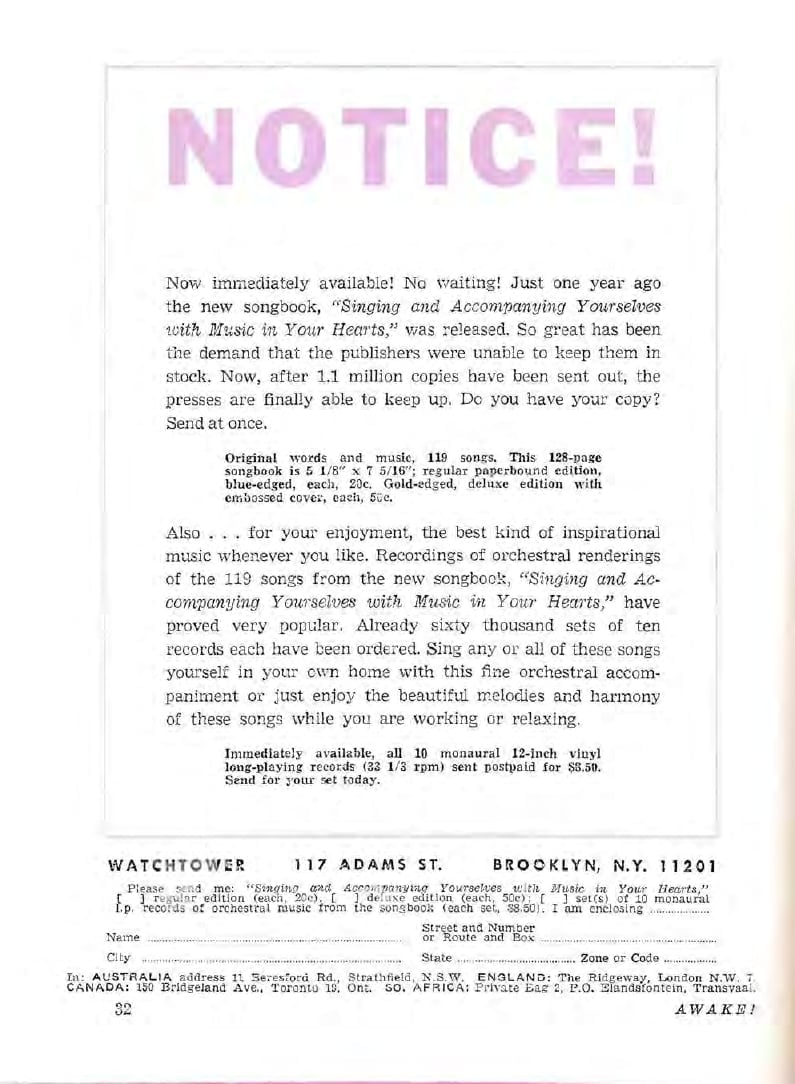
NOTICE!
Now immediately available! No waiting! Just one year ago the new songbook, "Singing and Accompanying Yourselves with Music in Your Hearts," was released. So great has been the demand that the publishers were unable to keep them in stock. Now, after 1.1 million copies have been sent out, the presses are finally able to keep up. Do you have your copy? Send at once.
Original words and music, 119 songs. This 128-page songbook is 5 1/8" x 7 5/16"; regular paperback edition, black-edged, each, 23c. Gold-edged, deluxe edition with embossed cover, each, 5ce.
Also . . . for your enjoyment, the best kind of inspirational music whenever you like. Recordings of orchestral renderings of the 119 songs from the new songbook, "Singing and Accompanying Yourselves with Music in Your Hearts," have proved very popular. Already sixty thousand sets of ten records each have been ordered. Sing any or all of these songs yourself in your own home with this fine orchestral accompaniment or just enjoy the beautiful melodies and harmony of these songs while you are working or relaxing.
Immediately available, all 10 monaural 12-inch vinyl long-playing records (33 1/3 rpm) sent postpaid for $8.50. Send for your set today.
WATCHTOWER
117 ADAMS ST.
BROOKLYN, N.Y. 11201
Please send me "Singing and Accompanying Yourselfs with Music in Your Hearts," [p. records of orchestral music from the songbook (each set, $8.60).] I am enclosing
Name ...
Street and Number or Route and Box
City State Zone or Code
IN: AUSTRALIA address 11 Seresford Rd., Strathfield, N.S.W. ENGLAND: The Ridgeway, London N.W. 7
IN: AUSTRALIA: 150 Bridgegard Ave, Toronto 15, Ont. SO. AFRICA: PRIVATE Eagl 2, P.O. Elandstontain, Transvaal.
EVOLUTION OR CREATION BY GOD
Which?
Popular misconceptions undermine faith. Scientific facts confirm the Bible.
THE REASON FOR THIS MAGAZINE
News sources that are able to keep you awake to the vital issues of our times must be unfettered by censorship and selfish interest. "Awakel!" has no fetters. It recognizes facts, faces facts, is free to publish facts. It is not bound by political ties; it is unhampered by traditional creeds. This magazine keeps itself free, that it may speak freely to you. But it does not abuse its freedom. It maintains integrity to truth.
The viewpoint of "Awakel" is not narrow, but is international. "Awakel" has its own correspondents in scores of nations. Its articles are read in many lands, in many languages, by millions of persons.
In every issue "Awakel" presents vital topics on which you should be informed. It features penetrating articles on social conditions and offers sound counsel for meeting the problems of everyday life. Current news from every continent passes in quick review. Attention is focused on activities in the fields of government and commerce about which you should know. Straightforward discussions of religious issues alert you to matters of vital concern. Customs and people in many lands, the marvels of creation, practical sciences and points of human interest are all embraced in its coverage. "Awakel" provides wholesome, instructive reading for every member of the family.
"Awakel!" pledges itself to righteous principles, to exposing hidden foes and subtle dangers, to championing freedom for all, to comforting mourners and strengthening those disheartened by the failures of a delinquent world, reflecting sure hope for the establishment of God's righteous new order in this generation.
Get acquainted with "Awake!" Keep awake by reading "Awake!"
PUBLISHED SEMIMONTHLY BY
WATCHTOWER BIBLE AND TRACT SOCIETY OF NEW YORK, INC.
117 Adams Street
Brooklyn, N.Y. 11201, U.S.A.
N. H. Knorr, President
GRANT SUTTER, Secretary
Average printing each issue: 4,475,000 Five cents a copy
Office
America, U.S., 117 Adams Street, Brentwood, 12010
American University
Australia, 11 Bensford St, Stratford, N.S.W. $1
Bermuda, 11 Bermuda St, Toronto, 19.8 $1
England, Twickenham House
The Hideaway, London N.W. 7 7/6
New Zealand, 623 New North Belfast, Australia S.W. 1 7/6
South Africa, 706
(Monthly additions set half the above rates)
Rentitance for subscriptions should be sent to the office in your country. Otherwise send your rentitance to Brockham. In case of most two weeks before subscription expires.
Now published in 26 languages
Semimonthly - Arthanus, Cebuane, Danish, Dutch, English,
Finnish, French, German, Greek, Loko, Italian, Japanese,
Korean, Norwegian, Portuguese, Spanish, Swedish, Tagalog,
Zulu.
Monthly—Chinese, Cityanja, Hiligayon, Malayalam, Polish,
Tamil, Urainian.
CHANGES OF ADDRESS will reach us thirty days before your moving date. Give us your old and new address (including your old address) and Write Watchhouse, 77 Adams Street, Brooklyn, New York 11203, U.S.A.
Second-class postage paid at Brooklyn, N.Y.
Printed in U.S.A.
The Bible translation regularly used in "Awake!" is the New World Translation of the Holy Scriptures, 1961 edition. When other translations are used, this is clearly marked.
CONTENTS
Why the Question Affects You 3
Is Evolution Open to Question? 5
How Did Life Originate? 7
Spontaneous Generation Unscientific 9
Does One Kind of Life Evolve into Another? 10
Life Appeared Suddenly 13
What Modern Dating Results Reveal 14
How Evolution Is Explained Today 16
The Human Body—Product of Evolution or God's Creation? 20
Animals Testify to the Existence of a Creator 24
Why Do They Believe It? 28
Watching the World 30
Brooklyn, N.Y., April 22, 1967
Volume XLVIII
Number 8
IN ALMOST all countries throughout the world the theory of evolution is accepted and taught. If you will pick up your child's high school or college textbook on biology, you will find evolution taught there. Even books for children in the pre-teen years contain evolutionary teachings.
Nor is this confined to schoolbooks. Evolutionary teaching saturates science, philosophy, history and even religion today. Whenever the subject of the origin of life and the origin of man is discussed, it is almost always presented in evolutionary terms. In newspapers, on the radio, and over television, historical, scientific and philosophical subjects are often introduced by such words as: 'Millions of years ago when our ancestors . . .'
The religious leaders of Christendom more and more accept and teach evolution. As a result, many clerics now deny the Bible account in Genesis about creation just as the atheists do, calling it "myth," legend," or "allegory."
So the teaching of evolution has captured in its grip the overwhelming majority of scientists and educators, and an increasing number of religious leaders. Yet, side by side with an increase in evolutionary teaching we find a progressive dis
integration of morals! As one prominent juvenile court judge exclaimed: "Crime is overwhelming our society." Dishonesty, immorality and lawlessness of all types have become the order of the day.
"But what," you may ask, "does the question of 'Evolution or Creation'
have to do with the disintegration of morals?" A second question you may ask is: "What does it have to do with me at all?"
The answer to the first question is that moral behavior is influenced by what one is taught, and if you have children, they will be taught evolution in school. There is a definite connection between this teaching and the fact that during the past two or three generations the Bible's high moral standards have been increasingly shoved aside as old-fashioned. In this regard the well-known historian H. G. Wells made some interesting observations. In his book The Outline of History he noted how, in the latter half of the nineteenth century, intellectuals seized upon Darwin's explanation of evolution. They used it as a weapon against the tyranny and authority of the church. Soon evolutionary theory gained widespread acceptance. But with what result? Wells, an evolutionist himself, admits:
"A real de-moralization ensued . . . There was a real loss of faith after 1859. The true gold of religion was in many cases thrown away with the worn-out purse that had contained it for so long, and it was not recovered.
. . . Prevalent peoples at the close of the nineteenth century believed that they prevailed by virtue of the Struggle for Existence, in which the strong and cunning get the better of the weak and confiding. . .
"Man, they decided, is a social animal like the Indian hunting dog, . . . so it seemed right to them that the big dogs of the human pack should bully and subdue." —Third Edition Revised, pages 956, 937.
Following the general acceptance of the evolution theory, a reckless age of violence developed that has no previous parallel. Two horrible wars and the threat of a third one followed, as did a terrible breakdown of morals, which still continues. And the faith in God of multitudes was shattered. As the prominent evolutionist Sir Arthur Keith once confessed: "By the absorption of this new knowledge, my youthful creed was smashed to atoms. My personal God, Creator of Heaven and Earth, melted away. The desire to pray—not the need—was lost; for one cannot pray for help to an abstraction."
Evolution thus paved the way for much agnosticism and atheism. True, some persons tried to harmonize belief in God with belief in evolution by saying that God created life as a one-celled organism and then guided its evolution upward to man. Many clergymen accepted this view. However, those clergymen who did, whether they realized it or not, contributed to the moral breakdown. Their acceptance watered down acceptance of the Bible and its code of high morality. In order to accept the evolutionists' views, they had to reject the Genesis account of God's creating man directly. And if they taught that that part of the Bible was not true, what confidence could persons have in the rest of the Bible, including its principles of morality?
accepted evolution sowed distrust in the Bible. They reaped disrespect for morality, as well as agnosticism, atheism and even violence. Another logical consequence of this sowing is now becoming more evident, for today the clergy are even parroting the atheistic evolutionist by saying "God is dead." Yes, the seed of moral decay sown by evolution is now reaching its fruition, for when men, including clergymen, abandoned God as the Creator of man, it was not long before they abandoned God altogether.
You reap what you sow. Clergymen who
So when your children are taught evolution, that man is nothing more than a highly developed beast, do not be surprised if they grow up to participate in the demoralization rampant today. It may not happen overnight, but, unless it is counteracted, it will work inexorably. A heavy drinker does not get liver disease overnight. A heavy smoker does not get lung cancer overnight. An immoral person does not overnight feel the effects of the venereal disease he has contracted. So with the ultimate effects of evolutionary teaching on morals.
But there is an even more significant way that this matter of evolution affects you and your family. It has to do with your everlasting destiny. Your future, your children's future, is at stake. How so? Because of this: If God created man, then surely he had a purpose in creating him. And that is what the Bible says. The Bible tells us that it is God's purpose to wipe out wickedness and wicked persons from the earth and to create a righteous new system on earth where obedient mankind can live in peace, happiness and perfect health forever. And the Bible also says that "it is impossible for God to lie." (Heb. 6:18) If that is so, then for anyone to enjoy those benefits of God's purposes he must learn what God wants and then do it. Obviously, a person that does not respect God and his Word, the Bible, will not do God's will, since he will not find out what it is.
However, if evolution is a fact, then what the Bible says about God must be wrong. That means there is no resurrection, for this Bible teaching would also be wrong. So if evolution is true, then this life is all one has or ever will have, for after death there will be no coming back. This puts a premium on "getting all you can" out of life right now. But by doing this you will likely break God's laws and
meet with his disapproval, forfeiting your participation in the grand future the Bible promises.
So you see, the teaching and accepting of evolution is not just an innocent, unimportant thing. Its acceptance or rejection will affect you and your family, not only because of its effect on morals, but particularly because it affects your standing with God and hence your everlasting future. Therefore, it is the course of wisdom to investigate and see what the facts show.
MANY persons have been sincerely led to believe that the evidence is overwhelmingly in support of evolution. So, despite its undermining of faith in Bible teachings and moral standards, they accept it because they consider the theory up-to-date and scientific.
At the Darwin centennial celebration held in Chicago in 1959, the prominent biologist Sir Julian Huxley told the 2,500 delegates: "We all accept the fact of evolution. . . . The evolution of life is no longer a theory. It is a fact. It is the basis of all our thinking." Also, the supposedly authoritative Encyclopaedia Britannica asserts: "We are not in the least doubt as to the fact of evolution. . . . The evidence by now is overwhelming." Even many religionists have been led to accept and proclaim the theory. The Interpreter's Bible, edited by some of the foremost theologians
in Christendom, says in Volume I, page 755: "The reptile was content to stay in the swamp; man wanted to climb out of it. He had and still has primitive instincts against which he must struggle, for he began on the plane of the animal; but he has not been content to dwell there."
The general acceptance of evolution can be attributed, in particular, to its teaching in the schools. The San Francisco Examiner of January 10, 1964, on its front page, reported to what extent this is done, despite vigorous protest: "Darwin's Theory of Evolution will continue to be taught in California public schools as the explanation for the origin of man, the State Board of Education decided here yesterday. The board refused to approve recommendations by State Superintendent Max Rafferty that Darwin's Theory be presented only . . . as a theory, not a fact."
The presentation of evolution in the textbook Biology for Today, 1964, used in New York schools is typical: "Living things probably originated as single-celled organisms (single-celled plants appearing first). These developed into more complex organisms. Effects of mutations accumulated, species changed and varied until thousands of different types of organisms existed." And the widely used school textbook Biology for You, Fifth Revised, 1963, page 531, asserts: "All reputable biologists have agreed that the evolution of life on the earth is an established fact."
The indoctrination begins even in preteen years. If you doubt this, visit the children's section of a library and examine literature there dealing with the origins of life and mankind. For example, the foreword of The Giant Golden Book of Biology (1961), by Gerald Ames and Rose Wyler, says: "About 400 million years ago, plants and a few animals emerged onto the land . . . About 1 million years ago, some of them began to be human, and about 50,000 years ago one such creature came to be our kind of man. And here you are, 50,000 years later, with a book that tells the story."
Another book for children, Man in the Making (1960), by Estelle Friedman, says on page 45: "Apes are our very distant cousins, descended with us from some common Primate ancestor many millions of years ago. Although this idea caused such a commotion when it was first introduced a hundred years ago, it is no longer a matter of doubt. All scientists today know that both man and the living apes descended from some ancient common ancestor."
Does all this mean that the subject is no longer open to question? Is evolution actually "an established fact"? Do scientists really "know that both man and the living apes descended from some ancient common ancestor"? Is the evidence so
abundant that you should teach your children evolution, even at the risk of their losing faith in God and casting off the moral restraint offered by His laws? Certainly not.
Shortage of Evidence
Regarding the lack of evidence in support of evolution, the Saturday Evening Post of December 3, 1966, noted: "Among those [evolutionists] leading the current research . . . feelings often run high when it comes to interpreting evidence. . . . Investigators have stalked out of meetings, indulged in personal vituperation, argued over priorities, accused colleagues of stealing their ideas. . . . The reason for this occupational ailment is obscure, but it may have something to do with the shortage of solid evidence."
Thus, it is noteworthy that in a discussion of the topic 'Evolution and Creation,' in November 1965, John W. Klotz, head of a college science department, admitted that "acceptance of evolution is still based on a great deal of faith." And in considering the question the evolutionist George Paulin some years ago said: "These considerations to me, a lifelong evolutionist, have proved of a highly disconcerting nature; . . . I must in all honesty confess that logically, as the matter presents itself to my mind, the argument is in favour of those who believe in the doctrine of special creation as our fathers believed in it."
Clearly, then, the evidence is not overwhelmingly in support of evolution. Evolution is not an established fact, as school textbooks dishonestly assert. Nor do all scientists believe it. For example, Dr. Theodore Newton Tahmisian, a physiologist for the Atomic Energy Commission, told audiences at several European universities, as reported in the Fresno Bee of August 20, 1959: "Scientists who go about teaching that evolution is a fact of life are great con men, and the story they are telling may be the greatest hoax ever.
In explaining evolution we do not have one iota of fact. . . To advance you have to have something new. How can the progenitor pass on to his children what he himself didn't have? Like breeds like. Yet evolutionists would tell us like breeds unlike."
How great the differences of opinion! A matter that so vitally affects our faith in God and his Word, as well as the moral standards of ourselves and our loved ones, demands our careful consideration. What do the facts show? Did the great variety of life on earth come as a result of evolution, or as a result of creation by God? Endeavor to dismiss any prejudice from mind as you consider the evidence.
How did
produce a kitten or an oak seed a palm tree? Of course not.
No need either to believe that earthly creations were completed in six literal twenty-four-hour days. Judging by the length of the seventh day of the creative week,
SURELY you do not want to depend upon myths or theories or even educated guesses for the answer to this vital question. Rather, you look for information that is reasonable, logical and in harmony with the facts as you know them today.
Originate?
What the Bible has to say on the subject is certainly reasonable. No mythical stories about animals being developed into men or of humans being produced from seeds planted in the ground or of selfish gods warring among themselves and producing men simply because of a whim. And how logical and orderly the process revealed in the Bible! First plant life, then creatures of sea and sky, then land animals and finally man, each one endowed with the ability to produce only its own kind and no other kind. (Genesis, chapter 1) Is not this in harmony with the facts as we find them today? Can a dog
which the Bible indicates is still in progress with a little more than 1,000 years to
go, each creative day was at least 7,000 years in length. Man was created at the very end of the "sixth [creative] day"; and according to chronology of the Bible, humans have now been on earth almost six thousand years.*—Gen. 1:31.
True, evolutionists assert that humans have lived here on earth hundreds of thousands of years, but history offers no support for such a theory. The World Book Encyclopedia (1965), Volume 6, page 12, explains: "The earliest records we have of human history go back only about 5,000 years." And Science magazine of June 20, 1958, interestingly observes: "The earliest appearance of urban civilization [is] first in alluvial Mesopotamia, about 5,500 years ago."
Evolution's Explanation
Perhaps the greatest problem of the evolution theory is to account for the origin of life. In his Origin of the Species Darwin attributed it to a Creator, saying: "There is a grandeur in this view of life, with its several powers, having been originally breathed by the Creator into a few forms or into one." Modern evolutionists, however, generally disagree. According to the New York Times of November 29, 1959, at the Darwin centennial celebration in 1959 Sir Julian Huxley said that "evolution had no room for the supernatural. The earth and its inhabitants were not created, they evolved."
The routine explanation for the origin of life is that presented in the widely read book The World We Live In, by the editorial staff of Life magazine, which claims, on page 88: "At some indeterminate point—some say two billion years ago, some a billion and a half—the entity called life miraculously appeared on the surface of the deep. . . . From such shadowy beginnings there emerged the wondrous process of living things."
Some details are supplied five pages later as to how it supposedly happened: "It is theoretically possible that on some distant day at the very dawn of time, when the earth's rocks were still hot and oceans and air seethed with chemical turbulence, certain organic compounds were synthesized in the sea by solar radiation and by unknown catalytic agents into a complex molecule capable of generating units like itself. . . . Then somehow more complex entities evolved . . . They were probably the first authentic members of the plant world."
Regarding the possibility of this occurring, Eldon J. Gardner, Professor of Zoology at Utah State University, observes on pages 11 and 12 of his booklet Organic
Evolution and the Bible (1960): "A type of spontaneous generation may have taken place in the remote past . . . The possibility of the appropriate elements, energy and suitable environment coming together by chance seems remote, indeed, but in tremendously long periods of time the 'impossible' becomes inevitable."
Think about that! Although man with all his advanced scientific knowledge has been unsuccessful in creating life under controlled laboratory conditions, yet an evolutionist says that the "impossible," if given sufficient time, is "inevitable!" And that by sheer chance, without any intelligent direction! This is typical evolutionary reasoning, but is it scientific?
Did Life Spontaneously Generate?
Loren Eiseley, one of the most distinguished evolutionists in America today, admitted in his book The Immense Journey, page 199:
"With the failure of these many efforts [to create life] science was left in the somewhat embarrassing position of having to postulate theories of living origins which it could not demonstrate. After having chided the theologian for his reliance on myth and miracle, science found itself in the unenviable position of having to create a mythology of its own; namely, the assumption that what, after long effort, could not be proved to take place today had, in truth, taken place in the primeval past."
The distinguished British biologist, Joseph Henry Woodger, called the assumption that life sprang from a nonliving source "simple dogmatism—asserting that what you want to believe did in fact happen." A biologist at Princeton University, Professor Edwin Conklin, also put it very bluntly when he said: "The probability of life originating from accident is comparable to the probability of the unabridged dictionary resulting from an explosion in a printing shop."—Reader Digest, January 1963.
Clearly, then, the evidence points to the creation of life by an Intelligent Force, yes, by the eternal God Jehovah, who is the source of life." One prominent research chemist, Edmund Carl Kornfeld, observed: "The more one studies the science of molecular structure and interaction, the more one is convinced of the necessity of a plan
necessity of a planner and designer of all. . . The sim-
complex animals and plants than it does to imagine a group of chemical substances evolving into a cell. It is very likely that the first step was more difficult, . . . The study of early evolution really amounts to educated guesswork."
The book The World We Live In also admits what a tremendous unaccounted-
ARTICLES ON THE NEXT ISSUE
for gap this is in the evolutionary chain saying on page 93:
plest man-made mechanism requires a planner and a maker. How a mechanism ten thousand times
Why Fear the "Evil Eye"?
Hungry India.
Your Personal Appearance Makes a Difference.
more involved and intricate can be conceived of as self-constructed and self-developed is completely beyond me."
A Huge Gap
Since there is no sound scientific explanation whatsoever as to how inorganic matter could possibly evolve upward to form the first one-celled organism to say
"The abyss between primordial organic molecule and [one-celled] protozoan was at least as great
as that between protozoan and man, and took perhaps as long to span."
Yet, without any evidence, yes, in direct opposition to the evidence, the evolution theory maintains that this gap was somehow bridged and life spontaneously came into existence. And what about the rest of the evolutionary chain? Do the facts indicate that lower, one-celled forms of life
Join the first one of organisms, to say nothing of the origin of the inorganic matter itself, what does this mean? It means that the entire first part of the evolutionary chain is missing! Evolutionist John Tyler Bonner, a university biology professor, acknowledged what a great gap this is in his book The Ideas of Biology, 1962, page 18:
"The cell is really such an astoundingly clever unit that when we think of it from the point of view of evolution it seems easier to imagine a single cell evolving into
create that law of the one form of the evolved upward until they became human? That is a question worthy of our honest consideration.
Meantime, the Bible's account of the origin of life commands respectful attention. It is clear, delivered with a confident ring of truth, and lacking any fatal gap in the process of events. It requires no scramble after possible links. It commends itself to reasonable men who recognize that only a grand Creator could unfold the mystery of human beginnings.
Spontaneous Generation Unscientific
The magazine Discovery, May 1962, in its review of R. Schubert-Soldern's book Mechanism and Vitalism observed: "Unhappily for materialists, however, life is characteristically unstable, and 'it is incredible that a complex of substances, all tending towards a state of stability, would produce the permanent chemical instability which is characteristic of animate matter.' Thus it is inconceivable that an organic compound should ever be formed in the absence of life."
APRIL 22, 1967 IF THE evolution theory were true, we would reasonably expect to find transitional or intermediate forms of life.
These "links" would serve to demonstrate that plants and animals can bridge the gap between fundamental kinds. Do we see such "links" in ex-
another, did it occur in the distant past? Evolutionists say, Yes. They claim that it took hundreds of millions of years to happen. Well, then, does the fossil record reveal the existence of "links," or intermediate forms?
instance today? Or is there a discontinuity, that is, a definite line of demarcation between basic kinds?
The prominent evolutionist Professor Theodosius Dobzhansky observed in his book Genetics and the Origin of the Species, Third Edition, pages 4 and 5: "A more intimate acquaintance with the liv-
Testimony of the
Early Record
Regarding the early geological record the book The World We Live In, published by Life magazine, observed: "For at least three-quarters of the book of ages engraved in the earth's crust the pages are blank. While the oldest rocks be-
ing world discloses a fact almost as striking as the diversity itself. This is the discontinuity of the variation among organisms. . . . The living world is not a single array in which any two variants are connected by unbroken series of intergrades, but an array of more or less distinctly separate arrays, . . . Biologists have exploited the discontinuity of variation to devise a scientific classification of organisms."
This discontinuity in living things today is one of the most obvious defects in the evolution theory. Nowhere do we see one
speak the rise and fall of ancient mountains and the advance and retreat of primeval seas, so far as life is concerned they stand all but mute. The first creatures whose outlines are clearly etched in fossil remains date from the period called the Cambrian."
After theorizing how life supposedly spontaneously generated, this source continues: "Just how more complex creatures evolved from these veiled [one-celled] beginnings remains another obscure chapter of life." However, the book does not hesitate to go on and assert:
evolution theory. Nowhere do we see one kind of plant or animal evolving into another. And, admittedly, in all of man's recorded history, it has never been observed. An amoeba has always remained an amoeba, a fly has stayed a fly, monkeys have continued to be monkeys, and so forth.
Since there is no evidence in recorded history that one kind of life evolved into
"The gulf between one-celled animals and the first organized multicellular creatures may have been bridged by colonial flagellates . . . In succession up the evolutionary ladder there must have appeared forms like the sponge . . . Sometimes in the late Pre-Cambrian there must have appeared a small but important worm-like
creature, the ancestral echinoderm."
(Italics added)
But these assertions are baseless! They are deceivingly false! For the New York Times of October 25, 1964, observed: "The chief puzzle in the record of life's history on earth [is] the sudden appearance, some 600 million years ago, of most basic divisions of the plant and animal kingdoms. There is virtually no record of how these divisions came about. Thus the entire first
sumed earliest periods prior to the Cambrian system,' said Darwin, 'I can give no satisfactory answer.' Nor can we today."
The evidence admittedly indicates special creation, but evolutionists generally refuse to accept it.
Are There Transitional Forms?
In his Origin of the Species published in 1859 Charles Darwin discusses the problem of missing transitional forms, or
part of evolutionary history is missing. . .
"The assumption has been that the earlier record was destroyed or that previous life forms did not have shells or skeletons hard enough to leave a record. Yet soft plants and animals also leave their prints in the sands of time and they, too, were absent."
What a devastating blow to the theory of evolution! Not only is there no explanation as to how the tremendous gap from inorganic matter to the first one-celled organism was bridged, but even after life
"links," and says: Geological research "does not yield the infinitely many fine gradations between past and present species required on the theory; and this is the most obvious of the many objections which may be urged against it." However, Darwin offers the explanation: "I believe the answer lies in the record being incomparably less perfect than is generally supposed."
Well, then, has an examination of the geological record in the succeeding decades revealed these missing "links" in fossil form? Harvard Professor Alfred S
name into existence, "three-quarters," or the entire first part," of the evolutionary chain is missing!
The Natural History magazine of October 1959 also acknowledged this serious problem in the evolution theory. Writing in that magazine, the prominent evolutionist Alfred S. Romer, professor of zoology at Harvard University, spoke of "the sudden appearance of groups of allied species," and noted:
This situation is . . . one admitted by Darwin to be a serious difficulty for his Theory, . . . Below this [Cambrian strata],
Romer declared: "Links' are missing just where we most fervently desire them, and it is all too probable that many 'links' will continue to be missing."* Another prominent zoology professor, Richard B. Goldschmidt, said: "The facts fail to give any information regarding the origin of actual species, not to mention higher categories . . . Nowhere have the limits of the species been transgressed, and these limits are separated from the limits of the next good species by the unbridged gap, which also includes sterility."—The Material Ba
there are vast thicknesses of sediments in which the progenitors of the Cambrian forms would be expected. But we do not find them; these older beds are almost barren of evidence of life, and the general picture could reasonably be said to be consistent with the idea of a special creation at the beginning of Cambrian times.
To the question why we do not find rich
fossiliferous deposits belonging to these as-
sis of Evolution, pages 165, 168.
After a careful examination of the evidence Lecomte du Noüy made similar observations, saying: "Unfortunately, the greater part of the fundamental types in the animal realm are disconnected from a paleontological point of view. . . . By link, we mean a necessary stage of transition between classes such as reptiles and birds, or between smaller groups.
"All types of reptiles belonging to the three orders (Ichthyosauria, Saurischia, Lacertae) appear 'suddenly' and it is impossible to link them to any terrestrial ancestors. The same is true of the tortoises. We have put the word 'suddenly' between quotation marks so as to make the problem stand out. . . . we have no precise facts to go on, and no trace of intermediaries."—Human Destiny, pages 71, 72, 75.
So, in the many intervening years since Darwin's day transitional forms have not turned up! Thus Professor D'Arcy Thompson concluded in his book On Growth and Form, pages 1093, 1094: "Eighty years' study of Darwinian evolution has not taught us how birds descend from reptiles, mammals from earlier quadrupeds, quadrupeds from fishes, nor vertebrates from the invertebrate stock. . . . We used to be told, and were content to believe, that the old record was of necessity imperfect—we could not expect it to be otherwise; . . . But, there is a deeper reason. 'A 'principle of discontinuity,' then, is inherent in all our classifications, . . . and to seek for stepping stones across the gaps between is to seek in vain, for ever."
If evolution were true, would there not necessarily have been thousands, yes, millions of transitional forms? Yes, indeed! But there are none. Now, think: Is it not simply beyond the realm of possibility that not one survived, either in fossil form or among living things today?
"According to Their Kinds"
The facts point conclusively to special creation by Almighty God, just as the Bible says. It is admitted that today living things produce according to their kinds. And it has always been that way! The
fossil record proves it. It should be obvious that the gap between basic kinds cannot be overstepped.
Regarding this, biology professor Frank Lewis Marsh wrote recently:
"One of the incomprehensible mysteries of our day is how sincere scientists can observe the discontinuity among fossils (where no true connecting links bridge the abysses between basic types), and how they can multiply so many cases of variation among living forms (which never are more than additional varieties of basic types that already exist), and still miss the law of reproduction that in stentorian accents cries to them from every side, the law that declares, 'No new basic types' Any other natural process that was even half so obvious would have been declared a law long ago!"
Origin of Man
But what about the gap that separates man from the apes? Have "missing links" between man and the apes been found? Or do the facts indicate that man also is a special, distinct creation by God?
The Primates, a 1965 volume of Life magazine's Nature Library, explains further: "Unfortunately, the early stages of man's evolutionary progress along his individual line remain a total mystery." Earlier this same source also admitted: "Unfortunately, the fossil record which would enable us to trace the emergence of the apes is still hopelessly incomplete. We do not know either when or where distinctively apelike animals first began to diverge from monkey stock."
Regarding the great lack of evidence, evolutionist Loren Eiseley said in Scientific American of June 1956: "For the whole Tertiary Period, which involves something like 60 to 80 million years [reaching down to one million B.C.E.] we have to read the story of primate evolution from a few handfulls of broken bones and teeth. These fossils, moreover, are from places thousands of miles apart on the Old World land mass.
. . . In the end we may shake our heads, baffled."
It is, therefore, with good reason that the Scientific American of July 1964 should say: "It may be wiser not to insist that the transition from ape to man is now being documented from the fossil record."
But what about the prospects of finding fossils that would link man to apelike ancestors? A prominent evolutionist, Professor Emeritus of Anatomy of the University of Oxford W. E. Le Gros Clark, noted in his book The Fossil Evidence for Human Evolution, 1964, page 41: "The chances of finding the fossil remains of actual ancestors, or even representatives of the local geographical group which provide the actual ancestors, are so fantastically remote as not to be worth consideration." Yes, the facts unearthed by geologists agree with what the Bible says about special creation.
Man About 6,000 Years Old
According to the Bible, God created man about 6,000 years ago, and in recent years this has many times been confirmed. The Review Text in Biology, a 1966 textbook now used in New York city schools, observes: "The invention of writing, about 6,000 years ago, ushered in the historic period of man. The time prior to 6,000 years ago is known as the prehistoric period."
Another textbook, Biology and Its Reaction to Mankind, by A. M. Winchester, Third Edition, 1964, page 600, states: Historical records go back to about 3,000
B.C." That is the fact. However, this textbook then states: "But this is only a small fraction of the time that man has lived on earth." This is not a fact, but an assertion. It is not based on reliable evidence.
Think about it: Why are the last 6,000 years called "the historic period of man"? Really, it is because in this period man's existence can be proved. There are records, documents, cities, monuments, writings and other artifacts to show that man has lived on earth for nearly 6,000 years. However, the period before that is called "prehistoric" because there is no evidence of man's having existed at that time. The proposed periods of time are built merely on theory, to support another theory, evolution.
Interestingly, Professor P. J. Wiseman notes in his book New Discoveries in Babylonia About Genesis, pages 28, 32 and 34: "No more surprising fact has been discovered by recent excavation, than the suddenness with which civilization appeared in the world. This discovery is the very opposite to that anticipated. . . . In the face of these facts, the slow progress of early man is a disproved assumption, and the idea that an infinitely prolonged period elapsed before civilization appeared cannot be maintained. . . . Life at the beginning was necessarily simple, but it seems that it was not only enlightened, it was cultured."
But, a person may inquire, have not modern methods of dating fossils and artifacts proved that man has been on earth longer than 6,000 years? What does the evidence show?
Life Appeared Suddenly
One of America's foremost paleontologists, George Gaylord Simpson, acknowledged: "It remains true, as every paleontologist knows, that most new species, genera, and families and that nearly all new categories above the level of family appear in the record suddenly, and are not led up to by known, gradual, completely continuous transitional sequences."—The Major Features of Evolution, page 360.
IS a common belief that man has lived on earth at least hundreds of thousands of years, and that this is a proved fact. Even
Nobel Prize winner Willard F. Libby believed that verified history extended back tens of thousands of years. Libby is the scientist who, about twenty years ago, first discovered that radiocarbon might be employed in dating old objects, and, writing about this dating method in
Science magazine of March 3,1961,he observed:
"Arnold [his coworker] and I had our first shock when our advisers informed us that history extended back only for 5,000 years. . . . You read statements to the effect that such and such a society or archeological site is 20,000 years old. We learned rather abruptly that these numbers, these ancient ages, are not known accurately; in fact, the earliest historical date that has been established with any real
The more cosmic-ray activity, the more radiocarbon is formed. The less cosmic-ray activity, the less radiocarbon is formed.
Plants absorb radiocarbon from the atmosphere. When man eats plants, his body also absorbs radiocarbon. At death, the accumulation of radiocarbon in his body stops, and what is present continues to decay and is not replaced. In about 5,600 years the radiocarbon is thought to be
certainty is about the time of the 1st Dynasty in Egypt."
Well, then, since radioactive dating methods have been introduced, has solid evidence been furnished that the Bible is in error? Have scientific methods of dating proved that man has been on earth longer than 6,000 years? What are the principal methods used? One is the "radiocarbon clock."
Radiocarbon Dating
Carbon-14, also called radiocarbon, is formed in the atmosphere by the activity of cosmic rays on the earth's atmosphere.
half gone; so it is said to have a half-life of that time.
Thus, scientists can take wood, charcoal, bone, or some other once-living object, and get an idea of its age by measuring the radioactive carbon present. If it is nearly half gone, the object is considered about 5,000 years old, nearly three-quarters gone, about 10,000 years old, and so on. Items
over 50,000 years old cannot be dated by this method. Well, what has this "radiocarbon clock" revealed when tested on supposedly very old specimens that can be connected with man?
The vast majority of such samples showed that the radioactivity was above the halfway point, well within the 6,000-year span allowed for man's existence by the Bible! It is true, however, that some dated objects have indicated man's existence to be somewhat longer than 6,000 years. Do these time estimates prove the Bible to be wrong?
Why the Dating Is Subject to Error
Science magazine of December 10, 1965 reported on a recent conference of radiocarbon experts, noting:
"Throughout the conference emphasis was placed on the fact that laboratories do not measure ages, they measure sample activities. The connection between activity and age is made through a set of assumptions, . . . one of the main assumptions of C<sup>14</sup> dating is that the atmospheric radiocarbon level has held steady over the age-range to which the method applies."
However, this assumption is wrong. It was shown at this conference that there were "deviations from the atmospheric uniformity assumed in C 14 dating." Science Year of 1966 also states: "Scientists have found that the C-14 concentration in the air and in the sea has not remained constant over the years, as originally supposed."
A number of factors can be responsible for these deviations in atmospheric radiocarbon concentrations. One, for example, is the magnitude of the magnetic field in the vicinity of the earth. Science Digest of December 1960 explained:
"The magnetic field of earth serves to deflect the cosmic rays away from most of the planet. Any decrease in such a field would mean an increase in the radiation reaching us from space. . . . It most certainly would ruin some of our carefully developed methods of dating things from the past. . . . If the level of carbon-14 was less in the past, due to a greater magnetic shielding from cosmic rays, then our estimate of the time that has elapsed since the life of the organism will be too long."
Was there a greater shielding of the atmosphere from cosmic rays in times past? Yes, for the Bible explains that prior to about 4,000 years ago a vast water canopy was suspended high above, and that its falling caused a global deluge in the days of the man Noah. This water canopy would have shielded the atmosphere, to an extent, from cosmic rays and reduced the
formation of radiocarbon. Thus, as Science Digest explained, objects dated by the "radiocarbon clock" from before that time would appear older than they really are.
Many Dating Errors
As you might have expected, difficulties have been encountered in obtaining reliable radiocarbon dates, particularly of objects that are more than three or four thousand years old. Science magazine of December 11, 1959, commented about "the failure of the radiocarbon (C 1+ ) technique to yield dates of certain dependability," and said:
"Although it was halled as the answer to the prehistorian's prayer when it was first announced, there has been increasing disillusion with the method because of the chronological uncertainties (in some cases, absurdities) that would follow a strict adherence to published C14 dates. . . . What bids to become a classic example of 'C14 irresponsibility' is the 6000-year spread of 11 determinations for Jarmo, a prehistoric village in northeastern Iraq, which, on the basis of all archeological evidence, was not occupied for more than 500 consecutive years."
Imagine that! Errors in dating of thousands of years! But this is not unusual. Science News Letter of August 5, 1961, also pointed to the uncertainty of the dating method, saying: "Samples from the same site have been cut into several pieces and given to different scientific institutions for carbon dating. Each laboratory has come up with a different answer.
It is, therefore, obvious that any radiocarbon dates that might indicate man to be more than 6,000 years old are highly questionable. They certainly are not a basis for discrediting the Bible!
Potassium-Argon Dating
But, someone may ask, has it not been proved that certain bones discovered by Dr. L. S. B. Leakey are 1,750,000 years old?
This was the widely published claim, but it is most misleading.
The Scientific American, September 1961, explained: "There is no way to date bone more than 50,000 years old, so they analyze samples of rock from immediately above and below the level where the bones were found. By measuring the content of potassium 40 and its decayed product, argon 40," scientists estimated that the volcanic rock was 1,750,000 years old, "plus or minus 'a couple hundred thousand years.'"
The general assumption is that the rock bed above was formed after the bones found beneath it were deposited. Interestingly, however, other scientists found that, in some cases, the rock bed below the bones gave a younger age than the bed lying above it!
Besides, the potassium-argon method is very uncertain in measuring the age of relatively recent volcanic rock. Radioac
tive potassium has a half-life of 1,300,000,000 years, meaning that in that time half of its potassium decays to the gas argon. So measuring rocks of less than a few million years old is like trying to measure seconds on a clock that has only an hour hand. Little wonder that estimated ages of these rocks varied by as much as half a million years!
In addition, the dating is made on the assumption that the volcanic activity dispelled all the argon originally in the molten material. However, if only a trace of argon remained, the clock would not be set at zero, and ages measured by it would be much too high.—See Science, April 2, 1965, page 73.
It is understandable, therefore, that scientists at Johns Hopkins University should say that "the dates are of doubtful value"! No, man did not live more than a million years ago. What the Bible says is true.
HOW EVOLUTION
AS A rule, it is in school that a person is introduced to evolution. How, then, are students taught that one kind of life evolves into another kind? Is the answer satisfying?
Years ago the evolution theory of the French scientist Jean de Lamarck was generally accepted and taught. The high school textbook Biology for Today, 1964, observes: Lamarck "claimed, for example, that because a
blacksmith used his arms a great deal, his muscles became large and this acquired characteristic would be passed on to his offspring." However, such acquired changes are not inherited by one's offspring; so this textbook concludes: "Lamarck's theory is considered unsatisfactory and is not accepted."
Later, toward the
end of the nineteenth century, Charles Darwin's theory of natural selection and the survival of the fittest became accepted by evolutionists. Darwin taught that in the struggle for existence the strong lived and the weak were destroyed; therefore, organisms with beneficial variations were best equipped to live and so survived.
Over a period of many years, the theory asserted, slow accumulation of variations led to a gradual change in the appearance of the species until an entirely new species appeared.
However, in time, it was acknowledged that this theory of natural selection failed to explain satisfactorily how the gradual accumulation of trivial variations could produce complex new creatures. So evolutionists conceded that natural selection by itself was not a sufficient explanation.
The Present-Day Theory
Then the observation was made that new traits in organisms occasionally appear suddenly due to changes or mutations in the genes. "This is the answer!" evolutionists exclaimed. Biology for Today sets out the resultant natural selection-mutation theory: "Hereditary changes brought about in mutations make possible a natural selection which leads to a new species. It is believed that a single mutation does not produce a new species but does contribute something new to the gene makeup of the species. In time, the accumulation of many changes results in a new species."
To illustrate: A beneficial small mutation supposedly appeared in a particular animal or plant. That mutation made its possessor better suited to survive than its competitors were. The small mutation was passed along by heredity through many generations. Over a period of millions of years other beneficial mutations continued to appear in the same line, causing the organism to change into a different one.
This is the theory of evolution generally accepted and taught today. Professor C. P. Martin of McGill University observed: "An overwhelming majority of [biologists] believe that evolution proceeds by mutations and natural selection." But is there proof?
Evolution or Variation?
It is often claimed today that the evolutionary process has been observed to occur. But has one kind of organism really been demonstrated to turn into another kind? Or is what has been noted simply variation within a basic kind? Prominent evolutionists frequently point to the following example, described by the famous evolutionist Sir Julian Huxley in Life magazine of June 30, 1958:
"During the past 80 years the Peppered Moth has turned black in the industrialized areas of Britain and Western Europe, due entirely to selection. This moth in its ordinary rural surroundings is camoufaged to match the tree trunks on which it rests by day. Occasionally dominant black mutants turn up; in the old days they were rare and much prized by collectors. Experiment shows that when blacks and normals [pale forms] are resting together on a normal tree trunk, the blacks are much more often seen and eaten by birds and so get eliminated . . .
"In the smoke-grimed industrial areas there are fewer insect-eating birds, and the 'normals' no longer match their surroundings so well. . . So whereas in the countryside camouflage gave the normals a strong selective advantage, in the industrial areas this advantage not only was less but was overridden by the blacks' advantage in hardiness. In each generation more blacks survived until in such areas the pale forms have been reduced to a rare variety. The story of the Peppered Moth is a story of evolution under our own eyes. We are able to understand it because we are the heirs to Darwin's greatest idea."
But is this evolution? Is the moth becoming something other than a moth? Is it turning into another kind of insect? Not at all! It is still a moth! The majority are simply black now instead of gray. But, actually, the possibility for such variation in color existed in the genetic material of the moths all the time. God created living things with the potential of great variety within their basic kinds.
So, while sizes, shapes and colors can vary, no mutation ever resulted in a new form of life. Mutational changes always remain within the basic type or Genesis kind to which the plant or animal belongs. Transformation of a basic kind into another by a series of mutations is never realized, either in the free state or experimentally in the laboratory. So to assert, as do evolutionists, that minor mutational changes occurring today prove that major changes from one basic kind to another were accomplished in the course of millions of years is simply unscientific dogmatism.
Mutations Harmful
In the first place, scientific evidence reveals that mutations seldom occur. Professor of Animal Genetics at Edinburgh University C. H. Waddington explained: "It happens rarely, perhaps once in a million animals or once in a million lifetimes." And secondly, and most importantly, mutations are almost always harmful. When the genetic material produces mutations that lead to an extreme variation from the original organism, it is invariably fatal. God created living things so that they would produce after their kinds, and this boundary cannot be overstepped.
A better understanding of genetics has supported this Bible teaching. For example, H. J. Muller, Nobel Prize winner in the field of genetics, observed: "Most mutations are bad. In fact, good ones are so rare that we may consider them all as bad." Theodosius Dobzhansky also acknowledged: "A majority of mutations . . . produce deteriorations of the viability, hereditary diseases, and monstrosities. Such changes, it would seem, can hardly serve as evolutionary building blocks."
Evolutionists Have No Explanation
The evidence has so accumulated against the role of mutations as a factor in evolution that many prominent evolutionists now openly acknowledge that there is no adequate explanation of how one kind of life could have evolved into another kind.
Evolutionist Sir James Gray, for more than twenty years professor of zoology at Cambridge University, points to the absence of a needed directive force in the evolutionary theory. In the book Science Today he acknowledges the usual explanation of "random mutational changes in the color of the wings of moths and to the survival of melanic [black] types against a black background," and writes:
"Admittedly, it is a long cry from such things to the leg of a horse or the behavior pattern of a bird, but if it took Nature 100 million years to produce the leg of a horse from a pentadactyl limb one cannot expect to see much happening in fifty years. But all biologists are not equally satisfied. Some feel that the argument gets uncomfortably close to a point when an adequate number of monkeys, tapping typewriters for an adequate length of time will inevitably produce an encyclopedia. . . .
"Biologists are on the horns of a dilemma. We either have to accept natural selection as the only available guide to the mechanism of evolution, and be prepared to admit that it involves a considerable element of speculation, or feel in our bones that natural selection, operating on the random mutations, leaves too much to chance. . . . My own feeling is that the last word has perhaps, not yet been said and that eventually some indication of directive evolution may eventually be found . . . But, your guess is as good as mine."
The prominent evolutionist and geneticist C. H. Waddington strikes even harder at the accepted theory, also writing in Science Today:
"We have only to wait long enough, therefore, and any sort of gene mutation is bound to turn up; for instance, all the genes which modify the bones of the forelimb to produce the knobs on the anteater, or the long, thin bones of the monkey.
This is really the theory that if you start with any fourteen lines of coherent English and change it one letter at a time, keeping only those things that still make sense, you will eventually finish up with one of the sonnets of Shakespeare. Now perhaps that is true, but is it really true enough? . . . it strikes me as a lunatic sort of logic, and I think we should be able to do better."
So Waddington calls the modern theory of evolution "a lunatic sort of logic." Do you subscribe to that kind of logic? The prominent French evolutionist Jean Rosand, in his 1961 publication, The Orion Book of Evolution, definitely says that he cannot. And Loren Eiseley, one of America's most respected evolutionists, in his New York Times review of the book, praises Rosand's straightforward objections. Eiseley expressed sympathy with the following expressions in Rosand's book:
"The mutations which we know and which are considered responsible for the creation of the living world, are, in general, either organic deprivations, deficiencies (loss of pigment, loss of appendage), or the doubling of the pre-existing organs. In any case, they never produce anything really new or original in the organic scheme, nothing which one might consider the basis for a new organ or the priming for a new function...
"No, decidedly, I cannot make myself think that these 'slips' of heredity have been able, even with the cooperation of natural selection, even with the advantage of the immense periods of time to which evolution works on life, to build the entire world, with its structural prodigality and refinements, its astounding 'adaptation', . . .
"I cannot persuade myself to think that the eye, the ear, the human brain have been formed in this way; . . . I discern nothing that gives me the right to conceive the profound structural alterations, the fantastic metamorphoses that we have to imagine in evolutionary history when we think of the transition from invertebrates to vertebrates, from fish to batrachians, from batrachians to reptiles, from reptiles to mammals."
Although Rostand admittedly does not advance a more acceptable substitute theory, he concludes: "Despite this rather disillusioned conclusion, it is of paramount importance that no excuse be found to cast doubt upon the fact of evolution itself." So evolutionists cling to their faith in evolution, even though they cannot explain how it could have occurred.
Students Brainwashed
Yet, despite its complete failure to explain how one kind of life can possibly evolve into another, this theory is still being presented in the school systems of today as a fact. Students are brainwashed into belief that it is gospel truth. Evolutionist C. P. Martin, writing in the American Scientist regarding the theory's tremendous difficulties, notes concerning students: "It is not that they are aware of the difficulties which I have mentioned above and esteem them of little weight or importance; they never heard of them and are amazed at the bare possibility of the accepted theory being criticized."
…