Awake!, April 8, 1967
Download: PDF — Awake!, April 8, 1967
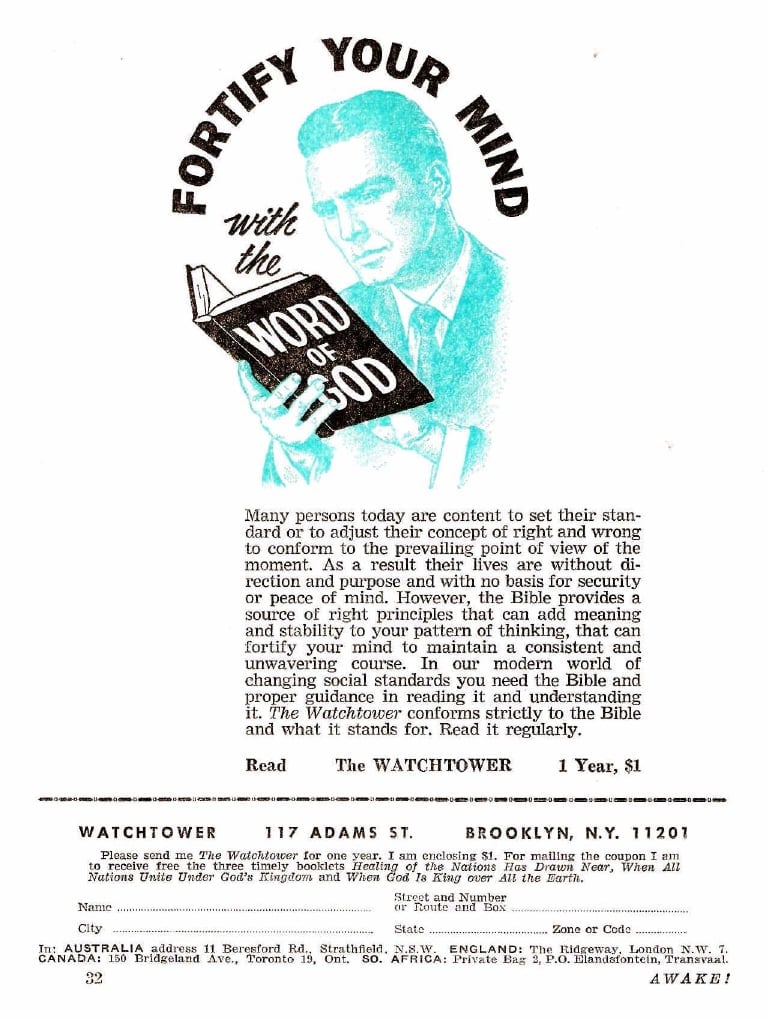
Many persons today are content to set their standard or to adjust their concept of right and wrong to conform to the prevailing point of view of the moment. As a result their lives are without direction and purpose and with no basis for security or peace of mind. However, the Bible provides a source of right principles that can add meaning and stability to your pattern of thinking, that can fortify your mind to maintain a consistent and unwavering course. In our modern world of changing social standards you need the Bible and proper guidance in reading it and understanding it. The Watchtower conforms strictly to the Bible and what it stands for. Read it regularly.
1 Year, $1
WATCHTOWER
117 ADAMS ST.
BROOKLYN, N.Y. 11201
Please send me the Watchblower for one year. I am enclosing $1. For mailing the coupon I am
Nations Unite Under God's Kingdom and When God Is King over All the Earth.
Name ...
Street and Number or Route and Box
City ...
State
In: AUSTRALIA address 11 Beresford Rd., Strathfield, N.W. EENGLAND: The Ridgeway, London N.W. 7. CANADA: 150 Bridgeland Ave., Toronto 19, Ont. SO. AFRICA: Private Bag 5, P.O. Elandfonsteyn, Transvaal.
Worship of Dead Ancestors or Love for Living Parents?
PAGE 5
When They Get the Keys to a Car
PAGE 8
High Blood Pressure and What Can Be Done About It
PAGE 12
Visiting South America
PAGE 17
THE REASON FOR THIS MAGAZINE
News sources that are able to keep you awake to the vital issues of our times must be unfettered by censorship and selfish interests. "Awake!" has no fetters. It recognizes facts, faces facts, is free to publish facts. It is not bound by political ties; it is unhampered by traditional creeds. This magazine keeps itself free, that it may speak freely to you. But it does not abuse its freedom. It maintains integrity to truth.
The viewpoint of "Awake!" is not narrow, but is international. "Awake!" has its own correspondents in scores of nations. Its articles are read in many lands, in many languages, by millions of persons.
In every issue "Awakel" presents vital topics on which you should be informed. It features penetrating articles on social conditions and offers sound counsel for meeting the problems of everyday life. Current news from every continent passes in quick review. Attention is focused on activities in the fields of government and commerce about which you should know. Straightforward discussions of religious issues alert you to matters of vital concern. Customs and people in many lands, the marvels of creation, practical sciences and points of human interest are all embraced in its coverage. "Awakel" provides wholesome, instructive reading for every member of the family.
"Awakel" pledges itself to righteous principles, to exposing hidden foes and subite dangers, to championing freedom for all, to comforting mourners and strengthening those disheartened by the failures of a delinquent world, reflecting sure hope for the establishment of God's righteous new order in this generation.
Get acquainted with "Awake!" Keep awake by reading "Awake!"
点
PUBLISHED SEMIMONTHLY BY
WATCHTOWER BIBLE AND TRACT SOCIETY OF NEW YORK, INC.
117 Adams Street
Brooklyn, N.Y. 11201, U.S.A.
N. H. Knora, President
GRANT SCHOOL, Secretary
Average printing each issue: 4,475,000 Five cents a copy
@SRS Yearly subscription rates for companion edition America, U.S., 117 Adams Street, St. Louis, 12021 Australia, 11 Barberfield Rd, Stratford, N.S.W. Canada, 11 Bridgway Ave, Toronto, 16 Out. Canada, 11 Bridgway Ave, Toronto, 16 Out. The Ridgway, London N.W. 7. 7/6 New Zealand, 821 New North Bd, Auckland S.W. 7. 7/6 South Africa, 821 New North Bd, Auckland S.W. 7. 7/6 (Monthly editions cost half the above rates)
Resellations for subscriptions should be sent to the office in every city and send your reservations to Residence Nolte exxilation in at least a quarter before subscription expires.
Now published in 26 languages
Seminario (†)-Africana, Cebuana, Danish, Dutch, English,
French, German, Greek, Italian, Japanese,
Korean, Norwegian, Portuguese, Spanish, Swedish, Tagalog,
Zulu
Monthly—Chinese, Cityanga, Hillgayoon, Malaysia, Polish, Tanzu, Uralian.
CHANGES OF ADDRESS should reach as thirty days before your moving date. Give us your old and new address, your old address (kid), write Watchdog, "Adam Street, Brooklyn, New York 12012, U.S.A."
Second-class postage paid at Bronx, N.Y.
Printed in U.S.A.
The Bible translation regularly used in "Awaken" is the New World Translation of the Holy Scriptures, 1961 edition. When other translations are used, this is clearly marked.
CONTENTS
Meet the Challenge of Adversity 3
Worship of Dead Ancestors or Love for Living Parents? 5
When They Get the Keys to a Car 8
High Blood Pressure and What Can Be Done About It 12
Enjoying Good Food in Argentina 17
Paraguay—in the Heart of South America 19
Uruguay—Unique Among
Latin-American Lands 20
United States of Brazil—Colossus
Visiting Venezuela in the Interest
of Peace 25
"Your Word Is Truth"
Does God Approve? 27
Watching the World 29
Brooklyn, N.Y., April 8, 1967
volume XLVIII
Number 7
HAVE you ever wished, "If only things could always go smoothly, reasonably, without too much difficulty"? "If only we were never brought face to face with adversity"? But since such is not to be, at least not in this present system of things, why not look at it another way, that you can learn valuable lessons from your meeting up with adversity, if you are willing to meet its challenge instead of rebelling or running away?
For one thing, adversity
helps us to become better acquainted with ourselves, with our strong points and our weak points. In the springtime a young man may pledge constant love, but, as the popular song has it, 'Will he love her in December as he did in May,' when the winds of adversity blow?
More than that, adversity will strengthen you if you meet its challenge. Thus, regarding discipline, which might be said to be one form in which adversity meets up with us, we read: "True, no discipline seems for the present to be joyous, but grievous; yet afterward to those who have been trained by it it yields peaceable fruit, namely, righteousness."—Heb. 12:11.
Failure to meet the challenge of adversity shows itself in more ways than one.
Some literally quit, run away. Others seek some escape, such as bitterness and resentment or self-pity and discouragement. Concerning such, wise King Solomon wrote: "Have you shown yourself discouraged in the day of distress? Your power will be scanty." (Prov. 24:10) That is not meeting the challenge.
If you would meet the challenge of adversity you must train for it; you must practice self-discipline. For example, to the extent that you are moderate in your spending
habits, exercising self-control, to that extent you will find it much easier to get along with less; and most likely you will have something saved to fall back on, should adversity suddenly strike in the form of an economic depression that could throw you out of employment.
The same principle also applies to your physical health. Disciplining yourself by taking a little bodily exercise, by moderation in food and drink and by avoiding such vices as the tobacco habit will enable you to meet adversity better when it strikes in the form of an accident or a serious illness.
Or adversity may strike in the form of an emotional crisis. If you have been working at disciplining yourself, controlling your temper in little things, you will likely meet well the challenge of adversity in the form of a serious reproof by someone in authority.
You will appreciate that you are prone to err, that the things you would not do you often do and the things you would like to do you often do not. More than that, the reproof administered to you most likely will be less severe by reason of your practicing self-discipline. It might therefore be said that, to the extent that we are concerned with doing what is right instead of following the lines of least resistance, we will be better able to adjust to circumstances over which we have no control, to meet the challenge of adversity.—Rom. 7:19.
Another great aid in meeting the challenge of adversity is hope. Remember, as a common saying goes, "This too will pass." Yes, when in the midst of adversity, we may feel that it will always be this way, we will never get well, we will never find employment, we will never be restored to favor, and so forth. But not so. More likely than not, time will solve these problems. Especially is the Christian's hope a help here. Thus a missionary who had spent seven years in solitary confinement in a Chinese Communist prison, afterward stated: "The Bible said we would have 'tribulation ten days.' In other words, there's going to be an end to it. Everything comes to an end in its own time. Therefore we just endure. God will bring us through."—Rev. 2:10.
Another great aid in meeting the challenge of adversity is love, for it "bears all things," the inspired apostle Paul tells us. Most likely, many of the thousands of husbands and fathers that have deserted their wives and children have really been put to the test because of adversity, adversity in the form of shrewish wives, sickness in the family, unemployment and what not, and so rationalized their walking out from
under their obligations. But love would have helped them to meet the challenge of adversity, to make the best of the situation. And thereby they could have hung on to their self-respect, for a man's need to shoulder responsibility is as real as his family's need for security.—1 Cor. 13:7.
Still another great aid in meeting the challenge of adversity is humility, submissiveness. It will enable you to absorb the blow instead of going to pieces under it. The Biblical character David must have had such humility, for, whether hunted as an outlaw by King Saul, severely reproved by God's prophet for his mistakes or fleeing from his usurping son Absalom, David neither rebelled nor became discouraged and quit, but made the best of each situation. Humility will help us to meet the challenge of adversity by picking up the broken pieces, as it were, and starting over again.—2 Sam. 12:13; 16:11, 12.
Not to be overlooked are faith in God and prayer. The Bible tells us that for his people God is "a refuge and strength, a help that is readily to be found during distresses." (Ps. 46:1) He is to be found primarily by means of prayer and his written Word. He works in all things for good to those who love him. So look for something good when adversity strikes.—Rom. 8:28.
And, among other things, seeing how others meet the challenge of adversity can help you to do the same. If no living examples are close by, turn to the Bible; it contains many of them, such as virtuous Joseph and patient Job. They met the challenge of adversity and in the end were blessed for it.-Jas. 5:11.
Yes, it is in your interest to meet the challenge of adversity. Do so by training for it, and by letting hope, love, humility, faith and the example of others aid you.
Is there value in worshiping dead relatives? How does it compare in importance with honoring living parents?
THE above are not just idle questions. For in many places in the world the worship of dead ancestors is a prominent part of the religious service of people. It was already highly developed in the sixth century B.C.E., and the famous teacher Confucius, who lived then, served to encourage it, saying: "As the foundation of things is Heaven, so the foundation of man is the ancestors."
Today ancestor worship is common among people in China, Japan, Korea, India, yes, throughout most of Asia and parts of Africa. It plays a major role in the lives of many Confucianists, Buddhists, Shintoists and even those not professing a religious faith. Observed one religious correspondent in Korea: "Although only some three million of Korea's more than twenty million population belong to an organized religion, the vast majority of Koreans practice ancestor worship as a national custom."
It is a common practice of ancestor worshipers to keep in the home a small altar at which they pay homage to their deceased relatives. At times a picture of the ones being honored is kept on the altar.
Here, too, incense is burned, prayers are regularly said, flowers are placed and even food is offered. However, after a while the food is usually thrown away or eaten by the rest of the family.
Many parents instill deeply in their children this form of worship, because they believe that such homage paid to them after they have died will assist them to enjoy a
happy existence in the "next life." It is also felt that prayers by living relatives will assure a future uniting of family members in a life after death. In addition, ancestor worship is believed to placate the dead, ensuring that they remain friendly spirits rather than become hostile ones who may do the family harm.
Honor of Living Parents Vital
In many families it is readily observed that more emphasis is placed on revering the dead than on showing love and respect for the living. Is this proper? Would you not much rather have your children honor you while you are alive? The oldest collection of sacred writings, commonly known as the Holy Bible, stresses that respect should be given to living parents. It says in one of its oldest parts: "Honor your father and your mother, just as Jehovah your God has commanded you; in order that your days may prove long and it may go well with you."—Deut. 5:16; Eph. 6:1, 2.
Parents who, in keeping with this commandment, instill within their children the need for respect and obedience to their father and mother lay the foundation for a happy family life. The family is united in a warm bond of love when children truly care for their parents, and, in turn, the parents always seek the best interests of their children.
Just last year this was drawn to the attention of a Buddhist man in Japan who opposed his daughter's investigation of the teachings of the Holy Scriptures. He feared that if she continued her studies she would not worship him after he died. However, when the value of the Bible's fine counsel was illustrated for him, he was deeply impressed.
The example of another Buddhist family was called to his attention. The daughter of the family, one of Jehovah's witnesses, adhered closely to the Bible's teaching and cared lovingly for her Buddhist parents right down until they died. On the other hand, the son did nothing to help his parents while they were alive, but bought them a $300 butsudan (a family Buddhist altar) after they died. Now, which is better: To be respected and loved while you are alive, or to be given perfunctory worship after you have died? The Buddhist father saw the point, and his attitude changed.
The wisdom of the Bible's counsel was also recognized by a respected eighty-one-year-old elder in a small village in Korea. When a young man, who had become one of Jehovah's witnesses, returned to his native village last year, he was severely opposed by his ancestor-worshiping parents and the village elders. However, when the Bible views were presented, the above-mentioned elder recognized the value of them and said: "We should walk the way of life rather than the way of the dead."
Honoring living parents is clearly seen to be of superior value, even by persons who, from their youth on, have been taught to worship dead ancestors. How practical it is to inculcate within children the importance of obeying their parents and keeping God's laws! (Deut. 5:16; 6:4-9) The value of the Bible teaching is
apparent from the exemplary conditions that exist in the homes where its counsel is truly applied.
Why Worship Dead Ancestors?
However, it is only natural that persons who have been taught to practice ancestor worship are inclined to attach importance to it. But think now: If you worship your ancestors, for what reasons do you consider such ancestors to be of value? Why do you regularly burn incense before the family altar and offer food there? Do you believe that the departed loved one can smell the sweet scent or derive value from the food? If the person were really alive, would he not make use of some of the good food that is offered? Does not the fact that the food is left untouched indicate that the dead are powerless?
Nevertheless, ancestor worshipers generally believe that the dead are more powerful than when they were alive as humans. Thus, many worship them to prevent their displeasure or to avoid some form of retaliation by them. But consider: Are you personally acquainted with any instance where a neglected ancestor came back to cause living relatives trouble? Is there any evidence that the millions of earth's inhabitants who do not worship their ancestors are ever troubled by them? No, there is no evidence that they are.
Still, persons who believe that their worship might, in some way, benefit dead loved ones are hesitant to forsake it. Yet, when you stop to think, is there any real evidence that the dead are alive somewhere and can accept such worship? Is ancestor worship not simply a custom that has been handed down from generation to generation since away back before the days of Confucius? Yes, it is, and neither sound reasoning nor the facts provide a solid basis for practicing it.
Do Humans Survive After Death?
Scientists and surgeons have not been able to find in man any evidence indicating that a conscious, living part survives the death of the body. Yet, it is understandable that a person might hold strongly to beliefs that are old, sincerely believing that these originate with God. And the belief that man has an immortal soul is certainly an old one. Today it is so widespread that practically all religions throughout the world teach it, including those of Christendom. But is this belief, upon which worship of dead ancestors is based, true? Does the oldest available evidence support it?
Dating from long before the days of Confucius, Buddha and other such famous teachers are the sacred Hebrew writings that compose a major part of the Holy Bible. These inspired writings even tell about the first human family and its creation by God. Observe what that record says about how man was created: "Jehovah God proceeded to form the man out of dust from the ground and to blow into his nostrils the breath of life, and the man came to be a living soul." Note that man was made a living soul; he was not given an immortal soul.—Gen. 2:7.
Throughout these old sacred writings not once does it say that man possesses an immortal soul that survives the death of his physical organism. Man is mortal; he is subject to death. No part of him lives on and so can receive worship by living relatives. In the tenth century before our Common Era an inspired Bible writer recorded: "The living are conscious that they will die; but as for the dead, they are conscious of nothing at all." (Eccl. 9: 5) And sometime later, the Almighty God himself said, as recorded by his prophet Ezekiel: "All the souls—to me they belong. . . . The soul that is sinning—it itself will die."—Ezek. 18:4.
These writings are in perfect harmony with the observable facts in saying that the soul dies. In addition, they are the oldest existent sacred writings, dating from before the practice of worshiping dead ancestors. And, really, how much more practical is their counsel, which emphasizes the honoring of living parents! The practicalness of these writings should inspire confidence in what the Bible also says about the condition of the dead.
Reunion with Dead Relatives
Does this mean, then, that there is no hope of being reunited with dead loved ones? Do people die and simply cease to exist forever? Not at all! In his inspired Word the Bible Almighty God makes known his purpose to destroy this wicked system of things, with its oppressive governments, and to usher in a righteous new order. Then, upon an earth under the direct rule of his heavenly Son Jesus Christ, persons separated long ago by death will be united again when they are brought to life in the resurrection. "The hour is coming," the Bible promises, "in which all those in the memorial tombs will hear his voice and come out."—John 5:28, 29; 2 Pet. 3:13.
What a grand reunion that will be! No human can accomplish such a miracle, and certainly no one who is unconscious in death can do so. Only man's Creator, the Almighty God Jehovah, can bring the dead back to life in a resurrection, enabling them to enjoy fellowship with one another again. So, instead of reverencing persons who have died and trying to instill in your children such reverence for the dead, heed the admonition to worship the true God Jehovah, the One alone who can make possible a reunion with dead relatives.
YOUTHS just cannot wait until they can get the keys to a car. It gives them a feeling of prestige, a sense of power, independence and of being grown up. "I don't know how to explain it," one fourteen-year-old said, "but when you have your own car, you've got it made. You can get where you want when you want." Another boy concurred: "It has
something to do with reaching the age of freedom. Having a car gives a person more liberty." Many of the dreams and ambitions
of youth are often bound up in obtaining access to a car.
But what happens when they get the keys to a car? Unfortunately, it all too often leads to tragedy. The frequency of the slaughter on the highways has caused alarm among safety and law-enforcement officials and ordinary citizens alike. In the United States one motor vehicles commissioner of an Eastern state emphasized his concern by citing the accidents during one early morning period.
At 1 a.m. an eighteen-year-old driver fell asleep at the wheel, ran his car into a tree and was killed. Eight minutes later a twenty-year-old driver plunged into a railroad locomotive and died. At 2:20 a.m. another twenty-year-old drove off the highway into a pole, killing one and injuring three other young passengers. Twenty-five minutes later a youth ran off the road into a tree, seriously injuring
himself and killing his young companion. And at 3:15 a.m. a nineteen-year-old driver, traveling at high speed, drove on the left side of the highway and smashed head-on into another vehicle, causing the death of himself and three others.
However, some persons may object that
it is unfair to isolate the accidents of youths, as if they were the chief offenders. Only a small minority of youngsters are
careless and irresponsible, they claim; the vast majority are said to be superior drivers. But what do the facts show? Just how good or how bad is youths' record behind the wheel?
Youths' Driving Record
"Frankly, it's not too good," a pamphlet of the United States National Safety Council observes. "Special studies have shown that teen-agers are involved in twice as many fatal accidents for the number of miles they drive as drivers over 25." The American Automobile Association reports: "Considering miles covered, 16-year-old drivers are involved in nine times as many fatal accidents as are those in the 45-50 age bracket." Youths are involved in so many accidents that, as soon as a teenager is added as a family car driver, insurance rates may jump more than 100 percent.
There is no getting around it—not just a minority, but young drivers in general are more unsafe than older drivers. "It's simply not true that a small minority of the youngsters are responsible for most of the accidents," Judson B. Branch, Chairman of the Board of the Allstate Insurance Company, explained. "Repeaters aren't the major problem, for we have found that those who have accidents today usually aren't the same ones who have the
ment, its exuberance, its yen to dare and be dared. Combine the thoughtlessness of youth and the power of the modern American automobile, and the result too often is death on our highways."
It is these immature characteristics of youth that are also responsible for their being involved in nearly two out of every three automobile thefts. According to the National Automobile Theft Bureau, teenagers steal some 280,000 of the more than
The Journal of American Insurance commented on this matter, saying: National Safety Council "figures also debunk the widespread notion that young drivers are tarred by the bad driving habits of only a small minority. Reports from traffic authorities of 27 states show that an astounding 43 out of every 100 drivers younger than 20 were involved in accidents in 1962, and that 30 out of 100 drivers age 20 to 25 had mishaps. By comparison, 18 out of 100 drivers of all other ages had accidents in 1962." One state
450,000 cars stolen each year in the United States! Usually they simply want a car for a "joy ride," and then abandon it when they are through. But their recklessness and lack of concern for life and property contribute toward the fact that an estimated two out of every five stolen cars are either wrecked or damaged.
More than Skill Required
Parents should, therefore, realize that being a good driver involves more than simply the ability to control and direct the movements of an automobile skillfully.
even attributed one out of every three of its traffic accidents to teen-age drivers!
Why They Are More Dangerous
Since younger persons are blessed with quicker reflexes, better vision and other such physical assets, why are they poorer drivers? Inexperience is one reason. They often have driven for only a year or two and have not learned to cope with dangerous traffic situations that can quickly arise. Yet even youths who can skillfully operate an automobile have more than their share
This ability can quickly be canceled out by overconfidence, lack of judgment and the desire to "show off." Careless drivers often get into situations that prove disastrous, regardless of their amount of skill.
True, a young person may drive carefully while his parents are with him, but they cannot take it for granted that he will drive that way when they are not around. It is just not characteristic of youth. They want to see how fast the car will go, how well they can handle it on
One source gave the following reasons: Here at Nationwide Insurance we're convinced that young drivers have this appalling accident record not because of inadequate driving skill alone. We believe that the real cause lies in the very nature of youth—its inexperience, its lack of judg- APRIL 8, 1967
a twenty-five-mile-an-hour curve doing fifty miles an hour, and so forth. According to a Gallup poll, one out of four high school seniors admitted that he had driven faster than ninety miles per hour. And you can be relatively sure that their mothers and fathers were not with them when they did!
A case in point is a seventeen-year-old high school football star. He easily passed the driver's test. There was no question about his skill in handling a car. Yet the first night out by himself, he ran down a mother and child in a crosswalk in a jackrabbit start. Why? What was the trouble? The boy's athletic coach offered this explanation:
"If they had asked me, I could have told them that Harvey wasn't ready emotionally to drive. He has a bad temper in the locker room and needles other players. He is a flashy performer and carries a chip on his shoulder. His mental attitude showed itself in his driving as soon as he was unsupervised. The boy just had to be first away when that light turned green."
Parents' Moral Responsibility
Parents need to stop and realize that when they hand their youngsters the keys to the family car they are entrusting them with one of the deadliest weapons in human history. All the bombs and artillery of some major wars kill fewer persons than the well over 100,000 who die each year in traffic accidents, some 50,000 in the United States alone! Are you as parents assuming the moral responsibility of placing such a potentially dangerous weapon into the hands of your youngsters? Have you done everything possible to see that they are equipped to drive safely?
Many parents have not. In fact, safety and law-enforcement officials cite lack of parental discipline, supervision and guidance as the main reason for the big problem of teen-age driving. The July 1965 issue of Highway Patrol observed: "Many times parents, when called in about a boy or girl who has been cited, will take a very negative attitude. Parents don't seem to know how to say NO and mean it. . . . The parents have never accepted the firm authority that is theirs. The kids run the
whole show and the poor parents, rather than having an understanding, tend to pass the whole thing off as an act of youth."
But misuse of the automobile cannot be dismissed as "an act of youth," as might a ball accidentally thrown through a glass window or some other such mishap. It is a life-or-death matter! As parents you need to assert your authority and enforce necessary rules and restrictions relative to use of the car. You must realize the urgency of exercising more control over your teen-agers in the matter of how and when they drive. Such supervision will reap good returns, for youths love and respect parents that discipline and instruct them.
Program of Instruction Vital
Instruction of youth in traffic safety should begin early, long before they are old enough to drive. Teach them, for example, always to lock their doors and fasten their seat belts. And, especially, do not underestimate the effect your example has on their future driving habits. Dr. Bruno Bettelheim, a noted psychoanalyst, said: "Even if a parent breaks a traffic law only occasionally, it may be enough to destroy a child's belief that he should obey all rules at all times. An occasional speeding violation by a parent, or impatient cheating at the stoplight, makes a youngster imagine that to be 'grown up' means one can break the law and get away with it."
As your youngster reaches the legal age to obtain a driver's permit or license, see that he receives proper supervised experience in handling an automobile. Show your interest in his progress. Praise the good driving he demonstrates. If you do that, rather than habitually nagging at him for his mistakes, he is more likely to heed seriously the counsel you offer.
Try, also, to impress upon him the importance of a proper mental attitude or frame of mind while driving. Endeavor to develop in him courtesy, respect for law, carefulness and consideration for the rights of others. Although he may yet be a teen-ager, it is vital that, when he is behind the wheel of a car, he be a mature person who values life and property.
Many high schools in the United States offer driving education courses, and many wise parents have their youngster enrolled in one. Courses that meet nationally accepted standards, not only provide hours of behind-the-wheel instruction, but endeavor to develop good "traffic citizenship." Among other things, they teach that kinds of behavior are safe and what are not, what to expect in different traffic situations, and consideration for pedestrians and other drivers. Surveys have shown that these courses have significantly reduced accidents among teen-agers, and, therefore, many insurance companies reduce by 15 percent the insurance rates of young people who have taken them.
There is more that can be done to impress upon youth the importance of safe driving. For instance, allowing youngsters to see and hear firsthand what happens to violators. Some parents and educational groups have arranged to attend court when traffic cases are being heard. If parents get in touch with the local court, the judge will no doubt be glad to have them come down to listen. He may even arrange to hear a series of cases that will be especially instructive and impressive for teen-agers.
Another thing that some law-enforcement officials find effective is to have youths visit the emergency ward of a hospital and watch traffic accident cases as they are brought in. It can certainly make a lasting impression that emphasizes the importance of safe driving! By inquiring
and explaining the reason for it, parents may receive permission to go to such an emergency ward with their youngsters.
Safeguard Their Future
It is not an exaggeration to say that the future of your youngster is dependent, to a surprising degree, upon proper supervision of his use of the car. Not only is his life seriously jeopardized if you permit him to roam the roads late at night, but his school education can also be adversely affected. A comprehensive study by the Allstate Insurance Company revealed that grades of students fell in proportion to the number of evenings a week they were permitted to use the car. It certainly is a mistaken kindness for parents to fail to take into consideration their youngster's future welfare by giving in whenever he wants the car keys.
Another thing for parents to consider seriously is the trouble that young boys and girls are getting into when they are alone together in a car. Among teen-agers, necking, petting, sex relations and the automobile have become practically synonymous. In fact, one Connecticut girl was quoted in a widely publicized survey as saying that accepting a date to a drive-in movie was equivalent to agreeing to sexual intercourse. True, your youngster may not think of planning such immorality. Yet, when two young people are together alone for extended periods of time, one thing often leads to another, and before they realize it they may have committed fornication.
As parents, you simply cannot close your eyes to the danger to which youths are exposed when you hand them the keys to the car. It is real! The matter must be taken seriously. Parents, it is your moral responsibility to do so. Think about it. Then take the necessary steps to safeguard your youngsters.
HIGH BLOOD PRESSURE
high blood pressure, and have to content ourselves with putting a little sand in the fuel line to cut down the flow of gasoline."12
Just what is this high blood pressure or hypertension? How widespread is it?
WHAT do the surgeon's scalpel and garlic have in common? What, for that matter, do they have in common with respiratory exercises and drugs such as Iverson and Reserpine? Simply this, all these as well as ever so many other drugs, trace
elements, vitamins, drug-induced sleep, physical exercises and psychotherapy have been and are being prescribed by doctors for high blood pressure or, as they call it, hypertension.
Does this suggest a confused picture? Well, then, it suggests the facts just as they are. High blood pressure may suddenly mainm or kill a person in his prime and in apparently good health; and yet not a few persons who have had very high blood pressure have lived upward of eighty years, at last to die from something else.
True, there are some specialists in the field that are highly pleased with the progress being made, but others are not so happy about it. They speak of hypertension as a "mix of diseases," and say that "in no other division of medicine is opinion more confused than in that which deals with the cause and significance of high blood pressure and with the progress and treatment of any patients who may exhibit it."31 And, says Boyd, one of America's leading authorities on pathology: "We have to admit that we do not yet understand the workings of the carburetor of
What can be done about it
What factors influence it, and how harmful can it be? Most important of all, what can be done about it?
What Is It?
Blood pressure refers to the pressure that the blood exerts on the walls
of the arteries because of the heart's pumping the blood throughout the body. To measure this pressure, doctors use the sphygmomanometer* by which the pressure can be registered on a mercury gauge. The blood pressure is indicated by two figures, the systolic, referring to the pressure at the time the heart contracts or pumps, and the diastolic for the pressure between heartbeats when the heart is being filled with blood. These two pressures are represented by two figures, such as 120/70. The diastolic or second figure is the more important, as it represents the pressure on the walls of the arteries four-fifths of the time, between beats. The ideal pressures in the prime of life are the foregoing ones. While most practitioners take for granted that the pressures will rise with advancing age, they disagree as to just how great a rise should be taken for granted.
Blood pressure often varies; it may be high during the day but return to normal at night, when a person is resting or sleeping. It may also vary depending upon whether one is sitting, standing or lying down, what the weather is and what one's emotional state is.
It may even vary depending upon who takes the blood pressure; once four physicians got four different readings from the same patients. a
One's blood pressure depends upon a number of factors: Among these are just how strong the heartbeat is, how rapid, the amount of blood in the blood vessels as well as its viscosity, that is, whether it is "thin" or "thick," and in particular does it depend upon the condition of the blood vessels, to what extent they are becoming hardened, are having accretions formed on their insides, lack "tone," or are suffering from constrictions of their walls due to nerve impulses. Nor to be overlooked are hormones and enzymes in the blood.4
High blood pressure is said to be either essential (viz., primary) or secondary. High blood pressure is said to be secondary when it, in turn, is being caused by some impaired condition of the heart, blood vessels or kidneys; although there is always the question as to which is the cause and which the effect.
When these conditions do not exist, high blood pressure is said to be essential, that is of itself, not meaning that it is necessary high blood pressure. Two of its characteristics are that it does not appear to give trouble until middle age and that it has a strong hereditary background. Some, even within the medical profession, however, view high blood pressure merely as a variation from normal or average, not a disease, even as some people may be tall and others short.
Contributing Factors
High blood pressure is widespread. Not only are highly cultured peoples affected by it but those leading apparently simple lives, such as the Alaskan Eskimos, the Marshall Islanders and the Bantus of Africa. It appears to be more frequent in women than in men but more harmful in men than in women. It is twice as frequent among those whose work involves nervous tension as among those doing physical labor. Some 10 percent of the adult population of such lands as the United States have high blood pressure.
That the main factor in essential high blood pressure is heredity is borne out by statistics. If neither of one's parents has or has had it, then one's chances of getting it are only 3 in 100. But if one parent has it, the chances are 4 out of 10, and they are 9 out of 10 if both parents have it.
In addition to nervous tension and heredity must be mentioned diet as a contributing cause. Eating more food than one's physical activity calls for, or the wrong kinds of food, and in particular too much salt, are also widely recognized as having a bearing on high blood pressure. The body's producing more than is needed of certain hormones and enzymes also appears at times to be involved.
What Difference Does It Make?
There is general agreement that every effort should be made to reduce one's blood pressure if it is high; except in the case of very old persons free from such disturbing symptoms as headaches and dizziness. High blood pressure usually follows a set morbid course and eventually is associated with deterioration of the blood vessels in the brain or with heart or kidney damage. It stands to reason that an organism designed to function best at a certain pressure would suffer if that pressure were greatly increased.
This is borne out by insurance statistics, which show that a United States male at thirty-five years with normal blood pressure has a life expectancy of forty-one and a half years, whereas if his blood pressure is high, 150/90, his life expectancy is reduced by about one-third, to twenty-five years.
High blood pressure has even been termed the second-greatest killer among civilized men. One reason for this, no doubt, is that one may have it for some time without being aware of it.
The Drug Approach
Some years ago the surgical approach was in vogue among the medical profession. It involved an operation that cut the nerves constricting the blood vessels. Today, however, it is rarely used except in urgent cases of secondary high blood pressure. For the past ten or fifteen years the drug approach has come into favor, as more and more new drugs that could lower the blood pressure have been discovered.
Certain of these drugs work on the kidneys, reducing both the plasma volume and the sodium content in the blood and are known, therefore, as diuretics. Other drugs counteract the chemical substances in the blood that seem to trigger hypertension. Still other drugs serve to relax the sympathetic and/or parasympathetic nerves that constrict blood vessels. Then, again, other drugs have a generally quieting effect, reducing the blood pressure.
Among the very latest drug approaches is using a chemical binder for cadmium. This harmful trace element is not found in the body at birth but apparently enters the body through polluted air, coffee, tea and from refined products such as polished rice and white flour. The urine of persons having high blood pressure has been found to have forty times as much cadmium as the average. By means of a drug it is possible to rid the body of its excess cadmium, resulting in a return of the blood pressure to normal.
But with the use of all drugs there are always side effects to be reckoned with. Thus we are told that "during the last decade effective hypotensive drugs were
widely used for the first time. The decreased mortality for severe hypertension was expected, but the variety and frequency of associated toxic effects was surprising.[14] And, says one of England's leading specialists: "Antihypertensive medication is notorious for its undesirable side effects."[15] Among the most common and least serious of these is constipation.
This is also the considered opinion of The Medical Letter, a periodical devoted to the efficacy of drugs. It holds that, except in severe cases of high blood pressure, the use of many of the drugs is questionable, since these do not cure but simply bring relief from symptoms and are often accompanied with unfavorable side effects.—February 2, 1962.
The Diet Approach
Some twenty years ago the German doctor W. Kempner came out with the salt-free, low-protein, rice diet by which he had great success in treating high blood pressure. While it seems that most doctors are reluctant to prescribe such an unpopular diet, there is general agreement that at least obese patients absolutely should cut down on their food intake.
Regarding the relative merits of diet and drugs, Dr. E. L. Housel, a chief of a hypertension clinic, writes: "Americans consume too many calories, too much salt, too much animal fat. Moderate reduction of these would be indicated. The . . . evidence which warrants these conclusions has been documented, but physicians have been slow to advocate these restrictions in their everyday practice. . . . The overshadowing of diet by the glamorous effective but expensive antihypertensive drugs would seem unwarranted. Restriction of salt in the diet is an effective treatment for hypertension, not as potent as new drugs, not as pleasant to the patient, but less costly.
. . It is so easy to write a prescription for a tablet the patient will take, so gratifying to observe the fall in blood pressure after the drug has been taken. It is more difficult to educate the patient about low sodium diets, it is more time-consuming. . . Physicians might be more aggressive in communicating this information to their patients."
Evidence of the value of moderation in eating for lowering high blood pressure was furnished by the siege of Leningrad during World War II. While it lasted, its enforced semistarvation brought about a general decrease in high blood pressure. As someone has well put it: "Eat less in the hope that you will live longer to eat more!"
Typical of the proof that abounds as to the effect of salt intake on high blood pressure is that procured from the Bahamas. There "almost one out of every two Negroes has high blood pressure and the death rate from this cause is very high. The salt content of the water in the Bahamas is very high and almost all the food is fried in salt pork oil."2 Experiments have demonstrated the same thing.
Not that the diet approach consists only of what one may not eat. There is also a positive side to it. One must also increase his intake of potassium, for it protects the body against salt, and many of the drugs taken to combat high blood pressure rob the body of vital potassium. Foods rich in this element are bananas, fish, oranges, grapefruit, the legumes, unpolished rice and oatmeal. Also highly recommended by some are the use of the vitamins C and E and of calcium, the latter as found in bone meal tablets.
The Psychosomatic Approach
There is not a little evidence that high blood pressure may result from too much mental or too much emotional strain and tension. As one authority stated: "It is
recognized that man by his thoughts alone may raise his blood pressure."4 By creating stressful situations it has been possible to give animals high blood pressure. Tests have shown that mental arithmetic, college examinations and stressful interviews all raise the blood pressure. The Texas City, Texas, disaster of 1947, in which explosions and fires caused the loss of some 1,000 lives, resulted in giving high blood pressure to 57 percent of the adult survivors.
This appears to be the approach taken by not a few Russian physicians, as reported in Annals of Internal Medicine, January 1959. In contrast to the drug approach in other Western lands, which largely concentrates on the sympathetic and parasympathetic nervous systems, these concentrate on the central nervous system and stress psychotherapy in line with Pavlov's experiments. They feature the making of changes in one's mode of life, mental attitudes and occupation, a few even going to the extreme of sleep therapy, in which patients are induced by drugs to sleep from fourteen to twenty hours a day for a period of from two to four weeks. These, however, also prescribe reduction in salt, fat, water and alcohol intake and strictly forbid the use of tobacco.
Other Approaches
Some thirty years ago, Dr. L. C. Tirala, Professor of Medicine, University of Munich, Germany, claimed to reduce high blood pressure to normal by means of respiratory exercises, for which reason he said that opera singers were remarkably free from high blood pressure. According to him it takes but three to six weeks of these exercises to bring the blood pressure back to normal, but then they must be kept up to keep the blood pressure normal.
And then there is the garlic approach.
Many doctors in the past recommended it, especially in Europe. Particularly had the use of Allimin, a garlic-parsley tablet, won high favor among certain physicians. It is said to be helpful in both primary and secondary high blood pressure, reduces the blood pressure from ten to forty points within an hour and its effects last for
twenty-four hours.
It is reported to strengthen the heartbeat, slow up the pulse, clear up headaches and relieve the toxic condition in the intestines. It is rec-
to be basically the result of too much—too much salt, too much food, especially too much animal fat, too much tension, too much mental work, too many emotional problems, or too much pleasure and excitement. As regards salt, it seems that most persons use too much, which also encourages overeating, and so especially if high
ommended to be taken three days in a row and then a day be skipped, and taking it is said not to give one an unpleasant breath. Recent research in the Netherlands tends to give support to the garlic cure.
Then there is the approach of manipulation as practiced by the chiropractor. Chiropractic proceeds on the premise that high blood pressure is the result of an imbalance between the sympathetic and parasympathetic nervous systems, resulting in an irritation of the nerves controlling the arteries. It also recognizes the role that the emotions might play. Chiropractic adjustments are said to restore this balance as well as aiding in removing muscle tension, all of which helps to reduce high blood pressure.
So, to the question as to what can be done about lowering high blood pressure, there is much to choose from. Among other things that have been recommended for it are physical exercise, certain herbs, hydrotherapy and fasting. Next to the primary factor of heredity, it might be said
blood pressure is in the family, it is wise to use less of it. Of course, all obese persons with high blood pressure should reduce until they reach the average for their
age, height and bone structure.
Perhaps more difficult is learning to exercise self-control as to one's pace, learning to slow down, to relax, getting more rest and sleep. Some practitioners recommend that high blood pressure patients spend every other weekend in bed. That may not always be practical, but one having high blood pressure should learn to content himself with trying to squeeze less out of each day, guard against being over-conscientious and, say, learn to go to bed at ten o'clock instead of watching TV or being at parties until midnight.
In brief, it means following the Bible's good counsel: "Let your reasonableness become known to all men," and be "moderate in habits," knowing that "whatever a man is sowing, this he will also reap." —Phil. 4:5; 1 Tim. 3:11; Gal. 6:7.
REFERENCES
1 Journal of Chronic Diseases, November 1963.
2 Pathology for Physicians-Boyd (1965).
Pathology for Physicians-Boyd (1965).
Essential Hypertension—Clba (1961).
Aunals of Internal Medicine, September 1962.
\textcircled{4} The Nature of Essential Hypertension—Sir George Pickering (1961).
7 Hypertension—Recent Advances—Brost & Moyer (1961).
RAVELING groups of Jehovah's witnesses converged on Argentina in January from Chile, Bolivia and Paraguay, looking forward to a pleasant few days in the eight-largest country in the world. Buenos Aires was in the middle of summer, and the trees lining the streets afforded pleasant shade for those on the sidewalks of big, bustling Buenos Aires. After their being in some smaller cities in other countries, it was a sudden change for the travelers to come to a center where the population is in the millions.
The visitors were accommodated in the heart of Buenos Aires not far from the Casa Rosada or pink house, headquarters of the present government of Argentina. A number of factors, including the size of the country, favored
the holding here of two assemblies in this series of international gatherings of Jehovah's witnesses; one in Buenos Aires at the Club Atlético Los Andes (soccer stadium) in the suburb of Lomas de Damora, about eleven miles south of downtown Buenos Aires; the other at Córdoba, an inland industrial city and former Roman Catholic stronghold.
The center of Buenos Aires has its large office buildings and great shopping streets as well as government buildings. As these were left behind and travelers passed into the neighborhood areas, they
could observe modern residences mingled with some of older style and linked to the past by such reminders of yesterday as horse-drawn carts. The horses wore hats, which is required by law. Noteworthy, too, was the tremendous amount of construction going on, especially new apartment buildings.
The open soccer stadium had been made ready to receive thousands of Argentine conventions and the visitors from other lands. Everyone had come prepared with hats and umbrellas because at midday there is no shelter from the warm summer sun. In the afternoons while most of the Argentines were having a siesta, serious-minded Christians at the conventions were enjoying good spiritual food. It was a remarkable thing to observers and passersby to see this large crowd engrossed in taking in more knowledge of God's Word. The crowd of 11,020 persons at the open stadium for the principal lecture was indeed gratifying. This, added to the 4,218 assembled in the covered stadium at Córdoba, meant that a total of 15,238 expressed interest in Almighty God's promise of a Millennium of peace. Also of great significance was the fact that 692 new ministers were baptized in symbol of their dedication to God during the two assemblies.
Enjoying Argentina's Famous Dishes
When a visitor has but two or three days to be in Argentina, he may wonder how it might be possible to participate in an international convention and at the same time visit an estancia (ranch). The travelers were treated to a visit at a simulated estancia less distant from the center of Buenos Aires than the international airport. The restaurant is typical of a ranch one might find in all parts of the
G. Suiter, Watch Tower Society official (on right), addressing Buenos Aires assembly through branch servant as interpreter
region where beef is raised. During the dinner gauchos (Argentine cowboys) appeared on the scene in their native costumes, including baggy pants and a large sash, to dance and entertain. One performed a precision dance, tapping the heels of his heavy boots while bouncing the boleadora on a wooden platform in time with the clicking boots. The boleadora is the Argentine counterpart of the American cowboy's lasso. It consists of three strands of rope with heavy balls at the end. It is thrown at a calf and entangles its feet, stopping it in its tracks until the gaucho can catch up.
There were also exhibitions with horses and riders in action.
Food was delightful. Entrees included empanadas (made from high-quality ground meat and eggs baked inside a pastry shell), and salchichoias (spiced sausage). Excellent Argentine wines were available. The main course was asado or barbecued ribs cooked over an open fire, but in Argentina they do not use sauce and spices. The asado, originated by the gauchos, was a dish they could readily prepare as they worked their beef herds on the open prairie.
Witness companions sharing in field service, wait outside the gate, as is the custom in urban Argentina
Asado must be considered the national dish of Argentina, for at about 8 p.m. one can go on a high building anywhere in Buenos Aires and he will see the smoke from open fires in the backyards and patios as the people prepare their dinner, the traditional Argentine asado.
Great Need for Sharing Spiritual Food
Some visiting Witnesses had an opportunity to go with Argentine Witnesses and share good spiritual food with the public. When going from house to house they found that it is not good manners to enter the gate of the Argentine home without invitation. The Argentine likes privacy, especially if he is a city dweller, and so he builds a wall along the sidewalk. There will be a postern gate, possibly with a bell. The visitor rings the bell or, if no bell, he claps his hands to get the householder's attention. Here at the gate he will be interviewed, seldom invited inside until his second or third visit. In rural areas it is different. The visitor is likely to be invited to sit in the shade of a tree and, if found to be friendly, offered a refreshing drink of mate, Argentina's native drink. They observed that it was not uncommon for the sehora to say: "We are members of the apostolic Roman Catholic Church. We do not believe in the Bible." The visitors wondered how a person could claim to be a Catholic in one breath and deny the Bible or even the existence of God in the next. The majority of homes in Argentina do not have a Bible.
A look at the background of Argentina will help us to understand. In the early 1500's an effort was made to colonize Argentina, and thousands of small expeditions under the auspices of the Roman Catholic kings of Spain and Portugal came with motives described as
"gold, glory and gospel"
All newcomers, however,
there were to be "no religious heretics" in the new land. This was about the time of the Council of Trent (1545-1565), from the deliberations of which proceeded the Index, a list specifying the books that no good Catholic should read. Included was the E Bible in the vernacular. "If the sacred books be permitted in the vulgar tongue indiscriminately, more harm than utility could arise therefrom," it was explained.
In the late nineteenth century news reached Europe of this fertile, sparsely populated land. So people came. Today 15 percent of the population is foreign, and 97 percent of the Argentines are considered to be of European stock.
Today there are more than 12,000 of Jehovah's witnesses busy teaching the Bible in Argentina. How did this come about? Those who attended the English convention sessions in the suburb of Buenos Aires heard Argentina's first Kingdom publisher, Juan Muñiz, now eighty-one years old tell them that in 1924 he was assigned by the Watch Tower Society to come and open up the work. In those days he and Carlos Ott organized a small group of twenty interested people and distributed literature in Argentina, Paraguay, Uruguay and Chile. He told how they worked hard up to 1845 and reached a peak of 415 Kingdom publishers in Argentina.
From 1948 the work increased even more, because of the help of trained missionaries from the first class of the Watchtower Bible School of Gilead. He expressed his appreciation for the thirty-five graduates of that School now serving in the country. Can you imagine this minister's joy when he addressed a crowd of over 10,000, forty years after his arrival in his foreign assignment?
So, if someone in Argentina would ask the question, When the complete New World Translation of the Holy Scriptures in Spanish becomes available this year, will many copies be needed in Argentina? you would hear from the mouths of 12,000 active Witnesses a unanimous "q!S!" echoing across the pampas, in the Andes and along the banks of the mighty Paraná. And the Watch Tower Bible and Tract Society will gladly send these Bibles by the tens of thousands to help the people of Argentina enjoy good spiritual food.
ISITORS to Paraguay, in the heart of South America, are guaranteed a meeting with the unusual. During and after rains Paraguay's roads are closed by law until dry. River travel is much more general among the natives than road travel. Its capital city, Asunción, with about 300,000 inhabitants, has no traffic lights; its streets are delightfully shaded by orange trees; television is still a novelty. Over the years German, Polish, Russian, Japanese, Ukrainian, Australian and even Korean immigrants have become established in various parts of the land.
The predominant religion of the people is Roman Catholicism. When the conquistadores arrived here, they found the Guarani population along the banks of the river Paraguay practicing a very simple type of religion. They had no images or temples, so the religion of the Spanish was different from what they were accustomed to. However, some of the practices of the people today seem quite pagan compared with the early religion of the Guarani; for instance, the Catholic festival celebrated on the eve of St. John's day, June 24. A bonfire is lit amid much singing and dancing. Then a bed of hot coals is prepared, and some men and even women walk barefoot across it without any apparent ill effects. Traced back to Europe and to the fakirs of the East, this religious custom is quite evidently of Babylonian origin.
Many Paraguayans are Catholic in name only. A goodly number are quite perturbed about the changes introduced by the Vatican Council II, and are not quite sure what to believe. Changes in ideas and rites that they were for so long assured to be God's will certainly shake their confidence in the church. It is a pleasure to see so many sincere Catholic people coming out of "Babylon the Great" while there is still time.—Rev. 18:2, 4.
…