Awake!, March 22, 1967
Download: PDF — Awake!, March 22, 1967
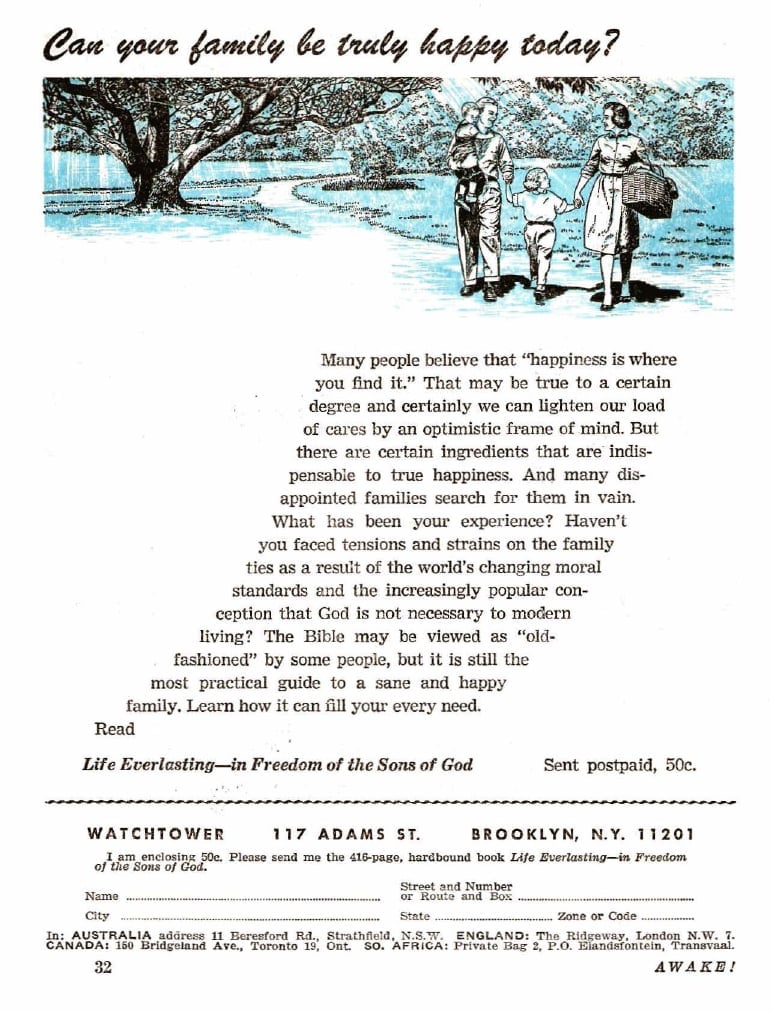
Can your family be truly happy today?
Many people believe that "happiness is where you find it." That may be true to a certain degree and certainly we can lighten our load of cares by an optimistic frame of mind. But there are certain ingredients that are indispensable to true happiness. And many disappointed families search for them in vain. What has been your experience? Haven't you faced tensions and strains on the family ties as a result of the world's changing moral standards and the increasingly popular conception that God is not necessary to modern living? The Bible may be viewed as "old-fashioned" by some people, but it is still the most practical guide to a sane and happy family. Learn how it can fill your every need.
Read
Life Everlasting—in Freedom of the Sons of God
Sent postpaid, 50c.
WATCHTOWER
117 ADAMS ST.
BROOKLYN, N.Y. 11201
I am enclosing 50c. Please send me the 416-page, hardbound book Life Everlasting—in Freedom of the Sons of God.
Name ...
Street and Number
or Route and Box ...
City ...
State ... Zone or Code ...
IN: AUSTRALIA address 11 Beresford Rd., Strathfield, N.S.W. ENGLAND: The Ridgeway, London N.W. 7. CANADA: 150 Bridgeland Ave., Toronto 19, Ont. SO. AFRICA: PRIVATE Bag 2, P.O. Elandstonden, Transvaal.
Why Did God Create Man?
PAGE 5
Expo 67—The World in a Thousand Acres
Acres
PAGE 8
A New Day Dawns in the Land of the Ancient Incas
PAGE19
Bolivia—Where Divisive Barriers Are Being Overcome
PAGE 22
MARCH 22,1967
THE REASON FOR THIS MAGAZINE
News sources that are able to keep you awake to the vital issues of our times must be unfettered by censorship and selfish interests. "Awake!" has no fetters. It recognizes facts, faces facts, is free to publish facts. It is not bound by political ties; it is unhampered by traditional creeds. This magazine keeps itself free, that it may speak freely to you. But it does not abuse its freedom. It maintains integrity to truth.
The viewpoint of "Awake!" is not narrow, but is international. "Awake!" has its own correspondents in scores of nations. Its articles are read in many lands, in many languages, by millions of persons.
In every issue "Awake!" presents vital topics on which you should be informed. It features penetrating articles on social conditions and offers sound counsel for meeting the problems of everyday life. Current news from every continent passes in quick review. Attention is focused on activities in the fields of government and commerce about which you should know. Straightforward discussions of religious issues alert you to matters of vital concern. Customs and people in many lands, the marvels of creation, practical sciences and points of human interest are all embraced in its coverage. "Awake!" provides wholesome, instructive reading for every member of the family.
"Awakel!" pledges itself to righteous principles, to exposing hidden foes and subtle dangers, to championing freedom for all, to comforting mourners and strengthening those disheartened by the failures of a delinquent world, reflecting sure hope for the establishment of God's righteous new order in this generation.
Get acquainted with "Awake!" Keep awake by reading "Awake!"
(1) — — — — (2) — — — —
PUBLISHED SEMIMONTHLY BY
WATCHTOWER, BIBLE AND TRACT SOCIETY OF NEW YORK, INC.
117 Adams Street
N. H. KNOR, President
Brooklyn, N.Y. 11201, U.S.A.
GRANT SUTTER, Secretary
Average printing each issue: 4,475,000 Five cents a copy
Five cash a copy
Offers
America, U.S., 117 Adams Street, Seattle, 11201 81
Australia, 11 Streddale Road, Streddale, N.S.W. 81
Canada, 150 Bridgland Ave., Toronto 19, Out. $1
England, Wash. Tower House, Toronto 19, Out. 7/0
New Zealand, 623 New North Bd., Auckland S.W. 1 7/0
South Africa, Private Bag 2, P.O. Elandtown, TN. 7/0
(Monthly editions cost half the above rates).
Remittances for subscriptions should be sent to the office in
Kansas or expatriates are sent at least two weeks before
submission expires.
Now published in 26 languages
Semimonthly — Afrikaans, Cebuano, Danish, Dutch, English, Finnish, French, German, Greek, Italian, Dutch, Japanese, Korean, Norwegian, Portuguese, Spanish, Swedish, Tagalog, Zulu.
Monthly Chinese, Clayanja, Hillgaynen, Malsyalan, Polish, Tacnil, Christanan.
CHANGES OF ADDRESS should reach us thirty days before your moving data. Give us your old and new address, your old address label, Write Watchtower, 117 Adams Street, Brooklyn, New York 11201, U.S.A.
Second-class postage paid at Brooklyn, N.Y. Printed in U.S.A.
The Bible translation regularly used in "Awake!" is the New World Translation of the Holy Scriptures, 1961 edition. When other translations are used, this is clearly marked.
(1) — — — — — (2) — — — — — (3) — — — — — (4) — — — — — (5) — — — — — (6) — — — — — (7) — — — — — (8) — — — — — (9) — — — — — (10) — — — — — (11) — — — — — (12) — — — — — (13) — — — — — (14) — — — — — (15) — — — — — (16) — — — — — (17) — — — — — (18) — — — — — (19) — — — — — (20) — — — — — (21) — — — — — (22) — — — — — (23) — — — — — (24) — — — — — (25) — — — — — (26) — — — — — (27) — — — — — (28) — — — — — (29) — — — — — (30) — — — — — (31) — — — — — (32) — — — — — (33) — — — — — (34) — — — — — (35) — — — — — (36) — — — — — (37) — — — — — (38) — — — — — (39) — — — — — (40) — — — — — (41) — — — — — (42) — — — — — (43) — — — — — (44) — — — — — (45) — — — — — (46) — — — — — (47) — — — — — (48) — — — — — (49) — — — — — (50) — — — — — (51) — — — — — (52) — — — — — (53) — — — — — (54) — — — — — (55) — — — — — (56) — — — — — (57) — — — — — (58) — — — — — (59) — — — — — (60) — — — — — (61) — — — — — (62) — — — — — (63) — — — — — (64) — — — — — (65) — — — — — (66) — — — — — (67) — — — — — (68) — — — — — (69) — — — — — (70) — — — — — (71) — — — — — (72) — — — — — (73) — — — — — (74) — — — — — (75) — — — — — (76) — — — — — (77) — — — — — (78) — — — — — (79) — — — — — (80) — — — — — (81) — — — — — (82) — — — — — (83) — — — — — (84) — — — — — (85) — — — — — (86) — — — — — (87) — — — — — (88) — — — — — (89) — — — — — (90) — — — — — (91) — — — — — (92) — — — — — (93) — — — — — (94) — — — — — (95) — — — — — (96) — — — — — (97) — — — — — (98) — — — — — (99) — — — — — (100) — — — — — (101) — — — — — (102) — — — — — (103) — — — — — (104) — — — — — (105) — — — — — (106) — — — — — (107) — — — — — (108) — — — — — (109) — — — — — (110) — — — — — (111) — — — — — (112) — — — — — (113) — — — — — (114) — — — — — (115) — — — — — (116) — — — — — (117) — — — — — (118) — — — — — (119) — — — — — (120) — — — — — (121) — — — — — (122) — — — — — (123) — — — — — (124) — — — — — (125) — — — — — (126) — — — — — (127) — — — — — (128) — — — — — (129) — — — — — (130) — — — — — (131) — — — — — (132) — — — — — (133) — — — — — (134) — — — — — (135) — — — — — (136) — — — — — (137) — — — — — (138) — — — — — (139) — — — — — (140) — — — — — (141) — — — — — (142) — — — — — (143) — — — — — (144) — — — — — (145) — — — — — (146) — — — — — (147) — — — — — (148) — — — — — (149) — — — — — (150) — — — — — (151) — — — — — (152) — — — — — (153) — — — — — (154) — — — — — (155) — — — — — (156) — — — — — (157) — — — — — (158) — — — — — (159) — — — — — (160) — — — — — (161) — — — — — (162) — — — — — (163) — — — — — (164) — — — — — (165) — — — — — (166) — — — — — (167) — — — — — (168) — — — — — (169) — — — — — (170) — — — — — (171) — — — — — (172) — — — — — (173) — — — — — (174) — — — — — (175) — — — — — (176) — — — — — (177) — — — — — (178) — — — — — (179) — — — — — (180) — — — — — (181) — — — — — (182) — — — — — (183) — — — — — (184) — — — — — (185) — — — — — (186) — — — — — (187) — — — — — (188) — — — — — (189) — — — — — (190) — — — — — (191) — — — — — (192) — — — — — (193) — — — — — (194) — — — — — (195) — — — — — (196) — — — — — (197) — — — — — (198) — — — — — (199) — — — — — (200) — — — — — (201) — — — — — (202) — — — — — (203) — — — — — (204) — — — — — (205) — — — — — (206) — — — — — (207) — — — — — (208) — — — — — (209) — — — — — (210) — — — — — (211) — — — — — (212) — — — — — (213) — — — — — (214) — — — — — (215) — — — — — (216) — — — — — (217) — — — — — (218) — — — — — (219) — — — — — (220) — — — — — (221) — — — — — (222) — — — — — (223) — — — — — (224) — — — — — (225) — — — — — (226) — — — — — (227) — — — — — (228) — — — — — (229) — — — — — (230) — — — — — (231) — — — — — (232) — — — — — (233) — — — — — (234) — — — — — (235) — — — — — (236) — — — — — (237) — — — — — (238) — — — — — (239) — — — — — (240) — — — — — (241) — — — — — (242) — — — — — (243) — — — — — (244) — — — — — (245) — — — — — (246) — — — — — (247) — — — — — (248) — — — — — (249) — — — — — (250) — — — — — (251) — — — — — (252) — — — — — (253) — — — — — (254) — — — — — (255) — — — — — (256) — — — — — (257) — — — — — (258) — — — — — (259) — — — — — (260) — — — — — (261) — — — — — (262) — — — — — (263) — — — — — (264) — — — — — (265) — — — — — (266) — — — — — (267) — — — — — (268) — — — — — (269) — — — — — (270) — — — — — (271) — — — — — (272) — — — — — (273) — — — — — (274) — — — — — (275) — — — — — (276) — — — — — (277) — — — — — (278) — — — — — (279) — — — — — (280) — — — — — (281) — — — — — (282) — — — — — (283) — — — — — (284) — — — — — (285) — — — — — (286) — — — — — (287) — — — — — (288) — — — — — (289) — — — — — (290) — — — — — (291) — — — — — (292) — — — — — (293) — — — — — (294) — — — — — (295) — — — — — (296) — — — — — (297) — — — — — (298) — — — — — (299) — — — — — (300) — — — — — (301) — — — — — (302) — — — — — (303) — — — — — (304) — — — — — (305) — — — — — (306) — — — — — (307) — — — — — (308) — — — — — (309) — — — — — (310) — — — — — (311) — — — — — (312) — — — — — (313) — — — — — (314) — — — — — (315) — — — — — (316) — — — — — (317) — — — — — (318) — — — — — (319) — — — — — (320) — — — — — (321) — — — — — (322) — — — — — (323) — — — — — (324) — — — — — (325) — — — — — (326) — — — — — (327) — — — — — (328) — — — — — (329) — — — — — (330) — — — — — (331) — — — — — (332) — — — — — (333) — — — — — (334) — — — — — (335) — — — — — (336) — — — — — (337) — — — — — (338) — — — — — (339) — — — — — (340) — — — — — (341) — — — — — (342) — — — — — (343) — — — — — (344) — — — — — (345) — — — — — (346) — — — — — (347) — — — — — (348) — — — — — (349) — — — — — (350) — — — — — (351) — — — — — (352) — — — — — (353) — — — — — (354) — — — — — (355) — — — — — (356) — — — — — (357) — — — — — (358) — — — — — (359) — — — — — (360) — — — — — (361) — — — — — (362) — — — — — (363) — — — — — (364) — — — — — (365) — — — — — (366) — — — — — (367) — — — — — (368) — — — — — (369) — — — — — (370) — — — — — (371) — — — — — (372) — — — — — (373) — — — — — (374) — — — — — (375) — — — — — (376) — — — — — (377) — — — — — (378) — — — — — (379) — — — — — (380) — — — — — (381) — — — — — (382) — — — — — (383) — — — — — (384) — — — — — (385) — — — — — (386) — — — — — (387) — — — — — (388) — — — — — (389) — — — — — (390) — — — — — (391) — — — — — (392) — — — — — (393) — — — — — (394) — — — — — (395) — — — — — (396) — — — — — (397) — — — — — (398) — — — — — (399) — — — — — (400) — — — — — (401) — — — — — (402) — — — — — (403) — — — — — (404) — — — — — (405) — — — — — (406) — — — — — (407) — — — — — (408) — — — — — (409) — — — — — (410) — — — — — (411) — — — — — (412) — — — — — (413) — — — — — (414) — — — — — (415) — — — — — (416) — — — — — (417) — — — — — (418) — — — — — (419) — — — — — (420) — — — — — (421) — — — — — (422) — — — — — (423) — — — — — (424) — — — — — (425) — — — — — (426) — — — — — (427) — — — — — (428) — — — — — (429) — — — — — (430) — — — — — (431) — — — — — (432) — — — — — (433) — — — — — (434) — — — — — (435) — — — — — (436) — — — — — (437) — — — — — (438) — — — — — (439) — — — — — (440) — — — — — (441) — — — — — (442) — — — — — (443) — — — — — (444) — — — — — (445) — — — — — (446) — — — — — (447) — — — — — (448) — — — — — (449) — — — — — (450) — — — — — (451) — — — — — (452) — — — — — (453) — — — — — (454) — — — — — (455) — — — — — (456) — — — — — (457) — — — — — (458) — — — — — (459) — — — — — (460) — — — — — (461) — — — — — (462) — — — — — (463) — — — — — (464) — — — — — (465) — — — — — (466) — — — — — (467) — — — — — (468) — — — — — (469) — — — — — (470) — — — — — (471) — — — — — (472) — — — — — (473) — — — — — (474) — — — — — (475) — — — — — (476) — — — — — (477) — — — — — (478) — — — — — (479) — — — — — (480) — — — — — (481) — — — — — (482) — — — — — (483) — — — — — (484) — — — — — (485) — — — — — (486) — — — — — (487) — — — — — (488) — — — — — (489) — — — — — (490) — — — — — (491) — — — — — (492) — — — — — (493) — — — — — (494) — — — — — (495) — — — — — (496) — — — — — (497) — — — — — (498) — — — — — (499) — — — — — (500) — — — — — (501) — — — — — (502) — — — — — (503) — — — — — (504) — — — — — (505) — — — — — (506) — — — — — (507) — — — — — (508) — — — — — (509) — — — — — (510) — — — — — (511) — — — — — (512) — — — — — (513) — — — — — (514) — — — — — (515) — — — — — (516) — — — — — (517) — — — — — (518) — — — — — (519) — — — — — (520) — — — — — (521) — — — — — (522) — — — — — (523) — — — — — (524) — — — — — (525) — — — — — (526) — — — — — (527) — — — — — (528) — — — — — (529) — — — — — (530) — — — — — (531) — — — — — (532) — — — — — (533) — — — — — (534) — — — — — (535) — — — — — (536) — — — — — (537) — — — — — (538) — — — — — (539) — — — — — (540) — — — — — (541) — — — — — (542) — — — — — (543) — — — — — (544) — — — — — (545) — — — — — (546) — — — — — (547) — — — — — (548) — — — — — (549) — — — — — (550) — — — — — (551) — — — — — (552) — — — — — (553) — — — — — (554) — — — — — (555) — — — — — (556) — — — — — (557) — — — — — (558) — — — — — (559) — — — — — (560) — — — — — (561) — — — — — (562) — — — — — (563) — — — — — (564) — — — — — (565) — — — — — (566) — — — — — (567) — — — — — (568) — — — — — (569) — — — — — (570) — — — — — (571) — — — — — (572) — — — — — (573) — — — — — (574) — — — — — (575) — — — — — (576) — — — — — (577) — — — — — (578) — — — — — (579) — — — — — (580) — — — — — (581) — — — — — (582) — — — — — (583) — — — — — (584) — — — — — (585) — — — — — (586) — — — — — (587) — — — — — (588) — — — — — (589) — — — — — (590) — — — — — (591) — — — — — (592) — — — — — (593) — — — — — (594) — — — — — (595) — — — — — (596) — — — — — (597) — — — — — (598) — — — — — (599) — — — — — (600) — — — — — (601) — — — — — (602) — — — — — (603) — — — — — (604) — — — — — (605) — — — — — (606) — — — — — (607) — — — — — (608) — — — — — (609) — — — — — (610) — — — — — (611) — — — — — (612) — — — — — (613) — — — — — (614) — — — — — (615) — — — — — (616) — — — — — (617) — — — — — (618) — — — — — (619) — — — — — (620) — — — — — (621) — — — — — (622) — — — — — (623) — — — — — (624) — — — — — (625) — — — — — (626) — — — — — (627) — — — — — (628) — — — — — (629) — — — — — (630) — — — — — (631) — — — — — (632) — — — — — (633) — — — — — (634) — — — — — (635) — — — — — (636) — — — — — (637) — — — — — (638) — — — — — (639) — — — — — (640) — — — — — (641) — — — — — (642) — — — — — (643) — — — — — (644) — — — — — (645) — — — — — (646) — — — — — (647) — — — — — (648) — — — — — (649) — — — — — (650) — — — — — (651) — — — — — (652) — — — — — (653) — — — — — (654) — — — — — (655) — — — — — (656) — — — — — (657) — — — — — (658) — — — — — (659) — — — — — (660) — — — — — (661) — — — — — (662) — — — — — (663) — — — — — (664) — — — — — (665) — — — — — (666) — — — — — (667) — — — — — (668) — — — — — (669) — — — — — (670) — — — — — (671) — — — — — (672) — — — — — (673) — — — — — (674) — — — — — (675) — — — — — (676) — — — — — (677) — — — — — (678) — — — — — (679) — — — — — (680) — — — — — (681) — — — — — (682) — — — — — (683) — — — — — (684) — — — — — (685) — — — — — (686) — — — — — (687) — — — — — (688) — — — — — (689) — — — — — (690) — — — — — (691) — — — — — (692) — — — — — (693) — — — — — (694) — — — — — (695) — — — — — (696) — — — — — (697) — — — — — (698) — — — — — (699) — — — — — (700) — — — — — (701) — — — — — (702) — — — — — (703) — — — — — (704) — — — — — (705) — — — — — (706) — — — — — (707) — — — — — (708) — — — — — (709) — — — — — (710) — — — — — (711) — — — — — (712) — — — — — (713) — — — — — (714) — — — — — (715) — — — — — (716) — — — — — (717) — — — — — (718) — — — — — (719) — — — — — (720) — — — — — (721) — — — — — (722) — — — — — (723) — — — — — (724) — — — — — (725) — — — — — (726) — — — — — (727) — — — — — (728) — — — — — (729) — — — — — (730) — — — — — (731) — — — — — (732) — — — — — (733) — — — — — (734) — — — — — (735) — — — — — (736) — — — — — (737) — — — — — (738) — — — — — (739) — — — — — (740) — — — — — (741) — — — — — (742) — — — — — (743) — — — — — (744) — — — — — (745) — — — — — (746) — — — — — (747) — — — — — (748) — — — — — (749) — — — — — (750) — — — — — (751) — — — — — (752) — — — — — (753) — — — — — (754) — — — — — (755) — — — — — (756) — — — — — (757) — — — — — (758) — — — — — (759) — — — — — (760) — — — — — (761) — — — — — (762) — — — — — (763) — — — — — (764) — — — — — (765) — — — — — (766) — — — — — (767) — — — — — (768) — — — — — (769) — — — — — (770) — — — — — (771) — — — — — (772) — — — — — (773) — — — — — (774) — — — — — (775) — — — — — (776) — — — — — (777) — — — — — (778) — — — — — (779) — — — — — (780) — — — — — (781) — — — — — (782) — — — — — (783) — — — — — (784) — — — — — (785) — — — — — (786) — — — — — (787) — — — — — (788) — — — — — (789) — — — — — (790) — — — — — (791) — — — — — (792) — — — — — (793) — — — — — (794) — — — — — (795) — — — — — (796) — — — — — (797) — — — — — (798) — — — — — (799) — — — — — (800) — — — — — (801) — — — — — (802) — — — — — (803) — — — — — (804) — — — — — (805) — — — — — (806) — — — — — (807) — — — — — (808) — — — — — (809) — — — — — (810) — — — — — (811) — — — — — (812) — — — — — (813) — — — — — (814) — — — — — (815) — — — — — (816) — — — — — (817) — — — — — (818) — — — — — (819) — — — — — (820) — — — — — (821) — — — — — (822) — — — — — (823) — — — — — (824) — — — — — (825) — — — — — (826) — — — — — (827) — — — — — (828) — — — — — (829) — — — — — (830) — — — — —
CONTENTS
Worried About What
the Neighbors Think? 3
Why Did God Create Man? 5
in a Thousand Acres 8
Colombia—A Fertile Land 13
Ecuador Welcomes News
of a Brighter Future 16
A New Day Dawns in the Land of the Ancient Incas 19
Bolivia—Where Divisive Barriers Are Being Overcome 22
Chile—Land of Many Latitudes 25
"Your Word Is Truth"
Why Was the Fruit Forbidden? 28
Worried About What the Neighbors Think?
THERE are people who spend a good part of their lives worrying about what the neighbors think of them. Their concern on this point dominates all their actions in and around the home. You might say they almost become enslaved to their neighbors, for every major consideration takes into account the question of how to hold on to the respect and approval of the people next door. On the other hand, there are those who go to the other extreme, for they care nothing at all about what their neighbors think. Now, what is the balanced view to take toward one's neighbor?
All things considered, neighbors are good to have. So often it turns out that we need them. In emergencies they are often the first to respond. A bond of mutual protection can build up. You look after their interests when they are away, and they do the same for you. When you leave on an extended trip, it is good to know that someone will keep an eye on things for you. How pleasant, too, to exchange a few words with them morning or evening and, on the basis of what you
learn about them, practice empathy in your dealings with them!
However, worrying about what the neighbors think is quite a different matter. It is amazing what such worry can make one do. There is the woman, for example, who insists that her family keep their conversations to a whisper for fear the noise will bother the neighbor. If they do raise their voices, she begins closing all the windows.
In other households where worry about neighbors is evident, the front lawn and the back garden become merely ornamental but useless places. Why? Because to spend time in either would put one under the critical eyes of the neighbors.
This preoccupation with what the neighbors think may even drive one into a materialistic way of life. Great numbers of people strive to put on as good a front as the neighbor, having just as good a car, just as big a TV aerial, and so on. Advertising capitalizes on this inclination, stimulating one's desire for articles that are really "status symbols." Many a householder has become engulfed in debt due to efforts to keep up with the Joneses.
How frustrating it can be to be caught in this very common snare!
But what about your neighbor? Who is he? For the most part he is simply another person very much like yourself. Financially, he may not be any better off than you yourself. If he does possess a lot of material things, much more than you do, don't forget that a large percentage of the population is struggling to keep above water, so to speak, as they pay and pay and pay for the things they purchased on credit. If you were to have a talk with him you would doubtless find that he respects you if you are one who has not been drawn into the scramble for status symbols.
There are times, however, when we should care about what the neighbors think. Christians are not extremists. They cannot be oblivious to others. They cannot be like the man depicted on the front cover of a popular magazine. From the one house that showed every sign of neglect came this man, all smiles, heading for his economy car with his golf clubs. It is true he looked carefree, but it is also true that he was demonstrating indifference to responsibility.
However, an exaggerated concern over the folks next door can produce bad results. This may be the real reason why some people refuse to invite to their home friends who are poor, or of some other nationality, race or religion. This may account for the fear of some to display a Bible in their home. Young people, particularly, fear religious discussion or open identification with the Bible for fear of being dubbed "old-fashioned" by their neighbors.
If you are doing what is right, then there is no reason to worry over what the neighbors think. In fact, if they are upright people, your good example will move them to speak well of you. How many people wish today they had the courage of their convictions, courage to refer to the Bible and support it, courage to study it with family and friends, courage to invite all their friends to their home, irrespective of race or social standing! And decent people admire such courage and will admire you when you display it in their neighborhood.
When a young mother was asked whether she worried about what her neighbors thought of her having a group Bible study in her home, she replied: "I want them to know that I have a Bible study group here, that we are Jehovah's witnesses. They may not care for what we believe, but knowing that we study the Bible gives them a greater sense of security. They know we're not going to do anything to harm them. Also, their knowing is a greater safeguard for me, for it forces me to live up to my Christian convictions." Such a stand cannot but be admired by honest persons.
But how can one break free from neighbor fear and gain this courage? The only way is by developing first a proper love for God and a desire to do his will. This can be done through study of the Bible and by gaining a deep appreciation of its fine principles. God's Word is the truth, and it is this truth that sets men free from bondage to improper fears. (John 8:32) Once we have gained the fear to displease God in any way, we are then in position to love our neighbor in a proper way. Then we shall certainly want to do to our neighbor what we would like him to do to us.
WHEN you look around at the misery and poverty so prevalent, it is understandable that you might wonder: What was God's purpose in creating man? Was it only to live out a life-span of some seventy or eighty years on earth, and then cease to exist? Is there any hope for man beyond the few short years that he now lives? It is only natural that you should desire authoritative answers to such vital questions.
Man's own organism testifies that he was created by God for the purpose of living on earth, not in heaven or on any other of the planets in the solar system. In every way the earth is perfectly suited for man, and man for the earth. Note how God's instructions to the newly created human pair emphasize where their proper place would be: "God blessed them and God said to them: 'Be fruitful and become many and fill the earth and subdue it, and have in subjection the fish of the sea and the flying creatures of the heavens and every living creature that is moving upon the earth.'"—Gen. 1:28.
But how long did God purpose that man should live upon earth? Was the earth simply to be a temporary abiding place to prepare persons for heavenly life as spirit creatures?
Death—A Blessing or a Curse?
The lot of the first man is very apparent—he died. And it is equally obvious that all his descendants down to this day continue to be subject to death. The Bible explains the reason for this unfortunate circumstance. It shows that, after creating man, God gave him certain instructions, one of which carried with it a sanction for disobedience: "You will positively die." (Gen. 2:17) The first man failed to listen to God, disobeyed him, and suffered the death penalty. And the liabilities of sin and death have been inherited by the entire human race that sprang from him. —Rom. 5:12.
But if the first man Adam had not disobeyed, would he have died? Could he and his offspring have lived on indefinitely here on earth if he had remained obedient? Did God purpose for man to break His law and experience physical death?
Since death was the penalty for disobedience, it logically follows that obedience would have been rewarded with continued life for the first human pair. They would have been able to carry out God's instructions to be fruitful, to produce righteous, sin-free children, and to subdue the whole earth, cultivating it to the same paradise state as the beautiful garden of Eden in which they had been placed by God.
What a pleasant home the earth could have been under such conditions! God certainly did not foreordain that man disobey Him and bring upon himself and all his yet unborn children the death penalty.
Some persons, however, will disagree. They argue that the earth is only a testing ground, a springboard, as it were, to heavenly life. Man's physical death, they say, was to open the way for him to leave earth and enter heaven. But if this were true, would it not mean that sin and death were blessings to man? Could we not, then, rejoice that the first human pair rebelled against God and brought upon themselves the death penalty? Yet, rather than describing death as a blessing, the Bible identifies it as a curse, an enemy, and says: "As the last enemy, death is to be brought to nothing."—1 Cor. 15:26.
How Was Man Made?
To determine God's purpose in creating man, it is important to know just how God made him. How did death affect the first man Adam? Did he lose by it, or did he profit by it? Did God create him in such a way that he could die physically, yet, at the same time, live on in a spiritual realm? Was Adam a single individual, or two persons in one? Some persons will argue that God made man in two parts—body and soul—and that the soul can exist separate and distinct from the body. Adam's body died, they say, but his soul was made immortal by God, and so survived the death of his body. Is this true? Is it what the Bible teaches? Let us see.
If Adam was composed of two separate parts, body and soul, what part was responsible for his actions or conduct? What part was it that disobeyed God's command—his body or his soul? If it was his soul,
why did his physical organism experience punishment, as God said: "In the sweat of your face you will eat bread until you return to the ground, for out of it you were taken. For dust you are and to dust you will return"? On the other hand, if it was his body that sinned, why is it claimed that the soul must be saved? —Gen. 3:19.
God announced in advance the penalty if Adam should disobey: "You will positively die." (Gen. 2:17) When Adam sinned, the penalty eventually was enforced. He died. From the dust he was taken, and to the dust he returned. Jehovah God did not make Adam in two distinct parts, so that one part would die and the other could separate and live on eternally in another world. Adam, the soul, sinned; and Adam, the soul, died. The Bible explains: "The soul that is sinning—it itself will die."—Ezek. 18:4.
To understand this better, consider how God made man. It is explained in the Bible at Genesis 2:7, where it says: "God proceeded to form the man out of dust from the ground." Note that God created the human organism from the elements of the earth; but this beautifully shaped human form was not a living person, it was not a living soul. The soul was made when, as the Bible goes on to say, God proceeded "to blow into his nostrils the breath of life, and the man came to be a living soul."
Clearly, then, man himself is a soul; he does not possess a soul that can leave his physical organism to enjoy a separate existence. Man is mortal, being subject to death because of sin. As the Bible pointedly says: "The living [sinners] are conscious that they will die; but as for the dead, they are conscious of nothing at all." (Eccl. 9:5) Adam is in that state. He is not in heaven or suffering in some subterranean hellfire, for he is dead, conscious of nothing at all. The same can be said of the billions of unconscious dead who inherited sin and death from Adam.
Does that mean, then, that all these dead are without hope? Do humans merely procreate, die, and forever cease to exist? What about God's original purpose in connection with the earth, when he told the first human pair to "be fruitful and become many and fill the earth and subdue it"? Will righteous, sin-free persons ever enjoy life in a restored earthly paradise?
God's Purpose to Be Fulfilled
Happily, God has lovingly made provision to recover mankind from the deteriorating effects of sin,
Adam lost for himself
and all his offspring. Note how the
Bible describes His
ransom provision:
"God sent forth his
the Bible prophecy regarding this: "For unto us a child is born, unto us a son is given: and the government shall be upon his shoulder: and his name shall be called Wonderful, Counsellor, The mighty God, The everlasting Father, The Prince of Peace. Of the increase of his government and peace there shall be no end." (Isa. 9:6, 7, Authorized Version) It is this government of God that will soon crush and put an end to all earthly governments in order to usher in righteous conditions on earth.—Dan. 2:44.
Associated with Jesus Christ in this heavenly government will be others who
COMING IN THE NEXT ISSUE
Worship of Dead Ancestors or Love for Living Parents?
When They Get the Keys to a Car.
only-begotten Son into the world that we might gain life through him." "By means of him we have the release by ransom through the blood of that one, yes, the forgiveness of our trespasses." "Christ Jesus . . . gave himself a corresponding ransom for all."—1 John 4:9; Eph. 1:7; 1 Tim. 2:5, 6.
High Blood Pressure.
Further Reports from South America.
Now think about it: If Christ was sent to restore what was lost by Adam's disobedience, what will be restored? Did Adam lose a heavenly home, or the right to life everlasting in an earthly paradise? Why, he lost perfect life in an earthly home! And that is what will be recovered for obedient humankind.
The kingdom for which we pray is the agency that God will use to accomplish his purpose to establish righteous conditions upon earth. (Matt. 6:9, 10) That kingdom is a superhuman government in the hands of the resurrected Jesus Christ, the one who had been born of a Jewish virgin but with God as his Father. Note
are selected from among mankind to rule in heaven. As was Jesus, they, too, are taken into a special covenant for the Kingdom. (Luke 22: 28, 29) The apostle
Paul had this heavenly hope, and, in writing to a fellow Christian with the same hope, he said: "Faithful is the saying: Certainly if we died together, we shall also live together; if we go on enduring, we shall also rule, together as kings." (2 Tim. 2:11, 12) However, only a few from among mankind, just 144,000 in all, are taken from earth to reign as kings with Christ.—Rev. 14:1, 3; 20:6.
The rest of mankind, including the millions of dead who will be brought forth from their graves, will be given full opportunity under righteous conditions to prove their worthiness to enjoy everlasting life in a paradise restored earth wide. Since the rebellion of the first man, God has lovingly made necessary provisions for carrying out his purposes respecting mankind. He originally created man to live forever in happiness on earth, and that purpose is certain to be realized!—John 5:28, 29; 2 Pet. 3:13; Rev. 21:3, 4.
FROM April 28 to October 27,1967,the largest Universal and International Exhibition ever staged will be held at Montreal, Canada. Although its proper name is the 1967 World Exhibition, it is already best known by its brief form, "Expo 67."
But, you ask, did not the New York World's Fair in 1964 rank as the largest ever held? In attendance and expenditures,
yes. But only some forty nations
took part. Already more than seventy nations are due to participate in Expo 67, and there is the possibility that there may be as many as eighty by opening day. This exposition will occupy a thousand acres, compared to New York's 646 acres, and will be about twice the area covered by the Brussels World Exhibition of
It has been estimated that ten million visitors from all parts of the world will pour into this location on two islands and a narrow neck of land in the St. Lawrence River to see, at least representatively, the world in a thousand acres. While the attendance is not expected to reach that of New York's Fair, it can still be said that Expo 67 will be the largest World Exhibition because New York's did not qualify as a world exhibition. Why?
Distinction Between Fairs
The first world exhibition was held in London, England, in 1851. It was such an
outstanding success that many attempts to match it followed on every continent but Asia. The frequency of these made it difficult for the nations to participate with a continuing quality of exhibits. Something had to be done to control matters. Thirty-one nations sent delegations to Paris on November 22, 1928, to try to regulate the frequency of these events and to set standards on the type and nature of
nem. To govern matters, the Bureau of International Exhibitions was established. Rules were set up for conducting world expositions. It was determined, for example, that international exhibitions of the first category may take place only at six-year intervals in the same zone. (The world was divided into three zones: Europe, Pan America and
the rest of the world.) No country would be allowed to put on a first-category exhibition more than once in a fifteen-year period. The Bureau defined a first-category exhibition as one in which the nations taking part are obliged to construct their own national pavilions.
It is explained by the Bureau that world fairs are primarily to stimulate commerce, with little emphasis on the educational aspect. World exhibitions, on the other hand, are not conceived to find buyers immediately, though there may be some commercial benefits, but, rather, are to show the value and usefulness of each nation's products and goods in an area where there can be general comparison.
This makes it an occasion for making a historical record of information about neighboring lands and peoples and their achievements in one time period.
Why International Exhibitions?
In November 1962 Canada was designated by the Bureau of International Exhibitions to be the country to hold the 1967 World Exhibition. An Act of Parliament the following month created the Corporation for the 1967 World Exhibition. Montreal, the largest city in Canada, and the seventh-ranking on the continent, was selected as the most suitable city. Perhaps, surprising to many, it is also the world's second-largest French-speaking city. Canada plans to spend 21 million on its own national pavilion and exhibits as the host country. Total expenditures by all participating nations are expected to be over330 million. Why such a tremendous outlay of funds? What beneficial purpose will it serve? Why do countries and cities vie for the opportunity to hold such events?
According to information distributed by Expo 67, the exhibition affords the occasion for the various countries participating to demonstrate their individual cultures and traditions in comparison with others and also explain their hopes for the future. This is highlighted in the Expo theme: Man and His World. It is developed in the subthemes that exhibits will attempt to amplify, such as: Man the Creator, Man the Explorer, Man the Producer, Man in the Community and Man the Provider. The Expo symbol represents these ideas and seems to express hopes for unity of mankind. It employs a stylized figure of a man with arms stretched upward in a gesture of worship, sets this figure in pairs to represent unity, then makes a complete circle with eight pairs to indicate man around the earth-Man and His World.
For Canada, Expo 67 offers a unique opportunity to capture the attention of the larger nations of the world, as well as to show her people that she has grown up. Also, as Montreal's mayor, Jean Drapeau, puts it, "Tits people, like other peoples represented, will wish to make themselves better known, understood and loved." Therefore, some of her displays will endeavor to show the way Canadians have tried to contribute to the advancement of international understanding and goodwill.
All this comes in the year of the Centennial of Canada's Confederation, and Expo 67 will be the highlight of many expressions of this year-long celebration. It is also the anniversary of the founding of Montreal 325 years ago.
Other Reasons
However, there is no denying the commercial advantages of this exposition. While it is true that the 247 million estimated revenue will not altogether offset the330 million expenditures, it is felt not only that this will be a sound investment, but that indirect revenues will make up the difference. Think of the amount of business it will bring to Canada in the form of monies spent for food, lodging and transportation alone! The Brussels Exhibition of 1958 had a decidedly good effect on the economy of that country. From Expo 67, it has been said, the "estimated turnover in terms of business generated in Canada may come close to two billion dollars."
One of the evidences of the appreciation of the commercial value of Expo is the formation of the Business Development Bureau by the Expo Corporation. An International Trade Centre, sponsored by the chartered banks of Canada, will provide quarters for the Bureau and a fully equipped meeting place for Canadian and foreign businessmen.
Then there are the advantages to the city and the nation that will be enjoyed for some time to come. A greatly stepped-up road-building program has brought new four-lane highways to both Canada and nearby New York State. Expo 67 will be a big boost to the tourist trade. Priceless publicity will result when news reports go to places all over the world to tell about Expo 67. A new subway system for Montreal, costing over $213 million, was opened October 14, 1966, and there is the view that its completion was pushed to have it ready in good time for Expo.
Education and Entertainment
What will one see and do at Expo? Let us look around. Montreal's Metro, its subway, will bring us to what was previously called Mackay Pier, a breakwater in Montreal's harbor. This has been extended and built up with four million tons of new land. Here we find the entrance to Expo 67. Off to the right we see Expo Stadium, seating 25,000, which will be the site of a number of international sporting events. As we enter the Expo grounds, the first large structure we see is the Administration and News Pavilion. Next, to the north, is the Art Gallery, housing 160 works of art intended to emphasize the theme, Man and His World. It is in this same area that we find the International Trade Centre mentioned earlier.
At the entrance we can board Expo Express, an electric train on an elevated roadbed, to ride free of charge to the next location we will visit. The Express reaches the four main areas of the exhibition. A secondary means of transportation around the various sites, a minirail system, will branch out from the Express.
As we head out toward the end of the peninsula, and just before we turn to cross
the St. Lawrence River, a striking sight meets the eye. This is Habitat 67. At first glance one thinks he may be looking at irregularly faced cliff dwellings or large crates or boxes carelessly stacked atop one another, but as he looks more closely he is impressed with the fact that he is viewing the city dwelling of the future. With space running out in city after city and with man still having the natural desire to stay close to physical creation, Habitat 67 has been designed to satisfy his needs. The complex is made up of 158 houses of the one- to four-bedroom types, built up to eleven stories. One begins to appreciate that the uneven façade and the staggering of the position of the houses is to allow for each to have plenty of fresh air and sunlight. A relief from flat frontage of which the eye has seen so much, this arrangement is also relaxing, giving a three-dimensional effect. Interestingly, the roof of the house below will make the garden space for the one above. Each unit is made of prefabricated, reinforced concrete, completely equipped, then set in place by a giant crane. A bold concept in city dwelling, it is giving an opportunity to see what can be done with new building techniques.
Now out over the river we go, onto the new Concordia Bridge, spanning the St. Lawrence to Ile Ste-Hélène. The Express stops on a point of land that was recently added to the original island so that the park there would not be ruined. Land was also added by man at the other end to make another area of Expo. To our right, as we get off Expo Express, is the Place des Nations, a 10,000-seat amphitheater in which the many participating nations will stage observances of their national days. On this end of the island will be the crystallike pavilion of Austria, those of Japan, Belgium, Switzerland, Nationalist China and one for the Scandinavian countries, most constructed in traditional styles.
The largest pavilion at this site will be the 187-foot-high geodesic dome of the United States. Made of plastic and glass sheets over a metal frame, it gives the appearance of a giant bubble. Exhibit platforms inside at different levels will present American achievements in the arts and sciences.
Taking Expo Express again, we can cross Le Moyne Channel to Ile NotreDame. This is entirely a man-made island of canals and water basins built for Expo 67. It, and the extensions to Mackay Pier and Ile Ste-Hélène, required twenty-five million tons of fill. One side of it is the dike that forms part of the St. Lawrence Seaway. On the canals and lakes will be shows, gondolas, junks and other watercraft in which the visitor may enjoy a ride. The large basin of water that catches the eye ahead is Regatta Lake, to be the site of numerous aquatic events and contests. It is on this island that we see the towerlike pavilion of Great Britain, rising 200 feet, higher than any other building on these islands. Nearby are those of France and West Germany; and Africa Place—a complex for several African states.
Directly ahead looms the largest of all the pavilions, Canada's $21 million showpiece, with its dominant edifice, Katimavik (Eskimo for "meeting place"), a pyramid turned upside down on its point! Surrounding Katimavik will be the smaller pavilions of the provinces of Canada, the entire grouping covering eleven acres. In all of these, Canada will be trying to show what a people of varying ethnic backgrounds can accomplish in one nation in meeting the challenges of climate and vast distances.
The $15 million Russian Pavilion is also on this island, right there directly across the Le Moyne Channel from where we
saw the United States Pavilion. With emphasis on its industrial and space accomplishments, the 449-foot-long pavilion has as its theme "In the name of man, for the good of man."
Now back to Expo Express for the last leg of the tour. After being inside many buildings and taking in so much knowledge we will welcome this part of Expo! It is the area set aside for entertainment. It will also be the basis for a permanent recreational spot, incorporating some of the best ideas of such famous places as Disneyland and Tivoli Gardens. An international plaza will be set up here so that visitors can shop for the unusual wares and try out the exotic foods of many nations. For more direct entertainment there will be the World Festival, called "the most ambitious and varied entertainment program ever brought to North America." Leading opera, ballet and theater companies, famous orchestras and groups will perform. Besides this there will be much free entertainment, such as touring groups that will perform for those waiting to get into pavilions. Or, if you just want to relax and watch the children play, this area offers that at Children's World, especially designed for ages four to ten, with places for parents to sit. You might also enjoy a casual stroll among the trees and rocks of Ile Ste-Hélène, where there will be an outdoor exhibit of fifty major works of international contemporary sculpture. Truly, every effort is being made to portray man's accomplishments.
Will It Achieve Its Goal?
Well, there it is—the world in a thousand acres! What did you see? The overall picture is one of tremendous human accomplishment in many fields. Of course, there is understandable pride in accomplishment, and this is not bad if the benefit thereof can be unselfishly shared for the common good.
But if it is used as propaganda to boast the superiority of one nation over another nation and people, this is not good. That there will be some display of national pride is to be expected. The national days celebrated in the Place des Nations will emphasize this. The exhibits of scientific and technological advances are usually accompanied with praising the nation that attained them, and its ideologies. One even senses an atheistic note in the Russian Pavilion's slogan, "In the name of man, for the good of man." But it could turn out to be an opportunity for the nations to see that man wants to know how others live and do things, that he is really interested in his neighbor. With an unprejudiced eye he could see that the mere fact that his neighbor has a different way of doing things, different customs, does not make his neighbor inferior or his neighbor's methods wrong. He could see in this practicality and beauty, and evidence of the Creator's purpose to have in humankind abundance with variety, as in all his other handiwork. If there were true love for one's neighbor, this would be possible.
But will a splashy display of material advancements, along with some knowledge of them shared, really make for that love and understanding? Do not these basic desires actually involve the spiritual side of man, and does this not show that man must go deeper to have these things? True, there will be a pavilion sponsored by seven major Christian denominations at the exhibition, but does the history
of Christendom's religions assure understanding, peace and goodwill for the future?
The answer to it all lies in the fact that nations and peoples want to be loved, as the mayor of Montreal indicated in his statement about Canadians. How the peoples around the earth want to be loved! Even the small nations grasping for recognition, like a small child trying to get attention, are really desperately seeking to be loved, not taken advantage of by others. How reasonable the Christian command to 'love your neighbor as yourself!' (Luke 10:27) Hence, to be loved, one must first take positive steps to love others, as Christ taught. (Matt. 7:12) Events like Expo 67 could be wonderful occasions for man to get to know more about 'man and his world.' But he will never learn this to his lasting benefit until he shifts the emphasis to learning about the Source of 'man and his world,' as well as the Source of love.
Nevertheless, Expo 67 will without doubt be educational and, in some measure, beneficial. At least, the individual who visits can learn much about others of the human family that can be used for good. Advancing knowledge in any field will not hurt mankind. It can wipe away groundless fears, superstitions and prejudices. In the case of many who have always wished they could travel around the world and visit the many different kinds of people and observe their customs and manner of life, Expo 67 will offer an opportunity to do that at one site—the world in a thousand acres!
WHICH IS THE LARGEST?
Each year all the giant blast furnaces of the world are said to produce a half billion tons of steel. Dwarfing this production is the work of tiny units of life-cells of green plants. In the same period of time, they will take 100 billion tons of carbon and transform it into life-sustaining fats, sugar, starches and proteins. During this process, these small cells release oxygen, supplying us with fresh air to breathe.
ORDERING on the Republic of Panama, with 710 miles of coast on the Caribbean Sea and 580 miles on the Pacific, Colombia was the first South American
country encountered on our tour of the "God's Sons of Liberty" International Assemblies. On our way to the industrial port city of Barranquilla, where the branch office of the Watch Tower Society is located and which city was chosen to be the site for an international assembly of Jehovah's witnesses from December 28, 1966, to January 1, 1967, we looked down from the airplane on a green land. Bananas and
Regular readers of Awake! magazine enjoyed the issue of March 8, 1967, with its eyewitness accounts by delegates to the "God's Sons of Liberty" International Assemblies of things they saw and heard in eight lands, from Mexico through to Panama. In the present issue the story of the assembly tour takes you into five lands on the west side of South America, commencing with Colombia.
many tropical foods grow well near the coast of Colombia. If we had the time to visit all parts of Colombia, we would have found a variety of climates, and crops such as coffee, rice, tobacco, cotton, cocoa, sugar and wheat. There are also vast forests in this very fruitful country.
How did it come about that a very Catholic dominated country like Colombia could be a host to an international assembly of Jehovah's witnesses? To be sure, it was to be a new experience for Jehovah's witnesses in Colombia. The first witness of Jehovah began preaching the good news up in the mountains of Colombia in 1922. He became a Witness because he got abold of one Watchtower magazine in 1920. Two years later he was joined by another Witness, and for nearly twenty years these two men were the only witnesses of Jehovah in Colombia. Some seeds of Kingdom truth were scattered by these two Witnesses and a few others, but it was not until Watch Tower missionaries were sent to Colombia in 1946 that the real harvest work began. Colombia is proving itself to be a very fruitful land in the production of praisers of the Almighty God. In a period of about twenty years the number of Kingdom witnesses has increased to the current peak of 4,250, who were in the land to welcome the conventions.
throughout Colombia. For over a year negotiations with city officials over the renting of the Coliseum Cubierto (Covered Coliseum) had been under way. Then success at last as the contract was signed. The search for room accommodations began early and also took much time. Most homes in this and other Colombian cities were already filled to capacity. In fact, one private house approached by a Witness
A great deal of preparatory work had to be done in connection with this five-day event that would bring together some 200 foreign delegates as well as Witnesses and interested persons from 134 congregations and groups
proved to have at least twenty families crowded into its limited space.
The families and friends of Jehovah's witnesses throughout Barranquilla cooperated generously, often doubling up with one another in order to provide rooms and homes for the eagerly awaited delegates. School officials gladly offered empty classrooms free of charge. In one instance a school was made available so that it might serve as dormitory for some 200 male conventioners.
The long-anticipated opening day was nearing. By plane, train and chartered bus, travelers converged on the assembly city. Since roads are often mountainous and unpaved, it meant many patient hours in coming. Jeeps and trucks can hold quite a few passengers, and in they came by the dozens. One canoe load of thirty-six conventioners had the misfortune of losing most of their possessions in a stream when their powered canoe overturned. Yet they came on regardless—why, they could not miss Colombia's biggest assembly!
What would be the effect on this assembly city, where Roman Catholicism has been dominant for so long? No public advertising was attempted and newspapers said little. Would opposition arise as in previous times and attempt to interfere with our program? Perhaps a look into the background of this country will help the reader to appreciate the impact of this "God's Sons of Liberty" Assembly in this land.
The Chibcha Indians once freely roamed this land. But then the Spaniards came with voracious appetites for gold and a determination to exploit the natives in the name of religion and commercial business. Following fast upon the heels of the footloose conquistadores came waves of Spanish civilians intent upon carving a new home and a new life out of these fabulous territories of the viceroyalty of Granada, as Colombia was once known. Then, in the nineteenth century, the echoes of the French Revolution of the previous century sounded across the Americas and revolutionary governments were swept into power.
Whether subject to Spanish monarchy or native republic, the population has always been under the powerful influence of Rome. In fact, even as recently as 1962, by special agreement with the Vatican, the Colombian government granted to the Roman Catholic Church the exclusive right to educate the young. Surely this privilege was not awarded on the basis of merit, for after 450 years of opportunity the Catholic church cannot deny that there is still a great degree of illiteracy in the country, perhaps 30 to 50 percent.
In Colombia today there are powerful currents within and without the church that challenge the medieval tempo of its activities and policies. A large segment of the younger priesthood are at odds with the arch-conservative administration of the Colombian Catholic hierarchy. They want more freedom of intellect and of action, more in line with the spirit of ecumenism of the Vatican II Council. They complain that they have not been able to obtain copies of the full text of the Council's resolutions. They feel that the higher clergy are dragging their feet in the matter of implementing those resolutions. Some of these younger clerics are even inclined to favor the cause of the rebel guerrillas still active in remote areas of Colombia.
Cross overlooking Cartagena, Colombia, is reminder that Catholicism has long dominated the scene
Another challenge to church authority is the sudden spread of birth control education in this land, the enthusiasm for it evinced by thousands of poverty-stricken mothers who see no future for the large families favored by the church. A growing number of mothers are seeking to avoid pregnancy simply because it has become impossible for them to support large families and keep up with what is expected of them in the way of church dues.
Need of Bible Education
Though not appreciated by many, the great need of the people of Colombia, the immediate need, is Bible education. Knowledge of the Bible would bring them hope for a happy future. It would inculcate good principles and combat the increasing trend toward more and more dishonesty and immorality found all over the world nowadays. Not a religion of ritual do the people need, but a practical religion that will promote among its disciples the qualities of love, peaceableness and generosity that are so sadly lacking in the modern scene.
In their ministry from house to house Jehovah's witnesses advocate just such a program of Bible education. And in furtherance of such a beneficial service among the people this "God's Sons of Liberty" Assembly had been called. How many Colombians would respond? Would many manifest appreciation for Bible truth and its relation to the problems of today? The developments of our assembly would furnish the answer.
At the Coliseum the program highlighted Bible dramas enacted by Witnesses dressed in brilliantly colored costumes. The fine principles of honesty, truthfulness and courage to stand up for the truth were most effectively portrayed. Of special interest were the scenes graphically warning against immorality and bad associations.
On Thursday evening the Covered Colseum rang to the delighted applause of the conventioners when President N. H. Knorr of the Watch Tower Society released a new book in Spanish, Life Everlasting—in Freedom of the Sons of God. Still greater pleasure was manifested when he announced that by May of this year the presses of the Society might be finished with printing the complete New World Translation Bible in Spanish.
Attendance at the public lecture was truly gratifying. Where did all the people come from, all 5,777 who listened so carefully to the speech delivered in Spanish by the Watch Tower Society's vice-president F. W. Franz, "Mankind's Millennium Under God's Kingdom"? Estimating that 2,000 of the number belonged to Barranquilla and 200 were foreign delegates, there must have been over 3,500 there from the interior and coastal regions of the country.
Many others besides Jehovah's witnesses came from far and near.
Despite the poverty and the banditry that still exist in certain areas, many refused to be deterred from attending and enjoying the spiritual blessings of the assembly. We heard of Witnesses who purchased piglets many months in advance so they could fatten and sell them in order to raise enough funds for the trip to Barranquilla. One family flew in from Bogotá with their nineteen children!
A number of buses were chartered by eager conventioners from the Bucaramanga area. Their journey from this interior city passed through some wild and sparsely populated regions. On Sunday evening one returning busload was accosted by two unkempt figures wearing well-worn army uniforms. The bus driver wisely decided not to stop for them, but just stepped on the gas and got away. The following night another one of the chartered buses did stop when confronted by the two men. All the male passengers were ordered out and lined up on the road. The women had to show their pocketbooks. Immediately the Witnesses began to tell the bandits about the Kingdom good news and how they were returning from the wonderful Barranquilla assembly. They displayed their Spanish Watchtower and Awake! magazines. What would happen now? Would the bandits shoot down the men, as they usually do, and then rob the women? No, they had been completely disarmed by the message of the happy conventioners. They took their leave, and it was said they were smiling as they went. The Witnesses, most thankful to Jehovah, arrived home safely the next day.
Reflecting on the highlights of the assembly, we find it satisfying to recall that 179 Colombians bore testimony to their dedication to Jehovah God by offering themselves for public immersion in water.
…