Awake!, December 8, 1966
Download: PDF — Awake!, December 8, 1966
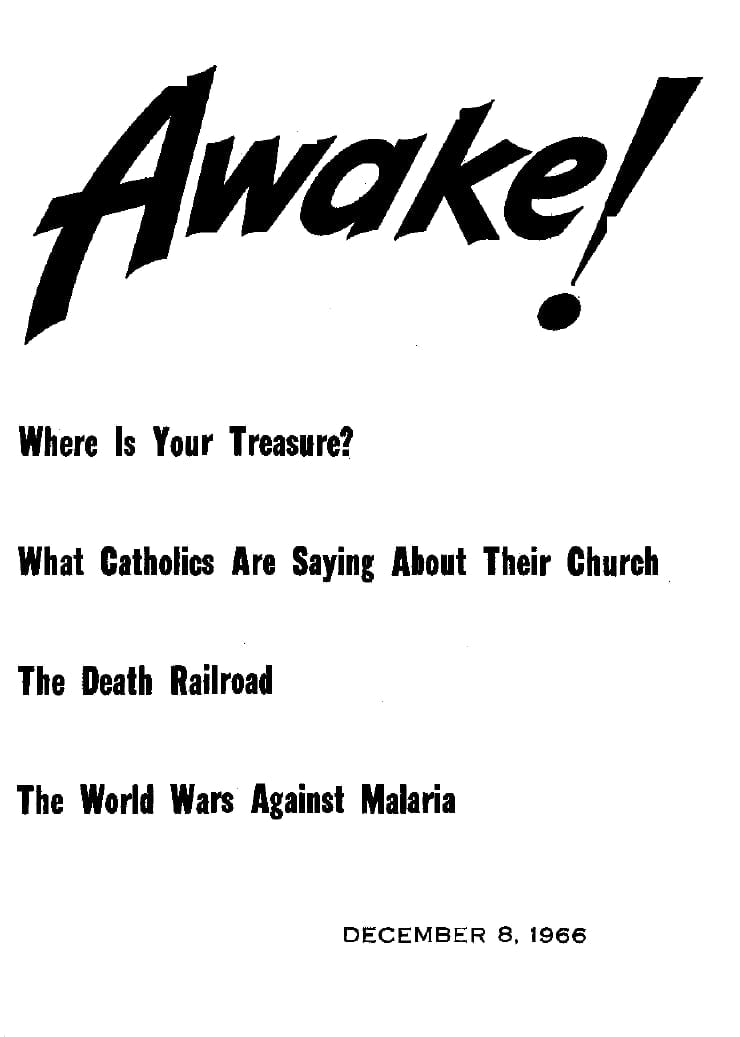
Where Is Your Treasure?
What Catholics Are Saying About Their Church
The Death Railroad
The World Wars Against Malaria
DECEMBER 8,1966
THE REASON FOR THIS MAGAZINE
News sources that are able to keep you awake to the vital issues of our times must be unfettered by censorship and selfish interests. "Awakel" has no fetish. It recognizes facts, faces facts, is free to publish facts, it is not bound by political ties; it is unhampered by traditional creeds. This magazine keeps itself free, that it may speak freely to you. But it does not abuse its freedom. It maintains integrity to truth.
The viewpoint of "Awake!" is not narrow, but is international. "Awake!" has its own correspondents in scores of nations. Its articles are read in many lands, in many languages, by millions of persons.
In every issue "Awake!" presents vital topics on which you should be informed. It features penetrating articles on social conditions and offers sound counsel for meeting the problems of everyday life. Current news from every continent passes in quick review. Attention is focused on activities in the fields of government and commerce about which you should know. Straightforward discussions of religious issues alert you to matters of vital concern. Customs and people in many lands, the marvels of creation, practical sciences and points of human interest are all embraced in its coverage. "Awake!" provides wholesome, instructive reading for every member of the family.
"Awake!" pledges itself to righteous principles, to exposing hidden foes and subtle dangers, to championing freedom for all, to comforting mourners and strengthening those disheartened by the failures of a delinquent world, reflecting sure hope for the establishment of God's righteous new order in this generation.
Get acquainted with "Awake!" Keep awake by reading "Awake!"
n
PUBLISHED SIMULTANEOUSLY IN THE UNITED STATES BY THE WATCHTOWER BIBLE AND TRACT SOCIETY OF NEW YORK, INC.
117 Adams Street Brooklyn, N.Y. 11201, U.S.A.
Average printing each issue: 4,475,000
London N.W. 7, England
GRANT SUITER, Secretary
4d a copy (Australia, Sec. South Africa, 3/4e)
Buses
Australia U.S., 117 Adams Street, Brisbane, 11291
Australia, 11 Forsyth Street, N.S.W. N.
Canada, 160 Bridghead Ave, Toronto, 19. Ont.
England, Wash. Town House
New Zealand, G24 New North Ed., Auckland S.W. 1
New Zealand, Private Bag 2, P.O. Box 1784.
(Monthly ailments sort half the above rates.)
Remittances for subscriptions should be sent to the crime in
Hobart and Australia and your assistance to Rockhampton.
Mails of validation are sent at all cases unless notice
subscriptions expires.
Now published in 26 languages
Sammamah—Artikraeus, Cohomun, Danish, Dutch, English,
French, French, German, Greek, Italian, Japanese,
Korean, Norwegian, Portuguese, Spanish, Swedish, Tagalog,
Zulu.
Monthly—Chinese, Ciyanjee, Hifilayann, Malaysian, Pollin,
Tamil, Ukrainian.
CHANCES OF ADDRESS should reach us as thirty days before your moving data, Give us as your old and new address. Call us at 1-800-722-2222. Watch Tower, Watch Tower Heights, The Rigneyway, London M.W. 7, England.
Sintered as second-class matter at Brooklyn, N.Y. Printed in England
The Bible translation regularly used in "Ankles" in the New World Translation of the Holy Scriptures, 1961 edition. When other translations are used, this is clearly marked.
CONTENTS
Do You Alm High Enough? 3
Where Is Your Treasure? 5
What Catholics Are Saying
About Their Church 8
The Death Railroad 12
Water and the Human Body 15
Generating Electrical Power 16
The World Wars Against Malaria 21
Serving a Useful Purpose 24
Joy in the Face of Tragedy 25
"Your Word Is Truth"
How Should Christians View Mary? 27
Watching the World 29
DO YOU AIM HIGH ENOUGH?
NO, this question does not relate to a failure to aim high enough with a shotgun when hunting fowl. Nor does it relate to aiming high enough as re-
tion, your conduct. Do you have a high standard? Are
you guided by your conscience or by "policy"? You will have a high enough standard at which to aim if you let the Bible dictate your principles. And since we all are God's creatures we are accountable to him and so should be governed by the principles he has set forth in his Word.
gards material success and mundane ambitions. True, some modest and timid souls may not aim high enough in such matters, but most persons are prone to aim too high. This causes them to "cut corners," as the saying goes, to lie, to cheat, to steal and to engage in the futility of gambling, hoping against hope that good fortune will
repeatedly shows. Thus Jesus Christ, God's Son, said: "You must accordingly be perfect, as your heavenly Father is perfect." That truly is a high standard! Of course, Jesus did not mean that we must be free from all imperfections, for by inheritance we all are imperfect, all are sinners. However, we must strive to be perfect as our Father in heaven is perfect by being impartial, fair and just in our dealings with others, which is what Jesus was talking about. Even as God lets the sun shine and the rain fall on the good and the bad, so we should let one set of principles guide us regardless of with whom we happen to be dealing. Do you aim that high? If so, then, for one thing, you will be free from
smile upon them. But all such self-seeking is self-defeating, for the "love of money" or selfish gain is "a root of all sorts of injurious things."—1 Tim. 6:10.
Rather, the question above relates to your guiding principles, the standard of morality by which you set your course of ac-
prejudice.—Matt. 5:48.
Jesus Christ also set a high standard for us in another respect when, continuing, he said: "Take good care not to practice your righteousness in front of men in order to be observed by them." Those who make a display of their generosity are deceiving themselves into thinking that they are liberal when actually they are selfish, being shrewd instead of generous. In showing kindness to our neighbor we ought to aim high, seeking God's approval thereby, not that of men. If we do so, he will reward us, both now and in the future.—Matt. 6:1-4.
One of the foremost followers of Jesus Christ, the apostle Paul, also gave us some food for thought on this matter of having a high standard to aim for, or a high set of principles to guide us.
He said: "We are overturning reasonings and every lofty thing raised up against the knowledge of God; and we are bringing every thought into captivity to make it obedient to the Christ." What a high standard that is! Yes, it is not sufficient for us to watch our actions, or to be careful how we speak, but the high standard the Bible sets for us to aim for begins with thoughts, both those we hear from others and our own. In his "sermon on the mount" Jesus, too, showed that we must not dwell on wrong thoughts.—2 Cor. 10:5; Matt. 5:28.
Truly the Word of God gives us high standards to aim at, high principles by which to be guided! By aiming high we will guard ourselves against carelessness and be the less likely to err seriously as to our conduct. We might liken such efforts to rowing upstream on the Niagara River above the falls. The faster we aim to row the safer we will be, the less likely we will be to find ourselves being swept over the falls to our destruction.
Thus the Christian minister who aims to attend all five meetings of the Christian congregation each week is not likely to find himself 'forsaking the gathering of himself with others.' Likewise, the minister who sets the high standard of engaging in each of the various forms of the ministry every week may not always succeed in doing so every week in the year, but one thing is certain: Never will a month go by without his having had at least some share in that ministry, be the season favorable or unfavorable.—Heb. 10:24, 25; 2 Tim. 4:2.
Yes, aiming high will help us to progress, to do better than we would otherwise do. As someone has well observed: 'You must reach higher than you can grasp.' The apostle Paul recognized his obligation to reach higher than he could grasp, as can be seen from his confession: "What I wish, this I do not practice; but what I hate is what I do. . . . I really delight in the law of God according to the man I am within, but I behold in my members another law warring against the law of my mind and leading me captive." But still he kept on striving and it profited him, enabling him to say, on another occasion: "I browbeat my body and lead it as a slave, that, after I have preached to others, I myself should not become disapproved somehow."—Rom. 7:15-25; 1 Cor. 9:27.
Aiming high has other advantages. It will keep us humble as we note how far short we come of what we aim for, and it will cause us to look more to Jehovah God in prayer and in his Word for guidance, strength and forgiveness. (Isa. 66:2) More than that, by diligently concerning ourselves with stripping off the old personality and putting on the new one, we will keep ourselves occupied and be less inclined to find fault with others, more inclined to be charitable in regard to their failings and less likely to complain about conditions over which we have no control, thereby avoiding the snares of frustration, lawlessness and rebellion.—Col. 3:9, 10.
Truly the Bible is 'a lamp to our feet, a light to our roadway.' By taking its high standards and guiding principles seriously and ever seeking to be governed by them we will be aiming high, as high as it is possible for us to aim. This will result in more peace of mind for ourselves, better relations with our fellowman, and, most important of all, we will be the more likely to please our Maker, Jehovah God.—Ps. 119:105.
Where Is Your Treasure?
IT IS usually easy to determine where a person's treasure is. He makes it known, by what he talks about, reads, about, thinks about, yes, by what is the central or focal point of his life. Music can become the treasure in the lives of some persons. They become completely absorbed in it. That is where their heart is. To other persons, medicine, photography, baseball, space research, or any number of things, can become the treasure on which they set their affections.
Where should it be? In material possessions, or in God's service?
In this modern day, however, the treasure that the majority of people seek after is money and the things it can buy. They spend practically every waking moment thinking how they can earn more money and what they can buy with that money. But is it wise to make material things one's treasure? What occurs when these are lost? It is a tragedy! In 1929, for instance, when the stock market began a nose dive, some people were so upset they committed suicide. Their devotion to money made life meaningless without it.
Really, then, how wise the counsel of Jesus Christ is! In his famous Sermon on the Mount he advised: "Stop storing up for yourselves treasures upon the earth, where moth and rust consume, and where thieves break in and steal. Rather, store up for yourselves treasures in heaven, where neither moth nor rust consumes, and where thieves do not break in and steal. For where your treasure is, there
your heart will be also." —Matt. 6:19-21.
Jesus' treasure was in heaven. His chief love was his heavenly Father, and serving Him. "Look! I am come to do your will," Jesus said. (Heb. 10:9) Everything else took second place. He knew that Jehovah God existed. There was no question about that. And his treasure was his commission to serve his Father and his privilege to accomplish the preaching work his Father commissioned him to do.
So absorbed was Jesus in doing this work that he owned no home and had few material possessions. Once he told a prospective follower: "Foxes have dens and birds of heaven have roosts, but the Son of man has nowhere to lay down his head." Nevertheless, Jesus was genuinely happy and content; more so, in fact, than those who possessed great material riches. —Luke 9:58.
Jesus' apostles also found genuine happiness in storing up treasures in heaven, rather than accumulating material possessions. The apostle Peter told Jesus: "Look! We left all things and have been following you." (Mark 10:28) Peter and his brother Andrew had been fishermen, but at Jesus' invitation they responded, as the scripture says: "At once abandoning the nets, they followed him." Their fellow fishermen, John and James, responded similarly: "At once leaving the boat and their father, they followed him." (Matt. 4:20, 22) Was this a hasty decision later regretted?
Not at all! Here was an opportunity of the ages! To serve Almighty God with his sent-forth Son! How could anything in a material way compare with that privilege?
Faithful Endurance
These apostles stuck with the preaching work for ten, twenty, thirty, forty, yes, more than sixty-five years! They took seriously Jesus' parting instructions to them: "Go therefore and make disciples of people of all the nations." "Be witnesses of me . . . to the most distant part of the earth." They never let up on that preaching work.—Matt. 28:19; Acts 1:8.
After more than thirty years in the ministry Peter exhorted fellow Christians: "Brace up your minds for activity." "Christ suffered for you, leaving you a model for you to follow his steps closely." "Shepherd the flock of God." (1 Pet. 1: 13; 2:21; 5:2) Peter retained his zeal for doing the preaching, despite arrests, prison bonds, harassment by authorities and decades in the ministry. And he was concerned that others maintain a similar urgency about the matter.—Acts 4:18-21; 5:17-29; 12:3, 6-11.
Peter's long-time associate, the apostle John, felt the same way, and that after spending more than sixty-five years in the ministry! John realized the danger, in time, of being sidetracked from doing God's will by material attractions, and was, therefore, prompted to write:
"Do not be loving either the world or the things in the world. . . . because everything in the world—the desire of the flesh and the desire of the eyes and the showy display of one's means of life—does not originate with the Father, but originates with the world. Furthermore, the world is passing away and so is its desire, but he that does the will of God remains forever." John thus stressed the importance
of not allowing love of material things to turn one aside from God's service. —1 John 2:15-17.
Another faithful pursuer of heavenly treasures, the apostle Paul, acknowledged that it is not easy to be a true Christian. Jesus had said that it required sacrifice and endurance under persecution. (Matt. 10:16-23; 16:24, 25) And genuine Christians in Paul's day found this to be true, as Paul wrote: "Down to this very hour we continue to hunger and also to thirst and to be scantily clothed and to be knocked about and to be homeless and to toil, working with our own hands. . . we have become as the refuse of the world, the offscouring of all things."—1 Cor. 4: 11-13.
A Foolish Course?
Do you feel that it was foolish for the apostles and other early Christians to devote their entire lives to the ministry? Was it unwise of them to spend their whole lives doing what Jesus did? Were they the losers because they had little or nothing to show in a material way for their lifetime of work? Was their treasure misplaced? What do you think?
From the standpoint of non-Christians, and, perhaps, of some spiritually weak believers, the apostles were foolish. Their treasure was misplaced. "We are fools because of Christ," Paul acknowledged. At least that is what some thought. And, indeed, Paul admitted, "If Christ has not been raised up, our preaching is certainly in vain, and . . . we are of all men most to be pitied." (1 Cor. 4:10; 15:14-19) But Christ had been resurrected! The apostles had seen him with their own eyes! And he had told them to preach, yes, in all the inhabited earth. So those early Christians were absolutely certain that they were not misguided in storing up treasures in heaven.
After spending more than twenty-five years in the full-time ministry, and while in prison for his preaching, the apostle Paul wrote relative to his convictions. He was not sorry for having given up a promising career in law and its monetary returns, but said: "I do indeed also consider all things to be loss on account of the excelling value of the knowledge of Christ Jesus my Lord. On account of him I have taken the loss of all things and I consider them as a lot of refuse, that I may gain Christ and be found in union with him, . . . to see if I may by any means attain to the earlier resurrection from the dead."
No expense in time or effort was too great; for nothing, absolutely nothing, could compare in value to the reward of God's prize of everlasting life. That is how Paul felt, and it is why he continued in his letter: "Brothers, I do not yet consider myself as having laid hold on it; but there is one thing about it: Forgetting the things behind and stretching forward to the things ahead, I am pursuing down toward the goal for the prize of the upward call of God by means of Christ Jesus." God's reward is certain; it is incomparable! Therefore, how wise the apostles were to seek such treasures!—Phil. 3:8-14; Heb. 6:10-12.
Where Is Your Treasure?
So you must decide: What am I going to make my treasure? Will it be serving God, seeking his favor and blessing? Or will my chief objective in life be pursuing personal interests, such as accumulating material possessions? It has to be one or the other. You cannot successfully choose both. Jesus showed this in his Sermon on the Mount. Immediately after speaking about our heart being where our treasure is, he said:
"The lamp of the body is the eye. If,
then, your eye is sincere [simple; all one way; in focus; generous], your whole body will be bright; but if your eye is bad, your whole body will be dark. If in reality the light that is in you is darkness, how great that darkness is! No one can be a slave to two masters . . . You cannot be slaves to God and to Riches."—Matt. 6: 22-24, NW, 1950 Edition, footnote a.
The eye that functions properly is to the body like a lighted lamp in the dark of night, because with it the body can walk about without stumbling or bumping into something. But to see correctly the eye must be simple, all one way in performing its function, in focus. It must faithfully catch up the light rays from an object and be able to register them in such a way that objects are seen as they really are.
Similarly, the 'eyes of the heart' must be simple, all one way, in focus, in order to see things in their proper perspective, and to motivate you to make the right choice or decision. On the other hand, an out-of-focus 'bad eye' leads to a mistaken estimate of things, resulting in a wrong choice, and the whole body becoming totally dark.—Eph. 1:18.
So when you make your choice, be sure your spiritual vision is clear and sharp. Examine things carefully in proper perspective—in the light of God's Word and the perfect example set by Jesus Christ. True, a new TV, a more luxurious car, a better home, a larger bank account, may make life easier and more comfortable now, but it is foolish to make such things your treasure. It is serving the wrong master! And it will only lead to frustration, unhappiness and death. So make the right choice, the one Jesus and his apostles made. Store up treasures in heaven by putting God's service first in your life. Those treasures you will be able to enjoy forever.
What Catholics are saying ABOUT Their Church
A FEW years ago Pope John XXIII decided that the Catholic church needed to examine herself, or, as he put it, "to let some fresh air in." Therefore, he called for, and eventually opened in Rome, a council of the church's chief prelates and dignitaries from throughout the world. But, as Archbishop Charles Roberts of England observed, "when good Pope John opened the window of the church to let in some fresh air he let in a few typhoons as well."
Catholic leaders have had much to say about their church, and they are still talking. On all levels Catholics are speaking out on a host of topics, often challenging what has long been established to be Catholic doctrine and practice.
Birth Control
life is an offense against the law of God and of nature, and those who indulge in such are branded with the guilt of grave sin." A great many church officials feel that this view needs 'airing out.
Take, for example, the use of contraceptives by married couples. The well-known encyclical on Christian Marriage by Pope Plus XI sums up clearly the official Catholic teaching on this: "Any use whatsoever of matrimony exercised in such a way that the act is deliberately frustrated in its natural power to generate
However, when the subject came up for discussion during the closing days of the ecumenical council in Rome last year, the pope stepped in to prevent further consideration of the matter. Why? Because it was apparently feared that the bishops would press for a radical change in official Catholic teaching, and this would expose the pronouncement of a previous pope to be in error.
But despite the pope's interference, practically everywhere within the Catholic church there remains a call for change. America, a prominent Catholic magazine, in its issue of April 24, 1965, observed: "Many Catholics, including some theologians, have begun to wonder publicly about the wisdom of traditional Catholic teaching on birth control." What do you think? Do you believe that the church is right in the position it has taken?
Another Catholic magazine, The Commonweal of April 16, 1965, took a positive stand on the question, as have also many priests and bishops: "Our own convictions side with those who want a change. We hope that eventually the magisterium will declare in favor of the right of couples to employ whatever methods of family limitation they find to be spiritually, psychologically and scientifically most effective."
Freedom of Worship
Another matter that has come in for much airing is that of religious liberty, and finally the ecumenical council went on record as favoring a measure of religious toleration. But British Cardinal John Heenan pointed to Roman Catholicism's double standard of 'suppressing the religious liberties of others when we are strong' and of demanding freedom of religion in places where 'we are poor and weak,' and reports from Spain and Portugal show that that is still the standard that is being applied.
The cardinal admitted: "It would be idle as well as false to deny the well-known fact that in certain places Protestants have suffered persecution at the hands of Catholics."—Vancouver Sun, September 17, 1965.
Many Catholic leaders at the ecumenical council in Rome made clear that they approve the suppression of the religious activities of non-Catholics whenever this can be achieved. Observed The Catholic World of November 1965 on this matter:
"Some Council opponents of religious liberty still adhere to the notion that the civil liberties of Protestants can only be tolerated in a Catholic state, and tolerated only when the state lacks the power to suppress them. Paradoxically, many who hold this position are staunch anti-Communists and yet they were aligning themselves with the Communist policy of suppression of religious liberty. Some Council Fathers placed in this dilemma would probably say that the Catholic Church is the true Church and that ordinary rules of fair play do not apply so that the Church may consistently claim when it is a minority the very rights it denies when its members constitute a majority of the population of a country."
Do you, too, agree that the Catholic church should suppress the religious freedom of others in your community? It has long been traditional Catholic belief that it is the right thing to do. But what do you think?
Jesuit priest John L. McKenzie indicated why the Catholic church endeavors to suppress other religions when he said this about what is offered to those who are in the Catholic church: "Diluted Christianity
for general consumption has been available in the church for a long time; if we have a peculiarly modern form of it, it may be identified as that form of passive Christianity in which the general membership of the church is treated as delicate children who should not be exposed to the risk of personal decision." (Chicago Daily News, June 12, 1965) Is that how you want to be treated by the church?
The Inquisition and the Jews
What have Catholics been saying about the terrible Inquisition when so-called heretics and Jews were hunted down, tortured on the rack and even burned at the stake simply because of not accepting Catholic doctrine? Hans Küng, dean of the Roman Catholic theological faculty at Germany's Tübingen University, commented on this period of church history, saying: "In the course of the centuries many faults have been committed by and in the Catholic Church against freedom of conscience. . . . The inquisition in particular, with its appalling trials, confiscation of goods, imprisonments, torture, and countless death sentences cannot be justified in any way whatsoever."—San Francisco Examiner, April 1, 1963.
But what of the present, this twentieth century? Kung admits: "Even today the spirit of the Inquisition and unfreedom has not died out."—Time magazine, September 20, 1963.
The recent Vatican Council approved a decree that "decries hatred, persecutions, displays of anti-Semitism, directed against Jews at any time and by anyone." But has the Catholic church in the twentieth century conducted herself in harmony with its sentiments? Are its actions in agreement with its claims? Friedrich Heer, distinguished Catholic historian and lecturer in European history at the University of Vienna, made these frank statements, as found in The Commonweal of February 28, 1964:
"I have to confess that all Catholics, from the highest to the lowest—priests, chaplains, laymen (anti-Semitic to this day)—are co-responsible for the mass murder of the Jews. Not only the thousands of baptized, confirmed and religiously wedded Christians who took a direct part in the mass murders. . . . Not only bishops who, as in Poland and Hungary, drew up anti-Semitic pastoral letters and permitted their publication . . . We have present[ed] to us the frightful failure of Rome from 1933 to 1945." Remember, that is the statement of a noted Catholic and in a Catholic publication. Is the blood-guilt of which he speaks something that you want to continue to share as a member of the church?
Position During Worldly Wars
Roman Catholics often make up a large part of the population of nations that fight in worldly wars. For example, Nazi Germany was a strongly Catholic country, and almost to the last man Catholics supported Hitler's military efforts. Do you believe that this was right? What do prominent Catholics have to say about the church's position during World War II? Catholic historian Gordon Zahn, associate professor of sociology at Loyola University, Chicago, admitted in his book German Catholics and Hitler's Wars, page 202:
"The Catholic Church did at least inadvertently serve the purposes of the Nazi regime to the extent that it formally recognized that regime as Germany's legitimate authority and placed its members under a moral obligation to render civil obedience to that regime. And when war came in 1939, this obligation to obey was given such repeated and fervent emphasis that we may justly conclude that, to all
intents and purposes, the Church did become an agency of social control operating in behalf of the Nazi state insofar as insuring wholehearted Catholic support of the war was concerned."
Throughout his book Zahn offered conclusive evidence to prove that the official statements of "bishops placed [a Roman Catholic] under a moral obligation to fulfill faithfully whatever duties might be required of him. No support of any consequence would have been furnished him had he refused to serve. Indeed, there were at least two instances in which men awaiting execution for such refusal were actually denied access to the sacraments for a time because the prison chaplain interpreted their action as a violation of their Christian duty."—Page 17.
But it was not only in Germany that Catholic prelates supported national war efforts. In practically every country at war they did the same, and still do today, even when it means that they will be fighting and killing fellow Catholics on the other side. Do you believe that is right? Does it identify adherents of the Catholic church as the ones of whom Jesus spoke when he said: "By this shall all men know that you are my disciples, if you have love one for another"?—John 13:35, Catholic Douay Version.
Many thinking Catholics have found the position of the church during worldly wars deplorable, and hoped that at her recent ecumenical council the church would come out with a strong statement against involvement in them. But she did not. This led to the lament in The Commonweal of March 5, 1965: "The person's responsibility for his own actions in war and his right to conscientious objection have been neglected to the point of scandal in the recent teaching and history of the Church, from the submersion of the Catholic conscience in Hitler's war effort to its un questioning role in Allied atrocities at Dresden and Hiroshima."
Study of the Bible
What are Catholic leaders saying about Bible study and preaching? At the recent ecumenical council Catholics received strong encouragement to read the Bible, one decree declaring: "The sacred synod also earnestly and especially urges all the Christian faithful, especially reli-
than in Protestant nations because Roman Catholics in those countries do not practice the principles of their faith. . . Cuba, which is 95 per cent Catholic, was the first western nation to go Communist. Where were the bishops, where were the priests and nuns, and the well-heeled and well-scrubbed laity?"—Toronto Daily Star, October 24, 1964.
Some Catholic leaders have lamented the failure of the church to teach its peo-
gious, to learn by frequent reading of the ple the Bible, especially when comparing divine scriptures." the religious knowl-
And at New York city's famous St. Patrick's Cathedral the congregation not long ago was told: "To be ignorant of the Scriptures is not to know Christ."
COMING IN THE NEXT ISSUE
Peace on Earth—How Will It Come?
* The New Movie "The Bible"
—How Good is It?
Strikes—Powerful Weapon of Labor.
A Visit to the Roof of Southern Africa.
But despite this encouragement to read the Bible, Catholic Bishop Arthur Elchinger observed during the ecumenical
the religious knowledge and activity of Catholics with certain non-Catholics. Our Sunday Visitor of June 3, 1962, asked: Why would a Catholic turn to
Jehovah's witnesses?' and it replied: "The bulletin of a Catholic church in Paris gave the following answer, "Three factors contribute—the discovery of warm and broth-
council: "In most Catholic homes, you don't find a Bible—or if you do, it doesn't have a place of honor." A similar observation was made in Madrid's magazine Agón of July-August 1960 by Catholic priest Mariano Gamo Sanchez, who wrote: "The ignorance of the Bible that we Catholics have is, without doubt, the most important failure of our culture, and of our religious life."
This failure to provide spiritual strength to its people, according to observant Catholic officials, has prepared the way for
erly communities; the discovery of the Bible; the discovery of lively preaching, easily understood. If they had found these things here [in the Catholic Church], they would not have looked elsewhere.'
It is indeed interesting to observe how outspoken Catholics have become on the many controversial issues that affect Christians today. Opening the window, so to speak, has let in a typhoon that has shaken Catholicism. As Bishop Fulton Sheen noted: "We of the Church have been living in a fortress for hundreds of
one ordinance, has prepared the way for godless communism. Jesuit Louis J. Twomey of New Orleans' Loyola University noted: "Roman Catholics must face the fact that communism has been more successful in so-called 'Catholic countries'
years, almost a kind of ghetto, and a fortress that resisted attacks. All this has been changed. There have been breaches and holes made in that fortress. Principally they were made by Pope John."—Wichita Eagle, February 10, 1964.
THE DEATH RAILROAD
By "Awake!" correspondent in Thailand
THEY were standing there deep in thought as they looked at the name of their son in a book entitled "1939-1945, The War Dead of the British Commonwealth and Empire—Kanchanaburi War Cemetery." They stood there for a long time, in silence. There was his name, the date of death, his age. He had died on June 8, 1943, at the age of twenty-one years. It was easy to figure out that he would be forty-four years old now if he were living.
This elderly couple from England had come here, to Thailand, to visit the grave of their son who had died here as a war prisoner during the second world war. Now they were standing at the gate of the cemetery. In the visitors' book they had written their names and also words quoted from the Bible book of Isaiah, chapter 2, verse 4: "They will have to beat their swords into plowshares and their spears into pruning shears. Nation will not lift up sword against nation, neither will they learn war any more."
Unusual Graveyard
"Actually they are not lying in this cemetery but along the railroad," said the man to his wife, as they entered the graveyard.
Before them were the graves of thousands of dead war prisoners side by side. All together, there were 6,982 of them, including 138 whose names are unknown! "How futile the wars of the nations are! How many young lives are destroyed for some selfish reasons!" answered the wife quietly.
"Yes, you are right. In a war neither side actually wins, but both sides lose. I'm
sure there is a countless number of parents mourning for the loss of their sons on both the 'victors' side' and that of the 'defeated,' said the man as he was looking at the tombstones.
Four or five Siamese gardeners moved about the tombstones, watering flowers. At the opposite side of the graveyard stood a tall white cross. Looking at the tombstones, one could see that this one had come from New Zealand and that one from Australia. Their comrade from America had been twenty-four years of age, another one only eighteen years. They had been young men: twenty years, twenty-five years, twenty-two years, thirty years.
As the man and his wife passed through the gate again they stopped to read the following on a plaque: "In honoured remembrance of the fortitude and sacrifice of that valiant company who perished while building the railway from Thailand to Burma during their long captivity."
This graveyard was exceptional in that the persons named on the gravestones had not been buried in this piece of land but had their unmarked graves right alongside the railroad proceeding from Kanchanaburi toward the Burmese border.
A Bridge over the River Kwai
Like many other visitors and tourists, our English friends made a trip to the nearby River Kwai. Of course, they were familiar with the best-seller novel The Bridge over the River Kwai by Pierre Bulle, based on the incidents in these Siamese jungles during World War II. They had also seen the movie based on the novel. But now they were going to see with their own eyes some of those places where their son had had to work with his unfortunate comrades.
And there it was—a bridge over the River Kwai! Not "the" bridge, though. The original had been destroyed and a new one had been constructed later.
The war prisoners had constructed railroad trestles to carry the railroad across the river. This place is called Tambol Tha Makham, and it is said to be the site of Pierre Bulle's story. The name of the river in Siamese is Maenam Khwae Yai, mean"大Khwae River." The river, although shallow most of the year, is wide at this point, several hundred yards wide. The riverbanks are quite high. When the river is in spate during the monsoon season, it becomes a wild torrent.
The English couple started to walk on the bridge, very carefully because it would have been easy to slip and fall into the river. The local people seemed to use this bridge as a footpath. Some of them were even pushing their bicycles along, as they made their way to the other side. Here and there there were projections for pedestrians to step on in order to make way for an approaching train. After reaching the other end of the bridge, they continued a little farther. But with the blazing April sun right above their heads and with absolutely no breeze, they soon began to feel like going back as quickly as possible.
During the months of February, March and April is the hottest season of the year. One could easily picture the difficult circumstances of those who had to do hard work here some twenty-three years ago. With the help of an interpreter, the visitors learned some interesting facts from the local residents. The railroad is called Thang Rodfai Morana, which means "Death Railroad." Some middle-aged natives said they still remember the war prisoners, who were mainly English,
American, Australian and Dutch. The Japanese soldiers treated them very harshly, and they had to work under adverse conditions. They died of different diseases, malnutrition and exhaustion. The food supplies, which came very irregularly, were inadequate, and much of the food was rotten when it arrived. As a result of all this, the prisoners fell victim to dysentery, malaria and pellagra, a vitamin-deficiency disease.
It is said that for every sleeper or crossie that was laid, one Allied soldier died. Added to the prisoners of war were coolies brought from Malaya and the Dutch East Indies (Indonesia) or conscripted in Siam (Thailand) and Burma. The exact number of, those who died is not known. The Japanese kept no records, but it is believed that between 80,000 and 100,000 perished. The Burmese and Malay laborers, too, died by the thousands.
Traveling the "Death Railroad"
As the English visitors walked back to their hotel in the nearby town, they were thinking about these things. The next day they would take a trip on the train along the "Death Railroad," traveling all the way to the terminus, a place called Nam Tok Khao Phang.
The following day our friends bought return tickets to the end of the railroad.
Very cheap!
Less than one United States dollar each. As the train goes only once a day and there is no train coming back the same day, they would have to spend a night in the little village at the other end of the railroad, virtually in the middle of the jungle. But they got to know that there was some kind of hotel in that village.
The ride from Kanchanaburi to Wang Po and on to the Khao Phang Waterfalls is a nice one, incredibly beautiful. It took almost three hours, although it is a trip of only about fifty miles. It was all jungle and great forests filled with wild beasts. Bamboo is plentiful, and the people of the Kanchanaburi province obtain their teakwood from these forests. Occasionally one can hear a peacock calling.
The construction of this railroad was a Japanese project. During the second world war the Japanese troops invaded Thailand. Being in an indefensible position, the country signed a treaty of friendship with the conqueror. The Japanese needed a railroad for better communications to maintain a large army in Burma. The section between Nong Pladuk and Kanchanaburi was fairly easy to build, because the land was flat. But when the constructors reached the banks of the Khwae Yai the difficulties began. Now they had to go through dense jungle with their railroad, around hills and mountains, and over two rivers, Khwae Yai (the River Kwai) and Khwae Noi. All this had to be done in an inhospitable climate.
Two groups worked from the opposite ends, and they were supposed to meet each other. One group, based in Burma, started working on October 1, 1942, at Thanbyuzayat; and the other, based in Thailand, started a little later at Ban Phong. The line was completed by December 1943. Trains began to operate toward the end of October 1943. The trains transported
Japanese troops and supplies. On the Thailand side the railroad had reached the Pass of the Three Pagodas, near the Burmese border, when the Japanese surrendered. The whole line was 263 miles long. In Thailand the railroad line followed the Khwae Nol River up to the Burmese frontier and then on down to Moulmein in Burma.
On their way toward the Nam Tok Khao Phang the English travelers saw the Khwae Noi River gleaming in the distance. But what is this? Suddenly they seemed to be going straight toward a huge rock, a mountain. As they were approaching it they saw a sign from the train window. On it was lettered in Siamese characters "Yud," which means "Stop." And, obeying the sign, the train came to a complete stop.
Almost immediately they began moving again, but very, very slowly. Now the train was traveling high above the river. The railroad track was on wooden beams supported by trestles that were creaking as the train passed over. They noticed that the trestles were right on the base of the limestone cliffs and that the track had to skirt the soft limestone precipices closely. Now they could understand why the train had to travel so slowly. There certainly existed the danger of some pieces of rock falling on the train, especially if the train would cause shaking of the ground.
Looking up, one could see the cliffs curving above the train, leaving a recess in the wall of the rock. At times it seemed as if the protruding cliffs would stick right into the train, the space between the cars of the train and the rocks being only about one inch in some places. On the other side was the Khwae Noi River. It was learned that this long trestle is an original one, that is, constructed by the war prisoners. It certainly is a creaky thing, they thought.
Soon they passed the limestone cliffs, and it was not long until they stopped.
End of the Line
What they saw now was a little village right in the jungle, a few houses. They knew the waterfalls would be less than a mile's walk away, and as there was still about two hours' time till it would grow dark, they decided to walk over. They were walking along when they suddenly came to the end of the railroad track. What? Does not the track go any farther? They knew they were still very far from the Burmese border. It was not until after this trip that they learned that the section between Khao Phang and the Pass of the Three Pagodas had been removed after the war. The State Railways of Thailand had bought the railroad from the Allies for some 50,000,000 baht (about two and a half million dollars). The last section of track, about eighty miles, was poorly constructed and unsafe for commercial use, so it was removed.
As the tropical sun was sending its last rays of the day into this faraway corner of the land, the two visitors returned to the village. From here on one could travel only by a riverboat or by elephant. But tomorrow they would return to Kanchanaburi and on to Bangkok.
for the English couple who had lost their only son there twenty-three years ago. They were absorbed in the thoughts of how sacred life is and how futile are the wars of men.
This trip to the jungle of northwest Thailand was a deep emotional experience
The visitors' book at the Kanchanaburi War Cemetery tells of mankind's desire for peace. As relatives from faraway countries have traveled to see the graveyard monument with the name of their dear son or husband or some other close relative, they have written their thoughts in the book. Expressions can be read, such as "No more war," or, "Is there any hope?"
This elderly English couple do have hope, however, for they have made a diligent study of the Bible and have now found true comfort. They have faith in God's promise that, "as the last enemy, death is to be brought to nothing," by means of God's kingdom and the resurrection. They know that that kingdom will forever end wars and bring in everlasting peace. They expect to meet their son once again under that peaceful new system of things, now so near. Then, he, too, will have the opportunity to learn God's will and gain everlasting life on earth. And, like the elderly English couple, others too can draw courage from these sure promises of the God "who cannot lie."—1 Cor. 15:26; Titus 1:2; Acts 24:15.
Water and the Human Body
♦ It has been estimated that, on the average, water constitutes two-thirds of the weight of the human body. Of course, some parts of the body, such as the bones, contain less water than others. The blood is more than 90 percent water. The gray matter of the brain is about 85 percent water. One physiologist calculated that a man could lose one-half of the protein and nearly all the fat stored in the body without serious danger. However, it would be serious if he lost 10 percent of his body water; a loss of 20 to 22 percent would mean death! With good reason, then, it is necessary to maintain sufficient water in the system.
Generating Electrical Power ID you ever try operating a tran
DID you ever try operating a transistor radio on coconut milk? As unlikely as this may seem, it can be done. In a recent experiment a transistor radio was operated for fifty hours during a forty-five-day period on the electricity generated in such a manner. This is one of many new ways now being developed for producing electrical power that is so vital for our modern way of life.
Despite our dependence upon electricity in our homes, at work, when traveling, when engaged in long-distance communication and even when being entertained, few of us know how it is produced. You might say that it comes from a generator or dynamo, but do you know why a generator produces electricity? Do you know what voltage is and how it can be increased or decreased? Are you familiar with the various ways of obtaining electrical power? Take coconut milk, for example. Why does it produce electricity? The answer has opened a whole new avenue for obtaining usable electrical power.
Coconut milk can become a source of electrical power when it is put into a biochemical fuel cell. Within this cell bacteria break down the milk into formic acid. In the process an electric current is formed that can be drawn off at the rate of 150 watts for every pound of coconut milk when the fuel cell is operated for 1,000 hours or more. But coconut milk is not the only substance that can be used in such cells. Bacterial action upon sugarcane, fruits and yams can also produce electricity. In fact, even waste matter such as sewage and decaying vegetation can be used.
Another type of fuel cell uses hydrogen and oxygen as fuel. As these gases are fed into the cell they combine to form water and in the process produce electricity at a high rate of efficiency. Hydrogen can be replaced as a fuel by other gases such as propane, butane and carbon monoxide. Fuel cells employing hydrogen and oxygen have been used with good success on recent Gemini space flights. With further development they could be the power supply for operating automobiles on electric power. That would eliminate the air-polluting engines we now use.
Great progress is being made in the use of light and heat for producing electrical power. The well-known photoelectric cell in the light meters of cameras, for example, transforms light energy into an electric current that moves the needle of the meter. A material in the cells gives off an electric current when struck by light. Solar panels on artificial satellites and space probes perform a similar work by converting sunlight directly into electricity.
One of several methods in which an electrical current can be produced directly by heat is being used in the Antarctic to operate a radio transmitter that sends out temperature readings.
Sixty buttons of lead telluride are located around four capsules of radioactive strontium-90 in a steel-encased container. The radioactive material provides a heat of 800 degrees F., which the telluride buttons convert directly into 10 watts of electrical power. This continues as long as one side of the buttons is hotter than the other side. By receiving heat from a radioactive, source that can last for many years, the buttons will produce electrical power continuously for a long time.
Discovery of the Electrical Generator
In 1831 an English physicist, Michael Faraday, discovered that when he moved a magnetized metal bar through the center of a hollow coil of wire, electricity was produced. But this happened only when the magnet was moved. His discovery was the beginning of our modern electrical generators, for it was the first time that electricity was produced by mechanical generation. Up until then its production was by chemical means in batteries.
The first battery was developed in 1800 by Alessandro Volta, who discovered that electricity was produced when two different metals, such as iron and copper, were put in contact with each other in the presence of moisture. Using this knowledge, he built the first battery, which was called a voltaic pile. It consisted of stacked copper and zinc plates that were separated by paper or cloth that had been moistened in a salt solution. The chemical action that took place in this pile produced the first steady electrical current. But Faraday's discovery thirty-one years later introduced an entirely new concept in the production of electricity.
The electric current generated when Faraday moved a magnet through a coil of wire was due to the magnetism in the bar. Magnetism is possible when the molecules in an iron bar are lined up in rows rather than jumbled up. Since every molecule has attraction for other molecules, the lined-up molecules pull as a unit and so attract things outside the bar. In an ordinary iron bar their attraction for one another is canceled out because they are in a jumbled state.
Each magnet has lines of force that arch out from one pole and return to the magnet at the opposite pole. These lines of force form the magnet's magnetic field and are the means by which electricity was generated by Faraday when he moved a magnet in the coil of wire. The coil cut through the invisible magnetic lines of force that arched out from the poles of his magnet. By keeping such a magnet moving so that the lines of force are continuously being cut by the wire, a steady current of electricity could be induced in the coil. It is upon this principle, called electromagnetic induction, that our modern electrical generators function.
Sources of Energy for Turning Generators
Because the production of electricity by a generator depends upon a coil of wire cutting through a magnet's lines of force that radiate from its poles, some form of mechanical energy is needed to start and maintain this motion. In big powerhouses located near dams or waterfalls, the mechanical energy of water pressure is used. Water from the dam or from the top of the falls is directed by a pipe against the blades of a huge turbine. As the turbine spins, its shaft turns a huge generator in the powerhouse.
Where water power is not available, steam is usually used. In fact, about two-thirds of the world's electrical power is produced by steam turbines. Usually boilers, heated by coal, provide the steam. In some places, such as New Zealand, the underground steam that produces geysers is harnessed and is a cheap source of power for turning generator turbines. Atomic energy is still another means of getting the needed steam, and its use is steadily expanding. But in the smaller generating plants often used as auxiliary sources of electricity in factories and big office buildings, diesel or gasoline engines turn the generators.
In France a special dam was recently constructed in order to harness the mighty coastal tides of Brittany. On an average day the tide there rises thirty-three feet. As it begins to rise, the twenty-four tunnels leading to twenty-four turbines in the dam are closed until the water is ten feet deep on the seaward side of the dam. Then the water is permitted to rush into the 160-foot-long tunnels where it turns the turbines, each of which has reversible blades that measure sixteen and one-half feet across.
A few hours later when the tide begins going out and the water level on the seaward side of the dam has fallen to where there is a difference of ten feet between it and the water behind the dam, the turbines can be operated in the opposite direction. With all twenty-four turbines in operation, the powerhouse will be able to generate 240,000 kilowatts of electricity from the mechanical energy provided by the tides. A similar power project is under construction in the Soviet Union.
Design of a Generator
of force or by keeping the magnet stationary and moving the coll. It does not matter which moves.
A generator can produce electricity either by moving a magnet so that a stationary coil of wire cuts its magnetic lines
Usually a generator that produces alternating current will have the coils fastened to the stationary framework because it is easier to draw off the current, which in large generators might be 22,000 volts, than when the coils are on the moving part. As the electromagnet on the shaft rotates, its magnetic field is cut by the coils, and this induces an electric current in them. The moving part is called the "rotor" and the stationary part is called the "stator."
As the magnet rotates, the current that is generated in the coils alternates its direction of flow. It will flow in one direction when the north pole of the magnet passes a coil and then flow in the opposite direction when the south pole passes. Such current is called "alternating" or "a-c," and it is the type of current we generally use in our homes and places of business. What is called "direct" current or "d-c" is electricity that always flows in one direction. It is the type that must be used in the electromagnets of a generator because the magnetic field must always be in the same direction. In an a-c generator, direct current is supplied by a small auxiliary generator called an "exciter."
A generator that produces direct current is designed so that the magnet is stationary whereas the coil is on the rotating shaft. Although an alternating current is still produced in the coil as it passes the opposite poles of the stationary magnet, it is kept flowing in one direction by a commutator when it leaves the generator. This is a ring that is in two segments and that is fastened to the shaft with the segments insulated from each other. A wire from the coil is fastened to one half and another wire from the coil is fastened to the other half.
Electric current generated in the coll leaves the generator through one of the segments of the commutator ring. It passes from the ring through a piece of carbon, called a "brush," that rides on the ring, and on into the circuit. The returning current in the circuit enters the generator through the other segment. As the shaft turns, causing the current to reverse its direction, each segment of the ring comes under the opposite brush. The movement of the segments from one brush to the next is timed with the change in direction of the current. Thus the outgoing current always exists from the generator through the same brush, which means the current always moves in the same direction through the outside circuit and is, therefore, direct current.
An alternating generator that produces a current that rises from nothing to its maximum and back to nothing and then rises to maximum and back to nothing in the opposite direction in one-sixtieth of a second is said to be producing a 60-cycle current. The rise and fall is due to the rotating magnet. The maximum is when a pole of the magnet is passing directly opposite a coil, and the low point is when the space between the magnet's poles passes the coil. If the coil is rotating instead of the magnet, the low point is when the coil is parallel with the magnet's lines of force and is not, at the moment, cutting across them.
For a two-pole magnet to produce a 60-cycle current its two poles must pass the coil 60 times a second, which requires the shaft it is on to rotate at 3,600 revolutions a minute. But when a diesel engine that operates at only 600 revolutions a minute is used to turn the rotor, more magnets have to be put on the rotor so as to get the 60-cycle current. This causes six times as many magnetic poles to pass the coil in a minute. These twelve poles produce
the same amount of electrical power as two magnetic poles moving six times as fast.
Volts, Amperes and Watts
Voltage is the original force that pushes the electric current through a circuit. It might be likened to water pressure. The higher water pressure is, the greater is the force that pushes water through a pipe. Voltage acts in the same way with electricity. A high voltage makes it easier for an electric current to overcome resistance in the circuit. When electrical power must be transmitted a great distance, a very high voltage is needed to force the current through the long transmission lines. In some instances as much as 460,000 volts are used. The voltage is raised or lowered by a transformer.
A transformer works on the principle that, if an alternating current is passed through a coil of wire, a similar current is induced in another coil placed near it. If, for example, the primary winding, or coil, in a transformer has 100 turns and the secondary winding, or coil, has 1,000, the voltage will automatically be increased tenfold. Direct current does not cause this effect.
Stepping up the voltage does not increase the amount of electrical power but, rather, the force or pressure of the current. Actually, the rate of flow of electricity is reduced. The unit of measurement of that flow is called an ampere and might be compared with the unit for measuring the flow of water, which is gallons per minute. So when a transformer steps up the voltage tenfold, for example, it decreases the amperage of the current, or the rate of flow, tenfold. Thus a current of 50 amperes at 100 volts that enters the primary winding of a transformer is changed to a current of 5 amperes at 1,000 volts in the secondary winding and can be carried by a lighter wire.
This is one reason for using high voltage when transmitting electrical power to places distant from the generator. Stepping the voltage down by another transformer raises the amperage in direct proportion to the reduction. The process is the reverse of that used to step it up.
The amount of electrical energy produced by a generator is determined by a unit of measurement called a watt. A watt is the power carried by a current of one ampere flowing under an electrical pressure of one volt. One thousand watts equal one kilowatt or 1.34 horsepower. Big generators can produce from five hundred thousand to one million kilowatts of electricity.
Power Networks
In the United States electrical power companies have found it to their advantage to link their various systems into regional networks called "grids." Within a certain region they pool their power resources and then the electrical system they establish thereby is connected with those in other regions.
Among the several reasons for linking electrical systems is a better use of equipment. Each company has certain peak hours of a day when more power is drawn from it than at other hours. During those periods of maximum drain, it can draw power from other parts of the network where the demand is low at the time. This keeps expensive equipment working and creates an economic saving. It also provides greater reliability of service by providing power for companies that experience a breakdown in their equipment.
Electricity 18 Dangerous
With electricity being a very commonplace source of power, you can easily forget that it is dangerous. If you become careless with it, it can kill you. Turning on or even touching a radio, for example, when standing or sitting in a bathtub of water can do just that. Being a good conductor of electricity, water causes the current to go through your body with ease despite the fact that your skin ordinarily has a certain amount of resistance to it. A good policy to follow is never to touch an electrical appliance while in a bathtub or shower, while standing on a wet floor or while hands or feet are wet.
…