Awake!, November 22, 1966
Download: PDF — Awake!, November 22, 1966
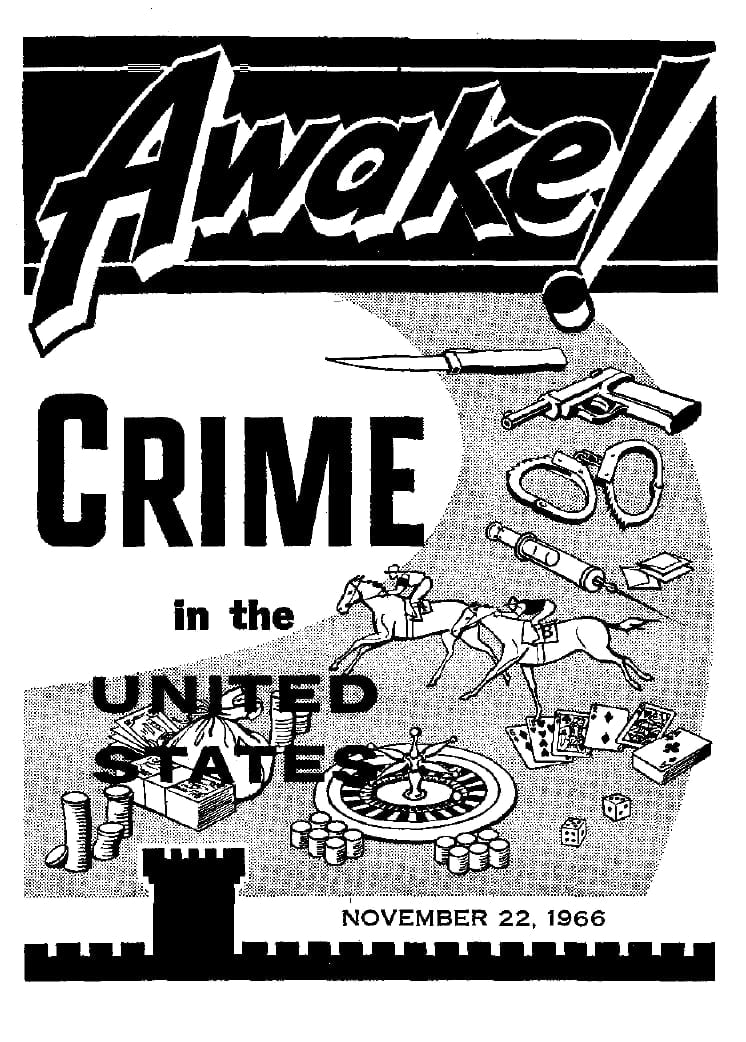
CRIME
NOVEMBER 22,1966
THE REASON FOR THIS MAGAZINE
News sources that are able to keep you awake to the vital issues of our times must be unfettered by censorship and selfish interests. "Awake!" has no fetters. It recognizes facts, faces facts, is free to publish facts. It is not bound by political ties; it is unhampered by traditional creeds. This magazine keeps itself free, that it may speak freely to you. But it does not abuse its freedom. It maintains integrity to truth.
The viewpoint of "Awake!" is not narrow, but is international. "Awake!" has its own correspondents in scores of nations. Its articles are read in many lands, in many languages, by millions of persons.
In every issue "Awakel" presents vital topics on which you should be informed. It features penetrating articles on social conditions and offers sound counsel for meeting the problems of everyday life. Current news from every continent passes in quick review. Attention is focused on activities in the fields of government and commerce about which you should know. Straightforward discussions of religious issues alert you to matters of vital concern. Customs and people in many lands, the marvels of creation, practical sciences and points of human interest are all embraced in its coverage. "Awakel" provides wholesome, instructive reading for every member of the family.
"Awakel" pledges itself to righteous principles, to exposing hidden faes and subtle dangers, to championing freedom for all, to comforting mourners and strengthening those disheartened by the failures of a delinquent world, reflecting sure hope for the establishment of God's righteous new order in this generation.
Get acquainted with "Awake!" Keep awake by reading "Awake!"
H H P H
PUBLISHED SIMULTANEOUSLY IN THE UNITED STATES BY THE WATCHTOWER BIBLE AND TRACT SOCIETY OF NEW YORK, INC. 117 Adams Street Brooklyn, N.Y. 11201, U.S.A. AND IN ENGLAND WATCH TOWER BIBLE AND TRACT SOCIETY Watch Tower House, The Ridgeway London N.W. 7, England N. H. KROK, President GRAND SUFFIT, Secretary
Average printing each issue: 4,475,000
44 a copy (Austria, Sr. Sc. Austria, 35%)
Printing rates for
offices
for centrally edited
America, U.S. 117 Adams Street, Brooklyn, N.Y. 11801 $1
Australia, 11 St. Petersburg, Dc. St. Petersburg, N.S.W. $1
Canada, 11 St. Petersburg, Tromsø, 19. Ocl. $1
England, Walt Disney Town, London, N.W. 7/5
Germany, Leipzig, N.W. 7/5
South Africa, Pretoria 4, P.O. Bristolton, S.W. 7/6
South Asia, Private Bag 4, P.O. Bristolton, S.W. 7/6
(Monthly additions set half the above rates).
Rentitations for subscriptions should be sent to the office in your enquiry. Qubees send your subscriptions to Brooklyn.
Qubees are sent at least 10% the issue before subscriptions expire.
Now published in 26 languages
Sammamimmo — Arkansas, Gainesville, Danish, Dothte, English, Flintia, French, Germain, Greek, Iceland, Italian, Japanese, Kocau, Norwegian, Portuguese, Spanish, Swedish, Tagalog, Zulu
Monthly—Chinese, Chiyanja, Hiligaynon, Malayalam, Polish,
Tamil, Urdu/Hindi.
CHANGES OF ADORESH should reach as thirty days before your morning date. Also info on age and new home address (address Ridgway). Watch Towne, Watch Tower Haas, The Ridgway, London N.W. 7, England.
Entered as second-class matter at Brooklyn, N.Y.
Printed in England
The Bible translation regularly used in "Awake!" In the New World Translation of the Holy Scriptures, 1962 edition.
When other translations are used, this is already marked.
CONTENTS
The Rise of Lawlessness 3
Organized Crime in the United States 5
Tagus River Bridge—Europe's Largest 14
When I Had a Stroke 17
Burns First Bible
—Is Converted by Second 20
How Phonograph Records Are Made 21
How We Teach in the Highlands
of New Guinea 24
"Your Word Is Truth"
Is There Significance
in Biblical Numbers? 27
Watching the World 29
The Rise of Lawlessness
THE mood of America is changing. Crimes of violence are on the increase. There is a growing tendency among citizenry to fight the police, disregard the law, revolt at authority, break out into mass lawlessness, steal and kill at the slightest provocation.
Cleveland, for example, was in a virtual state of siege last summer as National Guardsmen, police and firemen battled arsonists, looters and snipers. Chicago experienced much the same in a three-day riot in mid-July. While police manpower had been diverted to keep an eye on demonstrators, crime rose 25 percent in twenty-five days in Chicago. The riot wave struck a host of other cities.
Crime rates in America have been soaring for years. Since 1960 the yearly total of crimes has increased by 47 percent. Crime is growing nearly six times as fast as the population. Now, with race riots erupting in city after city, added to other types of crime, a national crisis has arisen, according to Assistant Chief Inspector Harry Taylor of the New York City police. In his professional opinion, the country is in "real trouble."
In the past decade crimes of violence have increased 40 percent, and crimes against property have risen 61 percent, although the population growth was only
10 percent. There is a forcible rape every 26 minutes, a robbery every five minutes, an aggravated assault every three minutes, a car theft every single minute, a burglary every twenty-eight minutes. All of this is costing the American taxpayer $27,000,000,000 a year. "The fact of crime and the fear of crime," said President Lyndon B. Johnson, "mark the life of every American."
The time has come, said superintendent of Chicago police, Orlando W. Wilson, when law-abiding citizens have to live in walled communities. In the Los Angeles area, he stated that he saw a real estate development for retired people—"a community with a high masonry wall surrounding it, and armed guards at the gates. In other words, it was sort of a penitentiary in reverse—the good people inside and the bad people outside. I think this condition is being reproduced in many cities in our country where the residents, through a sense of fear, do not undertake to enjoy the sidewalks and parks of the community after dark, but withdraw into their homes behind barred doors. It seems to me we are in a serious situation when our society reaches the point where it is necessary for the good people to bar themselves behind locked doors to protect themselves against the marauders."—U.S.
News & World Report, August 1, 1966.
Nearly every responsible official agrees that the causes of the crime crisis lie deep and the final answer to the problem is not to be found in more police, money or better courts. "Public attitude" is blamed for causing crime to get out of hand. Police superintendent Wilson said: "There is not only lack of respect for police authority, but for all our institutions—our courts, the church, parents, the home. . . . People today simply seem insistent on being above authority."
Policemen and prosecuting attorneys blame the courts for the rise in crime, for being too lenient with criminals. On the other hand, are guarantees of individual rights, which benefit the entire population, to be abridged in order to curb crime? The dilemma is a serious one.
"A breakdown in family life" is also cited as a cause. Assistant Chief Inspector Harry Taylor of the New York City police stated: "In thousands upon thousands of instances, the parents are at fault. There is a worsening breakdown of the family unit. It is in the home that respect for authority must first take shape."
People are being educated in violence. In World War I about sixty-five million people were mobilized in the armed forces of nations involved in the conflict, and during World War II more than ninety million were mobilized. When so many persons are trained to destroy property and lives on a wholesale scale, they are being mentally conditioned to do the same, even though on a lesser scale, when they return from war. Since brute force has been applied to solve problems on the international scale, it is not so difficult for some to reason that the same thing can be applied on an individual scale.
Television and the movies have done their share to educate people in violence. A Sign for Cain: An Exploration of Human Violence, a book by Fredric Wertham, is a well-documented study of violence. It says: "Violence is as contagious as the measles" and far more prevalent. Children are sent early to the "school for violence," where crime comic books are the texts and television dramas the instructors. On one TV station in one week, the author found 334 completed or attempted killings, mostly during youngsters' viewing time. Toy manufacturers fill Christmas counters with toy guns and war games. The Bible principle holds true: 'We reap what we sow.'—Gal. 6:7.
In times past respect for the principles of the Bible exercised a restraining influence. Now, many of the clergy who claim to teach the Bible are demonstrating in the streets, which has led to more lawlessness. Retired Associate Justice Charles E. Whittaker, of the U. S. Supreme Court, said: "It can hardly be denied that a large part of our current rash and rapid spread of lawlessness has derived from planned and organized mass disrespect for, and defiance of, the law and the courts, induced by the irresponsible and inflammatory preachments of some self-appointed leaders of minority groups," and some of these are headed by clergymen.
Lord Shawcross, a leading British attorney, calls this "a golden age" for the criminal. But, he says, "the problems themselves are very much the same the world over: Almost everywhere, including Soviet Russia, there appears to be an increase in crime, and particularly, alas, in juvenile crime."
But crime of this sort is only a part of the picture. These brief paragraphs have only touched on "umorganized" crime—the kind that touches everybody and jeopardizes the safety of people in the streets, in their homes and at their places of business. There is more to it, as the shocking facts on the following pages reveal.
ORGANIZED CRIME in the UNITED STATES
ORGANIZED crime in the United States "is bigger than all the automobile companies put together. It is so powerful that the Senate
the total U.S. defense budget! These were the startling facts brought to the attention of America by N.B.C.
Committee which investigated it said that 'it may be described as a private government.' But despite its size, its wealth and its power, most Americans know very little about organized crime. Some even doubt its existence." So began N.B.C.'s televised documentary.
To design, develop, build and test a 2,000-mile-an-hour B70 bomber cost the U.S. Defense Department $1,500,000,000, over a period of nine years.
N.B.C. pointed out that "the illegal sale of narcotics by organized crime will take that much out of the pockets of addicts in one year." On an average day the dollar value of
The Organization
What is organized crime? How does it operate? How does it damage society? And hopefully, what can be done about it?
It took a long time for Americans to find out that their biggest business even existed, said N.B.C. Many law-enforcement officers did not believe there was such a thing as organized crime. In the 1940's there were sensational revelations about
shares traded on the New York Stock Exchange is 300,000,000. On that same day organized crime will do about the same amount of business. From illegal gambling over this year (1966) it will make more than General Motors, Standard Oil, Ford, General Electric and United States Steel put together. Americans buy about 7,000,000 cars a year, for which they spend some21,000,000,000. But they spend almost four times that much for the products and services of organized crime or more than
"Murder, Inc." Then in the 1950's came the Kefauver hearings; Americans saw the big hoodlums in their white ties and dark glasses. But still there were some who would not believe that a
highly organized, sophisticated cartel of crime existed, until one day in 1957 when a State Police sergeant in Apalachin, New York, flushed out of the house of a local businessman fifty-eight of the leading hoodlums in the country. They were meeting like any group of executives to iron out their problems. As a result of that revelation, law-enforcement agencies, and the public, caught a glimpse behind the curtain of enforced silence into the secret world of organized crime.
Then in 1963 there was another important penetration of the underworld. Joe Valachi, killer, narcotics peddler, member of the dreaded Costa Nostra, told his story to the world. Valachi's testimony, said Sergeant Ralph Salerno of the New York city Police Department, "brought about a confirmation from the inside of organized crime."
The extent to which organized crime has infiltrated American society can be seen in the words of Aaron Kohn of the New Orleans Crime Commission. He said: "There is no national origin group that is not involved in one way in organized crime."
The Big Business of Gambling
One thing that makes organized crime different from unorganized crime is this: organized crime is a business. It has a product. It performs services. It has customers. It meets a consumer demand. N.B.C. cameras and personnel pointed out that since 1933, for more than three decades, the basic consumer service supplied by organized crime has been illegal gambling. Citizens who want to gamble where it is illegal go to organized crime. So many of them go that they have made illegal gambling the biggest single business in America. Last year on horse racing and dog racing Americans legally gambled away 5,500,000,000 at tracks around the country. In Las Vegas, thousands of Americans played slot machines and rolled dice legally and lost almost329,000,000 in one year. However, N.B.C. stated that Americans gambled many times that much illegally in 1966.
Police officers and city government officials all admit quite freely that illegal gambling operates rather openly. A sheriff in Florida said that illegal gambling exists because society wants it. In some instances the police not only knew of illegal
gambling operations but took part in them. Of New Rochelle, New York, N.B.C. viewers heard a witness say: "We had many people who came and told stories of police officers either seen going into these bookie places and placing bets themselves, or we had some people who told of the police officers being in the place and placing bets while they were there."
How to Succeed in the Business
Every year organized crime takes in from its gambling enterprises 9,000,000,-000. That is the income before expenses. In comparison: the total sales of United States Steel are only half as great, of IBM only one-third as great. But that9,000,-000,000 is not clear profit. There are expenses. What really costs money is to buy protection from the law. "Again and again, in our research for this program," said Frank McGee, who narrated the documentary for N.B.C., "this ugly fact stood out; the basic instrument for staying in business is the money [organized crime] uses to corrupt. A Department of Justice official estimated that "one half of its 9 billion dollars yearly gross revenue from gambling is used to buy protection. That's probably four times the total salaries of all the police in the country. Which seems to mean that organized crime pays more money to the police to look the other way than the American taxpayer pays to the police to do their job."
"Over and over honest law-enforcement and government officials told us this," said N.B.C., "that organized crime and corruption are inseparable." Aaron Kohn of the New Orleans Crime Commission stated that organized crime cannot prosper without official corruption. He defined organized crime "as the alliance between crime and politics." When the mayor of Miami was asked if illegal gambling can operate without some kind of corruption of public officials, he said: "No, it cannot."
A judge stated: "I think it is historically true that if you find any substantial degree of organized crime you will also find police protection or some corruption in government." A former police chief of Reading, Pennsylvania, testified that during his four-year administration "there were only about three authentic raids on gambling houses." All the others were "three-ring circuses," he said. "Everything was an act," the former police chief admitted.
These are not isolated cases. The men who spoke out are not exceptions. Their stories are repeated in cities all over the United States, Americans were told by N.B.C.
An "All-American City"
N.B.C. television cameras went to Youngstown, Ohio; population, 166,000. In 1947 a man who promised to smash racket rule was elected mayor. "We never eliminated crime or racketeering in Youngstown but we did smash the control of the rackets," said the former mayor. He went on to say that when certain high-ranking criminals were run out of the community, the local men began to take an interest in crime, the vice situation; they took over and built quite an empire for themselves. The new condition was more difficult to fight than the former. The criminal element turned to violence. The city became known as "Bombtown, U.S.A."
Today Youngstown is no longer called "Bombtown, U.S.A." One key official in city government told N.B.C. personnel that he felt that the change has been so great that Youngstown ought to be chosen the "All-American City for 1966."
What sort of city is Youngstown crimewise? An investigator, hired by the Chamber of Commerce in 1963 to look into the problem of upgrading law enforcement in this so-called All-American City, found
that police walked past the bookmaking establishments and gambling dens, and some of these were not far from City Hall When a police officer was asked if there are certain gambling establishments permitted to operate in the city, he answered: "There is absolutely no place in Youngstown today that [gambling] is permitted to operate." But a former Youngstown municipal judge stated: "A man has to be deaf, dumb, blind and bowlegged to say there's no rackets in Youngstown." The judge continued: "Probably the biggest bookmaker in this town, the fellow that I have in mind, is the major stockholder in one of our biggest banks in this town."
One of Youngstown's citizens summed up the city's viewpoint this way: "Well, the one thing you can say about the town, everybody loves everybody. It is not uncommon to see racketeers and businessmen, legitimate businessmen, chummy buddies. These are good friends. You'll see them in public places together. This is not to the discredit of the legitimate business or professional man, nor is it necessarily to the credit of the racketeer. But their attitude is, crime is a business here . . . We are supplying a demand. If there was no demand for vice or crime in Youngstown, you wouldn't have it. But there is a demand here and, as far as I know, there always will be. This may fluctuate one time or another, but when the demand is there they're supplying a demand. This is the thing that makes it good business. They think it's good business and they don't see anything wrong with it."
This is the sad story of the "AllAmerican City for 1966," as told to millions of Americans by N.B.C.
The Business of "Junk"
There are, roughly, 60,000 known heroin addicts in the United States. There are thousands of others who are not known.
All of these thousands require a daily supply of heroin. In the United States, since 1914, possession of narcotics—also known as "junk"—has been a crime. The fact that narcotics are illegal in America, and that at the same time they are craved by many people, has created an unlawful traffic. For the sellers this traffic means great profit, over a 1,000,000,000-a-year business. For the buyer it means great cost: twelve to fifteen thousand dollars a year. That is nearly300 a week.
The much-diluted heroin that is bought on the streets of New York begins as opium in the poppy fields of Turkey. The peasants there grow most of the world's opium. It is not against the law. From this legal crop comes most of the world's supply of morphine for medical use. There are stringent restrictions on the size of the crop, and it is against the law to overplant or to sell to anyone but the Turkish government. The legal price is $167.50 for ten kilos, which is about twenty-two pounds. The black-market price is more than double that.
Some opium, illegally grown, will be sold into the black market. It is smuggled past border patrol stations. The opium is converted to morphine base, which makes it easier to handle. It is smuggled into France. In France a foreign agent will charge 900 for a kilo of morphine. The morphine is then converted into heroin. The heroin is sold to the crime syndicate at a price of3,500 a kilo. The heroin finds its way to the United States. In America wholesalers buy uncut heroin from the syndicate for 18,000 a kilo and sell it to an Ounce Man for32,000 a kilo. The Ounce Man adulterates it to one-fifth its uncut strength and sells it to Pushers, who cut it again, to one-twentieth of the strength it had when it arrived in the United States. The cost to the consumers, the addicts, of the original kilo may be
225,000. This in a small way explains why marcotics is such a profitable business. Recently, a 200-pound cache of pure heroin was intercepted from the underworld. If it had reached the retail market, it could have been valued at up to32,000,000.
Where does the money come from to finance the narcotics traffic? Robert Morgenthau, U.S. attorney in New York, pointed the finger directly at the crime organization.
The Business of "Juice"
N.B.C. cameras next focused attention on the money-lending rackets. If you are someone desperately in need of money, you might be able, if you knew the right people, to arrange a loan from a "friendly" usurer. In return for the loan he will ask from 10 to 20 percent interest. It will not reduce the principal. The principal must be paid back in a lump sum. Depending on where you live, he will be called a loan shark, a six-for-five man, a shylock or a "juice" man. The weekly payments made are called vigorish, or "juice." If you miss a payment, they double your payment. They say, "All right now, you were supposed to pay 50, now you owe100. We're tacking it on to the principal."
In the underworld usury is a growth business. Almost all the big men in organized crime, and most of their underlings, are in loan sharking one way or another, N.B.C. viewers were told. The men get away with this form of robbery because they are men of violence. It is a matter of physical punishment. "If he doesn't pay," said a federal witness, "they beat him, and they'll torture him . . . I know of many cases where people have been beaten, they've been hurt, their families have been terrorized, their wives have been terrorized, their children's lives are threatened; this happens every day in the city of Chicago."
The Art of Violence
Organized crime is not a business for nice people. It is a business where violence is an everyday fact. In Chicago alone, during the past forty years, there have been almost a thousand gang killings. Only two have been solved. Some of these killings were done for money, some for revenge, some to gain power, some to set an example. All were committed brutally and with impersonal professionalism.
Violence is the glue of organized crime. It holds the mobsters together. And violence and the threat of violence intimidates and exploits the outsiders. When an N.B.C. interviewer remarked: "It's no problem getting anybody killed if he does something," he was interrupted with the reply: "O no, no problem at all. To [the hoodlum] there's no such thing as going to prison. . . You step one inch out of line--you're a dead man."
The "Respectables"
Until the 1950's organized crime was playing a fundamentally parasitic role, said N.B.C. It would attach itself to a political machine or an economic institution and draw strength from it, try to bleed it. After Prohibition and after penetration of small rackets, there was a great accumulation of wealth. That wealth had to be "legitimized." The movement in the direction of legitimate business was an effort by the underworld to do two things at once. First, to find places to invest their vast accumulated wealth, and, second, to find channels to legitimize their wealth so they would be able to explain to the Bureau of Internal Revenue where their money came from. The underworld began to buy businesses, also muscled their way into businesses. This group, that 150 years ago came out of the then slum neighborhoods, has worked its way up into a kind
of a new ruling class in America, said N.B.C. They now form part of the upper crust in the United States.
Kohn of the New Orleans Crime Commission briefly revealed the extent of the underworld's infiltration into the business world. He said: "Around the country today it has been possible to identify underworld investments or control, direct or indirect in banks, loan companies, mortgage companies, stock brokers, office buildings, apartment houses, and as I mentioned, housing subdivisions, industrial properties of major proportions, huge land investments that I have already talked about, hotels, motels, restaurants, night clubs, bars in large numbers, actually, I would say there is no aspect of legitimate American economy that is immune from their infiltration and control." This is the shocking reality of organized crime in America as told by N.B.C.
Organized crime has huge sums of money to invest. In Los Angeles, a special assistant to the mayor traced more than $2,000,000,000 in mob investments to southern California. In Detroit, a federal law-enforcement officer showed where and how the mob is moving in to control the waterfront. In Miami, New Orleans and the Midwest, huge real-estate investments are controlled by organized crime. Labor unions and other areas are also being invaded.
"You've got to remember that we're dealing with certain people who have been conditioned to a certain kind of morals or amorals," said Kohn of the Crime Commission. "I don't believe they are suddenly going to become very ethical people. They are opportunists and they are going to use every means that they have found successful in their illicit activity as a means of being successful in their so-called legitimate activity."
What Can Be Done?
The American people must ask themselves, said N.B.C., "What can, what should be done about organized crime in American society?" Law-enforcement officials say that they need better intelligence to fight organized crime, more intelligence units, more effective ways of sharing what they find out. They need to consolidate law-enforcement agencies, they say. They will tell you that they need judges who will hand down tough sentences to bookies and numbers runners; that they need more protection for witnesses who will testify against the mob. Most of all, they say they need the right to wire-tap and to use the information they get as evidence.
However, N.B.C. made clear that organized crime exists in the United States for two basic reasons. First, it performs services that many people want, illegal services that they cannot or do not want to perform for themselves. It allows people to gamble illegally. It provides narcotics for addicts. It lends money to people who cannot get it elsewhere. It performs strong-arm jobs for unions and businesses. Second, organized crime exists because of a moral climate that allows it to exist, and to flourish. A moral climate that shuts its eyes, turns its back on corruption, graft and under-the-table deals. A climate that permits police officers to take money from bookmakers; that allows politicians to accept favors from racketeers.
This much is clear, said N.B.C.: Organized crime is now a big business, a substantial sector of the economy of the United States. It operates on a highly organized basis. It damages the society economically by the billions it drains from it. It damages the society morally by its malignant corrupting influence on the law-enforcement agencies and the system of government.
To destroy organized crime, not simply fight a holding action against it while maintaining personal liberties, would require a new moral climate, a new attitude toward the laws, said N.B.C. At the moment it is clear that this attitude does not exist. The American society tolerates organized crime and uses it. That is why it exists. It is now part of the fabric of American society. Only a radical moral change in the American people can destroy it.
With that weighty, ominous, somber note, the three-and-a-half-hour N.B.C. program drew to a close.
Will that moral change ever come to America? If so, when, from where and how? With crime and violence skyrocketing as never before in history, the nation's present moral direction is certainly not one from which a person can draw encouragement. Will Americans wake up to the reality of organized crime's destructive influence on society before it is too late? There is nothing to convince one that this will happen.
Frankly, the whole world—American society along with it—is witnessing the reactions of what the British author Malcolm Muggeridge called "a degenerate . . . exhausted stock" of humanity. This generation is seeing the final death throes of a system of things strained by over 4,000 years of sin and death, and now in its final hour driven into a frightful frenzy by a Devil gone mad. (Rev. 12:12) Only complete destruction of all branches of corruption can possibly save what good is left of the human race. This humanly impossible undertaking is what God has promised to do by means of his heavenly kingdom. (Dan. 2:44) That kingdom is not only America's hope but the only hope of all men everywhere.
The place of WORSHIP in your life
What place should it have? A place of prominence, or a secondary one?
WHEN you are hungry or thirsty, to what ends will you go to obtain something to eat or to
drink? What place do food and drink have in your life? Can you get along without them? Why, of course not. Material food and drink are absolutely necessary for the sustenance of human life. Without them, you would die.
Yet Jesus Christ, the Founder of Christianity, emphasized that there were food and drink of even greater importance than that which sustain the physical body. On one occasion he counseled the crowds that followed him: "Work, not for the food that perishes, but for the food that remains for life everlasting, which the Son of man will give you." And he then explained: "I am the bread of life. He that comes to me will not get hungry at all, and he that exercises faith in me will never get thirsty at all."—John 6:27, 35.
So, while material food and drink are vital, Jesus showed that there are food and drink of even greater importance. Is this the way you feel about it? Have you been working only for physical sustenance, using up your life in a pursuit of material things? Or do you allow a place in your life for the more important spiritual food and drink by going to Jesus in faith and, in imitation of him, giving right worship a prominent place in your life?
When Worship Becomes Secondary
For many persons today, worship is confined to only a corner of their lives. It is
merely incidental. Often it enters into their life only when a member of their family is christened, married or buried. The rest of the time they ignore it. Others will attend religious services at Christmas and Easter, when special festivities and an ostentatious display of new hats and other finery are featured. It causes one to wonder what real meaning these two celebrations have for people who are twice-a-year "Christians." Still other persons may attend a religious meeting once or twice a week, but then carry on no differently the rest of the week from nonworshipers.
This raises the questions: Is worship that is confined to only a corner of one's life life-sustaining? Has it resulted in people today who are trusted neighbors, morally upright and motivated by righteous principles? Or has it, rather, resulted in the world's plunge into the throes of a moral breakdown?
That the latter is the case is generally conceded. "It has become the fashion," columnist Walter Lippmann wrote, "to expect cheating and to excuse a certain amount of it. . . . The popular standards of morality today allow for much more dishonesty than they did some time back."
Typical of the present conduct of people is what occurred on a Los Angeles, California, freeway this spring. When a bag containing ten thousand dollars fell from an armored truck and broke open, more than 400 motorists reportedly stopped their cars and grabbed as much cash as they could, and then drove off before the police arrived.
Dishonesty and a general disrespect for God's righteous laws and principles have become an ingrained part of people's personality.
But, really, this is not surprising. For just as a failure to take in adequate material food and drink is bound to cause people to become physically sick and diseased, so a relegating of the worship of God to the background is certain to cause sickness of the mind and heart. Yes, a lack of proper spiritual food and drink has sapped moral strength and integrity from the lives of the majority of people today. And it is a contagious disease that is passed along through association. As a result of its spread, the lives of the majority of mankind have been depleted of the fine, wholesome qualities that God approves, and because of their lack of faith, along with works to show it, they are not in line for everlasting life.
Its Proper Place
These disastrous consequences emphasize the importance of placing the worship of God first in our lives. They help us to appreciate Jesus' words: "Man must live, not on bread alone, but on every utterance coming forth through Jehovah's mouth." (Matt. 4:4) Yes, the instruction and guidance of the Almighty God, Jehovah, is even more vital than material food! This is because only spiritual food can build in us the qualities that will cause us to be pleasing to God.
Christ himself at all times put the doing of his Father's will first, and other things secondary. Worshiping Jehovah God was such an integral part of his life that he once said: "My food is for me to do the will of him that sent me and to finish his work." Jesus thus acknowledged
that worshiping God was just as vital to his sustenance as eating literal food. —John 4:34; Matt. 6:33.
As Christians, we, too, should have the same attitude. We should never push the worship of God into a corner of our life. Rather, it should be a vital, fundamental part of our daily lives, something as important to us as the literal food we eat and the water we drink.
Essentials of True Worship
But what is the form of worship that should hold such a prominent place in our daily lives? Since people have different ideas on the matter, it is vital to establish Scripturally what the proper worship of God involves.
The first essential is to take in knowledge of Jehovah God and his only-begotten Son, Jesus Christ. "This means everlasting life," the Bible says, "their taking in knowledge of you, the only true God, and of the one whom you sent forth, Jesus Christ." (John 17:3) It is only to be expected that a thorough knowledge concerning God and his purposes would be necessary in order to serve him properly. But true worship includes more than just taking in knowledge through study.
A second vital essential is to give out this knowledge of God; particularly the information about the instrument for vindicating His name and bringing blessings to all the families of the earth, namely, God's kingdom in the hands of his Son, Jesus Christ. The principal activity of God's worshipers today is to do the foretold preaching about this kingdom, 'in all the inhabited earth for a witness to all the nations before the end comes.'—Matt. 24:14.
What place in your life does this worship of God hold? Is it as fundamental a part of your life as eating literal food and drinking literal water?
Do you take some time regularly to study God's Word, and, if you have a family, to study with them too? Do you pray to God before meals, during the day and before retiring? And what about sharing these good things about God and his purposes with those outside your family and the Christian congregation? This also is a vital part of true worship; it is a Christian obligation to imitate Jesus Christ and his apostles by preaching the Kingdom good news to others.—Luke 4:43; Acts 5:42; 20:20.
More Is Involved
But taking in knowledge and preaching to others is not all that is involved in worshiping God properly. Also required is living our lives in harmony with the many righteous laws and principles found in the Bible. In this connection, it is interesting to note that in its infancy Christianity was known as "The Way." Since true worship involves following the way marked out by God in his Word for all Christians, it is also called "the way of Jehovah," "the way of God" and "the way of the truth." (Acts 9:2; 18:25, 26; 2 Pet. 2:2) The place of worship in our lives is, therefore, shown by how closely we follow in the way God sets out in the Bible.
For example, practically everyone is acquainted with the Bible's counsel relative to honesty: "You must not steal." "Let the stealer steal no more, but rather let him do hard work." (Ex. 20:15; Eph. 4:28) You may never violate these commands outrightly by taking what belongs to others. But do you, for instance, on going out of a store and discovering that you have
been given too much change, fail to return what really does not belong to you? Does your conduct in such matters reveal that true worship holds a vital place in your life?
Your speech also shows the place that worship holds in your life. It is not only a matter of refraining from deliberately "lying to one another." (Col. 3:9) But it also involves standing up for truths that may be unpopular. Under difficult circumstances, when it may open you to ridicule or reproach, do you always speak the truth?
The place worship holds in your life is shown by many such aspects of your daily conduct. For instance, a person that ignores God's prohibitions against fornication and adultery reveals that he really is not a true worshiper of God, regardless of how many religious services he may attend or the "good" works he performs. (Ex. 20:14; 1 Thess. 4:3-5) When persons regularly feed their mind on immoral literature, lewd movies or corrupting television programs, or dress in clothing that is immodest, they disclose that true worship is not a very important part of their life. And when God's ways are thus ignored, bad consequences result.—1 Tim. 2:9; 1 Pet. 3:3.
There is no way of avoiding it: If true worship is relegated to a secondary place, sickness of mind and heart develop. How vital, then, that you make true worship an integral part of your life, feeding regularly on God's Word and walking in the way he sets out! Yes, "work, not for the food that perishes, but for the food that remains for life everlasting."—John 6:27.
By "Awakel" correspondent in Portugal
FOR more than a century it has been just a dream of the Portuguese people. But on August 6, 1966, a suspension bridge linking southern Portugal with Lisbon, the capital, became a reality.
The Salazar Bridge, named after Premier Salazar, who has been leader of the Portuguese government for forty years, is truly a great engineering feat. With its graceful lines spanning the mile-and-a-quarter-wide estuary of the Tagus River, the structure is the world's longest suspension bridge outside the United States, and the fifth longest in the world.
To mark the opening of the bridge, stands were set up at the tollgates to seat the 11,000 persons from several countries who received special invitations. Thousands more lined both shores of the Tagus River to observe the ceremony that marked the fulfillment of a dream finally come true. Hundreds of vessels of every size and description moved about in festive spirit on the surface of the Tagus under the shadow of the bridge. The program began with speeches by government officials and engineers who directed the construction. Then several men who had a share in the construction work received awards.
To open the bridge officially to traffic, Americo Tomaz, president of Portugal, pushed a button, thus cutting the ribbons blocking the approaches and at the same time removing the banners that covered the memorial tablets bearing the name given the bridge. As the assembled dignitaries began the first official crossing of the bridge, more than a thousand pigeons were released heavenward and the air reverberated from the sound of a twenty-one-gun salute and the explosion of fireworks.
But this was just the beginning of three days of celebration for Lisbon and the rest of Portugal. Following the inauguration there were receptions, fireworks displays, folk festivals, parades, bullfights, an outdoor ballet performance and a sailing regatta on the Tagus.
The bridge spans a natural barrier that for centuries has divided the Portuguese people. On a map you will notice the reason for this division. The Tagus River originates in central Spain and flows some 375 miles southwesterly through Spain and Portugal, where it forms a marvelous harbor on the south shore of Lisbon and then enters the Atlantic Ocean. The Tagus River has been called the greatest, best and most valuable complement and friend of Lisbon, her eternal lover and her reason for living. This shows how important the river is to the life of Lisbon.
But, at the same time, the Tagus has divided the country of Portugal into two parts, hindering communications and development, especially in the southern part of the country.
In recent years the government has undertaken a huge program of industrial development. With an overcentralization of industry around Lisbon on the north bank of the river, heavy industry has been encouraged to establish itself on the southern bank, which is less suitable for agriculture. But the only direct connections for vehicles between Lisbon and southern Portugal were the ferry crossings, and the nearest highway bridge was at Vila Franca de Xira, fifteen miles up the Tagus River. It became apparent that if the country was to derive maximum benefit from its program of industrialization, a bridge connection was a necessity.
History of Bridge
It was first in 1876 that engineering plans were advanced for such a bridge, by Miguel Pais, a Portuguese engineer. During the century that followed, eight other plans were drawn up for the realization of this dream. In 1934 a worldwide competition was opened for suggested plans for the bridge, and in 1935 the government was ready to commence construction. But increasing tensions in world affairs eventually led to World War II, and work had to be postponed.
The project was not forgotten, and in 1953 the government appointed a commission to study possible sites. A plan was finally adopted and prepared specifications were presented, which formed the basis of a public tender. United States Steel International was chosen as builder. A very notable aspect of the construction is the fact that one single contract covers the entire project, making it one of the largest public works contracts in engineering history. Construction began November 5, 1962, and the bridge was scheduled to be opened to the public in February 1967.
Work proceeded better than anticipated, however, and by August 1965, 80 percent of the work was completed.
But another task yet remained. What was that? Well, when people first move into a new home, one of the first questions is: "What color will we paint it?" This was precisely what the Bridge Authority began asking. Four hundred experts were consulted to determine what color would best suit the dominant panorama, the blue of the sky and the color of the river. The decision: Golden Gate International Orange. This is the same color as that of the Golden Gate Bridge of California, which has been called the twin of the Salazar Bridge. But the difficult task of painting the bridge yet remained. Twenty carefully selected skilled painters were hired to coat the structure with 300 tons of paint, enough to cover about 5,000 average-size homes.
With everything moving ahead better than expected, the bridge was completed six months ahead of schedule. And with the inauguration on August 6, 1966, Salazar Bridge has been officially added to the list of famous man-made structures.
Notable and Unusual Features
With its main span of 3,323 feet, it is surpassed only by Verrazano-Narrows, Golden Gate, Mackinac and George Washington Bridges, all in the United States. Its towers, each 624 feet high, and Europe's tallest, are equal in height to a twenty-one-story building. The south pier supporting one of the towers is the deepest in the world, with a depth of 260 feet below the water level. And the bridge has the world's longest continuous truss, or roadway system, 7,472 feet from one end of the bridge to the other. At each end of the truss is an unusual sliding joint that provides a space of 4.5 feet for expansion and contraction due to changes in temperature and vibrations resulting from traffic.
The massive project required 344,000 cubic yards of concrete, enough to pave a four-lane highway for a distance of sixty miles. Eighty thousand tons of steel were used, enough to build about 130,000 European automobiles. The two cables that support the main span together weigh 8,000 tons, each with a diameter of two feet and containing 11,248 strands of wire. The total length of cable wire used was 33,686 miles, enough to encircle the earth at the equator one and a half times. The main span provides a vertical under-clearance of 230 feet, enough to permit passage of the world's largest vessels into Lisbon's excellent harbor.
At present the Salazar Bridge will carry only highway traffic on the four lanes of its top deck. But the bridge design also provides for the future installation of a double-track railroad on the existing lower deck to accommodate rapid-transit service across the Lisbon harbor. This makes the bridge the world's longest designed for both highway and rail traffic. And, if necessary, modifications can be made to provide an extra two lanes of traffic.
The bridge is said to be aerodynamically stable for any wind velocities expected at the site. Maximum wind velocities tested on a scale model of the structure were equivalent to actual velocities of 145 miles an hour. And because Lisbon has a long history of earthquakes, the piers supporting the towers were built deep. Tests taken show that the bridge can stand earthquake shocks twice as strong as the strongest ever recorded in the world!
Confidently the director of the Bridge Authority said that if Lisbon is ever hit by an earthquake, "just pray you are on the bridge."
Another interesting test, which has no
parallel in the history of suspension bridges, was conducted shortly before the inauguration. Eighty heavy trucks loaded with cargo and having a total weight of 1,500 tons, parked on the bridge to test its security and stability. The bridge span dropped ten feet at its center! But this was no surprise to the engineers conducting the test, for it is said that the span can sink as much as thirty-three feet and snap back into normal position. It is made to support a load of 2,800 tons, the equivalent of about 2,000 European cars, twice as many as can fit onto the bridge!
With the bridge now a reality, many benefits can be enjoyed by Portugal. Already-existing industry in the south now has a fast, direct link with the capital. Many industries are planning to establish themselves on the southern peninsula. At present the world's largest repair dockyards are being built on the south shore of the Tagus, and a new international airport has been proposed for the region. The government is presently engaged in developing the southern coast, with its Mediterranean-type climate, into a Portuguese Riviera, giving its tourist trade, which has increased over 50 percent over the previous year, even a greater boost.
From a purely aesthetic point of view, the Portuguese will enjoy an added benefit from the bridge. Moving across the span, they will have a beautiful view of the Tagus, "the highway of Lisbon." The bridge has formed a link that embraces northern and southern Portugal and that has attracted the attention of the rest of the world. But it takes more than engineering achievements to win the respect of the world. Portugal still deprives its unpopular minorities of religious freedom. Will it someday make a great step forward here too, by upholding religious freedom for all?
STROKE
UNTIL eight months ago I earned a living for myself, my wife and two children as a musician with a band here in Honolulu. Before this time I had been planning to go to my doctor for a long-overdue, complete physical examination. Sensations of numbness had occurred periodically. My being overweight, along with a touch of high blood pressure in the past, should have made me more alert to the possibility of stroke. But you know how it is, one keeps putting those examinations off. Just too busy. Never thought it could happen to me.
My knowledge, at the time, of what causes strokes was so limited that I thought they were caused only by hemorrhage; that is, when an artery of the brain ruptures. Since my own experience I have learned that there are four other major causes as well. (1) Thrombosis (clot formation in the artery of the brain). (2) Embolism (clot from elsewhere in the body stops up the brain artery). (3) Compression (pressure upon a vessel of the brain) and (4) Spasm (tightening and closing down of the walls of an artery).
There are a variety of causes for the five ways in which the circulation to the brain may be disturbed. Among these things are high blood pressure, infections of the blood vessels, physical injury, blood diseases, heart disease, hardening of the arteries, and some general infections.
Some people have had many more symptoms than I had to alert them of an approaching stroke. During my months of recovery here at the Rehabilitation Center others told me of their chronic headaches, difficulty in speaking and thinking, personality changes and mental disturbances. No one had all these symptoms, but some had several, and all of us had at least one of them prior to having a stroke.
It came as a shock to me to learn that nearly one-fourth of all patients admitted to some mental hospitals have cerebral-vascular disease. But happily, most people with cerebral-vascular disease have no mental disorders. I am so grateful to be among the latter group. Including its 50th state, Hawaii, the United States has over 2,000,000 handicapped from this disease, including stroke.
The first extremely essential thing toward rapid recovery and rehabilitation is prompt treatment and proper diagnosis as to the location of the blockage of blood to the brain.
Stroke at Night
To explain why this is so important, let me tell you what happened the night of my stroke.
I had just returned from my job in the band about 1 a.m. and was preparing for bed when the numbness I had felt only slightly in the past began covering my entire right side. Only this time it was not slight. I awoke my sleeping wife to call the doctor, as I was dizzy and had no feeling on my right side. By then the sounds coming from my mouth sounded like a wounded animal, fuzzy, strange sounds, not words anymore.
Although my wife could not understand what I was trying to say, she knew something was terribly wrong and called the doctor immediately.
After a very quick examination, I was transferred to the city hospital, where I underwent surgery for the removal of a clot that had blocked the artery to the brain. The dizziness had cleared up by then, but my right side was numb and my speech was still strange to my ears. I felt as though I had just come from the dentist after having a tooth extracted and my jaw was numb. Words cannot describe my fright. Thoughts of being a hopeless cripple, being waited on hand and foot by my wife and children, being supported financially by my wife and many other fears of this type led me to wish I were dead.
However, the doctor and my wife must have sensed my desperation, because they were so encouraging and hopeful. The doctor began answering my unspoken questions almost immediately.
Diagnosis and Rehabilitation
"You've had a mild stroke caused by a clot that blocked the artery going to your brain," he explained. "We call that Thrombosis. You're fortunate your wife called me promptly. We took X rays and found the clot, thereby enabling us to remove it quickly. But I know you're worrying about the changes you feel and see in your body. So I want to help you understand what is happening and what can be done about it.
"The effect of a stroke on a person depends on the number and work of the cells involved. If the cells that control the movement of the muscles of the arm are destroyed, the patient will not be able to move his arm. However, if the destroyed cells are those that merely relay instructions from the controlling center of the brain to the muscles, then new paths may
be made with other nerves to bypass the damaged area. In this case, the patient will not be able to move his arm at first but gradually will regain control of his muscles.
"Usually the muscles that bend the fingers, wrist, elbow, knee and hip are stronger than those that straighten them. After a stroke the muscles that straighten these parts are weakened. For this reason the stronger muscles, which bend these parts, pull these same limbs into a 'bent' position. Therefore, unless something is quickly done these joints and muscles become so stiff they can't be moved. But, as your physician, I will tell you when and what to do in the way of exercises.
"The narrower the gap between the disabling event and the beginning of rehabilitation training the more effective and efficient that training will be. Therefore, I want to send you over to the Rehabilitation Center as soon as possible. There you'll get good nursing care and the help that will enable you either to regain use of your afflicted limbs or to reeducate the unafflicted ones to be used in place of the lost ones. Perhaps if I tell you a little about our Rehabilitation Center of Hawaii, you will realize why I can confidently place you in their hands.
"The Rehabilitation Center of Hawaii, established in 1953 by the Board of Trustees of Kaulikeolani Children's Hospital, has both the equipment and personnel for complete physical, occupational, speech, hearing and recreational therapies.
"The cost-saving potentialities are incalculable to both the patient and the state. It means the difference between keeping a man in bed in a county hospital or even in his own home and, on the other hand, having him up and around on crutches or in a wheelchair, even walking, doing a job and earning a living.
"For example, expenditures of roughly 3,000 per person have already put a stop to bed care, which had already cost the taxpayers about40,000 per person and was slated to cost them twice as much in the next twenty-five years here in Hawaii.
"Your therapist at the Center will be an excellent teacher and a great encouragement to you. He will work under close medical supervision. But you're a grown man and you must not rely entirely on him or your family. Naturally, I'll expect your fullest cooperation. You must learn to do as many things by yourself as possible, step by step.
"That you are unable to speak doesn't
mean you are losing your mind. I know you understand what I'm saying but you can't speak nor write at present. You know what you want to say but the nerve
could not afford it and was determined to fight it.
ARTICLES IN THE NEXT ISSUE
When I entered the Rehabilitation Center a few days later, I knew this was to be my new home for a long time and it would require a willing attitude to adjust to the differences and schedule there. Naturally, I began to compare some of the differences with those of my own home. Later on I came to appreciate these differences, which made for my comfort and the convenience of those caring for me.
First, I noticed the single bed, higher than usual and much firmer. When I mentioned this to my wife, she told me she
Where Is Your Treasure?
that relays the message from your brain to your mouth also controls the nerves to your hand. The connection is damaged. So that you and I, as well as those who will be assisting you, will be able to communicate with you, let us work out a series of signals. Let's start first with this one. When you want water, close one eye. If you want food, open your mouth."
What Catholics Are Saying About Their Church.
Learning Things Over Again
The Death Railroad.
The doctor said that in my case intensive speech therapy was required, and, even though it would be difficult, I would find it to be most rewarding. He was right.
My knowing there was hope and that I had an interested, encouraging family, too, suddenly made the challenge worthwhile. I was determined to work as I had never worked before to build a new life so as not to be a burden on myself or my family. Self-pity is disastrous, as I learned later, but from the beginning I knew I
The World Wars Against Malaria.
had read a pamphlet from the United States Public Health Service called "Strike Back at Stroke," which referred to these same things and had many
other helpful suggestions for caring for stroke victims who live in areas not having rehabilitation centers or clinics. Many public libraries have this pamphlet, I understand, or it can be ordered from the Superintendent of Documents, United States Government Printing Office, Washington, D.C. I was interested in learning, however, that there are many general hospitals and clinics in many cities that conduct total rehabilitation programs. One could determine what facilities his community has by asking his physician, the local medical society or health department.
It would be impossible to remember all the many small details of daily living that had to be learned over again, such as learning to dress with one hand, learning to eat with another hand, and so forth, but I did learn. In learning how to dress myself again, I found that buttons and snaps are generally easier to manage than zippers. Elastic shoelaces and clip-on ties have been helpful.
Much of the patience and endurance needed to make these newly learned things become natural was gained through the assistance of my family. How? By the wonderfully hopeful and encouraging attitude they displayed. They did not "baby" me but encouraged me to keep trying. This, I discovered later, is one of the most important factors toward a successful recovery.
Rehabilitation Never Too Late
Here at my new home I met persons of many ages in all stages of rehabilitation. It came as quite a surprise to learn that it is never too late for rehabilitation. I am known as a hemiplegic, which means I have paralysis on one side of my body, or a half stroke. Ninety percent of the hemiplegic patients can be taught to walk again and care for their personal needs, and 30 percent can be taught to do useful work, such as I am able to do. In fact, the majority of all disabled persons who have been that way for months or even years can be partially rehabilitated and find gainful employment. Why, there was a paraplegic (one who had been paralyzed in the lower half of his body) who had been totally bedridden in a local hospital but who was rehabilitated and is almost completely self-sufficient in a wheelchair now. Another. a quadriplegic (one paralyzed in
all four limbs), who had been helpless for thirteen years, was rehabilitated, and now from his wheelchair he is able to support himself by writing radio and television scripts.
Today as I leave the Center I am in good spirits. My rehabilitation has been successful. Through physical and occupational therapy the physical abilities I have left have been reeducated, and today I start on a new job. Just to be able again to earn a living for my family makes me very happy. With the aid of an ankle brace I can walk on my own, without a cane. My new job is as a supply clerk for a sports goods company. So you see why my spirits are soaring today!
…