Awake!, September 8, 1966
Download: PDF — Awake!, September 8, 1966
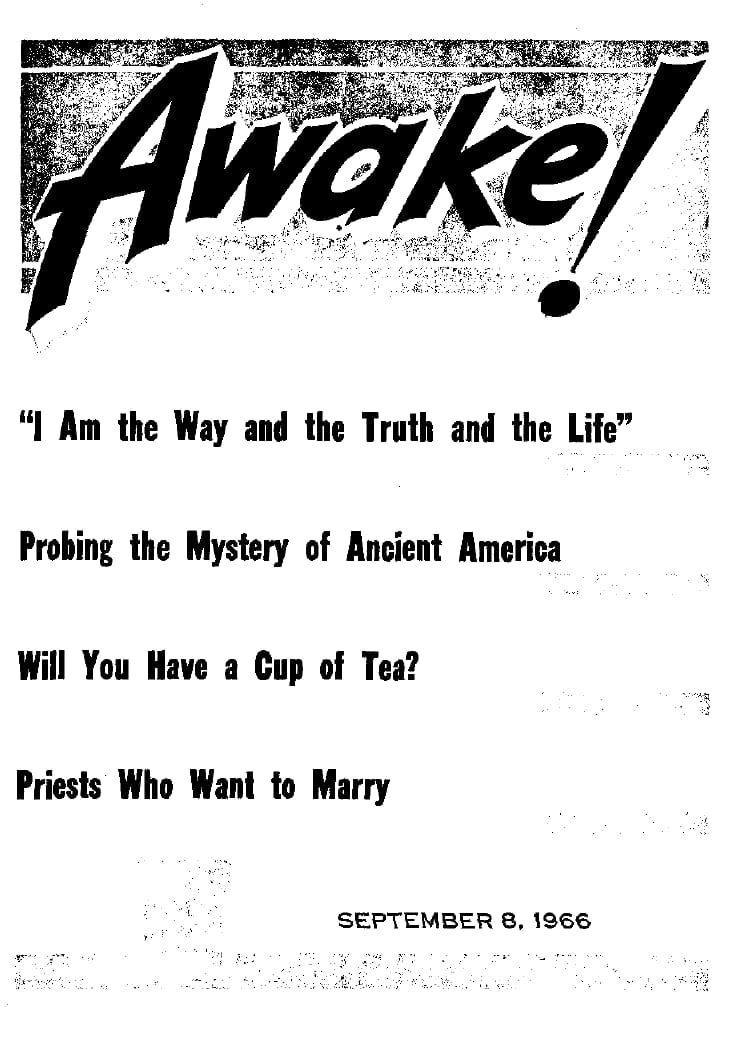
"I Am the Way and the Truth and the Life"
Probing the Mystery of Ancient America
Will You Have a Cup of Tea?
Priests Who Want to Marry
SEPTEMBER 8,1966
THE REASON FOR THIS MAGAZINE
News sources that are able to keep you awake to the vital issues of our times must be unfettered by censorship and selfish interest. "Awake!" has no fetters. It recognizes facts, faces facts, is free to publish facts. It is not bound by political ties; it is unhampered by traditional creeds. This magazine keeps itself free, that it may speak freely to you. But it does not abuse its freedom. It maintains integrity to truth.
The viewpoint of "Awake!" is not narrow, but is international. "Awake!" has its own correspondents in scores of nations. Its articles are read in many lands, in many languages, by millions of persons.
In every issue "Awakel" presents vital topics on which you should be informed. It features penetrating articles on social conditions and offers sound counsel for meeting the problems of everyday life. Current news from every continent passes in quick review. Attention is focused on activities in the fields of government and commerce about which you should know. Straightforward discussions of religious issues alert you to matters of vital concern. Customs and people in many lands, the marvels of creation, practical sciences and points of human interest are all embraced in its coverage. "Awakel" provides wholesome, instructive reading for every member of the family.
"Awaket" pledges itself to righteous principles, to exposing hidden foes and subtle dangers, to championing freedom for all, to comforting mourners and strengthening those disheartened by the failures of a delinquent world, reflecting sure hope for the establishment of God's righteous new order in this generation.
Get acquainted with "Awake!" Keep awake by reading "Awake!"
PUBLISHED SIMULTANEOUSLY IN THE UNITED STATES BY THE
WATCHTOWER BIBLE AND TRACT SOCIETY OF NEW YORK, INC.
117 Adama Street Brooklyn, N.Y. 11201, U.S.A.
WATCH TOWER BIBLE AND TRACT SOCIETY
Watch Tower House, The Ridgeway N. H. KNOZB, President
London N.W. 7, England
GRANT SUITER, Secretary
Average printing each issue: 4,475,000
48 a copy (Australia, Sydney, South Africa, 3/4e)
Very early subscription rates
Newly edition
Offers
America, U.S., 117 Adams Street, Brooklyn, N.Y. 112011
Australia, 11 Broadway, Brisbane, N.W. B
Canada, 160 Bridgeland Ave, Toronto, N.Y. 19, Ont.
USA, 7, New York, N.Y. 7
New Zealand, 823 New North Rd, Auckland, S.W. 7
South Africa, Private Bag 2, P.O. Elginton, S.W. 10
(Monthly editions cost half the above rates)
Rentitations for prescriptions should be sent to the office in Brooklyn, N.Y. to send your prescription in Brooklyn
Rentals, or in email at hstw (HSTW) before booking subscription cards.
Now published in 26 languages
Semigembally — Afrikaans, Cebuano, Dutch, Dutch, English,
Finish, French, German, Greek, Haiti, Italian, Japanese,
Korean, Norwegian, Portuguese, Swahili, Swedish, Tagalog,
Zulu.
Monthly—Citizens, Chiyanja, Hillgayrom, Malayalam, Polish,
Tamil, Urdu.
CHANGES OF ADDRESS should remain as thirty days before your moving date. She is your old and now your new address. She will be the address that she will be at Waltham Watch, Waltham Bower House, The Ridgeway, London N.W. 7, England.
Entered as second-class matter at Brooklyn, N.Y.
Printed in England
The Bible translation regularly used in "Awake"<sup>138</sup> is the New World Translation of the Holy Scriptures, 1961 edition. When other translations are used, this is equally marked.
CONTENTS
Should Pastors Unionize? 3
"I Am the Way and the Truth
The Regnal Year 8
Probing the Mystery of Ancient America 9
Will You Have a Cup of Tea? 13
Monk Recommends the Truth 16
Priests Who Want to Marry 17
This Is Paraguay 2
Infrared Detectors for Moths? 2
To a Mourning Youth 2
They Like a Fresco 2
"Your Word Is Truth"
Watching the World 2
Volume XLVII
London, England, September 8, 1966
Number 17
Should Pastors Unionize?
"UNIONS FOR CLERGYMEN." Thus read the headline of a report appearing in a popular United States news weekly recently. It told of efforts on the part of Roman Catholic clergymen, and especially the assistant pastors, to unionize in Los Angeles, California, in Detroit, Michigan, and in Oklahoma City, Oklahoma.
Not that this unionizing is limited to Roman Catholic pastors. The same report told that early in May of this year a committee of seven Episcopal priests, together with a deaconess and a rector's wife, had met to draft a constitution for a clerical union of the 1,000 Episcopal clergymen in California.Newsweek, May 9, 1966.
What is behind these efforts of pastors to unionize? Of
course, their desire is primarily to improve their lot, financial or otherwise. Regarding the plight of the Roman Catholic assistant pastors, "Msgr." John D. Conway, who at the same time is an authority on canon or Roman Catholic Church law, noted: "An assistant priest can be 50 years old and still be treated as a child by his superiors. A bishop can order an assistant priest around without consultation with him and his pastor even though canon law requires consultation with the pastor. There are channels of communication, but they don't work out. Organized leverage may be in some cases the only way to establish communication."
The pastors taking the lead in organizing the Episcopal clergy of California stated that their purposes were to protect them from their superiors, from the arbitrary actions of their bishops, to get more equitable salary distribution, to gain unemployment insurance and to get legal contracts between the clergy and their bishops, on the one hand, and, on the other hand, to protect the clergymen from their flocks, as it were, from the local vestries and church boards. As one of them put it: "Negotiation is ineffective unless it proceeds from a position of power. And we don't think it will take long to get it." The Episcopal unionizing pastors speak of gaining a "position of power," and their Roman colleagues of "organized leverage," both, therefore, advocating the use of pressure or force to gain their ends.
But does all this make sense? A pastor is supposed to be a shepherd; that is what the word literally means, it coming from the root "to pasture." Does a shepherd need to organize with other shepherds to protect himself from his own flock? If that seems to be necessary, there must be something wrong with both the shepherd and his flock; and apparently something wrong with the way the shepherd has been leading or teaching his flock for him to need to resort to the "power play," as it is called, to get what is right.
The same applies to the pastors' organizing to protect themselves from their bishops, literally, their overseers, to whom the pastors themselves are as a flock. Is there not something woefully lacking with religious organizations professing to be Christian, when such secular tactics, those borrowed from the economic war between capital and labor, seem to become necessary? Certainly no precedent for unionizing pastors can be found in the Sacred Scriptures.
The apostle Paul had the "anxiety for all the congregations." No question about his being a hardworking shepherd. But did he think it necessary to organize with other missionaries or overseers to protect themselves from their flocks? Or did Paul exert pressure so as to choose where he would minister? (2 Cor. 11:28; Gal. 2:8-10) Not that his flocks were always generous and considerate. At times they failed to contribute even the bare necessities to sustain Paul in the ministry. What did Paul do? Organize or in some other way exert pressure to procure a decent salary, as some of the modern pastors are doing? Far from it! He simply went to making tents to pay his expenses, until such time as they saw their privilege of contributing toward his expenses, which the Christians at Philippi did—Acts 18:3, 4; 1 Cor. 4:11-13; Phil. 4:10, 15, 16.
Should not the entire relationship between those professing to be Christians be based on love, and all service and giving be voluntary? In fact, the apostle Paul made this his boast, that he was not depending upon others for support of his ministry. He had learned to be self-sufficient and knew how to get along with either little or much. (1 Cor. 9:15-18; Phil. 4:11, 12) Should not Christian overseers or presiding ministers be governed by unselfish, principled love in dealing with their ministerial assistants, and should not the presiding ministers deal with their flocks and their flocks deal with them in the same way?
What is needed is the resort not to force, to unionizing, but to the principles that Jesus Christ gave his followers for dealing with one another, namely, those of justice and love. "Just as you want men to do to you, do the same way to them"; that is justice. And further, "By this all will know that you are my disciples, if you have love among yourselves." How far removed is that kind of love from resorting to force to gain one's ends! Applying such Christian principles would eliminate all need of Christians to organize to protect themselves from one another!—Luke 6:31; John 13:35.
It is a well-known fact that there is a great shortage of pastors in Christendom. The clerical profession is becoming ever less sought after. The fact that pastors should feel it necessary to unionize, that they should find conditions that cause them to resort to such methods in dealing with their flocks and their superiors, is but another evidence that Christendom is not practicing true Christianity, for Jesus said: "By their fruits you will recognize them."—Matt. 7:16.
Happily, though, there is no unionizing activity among the overseers, presiding ministers or ministerial assistants associated with the Christian witnesses of Jehovah. Among them there is no salaried clergy class. In fact, they do not even have a 'clergy-laity' distinction, for they know that Jesus said: "All you are brothers." —Matt. 23:8.
The way back in God, truth and life overlasting are basic needs of dying mankind. How are these fulfilled in Jesus Christ?
DISTINGUISHED teachers of ancient times referred to their doctrine as "the Way." Buddha claimed that he was the rediscoverer of an old path, long lost, into the reality of things. Lao Tru, founder of Taoism, called his teaching "the Way." However, none of these teachers taught men about God as did Jesus Christ of the first century of our Common Era. Their teachings became permeated with demonism. Christ shunned all demonism. And he, as no other man, taught that God was mankind's heavenly Father, instructing his followers to pray: "Our Father in the heavens, let your name be sanctified."—Matt. 6:9.
It was Jesus Christ who brought home to men how truly fatherly God is, and with what childlike confidence we can draw near to him. Jesus gave us the happy feeling that to turn to God is like turning to a loving father, which all men, because of the mounting problems of our day, desperately need to do.—Rom. 8:20-31, 34; 2 Cor. 5:20, 21.
Shortly before his death, Jesus said to his apostles: "In the house of my Father there are many abodes. Otherwise, I would have told you, because I am going my way to prepare a place for you. Also, if I go my way and prepare a place for you, I am coming again and will receive you home
to myself, that where I am you also may be. And where I am going you know the way."—John 14:2-4.
But Thomas, an apostle of Jesus Christ, was not that sure. "Lord," he said, "we do not know where you are going. How do we know the way?" Jesus then said to him: "I am the way and the truth and the life. No one comes to the Father except through me." (John 14:5, 6) Jesus was returning to his Father in heaven: "I am going my way to the Father," he said. "I am going my way to the Father, because the Father is greater than I am." (John 14:12, 28; 17:5) In John chapter 16, verses 10 and 28, Jesus emphasized this very point of going to the Father: "I am going to the Father and you will behold me no longer." "I came out from the Father and have come into the world. Further, I am leaving the world and am going my way to the Father."
In Jesus Christ alone we find what is literally and spiritually true, namely, that he leads men to the Father and that 'no one can come to the Father except through him.' Christ declared that he was the way to God, because by following in Jesus' footsteps closely men would come to know the heavenly Father. They would learn to know the true God as he really is and not as they imagined him to be. All of their misconceptions of Him would vanish.
Their misunderstandings about the Father that had deceived and caused them to wander in darkness would then, through Christ, be cleared up. Their joy at being reconciled or reunited with God would thus be fulfilled.—2 Cor. 5:20, 21.
Knowing that God is pure and holy, some have feared coming to God in their sinful condition. (Isa. 6:1-7) But seeing what a loving God he is, they are encouraged to come to Him through that new and living Way, Jesus Christ. What they see through the life of Christ is not a god as portrayed by false religions of the world, a god who delights in tormenting souls in purgatory or in a burning hellfire, as they may have believed, but a loving Father who comes to meet them and welcomes them back into peaceful relationship with himself, as Jesus so beautifully taught in his illustration of the prodigal son. (Luke 15:11-32) Through Christ they learn that Jehovah God is not cold and hard and implacable, as false religion had taught. They learn that Jehovah is a loving Father, wise in understanding, tender and most gracious. (Ex. 34:6, 7) I am the way,' declared Jesus Christ, 'the One through whom you can learn more about God, the very Source of life. Follow me!' —Ps. 36:9; Matt. 16:24.
The Way
How is Jesus Christ "the way" to the Father? He is the One who has made known the Father's will. (John 8:28, 42) In him we see the only path to the Father and to life everlasting. When many of Jesus' disciples left off following him because of some things they could not comprehend, Jesus then said to his apostles: "You do not want to go also, do you?" Simon Peter answered him: "Lord, whom shall we go away to? You have sayings of everlasting life; and we have believed
and come to know that you are the Holy One of God." (John 6:67-69) Peter recognized Jesus as coming from God and as the way to God, who is the Source of everlasting life. If we maintain this same appreciation of Jesus that Peter showed, we, too, will be showing that we recognize Christ as "the way."
Jesus is "the way" also by his example. His is the perfect life to be imitated. Jesus' apostle Peter writes: "In fact, to this course you were called, because even Christ suffered for you, leaving you a model for you to follow his steps closely." What sort of an example did Jesus leave for us? Peter answers, in these words: "He committed no sin, nor was deception found in his mouth. When he was being reviled, he did not go reviling in return. When he was suffering, he did not go threatening, but kept on committing himself to the one who judges righteously. He himself bore our sins in his own body upon the stake, in order that we might be done with sins and live to righteousness." (1 Pet. 2:21-24) Jesus' example also aids us to come to know and please the Father, the Source of life everlasting, by showing us what kind of life we must live. The way to God is to follow Christ closely.
Jesus also is "the way" to the Father by virtue of his sacrifice. By offering up his perfect human life for the sinful offspring of Adam, Christ made it possible for imperfect men to draw near to God through faith. Paul makes this point clear, saying: "Christ entered, not into a holy place made with hands, which is a copy of the reality, but into heaven itself, now to appear before the person of God for us." "Since we have a great priest over the house of God, let us approach with true hearts in the full assurance of faith."—Heb. 9:24; 10:21, 22.
Hence by obeying the commandments of Christ, by imitating his example, by depending on the merits of his ransom sacrifice, we show that we recognize Christ as the way to the Father, who promises to bless Jesus' anointed followers with life in the heavens and the "other sheep" with everlasting life on earth.—Luke 12:32; John 10:16; 3:16.
The Truth
Christ is also "the truth." "I am the way and the truth," he says. He is in opposition to all that is false, including false religion. He is the realization of the truth to which the shadows of the Mosaic law as well as the prophecies of the Hebrew Scriptures were pointing forward. All those things of a prophetic kind were focused on him. He was the living Truth of those revelations of God's purpose, the things to which God had sworn. He is no shadow, but the true Messiah, Christ. —Col. 2:17.
With Jesus' being born on earth, his coming into the world at the time of his baptism in water, his three and a half years of public service in behalf of God's kingdom, his death in faithfulness to God, his resurrection from the dead and his exaltation to heaven, with all these historical events, God's truth arrived in the person of Jesus Christ. The whole career of Jesus Christ, therefore, was one of bearing witness to the truth. Since he is the King of God's kingdom, God's Messianic kingdom as represented in Jesus Christ is the truth; for the purpose of bearing witness to it Jesus was born and came into the world.—John 18:37.
In view of the fact that Jesus Christ is "the truth," as he himself said in John 14:6, we must have the correct belief about him. The way to the Father is by knowing the truth about Christ. This is also the way to everlasting life. (John 17:3) Merely to have an intellectual concept of Christ or to have thoughts and notions
about Christ is not what is meant by knowing him. To know Christ is to live the teachings of Christ, to apply this whole matter of Christianity to one's life, to let his words and example mold our lives according to the Model God has given us. By doing this we show that we know the truth and that the truth has liberated us from bondage to superstitious fears.
The Life
Jesus is also "the life." He can speak of himself as being the life because he bought the human race with his lifeblood. By means of this ransom provision he will grant everlasting life to all those who exercise faith in him, thus becoming their Eternal Father. (John 3:16; Rom. 6:23; Isa. 9:6) As the King of God's heavenly kingdom, and as High Priest and Eternal Father, Christ will cause life to flow to all his earthly subjects. When he raises the dead to life, he thus will bring to an end Adamic death and its effect on the human race. The sting producing death, namely, sin, Christ will remove from all the earth. "Death will be no more, neither will mourning nor outcry nor pain be any more." (Rev. 21:4) The apostles of Jesus Christ, thrilled with these facts, write: "Christ came . . . and obtained an everlasting deliverance for us." "Look! [God is] making all things new." "‘Death is swallowed up forever.’ ‘Death, where is your victory?’ Death, where is your sting?’ . . . But thanks to God, for he gives us the victory through our Lord Jesus Christ!' (Heb. 9:11, 12; Rev. 21:5; 1 Cor. 15:54-57) Since Christ is victor over inherited sin and death, he is also our life!
Christ is "the life," for he made everlasting life possible not only for the living but for the dead as well. He is "the resurrection and the life." It was his death and resurrection that opened up the way for the dead to return to life in a resurrection.
Jesus told Martha, the sister of Lazarus whom he was about to raise from the dead: "I am the resurrection and the life. He that exercises faith in me, even though he dies, will come to life; and everyone that is living and exercises faith in me will never die at all." (John 11:25, 26) Christ is the living one who has "the keys of death and of Hades." (Rev. 1:17, 18) Therefore, Christ is the hope of the living and the dead. He has promised to open up the tombs and give the dead life in his new earth ruled by his heavenly government.—John 5:28, 29.
The way Christ lived is the way life should be lived today. His human life was a life dedicated to the service of God. Do you consider yourself a Christian? Then is your life dedicated to the service of God? Are you following in Jesus' steps? If so, there are marvelous prospects ahead of you. As Jesus said: "If anyone observes my word, he will never see death at all." "This is the bread that comes down from heaven, so that anyone may eat of it and not die. I am the living bread that came down from heaven; if anyone eats of this bread he will live forever; and, for a fact, the bread that I shall give is my flesh in behalf of the life of the world."—John 8: 51; 6:50, 51.
For an unnumbered multitude, following Jesus Christ will mean life everlasting in perfect health on a paradise earth. To the evildoer who said to Christ: "Jesus, remember me when you get into your kingdom," Christ promised: "Truly I tell
you today, You will be with me in Paradise." (Luke 23:42, 43) By practicing righteousness, not only this evildoer, but myriads, doubtless, untold thousands of millions of others will also come to enjoy the Paradise of Christ's Kingdom rule. For as the psalmist said: "The righteous themselves will possess the earth. And they will reside forever upon it."—Ps. 37:29.
For a very small number, compared with those who will inherit life on earth, Christ's course makes possible the privilege of reigning with him in the heavens for a thousand years. What a glorious prospect this! What a life to be enjoyed! Revelation chapter fourteen, verses one through four, tells us that 144,000 redeemed from the earth will experience this unspeakable privilege.—Rev. 20:4-6.
What meaning there is in those words of Jesus: "I am the way and the truth and the life!" The way to God is through Jesus Christ. As the one in whom the prophecies of the Hebrew Scriptures found fulfillment, Jesus himself is "the truth." He is also "the life" in that through him everlasting life has been made available for mankind. Should not this warm and hopeful approach to humanity's problem—man's alienation from God because of inherited sin—inspire us, more so, impel us to respond to God's love through Jesus Christ, to worship and serve Him for our everlasting good and to His eternal glory? It most certainly should. For this is the will of God.
THE REGNAL YEAR
In historical records it was the practice in ancient Israel, as well as in Babylon and Medo-Persia, to count the reigning or regnal years of a king as full years beginning on Nissan 1. The months during which the king might have actually started to rule prior to Nissan 1 were considered as forming his accession year, but were historically credited or counted as belonging to the full regnal years of the king who had preceded him. Hence, when the Bible speaks of a king as reigning for "forty years," it refers to a full forty-year period—1 Kli.1:30; 2:1, 10, 11; 11:42.
PROBING THE MYSTERY
DURING the past one hundred and thirty years archaeologists have been digging up the ruins of ancient American empires, some of which
antedate by some two hundred years the days of Nebuchadnezzar of Babylon and Cyrus of Persia. Here were peoples whose noble and priestly classes were already, like those of Babylon and Egypt, well-versed in sculpture, mathematics, astronomy and metallurgy. Their concepts of government and religion approximated those of the contemporary empires of the East. Yet a considerable mystery surrounds those early American cultures.
In the case of Babylon and Egypt, progress and development can be traced through many centuries. Not so, however, with the ancient cultures of Mexico and Peru. Suddenly, without gradual process, they blossomed where yesterday there had been only simple tribes of hunters and grain gatherers whose ancestors are believed to have reached the Western Hemisphere by way of the northern route from Siberia. How could this happen? How could those Indians span the centuries in one vast stride and achieve civilizations that ranked with Babylon and Egypt?
Practically the same question is raised by a modern writer on language origins, who says: "At the time of their first appearance, the [Mexican] Maya script and
astronomical and mathematical knowledge are fully developed, and this presupposes a previous evolution of long development—of which
nothing is known—unless there was some cultural importation, which is hardly thinkable."
But is a cultural importation unthinkable? If we dismiss the idea, we still have on our hands the unexplained emergence of full-blown civilizations well over two thousand years before the arrival of Columbus in America. And there is growing support in scientific circles for the proposition that the numerous similarities between the cultures of ancient America and the Near East cannot just be shrugged off as coincidences or parallel developments arrived at independently at such widely separated locations.
Some of the Similarities
One strange parallel that some view as being merely coincidental has to do with the worship of the sun. The royal family of ancient Peru claimed to be "children of the Sun" and, therefore, so superior to their subjects that the Inca had to marry his own sister in order to produce a legitimate heir. The Egyptian Pharaohs also claimed descent from the sun, and were permitted to marry only their own sisters, a practice followed by the Ptolemies right down to Caesar's time.
What is even more striking is that the name for the sun, in Peru as in Egypt, was Ra. And among the Chaldeans the father of the gods was called Ra.4
Serpent worship, linked with worship of the sun, was practiced in almost all the empires of the East. Referring to this fact, Joseph Bryant, in his Ancient Mythology, Volume II, page 203, had this to say: "The worship began among the people of Chaldea. They built the city of Opis upon the Tigris, and were greatly addicted to divination, and to worship of the serpent. From Chaldea the worship passed into Egypt, where the serpent Deity was called ... Cneph." Of the same creature, McClintock and Strong's Cyclopodia states: "The Phoenicians adored that animal as a beneficent genius; ... The Egyptians represented the eternal spirit Kneph, the author of all good, under the mythic form of that reptile."
In ancient American cultures the serpent was prominent. Walls, porches and sacred buildings are frequently decorated with the serpent motif. Not only this, but Quetzalcoatl, signifying "feathered serpent," was revered in Mexico as the great reveler of knowledge, the instructor in the use of metals, in the science of agriculture, and in the arts of government. Referring to such symbols of ancient art as the serpent, the tree of life, and others, the Egyptologist Joseph L. Smith, in his book Tomba, Temples and Ancient Art, remarks on the "striking features in common between the cultures of the Egyptians and of the Maya."
atop which sacrificial rites were performed and where astronomers conducted their search of the night sky. It has even been claimed that the Maya calendar system, based on astronomical knowledge, was even more accurate than the Babylonian system.
In Babylon, the ziggurats with their great brick-built steps leading up to lofty temples are known to have dominated each large city. They were also used as observatories by the priest-astronomers. The ancient empires of Middle America also had their ziggurat-like structures
In Egypt the pyramids were reared as tombs for mighty rulers. At least one Maya structure, the Temple of the Inscriptions at Palenque, in northern Chiapas, Mexico, has proved to be the tomb of some important personage. As in Egypt this tomb is equipped with a gigantic sarcophagus. Further elaborating on this Mayan pyramid-tomb, Alma M. Reed in the book The Ancient Past of Mexico states: "Fragments of the jade mosaic mask found inside the sarcophagus have been fitted together, providing still another similarity with Egypt and even with ancient Greece, where the faces of dead Achaean royalty of the Mycenaean period were covered with masks of thin beaten gold."
Commenting upon some of the beautiful art objects of polished jade retrieved from the cenote or sacrificial well at Chichén Itzá by divers, and doubtless having in mind the ancient use of jade in the religious art of Asiatic countries, the late artist-archaeologist Miguel Covarrubias said: "It would be hard not to share the belief in stronger and more direct ties with the East."
The use of cylinder seals was widespread in the empires of the East. They also occur in the Middle American cultures. In his extensive consideration of the subject, Henri Frankfort of the Oriental Institute of the University of Chicago stated: "One must reckon to a greater extent than most of us were hitherto prepared to admit with the possibility of diffusion from the Middle East." 8
Gordon F. Ekholm, associate curator of anthropology, American Museum of Natural History, drew attention to the close resemblance between Cambodian and Mayan temple pyramids and to the almost identical decorative motifs in the sculptured panels of Southern India and Yucatan, Mexico.
Brushing aside the claim that these features could have been developed independently, he declared: "To my mind it appears more probable that these similarities resulted from some historical contact between the two areas."
In the field of metal artistry, the empire of the Incas in Peru is known to have attained a remarkable proficiency. Nor does there appear to be any long record of the history of its development. Rather, as stated by Constance Irwin in Fair Gods and Stone Faces, "metallurgy seems to have burst forth suddenly in fullest flower." It had taken hundreds of years for the intricate techniques to be developed in the Near East.
How to Account for Sudden Emergence
How, then, can we explain all these similarities and the sudden emergence of a high degree of culture among the Indians of Middle America? How was it possible for them to parallel the Asiatic empires in so many of their features? Surely there must have been importations, not a few but many, from Europe and Asia during the period since 900 B.C.E. But how could such visitors ever get to America? The answer must be, By boat. But from where? There is considerable difference of opinion on this point. Some insist it could have been only from the sunrising, across the Atlantic, in order to conform to an old tradition mentioned by Montezuma to the Spaniards. Others claim it could have been from southeast Asia across the Pacific. Indeed, there seem to be indications that contacts may have been made from both east and west.
Suggestive of contact from both directions, J. Garnier, in his book The Worship of the Dead, writes: "It will be observed that, although their gods Hu and Wodan associate the Mexicans with the Buddhist races, their other gods, and their language, ritual and customs, and the form of their temple towers, connect them more intimately with the Phoenicians and the Babylonians, while their festival of the dead on November 17 is more especially Egyptian."
Beautifully painted frescoes adorning the walls of ruined temples located at Bonampak in eastern Chiapas, Mexico, came to the attention of archaeologists as recently as 1946. As stated by C. W. Ceram, in the book The March of Archaeology, "the style of the paintings is amazingly reminiscent of Egypt. The figures are arranged in rows, and the heads and feet of most of the persons represented are shown in strict profile."
Who Were the Importers?
Since the Egyptians and the Babylonians were never notable as maritime powers, the question arises, Who were the agents who carried the lore of Egypt and other eastern empires to the shores of America? Writing in the century before Christ, the Greek historian Diodorus Siculus told about the discovery of land westward from Libya (northern Africa) by the Phoenicians. He described it as "an island of considerable size and situated as it is in the ocean it is distant from Libya a voyage of a number of days to the west. Its land is fruitful, much of it being mountainous and not a little being a level plain of surpassing beauty. Through it flow navigable rivers . . ."10
Close attention to this description impresses the reader with the fact that only a continental land mass, believed at the time to be an island, or a large island such as Cuba would meet all of the requirements here set forth.
In her book Fair Gods and Stone Faces, in which considerable evidence is offered that points to the Phoenicians as the importers of cultural knowledge to America, Constance Irwin quotes a very significant statement by A. W. Brogger, director of the Norwegian Museum in Oslo: "It could also very well be believed that the route to America was discovered during the Bronze Age."
off lands to which trade took them. They were notorious as slave dealers, and no doubt their slave shipments included Negroes from the African coast. (Ezek. 27: 13) And, strangely, ancient American sculptures include figures of unmistakable Negroid appearance long before European slave traders delivered their human merchandise to the Western Hemisphere.
Another striking fact that seems to link Phoenicia with the Aztec civilization of Mesoamerica in the pre-Columbian era.
Bronze Age, at the time when sea voyaging was at its height. It could perhaps help to explain why the American peoples were living in a Bronze Age when Europeans reached them in the next great era of voyaging. It must be remembered that the prevailing winds and currents almost compel the discovery of Central America from Spanish and Portuguese harbors, when once open-sea voyages are made."
Of the unique contribution made by the Phoenicians to the development of civilizations, James F. McCurdy, in the book History, Background, and the Humean
Mexico is the practice of offering human sacrifices. The Phoenicians indulged in this horrible practice, offering helpless infants to their idol god. Likewise in the ancient empire of Mexico young men, maldens, captives and even young children were offered in appeasement of the gods.[11]
A recent news dispatch reports that an Italian writer is now offering evidence that the Etruscans were the first to reach the shores of the Americas many centuries before Columbus. In view of this and of the fact that archaeologists continue to dig for more evidence, the investigat
History, Prophecy and the Monuments, has this to say: "They penetrated unknown seas with an enterprise unsurpassed by Columbus or Drake. They circumnavigated Africa. They worked mines in Spain and Britain. . . . They taught international trade and navigation to the Greeks and then to the Romans. . . . Not only were the Phoenicians the originators of a worldwide trade and of a farsighted commercial policy unrivalled in ancient times, but their maritime supremacy has been the most enduring known to men."
These issues this week need their own
dig for more evidence, the immediate source of the early American cultures remains somewhat of a mystery. Of this we may be sure, that just as man originated in one spot and thereafter migrated eastward and westward around the earth, so also Babylonish religion and its cruel, superstitious practices spread across lands and oceans to bedarken men's minds. The peoples of ancient Middle America were no exception.
REFERENCES
1 The Alphabet, David Diringer, page 123.
Phoenician shipmasters had their markets in Egypt, all around the Mediterranean, and along the Atlantic coasts of Africa and Europe. Their commercial fleets sailed the Red Sea and the Indian Ocean. They borrowed most of their culture from the nations with which they did business, and we may be sure they also transmitted the information they picked up to other far-
2 Harpers New Monthly Magazine, Vol. VII, No. 37,
page 9. Article on "Ancient Peru" by E. G.
Squier.
a The Worship of the Dead, J. Garnler, pages 142, 143.
4 Chaldea, George Rawlinson, page 72.
6 Fair Gods and Stone Faces, C. Irwin, page 39.
4 Ibid., pages 112, 113.
7 The Ancient Past of Mexico, Alma M. Reed, page 8.
8 Ibid., page 10.
a Is American Indian Culture Astalier, Gordon F. Ekholm, in Natural History issue of October 1950.
20 Fair Gods and Stone Faces, page 220.
11 Americans Before Columbus, Elizabeth C. Baity, page 206.
WITH that cheerful invitation your hostess will pour a hot, amber-colored fluid into a cup and hand it to you with the hospitable query, "Do you care for cream or sugar?" Then you can relax and enjoy a brief interval of small talk as you slowly sip the aromatic beverage. A sense of well-being gradually sets in, and even your thinking ability seems to be improved. And the flavor is so good! so say tea drinkers.
Perhaps you have wondered why the last attempt you made at
tea brewing did not turn out as well as you might have wished. What is it that makes a good cup of tea? Is it the brand you buy at the grocery store that counts? How is one to determine the right blend of tea? Are the most expensive blends the best? And what about the brewing procedure? Is there, perhaps, something you are overlooking?
If you wish to gain greater enjoyment from this most common of all drinks apart from plain water, if you would like to improve the quality of your hospitality, it will be to your advantage to get the answers to these questions. Even the angles of economy and avoidance of waste may well be involved. After all, you may be paying as much as $1.50 per pound for your tea, and you want to get the most for your expenditure.
Shopping for Tea
In the larger stores you may be bewildered by the great variety of blends
that appear on the shelves. Upon examination you will observe that on each package label there is often some clue to the country of origin. Also, you will note that the label indicates whether the content is black, green or oolong tea. In the case of black tea there are likely to be added words of description, such as "flowery pekoe," "orange pekoe," or "pekoe." Naturally, you are curious. What makes the difference between black and green tea, and what does this word "pekoe" mean?
The leaves of the same tea plant may be used to produce black, green or oolong tea, for these differences are due to variations in the treatment and processing of the leaves for market. In the case of black tea, for example, the leaves are allowed to ferment when first brought in from the plantation, before the rolling and drying operations. Green tea, on the other hand, results when this fermentation is prevented by steaming the leaves and thereby sealing the pores on their surfaces. Oolong tea lies somewhere between black and green tea, for a limited degree of fermentation is permitted in its preparation.
The word "pekoe" refers to the grade of leaf that predominates in any blend of black tea. Keep in mind that all teas on the market today are really blends of several types of tea as supplied by the tea estates. On the tea plant each branch has a topmost, tender bud, and then a series of progressively larger leaves down the stem. When the leaves are brought in and processed, they are put through sieves with differing sizes of mesh.
The smallest leaves, including the buds, usually give the best quality tea, having more body and yielding their flavor more quickly. These are designated "flowery pekoe." Next in size comes "orange pekoe," then "pekoe," and finally the largest sizes are known as "souchong."
But now the question, Which tea shall I choose? The problems of cost and quality both enter the picture here. How much do you wish to pay? A word of caution is in order here. Experts in grading teas found that there was really very little relationship between price and quality. In other words, the most expensive tea may not be the best. In fact, it was noted that teas they graded as "fine," regardless of the grade of leaf, might cost anywhere from 1.00 to3.25 per pound, while teas graded "medium" might run from 1.00 to3.85 per pound.
The answer to your shopping problem, then, seems to be to try a number of teas in succession, and when you locate a blend that is reasonably priced and that yields a brew that appeals to your taste, settle for that. Later, if you are served a cup of tea somewhere that seems to be an improvement, you can always inquire discreetly about the brand name, and then do some private investigation on the comparative price.
What to Look For in Tea
If you are not a tea specialist, you may well wonder just what to look for in tea. Tea tasters, professionals employed by the great tea firms, are interested in four features, namely, taste, aroma, color and body. So, why not become your own tea taster and seek to detect these features in any tea that you use? For best results, your organs of taste and smell should be in good shape.
A good quality tea should have full flavor, something that is clearly discernible to your taste. It should have a distinct and pleasant aroma immediately after brewing. If black, the brewed tea should have the color of amber, perhaps somewhat on the darkish side. The thickness or body of the beverage should be detectable by simply feeling it on the tongue, quite apart from the flavor reaction of your taste buds.
How Do You Make Tea?
In order to conduct a fair investigation of several different blends of tea, the same brewing procedure should be followed closely. This will be simple if you are accustomed to purchasing tea bags rather than ordinary packaged tea. The two points that may then require to be checked are: Do the tea bags contain the same weight of tea? Have you steeped them in water for the same length of time?
Speaking of tea bags, it is claimed that this is by no means the most economical way to buy tea for the average household. You pay extra for the cotton or mesh bags and for the extra packaging expense. Thus a packet of 200 tea bags weighing one pound may cost you 2.00, while a one-pound package of loose tea of the same blend may be only 80 cents to1.00. Furthermore, since each normal tea bag should be able to produce two cups of tea—and most often they are used for but one—there is thus a certain amount of wastage. Of course, you may prefer the convenience of the tea bags.
Tea connoisseurs declare that you cannot get the best from your tea unless you follow strict rules of tea brewing. Here is what they recommend: Rinse the teapot with scalding water. Then measure into it one heaping teaspoon of tea for each cup that will be required and an extra one for the pot. Pour in fresh water that has just been brought to a full boil and let it steep for three to five minutes, according to the strength desired.
At this point another teapot should be available, and it also should be scalded. Into it the contents of the first teapot should be poured, straining out the tea leaves, which can now be disposed of. What you now have can be enjoyed immediately, or reheated once later, or can even be stored in glass in your refrigerator and used to make ice tea.
Members of your family or guests may have their preferences on how they take
their tea. Some like it with cream or sugar, and some like it without. Others may like a few drops of lemon juice. A touch of lemon juice can greatly enhance the
crops taken from the same estate differ in quality from season to season. Methods of cultivation, varying as they do from one plantation to another, have some bearing upon the resultant quality.
Why So Popular?
When you pause to consider the vast number of people who drink tea regularly, almost half the world's population, and that in some countries there is a heavy consumption of tea, such as in Britain
ARTICLES IN THE NEXT ISSUE
Finding Peace and Happiness.
* The Sea as a Way of Life.
Japan's Religion of "Gain."
Have You Taught Your Daughter to Cook?
flavor. Cream and sugar, on the other hand, have a tendency to reduce the flavor. This is why those who take cream and sugar usually prefer to have their tea stronger.
Why the Varieties of Tea?
People do manifest strong preference for either black or green tea, and there is reason for this. Green tea, mostly reaching us from Japan, is richer in aroma, but more delicate in flavor than the black. Oolong, as already mentioned, is somewhere between black and green teas, comes mainly from Taiwan, and is noted for its particularly delicate flavor and superb bouquet.
It is often puzzling to people when they note the numerous tea blends that can be produced from what is essentially but the one species of tea plant. Yet there are many factors that bear upon the quality. The location of the plantation, whether high on a hillside or on a plain, produces varying results. The soil and climate also account for considerable variety. Even
with its 1,900 cups per person each year, the reasonable question arises, Why all this popularity? Perhaps the constituents in tea will throw some light on the
subject-three of them particularly.
Caffeine, a stimulant, is a bitter crystallizable alkaloid, rich in nitrogen. Its potency may be judged from the fact that an injection of as much caffeine as is contained in fifteen cups of tea is often sufficient to revive instantly a patient who may have collapsed from exhaustion or exposure. In a cup of tea there is only about one-third of the caffeine concentration found in a cup of coffee. Green tea offers a rather greater stimulus than black tea because the caffeine is more easily extracted from it.
Tannic acid also occurs in tea. It has a somewhat astringent action, and this is why, when tea has stood on the leaves overly long, the drinker notices a puckering effect in his mouth. The tannin is responsible for the color, the body, and the briskness and strength of tea's flavor.
The small quantities of volatile oils found in tea account for its inviting aroma. This is the ingredient most likely to affect the health of those who work continually amid bulk quantities of tea. It is said that workers in tea factories sometimes suffer from its harmful effects headaches, dizzy spells and even slight attacks of paralysis.
Small quantities of tea, however, offer no such danger.
It is claimed by some that tea is habit-forming and tends to induce nervousness and constipation. This may be especially true when tea is taken in excessive quantity and in too strong a brew. Some researchers, however, claim that, when tak-
is negligible, it is also true that, in ordinary dosage, there is insufficient caffeine or tannic acid in tea to be harmful to most people.
Tea's rise to prominence and favor among Western nations has been rapid. Only three hundred years ago the queen of Charles II of England received as a gift two pounds of this mysterious herb from the East. Today Great Britain imports about one-third of all tea produced
en in reasonable quantity and not too strong, tea can actually aid in the assimilation of food. It is also declared that tea stimulates respiration.
The reasonable approach to the subject of tea and health, then, would be for those who are of nervous temperament and those who are subject to frequent digestive disturbances to limit their use of tea. While it is true that the nutritional value of tea
throughout the world, about 750 million pounds each year, mainly from India and Ceylon, the two leading producer countries.
So, if you are a tea drinker, you have lots of company. Multitudes of all races testify to tea's soothing and reviving effects. To throngs in almost every nation there is still music in the gracious invitation, "Will you have a cup of tea?"
A full-time minister of Jehovah's witnesses in a small town in the state of São Paulo, Brazil, related the following experience at a circuit assembly of Christian ministers:
"In my preaching activity I met a very devout Catholic family who listened to the good news of the Kingdom. I left a magazine with them. After three days, I made a back-call on them. Only one member of the family
edly. Seeing the monk, the man hastily threw the book in a drawer. But the monk said: 'I saw it! You can't hide it anymore, Mr. A—' The man turned pale and asked: 'What do you think of Jehovah's witnesses?' The monk answered by asking: 'Do you study with them?' The man replied that he did not. I was just looking at the book out of curiosity. He then took the book out of the drawer and gave it to the monk.
showed interest, the oldest son. His parents were always cold toward Bible truth, went to mass every Sunday and were close friends of a Roman Catholic monk.
"The time came when the Watch Tower Society published the book From Paradise Lost to Paradise Regained. The father of the family, seeing such a lovely, illustrated book in the home, began to look into it. One morning as he opened the book and started to read, the monk arrived unexpected-
"The monk said: I came to say good-bye. I am going to Campos de Jordão. But let me tell you the truth about Jehovah's witnesses. I am not against them, because they are the only ones who teach the truth. They preach the only hope for all mankind, the good news of the kingdom, the greatest Christian work.' He added: 'Study with them; be one of them!'" This good counsel was followed. Today the whole family are happy witnesses of Jehovah.
Priests WHO WANT TO MARRY
VATICAN Council II considered many problems and questions regarding Roman Catholic teaching, form of worship and morals. But there was a question that keenly interested Roman Catholic priests that was not granted open discussion. And what was that? Whether consideration should be shown to priests who want to marry or not.
Concerning this question about priests' marrying, Pope Paul VI stated: "It is not expedient to have a public discussion of a matter of such delicacy." Far from relaxing this rule, the pope said that the Roman Catholic Church intended not only "to conserve with
all our force this sacred and providential ancient law, but also to reinforce its observance, calling the priests of the Latin Church to an awareness of the reasons and motivations which today—particularly today in a special manner—make necessary that this very law must be regarded as most opportune." The press reported that the 2,100 prelates present vigorously applauded this position.
Why did the pope so rule and why did the bishops seem to be so much in accord with his position? Was it because there is no opposition among the priests themselves to the rule that priests may not marry? Far from it! In fact, there is so much opposition to it that the United States Jesuit weekly America has suggested a poll to get at the facts, and asks: "Are we not at the point where the harm done by continued silence is beginning to outweigh any probable harm from making the facts
known?" Also indicative of how widely and openly the question of whether priests should be allowed to marry is being discussed can be seen from the fact that in just
a few months' time three books that deal critically with the subject and that had been published in different parts of the world have now been released in the United States by Roman Catholic publishers.
The severity of the rule of celibacy is not generally understood or appreciated. A priest can be forgiven repeatedly for having had relations with a woman, married or single, but if he legally takes a wife to himself he makes himself liable
to excommunication or disfellowshiping, which means that he is barred from the mass, from the confessional, from the last rites and even from a Roman Catholic burial. In view of this fact it is not surprising that the rule of celibacy has long been unpopular among many of the laity, particularly husbands and fathers. Thus the late Roman Catholic historian Henri Daniel-Rops estimated that in fifteenth-century Burgundy half the children born out of wedlock were sired by Roman Catholic priests. And Rizal, in Social Cancer, told of the Philippines in the nineteenth century when the vow of chastity on the part of the priests "was never much more than a myth."
To what extremes some in the Roman Catholic Church are willing to go to enforce the rule of clerical cellbacy was revealed in the lawsuit that Roman Catholic Mrs. A. Ryan brought against her church and others for having broken up her marriage.
She and Mr. Ryan, a priest, were married secretly in 1950 and for five years lived together, during which time they had four children. Then on April 4, 1955, she charged, her husband was abducted "with force and the aid of intoxicating beverages." A year later he returned home, only to be abducted again after twelve hours. Her lawsuit, filed in 1962, charged that her husband was being kept in monasteries against his free will, consent or approval. The lawsuit, however, failed to reach the courts, for nine months after it was filed Mr. Ryan suddenly died.
Opposition by the Priests Themselves
How strongly the priests of the present decade are opposed to the rule that forbids them to marry is little appreciated by most persons. A report from the Vatican states: "The Holy Office has on file 10,000 requests from priests who want to renounce their vows, including many from priests who want to be relieved of their vows of chastity in order to marry."
Around the world there are said to be 60,000 priests that have left the priesthood, "fallen," as their coreligionists would call them. It is estimated that, of this number, 5,000 are found in the United States, 4,000 in France, and 15,000 in Italy (where there are, all together, 62,500 priests), or nearly one out of every four priests in that 99-percent Roman Catholic country.
At the Vatican Council Latin-American bishops privately circulated a survey of a thousand priests in Brazil revealing that the majority of them were very unhappy about the rule not permitting them to marry. There thirty-three priests requested to be relieved of their vows of chastity in one group, claiming that hundreds of other priests felt the same as they did. In Italy thirty priests made a like plea;
they want to continue as priests but be permitted to marry. Ex-priest Hermand's book on the subject, The Priestly State—Marriage or Celibacy?, created a sensation when published in France in 1963 but was banished from the book shops of Italy due to Vatican influence. In Portugal the government ordered an edition of 3,000 to be seized, but it was able to apprehend only 200 copies. In an interview Hermand said that after his book went on sale he received a hundred letters a week: "Who wrote most? Country priests—those man who live the loneliest of lonely lives. They understood my book. They encouraged me."
The Heartaches, the Suffering
As to how much grief, heartache and suffering the priests endure because of not being allowed to marry, they themselves tell. For example, there is the case of the forty-one-year-old Anthony Girandola, who lives with his wife and child in St. Petersburg, Florida. In April of this year he called in newspaper reporters to announce: "I am tired of hiding the fact that I am a priest." He hoped, among other things, to establish a "halfway house," a guest house for "my fellow lepers," meaning priests who, like him, quit the priesthood to marry. That expression alone tells much about the suffering priests who marry have to endure. And not only are they automatically excommunicated, he pointed out, but they are ill-equipped to make a living at some secular job. "They need help readjusting."
Particularly touching, is the account of the problem that a Roman Catholic priest gave (anonymously) in The Saturday Evening Post, March 12, 1966. At great length he told of his grief and burden under the heading: "I Am a Priest. I Want to Marry." He begins by saying: "I am a Catholic priest. That, to me, is a great joy. I am not permitted to marry.
That, to me, is a great mistake." Continuing, he tells that for fourteen years he has been counseling the young before marriage and the troubled after marriage, worked with alcoholics, assisted unwed mothers, visited countless sickbeds, interrupted his sleep to help those who were dying and strengthened his fellow priests. He tells of his need to love and to be loved by a woman and that, while he chose the priesthood, he did not deliberate, choose cellulah. "Thousands
bacy rule but to reinforce it, why did the 2,100 bishops of Vatican Council II so vigorously applaud? Yes, why, when it causes so much suffering and results in so many leaving the priesthood? One reason could be that they lacked empathy. They no longer are young and perhaps are not now concerned with marrying, or they may not have been greatly troubled with the problem in their youth, being such as could stifle such sentiments for the sake of their ecclesiastical ambitions. Then again
deliberately choose cathay. Thousands of us have discovered that our celibacy is as bitter as our priesthood is sweet." He feels that not being married builds a wall between the priests and their flocks, and points out that it is not merely a matter of sex but of keeping integrity, for any priest who wanted to could find himself a woman companion and so could continue as a priest just so long as he did not want to marry her. He also effectively answers the objections that Roman Catholic laymen might raise to their priests' marrying such as they are too busy must keep
of their sacerdoth imbulations. Then, again, some may have compromised themselves in their youth but now choose to forget this. Enjoying high offices, prestige and power, they may find that the joys of marriage pale by comparison.
However, it cannot be denied that celibacy has its advantages from an organizational standpoint. Priests without families can be transferred very easily, and that regardless of distance involved or the nature of the new assignment. They are free from domestic cares. More than that, single men can be contact with a much
ing, such as they are too busy, must keep secrets and that celibacy is proof of sincerity.
sincerely.
According to this priest, "The Church has never really come to grips with this problem it now has, has never really been honest about it . . . I thought the Council Fathers of Vatican II would face the problem that they well know thousands of us have, but the Council Fathers merely echoed the mossy accents of the past." In his conclusion he states: "I speak with honesty that scalds my soul. I have fought within the limits of my powers. Barbours
single men can be content with a male smaller salary than could married men raising a large family. Then, too, the image of a priest too holy to marry and to enjoy the pleasures of the nuptial bed sets him far above those of the "laity" who are naive or uneducated. And, perhaps, most important of all, the celibacy rule guarantees that fresh blood keeps flowing into the priesthood. Never will it deteriorate into a family affair, with the son resting on the laurels of his father, or merely becoming a priest because his father is one and because being a priest is the line of
within the limits of my powers. Perhaps I shall leave the priesthood; perhaps I shall not. But if I leave it, it will be, as far as I can honestly see, because celibacy makes no sense to me."
Why the Reluctance to Relax the Rule?
When the pope stated that the Catholic church intended not only to keep the celiSEPTEMBER 8, 1966
and because being a priest is the rule of least resistance.
So, when prelates leave empathy out of consideration and merely evaluate the problem from the standpoint of the advantages to the organization, it can be understood why they speak so highly of the celibacy of the priesthood and are so reluctant to make a change. Thus they hold on to this rule even though highly respected Roman Catholic publications, such as the National Catholic Reporter, tell that the law regarding celibacy is "something priests want to talk about," and that they "were disappointed when the Council shoved it under the rug."
…