Awake!, May 8, 1966
Download: PDF — Awake!, May 8, 1966
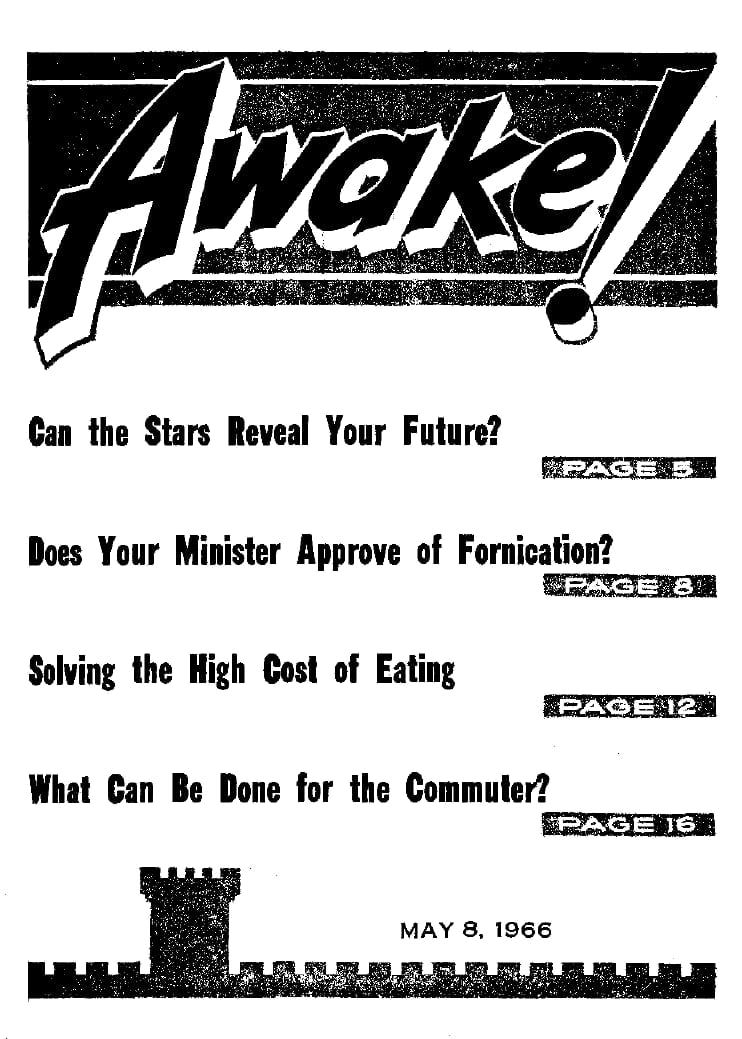
Can the Stars Reveal Your Future?
PAGE 5
Does Your Minister Approve of Fornication?
PAGE 8
Solving the High Cost of Eating
PAGE12
What Can Be Done for the Commuter?
PAGE 16
THE REASON FOR THIS MAGAZINE
News sources that are able to keep you awake to the vital issues of our times must be unfettered by censorship and selfish interests. "Awake!" has no fetters. It recognizes facts, faces facts, is free to publish facts. It is not bound by political ties; it is unhampered by traditional creeds. This magazine keeps itself free, that it may speak freely to you. But it does not abuse its freedom. It maintains integrity to truth.
The viewpoint of "Awake!" is not narrow, but is international. "Awake!" has its own correspondents in scores of nations. Its articles are read in many lands, in many languages, by millions of persons.
In every issue "Awake!" presents vital topics on which you should be informed. It features penetrating articles on social conditions and offers sound counsel for meeting the problems of everyday life. Current news from every continent passes in quick review. Attention is focused on activities in the fields of government and commerce about which you should know. Straightforward discussions of religious issues alert you to matters of vital concern. Customs and people in many lands, the marvels of creation, practical sciences and points of human interest are all embraced in its coverage. "Awake!" provides wholesome, instructive reading for every member of the family.
"Awakel!" pledges itself to righteous principles, to exposing hidden foes and subtle dangers, to championing freedom for all, to comforting mourners and strengthening those disheartened by the failures of a delinquent world, reflecting sure hope for the establishment of God's righteous new order in this generation.
Get acquainted with "Awake!" Keep awake by reading "Awake!"
PUBLISHED SIMULTANEOUSLY IN THE UNITED STATES BY THE
WATCHTOWER BIBLE AND TRACT SOCIETY OF NEW YORK, INC.
117 Adams Street
BROOKLYN, N.Y. 11201, U.S.A.
AND IN ENGLAND
BY
WATCH TOWER BIBLE AND TRACT SOCIETY
Watch Tower House, The Ridgeway
London N.W. 7, England
N. H. KNORE, President
GRANT SUITER, Secretary
Average printing each issue: 4,475,000
Now published in 26 languages
4 a day (Australia, Sa: South Africa, 3/4%)
Years:
Rates:
Offer:
Offer:
America, U.S., 117 Adams Street, Brooklyn, N.Y. 11301 $1
Canada, 130 Bridgway Street, Toronto, Ontario, T6 $1
New Zealand, New 31 North 93 St, Auckland R.W. 1 7/8
South Africa, Private Bag 2, R.O. Ghanafurt, Tnin. 70
Relationships for shouldbes should be sent to the office in your country. Otherwise and your residency to Resolution.
Relationships for shouldbes should be sent to the office in your country. Otherwise and your residency to Resolution.
Subscription expires
Seminario—Arthakar, Cebuano, Dandi, Dutch, English, Finnish, French, German, Hindi, Hobe, Japan, Japanese, Spanish, Portuguese, Spanish, Swedish, Polish, Eilu.
Chinese—Chinese, Ghanaian, Malayalam, Malayalam, Polish, Urdu, Uzbekistan.
CHANGES OF ADDRESS should reach us thirty days before your morning show. Check as you age and old now at www.mississippi.tv. Watch Tower, Train Tower Museum, The Bluegay, London, M.W. 7, England.
Entered as second-class matter at Brooklyn, N.Y.
Printed in England
The Bible translation regularly used in "Ankisi" is the New World Translation of the Holy Scriptures, 1961 edition. When other translations are used, this is clearly marked.
CONTENTS
Be a Willing Listener 3
Can the Stars Reveal Your Future? 5
Does Your Minister Approve of Fornication? 8
Solving the High Cost of Eating 12
The Watchtower Affects Lives 15
What Can Be Done for the Commuter? 16
The Spanish Armada
—an International Gamble 20
A Speech Handicap That Can Be Reduced 24
Building on a Solid Foundation 27
"Your Word Is Truth"
Jesus Christ—A Prophet like Moses 29
Watching the World 30
Volume XLV11
Number 9
BE A WILLING LISTENER
IT IS a relatively simple thing to do. Yet there are few things that can help a person more
or make him feel better than for someone else to listen with genuine interest to what he has to say. A willing listener can be of greater benefit than one may realize.
Some years ago, in Chicago, a promising young superintendent in a large plant was having some personal problems. When he missed a day of work and tried to explain to the plant manager the nature of his troubles, the manager refused to listen. "Don't bring family troubles here," he said. "They're no excuse for being absent." With no other outlet, the young man's problems grew in his mind. Gradually his work began to suffer, and, in time, his efficiency was so affected that he was to be fired or demoted.
At that point the parent company, an electrical equipment manufacturer, sent a trained counselor to see the superintendent. He was able to get the man to talk freely about his troubles, allowing him to see them more realistically. Slowly the superintendent's thinking began to straighten out, his efficiency improved, and soon he was a useful, happy worker again.
The benefits realized as a result of being a willing listener should cause one to examine his own listening habits, especially if he is in a position of responsibility and
has important decisions to make. Such a person may get into the habit of issuing directives and telling subordinates what to do without finding out how they may feel on matters. However, a willing listener invites suggestions and opinions, which usually result in better understanding, cooperation and, finally, productive accomplishment.—Prov. 15:22.
For instance, a person of responsibility may feel that a change in the way of handling matters is in order. So he may tell subordinates what he is going to do, and then proceed to explain how the new arrangement of things will operate. This could and, in fact, often does result in resentment rather than in willing cooperation by those closely affected by the decision.
The one in position of responsibility, on the other hand, could say something to the effect: "You have been associated here for a long time, John. What do you think of this new way of handling matters? Go ahead and express yourself; I'm listening." John may have some fine ideas, perhaps a view on the matter someone not living so close to the situation would see. Such willing listening results, not only in friendlier relations and better cooperation, but, in the long run, often in better efficiency and greater production.
A recent survey by public-opinion analyst Louis Harris emphasizes the importance of being willing to listen. He found that people's failure to listen to one another is both cause and symptom of some of their most serious problems. "People talk right past one another," he says. "Fathers talk past sons, mothers talk past daughters, teachers talk past students."
Especially within the family can relations be damaged by failure to listen to one another. Before they were married, husbands-to-be no doubt encouraged their prospective wives to express themselves and took into consideration their opinions. Why not continue to do so? It makes a woman feel so good to know that someone has a genuine interest in what she has to say—and if her husband fails to show that interest, she may begin to seek other company that will.
A wife, too, can improve family relations by listening to her husband, instead of letting his words go in one car and out the other. If she continually fails to pay attention to his instructions, a serious breach in their marriage may result. Her husband may even give up trying to communicate with her. So do not be a poor listener. Make a real effort; be a willing listener, and realize the benefits.
Unwillingness on the part of parents to listen to their children can also lead to serious consequences. More and more these days one hears the lament of the mothers and fathers of delinquent youngsters: "I just can't believe that he would do such a thing. He was a good child. There was no indication he would do something like this." Why the disbelief? Often it is because of the parents' own failure to listen to their children.
How, many times the parents scolded when their child came to speak to them, "Can't you see I'm busy now? Get out of my way"! They made no real effort to find out what was on their child's mind. There was no encouragement for the child to come and talk things over. So, failing to receive a listening ear, the child, in time, ceased to try to confide in his parents. "They're not interested anyway," he would understandably feel.
As a result, when the child grew older, there was not the closeness that would have existed had the parents been willing listeners when he was younger. The parents had lost the all-important confidence of their youngster. He did not have the assurance that they were really interested in him and his problems. Therefore, he did not tell them what company he was keeping, where the group went or what they did. When he needed mature counsel and direction most, his parents did not even realize it. It is little wonder that such mothers and fathers might be surprised to learn that their youngsters had gotten into serious trouble.
Parents, you expect your children to listen to you. Is that not so? Well, if you are a willing listener, it is much more likely that they will listen to you and obey what you have to say. Being a willing listener will result in friendlier relations and better cooperation in the household. You will keep your child's confidence and be able to give him the important counsel and direction he will need in later years.
A listening ear can mean so much. True, it takes a little time and effort, perhaps even a little humility to listen to the ideas and opinions of subordinates; but the benefits realized are well worth whatever is expended.
TWO men were about to form a business partnership. The papers were all ready for signatures, but each felt the need for further deliberation. "I must have one final consultation with my lawyer," said one. "Fine," replied the other, "and I must ascertain whether this is the best day for me to take this step." So one hastened to his lawyer, and the other to an astrologer.
It is not at all uncommon today for businessmen and housewives, for gamblers and politicians, for young and old, to consult the astrologer. They believe that the movements and positions of the heavenly bodies can be used to foretell one's future and to indicate the favorable time for every undertaking.
Actually these persons share a belief that has been traced back to its early beginnings in the Mesopotamian valley around 2100
B.C.E. In fact, as The World Book Encyclopedia points out, the astrology of the Babylonians "was so famous that the very names Chaldean and Babylonian came to mean 'astrologer.'" From Babylon astrology spread to Egypt, Greece, Rome and other parts of the world. To those ancients the sun, the moon and the planets all came to be identified with the leading gods of their pantheon. The stargazers of those days imagined they saw in the various star groups the outlines of various creatures, after whom they named those groups or constellations. The Encyclopedia
Americana says, however, that "the constellations themselves bear no resemblance to the signs designated by them."
The Zodiac and Its Signs
But how do astrologers go about the job of trying to reveal one's future by the stars? Ancient astrologers believed that the earth was the center of things, and that the sun and moon and other planets revolved around it. To them it seemed that all those heavenly bodies passed across the skies in a broad belt, which they called the zodiac, meaning "circle of animals." The zodiac they divided into twelve divisions of thirty degrees each. Each of these was called a "house" and was named from the supposed
shape of its dominant constellation, such as Leo (for Lion), Aries (for Ram) and Capricornus (for Goat). The constellation Libra, now usually represented as Scales, was,
by some, believed to be the claws of Scorpio (the Scorpion).
Each of these "houses of heaven" was said to influence some particular field of human interest, namely, the House of Life, the House of Riches, of Love and Marriage, of Religion, of Death, and so on. The position of the sun, the moon and the planets in the various "houses" at the precise time of one's birth was said to determine whether he would experience good or bad luck in these several departments of life. The astrologer's predictions were based upon the idea that some planets exerted an evil influence and others exerted a good influence.
Effort was made to tie in with these notions of astrology all the natural sciences. Each color, each metal, each precious stone, each plant, each animal, each drug, each hour of the day, each letter of the alphabet, each part of the human body was said to be presided over by one or another of the planets.
What Is a Horoscope?
Having set up the general guidelines to govern astrological readings, how, then, does the astrologer apply his fund of astral lore to your future? He casts a horoscope. The term itself is derived from the Greek words hora, meaning "hour," and skopein, meaning "to examine." He draws a map of the zodiac precisely as it appeared at the time of your birth, and then, from the relative positions of the planets at that given time, he reads your future. From such omens he claims to be able to forecast what specific periods in your life could prove to be critical, as well as the most propitious dates for embarking on new ventures.
Some Objections to Astrology
From early times there have been objections to the claims of astrologers. Cicero, the Roman statesman of the first century B.C.E., pointed to failure in the predictions that Caesar and other contemporary notables would die in peaceful old age. He also ridiculed the idea that planets, from such tremendous distances out in space, could exercise their influences upon humans.
Others have claimed that, since the original premise of the early astrologers that the earth was the center of things has proved to be wrong, then the whole system must be suspect.
An outstanding objection is that even where two persons are born at the same time, in the same astrological month, and at the same location, they are not always the same in build, appearance, disposition and potential, something that one would expect upon the basis of astrological claims. Abraham's grandsons, Esau and Jacob, should properly have turned out to be quite similar in most respects. Yet they proved to be so different that God hated the one and loved the other.—Heb. 12:16; 11:21; Mal. 1:2, 3.
Astrologers, it has been objected, differ in opinion about whether one's horoscope should be based on the reading of the stars at the time of birth or at the time of conception. Biologically this is a vital question, since at the moment of conception the parental genes have already combined to determine many of the eventual characteristics of the child. Even if the time of conception is favored, we must realize that it is often very difficult to decide exactly when it took place.
Still other objectors claim that horoscopes are often couched in vague and general terms, so much so that almost any later development could be pointed to as favoring the accuracy of the predictions. Astrologers have found that it is inadvisable to be too explicit. It is said that the death of England's famous Duke of Wellington was predicted to ensue within one year on several occasions during the last fifteen years of his life.
In his book L'Astrologie Paul Couderc, titular astronomer at the Paris Observatory, stated that astrology is a superstition that came into being "in an age when man, dominated by his fear of the heavens, the stars and the gods, was unable to distinguish between true determinism and coincidence." He also offers this quotation from the American Society of Psychological and Social Studies: "Faith in astrology is harmful for it encourages an unhealthy evasion of the permanent problems of real life.
. . . The astrologers, who offer the public a horoscope which takes the place of conclusions drawn from serious reflection, are guilty of encouraging the human tendency of choosing facility rather than the difficult way." Additionally, this author declares: "It is the duty of all astronomers and educators to inform the public of the true nature of astrology, to show that it is a fraud, a nonsensical pseudo-science and certainly not a science rivaling astronomy."
The Bible and Astrology
Regardless of what astrologers may say about these and other objections to astrology, we should be directly concerned about how the Creator-God, Jehovah, views this subject. This is the all-important criterion for judging astrology. There can be little doubt that astrologers practice divination, the art of foretelling the future by means of omens or unusual occurrences. To his typical people of Israel, God commanded: "There should not be found in you . . . anyone who employs divination, a practition of magic or anyone who looks for omens or a sorcerer . . . For everybody doing these things is something detestable to Jehovah." (Deut. 18: 10-12) Jehovah had given them his written law for their guidance, and promised to bless and prosper them as they conformed their lives to his will.
Superstitiously giving credit to the planets and the zodiac constellations for the shaping of our destiny is specifically condemned in the Bible. The Bible's commendatory record of good King Josiah of Judah is very much to the point: "He put out of business . . . all those making sacrificial smoke to Baal, to the sun and to the moon and to the constellations of the zodiac."—2 Kings 23:5.
When the time approached for the execution of judgment upon idol-worshiping Babylon, God caused his prophet Isaiah to taunt her multitude of wise men and astrologers, saying: "Let them stand up, now, and save you, the worshipers of the heavens, the lookers at the stars, those giving out knowledge at the new moons concerning the things that will come upon you." (Isa. 47:13) With all their predictions those astrologers were unable either to prophesy or to prevent Babylon's calamitous end.
Have you wondered about astrology and its claim to reveal your future by the stars? Surely, from what has been said, the question has been set at rest. To claim, as does astrology, that the future of each human is fixed by the circumstances of his birth, is to make a mockery of all the Bible's promises. Why, God says that, if the wicked repent and turn from the evil of their doings, they will receive his favor. (Ezek. 18:21) Sinful people can become transformed in their personality by making their minds over through study and application of God's Word.—Rom. 12:2.
A horoscope, based as it is upon superstitions and imaginations, can in no way help you to meet life's problems. Your future is not revealed by the stars. It depends upon the attitude you adopt toward the written guide that God has furnished. In that Sacred Book he caused these valuable words of counsel to be written: "Watch the blameless one and keep the upright one in sight, for the future of that man will be peaceful. But the transgressors themselves will certainly be annihilated together; the future of wicked people will indeed be cut off." (Ps. 37:37, 38) Your future will be determined, not by the position of the stars at the time of your birth, but by the course in life that you choose to follow.
DOES YOUR MINISTER
YOUR MINISTER APPROVE OF FORNICATION?
</div>
"W. Why, of course not," may be your immediate reply. "Fornication and adultery are direct violations of God's laws. My minister would never approve."
It is understandable that this might be your
reaction to the above question. Yet in view of recent comments by ministers, such an inquiry is not without reason.
For instance, not long ago Douglas A. Rhymes, a prominent London minister, told his Sunday audience that Christ never suggested that "marriage is the only possible occasion of any expression of physical relationship." He said further: "The moral code of today is being ignored because already it is outdated, the law of liberty which is love is never outdated and never inapplicable. We need to replace the traditional morality based upon a code with a morality which is related to the person and the needs of the person."
Many ministers are now advocating a "new morality" to replace God's law prohibiting fornication. They maintain that it is one's personal decision in a particular situation that determines whether fornication is right or wrong; not God's law on the matter. In certain situations, they say, premarital sexual intercourse could be 'meaningful,' a 'loving act,' and, therefore, morally acceptable.
the boys and girls give in to natural biological urges and experiment a bit. They don't say, "Stop, you're wrong," but, "Is it meaningful?"
Time magazine of January 24, 1964, noted that this decision-according-to-the-situation approach to morality is considered the best by many prominent psychologists, and said: 'Many Protestant churchmen are beginning to feel the same way. [As one psychologist said:] They are no longer shaking their finger because
"Methodist Bishop Kennedy condemns premarital sex 'in general' but adds, 'I wouldn't stand in judgment. There would be exceptions.' Recently, Wally Toevs, Presbyterian pastor at the University of Colorado, more or less condoned premarital sex when there is a 'covenant of intimacy.' A distinguished Protestant theologian privately recommends—he doesn't believe the U.S. is ready for him to say it publicly—the idea of a trial affair for some people, a 'little marriage' in preparation for the 'great marriage' which is to last."
The publication of the book Honest to God by the Anglican minister John T. Robinson has done much to popularize such views among ministers and laymen alike. In the chapter entitled "The New Morality" he asserted: "Nothing can of itself always be labelled as 'wrong.' One cannot, for instance, start from the position 'sex relations before marriage' or 'divorce' are wrong or sinful in themselves. They may be in 99 cases or even 100 cases out of 100, but they are not intrinsically so, for the only intrinsic evil is lack of love."
Some ministers are now becoming more outspoken regarding these views. Episcopal minister Frederic C.
Wood, for instance, touched off widespread discussion, and, in some quarters, great shock, by his sermon at Goucher College, Towson, Maryland, October 26, 1964. Among other things, he told the all-girl student body:
"There are no laws attached to sex. I repeat: absolutely no laws. There is nothing which you ought to do, or ought not to do. There are no rules of the game, so to speak. . . . Premarital intercourse . . . can be very beautiful." And in concluding he said: "Well, I have not told you whether you should or you shouldn't—or even how far you should. And the reason is that I cannot. To do so would be to give you a new law, or some kind of new code of behavior."
Many fellow ministers applauded Wood's remarks and, on occasion, even defended his views publicly when they were attacked in the press. Wood pointed out that his sermon expressed nothing new, but simply put in down-to-earth language the views held by leading ministers.
Why Your Minister May Hold Similar Views
"But my minister surely does not believe like this," you may say. Perhaps not. But, then again, maybe he does. There is a stronger possibility that he does than you might suspect. Why so? Because he likely attended a theological seminary where such views, or variations of them, are taught by the world's leading theologians.
"A good many modern theologians," observed Christianity Today of March 24, 1964, "have tried to reconstruct all of Christian ethics in terms of grace, without any law. In one form or another they end up with some variation on the theme that the only test for any action is whether or not it is inspired by love." This new pattern of so-called Christian thinking is
sometimes called "situation ethics." And Time magazine of January 21, 1966, noted concerning its increasing popularity: "Situation ethics' is rapidly gaining ground in U.S. divinity schools as a way of systematic thinking about morality, and it claims an impressive array of advocates."
These eminent theologians, who advocate eliminating God's laws and commandments as a regulation of human conduct, have influenced the thinking of an untold number of ministers. In reviewing the book Honest to God, by an Anglican bishop, The Episcopalian of November 1963 observed: "The Bishop is not committing a crime in revealing to a wider public what has been going on for a generation and longer in the world of advanced theological learning. . . Honest to God is simply a bold, and as some theologians may say, premature opening of a Pandora's box of theological novelties under debate among doctors of the [theological] schools behind the scenes."
So you see why your minister, too, may hold views condoning fornication. He has no doubt been exposed to, yes, perhaps immersed in the religious teachings of theologians who approve of fornication—sometimes. True, he may not publicly condone fornication, but are you sure that he does not believe that it is justified under certain circumstances? Many ministers are fence-straddlers on the issue, condemning fornication to those who believe it to be condemnable, but condoning it when speaking to those who believe that under certain circumstances it is all right. How does your minister feel?
What Theologians Are Teaching
But perhaps you still cannot believe that leading theologians actually teach that in some instances fornication is acceptable conduct. Yet they do. The Bible standard of morality is no longer taken seriously by them; they have supplanted God's Word with human reasoning.
Consider a few examples.
Joseph Fletcher is a noted professor at the Episcopal Theological School in Cambridge, Massachusetts. Recently he wrote in a widely circulated religious journal: "Sexual intercourse is not right or good just because it is legal (by civil or canonical law), nor is it wrong just because it is outside the law. . . . In this kind of Christian sex ethic the essential ingredients are caring and commitment. Given these factors, the only reason for disapproving sexual relations would be situational, not legal or principled. . . . There is nothing against extra-marital sex as such, in this ethic, and in some cases it is good."
Sometimes fornication and adultery are good, this eminent theologian argues! He even urges that persons be "situationalists," making their decisions according to the particular situation, instead of being governed by Bible commandments. Perhaps your minister received instruction under this prominent theologian, or has read his widely distributed writings. Are you certain he has not been influenced by these views? They are very common in theological circles.
In England, Harold Abbott Williams, Dean of Trinity College, Cambridge, England, also justifies fornication in certain instances. "Sexual intercourse outside marriage," says the head of this theological school, "may be often, perhaps almost always, an exploitation, unilateral or mutual. But there are cases where it need not be and isn't."
In his "Theology and Self-Awareness."* this eminent religious professor cites two incidents in popular films as examples.
According to him, in these cases fornication is not only justified but recommended! The first is the episode in the Greek film "Never on Sunday" involving a prostitute and a nervous, unsure-of-himself sailor. Afterward, the sailor "goes away a deeper fuller person than he came in," Williams observes, and says: "What is seen is an act of charity which proclaims the glory of God." The incident in the other film was similar, and this prominent theologian praises: "They sleep together, he has been made whole. And where there is healing, there is Christ, . . . And the appropriate response is—Glory to God in the Highest."
Think of that! And it is these views, or variations of them, that are taught and debated in theological schools! Remember, this is not an obscure minister, but a head of a theological college speaking. When he was challenged publicly to state categorically that fornication is wrong, he refused to do so. Your minister may be influenced by such prominent religious teachers.
These theologians have many arguments in favor of their so-called "new morality." Kenneth C. Bailey argued for fornication in the following way, his views appearing in the July 1963 issue of the prominent Protestant journal Theology Today:
"Sexual chastity is a highly emotive subject, so it is easy to imagine that any suggestion that under certain circumstances adultery would be ethically right will be met with many a raised eyebrow. But suppose, to take a not-so-extreme example, that a man and a woman, each the husband or wife of another, were cast away upon an island, with little or no hope of rescue. It would be ridiculous [reasons this theologian] to suppose that it would be ethically wrong for them to cohabitate, even without benefit of clergy!
As 'ong as society remains relatively stable, it makes very good sense to regulate the sexual behavior of people, but when circumstances no longer demand sexual chastity, it would be a mockery of the purpose of the commandment [forbidding adultery or fornication] to insist upon it."
No Wisdom in Them!
In this way God's commandments relative to proper conduct are shoved aside, and human reasoning is set in their place. How presumptuous! What foolishness! Humans need the guidance of God's laws. "It does not belong to man who is walking even to direct his step," the Bible says. (Jer. 10:23) To reject God's Word and choose other standards one thinks are right will lead only to calamity. As the Bible proverb says: "There exists a way that is upright before a man, but the ways of death are the end of it."—Prov. 14:12.
Theologians and ministers talk a lot about being motivated by love, rather than being governed by God's laws. But how does one show his love for God if it is not by obeying His commandments? "This is what the love of God means, that we observe his commandments," the inspired apostle John says. (1 John 5:3) And that includes the commandments against committing fornication. Christians should be motivated by love, but love is never shown by breaking God's commandments.
One college psychiatrist, Dr. Graham B. Blaine, Jr., gave insight as to why ministers accept, or at least condone, these new standards of morality. He said: "Many of the religious leaders who deal directly with college students are reluctant to make an emotional or spiritual appeal for adherence to the old standards for fear of being ridiculed by the more science-oriented, materialistic students." To win popularity with men, they have rejected the Bible and its standards! As
the prophet of God said: "Each one is going back into the popular course, like a horse that is dashing into the battle. . . . They have rejected the very word of Jehovah, and what wisdom do they have?"—Jer. 8:6-9.
They are without wisdom! And, as a result, they flounder about in confusion. At a North American Conference on Church and Family, a prominent religious professor admitted this. "Today," he said, "our first essential is still largely lacking—clear convictions of what sex standards should be advocated and why."
How strange! Christendom's leaders have no "clear convictions of what sex standards should be advocated." Yet God's Word clearly and unequivocally says: "Flee from fornication." (1 Cor. 6:18) "Abstain from fornication." (1 Thess. 4: 3) "Let fornication . . . not even be mentioned among you." (Eph. 5:3) How clear God's Word is that fornication is wrong—absolutely! Are not its bad fruits all too apparent—venereal disease, fear of pregnancy, illegitimate children, unwed mothers, heartbreak, clandestine abortions, plagued consciences and enmity with God? What utter foolishness and lack of wisdom to condone fornication!
Do you want your sons or daughters to receive spiritual counsel from ministers influenced by such modern theological training? Do you want your children instructed that premarital sexual relations are not necessarily bad? Do you approve of religious organizations that permit this kind of teaching? No person who truly loves God does. Therefore, show your love of righteousness by turning away from such religious leaders and any organization that tolerates them. As Jesus Christ said: "Let them be. Blind guides is what they are. If, then, a blind man guides a blind man, both will fall into a pit." —Matt. 15:14.
ARE you, as a homemaker, at times faced with the problem of providing wholesome meals for your family on a limited food allowance—and this without monotony? Many will answer an unhesitating "yes!"
to this question. There are probably few persons who at some time in their lives have not had to buy food on a limited budget.
Daily, all over the world, however,
Daily, all over the world, however, many rise successfully to the challenge this problem presents. For example, recently a young mother with three children complained to her friend that, since her husband had been out of work, beans had been all they could afford. Prospects for the next week did not look any better and she did not know what to do. Encouragingly her friend said, "You know, you have a wonderful opportunity to show your husband what a good manager you are. There are so many interesting ways to serve even beans." Before the young woman left her friend's home, she was happily prepared to fix baked beans, a hearty bean soup, bean loaf (using mashed cooked beans in place of meat) and a colorful Mexican meal of tostadas.
We are not suggesting here that all budget problems be solved by eating only beans. Yet this illustrates how many overcome food-budget problems with courage and thoughtful planning.
Planning and Shopping Wisely
In many countries local newspapers or grocery stores put out weekend shopping guides, featuring many
food items at sizable reductions in price. Some homemakers have found it beneficial to use these as a guide for planning
meals a week at a time and buying ahead those items needed.
Did you ever go into a market and discover how good everything looks when you are hungry? Chances are you have. Yes, you are much more apt to shop wisely with a contented stomach. The same is true of shopping in a hurry. We do our best when unhurried.
A money saver that wise shoppers do not neglect is the figuring of the cost of mixes compared with those that are homemade. Many suppose that mixing a recipe at home is cheapest, but this is not always true. It pays to make a comparison of costs.
Calculating the cost per ounce of various brands and types of the same food will save you many pennies. If a sugar-coated, ready-to-eat oat cereal is quite high-priced per ounce, perhaps a little more time could be spent preparing cooked oatmeal, which may be cheaper. Chances are the latter will be more filling and nutritious.
So that, too, may help you decide.
With trained observation you become alert to grocery bargains. Couldn't broken pieces of bacon, where available, serve just as well for seasoning as the higher priced, fancy packed bacon? For casserole dishes, wouldn't broken or odd-sized frankfurters do just as well as the popular advertised packages? Some butcher shops make pieces of frankfurters and bacon available in five- or six-pound lots reasonably priced. Many grocery stores sell outside stalks of celery very reasonably for soups or juices. Bananas, slightly bruised or separated from bunches, are often as much as ten cents a pound lower than perfect ones, and they are satisfactory for many uses. Fancy tomatoes are nice for salads, but for stews, spaghetti and chili sauce perhaps the economy pack would serve your purpose as well. The food value is the same. You may find it profitable to try some of the lesser advertised brands too. Possibly you will be just as satisfied and again be stretching your food dollar.
Finding meat reasonable enough in price is often a problem if you do not live on a farm and must purchase all your meat. If this is the case, it pays to be extra careful. Buying in quantity is often a good policy. Careful planning can give you varied meals from one large piece. For instance, if there is a reasonable price on chuck roast, you may be able to cut it up into several steaks. A large ham may be the source of ham steak for one meal, baked ham for another, pieces used for ham-and-egg omelet, and bones used for soup or seasoning beans. Many butchers will cut large pieces of meat for you free of charge. For food value per ounce, however, glandular meats (liver, tongue, kidneys, brains, sweetbreads), fish in season, poultry and hamburger are often your
best bargains, depending on where you live. When it comes to hamburger, many times the highest priced will be the better buy, as the cheaper kinds may contain a large amount of fat and thus cook away. In purchasing protein foods to substitute for meat, you can consider cheese, eggs, soy products, nonfat powdered milk and wheat germ. They are all sources of protein and may be relatively inexpensive in your locality.
Many homemakers who have the time bake their own wholesome breads. For those who do not have time available, bakeries generally offer day-old breads and rolls, reduced as much as 50 percent in price.
Where it is possible, some find it profitable to go directly to farms or packing houses to purchase fruits and vegetables in season at lower rates. Farmers will sometimes even allow gleaners to pick up good fallen fruit after harvest is through in the orchards.
Preparation
Now that we have planned our meals and shipped wisely, how may we prepare these foods to get the most for the money spent? Farm wives have long done their own canning, freezing and preserving. Of course, not only farm women but anyone who is able to obtain fruits and vegetables in large amounts, at reasonable prices, could do this. This not only affords an opportunity to save when prices on produce are low, but often gives you healthier foods in greater variety than you would otherwise be able to buy.
For those who must pack lunches, making your own lunch meat would be a great saver, and certainly more wholesome than the preservative-loaded commercial lunch meats. A delightful sliced sandwich meat may be made from economical beef short ribs, stew meat, glandular meat or, for a change, poultry.
Just place the meat in a small amount of water and cook slowly until it is tender. Drain off but save the broth, chilling it so that the rising fat may be removed. Debone and chop the meat fine, adding onions, olives, cheese or other seasoning for variety. Pack this in a greased loaf pan. Reheat the broth and dissolve one envelope of flavorless, plain gelatin in it. Pour it over the chopped meat until it is completely covered. After chilling, it may be sliced for sandwiches.
Exercise care to prepare foods with as little waste as possible. Steaming vegetables with little or no water gives you more nourishment per dollar spent than boiling them and pouring off your vitamins. The same principle applies to meats. Precautions must be taken to cook meats so that valuable proteins and minerals do not become waste products. Cooking at low temperatures, not salting until it is almost done, and not pricking to test for doneness assure you that the valuable meat juices remain intact. Dried-out meats have lost many valuable ingredients and pleasant flavors.
Using Leftovers
The cook's skill will really be put to the test in the field of leftovers. Certainly the old saying "a woman can throw out more with a spoon than a man can bring in with a wheelbarrow" has some truth, where both money and nutrition are concerned. Many feel that vitamins are virtually lost by reheating once-cooked foods. But this is not altogether true, as well-known American nutritionist Adelle Davis notes: "Some nutritive losses do occur during reheating. Home cooked foods, however, can be much more nutritious and carefully prepared than most commercially frozen foods."
However, she does caution, 'Dozens of out-of-date recipes for casserole dishes
specify cooking times as long as two hours or more. Since the fresh vegetables are customarily diced and the meat is already cooked, such long cooking is not only unnecessary but causes destruction of proteins and B vitamins, and probably the complete annihilation of vitamin C."
If one has a home freezer, there is less of a problem with leftovers. A large container may be used to accumulate bits of leftover meat and vegetables and their broth to make delicious soups. This not only utilizes every bit of scraps, but also saves vitamins and minerals that might otherwise be thrown out. Larger amounts of meat and vegetable scraps may be wisely put to use in various casserole dishes. A basic casserole usually contains a meat (generally already cooked), several vegetables, a thickened white sauce or canned, condensed cream soup, undiluted, and topped with leftover bread crumbs or wheat germ and butter.
Now that meat and vegetable scraps have been neatly tucked into soups and casseroles, what can be done with leftover fruits and their juices? Canned fruits, in small amounts, provide the basis for many a molded gelatin salad, fruit cup or as a garnish over another fruit dish. The syrup and juices in canned fruit may be heated and thickened with cornstarch to make an exquisite pudding sauce, flavored with lemon or orange. Fruit syrups may also be used as part of the water in gelatin or they may be used to sweeten lemonade, punch or hot cooked breakfast cereals. Stale sponge or plain cake may be combined with fruits to make delicious and beautiful desserts.
Bread scraps need not be discarded but can be broken down as bread crumbs and used in poultry dressing, casserole topping, meat leaves and bread pudding. French toast, regular toast, milk toast, and puffy egg omelets can all put partially dried bread to use.
Finely rolled dried bread crumbs may also be used to substitute for part of the flour mixture in cookies.
Small amounts of cooked breakfast cereal often go to waste when it could be used to give bread dough variety. Extra mashed potatoes and milk gone sour can also be used in bread dough. Leftover oatmeal and cornmeal mush may be molded, sliced, then fried in butter and served with syrup, jam or as a side dish with meat. Other cooked cereals may be added to waffle or pancake batter.
There are a few dishes that seem difficult to make over into anything other than its old warmed-over self. However, even spaghetti and macaroni can be given a changed appearance. For a change try chopping and combining it with French dressing or mayonnaise and serve on a bed of lettuce. Stew is another leftover that can have a changed appearance if it is put into a meat pie topped with biscuit dough rolled in wheat germ and topped with cheese slices. Cold, cooked fish may please the family as sandwich fillings, fish patties with chopped onion added, fish loaf, croquettes, fish soup or salad.
In her Modern Encyclopedia of Cooking,
Meta Given puts it very well: "The way left-overs are presented will usually determine the amount of enthusiasm they can be expected to arouse. An ancient, dried out dab of meat or vegetable can't possibly rate more than a cool reception, but a well-stored tasty left-over used in the preparation of a new and interesting 'dish' will be received with an enthusiastic welcome."
Serving Economy Meals
Part of keeping a family happy at mealtimes involves the use of pleasant table settings. Cheerful colors and centerpieces of flowers or leaves help. Garnishes add an impressive touch. A sprig of parsley, dash of paprika, a carrot curl, sliced hardboiled egg, or a bit of ready-to-eat breakfast cereal used to garnish will make the family forget that the cook may be bypassing luxury foods.
By keeping her goal in mind, not only will the wise homemaker plan for nourishing, economical meals without monotony, but she will find that she can do much to contribute happiness to the family's frame of mind, serving whatever fare is available in a way that shows she really cares.
The Watchtower Affects Lives
This experience was submitted by one of the Watch Tower Society's traveling ministers: "I was placing The Watchtower and Awake! on magazine Day and placed two early that morning with a young man. The Watchtower was the May 1, 1965, issue, and I highlighted the article 'Do You Get Angry over Small Things?' Later on during that same day he approached me and said he wanted to thank me for placing the magazine with him, because it saved him from getting into trouble. He explained to me that Later on I went into a bar and put a quarter into
the jujuke box, but I did not notice it was not on. The bartender was an old man who said, "You stupid fool, you just lost a quarter, you should have seen that the light was not on!" I was going to jump him and beat him, but I remembered what I just read in The Watchtower about getting angry, so I just walked out. I know that saved me from going to prison, especially since he was an old man. So I want to thank you for bringing me that Watchtower. From now on, whenever I see The Watchtower, I am going to be sure to get it!"
WHAT CAN BE DONE for the COMMUTER?
IF YOU are one of the many persons that moved to the suburbs in recent years and continue to work in a city, you have found that commuting to and from work is becoming an increasingly difficult task. Commuting by automobile often involves the annoyance of traffic-jammed roads. Instead of speeding along at a mile-eating clip, you move at a crawl, bumper to bumper. Finally, when you reach the city, you have the further irritation of trying to find a parking place.
Perhaps you try to avoid the aggravation of highway traffic by traveling on a train or a bus. Frequently this is disappointing. Buses are slowed by rush-hour traffic and are often crowded. In many instances trains are dilapidated and dismal with age; service may be bad. Fares keep rising. To make matters worse, the railroad you ride may be threatening to discontinue commuter service altogether because of growing deficits.
Cheerless as the situation appears for such commuters, there is hope for improvement. Government authorities are beginning to realize that something has to be done to help you commuters. Deterioration of commuter transportation is threatening the economy of big cities because a large percentage of their key business people live in the suburbs and commute to work. Unless something is done to help them, the transportation situation of these people is certain to grow worse, causing them to change to another
place of employment. It will also discourage business from moving to these cities and compel others to move out.
Perhaps your situation is not as trying as that faced every day by commuters going to and returning from Tokyo. The crush there is so great that 350 people squeeze into railway coaches designed to hold 160. Husky "puskers" and "pullers," called oshiya-san and hagitoriya-san, are employed by the Japan National Railways to keep the trains running on a tight schedule of one every two minutes. The 2,500 pushers and pullers cram commuters into the train and pull off the surplus so the doors can close.
Having had a population increase of 12.3 percent in the past five years, Tokyo is urgently in need of expanded transportation facilities. New subway construction projects and highway plans are being rushed to meet the need. While other cities in the world may not have the same crush of commuters, they do have growing populations and commuter problems. Many of them are beginning to do something for their commuters by tackling those problems.
Rail Service
One of the gravest commuter problems stems from the desire of certain railroads to discontinue commuter service. They feel compelled to do this because of mounting deficits.
The New York, New Haven and Hartford Railroad, for example, claims that it loses 5.5 million annually because of its commuter service. The Erie-Lackawanna Railroad claimed a deficit of over12 million in 1965. It has been estimated that, all together, American railroads lose 25 to30 million a year on commuter operations.
By taking steps to discontinue its commuter service to New York, the New Haven railroad has stirred up a public outcry that may lead to its being subsidized by the states it serves. In any event, public officials are trying desperately to keep its commuter service going for the benefit of the thousands of people using it. If this railroad were to cut off passenger service, these people would have to commute to work by automobile, and that would transform the already crowded highways to New York, and the city streets, into a monumental traffic jam. The city had a taste of that during its recent twelve-day subway strike, and city officials are not happy with the prospect of having it as a continuous thing.
Since 1950, more than a dozen American railroads have had to discontinue commuter trains because of mounting deficits. Other transit companies, including those operating within cities, also have had financial troubles, with the result that nearly 350 of them during this same period have either been sold or abandoned. In many cases municipal and state governments bought them and continue their operation with subsidies. For example, in January of this year, the state of New York bought the deficit-ridden Long Island Railroad, which operates an important commuter service to New York City.
Why the Deficits?
With crowded trains morning and evening, it may seem strange that railroads
find commuter service a losing proposition. A factor that some people suggest as contributing to it is low utilization of equipment and men.
Much of the equipment needed during the rush periods of two hours in the morning and two hours in the evening lies idle for the rest of the day. One railroad estimated that its locomotives are idle 65 percent of the time and its coaches 83 percent of the time. It is very difficult for such equipment to make a profit when it is not working steadily. The same railroad claims that 59 percent of the wages paid its commuter crews are for off-time duty between rush hours. It is not possible to pay the men just for the actual time they operate the trains. With the number of passengers during rush hours declining for many railroads, the volume of traffic is insufficient to cover daily operating expenses.
Automobiles are a big factor in causing a drop in passenger traffic on commuter trains. Bus competition also has affected it. Many persons have chosen to commute by automobile because of repeated raises in train fare. In some instances the fare has doubled since 1950. Fare increases can be self-defeating, because, each time the fare is raised to cover loss of revenue, more commuters leave the trains for automobiles, causing a further loss in revenue. Still another reason for the shift to cars is poor service and old, dilapidated equipment. One deficit-ridden railroad uses for its commuter service coaches that are thirty and forty years old. Modernization of equipment is a very important step toward winning back lost customers.
Commuter Service Can Be Made Profitable
A commuter railroad serving Chicago was in the same situation in 1956. The Chicago & North Western Railroad had a deficit of more than $2 million a year and was using worn-out equipment that was at least thirty years old.
For several years now it has been winning back its customers and has been earning a profit on commuters instead of running a deficit. In 1964 it had a net profit of $706,000. How did it do it?
It installed new, imaginative management that modernized the equipment. Borrowing $50 million, the railroad bought comfortable, double-decked, air-conditioned coaches and dieselized all the trains. The coaches are kept spotlessly clean and operate on a rigid time schedule. Agents and conductors are trained to be courteous at all times. A new fare structure was established that is to the benefit of the railroad as well as the commuter.
Instead of a passenger's paying for each ride according to the distance he travels, he buys a monthly commutation ticket that is sold at a fixed price. This entitles him to ride the train as much as he likes during that period. He is actually renting space on the trains by the month rather than buying rides. The scheme has worked well. These upbuilding changes, along with extensive advertising, have succeeded in drawing commuters from traffic-congested highways to the trains. Riders are increasing at a rate of 4 percent a year.
A similar experience was had by a California bus line that was on the verge of bankruptcy in 1954. New management streamlined maintenance facilities, upgraded employee morale by improving working conditions, inaugurated an equipment-replacement program, brightened the interiors of the buses with pastel shades and launched a public relations campaign to win commuters.
20 percent more passengers now than it did eight years ago. In the case of this bus line as well as the Chicago railroad, a genuine effort was made to please the public and to give them good service. This effort, along with modern equipment, has paid off in good earnings.
Since 1955 the entire fleet of buses has been replaced with new equipment. This has been accompanied by a steady increase in patronage. The bus line carries
Help for Commuter Transit Systems
Commuters can be seriously hurt when a railroad or bus line cuts off all commuter service because money is being lost on it. Rather than deprive the public of badly needed transportation facilities, it may be possible to find an alternative to stopping the service. In some instances the recommendation has been made to subsidize deficit-plagued companies with tax money or to use such money to help them modernize their equipment. Governor Rockefeller observed on March 1, 1965, that taxpayers must start to place a "little money into railroads" as well as highway construction.
It is a common practice for municipally owned transit lines to be aided by tax money. This has been done in New York, for example, where deficits on the subway and bus systems are a reoccurring problem. New equipment has been bought with such money. Even aid from the Federal government has been sought for financially sick transit systems.
Some persons take the view that since State and Federal funds are used for building and maintaining public highways that are needed for transportation, they should also be used to help railroads and buses in financial trouble. These too, they say, are for the public good. Some persons even go so far as to suggest that public transportation should be entirely tax supported and given to the people free of charge as is done with garbage collection, education and highways. No matter how a person may look at the commuter situation, it is a knotty problem that requires bold and imaginative thinking.
Transportation Improvements
Improvements in the alling transit systems are needed if they are going to attract more commuters and meet the transportation needs of a growing populace. Commuter railroads cannot meet these needs or compete with automobiles for commuter passengers by offering the public 1920-model transit facilities. Modern, fast, comfortable trains that give reliable, on-time service at reasonable prices are necessary. The city of San Francisco has set out to build such a system.
When the billiondollar Bay Area Rapid Transit, known as the BART system, is completed in 1969, San Francisco and its adjacent communities hope to have a
Our entire purpose in life is to produce a system so inviting that Bay Area travelers will choose to ride the 80-mile-an-hour trains instead of adding to the traffic congestion that has had such an undesirable effect on our urban way of life."
It may not be possible for other communities with transit facilities already well established to have anything as revolutionary as the BART system, but they might find it advantageous to modernize what they have. Marked improvements such as were made on the Chicago & North Western Railroad could give the public a transportation system more in keeping with the 1960's.
ARTICLES IN THE NEXT ISSUE
Can the Dead Be Restored to Life?
The Auschwitz Trial.
superb commuter service. The trains are expected to travel from the suburbs at eighty miles an hour. Coaches have been designed to feature good lighting, comfortable seats and air conditioning. Station waits are expected to be about one and a half minutes during rush hours. Plans call for the trains to be automatically controlled by a central computer, with a man standing by in the control cabin of each train for emergencies. Having a fare substantially below the cost of commuting by automobile and ample parking space at the suburban stations, the trains are expected to become a popular mode of travel for the people in the Bay Area.
The Burden-bearing Burro.
Liechtenstein—A Jewel in the Alps.
The general manager of the BART system said that the trains epitomize "more than anything else our goal of providing the most comfortable, fastest, safest and most economical means of interurban transportation the world has ever known.
A step in the direction of improved public transportation has been taken by President Johnson. Desiring to update intercity transportation in the densely
populated area of the northeastern United States, he signed legislation authorizing a program of research and development of a system of high-speed ground transportation. The aim is to have trains like Japan's new Tokaido system that run at speeds well over 100 miles an hour. Suggestions of capsules traveling through tubes at 500 to 1,000 miles an hour are under study. Whatever is finally developed will greatly help those commuters traveling from one city to another.
How successful public officials will be in keeping alive deficit-ridden train and bus systems and in bringing about modernization of such systems remains to be seen. Growing populations and worsening transit problems should spur them to action. Cities that respond to the problems and take steps to improve the lot of their commuters can do much to preserve their own economic life.
The SPANISH ARMADA
-an International Gamble
</div>
ATRULY breathtaking sight met the anxious eyes of watchers on the Lizard, southernmost point of England, on July 19, 1588. Over the horizon, arranged in the form of a giant crescent with horns pointing forward, appeared a mighty fleet of ships. As they swept into the Channel, pennants of Spain and Portugal streaming in the breeze, their number could be counted—one hundred and thirty-two crafts of all types and sizes, towering galleons, long galleys, galleasses, caravels and numerous smaller vessels. Impressive, indeed, to behold so much canvas billowing before the southwest wind!
But the breathtaking scene must not be permitted to defer urgent action. The watchers hastened to turn in their report, and that evening beacons flashed their message from promontory to promontory, carrying the news to London. At last the threat of many years had materialized. For eighteen years
Queen Elizabeth I had been under religious excommunication by papal Rome, and now a seaborne crusade against the English heretics was on its way. The forces of Christendom led by His Most Catholic Majesty, Philip II of Spain, would now enforce the decrees of the church.
The Prime Mover
Philip was peculiarly fitted to lead such an enterprise, though not himself a warrior. He was the strongest monarch in Europe. His empire covered a greater extent of territory than that of the empire of the Caesars. It included the kingdoms of Naples, Sicily and Portugal, the Duchy of Milan, the Netherlands, Franche-Comté, the Philippines and the East Indian colonies of Spain and Portugal, Peru, Chile, Mexico, New Spain and the islands of the Caribbean. He was titular king of England, France and Jerusalem. Of a gloomy and fanatical disposition, he clung tenaciously to a policy of despotism in matters political and religious. One of his representatives, the Duke of Alva, merely expressed the sentiments of his sovereign when he declared: "It would be better to preserve by war, for God and the king, an impoverished and blighted kingdom than to maintain it intact for the benefit of the devil and his satellites, the heretics."
…