Awake!, February 8, 1966
Download: PDF — Awake!, February 8, 1966
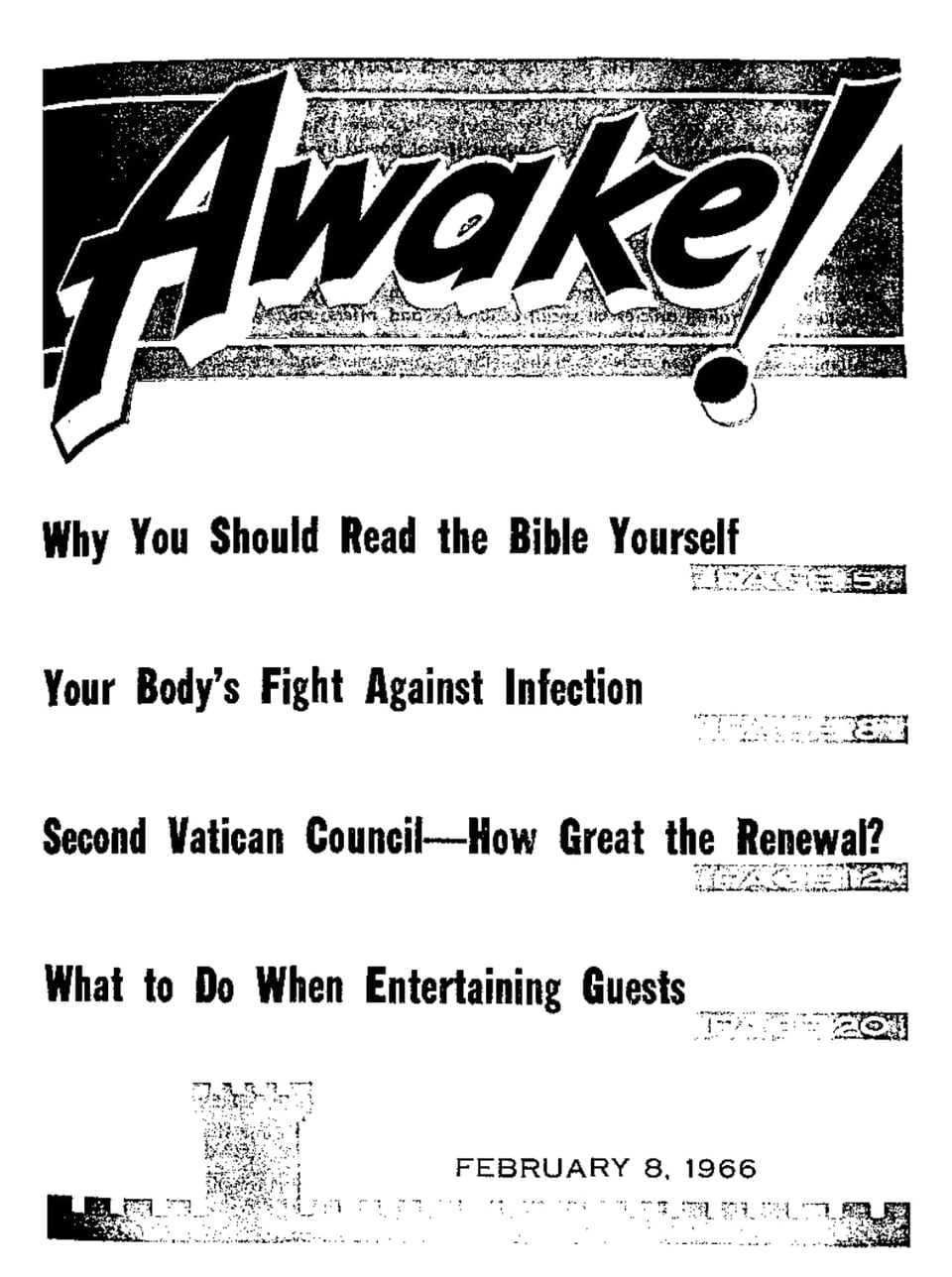
Why You Should Read the Bible Yourself
Your Body's Fight Against Infection
Second Vatican Council-How Great the Renewal?
What to Do When Entertaining Guests
FEBRUARY 8, 1966
THE REASON FOR THIS MAGAZINE
News sources that are able to keep you awake to the vital issues of our times must be unfettered by censorship and selfish interests. "Awake!" has no fetters. It recognizes facts, faces facts, is free to publish facts. It is not bound by political ties; it is unhampered by traditional creeds. This magazine keeps itself free, that it may speak freely to you. But it does not abuse its freedom. It maintains integrity to truth.
The viewpoint of "Awake!" is not narrow, but is international. "Awake!" has its own correspondents in scores of nations. Its articles are read in many lands, in many languages, by millions of persons.
In every issue "Awakel!" presents vital topics on which you should be informed. It features penetrating articles on social conditions and offers sound counsel for meeting the problems of everyday life. Current news from every continent passes in quick review. Attention is focused on activities in the fields of government and commerce about which you should know. Straightforward discussions of religious issues alert you to matters of vital concern. Customs and people in many lands, the marvels of creation, practical sciences and points of human interest are all embraced in its coverage. "Awakel!" provides wholesome, instructive reading for every member of the family.
"Awakel" pledges itself to righteous principles, to exposing hidden foes and subtle dangers, to championing freedom for all, to comforting mourners and strengthening those disheartened by the failures of a delinquent world, reflecting sure hope for the establishment of God's righteous new order in this generation.
Get acquainted with "Awake! Keep awake by reading "Awake!
PUBLISHED SIMULTANEOUSLY IN THE UNITED STATES BY THE WATCHTOWER BIBLE AND TRACT SOCIETY OF NEW YORK, INC. 117 Adams Street Brooklyn, N.Y. 11201, U.S.A. AND IN ENGLAND BY WATCH TOWER BIBLE AND TRACT SOCIETY W.ulh. Towe, House, The Ridgeway London N.W. 7, England N. H. Knowe, President Grant Surrey, Secretary
Printing this issue: 4,450,000
46 a copy (Australia, 5d; South Africa, 3½d)
Fewer subscription rates
(monitiously edited)
America, W.A. 117 Adams Street, Brooklyn 13241
Australia, 13 Benedict Road, Brightfield, N.S.W.
B./Canada, 150 Bridgland Ave, Toronto 10, Oct.
1/8
New Zealand, W. I. 7
1/8
New Zealand, 611 New York Ave, Auckland W. I. 7.
T./New South Africa, Private Mail B. 2, P.O. Klondendale, T.1c
(Mostly airlines only) only the above rates.)
Emissions for subscription costs (the above rates)
in four country locations with permanent remittances. Brooklyn.
Notes of expiration is most at least two months before
subscription expires.
Now published in 26 languages
Somethingsm - Alt-Ricam, German, Dutch, Dutch, English,
French, Français, German, Greek, Italian, Japanese,
Norwegian, Portuguese, Spanish, Swedish, Tagalog,
Laithe - Chinese, Cipuny, Kilimanjaro, Malagasy, Polish,
Tamil, Tirunain.
CHANGES OF ADDRESS should remain on thirty days before your moving date. Give to your old and new address on the same day of moving. Watch Your, Watch Your House, The Ridgeway, London H.W. 7, England.
Extended as second-class Master at Brooklyn, N.Y.
Printed in England
The Bible translation regularly used in "Answers" in the New World Translation of the Holy Scriptures, 1961 edition.
When other translations are used, this is clearly marked.
CONTENTS
Are You Gathering with Christ? 3
Bible Yourself 5
Your Body's Fight Against Infection 8
Second Vatican Council
—How Great the Renewal? 12
Spurious Text 19
What to Do When Entertaining Guests 20
"Td Rather Walk, Thank You" 24
Benefiting from Bible-Study Aids 26
"Your Word Is Truth"
Does Man Go Through a Series
of Rebirths? 27
Watching the World 29
ARE YOU Gathering WITH CHRIST?
IT IS one thing to
I claim to be a Christian and another thing really to be one. That is why the expression "professed Christians" has a slightly unfavorable connotation, for it implies that such may only profess to be and not actually be Christians. An even stronger term is "nominal Christians," meaning Christians in name only, the word "nominal" meaning "existing in name only, not actual or real."—Webster.
Such expressions do indeed have weight when we consider how many persons claim to be Christians. Have you any idea how many? According to the 1965 World Almanac, there are presently almost a thousand million persons professing to be Christians, 993,055,000 to be exact. But what kind of Christians are they? Nominal ones or real ones?
Consider an example. According to the Roman Catholic 1965 National Almanac (United States), Italy has a population of upward of 51 million, and, of these, 99.5 percent are Roman Catholics. According to the Roman Catholic Church it is the true Christian church, which means that they believe all Roman Catholics to be Christians. But how can 99.5 percent of Italy's population be Christians when 25.3 percent of them voted Communist in the 1963 general elections? Communism denies God
the Creator, his Word the Bible, and Jesus Christ as the Son of God. Obviously, at least that number of Italians are nominal rather than real Christians.
The fact is that throughout Christendom the great majority of professed Christians are content with a negative goodness. They think they are really doing fine so long as they do not break any of the Ten Commandments. Even their own leaders occasionally admit that fact. Thus Dr. Trueblood, one of America's leading religious educators, was quoted as saying: "Plenty of religions are no good at all. Don't ever say that what we need is religion! I am not interested in religion!" (Los Angeles Times, August 17, 1964) And said Jamaica's Anglican Bishop Percival Gibson: "Obviously, if there is no reception of the Holy spirit the sense of mission is absent. We have largely driven the Holy Spirit from our Church life and substituted organizations. We dare not scrap the organizations because we have nothing to offer in their place. Brethren of the clergy and laity, nothing short of a reformation, root and branch, can save our Church, because to continue as we are means spiritual bankruptcy and eventually death." -The Daily Gleaner, February 23, 1965.
A real Christian is a follower of Jesus Christ. To be one in more than name only, he cannot be content with a mere negative goodness. He must be a worker, for Jesus Christ certainly was a worker, expending himself tirelessly. Well could he say: "My Father has kept working until now, and I keep working." "We must work the works of him that sent me while it is day." That he meant for his followers to be likewise workers is clear from his words on another occasion: "Not everyone saying to me, 'Lord, Lord,' will enter into the kingdom of the heavens, but the one doing the will of my Father who is in the heavens will.'"—John 5:17; 9:4; Matt. 7:21.
Jesus made the same point in his illustration of the sheep and the goats. Therein he told of two classes of people into which all mankind would be separated during his second presence, after his taking Kingdom power. The "sheep," who gained his approval and who were rewarded with everlasting salvation, were those who were active, doing something in behalf of Christ's "brothers," cooperating with them, giving them support. To these he said: "Come, you who have my Father's blessing, inherit the kingdom prepared for you from the founding of the world."
In contrast to the "sheep," the "goats" were cursed and consigned to the destiny of the Devil and his angels—everlasting cutting off or destruction. Why? Does the illustration indicate that they were or had been particularly wicked? No, not from their viewpoint. Then what was wrong with them? What caused them to merit that destiny? They had failed to obey God's commandments. They had not been positively active; they had failed to cooperate with Christ's "brothers."—Matt. 25: 31-46.
This makes the matter of being more than a nominal Christian a very serious one. Negative goodness will not gain anyone favor with God and Christ, for it is considered the same as opposing them. Jesus made the same point when he once stated: "He that is not on my side is against me, and he that does not gather with me scatters."—Matt. 12:30.
Gathering with Christ Jesus does not mean merely gathering oneself to him but means gathering with him, working, helping to lead others to Jesus Christ. That is why, when he began to invite others to join him as followers, he was not merely inviting them to be listeners, merely to hear and believe what he had to say, but he invited them to be workers. Instead of their working hard daily fishing for fish in the sea of Galilee, he wanted them to become "fishers of men." By fishing for men they were to work gathering others, catching men, as it were, to be followers of Jesus, even as they themselves were. —Matt. 4:19.
And so also with Jesus' parting instructions to his disciples, most likely the five hundred mentioned at 1 Corinthians 15:6. They were counseled to make workers, gatherers, out of others: "Go therefore and make disciples of people of all the nations, baptizing them . . . teaching them to observe all the things I have commanded you." Yes, all these were also to be fishers of men.—Matt. 28:19, 20.
Do you profess to be a Christian? Then you have been favored in that you have come to know at least something about Jesus Christ, for there are ever so many persons throughout the world that have never heard of him and many others who want to have nothing to do with his name. But do not let it rest with merely professing to be a Christian. Do not be merely a nominal Christian; be a real one, one that goes beyond negative goodness and does something, one that gathers with Christ.
AWAKEN "I BELIEVE in God and go to church.
My minister tells me all I need to know. He has studied and prepared himself to teach me, so it's not necessary for me to study the Bible." Do you agree with that statement, which expresses the viewpoint of many persons?
Some persons take such a view of religious matters because they say it is too difficult to understand the Bible and that without some higher education one might misinterpret it or fail to understand it, and so they prefer to let the clergy explain it. But is it safe to take such a view? To help us learn the answer to this
vital question, we do well to examine the Holy Bible.
What Is the Bible?
The Bible is the Word of God. By means of the Bible, our invisible Creator speaks to us, revealing his name, purpose and will. Thus He guides us in the right way. This is why the psalmist speaks of God's Word as a "lamp to my foot, and a light to my roadway." (Ps. 119:105) The Bible serves as a Light to guide us in these hard-to-deal-with times, because it alone of all books is "inspired of God and beneficial for teaching, for reproving, for setting things straight, for disciplining in righteousness, that the man of God may be fully competent, completely equipped for every good work."—2 Tim. 3:16, 17.
Well, then, is the Bible a book for only certain specially educated persons? Did the Son of God say that his heavenly Father reveals understanding of His purposes only to the worldly-wise and intellectual ones? On the contrary, the Lord Jesus Christ plainly declared: "I publicly praise you, Father, Lord of heaven and earth, because you have hidden these things from the wise and intellectual ones and have revealed them to babes." (Matt. 11:25) To "babes"? Yes, to those whom the worldly-wise view as uneducated. The apostles of Jesus Christ, Peter and John, were "unlettered and ordinary." (Acts 4:
13) So God has not favored the worldlywise and intellectual ones above the ordinary person; in fact, it has pleased God to hide sacred things from the worldly-wise and to reveal them instead to "babes," or ordinary persons. One of the reasons for this is, as the apostle Paul explains, "in order that no flesh might boast in the sight of God."—1 Cor. 1:29.
Since God has chosen to reveal understanding of his Word to "babes," or "unlettered and ordinary" persons, why should such persons feel God's Word is too difficult for them? It is not too difficult for those who look to God for guidance. Why, God's Word can be taught to children. For this reason the Bible says of the disciple Timothy: "From infancy you have known the holy writings, which are able to make you wise for salvation."
(2 Tim. 3:15) So rather than being limited to specially educated ones, an understanding of the "holy writings" can be gained even "from infancy"!
The Bible, then, is written for the guidance of persons humble enough, modest enough to walk with God, really seeking to do the divine will. His written Word contains examples, warnings, counsel and prophecies. It is a true historical Record of the dealings of Jehovah God with mankind. It is written for our guidance and comfort, that "we might have hope." (Rom. 15:4) What a wonderful treasure we have, then, in the Bible! It is a divine library of sixty-six inspired books given to us and preserved for us throughout the ages, that we might know the truth and be instructed in the way of true worship.
Bible Rejected as Source of Truth
The Author of this divine library knows that the tendency of worldly-wise men is to rely on their own wisdom and intelligence; so He gave us a warning not to fall victim to their philosophies: "Look out: perhaps there may be someone who will carry you off as his prey through the philosophy and empty deception according to the tradition of men." (Col. 2:8) In view of this warning, have the religious leaders of today stayed clear of human philosophies and adhered to the Bible for teaching their parishioners? Do the clergy faithfully uphold what the Bible says?
More and more it is noted that clergymen are rejecting large parts of the Bible as myths. For example, one Protestant bishop in the United States said: "I don't see anything special about the birth of Christ. . . . Literal belief in the nativity narratives . . . is not required to be affirmed in our church. . . . I don't think the son of God category is a very useful one."
Many are the clergymen who snare similar views. In fact, a new official Sundayschool curriculum was adopted by the United Church of Canada after six years' preparation and at a cost of one million dollars. Viewed as "a major breakthrough," this new course teaches evolution, that the first eleven chapters of the Bible book of Genesis are myths, questions the birth of Jesus Christ as described in the Bible, calls one of the plagues God brought upon Egypt a "children's disease," denies that David killed Goliath, calls the flood of Noah's day a legend and says of the resurrection of Jesus Christ: "Some Christians take the stories literally . . . but others feel unable to do that."
Said a report in the Toronto Daily Star of July 4, 1964: "It is the first time a Sunday school course of study has taken such a frankly critical view of the Bible." Shocking? Not to ministers of the United Church and to some Baptists. "If this material is accepted in our Baptist churches," said cleric Frederick Helps, editor of Baptist Sunday-school publications, "It will be a very great step forward." Moreover, it was pointed out by the editor-in-chief of the United Church Sunday-school publications that this critical approach to the Bible is not to be viewed as revolutionary, since it has been taught in most Protestant theological seminaries for forty years or more!
Further, it is well known that the Roman Catholic Church has long placed tradition above the Bible, and more and more Catholic religious teachers in effect deny parts of the Bible. For instance, a priest, writing in a Catholic newspaper, says that "the Garden of Eden was surely not a geographic place but a symbol of man's innocence and happiness in his original life of union with God." As for the Bible account of Jonah and the big fish, a Catholic source says: "The prevailing view among Catholic scholars is that it is an allegory."
This trend of downgrading the Bible is also found in modern Bible dictionaries and commentaries that the clergy use for their reference works.
How different are the clergy and religious teachers who reject parts of the Bible as myths from the apostle of Jesus Christ who said: "I believe all the things set forth in the Law [the writings of Moses, including the book of Genesis] and written in the Prophets"! (Acts 24:14) How utterly different are the clergy from the Lord Jesus Christ, who referred to the book of Genesis as genuine truth, who knew the history of Jonah was true, and who called all of God's word "truth," saying: "Sanctify them by means of the truth; your word is truth"!—John 17:17; Mark 9:6-9; Matt. 12:40.
Instead of abiding by God's Word of truth, worldly religious leaders today have gone to cisterns of human philosophy, wisdom and tradition. This reminds us of the words of Jehovah God through his prophet Jeremiah: "There are two bad things that my people have done: They have left even me, the source of living water, in order to hew out for themselves cisterns, broken cisterns, that cannot contain the water." (Jer. 2:13) What these religious leaders offer people is, therefore, contaminated with human philosophies that God's Word warns against. For this reason the apostle John admonishes us: "Beloved ones, do not believe every inspired expression, but test the inspired expressions to see whether they originate with God, because many false prophets have gone forth into the world."—1 John 4:1.
Vital Need to Examine Bible Ourselves It is by means of the Holy Bible that we can "test the inspired expressions" as
admonished by the apostle John. If we examine the Bible ourselves, then we are in position to reject anything that is out of harmony with the Word of God, and we will safeguard ourselves in these dangerous times when religious teachers are elevating the theories and philosophies of men above God's written Word of truth.
In such a vital thing as religious instruction, is it really wise to rely on some bettled religious teacher for guidance without going to the Bible to verify his teaching? No, it is most unwise, for the Bible commands us: "Make sure of all things; hold fast to what is fine." The Bible writer Luke shows it is a noble course when we 'carefully examine the Scriptures daily' to see whether the things we hear from others are in harmony with the Bible. —1 Thess. 5:21; Acts 17:11.
If we fall to verify what we hear and believe, then what? The Son of God said: "If, then, a blind man guides a blind man, both will fall into a pit." (Matt. 15:14) Each one of us has to render an account to God, and we cannot call upon another to answer for us. If one has been led astray, it does little good to blame another for what one has done. Instead of trusting implicitly in a professed religious leader, a person should verify his guide's teachings before it is too late.
So, then, it is to Jehovah God that we must turn for guidance, and our prayer should be: "Teach me to do your will, for you are my God. Your spirit is good; may it lead me in the land of uprightness." (Ps. 143:10) If you humbly turn to Jehovah God in faith and diligently study his Word, the Bible, He will teach you his way and you will be able to discern between what is true and what is false. Use your God-given Guide, the Holy Bible; you need it.—Prov. 2:10-13.
YOUR BODY'S
Fight AGAINST INFECTION
</div>
ALL around you there are billions of microscopic organisms. You handle things every day that are covered by unseen bacteria, many of which perform valuable services, but some are germs that can produce sickness or even death.
How does your body resist infection by them? Is your skin an impenetrable barrier to their invasion?
What about the many infective microorganisms you take in with the air you breath, or swallow with the food you eat? Why do they not usually cause harm? How does your body afford protection against them? What happens when you are cut or wounded, and thousands of harmful germs at once gain entrance to the warm tissues and fluids of your body? What prevents them from multiplying and causing sickness and death?
You might think the body would be easily overwhelmed under constant attack by such a formidable host of invaders. Indeed, their great numbers and strength once caused a medical man to call health "the greatest of medical mysteries." Yet, on the other hand, an investigation of the body's marvelous system of defenses stimulates confidence in its ability to repel and overcome unfriendly organisms. In fact, the late physician Walter B. Cannon once said: "When you understand a great deal about the human body and its resources for health, you wonder why anyone is ever sick." Consider some of your body's defenses against infection—defenses with which man has been endowed by the Creator.
Initial Defenses
The first line of defense against disease-causing microbes is your skin. Despite its apparent fragility, it is an extremely tough barrier that microorganisms cannot ordinarily penetrate. Bacteria do sometimes gain entrance into sweat glands and cause local infection, but unless there is a cut or crack in the skin they cannot reach the deeper tissues. To avoid such breaks in the skin that would allow openings for the entry of unfriendly organisms, oil secretions keep the skin freely flexible.
Then, too, the flow of perspiration washes bacteria from skin pores, and skin secretions contain acids and enzymes that can kill bacteria or, at least, impede their growth. For example, the potent dysentery bacteria in a drop of fluid can survive for hours on a glass slide, but when placed on the clean palm of your hand they will die within about twenty minutes. The eyes, too, are washed by tears that contain a mild bacteria-killing substance that protects them from infection.
Even should microorganisms enter your body through the nose or mouth, they meet a strong line of resistance. For instance, hairs of the nasal cavity serve to strain out the bacteria-laden dust particles you inhale. And should these particles cause irritation in the nose, they are sneezed out; or your nose begins to run and
AWAKEN they are flushed out.
Infective organisms entering the mouth are resisted by antiseptic substances found in your saliva. If they are swallowed and washed into your stomach, the highly acid gastric juices will attack and destroy them. Very few bacteria make it alive from your stomach into the intestines.
Nevertheless, a fantastic number of bacteria do populate your intestines, mouth and nasal cavity. Most of these bacteria are harmless, and many, such as those in
dable staphylococci, which are ever present on the skin, make their entrance. With a beachhead established in the body's tissues the staphs multiply fast, building up their forces by dividing about every half hour. At that rate, a single staph, if left unchecked, can increase to over a billion in fifteen hours!
But your body does not permit this. It immediately takes countermeasures. An alarm sounds! Chemical substances are released, calling for help at the wound site.
the intestines that manufacture essential vitamins, are beneficial. In fact, there are so many in the intestines of the normal human that a sizable proportion of fecal matter is composed of dead microorganisms. In a normally healthy mouth, it is said, every fifteen drops of saliva are estimated to average 750 million microorganisms! However, they are normally prevented from entering your body tissues and fluids in significant numbers by the linings of the alimentary canal, nasal cavity and
In response the small blood vessels near the injury expand, allowing an increase in blood flow to the area. This produces the familiar reddening and, because blood is warmer than skin, a localized warmth. Then an amazing thing happens! Highly mobile little blood cells squeeze through walls of the dilated capillaries into the surrounding tissue, and at once begin attacking the invaders.
The first wave of defenders is made up of white blood cells called neutrophils. The
upper lung passages, which present a difficult-to-penetrate barrier, much as the skin does.
These linings are coated with a thick, slimy secretion called mucus, which entraps bacteria, on the flypaper principle. In the main breathing passages tiny hairlike growths called cilia (not to be confused with true hair) are constantly waving in this mucous fluid, sweeping bacteria caught in the mucus toward the throat. They are then swallowed, to meet the destructive gastric juices in the stomach; or
white blood cells, which are the primary defenders against infection, are composed of two main groups. First, those with granules in the cytoplasm (that part of the cell lying between the nucleus and outer membrane). The above-mentioned neutrophils make up about 95 percent of the cells of this group, while the other two types of cells in this first group are called eosinophils and basophils. The second group is composed of those white blood cells without granules in their cytoplasm. These include lymphocytes of larger and smaller
sometimes they are coughed up. Germs are thus often prevented from reaching the delicate tissues of the lungs.
When the Skin Is Breached
Suppose, however, a breach is made in the body's initial defenses; by a nail puncture of the skin, for instance. Immediately thousands of bacteria, including the formi FEBRUARY 8, 1966
sizes, which constitute the major number of cells in this group, and monocytes.
At the battlefield, the fast-arriving neutrophils somehow recognize the bacteria as foreign, and immediately attack by engulfing them and breaking them down by means of digestive enzymes. One neutrophil may wrap itself around and digest dozens of bacteria, but then it, too, becomes a battle casualty.
The invading enemy wages ferocious counterattacks, releasing potent toxins that destroy the defending cells.
This calls for reinforcements. So from storehouses in the body, neutrophil reserves are mustered, and, at the same time, in the red bone marrow there is a speedup in the manufacture of these defenders. Basophils and eosinophils are also found at the site of infection, but their functions are not clearly understood.
In order to keep the infection from spreading, the body takes measures to localize the conflict. The clotting agent fibrinogen of the blood plasma solidifies into a network of strands and, with other plasma substances, forms a protective wall around the battlefield.
As the conflict rages in the confined area the casualties on both sides become staggering, numbering into the millions. Swollen and broken cells, debris and fluid strew the field of battle. Within, a few hours the remaining neutrophils begin to break down and spew out their contents. The second wave of defenders next move in and begin a mopping-up work. They are the slow-moving lymphocytes and monocytes, which feed on the disintegrating neutrophils and remaining bacteria.
As they engulf the debris of the inflamed area, the lymphocytes swell up and become macrophages, which continue the cleaning-up action until every one of the alien invaders is disposed of. A few days after the cleanup by the macrophages, blood vessel cells and connective tissue cells begin growing in the area. In time, the body's miraculous healing processes fill the gap with firm, serviceable scar tissue.
of assisting your body in its fight. Do not neglect cuts or wounds. When the skin is breached, reduce the number of invaders by washing out the cut. Also, use of an antiseptic is a good practice; and then be sure to keep the area clean.
Remarkable Drainage System
Everyone has experienced this remarkable response of the body. But appreciating more fully the tremendous battle that rages, you will perhaps be more conscious
While much of the invading bacteria is broken down by enzymes into amino acids and sugars to nourish the cells, the body has a remarkable system for disposing of the remaining wastes and battle casualties. It is an amazing network of channels known as the lymphatic system. These innumerable vessels are continually returning seepage of fluids from the blood capillaries to the bloodstream, which prevents us all from "bleeding" to death internally. It also saves us from fatal poisoning. How so?
In that the lymphatic vessels carry away bacteria from the scene of battle, and, at the numerous strategically located lymph nodes along the way, strain them out and destroy them. By the time the lymph fluid reaches the nodes in the neck, where it is discharged into the bloodstream, all bacteria have generally been filtered out. Many persons have experienced painful evidence of this filtering process, developing swellings in the neck during a siege of "sore throat" or in the armpit after an infection of the hand or arm. These are swollen lymph nodes that have filtered out and are destroying infectious agents.
What is done within this remarkable drainage system to protect the body from infection indeed excites wonder. Men have only recently begun uncovering its secrets. For instance, they are now beginning to learn some answers as to what stimulates this system to produce its lifesaving products—the lymphocytes, macrophages, plasma cells and antibodies—and how these function in the fight against infection, particularly in the rapid repulsion of a second attack by the same invader.
Deeper Lines of Defense
Just four or five years ago the hitherto mysterious thymus, a barely discernible small gland in the chest, was discovered to play a key function in the body's defense mechanism. It was found that early in one's life the thymus
one's life the thymus stocks the lymphatic
known. However, it seems that, when macrophages carrying vanquished alien invaders reach the lymph nodes, somehow a component of the microbe is retained and is passed on to succeeding generations of the cells, new ones taking it up as old ones die. Then, when the same invader again enters the body, the cells having this component immediately break down on
coming in contact with the intruder. It
system with the vital lymphocytes, and then, apparently having served its purpose, diminishes in size. It was also
ARTICLES IN THE NEXT ISSUE
Worship According to Accurate Knowledge.
Deep Concern over Vietnam.
Ancient Mayan Religion—What Was Its Origin?
Marvel of the Setting Sun.
learned that the thymus supplies some substance, evidently a hormone, that prompts the lymph nodes to produce lymphocytes from their own cells.
Lymphocytes, as has been noted, travel to areas of infection and grow into macrophages after feeding on bacteria and the
tibodies.—Scientific 1964.
seems that the disintegrating cells then supply to plasma cells something that causes them to divide and manufacture an American, February
Although antibody undoubtedly plays the major role in combating reinfection by a particular virus, the question is raised as to what should be credited with beating back the first attack by a virus that, for
debris of battle. But what is the function of plasma cells? And how are antibodies the remarkable substances that are fashioned according to exact specifications to destroy specific alien invaders—produced?
Up until twenty years ago it was generally believed that macrophages produced the important antibodies. However, recent experiments prove that, instead, the plasma cells do; yet other scientists say that small lymphocytes also produce antibodies. So there is still some uncertainty. Interestingly, it is now suggested that lympho
instance, reaches the tissues of your lungs. Surprisingly, recovery was often noted to occur before the body had time to manufacture antibody against the invading virus. This was somewhat of a mystery. But then, in 1957, an active virus-interfering substance produced in the attacked cells themselves was isolated and named interferon. Unlike antibody that is manufactured to fight just one type of invader, interferon is a general reaction of cells to virus infection.
Men have obviously only scratched the
cytes, macrophages and plasma cells may all be variations of the same cell, which takes on different forms to carry out its complex operations against invading organisms.
How these cells cooperate to defend the body against a second attack by the same invader is truly amazing. Much is still un-
surface or knowledge regarding the marvelous functions of the body's defensive system. Yet the more that is learned, the more one comes to appreciate the divine wisdom of man's Creator. The human body was clearly designed with remarkable resources for health. You can do much to preserve these resources by providing your body with plenty of rest and good food.
SECOND VATICAN COUNCIL
ON January 25, 1959, Pope John XXIII made the startling announcement that he intended to call an ecumenical council—the first since Vatican Council I in 1869, 1870, and only the twenty-first in the Roman Catholic Church's long history. When asked the reason why, the pope is reported to have opened a nearby window and said: "To let some fresh air into the Church."
Now that the Council has officially concluded, its final chapter having been recorded, it seems appropriate to ask: Did the Council achieve its goal? How much fresh air was let in? How great was the renewal? The answers to these questions can better be understood by examining these council decisions and how they were passed.
A Sharply Divided Council
After more than three years of preparation the Second Vatican Council finally opened amid spectacular pageantry in Rome on October 11, 1962. Two days later, work sessions began for the more than 2,000 cardinals and bishops who had assembled. However, any notions that there would be unity of thought among them quickly disappeared. Almost immediately sharp differences erupted, and soon two sides became manifest.
On the one hand were the conservatives chief of whom were the cardinals of the
Roman Curia, the central and most powerful administrative body of the Church. These men, led by Alfredo Cardinal Ottaviani, were staunchly opposed to any change whatsoever; in fact, some of them were against calling the Council in the first place. On the other hand were the liberals or progressives, who included the majority of cardinals and bishops. These favored renewal. However, it soon became obvious that it would be a difficult thing to override the Curia and obtain any clearcut decisions for updating the Church.
In an attempt to start the Council on a less controversial matter, it was decided to consider first the document on liturgy, a decree involving principally matters of worship. It was hoped that a council decision would make the mass and other church sacraments more understandable and relevant to Catholics. The Curia, however, strongly resisted innovations, especially opposing the introduction of modern languages to replace Latin in the mass. But, despite the opposition, a preliminary vote in mid-November gave promise of some liturgical reforms.
The next major question considered was the decree on divine revelation. Here differences were even sharper. On the one hand, the conservatives argued for the popular Catholic position that there are two separate sources of revelation—the Bible and tradition—and that one is on the same level as the other.
The original draft was based on this view. However, it came under strong attack by progressives who realized that its wording would be offensive to Protestants, whom the Catholic Church would like to welcome back into its fold. This apparently influenced these prelates to argue that Catholic tradition is always founded on the Bible and is not separate and distinct from it. After an impossible deadlock, the pope intervened and sent the document back to the committee for reworking.
The final three weeks were taken up with debates on the use of mass communications, Christian unity and, particularly, the huge document entitled "De Ecclesia" ("On the Church"), which considered many aspects of the internal operations and teachings of the Church. Each of these subjects received further consideration in later sessions. So when the Council's first session concluded on December 8 there was little tangible evidence of accomplishment. No decrees had been promulgated, but it was evident that there were sharp differences of opinion on religious matters among members of the Church's foremost clergy.
Act II
The holding of any future sessions was called into question with the death of Pope John the following June. However, uncertainty was soon dispelled when, shortly after his election, Pope Paul VI announced that the Council would continue. The second session finally opened September 29 and ran to December 4, 1963.
The major document under discussion was the massive constitution De Ecclesia. For weeks its various chapters were vigorously debated, the greater attention being focused on what, in final form, was chapter III, On the Hierarchial Structure of the Church. This dealt with the question
of the relative authority of the pope and bishops. At the first Vatican Council, in 1870, the infallibility of the pope, when speaking officially on matters of faith and morals, was promulgated as Catholic doctrine. Now an effort was being made to define the position of bishops, and to increase their authority in the Church.
On October 16 Archbishop Elias Zoghby of Egypt said in discussion of the matter: "The authority of the Pope, which is not absolute, isolated, and independent, cannot be understood except in relationship to the College of Bishops. . . . It is a wonder that so many doubt the doctrine of collegiality." And noted Bishop Emile Josef De Smedt of Belgium: "It is now desirable and imperative that the Pope, in matters of graver importance, communicate with the other bishops and with episcopal conferences." It was hoped by the majority of prelates that the adoption of this chapter would pave the way for bishops around the world to have a fuller share in the administration of the Church.
Another emotion-packed issue considered at this time was whether to include a statement on Mary in De Ecclesia, or to honor her with an exclusive document. Arguments were heated. Rufino Cardinal Santos claimed that the text on the Church "could hardly be modified so as to include the schema on the Blessed Virgin Mary without her dignity and place in the Church thereby suffering, or without the door thereby being opened to erroneous ideas in the minds of the uninstructed." However, by a narrow margin—forty votes—the Council decided simply to include its statement on Mary in the final chapter of De Ecclesia.
Disappointing End
The last major document argued during the session was the one on ecumenism, or the union of all professing to be Christians.
It at first contained three chapters, but a fourth one on Catholics and Jews and a fifth on religious liberty were added. This schema was of great public interest, Catholics and non-Catholics alike wondering whether the Council would reverse the Church's position on these matters. Council speeches were followed with intense interest.
The most moving of them was the one by Bishop De Smedt on the religious liberty chapter. Tracing the Church's views on the matter, he noted that, in the past, pontifical documents had treated "religious liberty in such words that this liberty appeared as something that had to be condemned." He cited, as an instance, the encyclical of Pope Plus IX, Quanta Cura, which called "erroneous" the view "that the freedom of conscience and of cults is the proper right of each man."
To show the world that the Catholic Church no longer subscribes to such views, Bishop De Smedt urged that the present statement on religious liberty be adopted. "The whole world is waiting for this decree," he said. "The voice of the Church on religious liberty is being waited for in universities, in national and international organizations, in Christian and non-Christian communities, in the papers, and in public opinion—and it is being waited for with urgent expectancy. We hope that it will be possible to complete the discussion and the approbation of this very brief, but very important, decree before the end of this session."
However, many prelates, particularly the powerful Curia leaders, did not share De Smedt's views. They strongly opposed religious liberty and, by a series of deceptive moves, succeeded in blocking passage of the text.
fears, it was announced publicly, not once, but three times, that these separated chapters would be voted upon "within the next few days." On November 21 a preliminary vote unanimously favored the three-chapter document on ecumenism. However, during the remaining days of the session, the Curia leaders succeeded in preventing the promised vote on chapters four and five. Said one Catholic observer: "They outsmarted the majority and kept the statements on the Jews and religious liberty from a vote which could easily have been taken."
First, they had chapters four and five temporarily separated from the first three chapters on ecumenism. But, to relieve any
First Two Promulgations
But despite the bitter disappointments, the second session was not entirely without fruitage. The lengthy 12,000-word constitution on the liturgy finally was approved and promulgated by the pope. It provided for a measure of change, particularly in the mass. Provision was made for the use of vernacular languages and for certain active participation by the laity. However, application of the document's reforms is strictly reserved to a commission set up in Rome under the pope's direction.
The second promulgation was a short decree on communications, which considered the use of the press, radio and television. However, according to a statement of protest by some twenty-six bishops, this document "by no means reflects the wishes of the people, and especially of experts who work in the field." One Catholic prelate observed that the phraseology "undoubtedly leaves the door open for censorship."
So, at the midway point, the Council had accomplished little in the way of renewal and reform. Many prelates were bitterly disappointed.
The Third Session
On September 15, 1964, the third-session debates began with a consideration of chapter seven of De Ecclesia, which touches on doctrinal matters.
Some prelates argued for greater emphasis on the teaching of hellfire and purgatory, but this was not approved.
The next day most of the session was spent discussing the eighth and last chapter of De Ecclesia, the one devoted to Mary. The debate centered on the description of Mary as "mediatrix" for mankind, as if she had'a share in man's redemption. Prelates sleeped in Catholic tradition argued for unstinted glory of Mary, desiring that she be honored in this official document with such titles as "Mediatrix" and "Mother of the Church," even though the Bible does not call her such. But the majority of cardinals and bishops, in an effort to cut down on excessive worship of Mary, were able to have these designations ruled out of the decree.
During the following weeks a vast array of topics were reviewed, and some new ones introduced. Then on November 6 an incident worthy of note occurred. Because of interest in the proposed document on the Church's missions the pope, for the first time since the Council convened, attended to speak in behalf of a document. He pronounced it generally satisfactory, and left no doubt that he expected it would have overwhelming support. The assembled prelates, however, showed they had a mind of their own by rejecting it as inadequate and needing complete reworking. "We needed fire, and the commission gives us a candle," one Irish bishop of Rhodesia cried out. "We wanted a theological background for the preaching of the Gospel, and the commission has given us a few dry principles from a textbook."
Council Crisis
a substantial renewal in the Church after all. The De Ecclesia document, whose principle of collegiality was understood to diffuse the pope's authority and to give greater voice to bishops in church government, was ready for promulgation. Then, too, a vote had been promised on religious liberty, and it was certain to gain the approval of the majority of prelates. But then a bombshell was dropped.
As the session neared its November 21 close there was a feeling among many prelates that the Council was going to achieve
On November 19, two days before the Council's close, the announcement was made: It seems proper "that this question [on religious liberty] should not be decided now. We will not proceed to a vote." In moments the Council was up in arms; bishops were livid with rage. Quickly a petition was drawn up, and some 1,400 prelates signed the appeal: "To the most Holy Father: Reverently but urgently, very urgently, most urgently, we ask that a vote on the declaration on religious freedom be called before the end of this session of the Council lest the confidence of the world, both Christian and non-Christian, be lost."
The pope, however, refused to listen to the bishops, and endorsed the decision of the handful of conservatives to postpone the vote. But this was not the only shock. The prelates found that, after they had approved the document on ecumenism in chapter-by-chapter votes, the pope made nineteen last-minute textual changes before promulgating it. Further, although the bishops had decided that Mary had already been honored to the point of idolatrous worship, the pope spent half of his closing speech eulogizing her, and bestowed upon her the very title rejected by the Council, "Mother of the Church." So in this matter the pope allowed no hint of renewal, even calling Mary in one of his speeches "our Heavenly Mother and Queen," a title like that given by the ancient pagans to their goddess!—Jer. 44:17-19.
Some observers felt that the pope was perhaps smarting under the harsh rejection of his proposed mission's document two weeks before and wanted to impress upon the bishops his interpretation of this principle of collegiality.
It is interesting to note the comments of the Catholic periodical The Commonweal of December 4, 1964:
"The promulgation of that Constitution [De Ecclesia] was accompanied by a speech of Pope Paul in which he undercut some of its strongest points. In particular, he seemed totally to set aside the principle of collegiality voted upon by the Fathers by unilaterally proclaiming Mary as mother of the Church, by making nineteen suggestions for textual changes in the decree on ecumenism, and by failing to support that large group of bishops who petitioned him to allow a vote on the proposed document on religious liberty. In each of these instances, he could well have responded to the majority of the Fathers, thus giving an immediate indication of the seriousness with which he took De Ecclesia. . . . It clearly means that the way a decree is read and implemented counts for much."
So although three more documents were promulgated at the end of this session—De Ecclesia, ecumenism and a short one on the Oriental Catholic Churches—it was seriously questioned how they will actually be applied. Admittedly, the careful wording of the decrees, achieved under the direction of Curia leaders, can often be interpreted in various ways. Thus, despite the great publicity about renewal and updating, the documents themselves are not proof that such will be realized.
The Final Session
this was accompanied it brought the number of official decrees of the Second Vatican Council to sixteen.
The fourth and final session, which began last September and concluded December 8, 1965, was spent putting finishing touches upon and preparing the remaining eleven documents for promulgation. When
The first five of these were promulgated by the pope on October 28. They were decrees on the pastoral office of bishops, education, seminary training, religious orders all of which dealt principally with internal church matters—and the much publicized declaration on the relation of the Catholic Church to non-Christian religions, particularly the Jews.
Interestingly, before the Council opened, Curia leaders, on learning that Pope John had asked a cardinal to prepare a statement on the Jews, immediately alerted various Arab nations. Their diplomats, in turn, put up such a fuss to the Holy See that for a time it was a question of whether the statement on the Jews would come before the Council. One American bishop noted in bewilderment: "I wouldn't have believed all this if I hadn't seen it." Another prelate, an American member of the Curia, laughed at his naiveté. "What do these bishops think this is? A Boy Scout jamboree?"
But despite vigorous opposition, a short and many times revised declaration on the Jews was finally promulgated. It repudiates the attitude held in the past by many Catholics toward Jews that resulted in such terrible persecution of them. The decree says: "True, the Jewish authorities and those who followed their lead pressed for the death of Christ; still, what happened in His passion cannot be charged against all the Jews, without distinction, then alive, nor against the Jews of today. . . . The Church . . . decries hatred, persecutions, displays of anti-Semitism, directed against Jews at any time and by anyone."
However, if this was meant to be a conciliatory gesture toward the Jews, a Jewish rabbi pointed up a real weakness of the draft. He asked: "How can a historic document about Judaism possibly overlook the tragic record of Jewish persecution in which the church over the centuries was hardly neutral?
It is in the absence of the remotest reference to this record that the section on the Jews assumes a doubly unfortunate note: (1) it is condescending; (2) [and] . . . presumes to redress on its own terms a wrong which it does not admit. There is not a hint of contrition or atonement."
The next two documents, on the lay apostolate and divine revelation, were promulgated by the pope on November 18: The laity decree is the first ever produced by a Roman Catholic ecumenical council that deals exclusively with the laity. It repudiates the common Catholic belief that the laity are merely to sit and listen, saying: "They are consecrated . . . that they may offer spiritual sacrifices in everything they do but also that they may witness to Christ throughout the world." Yet the decree leaves entirely uncertain what it means to "witness to Christ." No provisions are described for training the laity to do this work; nor is an explanation given on how it should be done. It is extremely doubtful, therefore, that this decree will result in any renewal whatsoever.
The decree on divine revelation is a masterstroke of ambiguity. Originally it was called "On the two sources of revelation," but, in time, the name was changed, as the two-source view was minimized. Finally, however, the pope insisted on the insertion of the idea that Scripture is not the only source of Catholic teaching; so the document reads: "Consequently it is not from sacred scripture alone that the Church draws her certainty about everything which has been revealed. Therefore both sacred tradition and sacred scripture are to be accepted and venerated with the same sense of loyalty and reverence." So, in the end, no real change was achieved.
Nevertheless, Catholics were definitely encouraged to read the Bible. That they generally do not, especially in Catholic countries, Bishop Arthur Elchinger noted: "In most Catholic homes, you don't find a Bible—or if you do, it doesn't have a place of honor." Yet the decree says: "Easy access to sacred scripture should be provided for all the Christian faithful. . . . The sacred synod also earnestly and especially urges all the Christian faithful, especially religious, to learn by frequent reading of the divine scriptures." How fine it would be if they would all do that, and thus personally become acquainted with the Word of God!
What About Religious Liberty?
This was still the big question right down to the final session—its fate yet being undecided. But then a last-minute maneuver by conservatives to shelve the document completely was thwarted and a majority vote was finally obtained in its support. On the Council's next to last day the pope promulgated it, along with decrees on the role of missionaries, the ordinary priest, and the huge document on the Church in the modern world, to complete the total of sixteen promulgations.
But why such opposition to granting non-Catholics freedom to practice their religion? Because, for one thing, it poses a dilemma in Catholic teaching. As noted by a Catholic priest writing in The Commonweal of October 15, 1965: "The minority [conservatives, particularly of the Curia] insisted that the declaration on religious liberty went against traditional Catholic teaching. They were quite right. Religious liberty as proposed in the last century as part of the ideal lay state was then totally rejected by the Catholic Church. The minority could quote many papal documents in support of their view."
Papal decrees by former popes were obviously out of date.
But if the Church came out unconditionally for religious liberty, it would be an admission that the official declarations by former supposedly infallible popes were in error. Also, many of the Church's foremost clergy held tenaciously to these pronouncements.
For instance, Michael Cardinal Browne, an Irish-born member of the Curia, argued: "The spreading of another religion in a Catholic state is a violation of public morality and harms the right which Catholics enjoy not to have their faith endangered." The Spanish Benjamin Cardinal Arriba y Castro asserted: "We must remember that only the Catholic Church has the right to preach the gospel. Proseleytism in a Catholic state is bad and must be repressed." And Cardinal Ottaviani, the most powerful prelate next to the pope himself, expressed essentially the same opinion. In fact, The Catholic World of March 1965 said of him:
"His idea of religious tolerance may be stated briefly in this way: although truth and error as such cannot be said to involve rights, one must hold that persons professing the truth ought to be granted rights which are denied to those who profess error. On this basis, the Catholic Church will demand, when it is sufficiently strong, that the State give it a privileged position and restrict the activities of other religious groups. If, however, the Church is itself in a minority, it will either claim the freedom guaranteed by a liberal state or will protest, in the name of the rights of man, against oppression by a regime like the Communist State.
"It may seem that Cardinal Ottaviani's view scarcely differs from that of certain Catholics in the last century whose argument, in Montalembert's words, went according to this formula: 'When I am the weaker, I ask you for liberty because that is your principle, but when I am stronger,
Nevertheless, in apparent repudiation of these views and of former papal pronouncements, the religious-liberty declaration says: "The social nature of man, however, itself requires that he should give external expression to his internal acts of religion: that he should share with others in matters religious: that he should profess his religion in community. Injury therefore is done to the human person and to the very order established by God for human life, if the free exercise of religion is denied in society, provided just public order is observed."
Is this not a renewal, a change in viewpoint of the Church? That depends on whether it is interpreted and applied in keeping with its apparent meaning. But this still remains to be seen, for in Catholic countries such as Spain and Portugal non-Catholics, particularly Jehovah's witnesses, are to this day bitterly persecuted and oppressed for talking about their faith to others.
The Church in the Modern World
The decree on the church in the modern world was especially awaited because it promised to touch on questions closely affecting the lives of people, including birth control, marriage and divorce and nuclear war. However, for many Catholics the document, for the most part, was a source of great disappointment.
The pope intervened on the question of birth control, doubtless because of the strength of the progressive force that threatened to approve revolutionary changes. Just a few years back a former pope, Pius XI, in an encyclical on Christian Marriage, asserted: "Any use whatsoever of matrimony exercised in such a way that the act is deliberately frustrated in its natural power to generate life is an offense against the law of God and of nature, and those who indulge in such are branded with the guilt of grave sin."
Again, in this matter, approval of birth control would present a thorny problem to Catholic teaching of papal infallibility. So to the disappointment of many Roman Catholics, the official decree afforded no renewal. It simply stated: "Sons of the church may not undertake methods of birth control which are found blameworthy by the teaching authority of the church in its unfolding of the divine law."
When the matter of marriage and divorce was under consideration Monsignor Zogbyh of Egypt pointed to Matthew 5:32 and 19:9, and asked: 'Does not that expression—"except it be for fornication"—indicate that the law of indissolubility of marriage admits an exception, when one of the mates hardens himself in adultery?' But the Italian magazine Domenica del Corriere (Sunday Messenger) of October 17, 1965, observed: "Proposals like that of Monsignor Zogbyh are destined at present to fall in the air." They did.
Another question of great debate was that relative to modern war. Here again the document was unsatisfying. Observed The Commonweal of March 5, 1965: "The schema itself was disapproving [of war] but evasive . . . No effort was made in the schema to relate deterrence to the declaration against nuclear weapons."
The Catholic periodical then added: "The
person's responsibility for his own actions in war and his right to conscientious objection have been neglected to the point of scandal in the recent teaching and history of the Church, from the submersion of the Catholic conscience in Hitler's war effort to its unquestioning role in Allied atrocities of Dresden and Hiroshima. The text of Schema 13 did little to fill this vacuum when, after condemning nuclear weapons, it gave no counsel to the Christian ordered to use such weapons. . . .
"The Council could reinforce an affirmation of the right of conscientious objection in the schema proper by directing Christians toward a rediscovery of the Scriptural roots for a personal witness to peace. These are not hard to find—they constitute an essential part of the Gospel . . . There would be nothing imprudent in the Council's support of a Christian dedication to total peace." But this the decree failed to provide.
When, on December 8, the pope brought to a close the four-session Second Vatican Council, many persons still held hopes for reforms in Catholic teaching and practice. Within the Church itself there was hope for implementing the principle of collegiality to give the bishops a greater share in church government. But in view of what took place during the Council, it is evident that in these and other matters, the extent of the renewal yet remains to be seen.
Spurious Text
A recently released edition of the Christian Greek Scriptures, approved for use by Roman Catholics, makes an interesting comment on the spurious portion of 1 John 5:7 that has often been used in attempts to support the trinity doctrine. The New Testament, Revised Standard Version, Catholic Edition, omits from the main text the words: "There are three who give testimony in heaven: the Father, the Word, and the Holy Spirit; and these three are one." Commenting on this in Appendix 1, the Catholic edition states: "The Three Heavenly Witnesses," as the first sentence is called, is first found in the Latin (fourth century) and does not appear in any Greek manuscript until the fifteenth century. It is probably a marginal gloss that found its way into the text."
…