Awake!, December 22, 1965
Download: PDF — Awake!, December 22, 1965
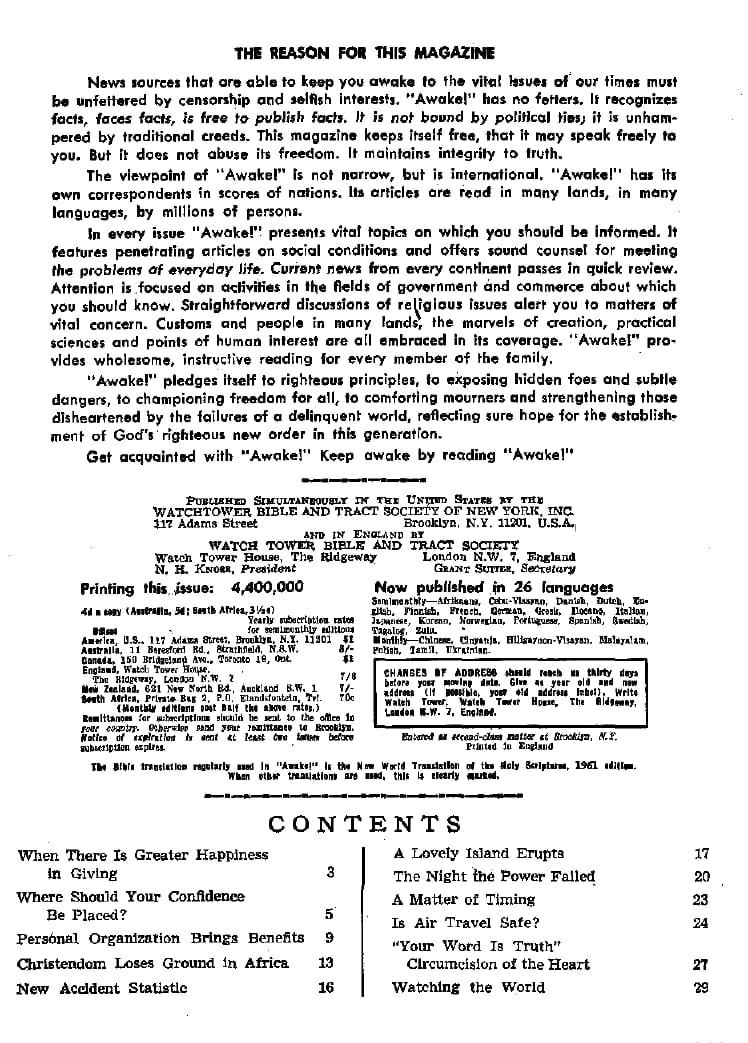
THE REASON FOR THIS MAGAZINE
News sources that are able to keep you awake to the vital issues of our times must be unfettered by censorship and selfish interest. "Awake!" has no fetters. It recognizes facts, faces facts, is free to publish facts. It is not bound by political ties; it is unhampered by traditional creeds. This magazine keeps itself free, that it may speak freely to you. But it does not abuse its freedom. It maintains integrity to truth.
The viewpoint of "Awake!" is not narrow, but is international. "Awake!" has its own correspondents in scores of nations. Its articles are read in many lands, in many languages, by millions of persons.
In every issue "Awake!" presents vital topics on which you should be informed. It features penetrating articles on social conditions and offers sound counsel for meeting the problems of everyday life. Current news from every continent passes in quick review. Attention is focused on activities in the fields of government and commerce about which you should know. Straightforward discussions of religious issues alert you to matters of vital concern. Customs and people in many lands, the marvels of creation, practical sciences and points of human interest are all embraced in its coverage. "Awake!" provides wholesome, instructive reading for every member of the family.
"Awakel" pledges itself to righteous principles, to exposing hidden foes and subtle dangers, to championing freedom for all, to comforting mourners and strengthening those disheartened by the failures of a delinquent world, reflecting sure hope for the establishment of God's righteous new order in this generation.
Get acquainted with "Awake!" Keep awake by reading "Awake!"
PUBLISHED SIMULTANEOUSLY IN THE UNITED STATES BY THE
WATCHTOWER BIBLE AND TRACT SOCIETY OF NEW YORK, INC.
117 Adams Street
BROOKLYN, N.Y. 11201, U.S.A.
BY
WATCH TOWER BIBLE AND TRACT SOCIETY
Watch Tower House, The Ridgeway
LONDON N.W. 7, England
N. H. Kroos, President
GRAN TOWER SECRETARY
Printing this issue: 4,400,000
44 n easy (Austin, Sd. South Africa)
Yorkshire subscription rates
America, U.S. 17, Jude Street, Brentwood, IA 13011
America, U.S. 11, Bancorp Rd., Marlborough, N.A.W. $8
America, U.S. 19, Bidbridge Ave., Tucson, 16 Oct $1
England, UK, Newbury, London, N.W. 7/8
New Zealand, CSA New North Bd., Auckland B.W. 1
South Africa, KwaZulu Natal, Tshwane, 7/6
(Annually additions just Balf the above rates)
Remitances for subscription should be sent to the office
of the reseller and your reservation to the reseller
of reservation is sent at least two weeks before
subscription expires.
Now published in 26 languages
Sanskritly—African, Arabic, Cicat-Vlasan, Danish, Dutch, English, Finchish, German, Greek, Indones, Italian, Japanese, Newman, Portuguese, Spanish, Swedish, Swedish-Mediterranean, Chinese, Cigaga, Hildagov-Vlasan, Malagasy, Polish, Tamil, Watratian.
CHARGES BF ADDRESS should teach us thirty days before your moving date. Give as age old and new your name and address. Watch Tower, Watch Tower House, The Bldgway, London W. W. 2, England.
Entered as second-class matter at Brooklyn, N.Y.
Printed in England
The Bible translation regularly used in "Anklet" is the New World Translation of the Holy Scripture, 1961 edition. When other translations are used, this is clearly marked.
CONTENTS
When There Is Greater Happiness
in Giving 3
Where Should Your Confidence
Be Placed? 5
Personal Organization Brings Benefits 9
Christendom Loses Ground in Africa 13
New Accident Statistic 16
A Lovely Island Erupts 17
The Night the Power Failed 20
A Matter of Timing 23
Is Air Travel Safe? 24
"Your Word Is Truth"
Circumcision of the Heart 27
Watching the World 29
WHEN you give something to someone because you want to, in a spontaneous expression of warm affection for that one, it can truly bring you happiness. Then
WHEN THERE IS GREATER HAPPINESS IN GIVING
you can readily appreciate the words of the Lord Jesus: "There is more happiness in giving than there is in receiving." (Acts 20:35) However, if the gift is given simply
Herszog Encyclopedia of Religious Knowledge, Vol. III, page 48, acknowledged: "The day among adults [has been] degraded into one merely for the exchange of presents, often neither given nor received in any affection, but out of a sense of obligation or as barter." This sense of being driven to give saps the giver of all hap-
because you feel obligated, as, for example, in reciprocation for something received, then, not only are you robbed of the greater happiness in giving, but it may cause you to be resentful as well.
This is how an increasing number of persons have come to feel at Christmas time. The season's custom of, 'You give a gift to me, so I give a gift to you,' creates an uneasy sense of hypocrisy that takes the joy out of giving and tinges purchases with resentment. It also creates problems, such as: 'Whom do I owe gifts this year?'
piness.
As a result, some editors have come out in strong condemnation of Christmas gift exchanging. "This year count me out," wrote This Week magazine's roving editor in its December 8, 1963, issue. "I'm fed up with the unabashed commercialism that has gradually made 'Season's Greetings' a synonym for season's greed. . . . Christmas Blackmail has turned gift-giving into hypocrisy."
And the religious editor of the Cleveland Plain Dealer wrote in his column:
Aunt Grace gave us an expensive gift last Christmas, so she will be expecting something at least as expensive from us this Christmas. The Joneses brought gifts to our children when they dropped by last Christmas Eve, so when we visit them this year we ought to bring something.'
Such type of gift-giving now dominates the Christmas celebration. The New Schaff-
'Please do me a large favor and pass me by this year. . . . Please relieve me of the 'season's spirit.' I've already had it. Weeks ago, even before Halloween, the hucksters were plying their bargains of yuletide decorations and countless other gimmicks. . . But if you think December came early only because of the stores, you misunderstand. The churches were way out in front in the
'grab-it-first' derby, with toy fairs, bazaars, sales of greeting cards, wrappings, fruit-cake orders, etc., etc. .
"The subtle (?) canned background music around town to agitate pre-season buying is already worn thin. And the build-up has only begun. When one contemplates the annual social pressures of late December—oooh. . . . The contention of the Jehovah's Witnesses, et al, that there is nothing in the New Testament that requires or commands our making a celebration of Christmas is worth another, and another, look."
Many persons in recent years have been taking a closer look at Christmas and its customs, resulting in some very interesting discoveries. Not only has it been conclusively established that Jesus was not born at this season of the year and that early Christians never celebrated birthdays, but it has been found that many Christmas customs originated with ancient pagan festivals that were celebrated in the winter. Time, the weekly news magazine, commented on the pagan gift-exchanging custom:
"Pagans celebrated the winter solstice with bonfires to strengthen the sun in its course, exchanged wreaths and candles and crowded their streets in noisy processions. . . .
"The early church for centuries forbade or at least discouraged gift giving at Christmas; the Puritans, for example, banned both religious and secular Christmas celebrations as pagan in inspiration. Still the early symbols—the pre-Christian gift giving, the evergreen as a mark of enduring life—became stubborn concomitants of the Christmas observance."
it is true, but they do give because 'it is expected at Christmas.' This was not the way of the early Christians, who gave anytime during the year—not waiting for a celebration that originated in paganism to inspire or obligate them to show generosity.
When the early Christians gave gifts, then, it was not out of obligation because of a pagan holiday. Many persons today, however, give gifts 'because it is a part of Christmas.' Not all expect a gift in return,
Interestingly, the bringers of gifts to Jesus were not the God-fearing shepherds to whom the angels appeared in the fields, but were magi or astrologers from the east, whose practice of astrology is condemned by God. (Isa. 47:12-15) These astrologers were guided by an ominous star, not to Jesus in Bethlehem, but to King Herod in Jerusalem, where they were told by Herod to report back to him when they had found the child. However, after they had located Jesus in Bethlehem, Almighty God stepped in and prevented them from revealing the whereabouts of His Son to that murderous king. Can it be said, then, that gift-giving in imitation of the practice of pagan worshipers is pleasing to God? Understandably those who adhere closely to the Bible have shunned the practice.
—Matt. 2:1-16.
Such a brief examination of the Christmas gift-giving custom makes clear why so many today have lost the happiness that comes with giving. The custom of, 'I'll give you a present, if you give me one,' or 'I'll give a gift because it is Christmas,' is not Christian giving. It is the practice of giving under a sense of obligation. No wonder it brings little, if any, happiness.
True Christian giving, on the other hand, is not limited to a particular season or even a special occasion, but is prompted by a warm, heartfelt affection for others. It is full and generous, made without any expectation of being repaid. Practice it yourself. Copy the example of Jesus Christ. See how spontaneous giving, done out of love, brings even greater happiness to the giver than it does to the receiver.
Where Should
WE LIVE in a dangerous world. The continual vying of powerful nations for superiority creates fear and a state of unrest that threatens to explode into a world war. Conditions have so deteriorated that, while nations talk in
The Bible records the example of a king who reasoned in much the same way, his goal being the liberation of his rule and his people from the oppressions of a foreign power. The matter is related in the form of a prophetic riddle given to the prophet Ezekiel some years before the fall of Jerusalem to the Babylonians in 607 B.C.E. A consideration of this divine riddle will lead us to the correct answer to the questions raised.
favor of peace, they are, at the same time, making serious preparations for war. Fully aware of the hideous
A Nation Goes Under
Foreign Domination
Using symbolisms of "eagles" and "trees," the riddle accurately described the state
CONFIDENCE
possibilities of a third world war, many nations band together in
of political affairs in Palestine late in the seventh century before our Common Era, In-
trducing the riddle, Jehovah God said: "The great eagle, having great wings, with long pinions, full of plumage, which had
alliances, smaller countries seek the protection of bigger powers, and individuals endeavor to find a sense of security in world organizations for peace, such as the United Nations, as well as in the efforts of religious organizations to collaborate with the nations in establishing a last-
color variety, came to Lebanon and proceeded to take the treetop of the cedar. He plucked off the very top of its young shoots and came bringing it to the land of Canaan;* in a city of traders he placed it. Furthermore, he took some of the seed of the land and put it in a field for seed. As a willow by vast waters, as a willow tree he placed it. And it began to sprout and gradually became a luxuriantly growing vine low in height, inclined to turn its foliage inward; and as for its roots, they gradually came to be under it. And it fi-
ing peace. Is this the way? Most important of all, is it God's way,
and can we count on his blessing such efforts and crowning them with success?
"Most certainly!" many will say. The nations want deliverance from oppression and the ravages of war; surely God wants man to have these things, they reason.
nally became a vine and produced shoots and sent forth branches."—Ezek. 17:1-6.
At first this riddle may seem somewhat obscure, but God's Word does not leave it that way.
It gives the identity of the symbolic "great eagle," and reveals who is represented by the "treetop of the cedar" that was brought to the city of traders. It also unmistakably identifies who is the "seed" that the "great eagle" put in a field, and which became a luxuriant low-growing vine. Note the riddle's inspired interpretation:
"Look! The king of Babylon came to Jerusalem and proceeded to take its king and its princes and bring them to himself at Babylon. Furthermore, he took one of the royal seed and concluded a covenant with him and brought him into an oath; and the foremost men of the land he took away, in order that the kingdom might become low, unable to lift itself up, that by keeping his covenant it might stand." —Ezek. 17:11-14.
How perfectly this fits the actual circumstances! The "great eagle" was the Babylonian king Nebuchadnezzar, who laid siege to Jerusalem; and when the Judean king Jehoiachin surrendered in 617 B.C.E., the king of Babylon brought him (the "very top" of the cedar) and the foremost men of the land to Babylon. This city of Babylon was appropriately called the "city of traders" because of its importance as a commercial center. Nebuchadnezzar then placed Jehoiachin's uncle, Zedekiah (one of the royal "seed"), on the throne in Jerusalem, and the Judean kingdom became as a luxuriant low-growing vine; its low stature being represented by its subjection to Nebuchadnezzar, whom Zedekiah had sworn to serve.—2 Ki. 24:8-17; 2 Chron. 36:9, 10.
The Result of Human Reasoning
Zedekiah had 'sworn by God' when he made his covenant with Nebuchadnezzar. (2 Chron. 36:13) He had given his word, and he had God's word that if Zedekiah
would keep his covenant 'the kingdom would stand.' But surely it was not God's purpose to let his chosen people remain in servitude to Babylon, reasoned King Zedekiah; there must be a way to free the nation from its oppressors! The prophetic riddle foretold, years in advance, just what way Zedekiah would select and how he would treat his covenant. It says:
"And there came to be another great eagle, having great wings, and having large pinions, and, look! this [Judean] vine stretched its roots hungrily toward him. And its foliage it thrust out to him in order for him to irrigate it, away from the garden beds where it was planted. Into a good field, by vast waters, it was already transplanted, in order to produce boughs and to bear fruit, to become a majestic vine."—Ezek. 17.7, 8.
Interpreting this portion of the riddle, Jehovah said: "He finally rebelled against him [the Babylonian king] in sending his messengers to Egypt, for it to give him horses and a multitudinous people."—Ezek. 17:15.
Just as the riddle prophesied, Zedekiah was not content to remain a vassal to Nebuchadnezzar and, as his subject, work to develop Judah into a majestic fruit-bearing vine. Instead, he rebelled and turned to the second "great eagle," the Egyptian Pharaoh, for military help. (2 Chron. 36: 13) The first-century Jewish historian, Flavius Josephus, confirms this, writing: "Now when Zedekiah had preserved the league of mutual assistance he had made with the Babylonians for eight years, he brake it, and revolted to the Egyptians, in hopes, by their assistance, of overcoming the Babylonians."*
Misplaced Confidence
What would be the result of the "vine's" turning to the powerful Egyptian "eagle" for help?
Was this the way of deliverance? Was it God's way? These same questions are raised by the Lord Jehovah, as the riddle describes the results and shows the answer: "Will it have success? Will not someone tear out its very roots and make its very fruit scaly? And must not all its freshly plucked sprouts become dry? It will become dry. Neither by a great arm nor by a multitudinous people will it have to be lifted up from its roots. And, look! although transplanted, will it have success? Will it not dry up completely, even as when the east wind touches it? In the garden beds of its sprout it will dry up." —Ezek. 17:9, 10.
What was wrong? Why was it a mistake to place confidence in Egypt's strength? Speaking as though the covenant Zedekiah had confirmed with Nebuchadnezzar by an oath in His name was actually a covenant made with Him personally, Jehovah says:
"By a great military force and by a multitudinous congregation Pharaoh will not make him effective in the war . . . He will not make his escape. . . . As I am alive, surely my oath that he has despised and my covenant that he has broken—I will even bring it upon his head. And I will spread over him my net, and he will certainly be caught in my hunting net; and I will bring him to Babylon and put myself on judgment with him there respecting his unfaithfulness with which he acted against me. And as regards all the fugitives of his in all his bands, by the sword they will fall, and the ones left remaining will be spread abroad even to every wind."—Ezek. 17: 16-21.
Is this what happened? Did the alliance with Egypt prove ineffective? It did not seem so at first, for the inspired Bible record says: "There was a military force of Pharaoh that came out of Egypt; and the Chaldeans [Babylonians] that were laying siege to Jerusalem got to hear the report
about them. So they withdrew from against Jerusalem."—Jer. 37:5.
Ah! but this withdrawal was only temporary. Historian Josephus tells us: "When the king of Babylon knew [of Zedekiah's alliance with Egypt], he made war against him . . . and came to the city Jerusalem itself to besiege it. But when the king of Egypt heard what circumstances Zedekiah his ally was in, he took a great army with him, and came into Judea, as if he would raise the siege; upon which the king of Babylon departed from Jerusalem, and met the Egyptians, and joined battle with them, and beat them; . . . Now as soon as the king of Babylon was departed from Jerusalem, the false prophets deceived Zedekiah, and said that the king of Babylon would not any more make war against him or his people."*
However, the Babylonians did return, and "the city was taken on the ninth day of the fourth month, in the eleventh year of the reign of Zedekiah. . . . the enemy took Zedekiah alive, . . . and brought him to the king. When he was come, Nebuchadnezzar . . . commanded [Zedekiah's] sons and his friends to be slain, while Zedekiah and the rest of the captains looked on; after which he put out the eyes of Zedekiah, and bound him, and carried him to Babylon,"† where he died in captivity.
—See also Jeremiah 37:6-10; 39:1-7; 52:4-11.
In time the remaining Jews, who had not been slaughtered or taken captive to Babylon, were scattered to every wind, just as God foretold in the interpretation of the riddle. The land of the Jews became completely desolated, without a human inhabitant. (2 Ki. 25:8-26; 2 Chron. 36:17-21) What a terrible fate, and all because of placing confidence in the wrong source of security and deliverance! Liberation of Israel was God's purpose.
But it was not to come by switching alliances from one political world power to another. It would come and did come only from Jehovah God and in his own way and time.
Where to Place Confidence
In this day of international fear and unrest, there is danger of making a similar mistake. Will you, like Zedekiah, look to a human source for
high and lofty mountain." Bible prophecies make clear that the "twig out of the stump of Jesse [King David's father]," the 'righteous sprout of David,' is none other than the Messiah, Jesus from Nazareth, who was born in the kingly line of David. (Isa. 11:1; Jer. 23:5; 33:15) The "high and lofty mountain" is the heavenly Mount Zion to which the resurrected Jesus ascended and from which he rules as heavier king. (Ps. 2:6
your protection and security? Or will you place your full confidence in your Creator and exercise faith in his provisions and promises? The conclusion of this seventeenth chapter of Ezekiel describes God's provision for blessing earth's inhabitants. Using familiar prophetic symbols, Jehovah explains:
COMING IN THE NEXT ISSUE
Flight That Is Lifesaving.
What Can You Do About Asthma?
Prospecting for the Treasures of the Earth.
Stretching Your Gasoline Dollar.
"I myself will also take and put some
Rev. 14:1) This "lowliest one of mankind," now exalted by Jehovah, has been given "the throne of David his father, and he will rule as king over
the house of Jacob forever, and there will be no end of his kingdom."—Dan. 4:17; Luke 1:32, 33.
Like a "majestic cedar," Christ's Kingdom rule will tower heaven-high over earth
of the lorry treetop of the cedar; from the top of its twigs I shall pluck off a tender one and I will myself transplant it upon a high and lofty mountain. On the mountain of the height of Israel I shall transplant it, and it will certainly bear boughs and produce fruit and become a majestic cedar. And under it there will actually reside all the birds of every wing; in the shadow of its foliage they will reside. And all the trees of the field will have to know that I myself, Jehovah, have abased the high tree born out on high the low tree born
and under its protection and blessing all lovers of righteousness will dwell in peace and security. "With righteousness he must judge the lowly ones, and with uprightness he must give reproof in behalf of the meek ones of the earth. And he must strike the earth with the rod of his mouth; and with the spirit of his lips he will put the wicked one to death." (Isa. 11:4; Matt. 13:31, 32) Not to political governments, nor to worldly alliances and confederations, but to the coming of God's kingdom did Christ Jesus, while on earth direct the people, and he
tree, have put on high the low tree, have dried up the still-moist tree and have made the dry tree blossom. I myself, Jehovah, have spoken and have done it."—Ezek. 17: 22-24.
Jehovah said he would pluck out a "tender one" from the twigs at the top of this cedar; that is, one from the kingly line of David, and would transplant it "upon a
wine on earth, direct the people, and he taught them: "You must pray, then, this way: 'Our Father in the heavens, let your name be sanctified. Let your kingdom come. Let your will take place, as in heaven, also upon earth.'" (Matt. 6:9, 10) It is in that heavenly kingdom of God that your confidence should be placed as mankind's only hope.
PERSONAL ORGANIZATION Brings Benefits
FOR work to be productive it needs to be organized. For that work to produce the most, in the least time, with the minimum of strain or wasted effort, it must be organized.
In the business world, good organization assures the manufacturer that the various parts of a product being assembled will flow correctly down the assembly line, and that, when completed, it will measure up to requirements. Good organization means the assembly procedure will not be stalled for the lack of a nut or a bolt.
In the home, good organization will assure the housewife that certain hot dishes for dinner do not get cold because they are cooked too early, and that the whole meal does not get cold because the family is late. Better organization will also mean less time needed for washing, ironing, cooking and housecleaning.
In addition to producing greater results for the energy expended, good personal organization will make for greater happiness. The organized person is not always worrying about what he should do, or if he can find the time to do it, or where things are that he needs. He has his life in order, and, as a result, will actually find more time to do the things he wants to do.
Right Perspective
This does not mean that good organization will always eliminate hard work, nor is it to be implied that hard work is undesirable. Hard work is noble. It should
not be belittled. However, there is nothing noble about wasted effort, about needless toil that is the result of bad organization. Self-sacrifice, devotion and the expending of much energy when there is a need for it are commendable. But where is the virtue in strenuous exertion if, by good organization, the same task could have been eliminated or done more quickly and efficiently, with less energy expended?
Another aspect to consider is how much organization we need. We do not want to become fanatical, so that our personal lives and homes become overorganized, beyond what is necessary, and we feel crushed by the very thing that should have provided relief. Organization should be a slave, not a master. Hence, the proper amount of personal organization is what is needed, not so much that it takes the joy out of living, nor so little that it does no good.
Good personal organization means, then, to arrange our lives in reasonable order as to time, place and purpose.
Scheduling Time
The first step in making the best use of time is to identify clearly your work goals. What is it you want to accomplish during the week? In establishing these goals, do so according to your own ability, personality and circumstances.
Then make a realistic estimate of the time available to you within the normal work week. Now you are ready for the next vital step: Into this available work time, schedule your work, with pencil and paper, if need be. Schedule first the tasks over which you have little control, such as secular work and preparing meals. These take priority over all other work, since they must get done and cannot be pushed aside. Assign each a specific day and time. Then stick to the assignment! This will prevent jobs from piling up and getting out of hand, with the attendant frustrations.
In scheduling time for essentials, make room for possible interruptions. If the housewife schedules her washing for Friday, will the family have clean clothing that weekend if something unexpected prevents her from doing the wash? Why not schedule this vital task earlier in the week so that, if an unforeseen circumstance arises, the wash can still be done that week? Scheduling the most important work early in the week ensures that it will get done.
Another word about scheduling time: apportion it realistically. If a particular evening calls for the family to be at a certain place, say at 7:30, it is of no use trying to save time by beginning preparation for it at the last minute. Time should be allotted, counting backward from the appointment to allow for eating, doing dishes, getting dressed and travel. Allow a few minutes extra in the schedule for such preparations, rather than too few. In that way nerves will not be stretched taut trying to keep a schedule that is too tight.
When assigning times and tasks, include the children. Household duties such as cutting lawns, setting and clearing the table, washing dishes, and other chores need to be scheduled so that doing them becomes
habitual. Young ones will know clearly what is expected of them. If such tasks are not scheduled, but are left up to youthful whims, they may not get done; or, if they are, the young may feel they are doing the family a favor instead of being made to realize they have a responsibility to make a contribution to the family's welfare.
After essential tasks are listed, then schedule time for other things you might like to get done in the way of work. Perhaps an afternoon, evening or day could be scheduled for "special projects." This provides flexibility, too, for such time could also be used for vital work if such were postponed on its scheduled day.
Parents will want to schedule time for recreation as a family unit. This will be a refreshing period as well as help to knit the family closer together. But besides this time for family activity, there must be considered the need for personal time, when each one of the family can do things he especially enjoys—reading, listening to music, working at a hobby or writing letters. This will be important to the children in another way, since it can be the beginning of their making decisions as to what to do with their time. This will be useful to them, for within a few years, as adults, they will need to arrange their entire lives. Parents who help their children learn how to do this in a small way at first do a great kindness to their offspring.
Saving Time
What about saving time? What can be done to cut down time spent doing things so more time can be freed for what you prefer to do?
One way time can be saved is by being selective. After you have determined the must work, list on paper the work you would like to do if you had time, work that you could do during the periods set aside for "special projects." For each of the tasks you have listed, ask yourself: "Will my interests or my family interests suffer in any way if this job is not done?"
If you can honestly say that eliminating a job will not cause loss in any significant way, then eliminate it! You may be surprised at how many things really do not have to be done at all.
In this regard a great saving of time can be made in what we read. Would you like to be able to read 10,000 or even 100,000 words a minute? To the average person who reads only a few hundred words a minute, this would seem like a marvelous way to get much reading done. But you can accomplish a similar thing by being able to recognize, in one minute, that you do not need to read a certain book, paper or magazine! By carefully selecting your reading matter you will realize an enormous saving of time.
Another way to save time is to examine each task you perform with a view toward simplifying it, or combining it with something else you are doing, or substituting more efficient methods. To do this, take two preliminary steps. The first we might call the thinking step. Think about how you might be able to do something in less time, with less effort. Evaluate the job and plan how you might shorten or hasten a process by eliminating a few steps, or by better grouping of the material with which you work. The second step is adequate preparation before you actually start work. Once you have thought the job through, set up the work so that you will not have to interrupt it later. Bring along everything necessary to complete the job, wherever possible.
A vast area for saving time is in not wasting it in the first place. Getting an early start in the day is fundamental. Do you linger over that morning cup of coffee
when important work needs to be done? Do you spend too much time reading the morning paper? Then during the day, what about those telephone conversations? Are they really essential to your work? Why not postpone calls of a social nature until your free time? Keeping phone calls to the minimum as to number and duration saves, not only time, but money too.
Is time lost by your being sidetracked? When you start a job, do you think about something else and decide to look into that instead of finishing what you are doing? Unless it is very important, stay with the task at hand. This will save time, since you will not have to put the work down and start over again later.
Finally, what about scheduling your difficult tasks during periods of peak energy? It is said that most people have energy peaks from about 10 to 11 in the morning and from about 2:30 to 3:30 in the afternoon. Determine what your peak energy periods are. Then schedule the more challenging jobs at this time. You will see that you get them done much faster and better than at a time when your energy is lower.
Place
All too often things are difficult to find. Frequently heard are expressions such as, "I wonder where I put the scissors," "Where's the hammer?", "Have you seen my book?" and many, many others. These are some of the signs of a disorganized home.
Not being able to find things you want often makes worse the disorganization existing. For instance, that misplaced key may require a lock to be broken and then replaced; the misplaced tool may require the borrowing of one or even the buying of another; unfied papers can mean lost receipts and bills, with corresponding financial difficulties.
Such things can be minimized or eliminated altogether by putting everything in its place.
Of course, there must be a place for everything. Tools cannot be put in their place without a box, drawer or place to hang them. Books need their shelves, clothes their closets, papers their files, pots and pans their cabinets. So the first thing to do is to provide a place, then assign this place to the household essentials.
It is important, too, that all members of the family know the assigned place for things, so that items are not put back in different locations. Father and mother do well to take the lead in making assignments and training children to follow their lead. The habit of putting things back in their assigned place when one is finished with them must be cultivated. Friendly reminders can aid here. At times, sterner discipline may be called for if young boys or girls are sloppy and drop their clothing or other things about in various places. Firm measures may be required to teach them good organization, to train them to be regular in putting things away. This may take time, especially at first; but it will be time well spent, for once good habits are formed, little effort is required to maintain them.
Self-discipline is particularly required for adults who set the example. When father takes off his coat after returning from work, he should cultivate the habit of hanging it up where it belongs. Sooner or later it will have to be put away anyhow. Why not do it to begin with? This will save time and later effort, preclude any irritation of others who see clothing strewn about a room, make for a tidy household, and at the same time set the right example for young ones.
Purpose
A disorganized home can quickly become the site of an entire array of needless items. Good organization will require a reason or purpose for things. This does not mean that the home is deprived of decorative items or that the mechanically inclined man must do without his container or drawer of gadgets. But the acquiring of things can be overdone, and soon that spare room or garage may contain so many unnecessary items that their original purpose may become obscured.
What should be kept? What should be thrown away? The deciding factor must be the usefulness of an item. Will it ever be used? In business organizations, material that is not used for a period of time is often disposed of. The same principle can be applied to personal organization. For example, some like to save old newspapers or magazines because of the good articles they contain. But instead of cluttering up a home or room with heaps of publications that will probably never be read again, why not cut out just the item that interested you and put it in a file for that purpose? It will take a fraction of the space. When entire issues or years of important publications are to be saved, these can be bound and placed on the bookshelf.
No doubt about it, good personal organization regarding time, place and purpose brings great benefits. A properly organized life and home are a joy. The longer good organization is practiced, the better it becomes, until little effort is required to keep things in order. This brings peace of mind, makes for neatness, gets more done in less time and contributes to the well-being of individual and family. So be organized! See the difference! You will never want to go back to the old way!
Christendom Loses Ground
DURING the past century particularly, the churches of Christendom have expended great efforts in various missionary movements in Africa. Thousands of missionaries from Europe and America and vast amounts of money have been poured into this continent to promote the proselytizing efforts and to finance construction of churches, church schools and church hospitals.
Yet, today, in spite of all this, Christendom is without question losing ground throughout Africa. In all parts of this continent there has been a rapid decline in the tremendous influence, power and prestige that the missionaries and churches of Christendom once enjoyed. Newspapers around the world have already reported on the burning of churches and assaults on Christendom's missionaries, priests and nuns. These open attacks are merely outward symptoms of the underlying and widespread trend of hostility toward Christendom and its representatives.
Europeans express dismay at what they say is the Africans' rejection of those who have done so much to help them in the past. They feel that the hostility toward Christendom's churches is simply a case of African ingratitude. However, that is not the viewpoint of most Africans.
In order to understand why most Africans feel the way they do, let us go back to the arrival of the early European missionaries and see what has happened since that time.
In the second half of the nineteenth century especially,
European explorers began to penetrate into East Africa. In November 1875 a letter appeared in the London Daily Telegraph appealing to the "Christian spirit of En-
gland to send missionaries to Mutesa." Mutesa was the name of the Kabaka (King) of Buganda, a native kingdom on the shores of Lake
Victoria. The writer of the letter was the famous Anglo-American explorer H. M. Stanley.
There was an immediate response. The English Church Missionary Socle-
ty sent a group of Protestant missionaries. Also, a group of French Catholic missionaries made the difficult journey and established themselves in Entebbe, on the north shore of Lake Victoria. The native people were in great awe of these new white men who were so much more advanced than they were.
However, it soon became apparent that there was little cordiality between the two groups of missionaries. One can imagine the confusion of the Africans. Here two groups of white men had arrived to teach them a new religion about a loving Christ, yet the two worked completely separate and showed no love for each other. This
conflicting attitude of the missionaries soon rubbed off on new African converts, and in 1893 there occurred a purely religious war between the native Catholics and Protestants.
Finally, peace was restored and a territorial arrangement was made between the different missions. They agreed that there was to be no "poaching" on each other's territory. But the damage was already done. Right at the start the Africans had received glaring evidence of Christendom's great and tragic weakness, her hopeless division.
Still, many joined the new religions. Without doubt some sincerely believed the message they heard. But for the most part the missions' success was due to other factors. For one thing, there was great prestige in being a "Christian." It gave the native a social standing above his pagan neighbors. In addition, many material benefits came from the missionaries: medicines, food and education. It was in the latter field, education, that the churches of Europe and America obtained their great hold on large segments of the African people. In tropical Africa there was usually very little opportunity for education outside the mission schools.
Another factor contributing to the missionaries' success was the backing they received from the European colonial governments. In the Belgian Congo, for example, the Roman Catholic Church was granted a monopoly on government aid for education. Another example showing the extent to which church and state were tied together in missionary efforts is the Portuguese arrangement with the church. Of this, a Roman Catholic clergyman, A. Hastings, a missionary in Uganda, wrote in 1964: "In return for sending missionaries and providing financial support for new churches, the Portuguese kings were to have complete control over the whole
missionary effort of the Church. Bishops were to be chosen by them, all missionaries were to travel out through Lisbon, to learn Portuguese first and to swear loyalty to the King of Portugal."11
"White Man's Religion"
Hence, as the missionary movements developed, the African observed that the white man's religious convictions were tied very closely to his national loyalty and to his pride in the achievements of his own race. So the native people began to consider this new religion as the religion of the European, the white man.
One African clergyman stated: "In spite of more than 300 years of contact with our continent, in spite of our boast of so many churches and approximately 60 million Christians on the continent, Christianity is still a foreign religion to us . . . the early missionary in bringing the 'Christ' to the African brought him wrapped up in some foreign 'swaddling clothes,' i.e., Western Culture."a
Pointing out how the missionaries' nationalistic feelings showed through their religious preaching, the same clergyman said that in his country simple. African converts, in telling what church they belong to, will say "I am American," or "I am Berlinian," depending on who started their church.
African Churchmen Condemn
Just how strongly the Africans resented the link between the churches and colonialism was shown at the first All-Africa Church Conference, held in Kampala, Uganda, in April 1963. The main speakers at this conference were leading African churchmen. Their feelings became evident as one speaker after another condemned the religio-political link of the past.
A Methodist minister said that "the advance of the Church in Africa has gone hand in hand with the Adventurer, the Explorer, the Colonizer and even the Imperialist. The hand that planted the Cross of Christ on this continent was not that of the priest or apostle. It was the blood-stained hand of the soldier. . . Even up to this century the Church in this continent, in spite of remonstrations to the contrary, has not been able to tear itself loose from the cords of Caesar's robes." Noting the difference between Christendom's missionaries and the early Christians, the same speaker said: "We submit that missionary activity on this continent has not followed the New Testament pattern where the Apostle, whose weakness of lack of support from some foreign conquering power was really his strength, planted the seed of the Evangel."2
A Malagasy clergyman admitted: "For most of the time in most of our countries, the history of the Church follows the same pattern as the history of colonization, and the question we have the right to ask is this: has it always been faithful to its calling, to its reason for being, to the Gospel which it had to preach and which it must always preach? It would be easy to stigmatize the contradiction, among so many others, between the wilfulness and force of the colonization by the white man and everything that the Gospel teaches about gentleness, brotherhood, love of neighbor, etc. . . . We must even recognize that in some places the Church prided itself on being a desirable collaborator with the colonial power."
Another speaker, from Ghana, West Africa, referred to racialism in the churches and said: "In some parts and periods, the close alliance between the church and imperial powers has made her fail in her mission of propagating the gospel . . . of the brotherhood and equality of mankind."
Political Changes Weaken Her Power
Inevitably, as political changes swept across Africa, the native people saw the missionaries of Christendom as being on the side of the colonial rulers. One political leader of Southern Rhodesia put it this way: "The present conflict between Christianity and African nationalism is really one between the interpreters of Christianity who would like to see the status quo [colonialism] perpetuated, and the adherents of African nationalism who would like to see the status quo completely disappear. Where Christianity is used openly or subtly to maintain the status quo, it becomes identified as an instrument of oppression, and therefore, it suffers the fate of oppression."16
When the trend against colonialism became obvious, many European missionaries tried to jump on the bandwagon and to identify themselves as being on the side of the native people and against colonialism. However, it was too late!
So it is that today the authority of Christendom's religious organizations has been greatly weakened. The All-Africa Church Conference admitted that "these days [the Church] is being considered irrelevant because Christianity has lost her prestige or economic value, and Africa is freeing herself from the foreign powers which gave the Church her political and social status."*
Further weakening of the power of Christendom's religious influence in Africa comes in the field of education. Through their education systems the newly independent governments are trying to develop a feeling of national consciousness and pride. They are endeavoring to teach their people to be independent from both Eastern and Western blocs of nations. However, the missionaries of Christendom, on the side of the West, have come into conflict with these endeavors. So the African rulers naturally do not wish to leave the education of their young people under the control of the Western oriented mission aries.
Therefore, in one country after another, the system of Christendom's mission schools has been taken over by the government.
Another factor contributing to the great weakening is that native African churchmen are calling for their own churches to be independent of the parent organizations in Europe. Among the resolutions passed at the All-Africa Church Conference was one calling for the "Africanization" of the church. In one of the conference papers, entitled "The Selfhood of the Church in Africa," there was a call for "a church freed completely from any form of foreign shackles. . . . So also must the foreign helpers stop any kind of aid which are only means of maintaining an economic imperialism over the Church in Africa."[18] Already, in many new states, independent national churches have been set up, adding to the already hopeless division of Christendom.
The Future
What does the future hold for Christendom's religions in Africa? Concerning this, Roman Catholic clergyman Hastings said: "We are passing from a period of comparatively easy mission work to one of difficulty; [in the past] the Church has preached to simple people, in backward societies . . . easily overwhelmed by the material adjuncts the missionary brought with him: books and trousers and medicines. The desire for a simple schooling,
the desire for all the good natural things to which Church membership seemed the only way, made of conversion a very easy thing. All that is changing. The government may take our schools and our hospitals or, even if we keep them, they will no longer provide the obvious motive for faith that they used to. The battle has now to be fought in other ways." The clergyman then added: "As a matter of historical fact, in most parts of Afro-Asia the Church came in with European colonialism. Her problem today is how to avoid going out with European colonialism as well."
From all this it can be seen that the increasing rejection of Christendom in Africa today is largely due to her own sins in the past. Observing Christendom's hopeless division, African people do not take seriously her claim to represent the kingdom of God in the world. As has happened so often before in history, her involvement in the politics of this world has caught up with her and she is now feeling the effect of it. All the signs available today clearly point to the fact that the trend against Christendom is, likely to continue in the future.
REFERENCES
1 The World Mission of the Church, by Adrian Hastings, 1964.
2 Gabriel Setilcane, "Freedom and Anarchy in the Church," All-Africa Church Conference, 1963.
s Richard Andrhamanjato, "Liberty and Anarchy in the African Nation," All-African Church Conference, 1863.
4 Dr. K. A. Busia, "Freedom and Unity in Christ in Society," All-Africa Church Conference, 1963.
5 Ndabeningi Sithole, "African Nationalism and Christianity," Ali-Africa Church Conference, 1963.
a "The Selfhood of the Church in Africa," All-Africa Church Conference, 1963.
NEW ACCIDENT STATISTIC
According to the American Medical Association, about 6,000 persons in the United States annually end up in the hospital as a result of trying to walk through glass windows, walls or doors. Many more, of course, crash into the almost invisible barriers but are not injured seriously enough to be hospitalized. No doubt many of these accidents could be prevented by more visibility, such as a plant behind a pure glass wall or more conspicuous doorknobs for glass doors.
A Lovely Island
"I AM not afraid of the volcano. If the tremors come, we will leave our home. Otherwise, we will continue to live here in peace," said the farmer. The caption below his picture in the Sunday Times Magazine of September 26 read: "Alone with his family on the slope of the volcano, Elpidio Cacao lives a peaceful, unperturbed life."
By "Awakel" correspondent in the Philippines
This relatively peaceful volcano was located on Taal Island in Taal Lake in Luzon, the largest of the Philippine Islands. Newsmen who had just visited the island were told by volcanologists: "There is no danger."
The last previous eruption of Taal Volcano was in 1911. Since then the island had remained relatively quiet, with only an occasional rumble and hiss. People such as Cacao and his family had repopulated the island and for some forty-four years had engaged in the normal pursuits of life. Rice grew abundantly. Coconut, banana and bamboo trees flourished; ducks and chickens too. In the lake, freshwater fish swam and spawned. It was a beautiful island. But it was to be a murderous one.
The Eruption
In the early morning of September 28, many residents of Batangas town, thirty kilometers away, were unable to sleep, as the weather had turned unbearably warm. At about 2:30 a.m. there were rumblings underground and repeated thunderclaps.
DECEMBER 22,1965
At this, many went to their windows—to gasp in astonishment at the sight they beheld! Had an atomic bomb exploded over Taal Lake? No, this was no bomb; there was no war. Yet, the horrified onlookers saw that fire leaped high and turned the sky bloodred. Smoke billowed up in a mushroom shape. Forked lightning danced angrily in
the sky. Blackness followed. Then another bowl of fire shot upward. More smoke and angry lightning, then blackness
again. This went on at five-minute intervals. Now there was no question about what had happened. Taal Volcano had erupted!
Sleepless thousands gaped at the sight for kilometers around the lake. The eruptions continued until about 10 a.m., some eight terrible hours, and for days afterward the island rumbled and hissed.
The passengers and crew of an airplane flying to Manila from the south witnessed the chilling spectacle. The pilot reported that the lake itself had turned bloodred as flames shot up to incredible heights. The smoke and gas rose to 10,000 feet. Other observers were seven men of a geodetic survey team who were on the island itself. At close range they saw the village of Alas-as disappear. A few meters from where they stood, a family of six were buried alive when a landslide crushed their house. "We were helpless to save them," one said.
Biting sulphuric dust, blazing gobs of mud and lava, searing gas and steam swept the island and the lake, went over the southwestern towns of Agoncillo, Alitagtag, San Nicolas, Lemery, Taal and Balayan, and over Lubang Island in the China Sea. A village across from the lake lost its rice crop under a layer of ash five inches deep. Roofs caved in. Trees were slashed in half, bamboos twisted like toothpicks. For weeks the weather was hot and the province of Batangas smelled like a battlefield.
Some say there was no explosion, like that of a bomb or a gun. They claim it was an eruption, a belching, like the earth vomiting out something that bothered its digestion. To the people who ran for their lives it mattered little.
The people who could, fled with whatever they had on, some barefoot, many half-naked, screaming or dumb with shock. Many were burned and bruised, numb for days, too exhausted even to answer questions. Refugees—some say about 50,000—poured into markets, schools, town halls, homes, shops and onto the sidewalks, their hair matted by mud and sulphur, their babies crying, with no food or money. But soon aid poured in. Food, cooking utensils, clothing, tents, sleeping equipment, lumber and money came from many countries. The relief work was disorganized at the start, but what mattered most was that it was there. Teachers, soldiers, doctors, nurses, mayors, clerks, the ordinary citizen as well as the president of the Philippines came to lend a hand.
Those Who Died
ash conceals people who died in their sleep young and old, buried with their family heirlooms and images, their plows and sickles, their homes, chapels, schools, crops herds and household pets.
How many died? No man knows for certain, but there were likely hundreds. Though the island of Taal is still there, still fertile, perhaps even more so now, it is stripped bare. And it is also one vast cemetery. The earth and heavy layer of
Others did not die that easily. An old woman was dug up out of the dust later, still upright, a rosary in her left hand, a handbag clutched to her right hip. Another was dug out with arms raised as if in prayer. Many had been baked alive in flight by boiling mud that had hardened into cement. Families died on the beaches when former friends and neighbors dueled with bolo or gun for the possession of little wooden boats that could take them across the lake. Overloaded boats sank in the boiling water. It was almost impossible to swim to safety, though a few did make it.
One motor launch with thirty-three refugees might have made it had the motor not failed in the middle of the lake. A man deserted his family to join an overcrowded boat. The boat sank. He never made it, but his family survived. A teacher who returned home early from a holiday died. Her school now lies beneath some thirty feet of earth and ash. Many others had come to the island from Batangas to take part in the crop harvests, which were so good this year. Instead, the island consumed them.
Ironically, one safe place on September 28 was the old crater of Mt. Binintian. Cows were found there later on, on the ledge inside the rim, unharmed, for the old crater had not erupted, but a new one nearby did.
Beware of Volcanoes!
Taal Island has a history of destruction. It wiped out its entire population in 1911. Some say only one whimpering puppy survived. In another earlier eruption it erased Taal town, then on the lakeshore. The provincial capital was moved to Batangas town, and the old capital of Taal became just another town rebuilt farther inland.
Its eleven previous eruptions, over a span of 300 years, should have served as a grim reminder to be cautious, to stay away.
When one stands on Tagaytay ridge to view Taal Lake with binoculars, he may not realize that he is standing on the rim of a giant crater some twenty kilometers in diameter. Beneath his feet, magma-filled caverns curl deep down into the belly of the earth. An article in the Free Press of October 9 stated that Manila, Bulacan, Cavite, Batangas, Quezon and all the way down to the Bicol provinces are on the slopes of an immense volcano, quite likely the largest ever. The crater is Taal Lake itself!
The volcano on Taal Lake had given warning of impending activity. As early as July 21 the lake had begun to simmer. But the "experts" cautioned newsmen against scaring people with news of a possible eruption. Even the governor was persuaded to calm the people down. "There is no danger," they said.
The people were told that there were five signs to watch for: an increase of tremors on the island, a continuous rise in temperature in the water, rumbling sounds, withering plant life, panicky animals. But the tremors were the usual, the island did not rumble, the rice harvests were never so good and the bananas were never as fat. The animals munched green grass and even strayed into the old crater. However, the water in the crater lake had risen in temperature. And two days before the eruption, residents noticed smoke being emitted from the volcano's several craters.
before the initial eruption some 150 residents of one area managed to flee to safety in three motorized boats that they had lashed together. One of the refugees recounted: "About ten minutes after we left, we suddenly saw flames come out of the crater on the western part of the island."
But most believed the experts who had altogether overlooked the rice fields of Alas-as and Kaygabok. It was out of these fields of grain that the volcano tore a fresh crater two kilometers long and half a kilometer wide, expelling an estimated fifty million cubic meters of flaming destruction.
Today Taal Lake is blue and quiet. It is being restocked with fish. Taal Island will probably be green with grass and cane and rice once more. Cogon plumes will wave again on its slopes. But now it is off limits, and Philippine authorities are considering making it a national park.
At this time only former inhabitants are permitted to return to dig their worldly goods out of the ashes and to search for missing relatives. One wonders if Elpidio Cacao and his family survived and will be among those returning.
Do you wish to live again on the island? "No," says an islander. He will start anew elsewhere, as will many other survivors whom the government is trying to resettle. Will the volcano erupt again? "Undoubtedly," says Dr. James Moore, an American volcanologist. How soon? "I certainly could not say when," he answers. His advice? Evacuate the island—permanently.
When it comes to volcanoes, this simple rule might save your life someday: Never trust a volcano!
IMPOSSIBLE!' 'Unbelievable!' 'Fantastic!' 'It couldn't happen!' But it did. On Tuesday, November 9, the biggest technological breakdown in history plunged the northeastern United States and part of Canada into sudden darkness. People were stunned. All electrically operated machinery—including subway trains, railroads and elevators—abruptly halted, trapping hundreds of thousands of persons in subways and tens of thousands more in elevator shafts.
The power failure occurred at the height of the evening rush hour. It apparently originated at about 5:16 p.m. in a power system somewhere in Ontario, Canada. There a defect triggered the collapse of one interconnected power facility after another. The effect was likened to a file of falling dominoes, each collapsing the one next to it.
As one power system after another failed, darkness swept across New York State, engulfing such large cities as Buffalo, Rochester, Syracuse, Schenectady and Albany. Then onward it sped across Massachusetts, all the way to Boston. It also raced into New Hampshire and Vermont, and affected Canada; southward to Connecticut, Rhode Island and parts of New Jersey and Pennsylvania. In fifteen minutes some 80,000 square miles and 35 million persons felt the paralyzing effects of the colossal power failure.
New York City Crippled
In New York City millions of workers were either on their way home or preparing to leave for home. The gradual loss of illumination had the effect of causing some persons to feel they were slowly losing consciousness. Others thought their vision was falling. But then, at 5:28 p.m., the lights went out completely, plunging the city into darkness, at least relieving such mistaken fears.
At first, people thought the failure was limited to their own dwelling or building or section of the city. But it soon became obvious it was more widespread. Everywhere one looked there was darkness, with the notable exception of Staten Island and a section of Brooklyn that continued to receive electricity from an unaffected power system in New Jersey. All street and traffic lights went out, ensnaring the heavy rush-hour traffic. Incoming planes were directed away from blackened airports to as far away as Bermuda, and outgoing planes could not take off.
…