Awake!, December 8, 1965
Download: PDF — Awake!, December 8, 1965
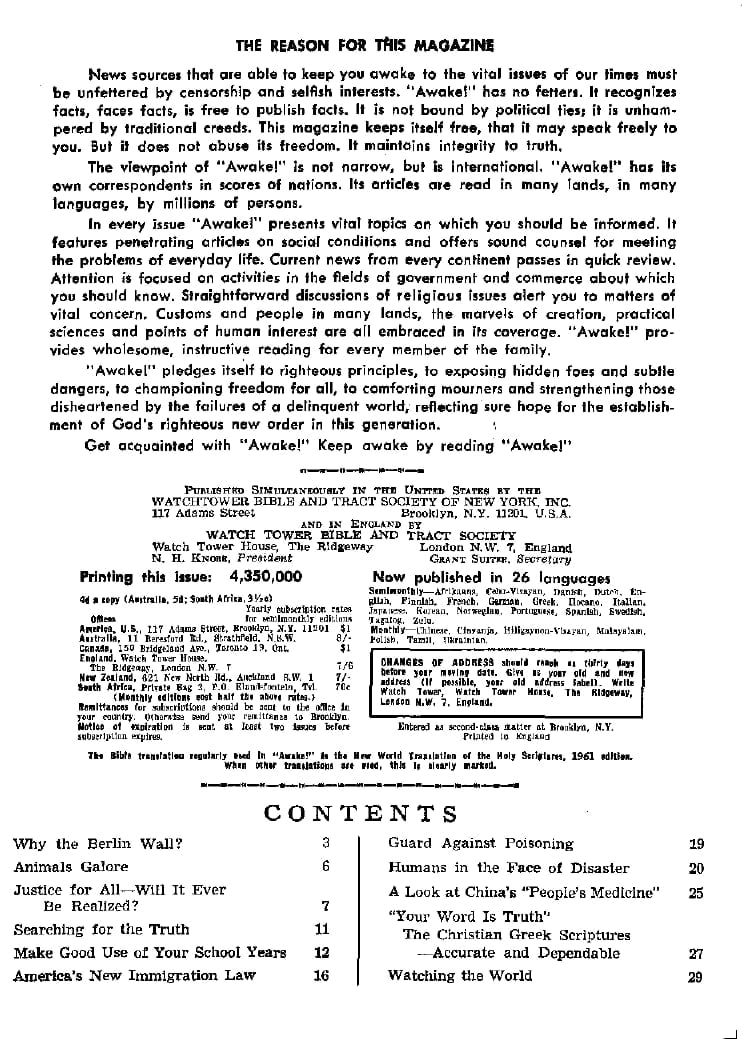
THE REASON FOR THIS MAGAZINE
News sources that are able to keep you awake to the vital issues of our times must be unfettered by censorship and selfish interests. "Awake!" has no fetters. It recognizes facts, faces facts, is free to publish facts. It is not bound by political ties; it is unhampered by traditional creeds. This magazine keeps itself free, that it may speak freely to you. But it does not abuse its freedom. It maintains integrity to truth.
The viewpoint of "Awake!" is not narrow, but is international. "Awake!" has its own correspondents in scores of nations. Its articles are read in many lands, in many languages, by millions of persons.
In every issue "Awake!" presents vital topics on which you should be informed. It features penetrating articles on social conditions and offers sound counsel for meeting the problems of everyday life. Current news from every continent passes in quick review. Attention is focused on activities in the fields of government and commerce about which you should know. Straightforward discussions of religious issues alert you to matters of vital concern. Customs and people in many lands, the marvels of creation, practical sciences and points of human interest are all embraced in its coverage. "Awake!" provides wholesome, instructive reading for every member of the family.
"Awakel" pledges itself to righteous principles, to exposing hidden faes and subtle dangers, to championing freedom for all, to comforting mourners and strengthening those disheartened by the failures of a delinquent world, reflecting sure hope for the establishment of God's righteous new order in this generation.
Get acquainted with "Awake!" Keep awake by reading "Awake!"
PUBLISHED SIMILARLY IN THE UNITED STATES BY THE
WATCHTOWER BIBLE AND TRACT SOCIETY OF NEW YORK, INC.
117 Adams Street
Brooklyn, N.Y. 11301, U.S.A.
N. H. KNONE, President
Printing this issue: 4,350,000
London N.W. 7, England
GRANT SUITE. Secretary
4d a copy (Australia, 5d; South Africa, 3 1/2c)
Officer
Yearly subscription rates
for semi-licensed offices
Appalachia, U.S. 127 Adams Street, St. Louis, 11911
Australia, 11 Westfield Street, St. Johns, N.W. 8/
Canada, 195 Bridge Road, Toronto, Ontario, T9.
Canada, 195 Bridge Road, Toronto, Ontario, T9.
The Bridgeway, Toronto, N.W. 7
New Zealand, 622, New North York, Auschwitz R.W. 1
South Africa, 76
(Monthly edition) cost half the above rates.
Remittances for subscription should be sent to the office in
Boulder, Colorado, and send your conditions to Brooklyn.
Boulder, Colorado, is near at West Two Avenues before
subscription expires.
Now published in 26 languages
Seminoryly—Arkansas, California, Danvers, Danee, English, Florida, French, Garzon, Hicoe, Italian, Florida, Newport, Portuguese, Spain, Swahili, Tupaing, Tonga, United States, Meadland—Chinese, Chongqing, Hillaryson-Viacau, Malaysia, Polish, Tamil, Uzbekistan.
DANGERS OF ADDRESS should range to thirty days before your mating date. Give us your old and new address, and we will send you a new address. Watch Tower, Watch Tower Houses, The Kiskeyway, London MW, 7, England.
Entered as second-class matter at Brooklyn, N.Y.
Printed in Kinglans
The Bible translation regularly used in "Answers" in the New World Translation of the Holy Scriptures, 1961 edition.
When other translations are used, this is clearly marked.
CONTENTS
Why the Berlin Wall? 3
Animals Galore 6
Justice for All—Will It Ever
Be Realized? 7
Make Good Use of Your School Years 12
America's New Immigration Law 16
Guard Against Poisoning 19
Humans in the Face of Disaster 20
A Look at China's "People's Medicine" 25
"Your Word Is Truth"
The Christian Greek Scriptures
—Accurate and Dependable 27
Watching the World 29
Volume XLVI
London, England, December 8, 1965
Number 23
AUGUST 13, 1965, was the fourth anniversary of the Berlin Wall. On that day friends and relatives of many of the sixty-one persons killed while trying to cross the Wall went there and laid wreaths on plaques commemorating their violent deaths. These brutal killings by Communist border guards have been a cause of anger among most of the German people, but that has not altered the Communist determination to keep the border between East and West Berlin sealed.
Completely surrounding West Berlin now are barbed-wire fences, mines, a death strip and armed guards. There are also 600 vicious dogs patrolling the border, 200 of which are attached to chains that are hooked onto long cables. East Germany's border with West Berlin is a formidable barrier that is continually being strengthened.
West Berlin is an enclave in territory that the Russians insist upon maintaining
as a Communist State. By the Potsdam agreement after Germany's surrender in 1945, the big powers of Britain, France, the United States and the Soviet Union occupied sectors of Berlin and put the city under joint rule. The Cold War made it impossible for such an arrangement to last for long. In due time the Russians broke off their sector
from the others and set up there a Communist city government. Thus Berlin became a divided city.
The fact that people could travel freely from East Berlin to West Berlin became a bone in the throat of the rulers of Communist East Germany. On August 13, 1961, they took action to remove that bone. During the early morning hours trucks of Communist workers and soldiers armed with submachine guns, sealed off one million East Berliners by means of a hastily raised barbed-wire fence strung entirely across the city. The residents of Berlin were stunned despite the fact that rumors of such action had circulated for six weeks.
Huge crowds gathered on both sides of the Brandenburg Gate and at other crossing points on the sector border. Angry East Berliners were dispersed with tear gas and powerful jets of water from Communist water cannons mounted on trucks, which also were turned on the jeering crowds of West Berliners.
Family members that happened to be in different parts of the city that night were shocked to find themselves separated, with no way to be reunited. Approximately 50,000 persons in East Berlin found themselves forcibly cut off from their jobs in West Berlin. Neighbors living across the street from one another could no longer visit, because they were now separated by barbed wire and armed guards. The injustice of it all angered the people of Berlin. Then, too, this closing of the border gave the spirit of German nationalism that yearns for the reuniting of Germany a severe blow.
A few days after the barbed-wire fence went up, the Communists began raising a sturdier barricade made of cinder blocks. A wall five feet high gradually began snaking its way thirty miles across the city. In the meantime 150 persons a day were risking their lives by fleeing over the fence. Among them were so many members of the East German border guard that the Communists began sending out the guards in pairs so they could watch each other.
Tensions rose as it became increasingly evident that the Communists intended to seal off East Berlin permanently. Tens of thousands of Soviet troops were massed along the entire East-West German border, and two divisions were moved into the outskirts of Berlin. At Friedrichstrasse fifteen Soviet tanks were parked in a vacant lot. Another fifteen were in Marx-Engels Platz. On August 19 the United States moved its Eighth Infantry Division into Berlin, and the British sent in a train with eighteen troop carriers. On October 26 American and Soviet tanks faced each other at the border for several hours and then withdrew. So tense was the situation that a false move by either side could easily have caused an armed conflict that could have spread into another world war.
Why the Wall Was Built
The Communist claim that the Wall was erected to keep out spies and saboteurs was obviously not the real reason. An East German housewife made that evident when she shouted at the guards on the day the border was closed: "If the border is being closed to keep out Western spies and militarists, why can West Berliners still come here whenever they like, while I am forbidden to visit my friends in the West?"
The great many persons wounded or killed by border guards during the past four years were not spies and saboteurs from the West but were East Germans fleeing to the West. Keeping East Germans in East Germany was thus revealed most graphically to be the real reason for the Wall.
More than three and a half million East Germans had fled to West Germany during the years when travel between East and West Berlin was unobstructed. Most of them chose Berlin as their escape route rather than face the hazards of the Communist-guarded border with West Germany. In the month before the border was closed more than 30,000 persons fled to West Berlin.
With 20 percent of the entire East German population having gone to the West and the daily number of refugees steadily increasing, the Communists felt compelled to close the border. East Germany's economy was being severely hurt by a grave loss of valuable manpower. The loss of doctors, for example, had created an acute shortage of skilled medical personnel. During the first nine months of 1961, more than 2,000 doctors escaped to the West. The only answer the Communists apparently had for this drain of valuable workers was the Berlin Wall.
As the barbed-wire fence strung out on August 13, 1961, was not enough to stop escaping East Germans, so the Wall itself was not enough. Athletic youths kept jumping over it. By raising its height generally to eight feet, topping it with broken glass and a barbed-wire fence, and erecting an inner row of barbed wire the Communists thought they could discourage further attempts to escape, but that still was not enough.
A 100-meter no-man's-land was established along much of the wall and floodlit at night. This was a cleared area that gave the armed guards an unobstructed line of fire. In places the cinder-block wall was strengthened with concrete slabs ten feet long and four feet wide. In a further measure to prevent escapes, the buildings along the border are now being demolished.
As might be expected, the flow of refugees has been cut sharply by these security measures. In the first seven months of 1965, only about 230 persons succeeded in escaping. The figure is now running about ten a week. To the Communists the Berlin Wall is a success.
Dramatic Escapes
Despite the great hazards in trying to escape from Communist East Germany, there are hundreds of persons who have succeeded in a very dramatic way. There is the case of a mother who leaped from the balcony of a building facing the Western sector, after having first dropped her five-year-old son into a net being held in the street below by West Berliners. She landed safely, although Communist guards were shooting at her. Still another woman bravely slipped past East German border guards and swam a canal to West Berlin, towing her infant son behind her in a tub. Another swimmer, a 14-year-old boy, was shot and seriously wounded, but he managed to reach West Berlin.
In desperate efforts to get out of East Germany, refugees have smashed trucks through the Berlin Wall and crashed a train through a border barricade. More than 150 crawled through underground drainage canals, and one refugee squirmed to West Berlin through the sewer system. Another made it safely over the Wall when the border guards were distracted by a girl who began taking off her clothes in a West Berlin street. Still others have escaped through tunnels dug under the Wall. Their escape efforts show the resourcefulness and determination of people who want to flee the injustices of Communist rule.
One of the first tunnels dug under the Wall was the work of West Berliners whose wives were trapped in East Berlin by the sudden raising of the Wall. The tunnel went a short distance from a shed on the west side to a graveyard on the east side. At that time people were permitted in the graveyard, although it was near the Wall. A group of mourners would gather there around a grave, and when patrolling guards were out of sight they quickly would climb down into the grave and crawl through the tunnel to West Berlin.
Usually tunnels were dug by West Berliners, but there were some dug by East Berliners. One such instance involved an 81-year-old man and his wife who lived in the vicinity of the Wall. With the help of twelve persons they dug a tunnel 110 feet long from a small, wooden hen house to the western side of the Wall. In West Berlin the man said: "We did not even want to be buried over there."
Tunneling in Berlin's sandy soil is very hazardous because of the constant danger of a cave-in. Some tunnels could not be completed for this reason. In one instance a refugee was buried by a cave-in, but his companions succeeded in rescuing him. Sometimes sagging ground above a tunnel broke water pipes that caused the tunnel to fill with water.
This happened with a tunnel that was 15 feet below the ground and spanned a distance of 130 yards. Twenty-nine East Berliners escaped through it, but the last to come through had to wade in water up to their armpits.
Whether escape was through tunnels, through storm sewers, across canals, under barbed-wire fences or over the Wall, the hazards were very great. The price that a person might have had to pay in addition to the loss of his property and personal possessions that he left behind could have been life itself. Many have paid this price.
When two East German youths risked their lives to climb the Wall in 1962, one made it to the other side but the other was shot. He fell to the ground at the base of the Wall severely wounded. People on the west side of the Wall saw him and heard his cries for help but were powerless to do anything, because he was lying on the Communist side. East German guards left him lying there for one hour until he hled to death. This so infuriated West Berliners that crowds of them erupted into angry demonstrations that lasted for four days. They threw stones at Communist border guards and hurled insults at them. They battled their own police and chanted: "The Wall must go!" Rocks were showered on busloads of Soviet soldiers that were traveling through West Berlin to the Russian war memorial located there. Once again relations between the East and the West reached a critical point because of the Wall.
Unhappy Captives
During the last four years of the Wall's existence dramatic evidence has been given to the entire world by East German refugees that the people under Communist rule in East Germany are unhappy captives. They want to be united with the rest of Germany and have the freedom of movement that the West Germans have.
The emotional hardship caused by the Wall has been repeatedly revealed in touching scenes of weeping parents in apartment windows on the east side watching a son or daughter being married beside the Wall on a raised platform so they could witness the ceremony. At other times a weeping couple could be seen waving to relatives on the eastern side of the Wall or perhaps holding up a baby for them to see. The heartaches caused by the Wall because it separated relatives reveal the great injustice that was done to the people of Berlin when the border was firmly closed.
Unpleasant as the Wall is, Berliners are learning to live with it. Regarding this fact, West Berlin's mayor, Willy Brandt, remarked: "We shall never accept the Wall, but it would avail us nothing to bash our heads against it. The Wall will only come down as part of a larger settlement. . . In the meantime, we do what we can to make the intolerable tolerable."
For separated families and friends, for persons cut off from their jobs and relatives of slain refugees, the Berlin Wall has been a tragedy, a monument to injustice. On its fourth anniversary Berliners could only look at it and hope for the day when all barriers to human fellowship and unity will come down.
ANIMALS GALORE
A speaker at a convention of the American Veterinary Medical Association recently estimated that the number of pets and farm animals in the United States will probably reach one billion within twenty years. But even with the present number of pets, it is reported that the pet food industry is already two and a half times as large, dollar-wise, as the baby-food industry.
Mankind has long suffered under the heel of oppression and injustice. Are there prospects for an early remedy of the situation?
NO MATTER how earnestly they have tried, human rulers have failed to bring forth justice for all. They have seldom shown equal consideration for all people. Members of unpopular races, those in lower income brackets or persons without social status rarely receive the same regard as the socially prominent and wealthy. On the other hand, neither is money or a prominent position a guarantee one will not suffer oppression. This is true even in countries dedicated to securing 'liberty and justice for all.'
The injustice and oppression world wide have caused many persons to long for a righteous administration of affairs. O how wonderful it would be to live under a government where all were treated with consideration and understanding! Is there any possibility of this being realized? Will earth's inhabitants ever be governed by a righteous ruler who will administer equal justice to all?
From the human standpoint this may seem only a wishful dream, but Almighty God promises in his Word the Bible that it will soon be realized. In the eighth century before our Common Era he foretold through his prophet Isaiah the coming of such a righteous ruler, who would deal
justly with all his earthly subjects. He said:
"Look! My servant, on whom I keep fast hold! My chosen one, whom my soul has approved! I have put my spirit in him. Justice to the nations is what he will bring forth. He will not cry out or raise his voice, and in the street he will not let his voice be heard. No crushed reed will he break; and as for a dim flaxen wick, he will not extinguish it. In trueness he will bring forth justice. He will not grow dim nor be crushed until he sets justice in the earth itself; and for his law the islands themselves will keep waiting."
—Isa. 42:1-4.
But, you may ask, what exactly does this prophecy mean? Who is the one that will bring forth justice for the blessing of the nations? What does it mean that he will not raise his voice in the street? And in what way will he not break a crushed reed nor extinguish a dim flaxen wick? For an answer to these questions, turn your attention to the remarkable events that began to take place in the Palestinian province of Galilee in the first century of our Common Era.
The Introducer of Justice
It is the spring or early summer of the year 31 C.E., and the Galilean countryside is abuzz with news concerning the miraculous healing being performed by Jesus of Nazareth. Jesus has just come up from Jerusalem, about seventy-five miles to the south, and he is again teaching in the vicinity of the Sea of Galilee. Less than a year before, Jesus began concentrating his ministerial activities in this area, and now, after a brief trip down to Jerusalem to attend the Passover, he is back.
What excitement! People are flocking from all over to see his marvelous works and to be cured of their diseases. Some have come all the way up from Jerusalem, and from even farther south in Idumea. Others have come over from across the Jordan River, and, on hearing reports of him, a great multitude have even come down from the Phoenician cities of Tyre and Zidon. How different this man is! He is so patient and understanding, showing kindness and consideration to even the lowliest of persons. Despite his superhuman powers, people feel comfortable in his presence, for he never acts superior or deals harshly with people because they are lowly. This does not mean he is weak-kneed and passive. To the contrary, he stands right up to the proud religious leaders, as, for example, on a recent sabbath.
It was in a synagogue not far from the Sea of Galilee where a man with a withered right hand was present. The religious Pharisees were there too, just looking for a chance to find some accusation against Jesus. These religionists had adopted a strict, unscriptural view as to what constituted a violation of the sabbath-day requirement prohibiting work. Therefore, when Jesus asked the man with the withered hand to come to the center of the synagogue, they thought that they would get an accusation against him. However, Jesus, knowing their thoughts, turned to them and asked:
"Who will be the man among you that has one sheep and, if this falls into a pit on the sabbath, will not get hold of it and lift it out? All considered, of how much more worth is a man than a sheep! So it is lawful to do a fine thing on the sabbath." Then he said to the man: 'Stretch out your hand.' And he stretched it out, and it was restored sound like the other hand. But the Pharisees went out and took counsel against him that they might destroy
him."—Matt. 12:9-14; Mark 3:1-6; Luke 6:6-11.
How perverse these religious leaders were! What an unmerciful and unjust application they made of God's sabbath law! "The righteous one is caring for the soul of his domestic animal," and would instinctively rescue it or relieve its suffering on the sabbath. (Prov. 12:10) But these men were so lacking in compassion and mercy that they were murderously angry because on the sabbath Jesus healed a fellow human, one of much greater worth than an animal. How unjust and lacking in understanding and feeling to plot Jesus' death for doing such a merciful deed!
After learning about their plans to do away with him, "Jesus withdrew from there." (Matt. 12:15) According to another inspired record of these events, he "withdrew to the sea." It was here, near the Sea of Galllee, that great crowds of people from all over Palestine, and even from outside its borders, flocked to him. —Mark 3:7, 8.
Application of Isaiah's Prophecy
Now, note carefully how the inspired historian Matthew applies a Bible prophecy in the book of Isaiah to these things that were taking place. "Many also followed him, and he cured them all, but he strictly charged them not to make him manifest; that there might be fulfilled what was spoken through Isaiah the prophet."—Matt. 12:15-17; Mark 3:7-12.
What prophecy in Isaiah was here being fulfilled? Why, the one found at Isaiah 42: 1-4. The apostle Matthew went on to quote it, saying: "Look! My servant whom I chose, my beloved, whom my soul approved! I will put my spirit upon him, and what justice is he will make clear to the nations. He will not wrangle, nor cry aloud, nor will anyone hear his voice in the broad ways. No bruised reed will he crush, and no smoldering flaxen wick will he extinguish, until he sends out justice with success.
Indeed, in his name nations will hope."—Matt. 12:18-21.
Jesus Christ is the foretold servant of Jehovah God, the chosen one on whom God expressed approval. At Jesus' baptism, about eighteen months before, God's own voice came from out of heaven and said: "This is my Son, the beloved, whom I have approved." The merciful works Jesus was now performing, and the tender affection that he was showing for the downtrodden and oppressed, were activities that continued to meet with God's approval. —Matt. 3:17.
Justice Made Clear
Just as Isaiah's prophecy said, Jesus was making clear to the nations what justice is. As a result of false religious traditions true justice had become obscure, even to those who possessed the inspired Scriptures and professed to live by them. Why, the Pharisees' unjust application of God's law prevented them from even coming to the aid of someone in need of help on the sabbath day! So Jesus made clear to the people God's justice. He relieved them from the burden of unjust religious traditions. (Matt. 23:4) By his teaching and example he showed that Jehovah God is a kind, loving Father and that His justice is tempered with mercy and consideration.
Although Jesus' ministry was directed to the 'lost sheep of the house of Israel,' (Matt. 15:24) it may be that on this occasion there were also non-Jews present among those who had come down from Tyre and Zidon; and these, too, learned concerning true justice. When the occasion presented itself, tenderhearted Jesus did not hold back from preaching to and healing people of the nations. (Matt. 15:21-28) However, it was particularly through the ministry of his followers that he made
clear to the nations what justice is, since he commissioned them: "Go therefore and make disciples of people of all the nations, . . . teaching them to observe all the things I have commanded you."—Matt. 28:19, 20.
Starting in 36 C.E. these teachings of Jesus Christ opened to uncircumcised people of the nations the opportunity to come within the Christian arrangement of things to experience true justice. Here no national, racial, social or economic distinctions separated them, but all were treated as Christian brothers and sisters. Jesus drew a contrast between this just arrangement and the injustice suffered under worldly governments, saying: "You know that the rulers of the nations lord it over them and the great men wield authority over them. This is not the way among you; but whoever wants to become great among you must be your minister, and whoever wants to be first among you must be your slave." Jesus certainly made clear what justice is.—Matt. 20:25-27; Acts 10:34, 35.
Jesus' Humility and Mercifulness
But what does it mean that he will not wrangle, nor raise his voice so as to be heard in the broad ways? This means that Jesus Christ would not advertise himself for self-glory, nor cause a public sensation to magnify his own name. Just before quoting Isaiah's prophecy, Matthew explained that, when Jesus cured the people, "he strictly charged them not to make him manifest." He did not want people to base any decision as to his Messiahship on excited reports passed from mouth to mouth and enlarged upon, or on noisy advertising of him in the streets. He was not out for publicity of that kind, as the religious Pharisees were.—Matt. 6:2, 5.
Jesus did not concentrate on ministering to the world's high and mighty, but, rather, he went to the humble and lowly ones who had failed to receive spiritual strengthening from the religious leaders.
He carried his comforting message to these persons who figuratively were like a bruised reed, bent over and knocked under foot; and were like a smoldering flaxen wick, whose last spark of life had nearly been smothered out. Jesus did not crush the bruised reed or quench the flickering, smoking flax, but with surpassing tenderness and love he skillfully lifted up the meek and nurtured the spiritually weak to become upright, shining illuminators, to God's praise.
The great tenderness Jesus felt for these oppressed and downtrodden ones was described by his apostle Matthew, who wrote: "On seeing the crowds he felt pity for them, because they were skinned and thrown about like sheep without a shepherd." How happy we can be that this merciful One, now resurrected from the dead and rejoined with his Father in heaven, has been appointed by God as the Judge of mankind!—Matt. 9:36; John 5:22, 30.
Another prophecy in Isaiah says concerning him: "He will not judge by any mere appearance to his eyes, nor reprove simply according to the thing heard by his ears. And with righteousness he must judge the lowly ones, and with uprightness he must give reproof in behalf of the meek ones of the earth. And he must strike the earth with the rod of his mouth; and with the spirit of his lips he will put the wicked one to death." It is apparent from this that we can be confident that the judge Jesus Christ will send forth justice with success, showing consideration for the meek and lowly ones when he executes judgment on the willfully wicked.—Isa. 11:3-5.
Justice for All Soon to Be Realized
It is true that mankind still suffers under the oppressive administration of worldly rulers; however, a measure of relief is now being enjoyed by hundreds of thousands of persons. How so? In that they have taken refuge within the Christian congregation of Jehovah God's people on earth where, just as in the first-century congregation, the teachings and merciful example of Jesus Christ are applied. Here all are treated as brothers and sisters regardless of race, nationality, social position or economic status. The benefits of godly justice are truly being realized!
Shortly now the benefits of this just administration will be extended everywhere, for Jesus Christ will act with judicial authority and "strike the earth with the rod" and "will put the wicked one to death." This will be at the fast-approaching war of Armageddon, when he rides forth to execute the willful opposers of God's kingdom. Then, at last, all unjust worldly rulers will be destroyed, and true justice will be enjoyed by all—Rev. 16:14-16; 19:11-16; 2 Thess. 1:6-9.
Looking forward to this just administration, the Bible prophecy long ago foretold: "In the wilderness justice will certainly reside, and in the orchard righteousness itself will dwell. And the work of the true righteousness must become peace; and the service of the true righteousness, quietness and security to time indefinite. And my people must dwell in a peaceful abiding place and in residences of full confidence and in undisturbed resting places." —Isa. 32:16-18.
How grand it will be when these conditions are extended earth-wide by means of God's kingdom! Do you truly long to enjoy the benefits of such a just administration? Then do not delay; avail yourself of the opportunity to become an active member of the Christian congregation. Learn what true justice is by studying the teachings and example of Jesus Christ. Then share these good things with others. In this way you will be taking the steps to enjoy life forever under the rule of God's kingdom.
Searching for the Truth
MANY YEARS OF SEARCHING
A Swiss man in his early seventies was baptized in 1964 in the United States, in symbol of his dedication to Jehovah. He had found God's truth while working as the manager of a small hotel in West Los Angeles, California. Two women Witnesses had finished calling on all the homes in their assigned block, and they decided to go into the small hotel. They met the manager. He had been searching for God's truth all his life. In 1939, when in the Swiss army, he was punished because he had publicly deplored the fact that priests blessed Catholics who were killing Catholics, for which he was called a "Jehovist," a word he did not then understand. Because the trinity doctrine and worship of Mary bothered him, he turned from Catholicism to other religions, in search for the truth. In 1962, at the age of seventy-one, he was taking a course in religion with a radio church in Pasadena and was investigating another group. But finally, two Witnesses called at his little, out-of-the-way hotel and helped him to find what he was looking for.
STUDYING AND PRAYING TO FIND THE TRUTH
"I used to teach an adult Sunday-school class," one of Jehovah's witnesses in Florida recently wrote, telling of her search for Bible truth. "I wanted to teach the truth of God's Word. So I found myself getting away from the church literature and sticking more and more to the Bible. I studied and prayed for help. I spent many of my daily hours studying and praying. I knew something of Jehovah's witnesses because my mother-in-law is a Witness. So one morning as I was studying, I prayed and asked God, 'If the Witnesses are right, will you please let one come to my house today so I can ask them some questions.' At noon I was sitting at my table, having finished lunch, still studying the Bible. There came a knock at my door, and I was so thrilled, thinking that maybe this was one of the Witnesses. On going to the door, I was disappointed, since I did not see a large bag in the hand of the woman at the door. But as I was speaking with her, she told me she was one of Jehovah's witnesses and I rejoiced, asking her to come in. We had a very good Bible discussion. I soon told my Sunday-school class why I could no longer teach in
the church and severed all ties with that organization. I symbolized my dedication to Jehovah at the first opportunity."
QUESTIONS ANSWERED FROM THE BIBLE
A Roman Catholic man from São Paulo, Brazil, wrote the branch office of the Watch Tower Society in Rio de Janeiro, asking questions about the fleshy half brothers of Jesus Christ. At the same time he sent the same questions to an Adventist organization, Writing again to the Watch Tower Society, this person expressed appreciation for the authoritative answers they had provided, calling them "excellent," since they contained Bible references. He also said that the answers he received from the Adventist group were "very poor," since they were without any Biblical proof. This sincere person, looking for the truth, continued to take in accurate knowledge about God and his kingdom; and he dedicated himself to Jehovah, being baptized at an assembly of Jehovah's witnesses. He now helps others to find answers to their Bible questions.
RESULT OF PERSONAL INVESTIGATION
A woman in Ohio had been studying the Bible on her own for two and a half years, investigating various religions. One day this truth seeker remarked to one of Jehovah's witnesses: "I am hungrier for truth than for food." The Witness suggested a regular home Bible study and asked how she knew that the Witnesses were teaching the truth of God's Word. She told about the result of her personal investigation: "I don't believe in hellfire; all the other religions I investigated teach it, using Luke 16 about Lazarus and the rich man for proof. Well, my Bible tells me that that is a parable. Well, my Bible tells me that in the Bible that God reveals his name to his people. Other religions do not use God's name as you do. It's a name to be proud of. Now I want you to instruct me how I can become one of Jehovah's witnesses, for I feel that Jehovah has directed me in the right way." A Bible study was started, and this woman soon attended meetings at the Kingdom Hall. Telling her husband about the meetings, she said: "I'd be happy to pay money to belong to an organization like that." But, as she learned, Jehovah's witnesses provide Bible instruction free of charge.
MAKE GOOD USE OF YOUR
YOU God-fearing youths have a problem that it is wise to resolve early in your life, and that is, How can you make good use of your school years? The question is not whether to attend school; as you well know, that is required. But what are you going to accomplish during those school years?
In most cases your parents have taught you the Bible and its importance in your life. They have taken you to meetings where you have enjoyed the close association of those who have strong faith in God's Word. They have endeavored to help you to appreciate that serving God is the thing that will give real meaning to your life. It may be that, as a result, you have set your heart on the Christian ministry and want to
give it first place in your life. That is fine. But how can you use your years of public schooling to help equip you to pursue that purpose in life? What can you do during your school years that will prove of real benefit to you without your becoming engulfed by worldly enticements?
The problem is real, because, upon graduating from school, you are not going to emulate the vast body of clergymen who live off the salary paid by the flock; but, like the apostles of Jesus Christ, who freely gave of themselves without pay, you, too, will give of yourself. The apostle Paul, for example, worked at the trade of tent-making to sustain himself in the ministry, so as not to be a burden on his Christian brothers. You, too, do well to learn a trade. —1 Thess. 2:9; Acts 18:3.
With such a view of life, how can you school-aged God-fearing youths equip yourselves so as not to be a burden on
your spiritual brothers and, at the same time, be able to provide life's necessities? No doubt one way is by making good use of your school years.
Now, you youths know that a lot of time is wasted in school. Vital hours are played or dreamed away by students doing nothing in particular. Too often students treat school subjects with superficial seriousness. How many times do you do more than is required? Many students frequently do only what is requested; and if they feel that they can get away with it, they do a whole lot less. You may be able to think of times in your classrooms when you allowed your mind to wander, so that what was being taught never really did sink in and become a part of your thinking. But nothing really beneficial results from this mind-wandering. You are not benefiting from that time spent in school.
However, much that will prove priceless to you in later years can be learned in the classroom when you do pay attention. Consider, for example, how the basics—reading, writing, arithmetic, history and geography—can benefit you in later life if you apply yourself now while in school.
Learn to Read Well
One of the things that does a tremendous amount to influence your enjoyment and success in life is your ability to read well. This fact cannot be overstressed or overemphasized. Your success in the divine ministry will be greatly affected by your ability to read and comprehend what you are reading. The leaders of ancient Israel were commanded by God himself to read the law of God in an undertone day and night, in order to take care to do according to all that was written in the law; for then they would make their way successful and then they would act wisely. (Josh. 1:8) This instruction from God should cause you to appreciate the importance of reading and the vital part it will play in your life.
Realize now that virtually every day of your life you will read something. It may be a road sign, a newspaper advertisement, a bill, a magazine, the Bible. An ocean of information can pour into the mind daily from print; and the more efficient you are in the art of reading, the more informed you will be and the greater will be your pleasure. Textbooks, manuals, dictionaries of many kinds and books by the thousands on myriads of subjects will be yours to enjoy and to benefit from readily if you can read well. In school you can learn not only to read, but to read well. It is possible for you to squeeze by and still pass, but is this making good use of your school years? How will you view reading later in life if you do not master the art now?
Failure to put forth a little extra effort now will make reading a burden for the rest of your life. Do not be satisfied with an ordinary effort. Give your best to this art.
Become a skilled oral reader too. For incentive think of the many times you will be called on to read aloud in your career as a minister. In the Christian congregation the Word of God is made alive by good oral reading. (1 Tim. 4:13) In the field ministry, understanding and comfort are imparted when the Word of God is read to people well. At home the family is edified by reading together. Reading with comprehension, reading with dramatic ability, reading both silently and aloud are all achievements attainable by the student who makes the most of his school years.
While you are at school, then, work at the art of oral reading until you have mastered it. Words we do not fully understand stand out when we read them aloud. Audible reading often exposes weaknesses that the mind tolerates, such as weaknesses in articulation and pronunciation, and whether we grasp the sense of what we read or not.
So do not neglect this priceless art of reading, both silently and orally. It will serve you well throughout life.
Learn to Write Well
What about writing? Some students may feel that writing, that is, writing longhand, is a fading art, this being the age of the typewriter. Do not allow yourself to think this way. There are times when a typewriter is not available. Besides, how many people throughout the world own typewriters today? And, even if you own one, do you always carry it with you? Of course not. Except for a very few, however, all have hands with which to write. Writing is almost as important in life as language itself. Almost all your thoughts can be recorded by writing, and they can be read and understood by others if written legibly.
What a delight it is to see beautiful hand-written copy! It says something nice about the person himself, that he is neat, thoughtful, and that he cares.
On the other hand, scrawling reveals a certain amount of negligence, not skill. Scribbling is a trait of a babe, which traits we are happy to leave behind. In school, with conscious effort, you can train yourself to write so that others can read your writing without having to struggle through it. You will not have to apologize for bad handwriting if you apply yourself now while in school.
Learn also how to write both business and personal letters. Learn how to write well-formed sentences and paragraphs. Learn how to use a fine vocabulary. Learn the rules of punctuation. All of these things will serve you well in later years.
During your school years mold yourself into a skillful worker, remembering that the skills you develop no doubt will serve you well, not only in this system of things, but also in the righteous system of things to come.—2 Pet. 3:13.
Learn to Spell Accurately
Accurate spelling, of course, is essential too. Businessmen in the United States complain that so few secretaries today know how to spell accurately. Even with languages in which spelling appears to be no problem, there is always the need of not overlooking the accent marks that affect meaning and that enable the reader to pronounce the words correctly.
To learn to spell words in the English language is not an easy assignment, neither is it an impossible one. This is something that needs constant attention throughout your school years and thereafter. Train yourself to spell each and every word right. Do not be satisfied with
a "near miss" or with a "guess that's right." Know it is right. Teachers may tolerate negligence in spelling, but know that your future employer will not. Your livelihood as a secretary may very well depend on your ability to spell accurately. And good secretaries are usually in demand.
Other skills that can be developed in school, helping you to provide the necessities of life while serving your Grand Creator in the ministry, are shorthand and typing. Many high schools teach these subjects. These skills can prove invaluable for those searching for part-time jobs. So become proficient in them. Do not content yourself with being average, but strive to be above average. It is that extra bit that makes the difference. Too many students are content just to get by. But you will do better if you set your sights higher. Why not excel in whatever you do in school? True, you may miss out on some of youth's momentary fun, but your joy will come later when the other students are regretting the fact that they did not follow your example of diligence.
Mathematics, History and Geography
Someday there will be income-tax forms to fill out, a budget to keep, bills to pay, money coming in and money going out. And in the Christian congregation there will be records to fill out, accounts to balance, numbers to tally. Will you be able to do the mathematics well? Whether you are male or female, whether you intend to be a carpenter, an electrician, a bookkeeper, a secretary or a housewife, almost every day you will have use for basic arithmetic. If you buy groceries, you will wonder if you have enough money. Then, did you get back the right change? There are countless times and places where knowledge of basic arithmetic is needed. Since that is the case, why not apply yourself now in school and learn it?
Even if you do not see an immediate use for mathematics, know that sometime during your lifetime there will be. Can you afford to wait until that time arrives? Prepare now.
You may say to yourself, Why do I need to study history? Did you know that a goodly portion of the Bible is history? Why did God put it there in his written Word if it is not really important? A study of history with its long record of human governments will help you to appreciate the need to look to Almighty God for a government of peace. The study of history often fills in details that help you to understand better the Bible's account of nations and world empires, and the study of history is thus often a study of Bible authenticity. History studies of the Caesars, such as Nero, interests us because early Christians, as the apostle Paul, stood before and witnessed to them and their officials.
A study of geography will heighten your interest in world happenings. You will be able to follow developments as they reflect the fulfillment of Bible prophecies. Reports of Christian activity and increase, experiences from those in other parts of the world whose interests you share will have greater meaning. Geography brings the physical earth, mankind's home, into closer focus. In later life this background knowledge will enlarge your interest in life itself and serve you well.
When choosing optional courses, learn now to evaluate them in terms of future life. A language course, for example, may prove to be a blessing for those who are planning on a career as a missionary.
Learning a trade will help you to provide your material necessities.
Learning a Trade
Learning a skill or a trade during your school years is something you should strive to do. Whatever trade you choose, work at it also so as to become "a man skillful in his work," a craftsman. (Prov. 22:29) If you are really skilled it will be easier to find part-time work to sustain you in the full-time Christian ministry.
Since we are living in the age of the technician and the specialist, this means you may need guidance to pick the right subjects in school that will serve you best, considering your chosen trade and your goal in life. If you need help, do not hesitate to talk this over with your parents, your congregation overseer and, if need be, your school counselor. Tell them of your plans, the trade you wish to learn and your choice of a ministerial career.
Many high schools have cooperative programs, and Federal and State employment services have counselors with whom you can consult. Some students will find it advantageous to get technical training by considering a technical program in a trade school.
Remember, however, a trade, a skill, a job is merely a means of fulfilling a Christian's greater goal, which is to serve Jehovah God and his Kingdom interests. Do not allow either your education or your employment to detract you from your chosen goal. Make good use of your school years, and rewards will follow, including blessings from God as you seek first his kingdom.
BENEATH the 305-foot Statue of Liberty in New York's harbor, President Johnson, on October 3, 1965, signed into law a new United States Immigration bill.
It was a historic moment of great significance to people all over the world who desire to immigrate to the United States. The new law makes major, liberalizing changes in America's immigration policy that is to their benefit.
President Johnson stated, when he signed the bill, that the new law "repairs a deep and painful flaw in the fabric of American justice. . . The days
of unlimited immigration are past, but those who do come will come because of what they are and not because of the land from which they sprung."
The previous 41-year-old immigration law, dating from 1924, contains a national origins quota system that has long been viewed as decidedly discriminatory. It grants to such countries as Great Britain, Ireland and Germany far higher immigration quotas than Slavic, Latin and Oriental countries. Britain, for example, enjoys an annual quota of about 65,000, most of which goes unfilled. India, on the other hand, was given a quota of 100 and consequently has more than 16,000 people waiting to get into the United States. Italy, with a quota of 5,666, has 249,000 people on the waiting list. In Poland 80,000 people are seeking to be among the 7,500 immigrants per year allotted to that country. Applications made there in 1959 are just now being processed.
Persons of Chinese ancestry were placed under a quota of 105 regardless of where they lived. Because of their race they could not come under the quota of the country in which they resided, as peoples of other races could. With good reason Hawaii's Senator Hiram L. Fong, who is of Chinese parentage, stated that the old law contains
America's
"socially discriminatory features" that "hurt the United States at home and abroad."
Such discrimination has been embarassing to the United States, which wants to appear in the eyes of the world as a nation that advocates equal treatment for all peoples regardless of race, nationality and religion. Another flaw in the old law is its treatment of foreign-born relatives of American citizens. It has made the uniting of families a difficult matter. Greek parents of an American citizen, for example, have had to wait at least eighteen months before they could be united with him.
The old immigration law is so restrictive that only one-third of all the persons immigrating to the United States have done so under its provisions. The rest were admitted under legislation for refugees and displaced persons and by private bills that Congress acted on for individuals.
When introducing the new immigration bill to Congress, President Johnson stated: "The principal reform called for is the elimination of the National Origins Quota System. That system is incompatible with our basic American tradition. . . . The procedures imply that men and women from some countries are, just because of where they come from, more desirable citizens than others. We have no right to disparage the ancestors of millions of our fellow Americans in this way. Relationships with a number of countries, and hence the success of our foreign policy, is needlessly impeded by this proposition. The quota system has other grave defects. Too often it arbitrarily denies us immigrants who have outstanding and sorely needed talents and skills. I do not believe this is either good government or good sense. Thousands of our citizens are needlessly separated from their parents or other close relatives."
Provisions in the New Law
In place of a quota system based on national origin the new immigration law will have a ceiling of 170,000 regular immigrants a year for all countries outside the Western Hemisphere. No more than 20,000 immigrants a year will be admitted from any one country, no country being favored more than another. Applications will be largely on the basis of first come, first served. Preference will be given to immigrants with skills needed in the United States. Immigrants from countries in the Western Hemisphere will be limited to 120,000 annually. Unaffected by this quota will be relatives of American citizens and refugees. In a primary category will be relatives of American citizens who, regardless of their nationality, want to immigrate to the United States. This involves marital partners, parents and children. The objective of this new law is to unite families. All together, the yearly number of immigrants is expected to be about 350,000, or about 50,000 more than at present.
The new law will go into effect July 1, 1968, at which time the national origins system of quotas will cease, but in the meantime the unused quotas of such countries as Great Britain and Ireland will be transferred to countries with low quotas and large waiting lists.
Immigration will still be regulated so as to keep out criminals, prostitutes and other undesirable persons. Also, anyone who is liable to endanger the security of the country will not be accepted. For most applicants, employment requirements such as having a job arranged for in advance will have to be met.
Opposition to Immigration Bill
Voices raised in opposition to the new immigration bill expressed fears that the door was being opened to a flood of immigrants that would contribute to unemployment by taking jobs that others might have had. Senator John L. McCiellan remarked: "I don't think we ought to let this country get flooded with immigrants. We've got enough of an unemployment problem as it is."
There are factors, however, that seem to counter such arguments. Pointing out one of them, Secretary of Labor William Wirtz expressed the opinion that the number of immigrants entering the country's 70-million work force annually would be so small in comparison with the total work force that it would be "insignificant."
Another factor, as we have noted, is that preference will be given to immigrants with skills needed in the United States. Such ones will be filling jobs for which there is a shortage of American workers. Still another factor is that an immigrant must have employment arranged for before he is accepted, and that employment must not be in a community where there is a willing and able American worker who can fill the job.
President Johnson stated: "No immigrants admitted under this bill could contribute to unemployment in the United States."
Other Countries
Unlike the United States, other countries usually do not use a quota system for immigrants. Many of them control the influx of immigrants by the number of work permits they issue. France and Switzerland, for example, have just about closed
Attitude Toward Immigrants
It is not unusual for some persons to harbor hostility toward immigrants. The basis for it is not entirely fear of competition for employment, but is sometimes due to suspicion of persons who have different customs, appearance and language. This attitude among some people in the United States has contributed in the past to disgraceful treatment of Chinese-, Irish-,
COMING IN THE NEXT ISSUE
• Where Should Your Confidence
Be Placed?
Personal Organization Brings Benefits.
Christendom Losses Ground In Africa.
Is Air Travel Safe?
their doors on immigration by making the obtaining of such permits very difficult. Great Britain is beginning to follow a similar course.
Because of the employment and housing problems Great Britain is encountering as a result of the great number of immigrants that have come into the country from the Caribbean islands, she is making immigration more difficult. Great Britain raised no barriers to citizens of a Commonwealth country until 1962, when she began to require certificates that jobs awaited immigrant heads of families. Further restrictions were made in 1965 by reducing the number of work permits to be issued annually from 20,000 to 8,500.
Australia, on the other hand, has the room to absorb a great number of immigrants. In fact, it has followed a policy of advertising for immigrants in Europe, in many instances offering to provide free transportation. Although it is nearly as large as the continental United States and has only about 11 million people, it does not admit Aslan immigrants, because of the problems it fears would be created in a multiracial society.
Italian- and Spanish- speaking immigrants.
In 1873 mobs of Americans attacked Chinese immigrants, burning their homes and even killing some of them. Regarding
Chinese and Japanese immigrants, former U.S. president John Kennedy stated in his book A Nation of Immigrants: "Immigration from the Orient in the latter part of the nineteenth century was confined chiefly to California and the West Coast. Our behavior toward these groups of newcomers represented a shameful episode in our relationships to those seeking the hospitality of our shores."
The majority of the people in the United States have reason to be sympathetic toward immigrants because they are either immigrants themselves or descendants of immigrants. Theirs is a nation of immigrants. Their keeping this fact in mind can help them to cultivate a kindly and patient attitude toward the people of other lands who are making new homes for themselves in this country.
The factor about this law that is not worthy is not the relatively small increase in immigrants that it permits but its greater fairness. Thus for people in many countries who have been waiting patiently for years to immigrate to the United States, America's new immigration law gives renewed hope.
GUARD AGAINST POISONING
EACH year there are about a million cases of accidental poisoning in the United States alone, one-half of which involve children. Of these, about five hundred result in the death of the child. Because of the many accidental poisonings that occur, the United States Congress has legislated that the third week of March each year be known as "National Poison Prevention Week." Working toward the same end, the medical profession, along with others, has established five hundred Poison Control Centers throughout the United States that are prepared to give immediate information as to what to do in any certain case of accidental poisoning.
It is not only what is literally poisonous that has caused all these accidents and deaths. Just about every household product and medicine can be dangerous. Thus, one of the most common forms of child poisoning is their accidentally taking aspirin. One three-year-old emptied an aspirin bottle of its pills, but by the time the parents noticed that something was wrong with the child, it was too late. Though rushed to the hospital, she lapsed into a coma and died. Death also came to the two-and-a-half-year-old child whose mother gave it a teaspoon of oil of wintergreen thinking it was cough syrup. And there was a thirteen-month-old infant who drank kerosene from a milk bottle, causing its death. Aspirin, oil of wintergreen and kerosene are not generally thought of as poisons, yet all three proved death-dealing!
Highlighting the extent of this problem is the fact that in the United States there are more than 200,000 household products that can harm a child if taken internally, one out of ten of these being actually poisonous. At the poison centers mentioned above, there is information as to what to use or do in the case of poisoning by any one of these, there being ninety-five specific antidotes.
As far as you adults are concerned, there are definite things you can do to protect yourselves. For one thing, keep all food items separate from medicines and household products and you will be less likely to have a mishap. Secondly, never put things that can harm into any container without plainly marking the bottle or container, not only with its name but with some warning word such as DANGEROUS, POISON or CAUTION! Third,
read labels carefully whenever you purchase anything that might be harmful if taken internally, so as to know what to do in case of an accident. And never take medicines in the dark; you might have the wrong bottle!
For the protection of your children, there are other suggestions to keep in mind. For example, never tell a child that medicine is candy; too much candy may give a tummy ache, but too much medicine can kill. If possible, keep all medicines out of sight as well as out of reach. Do not take medicines in the presence of children. Do not depend upon the so-called safety caps on bottles; children have a way of removing them, as with their teeth. Remember, children are prone to take anything they find into their mouths, for which reason one pediatrician referred to them as "human vacuum cleaners."
A medicine cabinet that can be locked is a protection to your children. It is even wise to lock the closet that contains all the household products that could harm if taken internally, such as lyes, bleaches, detergents and ammonia. Periodically check your medicine cabinet and throw out old medicines and rinse out bottles; more than one child has been poisoned by emptying a discarded medicine bottle.
And what if any poisons are taken accidentally? First of all, call the doctor or your Poison Control Center—if you live in the United States. If the child took an alkali or acid poison, have it drink plenty of water to dilute it and then give it milk, egg whites or olive oil to counteract the poison. For some things, such as an overdose of aspirin, it is best to try to get the child to vomit, unless it is unconscious or is having convulsions. To get a child to vomit place it on your knees, head down, in spanking position, and with a finger tickle its throat. If that does not work, try giving it warm salt water, two tablespoons of salt per glass, or give it syrup of ipecac. For strong acids or petroleum, vomiting is not recommended.
…