Awake!, November 22, 1965
Download: PDF — Awake!, November 22, 1965
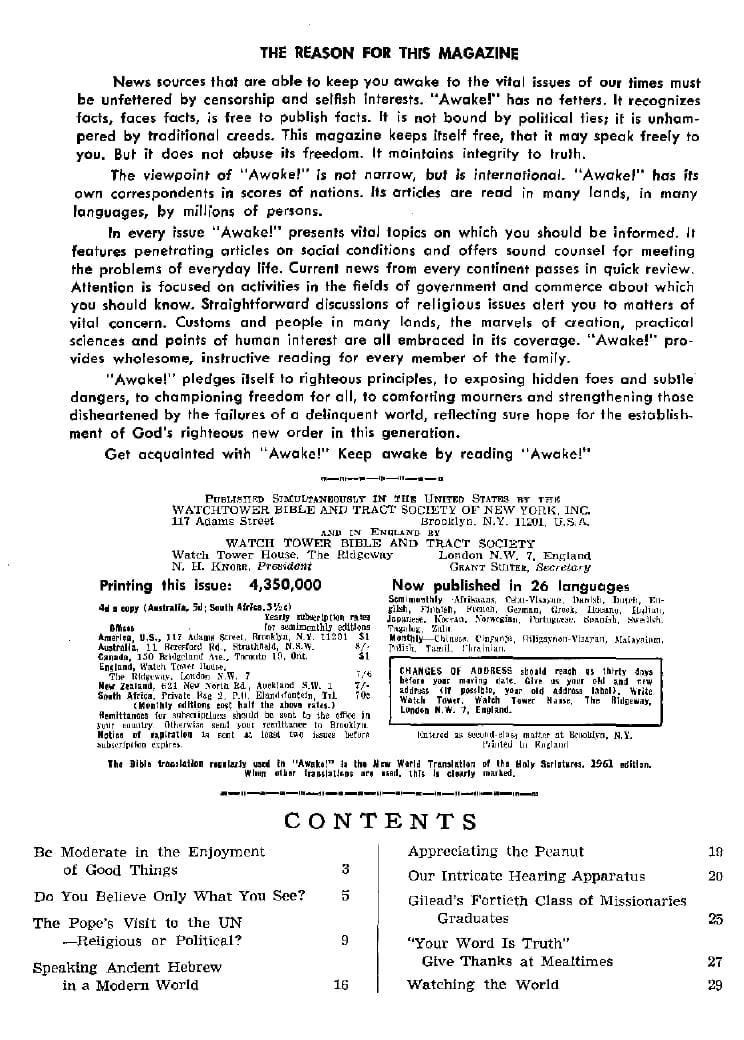
THE REASON FOR THIS MAGAZINE
News sources that are able to keep you awake to the vital issues of our times must be unfettered by censorship and selfish interests. "Awakel" has no fetters. It recognizes facts, faces facts, is free to publish facts. It is not bound by political ties; it is unhampered by traditional creeds. This magazine keeps itself free, that it may speak freely to you. But it does not abuse its freedom. It maintains integrity to truth.
The viewpoint of "Awake!" is not narrow, but is international. "Awake!" has its own correspondents in scores of nations. Its articles are read in many lands, in many languages, by millions of persons.
In every issue "Awake!" presents vital topics on which you should be informed. It features penetrating articles on social conditions and offers sound counsel for meeting the problems of everyday life. Current news from every continent passes in quick review. Attention is focused on activities in the fields of government and commerce about which you should know. Straightforward discussions of religious issues alert you to matters of vital concern. Customs and people in many lands, the marvels of creation, practical sciences and points of human interest are all embraced in its coverage. "Awake!" provides wholesome, instructive reading for every member of the family.
"Awakel" pledges itself to righteous principles, to exposing hidden foes and subtle dangers, to championing freedom for all, to comforting mourners and strengthening those disheartened by the failures of a delinquent world, reflecting sure hope for the establishment of God's righteous new order in this generation.
Get acquainted with "Awake!" Keep awake by reading "Awake!"
PUBLISHED SIMULTANEOUSLY IN THE UNITED STATES BY THE
WATCHTOWER BIBLE AND TRACT SOCIETY OF NEW YORK, ING.
117 Adams Street
BROOKLYN, N.Y. 11201, U.S.A.
AND IN ENGLISH
BY
WATCH TOWER BIBLE AND TRACT SOCIETY
Watch Tower House, The Ridgeway
London N.W. 7, England
N. H. Known, President
GRANT Sister, Secretary
Printing this issue: 4,350,000
4d a copy (Australia, 5d. South Africa, 35c)
Mississippi
Officer for seminumeracy editions
America, U.S., 117 Adams Street, Brooklyn, N.Y. 11501 51
Canada, 105 Regent Street, Toronto, T6d 51
England, Watson Tower Junction, London 71
New Zealand, 423 New South Ed., Auckland, S.W. 71/
South Africa, Private House, Belfast, Belfast, T1n 70e
Remittances for subscriptions should be sent to the office in your country. Subscriptions send your remittance to Brooklyn, N.Y. 11501 a rent at 435.105 last week before subscriptions expire.
Now published in 26 languages
Somerset, Africana, Africana-Violaan, Danish, Danish, English, Finnish, German, Greek, Lithuanian, Italian, Japanese, Korean, Norwegian, Portuguese, Spanish, Swedish, Norwegian-China, Congo, Congo-Violaan, Malaysia, Polish, Tamil, Ukrainian.
CHANGES OF ADDRESS should reach us thirty days before your moving sale. Give us your child and their address. Call us at 212-555-1234 or Watch Tower, Watch Tower House, The Ridgeway, Longton N.W. 7, England.
Inhered as second-class matter at Brooklyn, N.Y.
Painted in England
The Bible translation regularly used in "Awake" is the New World Translation of the Holy Scriptures, 1961 edition. When other translations are used, this is clearly marked.
CONTENTS
Be Moderate in the Enjoyment
of Good Things 3
Do You Believe Only What You See? 5
The Pope's Visit to the UN
Speaking Ancient Hebrew
in a Modern World 16
Appreciating the Peanut 10
Our Intricate Hearing Apparatus 20
Gilead's Fortieth Class of Missionaries
Graduates 25
"Your Word Is Truth"
Give Thanks at Mealtimes 27
Watching the World 29
Volume XLV1
London, England, November 22, 1965
Number 22
BE MODERATE in the ENJOYMENT of Good Things
IT WAS during the coffee break at the office one forenoon that Frank was heard saying to John, "You look rather tired today. What's the matter? Not feeling well?" "No, not that," John replied. "It's just that television set. It was past midnight again before we all got to bed; we just couldn't turn it off. The only remedy I can see is to get rid of it. I just can't do good work unless I get enough sleep."
"That's one way of handling the problem," Frank countered; "but isn't there another way to cope with the situation? Really, the way I see it, it's a matter of exercising self-control and, as head of the house, it's your responsibility to keep the use of the TV within reasonable limits. We have a television set in our house, but we don't let it run our lives. Rather than watch anything that comes on, it is important to be selective."
"You've got a point there," John replied.
Yes, Frank did have a point. There are indeed many things that we can let ourselves enjoy if we enjoy them in moderation. To be moderate means to avoid extremes; it means exercising discretion and self-control. It is just plain good sense that we use moderation, for there are certain things that make a prior claim on our time, such as our worship of God, providing for our families and getting the needed rest and sleep.—1 Tim. 5:8.
Not only is our time limited but so is our capacity for enjoying good things. Overindulgence exacts its price. When it comes to food, our eyes may have no limit but our stomachs do, and so does the rest of our body. Lack of moderation in the enjoyment of good food can well lead to a host of ills. Wisely an ancient king counseled: "Is it honey that you have found? Eat what is sufficient for you, that you may not take too much of it and have to vomit it up." Yes, "the eating of too much honey is not good." And that principle applies not only to honey but to all food that we particularly enjoy.—Prov. 25:16, 27.
Another good reason for being moderate in the enjoyment of good things is that immoderate indulgence leads invariably to bondage to one's appetites, and who wants to be a slave to them? There is nothing wrong with enjoying wine in moderation, for the Hebrew psalmist tells us that Jehovah God is to be blessed because, among other things, he gives "wine that makes the heart of mortal man rejoice." Besides, did not Jesus change water to wine at the wedding feast at Cana, and did not the apostle Paul recommend that his friend Timothy take "a little wine" for the sake of his stomach and his frequent cases of sickness?—Ps. 104:15; John 2:1-11; 1 Tim.
5:23.
But a man may start out drinking an occasional glass of wine and get to like it so much that he begins to take it frequently, and before he realizes what is taking place he is a heavy drinker on his way to ruin as an alcoholic, all because he failed to be moderate in his enjoyment.
moderate indulgence denies our better selves. The doing of things because they are the wise thing to do, the right and the unselfish thing to do, has its own rewards, its own satisfactions. Not without good reason does the Bible state: "Happy is the man that has found wisdom," and that "there is more happiness in giving than there is in receiving."—Prov. 3:13; Acts 20:35.
Thus, also, your appetite is not likely to
Well do the Scriptures warn against overindulgence: "Do not come to be among heavy drinkers of wine. . . . Who has woe? Who has uneasiness? Who has contentions? Who has concern? Who has wounds for no reason? Who has dullness of eyes? Those staying a long time with the wine, those coming in to search out mixed wine. Do not look at wine when it exhibits a red color, when it gives off its sparkle in the cup, when it goes with a slickness." In other words, if you cannot indulge in moderation, stay away from it altogether.
fire of bread, of meat and potatoes or whatever your staple food may be, because these are things you need daily. But you would tire of the same dessert every day or several times a day, because it is more a matter of pleasure than of need. If you go to the movie every night or even every week, you will not enjoy those movies nearly so much as you would if you went but once or twice a year.
For the same reason wise marriage counselors recommend moderation in the enjoyment of nuptial pleasures. They are
Prov. 23:20, 29-31.
The same principle applies to other good things, such as pursuing a hobby. Indulged in moderately, a wholesome hobby can be an aid to mental, physical and emotional well-being and, at times, even financially profitable; but not when it becomes all-absorbing, as with the music enthusiast who could hardly wait until he came home to enjoy his stereophonic recordings, neglecting his wife and even slighting his worship of God because of his passion for music with the effect of being "right
a good thing and there is nothing wrong with enjoying them within the bonds of weedlock; in fact, the apostle Paul warns against the prolonged denial of such privileges on the part of marriage mates. But moderation will make them both more enjoyable and more rewarding; besides, moderation shows consideration for each other. So simply from the standpoint of enjoyment of such good things, it is the course of wisdom to be moderate.—1 Cor. 7:5; 1 Pet. 3:7.
there"!
In fact, by the very nature of things, it follows that for us to keep enjoying such good things we must take them in moderation. Why is that so? Because, not being absolute necessities, their enjoyment is based on the law of diminishing returns. The more you indulge, the less enjoyment and the less happiness proportionately. Im-
things as fine food and drink, hobbies and recreation might be said to be an expression of love of self. There is nothing wrong with loving oneself so long as one loves his neighbor as himself and, above all, loves God. That of itself implies being moderate in the enjoyment of these good things, which is thus seen to be the right as well as the wise course to pursue.
AWAKE!
"SEEING is believing," some say. What is usually meant by this is that if a person can see something, then he will believe it exists. The opposite also holds true for those who believe this way—that if something cannot be seen, then it will not be believed.
DO YOU
BELIEVE
ONLY
WHAT YOU
SEE?
Many project this reasoning to nonbelief in God. Because God cannot be seen, they do not believe in him. Their observations through telescopes and the experiences of the astronauts have not verified by sight the existence of God, so these say they will not believe in him.
How sound is this kind of reasoning? Is it always true
that we believe only what we see? Do we only acknowledge and deal with just what we see and reject and refuse to deal with the unseen?
Beyond Sight
Of all the senses humans possess, the one that comes most into play in this question is the sense of sight. When a person sees an object, he knows it exists. Because he sees animals, humans, trees, clouds and water, he knows these to be realities.
But is this all an individual acknowledges? Does he really believe only what he can see? No, for in everyday life there is much that is far beyond the limit of our sense of sight, much that we cannot see, that yet we do not hesitate to believe as really existing.
For example, when the different elements of the earth are seen through a mechanism that refracts light, each is observed to throw off a rainbow of colors not observed by the naked eye. These colors were there all the time, but were beyond the range of the unaided human eye. Scientists know that every element gives off its own range of color undetected by human eyes. Instruments detect these distinctive colors, so that each element is known by a color distribution and intensity peculiar to itself. We can say that the spectrum of the element becomes its fingerprint. In such a way the element helium was discovered on the
sun even before its discovery on earth. The light it gave off was examined and its spectrum noted to be different from that of the other elements of the sun. Its existence was later
verified on earth.
Today no knowledgeable person in the field of science would think of denying that this great variety of color associated with the different elements exists, although beyond the range of the human eye. But because these colors cannot be seen, are they disbelieved? By no means. Their existence is believed just as surely as if they could be seen with the naked eye.
There is a great variety of things we cannot see but in the existence of which we believe. We cannot see the energy that binds the nucleus of the atom together "atomic cement"—but science knows that mysterious force does exist.
When the nucleus of a particular atom is broken apart, or another fused with it, this fantastic energy in the core of an atom is released and produces tremendous explosions. The force was there in the nucleus of the atom all the time, unseen to human eyes. Its release in such prodigious amounts shows that it does exist, although invisible.
What of gravity? Without this unseen force operating in the earth, objects, including man himself, would have trouble staying on earth's surface. Astronauts have difficulty maneuvering in space when this force of gravity is neutralized. We cannot see gravity, as we cannot see the earth's magnetic field, yet we do not for a moment deny they exist. While unseen, they are detected by instruments and experiments that verify their reality.
Do you doubt that wind exists? You cannot see it, yet even the child knows it is there by the results he sees: the trees waving in the breeze, the ocean spray tossed by the wind, the cooling force on one's face in the summer heat or icy blast in the cold of winter. Unseen? Yes. But disbelieved? Certainly not!
As a matter of fact, it is something unseen in which we believe that keeps us alive. Without it we would collapse within a few minutes and die! This is the air we breathe! It too is beyond the range of the human eye to see, but no one would be foolish enough to deny it exists. Any who doubt it can try holding their nose and mouth tightly closed for a moment. How quickly they will gasp for what they cannot see—air! How grateful they are that it does exist even though they cannot see it!
inventions in recent decades have utilized some of these forces that exist beyond the range of the human eye.
Inventions Use Unseen Forces
There are many more forces we cannot see, yet we believe in them. A number of
Radio waves are transmitted in one part of the world, sent unseen through the atmosphere to another part of the world. There they are picked up by receivers and transformed into the sound we hear when we turn on a radio. The transmission of television is similar. And what of the radar beam that can be bounced off distant objects and returned to the sender to be recorded by instruments that show how far away the object is, its size and direction? All of this is accomplished by the invisible radar beam.
Beyond sight, too, is the X ray. We cannot see an X ray when it is projected by a laboratory instrument, yet the science of medicine uses it daily to photograph the inside of the human body. What the eye cannot detect, the photographic plate can, all because of the unseen X ray. Tell the doctor you do not believe in X rays because you cannot see them, and he might conclude that your mental health is in jeopardy.
There is no getting around it. What we can see with our eyes compared to what there is all around us, but which is invisible, is infinitesimal. As marvelous as our eyes are, yet we are comparatively blind when we note the wonders and glory around us that we cannot see, but that, in fact, exist. Dare we conclude that reality ends just because our sense of sight is limited?
Beyond Hearing
The human ear is another wonderful mechanism, far better than any instruments that attempt to duplicate it. But there is much that exists in the way of sound that the human ear cannot detect.
Have you heard of the ultrasonic dog whistle? This is a whistle that has a frequency too high for the human ear to detect, but a dog can quickly pick it up, for his ears are in tune with that frequency.
That we humans cannot hear the whistle's sound does not mean the sound is nonexistent. It exists. It is a reality, though beyond capture by the human sense of hearing.
Sound that is beyond the range of our ears is used in other ways too. Sound waves can wash even the greasiest of dishes surgically clean. They can be used in performing delicate operations. Yet we cannot hear these sound waves, as they are beyond the limits of the human ear.
Can You Smell It?
Our sense of smell is far, far superior to the best machine ever invented to duplicate it. Yet there is much beyond the range of the human nose that exists, though we cannot smell it.
When a crime is committed and the criminal needs to be tracked down, do police not at times call in bloodhounds? Humans cannot track in such a way, as the scent a person gives off is usually too faint to be detected by the human nose. Yet the scent is there, as the bloodhounds quickly note. Once they pick it up, they track their quarry over ground where it would be impossible for humans to do so. We cannot doubt that the scent exists just because we cannot smell it.
Some species of moths can detect each other over long distances just by the odor they give off. This odor cannot be picked up by the human nose, but it is there all the time. The moth's sensitive odor detector picks it up. Such odors exist, although humans cannot smell them.
Evidence of Existence
The existence of such a wide variety of things we cannot see, hear or smell should
make the honest person wonder if there is much more unseen that is also a reality. Rash would be the person who, confronted with such evidence, would conclude that there cannot be anything else unseen.
Things we know exist, although unseen, have usually been detected by the evidence they produce. Invisible cosmic rays bombarding the earth every second can be detected by sensitive photographic plates. The sound coming from a radio proves that radio waves exist. The image on our television screen, or on the radar screen, testifies to the existence of these unseen transmissions. The X-ray photograph proves the existence of that force. The dog's reaction to the ultrasonic whistle shows that this sound is a reality, as is the scent picked up by the bloodhound. In case after case, what is unseen can often be detected by what is produced.
In like manner God can indeed be discerned because he manifests himself. How? A wise man of the first century, Paul, an apostle of Jesus Christ, showed how. His answer is recorded in the Bible at Romans chapter one, verse 20. He stated: "For his [God's] invisible qualities are clearly seen from the world's creation onward, because they are perceived by the things made, even his eternal power and Godship."
The evidence of God's handiwork is all around us in his creation. One who cannot deny that other invisible forces exist because of what they produce should not deny that God exists, because of what he has produced. God has produced an entire universe of staggering proportions, of such precision that we set our clocks by it. It includes an endless variety of animal and vegetable life so complex and beautiful that man cannot even begin to duplicate it. The one who denies the existence of God should try to create a blade of grass! Even the most clever scientist with the best equipment is confounded in an attempt to do so.
That blade of grass testifies to the existence of a Creator, for as a physicist stated: "No material thing can create itself."*
If you think it can, then look about you wherever you may be at this moment. If you are in the privacy of your room, how many things within the range of your sight created themselves? Did your desk come into existence by it.
dows, roof and cellar, to produce a complete house? Preposterous, you say? Just as preposterous is the concept of one who, in the face of the evidence of the unseen, in the face of the evidence of God's handiwork throughout the universe, still maintains, I cannot believe in God because I cannot see him.'
Without doubt, we believe what we cannot see, because of the evidence produced. So the hollyman in
into existence by itself? Did that table, chair, mirror, rug, picture on the wall, or the wall itself come into existence without a directing force behind it? That watch
COMING IN THE NEXT ISSUE
Why the Berlin Wall?
Justice for All—Will It Ever Be Realized?
Make Good Use of Your School Years.
Humans in the Face of Disaster.
on your wrist—how did it get to be? By blind chance? By creating itself? Of course not! Everything you see in your room was made by someone, probably by someone you did not see nor ever will. Yet you do
so the believer in God can attest to His existence because of the evidence of God produced throughout the universe. In addition, man can know his Maker by the
communication God has inspired for that purpose, his Word, the Holy Bible, for "all Scripture is inspired of God and beneficial for teaching, for reproving, for setting things straight." (2 Tim. 3:16) Wise per-
not doubt for a moment that these things were made, that they did not spring up by themselves.
However, making the things you see in your room is child's play compared to making an atom, a blade of grass, a planet like the earth, a galaxy, a universe! If relatively simple things cannot come into existence without the work of a craftsman, are we to believe that the infinitely more complicated things, particularly living things, came into existence without a Cre-
sons regularly consult God's Word in order that they may come to know their Creator. As they do they learn why man was put on earth, why he dies, why wickedness has been permitted, why such distressing conditions prevail earth-wide, and what the future holds. As they learn, they enlarge their appreciation of the majesty of God, even though he is unseen.
One who has come to believe in God by the evidence of creation and by God's own Word is humbled. He is humbled because
ator? No, nothing organized ever just "happens." Without a directing and organizing force, things deteriorate or go back to a neutral state.
Will one brick placed on a plot of land somehow duplicate itself and grow into another brick, then into beams and win-
now he realizes that there is an unseen being and power so great that it makes insignificant what he can see. Such ones agree with King David of ancient Israel when he said: "The senseless one has said in his heart: 'There is no Jehovah.'" (Ps. 14:1) Because of the overwhelming evidence, they wisely do not limit their belief to the things they can see.
THE POPE'S VISIT TO THE U.N.
"THIS is the day which we have desired for centuries!" exclaimed Pope Paul VI to the vast throng of 90,000 gathered at Yankee Stadium in New York City. The crowd showed they felt the same, for they had given him a roaring, foot-stamping ovation
Several million approving New Yorkers saw the pontiff during the day, according to police estimates. They lined the streets along his route and crowded around the places he visited. The television audience
when his Lincoln Continental limousine entered the stadium and slowly circled the track.
As evident from the reception accorded the pope throughout his visit, many others also found the day desirable. There was the huge sign appearing in the windows of the United Nations Plaza that read, "PACEM IN TERRI WELCOME POPE PAUL VI." And from what occurred during the day it was apparent that the United Nations, made up of 117 countries now, gave approval and support to his visit.
Religious leaders of other denominations also welcomed the leader of the Roman Catholic Church and expressed appreciation for his coming. Many of them were in attendance at Yankee Stadium and personally greeted the pope after he celebrated mass there. Earlier, at an interfaith meeting, 120 Protestant, Jewish and Roman Catholic leaders met the pope in the Holy Family Catholic Church.
in the United States alone was estimated to be about 100 million persons!
Trip Unprecedented
The trip was precedent shattering. No reigning pope had ever visited the United States before.
In fact, until Pope Paul VI, no pope since 1870 had gone much beyond the confines of Rome. In that year the church's vast powers and properties, comprising an area of some 16,000 square
miles in Italy, were confiscated by the Italian government. In protest, Pope Pius IX and succeeding popes voluntarily confined themselves to the Vatican area. This tradition was broken only in recent years, first in a small way by Pope John XXIII and then by Pope Paul VI, who traveled to Jordan, Israel and India in 1964.
Then, last year, United Nations Secretary-General U Thant extended an invitation to Pope Paul VI to come to New York and address the United Nations General Assembly. This invitation was accepted, forming the basis for the pope's trip to New York City.
Extensive Preparations
The pope's visit to New York began when the Alitalia DC-8 jet aircraft bearing him and his official party touched down at Kennedy International Airport at 9:27 a.m. on Monday, October 4.
Long before then, however, extensive preparations had been made.
For one thing, the most elaborate security precautions in the history of New York City were taken. Of the 26,000-man police force in New York City about 18,000 were assigned to the papal visit. This represented the largest commitment of man-hours in police force history. Overtime costs for the one day alone amounted to one million dollars. For days the police had been drilled in preparation for handling the expected grounds. More than 1,000 were assigned to
ments of countries he passed over or near. This included France, Switzerland, Britain, Ireland and Canada.
When the jet landed at Kennedy International Airport it taxied up to the special place provided, the flags of the United States and of the Vatican flying from the pilots' cockpit. Among the first up the ramp to the plane were the head of protocol for the United Nations and a church official. Following them was UN Secretary General U Threaty who extended
crowds. More than 1,000 were assigned to St. Patrick's Cathedral alone. During the papal mass 5,000 police were assigned to duty at Yankee Stadium. Thousands more were to line the 24-mile route of the pope's motorcade entering the city.
Elaborate preparations in other areas were made too. Kennedy International Airport was closed while the pope was in the area. In the communications field thousands of radio and television engineers and technicians set up hundreds of microphones and cameras to cover the proceedings. The three major TV networks, NBC
Secretary-General O'Twan, who extended his welcome. Then the pope, clad in a white tunic and a cloak of cardinal red, greeted the political representatives present, Mayor Wagner of New York City, United States Secretary of State Dean Rusk, New York State Governor Rockefeller, and a host of other dignitaries, both political and clerical.
The pope walked over a 60-foot red carpet to a speaker's platform and, with U Thant at his side, delivered a brief speech that set the tone of his visit. He stated:
CBS and ABC, canceled everything, including commercials, to give all-day coverage to the pope—an unparalleled television coverage for any foreign dignitary. This meant a ten-million-dollar deficit in canceled billing and production costs!
Even the area in Harlem through which the pope would travel received a face-lifting, for it had been extensively cleaned up and the evidence of poverty disguised as best as possible. This caused one Negro man to ask a Catholic priest: "Hey, father, how come they clean up Harlem so much
"We reply without delay to the greetings presented to us by the distinguished representatives of the United Nations, and we express our sincere thanks for the invitation to us to address that great assembly. We are thus given the honor and the good fortune of meeting that greatest of all international organizations. It gives us particular pleasure to mark in this way the 20th anniversary of the founding of the United Nations, and to express our best wishes for its permanency and its development." Thus at the very start of his visit
today for the Pope's visit? . . . How come they don't clean up other times, father?"
Finally, the gigantic advance preparations came to their successful conclusion and the city awaited the papal visit.
Events of the Day
While en route to the United States, the pope sent messages to the heads of govern-
he let it be known that he firmly endorsed that international political organization, the United Nations.
The papal motorcade then drove off under heavy police escort. After visiting for about fifteen minutes inside celebritypacked St. Patrick's Cathedral, the pope went to the Waldorf-Astoria hotel for a lengthy conference with United States President Lyndon B.
Johnson. Though other events during the day were witnessed by many, details of the matters discussed with President Johnson were not so widely publicized.
In midafternoon the pope went to the United Nations to address the General Assembly, where he stressed the need for peace and disarmament. Then he was taken on a tour of the Security Council, the Trusteeship Council and the Economic and Social Council, where overflow audiences assembled. To each he restated briefly what he had told the General Assembly. Later the representatives of the political states making up the UN gathered in a long reception line to be personally greeted by the pope. Never before had the political representatives of so many of the nations of earth honored the head of the Roman Catholic Church.
In the evening the pope celebrated mass at Yankee Stadium. Following this he briefly toured the Vatican Pavilion at the World's Fair, and at about 11:30 p.m. left Kennedy International Airport aboard a TWA 707 jet bound for Rome.
Reactions
In addition to the favorable reaction of assembled UN delegates, American politicians and religious leaders, the world press comment was generally favorable too.
In Washington, the pope's plea for world peace was warmly praised in Congress and his speech to the UN was placed in its entirety in the Congressional Record.
In London, Rome, Paris and most other world capitals the reaction was the same. Interesting was this report from the Communist Czechoslovakian press: "Whatever the background of his visit, his declaration of support for the struggle to preserve peace from the forum of . . . the UN will make his journey to New York an event of
positive significance for the cause of peace."
Among the most significant comments was one from the Soviet Union. There the government news agency Tass said: "All sincere peace champions will welcome a more active participation of Catholics in the noble work of removing the threat of disastrous military conflict. In the opinion of the Soviet people, political and religious differences should be no hindrance to the joint efforts of all those who place the preservation of peace, the supreme blessing of mankind—above all else."
The Soviet statement seemed to invite cooperation between the Kremlin and the Vatican. On this point a New York newspaper said: "The Tass commentary, which is explicit on this point, comes after a long discussion among Marxist philosophers on the need for a Marxist-Catholic co-operative effort. In Spain, Communists view Catholics today as their best allies in the fight against dictator Francisco Franco."
"The most prevalent criticism of the trip heard in Rome," states the New York Herald Tribune, "is simply that the UN is in a state bordering on collapse and that it is unwise for the Pope to identify himself with it. One typically cynical Roman remark increasingly heard is: 'The Pope's going to the UN to give it the last rites.'"
Religious or Political?
What does it all mean? What is the significance of the pope's visit, particularly his address to the United Nations?
Representing one of the world's largest religious denominations, the pope had an opportunity to promote the message of Christianity in an unparalleled way. But did the pope present God's message, Christ's message, to the United Nations and the world? Was his visit, his message, purely religious or was it political as well?
That the visit was not purely religious but was mainly political has already been acknowledged by impartial observers. As the NBC television newsman stated, the pope's coming was "not primarily a spiritual visit." In Catholic France the influential newspaper Le Monde stated of the pope's visit: "He went beyond the spiritual and religious levels which are his and took the responsibility of a political act, the effect of which is still fully to be measured."
There can be no doubt that in addressing a purely political body, the United Nations, the pope performed a political act. There is no provision in the United Nations charter for religious leaders to be members of the UN or to have the right to address the General Assembly. They can do so only by invitation, and in this case, the pope was invited not as a purely religious leader, but as one 'invested with temporal sovereignty' as head of an independent state, Vatican City, as he acknowledged in his speech to the UN. Though small, the Vatican state has political representations in many countries. At present, about fifty nations maintain diplomatic (not religious) relations with the Vatican.
That the pope would carry out a political mission is no surprise to church authorities. No less a church figure than Richard Cardinal Cushing of Boston stated that Pope Paul VI is a "trained diplomat." This is certainly so, because the present pope has had long training in the political arena. After his ordination as a priest in 1920, he trained as a Vatican diplomat. In 1936 he became Vatican undersecretary of state and in 1952 was made prosecretary of state for ordinary affairs. The secretariat of state is the "most definitely political organ of the Vatican," states The Encyclopedia Britannica. This department, the secretariat, where the present pope worked for so many years, is responsible for everything having to do with political relations and
with instructions given to Roman Catholics on questions dealing with political life. Hence, Pope Paul was well trained and qualified to deal with a purely political body, the United Nations.
The political nature of the visit was emphasized by the fact that political dignitaries at all levels, from local officials to mayor to governor to president to UN leader, greeted and conferred with the pontiff, as did the many political representatives in the pope's receiving line at the UN.
But, some may ask, what difference does that make? What does it matter if the pope's visit was political in purpose? This really brings us to the crux of the matter. What was the pope's message to the United Nations and to the world? Since he claims to be in direct line from the apostle Peter and claims to speak as the vicar of Jesus Christ on earth, was Pope Paul VI's message the message that Jesus Christ gave to humanity, the message that God ordained Jesus to give?
Pope's Message, Christ's Message
If the pope's message was Christ's message, then mankind indeed has cause to rejoice. The unprecedented exposure the pope received when addressing the United Nations, and his audience of hundreds of millions afforded by newspaper, magazine, radio and television coverage gave him a marvelous opportunity to present Christ's message. A significant portion of mankind could thus have heard God's message, thereby promoting God's interests on earth. What an amazing opportunity, unparalleled in human history!
The pope represented himself as the "bearer of a message for all mankind." He said that his presence at the UN fulfilled a desire nourished "ever since the command was given us: go and bring the good news to all peoples." And what was the message that he delivered? It followed the theme he set at the airport on arrival when he called the UN the "greatest of all international organizations," for at the UN the pope declared that his message was a "ratification, a solemn moral ratification of this lofty institution," the United Nations.
The pope further declared of the United Nations: "This organization represents the obligatory path of modern civilization and of world peace." He said: "The peoples of the earth turn to the United Nations as the last hope of concord and peace; we presume to present here, with their tribute of honor and of hope, our own tribute also." He added: "Hearken now to the continuation of our message. It becomes a message of good wishes for the future. The edifice that you have constructed [the UN] must never fall; it must be perfected." New York Herald Tribune, October 5, 1965, page B, special section.
But is this the good news that Jesus Christ preached and that he commanded his disciples to carry to all mankind? No! The theme of Jesus' teaching was the kingdom of God, or as he frequently referred to it, the kingdom of the heavens. That is why he taught his disciples to pray: "Our Father in the heavens, let your name be sanctified. Let your kingdom come. Let your will take place, as in heaven, also upon earth."—Matt. 6:9, 10.
However, is not this kingdom of God something that God will establish through men on earth? some may ask. Jesus answered very pointedly, and to a political ruler at that, saying: "My kingdom is no part of this world." (John 18:36) He refused kingship at the hands of men. (John 6:15) Nowhere did Jesus Christ endorse a political organization as the means to bring the long-desired peace to earth. When Jesus talked of a time when 'God's will would be done on earth as it is in heaven,' he never once said this would be brought about by any political
power or combination of powers such as the United Nations.
It is a heavenly government or kingdom with Jesus Christ as king, with associate kings and priests ruling from heavenly thrones over the earth, that God uses to bring permanent peace to mankind. (Dan. 7:13-27) Never did Jesus attribute to political bodies the hopes and promises Pope Paul VI did to the UN!
What Peace?
In his plea for peace and disarmament, the pope stated: "Not the ones against the others, never again, never more!" "No more war, war never again!" "If you wish to be brothers, let the arms fall from your hands. One cannot love while holding offensive arms."
Later in his address, the pope said: "We may consider this the fulfillment before our very eyes, and by your efforts, of that prophetical announcement so applicable to your institution: 'They will melt down their swords into ploughshares, their spears into pruning-forks' (Isa. 2:4). Are you not using the prodigious energies of the earth and the magnificent inventions of science, no longer as instruments of death but as tools of life for humanity's new era?"
However, who is it that is making this plea for peace and disarmament? It is the same man who was being trained as a Vatican diplomat when his church blessed Mussolini's slaughter of the people of Ethiopia! It is the one whose church blessed Fascist weapons of war as they paraded before political and church officials! And, as a Vatican unders secretary of state, he was involved in the political machinery of the church during the years that the Catholic church had an active concordat with Adolf Hitler!
Also, it is a fact of history that the worst wars have been fought right in the heart of Christendom, among people who claim they are Christian.
Prominent in all this slaughter has been the Roman Catholic Church and its people. In both world wars Catholics, with the blessing of their clergy, have shed the blood of fellow Catholics just because their nationality differed!
Why, then, if the pope wants to promote true peace, does he not tell his own people to set the example? When he talked to the Catholic people in Yankee Stadium he did not tell them, "No more war, war never again!" He did not tell the people of his own Catholic church, "Let the arms fall from your hands." The simple fact remains that the popes have never done so, but have permitted their people, at the behest of political rulers, to violate God's commands and to kill one another in time of war!
What a sorry spectacle it is to claim to promote peace when there is no peace in one's own household! Could we imagine Jesus Christ blessing the apostles if they chose sides and fought against one another? Jesus even told Peter to put his sword down when he struck a non-Christian! No, Jesus' followers did not kill one another, but the adherents of Pope Paul's church do, with no correction or reproof coming forth from their leader. How truly hollow the claim of being peaceful and the urging of politicians to disarm when members of the Roman Catholic Church have slaughtered one another throughout their history! Taking the life of a spiritual brother is commented on in the Bible. At 1 John 4:20, 21 it says: "If anyone makes the statement: 'I love God,' and yet is hating his brother, he is a liar. For he who does not love his brother, whom he has seen, cannot be loving God, whom he has not seen. And this commandment we have from him, that the one who loves God should be loving his brother also." First John 3:10-12 adds:
"The children of God and the children of the Devil are evident by this fact: Everyone who does not carry on righteousness does not originate with God, neither does he who does not love his brother. For this is the message which you have heard from the beginning, that we should have love for one another; not like Cain, who originated with the wicked one and slaughtered his brother."
No Rejection of Adulation
Further, the glory and adulation that the pope received at the hands of people, religious leaders and politicians, was the very opposite of what God's servants in the first century allowed.
On one occasion, the apostle Peter entered the house of the Gentle Cornellius. Acts 10:25, 26 says: "As Peter entered, Cornellius met him, fell down at his feet and did obeisance to him. But Peter lifted him up, saying: 'Rise; I myself am also a man.'" No, Peter did not permit men to bow and scrape to him, for he knew such adoration belonged only to God.
But when scores of world leaders, politicians, one by one, passed before the pope at the United Nations, bowing and kissing his ring, did he stop them? No. How unlike Peter, whose successor the pope claims to be!
Friend of the World
To the political organization, the United Nations, the pope declared: "It is as a friend that we are here today."
On the other hand, Jesus' half brother, James, writing under the direction of God's holy spirit, declared: "Adulteresses, do you not know that the friendship with the world is enmity with God? Whoever, therefore, wants to be a friend of the world is constituting himself an enemy of God."—Jas. 4:4.
When Pope Paul VI said to the 117 nation political body: "We have only a desire to express and a permission to request: namely, that of serving you in so far as we can," he was expressing a desire to have relations with the political body representing the entire world of governments, and he has indeed done so.
This intercourse God forbids, as James plainly states, calling those who claim to be Christ's followers adulteresses if they participate in such illicit intercourse with political organizations.
God's Word clearly states that Satan the Devil, God's chief adversary, is "the god of this system of things." (2 Cor. 4:4) And 1 John 5:19 says: "The whole world is lying in the power of the wicked one." That is why Jesus Christ said of his true followers when he was praying to God: "They are no part of the world, just as I am no part of the world."—John 17:14.
The Roman Catholic Church claims to be the bride of Christ. That bride, Jesus showed, was to be made up of persons who were, spiritually speaking, virgins, because they did not adulterously seek friendship with the world. They would preach to the world, true; but they would not become part of the world, endorsing its political movements and joining with the people of the world in supporting its United Nations as "the last hope of concord and peace." As Jesus said, his true followers would be "no part of the world."
But did the pope act in harmony with that description of the disciples of Jesus Christ? No! When he declared to the UN that he had "a desire to express and a permission to request," namely, "that of serving you in so far as we can," he showed that, rather than acting as a member of the chaste bride of Christ, he is part of that religious empire represented in the book of Revelation as a harlot bearing the name "Babylon the Great."
world organization of false religion is shown astride the beastlike world confederation of governments. But, in time, states Revelation 17:16, these nations that make up this world political body "will hate the harlot and will make her devastated and naked, and will eat up her fleshy parts and will completely burn her with fire." And where does this judgment originate? With God! Verse 17 adds: "For God put it into their hearts to carry out his thought." Hence, the very ones bowing and scraping and adoring today will be the ones that turn against the symbolic religious harlot very shortly!*
But is it not intolerant to take such a view of the pope's visit to the UN? No; there is a vast difference between pointing out error or danger and being intolerant. Intolerant ones endeavor to silence those who disagree, by force if necessary. This the Christian cannot do. However, to point out that the words and actions of Pope Paul VI differ strikingly from the words and actions of Jesus Christ is a solemn obligation for any persons professing to be Christian. Not to do so would be failing to declare the truth. Jesus said: "You will know the truth, and the truth will set you free."—John 8:32.
The similarity between what is occurring now and what occurred in Jesus' day is highly significant. Then, the religious leaders gave open evidence that they were friends of the world; they turned to the political leaders and rejected Jesus, crying out, "We have no king but Caesar." (John 19:15) Today, when Pope Paul VI gets into the political arena and tells the UN he brings them his "tribute also," he is in effect saying the same thing as the religious leaders of nineteen centuries ago: "We have no king but Caesar"!
By "Awakel" correspondent in Israel
SITUATED in the Middle East not far from the cradle of mankind lies the relatively new republic of Israel. However, the language spoken by its inhabitants is considered to be mankind's oldest language. So one might well ask, What is the difference between the spoken Hebrew of today and the original language that God gave Adam? What have been the influences on the language throughout history? How have words been derived to fit the needs of the modern generation?
Bible students understand that the diversity of languages began with the disruption of work on the Tower of Babel, when Jehovah God changed the language of the builders, forcing them to comply with his purpose of having mankind spread out over the earth. (Gen. 11:1-9) Those who maintained the true worship of God would have kept the same language, the original one with which Adam was endowed at his creation. But later on this original language would be bared to the relentless, diversifying pressures of new languages. Over a period of time the original language underwent some changes of existing words and language structure; but to what extent is not known.
Hebrew's Distinctiveness Intact
Considerable change in a language can occur in comparatively short periods of time. For instance, let an English-speaking person try to read Chaucer, who wrote English poetry only 500 to 600 years ago, and he will get an idea of how much English has changed. However, there are good reasons to believe that, in the case of Hebrew, the basic language pattern may have remained much the same. One reason is the consonantal structure of Hebrew. Each word has as its root three consonants, and upon these three consonants vowel patterns are added to give the word explicit meaning.
For example, take the three consonants sing in English. Add the letter o and you get song, a noun. Add o, i, or u and you obtain sang, sing or sung, three different tenses of the same verb. So it is with most Hebrew words. While the original pronunciation has changed over a period of time, the roots apparently have remained very much the same, thus limiting various possibilities of pronunciation.
Another reason why changes in the original language have been minimized is the Bible itself and the great respect it has held throughout the centuries. Because of the Bible, Hebrew language study has been encouraged for generations, even among non-Jews. Showing why the Biblical Hebrew so deeply affects the modern Hebrew, Hebrew scholar W. Chomysh, writing in the book Hebrew: The Eternal Language, states: "The biblical phrases and expressions of thirty-five centuries ago pulsate with vitality and vigor."
In addition to the Hebrew text of the Hebrew Scriptures, the Aramaic language has left its stamp. Words, passages and entire chapters of Daniel and Ezra were written in Aramaic. Other languages that have left their mark in the Hebrew Scriptures include Egyptian, AssyroBabylonian and Philistine, "But despite all these admixtures," adds Chomsky, "the organic distinctiveness of the Hebrew language remained intact."
The vocalization, or addition of vowel signs as used in modern Hebrew, was done during early centuries of our Common Era, during which time a number of systems were employed in different localities. However, the system devised at Tiberias on the Sea of Galilee is the one in common use today. Of course, the Masoretic scholars in the Tiberian academies indicated the pronunciation as they knew it, and this does not mean that this same pronunciation was necessarily used in the earliest periods of history.
During most of the Middle Ages and until the nineteenth century, Hebrew was not in use as a daily language, although learned Jews of different countries often used it as the only common means of communication between them. But it was still a literary means of expression. During the Renaissance the study of Hebrew as a classic language, and the study of the Bible in particular, was given new impetus.
During the nineteenth century Hebrew study was limited mostly to literary works. Then came the forces that urged the return of Jews to Palestine and which also fostered the return of the Hebrew language as the living language of the Palestinian Jews. Perhaps the most outstanding figure with regard to modern Hebrew is Elieser Ben-Yahude, who is thought of as the father of modern Hebrew. He worked diligently toward enriching the language and adapting it for the needs of the modern world. He began compiling a voluminous dictionary, most of which was completed after his death. From this beginning developed what is commonly known as modern Hebrew.
Accepting the Modern Language
Slowly but surely Hebrew was becoming accepted as a major language of the area then known as Palestine. A prime mover of the everyday use of Hebrew was the youth; and so as more and more schools adopted Hebrew as the language of instruction, the children grew up with it as their native tongue. But when it was decided upon by the directors of the technical college now called the Technion that, due to the inability of Hebrew to cope with the demanding linguistical needs of technology, the language of the Technion would be German, a war of the languages broke out. Strikes were declared by a number of schools, support was given by the teachers' organization and the children joined in enthusiastically. When the dust of battle cleared, Hebrew became the language of the first technical college in the country. Four years later, in 1918, when the cornerstone of the Hebrew University was laid in Jerusalem, the language of instruction was Hebrew. In 1921 the Palestine Mandate gave recognition to Hebrew as one of the official languages of the country In addition to English and Arabic.
Adapting Hebrew to Modern Needs
To adapt the ancient language to its modern requirements the Academy of the Hebrew Language was founded. It determines new words and fixes spelling and grammar. What are the sources for new words that are drawn on by the Academy?
First of all, the Academy utilizes, wherever possible, existing words in classical Hebrew writings, primarily the Hebrew Scriptures. This is possible whenever the meaning of the original word is close to that of the desired meaning, and then it is altered grammatically when necessary. For example, the Hebrew word now used for "garage," musach, is found at 2 Kings 16: 18, where it means a "covered structure" that was built in the entryway of the building.
Where such existing words in Hebrew are not available, the Academy turns to existing words in a related language, such as Aramaic or Arabic. The word for "polite," adib, is one taken directly from Arabic.
Should this method also fail, the Academy turns to nonrelated languages. The object here is to incorporate the structure of the foreign word directly into the Hebrew with a minimum of alteration. See if you can notice the similarity between the English word "brush" and the Hebrew equivalent, mibreshet.
Often the Academy simply borrows a foreign word intact and uses it with Hebrew phonetic spelling. Most of the words in this category are universally accepted, such as "telephone," "radio" and "psychology." If none of the aforementioned sources satisfactorily provide the needed word, then, as a last resort, the Academy simply coins a new word.
There is also an unofficial way by which words find their way into modern Hebrew—the simple adapting of popular words and phrases from foreign languages by the common people. This is frowned upon, of course, by language officials, by those wishing to keep the language pure and untarnished. However, the average Israeli has other ideas as to how he is going to express himself.
So into the language of the street fall words and expressions from Yiddish, German, English, Russian and a variety of other unofficial sources. Thus when an Israeli youngster invites his friends to sit around a campfire, he invites them to a kumsitz, from the German kum (come) and sitz (sit). If any of the boys lived on
a kibbutz, the unique Israeli collective settlement, he would be known as a kibbutznik, the Russian suffix nik being added to denote association in a particular group. If a boy refers to his house as being katanchik, why, it is readily understood that he means "very small," even though he has added to the Hebrew katan (small) the Russian diminutive suffix, chik. The English language has left its mark as well with such words as "puncture," "sweater," "OK" and "idiot," which are pronounced more or less like the original English words.
Yes, in addition to the bilbul or "Babel" of foreign words and expressions in the vernacular, one hears a wide variety of colorful accents, arising from the large immigrant population. There are even definite accentual patterns developing among the native-born Israelis, reminding Bible readers of the Shibboleth test of Judges 12:4-6.
Yes, it is an interesting experience listening to and speaking a language such as Hebrew, which, though modern, is also ancient, since its root letters maintain connection with its ancient form. This is especially true in the literary style.
Learning Hebrew presents a challenge to those whose native tongue is not Semitic, but it is a rewarding challenge, for it enables one to read and appreciate the Bible in one of its original languages. Learning Hebrew requires more than just effort and time; it requires rethinking in order to learn the rhythm and the particular style of the language. But to those who do so the investment of the required time and study will open up new vistas in expression and a world of enjoyment as they learn to speak ancient Hebrew in a modern world.
Appreciating the Peanut
PEANUTS usually are looked down upon. So much so, in fact, that among the definitions for "peanuts," according to Webster, are "something small, inconsequential; a petty sum of money usually in comparison to the total amount involved." But this does the peanut a gross injustice, as we shall see.
The peanut appears to be a native of South America, archaeologists having traced it back to Peru. Brought to Europe by explorers, it has spread from there to Africa, Asia and North America. Among the chief peanut-growing countries today are China, India, Nigeria and the United States.
Peanuts, strictly speaking, are not nuts, but, rather, a legume, as are beans, peas and lentils, for which reason they are called peanuts. Different from other legumes, which grow on bushes, the peanut grows underground. But in common with other legumes, the peanut, in the first place, is very valuable as a rotating crop to enrich the soil, and its plants also make good feed for cattle.
The peanut might be said to be as valuable as it is plentiful. It gives more edible oil per ton than any other crop and ranks third, after the soybean and cottonseed, as a source of edible oil. A peanut is about 24 percent carbohydrate, about 25 percent protein, about 38 percent fat, 9 percent water and 2 percent ash. A pound of peanuts contains more protein, carbohydrates, minerals and vitamins than does a pound of beefsteak.
Especially in the United States are peanuts in great favor, figuring largely in confections and nut mixtures in addition to being enjoyed by themselves. About half the United States crop is used for peanut butter. At present there are two trends in the preparation of peanut butter that are to the advantage of the manufacturer rather than the consumer. One of these is to add hydrogenated oil to the butter. This helps to preserve the peanut butter and to keep it from separating, with the oil coming to the top, but hydrogenated oils are hardened and are not nearly as valuable or as easily digestible as are oils in their natural state. The other practice is to add inferior products to the peanut butter, such as cheap cooking fats. In the United States the law requires that a high percentage of peanut butter be peanuts, but some manufacturers get around this law by advertising their product as "peanut spread."
Peanuts are also used in making medicines, soaps, sweeping compounds and plastics. After the oil is pressed from the nuts the remains are processed for stock feed or mixed in with fertilizers. There are also many uses for the shells, and a fiber has been produced from peanuts that resembles wool in its softness. In fact, the pioneer, developer of peanut products, the late Negro scientist, George Washington Carver, developed some three hundred products from peanuts, including coffee, ice cream and buttermilk.
Today certain lands in Asia and Africa suffer because of a lack of protein in the diet of their peoples. These very lands grow plenty of peanuts but feed them to their cattle, the people preferring rice and other starchy foods. To solve the problem, scientists have developed a mixture of taploca and peanut flour, which tastes more like rice than peanuts and which they process into pellets resembling rice grains. Incidentally, the red skins of peanuts are also very valuable. They contain an extremely important yet one of the least plentiful vitamins, riboflavin.
The latest boost for peanuts came about wholly by accident. American scientist H. Bruce Boudreaux, a victim of hemophilia, in which disease the blood does not clot, suddenly noticed that his condition had greatly improved; seeking the cause, he found that it was due to his having eaten many peanuts. Experiments with other hemophiliacs corroborated his findings.
More and more gardening magazines recommend growing peanuts if one's land has from 110 to 120 days free from frost. Peanut bushes make a beautiful hedge around the garden, about eighteen inches high, and after the first light frost they can be harvested. Because of their nutritional value peanuts are high on the list in ambitious future space plans, both to be taken along as food, four handfuls furnishing sufficient calories for a spaceman for one day, and to be grown in spaceships! —New York Times Magazine, March 6, 1960.
…