Awake!, November 8, 1965
Download: PDF — Awake!, November 8, 1965
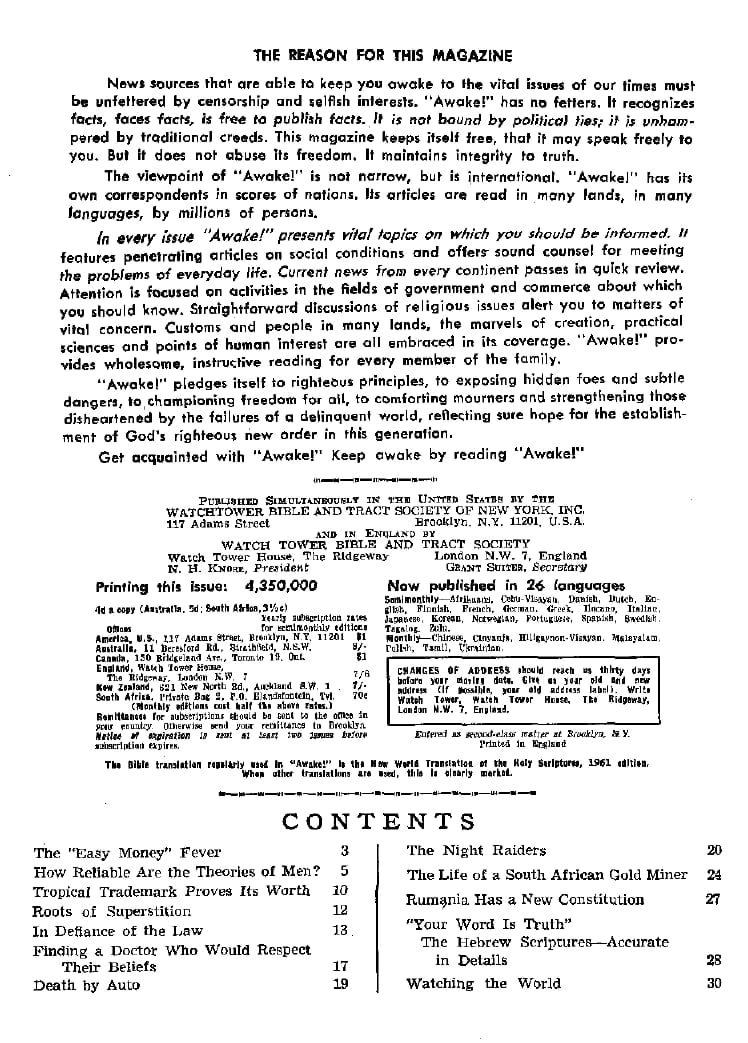
THE REASON FOR THIS MAGAZINE
News sources that are able to keep you awake to the vital issues of our times must be unfettered by censorship and selfish interests. "Awake!" has no fetters. It recognizes facts, faces facts, is free to publish facts. It is not bound by political ties; it is unhampered by traditional creeds. This magazine keeps itself free, that it may speak freely to you. But it does not abuse its freedom. It maintains integrity to truth.
The viewpoint of "Awake!" is not narrow, but is international. "Awake!" has its own correspondents in scores of nations. Its articles are read in many lands, in many languages, by millions of persons.
In every issue "Awake!" presents vital topics on which you should be informed. It features penetrating articles on social conditions and offers sound counsel for meeting the problems of everyday life. Current news from every continent passes in quick review. Attention is focused on activities in the fields of government and commerce about which you should know. Straightforward discussions of religious issues alert you to matters of vital concern. Customs and people in many lands, the marvels of creation, practical sciences and points of human interest are all embraced in its coverage. "Awake!" provides wholesome, instructive reading for every member of the family.
"Awakel!" pledges itself to righteous principles, to exposing hidden foes and subtle dangers, to championing freedom for all, to comforting mourners and strengthening those disheartened by the failures of a delinquent world, reflecting sure hope for the establishment of God's righteous new order in this generation.
Get acquainted with "Awake!" Keep awake by reading "Awake!"
PUBLISHED SIMULTANEOUSLY IN THE UNITED STATES BY THE
WATCHTOWER BIBLE AND TRACT SOCIETY OP NEW YORK, ING.
117 Adams Street
Brooklyn, N.Y. 11201, U.S.A.
AND IN ENGLAND
WATCH TOWER BIBLE AND TRACT SOCIETY
Watch Tower House, The Ridgeway
London N.W. 7, England
N. H. Knoze, President
GRANT SCIENCES, Secretary
Printing this issue: 4,350,000
4d a copy (Australia, 5d; South Africa, 3½c)
10 a copy (Australia, S. E. 120) for semi- subscription rates
U.S. 127 Adams Street, Birmingham, 11201
Australia 11 Berrydale Ed. St., Birmingham, 9.10
Australia 150 Berrydale Ed. St., Tornow, 19.07
New Zealand 621 New North Ed. Auckland A.W. 1. 7/
(Monthly editions cost half the share rates)
Banditances for subscription should be sent to the office in your city and your year certificates in the office.
For engagement is sent at least two months before subscription expires.
Now published in 26 languages
Summermonth—Athlanta, Cebu-Viacau, Dutch, Dutch, English, Finish, French, German, Greek, Honeau, Japanese, Japanese, Norwegian, Portuguese, Spanish, Swahili, Monthly—Chinese, Cincinnati, Hullgauen, Viacau, Malaysian Pulch, Tamil, Urduan.
CHARAGES OF ADDRESS should reach us thirty days before your arrival date. Give an age old and new name to your child. Call the Town Tower, Watch Tower, Watch Tower House, The Ridgeway, London W. N. 7, England.
Entered as second-class matter at Brooklyn, N.Y.
Printed in England
The Bible translation regularly used in "Awake!" is the New World Translation of the Holy Scriptures, 1961 edition. When other translations are used, this is clearly marked.
CONTENTS
The "Easy Money" Fever 3
How Reliable Are the Theories of Men? 5
Tropical Trademark Proves Its Worth 10
Roots of Superstition 12
In Defiance of the Law 13
Finding a Doctor Who Would Respect
Their Beliefs 17
Death by Auto 19
The Night Raiders 20
The Life of a South African Gold Miner 24
Rumania Has a New Constitution 27
"Your Word Is Truth"
The Hebrew Scriptures—Accurate
in Details 28
Watching the World 30
London, England, November 8, 1965
Volume XLVI
SYMPTOMS of the "easy money" fever are seen almost everywhere. They are reflected in rising crime statistics, the dishonesty that plagues the business world and in the fact that millions of persons have put their hope for betterment on a lottery ticket. For the "easy money" fever
is the craving many people have today to get something for virtually nothing or something to which they are not entitled.
Since the odds are hopelessly against the lottery-ticket buyer, those who long to get money this way must count on luck and not skill, on hunches and not logic. As a result, most gamblers are inclined to be superstitious, trusting in luck.
Though gambling is just one aspect of the "easy money" fever, it is most common, especially since the sale of lottery tickets is legal in many countries. To entice people to buy the tickets, prizes may reach great sums of money, even $100,000 or more. The appeal is to the people's desire to get something for as close to nothing as possible. The odds against winning such prizes are extremely high; in the Irish Sweepstakes, it has been placed at 450,000 to 1; and in a British pool, the odds against winning a big prize may be many millions to one. Disappointment is the lot of the lottery-ticket buyer!
The ancients also indulged in this. When the Jews backslid they fell into the evil practices of the heathen nations and
sacrified to false gods, some of them the deities of gamblers. Hence Jehovah God said to his people on one occasion: "You men are those leaving Jehovah, those forgetting my holy mountain, those setting in order a table for the god of Good Luck and those filling up mixed wine for the god of Destiny. And I will destine you men to the sword."—Isa. 65:11, 12.
Such reliance upon luck put God's ancient people at odds with Him. Is it reasonable to think that God has changed and that now he approves of his worshipers' trusting in luck? No, indeed.
Hence, whether the lottery-ticket buyer realizes it or not, he is embarking on a road that is both spiritually and morally degrading. He hopes to win money to avoid work, and what he longs to win he hopes to win from his neighbors, even though they really do not want him to have it. His motive, however carefully disguised it may be, is covetousness. He covets money that is not his own; in fact, gambling has been defined this way: "A kind of robbery by mutual agreement; but it is still robbery, just as dueling, which is murder by mutual agreement, is still treated as murder.
It is begotten of covetousness." (Hastings Encyclopedia of Religion and Ethics, Vol. VI, p. 166) Thus, if a person buys a lottery ticket, he is actually a party to extortion in that he is supporting an arrangement that involves a form of extortion. The Bible is plain on how God views the practice of extortion.—1 Cor. 6:10.
Another common form the "easy money" fever takes is stealing. Those overcome by it want money for which they have not worked. By using lie detector machines an operator of a group of supermarkets in the United States found out that 90 percent of its employees had been stealing. Not surprisingly, the "easy money" fever has turned many persons into embezzlers. News reports turn up repeatedly, telling of some trusted bank employee who succumbs to the lure for "easy money." Typical of many is a news report from North Carolina about a woman bank teller at Oakboro who was charged with embezzling $91,000 over a sixteen-year period. So it goes with the "easy money" fever.
And what about much of the hideous crime, the holdups and muggings and attacks on people to get their money? Here again we see how the craving for "easy money" degrades one morally. In Colombia the craze for "easy money" has taken on the form of kidnapping, and news reports almost daily carry accounts of kidnappings or of attempts at kidnapping. "There is hardly a Colombian family of wealth or even of middle-class means," said the New York Times recently, "that does not fear that one of its members may be a victim of kidnapping or armed assault." This fever for "easy money" is so contagious that recently a maid kidnapped the daughter of an accountant and demanded 10,000 pesos.
Small wonder that the "easy money" fever is contrary to the whole spirit of the Word of God. The inspired Holy Scriptures stress diligence, industriousness and hard work. "The very soul of the diligent ones will be made fat." Further showing that God meant for man to have satisfaction in his hard work, wise King Solomon was inspired to write: "I have come to know that there is nothing better for them than to rejoice and to do good during one's life; and also that every man should eat and indeed drink and see good for all his hard work. It is the gift of God."—Prov. 13:4; Eccl. 3:12, 13.
The Christian Greek Scriptures also stress work. Not that all money must be made by physical work, since investing money and getting a return for it is not wrong. (Matt. 25:27) But people often want something for virtually nothing or something to which they have no right. Thus Paul, the apostle of Jesus Christ, wrote: "Work with your hands, just as we ordered you; so that you may be walking decently as regards people outside and not be needing anything." "When we were with you, we used to give you this order: 'If anyone does not want to work, neither let him eat.' To such persons we give the order and exhortation in the Lord Jesus Christ that by working with quietness they should eat food they themselves earn." —1 Thess. 4:11, 12; 2 Thess. 3:10, 12.
So Jehovah God did not make man to be a loafer nor is it His will that they spiritually and morally degrade themselves by becoming lovers of money. How prudent the persons who put their hope, not on material possessions, but on God, and who "work at good, . . . safely treasuring up for themselves a fine foundation for the future, in order that they may get a firm hold on the real life," by doing the will of God!—1 Tim. 6:10, 17-19.
HOW RELIABLE ARE THE THEORIES OF MEN?
WHO is right—God or man? That has become an issue today. How so? In that some of man's popular theories are diametrically opposed to what is taught in God's Word the Bible. This was well illustrated by a science article appearing in the New York Times Magazine of April 11, 1965. The article, entitled "When Man First Stood Up," began:
"Somewhere in Africa, perhaps four million or so years ago, our remote ancestors arose from a variety of unusual apes, and evolution was off on a new tack. . . . Members of a minority species on the make, they may have found the going rough in the beginning. But their rise was steady until—quite recently, perhaps 100,000 years ago or less—modern man, Homo sapiens, emerged with preeminent status . . . Current studies confirm the notion that things did not happen in a blaze of glory, a great evolutionary spurt. Man's coming, like the coming of the half-billion species that preceded him, was a gradual affair resembling a sunrise rather than a bolt of lightning."
Are they always correct? Is it wise to put confidence in them when they conflict with God's Word?
Only a Theory
The science writer, John Pfeiffer, went on to say that these now-extinct apelike ancestors of man "were discovered about forty years ago in South Africa's Transvaal." But he adds: "No one regards them as apes. They were somewhat more than that, though somewhat less than men—so, logically enough, they have been called ape-men. . . . Mankind was in the process of being shaped."
Is this true? Did we humans evolve from a variety of apes over a period of hundreds of thousands of years? This is a popular theory of men today, but, as in the above article, it is often presented as though it were an established fact. Is this really honest? Is there any reliable evidence to this effect? Does recorded history date back hundreds of thousands of years,
or even tens of thousands of years?
No; to the contrary, there is not one piece of reliable evidence that proves that man has been on earth more than 6,000 years. "The earliest
written documents that archaeologists have discovered so far date only from 3000 B.C.," the Natural History journal acknowledged in its January 1961 issue, page 31. And Volume I of A History of Civilization (1955) by Crane Brinton, John B. Christopher and Robert Lee Wolff says on page ten: "Historical records—that is, written accounts that we can read—go back no more than 5,000 [years]."
NOVEMBER 8, 1965
Yes, reliable evidence indicates that intelligent men have been on earth less than 6,000 years. However, evolutionists reason that it must have taken apelike creatures many hundreds of thousands of years to evolve to this elevated plane. That is why the above-quoted history goes on to assert: "The ratio of the time man has been on earth before history to the time since history began is something like the ratio of three hours to one minute."
Notice the similar inference in an article on mathematics appearing in the June 1961 Science Digest: "The earliest written records, on clay tablets dating back to about 3500 B.C., indicate that even at that time, the operations of addition and multiplication of the positive whole numbers were well established." The earliest records of man's existence on earth are less than 6,000 years old, but it is assumed that because man was well acquainted with the principles of mathematics by about 3500 B.C.E. he must have actually been on earth much longer.
This assumption, however, is in direct conflict with what is taught in God's Word the Bible. These inspired Scriptures, in perfect harmony with the facts, explain that about 6,000 years ago the first man and woman were created specially by God as intelligent living creatures. In confirmation of this, Jesus Christ, the wisest teacher ever to walk this earth, said: "He who created them from the beginning made them male and female." The Bible clearly teaches divine creation, not evolution. —Matt. 19:4-6; Gen. 1:27; 2:7.
Nevertheless, the generally accepted belief of worldly men is not what God's Word teaches on the matter, but that humans evolved from apelike creatures. However, note that a discussion of the matter published in The Encyclopedia Americana, Vol.18, page 182, 1942 edition, points out that this is only a theory, and that it lacks substantial basis: "The generally accepted idea is that both the monkey and man came from a remote ancestor, one branch of whose progeny continued an upward course in the direction of the human body . . . This is, however, entirely theory. There is no evidence for it."
This same source, on page 186, observes regarding the testimony of archaeology: "The excavations in the Dordogne and in western and southern France and northern
Spain have completely contradicted the idea that man began low down in the scale of being, scarcely above the beasts, and gradually climbed up. They have shown on the contrary that the very first man of whom we have any definite records many thousands of years ago was the intellectual and the spiritual brother of man as we know him now." And concerning the popular view regarding ugly, apelike cave men, it explains: "This was the supposedly scientific picture of the cave man that was popularized and the general public has as yet no idea apparently that the discoveries of actual remains in the caves completely contradict this theory."
Despite the claims of some evolutionists, there is no authentic evidence regarding the existence of "ape-men" who evolved into humans. In fact, there is no evidence in the fossil record that any family kind evolved into another family kind. Therefore, in an effort to account for the lack of evidence, evolutionists grasped at the theory that so many hundreds of millions of years elapsed in the history of evolving life that the evidence has been obscured. But is it true that living creatures evolved and present features of the earth were formed during millions and millions of years of gradual change?
Theory of Uniformitarianism
For years now prominent men have taught this theory as though it were a fact. Commenting on the matter, Newsweek magazine recently said: "The current theory about geological change, called uniformitarianism, holds that once the laws of nature were put in motion, they proceeded smoothly." And the Scientific American magazine explained: "Most geologists, following the 'uniformitarian' point of view expounded in the 18th century by James Hutton and in the 19th by Charles Lyell, are satisfied that observable processes are quite adequate to explain the history of the earth."
This theory of uniformitarianism was embraced by Charles Darwin, a friend of Lyell, and became the basis upon which he built his theory of evolution published in 1859 in The Origin of Species. Explained an exponent of the evolution theory, H. F. Osborn: "Present continuity implies the improbability of past catastrophism and violence of change, either in the lifeless or in the living world; moreover, we seek to interpret the changes and laws of past time through those which we observe at the present time. This was Darwin's secret, learned from Lyell."*
With acceptance by the scientific world of Darwin's evolutionary teaching, the belief that the earth had experienced past violent upheavals was replaced with the theory of uniformitarianism. No longer was the Bible's teaching regarding the Noachian flood acceptable to advocates of this theory. Catastrophes like that, it was asserted, had no part in molding the surface of the earth. Only forces observable today, such as the action of the wind and slow erosion by rivers, were responsible. Therefore, hundreds of millions of years were needed to gouge out canyons and shape the earth to its present form. This theory was quickly adopted and was used as a tool against Bible believers.
Facts Shoved Aside
But how dishonest! Facts were ignored and cast aside! For rather than indicate gradual, uniform change, geological evidence pointed unquestionably to sudden catastrophes, such as was the Noachian flood. On February 18, 1831, the eminent British geologist Adam Sedgwick said in a speech to the Geological Society regarding cracks in certain rock strata: "We have the strongest reasons for believing that
they were produced by an action both violent and of short duration. . . . There is no trace of any effect that indicates a slow progress."
And one of the most outstanding scientists of that period, Baron Georges Cuvier (1769-1832), made these comments in his Essay on the Theory of the Earth: "The breaking to pieces, the raising up and overturning of the older strata [of the earth], leave no doubt upon the mind that they have been reduced to the state in which we now see them, by the action of sudden and violent causes; and even the force of the motions excited in the mass of waters, is still attested by the heaps of debris and rounded pebbles which are in many places interposed between the solid strata. Life, therefore, has often been disturbed by terrific events."
Even Lyell himself acknowledged that geological evidence conflicted with the theory of uniform, gradual change. He wrote in his Principles of Geology: "It has been truly observed that when we arrange the known fossiliferous formations in chronological order, they constitute a broken and defective series . . . These violations of continuity are so common as to constitute in most regions the rule rather than the exception, and they have been considered by many geologists as conclusive in favour of sudden revolutions in the inanimate and animate world."
Nevertheless, uniformity came to be taught in all places of learning as gospel truth. Why? Not because the burden of evidence supported it, but because it better fit the theory of evolution, which men wanted to believe.
Changing of the Mind
Over the years the evidence of sudden catastrophes has been a source of embarrassment to uniformists. For example, the mass extinctions of herds of animals in the northern stretches of Siberia.
J. D. Dana, a leading American geologist of the last century, wrote: "The encasing in ice of huge elephants, and the perfect preservation of the flesh, shows that the cold finally became suddenly extreme, as of a single winter's night, and knew no relenting afterward."* So suddenly were mighty animals such as the now-extinct mammoth encased in ice, that they are sometimes found in a standing position and with an undigested meal in their stomachs!
It is, therefore, interesting to note that finally, within the last few years, leading scientists have been openly acknowledging that the earth indeed has had a cataclysmic past. However, their efforts to harmonize this with their pet theory of evolution is apparent in the article appearing in the February 1963 Scientific American. The heading asked: "How IS IT THAT WHOLE GROUPS OF ANIMALS HAVE SIMULTANEOUSLY DIED OUT? PALEONTOLOGISTS ARE RETURNING TO AN EARLIER ANSWER: NATURAL CATASTROPHE. THE CATASTROPHES THEY VISUALIZE, HOWEVER, ARE NOT SUDDEN BUT GRADUAL."
The article pointed out: "Mass extinction, rapid migration and consequent disruption of biological equilibrium on both a local and a world-wide scale have accompanied continual environmental changes. . . . The cause of these mass extinctions is still very much in doubt and constitutes a major problem of evolutionary history." It was asked: "Did extinction occur over hundreds, thousands or millions of years? The question has been answered in many ways, but it still remains an outstanding problem."
The science section of the December 23, 1963, Newsweek magazine noted the stir that this question has made among geologists. It said: "Catastrophism is a fighting word among geologists. It is a theory based
on divine intervention, and its adherents held that the history of the earth and the life on it were moved by a series of disasters inspired by God—the last one Noah's Flood. It was the major line of thought for a few decades last century, but a vigorous counterattack by the naturalists against the supernaturalists eventually pushed it aside.
"But now many geologists believe the counterattack may have been all too vigorous. . . As a result, many geologists at the recent meeting of the American Geological Society were advising the rehabilitation of catastrophism, without recourse to a supernatural agent."
Interestingly the article observed: "Signs of mass extinction, once ignored or cast aside, have periodically turned up. There is evidence, for example, that great expanses have been inundated within a matter of days. Such catastrophes were often followed by explosive development of different forms of life. These adapted more easily to the new pressures of the new environment—a process which Darwin charted in one part of his theory of evolution. On the other hand, Darwin was firmly set against the notion of catastrophes."
Darwin grasped at the theory of uniformity, not because of the weight of evidence in its support, but because it provided a means to explain his evolutionary ideas. Sudden catastrophes did not fit his theory. So this unfavorable evidence was ignored and cast aside—something evolutionists have long been champions at doing.
Paleontologist Norman D. Newell, associated with the American Museum of Natural History, commented on this disposition to grasp upon convenient theories. "Geology suffers from a great lack of data," he said, "and in such a situation, any attractive theory that comes along is taken as gospel. That is the case with uniformitarianism. Geology students are taught that 'the present is the key to the past,' and they too often take it to mean that nothing ever happened that isn't happening now.
But since the end of World War II, when a new generation moved in, we have gathered more data, and we have begun to realize that there were many catastrophic events in the past, some of which happened just once."
Where to Place Confidence?
It becomes apparent that the theories of men are often unreliable. They are not always based on the solid evidence that some scientists would try to make others believe. In fact, investigation often reveals a lack of objectivity, and even dishonesty, in efforts to vindicate their pet theories. As Hadley Cantril, former chairman of the Psychology Department of Princeton University, observed: The scientific community "operates much like other social institutions, complete with hierarchy, dogma, and coercive power. Truth tends to be confused with orthodoxy, science with scientism."
Efforts are even made on occasions to suppress unfavorable evidence. For example, a few years ago when a book was published presenting facts that supported catastrophism, the scientific community tried to prevent its publication. The late columnist for the New York Journal American, George E. Sokolsky, noted: "Certain scientists threatened with a boycott. Of course, what the learned and liberal professors wanted was the total suppression of a book which opposes their dogma. Scientists tend to become dogmatic like theologians, whom they denounce as dogmatic."
But regardless of the evidence to the contrary, evolutionists will continue to cling to their theory of evolution. Why? Because evolution is their dogma, their faith! As Professor T. L. More, University of Cincinnati, once explained: "The more
one studies palaeontology, the more certain one becomes that evolution is based on faith alone." And evolutionists adhere to this faith despite a total lack of evidence. As a professor at London University, D. M. S. Watson, once observed: "Evolution itself is accepted by zoologists, not because it has been observed to occur or . . . can be proved by logically coherent evidence to be true, but because the only alternative, special creation, is clearly incredible."
For persons who refuse to acknowledge the existence of God special creation may indeed seem incredible. They may even believe that this justifies twisting evidence, ignoring facts and presenting the evolutionary theory as though it were an established truth. But this is dishonest! It is untruthful! God does exist, and there is bountiful evidence that he created all life, including man.
"Know that Jehovah is God," the inspired Bible psalmist sang. "It is he that made us, and not we ourselves." That this is the truth Jesus Christ himself verified when he stamped the Bible account of creation as authentic. And one of his apostles reasoned soundly on the evidence of God's Creatorship, explaining that the marvelous things that we can see around us are proof that there is a Grand Creator who made it all.—Ps. 100:3; Matt. 19:4-6; Rom. 1:20.
Certainly, then, it is unwise to put confidence in the theories of men when they conflict with God's Word of truth. Men have often been wrong. Their theories are ever changing. Therefore, the wise thing to do is, take the position of the Bible writer who said: "What, then, is the case? If some did not express faith; will their lack of faith perhaps make the faithfulness of God without effect? Never may that happen! But let God be found true, though every man be found a liar."—Rom. 3:3, 4.
IF YOU were to sketch a tropical seashore from memory or imagination, what would you most likely include in it? Why, at least one coconut palm, and probably several of them. These tall, swaying trees with their leaning trunks would add color and beauty to a drawing or painting, wouldn't they? Yes, these ornamental trees that grace shorelines and coastal roads are a kind of tropical trademark, one that is proving its worth in many ways.
In fact, the coconut palm is probably the most important tree of the tropics. Many are the Pacific islands that would be virtually uninhabitable without them, for the coconut palm is a tree that represents food, drink, clothing, shelter and many other things.
We can observe this for ourselves by taking an informative tour to a coconut plantation along the Atlantic coast east of Georgetown, British Guiana, to see how this tropical trademark proves its worth. A kind manager gives us a tour.
Picking and Opening Coconuts
Thud! Thud! Thud! Coconuts are falling! We rush out of the office to watch a group
of about ten "pickers" at work. They are not climbing the tree trunks, as we might have expected. They are standing on the ground, holding long bamboo poles with curved knives tied to the upper ends. With these, they cut loose the coconuts vom the stalks.
Of course, in some parts of the tropics coconut are gathered by men who climb the trees; and in a few places trained monkeys are used as pickers. One way in which a monkey is thus used by his owner is by his placing a cord around the monkey's waist; it is then taken to a coconut palm, which it quickly climbs. The monkey grabs ahold of a coconut; if the monkey's owner decides that it is ripe for picking, he may shout to the monkey, which twists the coconut round and round till the stalk is broken, and then lets it fall to the ground. Should the monkey lay hold of an unripe coconut, the owner tugs the cord and the monkey will try another. Sometimes no cord at all is used, the monkey being guided by the tones and inflections of its master's voice. An observer of monkeys hard at work in Sumatra reported that the monkeys worked very industriously; but these animal coconut pickers would sulk, he said, if they felt they were being worked too long.
Here in British Guiana knives on bamboo poles are preferred by the pickers. They must be careful, though, for you can well imagine the impression that one of these falling coconuts, about the size of an American football but weighing as much as six pounds, would make on a person's head, or the impact of a rebound. Some of the pickers point to scars on their legs from "bounding nuts."
The pickers now load their small boats with coconuts and then transport them to the main area, where the diggers are waiting. The diggers, we observe, are mostly women.
With one blow from an ax they chop each coconut in two, and after hundreds are thus opened, they sit and dig out the white meat from the hard inner shell with their small curved knives. "How many can you dig out in a day?" we ask. Answers vary from 800 to 1,400!
Our interest aroused, we view the next step. A man piles the coconut pieces into his donkey cart and takes them to a nearby furnace (kiln), where they are placed on trays and shoved inside for overnight drying. Upon being taken out in the morning, they are bagged for shipment to a city refinery. The dried coconut meat is now called copra; it is from this that coconut oil is made. Sun-drying is another process, a longer one, to obtain the copra.
The Husks, Shells and Leaves
The husk (the fibrous mass lying between the smooth outer skin and the hard shell containing the meat) is used mainly for making fiber, we learn. The fiber is used in making mattresses and mats and in caulking boats here, whereas, in other lands, rope, fishnets, packing material and paper pulp are made from the coconut husk. "What is better for cleaning your boots or washing machinery than a ball of this fiber?" our host asks with a grin.
And what about the shells? "Well," he says, "we use them for fuel, and haven't you seen decorations in many homes—painted coconut shells and lamps?" Oh, yes, we have. In other parts of the globe the shells are also used in the making of buttons, drinking vessels and kitchen spoons.
Back in the plantation office again, we are offered a refreshing tropical beverage —coconut water. A smiling worker, with one deft blow from his cutlass, as the machete is called here, hacks off the end of a green nut and then bores a small hole in it. In about two minutes he has several
prepared for us. Putting the coconuts to our mouths, we each enjoy nearly a quart of tasty coconut water, followed up by our scooping out the "jelly," that soft substance that would have eventually hardened to form the coconut meat.
Then another familiar sound is heard. Someone is sweeping outside, but with what? Why, it is a "coconut broom," about three feet in length, made from the leaves stripped down to single strands and bound together. This woman, bending low, makes long sweeping movements that cover a lot of ground. Coconut-palm leaves are also used for thatching roofs and constructing shelters. The stalks are made into fences and they provide fine firewood too. Young shoots, after being dried for several hours, are used in plaiting hats and handbags.
As Wood and Food
Stepping outside once more for a closer look at the palm trees, we observe the scar-ringed trunks. These long, slender trunks, fifteen to eighteen inches in diameter, are used in building footbridges in British Guiana, we are told, and for making props for slipping soil, as well as for fuel. In some countries, too, fine furniture is made from the wood at the base of the trunks, which is called "porcupine wood."
Gazing upward, we are informed that these particular trees are eighty years old. Just think for a moment of the precious payloads such "old-timers" have borne from about their sixth year on, and may bear up to nearly a hundred years, at the rate of fifty or more coconuts per year!
Our genial host now suggests that we visit a coconut-oil factory to see more about the worth of this tropical trademark.
But first, a necessary stop. A midday meal is graciously provided by a friend, who has for her main dish "cook-up." The ingredients are rice, meat and fish, with a plentiful covering of coconut milk—and all cooked together.
Since our cook is "coconut-minded" today, she reviews for us how coconut is featured in preparing "metagee," a combination of green plantains, cassava, tania, potatoes, fish and dumplings, cooked in coconut milk. Then there is the ice cream that is made from semiwater coconuts, the hardening jelly being squeezed out for the base of this well-known delicacy. And we cannot overlook that roadside treat, "sugar cake," a chipped coconut confection that lightens the burdens of schoolchildren trudging through the hot sun.
Refined Oil and Crude Oil
Soon we are off to our next stop: The oil and cake mill. The oil is the deodorized cooking oil that is widely used here, and the "cake" is the hard meal residue, a popular feed for poultry and pigs.
We remember now the kiln-dried or sundried copra that was leaving the plantation. It contains about 65 percent coconut oil. Well, here the copra is emptied out of the bags and dropped onto conveyors that take it to disintegrators, where it is broken up, and to expellers, where the oil is separated by pressure from what is later termed "cake." On goes the oil to be refined: To the neutralizer, to the bleacher, to the filterer, to the deodorizer and to the drums for shipping. This method produces cooking oil, which is consumed locally. The fats remaining from this process are sold to firms here producing soap, margarine and shortening.
En route home we pause to see a simple home method. A man takes the undried coconut meat and dumps it into a small mill, where it is grated. Out of the bottom comes what is called "cush-cush." This soft, powdery substance is covered with much water and then trodden by bare feet. The cream is drained off and allowed to settle overnight. After boiling for a few hours, the crude oil rises and is drawn off. The residue is squeezed for more oil, then fed to farm stock. Besides its use for cooking purposes, this crude coconut oil also serves to massage many a baby's tender skin.
At home, after the day's enjoyable experience in the coconut world, I glance up at the painting hung on a wall of our room, one of a typical tropical shore, with several of the trademark palms dotting the landscape. I think again of our standing in the midst of those thousands of lofty trees, gazing upward at the countless clusters of brown coconuts on them all. I remind myself that there are still thousands more of these plantations in this "coconut belt" that rings the center of our earth. I reflect, too, on the poet's recognition of his own insignificance and the Creator's marvelous powers, with the idea that 'poems are made by men like me, but only God can make a tree.' And what a tree the Almighty made, when he fashioned the stately coconut palm, a veritable trademark of the tropics!
Roots of Superstition
One of the insects given generation in earlier times was the honeybee. Old sayings rooted in superstitions about the honeybee die hard, as they are lightly passed on from generation to generation. One popular expression heard only recently, "Remember to the tell the bees!" is based on the belief that they are the protectors and friends of the family. They were considered part of the family, to share joy and sorrow. Mystical powers were attributed to them, and they were to be informed of the death of members of the family. To overlook them would call forth their displeasure or a withholding of their blessing. Evidently many old sayings that persist today are rooted in such superstition.
IN DEFIANCE
SMASHING, looting, burning and shooting, a frenzied mob of thousands turned forty-five square miles of Los Angeles, California, into a virtual battlefield for nearly a week in August.
When the orgy of lawlessness had ended, 36 persons were dead and almost 900 injured. Over 200 buildings were destroyed and about 800 damaged. One estimate set the cost of damage at nearly 200 million dollars!
The tide of battle was turned only when 15,000 National Guard troops with heavy machine guns moved in to support local law enforcement officials.
Chronology of Events
Wednesday, August 11, started out much like any other day in Los Angeles, but it did not end that way. That evening police officers had noted a car weaving in and out of traffic and arrested the young Negro behind the wheel for drunken driving. The youth resisted arrest and the officers applied force. That proved to be the trigger for the fantastic explosion that followed, for soon an angry crowd had gathered accusing the police of brutality, although the youth had exclaimed: "You're not going to take me to jail . . . You're going to have to take me the hard way." Word of the incident spread through the Negro community, particularly that section of Los Angeles called Watts.
The crowd grew, and soon thousands of sullen persons milled about. Then some youths began throwing rocks and other missiles at store windows and passing cars, these acts spreading over several square blocks. Police began to come into the area, but this further infuriated the mob. All through Wednesday night the rioting gathered force. Scores of vehicles and buildings were damaged or burned. Dozens of persons were injured.
When Thursday morning came, the situation had quieted down somewhat and undamaged stores opened as usual. During the day, however, angry groups gathered, and by nightfall violence flared up again, this time much worse than the night before. Many more thousands of rioters took to the streets and, often urged on by their elders, swarmed through an area that had now widened to include a score of blocks. Although a thousand police were on hand by this time, they were unable to control the situation. Gasoline bombs, called "Molotov cocktails," were thrown by rioters. Large fires quickly spread. Firemen were often unable to fight the flames because rifle fire from snipers and other missiles thrown at them endangered their lives, with the result that many of the fires burned unchecked. A condition of anarchy existed as mobs ran wild throughout the night. Some called it an insurrection.
On Friday the rioting continued, even during daylight hours.
Whites were often singled out for attack, though Negroes were also assaulted by other Negroes. Then the mobs turned to looting. Stores over a wide area were systematically stripped clean of goods. Among the stores looted were those that could provide weapons. Liquor stores were among the first to be pillaged, the liquor no doubt adding to the frenzy of the mob.
By now the situation was out of control. Hence, the governor of California, on vacation in Athens, Greece, authorized calling out the National Guard. But by this time it was late evening and too late to stop that night's carnage. Rioting spread to over 150 square blocks and the mobs grew in size. Fire bombs by the dozen splattered against buildings and automobiles. The entire scene resembled a World War II battleground.
Late that night National Guard troops began arriving and advanced through the chaos. Heavy machine guns were quickly set up at critical points and soon their deadly clatter against snipers added to the nightmare situation.
On Saturday additional troops arrived, swelling their number to 4,000, with thousands more on the way. Still, the situation became progressively worse. The battle had spread to over twenty square miles of the city by now and the area was declared a disaster zone, permitting police to be brought in from surrounding cities. Sniper fire at aircraft flying overhead was so frequent that the Federal Aviation Administration advised airliners to detour the area. A National Guard general and the Los Angeles police chief compared the violence to guerrilla warfare, "very much like Vietnam." That night, a curfew was imposed on thirty-five square miles of Los Angeles.
upper hand, although looting, sniping and burning continued throughout the day. At night another curfew was imposed, this time covering an area of about fifty square miles of the city.
By Sunday 15,000 soldiers were on the scene and authorities began gaining the
Finally, as the week ended, the lawless rampage was brought under control and subsided except for an occasional outburst.
Local Affair?
Lawlessness that week was not just a local affair confined to Los Angeles, though the worst violence did occur there. Shortly after rioting began in Los Angeles it also broke out in communities surrounding the city. In nearby Long Beach a policeman was killed. Rock throwing, burglary, fire attacks and sniping flared up in San Bernardino, Inglewood, San Diego, Hollywood, Van Nuys, Burbank, Pasadena and a number of other towns and suburbs.
Nor was this limited to California. In the same period riots flared up in Chicago, Illinois, and then in Springfield, Massachusetts. And such rioting was not new to the United States, for in 1964 and previous years serious outbreaks with racial overtones had occurred in many cities.
However, lawlessness in the United States is not confined to just rioting. Even without this type of mob action, defiance of established law and order has grown with terrifying rapidity throughout the United States in recent years. That it has reached crisis proportions authorities acknowledge. As U. S. News & World Report of August 9, 1965, put it: "Violent crime is now running wild in the cities and suburbs of the United States. The crime rate since 1958 has shot up almost six times as fast as the rise in population. In 1964, there occurred a virtual explosion of crime."
Also, time and again police are hindered in the performance of their duty by mobs who come to the aid of the criminal, even assaulting police making arrests.
When others try to assist the police, which is infrequent, they too come into difficulty, as did one man in New York City who was stabbed when trying to aid an officer.
How Widespread?
What is happening in the United States is happening throughout the world. Everywhere, including Communist lands, lawlessness, particularly in the form of crime and juvenile delinquency, grows by leaps and bounds, shocking even those authorities who have worked a lifetime in this field. Law enforcement officials are often hard pressed to maintain even the minimum of security.
Even the animosity manifested toward law enforcement agents themselves is widespread. As one of the many examples of this, consider Colombia, South America. There lawlessness in the form of murder, kidnapping and banditry has resulted in huge losses to the civilian population in recent years. Thousands of individuals have been murdered. One of the more prominent public enemies was Efrain Gonzales, who had been charged with killing about two hundred persons. The day finally came, in June, when Gonzales was cornered by military police and killed. A great source of terror had been removed. Many were relieved that the action had been taken. But from others there were cries of "murderers," "police brutality" and "injustice." No sooner had Gonzales been declared officially dead than a mob formed and began throwing stones at the police. The mob made Gonzales a hero and a martyr. On the spot where he fell a makeshift shrine of bricks was erected to mark the location. Many who came to it brought wreaths of flowers.
This lawless trend is not abating, but is gathering force on all continents. Note a few sample reports: "British courts are in
a quandary as they attempt to cope with this country's soaring crime rate." Germany reports "a disturbing increase in capital crimes and a rise in offenses committed by juveniles." Reports from the Philippines state that "we are so near the point of chaos that a sense of insecurity is becoming part of our nature." From Africa comes the report by police that an increase in crimes 'has become a regular feature each year.' In Greece and South Korea mobs have taken to the streets. In the Sudan blood flows as lawlessness spreads. Everywhere one looks, violent forces are at work.
Why?
Why this growing disregard for established law and order, as well as the frequent contempt for law enforcement officials? What is behind it all?
One reason for such unrest is related to social inequities, such as racial discrimination. There are those who have suffered personal mistreatment, harassment and injustice at the hands of intolerant persons. This has stirred up in them deep resentment; so when they see the opportunity, they take the law into their own hands to protest. Also, in some countries the law treats certain groups as inferior, while in other lands laws that give them rights are ignored by those charged with enforcing the law. Hence, the oppressed come to view the law and its agents for enforcement as their enemies, and their rioting is a protest against the society that has wronged them.
Add to this, in the case of the United States especially, the fact that African natives were torn away from their villages and sold as slaves in the United States until little more than a century ago. Such a foundation could not produce good fruit, because even when slavery was abolished by law, discrimination was not, for such is often a mental condition against which laws cannot be enforced.
With such negative forces at work, a state of mind was created that resulted in disgust for the system that had so imposed itself on the group discriminated against.
On the other hand, it is not always true that such rioting is based on social inequities. There are many, regardless of race, who foment riots because they provide an opportunity to steal, destroy and run wild. This "hooligan" element looks for the chance to indulge in violence. So the motives of those who riot, plunder, destroy and even kill under the banner of "racial discrimination" are many.
At times police brutality is blamed for outbreaks of violence. It is true that there are officers who stir up resentment in the public by misusing their authority, needlessly ordering people around instead of being servants to the people. But arresting a law violator is not in itself an evidence of police brutality, and using physical force against a criminal who resists arrest with violence is not brutality on the part of the officer. So, while there are instances of brutality, more often it is those hating the law because of their own lawlessness who riot in protest against alleged police brutality. Some police have been killed and others seriously injured by trying to avoid the undue use of force. What would it be like if officers refused to arrest lawbreakers just to avoid any possibility of police brutality? To a great degree the average citizen in most liberal lands owes the safety of his life and properties to the police.
those in power. In this way an entire population may be frustrated to the point where they feel the only alternative is armed rebellion.
This is not always the case, unfortunately. In some countries brutal dictatorial governments have forced themselves upon the people. Police powers have been used in the cruelest way. Instead of protecting the rights of the ordinary citizens, they have protected only the vested interests of
Not to be overlooked as a cause for violence are the trained political agitators. These have been schooled in ways to exploit situations of public discontent. When the occasion lends itself to their aims, they jump in to fan the flames and keep the trouble going. Along with the "hooligan" element, they exploit the situation for their own ends, Communist and otherwise.
More to It
These are just some of the reasons why defiance of the law exists today. But there is more to it. When pandemonium breaks out it is evidence that people have abandoned godly principles and are manifesting the spirit of the first lawbreaker, Satan the Devil. Appropriately, pandemonium means a wildly lawless or riotous state, or an abode of the demons. The Bible shows that the Devil and his demon angels are the foremost agitators of lawlessness and violence in the earth.—Eph. 2:2.
Why is this so, especially in our time? Because we live in the foretold "last days" of this wicked system of things. Satan the Devil, along with the demons and all humans who manifest his spirit, will, in a short time, be put out of operation. States the Bible book of Revelation: "The Devil has come down to you, having great anger, knowing he has a short period of time." (Rev. 12:12) That is why Jesus Christ foretold the now-occurring "increasing of lawlessness," for we are nearing the end of this present system of things.—Matt. 24:12.
In view of this greater cause of lawlessness, what should the seeker of righteousness do when surrounded by lawless acts? The God who will shortly end all violence counsels: "Do not show yourself heated up because of the evildoers.
Do not be envious of those doing unrighteousness. For evildoers themselves will be cut off, but those hoping in Jehovah are the ones that will possess the earth." (Ps. 37:1, 9) Yes, lawlessness, injustice, discrimination and oppression may have their day, but soon
they will be wiped out of existence by a loving Creator. So do not foolishly jeopardize your life, as well as your prospects of everlasting life in a new order of God's making, by rising up in defiance of the law. Wait upon God to remedy injustices, as he guarantees he will by means of his kingdom in the hands of Jesus Christ.
Finding a Doctor Who Would
CRISIS came to the home of Frederick and Eleanor King, near Paris, Ontario, late in the year 1963 and early 1964. Sandra Kathleen, their beautiful little five-year-old daughter, began to lose her sense of balance and her left eye was starting to cross. More ominous, she started to
RESPECT
Their
BELIEFS
get pains at the top of the head, pains that steadily grew more severe. A local pediatrician examined the little sufferer and pronounced that she had a brain tumor. Arrangements were immediately made for her admission to the Hospital for Sick Children in Toronto.
At the admitting desk the anxious parents took special care to fill out the form, stating that they were Jehovah's witnesses and that they would not under any circumstances sanction the use of blood transfusions for their daughter, since they were forbidden by God's law as recorded in the Holy Scriptures, such as at Genesis 9:4 and Acts 15:28, 29.
The Toronto doctor under whose care Sandra Kathleen had been placed took
X rays and an electroencephalogram in an effort to determine the true condition of the little patient. A few days later this doctor told the parents that the tumor was too deep in the brain to risk an operation and that all they could do was take her home and make her as comfortable as
possible for the few months of life she had left. Desperately the father inquired if it would not be possible to use X-ray or cobalt therapy. The reply was that the tumor was too deep, and that even if an operation were possible the cobalt therapy would drive the child insane.
A few days later the Toronto doctor asked the parents to go and interview a neurosurgeon at the hospital. After further study of X rays he thought he could get the tumor out, but—he would have to have blood. His reasoning was that he probably would not need it, but if an artery happened to run through the tumor, when he cut it he would need plenty of blood handy. Again the parents stated their determination not to sanction the use of blood.
The surgeon declared that without blood he would not operate.
To make matters more difficult the doctor who was caring for Sandra in the hospital became very bitter toward the parents, even though so recently he had told them that there was no hope of saving Sandra. Now he kept after them for permission to go ahead and use blood. Firmly they stood their ground, for, after all, to them success in their undertakings was measured in terms of God's approval and not in terms of what men might think and say.
Meantime, the parents were not idle, nor did they consider that it was enough to pray to God while making no effort themselves. They made inquiry after inquiry, only to be told that an operation without blood was out of the question. Finally, on Friday, February 28, 1964, they decided to take Sandra out of the Hospital for Sick Children. On being informed of this decision the doctor in charge of the case stated that they could not remove the child from the hospital until such time as he and some other doctors had an important conference concerning Sandra.
Worried now, the parents sought legal advice and upon the strength of it they proceeded to make arrangements for Sandra's removal from the hospital. Said the lawyer, "Why can't you take her home if you wish? Is she in a hospital or a jail?" He went on to explain that if you hire a lawyer and he fails to do the job he was hired to do, you fire him and get someone else. Doctors are no different.
Thus, on Sunday, March 1, 1964, they went to the hospital, accompanied by two friends. They gathered Sandra's toys, got her dressed, and with trembling hearts prepared to leave, realizing that there was likelihood of quite a scene at the desk on the way out. When the father went to the desk to inform the head nurse that they
were leaving, she declared that they could not do this as the doctor in charge of the case had not released Sandra. She immediately contacted him on the phone. Meantime the father had arranged for his wife to take Sandra to the elevator and be on their way to the main entrance. Faced with this determined action, the hospital officials had to be content with Frederick King's signing forms that would release the doctor and the hospital from any responsibility for the outcome of Sandra's case.
Sandra's pains continued to increase. Where she had had one bad spell in a night, she was now getting two or three. It became urgent to find some doctor who would handle the case without the use of blood transfusion. Doctors in such faraway places as Saskatoon, Saskatchewan, and Columbus, Ohio, were tried, but without success. Finally, after much helpful inquiry on the part of various friends, the parents were informed that there was a doctor, a professor of neurosurgery, in New York who would undertake the necessary surgery.
On Friday, March 13, Sandra was admitted to the New York hospital, and, in an interview, the doctor and his assistants put the parents fully at ease, for they respected them for their beliefs and intended to do nothing that would violate their conscientious views on blood.
The operation was tentatively scheduled for the following Tuesday, but, Sandra's condition having become more serious, it was decided definitely to operate on Tuesday at 8 a.m. The surgeon explained that Sandra's tumor was certainly deep in the brain and that to try to cut it out would probably result in severe damage to the brain, if not death. Instead, he was going to perform a "shunt" operation. He would leave the tumor in, but would tap it by inserting a very thin plastic pipe into the tumor with a little pump that would work from Sandra's heartbeat or blood pressure.
The tube would run down under the skin behind the ear and into the jugular vein, where the fluid from the tumor would flow away through normal body processes. Then Sandra would receive twenty-six treatments of cobalt-60 therapy in order to shrink the tumor.
When the parents asked about the possible effect on Sandra's sanity the surgeon replied that he would not be working anywhere near the part of the brain that affects sanity.
Tuesday, March 17, the parents hurried to the hospital solarium, where they expected to wait some four hours before they could know anything of the results of this serious operation on their little girl. When one of the surgeon's assistants stepped off the elevator shortly after 10 a.m., their hearts sank. Could it be that Sandra had not survived? When the father approached and asked what had happened, the doctor broke into a smile and said that the operation had been completed at 9:45 a.m., and the doctors and nurses had been talking to Sandra fifteen minutes later. She had lost less than a cupful of blood, and not even a blood substitute was needed. On Thursday Sandra was allowed up in a wheelchair, and on Saturday, when her parents arrived, Sandra came running
by herself. The next five weeks were still anxious ones for the parents, but gradually they rejoiced to see her balance improving and her eye straightening up as the cobalt therapy, which she had to undergo five times a week, continued to shrink the tumor.
Monday, April 27, was a happy day for the King family, for Sandra was finally released from the hospital. The surgeon was extremely well pleased with her recovery, though he did indicate the possibility of a recurrence of the tumor at some time in the future. "However," he assured, "many children in New York have had this kind of operation quite a few years ago and are still running around in good health."
In October the Kings brought Sandra back to New York for a checkup, and the doctor was glad to report that she was continuing to show good progress. Earlier in the year when Sandra was taken to a pediatrician in Brantford, he assured the parents they had done the right thing in taking Sandra where proper attention could be given her case. He also stated that the way the operation had turned out was like a small miracle.
The King family are truly happy the way things have turned out. Sandra is enjoying normal health, and they themselves enjoy peace of mind by reason of their steadfast adherence to God's will and law.
Death by Auto
In the United States the Changing Times magazine recently reported: "During the first half of your life, you are more likely to die in an automobile accident than from any other cause. Over your life span as a whole, only heart disease, cancer and stroke are more dangerous than automobiles. The reason is obvious: Every week, on the average, citizens armed with cars go out and kill nearly 1,000 people and injure more than 34,000." What can you do about it? Show respect for the life of your fellowman; drive carefully.
The NIGHT RAIDERS
WHILE people sleep, shadowy figures silently creep out of dark hiding places to raid food supplies in homes, restaurants, warehouses and farm buildings. These night raiders are rats.
Flourishing in the big cities of the world, towns and farms, they multiply in great numbers, breeding from six to eight times a year and producing six to thirteen rats in a litter. In a life-span that may last up to five years, depending upon circumstances, a pair of rats can produce hundreds of offspring.
In Tokyo, Japan, where, it has been estimated, about two million rats live, hordes of them come out of hiding in the Ginza district after the cabarets close and scamper about looking for things to eat. Not even leather furniture and mink coats in department stores are safe from them. At the construction site of a new building in Tokyo they even ate the blueprints of the building, delaying its construction. In the United States the rat population is thought by some persons to be about 100 million, whereas others estimate it as being as much as 500 million, with half of the population living in fifty of the largest cities.
…