Awake!, October 22, 1965
Download: PDF — Awake!, October 22, 1965
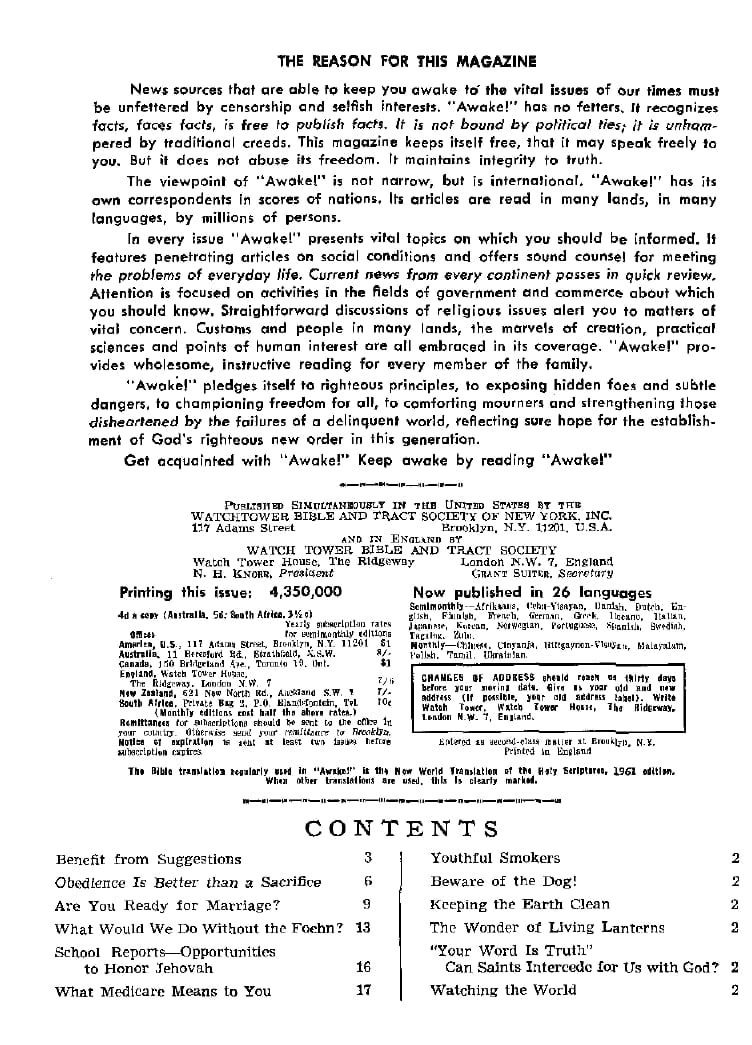
THE REASON FOR THIS MAGAZINE
News sources that are able to keep you awake to the vital issues of our times must be unfettered by censorship and selfish interests. "Awake!" has no fetters. It recognizes facts, faces facts, is free to publish facts. It is not bound by political ties; it is unhampered by traditional creeds. This magazine keeps itself free, that it may speak freely to you. But it does not abuse its freedom. It maintains integrity to truth.
The viewpoint of "Awake!" is not narrow, but is international, "Awake!" has its own correspondents in scores of nations. Its articles are read in many lands, in many languages, by millions of persons.
In every issue "Awakel" presents vital topics on which you should be informed. It features penetrating articles on social conditions and offers sound counsel for meeting the problems of everyday life. Current news from every continent passes in quick review. Attention is focused on activities in the fields of government and commerce about which you should know. Straightforward discussions of religious issues alert you to matters of vital concern. Customs and people in many lands, the marvels of creation, practical sciences and points of human interest are all embraced in its coverage. "Awakel" provides wholesome, instructive reading for every member of the family.
"Awakel" pledges itself to righteous principles, to exposing hidden faes and subtle dangers, to championing freedom for all, to comforting mourners and strengthening those disheartened by the failures of a delinquent world, reflecting sure hope for the establishment of God's righteous new order in this generation.
Get acquainted with "Awake!" Keep awake by reading "Awake!"
--add a copy (Australia, 56 South Africa). Verify generation rates for each edition. Verify edition numbers for each edition. For editions only 117 Abbey Street, Brisbane, Australia, 11 Brechin Street, St. Andrews
PUBLISHED SIMULTANEOUSLY IN THE UNITED STATES BY THE
WATCH TOWER BIBLE AND TRACT SOCIETY OF NEW YORK, INC.
157 Adams Street
AND IN ENGLAND
WATCH TOWER BIBLE AND TRACT SOCIETY
Watch Tower House, The Ridgeway
N. H. KNORB, President
GRANT SHORE, Secretary
Printing this issue: 4,350,000
4d x copy (Australia, 5d: South Africa, 3½ o)
Now published in 26 languages
Seminominally—Arkansas, Ohio, Virginia, Danish, Dutch, Dutch,
English, Finland, Germany, Greek, Iceland, Italian,
Japan, Korea, New Jersey, Portugal, Nantucket, South Korea,
Northly—Chinese, Croatia, Haiti-guang-Province, Malaysia,
Polish, Tamil, Uzbekistan
GRANCHES OF ADDRESS should reach us thirty days before your morning date. Give us your old and new address. Call us at 212-555-1234. Watch Tower, Watch Tower House, The Bidwells, London W. 7, England.
Entered as second-class matter at Brooklyn, N.Y.
Printed in England
The Bible translation regularly used in "Awaken" is in the New World Translation of the Holy Scriptures, 1961 edition. When other translations are used, this is clearly marked.
B₁ B₂ B₃ B₄ B₅ B₆ B₇ B₈ B₉ B₁₀ B₁₁ B₁₂ B₁₃ B₁₄ B₁₅ B₁₆ B₁₇ B₁₈ B₁₉ B₂₀ B₂₁ B₂₂ B₂₃ B₂₄ B₂₅ B₂₆ B₂₇ B₂₈ B₂₉ B₃₀ B₃₁ B₃₂ B₃₃ B₃₄ B₃₅ B₃₆ B₃₇ B₃₈ B₃₉ B₄₀ B₄₁ B₄₂ B₄₃ B₄₄ B₄₅ B₄₆ B₄₇ B₄₈ B₄₉ B₅₀ B₅₁ B₅₂ B₅₃ B₅₄ B₅₅ B₅₆ B₅₇ B₅₈ B₅₉ B₆₀ B₆₁ B₆₂ B₆₃ B₆₄ B₆₅ B₆₆ B₆₇ B₆₈ B₆₉ B₇₀ B₇₁ B₇₂ B₇₃ B₇₄ B₇₅ B₇₆ B₇₇ B₇₈ B₇₉ B₈₀ B₈₁ B₈₂ B₈₃ B₈₄ B₈₅ B₈₆ B₈₇ B₈₈ B₈₉ B₉₀ B�₁₁ B�₁₂ B�₁₃ B�₁₄ B�₁₅ B�₁₆ B�₁₇ B�₁₈ B�₁₉ B�₂₀ B�₂₁ B�₂₂ B�₂₃ B�₂₄ B�₂₅ B
CONTENTS
Benefit from Suggestions 3
Obedience Is Better than a Sacrifice 6
Are You Ready for Marriage? 9
What Would We Do Without the Foehn? 13
School Reports—Opportunities to Honor Jehovah 16
What Medicare Means to You 17
Youthful Smokers 2
Beware of the Dog! 2
Keeping the Earth Clean 2
The Wonder of Living Lanterns 2
"Your Word Is Truth"
Can Saints Intercede for Us with God? 2
Watching the World 2
HAS someone recently offered you a suggestion? Perhaps it was on how you should conduct your business, perform your work, decorate your home or improve your appearance. How did you react? Some people consider suggestions an insult, an inference that they lack ability to handle matters, or a challenge to their position. However, suggestions can abound with benefits, especially if they are given in sincerity and received by a person desirous of making improvement.
Those who rebel at suggestions often do so because they do not truly appreciate what suggestions are. They view them as implied orders given by someone who has no authority to command. But, in actuality, a suggestion can be just a proposal presented, not to command action, but, rather, to stimulate consideration. Action is left entirely up to the discretion of the hearer. So instead of being offended when someone offers a suggestion, a wise person appreciates that the offerer has enough respect for his judgment to present a suggestion and then let him decide on its value. As has been said, 'a word to the wise is sufficient.' If we
are wise we will value a timely suggestion as we would gold. How true the proverb, "As apples of gold in silver carvings is a word spoken at the right time for it!" —Prov. 25:11.
While many persons appreciate that they can benefit from a sound suggestion, it is noteworthy that the benefits can be reciprocal, shared by both the person acting on the suggestion and the one offering it. The individual whose suggestion has been accepted and successfully applied receives the satisfaction of seeing his idea benefit others. Additionally, he often receives a tangible benefit. This recently has been the experience of many workers at their places of employment.
For years the 'suggestion box' served more as a source of amusement than of improvement. Why so? Well, if, out of an honest desire to improve working conditions or reduce waste, you offered two or three practical suggestions that were rejected because of your employer's pride or were never even considered, would you have a desire to continue trying to offer beneficial suggestions?
But that is what has happened in countless business establishments. Consequently, suggestions were stifled. But now wise business leaders, appreciating that their employees are in position to offer practical and profitable ideas, are trying to elicit suggestions.
In order to encourage employee suggestions, many firms have instituted suggestion systems, offering cash awards to employees based on the expected savings for the company that result from their applied suggestions. It has been estimated that in 1960 United States companies paid 20,000,000 for such recommendations. One firm that makes electronic computers had a problem with the wheels on its tape recorders slipping. An employee suggested that a small metal shim be added when the equipment was manufactured. What was the result? The company substantially reduced maintenance and repair costs. How about the employee? He received32,000 for the suggestion! At another firm a woman saw that the drive belt on her machine frayed rapidly and became unsightly. Motivated by her feminine sense of tidiness, she put some nail polish on the edges of the belt. Other employees convinced her that she should submit the idea as a suggestion. Outcome? The company found that the belts lasted longer if the edges were coated with lacquer. Applying the suggestion, the firm saved 43,000 the first year and paid the woman6,000 for her idea.
However, sometimes it is necessary to overcome personal pride or imagined self-importance in order to accept suggestions. For instance, in the days of the Hebrew prophet Elisha, the chief of the Syrian army, Naaman, was a leper. A captive Israelite slave girl suggested to her mistress, Naaman's wife, that Elisha could cure Naaman of his leprosy. The suggestion was
passed on to the king of Syria, and he sent Naaman to Israel. When Naaman was told in a message from the prophet to bathe seven times in the Jordan River, he became indignant, feeling that at least Elisha could have personally appeared and performed some special hand-waving to cure him instead of asking him to bathe in a river that was muddier than those in his own country. He left in a rage. But when his servants suggested that he do what Elisha said, since it was such a small thing, Naaman 'swallowed his pride,' accepted their suggestion and was healed. —2 Ki. 5:1-19.
Both of the suggestions that led to Naaman's cure were offered by his subordinates, one by his wife's slave girl and the other by his servants. Yet Naaman obtained lasting benefits by overcoming his pride and accepting from underlings suggestions that appear to have been given out of kindness and concern for a fellow human. So, if in the future someone in your employ or under your direction offers you a suggestion, consider it. Remember Naaman!
There is, though, another sphere of life that is often sprinkled with suggestions; that is the family. But sometimes persons who readily accept suggestions at their place of employment are unresponsive to suggestions offered by a family member. One reason for this is that the relationship between business associates is rather formal, and emotions are not usually involved. In contrast, the family relationship involves emotions that can make it more difficult to accept suggestions. Family members may be quite sensitive about their position or duties in the home and so be reluctant to accept suggestions from another member of the family, even though they love that person. But the very fact that the one offering a suggestion is a person they love should make it easier to accept the idea and benefit from it.
For example, a husband is in position to give helpful suggestions to his wife that can result in increased happiness for the entire family. He might learn from talking with her that one of the reasons she is often tired is that she duplicates work, such as going shopping every day. Applying some of the efficient methods he uses at work, he may sug-
but she could prepare meals that would assist him to lose weight and, possibly, could make a tactful comment about her reason for doing so. If she did this lovingly, her husband might appreciate the suggestion and improve his health by cooperating. Or a wife might observe a hazard in the home, such as a torn carpet on the stairs, but not be able to repair it herself. If she tactfully mentioned to her husband the need for hav-
gest that she try to do all her shopping in just one or two visits to the market a week. Will she be offended and feel that he is trying to domi-
ARTICLES IN THE NEXT ISSUE
How Reliable Are the Theories of Men?
Tropical Trademark Proves Its Worth.
In Defiance of the Law.
Finding a Doctor Who Would Respect Their Beliefs.
The Night Raiders.
mate her every movement, or will she appreciate the suggestion and try to apply it as circumstances allow? Application of the suggestion could benefit the wife with more energy for other pursuits, and the husband with a more refreshed and peering it fixed, and if he acted on her suggestion, a severe accident might be averted.
In order to encourage suggestions the
father could arrange for the entire family to share in a discussion of general family matters. While he, as the head of the household, must make the final decision on many issues, by considering suggestions from his wife and children, he would be
husband with a more refreshed and energetic wife.
Other suggestions for the wife could come even from the children. She might mentally take note of the gusto with which they eat a certain meal and wisely decide to prepare it again in the future. Or she could ask the family for suggestions as to what they would like to eat the coming week. Applying their ideas, when possible, will benefit the wife with a more contented family and will ease her chore of trying to propose an appetizing menu.
From his wife and children, he would be prepared to make decisions that would bring the greatest happiness and benefit to his family. In this way the family will be drawn together as a single operating unit instead of each person considering just his own interests. And think what a fine example it will set for the children in being open-minded and reasonable. Yes, the benefits will be many from such suggestions.
Are you looking for beneficial suggestions? To find them, why not directly ask for them, be察看of other people.
Looking at the other side of the picture, a wife also could give suggestions to her husband. But when doing so she should remember that the Bible shows that she is to be in subjection to him. (Eph. 5:22, 23) Thus, if she felt that her husband was becoming overweight, she should not proceed to give him orders as to what to do,
for them, be observant of other peoples actions and comments, note ideas found in everyday reading and adopt methods that have proved successful to other persons? You will have to be alert and willing to make adjustments in your thinking and actions, but rest assured that you can enjoy increased happiness and success if you will benefit from suggestions.
Obedience
in obeying the voice of Jehovah? Look! To obey is better than a sacrifice, to pay attention than the fat of rams."—1 Sam. 15:15, 22.
Jehovah God is not one to let himself
Why does the Holy Bible make this point? How does it apply to you?
NO MATTER what a person does to compensate for disobedience, it would have been better if he had obeyed and done what is right, isn't that so? It certainly is true of the obligations of children toward their parents, and it is true of mankind toward God the Creator.
Of course, there are times when children think that they know better than their parents; so they ignore their instructions, perhaps convincing themselves that what they are doing is better. And there are times when individuals set aside the Word of God, ignoring what it has to say, reasoning that what they are doing may result in even greater good. But, really, do youngsters know better than their parents, and do any of us have wisdom that is greater than God's?
This point was emphasized to King Saul of Israel, who was commanded by God to execute the Amalekites and to devote to destruction all their animals. But King Saul spared the choicest of the animals, intending to sacrifice them to God—a sacrifice Jehovah had not commanded. King Saul then sought to justify his disobedience on the basis that the spared animals were "for the purpose of sacrificing to Jehovah." Reproving him, the prophet Samuel said: "Does Jehovah have as much delight in burnt offerings and sacrifices as
be bribed by sacrifices, so that one could willfully neglect God's other requirements. Otherwise, God might become party to all sorts of wickedness and violence.
A Case in Point-The Crusades
But men professing to serve God have made that mistake, thereby becoming parties to all sorts of wickedness and violence. How so? Consider an example. When enlisting soldiers for their crusades against the Turks holding the "Holy Land" of Palestine, certain popes of Rome granted those who made the necessary sacrifices to enlist in such crusades "indulgences and temporal privileges, such as exemption from civil jurisdiction, inviolability of persons or lands, etc."* In other words, those taking part in such crusades not only were supposed to have their sins forgiven, but were freed from accountability to any human government for their actions.
What were the fruits of this policy of making sacrifices but not obeying the laws of God and of man? We are told that "seldom does history of profane wars display such scenes of intemperance and prostitution as were exhibited under the walls of Antioch" by those taking part in the First Crusade. And when these finally took Jerusalem in July 1099, they not only ruthlessly and mercilessly slaughtered 70,000 Moslems, men, women and children, but then herded all the Jews into their synagogue, which they set on fire, burning all the Jews alive. And all this by ostensible soldiers of Christ!- Historian's History of the World, Vol. 8, pp.
348, 352.
The Fourth Crusade, which was the direct result of the vehement exhortations of Pope Innocent III, never did get to Jerusalem. Instead, it spent all its fury on the Greek Catholic city of Constantinople, regarding which we are told: "The sack of the most civilized city in Christendom . . . was incredible. . . Havoc and destruction became general. Robber barons, as well as Latin ecclesiastics, in holy orders, shared equally in taking whatever they could carry. . . . Finally the warriors of the Cross committed open rape, adultery and fornication and their violence did not even spare the maidens and virgins vowed to God."* Regarding this event, which took place in April 1204, The Catholic Encyclopedia tells us: "The holy relics especially excited the covetousness of the Latin [Roman Catholic] clerics."—Vol. 4, p. 304.
There were seven such crusades between the years 1096 and 1270 C.E., and concerning them a modern historian writes: "In short, the Crusades were an exhibition of unbridled, unprincipled, unrestrained savagery in the name of Christ."—The Story of Civilization (1931), G. E. Dorsey, p. 587.
If the enlisting in a "holy" cause, fancied or real, can justify disobedience to God's laws, then men can find justification for any crime.
A Reiterated Bible Principle
Under the Mosaic Law, provision was made for sacrifice to atone for one's sins. Other sacrifices could be offered as an expression of thanks or praise to God. But such sacrifices, to be of any worth, had to be coupled with respect for God's law. There was no provision by which a person could offer extensive sacrifices to God and so be freed from his obligation to obey the law.
For example, at the dedication of the temple of Jehovah, King Solomon offered up 22,000 cattle and 120,000 sheep, out of his appreciation and zeal for Jehovah's worship. However, this sacrifice did not relieve Solomon of obeying the first of the Ten Commandments, which states: "You must not have any other gods against my face." In his old age Solomon failed to obey this law. No matter how many sacrifices he might have offered, they could not relieve him of the obligation to obey that commandment.—Ex. 20:3; 1 Kl. 8: 62-64; 11:4-6.
Yes, indeed, a sacrifice, whether it be optional or required by God, must be coupled with an obedient heart. Fittingly, we find this principle included in the inspired proverbs: "The sacrifice of the wicked ones is something detestable to Jehovah, but the prayer of the upright ones is a pleasure to him." The wicked are merely deceiving themselves if they think that God will overlook their wickedness because of their offering sacrifices.—Prov. 15:8.
By means of one prophet after another, God kept reminding his ancient people Israel that sacrifice must be coupled with obedience. The grand prophecy of Isaiah both begins and ends enunciating this principle: "Of what benefit to me is the multitude of your sacrifices? . . . Even though you make many prayers, I am not listening; with bloodshed your very hands have become filled. . . Learn to do good; search for justice." Jehovah God says that because "they kept on doing what was bad in my eyes, and the thing in which I took no delight they chose," he considered their "slaughtering the bull" for sacrifice as the murder of a man. -Isa. 1:11-17; 66:3, 4; Amos 5:22, 24; Jer. 6:13, 15, 20.
Pertinent also are the words of Micah: "Will Jehovah be pleased with thousands of rams, with tens of thousands of torrents of oil?
. . . He has told you, O earthling man, what is good. And what is Jehovah asking back from you but to exercise justice and to love kindness and to be modest in walking with your God?" (Mite. 6:7, 8) God was not asking only for sacrifices, as if a vast number would forever satisfy him. Apart from justice, kindness and modesty on the part of the worshiper, the sacrifices were not even wanted.
It is not surprising, then, that Jehovah's greatest prophet of all, his Son Jesus Christ, repeatedly alluded to the same principle; namely, that sacrifice must be coupled with obedience. Thus, on one occasion, Jesus showed that the religious leaders of his day had made "the word of God invalid" by their tradition of making a sacrifice to God an excuse for not honoring one's father and mother.—Matt. 15: 5, 6.
Applicable to Christians
There is no gainsaying the principle that sacrifice must be coupled with obedience. It is true that Christians are not required to make animal sacrifices to God, nor are even voluntary sacrifices of animals a part of their worship; yet they do offer 'sacrifices of praise to God, that is, the fruit of lips that make public declaration to his name.' (Heb. 13:15) This is required of all who worship Jehovah God; the offering of such sacrifices is a matter of obedience.
Yet the offering of such sacrifice of praise is of no value if it is not coupled with obedience to others of God's laws. For instance, there have been some who were very active in the ministry of praise to God's name, devoting their full time to it and truly sacrificing many things to do this; but they grew lax as to their morals,
as though their zeal could compensate for wrongdoing. In the end they were cut off from God's people. This also happened to some who, after suffering many years in Nazi concentration camps, were excommunicated because of sexual immorality. The apostle Paul was fully aware of this danger, as can be seen by his words: "I browbeat my body and lead it as a slave, that, after I have preached to others, I myself should not become disapproved somehow"; thereby making vain all his sacrifices.—I Cor. 9:27.
Others may be moved by a generous heart to make personal sacrifice of a material nature to advance true worship. They contribute generously in a material way, and, as a result, they gain much happiness. (Acts 20:35) However, the making of such sacrifices does not relieve them of the responsibility to obey the commandments of God. For example, they must show love for their neighbor, even as they profess love for God. (1 John 5:2, 3; Jas. 2:8) So the apostle Paul explained, "If I give all my belongings to feed others, and if I hand over my body, that I may boast, but do not have love, I am not profited at all." They must share in the preaching of the good news of God's kingdom, doing as Jesus said: "Make disciples of people of all the nations, . . . teaching them to observe all the things I have commanded you." Thus, sacrifices of a material nature do not eliminate the need for obedience to these Bible commands.—1 Cor. 13: 3; Matt. 28:18-20; 24:14.
We cannot escape it. If we would not deceive ourselves, if we would have Jehovah's approval, we must make certain that our sacrifices are coupled with an obedient heart.
ARE YOU READY
FOR Marriage?
</div>
"DATING was such fun we thought that marriage would be the same," lamented a disillusioned youngster. Another acknowledged: "We married as boy and girl,
Are you prepared to choose a suitable mate? Can you care for the responsibility that marriage brings?
but marriage required a man and woman." And a heartbroken young girl captured the tragedy of her marriage when she explained: "The trouble with my husband and me is that we didn't give ourselves time to find ourselves. We married before we had any idea what we really were or really wanted—and now we've discovered that what we want is certainly not each other."
The evidence indicates that many are not. Repeatedly, investigations have found that happiness in marriage is found less often in early marriages than in later ones. One investigator, for instance, reported that the "divorce rate was six times higher in the marriages where both spouses were under 21, than in the marriages in which
These are typical expressions of youths who have been hurt badly in the wake of today's avalanche of teen-age marriages. The increase of these marriages has been so great that, in the United States, nearly 50 percent of the more than 1,600,000 brides in a recent year were still in their teens. A surprising number of new husbands are also teen-agers. No doubt some of these young couples have made a fine success of their marriages, but can it be said that this is the general rule? Are such young persons prepared to take on the responsibilities of courtship and marriage?
both spouses were 21 or over at the time of marriage."
This is certainly sobering evidence to consider if you are a teen-ager who wants to get married. It should at least cause you to pause and think the matter over.
Although it is by no means true everywhere, where you live it may be the custom for a young man or woman to choose one's own marriage mate. If so, think of the tremendous responsibility: To select a mate with whom you will live day in and day out for the rest of your life!
Prepared to Choose?
This raises the question as to whether you, as a teen-ager, are in position to choose a marriage mate for the fully developed adult that you will in time become. True, you may have a strong desire to get married, and may even feel that a particular person is the ideal one for you. But have you stopped to analyze why you believe this person will make a fine lifelong partner?
Young people often rate prospective marriage mates according to standards that have little to do with whether they will make good husbands and wives. For example, young girls are often enamored by a star athlete, a smooth dancer, or by a boy with dark curly hair and a sleeklooking automobile.
Perhaps you, too, are prone to rate a prospective mate according to values such as these. But are these the things that are really vital to a happy marriage? Is it not of much more importance that a young man have the qualities that will make him a kind, considerate husband, and a faithful provider for the family? Unfortunately, however, the emotions of young girls usually do not permit them to make such an objective assessment of prospective mates.
The same can be said of young men. Contrary to what many of them seem to think, a girl's having a pretty face and charming ways does not mean that she will be a dutiful wife, loving mother and an interesting companion. You may be satisfied with just a pretty face now, but later on you will want the qualities of a fully developed woman, including intelligence and ability to shoulder responsibility. Remember, too, with the passing of years bodies and faces change, and the glow of youth that makes some girls so lovely now does not last. So if your choice of a marriage mate is based primarily on such transitory values, the union is not likely to be a happy one.
Many marriage authorities will not hesitate to point out that the average teenager is not prepared to make such an important choice. And conditions that exist in countries where youths are allowed free rein to select their own marriage mates tend to bear out their contention.
In many parts of the world even the teen-agers themselves will readily acknowledge that they are not qualified to select a marriage mate. In fact, for centuries this important choice has largely been left up to parents. As one Indian girl explained to a well-known marriage counselor, Dr. David R. Mace: "How would we be able to judge the character of a boy we met and got friendly with? We are young and
inexperienced. Our parents are older and wiser, and they aren't as easily deceived as we would be. . . . It's so important that the man I marry should be the right one. I could so easily make a mistake if I had to find him for myself."
Sex Attraction and Romance
What makes a wise selection of a marriage mate especially confusing for inexperienced youth is the powerful attraction that exists between the sexes. When young people, unfamiliar with these forces, are caught up in the clouds of romance they lose all sense of sound judgment. Young girls and boys are thus easily prone to confuse sexual passion with true love.
Further, where problems or troubles crop up, young couples who are courting often resort to hugging and kissing their way out of them. The trouble may be any one of a number of things—bad habits or mannerisms, differences in likes and dislikes, or conflicting attitudes toward religion or handling of money. But thinking that the wonderful feeling they have for each other will automatically solve such difficulties, they go ahead and get married. This no doubt explains why many teenagers, and even persons out of their teens, are so in love before marriage and so terribly unhappy afterward.
Largely responsible are the modern movies, literature and songs that glamorize romantic love, leaving the impression that it is a sufficient basis for a happy marriage. A girl whose marriage was prompted by such a wrong impression relates: "I was elected Queen of the May and crowned in a gorgeous coronation ceremony. As I stepped down from the stage after being crowned, Don met me at the foot of the stajrs. He asked me for a date, and I agreed to go out with him the next week. On that date he said when he saw me being crowned queen, he knew he loved me."
The twp were quickly married.
But rather than living happily ever after, the couple did not get along at all. She said: "He thought my standards foolish and called me highbrow. He really wanted nothing in life beyond a car and a good time. When he hurt me, he never apologized." The attraction that drew the two together was not genuine, unselfish love. It was sufficient for a pleasurable romance, but not for a happy marriage.
Would it not be wise, then, for you to consider whether sex attraction and romance are the primary reasons you want to marry a certain person? Is it her radiant smile, laughing eyes or beautiful form that make her irresistible to you? Or is it the way that he holds you in his arms and kisses you that makes you certain he is the one for you? If your desire for a person is based almost exclusively on sex appeal, be cautious. Do not confuse this romantic feeling with the type of love needed for a successful marriage.
Ready for Courtship?
The first question to consider, however, is whether you, as a teen-ager, are ready for courtship. In other words, are you in position to take on the responsibilities of married life with which courtship culminates? If not, is there any valid reason for going out alone with persons of the opposite sex and showing interest in them in a way that would naturally be expected to lead to marriage? Is it wise to "date" before you are old enough to get married?
Of course, if you live in communities where "dating" by even very young persons is the custom, you may see nothing wrong in it. In fact, you may accept it as the natural and proper thing to do. But simply because something is popular, and "everybody does it," does not mean it is wise. The question is: What is the fruitage
of such a custom? Does early unchaperoned dating lead to honorable, successful marriage? Is it good training for youth in eventually choosing a mate?
You probably are aware that teen-agers who "date" regularly often get romantically involved and do a lot of necking and petting. What does this often lead to? You know. All too often the girl gets pregnant, and they enter a marriage for which neither is prepared. They did not plan it that way; they may have realized that fornication is wrong, but they lost control of themselves. Sociologists agree that 30 to 40 percent of the teen-age brides in the United States get married because they are pregnant, which means there are now 300,000 to 400,000 teen-age wives who were literally forced into marriage.
Even worldly authorities recognize the inadvisability of early dating. Noted the internationally known expert on marriage and family life, Dr. Margaret Mead: "Boys should probably not start courting girls until they have got their growth; until they have some sense of themselves as people; and until a girl a couple of years younger than they are is old enough to be courted." Unchaperoned dating by young teen-agers simply is not wise.
Rather than being a form of teen-age entertainment, dating and courtship are for mature people who are ready for marriage. It is a time, not for sexual experimentation, but for serious contemplation—when one makes the momentous choice of his lifelong mate. This calls for taking a good, hard, realistic look at the other person, seeing him in as many situations as possible, particularly difficult and unglamorous ones. Learn what the person is really like. Consult your parents. What do they think of the person? Listen to their advice, for generally they are in a much better position to judge qualities of personality than you are.
The Responsibility Involved
But regardless of whether your parents choose for you or the decision is your own, the question still remains: Are you prepared to care for the responsibility involved? And, too, is the one you plan to marry ready?
Unfortunately young persons often have a very unrealistic view of marriage responsibilities. They simply do not know enough about what is involved when two people agree to live together. For instance, do you have a realistic view of what it costs to live? Have you paid your own bills, done your own shopping, handled insurance and taken care of other family matters? It takes training and experience to run a household. Have you had such training?
If you are a girl, you may reason that that will be your husband's responsibility. Well, then, is he qualified to handle such matters? Does he have the necessary experience, or do his parents still support him? If he has never been on his own and taken care of himself, how can you expect him to support both himself and you? Is it wise to entrust yourself into the hands of such inexperience? You will want to determine this before getting married.
A wife, too, has responsibilities. Are you sure you are ready to care for them? Do you know how to wash, iron, cook, clean the house, and do the many other things that are so necessary for a pleasant home? True, you may be able to heat a can of beans or put TV dinners in the oven, but can you expect your husband to be happy with a steady diet of such meals? Hardly. To care properly for washing, ironing and cleaning also takes practice and interest. For instance, you can be sure that your husband will not be pleased if he learns that you ruined his new white shirts by
putting his colored socks in the same wash with them.
Inexperience can lead to much unhappiness. One young married girl recently admitted: "Like so many girls, I had never learned to cook or keep house. I didn't even know how to iron a blouse. And Ralph's mother had always done everything for him; he'd never had to pick up his bath towels or put the toothpaste away." The two were completely unequipped to handle the everyday responsibilities of married life, and the marriage failed. The same thing can so easily happen to you.
And what if you should become pregnant? Would you know how to care for yourself during pregnancy, and for the baby after it is born? Or would your feelings be those of the inexperienced teenage wife who explained: "When I first began to realize I might be pregnant, I was shocked. All I could think was, . . . I've never held a baby. How can I possibly take care of one?" This is a serious matter, for the early care of a child has a great effect on its well-being in later life. Would your husband be mature enough to meet the situation? Would you feel secure and confident in his care?
These are matters for serious consideration, because they are responsibilities that go with marriage. So if you are nearing adulthood and realize that you are not yet equipped to care for the obligations that go with it, now is the time to do something about it. Benefit from the experience that your parents have had; they will be glad to share it with you. Show yourself willing to help with the work that has to be done at home, in this way gaining the training and experience that you will need in years to come. Make the best use of your opportunities now, so that, when you are ready to choose a marriage mate, you will be equipped to contribute your share to a happy home.
WHAT WOULD WE DO WITHOUT THE Foehn?
BY "AWAKEI"
CORRESPONDENT
IN SWITZERLAND
OH, MY poor head!" "I'm all edgy today!" "There's such a pressure in the air that I can hardly breathe!" "What's the matter—I keep making mistakes!" "I know—it must be the foehn!" Someone will look knowingly up into the sky and respond, "Yes, there's a foehn in the making." With a sigh of relief all the aches, pains, human inadequacies, tempers and tensions are piled on that old scapegoat as he fills his nostrils, gathers force and blows his way down the valleys of Switzerland. Then we stop and think, "What would we do without the foehm to blame for everything?"
To hear us, you might think that Switzerland has a monopoly on the foehn, but not so. Our Austrian neighbors of the Tyrol region share the Alpine foehn with us. Going westward around the globe, we observe that the mountainous terrain of Greenland helps to create winds also called the foehn. Farther to the west, the plains east of the Rocky Mountains in Canada and the United States experience an impressive manifestation of winds similar to the foehn, but there they are called the chinook. Nevertheless, whether they are encountered in Switzerland, Greenland or Canada, these winds are a phenomenon to remember.
What Is the Foehn?
It is a warm, dry wind that pours down one side of a mountain range—in our case the Swiss Alps. In the past it was erroneously thought that the heated air of the Alpine foenn came from the hot Sahara desert, across the Mediterranean Sea, up the Italian side of the Alps, and down into our peaceful Swiss valleys. But with increased scientific understanding of meteorology, study of the atmosphere, and the establishment of weather stations in the Alps, much more is now known about the how's and why's of our strange, windy companion, the foenn.
What are those how's and why's? They involve answers to such questions as, How is it that the coming of the foehn can change the weather from below-zero winter to balmy spring in just twenty-four hours? Why are headaches and discomfort so common when the foehn is here? Why do the mountains appear so picturesquely bright and near on those days? You can answer those questions with just an outline knowledge of the mechanics of the unusual foehn.
The buildup comes when the atmospheric pressure is low on the northern side of the Alps and high in the southern region around Italy. The warm, moist air south of the mountains slowly begins to move, creating winds heading toward the low-pressure zone on the other side of the Alps. When they reach the mountains, they are forced to rise, billowing up the ridges and peaks.
The moisture condenses over the cooler land of the mountains, and beautiful, lens-shaped clouds are formed. Much of the moisture falls as rain and snow on the Italian side of the mountains. The condensation further warms the moving air. As it descends the northern side of the Alps, the air is additionally heated by compression and flows down the valleys as a mild, arid wind.
The spring foehn brings rain and sometimes floods to the plains of the Po River in Italy and thawing and evaporation to the snow-covered slopes of Switzerland. To some persons it is a terrifying enemy, but to many others it is a magnificent friend.
Why Is It Dreaded?
You might say, though, "There are winds everywhere. Who has not heard of the trade winds, the oppressive siroco winds of Sicily and southern Italy, and many others? Why, certain parts of the earth endure hurricanes and cyclones!" Yes, that is all true, but the reputation of the foehn is such that many people consider it second to none in the category of eccentric weather.
Those who have never experienced the foehn should not imagine it as just a warm, gentle breeze. Often it is that, but at other times the winds plunge down from the ridges with gale force. At one weather station in Greenland the wind-recording device vanished when the gusts of a foehn wind topped 125 miles an hour. But the speed of the wind continued to increase until the whole weather station was vibrating like a tuning fork in a steady wind estimated at 170 miles an hour. Here in Switzerland the foehn does not attack us with such ferocity, but its force is still something with which to reckon. The roofs of many of the cabins and stables in the mountains have to be weighted down with
several rocks that could weigh 70 kg (about 150 pounds) each or more. Even at that, some of the structures come crashing down under the pounding gusts of the foehn. Often trees are uprooted or snapped off with ease by the blasts of wind.
When the warm winds pass over the peaks that are heavily laden with winter snow, quickly the crisp, strong snowfields are converted into weak masses of wet snow. Then begin the dangerous avalanches and slides, transporting tremendous quantities of snow to the lower slopes and sometimes bringing destruction and death. Mountaineers and skiers are warned to keep to the foehn-free areas or to the higher altitudes. So the foehn is not welcomed by those engaged in winter sports.
For many persons down in the cities the worst thing about the foehn is its effect upon the body. The wind is prevalent from March to May and again in the fall in October and November, though it varies from year to year. When it quickly follows a cold winter season, the sudden rise in temperature and increase in atmospheric pressure bring apathy, exhaustion, dizziness and headaches to some people. In Montana, in the United States, this type of wind once raised the temperature 34\circ F. within seven minutes. The rapid change produces a physical and emotional strain as the body struggles to adapt to the new weather. Then many will say, "It must be the foehn," and start to reach for the headache pills. Even members of the animal kingdom are aware when a foehn is brewing. Bees and other insects demonstrate increased irritability, and cows become restless.
Irritation or Blessings?
Let us take time, though, to consider the foehn fairly. Many of the very things about if that cause irritation to some persons are counted by others to be blessings.
Numerous individuals are thankful for the foehn and look forward with anticipation to its coming. But why?
The snow-melting effect that is a cause of grief to the skier is a source of joy to the Swiss farmer. In March and April, after the heavy snowfalls of winter, the advent of the foehn brings a tremendous change. The warm, dry winds that thirstily lap at the snow have received the name Schneefresser (snow devourer). Life begins to stir mightily. Where only yesterday, it seems, there was an ocean of snow, today there is a gorgeous field of alpine crocuses. The foehn treats the farmers impartially, clearing the snow from the fields on the shady side of the mountains at the same time that it cleans those on the sunny side. Thanks to the foehn, the tilling can begin early in the year. Because a foot or more of snow can disappear in a few hours under the warm breath of the chinook wind, ranchers in Alberta, Canada, can graze their cattle in winter areas, where it would be impossible were it not for the foehn-type winds.
The Swiss husbandman welcomes the fall foehn that it will aid his grapes to ripen. He even calls it the Traubenkocher (grape cooker). In the 'foehn oasis,' vineyards can be planted at heights that would be out of the question in areas without the helpful foehn. The warm, dry weather of the foehn produces grapes of superior quality, and naturally the resulting wine is vastly improved. Corn or maize can be cultivated and brought to harvest in northern Alpine valleys of Austria with the aid of the warm foehn. The chestnut trees, a speciality of Ticino to the south, thrive on the 'foehn-oasis' slopes of Lake Lucerne, growing at altitudes not achieved in surrounding territory lacking the foehn. Yes, the people of these Alpine valleys have good reason to ask, "What would we do without the foehn?"
Even the wind itself brings benefits to the people of Switzerland. Just prior to the coming of the foehn, atmospheric pressure may keep exhaust fumes near the ground in some of the cities, but when the foehn sweeps down the valleys, stagnant air and smoke are quickly replaced with fresh, clean breezes from the mountains. The wind speedily dries the housewives' hanging wash, brings joy to the hearts of young boys with their kites, and spreads the seeds of southern flora over the Alps, especially clothing the lower passes with a blanket of glory. With grace and ease the yellow-billed alpine choughs wing their way playfully into the rising air currents, bringing pleasure and wonderment to all who observe them. Even the glider pilot appreciates the power of the foehn as it carries his light craft to exceptionally high altitudes.
If your specialty is photography, you too have good reason to be thankful for the foehn. With the clear foehn air the scenic Alps take on added beauty; they really put on a show! Peaks and ridges, cliffs and crevices, the majestic mountains present scenes of awe-inspiring splendor on every hand. Reflected in the sparkling lakes, the autumn colors of the trees and flowers, with the snow-covered Alps in the background, are subjects for color photography that are unequaled.
Why, we have made quite a case in favor of that old vagrant of the mountains, to use but one of his uncomplimentary titles. But, no matter how you look at it, just what would we do without the fierce and friendly foeln?
SCHOOL REPORTS—OPPORTUNITIES TO HONOR JEHOVAH
'SOMETHING DIFFERENT'
♦ "I was required to write some papers on the subject of my choice in my English class," reports one of Jehovah's witnesses in Arkansas. "I used this opportunity to write about family unity. I brought out what I had previously read in The Watchtower and showed how each family member could go to God's Word and receive instruction on right conduct. I also mentioned the need for each member to set a good example for the others and the need for the family to talk about and do things that are upbuilding, especially making time for the study of Jehovah's Word. When the teacher read this report, she told the whole class that I had written something very different from the ones that had written about sports. She said it was unusual for me to know about family matters and that she was going to make a copy of it to put in the church bulletin. I thank Jehovah for giving me the courage to use these opportunities to witness to my classmates and teachers."
SPECIAL ASSIGNMENT
This experience comes from the state of Washington: "As part of an English class assignment calling for an oral report on the part of all students, my English teacher, who knew I was one of Jehovah's witnesses, approached me after class and gave me a special assignment. It consisted of an oral report on Emanuel Swedenborg, spiritist and philosopher of the eighteenth century. He presented me with two of Swedenborg's philosophical works and asked me to comment on them in my report. I was greatly helped in preparing my report by the Watchtower article 'Spirit World Guided Swedenborg.' My talk covered key points such as whether all religion is good or not, the ransom sacrifice, the false teaching of the immortality of the soul and the right understanding of Jehovah in relation to his Son. My talk lasted fifteen minutes; then questions poured in for the last forty-five minutes of the period. My classmates seemed amazed to see one oppose false concepts of men and to stand up in defense of Jehovah's Word. But most amazed of all was my English teacher, himself a minister for ten years. The next day I gave my report in all five of my English teacher's classes, with similar results."
TEACHER USES REPORT
A Witness in Louisiana tells how she was able to make an effective report: "My Civics teacher told me to select a subject from a list and write a fifteen page report. I selected the subject of 'Juvenile Delinquency.' I went to the Watch Tower Publications Index, knowing this would help me find the best material available. After doing much research in the Society's publications, I wrote the report, pointing out, among other things, that the ancient nation of Israel did not have this problem as long as families were closely united in the worship of Jehovah. I gave the report to my teacher. Then the following week he asked the class why they could not write a report like this one. He began reading the report to the class, stopping after every three or four pages to elaborate on what he had read. This went on for a couple of days, then one afternoon he invited another teacher in to listen. This teacher also wanted to read the report to his classes. The report was returned to me with a big '100 marked on the front. When asked where I collected the material, I replied, 'The Watchtower and Awake! magazines.'"
BIBLE STUDY STARTED
♦ At a circuit assembly in Chicago, Illinois, a Witness recently related this experience: "I am in high school and am required to take a course in government. When we came to the subject of civil rights, the teacher asked me if I would give a report on Jehovah's witnesses. I could have the whole period of fifty-five minutes. Thanks to the Society's publications, such as the book Jehovah's Witnesses in the Divine Purpose, I was able to give a report, with good results. In fact, I ended up giving my report to all three of my teacher's government classes. After one of these classes, a girl asked me where she could learn more about Jehovah's witnesses. Arrangements were made for a sister who goes to school here to study with her. Since neither can stay a full hour, they study on two evenings after school for thirty minutes each. I am happy to be part of Jehovah's organization that so thoroughly equips us to know how and where to find needed information along with the best way to give it."
FOR more than twenty years Americans debated whether they should adopt a system of compulsory health insurance. Now the matter is settled. For on July 30, 1965, President Lyndon B. Johnson signed the Medicare-Social Security bill into law.
The bill expanded the thirty-year-old Social Security insurance program to provide hospital care, nursing-home care, home nursing services and out-patient diagnostic services for all Americans sixty-five years of age and older. It also set up a supplementary program of Federal insurance covering doctors' bills and some other health costs of persons in this agegroup.
Now that medicare is law in America, just what does it cover? How much will it cost the average taxpayer? How does the American program compare with the health services of other nations? Why did many American doctors oppose the plan?
The Plan at a Glance
Who is going to benefit by medicine? Those eligible for benefits are all persons sixty-five years old and over, with a few exceptions. For example, aliens with less than five years of residence in the United States, also aliens without status as permanent residents and Federal employees eligible for government health insurance under another law are not embraced by the medicare law.
Insurance is provided under two plans: one known as "basic" and the other as "supplementary." Both plans become operative July 1, 1966.
Basic Plan
The basic plan automatically covers those who are sixty-five years old and over, with the aforementioned exceptions. It applies regardless of income. It benefits people still working, as well as the retired. A person qualifies whether covered by Social Security or not.
Benefits under the basic plan include hospitalization up to ninety days for each spell of illness. The patient pays the first 40 of hospital costs. After sixty days, he pays10 a day up to the ninety-day limit. Under the plan a spell of illness starts with the first day of hospitalization and ends when the patient has spent sixty consecutive days without hospital or nursing care after being discharged.
Benefits cover cost of semiprivate room and board, plus usual hospital services such as nursing, drugs and supplies. Not covered are fees for most surgery, a private doctor or a private nurse.
Nursing-home care, effective in 1967, will be provided for up to a hundred days in each illness but only after a stay of at least three days in a hospital. The patient pays nothing for the first twenty days in the nursing home.
Thereafter he pays $5 daily.
Another benefit is home nursing up to a hundred visits by nurses or technicians in a one-year period following the patient's discharge from a hospital.
Tests and related diagnostic services that are normally provided by hospitals to outpatients will also be available. The patient, however, will pay 20 of the charge for each diagnostic study by the same hospital in a twenty-day period. The patient also pays 20 percent of the charges above20, and medicare covers the rest.
These are just some of the major provisions of the "basic" plan.
Supplementary Plan
The supplementary plan will be available on a voluntary basis, with participants paying 3 a month in premiums. Social Security pensioners who enroll in this plan, may, if they wish, arrange to have their3 premiums deducted from their monthly Social Security checks. This may be arranged at the time of enrollment.
This plan supplements the basic plan by covering most other major medical expenses, except those for dental services, medicines and drugs. It covers physicians' fees, including surgery, whether performed in or away from a hospital. It also takes care of charges for various services and supplies, such as X ray, radiological treatments, surgical dressing, whether provided in or out of a medical institution.
Besides the 3-a-month premium, a participant in the supplementary plan pays50 of his annual costs for the services and supplies covered. He also pays 20 percent of the yearly cost above $50.
How Financed?
Who will pay for the basic plan in medicine? This plan will be financed by increases in the Social Security payroll taxes
over the next twenty-two years, starting January 1, 1966. The tax, shared equally by employers and employees, is now 74 percent. Under the bill, the combined employer-employee rate is scheduled to rise in seven steps to 11.3 percent in 1987.
In 1950 Americans spent about 12,000,000,000 on health; immediately prior to the passing of the medicare law the figure was more than33,000,000,000. With medicine this figure is expected to rise considerably. The average manufacturing worker now makes 5,600 a year. His Social Security taxes will go up60 next year. In 1964, half of all American workers had earnings of about 5,200. The Social Security tax of these wage earners will go up next year about55. So for the bulk of the working population, the Social Security tax increase will be no small matter. There will be some loss of purchasing power. But those over sixty-five will experience some gain.
What Medicare Does Not Do
Despite the heavy cost, medicare's basic plan does not do many things. It does not cover the doctor's bill, or bills for drugs, except when these are supplied by a hospital. Nor does the plan cover dental bills, the buying of eyeglasses, hearing aids or artificial limbs. And, of course, it does not apply to anyone under sixty-five years of age.
Here are some examples to help you see what the basic plan will and will not do. For example, a man, 65, ruptures himself. He calls the family doctor, who consults a surgeon, who sends the man to a hospital. Except for a small charge, medicare pays all the hospital bill, but does not pay for the family doctor, the surgeon or any of the drugs that the man might have to take after leaving the hospital. If the man had enrolled in the supplementary plan and had paid his $3 a month premium, this plan would cover the bills from his doctor and the surgeon.
Say a man seventy-two years old has fainting spells. A friend calls a doctor. The doctor suggests that he go to a hospital for observation. The man prefers to be treated at home. All the doctor's fees must be paid by the patient, unless, of course, he is a participant in the supplementary plan. Then these bills would be covered. However, had he agreed to hospitalization, the hospital bill and the diagnostic service would have been covered by medicare under the basic plan.
A young couple, for example, with two children try to care for the wife's grandmother, who is eighty. The wife feels the strain, but they cannot afford a maid or a nurse. They place the grandmother in a nursing home. The couple call on medicine to help pay the cost. Their appeal is rejected. They are told that under the basic plan only after a patient has been released from a hospital to a nursing home does medicare apply. Since the grandmother was not hospitalized, medicare does not apply. The couple, or some other agency, must pay the nursing-home bill.
A seventy-year-old retired carpenter enters a hospital for a cancer operation. He remains in the hospital a full year, and then dies. Medicare pays, within its provisions, only during the first three months. As outlined in the plan it covers a maximum of ninety days in the hospital, with the patient paying a part of that bill. The final nine months must be paid for by his estate, his family, or some other agency.
A diabetic, in his seventies, applies to medicare for help in purchasing drugs and medicines that he must take the rest of his life. His appeal is turned down. Medicare does not supply medicine under the basic plan except to patients hospitalized. The supplementary plan would cover this.
How, then, is medicare a saving? A
hospital bill of 7,300 could be covered by medicare and the supplementary plan to the extent of6,000 and more, leaving the patient with only a $1,300 bill. But an accurate estimate is impossible to arrive at because of varying circumstances and costs in each case. Much depends on location, hospital and services rendered. Nevertheless, there definitely are savings.
Since medicine benefits do not become available until July 1, 1966, insurance experts bid the elderly to keep up their present insurance policies.
Health Plans of Other Nations
How does the United States medicare plan compare with the health services of other nations? Today it is claimed that some sixty nations provide medical care for their people.
On July 5, 1948, some 50,000,000 people, alien residents and tourists in the United Kingdom, were given access to various kinds of medical care under the British National Health Service (NHS). The present system is compulsory for everyone. There is no age limit, and it is available to both alien residents and citizens. On occasions people in need of expensive surgery have flown to Britain, the cost of the flight being less than the cost of the operation in their own country. The British believe their system has won them many friends, and no doubt it has.
The average Englishman pays about £30 ($84) each year for his social security, which includes 18 each year toward the NHS. Only 4 percent of the NHS's income is from fees paid by patients using the Service. Drug costs are not levied on hospital patients. The patient pays 2 shillings (about 28c) for each item prescribed, regardless of its cost. Dental treatment is free to children and expectant mothers. The rest pay a small fee.
which for all practical purposes embrace all the people. However, the manner in which the plans are financed may differ slightly in each country. Some health services are a part of a nation's social security arrangement; others are embraced by industrial or farmers' insurance or other agencies. The systems as a rule are quite complex. But they do ensure that no individual need bankrupt himself as a result of his own or his family's ill health.
Doctors' Opposition to Medicare
Why did many American doctors oppose medicine? Dr. George M. Fister, president of the American Medical Association, a 200,000-member association, which represents 90 percent of the practicing physicians in America, stated, in 1963, that he believed that the medicine plan was "detrimental to the public welfare." He also believed that medicine would "seriously undermine professional freedom." "Doctors want to be free to give their patients the best medical care they are capable of giving," Fister said. "With few exceptions, they are convinced that only if medicine remains a free institution can it serve the people of America to the limits of its capacity." Fister claimed that the government-controlled health-care programs would be wasteful and unnecessary and at the same time potentially harmful
…