Awake!, September 8, 1965
Download: PDF — Awake!, September 8, 1965
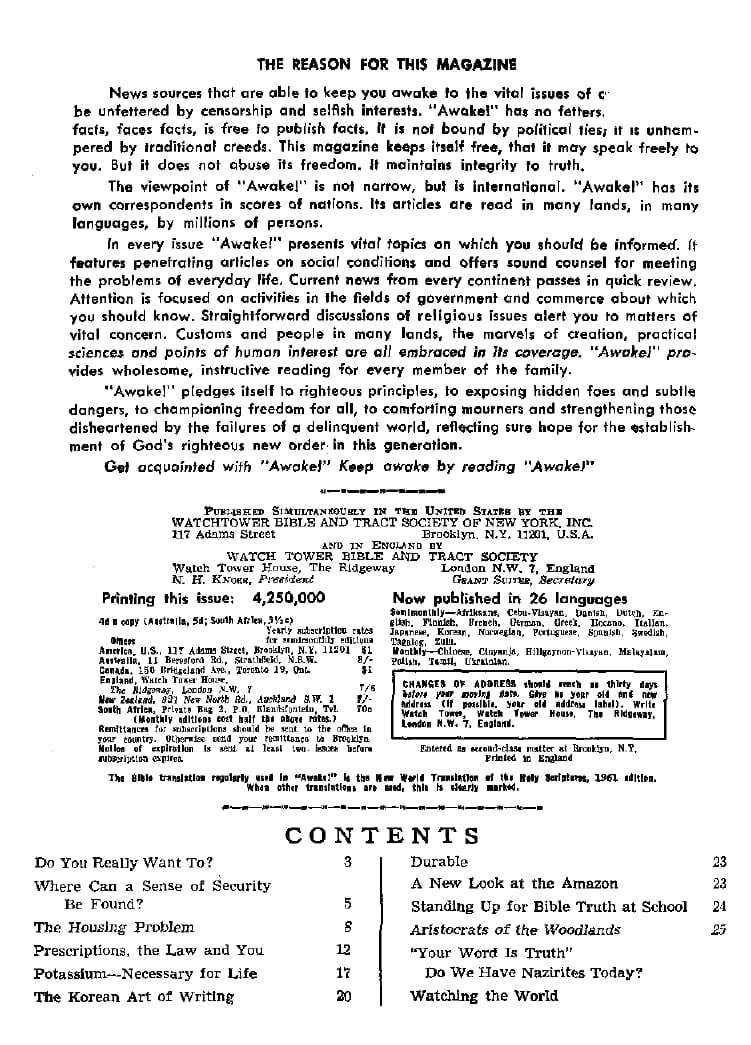
THE REASON FOR THIS MAGAZINE
News sources that are able to keep you awake to the vital issues of c are unfettered by censorship and selfish interests. "Awakel" has no fetters. facts, faces facts, is free to publish facts. It is not bound by political ties; it is unhampered by traditional creeds. This magazine keeps itself free, that it may speak freely to you. But it does not abuse its freedom. It maintains integrity to truth.
The viewpoint of "Awake!" is not narrow, but is international. "Awake!" has its own correspondents in scores of nations. Its articles are read in many lands, in many languages, by millions of persons.
In every issue "Awake!" presents vital topics on which you should be informed. It features penetrating articles on social conditions and offers sound counsel for meeting the problems of everyday life. Current news from every continent passes in quick review. Attention is focused on activities in the fields of government and commerce about which you should know. Straightforward discussions of religious issues alert you to matters of vital concern. Customs and people in many lands, the marvels of creation, practical sciences and points of human interest are all embraced in its coverage. "Awake!" provides wholesome, instructive reading for every member of the family.
"Awakel" pledges itself to righteous principles, to exposing hidden foes and subtle dangers, to championing freedom for all, to comforting mourners and strengthening those disheartened by the failures of a delinquent world, reflecting sure hope for the establishment of God's righteous new order in this generation.
Get acquainted with "Awake!" Keep awake by reading "Awake!"
FULLETERED SIMULTANEOUSLY IN THE UNITED STATES BY THE WATCHTOWER BIBLE AND TRACT SOCIETY OF NEW YORK, INC. 117 Adams Street Brooklyn, N.Y. 11201, U.S.A.
AND IN ENOLAND BY
WATCH TOWER BIBLE AND TRACT SOCIETY
WATCH TOWER BIBLE A
Watch Tower House, The Ridgeway
N. H. Kxoka, President
London N.W. 7, England
GRANT SUTTER, Secretary
Printing this issue: 4,250,000
4d copy (Australia, 5d; South Africa, 3½c)
Austinville, 11 Brewster Rd., Stratford, N.W.R. $7/
Canada, 150 Bridgegate Ave., Toronto, 19 Owl. $1
The Bldg. Lagoon, London N.W. 7
New Zealand, 937 New North Bd., Auckland S.W. 1
South Africa, Private Bag 2, P.O. Blindforton, TvL 70n
(Monthly addition: each half has the above holes.)
Remainder (subtraction) should be written in place in your country.
If your position is in Britain, holes of expiration is next to least two houses before subscription expires.
Seslemnium — Arkansas, Cebu-Viraya, Dutch, Dutch, Dutch, Finnish, French, German, Greek, Hecaton, Italian, Italian, Italian, Portuguese, Spanish, Swedish, Swedish, Tangkak, Zulu, Zulu, Zulu, Zulu, Zulu, Clipone, Hilippi-Viraya, Malayalam, Padi, Tamil, Urkasha,
CHANGES OF ADDRESS should reach us thirty days before your moving date. Give us your old id and new id. Please contact the House of the Watch Tower, Watch Tower House, The Ridgeway, London N.W. 7, England.
Entered as second-class matter at Brooklyn, N.P.
Printed in England
The Bible translation regularly used in "Awaken" is the New World Translation of the Holy Scriptures, 1961 edition. When other translations are used, this is clearly marked.
CONTENTS
Do You Really Want To? 3
Where Can a Sense of Security
Be Found? 5
The Housing Problem 8
Prescriptions, the Law and You 12
Potassium----Necessary for Life 17
The Korean Art of Writing 20
Durable 23
A New Look at the Amazon 23
Standing Up for Bible Truth at School 24
Aristocrats of the Woodlands 25
"Your Word Is Truth"
Do We Have Nazirites Today?
Watching the World
DO YOU Really WANT TO?
DO YOU? There are certain things we are supposed to do whether we want to do them or not, but there are also other things the doing of which is optional with us. In either case, however, success most likely will depend upon whether we really want to or not.
An example of this is the successful laying of the first cable between Europe and the United States. It was more than a century ago, in 1854, that an American, Cyrus Field, set his heart on the laying of such a transatlantic cable. It was no small undertaking, the laying of a cable 1,950 miles long and at an average depth of 10,000 feet; few thought it possible. But Field worked at it tirelessly, enlisting the support of private enterprise, public opinion and the governments of Great Britain and the United States. After twelve years of effort and four very costly and unsuccessful attempts, success finally crowned the efforts of those whom he had persuaded to undertake the project. He gained a lasting reputation for patience. He really wanted to see that cable laid and so was not easily discouraged or diverted therefrom.
SEPTEMBER 8,1965
How often we have wishes, desires, aspirations, ideals; how often we want to have this skill or that possession; or we may want to break a bad habit, but so often we fail to realize our objective because we do not really want to. A man may see his friend enjoying some hobby, such as photography, or a woman may see the dresses that her friends have made, and these may wish they could do the same, but that is as far as they go. If they really wanted to, they could develop these skills and reap their rewards, bringing pleasure to themselves as well as to others.
Or it may be the skill of touch-typing, being able to use all one's fingers on the typewriter without looking at the keys, making possible both speed and accuracy. Many persons who use the "hunt-and-peck" system fondly want to be able to do that, but do they really want to? If so, they will take the time and effort to make this skill their own, even as millions of others have done.
Then again, a young man, or a man not so young, may feel attracted toward a charming creature of the opposite sex and may want to have her as his wife. But merely wanting her will not be enough, nor even the making of a few timid advances.
The intended may show no interest at first; she may at first not be interested. But if he really wants to have her company he will remember that "faint heart never won fair lady," and so will call into play ardor, imagination and perseverance, remembering how many years the Hebrew patriarch Jacob served for his beloved Rachel!—Gen. 29:17-28.
At times the thing that is wanted is the breaking of a bad habit, such as cigarette smoking. A person may feel distressed by all he reads about the harm that cigarette smoking can do to one's health, not to say anything about its being a costly and unclean habit; but does he really want to break it? If he really does, he can and he will. Then he will not be like those "chain smokers" who die in their fifties when they might well have lived on into their seventies. Rather, he will make a firm resolve and then act upon it. He will admit to himself that, while it may not be easy, it certainly is not impossible. Have not many, many thousands broken this habit? They have and they have found it was worth while doing so, although not easy.
This searching question may also be applied to trying to live up to one's principles, ideals, convictions. Do you really want to keep honest, upright, chaste? Or have you left some loopholes? If you have left some loopholes, then sooner or later a strong temptation will cause you to yield, making your close friends and relatives wonder how you could have made such a serious mistake. No doubt the sad plight of many an unwed mother is not so much the result of a girl wanting to do wrong as it is of her not really wanting, or not wanting strongly enough, to do what is right. The Bible helps us in this respect, for it inculcates not only the loving of
what is right but the hating of what is bad. If we really want to do what is right, we will hate what is bad.—Ps. 45:7; Prov. 8:13.
The same principle also applies to the subject of prayer. If a Christian really wants his prayers answered, then, for one thing, he will persevere in prayer. He will also exercise faith that God will answer his prayers, for that also is vital. And since the Bible tells us that faith without works is dead, he will need to work at what he prays for, since it is a true saying that God does not do something for us that we can do for ourselves; he will do his part, but the one praying must also do his part.
—Luke 18:1-8; Jas. 1:5-7; 2:24, 26.
All this applies with peculiar force to the Christian ministry. A minister may wish he had more knowledge so as to be able to answer the many questions that are continually being put to him. He may wish he could give fine comments at study meetings or to give informative, coherent and persuasive Bible lectures. But does he really want to be able to do these things? If so, he will do what others have done to acquire these abilities; he will conscientiously apply himself to achieving these qualities, heeding the counsel that the Christian apostle Paul gave his friend Timothy: "Continue applying yourself . . . Ponder over these things; be absorbed in them . . . Pay constant attention to yourself and to your teaching. Stay by these things."—1 Tim. 4:13, 15, 16.
We all are limited when it comes to time, energy and means. As the saying goes, "It is never this and that but this or that!" The question is, Do you really want to acquire that skill, win that treasure, break that bad habit, live according to your principles? If you do, you must make room for it. But you must really want to!
BE FOUND?
THE perils of living in this twentieth century, made so clearly evident by daily newspaper reports, magnify the need to find something that can give a sense of security. A child finds it in the strong arms of his father, where can an adult find it? When he is confronted with distressing events that are beyond his control, where can he turn for the sense of security that is so necessary to carry him through?
Over 3,000 years ago a man that was confronted with seemingly insurmountable difficulties on more than one occasion revealed where he found the sense of security that enabled him to endure. Because of it he did not collapse in fear or compromise his integrity. That man was an Israelite king who was noted for being a composer of songs. One song in particular reveals the source of his sense of security and how he felt, because of it, when faced with trying circumstances. The stimulating words of that song are still in existence and can be found in a large book of songs contained in the Holy Bible. It is the twenty-third of 150 songs that the Bible has preserved for us in the book entitled Psalms.
In the opening verse, David identifies the basis for his sense of security as being man's heavenly Creator, the source of the energy that forms the fundamental building blocks of the visible universe. The proper name of the universe's Creator is given many times in the original language in which Psalms was written, and it is commonly translated into English as Jehovah. In the first verse of Psalm 23, David
likens Jehovah to a shepherd, saying: "Jehovah is my Shepherd. I shall lack nothing." Dwell on this sentence a moment and sense the soothing calm that it brings one.
Having been a shepherd, David was intimately acquainted with the relationship of a shepherd to a flock of sheep. A shepherd is keenly interested in the welfare of his sheep and stays close to them, giving them loving care. He leads them to places where he knows there is good grass to eat and water to drink. Under his loving care they lack nothing, for he provides for all their needs. The nation of Israel was like a flock of sheep over which Jehovah acted as a loving Shepherd. While they were wandering in the wilderness, he provided for them, seeing to it that they did not lack for food, water and other necessities of life.—Ps. 80:1.
Pointing out how Jehovah cares for his people, David sang in another song: "Fear Jehovah, you holy ones of his, for there is no lack to those fearing him." (Ps. 34: 9) In still another song, David observed: "A young man I used to be, I have also grown old, and yet I have not seen anyone righteous left entirely, nor his offspring looking for bread." (Ps. 37:25) Those who are God's people today and who look to him as their Shepherd have a sense of security that they will lack nothing that is necessary for their basic needs. Jesus Christ pointed this out when he said to his faithful followers:
"Never be anxious and say, 'What are we to eat?' or, 'What are we to drink?'
or, 'What are we to put on?' For all these are the things the nations are eagerly pursuing. For your heavenly Father knows you need all these things. Keep on, then, seeking first the kingdom and his righteousness, and all these other things will be added to you." (Matt. 6:31-33) When persons who serve God faithfully as David did put forth a reasonable effort to obtain the necessities of life, Jehovah blesses those efforts, and they go in want for none of them.
Continuing with the viewpoint of sheep under the care of a loving shepherd, David says in verse two of Psalm 23: "In grassy pastures he makes me lie down; by well-watered resting places he conducts me." Here we sense contentment, satisfaction, joy. During the heat of the day, shepherds in Bible times brought their sheep to shaded watering places where the sheep could drink and rest. In a spiritual sense, God does this with his people. He provides them with refreshing waters of truth and shields them from the scorching heat of his fiery judgments that come upon those who have refused the opportunities given them to know God as part of his flock of obedient people.—2 Thess. 1:8.
In the book of Revelation, those who make up the great crowd of persons serving Jehovah today are promised that they will not hunger or thirst for spiritual nourishment. Divine chastisement will not beat down upon them like a hot midday sun, but they will be shaded from the scorching heat of God's fiery judgments. Jehovah's shepherd Son, Jesus Christ, who has been given the responsibility of caring for Jehovah's flock, will "shepherd them, and will guide them to fountains of waters of life." (Rev. 7:16, 17) This prophetic promise is well illustrated by David's inspired comparison of Jehovah's people with sheep.
provides his people with life-giving waters of truth and energy-giving spiritual food, their souls are refreshed, as promised in verse three of Psalm 23: "My soul he refreshes. He leads me in the tracks of righteousness for his name's sake." Is it not refreshment that we long for? Refreshment from woes and cares that burden the soul, David felt this refreshment. When opposition from enemies of Jehovah's people or unpleasant events in one's life cause discouragement, the upbuilding counsel and faith-inspiring expressions in God's Word of truth refresh one, giving him strength to continue walking the way of integrity to God. The tracks of righteousness are in a narrow road of obedience to God, with its boundaries set by God's laws. As long as a servant of Jehovah God stays within those boundaries he walks a way of righteousness that leads to eternal life for him. Jesus Christ spoke of this road when he said: "Narrow is the gate and cramped the road leading off into life, and few are the ones finding it."—Matt. 7:14.
By means of his inspired Word and his devoted organization of faithful servants on earth Jehovah leads his people in the tracks of righteousness. Continually they are given counsel on proper moral conduct so they might not succumb to sexual immorality and the dishonest practices of the world. They are urged to avoid bad associations so they will not be drawn away from the tracks of righteousness. Close association with Jehovah's clean organization is constantly emphasized. Thus Jehovah guides his people along the road of righteousness, which ultimately leads to their salvation and the gift of life. Their soul he refreshes.
Because of their complete trust in Jehovah, his servants have a satisfying sense of security even when faced with dangerous circumstances that threaten their freedom and put their lives in danger.
Fanatical persecution by religious enemies, the hatred of political governments and popular disapproval do not cause Jehovah's people to become fearful and stop serving the true God. Comparing their sense of security in the face of danger with the secure feeling sheep can have when their shepherd is leading them through dangerous terrain where wild beasts may be lurking, David said in verse four of Psalm 23: "Even though I walk in the valley of deep shadow, I fear nothing bad, for you are with me; your rod and your staff are the things that comfort me." "You are with me" is the assurance that each of us wants, that God is with us, that he cares for us. (1 Pet. 5:7) With his staff a shepherd could beat off predatory animals and snakes that threatened the sheep. In the case of the Great Shepherd, Jehovah God, the use of his weapons of denunciation against enemies that seek to destroy his people are a comfort to them, giving them a sense of security.—Isa. 13:5.
With verse five of Psalm 23, David shifts from the illustration of sheep under the care of a shepherd to an illustration of a generous host. For Jehovah's people, the host that provides a sumptuous banquet for them in the midst of their enemies is Jehovah. David sang about this: "You arrange before me a table in front of those showing hostility to me. With oil you have greased my head; my cup is well filled." The well-ladened table of nourishing foods that Jehovah provides for his people is a bountiful banquet of spiritual food. Although they live among enemies who are hostile toward them, they are spiritually well fed. This Jehovah foretold through the prophet Isaiah, saying: "Look! My own servants will eat, but you yourselves will go hungry. Look! My own servants will drink, but you yourselves will go thirsty."—Isa. 65:13.
One of the ways a host could manifest his hospitality was to put perfumed oil on the head of a guest. This is indicated from what Jesus said when he was received into the home of a Pharisee by the name of Simon. He pointed out how Simon was a neglectful host, failing to give him water for his feet, a kiss of welcome and perfumed oil for his head. (Luke 7:44-46) Jehovah does not fail to do this for the people to whom he gives a banquet of spiritual food. As foretold through the prophet Isaiah, he gives them the "oil of exultation instead of mourning."—Isa. 61:3.
At a sumptuous feast in ancient times, such as David was using for an illustration, good wine was served. This was done at the marriage feast of Cana, where Jesus performed his first miracle by replenishing the supply of wine by changing water to wine. (John 2:11-10) We are told at Psalm 104:15 that God provides wine to make "the heart of mortal man rejoice." In the spiritual banquet of good things that Jehovah provides so generously for his people he includes a well-filled cup of joy, symbolized by the banquet cup of wine.
With the strong sense of security that comes from being able to trust in Jehovah, the Creator of the universe, Jehovah's dedicated people are able to face the trials and tribulations of this age courageously. Because of his blessings, they can say as David did in the sixth and final verse of Psalm 23: "Surely goodness and loving-kindness themselves will pursue me all the days of my life; and I will dwell in the house of Jehovah to the length of days." Jehovah's goodness and loving-kindness will pursue his people as long as they continue to walk in the steps of righteousness. They will always be the objects of his blessings and loving care. Thus it is in Jehovah God that a real sense of security can be found in this perilous age.
IT IS a strange paradox. Nations are spending billions of dollars to put a man on the moon, yet many humans on earth do not have a decent place to live that affords privacy and protection from the
elements. Cities in many places are so crowded that millions of people are forced to live in slums that are sometimes unfit habitations for lower animals. Others, who are unable even to afford these accommodations, make their home on sidewalks.
Describing this paradox of the twentieth century, housing expert Charles Abrams writes: "Housing progress lags far behind industrial progress in every part of the world. The technical genius that broke the secrets of speed, sound, space, and light still cannot build a house cheap enough for the rank and file. While a Soviet cosmonaut can orbit the world, the state that launched him cannot establish a good housing program on the ground. A negro laborer's family in New York and a squatter in Caracas may both have television sets, but neither can afford a decent house."
Factors Responsible
Two factors in particular are responsible for this shortage of decent housing, described by some as one of man's greatest social problems. First is the present-day population explosion. For the first eighteen hundred years of the Common Era the
world's population remained practically stable, the death rate nearly balancing the birth rate. But then earth's population leaped ahead, from about two billion in 1930 to three billion by the end of 1960. Presently the rate of growth is estimated at over 175,000 persons a day, or about eighty million annually. Certainly an enormous number of persons to provide with adequate housing each year!
A second major factor that is responsible for the housing problem is the tremendous migration to cities. With the coming of industrialization during the nineteenth century, the cities of Europe and America experienced such a migration, forcing many persons to sleep in the streets because of lack of accommodations. In recent years the industrial revolution has reached Africa, Asia and Latin America and, according to one estimate, 200 million people are expected to move into the cities of these continents between 1960 and 1970. Where to put them all presents a critical problem.
When People Move to Cities
People who live in rural communities generally have little difficulty with housing. Land is plentiful and neighbors work to help one another build their own homes.
But when people move to crowded cities to obtain employment in industry, housing is not so easily obtained. A report made a few years ago by a United Nations Mission regarding the housing situation in Ghana is interesting in this connection.
The Mission found that 80 percent of the houses in that African country were built by their occupants. Everyone pitched in to help, including the women, who did such work as plastering the walls and finishing the floors. Building was of particular excellence wherever traditions were undisturbed, and the builders had to live up to the quality standards established by their ancestors. So in most rural communities housing was not found to be a problem.
On the other hand, it was observed that self-help and cooperation became steadily less common in the larger population centers. In the cities there was specialization in the building enterprise, and housebuilding had become involved with the money economy. Land was expensive, and even if it could be afforded people with secular employment generally did not have enough free time to do any building themselves. So, in order to get a house constructed, it was necessary to leave the work to specialists. Since few could afford this, they were forced either to sleep in the streets or to find a place in crowded slums. As a result, in Accra, Ghana's capital city, occupancy per single house in 1960 was 19.3 persons.
Accommodating increasing urban populations is a gigantic problem faced by developing nations the world over. In his recent book, Man's Struggle for Shelter in an Urbanizing World, Charles Abrams commented on industrialization's effect on housing, saying:
a housing problem. The moment it begins to develop industrially, its housing problem burgeons. The more it develops industrially, the more stubborn the problem becomes. In a primitive village, the housing problem is not critical. The moment the family moves from village to city, its members surrender the home that is usually their own, as well as the more ample space on which it stands, the freedom from noise, smoke, traffic, and danger, the proximity to nature, and their place in community life. What they get in the impersonal city, whatever the other compensations may be, is a crowded slum and sometimes not even that."
"The anomaly is that the less industrialized the country, the less apt it is to have
Where the Problem Is Severest
It is in the more recently industrialized countries of Asia, Africa and Latin America that the housing problem is severest. The rate of urban growth in Asia is 400 percent higher than in Western cities, and the migration is only beginning. However, already the inundation of people has resulted in almost unbelievable conditions of overcrowding. In Calcutta, India, for instance, the population has swelled so quickly that some 600,000 persons, or more than 10 percent of the population, are forced to sleep in the streets. Street sleeping is common in many countries.
Perhaps the most crowded place in the world is Hong Kong. In some places there the population density reaches about 2,000 persons per acre, and people live without a water supply or any organized system of refuse disposal. If that density of population were applied throughout New York City, all the 300 million people living in Africa or all the inhabitants of North America could be housed within New York's city limits. Imagine the tremendous problem of accommodating so many persons in such cramped quarters!
Lagos, Nigeria, the capital of Africa's most populous country, also exemplifies the problems created by an exploding urban population. One sector of the city increased from 36,000 people in 1952 to 277,000 in 1962, and now as many as eighty persons are forced to share one small house. Sanitation is one of the major problems. Human excrement is deposited daily in some 13,000 night-soil buckets, and is collected and dumped into the lagoon. The problem is reflected in the fact that about 85 percent of the schoolchildren in Lagos are infected with either roundworm or hookworm.
In Tokyo, Japan, the world's largest city, a recent survey by the municipal authorities revealed that the housing shortage was regarded as the greatest grievance citizens had against the government. There the average resident has less space in which to live than before the second world war. Just recently the press reported an instance of where a taxicab driver was arrested by the police for making love to his wife in the public plaza of the Imperial Palace. But when the man pleaded that he simply could not perform his husbandy duties at home, where their family of six was crowded together into a room nine feet by nine feet, he was given a sympathetic release.
A study made by the United Nations indicates the enormity of the housing problem. It was estimated a few years ago that more than one billion persons in Africa, Asia and Latin America, or roughly half of the population of those continents, are either homeless or live under unsafe or grossly overcrowded housing conditions. To cope with the situation, one housing expert said, the nations of these continents need to build a minimum of 24 million dwellings a year, or about ten dwellings annually per 1,000 inhabitants.
Housing in Europe and the U.S.
Wartime bombings, the population explosion and massive movements of people to the cities have created a critical housing problem in Europe also. Reporting on the situation, Time magazine of July 10, 1964, observed: "A space race is on in Western Europe, but the goal is not some distant planet: it is a down-to-earth place to live. . . Rentals have soared, and the price of private houses has shot out of reach for millions of people. . . Monthly rent for a three-room apartment in a lower-middle-class district averages 65 in Düsseldorf,70 in Brussels and a skyscraping 180 in Paris, Europe's toughest town for housing. In Italy's cities, unskilled workers have a hard time finding one-room flats for50, which represents one-half of their monthly income."
Across the channel in England proper housing is at least as difficult to obtain. "In London alone, seven families each day become officially homeless, and the rate is rising," Time magazine of December 1, 1961, reported. According to an eighteen-month investigation completed earlier this year, there are 1,500 "known homeless families" in Greater London, and an additional 190,000 families in urgent need of better housing. It was also reported that one out of every five households is without a bath, and that less than half have the private use of hot and cold water, bath, toilet, sink and stove.
The United States, often considered the most prosperous nation in the world, has a housing problem too. In many of her principal cities millions of persons live in slums that, in some cases, rival the inhospitable living conditions found in cities of less prosperous countries. Not long ago housing expert C. F. Palmer told a class at Harvard Graduate School of Business Administration: "Throughout America more people live in slums than on farms."
And The Encyclopedia Americana, 1956 Edition, Volume 14, page 448, noted: "The often repeated statement that 'one third of the nation is improperly housed' is no mere epigram; it is a fact witnessed by repeated investigation and statistics."
What Is Being Done
Although faced with a gigantic task, many countries are making concerted efforts to relieve their housing shortage. Japan is one example. Already since World War II about 9,150,000 housing units have been constructed, 787,000 in one recent year. The rallying cry of Premier Eisaku Sato's government has become "a home for every family" by 1970. However, the exorbitant price of land is an obstacle. In central Tokyo it sells for as much as $18,-000,000 an acre, twice the top price for land in the choicest sections of New York City.
Progress has also been made in Russia, where the policy aim is to provide houses for as many people as possible in the shortest time possible. From 1957 to 1962 about 12 million dwellings were completed in towns and workers' settlements and 3.8 million in rural districts. In recent years Russia has regularly led the world in house production; in 1960 its output of 14 dwellings per 1,000 inhabitants far surpassed the runner-up nation, West Germany, which produced 10.5 houses per 1,000 inhabitants.
The Netherlands, too, has made real efforts toward providing adequate housing. In 1964 housing formed the third-largest item in the budget, and a goal of 90,000 dwellings was set. France is another nation making strides toward meeting her housing needs. Since World War II she has constructed over 3 million dwellings, and in 1963 increased production nicely to 328,000. Italy also is moving ahead in house
production, from 313,000 in 1962 to 360,- 000 in 1963.
Great Britain is building more houses than ever before, 420,000 being under construction by the middle of 1964, and yet the demand for housing there is still great. In the United States about a million and a half new homes are started each year. However, some builders argue that priority is given to requests for higher-priced dwellings. They claim that not nearly enough effort has been made to provide housing for persons in the lower income brackets. It is true that in some cities great strides have been made in replacing slums with fine housing developments, but, unfortunately, almost as quickly, other areas deteriorate into slums.
In spite of efforts made and progress attained, housing problems throughout the world remain acute. Progress in some areas is outweighed by deteriorating situations in other parts of the world. While unprecedented strides in technology have been made in the past twenty years, the housing situation, viewed from an international standpoint, has become worse.
Clearly, to satisfy even this basic need of man, it is necessary to look beyond the stop-gap proposals of human agencies. God-fearing persons can take comfort in the promise that soon, in God's new system of things, everyone will have what is necessary to make them happy. The Bible promise is: "They will certainly build houses and have occupancy; and they will certainly plant vineyards and eat their fruitage. They will not build and someone else have occupancy; they will not plant and someone else do the eating. For like the days of a tree will the days of my people be; and the work of their own hands my chosen ones will use to the full." Housing problems will then be a thing of the past.—Isa. 65:21, 22.
CAUTION: FEDERAL LAW PROHIBITS DISPENSING WITHOUT A PRESCRIPTION! These words, called the Rx legend, appear on many drugs commonly used in modern medical practice and require the pharmacist to exercise great care in the filling and refilling of your prescription. Have you often wondered why it is that you can buy some drugs without a prescription, while, with many, you must present a properly signed prescription? How can the pharmacist read that prescription that may not seem clear to you? What do those strange symbols mean? How can you save money on prescription drugs?
It is an old joke that only a druggist can read a doctor's writing. In many cases this is the truth. Like all of us, doctors may write illegibly when they are in a hurry—and in today's busy world they are often in a hurry. Generally speaking, the druggist becomes familiar with both the doctor's handwriting and the drugs that he commonly prescribes, so that it is not usually a problem for the pharmacist to know what the particular physician wants. It is not uncommon, however, for the pharmacist to telephone the doctor to check on the matter, and it is a wise man who does
so instead of taking a chance on dispensing the wrong drug.
Chemical, Generic and Trade Names
Prescriptions can legally be written in a variety of different ways. They can call for either the chemical name, the generic name or the trade name of a drug. Every drug produced has what is called its
chemical name. It is a name given to it to describe its chemical structure, and a chemist can construct the drug by following rules of nomenclature when he reads this name. When a new drug is produced it is also given another name. This is a shorter name and usually cannot be used to determine its chemical structure. This is called its generic name, and in contrast to the chemical name, this one is often used in prescription writing.
The chemical and the generic names are always constant; however, each company that produces a drug has the right to give its product its own trade name. Therefore any drug that is manufactured by different companies can have a variety of trade names although they are referring to the same drug. This trade name is the one that becomes the most popular, both because it usually is shorter and easier to remember and because the manufacturer's representative, who often visits the doctor, tries to get the doctor to prescribe his product. The doctor can write his prescription by any of these different names that he chooses, but usually he chooses the trade name, although he can, and often does, write the generic name, which can be an advantage to the patient in some cases.
If the doctor calls for a drug under its trade name, it has been held illegal for the pharmacist to fill that prescription with any other product of any other company, although he may have the same drug under a different name. Naturally the manufacturer wants to protect his product and, after spending millions of dollars in advertising and promotion, he does not want the druggist to substitute another company's product. On the other hand, this practice requires the druggist to stock a variety of different products when he would prefer to stock fewer. Naturally this larger investment requires him to charge more for the prescriptions that he fills, and the ultimate cost is carried by you, the customer.
This price dilemma has become so serious in the United States that it has caused a Congressional investigation of drug prices, that is, the prices that manufacturers place on their drugs. However, it should be borne in mind that from 40 to 50 percent of the retail price to the customer can be the markup that the retail druggist puts on the prescription.
One suggested solution is that the doctor write the generic name of the drug, allowing the druggist to use any company's product. It should be stated that, to their credit, many doctors do use the generic names in their prescriptions. This often results in a saving of money for the customer. How is this? It is because not all drug manufacturers charge the same prices. Some companies do little or no research; moreover, they may not do much advertising of their products. As a result, they can offer the druggist a product at a cheaper price than can the drug manufacturers who have large expenses in developing and marketing a new drug.
Since the druggist usually bases his price to the customer on the cost of the drug,
it can result in a cheaper cost for that prescription. A few years ago The Medical Letter purchased samples of a drug called "prednisone" from twenty-nine different pharmaceutical companies. The tablets were tested to see whether a doctor could safely prescribe by generic name. The conclusion: "The risk involved in prescribing prednisone by generic name appears to be small. Particularly where the high cost of the 'name' brand offers a serious burden to the patient, generic-name prescribing would appear to be in order." The saving, it added, can amount "to many dollars on each hundred tablets."
Anyone who is taking drugs over a long period of time would do well to ask the doctor to write the prescription with the generic name.
What It Says
How is it that the druggist can read that prescription in the first place? Contrary to popular opinion, most prescriptions are not written in Latin, at least not in the United States. The name of the drug is written either by the generic or by the trade name. The part of the prescription that comes after the name of the drug can be written in many different ways and tells the quantity of the drug being prescribed. For example, if the product comes in capsule form it may be written: caps. 24 or caps. xxiv, both of which mean 24 capsules, the latter being in Roman numerals.
The part of the prescription called the signature, and abbreviated as S. or Sig., gives the directions for taking the medicine. Here the doctor may use a shorthand method of writing, partially derived from Latin. As an example: caps. i. t.i.d. means to "take one capsule three times a day," while q.i.d. means "four times a day." Tabs. ii, h.s. becomes "take two tablets at bedtime" and a.c. means "before meals," while p.c. means "after meals." Therefore, the prescription's directions written: sig.
tabs. i, q.i.d., p.e. and h.s. comes out on the label: "Take one tablet four times a day, after meals and at bedtime." Often the doctor will tell the druggist the number of times the prescription may be re-filled by noting: "May be refilled 3X," meaning three times.
Laws Vary by State and Country
United States federal law requires a prescription for certain drugs. Almost all countries have similar laws regulating the sale of drugs, which laws may be more strict or more lenient. Then, too, within the United States, each state has the power to tighten the regulations governing the sale of drugs, which causes a great variety of drug laws in the United States.
Federal law does not say who may or who may not write a prescription, nor who may or who may not dispense a drug. It merely says that a prescription must be written by a "practitioner licensed by law to administer such drugs." This allows the individual states to determine who may lawfully write a prescription and also who may legally fill the prescription. Osteopathic physicians and medical doctors are usually allowed to write prescriptions in any state.
United States federal law carries a heavy penalty for those who violate its prescription regulations. Under the law, any person who is found guilty of selling Rx legend drugs (those included under the law as ones that may be sold only on a prescription basis) without a prescription, or refilling a prescription without the authorization of the physician, can receive a penalty of a 1,000 fine and one year in prison for each separate offense (each sale is considered a separate offense). If a person is convicted a second time, he can be fined10,000 and be given three years' imprisonment for each separate offense. You
can readily see why your neighborhood druggist requires you to present your prescription before he will sell you the drug you may want. Those who make it a practice to sell Rx legend drugs to friends without a prescription are playing with the possibility of a very heavy penalty.
Each country, of course, has its own laws, and even though a drug carries an Rx legend on the bottle: CAUTION: FEDERAL LAW PROHIBITS DISPENSING WITHOUT A PRESCRIPTION, this can easily be ignored in those countries that have different laws, and often it is. In many South and Central American countries quite a number of drugs are used that are manufactured in the United States, and it is not uncommon for people to buy a drug that would be prohibited to them in the United States unless they had a prescription. In Costa Rica, for example, almost any Rx legend drug can be purchased by merely asking for the drug and paying the price. Of course, Costa Rica has its own pharmacy laws, and those of the United States do not apply.
Copies of Prescriptions and Refills
Sometimes a person may wonder if he can obtain a copy of his prescription. Strictly speaking, the prescription is the property of the customer. He paid the doctor for writing it and it is his personal property. However, United States law requires that the pharmacist keep the prescription on file for at least five years. Therefore it cannot be returned to its owner, and if he wants a record, he must get a copy. According to the federal government, there is no objection to the customer's receiving a copy of his prescription. However, the government's view is that it is, of course, merely a copy and has no value for obtaining a refill. The pharmacist has the responsibility to mark it clearly as a copy.
If you need more of a prescription drug, it is common for the pharmacist to telephone your doctor while you are waiting and find out whether you should still be taking the medicine. Since, according to law, an oral prescription received over the telephone is a valid prescription, the pharmacist is, in effect, receiving a new prescription and is then legally filling it for you. Therefore, if you are planning a trip away from the area of your doctor and it would not be practical for a drug-gist to telephone your doctor, it would be the course of wisdom to carry your medicine with you, enough to supply you for your entire time away from home. Or you may carry a few extra legal prescriptions with you, which will usually be cheerfully supplied by your doctor if he understands why you want them. Some drugs cannot legally be prescribed over the telephone, however, and this involves those that are commonly called "narcotics."
Narcotics are drugs such as morphine or codeine. They are usually used for the relief of pain but have the serious disadvantage that they produce addiction if used over a period of time. Because of this, the United States government regulates their sale. These drugs can be dispensed only on receipt of a signed prescription, and the prescription may not legally be refilled at any time. Many pharmacists will not even give a copy of such a prescription. The patient can get the drug again only by getting another prescription.
There are many types of prescriptions, however, that can be refilled almost at will. Often a doctor will write on a prescription the words: Refill p.r.n. or ad. lib., meaning as often as is requested. How does the Federal government view this type of instruction? The view is that, if a doctor allows the pharmacist to refill it at will, he is violating his authority under the law, since he is the only one allowed to determine
the amount of a drug to be used. What is usually done is that the druggist will call the doctor from time to time to see if the patient is still to receive the medicine, and in this way he is protecting himself from violating the law, as he is only acting in "good faith."
Drug Prices and How You Can Save
There is no doubt that prescription prices are on the increase. According to a survey conducted yearly by the Eli Lilly Company, a large drug manufacturer, in 1944 the average pharmacy filled 6,343 prescriptions and the average prescription cost was 1.10. In its survey of 1963, it was found that the average store dispensed 17,320 prescriptions and the average cost was3.39. These figures must be considered in the light of the fact that, according to this same survey, 19 percent or almost one out of five pharmacies operated at a net loss. Fifty-nine percent of all the 2,529 pharmacies in this survey operated their stores at a 5-percent net profit or less, on their invested capital. However, that survey showed that prescription costs have climbed from an average of 3.19 in 1960 to3.25 in 1961, 3.32 in 1962 and3.39 in 1963.
Many stores follow as a guide for prescription pricing the average cost of drug-store operation in their area. Often, in this case, the more you buy of the drug, the cheaper it becomes for each dose. As an example, you may be charged $1.50 for 24 tablets, but if you were to purchase 100 of the tablets the cost might only be doubled. Why is this? Because under this system of pricing, the pharmacist charges you a flat rate for the time involved in filling the prescription, and this is often the largest item in the cost of the prescription. He adds to this rate the cost of the medicine and a markup on the medicine, which is his profit on his investment. Since it takes no more time to fill a prescription for 100 than for 24, you make a large saving.
Those who are taking drugs over a long period of time can thus save money by buying in larger quantities. However, a note of caution! It is a good idea to shop
in different stores to see what they will charge you for the larger quantity. Not
duction under this system. In some more highly competitive areas, the profit may not be 50 percent but only 40 percent.
How can you get the best price? First, ask your doctor if he will write the generic name; then the druggist can use any company's product. Ask the druggist ahead of
ARTICLES IN THE NEXT ISSUE
Practicing True Religion Brings Great Gain.
time what the price will be. On highly competitive items such as antibiotics
larger quantity. Not all stores have the same policy in their prescription pricing and, if you are taking
Hormones and You.
The United Nations Observes its
Twentieth Anniversary.
They Bury the Dead Again and Again.
drugs over a period of time, a substantial saving can be made many times. Also, it is good to ask your own druggist for a price reduction for a larger quantity. Often he will not suggest it—he is making more money by filling it more often, and he may not honestly know that you are planning to continue to take the drug.
If a druggist knows that you are going
such as antibiotics you will likely find that most druggists charge about the same price, but in
others there may be a great variety. Also ask if a prescription is required for the product your doctor has recommended; does it have the Rx legend? You may be surprised to learn that many prescriptions are written for vitamins or drugs that do not have the Rx legend. The pharmacist, not knowing the doctor's intentions, will fill the prescription as if a prescription were
If a druggist knows that you are going to be price conscious, he usually will give you his best price when he is asked. And it will keep him honest if he thinks you may go down the street to ask there as well.
Prices may differ considerably from store to store. It may be that one druggist has special prices from manufacturers. Also, not all druggists follow the same method in determining prescription prices. Some follow a scientifically arranged chart that gives a corresponding reduction for the quantity of a drug based
required. Incidentally, he will charge you his prescription price, not the over-the-counter price, which may be considerably lower.
If you ask for this information, the honest druggist will usually not hesitate to tell you. After all, you are a customer and his means of livelihood; and he does not want to offend you but, rather, wants to win your friendship. The druggist who is overcharging is usually the one who is reluctant to tell you the price. Naturally your
upon expenses and a profit on investment. Many druggists, however, just follow a rule-of-thumb guide and charge a certain percentage of the cost of the medicine. It is a common practice for the druggist to find his cost for the medicine you are going to receive and then to double it to get the retail price. Of course, if you are buying large quantities, you may not get any re-
druggist expects you to be pleasant as well. Often he has an aversion to the "bargain hunter," but if you are pleasant in your inquiries, you will often find him helpful.
Increasing drug prices may seem a bitter pill for many to have to swallow, but at least if one is aware of the possibilities of saving money, he will get more for his prescription dollar.
By "Awake!" correspondent in Canada
IN ITS pure state, potassium is a silvery-white metal with a pinkish tinge, having radiant beauty. Its characteristics set it apart from all other minerals.
Importance of Potassium to Living Things
Throw some onto the surface of a pond—it will float—but at the same time you will see the amazing spectacle of water burning! The mineral begins to decompose the water, generating intense heat, which sets the liberated hydrogen on fire. This will burn with a brilliant violet-purple flame until the potassium is exhausted. At freezing point, potassium is hard and brittle, but raise its temperature to 60\circ Fahrenheit and you can knead it into any shape you wish or slice it with a blunt knife. When freshly cut, it quickly "rusts" because of its avidity for oxygen, forming a white film of potassium-hydroxide or "caustic potash," which can quickly destroy your skin. Yes, this beautiful mineral in its purity must be handled with more than "kid gloves" because it would destroy these too!
Like humans, plants need to eat properly. Without a balanced diet, humans can become seriously ill, and in the same way plants will suffer from a lack of certain
But in spite of its destructive nature, it is essential to the life of every living organism on earth.
elements in the soil. Years ago the
Indian discovered that his corn crop grew much better on land where brush had been burned. But he did not realize that the wood ashes supplied potash to the soil, which, in turn, supplied potassium to the corn. Yet potassium is now known to be a major nutrient for all
plants and essential for their good health and yours.
For yours? Yes, that's right! For, if all potassium salts in the earth became exhausted, all life on earth would soon cease to exist. Plant life would be the first to suffer. Even today, plant life will warn its human caretakers when the soil becomes potassium-poor. Do you find the leaves of your young corn plants streaked with yellow and acquiring a scorched appearance on edges and tips? Do the stunted plants fail to produce ears, or at best produce poor ears that do not fill out to the tips? What about the small-grain plants that are suffering similarly, bending weakly on fragile stalks? Or the potato plant with its leaves becoming crinkled, yellow, finally dying, tubers underdeveloped and growth of the whole plant hindered or completely curbed? Eloquently, such plants are telling of their potassium deficiency!
If potassium were to become too scarce, animal and human deficiency symptoms would follow hard on the heels of those of the plant world. Signs of diminishing life and activity would be noted everywhere. Even the waters of the lakes and seas would become strangely silent, with no fish to swarm in their depths or to break their mirrorlike surfaces.
Sheep, the source of your winter "woolies," would be quickly affected because potassium compounds are known to make up at least a third of the bulk of raw merino. The family pup would lose his bounce and zest, for dogs lacking this element have been paralyzed in neck and limbs. His master would find his own muscles responding more slowly, finally losing coordination. Even his most vital muscle, the heart, would develop an erratic beat. That potassium does have an important effect on heart action was dramatically shown by a scientist's experiment on an animal heart that had ceased beating. When touched with his finger molested with saliva, it started beating again. The stimulant proved to be the salts of sodium and potassium in the saliva. How vital, then, that man and beast as well as vegetation receive a constant supply of potassium!
How Vegetation Gets Potassium
The soil of the earth can be likened to a family larder. It should be stocked with all the necessary minerals to build strong and healthy plants. Just as the foods on the pantry shelves do not come onto the dinner table of their own accord, so the nutrients in the soil as a rule do not come to the plant, but the plant has to reach out for them by means of its root system. The plant's water system is the food server, serving the minerals to the parts of the plant where they are most needed. In this way potassium can go to work building plant cells and play an important part in forming proteins, cellulose, sugars and starches. It also has much to do with controlling the plant's rate of respiration. When drought comes, the potassium salts safeguard the plant from too great a loss of water and, besides this, it diminishes harm due to low temperatures. How it does all these things still baffles scientists;
yet how vital it is that the larder of the soil be constantly replenished as available potassium is used up!
Potassium is not fabricated into any part of the structure of plants, even though they need it for good health. As long as they live, plants retain their potassium salts, but as soon as they are cut and left on the fields, the rain quickly washes them out. In some cases, as plants ripen, the salts return to the earth. Nevertheless, as many crops are grown on a plot of ground, the tendency is for the available potash salts in the soil to be depleted. Why? Because the soil is quite close-fisted when it comes to doling out its hoard of this vital element. For example, an acre of land to a depth of half a foot may have a bank of twenty tons of these salts. Yet in some wonderful way the soil allows only a hundred to six hundred pounds of it to be usable for plant life. When that is used up, the bank cuts off the credit. Unless this credit balance of potash is restored, the plants will suffer malnutrition.
This is where man has a job to do in caring for the land. Fertilization of the soil is indicated. For many years, farmyard manure or wood ashes and even kelp were used to prepare the land for planting, doubtless with little knowledge of their contribution of potassium. But all these have come to be in short supply with the expanding demand for farm produce. So man has had to probe deeper into earth's crust searching for potash, now one of the fundamental components of agricultural fertilizers. Farmers, at first hesitant about its use, began to realize its value with the advent of large-scale farming methods.
For small plots of ground, the adding of potash fertilizer can be done by hand. Vaster fields need specialized equipment. Such fertilizer application equipment having great capacity is available, and it is effective and precise in accomplishing the work.
In fact, you might say that some of these machines are tailor-made so that no harm will be done to the seed, the roots or the foliage of the plants. In some cases the fertilizer is applied by low-flying airplanes. The bountiful harvests of Canada and the United States in recent years speak in glowing terms of the value of potassium and other fertilizers being added to the soil. Around the world the demand for potash fertilizers is rapidly increasing. Keep abreast is steadily taxing the ingenuity of man in opening up new sources.
Available Sources
A cause for marvel is that potassium makes up 21⁄2 percent of earth's matter, yet the earth does not liberate for man's use this vast hoard of the vital element without a struggle. A certain amount is contained in all rocks of the earth. Their disintegration over the centuries has furnished the available soluble salts in all fertile soils. The problem is that these rocks do not seem to disintegrate quickly enough to supply what is needed, and the economy of this world needs more and more. Where to get it has been the big question.
The oceans themselves are said to contain more than a million billion tons of it. Even though costly, seawater is being evaporated in South Africa to obtain potassium salts. Likewise, in Israel the waters of the Dead Sea are producing thousands of tons of potash to bring new life to the nutrient-starved lands of Asia. Brine wells in different parts of the earth yield their share. But the most economical sources of this mineral are the ones found deep down in the earth's crust.
ern Hemisphere. A mine near Carlsbad, New Mexico, became North America's main source of supply. As the demand increased at the rate of 6 percent each year, more mines came into production. Other countries now became potash producers; the search for new sources of supply became global in extent. Chile produced nitrate of potash from its nitrate deposits. Large quantities were found in the salt mines of Kalusz in the eastern Carpathian Mountains of Russia. Then in 1943 oil exploration crews brought to light the first indications of the largest mineable body of potash ore in the world, three-fourths of a mile beneath the waving wheatlands of Saskatchewan, Canada.
The mines at Stassfurt, Germany, were for many years the world's main source of potash. World War II made it necessary for new deposits to be located in the West-
"The Potash Capital of the World"—is what this area is now called, taking in eleven towns about a hundred miles east of Regina, the provincial capital. And no wonder! Because from here the ore body extends in a northwesterly direction for 450 miles, and in some places it is 50 miles wide! It is estimated by geologists that the deposit contains at least five billion tons of the mineral, enough to sustain production for centuries to come!
The world's largest potash mine, at Esterhazy, Saskatchewan, owned and operated by International Minerals and Chemical Corporation, went into production just three years ago. It took them five years to sink a shaft 18 feet in diameter, 3,132 feet ( 21⁄2 times the height of the Empire State Building in New York) down to the potash. IMC describes this shaft-sinking project as the "toughest ever completed in the Western Hemisphere." But after its completion, continuous mining machines weighing 52 tons each, went to work biting out five tons of glistening crystals of halite and sylvite (potash ore) every minute. As a result, 1.2 million tons of potash are now being poured onto the world market every year, leaving the mine site daily in trains three-fourths of a mile in length.
Its Many Uses
Ninety percent of all potash mined will go back into the soil as fertilizer. The remaining 10 percent is used in our everyday living in a great variety of ways. It is employed in the manufacture of dyes, synthetic rubber, soaps, textiles, paper, glass and wallboard. Your vitamin pills may have potash in them as well as many of the medicines you get from your drugstore. Batteries require this versatile mineral and so may the fire extinguisher hanging on your wall. If you use matches to
…